Article

Impact of Potentially Toxic Compounds in Cow Milk: How Industrial Activities Affect Animal Primary Productions

by
Sergio Forcada
1,*,
Mario Menéndez-Miranda
1,
Carlos Boente
2,
José Luis Rodríguez Gallego
3,
José M. Costa-Fernández
4,
Luis J. Royo
1,5 and
Ana Soldado
4,*
1
Regional Service for Agrofood Research and Development (SERIDA), P.O. Box 13, 33300 Villaviciosa, Asturias, Spain
2
Atmospheric Pollution Laboratory, CIQSO-Center for Research in Sustainable Chemistry, Associate Unit CSIC-University of Huelva, Campus El Carmen s/n, 21071 Huelva, Huelva, Spain
3
Environmental Biogeochemistry & Raw Materials Group and INDUROT, Campus de Mieres, University of Oviedo, C/Gonzalo Gutiérrez Quirós s/n, 33600 Mieres, Asturias, Spain
4
Department of Physical and Analytical Chemistry, Faculty of Chemistry, University of Oviedo, Avda. Julián Clavería 8, 33006 Oviedo, Asturias, Spain
5
Department of Functional Biology, Genetics, University of Oviedo, Avda. Julián Clavería 6, 33006 Oviedo, Asturias, Spain
*
Authors to whom correspondence should be addressed.
Foods 2023, 12(8), 1718; https://doi.org/10.3390/foods12081718
Submission received: 14 March 2023 / Revised: 14 April 2023 / Accepted: 18 April 2023 / Published: 20 April 2023
(This article belongs to the Special Issue Food Contaminant Components: Source, Detection, Toxicity and Removal)

Abstract

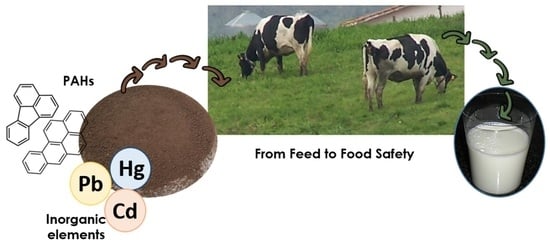
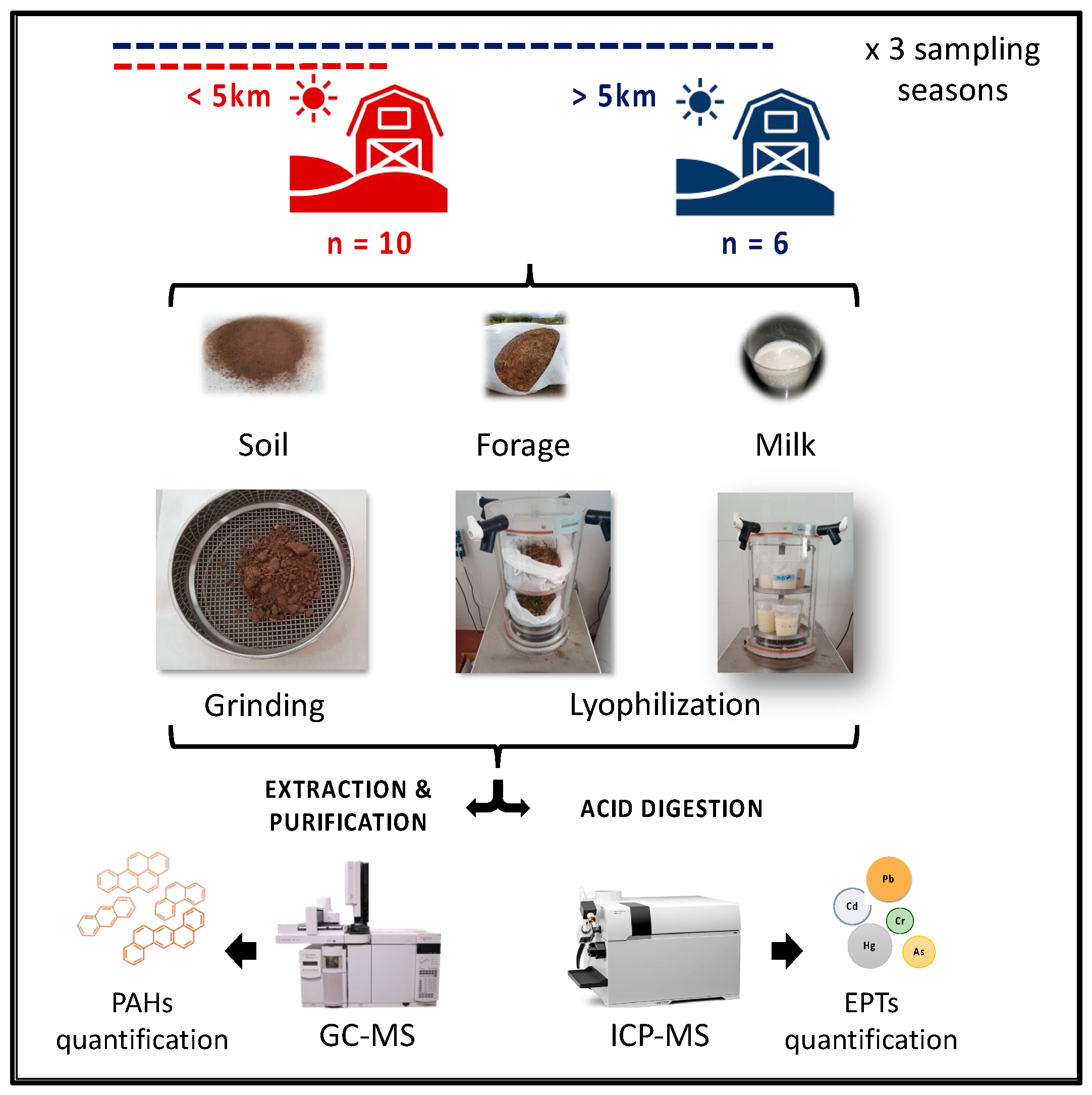
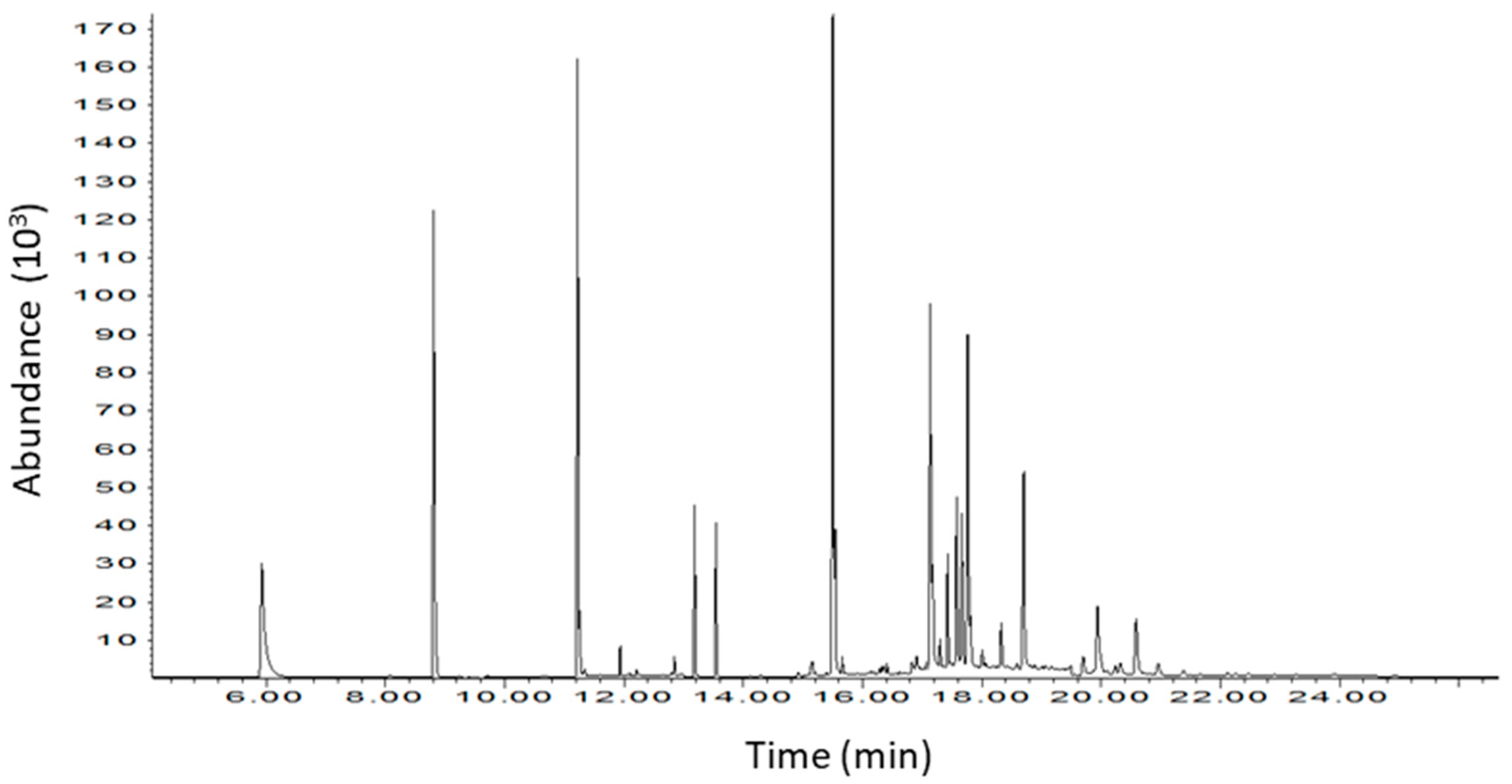
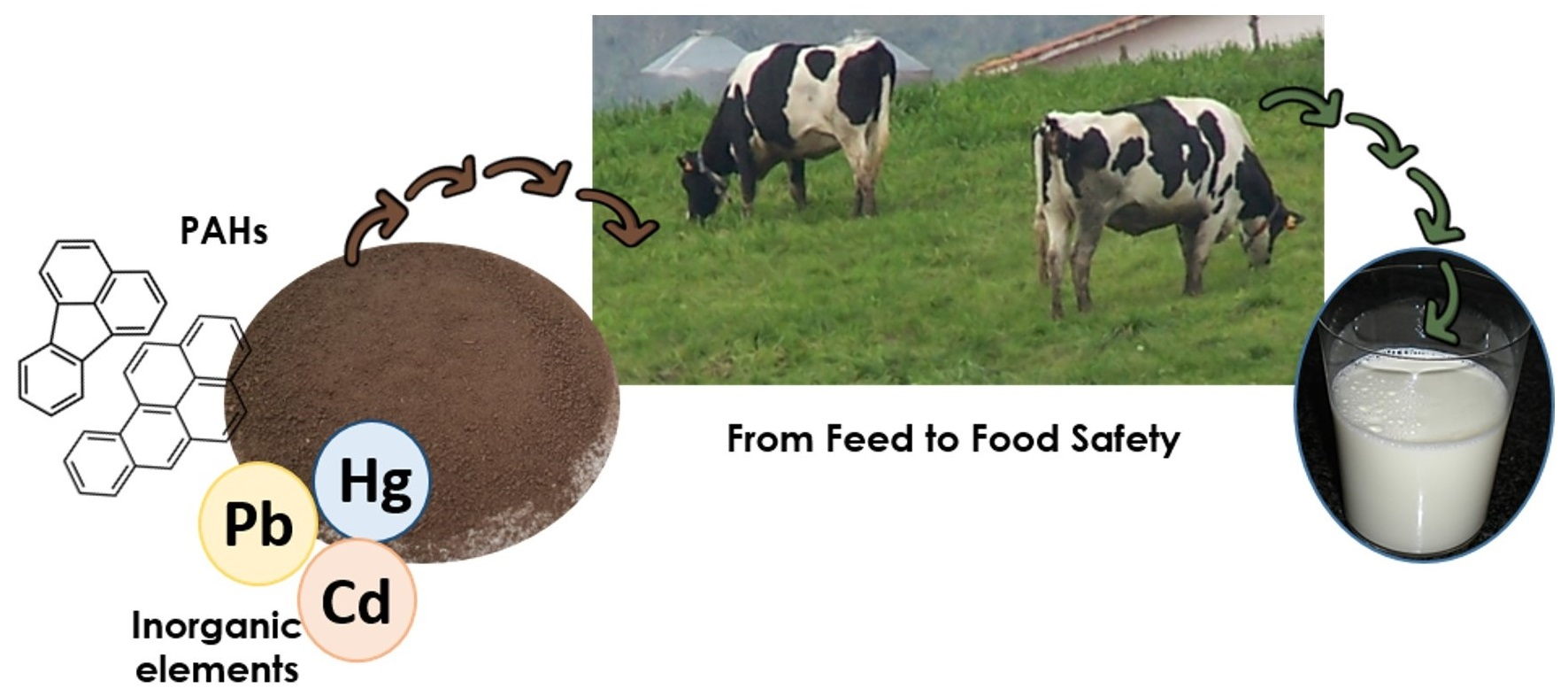
Potentially toxic elements (PTEs) and polycyclic aromatic hydrocarbons (PAHs) frequently coexist in soils near industrial areas and sometimes in environmental compartments directly linked to feed (forage) and food (milk) production. However, the distribution of these pollutants along the dairy farm production chain is unclear. Here, we analyzed soil, forage, and milk samples from 16 livestock farms in Spain: several PTEs and PAHs were quantified. Farms were compared in terms of whether they were close to (<5 km) or far away from (>5 km) industrial areas. The results showed that PTEs and PAHs were enriched in the soils and forages from farms close to industrial areas, but not in the milk. In the soil, the maximum concentrations of PTEs reached 141, 46.1, 3.67, 6.11, and 138 mg kg−1 for chromium, arsenic, cadmium, mercury, and lead, respectively, while fluoranthene (172.8 µg kg−1) and benzo(b)fluoranthene (177.4 µg kg−1) were the most abundant PAHs. Principal component analysis of the soil PTEs suggested common pollution sources for iron, arsenic, and lead. In the forage, the maximum contents of chromium, arsenic, cadmium, mercury, and lead were 32.8, 7.87, 1.31, 0.47, and 7.85 mg kg−1, respectively. The PAH found in the highest concentration in the feed forage was pyrene (120 µg kg−1). In the milk, the maximum PTE levels were much lower than in the soil or the feed forages: 74.1, 16.1, 0.12, 0.28, and 2.7 µg kg−1 for chromium, arsenic, cadmium, mercury, and lead, respectively. Neither of the two milk samples exceeded the 20 µg kg−1 limit for lead set in EU 1881/2006. Pyrene was the most abundant PAH found in the milk (39.4 µg kg−1), while high molecular weight PAHs were not detected. For PTEs, the results showed that soil–forage transfer factors were higher than forage–milk ratios. Our results suggest that soils and forages around farms near industries, as well as the milk produced from those farms, have generally low levels of PTE and PAH contaminants.
Keywords: pollution; soil; forage; milk; polycyclic aromatic hydrocarbon; potentially toxic element pollution; soil; forage; milk; polycyclic aromatic hydrocarbon; potentially toxic element
Graphical Abstract