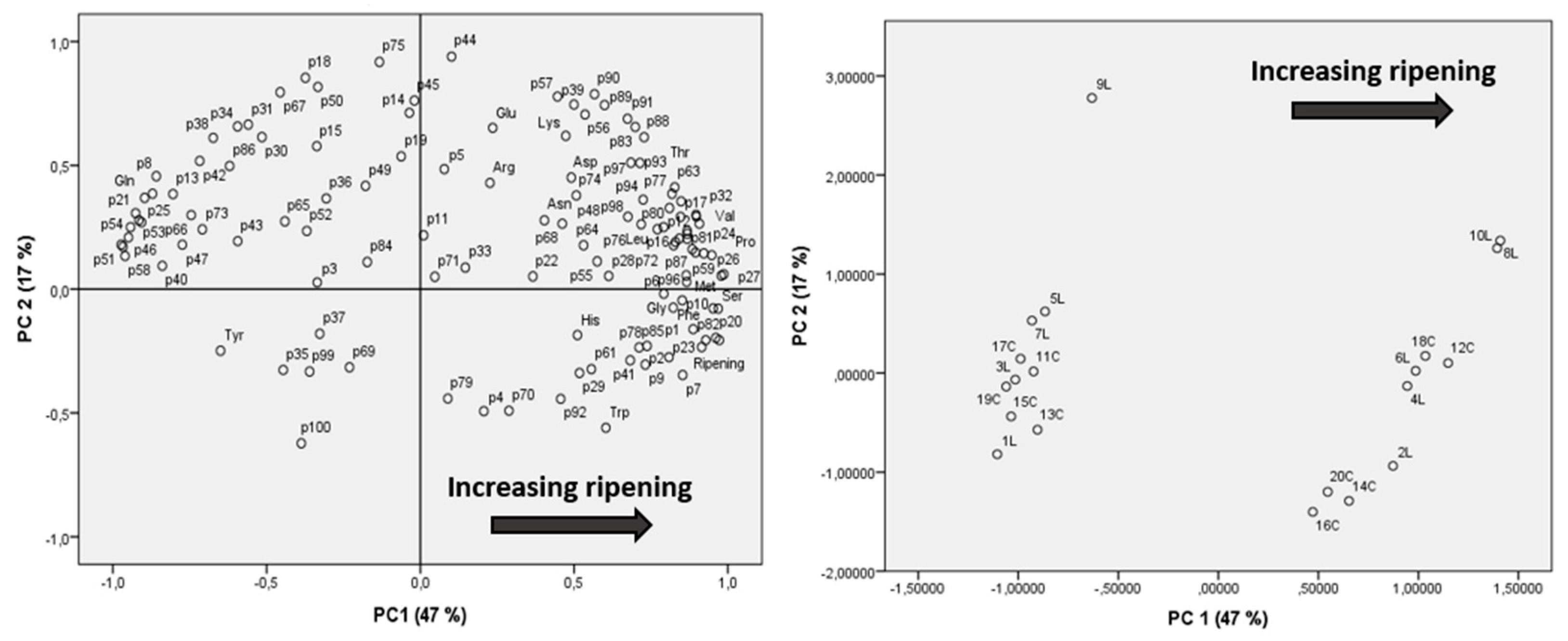
Reduction in the Brining Time in Parmigiano Reggiano Cheese Production Minimally Affects Proteolysis, with No Effect on Sensory Properties
 ,
,
Abstract
1. Introduction
2. Materials and Methods
2.1. Cheese Samples
2.2. Proximate Analysis
2.3. Reagents
2.4. Isolation of Amino Acids and Peptide Fractions
2.5. UPLC-MS Analysis of Water-Soluble Peptide Extracts from Parmigiano Reggiano Samples
2.6. Free Amino Acid Determination and Quantification
2.7. Identification of Bioactive Peptides
2.8. Sensory Analysis
2.9. Data Analysis and Statistics
3. Results and Discussion
3.1. Samples and Proximate Analysis
3.2. Free Amino Acid Determination
3.3. Characterization of Peptides and Proteins in Aqueous Extracts
3.4. Sensory Analysis
4. Conclusions
Supplementary Materials
Author Contributions
Funding
Institutional Review Board Statement
Informed Consent Statement
Data Availability Statement
Conflicts of Interest
References
- Parmigiano Reggiano Single Document. Available online: https://www.parmigianoreggiano.com/ (accessed on 19 February 2021).
- Solieri, L.; Bianchi, A.; Giudici, P. Inventory of non-starter lactic acid bacteria from ripened Parmigiano Reggiano cheese as assessed by a culture dependent multiphasic approach. Syst. Appl. Microbiol. 2012, 35, 270–277. [Google Scholar] [CrossRef] [Scilit] [PubMed]
- Bottari, B.; Levante, A.; Neviani, E.; Gatti, M. How the fewest become the greatest. L. Casei’s impact on long ripened cheeses. Front. Microbiol. 2018, 9, 2866. [Google Scholar] [CrossRef] [Scilit]
- McSweeney, P.L.H. Biochemistry of cheese ripening. Int. J. Dairy Tech. 2004, 57, 127–144. [Google Scholar] [CrossRef] [Scilit]
- Liu, S.Q.; Holland, R.; Crow, V.L. Esters and their biosynthesis in fermented dairy products: A review. Int. Dairy J. 2004, 14, 923–945. [Google Scholar] [CrossRef] [Scilit]
- Malacarne, M.; Summer, A.; Franceschi, P.; Formaggioni, P.; Pecorari, M. Free fatty acid profile of Parmigiano–Reggiano cheese throughout ripening: Comparison between the inner and outer regions of the wheel. Int. Dairy J. 2009, 19, 637–641. [Google Scholar] [CrossRef] [Scilit]
- Sousa, M.J.; Ardö, Y.; McSweeney, P.L.H. Advances in the study of proteolysis during cheese ripening. Int. Dairy J. 2001, 11, 327–345. [Google Scholar] [CrossRef] [Scilit]
- De Dea Lindner, J.; Bernini, V.; De Lorentiis, A.; Pecorari, A.; Neviani, E.; Gatti, M. Parmigiano Reggiano cheese: Evolution of cultivable and total lactic microflora and peptidase activities during manufacture and ripening. Dairy Sci. Tech. 2008, 88, 511–523. [Google Scholar] [CrossRef] [Scilit]
- Sarmadi, B.H.; Ismail, A. Antioxidative peptides from food proteins: A review. Peptides 2010, 31, 1949–1956. [Google Scholar] [CrossRef] [Scilit]
- Cioni, F.; Dall’Aglio, E.; Arsenio, L. 18. Parmigiano-Reggiano cheese: Nutritional aspects and historical context. In Handbook of Cheese in Health, Production, Nutrition and Medical Sciences, Human Health Handbooks; Preedy, V.R., Watson, R.R., Patel, V.B., Eds.; Wageningen Academic Publishers: Wageningen, The Netherlands, 2013; pp. 261–276. [Google Scholar]
- Summer, A.; Formaggioni, P.; Franceschi, P.; Di Frangia, F.; Righi, F.; Malacarne, M. Cheese as functional food: The example of parmigiano reggiano and grana Padano. Food Technol. Biotechnol. 2017, 55, 277–289. [Google Scholar] [CrossRef] [Scilit]
- Sforza, S.; Cavatorta, V.; Lambertini, F.; Galaverna, G.; Dossena, A.; Marchelli, R. Cheese peptidomics: A detailed study on the evolution of the oligopeptide fraction in Parmigiano-Reggiano cheese from curd to 24 months of aging. J. Dairy Sci. 2012, 95, 3514–3526. [Google Scholar] [CrossRef] [Scilit]
- O’Donnell, M.; Mente, A.; Yusuf, S. Sodium intake and cardiovascular health. Circ. Res. 2015, 116, 1046–1057. [Google Scholar] [CrossRef] [Scilit]
- Sacks, F.M.; Lichtenstein, A.H.; Wu, J.H.Y.; Appel, L.J.; Creager, M.A.; Kris-Etherton, P.M.; Miller, M.; Rimm, E.B.; Rudel, L.L.; Robinson, J.C.; et al. Dietary fats and cardiovascular disease: A presidential advisory from the American Heart Association. Circulation 2017, 136, e1–e23. [Google Scholar] [CrossRef] [Scilit] [PubMed]
- Rulikowska, A.; Kilcawley, K.N.; Doolan, I.A.; Alonso-Gomez, M.; Nongonierma, A.B.; Hannon, J.A.; Wilkinson, M.G. The impact of reduced sodium chloride content on Cheddar cheese quality. J. Dairy Sci. 2013, 28, 45–55. [Google Scholar] [CrossRef] [Scilit]
- Parra Baptista, D.; da Silva Araújo, F.D.; Nogueira Eberlin, M.; Gigante, M.N. Reduction of 25% salt in Prato cheese does not affect proteolysis and sensory acceptance. J. Dairy Sci. 2017, 75, 101–110. [Google Scholar] [CrossRef] [Scilit]
- McCarthy, C.M.; Kelly, P.M.; Wilkinson, M.G.; Guinee, T.P. Effect of fat and salt reduction on the changes of concentrations of free amino acids and free fatty acids in Cheddar-style cheese during maturation. J. Food Comp. Anal. 2017, 59, 132–140. [Google Scholar] [CrossRef] [Scilit]
- Møller, K.K.; Rattray, F.P.; Bredie, W.L.P.; Høier, E.; Ardö, Y. Physicochemical and sensory characterization of Cheddar cheese with variable NaCl levels and equal moisture content. J. Dairy Sci. 2013, 96, 1953–1971. [Google Scholar] [CrossRef] [Scilit]
- Guinee, T.P.; Fox, P.F. Salt in cheese: Physical, chemical and biological aspects. In Cheese: Chemistry, Physics and Microbiology. General Aspects, 3rd ed.; Fox, P.F., McSweeney, P.L.H., Cogan, T.M., Guinee, T.P., Eds.; Academic Press: London, UK, 2004; Volume 1, pp. 207–259. [Google Scholar]
- Mistry, V.V. Low fat cheese technology. Int. Dairy J. 2001, 11, 413–422. [Google Scholar] [CrossRef] [Scilit]
- Buhler, S.; Riciputi, Y.; Perretti, G.; Caboni, M.F.; Dossena, A.; Sforza, S.; Tedeschi, T. Characterization of Defatted Products Obtained from the Parmigiano Reggiano Manufacturing Chain: Determination of Peptides and Amino Acids Content and Study of the Digestibility and Bioactive Properties. Foods 2020, 9, 310. [Google Scholar] [CrossRef] [Scilit]
- Wilkinson, M.G.; Guinee, T.P.; O’Callaghan, D.M.; Fox, P.F. Autolysis and proteolysis in different strains of starter bacteria during Cheddar cheese ripening. J. Dairy Res. 1994, 61, 249–262. [Google Scholar] [CrossRef] [Scilit]
- Collins, Y.F.; McSweeney, P.L.H.; Wilkinson, M.G. Evidence of a relationship between autolysis of starter bacteria and lipolysis in Cheddar cheese during ripening. J. Dairy Res. 2003, 70, 105–113. [Google Scholar] [CrossRef] [Scilit]
- Fenelon, M.A.; O’Connor, P.; Guinee, T.P. The effect of fat content on the microbiology and proteolysis in Cheddar cheese during ripening. J. Dairy Sci. 2000, 83, 2173–2183. [Google Scholar] [CrossRef] [Scilit]
- Tidona, F.; Bernardi, M.; Francolino, S.; Ghiglietti, R.; Hogenboom, J.A.; Locci, F.; Zambrini, V.; Carminati, D.; Giraffa, G. The impact of sodium chloride reduction in Grana-type cheese production and quality. J. Dairy Res. 2019, 86, 470–476. [Google Scholar] [CrossRef] [Scilit] [PubMed]
- Kitts, D.D.; Weiler, K. Bioactive proteins and peptides from food sources. Applications of bioprocesses used in isolation and recovery. Curr. Pharm. Des. 2003, 9, 1309–1323. [Google Scholar] [CrossRef] [Scilit] [PubMed]
- Hartmann, R.; Meisel, H. Food-derived peptides with biological activity: From research to food applications. Curr. Opin. Biotechnol. 2007, 18, 163–169. [Google Scholar] [CrossRef] [Scilit] [PubMed]
- Korhonen, H. Milk-derived bioactive peptides: From science to applications. J. Funct. Foods 2009, 1, 177–187. [Google Scholar] [CrossRef] [Scilit]
- Muro Urista, C.; Alvarez Fernandez, R.; Riera Rodriguez, F.; Arana Cuenca, A.; Tellez Jurado, A. Production and functionality of active peptides from milk. Food Sci. Technol. Int. 2011, 17, 293–317. [Google Scholar] [CrossRef] [Scilit] [PubMed]
- Guinee, T.P.; Fox, P.F. Changes in Sodium Chloride and Moisture Levels in Romano-Type Cheese during Ripening. Irish J. Food Sci. Technol. 1983, 7, 119–128. [Google Scholar]
- Guinee, T.P.; Fox, P.F. Transport of Sodium Chloride and Water in Romano Cheese Slices During Brining. Food Chem. 1986, 19, 49–64. [Google Scholar] [CrossRef] [Scilit]
- Gado Yakubu, H.; Kovacs, Z.; Toth, T.; Bazar, G. The recent advances of near-infrared spectroscopy in dairy production—A review. Crit. Rev. Food Sci. Nutr. 2020, 1–22. [Google Scholar] [CrossRef] [Scilit]
- Milk Products—Guidelines for the Application of Near Infrared Spectrometry. ISO 21543:2006 [IDF 201:2006]. Available online: https://www.iso.org (accessed on 24 February 2021).
- Buning-Pfaue, H. Analysis of water in food by near infrared spectroscopy. Food Chem. 2003, 82, 107–115. [Google Scholar] [CrossRef] [Scilit]
- Dhanoa, M.S.; Lister, S.J.; Sanderson, R.; Barnes, R.J. The Link between Multiplicative Scatter Correction (MSC) and Standard Normal Variate (SNV) Transformations of NIR Spectra. J. Near Infrared Spectrosc. 1994, 2, 43–47. [Google Scholar] [CrossRef] [Scilit]
- Drud, N.S.; Beverly, R.L.; Qu, Y.; Dallas, D.C. 2017. Milk Bioactive Peptide Database: A Comprehensive Database of Milk Protein-Derived Bioactive Peptides and Novel Visualization. Food Chem. 2017, 232, 673–682. [Google Scholar]
- Milk Bioactive Peptides Database. Milk Bioactive Peptide Database (oregonstate.edu). Available online: https://mbpdb.nws.oregonstate.edu/ (accessed on 19 February 2021).
- Bérodier, F.; Zannoni, M.; Herrero, L.; Lavanchy, P.; Casals, J.; Adamo, C. Guide to the smell, aroma and taste evaluation of hard and semi-hard cheese. Lebensm. Wiss. Technol. 1997, 30, 653–666. [Google Scholar] [CrossRef] [Scilit]
- Lavanchy, P.; Bérodier, F.; Zannoni, M.; Noêl, Y.; Adamo, C.; Squella, J.; Herrero, L. Sensory evaluation of texture of hard and semi-hard cheeses-L’évaluation Sensorielle de la Texture des Fromages à Pâte Dure ou Semi-dure. LWT-Food. Sci. Tech. 1993, 26, 59–68. [Google Scholar] [CrossRef] [Scilit]
- Parmigiano Reggiano Official Website. Available online: https://www.parmigianoreggiano.com (accessed on 24 February 2021).
- Engels, W.J.M.; Visser, S. Isolation and comparative characterization of components that contribute to the flavor of different types of cheese. Neth. Milk Dairy J. 1994, 48, 127–140. [Google Scholar]
- Careri, M.; Spagnoli, S.; Panari, G.; Zannoni, M.; Barbieri, G. Chemical parameters of the non-volatile fraction of ripened Parmigiano-Reggiano cheese. Int. Dairy J. 1996, 6, 147–155. [Google Scholar] [CrossRef] [Scilit]
- Bottesini, C.; Tedeschi, T.; Dossena, A.; Sforza, S. Enzymatic production and degradation of cheese-derived non-proteolytic aminoacyl derivatives. Amino Acids 2014, 46, 441–447. [Google Scholar] [CrossRef] [Scilit]
- Hillmann, H.; Behr, J.; Ehrmann, M.A.; Vogel, R.F.; Hofmann, T. Formation of kokumi-enhancing γ-glutamyl dipeptides in Parmesan cheese by means of γ-glutamyltransferase activity and stable isotope double-labeling studies. J. Agric. Food Chem. 2016, 64, 1784–1793. [Google Scholar] [CrossRef] [Scilit]
- Elsden, S.R.; Hilton, M.G.; Waller, J.M. The end products of the metabolism of aromatic amino acids by Clostridia. Arch. Microbiol. 1976, 107, 283–288. [Google Scholar] [CrossRef] [Scilit]
- McSweeney, P.L.H.; Sousa, M.J. Biochemical path-ways for the production of flavour compounds in cheese during ripening. Le Lait 2000, 80, 293–324. [Google Scholar] [CrossRef] [Scilit]
- Sforza, S.; Cavatorta, V.; Galaverna, G.; Dossena, A.; Marchelli, R. Accumulation of non-proteolytic aminoacyl derivatives in Parmigiano Reggiano cheese during ripening. Int. Dairy J. 2009, 19, 582–587. [Google Scholar] [CrossRef] [Scilit]
- Toelstede, S.; Dunkel, A.; Hofmann, T. A series of kokumi peptides impart the long-lasting mouthfulness of matured Gouda cheese. J. Agric. Food Chem. 2009, 57, 1440–1448. [Google Scholar] [CrossRef] [Scilit] [PubMed]
- Tagliazucchi, D.; Martini, S.; Solieri, L. Bioprospecting for bioactive peptide production by lactic acid bacteriaisolated from fermented dairy foods. Fermentation 2019, 5, 96. [Google Scholar] [CrossRef] [Scilit]
- Sforza, S.; Ferroni, L.; Galaverna, G.; Dossena, A.; Marchelli, R. Extraction, semi-quantification, and fast on-line identification of oligopeptides in Grana Padano cheese by HPLC-MS. J. Agric. Food Chem. 2003, 51, 2130–2135. [Google Scholar] [CrossRef] [Scilit] [PubMed]
- Solieri, L.; Baldaccini, A.; Martini, S.; Bianchi, A.; Pizzamiglio, V.; Tagliazucchi, D. Peptide Profiling and Biological Activities of 12-Month Ripened Parmigiano Reggiano Cheese. Biology 2020, 9, 170. [Google Scholar] [CrossRef] [Scilit] [PubMed]
- Martini, S.; Conte, A.; Tagliazucchi, D. Effect of ripening and in vitro digestion on the evolution and fate of bioactive peptides in Parmigiano Reggiano cheese. Int. Dairy J. 2020, 105, 104668. [Google Scholar] [CrossRef] [Scilit]
- Nongonierma, A.B.; Fitzgerald, R.J. Structure activity relationship modelling of milk protein-derived peptides with dipeptidyl peptidase IV (DPP-IV) inhibitory activity. Peptides 2016, 79, 1–7. [Google Scholar] [CrossRef] [Scilit]



| Brining Conditions | Low-Salt-Content Samples | Conventional Samples |
|---|---|---|
| Type of brine | Fully submerged | Fully submerged |
| Time | 12 days | 18 days |
| Temperature | 14 °C | 14 °C |
| NaCl concentration | About 36% | About 36% |
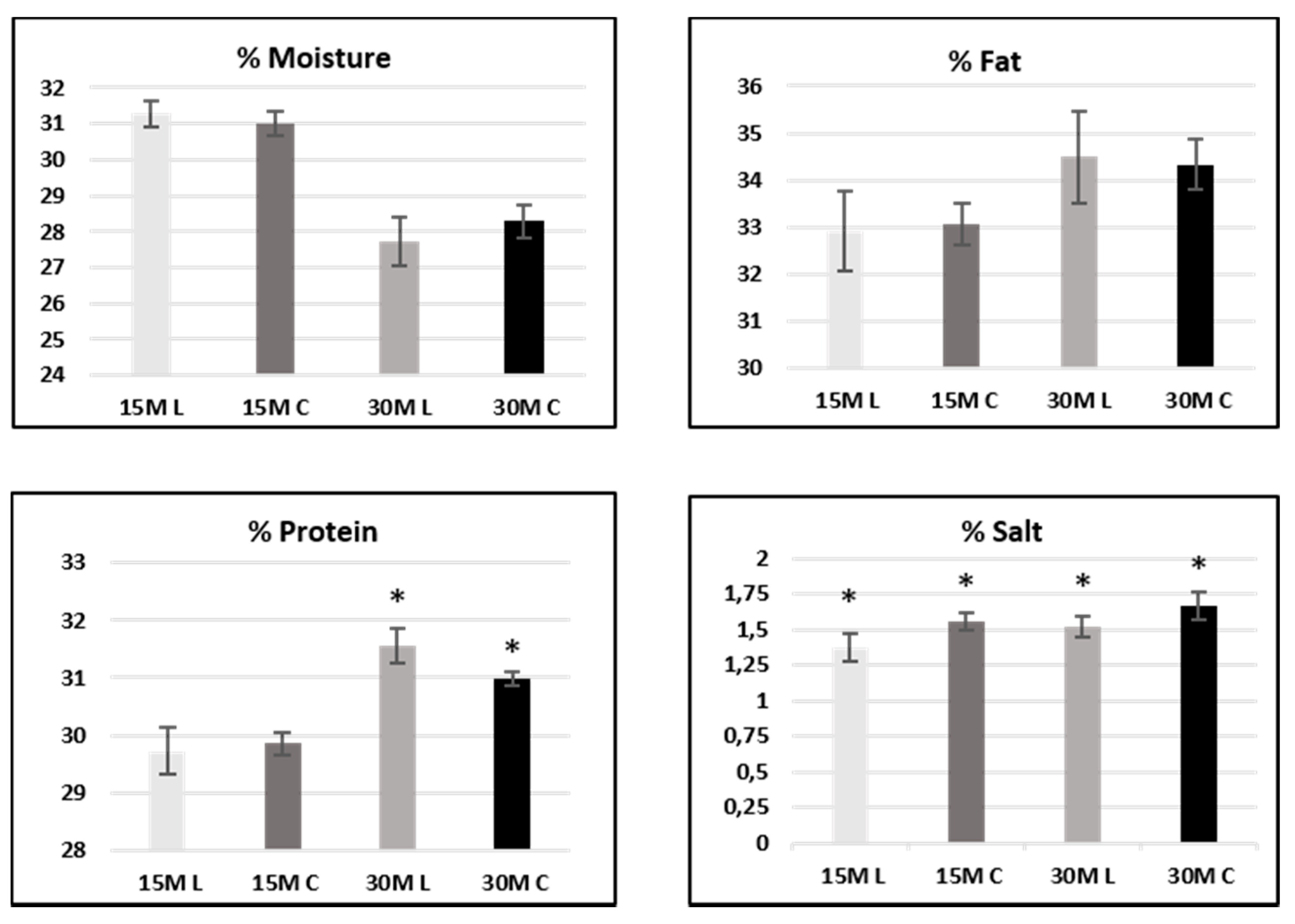
| Samples | Moisture (%) | Fat (%) | Protein (%) | Salt (%) | Fat (% of DM) | Protein (% of DM) | Salt (% of DM) |
|---|---|---|---|---|---|---|---|
| 15 M L | 31.29 ± 0.36 | 32.91 ± 0.86 | 29.73 ± 0.41 | 1.37 ± 0.10 | 47.69 ± 0.86 | 43.00 ± 0.41 | 1.98 ± 0.10 |
| 15 M C | 31.00 ± 0.35 | 33.05 ± 0.45 | 28.86 ± 0.20 | 1.55 ± 0.06 | 47.82 ± 0.45 | 41.82 ± 0.20 | 2.24 ± 0.06 |
| 30 M L | 27.73 ± 0.68 | 34.49 ± 0.98 | 31.56 ± 0.30 | 1.52 ± 0.10 | 47.90 ± 0.98 | 43.83 ± 0.30 | 2.11 ± 0.10 |
| 30 M C | 28.29 ± 0.45 | 34.32 ± 0.54 | 30.98 ± 0.12 | 1.67 ± 0.06 | 47.66 ± 0.54 | 43.02 ± 0.12 | 2.32 ± 0.06 |
| 15 Months Low-Salt | 15 Months Conventional | |||
|---|---|---|---|---|
| Species | Mean | SD | Mean | SD |
| p11 = N-lactoyl Tyr | 0.891 | 0.075 | 0.717 | 0.102 |
| p26 = β-CN (171-175) | 0.074 | 0.009 | 0.064 | 0.006 |
| p39 = β-CN (145-151) | 0.016 | 0.004 | 0.009 | 0.001 |
| p45 = αS1-CN (117-127) | 0.038 | 0.009 | 0.019 | 0.009 |
| p50 = β-CN (195-209) | 0.054 | 0.015 | 0.022 | 0.006 |
| (1) | ||||
| 30 Months Low-Salt | 30 Months Conventional | |||
|---|---|---|---|---|
| Species | Mean | SD | Mean | SD |
| p5 = N-lactoyl Met | 0.156 | 0.008 | 0.140 | 0.006 |
| p11 = N-lactoyl Tyr | 0.823 | 0.050 | 0.776 | 0.038 |
| p13 = γ-Glu-Leu | 2.636 | 0.203 | 2.416 | 0.237 |
| p17 = γ-Glu-Phe | 1.544 | 0.058 | 1.414 | 0.123 |
| p24 = β-CN (199-203) | 0.079 | 0.004 | 0.072 | 0.005 |
| p32 = β-CN (170-176) | 0.080 | 0.004 | 0.071 | 0.007 |
| p45 = αS1-CN (117-127) | 0.034 | 0.003 | 0.028 | 0.008 |
| p57 = β-CN (170-183) | 0.052 | 0.004 | 0.023 | 0.002 |
| p60 = β-CN (13-28)4P | 0.119 | 0.007 | 0.108 | 0.005 |
| p74 = αS1-CN (85-114) | 0.151 | 0.004 | 0.133 | 0.006 |
| p90 = β-CN (107-172) | 0.163 | 0.015 | 0.098 | 0.014 |
| Low-Sodium Cheese (15 Months) | Normal-Sodium Cheese (15 Months) | ||||
|---|---|---|---|---|---|
| Sensory Descriptors | Mean | SD | Mean | SD | Significance |
| Color | 3.4 | 0.5 | 3.4 | 0.5 | n.s |
| Smell intensity | 4.4 | 0.5 | 4.4 | 0.5 | n.s |
| Butter’s smell | 3.6 | 0.5 | 3.6 | 0.5 | n.s |
| Other smell | 2.3 | 0.4 | 2.4 | 0.5 | * |
| Butter’s aroma | 4.0 | 0.4 | 3.9 | 0.4 | n.s |
| Broth’s aroma | 3.3 | 0.5 | 3.3 | 0.5 | n.s |
| Other aroma | 2.4 | 0.4 | 2.6 | 0.4 | n.s |
| Salty | 2.5 | 0.5 | 2.5 | 0.5 | n.s |
| Bitter | 2.0 | 0.4 | 2.1 | 0.5 | n.s |
| Pungent | 1.7 | 0.3 | 1.9 | 1.5 | n.s |
| Elasticity | 3.2 | 0.5 | 3.1 | 0.4 | n.s |
| Solubility | 4.1 | 0.5 | 4.2 | 0.4 | n.s |
| Presence of grains | 3.8 | 0.4 | 4.0 | 0.5 | * |
| Low-Sodium Cheese (30 months) | Normal-Sodium Cheese (30 months) | ||||
|---|---|---|---|---|---|
| Sensory Descriptors | Mean | SD | Mean | SD | Significance |
| Color | 4.0 | 0.6 | 4.1 | 0.5 | n.s |
| Smell intensity | 4.7 | 0.5 | 4.8 | 0.5 | n.s |
| Butter’s smell | 2.7 | 0.6 | 2.5 | 0.5 | * |
| Rind’s smell | 2.3 | 0.5 | 2.3 | 0.5 | n.s |
| Boiled vegetable’s smell | 2.1 | 0.6 | 2.1 | 0.6 | n.s |
| Nut’s smell | 2.5 | 0.5 | 2.5 | 0.5 | n.s |
| Other smell | 2.2 | 0.4 | 2.3 | 0.4 | n.s |
| Butter’s aroma | 2.8 | 0.5 | 2.8 | 0.5 | n.s |
| Rind’s aroma | 2.4 | 0.5 | 2.4 | 0.6 | n.s |
| Nut’s aroma | 2.8 | 0.4 | 2.7 | 0.4 | n.s |
| Broth’s aroma | 2.8 | 0.5 | 2.9 | 0.5 | n.s |
| Nutmeg’s aroma | 2.5 | 0.5 | 2.5 | 0.5 | n.s |
| Other aroma | 2.4 | 0.4 | 2.3 | 0.5 | n.s |
| Sweet | 3.0 | 0.5 | 2.9 | 0.4 | n.s |
| Salty | 3.0 | 0.7 | 3.0 | 0.5 | n.s |
| Bitter | 2.3 | 0.7 | 2.2 | 0.5 | n.s |
| Pungent | 1.8 | 0.4 | 1.8 | 0.4 | n.s |
| Elasticity | 2.3 | 0.4 | 2.4 | 0.5 | n.s |
| Friability | 4.6 | 0.5 | 4.7 | 0.5 | * |
| Moisture | 2.6 | 0.5 | 2.5 | 0.5 | n.s. |
| Solubility | 4.8 | 0.5 | 4.9 | 0.4 | * |
| Presence of grains | 4.9 | 0.4 | 4.8 | 0.4 | n.s. |
Publisher’s Note: MDPI stays neutral with regard to jurisdictional claims in published maps and institutional affiliations. |
© 2021 by the authors. Licensee MDPI, Basel, Switzerland. This article is an open access article distributed under the terms and conditions of the Creative Commons Attribution (CC BY) license (https://creativecommons.org/licenses/by/4.0/).
Share and Cite
Loffi, C.; Bortolazzo, E.; Garavaldi, A.; Musi, V.; Reverberi, P.; Galaverna, G.; Sforza, S.; Tedeschi, T. Reduction in the Brining Time in Parmigiano Reggiano Cheese Production Minimally Affects Proteolysis, with No Effect on Sensory Properties. Foods 2021, 10, 770. https://doi.org/10.3390/foods10040770
Loffi C, Bortolazzo E, Garavaldi A, Musi V, Reverberi P, Galaverna G, Sforza S, Tedeschi T. Reduction in the Brining Time in Parmigiano Reggiano Cheese Production Minimally Affects Proteolysis, with No Effect on Sensory Properties. Foods. 2021; 10(4):770. https://doi.org/10.3390/foods10040770
Chicago/Turabian StyleLoffi, Cecilia, Elena Bortolazzo, Anna Garavaldi, Valeria Musi, Paolo Reverberi, Gianni Galaverna, Stefano Sforza, and Tullia Tedeschi. 2021. "Reduction in the Brining Time in Parmigiano Reggiano Cheese Production Minimally Affects Proteolysis, with No Effect on Sensory Properties" Foods 10, no. 4: 770. https://doi.org/10.3390/foods10040770
APA StyleLoffi, C., Bortolazzo, E., Garavaldi, A., Musi, V., Reverberi, P., Galaverna, G., Sforza, S., & Tedeschi, T. (2021). Reduction in the Brining Time in Parmigiano Reggiano Cheese Production Minimally Affects Proteolysis, with No Effect on Sensory Properties. Foods, 10(4), 770. https://doi.org/10.3390/foods10040770