
Awareness, Knowledge and Practice of Dental Professionals Regarding Biomedical Waste Management for a Green Dentistry: A Scoping Review

 , , , , , and
Abstract
1. Introduction
2. Materials and Methods
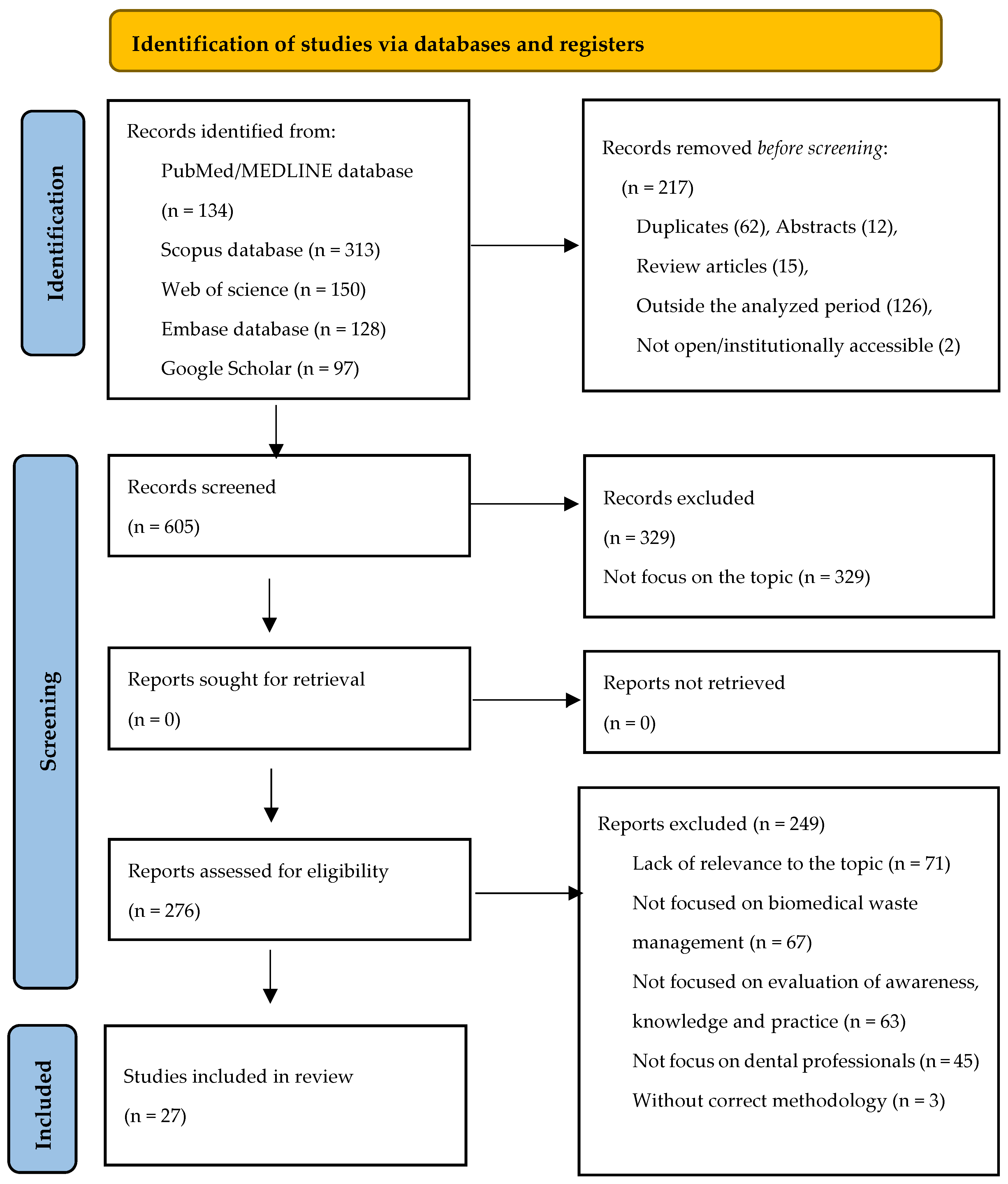
- Defining the research question;
- Identifying relevant studies that match the defined research question;
- Selecting studies using predetermined inclusion and exclusion criteria;
- Creating the database;
- Collecting and reporting the results.
2.1. Review Questions
- -
- Are dental professionals aware of the sustainability issues caused by current dental practices?
- -
- What is their level of knowledge regarding the proper collection and disposal of waste generated in dental offices?
2.2. Information Sources and Search Strategies
2.3. Inclusion and Exclusion Criteria
3. Results
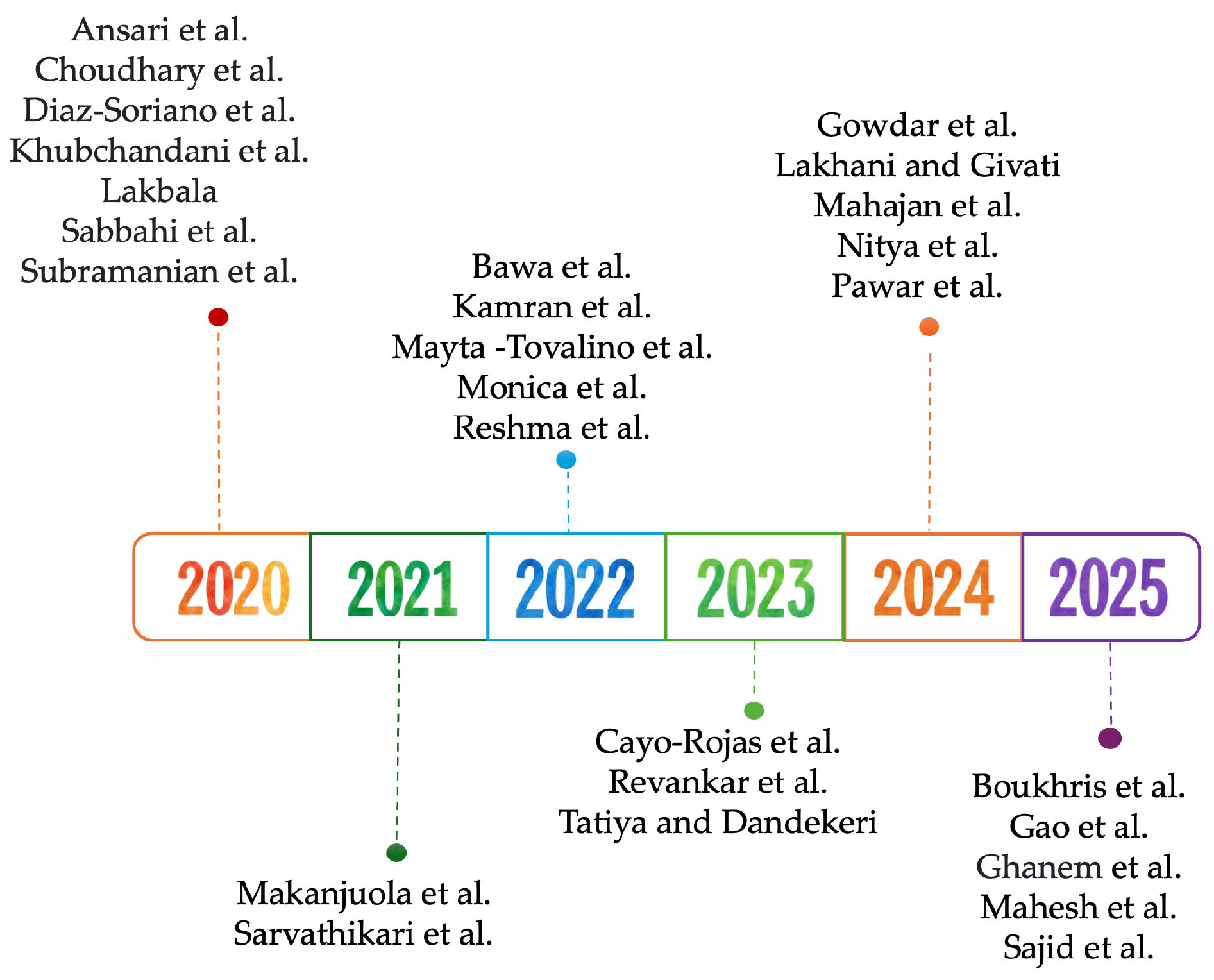
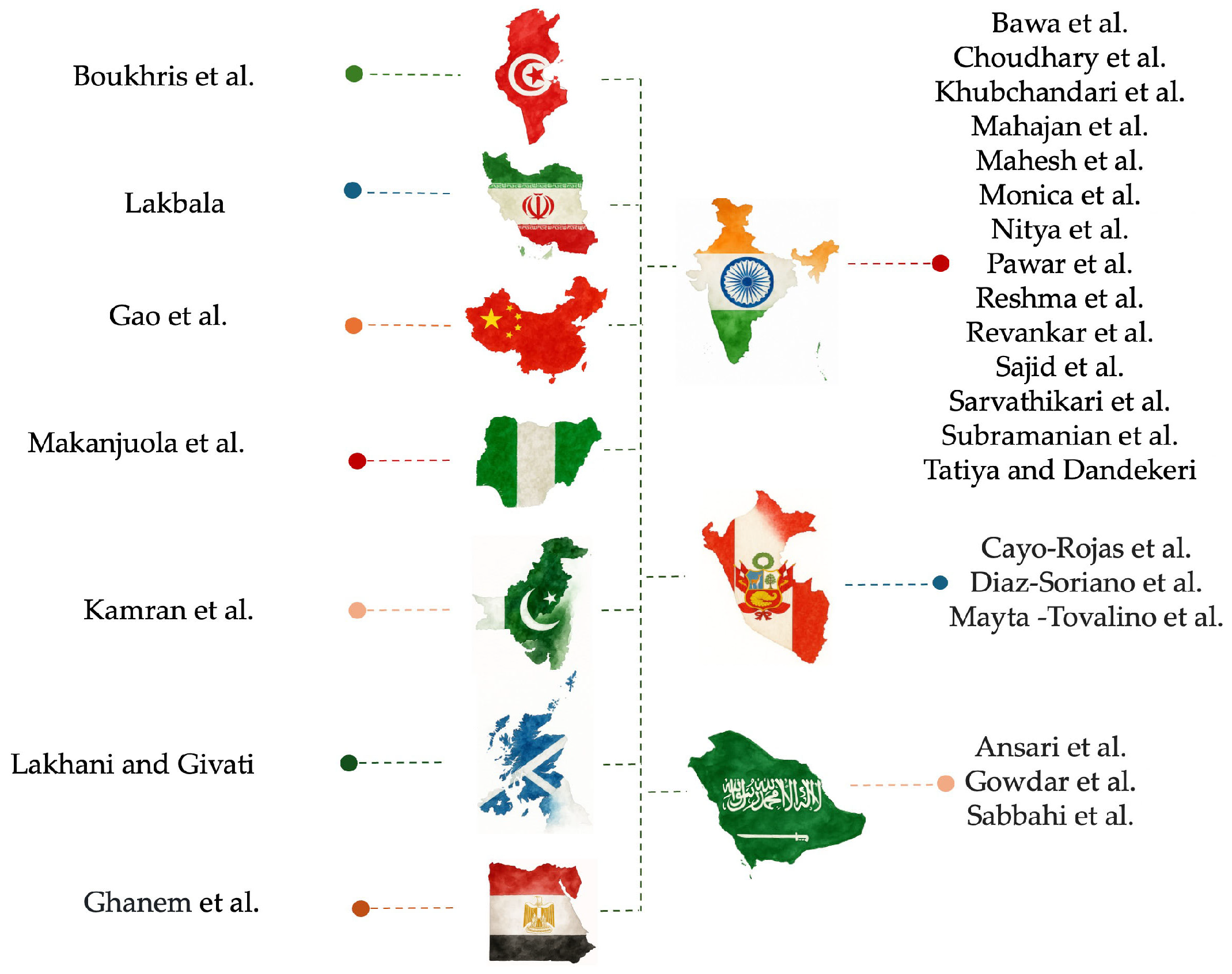
General Characteristics of the Selected Articles
4. Discussion
4.1. Management of Hazardous Waste: Mercury and Silver Ions
4.2. Other Dental Waste
4.3. Segregation of Biomedical Waste into Colour-Coded Containers
4.4. Disposal of Sharp Waste
4.5. Educational Interventions in Ecological Dentistry
4.6. Incorrect Practices, Regulatory Gaps and Inadequate Training
- -
- -
- -
- -
4.7. Heterogeneity of Selected Studies
4.8. Gaps in Literature and Future Research Challenges
4.9. Clinical Implications
4.10. Study Limitations
5. Conclusions
- Implementing sustainability in dental practice is both a current necessity and a moral obligation. This scoping review highlights significant gaps in awareness, knowledge, and professional practice regarding the proper management of biomedical waste (BMW).
- Although some studies reported a generally positive attitude among dental professionals, even these individuals showed the need for further updating and improvement in their knowledge.
- The shift towards sustainable dental care is no longer optional; it has become essential in response to ongoing environmental, economic, and public health challenges, including those highlighted by the COVID-19 pandemic.
- Each country must establish clear and accessible protocols and guidelines for the proper segregation of BMW, provide support and opportunities for dental practices to adopt sustainable measures, and actively promote awareness among healthcare professionals.
Supplementary Materials
Author Contributions
Funding
Institutional Review Board Statement
Informed Consent Statement
Data Availability Statement
Conflicts of Interest
Abbreviations
| BMW | Biomedical waste |
| FDI | World Dental Federation |
| WHO | World Health Organization |
References
- Hackley, D.M.; Luca, J. Sustainability in Dentistry: An Overview for Oral Healthcare Team Members. J. Calif. Dent. Assoc. 2024, 52, 2422150. [Google Scholar] [CrossRef] [Scilit]
- Batsford, H.; Shah, S.; Wilson, G.J. A Changing Climate and the Dental Profession. Br. Dent. J. 2022, 232, 603–606. [Google Scholar] [CrossRef] [Scilit]
- World Health Organization. Climate Change. WHO Fact Sheets 2021. Available online: https://www.who.int/news-room/fact-sheets/detail/climate-change-and-health (accessed on 29 September 2025).
- Künzle, P.; Frank, A.C.; Paris, S. Environmental Impact of a Tooth Extraction: Life Cycle Analysis in a University Hospital Setting. Community Dent. Oral Epidemiol. 2025, 1–10. [Google Scholar] [CrossRef] [Scilit]
- Sijm-Eeken, M.; Jaspers, M.; Peute, L. Identifying Environmental Impact Factors for Sustainable Healthcare: A Scoping Review. Int. J. Environ. Res. Public Health 2023, 20, 6747. [Google Scholar] [CrossRef] [Scilit] [PubMed]
- Nassar, M.; Shalan, W.; Al-Janaby, U.; Elnagar, H.; Alawadhi, M.; Jaser, S.; Joury, E. Exploring Environmental Sustainability in Dentistry among Students and Educators in the United Arab Emirates: A Cross-Sectional Survey. BMC Med. Educ. 2024, 24, 489. [Google Scholar] [CrossRef] [Scilit] [PubMed]
- Khurshid, Z.; Alqurashi, H.; Ashi, H. Advancing Environmental Sustainability in Dentistry and Oral Health. Eur. J. Gen. Dent. 2024, 13, 264–268. [Google Scholar] [CrossRef] [Scilit]
- Al Shatrat, S.M.; Shuman, D.; Darby, M.L.; Jeng, H.A. Jordanian Dentists’ Knowledge and Implementation of Eco-Friendly Dental Office Strategies. Int. Dent. J. 2013, 63, 161–168. [Google Scholar] [CrossRef] [Scilit]
- Martin, N.; Mulligan, S. Environmental Sustainability through Good-Quality Oral Healthcare. Int. Dent. J. 2022, 72, 26–30. [Google Scholar] [CrossRef] [Scilit]
- Spaveras, A.; Antoniadou, M. Awareness of Students and Dentists on Sustainability Issues, Safety of Use and Disposal of Dental Amalgam. Dent. J. 2023, 11, 21. [Google Scholar] [CrossRef] [Scilit]
- Khanna, S.S.; Dhaimade, P.A. Green Dentistry: A Systematic Review of Ecological Dental Practices. Environ. Dev. Sustain. 2019, 21, 2599–2618. [Google Scholar] [CrossRef] [Scilit]
- Macrì, M.; D’Albis, V.; Marciani, R.; Nardella, M.; Festa, F. Towards Sustainable Orthodontics: Environmental Implications and Strategies for Clear Aligner Therapy. Materials 2024, 17, 4171. [Google Scholar] [CrossRef] [Scilit]
- Mazur, M.; Ndokaj, A.; Jedlinski, M.; Maruotti, A.; Stamegna, C.; Corridore, D.; Capocci, M.; Ottolenghi, L.; Guerra, F. How Dentistry Is Impacting the Environment. Senses Sci. 2019, 6, 922–928. [Google Scholar]
- Mittal, R.; Maheshwari, R.; Tripathi, S.; Pandey, S. Eco-Friendly Dentistry: Preventing Pollution to Promoting Sustainability. Indian J. Dent. Sci. 2020, 12, 251–257. [Google Scholar] [CrossRef] [Scilit]
- Sant, I.; Tripathi, P.; Chandra, S.; Sinha, S. Eco-Dentistry: Sustainable Practices for Healthier Life and a Greener Planet. Asian J. Oral Health Allied Sci. 2025, 15, 2. [Google Scholar] [CrossRef] [Scilit]
- Liu, C.M.; Yu, C.H.; Chang, Y.C. Current Eco-Friendly Dentistry to Enhance Environmental Sustainability in Taiwan. J. Dent. Sci. 2023, 18, 1918–1919. [Google Scholar] [CrossRef] [Scilit]
- Satchanska, G.; Davidova, S.; Petrov, P.D. Natural and Synthetic Polymers for Biomedical and Environmental Applications. Polymers 2024, 16, 1159. [Google Scholar] [CrossRef] [Scilit]
- Bamedhaf, O.; Salman, H.; Tegginmani, S.A.; Guraya, S.S. Environmental Sustainability in the Dental Curriculum: A Scoping Review. BMC Med. Educ. 2025, 25, 844. [Google Scholar] [CrossRef] [Scilit]
- Attrah, M.; Elmanadely, A.; Akter, D.; Rene, E.R. A Review on Medical Waste Management: Treatment, Recycling, and Disposal Options. Environments 2022, 9, 146. [Google Scholar] [CrossRef] [Scilit]
- Yeoh, S.; Bourdamis, Y.; Saker, A.; Marano, N.; Maundrell, L.; Ramamurthy, P.; Sharma, D. An Investigation into Contaminated Waste Composition in a University Dental Clinic: Opportunities for Sustainability in Dentistry. Clin. Exp. Dent. Res. 2024, 10, e70015. [Google Scholar] [CrossRef] [Scilit]
- Wadhawan, R.; Mishra, S.; Parihar, S.; Raj, N.; Rajput, B.; Kumar, S.; Devi, L.M.; Manauwwar, M. Eco-Friendly Dentistry: Understanding the Environmental Impact in Dental Practice. J. Dent. Spec. 2025, 12, 67–71. [Google Scholar] [CrossRef] [Scilit]
- World Health Organization. Health-Care Waste. WHO Fact Sheets 2024. Available online: https://www.who.int/news-room/fact-sheets/detail/health-care-waste (accessed on 29 September 2025).
- Rodrigues de Sousa, A.T.; Pataca, L.C.M.; Maia, C.C.; Vimieiro, G.V.; Gonçalves, M.F.; Gomes Mol, M.P. Waste Management from Dental Clinics: A Case Study in Belo Horizonte, Brazil. Waste Manag. 2024, 189, 177–184. [Google Scholar] [CrossRef] [Scilit]
- Antoniadou, M.; Varzakas, T.; Tzoutzas, I. Circular Economy in Conjunction with Treatment Methodologies in the Biomedical and Dental Waste Sectors. Circ. Econ. Sustain. 2021, 1, 563–592. [Google Scholar] [CrossRef] [Scilit]
- Ozbek, M.; Sanin, F.D. A Study of the Dental Solid Waste Produced in a School of Dentistry in Turkey. Waste Manag. 2004, 24, 339–345. [Google Scholar] [CrossRef] [Scilit] [PubMed]
- Mandalidis, A.; Topalidis, A.; Voudrias, E.A.; Iosifidis, N. Composition, Production Rate and Characterization of Greek Dental Solid Waste. Waste Manag. 2018, 75, 124–130. [Google Scholar] [CrossRef] [Scilit] [PubMed]
- Wilmott, S.; Duane, B. An Update on Waste Disposal in Dentistry. Br. Dent. J. 2023, 235, 370–372. [Google Scholar] [CrossRef] [Scilit]
- Chanioti, M.; Nikolelis, G.; Mitsika, I.; Antoniadou, M. The Role of Dentists in Promoting Environmental Awareness and Climate Consciousness for Sustainability. Circ. Econ. Sustain. 2025, 5, 3645–3669. [Google Scholar] [CrossRef] [Scilit]
- Mitsika, I.; Chanioti, M.; Antoniadou, M. Dental Solid Waste Analysis: A Scoping Review and Research Model Proposal. Appl. Sci. 2024, 14, 2026. [Google Scholar] [CrossRef] [Scilit]
- Khanna, R.; Konyukhov, Y.; Maslennikov, N.; Kolesnikov, E.; Burmistrov, I. An Overview of Dental Solid Waste Management and Associated Environmental Impacts: A Materials Perspective. Sustainability 2023, 15, 15953. [Google Scholar] [CrossRef] [Scilit]
- World Dental Federation. Sustainability in Dentistry: Adopted by the FDI General Assembly: August 2017, Madrid, Spain. Int. Dent. J. 2018, 68, 10–11. [Google Scholar] [CrossRef] [Scilit]
- Husaini, D.C.; Bernardez, V.; Zetina, N.; Mphuthi, D.D. Healthcare industry waste and public health: A systematic review. Arab. Gulf J. Sci. Res. 2024, 4, 1624–1642. [Google Scholar] [CrossRef] [Scilit]
- Jamal, H.; Marghalani, A.A.; Al-Sharif, A.; Shinawi, A.; Gaffar, B.; Al-Edaili, E.A.; Al-Baqami, G.; AlQarni, M. Exploring the Perception of Dental Undergraduate Students and Faculty on Environmental Sustainability in Dentistry: A Cross-Sectional Survey in 26 Dental Schools in Saudi Arabia. Dent. J. 2023, 11, 103. [Google Scholar] [CrossRef] [Scilit] [PubMed]
- Joury, E.; Lee, J.; Parchure, A.; Mortimer, F.; Park, S.; Pine, C.; Ramasubbu, D.; Hillman, L. Exploring Environmental Sustainability in UK and US Dental Curricula and Related Barriers and Enablers: A Cross-Sectional Survey in Two Dental Schools. Br. Dent. J. 2021, 230, 605–610. [Google Scholar] [CrossRef] [Scilit] [PubMed]
- Al-Thunian, F.F.; Al-Bounni, R.S.; Ingle, N.A.; Assery, M.K. Evaluation of Green Dental Practice Implementation among Dental Practitioners Worldwide-A Systematic Review. J. Dent. Oral Health 2020, 7, 1–7. [Google Scholar]
- Feres, M.; Albuini, M.; de Araújo Castro Santos, R.; de Almeida-Junior, L.A.; Flores-Mir, C.; Roscoe, M.G. Dentists’ Awareness and Knowledge of Evidence-Based Dentistry Principles, Methods and Practices: A Systematic Review. Evid. Based Dent. 2022, 1–11. [Google Scholar] [CrossRef] [Scilit]
- Rai, R.; Krupetsky, R.; Howard, S.; Banava, S. Innovating for Impact: Student Leadership in Sustainable Dental School Waste Management. J. Dent. Educ. 2025, 89, 985–987. [Google Scholar] [CrossRef] [Scilit]
- Aromataris, E.; Lockwood, C.; Porritt, K.; Pilla, B.; Jordan, Z. (Eds.) JBI Manual for Evidence Synthesis; JBI: Adelaide, Australia, 2024; Available online: https://synthesismanual.jbi.global (accessed on 29 September 2025).
- Tricco, A.C.; Lillie, E.; Zarin, W.; O’Brien, K.K.; Colquhoun, H.; Levac, D.; Moher, D.; Peters, M.D.J.; Horsley, T.; Weeks, L.; et al. PRISMA Extension for Scoping Reviews (PRISMA-ScR): Checklist and Explanation. Ann. Intern. Med. 2018, 169, 467–473. [Google Scholar] [CrossRef] [Scilit] [PubMed]
- Daudt, H.M.; Van Mossel, C.; Scott, S.J. Enhancing the Scoping Study Methodology: A Large, Inter-Professional Team’s Experience with Arksey and O’Malley’s Framework. BMC Med. Res. Methodol. 2013, 13, 48. [Google Scholar] [CrossRef] [Scilit]
- Ansari, S.H.; Al Neemi, N.A.; Al Jadaan, S.; Alsenan, F.K.; Aldawsari, F.S.; Saleh, F.K. The Disposal of Biomedical Waste by the Dental Health Professionals in Riyadh: Impact on Current Practice. Med. Sci. 2020, 24, 4133–4138. [Google Scholar]
- Bawa, R.; Khurana, D.; Girdhar, P.; Verma, N. Biomedical Waste Management-Related Knowledge, Attitude, and Practices among Clinical Dental Undergraduates in the State of Punjab, India: A Cross-Sectional Study. Dent. J. Adv. Stud. 2022, 10, 55–63. [Google Scholar] [CrossRef] [Scilit]
- Boukhris, H.; Zidani, H.; Khalifa, A.B.H.; Bouslema, G.; Youssef, S.B. Environmental Impact of Dental Waste: A Survey-Based Analysis of Waste Segregation and Recycling Practices in Dental Clinics. J. Contemp. Dent. Pract. 2025, 26, 250–256. [Google Scholar] [CrossRef] [Scilit]
- Cayo-Rojas, C.; Briceño-Vergel, G.; Córdova-Limaylla, N.; Huamani-Echaccaya, J.; Castro-Mena, M.; Lurita-Córdova, P.; Bermúdez-Mendoza, J.; Allen-Revoredo, C.; Torres-Vásquez, J.; Ladera-Castañeda, M. Impact of a Virtual Educational Intervention on Knowledge and Awareness of Biomedical Waste Management among Peruvian Dental Professionals. Sci. Rep. 2023, 13, 22346. [Google Scholar] [CrossRef] [Scilit] [PubMed]
- Choudhary, M.; Verma, M.; Ghosh, S.; Dhillon, J.K. Assessment of Knowledge and Awareness about Biomedical Waste Management among Health Care Personnel in a Tertiary Care Dental Facility in Delhi. Indian J. Dent. Res. 2020, 31, 26–30. [Google Scholar] [CrossRef] [Scilit] [PubMed]
- Diaz-Soriano, A.; Gallo, W.; Luza, S.; Munive-Degregori, A.; Bocanegra, R.; Mayta-Tovalino, F. Knowledge and Awareness of Effective Recycling of Dental Materials and Waste Management among Peruvian Undergraduate Students of Dentistry: A Logistic Regression Analysis. J. Int. Soc. Prev. Community Dent. 2020, 10, 309–315. [Google Scholar] [CrossRef] [Scilit]
- Gao, Y.; Huang, X.; Jin, Z.; Zhang, X.; Liu, Y.; Chen, J. Tailored Role-Specific Training Program Improves Knowledge, Attitudes, and Practices in Medical Waste Management among Dental Professionals. Sci. Rep. 2025, 15, 19373. [Google Scholar] [CrossRef] [Scilit]
- Ghanem, E.A.; Elhossiney, D.M.; Gamal, D.A. Biomedical Waste Management, Mercury Hygiene Practices and Associated Factors among Dentists and Dental Students. Egypt. J. Occup. Med. 2025, 49, 17–34. [Google Scholar] [CrossRef] [Scilit]
- Gowdar, I.M.; Al-Mansour, O.A.; Alshehri, M.A.; Alaskar, A.M.; Alfahad, M.H.; Al-Harbi, K.F. Biomedical Waste Management Knowledge among Dental Students and Private Dental Practitioners of Alkharj, Saudi Arabia. J. Pharm. Bioallied Sci. 2024, 16, S2271–S2274. [Google Scholar] [CrossRef] [Scilit]
- Kamran, M.A.; Zareef, U.; Ahmed, T.; Rasool, R.; Khan, N.; Kashif, M. Awareness of Dental Undergraduates, Postgraduates and Dental Practitioners about Dental and Biomedical Waste Management. J. Liaquat Univ. Med. Health Sci. 2022, 21, 50–54. [Google Scholar]
- Khubchandani, K.; Devi, K.M.; Gunasekaran, S.; Yeturu, S.K.; Ramanarayanan, V. Knowledge, Attitude, and Practices of Biomedical Waste Management among Clinical Dental Students. J. Glob. Oral Health 2020, 3, 110–117. [Google Scholar] [CrossRef] [Scilit]
- Lakbala, P. Dental Waste Management among Dentists of Bandar Abbas, Iran. AIMS Environ. Sci. 2020, 7, 258–267. [Google Scholar] [CrossRef] [Scilit]
- Lakhani, B.; Givati, A. Perceptions and Decision-Making of Dental Professionals to Adopting Sustainable Waste Management Behaviour: A Theory of Planned Behaviour Analysis. Br. Dent. J. 2024, 237, 1–7. [Google Scholar] [CrossRef] [Scilit]
- Mahajan, A.; Pawar, M.; Patil, A.N.; Behera, S.; Pattnaik, S.J.; Rajguru, J.P. Biomedical Waste Management: A Study on the Awareness and Practice among Dental Healthcare Workers in India. J. Int. Clin. Dent. Res. Organ. 2024, 16, 120–125. [Google Scholar] [CrossRef] [Scilit]
- Mahesh, S.; Hemalata, K.; Shanta, R.; Vashistha, U.; Krishnakumar, K.; Arora, S.; Gupta, A. Bridging the Gap: A Cross-Sectional Study on Biomedical Waste Management Education and Compliance in Dental Institutions of Delhi National Capital Region. GMS Hyg. Infect. Control 2025, 20, Doc24. [Google Scholar]
- Mayta-Tovalino, F.; Munive-Degregori, A.; Bocanegra, R.; Alvitez, J.; Temoche, A. Awareness, Knowledge, Attitude, and Practices in the Management of Biomedical Waste: A Multivariate Analysis of Associated Factors in Peruvian Students. World J. Dent. 2022, 13, 3–8. [Google Scholar]
- Makanjuola, J.O.; Ekowmenhenhen, U.I.; Enone, L.L.; Umesi, D.C.; Ogundana, O.M.; Arotiba, G.T. Mercury Hygiene and Biomedical Waste Management Practices among Dental Health-Care Personnel in Public Hospitals in Lagos State, Nigeria. Afr. Health Sci. 2021, 21, 457–469. [Google Scholar] [CrossRef] [Scilit]
- Monica, K.; Abilasha, R.; Ramani, P.; Gheena, S.; Reshma, P.K. Knowledge and Awareness on Management of Biomedical Waste among Orthodontists and General Dental Practitioners. Int. J. Orthod. Rehabil. 2022, 13, 28–35. [Google Scholar] [CrossRef] [Scilit]
- Nitya, K.; Perumal, P.; Kumarasamy, B.; Gangadharamurthy, B. From Classroom to Clinic: A Cross-Sectional Survey on Fostering Awareness of Biomedical Waste Management among Dental Students. SRM J. Res. Dent. Sci. 2024, 15, 27–31. [Google Scholar] [CrossRef] [Scilit]
- Pawar, M.D.; Kamala, K.A.; Pawar, M. Knowledge, Awareness, and Perceived Attitude of Biomedical Waste Management among Healthcare Personnel. Cureus 2024, 16, e73492. [Google Scholar] [CrossRef] [Scilit] [PubMed]
- Reshma, S.; Arshiya, S.; Prabhath, E.K.; Sekhar, P.R.; Ranganath, S. Awareness on Biomedical Waste Management among Dental Students: A Cross-Sectional Questionnaire Survey. Int. J. Adv. Res. 2022, 10, 1001–1008. [Google Scholar] [CrossRef] [Scilit]
- Revankar, V.D.; Ponnusamy, C.; Subramanian, A.; Noon, A.M.; Subhashini, M.; Saravanaraja, M. Knowledge of Biomedical Waste Management Amidst the Clinical Students of Dental College, Tamil Nadu State, India—A Cross-Sectional Observational Study. J. Pharm. Bioallied Sci. 2023, 15, S711–S714. [Google Scholar] [CrossRef] [Scilit] [PubMed]
- Sabbahi, D.A.; El-Naggar, H.M.; Zahran, M.H. Management of Dental Waste in Dental Offices and Clinics in Jeddah, Saudi Arabia. J. Air Waste Manag. Assoc. 2020, 70, 1022–1029. [Google Scholar] [CrossRef] [Scilit]
- Sajid, S.; George, B.; Soman, R.R. Knowledge on Biomedical Waste Management Systems in Kerala among Dental Students. Clin. Dent. 2025, 19, 26–31. [Google Scholar]
- Sarvathikari, R.; Pavithran, V.K.; Ravichandiran, R. Challenges in Implementation of Biomedical Waste Management among the Dental Practitioners in a Tier 2 Town in India-A Cross-Sectional Study. Indian J. Dent. Res. 2021, 32, 443–447. [Google Scholar] [CrossRef] [Scilit]
- Subramanian, A.K.; Nivethigaa, B.; Srirengalakshmi, M.; Varghese, R.M.; Navaneethan, R.; Babu, H. Biomedical Waste Management Practice in Dentistry. Bioinformation 2020, 16, 958–964. [Google Scholar] [CrossRef] [Scilit]
- Tatiya, V.; Dandekeri, S. Knowledge Assessment of Biomedical Waste Management of Dental Materials in Dakshina Kannada. J. Health Allied Sci. NU 2023, 13, 222–227. [Google Scholar] [CrossRef] [Scilit]
- Guerra, M.; Morgado, M.; Leira, Y.; Leitão, T.; Botelho, J.; Mendes, J.J. Integrating Sustainability in Dentistry: A Pathway towards Achieving the UN 2030 Agenda. Front. Oral Health 2025, 6, 1549020. [Google Scholar] [CrossRef] [Scilit]
- Sakchhi, S.; Elbanna, L.; Chakor, M.; Nikferjam, A.Z.; Saeedi, N.; Badve, S.; Singh, S. Green Dentistry: Sustainable Practices and Materials for a Healthier Planet. Int. J. Dent. Mater. 2025, 7, 84–92. [Google Scholar] [CrossRef] [Scilit]
- Zia, N.; Doss, J.G.; John, J.; Panezai, J. Sustainability in Dentistry: Assessing Knowledge, Attitude, and Practices of Dental Practitioners about Green Dentistry. Pak. J. Med. Sci. 2024, 40, 233–241. [Google Scholar]
- Speroni, S.; Polizzi, E. Green Dentistry: State of the Art and Possible Development Proposals. Dent. J. 2025, 13, 38. [Google Scholar] [CrossRef] [Scilit]
- Țâncu, A.M.C.; Imre, M.; Iosif, L.; Pițuru, S.M.; Pantea, M.; Sfeatcu, R.; Ilinca, R.; Bodnar, D.C.; Didilescu, A.C. Is Sustainability Part of the Drill? Examining Knowledge and Awareness among Dental Students in Bucharest, Romania. Dent. J. 2025, 13, 114. [Google Scholar] [CrossRef] [Scilit]
- Wolf, T.G.; Campus, G. Changing Dental Profession—Modern Forms and Challenges in Dental Practice. Int. J. Environ. Res. Public Health 2021, 18, 1945. [Google Scholar] [CrossRef] [Scilit]
- Hsu, L.P.; Huang, Y.K.; Chang, Y.C. The Implementation of Artificial Intelligence in Dentistry Could Enhance Environmental Sustainability. J. Dent. Sci. 2022, 17, 1081–1082. [Google Scholar] [CrossRef] [Scilit]
- Dormen, M.; Özkan, P. Sustainable Dental Approaches for the Environment and Human Health: A Traditional Literature Review. HRU Int. J. Dent. Oral Res. 2025, 5, 51–58. [Google Scholar]
- Duane, B.; Dixon, J.; Ambibola, G.; Aldana, C.; Coughlan, J.; Henao, D.; Daniela, T.; Veiga, N.; Martin, N.; Darragh, J.; et al. Embedding Environmental Sustainability within the Modern Dental Curriculum: Exploring Current Practice and Developing a Shared Understanding. Eur. J. Dent. Educ. 2021, 25, 541–549. [Google Scholar] [CrossRef] [Scilit]
- Haque, S.; Nurunnabi, M.; Haque, T. Saudi Dental Students’ Perceptions on Sustainable Development Goals and Sustainable Dental Practice. BDJ Open 2024, 10, 40. [Google Scholar] [CrossRef] [Scilit]
- Durnall, O.; Martin, N.; Mulligan, S.; Dixon, J. Environmental Sustainability: The Attitudes and Experiences of UK Students in the Oral Health Care Profession. Br. Dent. J. 2024, 236, 1–7. [Google Scholar] [CrossRef] [Scilit]
- Hassan, E.H.; Lotfy, N.; Abdou, M.H.; Fetohy, E.M.; Hussein, M.F. Effectiveness of an Environmental Educational Program on Intern Dentists’ Knowledge and Practices Regarding Eco-Friendly Green Dentistry: A Quasi-Experimental Study. BMC Med. Educ. 2025, 25, 32. [Google Scholar] [CrossRef] [Scilit]
- Bano, V.; Amin, E.; Maqbool, S.; Hassan, S.A.; Baber, A.; Urooj, R. Awareness of Green Dentistry Concept among Dental Professionals. Life Sci. 2024, 5, 251–258. [Google Scholar] [CrossRef] [Scilit]
- Dixon, J.; Field, J.; Gibson, E.; Martin, N. Curriculum Content for Environmental Sustainability in Dentistry. J. Dent. 2024, 147, 105021. [Google Scholar] [CrossRef] [Scilit]
- Al-Rabab’ah, M.A.; Bustani, M.A.; Khraisat, A.S.; Sawair, F.A. Phase Down of Amalgam: Awareness of Minamata Convention among Jordanian Dentists. Saudi Med. J. 2016, 37, 1381–1386. [Google Scholar] [CrossRef] [Scilit]
- Mackey, T.K.; Contreras, J.T.; Liang, B.A. The Minamata Convention on Mercury: Attempting to Address the Global Controversy of Dental Amalgam Use and Mercury Waste Disposal. Sci. Total Environ. 2014, 472, 125–129. [Google Scholar]
- Eshrati, M.; Momeniha, F.; Momeni, N.; Ahmadi, E.; Hashemian, A.; Kashani, H.; Alaeddini, M. Clinical Guide Adaptation for Amalgam Waste Management in Dental Settings in Iran. Front. Dent. 2024, 21, 44. [Google Scholar] [CrossRef] [Scilit]
- European Union. Regulation (EU) 2024/1849 of the European Parliament and of the Council. Off. J. Eur. Union 2024. Available online: https://eur-lex.europa.eu/legal-content/EN/TXT/PDF/?uri=OJ:L_202401849 (accessed on 29 September 2025).
- Disha, S. Dental Amalgam Set to Be Phased Out by 2034 to Reduce Toxic Mercury Exposures. Health Policy Watch, Health & Environment 2025. Available online: https://healthpolicy-watch.news/dental-amalgam-set-to-be-phased-out-by-2034-to-reduce-toxic-mercury-exposures/ (accessed on 25 September 2025).
- Tibau, A.V.; Grube, B.D. Mercury Contamination from Dental Amalgam. J. Health Pollut. 2019, 9, 190612. [Google Scholar] [PubMed]
- Environment Agency. Healthcare Waste: Appropriate Measures for Permitted Facilities. Gov.UK 2021. Available online: https://www.gov.uk/guidance/healthcare-waste-appropriate-measures-for-permitted-facilities/waste-storage-segregation-and-handling-appropriate-measures (accessed on 29 September 2025).
- Gao, Q.; Shi, Y.; Mo, D.; Nie, J.; Yang, M.; Rozelle, S.; Sylvia, S. Medical waste management in three areas of rural China. PLoS ONE 2018, 13, 7. [Google Scholar]
- De Leon, M.L. Barriers to Environmentally Sustainable Initiatives in Oral Health Care Clinical Settings. Can. J. Dent. Hyg. 2020, 54, 156–160. [Google Scholar] [PubMed]
- Martin, N.; Sheppard, M.; Gorasia, G.; Arora, P.; Cooper, M.; Mulligan, S. Awareness and Barriers to Sustainability in Dentistry: A Scoping Review. J. Dent. 2021, 112, 103735. [Google Scholar] [CrossRef] [Scilit]



| Database Name | Search Terms | Number of Articles Found |
|---|---|---|
| PubMed/Medline | green dentistry OR sustainability dentistry AND waste management, awareness, knowledge, practice OR sustainability AND dentists AND dental students AND biomedical waste management | 134 |
| Scopus | awareness AND knowledge AND practice AND green dentistry AND waste AND management OR sustainability AND dentists AND dental students AND dental practice AND knowledge AND biomedical waste | 313 |
| Web of science | green dentistry AND waste management OR biomedical waste AND awareness AND knowledge AND dental practice OR sustainability AND dentistry AND waste management AND awareness OR eco-friendly dentistry AND waste management AND practice AND dentists AND dental students | 150 |
| Embase | waste management AND dental practice OR awareness, knowledge, practice AND waste management AND green dentistry OR sustainability dentistry AND waste management OR eco-friendly dentistry AND biomedical waste AND knowledge | 128 |
| Google Scholar | biomedical waste management, dentists, dental students OR green dentistry, awareness, knowledge, dental practice, medical waste OR eco-friendly dentistry, medical waste, knowledge, sustainability dentistry, awareness | 97 |
| Criterion | Inclusion | Exclusion |
|---|---|---|
| Type of study | Cross-sectional studies, analytical studies, qualitative studies | Systematic review, narrative review, scoping review |
| Participants | Dentists and dental students | Professionals from other healthcare specialties, staff from other medical and educational institutions (physiotherapists, general medicine nurses, economists) |
| Evaluation period | Articles published between 2020–2025 | Articles published before 2020 |
| Disponibility | Full-text articles in English, with open access or access through the university | Articles in abstract or not freely accessible, articles published in other languages than English |
| Intervention | Studies that aim to evaluate the level of awareness, knowledge and practice regarding waste in the dental office | Irrelevant articles, which do not correspond to the proposed purpose, or which do not have a clear research methodology |
| Category | Details |
|---|---|
| General Information | The first author of the article, year of publication, country and region where the research was conducted |
| Study design | Cross-sectional studies/analytical studies |
| Study objective and aim | The main objectives of the research: to evaluate the level of awareness, knowledge and practice regarding the disposal of infectious and toxic dental waste from the dental office |
| Population | Sampling method, number of subjects, age, type of professionals, dental specialisation, experience |
| Intervention | Type of questionnaire used, number of items, validation; other types of interventions |
| Key findings and conclusions | Main findings, conclusions, future research suggestions, limitations |
| Author, Year | Study Population | Sample Size | Sample Area | Study Type and Instrument | Findings | Conclusions |
|---|---|---|---|---|---|---|
| Ansari et al., 2020 [41] | Dentists | 315 | Saudi Arabia | Cross-sectional study; Questionnaire with 16 items | 75% of dentists were aware of the necessity of waste segregation and of Occupational Safety and Health Act (OSHA) guidelines. In dental practice, 41% of the participants reported incorrect disposal of amalgam and half of them—of sharp instruments. Male participants presented better knowledge and attitude regarding BMW disposal and OSHA guidelines. | Dental practitioners and dental students should be trained for BMW management by attending specialised programmes. |
| Bawa et al., 2022 [42] | Undergraduate students in dental surgery and interns | 845 | India | Cross-sectional study; Questionnaire with 24 items | Almost half of the undergraduate students in the third and sixth year of study had good knowledge on BMW and had a positive attitude regarding the rules for waste management (47% and 48%, respectively). Third-year students had significantly better knowledge and more positive attitude when compared to the students in the sixth year of study and the interns. | Very few participants (34%) followed the rules regarding BMW management in a correct manner. Education of dental students (good knowledge and correct practice) regarding BMW management is needed. |
| Boukhris et al., 2025 [43] | Dental professionals | 120 | Tunisia | Cross-sectional study; A structured questionnaire consisting of 30 questions | While 68% of participants understood waste segregation, only 42% consistently followed proper procedures. Key barriers included a lack of training (with just 30% receiving formal instruction) and inadequate infrastructure (44% lacked proper bins). Half the clinics still used incineration despite its environmental impact. | Addressing operational, financial, and knowledge-related barriers may lead to improvements in waste segregation, recycling, and disposal practices among dental professionals. |
| Cayo-Rojas et al., 2023 [44] | Dentists | 165 | Peru | Longitudinal prospective study assessing the effects of a virtual educational programme on the knowledge and awareness of dental material recycling and reuse, as well as BMW management; A 30-item questionnaire | Recycling, dental material reuse, and biomedical waste management response rates improved post-test (p < 0.05), but after 14 days, knowledge retention remained low among private university participants, unmarried individuals, bachelor’s degree holders, non-specialists, non-teachers, and those with under ten years’ experience. | Government agencies should support oral health professionals researching educational methods to improve and assess the sustainability and environmental impact of dental practices. These efforts help advance knowledge and enable effective evaluation of dentistry’s environmental footprint. |
| Choudhary et al., 2020 [45] | Undergraduate students, residents, and nursing staff | 95 | India | Cross-sectional study; Questionnaire with 10 items | The highest score of correct answers was recorded by nursing staff and the lowest by undergraduate students. | More awareness of the dentists is needed to improve BMW management. The topic should be included in the university curriculum of undergraduate students and continuing education programmes should be conducted. |
| Diaz-Soriano et al., 2020 [46] | Dental students of Public University Peru | 254 | Peru | Cross-sectional study; The questionnaire used is Biomedical Waste Management Awareness & Knowledge with 30 items | The aim of the study was to examine the influence of age, gender, year of study, and marital status on the level of knowledge and awareness about biomedical waste using logistic regression analysis. The results showed that none of the analysed variables influenced the level of knowledge: age (OR = 0.96; CI: 0.85–1.08), gender (OR = 1.69; CI: 0.98–2.90), year of study (OR = 1.18; CI: 0.91–1.54), marital status (OR = 1.84; CI: 0.14–23.68). | The authors concluded that students are aware of and knowledgeable about the management and recycling of BMW from dental products. |
| Gao et al., 2025 [47] | Dental professionals: dentists, dental nurses, dental students | 187 | China | Cross-sectional quasi-experimental study; Questionnaire with 30 items | The study examined the level of knowledge, attitudes, and practices of dental professionals at two time points: before and after the BMW training programme. Post-intervention, knowledge, attitude, and practice scores rose by 22.3, 17.1, and 22 points, respectively. Students showed the highest gains, with statistically significant differences compared to dentists (p = 0.002 for knowledge, p = 0.001 for attitude, p = 0.004 for BMW practice). | The authors demonstrate the important role of educational interventions that can substantially improve dental professionals’ knowledge, attitudes, and practices regarding BMW management. |
| Ghanem et al., 2025 [48] | Dentists, dental students, and interns | 257 | Egypt | Cross-sectional study; Questionnaire with 37 items | Less than half of participants (40.1%) knew about BMW laws and rules in Egypt and about 77% of them had poor knowledge regarding BMW management. An increased percentage (84%) disposed of the waste in different coloured bags. Even half the participants were trained in dental waste management, and an increased percentage (89.1%) considered that more training is needed. | Dentists and dental students presented considerable lack of knowledge and low laxity in performing BMW management. Knowledge level was significantly associated with the education level. |
| Gowdar et al., 2024 [49] | Dental students and dental practitioners | 200 | Saudi Arabia | Cross-sectional study; Questionnaire with 20 items | A high percentage of dental practitioners and dental students were aware of different categories of BMW (72% and 56%, respectively), of the law and rules of BMW management (72% and 86%, respectively), and had knowledge about colour coding for waste segregation (79% and 48%, respectively). Dental practitioners had slightly more awareness and knowledge regarding BMW disposal when compared to dental students. | Better knowledge regarding BMW management of dental practitioners was reported when compared to dental students. |
| Kamran et al., 2022 [50] | Undergraduate and postgraduate dental students, and dental practitioners | 273 | Pakistan | Cross-sectional study; Close-ended questionnaire with 25 items | 64.4% of respondents were unaware of dental waste regulations, but 67.7% knew waste categories. Most (95.5%) supported training, with postgraduates scoring highest (p = 0.069). | The overall knowledge regarding environmentally friendly waste management was found to be inadequate among dental students and practitioners. |
| Khubchandani et al., 2020 [51] | Dental undergraduate students, interns and postgraduate students | 168 | India | Cross-sectional study; Questionnaire with 45 items | High percentages of participants had no training on biomedical waste management and were not aware of legislations (80% and 70%, respectively). Also, 70% considered that they do not have adequate knowledge regarding BMW management. A small percentage (10%) did not practice waste segregation on specific categories. | The knowledge and practice regarding BMW management should be improved, despite the positive attitude and the awareness of dental practitioners and students. |
| Lakbala, 2020 [52] | Dentists | 133 | Iran | Cross-sectional study; Self-administered questionnaire with 40 items | Only 12.0% of dentists knew how to use the yellow container for human anatomical waste. Most disposed of x-ray film lead foils (52.6%), orthodontic wires (48.9%), and expired medications (60.2%) in the trash, while chemicals and amalgams were typically poured into municipal sewage. | Overall, dentists demonstrated limited awareness regarding dental waste management, and their waste disposal practices often did not meet established standards. Consequently, there is a need to implement a comprehensive healthcare waste management system in Iran. |
| Lakhani and Givati, 2024 [53] | Dental professionals (dentists, dental nurses, dental hygienists) | 15 | Scotland | Qualitative study; Semi-structured interview of 20–30 min; Responses were analysed using the Theory of Planned Behaviour framework. | Thematic analysis identified eight themes related to participants’ attitudes, subjective norms, and behavioural control, highlighting that knowledge gaps and lack of awareness often corresponded with low intent to engage in sustainable waste management. | The study highlights that using broader behaviour change theories and models is crucial for developing effective interventions to encourage sustainable waste segregation among health professionals. |
| Mahajan et al., 2024 [54] | Dental undergraduate students | 450 | India | Cross-sectional study; Questionnaire with 37 items | A very low percentage of undergraduate dental students had excellent level of knowledge concerning the legislation and the practice of BMW management (10.19% and 6%, respectively). Almost 30% of the participants showed a poor attitude regarding proper BMW management. | Undergraduate dental students did not have adequate knowledge, awareness, and attitude regarding the adequate practice of BMW management. |
| Mahesh et al., 2025 [55] | Undergraduate and postgraduate students from a dental college, and faculty members | 180 | India | Cross-sectional study; Questionnaire with 59 items | 41.7% of respondents knew black is for general waste, while 73.8% correctly identified puncture-resistant bins for needle syringes. Mercury disposal awareness was 42.8%. 53.9% were aware of sharps containers and blood waste incineration. Faculty members scored highest overall. | The study highlights the importance of emphasising biomedical waste training, especially for undergraduate students, to promote uniform compliance with safety and disposal protocols within healthcare environments. |
| Mayta-Tovalino et al., 2022 [56] | Dental students from the Faculty of Dentistry of the Universidad Nacional Mayor de San Marcos | 254 | Lima, Peru | Cross-sectional study; Questionnaire with 13 items | 70.3% of female students knew about separating BMW into separate containers, compared with 29.6% of male students; 71% of female students and 28.9% of male students disposed of excess amalgam in the common trash bin, while 49.4% of female students and 50.5% of male students discarded lead foils in the common trash bin. | The logistic regression model showed that age, gender, year of study, and marital status did not significantly influence the level of awareness, knowledge, attitude, or practices regarding BMW management. |
| Makanjuola et al., 2021 [57] | Dentists, dental students of 5th and 6th years, dental nurses, dental therapists | 437 | Nigeria, Lagos State | Cross-sectional study; Self-administered questionnaire with 31 items | 95.9% had poor medical waste management practices; 42.3% disposed of hazardous liquid waste into the sewage system; none of the respondents used an amalgam separator. There were statistically significant differences in BMW practices according to years of experience (p = 0.01), student/dentist status (p = 0.006), and place of work (p = 0.006). | 82.8% of respondents had insufficient knowledge regarding dental amalgam management and BMW legislation. |
| Monica et al., 2022 [58] | Orthodontists and General dental practitioners | 111 | India | Cross-sectional study; Questionnaire consisting of 18 closed-ended questions | 83.8% of dental practitioners follow BMW disposal policies, 91% use protective gear, 63.1% properly dispose of anatomical and blood waste, 55.9% use yellow bags for teeth/tissue, and both general dentists and orthodontists correctly use needle destroyers for sharps (p = 0.041). | Between 7% and 9.2% of dentists do not adhere to established BMW management practices, and 9% do not use appropriate protective barriers during disposal. Increasing awareness of BMW management could be addressed through targeted camps and training sessions. |
| Nityae et al., 2024 [59] | Students (final year, interns, and postgraduates) | 100 | India | Cross-sectional study, Questionnaire with 28 items | The score of overall knowledge, attitude, and practice for the students in the final year of study, interns, and postgraduates was 67.5%, 68.09% and 71.76%, respectively. | Implementation of proper waste segregation, and using colour coding, safe storage and controlled transportation and disposal are mandatory for all dentists. |
| Pawar et al., 2024 [60] | Dentists, general physicians and nurses | 150 | India | Cross-sectional study Structured questionnaire with 18 items | Less than half of healthcare staff knew the correct biomedical waste storage time, and only 34% had excellent management knowledge. General physicians were most informed, then nurses and dentists. For sharp waste, most dentists and physicians (70%) and 60% of nurses correctly identified white or blue containers. | The study finds that ongoing training in BMW management is necessary for healthcare professionals, with targeted interventions needed due to varying knowledge and attitudes among dentists, physicians, and nurses. |
| Reshma et al., 2022 [61] | Dental undergraduate students (third year and final year) and house surgeons. | 125 | India | Cross-sectional study; Self-administered questionnaire with 45 questions | Most third-year participants and house surgeons knew BMW management, but 77.4% had no prior training. Few identified colour-coded bins correctly, and 30.4% used transparent containers for sharps. | The findings indicate a clear necessity for a comprehensive and continuous educational programme addressing the medical risks associated with inadequate waste management throughout all stages of the dental curriculum. |
| Revankar et al., 2023 [62] | Dental students | 180 | India | Cross-sectional study; Questionnaire with 21 items | 70.4% of subjects provided correct answers; 74.37% were aware of medical waste management; there were statistically significant differences (p < 0.05) between correct and incorrect answers. | The students had a high level of awareness regarding medical waste management. |
| Sabbahi et al., 2020 [63] | General dentists, interns and specialists | 306 | Jeddah, Saudi Arabia | Cross-sectional study; Self-administered, close-ended online questionnaire with 18 items | Only 20% knew how to manage dental waste; 33% had training, and 73.2% understood waste coding. Knowledge and behaviour were significantly related to specialty, practice type, experience, and positively correlated (rs = 0.379, p < 0.001). | The participants had a low level of knowledge regarding the separation, collection, transport, and treatment of dental waste. Correct answers did not exceed the 20% threshold. |
| Sajid et al., 2025 [64] | Dental students of third year, final year students and Interns from 26 dental colleges | 387 | India, Kerala | Cross-sectional study; A 12-item, self-administrated, structured questionnaire | 74.4% of fourth-year students obtained the lowest knowledge score (1–4 correct answers) regarding BMW management; 59% of interns had a low level of knowledge. Statistically significant differences (p = 0.000) were observed only regarding gender distribution, with male students showing a higher level of knowledge than female students. | The authors concluded that 69.3% of students had a low level of knowledge, while the proportion of those with a high level (9–12 correct answers) was only 2.1%. Third-year students had the highest knowledge scores compared to fifth-year students or interns. |
| Sarvathikari et al., 2022 [65] | Dental practitioners | 54 | India | Cross-sectional study; Questionnaire with 13 items | There were practitioners having no knowledge about BMW management and who did not practice colour-coded bins segregation. A quarter of dental practitioners declared they have difficulties in BMW management (too large bins, low frequency of waste collection, additional expenses). | Despite the awareness of dental practitioners about BMW management importance, there is a lack of knowledge and a lot of challenges in rules application. |
| Subramanian et al., 2020 [66] | Dentists (students, academicians, and clinicians) | 355 | India | Cross-sectional study; Questionnaire with 23 items | Increased percentage of the students, practitioners, and academicians (81.6%, 88.7%, and 76.9%, respectively) were aware of the laws and rules regarding BMW management. Low level of awareness was observed regarding the management of sharp wastes, amalgam, chemical waste and incineration procedure. | Although most participants knew the laws and rules regarding BMW management and the methods of segregation, the practice is not satisfactory. |
| Tatiya and Dandekeri, 2022 [67] | Undergraduate students, postgraduate students, and practitioners | 162 | India | Cross-sectional study; Questionnaire with 23 items | Despite an increased percentage (87.7%) of the participants being aware of BMW management according to new regulations, there was a gap between the knowledge and the implementation of waste segregation and disposal. | A certified carrier service should verify the segregated biomedical materials resulting from dental clinics and laboratories. Frequent updates of BMW management should be performed by the certified carrier. |
Disclaimer/Publisher’s Note: The statements, opinions and data contained in all publications are solely those of the individual author(s) and contributor(s) and not of MDPI and/or the editor(s). MDPI and/or the editor(s) disclaim responsibility for any injury to people or property resulting from any ideas, methods, instructions or products referred to in the content. |
© 2025 by the authors. Licensee MDPI, Basel, Switzerland. This article is an open access article distributed under the terms and conditions of the Creative Commons Attribution (CC BY) license (https://creativecommons.org/licenses/by/4.0/).
Share and Cite
Murariu, A.; Gelețu, G.L.; Bobu, L.; Stoleriu, S.; Iovan, G.; Zapodeanu, D.; Onofrei, B.-A.; Lupu, C.I.; Baciu, E.-R. Awareness, Knowledge and Practice of Dental Professionals Regarding Biomedical Waste Management for a Green Dentistry: A Scoping Review. Dent. J. 2025, 13, 594. https://doi.org/10.3390/dj13120594
Murariu A, Gelețu GL, Bobu L, Stoleriu S, Iovan G, Zapodeanu D, Onofrei B-A, Lupu CI, Baciu E-R. Awareness, Knowledge and Practice of Dental Professionals Regarding Biomedical Waste Management for a Green Dentistry: A Scoping Review. Dentistry Journal. 2025; 13(12):594. https://doi.org/10.3390/dj13120594
Chicago/Turabian StyleMurariu, Alice, Gabriela Luminița Gelețu, Livia Bobu, Simona Stoleriu, Gianina Iovan, Diana Zapodeanu, Bianca-Andreea Onofrei, Costin Iulian Lupu, and Elena-Raluca Baciu. 2025. "Awareness, Knowledge and Practice of Dental Professionals Regarding Biomedical Waste Management for a Green Dentistry: A Scoping Review" Dentistry Journal 13, no. 12: 594. https://doi.org/10.3390/dj13120594
APA StyleMurariu, A., Gelețu, G. L., Bobu, L., Stoleriu, S., Iovan, G., Zapodeanu, D., Onofrei, B.-A., Lupu, C. I., & Baciu, E.-R. (2025). Awareness, Knowledge and Practice of Dental Professionals Regarding Biomedical Waste Management for a Green Dentistry: A Scoping Review. Dentistry Journal, 13(12), 594. https://doi.org/10.3390/dj13120594