
Temporomandibular Disorders Management—What’s New? A Scoping Review

 , , ,
, , ,  and
and 
Abstract
1. Introduction
2. Materials and Methods
2.1. Search Strategy
2.2. Data Extraction and Synthesis
3. Results
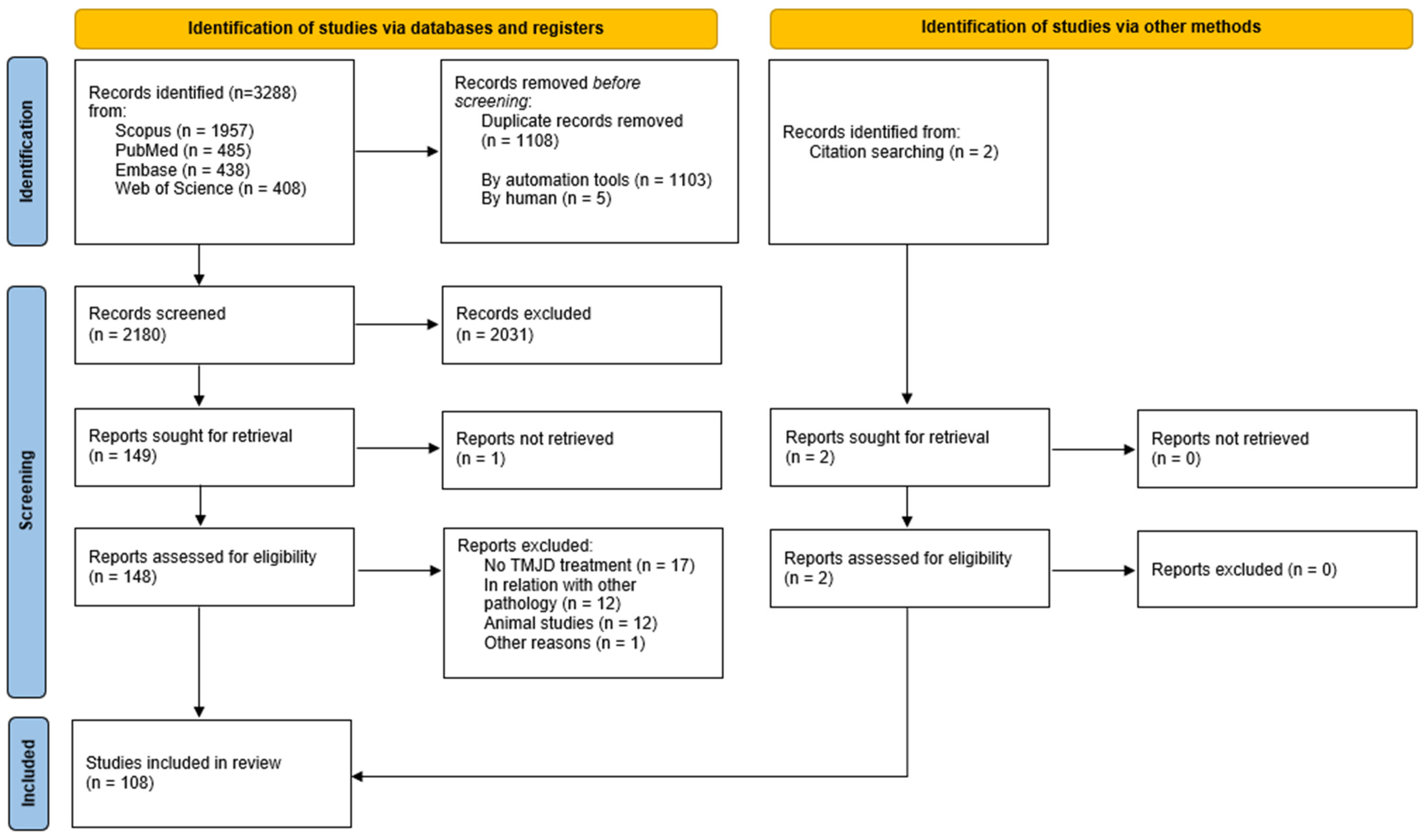
3.1. Literature Screening Process
3.2. Description of the Selected Studies
3.2.1. Study Characteristics
3.2.2. Treatment Approaches
Non-Invasive (Conservative) Approaches
- Cognitive–behavioral therapy (CBT) and counseling
- Physical therapy, MT, and exercises
- Other options
Minimally Invasive Approaches
- Arthrocentesis or intra-articular injections
- PRP, PRF, PRGF, PDGF, and stem cell therapy
- Acupuncture
- Botulinum toxin
- Drugs
- Laser and TENS
- Oral splints
Surgical Procedures
4. Discussion
5. Conclusions
- Initially, non-invasive methods such as cognitive–behavioral therapy, physical therapy, and exercises should be prioritized. If these approaches are not effective, minimally invasive treatments like arthrocentesis and intra-articular injections may be considered.
- Surgery should be reserved for severe cases, with conservative therapies used in conjunction with invasive procedures for optimal patient outcomes.
- Furthermore, there is a need for standardization and higher-quality research to further advance the field. Clinicians should stay updated on the latest findings and prioritize preventive measures to reduce the chronicity of TMDs.
Author Contributions
Funding
Institutional Review Board Statement
Informed Consent Statement
Data Availability Statement
Acknowledgments
Conflicts of Interest
References
- National Academies of Sciences, Engineering, and Medicine; Health and Medicine Division; Board on Health Care Services; Board on Health Sciences Policy; Committee on Temporomandibular Disorders (TMDs): From Research Discoveries to Clinical Treatment. Temporomandibular Disorders: Priorities for Research and Care; National Academies Press: Washington, DC, USA, 2020. [Google Scholar]
- Valesan, L.F.; Da-Cas, C.D.; Réus, J.C.; Denardin, A.C.S.; Garanhani, R.R.; Bonotto, D.; Januzzi, E.; de Souza, B.D.M. Prevalence of temporomandibular joint disorders: A systematic review and meta-analysis. Clin. Oral. Investig. 2021, 25, 441–453. [Google Scholar] [CrossRef]
- Minervini, G.; Franco, R.; Marrapodi, M.M.; Fiorillo, L.; Cervino, G.; Cicciù, M. Prevalence of temporomandibular disorders in children and adolescents evaluated with Diagnostic Criteria for Temporomandibular Disorders: A systematic review with meta-analysis. J. Oral. Rehabil. 2023, 50, 522–530. [Google Scholar] [CrossRef] [PubMed]
- Bueno, C.H.; Pereira, D.D.; Pattussi, M.P.; Grossi, P.K.; Grossi, M.L. Gender differences in temporomandibular disorders in adult populational studies: A systematic review and meta-analysis. J. Rehabil. 2018, 45, 720–729. [Google Scholar] [CrossRef] [PubMed]
- Shaefer, J.R.; Khawaja, S.N.; Bavia, P.F. Sex, Gender, and Orofacial Pain. Dent. Clin. N. Am. 2018, 62, 665–682. [Google Scholar] [CrossRef]
- Scariot, R.; Corso, P.F.C.L.; Sebastiani, A.M.; Vieira, A.R. The many faces of genetic contributions to temporomandibular joint disorder: An updated review. Orthod. Craniofac. Res. 2018, 21, 186–201. [Google Scholar] [CrossRef] [PubMed]
- Damasceno, Y.S.S.; Espinosa, D.G.; Normando, D. Is the extraction of third molars a risk factor for the temporomandibular disorders? A systematic review. Clin. Oral. Investig. 2020, 24, 3325–3334. [Google Scholar] [CrossRef] [PubMed]
- Al-Moraissi, E.A.; Wolford, L.M.; Perez, D.; Laskin, D.M.; Ellis, E., 3rd. Does Orthognathic Surgery Cause or Cure Temporomandibular Disorders? A Systematic Review and Meta-Analysis. J. Oral. Maxillofac. Surg. 2017, 75, 1835–1847. [Google Scholar] [CrossRef] [PubMed]
- Häggman-Henrikson, B.; Bechara, C.; Pishdari, B.; Visscher, C.M.; Ekberg, E. Impact of Catastrophizing in Patients with Temporomandibular Disorders-A Systematic Review. J. Oral. Facial Pain Headache 2020, 34, 379–397. [Google Scholar] [CrossRef] [PubMed]
- Oliveira Reis, L.; Ribeiro, R.A.; Martins, C.C.; Devito, K.L. Association between bruxism and temporomandibular disorders in children: A systematic review and meta-analysis. Int. J. Paediatr. Dent. 2019, 29, 585–595. [Google Scholar] [CrossRef]
- Pantoja, L.L.Q.; de Toledo, I.P.; Pupo, Y.M.; Porporatti, A.L.; De Luca Canto, G.; Zwir, L.F.; Guerra, E.N.S. Prevalence of degenerative joint disease of the temporomandibular joint: A systematic review. Clin. Oral. Investig. 2019, 23, 2475–2488. [Google Scholar] [CrossRef]
- De La Torre Canales, G.; Câmara-Souza, M.B.; Muñoz Lora, V.R.M.; Guarda-Nardini, L.; Conti, P.C.R.; Rodrigues Garcia, R.M.; Del Bel Cury, A.A.; Manfredini, D. Prevalence of psychosocial impairment in temporomandibular disorder patients: A systematic review. J. Oral. Rehabil. 2018, 45, 881–889. [Google Scholar] [CrossRef] [PubMed]
- Chen, Y.Y.; Fan, H.C.; Tung, M.C.; Chang, Y.K. The association between Parkinson’s disease and temporomandibular disorder. PLoS ONE 2019, 14, e0217763. [Google Scholar] [CrossRef] [PubMed]
- Shrivastava, M.; Battaglino, R.; Ye, L. A comprehensive review on biomarkers associated with painful temporomandibular disorders. Int. J. Oral. Sci. 2021, 13, 23. [Google Scholar] [CrossRef]
- Manfredini, D.; Lobbezoo, F. Sleep bruxism and temporomandibular disorders: A scoping review of the literature. J. Dent. 2021, 111, 103711. [Google Scholar] [CrossRef]
- Manfredini, D.; Thomas, D.C.; Lobbezoo, F. Temporomandibular Disorders Within the Context of Sleep Disorders. Dent. Clin. N. Am. 2023, 67, 323–334. [Google Scholar] [CrossRef]
- de Oliveira-Souza, A.I.S.; de O Ferro, J.K.; Barros, M.M.M.B.; Oliveira, D.A. Cervical musculoskeletal disorders in patients with temporomandibular dysfunction: A systematic review and meta-analysis. J. Bodyw. Mov. Ther. 2020, 24, 84–101. [Google Scholar] [CrossRef]
- Ayouni, I.; Chebbi, R.; Hela, Z.; Dhidah, M. Comorbidity between fibromyalgia and temporomandibular disorders: A systematic review. Oral. Surg. Oral. Med. Oral. Pathol. Oral. Radiol. 2019, 128, 33–42. [Google Scholar] [CrossRef] [PubMed]
- Réus, J.C.; Polmann, H.; Souza, B.D.M.; Flores-Mir, C.; Gonçalves, D.A.G.; de Queiroz, L.P.; Okeson, J.; De Luca Canto, G. Association between primary headaches and temporomandibular disorders: A systematic review and meta-analysis. J. Am. Dent. Assoc. 2022, 153, 120–131.e6. [Google Scholar] [CrossRef]
- Omidvar, S.; Jafari, Z. Association Between Tinnitus and Temporomandibular Disorders: A Systematic Review and Meta-Analysis. Ann. Otol. Rhinol. Laryngol. 2019, 128, 662–675. [Google Scholar] [CrossRef]
- Bitiniene, D.; Zamaliauskiene, R.; Kubilius, R.; Leketas, M.; Gailius, T.; Smirnovaite, K. Quality of life in patients with temporomandibular disorders. A systematic review. Stomatologija 2018, 20, 3–9. [Google Scholar]
- Pigozzi, L.B.; Pereira, D.D.; Pattussi, M.P.; Moret-Tatay, C.; Irigaray, T.Q.; Weber, J.B.B.; Grossi, P.K.; Grossi, M.L. Quality of life in young and middle age adult temporomandibular disorders patients and asymptomatic subjects: A systematic review and meta-analysis. Health Qual Life Outcomes 2021, 19, 83. [Google Scholar] [CrossRef] [PubMed]
- Greene, C.S.; Manfredini, D. Treating Temporomandibular Disorders in the 21st Century: Can We Finally Eliminate the “Third Pathway”? J. Oral. Facial Pain Headache 2020, 34, 206–216. [Google Scholar] [CrossRef] [PubMed]
- Freddi, G.; Romàn-Pumar, J.L. Evidence-based medicine: What it can and cannot do. Ann. Ist. Super. Sanita 2011, 47, 22–25. [Google Scholar] [CrossRef] [PubMed]
- Tricco, A.C.; Lillie, E.; Zarin, W.; O’Brien, K.K.; Colquhoun, H.; Levac, D.; Moher, D.; Peters, M.D.; Horsley, T.; Weeks, L.; et al. PRISMA extension for scoping reviews (PRISMA-ScR): Checklist and explanation. Ann. Intern. Med. 2018, 169, 467–473. [Google Scholar] [CrossRef] [PubMed]
- Page, M.J.; McKenzie, J.E.; Bossuyt, P.M.; Boutron, I.; Hoffmann, T.C.; Mulrow, C.D.; Shamseer, L.; Tetzlaff, J.M.; Akl, E.A.; Brennan, S.E.; et al. The PRISMA 2020 statement: An updated guideline for reporting systematic reviews. BMJ 2021, 372, n71. [Google Scholar] [CrossRef] [PubMed]
- Penlington, C.; Bowes, C.; Taylor, G.; Otemade, A.A.; Waterhouse, P.; Durham, J.; Ohrbach, R. Psychological therapies for temporomandibular disorders (TMDs). Cochrane Database Syst. Rev. 2022, 8, CD013515. [Google Scholar] [CrossRef]
- Thorpe, A.R.D.S.; Haddad, Y.; Hsu, J. A systematic review and meta-analysis of randomized controlled trials comparing arthrocentesis with conservative management for painful temporomandibular joint disorder. Int. J. Oral. Maxillofac. Surg. 2023, 52, 889–896. [Google Scholar] [CrossRef] [PubMed]
- Tournavitis, A.; Sandris, E.; Theocharidou, A.; Slini, T.; Kokoti, M.; Koidis, P.; Tortopidis, D. Effectiveness of conservative therapeutic modalities for temporomandibular disorders-related pain: A systematic review. Acta Odontol. Scand. 2023, 81, 286–297. [Google Scholar] [CrossRef] [PubMed]
- Kelemen, K.; König, J.; Czumbel, M.; Szabó, B.; Hegyi, P.; Gerber, G.; Borbély, J.; Mikulás, K.; Schmidt, P.; Hermann, P. Additional splint therapy has no superiority in myogenic temporomandibular disorders: A systematic review and meta-analysis of randomized controlled trials. J. Prosthodont. Res. 2024, 68, 12–19. [Google Scholar] [CrossRef]
- Al-Moraissi, E.A.; Farea, R.; Qasem, K.A.; Al-Wadeai, M.S.; Al-Sabahi, M.E.; Al-Iryani, G.M. Effectiveness of occlusal splint therapy in the management of temporomandibular disorders: Network meta-analysis of randomized controlled trials. Int. J. Oral. Maxillofac. Surg. 2020, 49, 1042–1056. [Google Scholar] [CrossRef]
- van der Meer, H.A.; Calixtre, L.B.; Engelbert, R.H.H.; Visscher, C.M.; Nijhuis-van der Sanden, M.W.; Speksnijder, C.M. Effects of physical therapy for temporomandibular disorders on headache pain intensity: A systematic review. Musculoskelet. Sci. Pract. 2020, 50, 102277. [Google Scholar] [CrossRef] [PubMed]
- de Melo, L.A.; de Medeiros, A.K.B.; Campos, M.D.F.T.P.; de Resende, C.M.B.M.; Barbosa, G.A.S.; de Almeida, E.O. Manual Therapy in the Treatment of Myofascial Pain Related to Temporomandibular Disorders: A Systematic Review. J. Oral. Facial Pain Headache 2020, 34, 141–148. [Google Scholar] [CrossRef] [PubMed]
- Al-Moraissi, E.A.; Conti, P.C.R.; Alyahya, A.; Alkebsi, K.; Elsharkawy, A.; Christidis, N. The hierarchy of different treatments for myogenous temporomandibular disorders: A systematic review and network meta-analysis of randomized clinical trials. Oral. Maxillofac. Surg. 2022, 26, 519–533. [Google Scholar] [CrossRef] [PubMed]
- Patel, J.; Cardoso, J.A.; Mehta, S. A systematic review of botulinum toxin in the management of patients with temporomandibular disorders and bruxism. Br. Dent. J. 2019, 226, 667–672. [Google Scholar] [CrossRef] [PubMed]
- La Touche, R.; Martínez García, S.; Serrano García, B.; Proy Acosta, A.; Adraos Juárez, D.; Fernández Pérez, J.J.; Angulo-Diaz-Parreno, S.; Cuenca-Martinez, F.; Paris-Alemany, A.; Suso-Marti, L. Effect of Manual Therapy and Therapeutic Exercise Applied to the Cervical Region on Pain and Pressure Pain Sensitivity in Patients with Temporomandibular Disorders: A Systematic Review and Meta-analysis. Pain. Med. 2020, 21, 2373–2384. [Google Scholar] [CrossRef] [PubMed]
- Lee, N.W.; Lee, S.H.; Kim, K.W.; Ha, I.H.; Cho, J.H.; Lee, Y.J. Effectiveness of Chuna (or Tuina) Manual Therapy for Temporomandibular Disorder: A Systematic Review. Altern. Ther. Health Med. 2023, 29, 258–268. [Google Scholar] [PubMed]
- Menéndez-Torre, Á.; Pintado-Zugasti, A.M.; Zaldivar, J.N.C.; García-Bermejo, P.; Gómez-Costa, D.; Molina-Álvarez, M.; Arribas-Romano, A.; Fernández-Carnero, J. Effectiveness of deep dry needling versus manual therapy in the treatment of myofascial temporomandibular disorders: A systematic review and network meta-analysis. Chiropr. Man. Ther. 2023, 31, 46. [Google Scholar] [CrossRef]
- Asquini, G.; Pitance, L.; Michelotti, A.; Falla, D. Effectiveness of manual therapy applied to craniomandibular structures in temporomandibular disorders: A systematic review. J. Oral. Rehabil. 2022, 49, 442–455. [Google Scholar] [CrossRef]
- Ferrillo, M.; Nucci, L.; Giudice, A.; Calafiore, D.; Marotta, N.; Minervini, G.; D’Apuzzo, F.; Ammendolia, A.; Perillo, L.; de Sire, A. Efficacy of conservative approaches on pain relief in patients with temporomandibular joint disorders: A systematic review with network meta-analysis. Cranio 2022, 1–17. [Google Scholar] [CrossRef]
- Herrera-Valencia, A.; Ruiz-Muñoz, M.; Martin-Martin, J.; Cuesta-Vargas, A.; González-Sánchez, M. Efficacy of manual therapy in temporomandibular joint disorders and its medium-and long-term effects on pain and maximum mouth opening: A systematic review and meta-analysis. J. Clin. Med. 2020, 9, 3404. [Google Scholar] [CrossRef]
- Ferrillo, M.; Ammendolia, A.; Paduano, S.; Calafiore, D.; Marotta, N.; Migliario, M.; Fortunato, L.; Giudice, A.; Michelotti, A.; de Sire, A. Efficacy of rehabilitation on reducing pain in muscle-related temporomandibular disorders: A systematic review and meta-analysis of randomized controlled trials. J. Back. Musculoskelet. Rehabil. 2022, 35, 921–936. [Google Scholar] [CrossRef] [PubMed]
- La Touche, R.; Boo-Mallo, T.; Zarzosa-Rodríguez, J.; Paris-Alemany, A.; Cuenca-Martínez, F.; Suso-Martí, L. Manual therapy and exercise in temporomandibular joint disc displacement without reduction. A systematic review. Cranio 2022, 40, 440–450. [Google Scholar] [CrossRef] [PubMed]
- Liberato, F.M.; da Silva, T.V.; Santuzzi, C.H.; de Oliveira, N.F.F.; Nascimento, L.R. Manual Therapy Applied to the Cervial Joint Reduces Pain and Improves Jaw Function in Individuals with Temporomandibular Disorders: A Systematic Review on Manual Therapy for Orofacial Disorders. J. Oral. Facial Pain Headache 2023, 37, 101–111. [Google Scholar] [CrossRef]
- González-Sánchez, B.; García Monterey, P.; Ramírez-Durán, M.D.V.; Garrido-Ardila, E.M.; Rodríguez-Mansilla, J.; Jiménez-Palomares, M. Temporomandibular Joint Dysfunctions: A Systematic Review of Treatment Approaches. J. Clin. Med. 2023, 12, 4156. [Google Scholar] [CrossRef] [PubMed]
- Lam, A.C.; Liddle, L.J.; MacLellan, C.L. The Effect of Upper Cervical Mobilization/Manipulation on Temporomandibular Joint Pain, Maximal Mouth Opening, and Pressure Pain Thresholds: A Systematic Review and Meta-Analysis. Arch. Rehabil. Res. Clin. Transl. 2023, 5, 100242. [Google Scholar] [CrossRef] [PubMed]
- Feng, J.; Luo, M.; Ma, J.; Tian, Y.; Han, X.; Bai, D. The treatment modalities of masticatory muscle pain a network meta-analysis. Medicine 2019, 98, e17934. [Google Scholar] [CrossRef] [PubMed]
- Al-Moraissi, E.A.; Almaweri, A.A.; Al-Tairi, N.H.; Alkhutari, A.S.; Grillo, R.; Christidis, N. Treatments for painful temporomandibular disc displacement with reduction: A network meta-analysis of randomized clinical trials. Int. J. Oral. Maxillofac. Surg. 2024, 53, 45–56. [Google Scholar] [CrossRef]
- Dinsdale, A.; Costin, B.; Dharamdasani, S.; Page, R.; Purs, N.; Treleaven, J. What conservative interventions improve bite function in those with temporomandibular disorders? A systematic review using self-reported and physical measures. J. Oral. Rehabil. 2022, 49, 456–475. [Google Scholar] [CrossRef]
- Argueta-Figueroa, L.; Flores-Mejía, L.A.; Ávila-Curiel, B.X.; Flores-Ferreyra, B.I.; Torres-Rosas, R. Nonpharmacological Interventions for Pain in Patients with Temporomandibular Joint Disorders: A Systematic Review. Eur. J. Dent. 2022, 16, 500–513. [Google Scholar] [CrossRef]
- Al-Moraissi, E.A.; Wolford, L.M.; Ellis, E., 3rd; Neff, A. The hierarchy of different treatments for arthrogenous temporomandibular disorders: A network meta-analysis of randomized clinical trials. J. Craniomaxillofac. Surg. 2020, 48, 9–23. [Google Scholar] [CrossRef]
- Idáñez-Robles, A.M.; Obrero-Gaitán, E.; Lomas-Vega, R.; Osuna-Pérez, M.C.; Cortés-Pérez, I.; Zagalaz-Anula, N. Exercise therapy improves pain and mouth opening in temporomandibular disorders: A systematic review with meta-analysis. Clin. Rehabil. 2023, 37, 443–461. [Google Scholar] [CrossRef] [PubMed]
- Melis, M.; Di Giosia, M.; Zawawi, K.H. Oral myofunctional therapy for the treatment of temporomandibular disorders: A systematic review. Cranio 2022, 40, 41–47. [Google Scholar] [CrossRef] [PubMed]
- Ávila-Curiel, B.X.; Gómez-Aguirre, J.N.; Gijón-Soriano, A.L.; Acevedo-Mascarúa, A.E.; Argueta-Figueroa, L.; Torres-Rosas, R. Complementary interventions for pain in patients with temporomandibular joint disorders: A systematic review. Int. J. Acupunct. 2020, 14, 151–159. [Google Scholar] [CrossRef]
- Torres-Rosas, R.; Marcela Castro-Gutiérrez, M.E.; Flores-Mejía, L.A.; Torres-Rosas, E.U.; Nieto-García, R.M.; Argueta-Figueroa, L. Ozone for the treatment of temporomandibular joint disorders: A systematic review and meta-analysis. Med. Gas. Res. 2023, 13, 149–154. [Google Scholar] [CrossRef] [PubMed]
- Chęciński, M.; Chęcińska, K.; Nowak, Z.; Sikora, M.; Chlubek, D. Treatment of Mandibular Hypomobility by Injections into the Temporomandibular Joints: A Systematic Review of the Substances Used. J. Clin. Med. 2022, 11, 2305. [Google Scholar] [CrossRef] [PubMed]
- Liu, G.F.; Gao, Z.; Liu, Z.N.; Yang, M.; Zhang, S.; Tan, T.P. Effects of Warm Needle Acupuncture on Temporomandibular Joint Disorders: A Systematic Review and Meta-Analysis of Randomized Controlled Trials. Evid. Based Complement. Altern. Med. 2021, 2021, 6868625. [Google Scholar] [CrossRef] [PubMed]
- Guarda-Nardini, L.; De Almeida, A.M.; Manfredini, D. Arthrocentesis of the Temporomandibular Joint: Systematic Review and Clinical Implications of Research Findings. J. Oral Facial Pain Headache 2021, 35, 17–29. [Google Scholar] [CrossRef]
- Hu, Y.; Liu, S.; Fang, F. Arthrocentesis vs. conservative therapy for the management of TMJ disorders: A systematic review and meta-analysis. J. Stomatol. Oral. Maxillofac. Surg. 2023, 124, 101283. [Google Scholar] [CrossRef]
- Tang, Y.; van Bakelen, N.; Gareb, B.; Spijkervet, F. Arthroscopy versus arthrocentesis and versus conservative treatments for temporomandibular joint disorders: A systematic review with meta-analysis and trial sequential analysis. Int. J. Oral. Maxillofac. Surg. 2024, 53, 503–520. [Google Scholar] [CrossRef]
- Nagori, S.A.; Bansal, A.; Jose, A.; Roychoudhury, A. Comparison of outcomes with the single-puncture and double-puncture techniques of arthrocentesis of the temporomandibular joint: An updated systematic review and meta-analysis. J. Oral. Rehabil. 2021, 48, 1056–1065. [Google Scholar] [CrossRef]
- Li, J.; Zhang, Z.; Han, N. Diverse therapies for disc displacement of temporomandibular joint: A systematic review and network meta-analysis. Br. J. Oral. Maxillofac. Surg. 2022, 60, 1012–1022. [Google Scholar] [CrossRef]
- Nogueira, E.F.C.; Lemos, C.A.A.; Vasconcellos, R.J.H.; Moraes, S.L.D.; Vasconcelos, B.C.E.; Pellizzer, E.P. Does arthroscopy cause more complications than arthrocentesis in patients with internal temporomandibular joint disorders? Systematic review and meta-analysis. Br. J. Oral. Maxillofac. Surg. 2021, 59, 1166–1173. [Google Scholar] [CrossRef] [PubMed]
- Nemeth, A.; Gurgel, B.V.; Lowenstein, A.; Juliasse, L.; Siroma, R.S.; Zhu, Z.; Shibli, J.A.; Mourão, C.F. Does Liquid/Injectable Platelet-Rich Fibrin Help in the Arthrocentesis Treatment of Temporomandibular Joint Disorder Compared to Other Infusion Options? A Systematic Review of Randomized Clinical Trials. Bioengineering 2024, 11, 247. [Google Scholar] [CrossRef] [PubMed]
- Goker, F.; Russillo, A.; Taschieri, S.; Giannì, A.B.; Mortellaro, C.; Colletti, L.; Manfredi, B.; Rovati, M.; Biagi, R.; Del Fabbroet, M. Evaluation of Arthrocentesis with hyaluronic acid injections for management of temporomandibular disorders: A systematic review and case series. J. Biol. Regul. Homeost. Agents 2021, 35, 21–35. [Google Scholar] [CrossRef] [PubMed]
- Ulmner, M.; Bjørnland, T.; Rosén, A.; Berge, T.I.; Olsen-Bergem, H.; Lund, B. Evidence for minimally invasive treatment-A systematic review on surgical management of disc displacement. J. Oral. Rehabil. 2024, 5, 1061–1080. [Google Scholar] [CrossRef] [PubMed]
- Gutiérrez, I.Q.; Sábado-Bundó, H.; Gay-Escoda, C. Intraarticular injections of platelet rich plasma and plasma rich in growth factors with arthrocenthesis or arthroscopy in the treatment of temporomandibular joint disorders: A systematic review. J. Stomatol. Oral. Maxillofac. Surg. 2022, 123, e327–e335. [Google Scholar] [CrossRef]
- Nagori, S.A.; Jose, A.; Roy Chowdhury, S.K.; Roychoudhury, A. Is splint therapy required after arthrocentesis to improve outcome in the management of temporomandibular joint disorders? A systematic review and meta-analysis. Oral. Surg. Oral. Med. Oral. Pathol. Oral. Radiol. 2019, 127, 97–105. [Google Scholar] [CrossRef] [PubMed]
- Liu, Y.; Wu, J.S.; Tang, Y.L.; Tang, Y.J.; Fei, W.; Liang, X.H. Multiple Treatment Meta-Analysis of Intra-Articular Injection for Temporomandibular Osteoarthritis. J. Oral. Maxillofac. Surg. 2020, 78, 373.e1–373.e18. [Google Scholar] [CrossRef] [PubMed]
- Haddad, C.; Zoghbi, A.; El Skaff, E.; Touma, J. Platelet-rich plasma injections for the treatment of temporomandibular joint disorders: A systematic review. J. Oral. Rehabil. 2023, 50, 1330–1339. [Google Scholar] [CrossRef]
- Siewert-Gutowska, M.; Pokrowiecki, R.; Kamiński, A.; Zawadzki, P.; Stopa, Z. State of the Art in Temporomandibular Joint Arthrocentesis—A Systematic Review. J. Clin. Med. 2023, 12, 4439. [Google Scholar] [CrossRef]
- Li, D.T.S.; Wong, N.S.M.; Li, S.K.Y.; McGrath, C.P.; Leung, Y.Y. Timing of arthrocentesis in the management of temporomandibular disorders: An integrative review and meta-analysis. Int. J. Oral. Maxillofac. Surg. 2021, 50, 1078–1088. [Google Scholar] [CrossRef] [PubMed]
- Abrahamsson, H.; Eriksson, L.; Abrahamsson, P.; Häggman-Henrikson, B. Treatment of temporomandibular joint luxation: A systematic literature review. Clin. Oral. Investig. 2020, 24, 61–70. [Google Scholar] [CrossRef] [PubMed]
- Agostini, F.; Ferrillo, M.; Bernetti, A.; Finamore, N.; Mangone, M.; Giudice, A.; Paoloni, M.; de Sire, A. Hyaluronic acid injections for pain relief and functional improvement in patients with temporomandibular disorders: An umbrella review of systematic reviews. J. Oral. Rehabil. 2023, 50, 1518–1534. [Google Scholar] [CrossRef] [PubMed]
- Xu, J.; Ren, H.; Zhao, S.; Li, Q.; Li, C.; Bao, G.; Kang, H. Comparative effectiveness of hyaluronic acid, platelet-rich plasma, and platelet-rich fibrin in treating temporomandibular disorders: A systematic review and network meta-analysis. Head Face Med. 2023, 19, 39. [Google Scholar] [CrossRef] [PubMed]
- Li, F.; Wu, C.; Sun, H.; Zhou, Q. Effect of Platelet-Rich Plasma Injections on Pain Reduction in Patients with Temporomandibular Joint Osteoarthrosis: A Meta-Analysis of Randomized Controlled Trials. J. Oral. Facial Pain Headache 2020, 34, 149–156. [Google Scholar] [CrossRef] [PubMed]
- Quezada, D.L.; López, C.L.; Montini, F.C.; Skarmeta, N.P. Effectiveness of intra-articular infiltration of platelet concentrates for the treatment of painful joint disorders in the temporomandibular joint: A systematic review. Med. Oral. Patol. Oral. Cir. Bucal 2024, 29, 25658. [Google Scholar] [CrossRef] [PubMed]
- Xie, Y.; Zhao, K.; Ye, G.; Yao, X.; Yu, M.; Ouyang, H. Effectiveness of Intra-Articular Injections of Sodium Hyaluronate, Corticosteroids, Platelet-Rich Plasma on Temporomandibular Joint Osteoarthritis: A Systematic Review and Network Meta-Analysis of Randomized Controlled Trials. J. Evid. Based Dent. Pract. 2022, 22, 101720. [Google Scholar] [CrossRef] [PubMed]
- Chung, P.Y.; Lin, M.T.; Chang, H.P. Effectiveness of platelet-rich plasma injection in patients with temporomandibular joint osteoarthritis: A systematic review and meta-analysis of randomized controlled trials. Oral. Surg. Oral. Med. Oral. Pathol. Oral. Radiol. 2019, 127, 106–116. [Google Scholar] [CrossRef] [PubMed]
- Liapaki, A.; Thamm, J.R.; Ha, S.; Monteiro, J.L.G.C.; McCain, J.P.; Troulis, M.J.; Guastaldi, F.P.S. Is there a difference in treatment effect of different intra-articular drugs for temporomandibular joint osteoarthritis? A systematic review of randomized controlled trials. Int. J. Oral. Maxillofac. Surg. 2021, 50, 1233–1243. [Google Scholar] [CrossRef]
- Derwich, M.; Mitus-Kenig, M.; Pawlowska, E. Mechanisms of Action and Efficacy of Hyaluronic Acid, Corticosteroids and Platelet-Rich Plasma in the Treatment of Temporomandibular Joint Osteoarthritis-A Systematic Review. Int. J. Mol. Sci. 2021, 22, 7405. [Google Scholar] [CrossRef]
- Christidis, N.; Al-Moraissi, E.A.; Barjandi, G.; Svedenlöf, J.; Jasim, H.; Christidis, M.; Collin, M. Pharmacological Treatments of Temporomandibular Disorders: A Systematic Review Including a Network Meta-Analysis. Drugs 2024, 84, 59–81. [Google Scholar] [CrossRef]
- Chęciński, M.; Chęcińska, K.; Turosz, N.; Kamińska, M.; Nowak, Z.; Sikora, M.; Chlubek, D. Autologous Stem Cells Transplants in the Treatment of Temporomandibular Joints Disorders: A Systematic Review and Meta-Analysis of Clinical Trials. Cells 2022, 11, 2709. [Google Scholar] [CrossRef]
- López, J.P.; Orjuela, M.P.; González, L.V.; Peraza-Labrador, A.J.; Díaz-Baez, D. Comparison of the Clinical Effectiveness of Intra-Articular Injection with Different Substances After TMJ Arthroscopy: A Systematic Review and Meta-Analysis. J. Maxillofac. Oral. Surg. 2024, 23, 261–270. [Google Scholar] [CrossRef]
- Chęciński, M.; Chęcińska, K.; Rąpalska, I.; Turosz, N.; Chlubek, D.; Sikora, M. Autologous Blood Injections in Temporomandibular Hypermobility: A Systematic Review. J. Clin. Med. 2023, 12, 5590. [Google Scholar] [CrossRef]
- Al-Hamed, F.S.; Hijazi, A.; Gao, Q.; Badran, Z.; Tamimi, F. Platelet Concentrate Treatments for Temporomandibular Disorders: A Systematic Review and Meta-analysis. JDR Clin. Trans. Res. 2021, 6, 174–183. [Google Scholar] [CrossRef]
- Di Francesco, F.; Minervini, G.; Siurkel, Y.; Cicciù, M.; Lanza, A. Efficacy of acupuncture and laser acupuncture in temporomandibular disorders: A systematic review and meta-analysis of randomized controlled trials. BMC Oral. Health 2024, 24, 174. [Google Scholar] [CrossRef]
- Park, E.Y.; Cho, J.H.; Lee, S.H.; Kim, K.W.; Ha, I.H.; Lee, Y.J. Is acupuncture an effective treatment for temporomandibular disorder?: A systematic review and meta-analysis of randomized controlled trials. Medicine 2023, 102, e34950. [Google Scholar] [CrossRef]
- Peixoto, K.O.; Abrantes, P.S.; De Carvalho, I.H.G.; De Almeida, E.O.; Barbosa, G.A.S. Temporomandibular disorders and the use of traditional and laser acupuncture: A systematic review. Cranio 2023, 41, 501–507. [Google Scholar] [CrossRef]
- Mohamad, N.; de Oliveira-Souza, A.I.S.; de Castro-Carletti, E.M.; Müggenborg, F.; Dennett, L.; McNeely, M.L.; Armijo-Olivo, S. The effectiveness of different types of acupuncture to reduce symptoms and disability for patients with orofacial pain. A systematic review and meta-analysis. Disabil. Rehabil. 2024, 1–17. [Google Scholar] [CrossRef]
- Thambar, S.; Kulkarni, S.; Armstrong, S.; Nikolarakos, D. Botulinum toxin in the management of temporomandibular disorders: A systematic review. Br. J. Oral. Maxillofac. Surg. 2020, 58, 508–519. [Google Scholar] [CrossRef] [PubMed]
- Machado, D.; Martimbianco, A.L.C.; Bussadori, S.K.; Pacheco, R.L.; Riera, R.; Santos, E.M. Botulinum Toxin Type A for Painful Temporomandibular Disorders: Systematic Review and Meta-Analysis. J. Pain 2020, 21, 281–293. [Google Scholar] [CrossRef] [PubMed]
- Li, K.; Tan, K.; Yacovelli, A.; Bi, W.G. Effect of botulinum toxin type A on muscular temporomandibular disorder: A systematic review and meta-analysis of randomized controlled trials. J. Oral. Rehabil. 2024, 51, 886–897. [Google Scholar] [CrossRef] [PubMed]
- Ramos-Herrada, R.M.; Arriola-Guillén, L.E.; Atoche-Socola, K.J.; Bellini-Pereira, S.A.; Castillo, A.A.D. Effects of botulinum toxin in patients with myofascial pain related to temporomandibular joint disorders: A systematic review. Dent. Med. Probl. 2022, 59, 271–280. [Google Scholar] [CrossRef] [PubMed]
- El-Kahky, A.M.; Hamdy, T.A.H.; El-Tantawy, M.E.S.A.; Askoura, A.M. Meta Analytical Study of the Role of Intramuscular Botulinum A Toxin Injection in the Treatment of Temporomandibular Joint (TMJ) Disorders. Egypt J. Ear Nose Throat Allied Sci. 2022, 23, 1–18. [Google Scholar] [CrossRef]
- Saini, R.S.; Almoyad, M.A.A.; Binduhayyim, R.I.H.; Quadri, S.A.; Gurumurthy, V.; Bavabeedu, S.S.; Kuruniyan, M.S.; Naseef, P.P.; Mosaddad, S.A.; Heboyan, A. The effectiveness of botulinum toxin for record temporomandibular disorders: A systematic review and meta-analysis. PLoS ONE 2024, 19, e0300157. [Google Scholar] [CrossRef] [PubMed]
- Derwich, M.; Górski, B.; Amm, E.; Pawłowska, E. Oral Glucosamine in the Treatment of Temporomandibular Joint Osteoarthritis: A Systematic Review. Int. J. Mol. Sci. 2023, 24, 4925. [Google Scholar] [CrossRef] [PubMed]
- Minervini, G.; Franco, R.; Crimi, S.; Di Blasio, M.; D’Amico, C.; Ronsivalle, V.; Cervino, G.; Bianchi, A.; Cicciu, M. Pharmacological therapy in the management of temporomandibular disorders and orofacial pain: A systematic review and meta-analysis. BMC Oral. Health 2024, 24, 78. [Google Scholar] [CrossRef]
- Kulkarni, S.; Thambar, S.; Arora, H. Evaluating the effectiveness of non-steroidal anti-inflammatory drugs (nsaids)for relief of pain associated with temporomandibular joint disorders: A systematic review. Int. J. Oral. Maxillofac. Surg. 2019, 48, 285. [Google Scholar] [CrossRef] [PubMed]
- Montinaro, F.; Nucci, L.; d’Apuzzo, F.; Perillo, L.; Chiarenza, M.C.; Grassia, V. Oral nonsteroidal anti-inflammatory drugs as treatment of joint and muscle pain in temporomandibular disorders: A systematic review. Cranio 2022, 1–10. [Google Scholar] [CrossRef]
- Srinivasulu, Y.; Wahab, A.; Senthil Murugan, P. Comparison of efficacy of amitryptyline and duloxetine sodium in reduction of pain in temporomandibular joint disorder (Tmd) patients-a systematic review. Int. J. Pharm. Res. 2020, 12, 2315–2325. [Google Scholar] [CrossRef]
- Ruiz-Romero, V.; Toledano-Serrabona, J.; Gay-Escoda, C. Efficacy of the use of chondroitin sulphate and glucosamine for the treatment of temporomandibular joint dysfunction: A systematic review and meta-analysis. Cranio 2022, 1–10. [Google Scholar] [CrossRef]
- Ren, H.; Liu, J.; Liu, Y.; Yu, C.; Bao, G.; Kang, H. Comparative effectiveness of low-level laser therapy with different wavelengths and transcutaneous electric nerve stimulation in the treatment of pain caused by temporomandibular disorders: A systematic review and network meta-analysis. J. Oral. Rehabil. 2022, 49, 138–149. [Google Scholar] [CrossRef]
- Jing, G.; Zhao, Y.; Dong, F.; Zhang, P.; Ren, H.; Liu, J.; Liu, Y.; Yu, C.; Hu, J.; Bao, G.; et al. Effects of different energy density low-level laser therapies for temporomandibular joint disorders patients: A systematic review and network meta-analysis of parallel randomized controlled trials. Lasers Med. Sci. 2021, 36, 1101–1108. [Google Scholar] [CrossRef]
- Máximo, C.F.G.P.; Coêlho, J.F.; Benevides, S.D.; Alves, G.Â.D.S. Effects of low-level laser photobiomodulation on the masticatory function and mandibular movements in adults with temporomandibular disorder: A systematic review with meta-analysis. Codas 2022, 34, e20210138. [Google Scholar] [CrossRef]
- da Silva Mira, P.C.; Biagini, A.C.S.C.F.; Gomes, M.G.; Galo, R.; Corona, S.A.M.; Borsatto, M.C. Laser acupuncture to reduce temporomandibular disorder (TMD) symptoms: Systematic review and meta-analysis. Lasers Med. Sci. 2024, 39, 66. [Google Scholar] [CrossRef]
- Ahmad, S.A.; Hasan, S.; Saeed, S.; Khan, A.; Khan, M. Low-level laser therapy in temporomandibular joint disorders: A systematic review. J. Med. Life 2021, 14, 148–164. [Google Scholar] [CrossRef]
- Fertout, A.; Manière-Ezvan, A.; Lupi, L.; Ehrmann, E. Management of temporomandibular disorders with transcutaneous electrical nerve stimulation: A systematic review. Cranio 2022, 40, 217–228. [Google Scholar] [CrossRef]
- Serrano-Muñoz, D.; Beltran-Alacreu, H.; Martín-Caro Álvarez, D.; Fernández-Pérez, J.J.; Aceituno-Gómez, J.; Arroyo-Fernández, R.; Avendaño-Coy, J. Effectiveness of Different Electrical Stimulation Modalities for Pain and Masticatory Function in Temporomandibular Disorders: A Systematic Review and Meta-Analysis. J. Pain. 2023, 24, 946–956. [Google Scholar] [CrossRef]
- de Castro-Carletti, E.M.; Müggenborg, F.; Dennett, L.; de Oliveira-Souza, A.I.S.; Mohamad, N.; Pertille, A.; Rodrigues-Bigaton, D.; Armijo-Olivo, S. Effectiveness of electrotherapy for the treatment of orofacial pain: A systematic review and meta-analysis. Clin. Rehabil. 2023, 37, 891–926. [Google Scholar] [CrossRef] [PubMed]
- Wu, X.; Zhu, J.; Zheng, B.; Liu, J.; Wu, Z. Effectiveness of low-level gallium aluminium arsenide laser therapy for temporomandibular disorder with myofascial pain A systemic review and meta-analysis. Medicine 2021, 100, e28015. [Google Scholar] [CrossRef] [PubMed]
- Zwiri, A.; Alrawashdeh, M.A.; Khan, M.; Ahmad, W.M.A.W.; Kassim, N.K.; Ahmed Asif, J.; Phaik, K.S.; Husein, A.; Ab-Ghani, Z. Effectiveness of the Laser Application in Temporomandibular Joint Disorder: A Systematic Review of 1172 Patients. Pain Res. Manag. 2020, 2020, 5971032. [Google Scholar] [CrossRef]
- Zhang, Y.; Qian, Y.; Huo, K.; Liu, J.; Huang, X.; Bao, J. Efficacy of laser therapy for temporomandibular disorders: A systematic review and meta-analysis. Complement. Ther. Med. 2023, 74, 102945. [Google Scholar] [CrossRef]
- de França, A.M.P.; Gonçalves Borges, A.; Boff Daitx, R.; Ferrer, R.M.; Baptista Dohnert, M.; Durigan, J.L.Q. Photobiomodulation in temporomandibular dysfunction: A systematic review. Muscles Ligaments Tendons J. 2021, 11, 463–474. [Google Scholar] [CrossRef]
- Farshidfar, N.; Farzinnia, G.; Samiraninezhad, N.; Assar, S.; Firoozi, P.; Rezazadeh, F.; Hakimiha, N. The Effect of Photobiomodulation on Temporomandibular Pain and Functions in Patients With Temporomandibular Disorders: An Updated Systematic Review of the Current Randomized Controlled Trials. J. Lasers Med. Sci. 2023, 14, e24. [Google Scholar] [CrossRef]
- Alkhutari, A.S.; Alyahya, A.; Rodrigues Conti, P.C.; Christidis, N.; Al-Moraissi, E.A. Is the therapeutic effect of occlusal stabilization appliances more than just placebo effect in the management of painful temporomandibular disorders? A network meta-analysis of randomized clinical trials. J. Prosthet. Dent. 2021, 126, 24–32. [Google Scholar] [CrossRef]
- Muresanu, S.A.; Hedesiu, M.; Dinu, C.; Roman, R.; Almasan, O. Digital occlusal splints for temporomandibular joint disorders: A systematic review. Rom. J. Stomatol. 2022, 68, 97–105. [Google Scholar] [CrossRef]
- Michiels, S.; Nieste, E.; Van de Heyning, P.; Braem, M.; Visscher, C.; Topsakal, V.; Gilles, A.; Jacquemin, L.; De Hertogh, W. Does conservative temporomandibular therapy affect tinnitus complaints? A systematic review. J. Orofac. Pain. 2019, 33, 308–317. [Google Scholar] [CrossRef]
- Hidalgo Ordoñez, S.; Mora Rojas, M.; Velásquez Ron, B. Effect of occlusal splints on temporomandibular dysfunctions: Systematic review. Av. Odontoestomatol. 2021, 37, 67–77. [Google Scholar] [CrossRef]
- Maheshwari, K.; Srinivasan, R.; Singh, B.P.; Tiwari, B.; Kirubakaran, R. Effectiveness of anterior repositioning splint versus other occlusal splints in the management of temporomandibular joint disc displacement with reduction: A meta-analysis. J. Indian. Prosthodont. Soc. 2024, 24, 15–24. [Google Scholar] [CrossRef] [PubMed]
- Zhang, L.; Xu, L.; Wu, D.; Yu, C.; Fan, S.; Cai, B. Effectiveness of exercise therapy versus occlusal splint therapy for the treatment of painful temporomandibular disorders: A systematic review and meta-analysis. Ann. Palliat. Med. 2021, 10, 6122–6132. [Google Scholar] [CrossRef] [PubMed]
- Honnef, L.R.; Pauletto, P.; Conti Réus, J.; Massignan, C.; Souza, B.D.M.D.; Michelotti, A.; Flores-Mir, C.; De Luca Canto, G. Effects of stabilization splints on the signs and symptoms of temporomandibular disorders of muscular origin: A systematic review. Cranio 2022, 1–12. [Google Scholar] [CrossRef] [PubMed]
- Zhang, S.H.; He, K.X.; Lin, C.J.; Liu, X.D.; Wu, L.; Chen, J.; Rausch-Fan, X. Efficacy of occlusal splints in the treatment of temporomandibular disorders: A systematic review of randomized controlled trials. Acta Odontol. Scand. 2020, 78, 580–589. [Google Scholar] [CrossRef]
- Fouda, A.A.H. No evidence on the effectiveness of oral splints for the management of temporomandibular joint dysfunction pain in both short and long-term follow-up systematic reviews and meta-analysis studies. J. Korean Assoc. Oral. Maxillofac. Surg. 2020, 46, 87–98. [Google Scholar] [CrossRef] [PubMed]
- Riley, P.; Glenny, A.M.; Worthington, H.V.; Jacobsen, E.; Robertson, C.; Durham, J.; Davies, S.; Petersen, H.; Boyers, D. Oral splints for patients with temporomandibular disorders or bruxism: A systematic review and economic evaluation. Health Technol. Assess. 2020, 24, 1–224. [Google Scholar] [CrossRef] [PubMed]
- Lima, F.G.G.P.; Rios, L.G.C.; Paranhos, L.R.; Vieira, W.A.; Zanetta-Barbosa, D. Survival of temporomandibular total joint replacement: A systematic review and meta-analysis. J. Oral. Rehabil. 2024, 51, 775–784. [Google Scholar] [CrossRef]
- Yaseen, M.; Abdulqader, D.; Audi, K.; Ng, M.; Audi, S.; Vaderhobli, R.M. Temporomandibular Total Joint Replacement Implant Devices: A Systematic Review of Their Outcomes. J. Long-Term Eff. Med. Implants 2021, 31, 91–98. [Google Scholar] [CrossRef] [PubMed]
- Rodhen, R.M.; de Holanda, T.A.; Barbon, F.J.; de Oliveira da Rosa, W.L.; Boscato, N. Invasive surgical procedures for the management of internal derangement of the temporomandibular joint: A systematic review and meta-analysis regarding the effects on pain and jaw mobility. Clin. Oral. Investig. 2022, 26, 3429–3446. [Google Scholar] [CrossRef] [PubMed]
- López, J.P.; Orjuela, M.P.; Díaz-Baez, D.; González, L.V. Comparison of the TMJ arthroscopy discopexy techniques: A systematic review and meta-analysis. J. Craniomaxillofac. Surg. 2024, 52, 558–564. [Google Scholar] [CrossRef] [PubMed]
- Marlière, D.A.A.; Vicentin Calori, M.J.A.; Medeiros, Y.D.L.; Santiago, R.C.; Strujak, G.; Asprino, L. Clinical outcomes of the discopexy using suture anchors for repositioning disc displacement in temporomandibular joints: Systematic review and meta-analysis. J. Craniomaxillofac. Surg. 2023, 51, 475–484. [Google Scholar] [CrossRef]
- Gonzalez, L.V.; López, J.P.; Orjuela, M.P.; Mejía, M.; Gallo-Orjuela, D.M.; Granizo López, R.M. Diagnosis and management of temporomandibular joint synovial chondromatosis: A systematic review. J. CranioMaxillofac. Surg. 2023, 51, 551–559. [Google Scholar] [CrossRef]
- Mittal, N.; Goyal, M.; Sardana, D.; Dua, J.S. Outcomes of surgical management of TMJ ankylosis: A systematic review and meta-analysis. J. CranioMaxillofac. Surg. 2019, 47, 1120–1133. [Google Scholar] [CrossRef] [PubMed]
- Askar, H.; Aronovich, S.; Christensen, B.J.; McCain, J.; Hakim, M. Is Arthroscopic Disk Repositioning Equally Efficacious to Open Disk Repositioning? A Systematic Review. J. Oral. Maxillofac. Surg. 2021, 79, 2030–2041.e2. [Google Scholar] [CrossRef] [PubMed]
- Slade, G.D.; Fillingim, R.B.; Sanders, A.E.; Bair, E.; Greenspan, J.D.; Ohrbach, R.; Dubner, R.; Diatchenko, L.; Smith, S.B.; Knott, C.; et al. Summary of findings from the OPPERA prospective cohort study of incidence of first-onset temporomandibular disorder: Implications and future directions. J. Pain. 2013, 14 (Suppl. S12), T116–T124. [Google Scholar] [CrossRef] [PubMed]
- Maixner, W.; Diatchenko, L.; Dubner, R.; Fillingim, R.B.; Greenspan, J.D.; Knott, C.; Ohrbach, R.; Weir, B.; Slade, G.D. Orofacial pain prospective evaluation and risk assessment study—The OPPERA study. J. Pain. 2011, 12 (Suppl. S11), T4–T11.e2. [Google Scholar] [CrossRef] [PubMed]
- Suvinen, T.I.; Reade, P.C.; Kemppainen, P.; Könönen, M.; Dworkin, S.F. Review of aetiological concepts of temporomandibular pain disorders: Towards a biopsychosocial model for integration of physical disorder factors with psychological and psychosocial illness impact factors. Eur. J. Pain 2005, 9, 613–633. [Google Scholar] [CrossRef]
- Aranha, R.L.B.; Martins, R.C.; de Aguilar, D.R.; Moreno-Drada, J.A.; Sohn, W.; Martins, C.C.; de Abreu, M.H.N.G. Association between Stress at Work and Temporomandibular Disorders: A Systematic Review. Biomed. Res. Int. 2021, 2021, 2055513. [Google Scholar] [CrossRef] [PubMed]
- Dreweck, F.D.S.; Soares, S.; Duarte, J.; Conti, P.C.R.; De Luca Canto, G.; Luís Porporatti, A. Association between painful temporomandibular disorders and sleep quality: A systematic review. J. Oral. Rehabil. 2020, 47, 1041–1051. [Google Scholar] [CrossRef] [PubMed]
- Roithmann, C.C.; Silva, C.A.G.D.; Pattussi, M.P.; Grossi, M.L. Subjective sleep quality and temporomandibular disorders: Systematic literature review and meta-analysis. J. Oral. Rehabil. 2021, 48, 1380–1394. [Google Scholar] [CrossRef]
- Kapos, F.P.; Exposto, F.G.; Oyarzo, J.F.; Durham, J. Temporomandibular disorders: A review of current concepts in aetiology, diagnosis and management. Oral. Surg. 2020, 13, 321–334. [Google Scholar] [CrossRef]
- Chan, N.H.Y.; Ip, C.K.; Li, D.T.S.; Leung, Y.Y. Diagnosis and Treatment of Myogenous Temporomandibular Disorders: A Clinical Update. Diagnostics 2022, 12, 2914. [Google Scholar] [CrossRef]


| Database | Search Strategy | Number of Results |
|---|---|---|
| Scopus | (TITLE-ABS-KEY (“temporomandibular joint disorder”) OR TITLE-ABS-KEY(“temporomandibular joint disease”) AND TITLE-ABS-KEY(“treatment”)) AND PUBYEAR > 2018 AND PUBYEAR < 2025 | 1957 |
| PubMed | ((“temporomandibular joint disorder” [MeSH Terms] OR (“temporomandibular” [All Fields] AND “joint disease” [MeSH Terms])) AND “therapeutics” [MeSH Terms]) AND (2019:2024[pdat]) | 485 |
| Embase | (‘temporomandibular joint disorder’: ti,ab,kw OR ‘temporomandibular joint disease’: ti,ab,kw) AND ‘treatment’: ti,ab,kw AND [2019–2024]/py | 438 |
| Web of Science | ((TS = (“temporomandibular joint disorder ”)) OR TS = (“temporomandibular joint disease ”)) AND TS = (“treatment”) | 408 |
| Treatment | References | |
|---|---|---|
| Non-invasive approach (n = 39) | Cognitive–behavioral therapy and counseling (n = 8) | [27,28,29,30,31,32,33,34] |
| Physical therapy, manual therapy, and exercises (n = 25) | [28,29,30,32,33,34,35,36,37,38,39,40,41,42,43,44,45,46,47,48,49,50,51,52,53] | |
| Oxygen–ozone (O2O3) therapy (n = 5) | [34,40,54,55,56] | |
| Ultrasonic therapy (n = 1) | [57] | |
| Minimally invasive approach (n = 120) | Arthrocentesis and Intra-articular injections (n = 23) | [28,38,43,48,51,58,59,60,61,62,63,64,65,66,67,68,69,70,71,72,73,74] |
| PRP, PRF, PRGF, PDGF, and stem cell therapy (n = 23) | [48,51,54,56,62,64,66,67,69,70,73,75,76,77,78,79,80,81,82,83,84,85,86] | |
| Acupuncture (n = 8) | [47,50,54,57,87,88,89,90] | |
| Botulinum toxin (n = 13) | [29,34,35,47,82,91,92,93,94,95,96] | |
| Drugs (n = 13) | [28,47,56,62,69,82,84,97,98,99,100,101,102] | |
| Laser and transcutaneous electric nerve stimulation (n = 18) | [29,40,47,48,50,103,104,105,106,107,108,109,110,111,112,113,114,115] | |
| Oral splints (n = 22) | [28,29,30,31,40,42,47,48,49,51,62,68,116,117,118,119,120,121,122,123,124,125] | |
| Surgical approach (n = 15) | Minimally invasive surgery (arthroscopy) (n = 7) | [51,60,63,66,67,83] |
| Open surgery (n = 8) | [126,127,128,129,130,131,132,133] | |
| Author (Year) | Country | Number and Type of Studies Included | Treatment Approaches Evaluated | Conclusions |
|---|---|---|---|---|
| Thorpe ARDS et al. (2023) [28] | Australia | 7 RCTs | Arthrocentesis vs. occlusal splint therapy, MT, therapeutic exercise, NSAIDs, CBT | Arthrocentesis > conservative management in |
| ||||
| Patel J et al. (2019) [35] | United Kingdom | 11 CTs | BTX | BTX should be considered but due to financial implications and possible side effects, conservative options, such as self-management with explanation and physical therapies, should be exhausted first. |
| Kelemen K et al. (2024) [30] | Hungary | 10 RCTs | Comparison between splint therapy along with physiotherapy, manual therapy, and counseling vs. physiotherapy, manual therapy, and counseling alone | Combination therapy and physiotherapy for myogenic TMDs. Combination therapy did not prove superior to physiotherapy alone, casting doubt on the need for additional splint therapy. |
| Guarda-Nardini L et al. (2021) [58] | Italy | 30 RCTs | Arthrocentesis | TMJ arthrocentesis ↑ jaw function and ↓ pain levels. Multiple sessions (3–5) > single session. |
| Hu Y et al. (2023) [59] | China | 8 CTs | Arthrocentesis vs. conservative management | TMJ arthrocentesis: small improvement in pain scores without any improvement in MMO vs. conservative therapies. |
| Tang YH et al. (2024) [60] | The Netherlands | 13 CTs | Arthroscopy vs. arthrocentesis vs. conservative treatments | TMJ arthroscopy: Similar pain reduction and complication rates to arthrocentesis. Arthroscopic lysis and lavage is superior to arthrocentesis in ↑ MMO at intermediate-term follow-up. |
| Chęciński M et al. (2023) [85] | Poland | 22 RCTs | Injection of autologous blood | Injections of autologous blood were effective in preventing further TMJ dislocation episodes in 75–94% of patients. Mouth opening was reduced by 10–20% and the articular pain ↓. No cases of post-interventional ankylosis were identified. |
| Chęciński M et al. (2022) [83] | Poland | 5 CTs | Autologous stem cell transplants | IA administration of mesenchymal stem cells to TMJ (based on weak evidence) ↓ articular pain and ↑ MMO in TMDs. |
| Thambar S et al. (2020) [91] | Australia | 7 RCTs | BTX | Despite showing benefits, consensus on the therapeutic benefit of BTX in the management of myofascial TMD is lacking. |
| Machado D et al. (2020) [92] | Brazil | 12 RCTs | BTX-A |
|
| Marliere DAA et al. (2023) [130] | Brazil | 11 CTs | Discopexy using suture bone anchors | Discopexy using suture anchors seemed to ↓ pain and ↑ mouth opening. |
| Xu J et al. (2023) [75] | China | 12 RCTs | Intra-articular infiltration: HA vs. PRP vs. PRF | Efficacy PRP = PRF in short-term. PRF > PRP in long-term. Therefore, PRF was recommended for treating TMDs. |
| Ren H et al. (2022) [103] | China | 27 RCTs | LLLT vs. TENS | The results of the meta-analysis showed that LLLT had better short-term efficacy than TENS in the treatment of pain caused by TMDs. Better results can be achieved with higher wavelengths. Therefore, it is recommended to treat TMDs using LLLT with a wavelength ranging from 910 nm to 1100 nm. |
| Srinivasulu Y et al. (2020) [101] | India | 15 RCTs | AMT vs. DLX vs. PGB | The drugs evaluated showed benefits for pain reduction in patients with fibromyalgia. |
| Nagori SA et al. (2021) [61] | India | 12 RCTs 1 R | Single-puncture vs. standard double-puncture techniques for arthrocentesis | No difference in pain or MMO with single- or double-puncture techniques for arthrocentesis. |
| Ávila-Curiel BX et al. (2020) [54] | Mexico | 8 RCTs | Acupuncture Ozone therapy PRP Phonophoresis | Acupuncture, ozone therapy, platelet-rich plasma, or phonophoresis reported positive results in the control of pain for TMJ. |
| Gonzalez LV et al. (2023) [131] | Colombia | 8 CTs | Arthroscopic surgery Arthroplasty in TMJ-SC |
|
| Muresanu SA et al. (2022) [117] | Romania | 4 RCTs 3 CTs | Computer-assisted or digitally constructed occlusal splints vs. conventional splint | Digitally constructed occlusal splints generated results comparable to conventional splints in TMJD treatment. Some even produced better results due to the higher accuracy of the virtual articulator and the material properties of the splint materials. |
| Li J et al. (2022) [62] | China | 26 RCTs | Arthrocentesis + CCS injection Arthrocentesis + CCS injection + stabilization splint Arthrocentesis + NSAID + stabilization splint Arthrocentesis + opioid injection Arthrocentesis + PRP Arthrocentesis + sodium hyaluronate injection Arthrocentesis + sodium hyaluronate injection + stabilization splint Arthrocentesis + stabilization splint | Arthrocentesis + PRP was the best option to reduce pain and improve MMO |
| Nogueira EFC et al. (2021) [63] | Brazil | 5 RCTs | Arthroscopy vs. arthrocentesis | There was no increased risk of complications with arthroscopy vs. arthrocentesis. When complications were present, they were temporary. |
| Michiels S et al. (2019) | Belgium | 8 cohort studies 2 RCTs 1 CT | Occlusal splint, exercise therapy in TMJD with tinnitus | Low-quality evidence for a positive effect of conservative treatment on tinnitus complaints. Splint therapy + exercise treatment was the best treatment approach (↓ tinnitus severity and intensity) |
| Nemeth A et al. (2024) [118] | United States of America | 5 RCTs | Intra-articular infiltration: PRF PRP + arthrocentesis | Adding PRF injections to standard arthrocentesis protocols (vs. arthrocentesis alone or combined with other agents like PRP): ↓ pain; ↑ mouth opening, joint function, and favorable structural changes. |
| Li K et al. (2024) [93] | Canada | 15 RCTs | BTX-A | BTX-A is a safe and effective treatment to ↓ pain and ↑ temporomandibular muscle and joint function in muscular TMD patients. A bilateral dose of 60–100 U might be an optimal choice for treating muscular TMD pain. |
| La Touche R et al. (2020) [36] | Spain | 6 RCTs | Cervico-craniomandibular MT vs. cervical MT | Cervical MT > placebo MT or minimal intervention in ↓ pain (moderate evidence). Cervico-craniomandibular interventions achieved a greater short-term ↓ in pain intensity and increased pain-free MMO over cervical intervention alone in TMD and headache (weak evidence). |
| Hidalgo Ordoñez S et al. (2021) [119] | Chile | 13 cases and controls | Occlusal splint | Occlusal splints: |
| ||||
| The most effective treatments are multidisciplinary. | ||||
| Li F et al. (2020) [76] | China | 6 RCTs | Intra-articular infiltration PRP in TMJ-OA | PRP injections > placebo injections in ↓ pain in TMJ-OA at 6 months and 12 months postinjection (level of evidence: moderate). |
| Maheshwari K et al. (2024) [120] | Iran | 4 RCTs | Anterior repositioning splint vs. occlusal splint in DDwR |
|
| Lee NW et al. (2023) [37] | South Korea | 12 RCTs | Chuna MT | Chuna MT had a significant effect on: |
| ||||
| Chuna MT is safe with fewer adverse events. | ||||
| Tournavitis A et al. (2023) [29] | Greece | 28 RCTs | Occlusal splint CBT Counseling Hypnosis MT LLLT BTX-A Photobiomodulation |
|
| Menéndez-Torre Á et al. (2023) [38] | Spain | 17 RCTs | MT vs. dry needling in myofascial TMD | Indirect comparisons between dry needling and MT showed no significant differences in their effects on ↓ pain in patients with myofascial TMD. However, MT was the intervention with the highest probability of success in ↓ pain in the short term, followed by dry needling. |
| Serrano Muñoz D et al. (2023) [109] | Spain | 7 RCTs | Electrical stimulation |
|
| De Castro-Carletti EM et al. (2023) [11] | Brazil | 43 CTs | Electrotherapy | TENS can be a supplementary technique for reducing pain in patients with mixed TMD. |
| Zhang L et al. (2021) [121] | China | 6 RCTs | Exercise therapy vs. occlusal splint | Occlusal splint therapy vs. exercise therapy: |
| ||||
| Quezada DL et al. (2024) [77] | Chile | 4 RCTs | Intra-articular infiltration PRP | Intra-articular infiltrations with PRP showed effectiveness in ↓ pain and ↑ interincisal distance up to six months after their administration. |
| Xie Y et al. (2022) [78] | China | 9 RCTs | Intra-articular infiltration of CCS vs. HA vs. PRP in TMJ-OA | Intra-articular pharmacological injections of CCS, HA, and PRP had no effect on improving temporomandibular joint pain and functional outcomes vs. placebo. |
| Wu X et al. (2021) [111] | China | 8 RCTs | GaAlAs laser treatment | Insufficient evidence to indicate an efficacy of low-level GaAlAs laser therapy in improving TMD pain and maximal oral opening. |
| Asquini G et al. (2022) [39] | United Kingdom | 6 RCTs | MT | Very low quality of evidence supports MT for patients with TMD for successfully ↓ pain and ↑ MMO in the mid-term. Whether MT is superior to other interventions remains unclear but it is a low-cost, conservative option. |
| Al-Moraissi EA et al. (2020) [31] | Yemen | 48 RCTs | Non-occluding splint Hard stabilization splint Soft stabilization splint Prefabricated splint Mini-anterior splint Anterior repositioning splint Counseling with or without hard stabilization splint | All occlusal splints are probably more effective treatments for arthrogenous and myogenous TMDs vs. no treatment and non-occluding splints. |
| ||||
| Chung PY et al. (2019) [79] | Taiwan | 5 RCTs | Injections of PRP vs. HA vs. saline solution |
|
| Zwiri et al. (2020) [112] | Malaysia | 25 RCTs 6 nRCTs 1 R | Laser therapy | Laser therapy shows a promising outcome of pain ↓ for TMD patients. |
| Ramos-Herrada RM et al. (2022) [94] | Peru | 8 RCTs | BTX | BTX can be used for refractory myofascial pain (in low doses in order to avoid adverse effects). |
| Jing G et al. (2021) [104] | China | 16 RCTs | LLLT |
|
| Maximo CFGP et al. (2022) [105] | Brazil | 10 RCTs | LLL photobiomodulation | Scarcity of literature regarding masticatory functions. In the intervention groups, LLL photobiomodulation had significant results, particularly in the amplitude of mouth opening. |
| Van der Meer HA et al. (2020) [32] | The Netherlands | 5 RCTs | MT Joint and muscle exercises Counseling | Very low certainty that there is an effect of physical therapy for TMD for concomitant headache intensity vs. control. |
| Honnef LR et al. (2022) [122] | Brazil | 10 CTs | Stabilization splints | A positive effect on signs and symptoms of TMDs of muscular origin of a stabilization splint could not be confirmed or refuted based on very low-quality evidence found. |
| Liu GF et al. (2021) [57] | China | 10 RCTs | Warm needle acupuncture Acupuncture Drug therapy Ultrasonic therapy | Warm needle acupuncture may have a significant therapeutic effect and clinical significance for TMDs (vs. acupuncture, drug therapy, ultrasonic therapy, and electric acupuncture). |
| Di Francesco et al. (2024) [87] | Italy | 11 RCTs | Acupuncture Laser acupuncture |
|
| Ferrillo M et al. (2022) [40] | Italy | 13 RCTs | Occlusal splints LLLT MT Ozone therapy | Conservative approaches might be effective in pain relief for intracapsular TMD patients. |
| Zhang Y et al. (2023) [113] | China | 28 RCTs | Laser therapy | Laser therapy: |
| ||||
| Herrera-Valencia A et al. (2020) [41] | Spain | 6 RCTs | MT MT + therapeutic exercises | MT seems to be an effective in the medium term, and the effect appears to ↓ over time. The effects of MT + therapeutic exercise can be maintained in the long term. |
| Zhang SH et al. (2020) [123] | China | 11 RCTs | Occlusal splints | An occlusal splint can be considered especially in patients with signs and symptoms of restriction of mandibular movement and pain. |
| Ferrillo M et al. (2022) [42] | Italy | 16 RCTs | MT Occlusal splints | Rehabilitative approaches might be effective in ↓ pain in muscle-related TMD patients. |
| Ruiz-Romero V et al. (2022) [102] | Spain | 3 RCTs | CS GS | CS + GS is effective in symptomatic and functional improvement of TMJ in TMD (without notable adverse effects): |
| ||||
| Kulkarni S et al. (2019) [99] | Australia | 11 RCTs | NSAID | NSAIDs can ↓ pain and ↑ mouth opening. Insufficient evidence to conclude the type, dosage, and duration for each diagnostic category of TMDs. |
| Goker F at al. (2021) [65] | Italy | 26 RCTs 2 CTs 1 R | Intra-articular injections: HA + arthrocentesis | HA injections with/without arthrocentesis seems to be beneficial in terms of clinical symptoms and quality of life. |
| Ulmner M et al. (2024) [66] | Sweden | 36 RCTs 15 Obs | Arthrocentesis vs. conservative management vs arthrocentesis + HA vs. arthroscopy + PRGF vs. arthroscopy |
|
| Idañez-Robles AM et al. (2023) [52] | Spain | 16 RCTs | Therapeutic exercise | Therapeutic exercise is an effective therapy to ↓ pain and ↑ the pain pressure threshold and active and passive MMO. |
| Agostini F at al. (2023) [74] | Italy | 13 RCTs 5 CTs | Intra-articular injections: HA |
|
| Gutiérrez IQ et al. (2022) [67] | Spain | 8 RCTs | Intra-articular injections: PRP or PRGF + arthrocentesis or arthroscopy | PRP or PRGF demonstrated slightly better clinical results but was not significantly different from that of the control group. |
| Rodhen RM et al. (2022) [128] | Brazil | 17 nRCTs 2 RCTs | Discectomy Arthroplasty Condylotomy Eminectomy Arthroscopy Discoplasty Disc repositioning | TMJ discectomy (vs. arthroscopy, eminectomy, and discoplasty): ↓ joint pain; ↑ mouth opening. Minimally invasive surgical procedures (arthroscopy): first-line treatment option for arthrogenous TMD management. |
| Park EY et al. (2023) [88] | South Korea | 22 RCTs | Acupuncture | Acupuncture significantly improved outcomes versus active controls and when add-on treatments were applied. |
| Askar H et al. (2021) [133] | United States of America | 20 Rs 6 Ps 1 cross-sectional study | Arthroscopic disk repositioning vs. open disk repositioning | Both arthroscopic and open disc repositioning ↑ clinical outcomes (pain scores and maximal incisal opening). |
| Nagori SA et al. (2019) [68] | India | 3 RCTs 2 CTs 1 R | Splint therapy + arthrocentesis | Splint therapy may not improve outcomes after arthrocentesis. |
| Alkhutari AS et al. (2021) [116] | Yemen | 24 RTCs | Stabilization appliance vs. non-occluding appliance (active placebo) | Stabilization appliances vs. non-occluding appliances: stabilization appliances’ treatment efficacy is beyond the placebo effect. |
| ||||
| Liapaki et al. (2021) [80] | United States of America | 9 RCTs | Intra-articular injections: HA vs. CS vs. PRP/PRGF with or without arthrocentesis in TMJ-OA | All injectables + arthrocentesis were efficient in alleviating pain and improving MMO in TMJ-OA patients. |
| Da Silva Mira PC et al. (2024) [106] | Brazil | 4 RCTs 3 nRCTs | LLLT | LLLT may alleviate symptoms in patients with a TMD. |
| Ahmad SA et al. (2021) [107] | India | 37 RCTs | LLLT | LLLT appears to be efficient in ↓ TMD pain. Advantages: non-invasive, reversible, with fewer adverse effects, and may also improve the psychological and emotional aspects. |
| Fertout A et al. (2022) [108] | France | 6 RCTs 6 nRCTs 1 cross-over trial 1 CT | TENS | TENS: ↓ electrical muscular activity; ↓ thickness of the masseter muscles; ↑ function and comfort; ↓ pain. |
| La Touche R et al. (2022) [43] | Spain | 10 RCTs | MT + therapeutic exercise in DDwoR |
|
| Liberato FM et al. (2023) [44] | Brazil | 5 RCTs | MT | MT: Reduction in pain intensity; Improvement in jaw function. |
| De Melo LA et al. (2020) [33] | Brazil | 5 RCTs | MT | MT alone is Better than no treatment; No better than BTX. MT combined with counseling is no better than counseling alone. MT combined with therapeutic exercise is better than therapeutic exercise alone. |
| Derwich M et al. (2021) [81] | Poland | 16 RCTs | Arthrocentesis with intra-articular injections: HA vs. CCS vs. PRP in TMJ-OA | Arthrocentesis alone: Improvement in jaw function; Reduction in pain intensity. Arthrocentesis with injections of HA or CCS: No improvement in final clinical outcomes. CCS: Chondrotoxicity on articular cartilage; No better than HA or arthrocentesis alone or combined. PRP: No improvement in MMO. |
| El-Kahky AM et al. (2022) [95] | Egypt | 20 RCTs 3 cross-over trials 13 Ps 3 Rs | BTX-A | BTX-A in the myogenous type of TMD: Effective, safe, and minimally invasive; Better than active treatments, LLLT, needling, acupuncture, and surgery. |
| Liu Y et al. (2020) [69] | China | 11 RCTs | Intra-articular injections: HA, dexamethasone, prednisolone, betamethasone, betamethasone + HA, morphine, tramadol, PDGF Arthrocentesis combined/alone in TMJ-OA | Tramadol, morphine, and PDGF injections after arthrocentesis: Reduction in pain; Improvement in joint opening. HA: Improvement of MMO in short term CCS + HA: Reduction in symptomatology of TMJ-OA patients. |
| Fouda AAH et al. (2020) [124] | Egypt | 22 RCTs | Stabilizing splint, Michigan splint, centric relation appliance, flat occlusal appliance, soft or hard splints, vinyl appliances, and positioning splints | Oral splints: No reduction in pain; No improvement of MMO; Placebo effect in combination with non- or minimally invasive treatments for TMJD. |
| Argueta-Figueroa L et al. (2022) [50] | Mexico | 14 RCTs | Acupuncture, physiotherapy, LLLT, and massage | Acupuncture, physiotherapy, LLLT, and massage: Reduction in pain intensity. |
| Derwich M et al. (2023) [97] | Poland | 8 RCTs | Oral glucosamine in TMJ-OA | Oral glucosamine: Reduction in TMJ pain in long term; Increase in MMO; Anti-inflammatory effects. |
| Melis M et al. (2022) [53] | Italy | 4 RCTs | Oral myofunctional therapy | Oral myofunctional therapy: Effective for TMDs; Favorable cost–benefit and risk benefit ratios. |
| Montinaro F et al. (2022) [100] | Italy | 4 RCTs | Oral NSAIDs | Oral NSAIDs: Improvement in TMJ pain; Effective first approach to control muscle and joint pain. |
| Riley P et al. (2020) [125] | United Kingdom | 52 RCTs | Oral splints | Oral splints: No reduction in pain in TMDs; Insufficient evidence to determine whether or not splints reduce tooth wear in patients with bruxism. |
| Mittal N et al. (2019) [132] | India | 7 RCTs 19 Rs | Gap arthroplasty vs. interpositional gap arthroplasty vs. reconstruction arthroplasty vs. distraction osteogenesis in TMJ ankylosis | Interpositional gap arthroplasty: Highest improvements in MMO. |
| Torres-Rosas R et al. (2023) [55] | Mexico | 8 RCTs | Ozone therapy | Ozone therapy: Reduction in TMJ pain; Improvement in MMO; No better alternative than occlusal splints and pharmacotherapy. |
| Minervini G et al. (2024) [98] | India | 8 RCTs | NSAIDs CCS Diazepam Morphine PGB AMT Gabapentin | NSAIDs: Effective in the treatment of acute pain. Opioids: Substitute for NSAIDs in the case of patients with previous gastrointestinal bleeding or in the case of acute moderate/severe TMJ pain. CCS: Used in treatment of acute moderate/severe pain; The first choice is an intra-articular injection. Myorelaxants: The drugs of choice either for acute contractions and/or contractures or are used to treat chronic pain. Antidepressants: For chronic pain and in patients refractory to bite therapy. Anticonvulsants: For neuropathic pain and thus chronic TMJ pain. Benzodiazepines: Used in treatment of chronic myofascial pain. Pharmacological treatment must be supported by functional therapy, physiotherapy, and behavioral therapy. |
| Christidis N et al. (2024) [82] | Sweden | 40 RCTs | BTX-A NSAIDs CCS Dextrose Clonazepam Morphine 5 mg Morphine 1.5 mg Magnesium sulfate Lidocaine Melatonin Cyclobenzaprine Granisetron PRP | For muscular TMDs, the best drugs are BTX-A, granisetron, PRP, and muscle relaxants. For joint TMDs-J, the best pharmacological treatment approaches are NSAIDs, CCS, HA, and dextrose. |
| Pimentel de França AM et al. (2021) [114] | Brazil | 12 RCTs | Photobiomodulation | Photobiomodulation: Reduction in pain intensity; Complicated standardization guidelines; No clear effects on TMJ mobility and function. |
| Al-Hamed FS et al. (2021) [86] | Canada | 9 RCTs | Intra-articular injections: platelet concentrates vs. HA vs. saline solution | Platelet concentrates: Reduction in pain when compared to HA during the first 3 months after treatment; Reduction in pain and increase in MMO for longer durations when compared to saline solution. |
| Haddad C et al. (2023) [70] | Lebanon | 5 RCTs | Intra-articular injections: PRP vs. HA vs. saline solution after arthrocentesis | PRP injections: Improvements in mandibular range of motion and pain intensity up to 12 months after treatment. |
| Penlington C et al. (2022) [27] | United Kingdom | 22 RCTs | CBT BT ACT | CBT: Greater reduction in pain intensity than alternative treatments at longest follow-up; Better than alternative treatments for reducing psychological distress at treatment completion and follow-up. |
| Siewert-Gutowska M et al. (2023) [71] | Poland | 25 RCTs | Arthrocentesis | Arthrocentesis: Reduction in pain; Increase in MMO in DDwR/DDwoR. Additional intra-articular injections: HA, dexamethasone, and PRP/PRP do not improve the outcome of arthrocentesis. Intra-articular injections with medications without arthrocentesis is less effective. |
| Lima FGGP et al. (2024) [126] | Brazil | 6 Ps | Prosthetic total joint replacement | TMJ total prosthesis is apparently a safe procedure with a high survival rate. |
| Peixoto KO et al. (2023) [89] | Brazil | 6 RCTs | Traditional acupuncture vs. laser acupuncture | Traditional and laser acupuncture: Improvement in pain and MMO. |
| González-Sánchez B et al. (2023) [45] | Spain | 15 RCTs | Physiotherapy | Therapeutic exercise protocols + MT are the most commonly utilized method for addressing TMDs and thus provide the best results. |
| Yaseen M et al. (2021) [127] | United States of America | 13 Ps 4 Rs | Prosthetic total joint replacement | Prosthetic total joint replacement: Improvement in pain and MMO. |
| Farshidfar N et al. (2023) [115] | Iran | 40 RCTs | Photobiomodulation | Photobiomodulation: Reduction in pain; Improvement in MMO. The infrared diode laser is the best option. |
| Lam AC et al. (2023) [46] | United States | 8 RCTs | MT | Upper cervical spine MT presents limited benefits for TMDs. |
| Saini RS et al. (2024) [96] | Saudi Arabia | 14 RCTs | BTX | BTX was not associated with better pain reduction adverse events, MMO, bruxism events, and maximum occlusal force. |
| Mohamad N et al. (2024) [90] | Canada | 37 RCTs 15 CTs | Acupuncture | Acupuncture: Reduction in pain intensity in myogenous TMDs; Reduction in tenderness in the medial pterygoid muscle; Reduction in joint dysfunction. |
| Al-Moraissi EA et al. (2020) [51] | Yemen | 36 RCTs | Muscle exercises + occlusal splint therapy Occlusal splint therapy Intra-articular injection of HA or CCS Arthrocentesis with or without HA, CCS, and PRP Arthroscopy with or without HA and PRP Open joint surgery Physiotherapy. | Arthrocentesis + intra-articular injections of adjuvant pharmacological agents (PRP, HA, or CCS): Pain reduction; MMO improvement. In short term: ≤5 months. In intermediate term: 6 months–4 years. |
| Al-Moraissi EA et al. (2022) [34] | Yemen | 52 RCTs | Counseling therapy Occlusal appliances MT Laser therapy Dry needling Intramuscular injection of local anesthesia or BTX-A Muscle relaxants Hypnosis/relaxation Oxidative ozone therapy | MT is considered the most effective treatment for muscular TMDs, followed by counseling treatment, intramuscular injection of local anesthesia, and occlusal appliances. |
| Feng J et al. (2019) [47] | China | 12 RCTs | Occlusal splint Physiotherapy Acupuncture TENS Gabapentin MT BTX-A NSAIDs Hypnosis Therapeutic exercises | Complementary therapies are more effective than placebo in reducing TMJ pain. |
| Li DTS et al. (2021) [72] | Hong Kong | 8 RCTs 3 Ps | Arthrocentesis as the initial treatment vs. early arthrocentesis vs. late arthrocentesis | Regardless of start time, arthrocentesis results in an improvement in MMO and pain reduction. Arthrocentesis performed within 3 months of conservative treatment might produce beneficial results. |
| Chęciński M et al. (2022) [56] | Poland | 52 RCTs | Intra-articular injections: HA CCS PRGF PRF PRP Morphine Dextrose + lidocaine Tramadol Ozone gas Bone marrow Adipose tissue | Better effects of intra-articular administration are achieved by preceding the injection with arthrocentesis. The most promising substances appear to be bone marrow and adipose tissue. |
| Abrahamsson H et al. (2020) [73] | Sweden | 8 RCTs | Conventional repositioning Wrist pivot method Injections: Dextrose Autologous blood | Autologous blood injection into the superior joint space and pericapsular tissues with intermaxillary fixation seems to be the treatment for recurrent TMJ luxation. |
| Al-Moraissi EA et al. (2024) [48] | Yemen | 20 RCTs | Occlusal splints LLLT MT Arthrocentesis Arthrocentesis + intra-articular injection of PRP or HA Arthrocentesis + occlusal splint | Arthrocentesis with intra-articular injection of PRP/HA: The most effective treatment in terms of pain reduction. LLLT: The best choice for increasing MMO for patients with DDwR. |
| Dinsdale A et al. (2022) [49] | Australia | 10 RCTs 1 prepost study | Occlusal splints Photobiomodulation Needling Exercise MT Patient education | MT, needling, oral splinting, exercise, and photobiomodulation: Improvement in bite function in TMDs. Patient education: No improvement in bite function. |
| López JP et al. (2024A) [129] | Colombia | 12 N/R | Arthroscopic discopexy: Non-rigid Semi-rigid Rigid. | Semi-rigid technique shows the best results in terms of improvement in MMO and pain reduction. |
| López JP et al. (2024B) [84] | Colombia | 4 RCTs 1 case series | Arthroscopy + intra-articular injections: HA CCS NSAIDs PRP PRGF Sodium hyaluronate | The benefit of substances like ATM arthroscopic adjuvants has not been clearly established. |
Disclaimer/Publisher’s Note: The statements, opinions and data contained in all publications are solely those of the individual author(s) and contributor(s) and not of MDPI and/or the editor(s). MDPI and/or the editor(s) disclaim responsibility for any injury to people or property resulting from any ideas, methods, instructions or products referred to in the content. |
© 2024 by the authors. Licensee MDPI, Basel, Switzerland. This article is an open access article distributed under the terms and conditions of the Creative Commons Attribution (CC BY) license (https://creativecommons.org/licenses/by/4.0/).
Share and Cite
Mauro, G.; Verdecchia, A.; Suárez-Fernández, C.; Nocini, R.; Mauro, E.; Zerman, N. Temporomandibular Disorders Management—What’s New? A Scoping Review. Dent. J. 2024, 12, 157. https://doi.org/10.3390/dj12060157
Mauro G, Verdecchia A, Suárez-Fernández C, Nocini R, Mauro E, Zerman N. Temporomandibular Disorders Management—What’s New? A Scoping Review. Dentistry Journal. 2024; 12(6):157. https://doi.org/10.3390/dj12060157
Chicago/Turabian StyleMauro, Giovanni, Alessio Verdecchia, Carlota Suárez-Fernández, Riccardo Nocini, Enrico Mauro, and Nicoletta Zerman. 2024. "Temporomandibular Disorders Management—What’s New? A Scoping Review" Dentistry Journal 12, no. 6: 157. https://doi.org/10.3390/dj12060157
APA StyleMauro, G., Verdecchia, A., Suárez-Fernández, C., Nocini, R., Mauro, E., & Zerman, N. (2024). Temporomandibular Disorders Management—What’s New? A Scoping Review. Dentistry Journal, 12(6), 157. https://doi.org/10.3390/dj12060157