
Article

Assessing Ammonium and Orthophosphate Ion Adsorption from Eutrophic Freshwaters with the Application of Iron-Modified Zeolites

Laboratory of Environmental Engineering, Department of Civil Engineering, University of Patras, 265 04 Patras, Greece
*
Author to whom correspondence should be addressed.
Inorganics 2026, 14(2), 50; https://doi.org/10.3390/inorganics14020050
Submission received: 22 December 2025 / Revised: 28 January 2026 / Accepted: 3 February 2026 / Published: 9 February 2026
(This article belongs to the Special Issue Crystalline Porous Materials for Environment and Sensing)

Abstract

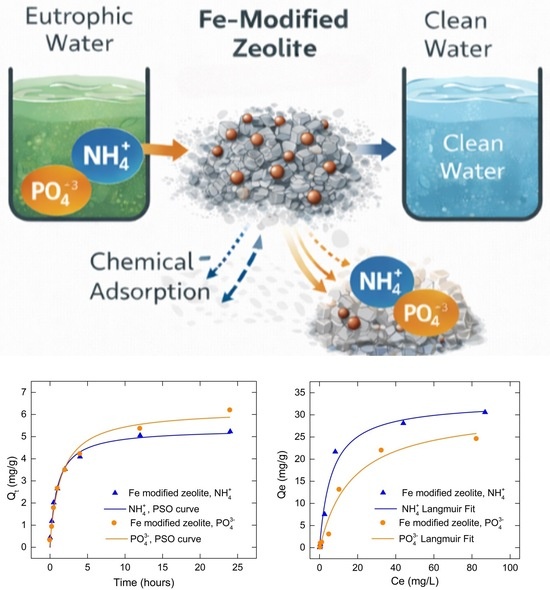
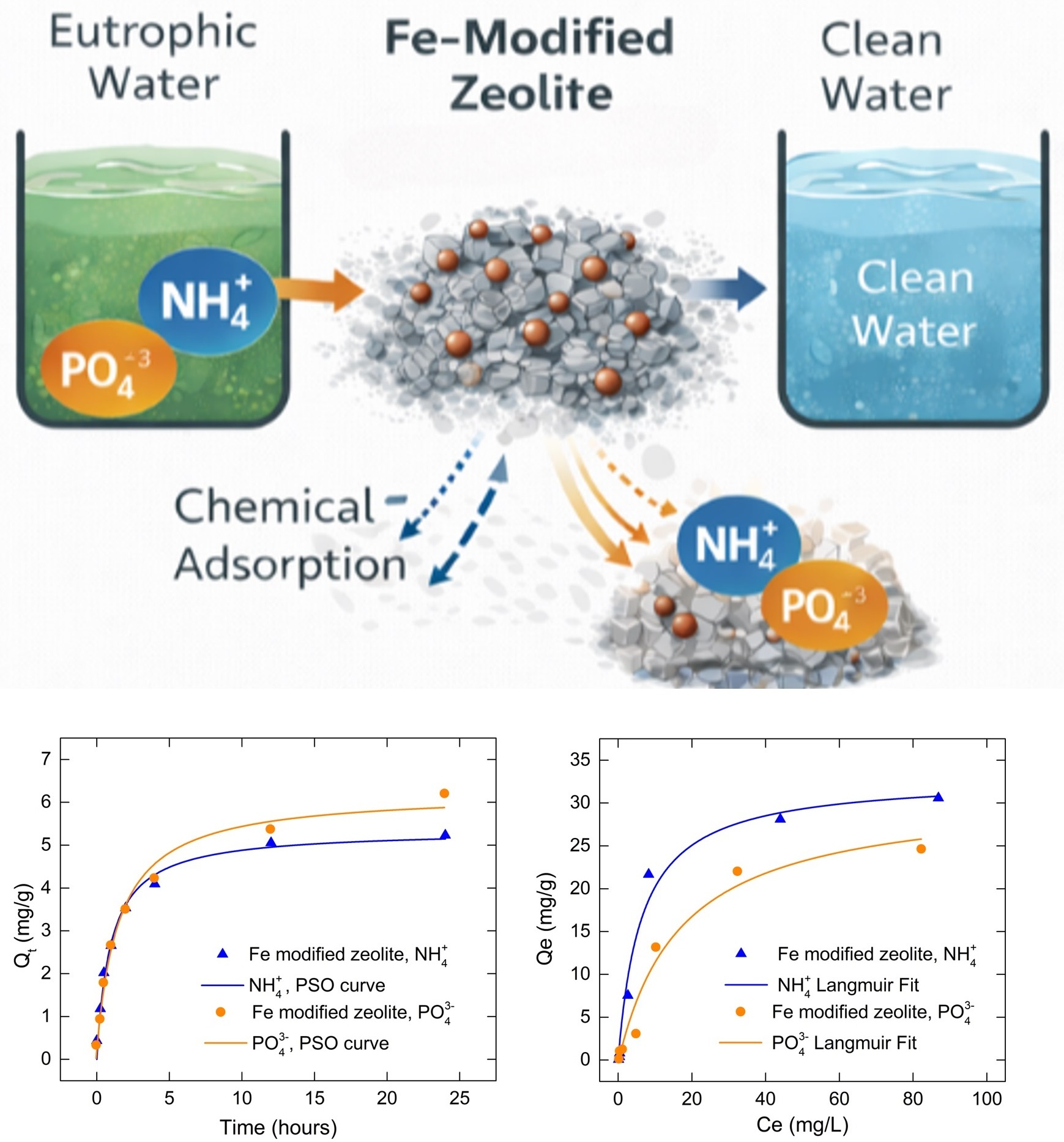
Eutrophic inland and coastal waters, created due to excessive concentrations of nutrients, cause harmful algal blooms and decreased water quality. Chemical adsorption of ammonium and orthophosphate ions with clay-based materials is an effective method for reducing nutrient pollution. This study assesses the adsorption of ammonium and orthophosphate ions using different iron-modified zeolites. Chemical composition analysis, in parallel with the kinetic efficiency results for ammonium and orthophosphate ion adsorption, indicates that the incorporation of iron-modified zeolites enables these ions to be adsorbed due to their increased surface area and improved ion exchange properties. Additionally, the Langmuir isotherm effectively captures the adsorption characteristics of iron-modified zeolites for ammonium and orthophosphate ions. This study proposes an ecological restoration approach, along with a sustainable water treatment solution, emphasizing the efficacy of iron-modified zeolites in environmental management.

Graphical Abstract

1. Introduction

Eutrophication is a widespread [1] water-quality problem in freshwater habitats that results from nutrient enrichment—especially nitrogen (N) and phosphorus (P)—from sources such as agricultural runoff [2] and home and industrial wastewater [3]. It is characterized by an overgrowth of algae and aquatic vegetation [4], disruption of the food web [1], reduced dissolved oxygen levels [5], and decreased water quality [6]. Moreover, the economic cost of freshwater eutrophication in affected catchments can reach up to EUR 114.3 million per year for England and Wales [7] and up to USD 2.2 billion per year for the US [8], owing to increased drinking-water treatment costs for toxin removal; expenses for taste and odor control; lost revenue from fisheries, tourism, and recreation; and lower property values.
While reducing external nutrient loads from point and non-point sources [9] is the ultimate long-term solution, restoration strategies are required to control eutrophication consequences, restore N and P nutrient balance [10] from the water column, and address the legacy of accumulated nutrients, particularly phosphorus (P) [11], which frequently acts as the limiting nutrient for algal growth [12]. According to the Water Framework Directive (2000/60/EC), risk levels and threshold values for chemical parameters such as N and P are not universally fixed [13] but defined in relation to the specific characteristics, typology, water-body type, local environmental conditions, and background nutrient levels; thus, communities should address the root cause of water-body eutrophication. Over the last century, scientists have used several restoration techniques to mitigate eutrophication, including biological, chemical, aeration, and dredging, among others. Despite providing a significant environmental benefit, these technologies can also entail significant environmental costs associated with implementation, a risk of lower efficiency in low-P waters, and ecological risks ranging from the release of toxins to habitat disruption [10,14]. Furthermore, neglecting to manage the release of internal sediment phosphorus frequently leads to rapid deterioration in water quality. Innovative clay-based applications, including natural zeolites [15] and modified zeolites [16], natural and modified bentonites [17,18], and others, provide significant reductions in phosphorus and ammonium ions via chemical adsorption mechanisms [19].
Zeolites are low-cost crystalline aluminosilicates [20] that are naturally abundant [21], have a porous structure [22], and exhibit a high ion exchange capacity [23]. Therefore, they are widely used to remove selective pollutants from freshwater bodies. However, the inherent negative surface charge of zeolites [24] hinders their ability to retain anionic elements and chemical compounds such as orthophosphate. Nonetheless, zeolites can be chemically modified to improve their adsorption potential.
Iron modification has been a successful method for modifying zeolites with iron oxy-hydroxide [25,26] groups providing new sites for orthophosphate adsorption while maintaining the ammonium removal potential associated with zeolites. Through the introduction of Fe(III) oxides or hydroxides that create surface hydroxyl groups, stable inner-sphere Fe-O-P complexes with orthophosphate are formed [26,27]. The elevated sorption affinity of iron oxides for phosphate and the zeolite’s framework enriches cation exchange sites and therefore increases the removal of ammonium ions simultaneously. Iron-modified zeolites have been shown to substantially increase P and N adsorption capacities and reduce internal nutrient release from sediments [10,14,28,29]. Nonetheless, the nutrient removal efficiency varies depending on the modification protocols [30], environmental water-body chemistry [17,31], and natural zeolite mineralogy [32,33,34].
Although iron-modified zeolites have demonstrated considerable potential for mitigating eutrophication [35] through enhanced orthophosphate and ammonium retention, several critical knowledge gaps constrain their optimization for large-scale application. Concerning iron modification, there is currently no systematic evaluation of how different protocol procedures (such as impregnation and precipitation) or protocol optimization choices (concentration of iron solutions, reaction time, drying time, temperature, etc.) influence the adsorption potential of the material and the stability of the iron-modified zeolite in freshwater over more extended time periods [29,36].
This study examines the optimization process for the embaptized iron-modified zeolite protocol (iron-modified zeolites A1, B1, C1, B2, and B3) and presents a comparative literature review of different iron-modified zeolites. This study aims to enable a direct evaluation of how variations in the iron-modified zeolite protocol affect nutrient removal efficiency and long-term stability. Establishing such comparative baselines under standardized testing conditions is essential to identify the most robust and cost-effective iron-modified zeolite formulations for site-specific freshwater remediation.

2. Results

Natural zeolite (N-Z) and five iron-modified zeolites (A1, B1, C1, B2, and B3) used in different embaptized protocols were reviewed in order to determine the best material for ammonium and orthophosphate adsorption. The study presents batch kinetic and isotherm experiments, along with characterization analysis results.

2.1. Kinetic Experiment Results

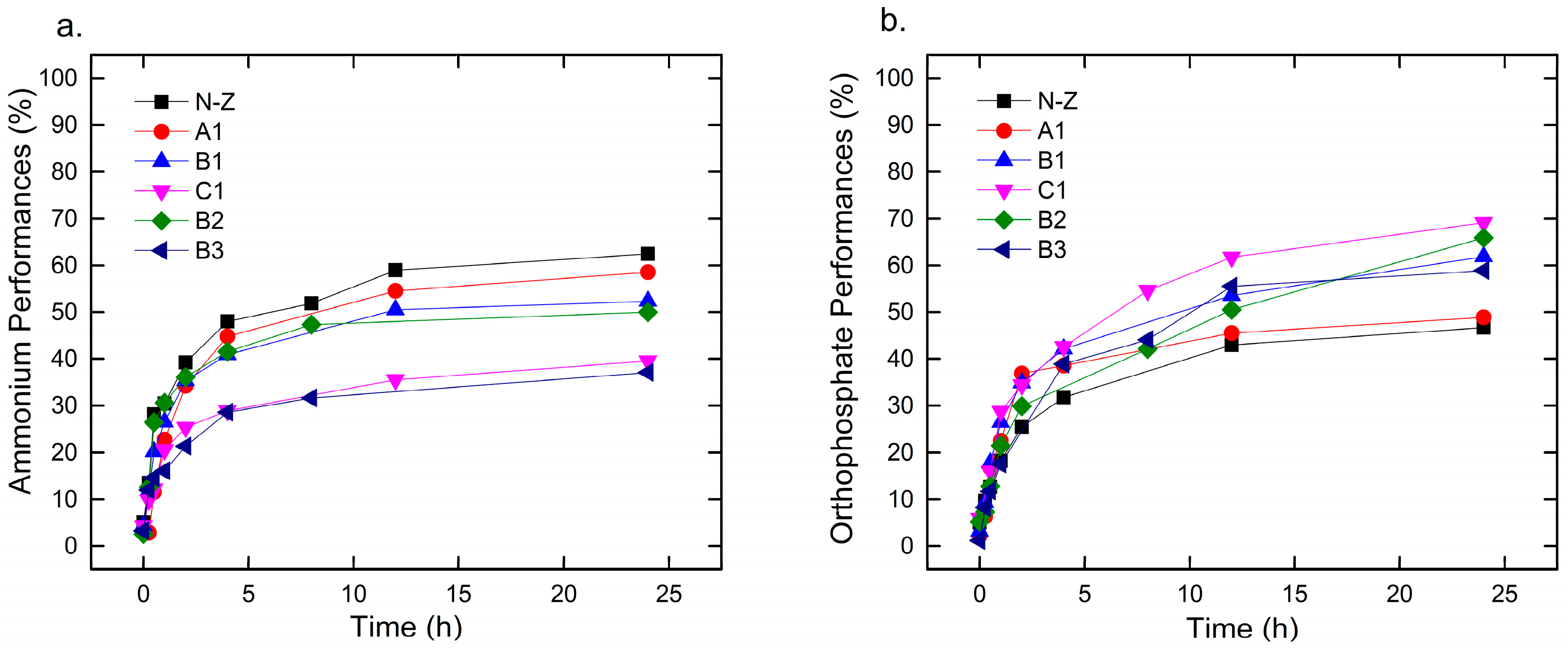
Figure 1 displays the 24 h adsorption profiles for ammonium (left) and orthophosphate (right) across six sorbents: natural zeolite (N-Z) and A1, B1, C1, B2, and B3 iron-modified zeolites. The removal curve rises very steeply, inclined over the first five hours, and ends in a gradual, steady value toward what appears to be equilibrium. Natural zeolite (N-Z) has the best ammonium removal performance compared to iron-modified zeolite’s performance, reaching about 70% removal efficiency. The results indicate that both the lower and medium presence of iron provides similar ranges, with removal efficiencies at the end of the 24 h kinetic experiment application reaching around 65% and 60%, respectively. The two longer dried materials (2 days and 4 days) also show similarly poor performance for ammonium ion adsorption, with B2 stabilizing at about 50% removal and B3 at 45% removal efficiency.
Orthophosphate ion adsorption performance differs compared to ammonium adsorption for the materials reviewed in this study. The higher-iron-loaded zeolite (C1) achieves almost 70% removal efficiency, with B2 and B3 also in the effective range, achieving greater than 60% removal, at 24 h. N-Z and low iron-loaded zeolite again performed poorly compared to other modified zeolites, reaching a performance plateau of around 50%. The divergent outcomes suggest an apparent selectivity; zeolitic ion-exchange sites prefer ammonium, but increased orthophosphate removal efficiency is achieved through an iron-modification protocol.
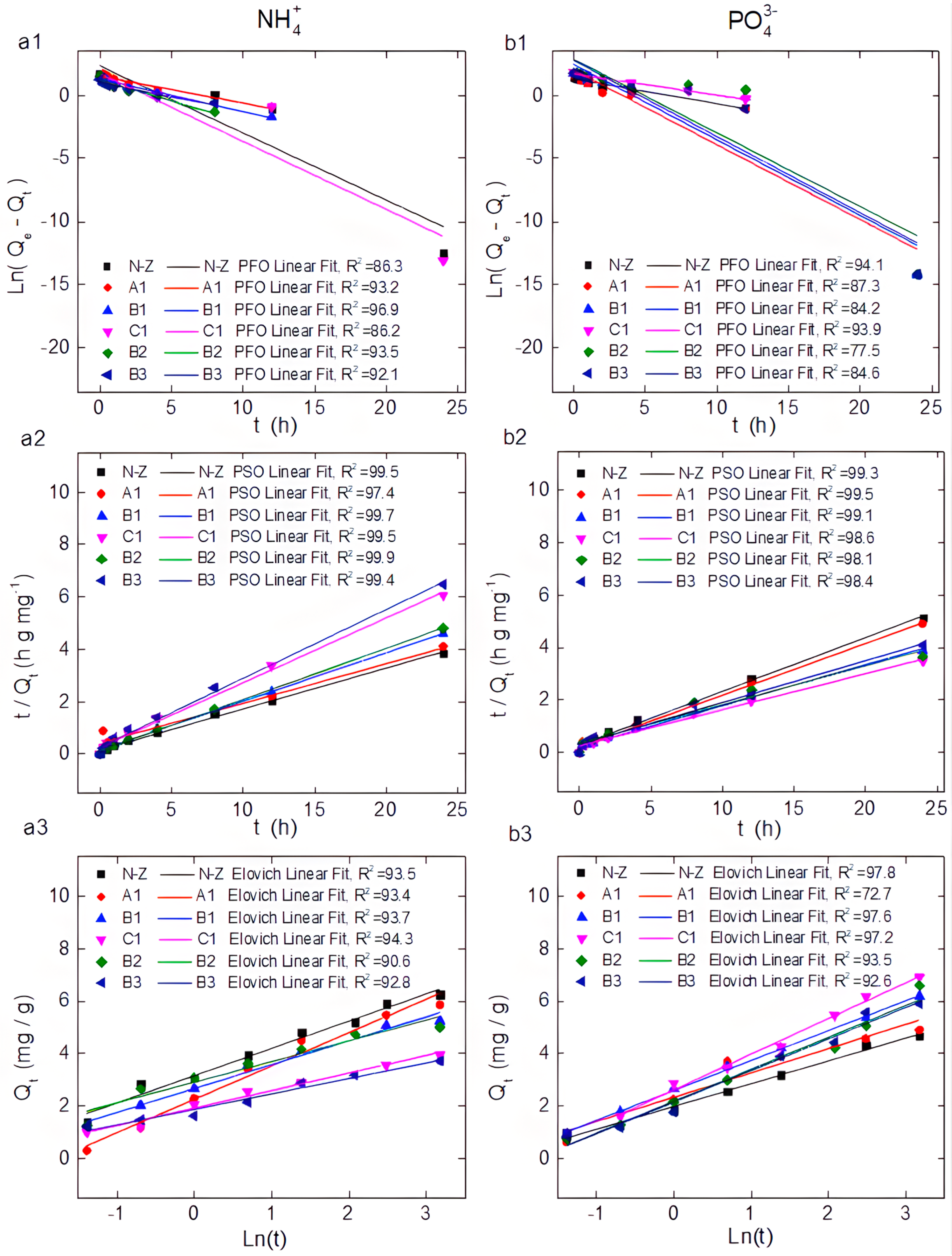
For the evaluation of the adsorption kinetics of the Natural Zeolite (N-Z) and the iron-modified materials (A1, B1, C1, B2 and B3), the Pseudo First Order (PFO), Pseudo Second Order (PSO) and Elovich models were used for analysis. The best-fitting model was determined by comparing to the coefficients of determination (R2) derived from their linear expressions. Figure 2 presents the ammonium (on the left) and the orthophosphate (on the right) results of the linear expression of the PFO, PSO and Elovich model after 24 h of sorption experiment.
In the context of this study, ammonium and orthophosphate removal efficiencies were not evaluated against a single regulatory threshold, but rather examined in terms of their relative contribution to nutrient enrichment and potential eutrophication risk and not within a specific water body of interest.
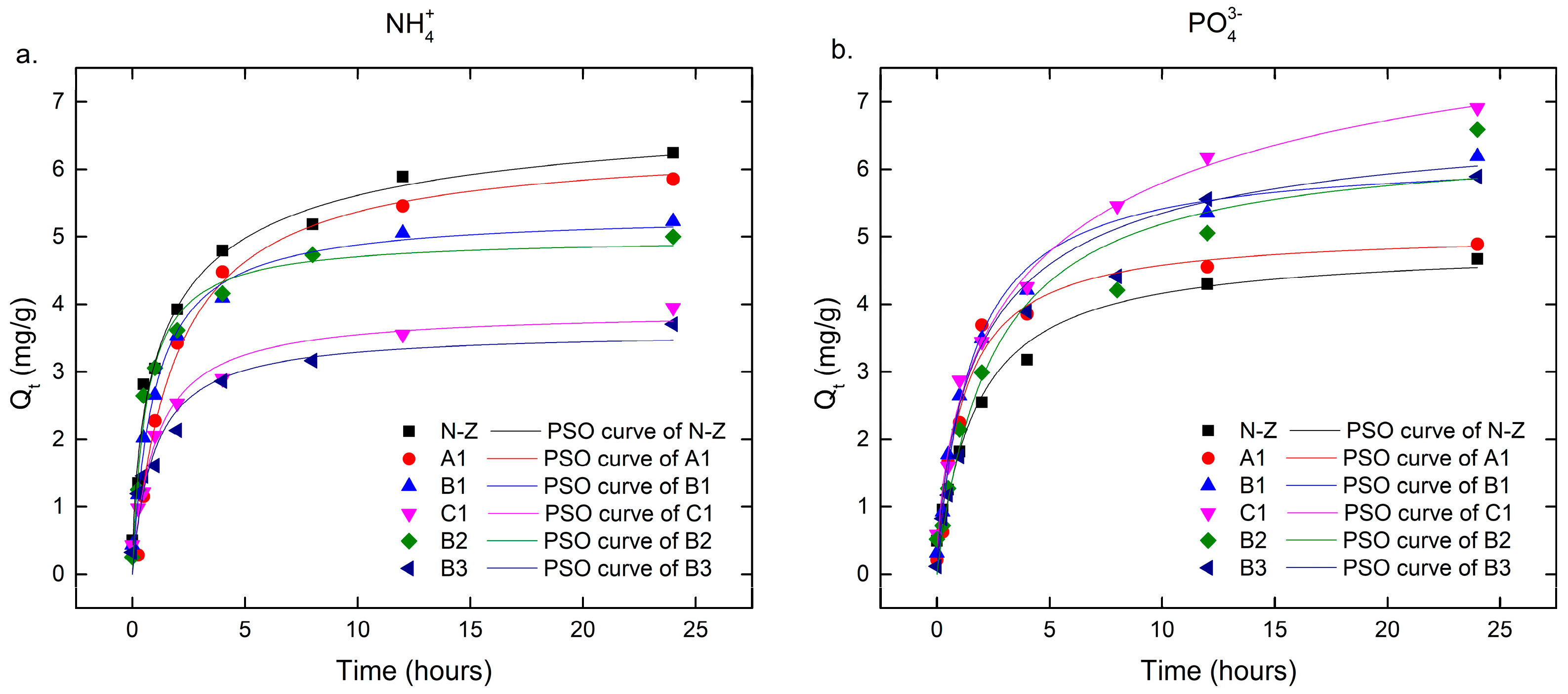
The materials reviewed exhibited excellent performance using the pseudo-second kinetic model, as indicated by the coefficient of determination (R2 > 97% for all tested materials). Furthermore, the non-linear Pseudo-Second-Order (PSO) kinetic data for the examined zeolites were reviewed to examine the models’ characteristics. Also, Figure 3 illustrates that all adsorbents initially (0 to 4 h) exhibited faster adsorption rates before moving towards slower steady-state equilibrium conditions, consistent with the pseudo-second model description of the sorption.
Regarding ammonium adsorption, the natural zeolite (N-Z, presented in black) had the highest equilibrium adsorption capacity. The N-Z kinetic curve showed a substantial increase during the initial hours of testing, reaching approximately 6 mg/g before stabilizing at a steady state. The iron-modified zeolite with the highest oven-drying time (B3 in navy) was, in general, the least effective for ammonium absorption. In parallel, the model yielded comparable fits to the experimental data across all samples, suggesting that the adsorption mechanism was likely chemisorption arising from electron sharing or exchange.
The pseudo-second-order kinetic model for the orthophosphate adsorption trend was inverted. Sample C1 in magenta, the iron-modified zeolite with the highest iron concentration, showed the highest adsorption capacity results of all tested materials. Both natural zeolite (N-Z in black) and the lowest iron concentration-modified zeolite (A1 in red) had the lowest orthophosphate adsorption capacities. Similar to ammonium adsorption, the pseudo-second-order kinetic model provided an excellent fit to the experimental data, further reinforcing the conclusion that orthophosphate adsorption was, on average, by a mechanism similar to that of ammonium.
In summary, the pseudo-second-order kinetics analysis not only validated the trends observed in the performance data but also provided insight into the mechanisms that govern the adsorption processes. The high coefficient of the pseudo-second-order kinetic model for ammonium (Table 1 left) and orthophosphate (Table 1 right) sorption by the six zeolite sorbent materials discussed is shown in Table 2. It is concluded that all pseudo-second-order kinetic models have high R2 values (greater than 96%), indicating that the chemisorption process was rate-limiting of sorption.
In addition, Table 1 shows that for ammonium ion adsorption, the natural zeolite had the largest ammonium capacity (Qe = 6.78) and the fastest sorption, as evidenced by the lowest kinetic constant (k2p = 0.01). In parallel, the orthophosphate kinetic results reveal that the zeolite modified with the highest iron concentration yields both higher affinity and faster chemisorption of orthophosphate.
Both the adsorption performance and the pseudo-second-order kinetic model indicated that the ammonium ion adsorption favors the natural zeolite and the zeolite with the lowest iron concentration. In contrast the modified zeolite of the highest iron concentration achieved the highest result in orthophosphate ion adsorption.
Reviewing the results of all six tested materials, the concentration of iron that should be added for this modified zeolite’s protocol is 0.1 M. In fact, natural zeolites have limited affinity for orthophosphate due to their negatively charged framework [37], which repels anionic PO43−. Iron modification introduces Fe3+ ions or iron oxides (e.g., Fe2O3, FeOOH) that form positively charged sites, enabling strong [38] and electrostatic attraction [39] with orthophosphate.
In terms of oven-drying time, it was 1 day. Moderate drying (60–100 °C, 4–12 h) promotes iron oxide/hydroxide coatings, thereby enhancing a positive surface charge that attracts PO43− electrostatically [40]. For NH4+, the zeolite’s cation-exchange capacity, augmented by iron, remains effective [41,42]. Over-drying may sinter iron particles, reducing surface area, while under-drying can cause uneven iron distribution. Therefore, the kinetic analysis reveals that the material with B1 was the best material for the best material in adsorption in terms of concentration in the presence of both ammonium and orthophosphate ions.

2.2. Isotherm Experiment Results

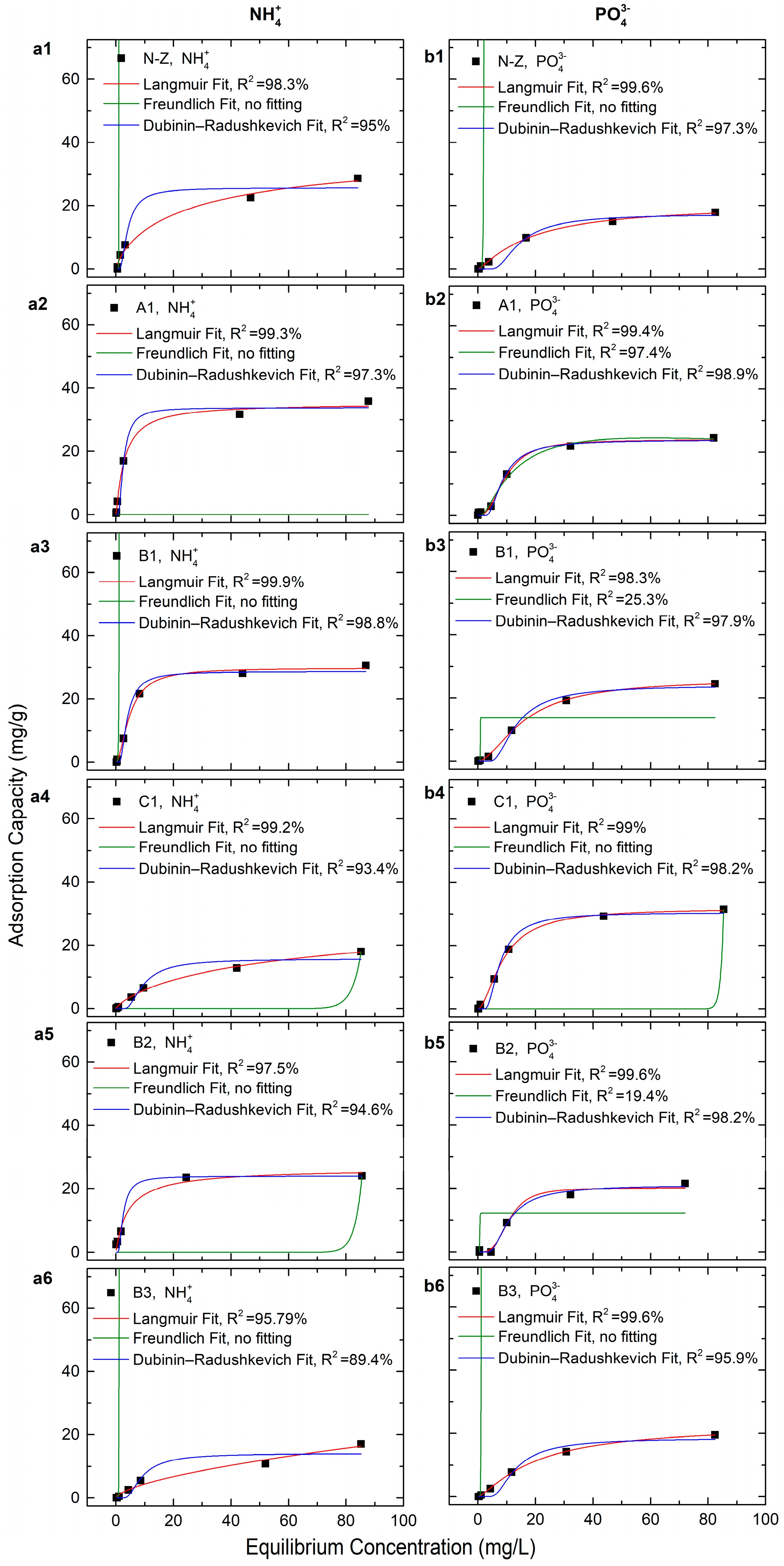
For the evaluation of the isotherm adsorption of the Natural Zeolite (N-Z) and the iron-modified materials (A1, B1, C1, B2 and B3), the Langmuir, Freundlich, and Dubinin–Radushkevich models were used for the analysis. The best-fitting model was determined by comparing the coefficients of determination (R2) derived from their linear expressions. Figure 4 presents the ammonium (on the left) and the orthophosphate (on the right) results of the linear expression of the Langmuir, Freundlich, and Dubinin–Radushkevich model after 24 h of sorption experiment.
The results indicate that the Langmuir model has the best fit (over 95.79%). It shows high correlation with the adsorbents achieved by the Dubinin–Radushkevich model (89.4%), whereas the Freundlich model failed to fit for multiple sets of isotherm experiment data of the study. To accurately calculate Langmuir’s model results, the nonlinear adsorption expression has been used for iron-modified zeolites. Figure 4 presents the experimental adsorption isotherms for ammonium and phosphate, showing equilibrium uptake versus equilibrium concentration for each zeolite sample (independent experiments).
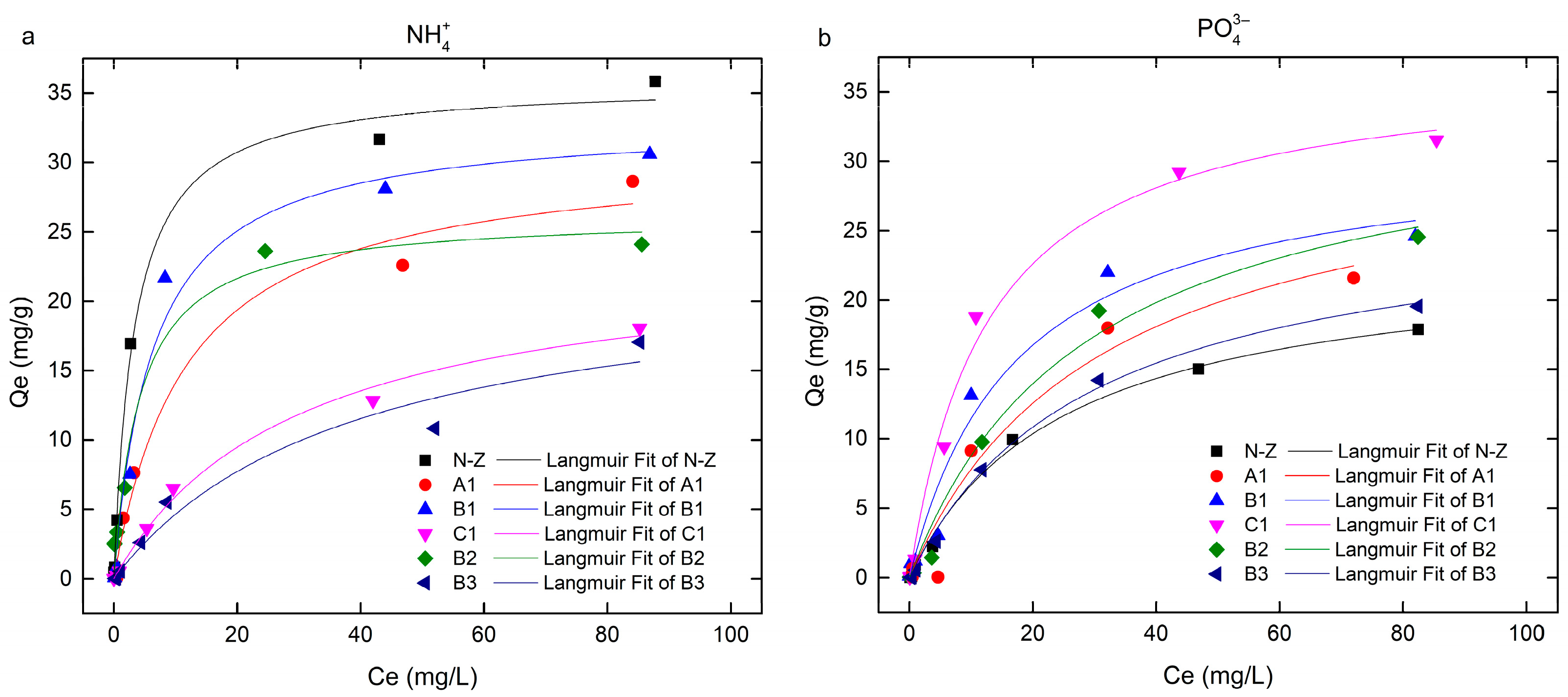
Natural zeolite (Figure 5, N-Z in black) had the highest adsorption capacity for ammonium, as evidenced by the steeper and elevated Langmuir curve within the investigated concentration ranges. The Table 2 data align with the Langmuir model, indicating monolayer adsorption and suggesting that the adsorbent sites are energetically uniform, thereby revealing a substantial maximum adsorption capacity.
Regarding Langmuir isotherm results for orthophosphate ions, the C1-iron-modified zeolite (in magenta) exhibited the highest adsorption, characterized by a significantly steep slope in its Langmuir curve and the highest experimental equilibrium capacity. Choosing the best material for both ammonium and orthophosphate ion presence, the B1-iron-modified zeolite is depicted as the best-fitting material when orthophosphate ions are both present with ammonium solutions. Similarly, the observations in Table 3 align with the Langmuir model, suggesting that monolayer adsorption occurs as well.
The isotherm statistics (Table 3) support the previously discussed pseudo-second kinetic model and the kinetic performance results. Natural zeolite exhibited the highest site densities and interaction energies for ammonium, whereas the iron-modified (C1 and B1) samples demonstrated the greatest affinity and capacity for orthophosphate. The equilibrium results, along with the pseudo-second-order fits, underscore that surface chemistry is a vital element for selective nutrient removal from water bodies.

2.3. Characterization Analysis Results

Characterization analysis was conducted for the materials: N-Z, A1, B1 and B2, and is presented in Table 3. The isotherm and kinetic analyses conducted revealed that for aquatic bodies containing both ammonium and orthophosphate ions, the B1 iron-modified zeolite was the most suitable application for eutrophication control. In parallel, the application of natural zeolite is the best-suited application for water bodies with eutrophic conditions developed solely due to the presence of ammonium ions. Finally, for lab applications involving aqueous solutions containing only orthophosphate ions, the C1 modification was found to be the best choice. Nonetheless, natural marine environments generally consist of higher ammonium concentrations compared to orthophosphate ions, and it has been found that the ratio N/P ranges from 16 to 4 [43]. Therefore, the B2 application is best-suited for the adsorption of orthophosphate ions, given the preference for a less iron-incorporated material for sustainable applications.
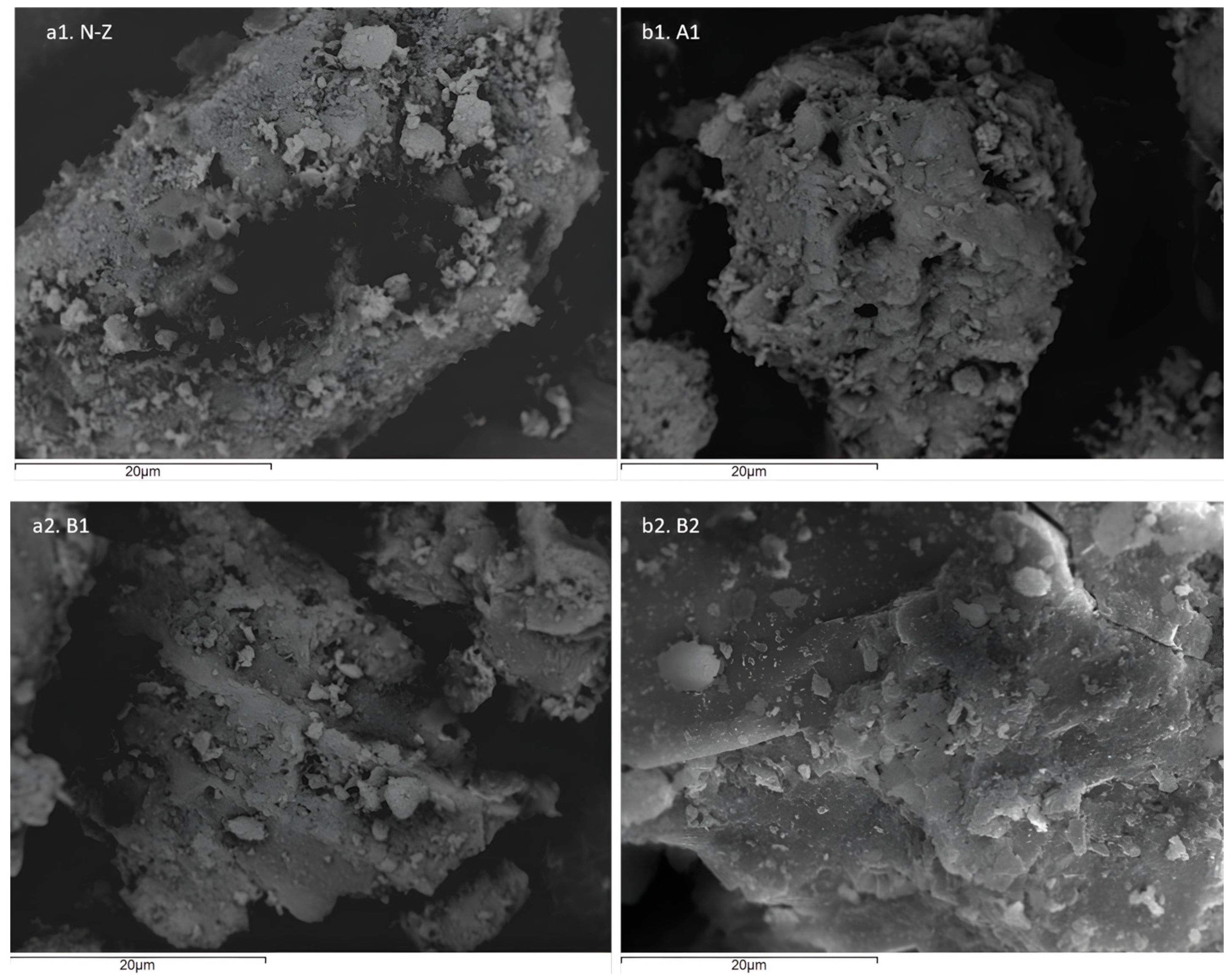
Figure 6 demonstrates SEM analysis results of Si among zeolitic samples of different iron concentrations (a. N-Z, b. A1, c. B1 and d. B2), demonstrating notable changes in surface porosity, surface roughness, and particle clustering/aggregation, which influences the adsorption capacity and the adsorption performance of each material. The N-Z (Figure 6a1) appears to have an irregularly heterogeneous and permeable structure with many irregularly shaped particles. A1 (Figure 6b1) also has a more rounded porous morphology, with a texture that is less rough than that of the N-Z. B1-modified zeolite (Figure 6a2) has a granular structure with heterogeneous particle-size characteristics. B2 (Figure 6b2) has a denser, more compact surface with very few pores and therefore generally appears smoother, although it still contains particle agglomerates.
Finally, the Si/Al molar ratio results in Table 4 reveal the drastically different Si/Al framework ratios between each of the four zeolitic materials and provide insights into their structural properties and resulting adsorption behavior. Natural zeolite (N-Z) has a molar Si/Al ratio of 5.85, which is representative of medium-silica zeolites having moderate cation-exchange capacity. This value indicates a balanced framework with sufficient aluminum substitution to create negative charge sites for ammonium exchange, consistent with its superior NH4+ adsorption performance in the kinetic and isotherm studies.
A1 and B1 both have Si/Al ratios of 5.10 and 4.98, respectively, both of which are lower than the parent N-Z material. This reduction suggests that the modification procedures introduced more aluminum-containing phases, or selectively leached silicon from the framework, while retaining ammonium adsorption capacity.
The most surprising outcome was the elevated molar Si/Al ratio in B2 with a dramatic value of 10.82, nearly double the Si/Al values of the other samples. This ratio suggests significant removal of aluminum from the framework through this extended drying treatment. Therefore, the presence of more siliceous structure, leading to fewer negative charge sites, explains B2’s markedly lowered ammonium adsorption capacity and slower kinetics. From a mechanistic standpoint, the dealumination of B2 creates two sets of opportunities. Zeolite’s cation exchange capacity is diminishing in the presence of lower concentrations of aluminum (and therefore lower NH4+ uptake), while creating silanol groups (Si-OH) as well as framework defects [44].
It is concluded that materials possessing a lower Si/Al ratio (N-Z, A1, B1) are able to retain more aluminum-based exchange sites and favor the removal of ammonium, compared to the high-silica B2 material. Both synthesis protocols and drying conditions significantly impact the Si/Al ratio and thereby influence the selectivity of each material toward target contaminants in water treatment applications.

2.4. XRD Analysis Results

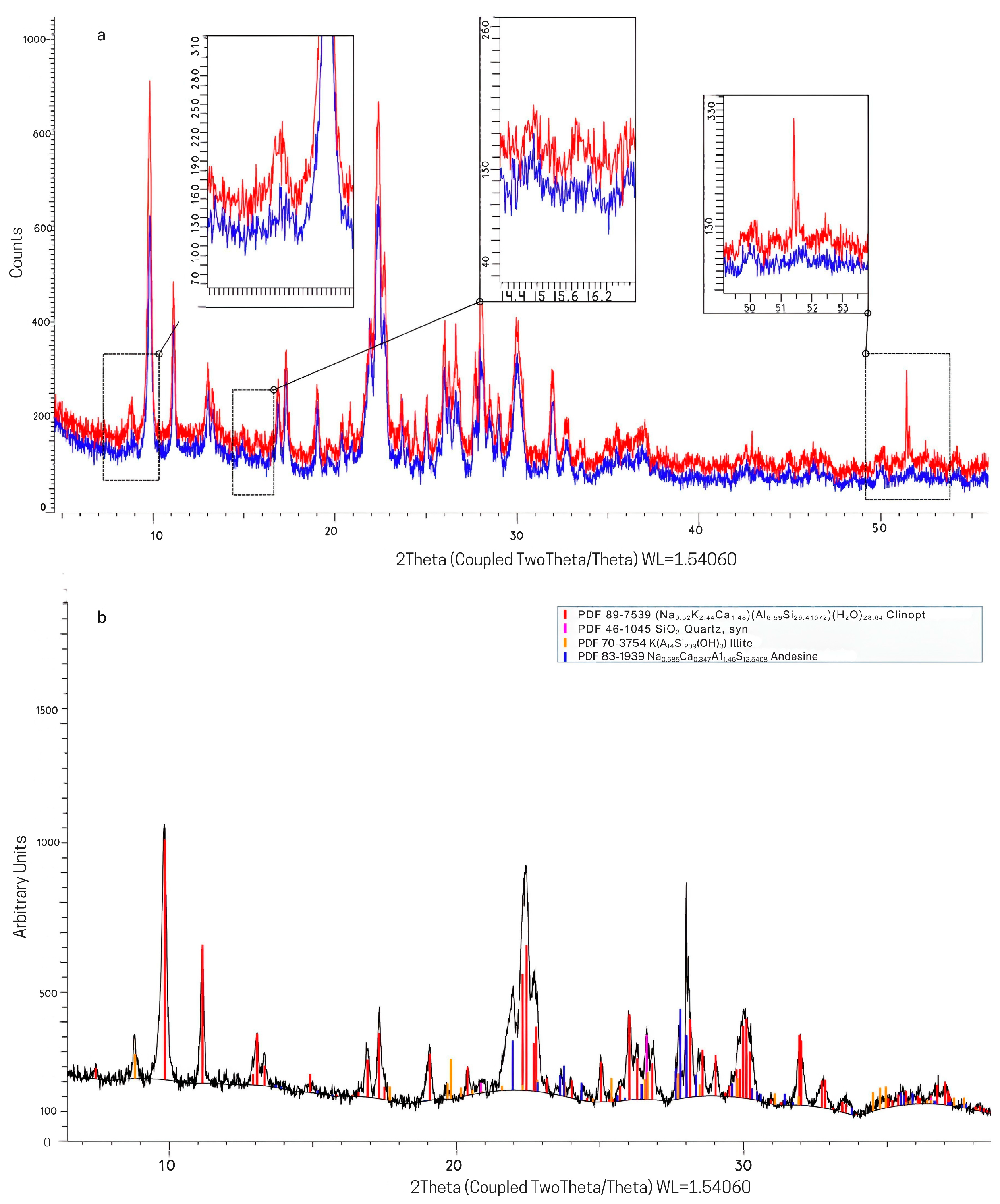
X-ray Diffraction (XRD) analysis is one of the most important tools for characterizing zeolite adsorbents and for understanding the mechanism of adsorption of nitrogen (N) and phosphorus (P). For natural zeolites, the expected peaks of the major components (clinoptilolite) are located at specific 2θ values (17°, 19°, 22°, 26°, 28°, 30°, 32°, and 35°) [45,46,47,48]. Other synthetic zeolites, like Na-P1, have their own distinct peaks [49], whereas other zeolites, like the iron-modified zeolites of the study, present peak positions of natural and modified zeolite to be coincident across the 2θ range, as presented in Figure 7. The zeolite samples presented in this study consist mostly of clinoptilolite, but also have mixes of quartz, illite and adesite. Tschegg et al. [50], in their study of the clinoptilolite mine in Nizny, Slovakia, similar to our study, reported that parallel to the clinoptilolite zeolite, smaller amounts of biotite, cristobalite, feldspar and quartz were present.
The comparison of natural and the iron-modified zeolite (B1) indicates that the iron-modified zeolite had consistent peaks along the range of 2θ, since they have similar crystalline “backbone” (the overall fingerprint of peaks occurs in the same general 2θ regions). In terms of intensity, several peaks are consistently higher than those of natural zeolite. The natural zeolite presents a “sharper” (“clearer”) pattern than the iron-modified zeolite, revealing that the natural material is ideal for reference in subtle treatment-driven changes. It is observed that ZFe does not create a dominant new crystalline phase, suggesting that the iron compounds of the modified material are present as surface-bound, amorphous, or finely dispersed iron oxyhydroxides.
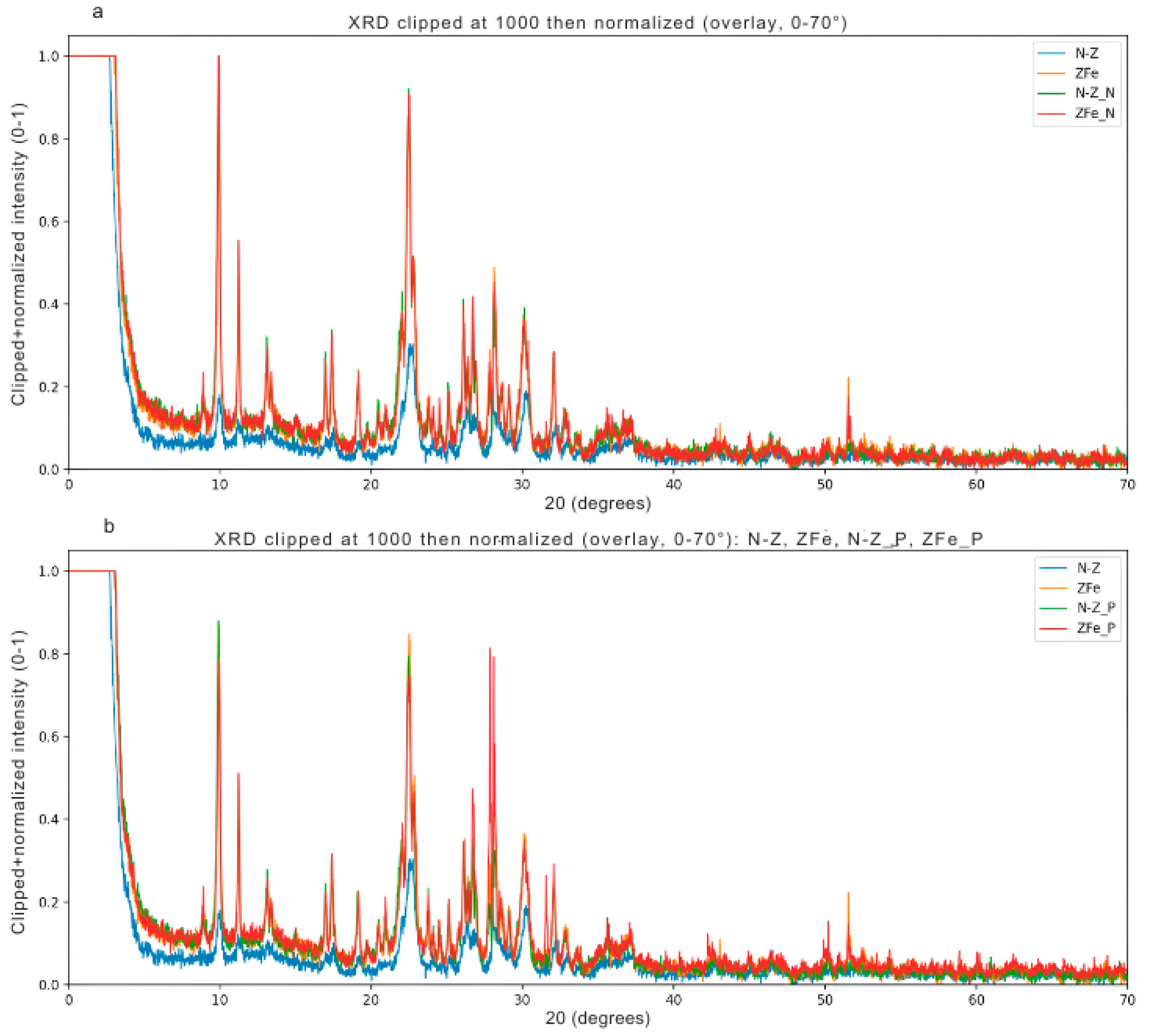
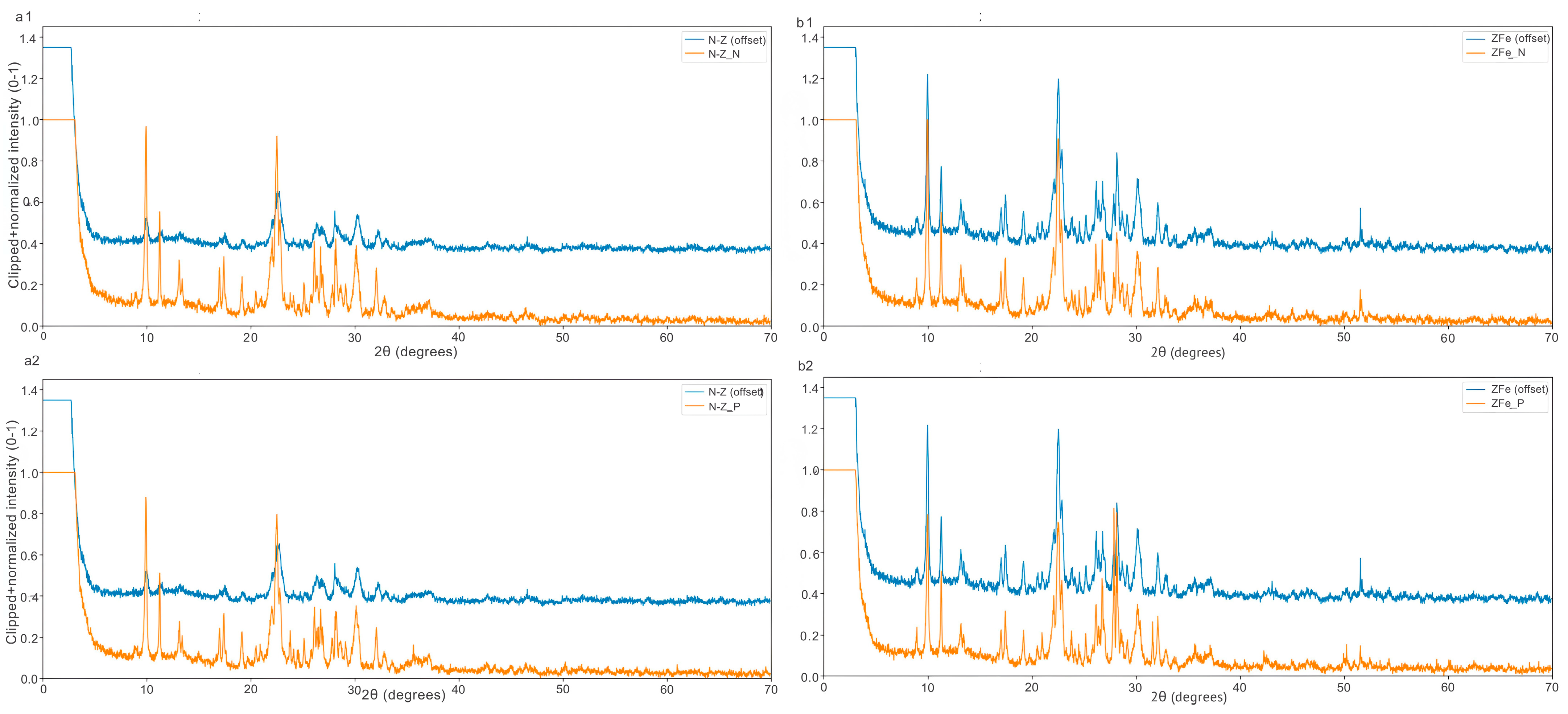
Furthermore, comparative XRD results for treated and non-treated samples can detect the mechanism of sorption of natural and iron-modified zeolites. The presence of higher intensity of phosphate-treated natural zeolite (Figure 8 and Figure 9) implies that ligand exchange is the mechanism of phosphate sorption because the XRD results do not present significant phase change or shifts of certain minerals, therefore eliminating precipitation and interlayer adsorption [51].
In addition, comparing the N-Z, ZFe, and ammonium treatments, in the absence of changes in crystallinity and intensity, the phase in the XRD diagram (Figure 8), ion exchange is the mechanism that cannot be presented in the XRD diagrams. The modification aims to alter the zeolite’s surface features (e.g., surface charge and active sites) to improve its affinity for orthophosphate ions. Prior research has shown that these changes can markedly enhance phosphate adsorption compared to unmodified zeolites. For example, iron-modified NaP1 and FAU/LTA zeolites show markedly enhanced phosphate uptake due to anion exchange with iron hydroxyl groups and formation of Fe–phosphate complexes, while the parent zeolites have negligible P adsorption [52].

3. Discussions

3.1. Material Comparison Related to Drying Time

Drying at 80 °C is a conventional procedure following the alteration of iron-modified zeolites, regardless of the drying time employed. The objectives of drying consist of (i) the elimination of physically adsorbed water, (ii) the stabilization of iron (oxy)hydroxide coatings formed during chemical modification, and (iii) facilitating adsorption tests [26,36]. Within the scientific literature, drying times generally range from 12 to 24 h. However, there have been reported variations in shorter or longer durations based on sample thickness or the intended moisture content [26,53].
In our study comparing the results of drying time among 1, 2 and 4 days, it was concluded that the drying time does not affect ammonium ion adsorption. Ammonium is adsorbed onto the zeolite mostly due to its inherent cation exchange capacity [15], which remains largely unaffected by moderate drying at 80 °C. If the zeolites are not dried for sufficient time, residual water may occupy its exchange sites, leading to a marginally reduced observed ammonium capacity.
Phosphate adsorption depends upon the quantity and reactivity of iron (oxy)hydroxide coatings on the zeolite surface. Drying at 80 °C aids in stabilizing the iron coatings [36,53], typically resulting in the fixation of mixed coatings/contents into amorphous or weakly crystalline phases with elevated phosphate binding capacity. The study results indicate that the quantity of phosphate adsorbed remains relatively constant for extended drying durations at 80 °C beyond the time required to achieve a constant weight of the sample. Excessive drying (at 80 °C) does not result in the sintering of iron phases or a reduction in surface area. As a result, the optimized protocol involves drying at 80 °C until the sample attains a consistent weight (about 12–24 h for standard batch sizes). A prolonged drying period of 24 to 48 h is permissible but not obligatory. Prolonged dryness does not adversely affect the sample, nor does it modify ammonium or phosphate adsorption efficiency.

3.2. Material Comparison Related to the Iron Concentration Addition

The added iron concentration and drying period affect the balance between ammonium and phosphate performance. A1 (0.05 M, 1 day) has the highest ammonium capacity while still being able to reach a phosphate capacity that was greater than most zeolites in the literature (except ZeoPhos [53] and B1). Increasing the FeCl3 concentration from 0.1 M to 0.2 M, any selectivity shift in performance was toward phosphates, with the highest capacities in B1 and C1.
If ammonium removal is the priority, low FeCl3 loading (0.05 M) and short drying time are associated with better capacity and affinity than the natural zeolite and preserve over-saturation of sites to a greater extent than the natural zeolite. If control of orthophosphate contamination is sought, a higher loading (0.2 M, C1) is preferred, which would give maximum capacity and improved affinities. However, C1 exhibited a lower ammonium removal efficiency than the rest of the materials examined in this study. For 0.1 M FeCl3 loading and limiting drying to 1 day represents the optimal performance of the drying times in regard to the performance of the materials. If the objective in the collection of contaminants is to remove both species at the same time, B1 has a positive advantage in the removal of ammonium over the N-Z and a positive gain towards removing phosphate. All in all, these results provide support for the mechanisms of iron functionalization strictly contributing to the binding of negatively charged species. The results highlight the need to tune both the FeCl3 concentration and drying time, related to the initial conditions of the eutrophic water body.

3.3. Langmuir Isotherm Results of Literature Iron-Modified Zeolites

In terms of Langmuir ammonium adsorption, Fe loading on zeolite at a lower concentration (0.05 M; A1) improved the Langmuir capacity compared to natural zeolite (slightly increased from 34.82 mg/g for N-Z to 35.79 mg/g for A1), suggesting greater binding strength at equilibrium. The lowest overall ammonium capacity was observed for the 0.2 M FeCl3 material (C1), which had Qe = 23.66 mg g/g. Overall, mild Fe loading (0.05 M) was beneficial for ammonium adsorption, with results similar to those from 0.05 and 0.1 M Fe loading. Orthophosphate adsorption, conversely, behaved in a reverse manner with respect to Fe loading, where higher quantities of iron shifted the materials toward higher phosphate capacities and affinities. The natural zeolite exhibited modest phosphate performance (Qe = 23.28 mg/g). The highest Fe loading (0.2 M; C1), produced the overall best phosphate performance, Qe = 37.07 mg/g, followed by 0.1 M loaded zeolite (B1).
Table 5 presents comparative results for other iron-modified zeolites from the scientific literature on ammonium and orthophosphate adsorption. The comparison with other lower-capacity Fe-modified zeolites included in Table 5 shows that ammonium A1 and B1 capacities are both greater than the commonly cited Fe(III)-modified clinoptilolite capacities of around 27 mg/g [36]. For phosphate, C1 and B1 are equal to or exceeding ZeoPhos (34.3 mg/g) [53] and far exceeding typical Fe/Al-zeolites (11–19 mg/g) [14,26]. The Z-Fe/Fe(III)-modified clinoptilolite capacity (27 mg/g NH4+, 3.4 mg/g PO43−) [36] demonstrates a common dichotomy in Fe-only modifications where ammonium uptake is low, and phosphate capacity is low. The extreme phosphate uptake for Iron-Z-A [25] is expressed per mass of iron rather than per mass of adsorbent and is thus incomparable. The iron-modified zeolites, in general, increase the adsorption capacity of orthophosphate ions either through hydrogen bonding and complexation at protonated Fe-OH groups [25,36] or through Fe/Mn inner-sphere complexation sites [26].
At this point, a crucial aspect should be noted: In almost all studies discussed, the anticipated decrease in ammonium and orthophosphate adsorption capacity in the presence of interfering ions. Various interfering ions coexist in the real world and pilot applications of eutrophic water bodies can give insights into the selectivity of adsorption the presence of other ions. Specifically, the ammonium ion adsorption agonizes the adsorption from other cations such as (Na+, K+, Ca2+ and Mg2+) [51]. This competition drastically reduces ammonium removal efficiency in high-ionic-strength environments, such as seawater [17]. Additionally, depending on the modification (added material or modification protocol), different cations present higher cation ion selectivity.
On the other hand, phosphate ion adsorption is affected by the water body’s co-existing anions on the structure of the natural zeolite (mostly divalent ions such as CO3), significantly decreasing the orthophosphate ion adsorption [54]. For iron-modified zeolites, due to the iron-zeolite structure with hydroxide sites, the presence of cations has a positive effect, promoting the formation of HPO4-bridged ternary complexes (e.g., Fe-O-PO2-Ca) [55] or promoting calcium phosphate precipitation on or near the zeolites’ surface [56].

3.4. Characterization Analysis Comparison

The compared pattern of a different modified zeolite (such as ZrMZ or FeAl-Z) to the natural zeolite (NZ) confirms that the modification process generally does not destroy the fundamental crystalline framework if the core peaks remain [57,58]. The same result is verified in our study as well.
Adsorption of phosphate is frequently based upon chemical reactions. Evidence of chemically precipitated materials from adsorption can be demonstrated when there new peaks appear in the XRD diffractogram as is the case with La-P1 (lanthanum modified zeolites) [59]. On the other hand, also, if a large displacement of specific peaks is depicted in XRD diagrams, such as on bentonite, phosphate anions have successfully moved into and altered the interlayer spacing of the clay structure [60].
Ammonium adsorption occurs through ion exchange (replacing Na2+, Ca2+, etc.) or electrostatic attraction. These types of changes can decrease the intensity of some peaks in the XRD diagram [39]. In contrast, if nitrogen-containing compounds enter the clay mineral interlayers, the XRD can confirm structural strain since it remains unchanged by ion exchange [61].

4. Materials and Methods

4.1. Protocol of Material Synthesis

Natural Slovakian zeolite was provided by Zeocem (Bystre, Slovakia, https://www.zeocem.com/en (accessed on 24 July 2025)). The raw zeolite material is of clinoptilolite type with the following molecular form: (Ca, K2, Na2, Mg)4 Al8Si40O96 24H2O. Before application, the zeolite was washed with de-ionized water under a high-stirring procedure, dried at 100 °C for 24 h, galvanized and sieved with ASTM E11 (Fisherbrand, Thermo Fisher Scientific, Loughborough, UK), at 106 μm (No 140) using woven wire mesh sieves to obtain the desired uniform particle size. Then the material was placed in a dryer at 37 °C to eliminate hydration impurities.
Five zeolite modifications were assessed for this experimental study. The A1-modified zeolite was developed after impregnation of 10 g of natural zeolite with 200 mL of a 0.05 M solution of iron (III) chloride. A total of 13.514 g of FeCl3 6H2O reagent (FeCl3 6H2O ACS reagent, 97%, Sigma-Aldrich, St. Louis, MO, USA) was dissolved in a final volume of 1 L of deionized water. The mixture was stirred for 5 h at 900 rpm. The process was repeated twice. The modified zeolite is then stirred with 200 mL of de-ionized water for 10 min. The process is repeated three times and dried for 1 day in an oven at 80 °C. The modified material was subsequently placed in a dryer at 37 °C to eliminate the hydration impurities.
The B1-modified zeolite was prepared with the same procedure as the A1-modified zeolite. The difference lies in the concentration of the FeCl3 solution at 0.1 M rather than 0.05 M.
A similar protocol was used to create the C1-modified zeolite. The concentration of the FeCl3 solution was set to 0.2 M.
In parallel, the next set of zeolites had the same concentration of iron chloride solution as the B1-modified zeolite. However, the drying time was different and equal to 1 day, 2 days, and 4 days for the modified zeolites B1, B2, and B3, respectively. All materials created along with their notable differences are presented in Table 6.

4.2. Kinetic Experiment Procedure

Batch adsorption tests were conducted to assess the kinetic removal efficiency of orthophosphate and ammonium ions. A total of 100 mL of ammonium aqueous solutions containing 1 mg NH4+-N/L (381.0 mg NH4Cl (NH4Cl, ≥99.5%, Sigma-Aldrich, St. Louis, MO, USA) in 1 L of extra-pure de-ionized water) was added to 100 mg/L of adsorbent material. Then 100 mL of aqueous orthophosphate solution containing 1 mg PO43−-P/L (441.93 mg KH2PO4 (KH2PO4, analytical grade, Merck, Darmstadt, Germany) in 1 L of extra-pure de-ionized water) was added to 100 mg/L of adsorbent material. In both kinetic studies, the volume was ensured to replicate the experiments and support the results. All experiments were conducted at 25 °C and a stable pH of 7 within 24 h. The ammonium and orthophosphate samples were filtered using 47 mm gridded filters (0.45 µm pore size, Whatman, Cytiva, Maidstone, UK) at 0 min, 15 min, 30 min, 1 h, 2 h, 4 h, 8 h, 12 h, and 24 h. The remaining ammonium ions were assessed using a modified indophenol method, as described by Pai et al. [62] and the remaining orthophosphate ions in both original and filtered samples were evaluated with the ascorbic method [63].

4.3. Isotherm Experiment Procedure

Additionally, batch adsorption tests were conducted to evaluate the sorption capacities of ammonium and orthophosphate ions in aqueous solutions. For adsorbent masses of 0.1 g, they were added to 100 mL volumetric flasks with initial ammonium concentrations of 0.1, 0.5, 1, 5, 10, 50, and 100 mg NH4+-N/L. Volumetric flasks with initial orthophosphate concentrations of 0.1, 0.5, 1, 5, 10, 50, and 100 mg PO43−-P/L were also created. Measurements were all carried out at the same temperature (25 °C) and pH (7).

4.4. Kinetic Models

4.4.1. Pseudo-First-Order (PFO) Model

A pseudo-first-order kinetic equation is commonly employed to describe the processes of external mass transfer, while predicting the equilibrium adsorption capacities [64]. The linear form of the pseudo-first kinetic model is described by Equation (1):
L n ( Q e Q t ) = k 1 t + L n ( q e )
where ‘ k 1 ’ (h−1)) is the rate constant of the pseudo-first-order model, ‘ Q t ’ (mg/g) is the quantity of nutrients that have been adsorbed onto the surface of the material at time ‘ t ’ (h), and ‘ Q e ’ (mg/g) is the equilibrium quantity of nutrients adsorbed onto the surface of the material.

4.4.2. Pseudo-Second-Order (PSO) Model

The pseudo-second kinetic equation provides valuable information about reaction rates and the sorption mechanism and helps elucidate when there are rate-limiting phases and how the entire adsorption process operates [65]. The pseudo-second-order model proposes a process mechanism controlled by chemisorption [66]. The pseudo-second-order model can be described by Equation (2) and its linear form can be expressed by Equation (3):
d Q t d t = k 2 p Q e Q t 2
t Q t = 1 Q e t + 1 Q e 2 k 2 p
where ‘ k 2 p ’ (g/(h mg)) is the rate constant of the pseudo-second-order model, ‘ Q t ’ (mg/g) is the quantity of nutrients that have been adsorbed onto the surface of the material at time ‘ t ’ (h), and ‘ Q e ’ (mg/g) is the equilibrium quantity of nutrients adsorbed onto the surface of the material.

4.4.3. Elovich Model

According to the Elovich model, the limiting step of the adsorption process is chemical sorption occurring at an active site on the surface of the adsorbent [67]. The model’s expression for adsorption studies is described in Equation (4):
Q t = 1 β Ln α β + 1 β Ln t
where ‘ β ’ (g/mg) is the desorption constant, ‘ α ’ (mg/(g h)) is the initial sorption rate and ‘ Q t ’ (mg/g) is the quantity of nutrients that has been adsorbed onto the surface of the material at time ‘ t ’ (h).

4.5. Isotherm Models

4.5.1. Langmuir Isotherm Model

The Langmuir adsorption model has been used to study the adsorption isotherm parameters of the iron-modified zeolites to describe the relationship between the solute concentration in solution and the concentration on the adsorbent, at a constant temperature and pressure [68]. The Langmuir adsorption model is a reliable way to quantify molecular adhesion to surfaces. Adsorption is advantageous when the surface is homogeneous, with a limited number of identical sites and each site will hold one adsorbate molecule. The mass of the substance adsorbed on clay-based material is represented as ‘ Q e ’ in ‘mg/g’ related to the concentration of the adsorbate, ‘ C e ’. The model is expressed in Equation (5):
Q e = Q m K L C e 1 + K L C e
where ‘ K L ’ in the above equation is the Langmuir sorption constant, measured in (L/mg), at a constant temperature, and represents the energy of sorption, while ‘ Q m ’ is the maximum sorption capacity (mg/g).

4.5.2. Freundlich Isotherm Model

The Freundlich model is used to describe nonlinear adsorption. This isotherm model is mainly applied to represent multilayer adsorption on heterogenous surfaces [69]. Freundlich’s formula is presented in Equation (6):
Q e = K F C e 1 n
where ‘ K F ’ is Freundlich’s constant (L1/n·mg1−1/n·g−1) and ‘ n ’ is the is the sorption intensity.

4.5.3. Dubinin–Radushkevich (D–R) Isotherm Model

The Dubinin–Radushkevich Isotherm model expresses an adsorption mechanism with a Gaussian energy distribution onto a heterogeneous surface [70]. This model has been shown to provide good fits to many sets of experimental data, particularly those at higher adsorbed solution concentrations and in the middle concentration ranges. The Dubinin–Radushkevich formula is presented in Equation (7):
Q e = Q m e K D ε 2
where ‘ Q m ’ is the maximum sorption capacity (mg/g) and ‘ n ’ is the sorption intensity, ‘ K D ’ is Dubinin–Radushkevich constant, (mol2/J2) and ‘ ε ’ is the Polanyi potential, calculated from the above Equation (8):
ε = R   T   Ln ( 1 + 1 C e )
where ‘ R ’ is the ideal gas constant (J/(mol K)) and ‘ T ’ is the temperature (K).

4.6. Scanning Electron Microscope Characterization

Rapid qualitative and quantitative microanalysis of the composition of natural and modified zeolites was made possible using the Scanning Electron Microscope (JEOL 6300, JEOL Ltd., Tokyo, Japan) with Energy Dispersive X-ray Spectrometer (Link ISIS 300, Oxford Instruments, Abingdon, UK). Samples were first coated with a 15.0 nm gold layer to improve the image quality, while still maintaining the zeolite’s internal structure. Zeolites’ chemical composition enables quantification of the weighted percentage of silicon (Si) and aluminum (Al). The Si/Al ratio controls surface polarity, cation exchange behavior, acidity type/strength, adsorption selectivity, and hydrothermal stability of zeolites. The Si/Al ratio is presented in Equation (9):
S i / A l   r a t i o = W t % S i A r ( S i ) W t % A l A r ( A l )
where W t % S i is the weighted percentage of the silicon, W t % A l is the weighted percentage of aluminum, A r ( S i ) is the atomic weight of silicon equal to 28.0855 g/mol and A r ( A l ) is the atomic weight of aluminum equal to 26.9815 g/mol.
Zeolites with a Si/Al ratio < 2 are considered low-silica zeolites and have a high cation-exchange capacity [71]. Medium-silica zeolites are considered to be when the Si/Al ratio is between 2 and 5. They are more hydrophobic than low-silica zeolites and have lower cation exchange capacity but enhanced thermal and acid stability. When the Si/Al ratio is greater than 5, they are considered high-silica zeolites, which are hydrophobic zeolites with lower cation exchange capacity but with enhanced acid and thermal stability. Pure silica-zeolites are developed when the obtained Si/Al ratio is almost infinite; they are very hydrophobic and have the lowest exchange capacity. High-silica and pure-silica zeolites are under extensive scientific research [36,53] due to their high thermal and chemical stabilities, which favor adsorption [71].

4.7. XRD Analysis Methodology

X-ray powder diffraction (D8 Advance diffractometer Bruker (Bruker AXS GmbH, Karlsruhe, Germany) equipped with a LynxEye detector (Bruker AXS GmbH, Karlsruhe, Germany) was used to determine bulk mineralogy. To analyze the bulk mineralogy using X-ray powder diffraction, the conditions were as follows: Ni-filtered Cu Kα-radiation (40 kV and 40 mA); a 2–70° 2θ; a scanning angle step of 0.015° and a time step of 0.1 s. Mineral phases were semi-quantitatively evaluated using DIFFRACplus EVA12 (software Bruker-AXS, Madison, WI, USA) based on the ICDD Powder Diffraction File of PDF-2 2006 and area calculations.

5. Conclusions

The results of this research are highly significant, advancing sustainable water quality management, owing to the knowledge gained from iron-modified zeolites as a viable approach for immobilizing phosphorus and ammonium in freshwater systems. The study helped overcome the previously poor understanding of the impacts of different iron-modification approaches upon the performance of modified materials. It was concluded that the performance was best for the B1-modified zeolite prepared from moderate-to-low iron concentrations using a straightforward, low-cost approach. This material showed very high stability under simulated environmental conditions to mitigate any potential secondary pollution, with adsorption capacities of 33.05 and 39.59 mg/g for ammonium and orthophosphate ions.
Low iron concentration additions (≤0.05–0.1 M) with minimal drying maintain zeolites’ ammonium exchange pathways, yielding high adsorption capacities and elevated KL for NH4+, while moderately enhancing PO43− uptake. At intermediate Fe (~0.1 M), brief drying maximizes phosphate capacity while attenuating ammonium capacity; extended drying degrades both, consistent with Fe-oxide coarsening and diminished accessibility of Fe-OH sites. High Fe (≥0.2 M) produces phosphate-specialized sorbents, achieving maximal Qe and KL for PO43− at the expense of NH4+ performance. Typically, low iron (Fe) is advised for prioritizing ammonium (NH4+) removal, high iron for phosphate (PO43−) management, and low-to-intermediate iron with brief drying for balanced dual removal. Thermal therapy is as essential as iron dosage. These results correspond with mechanistic predictions; phosphate adsorption increases with Fe-OH density until saturation, while ammonium adsorption decreases as exchangeable cation sites become increasingly occupied.
The iron modification, although primarily intended to improve phosphate binding, also provides paramagnetic characteristics to the zeolite. There is now a clear pathway to address one of the few disadvantages of conventional remediation practices, as the paramagnetic zeolite can be removed and recovered from the water body at the conclusion of the remedial process using magnets. In contrast to chemical precipitants or dredging, which remove sediment remaining in the benthic environment, the paramagnetic zeolite may be magnetically extracted and removed from the water body after treatment. This methodology, if advanced, might enable a circular economy model for water remediation, allowing the possible regeneration and reutilization of the exhausted adsorbent. The findings of this study have established a clear engineering and scientific workflow for transitioning from conventional disruptive remediation approaches to the next generation of innovative, low-impact, and highly sustainable water treatment technologies.

Author Contributions

Conceptualization, I.Z.; Investigation, I.B.; Writing—original draft, I.B.; Writing—review & editing, I.Z.; funding acquisition, I.Z. All authors have read and agreed to the published version of the manuscript.

Funding

This work was funded by EEA and Norway Grants 2014–2021 through the project “BLUE-GREENWAY: Innovative solutions for improving the environmental status of eutrophic and anoxic coastal ecosystems” (project number 2018-1-0284, Support for Regional Cooperation).

Institutional Review Board Statement

Not applicable.

Informed Consent Statement

Not applicable.

Data Availability Statement

The raw data supporting the conclusions of this article will be made available by the authors on request.

Acknowledgments

We would like to thank Zeocem (from Bystré, Slovakia) (https://www.zeocem.com/en/ (accessed on 27 May 2025)) and Andrea Cseteová and Vassiliadis George for supplying the thermal activated zeolite material and, in particular, the product ZeoAqua, which is 100% natural zeolite-clinoptilolite (+94% Clinoptilolite). The authors acknowledge the use of Grammarly (version 14.1271.0) in English Editing. We would like to greatly thank Ioannis Iliopoulos, Director of the Minerals and Rocks Research Laboratory, of the Department of Geology of the University of Patras, for his valuable comments in XRD analysis results.

Conflicts of Interest

The authors declare no conflicts of interest. The funders had no role in the design of the study; in the collection, analyses, or interpretation of data; in the writing of the manuscript; or in the decision to publish the results.

References

  1. Kornijów, R. Eutrophication and Derivative Concepts. Origins, Compatibility and Unresolved Issues. Ecohydrol. Hydrobiol. 2024, 24, 289–298. [Google Scholar] [CrossRef]
  2. Yu, C.; Li, Z.; Xu, Z.; Yang, Z. Lake Recovery from Eutrophication: Quantitative Response of Trophic States to Anthropogenic Influences. Ecol. Eng. 2020, 143, 105697. [Google Scholar] [CrossRef]
  3. Ren, J.S.; Barr, N.G.; Scheuer, K.; Schiel, D.R.; Zeldis, J. A Dynamic Growth Model of Macroalgae: Application in an Estuary Recovering from Treated Wastewater and Earthquake-Driven Eutrophication. Estuar. Coast. Shelf Sci. 2014, 148, 59–69. [Google Scholar] [CrossRef]
  4. Le Moal, M.; Gascuel-Odoux, C.; Ménesguen, A.; Souchon, Y.; Étrillard, C.; Levain, A.; Moatar, F.; Pannard, A.; Souchu, P.; Lefebvre, A.; et al. Eutrophication: A New Wine in an Old Bottle? Sci. Total Environ. 2019, 651, 1–11. [Google Scholar] [CrossRef]
  5. Knutsen, Ø.; Stefanakos, C.; Slagstad, D.; Ellingsen, I.; Zacharias, I.; Biliani, I.; Berg, A. Studying the Evolution of Hypoxia/Anoxia in Aitoliko Lagoon, Greece, Based on Measured and Modeled Data. Front. Mar. Sci. 2024, 11, 1299202. [Google Scholar] [CrossRef]
  6. Lin, S.S.; Shen, S.L.; Zhou, A.; Lyu, H.M. Sustainable Development and Environmental Restoration in Lake Erhai, China. J. Clean. Prod. 2020, 258, 120758. [Google Scholar] [CrossRef]
  7. Pretty, J.N.; Mason, C.F.; Nedwell, D.B.; Hine, R.E.; Leaf, S.; Dils, R. Environmental Costs of Freshwater Eutrophication in England and Wales. Environ. Sci. Technol. 2003, 37, 201–208. [Google Scholar] [CrossRef] [PubMed]
  8. Dodds, W.K.; Bouska, W.W.; Eitzmann, J.L.; Pilger, T.J.; Pitts, K.L.; Riley, A.J.; Schloesser, J.T.; Thornbrugh, D.J. Eutrophication of U. S. Freshwaters: Analysis of Potential Economic Damages. Environ. Sci. Technol. 2009, 43, 12–19. [Google Scholar] [CrossRef] [PubMed]
  9. Kakade, A.; Salama, E.S.; Han, H.; Zheng, Y.; Kulshrestha, S.; Jalalah, M.; Harraz, F.A.; Alsareii, S.A.; Li, X. World Eutrophic Pollution of Lake and River: Biotreatment Potential and Future Perspectives. Environ. Technol. Innov. 2021, 23, 101604. [Google Scholar] [CrossRef]
  10. Zhan, Y.; Yu, Y.; Lin, J.; Wu, X.; Wang, Y.; Zhao, Y. Simultaneous Control of Nitrogen and Phosphorus Release from Sediments Using Iron-Modified Zeolite as Capping and Amendment Materials. J. Environ. Manag. 2019, 249, 109369. [Google Scholar] [CrossRef]
  11. Zamparas, M.; Deligiannakis, Y.; Zacharias, I. To Phosphate Adsorption from Natural Waters and Evaluation of Sediment Capping Using Modified Clays. Desalin. Water Treat. 2013, 51, 2895–2902. [Google Scholar] [CrossRef]
  12. Márquez-Pacheco, H.; Hansen, A.M.; Falcón-Rojas, A. Phosphorous Control in a Eutrophied Reservoir. Environ. Sci. Pollut. Res. 2013, 20, 8446–8456. [Google Scholar] [CrossRef]
  13. Poikane, S.; Kelly, M.G.; Salas Herrero, F.; Pitt, J.A.; Jarvie, H.P.; Claussen, U.; Leujak, W.; Lyche Solheim, A.; Teixeira, H.; Phillips, G. Nutrient Criteria for Surface Waters under the European Water Framework Directive: Current State-of-the-Art, Challenges and Future Outlook. Sci. Total Environ. 2019, 695, 133888. [Google Scholar] [CrossRef] [PubMed]
  14. Zhou, J.; Lin, J.; Zhan, Y. Control of Phosphorus Release from Sediment by Iron/Aluminum Co-Modified Zeolite: Efficiency, Mechanism, and Response of Microbial Communities in Sediment. Environ. Sci. Pollut. Res. 2024, 31, 33708–33732. [Google Scholar] [CrossRef] [PubMed]
  15. Pesendorfer, S.; Ellersdorfer, M. Kinetics of Simultaneous Ammonium and Phosphate Recovery by Natural Zeolite. ChemEngineering 2021, 5, 68. [Google Scholar] [CrossRef]
  16. Shaheen, U.; Ye, Z.L.; Abass, O.K.; Zamel, D.; Rehman, A.; Zhao, P.; Huang, F. Evaluation of Potential Adsorbents for Simultaneous Adsorption of Phosphate and Ammonium at Low Concentrations. Microporous Mesoporous Mater. 2024, 379, 113301. [Google Scholar] [CrossRef]
  17. Biliani, I.; Tsavatopoulou, V.; Zacharias, I. Comparative Study of Ammonium and Orthophosphate Removal Efficiency with Natural and Modified Clay-Based Materials, for Sustainable Management of Eutrophic Water Bodies. Sustainability 2024, 16, 10214. [Google Scholar] [CrossRef]
  18. Copetti, D.; Finsterle, K.; Marziali, L.; Stefani, F.; Tartali, G.; Douglas, G.; Reitzel, K.; Spears, B.M.; Winfield, I.J.; Crosa, G.; et al. Eutrophication Management in Surface Waters Using Lanthanum Modified Betonite a Review. Water Res. 2015, 97, 162–174. [Google Scholar] [CrossRef]
  19. Wei, X.; Wang, Y.; Hernández-Maldonado, A.J.; Chen, Z. Guidelines for Rational Design of High-Performance Absorbents: A Case Study of Zeolite Adsorbents for Emerging Pollutants in Water. Green Energy Environ. 2017, 2, 363–369. [Google Scholar] [CrossRef]
  20. Kordala, N.; Wyszkowski, M. Zeolite Properties, Methods of Synthesis, and Selected Applications. Molecules 2024, 29, 1069. [Google Scholar] [CrossRef]
  21. Liu, P.; Zhang, A.; Liu, Y.; Liu, Z.; Liu, X.; Yang, L.; Yang, Z. Adsorption Mechanism of High-Concentration Ammonium by Chinese Natural Zeolite with Experimental Optimization and Theoretical Computation. Water 2022, 14, 2413. [Google Scholar] [CrossRef]
  22. Bahmanzadegan, F.; Ghaemi, A. A Comprehensive Review on Novel Zeolite-Based Adsorbents for Environmental Pollutant. J. Hazard. Mater. Adv. 2025, 17, 100617. [Google Scholar] [CrossRef]
  23. Tatlier, M.; Atalay-Oral, C.; Bayrak, A.; Maraş, T.; Erdem, A. Impact of Ion Exchange on Zeolite Hydrophilicity/Hydrophobicity Monitored by Water Capacity Using Thermal Analysis. Thermochim. Acta 2022, 713, 179240. [Google Scholar] [CrossRef]
  24. Cieśla, J.; Franus, W.; Franus, M.; Kedziora, K.; Gluszczyk, J.; Szerement, J.; Jozefaciuk, G. Environmental-Friendly Modifications of Zeolite to Increase Its Sorption and Anion Exchange Properties, Physicochemical Studies of the Modified Materials. Materials 2019, 12, 3213. [Google Scholar] [CrossRef]
  25. Saifuddin, M.; Kim, S.; Aziz, A.; Kim, K.S. Mechanistic Study of Phosphorus Adsorption onto Iron Z-A: Spectroscopic and Experimental Approach. Appl. Sci. 2019, 9, 4897. [Google Scholar] [CrossRef]
  26. Guaya, D.; Cobos, H.; Camacho, J.; López, C.M.; Valderrama, C.; Cortina, J.L. LTA and FAU-X Iron-Enriched Zeolites: Use for Phosphate Removal from Aqueous Medium. Materials 2022, 15, 5418. [Google Scholar] [CrossRef] [PubMed]
  27. Bacelo, H.; Pintor, A.M.A.; Santos, S.C.R.; Boaventura, R.A.R.; Botelho, C.M.S. Performance and Prospects of Different Adsorbents for Phosphorus Uptake and Recovery from Water. Chem. Eng. J. 2020, 381, 122566. [Google Scholar] [CrossRef]
  28. Sloan, J.J.; Ampim, P.A.Y.; Jaber, F. Phosphorus and Nitrogen Adsorption by Clinoptilolite Zeolite Coated with Iron-Oxide. Commun. Soil. Sci. Plant Anal. 2019, 50, 2669–2681. [Google Scholar] [CrossRef]
  29. Gao, L.; Zhang, C.; Sun, Y.; Ma, C. Effect and Mechanism of Modification Treatment on Ammonium and Phosphate Removal by Ferric-Modified Zeolite. Environ. Technol. 2019, 40, 1959–1968. [Google Scholar] [CrossRef]
  30. Stocker, K.; Ellersdorfer, M.; Lehner, M.; Raith, J.G. Characterization and Utilization of Natural Zeolites in Technical Applications. BHM Berg-Und Hüttenmännische Monatshefte 2017, 162, 142–147. [Google Scholar] [CrossRef]
  31. Poikane, S.; Van Den Berg, M.; Hellsten, S.; De Hoyos, C.; Ortiz-Casas, J.; Pall, K.; Portielje, R.; Phillips, G.; Solheim, A.L.; Tierney, D.; et al. Lake Ecological Assessment Systems and Intercalibration for the European Water Framework Directive: Aims, Achievements and Further Challenges. Procedia Environ. Sci. 2011, 9, 153–168. [Google Scholar] [CrossRef]
  32. Xu, R.; Zhang, M.; Mortimer, R.J.G.; Pan, G. Enhanced Phosphorus Locking by Novel Lanthanum/Aluminum-Hydroxide Composite: Implications for Eutrophication Control. Environ. Sci. Technol. 2017, 51, 3418–3425. [Google Scholar] [CrossRef]
  33. Stocker, K.; Ellersdorfer, M. Phosphate Fixation and P Mineralogy on Natural and Ca-Modified Zeolites During Simultaneous Nutrient Removal. Water. Air. Soil Pollut. 2022, 233, 41. [Google Scholar] [CrossRef]
  34. Mihajlović, A.R.; Došen, A.; Stojanović, J.; Kašić, V.; Simić, V. Occurences and Properties of Zeolitic Tuffs in Serbia. In Proceedings of the 5th Serbian-Croatian-Slovenian Symposium on Zeolites; Serbian Zeolite Association (SZA): Belgrade, Serbia, 2013; Volume 2, pp. 116–119. [Google Scholar]
  35. Florea, A.F.; Lu, C.; Hansen, H.C.B. A Zero-Valent Iron and Zeolite Filter for Nitrate Recycling from Agricultural Drainage Water. Chemosphere 2022, 287, 131993. [Google Scholar] [CrossRef]
  36. Guaya, D.; Valderrama, C.; Farran, A.; Cortina, J.L. Modification of a Natural Zeolite with Fe(III) for Simultaneous Phosphate and Ammonium Removal from Aqueous Solutions. J. Chem. Technol. Biotechnol. 2016, 91, 1737–1746. [Google Scholar] [CrossRef]
  37. He, Y.; Lin, H.; Dong, Y.; Liu, Q.; Wang, L. Simultaneous Removal of Ammonium and Phosphate by Alkaline-Activated and Lanthanum-Impregnated Zeolite. Chemosphere 2016, 164, 387–395. [Google Scholar] [CrossRef]
  38. Xu, Q.; Li, W.; Ma, L.; Cao, D.; Owens, G.; Chen, Z. Simultaneous Removal of Ammonia and Phosphate Using Green Synthesized Iron Oxide Nanoparticles Dispersed onto Zeolite. Sci. Total Environ. 2020, 703, 135002. [Google Scholar] [CrossRef]
  39. Alotaibi, S.S.; Ibrahim, H.M.; Alghamdi, A.G. Application of Natural and Modified Zeolite Sediments for the Stabilization of Cadmium and Lead in Contaminated Mining Soil. Appl. Sci. 2024, 14, 10864. [Google Scholar] [CrossRef]
  40. Guo, B.; Fan, C.; Meng, J.; Yang, Y. The Comparative Study of a Nano-Fe0-Loaded and a Nano-Fe/Ce-Loaded Expanded-Perlite on Removal of Phosphate from Water. J. Water Process Eng. 2023, 56, 104336. [Google Scholar] [CrossRef]
  41. Englert, A.H.; Rubio, J. Characterization and Environmental Application of a Chilean Natural Zeolite. Int. J. Miner. Process. 2005, 75, 21–29. [Google Scholar] [CrossRef]
  42. Wang, S.; Peng, Y. Natural Zeolites as Effective Adsorbents in Water and Wastewater Treatment. Chem. Eng. J. 2010, 156, 11–24. [Google Scholar] [CrossRef]
  43. Geider, R.; La Roche, J. Redfield Revisited: Variability of C:N:P in Marine Microalgae and Its Biochemical Basis. Eur. J. Phycol. 2002, 37, 1–17. [Google Scholar] [CrossRef]
  44. Shah, M.A.; Nagornyy, T.; Aiwekhoe, S.E.; Hong, S.; Huy Tran, N.H.; Luo, S.; Chen, Z.; Auerbach, S.M.; Fan, W. Rapid Crystallization of Zeolites with Controllable Defects: Disentangling Fluoride Concentration and PH Using NH4F. Cryst. Growth Des. 2025, 25, 1821–1832. [Google Scholar] [CrossRef]
  45. Grifasi, N.; Ziantoni, B.; Fino, D.; Piumetti, M. Fundamental Properties and Sustainable Applications of the Natural Zeolite Clinoptilolite; Springer: Berlin/Heidelberg, Germany, 2025; Volume 32. [Google Scholar]
  46. Minceva, M.; Fajgar, R.; Markovska, L.; Meshko, V. Comparative Study of Zn2+, Cd2+, and Pb2+ Removal From Water Solution Using Natural Clinoptilolitic Zeolite and Commercial Granulated Activated Carbon. Equilibrium of Adsorption. Sep. Sci. Technol. 2008, 43, 2117–2143. [Google Scholar] [CrossRef]
  47. Behin, J.; Kazemian, H.; Rohani, S. Ultrasonics Sonochemistry Sonochemical Synthesis of Zeolite NaP from Clinoptilolite. Ultrason. Sonochemistry 2016, 28, 400–408. [Google Scholar] [CrossRef]
  48. Dimowa, L.; Tzvetanova, Y. Powder XRD Study of Changes of Cd2+ Modified Clinoptilolite at Different Stages of the Ion Exchange Process. Minerals 2021, 11, 1130. [Google Scholar] [CrossRef]
  49. Liu, Y.; Yan, C.; Zhao, J.; Zhang, Z.; Wang, H.; Zhou, S.; Wu, L. Synthesis of Zeolite P1 from Fly Ash under Solvent-Free Conditions for Ammonium Removal from Water. J. Clean. Prod. 2018, 202, 11–22. [Google Scholar] [CrossRef]
  50. Tschegg, C.; Rice, A.N.H.; Grasemann, B.; Matiasek, E.; Kobulej, P.; Dzivák, M.; Berger, T. Petrogenesis of a Large-Scale Miocene Zeolite Tuff in the Eastern Slovak Republic: The Nižný Hrabovec Open-Pit Clinoptilolite Mine. Econ. Geol. 2019, 114, 1177–1194. [Google Scholar] [CrossRef]
  51. Biliani, I.; Zacharias, I. Natural and Modified Zeolites as Adsorbents for Nitrogen and Phosphorus Control in Eutrophic Freshwater Bodies: A Comprehensive Review on Freshwater Applications of the Last 10 Years. Materials 2025, 18, 4870. [Google Scholar] [CrossRef] [PubMed]
  52. Saifuddin, M.; Bae, J.; Soo, K. Role of Fe, Na and Al in Fe-Zeolite-A for Adsorption and Desorption of Phosphate from Aqueous Solution. Water Res. 2019, 158, 246–256. [Google Scholar] [CrossRef] [PubMed]
  53. Biliani, I.; Zacharias, I. Synthesis of a Novel Modified Zeolite (ZeoPhos) for the Adsorption of Ammonium and Orthophosphate Ions from Eutrophic Waters. Water 2025, 17, 786. [Google Scholar] [CrossRef]
  54. Perassi, I.; Borgnino, L. Adsorption and Surface Precipitation of Phosphate onto CaCO3-Montmorillonite: Effect of PH, Ionic Strength and Competition with Humic Acid. Geoderma 2014, 232–234, 600–608. [Google Scholar] [CrossRef]
  55. Lin, J.; Zhao, Y.; Zhan, Y.; Wang, Y. Influence of Coexisting Calcium and Magnesium Ions on Phosphate Adsorption onto Hydrous Iron Oxide. Environ. Sci. Pollut. Res. 2020, 27, 11303–11319. [Google Scholar] [CrossRef]
  56. Zhan, Y.; Zhang, H.; Lin, J.; Zhang, Z.; Gao, J. Role of Zeolite ’s Exchangeable Cations in Phosphate Adsorption onto Zirconium-Modi Fi Ed Zeolite. J. Mol. Liq. 2017, 243, 624–637. [Google Scholar] [CrossRef]
  57. Zhang, H.; Lyu, T.; Liu, L.; Hu, Z.; Chen, J.; Su, B.; Yu, J.; Pan, G. Exploring a Multifunctional Geoengineering Material for Eutrophication Remediation: Simultaneously Control Internal Nutrient Load and Tackle Hypoxia. Chem. Eng. J. 2021, 406, 127206. [Google Scholar] [CrossRef]
  58. Marzi, M.; Kazemian, H.; Bradshaw, C. Study on Phosphate Removal from Aqueous Solutions Using Magnesium-Ammonium- and Zirconium-Modified Zeolites: Equilibrium, Kinetic, and Fixed-Bed Column Study. Environ. Monit. Assess. 2023, 195, 826. [Google Scholar] [CrossRef]
  59. Goscianska, J.; Ptaszkowska-Koniarz, M.; Frankowski, M.; Franus, M.; Panek, R.; Franus, W. Removal of Phosphate from Water by Lanthanum-Modified Zeolites Obtained from Fly Ash. J. Colloid. Interface Sci. 2018, 513, 72–81. [Google Scholar] [CrossRef] [PubMed]
  60. Fan, T.; Wang, M.; Wang, X.; Chen, Y.; Wang, S.; Zhan, H.; Chen, X.; Lu, A.; Zha, S. Experimental Study of the Adsorption of Nitrogen and Phosphorus by Natural Clay Minerals. Adsorpt. Sci. Technol. 2021, 2021, 17–19. [Google Scholar] [CrossRef]
  61. Watanabe, Y.; Yamada, H.; Tanaka, J.; Moriyoshi, Y. Hydrothermal Modification of Natural Zeolites to Improve Uptake of Ammonium Ions. J. Chem. Technol. Biotechnol. 2005, 80, 376–380. [Google Scholar] [CrossRef]
  62. Pai, S.C.; Tsau, Y.J.; Yang, T.I. PH and Buffering Capacity Problems Involved in the Determination of Ammonia in Saline Water Using the Indophenol Blue Spectrophotometric Method. Anal. Chim. Acta 2001, 434, 209–216. [Google Scholar] [CrossRef]
  63. American Public Health Association; American Water Works Association; Water Environment Federation. Method 4500-P E: Phosphorus (Orthophosphate) by Ascorbic Acid Method. In Standard Methods for the Examination of Water and Wastewater; American Public Health Association: Washington, DC, USA, 2017; pp. 4.146–4.148. [Google Scholar]
  64. Liang, Z.; Gao, Q.; Wu, Z.; Gao, H. Removal and Kinetics of Cadmium and Copper Ion Adsorption in Aqueous Solution by Zeolite NaX Synthesized from Coal Gangue. Environ. Sci. Pollut. Res. 2022, 29, 84651–84660. [Google Scholar] [CrossRef] [PubMed]
  65. Liu, Y.; Tai, K.; Dillon, S.J. Growth Kinetics and Morphological Evolution of ZnO Precipitated from Solution. Chem. Mater. 2013, 25, 2927–2933. [Google Scholar] [CrossRef]
  66. Haghseresht, F.; Wang, S.; Do, D.D. A Novel Lanthanum-Modified Bentonite, Phoslock, for Phosphate Removal from Wastewaters. Appl. Clay Sci. 2009, 46, 369–375. [Google Scholar] [CrossRef]
  67. Largitte, L.; Pasquier, R. A Review of the Kinetics Adsorption Models and Their Application to the Adsorption of Lead by an Activated Carbon. Chem. Eng. Res. Des. 2016, 109, 495–504. [Google Scholar] [CrossRef]
  68. Xing, L.; Huang, L.; Yang, Y.; Xu, J.; Zhang, W.; Chi, G.; Hou, X. The Blocking Effect of Clay in Groundwater Systems: A Case Study in an Inland Plain Area. Int. J. Environ. Res. Public Health 2018, 15, 1816. [Google Scholar] [CrossRef]
  69. Wang, J.; Guo, X. Adsorption Isotherm Models: Classification, Physical Meaning, Application and Solving Method. Chemosphere 2020, 258, 127279. [Google Scholar] [CrossRef]
  70. Dada, A.; Olalekan, A.P.; Olatunya, A.M.; Dada, O. Langmuir, Freundlich, Temkin and Dubinin–Radushkevich Isotherms Studies of Equilibrium Sorption of Zn2+ Unto Phosphoric Acid Modified Rice Husk. IOSR J. Appl. Chem. 2012, 3, 38–45. [Google Scholar] [CrossRef]
  71. Pérez-Botella, E.; Valencia, S.; Rey, F. Zeolites in Adsorption Processes: State of the Art and Future Prospects. Chem. Rev. 2022, 122, 17647–17695. [Google Scholar] [CrossRef] [PubMed]
Figure 1. Ammonium (a) and orthophosphate (b) ion adsorption performance results for 100 mg/L N-Z (in black), A1 (in red), B1 (in blue), C1 (in magenta), B2 (in olive), and B3 (in navy) in separate solutions of 1 mg NH4+-N/L and of 1 mg PO43−-P/L aqueous solutions. The creation protocol of the iron-modified zeolites is presented in Table 1 as well. Graphs were generated with OriginLab (version 9) (OriginLab Corp., Northampton, MA, USA).
Inorganics 14 00050 g001
Figure 2. Pseudo-First (a1,b1), Pseudo-Second (a2,b2) and Elovich (a3,b3) of ammonium (a1a3) and orthophosphate (b1b3) ion adsorption kinetic model results. The adsorption studies were performed for 100 mg/L of adsorbent materials (N-Z in black, A1 in red, B1 in blue, C1 in magenta, B2 in olive and B3 in navy), in 100 mL aqueous solutions at a room temperature of 25 °C and at a pH level equal to 7. Graphs were generated in OriginLab (version 9) (OriginLab Corp., Northampton, MA, USA).
Inorganics 14 00050 g002
Figure 3. Pseudo-second, ammonium (a) and orthophosphate (b) ion adsorption kinetic model result for 100 mg/L of adsorbent materials (N-Z in black, A1 in red, B1 in blue, C1 in magenta, B2 in olive and B3 in navy as presented in Table 1), in 100 mL aqueous solutions at room temperature of 25 °C and at pH level equal to 7. Graph visualization has been performed in OriginLab (version 9) (OriginLab Corp., Northampton, MA, USA).
Inorganics 14 00050 g003
Figure 4. Langmuir (in red), Freundlich (in green) and Dubinin–Radushkevich (in blue), ammonium (left or a1-2-3-4) and orthophosphate (right or b1-2-3-4) ion adsorption kinetic model results for 100 mg/L of adsorbent materials N-Z (a1,b1), A1 (a2,b2), B1 (a3,b3), C1 (a4,b4), B2 (a5,b5) and B3 (a6,b6), in 100 mL aqueous solutions at room temperature of 25 °C and at pH level equal to 7. Graphs were generated in OriginLab (version 9) (OriginLab Corp., Northampton, MA, USA).
Inorganics 14 00050 g004
Figure 5. Langmuir, ammonium (a) and orthophosphate (b) ion adsorption kinetic model results for 100 mg/L of adsorbent materials (N-Z in black, A1 in red, B1 in blue, C1 in magenta, B2 in olive and B3 in navy as presented in Table 1), in 100 mL aqueous solutions at room temperature of 25 °C and at pH level equal to 7. Graphs were generated in OriginLab (version 9) (OriginLab Corp., Northampton, MA, USA).
Inorganics 14 00050 g005
Figure 6. SEM microscopic analysis at 20 kV and 2500 resolution of natural zeolite (a1) N-Z, and iron-modified zeolites (b1) A1, (a2) B1 and (b2) B2. The samples were coated with gold—thickness (nm): 15.0, density (g/cm3): 19.32. The analysis was performed at the Laboratory of Electronic Microscope & Microanalysis of the University of Patras (https://electronmicroscopylab.upatras.gr/ (accessed on 27 May 2025)).
Inorganics 14 00050 g006
Figure 7. (a): XRD pattern of Natural Zeolite (in blue) and B1 material (in red) for WL = 1.54060 and range of 2θ equal with 2–70. (b): XRD pattern of Natural Zeolite (in black) for WL = 1.54060 and range of 2θ equal with 2–70. In addition, the standard patterns of clinoptilolite are presented in red, those of quartz in magenta, those of illite in orange and those of andesite in blue. The analysis of the samples was conducted at the Minerals and Rocks Research Laboratory of the Department of Geology of the University of Patras (http://www.geology.upatras.gr/index.php/en/mineral-rocks-research-laboratory-en (accessed on 2 February 2026)). Graph visualization was performed using DIFFRACplus EVA12 (version 8) (software Bruker-AXS, Madison, WI, USA).
Inorganics 14 00050 g007
Figure 8. Comparative (normalized) XRD pattern of Natural Zeolite (N-Z), B1 Iron-Modified zeolite (ZFe) and the materials after treatment with ammonium (a) or orthophosphate (b) ions when WL = 1.54060 and the range of 2θ is equal to 0 up to 70o. The analysis of the samples was conducted at the Minerals and Rocks Research Laboratory of the Department of Geology of the University of Patras (http://www.geology.upatras.gr/index.php/en/mineral-rocks-research-laboratory-en (accessed on 2 February 2026)). Graphs were generated using OriginLab (version 9) (OriginLab Corp., Northampton, MA, USA).
Inorganics 14 00050 g008
Figure 9. Comparative (normalized) XRD pattern of Natural Zeolite (N-Z), B1 Iron-Modified zeolite (ZFe) and the materials after treatment with ammonium or orthophosphate ions when WL = 1.54060 and the range of 2θ is equal to 0 up to 70. The influence of each adsorption separately: N-Z vs. N-Z_N (a1), ZFe vs. ZFe_N (a2), N-Z vs. N-Z_P (b1) and ZFe vs. ZFe_P (b2). The analysis of the samples was conducted at the Minerals and Rocks Research Laboratory of the Department of Geology of the University of Patras (http://www.geology.upatras.gr/index.php/en/mineral-rocks-research-laboratory-en (accessed on 2 February 2026)). Graphs were generated using OriginLab (version 9) (OriginLab Corp., Northampton, MA, USA).
Inorganics 14 00050 g009
Table 1. Pseudo-second ammonium and orthophosphate adsorption kinetic model parameter results for 100 mg/L of adsorbent materials (N-Z, A1, B1, C1, B2 and B3 as presented in Table 1) at room temperature of 25 °C and at pH level equal to 7.
MaterialsAmmonium Ion ResultsOrthophosphate Ion Results
Qe (mg/g)k2p (g/mg·h)R2 (%)Qe (mg/g)k2p (g/mg·h)R2 (%)
N-Z6.78 ± 0.290.01 ± 0.0197.254.86 ± 0.260.13 ± 0.0296.78
A16.40 ± 0.230.08 ± 0.0198.865.084 ± 0.110.17 ± 0.0197.99
B15.35 ± 0.190.19 ± 0.0398.996.65 ± 0.230.11 ± 0.0298.40
C13.91 ± 0.180.25 ± 0.0596.366.89 ± 0.210.12 ± 0.0198.25
B24.99 ± 0.170.33 ± 0.0497.86.40 ± 0.530.06 ± 0.0197.40
B33.61 ± 0.250.29 ± 0.0697.485.85 ± 0.460.03 ± 0.0198.13
Table 2. Langmuir isotherm model for ammonium and orthophosphate adsorption kinetic model parameter results for 100 mg/L of adsorbent materials (N-Z, A1, B1, C1, B2 and B3 as presented in Table 1) at room temperature of 25 °C and at pH level equal to 7.
MaterialsAmmonium Ion ResultsOrthophosphate Ion Results
Qe (mg/g)kL (L/mg)R2 (%)Qe (mg/g)kL (L/mg)R2 (%)
N-Z34.82 ± 2.06 0.08 ± 0.02498.3523.28 ± 1.130.04 ± 0.00599.60
A135.79 ± 1.060.30 ± 0.04499.3631.11 ± 2.540.06 ± 0.00296.38
B133.05 ± 1.940.16 ± 0.03797.9636.59 ± 2.580.03 ± 0.00998.27
C123.66 ± 1.610.03 ± 0.00699.2437.07 ± 1.790.08 ± 0.01399.02
B226.22 ± 1.620.24 ± 0.07297.5032.25 ± 1.760.03 ± 0.01695.84
B322.76 ± 2.370.03 ± 0.01495.7926.89 ± 1.370.04 ± 0.00499.56
Table 3. Chemical analysis of the best-fitting materials N-Z, A1, B1 and B2. The samples were coated with gold—thickness (nm): 15.0, density (g/cm3): 19.32. Analysis from the Laboratory of Electronic Microscope & Microanalysis of the University of Patras (https://electronmicroscopylab.upatras.gr/ (accessed on 27 May 2025)).
ElementN-ZA1B1B2
O (%)57.4450.9248.6447.66
Na (%)0.870.000.000.00
Mg (%)0.380.470.610.26
Al (%)5.626.426.832.88
Si (%)30.8234.1035.4232.43
K (%)2.093.171.790.98
Ca (%)1.280.840.930.53
Fe (%)0.712.804.671.43
Cu (%)0.770.830.660.45
Cl (%)0.000.430.450.19
C (%)0.000.000.0013.2
Table 4. Si/Al molar ratio of the adsorbents N-Z, B1, A1, B2.
MaterialSi/AlSi/28.09Al/26.98Molar Si/Al Ratio
N-Z6.091.150.205.85
B15.191.260.254.98
A15.311.210.245.10
B211.261.150.1110.82
Ar(Si) = 28.09 and Ar(Al) = 26.98.
Table 5. Literature comparative results of ammonium and phosphate/orthophosphate adsorption isotherm capacities of iron-modified zeolites. N/A corresponds to non-available values.
MaterialAmmonium Adsorption
Isotherm Capacity (mg/g)
Phosphate/Orthophosphate
Adsorption Isotherm Capacity (mg/g)
Citation
IM-Z (Iron-Modified Zeolite)6.830.506[10]
FeAl-Z (Iron/Aluminum)N/A11.2[14]
FeZeo (Coated with Hydrous Ferric Oxide)97% leaching reduction (no mg/g)97.3% leaching reduction (no mg/g)[28]
LTA-FeN/A18.5[26]
FAU-X-FeN/A17.5[26]
Ferric Modified Zeolite1.5510.159[29]
HCl + Fe Modified Zeolite1.5580.186[29]
0.1Na + Fe Modified Zeolite1.6920.178[29]
0.9Na + Fe Modified Zeolite2.2630.108[29]
Iron-Z-AN/A382.296 mg PO43−/g Fe[25]
Fe(III)-modified zeolite273.4[36]
ZeoPhos (Fe/Ca/Humic Acid)28.6134.3[53]
ZFe (B1: 0.1 M, 2 days)33.0536.59This study
Table 6. Description of the six sorbent materials (natural zeolite (N-Z) and iron-modified zeolites (A1, B1, C1, B2, B3)) that were created to assess the best-fitting iron-modified zeolites described in the study. N/A indicates that the added process is non-applicable (N/A).
MaterialConcentration Of Iron Chloride Solution (M)Drying Time in an Oven of 80 °C (d)
N-ZN/AN/A
A10.051
B10.11
C10.21
B20.12
B30.14
Disclaimer/Publisher’s Note: The statements, opinions and data contained in all publications are solely those of the individual author(s) and contributor(s) and not of MDPI and/or the editor(s). MDPI and/or the editor(s) disclaim responsibility for any injury to people or property resulting from any ideas, methods, instructions or products referred to in the content.