1. Introduction
Diffraction of light on a grating is a well-studied optical phenomenon with a long history. Nevertheless, diffraction elements still can serve as a base for completely new photonic devices, photonic neural networks. Photonic neuromorphic systems provide energy-efficient calculations at the speed of light. Diffraction of light easily implements the matrix-vector multiplications that machine learning algorithms are based on. Thus, one of the popular implementations of optical neural networks is the diffraction neural network [
1,
2]. Diffraction neural networks perform matrix-vector multiplications by propagating light between separate diffractive elements arranged into layers.
One of the key features of neural networks is their multilayered structure. The multi-layered structure allows artificial neural networks to efficiently generalize information. Modern neural networks may contain thousands of layers. However, the laws of light propagation and diffraction are generally linear. Applied to the neural networks, this means that the whole set of linear diffractive layers can be replaced by a single layer. However, single-layered neural networks are not able to single out hierarchical features and learn complex nonlinear dependencies.
To overcome the linearity of the optical diffraction, one may need to utilize electro-optical elements inside the layers of the optical neural network. In particular, several approaches used Kerr nonlinearity [
3], electro-optical transformations [
4,
5], and saturable absorbers [
6] to achieve nonlinearity. However, the additional electro-optical transformations would eliminate the advantage of fast processing and energy efficiency in optical neural networks. Recently, several works appeared devoted to the implementation of nonlinearity in otherwise linear optical systems [
7,
8,
9,
10]. The approach presented in these works is based on structural nonlinearity: nonlinearity arises from encoding data into the scattering potential.
Here, we introduce a different approach for achieving nonlinear operations for diffractive phenomena. The nonlinearity is introduced through parameter-dependent integration limits in a transformation describing light propagation. Namely, we introduce an aperture whose effective size depends on the coherent properties of the light. The variability of aperture size creates an effective nonlinearity of the laws governing the propagation of partially coherent light (PCL).
Several groups have already utilized PCL in diffraction neural networks [
11,
12,
13,
14]. It was found in [
11,
12,
13] that spatial light coherence crucially affects the intensity distribution in optical neural networks. Diffraction neural networks on PCL demonstrated increased resistance to perturbations and better classification accuracy than the networks utilizing coherent light. The importance of light coherence in diffraction neural networks was indicated by Kleiner et al. [
14]. Nevertheless, neither of the previous works considered coherence as an information carrier, and nonlocal properties of the coherence were never used for the realization of nonlinear optical transformations that leave an important research gap. What is still missing is a passive optical mechanism in which the statistical properties of the incident field, such as the spatial coherence length, directly control the effective transfer function of the diffractive element. Such a mechanism would allow the optical system to perform an input-dependent transformation without relying on intensity-dependent materials, electro-optical feedback, or active modulation.
In the present work, we address this gap by proposing a binary-phase-grating-based diffractive element whose effective aperture depends on the spatial coherence length of the incident partially coherent field. As a result, the transformation of the cross-spectral density becomes nonlinear: the output coherence properties are determined not only by the fixed geometry of the aperture, but also by the coherence state of the incident light. This provides a physically simple route toward coherence-gated nonlinear optical operations and suggests a possible passive building block for multilayer diffractive photonic architectures.
2. Methods
The propagation of electromagnetic waves is described by linear transformations. For example, the propagation of the scalar component of an electric field
from an arbitrary surface
to the observation point
can be described by an integral equation [
15]
where
is the integration kernel, a transfer function between points
and
, and
is the frequency of the radiation. The additional dependence of
on frequency
is omitted to simplify notations. The integral in Equation (1) represents an integral linear operator
.
Applied to the case of multilayer diffractive networks,
could be a surface corresponding to a particular layer of a neural network. Then, when the light propagates through a sequence of two surfaces,
followed by
, Equation (1) should be applied to
in succession—first for the first plane, then for the second. From a mathematical point of view, this sequential propagation corresponds to the composition of two linear integral transformations
and
. The composition of these linear operators yields another linear operator
:
with the kernel
Hence, in the case of multiple planes, the sequence of linear transformations can be replaced by a single linear transformation. This fact prevents the construction of truly multilayer optical neural networks.
Electric field strength
is a commonly used electromagnetic field characteristic. However, electromagnetic field possesses a variety of other characteristics; one of them is spatial coherence. Spatial coherence properties of the field between two arbitrary points
and
at frequency
ω are described by the cross-spectral density function (CSD)
where the angle brackets denote ensemble averaging and the asterisk stands for complex conjugation. The propagation of CSD from the surface
to another surface is described by the following integral transformation [
15,
16]:
where
are the radius vectors of two arbitrary points on the surface
, and
is the CSD on the surface
;
,
are the radius vectors of two arbitrary points on the observation surface. Despite its more complex appearance, the propagation of a CSD is still described by a linear operator
in Equation (5). By analogy with the derivation of Equations (2) and (3) for the case of two sequentially arranged surfaces
and
, it can be readily shown that the composition of linear transformations
reduces to a single linear transformation. However, later in this article, we demonstrate that certain diffractive elements alter Equation (5) such that the composition rule for the operators
ceases to be a linear operator.
To disrupt the linear composition rule for operator
, we suggest making the integration limits of Equation (5) dependent on the coherent properties of input light on the surface of integration
:
where
is the kernel of the integral transform. To simplify the notations,
in Equation (6) stands for
. For the transmission through two successive planes
and
, Equation (6) generalizes to
where
is CSD at the surface
, and the integral kernel is
Thus, is a function of , and Equation (8) becomes a nonlinear integral operator. Nonlinear kernel in Equation (9) prevents the collapse of the sequence of integral transformations Equation (6) into a single linear operation that opens the avenues in the construction of multilayer optical neural networks.
For a concrete implementation of dependence, we make the integration limits in Equation (6) dependent on the spatial coherence length (SCL) of incident light. SCL denotes the characteristic scale over which is nonzero. The specific definition of SCL will be given later in the text.
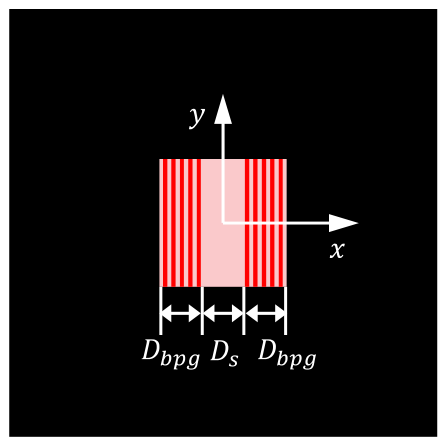
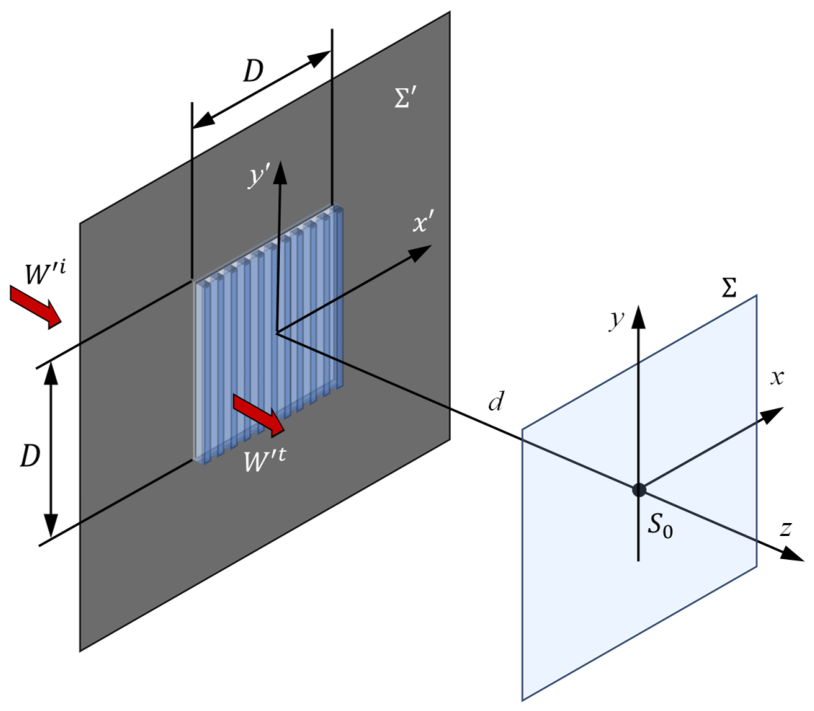
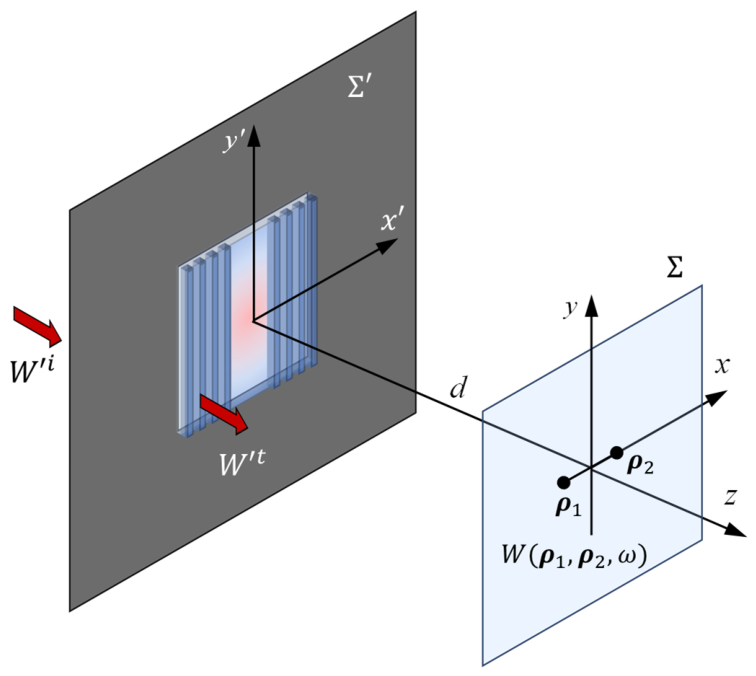
Let us consider PCL incident on a diffractive element, shown in
Figure 1. This element comprises a square opening with two identical binary phase gratings (BPGs) positioned at two opposing edges of the aperture. BPGs have a phase modulation of
. In a conceptual thought experiment, each BPG prevents coherent light from propagating in the forward direction due to destructive interference. In contrast, for PCL with an SCL smaller than the grating period, destructive interference is suppressed, allowing the wave to propagate in the forward direction. In other words, the same BPG behaves differently under coherent and partially coherent illumination. Consequently, when placed next to a conventional slit, such a composite diffractive element would have a coherence-dependent effective width. That is exactly the property required to introduce into Equation (8) the dependence of the integration limits on the coherent properties (
) of light.
The propagation of a complex electric amplitude
through a thin BPG is governed by the following expression [
15,
17]:
where
is the field behind the diffractive slab, and
is the complex transmission coefficient. Thus, the CSDs of the transmitted (
) and incident (
) light are related via [
15,
17]
Note that
for the opaque screen, and
for the opening not covered with BPG. For BPG,
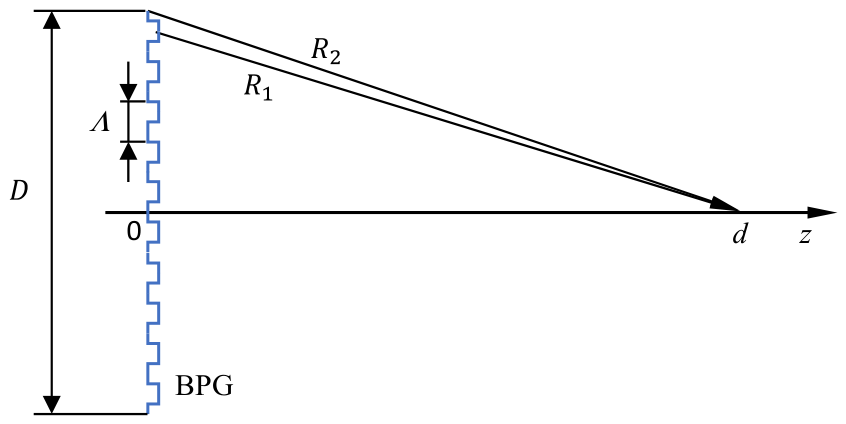
takes the values of
and 1 and is spatially modulated with a period
Λ which is determined by the period of the grating.
4. Discussion
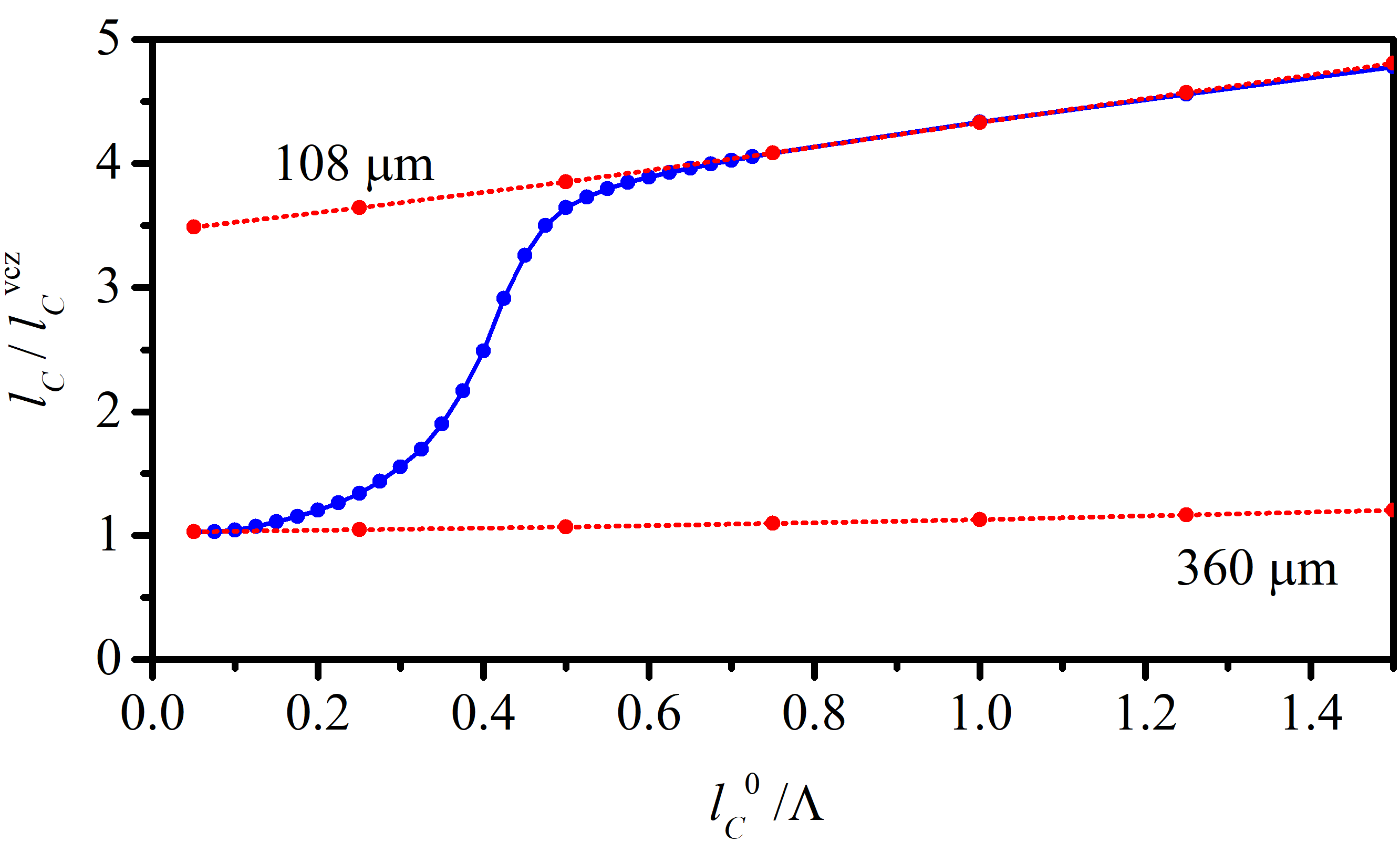
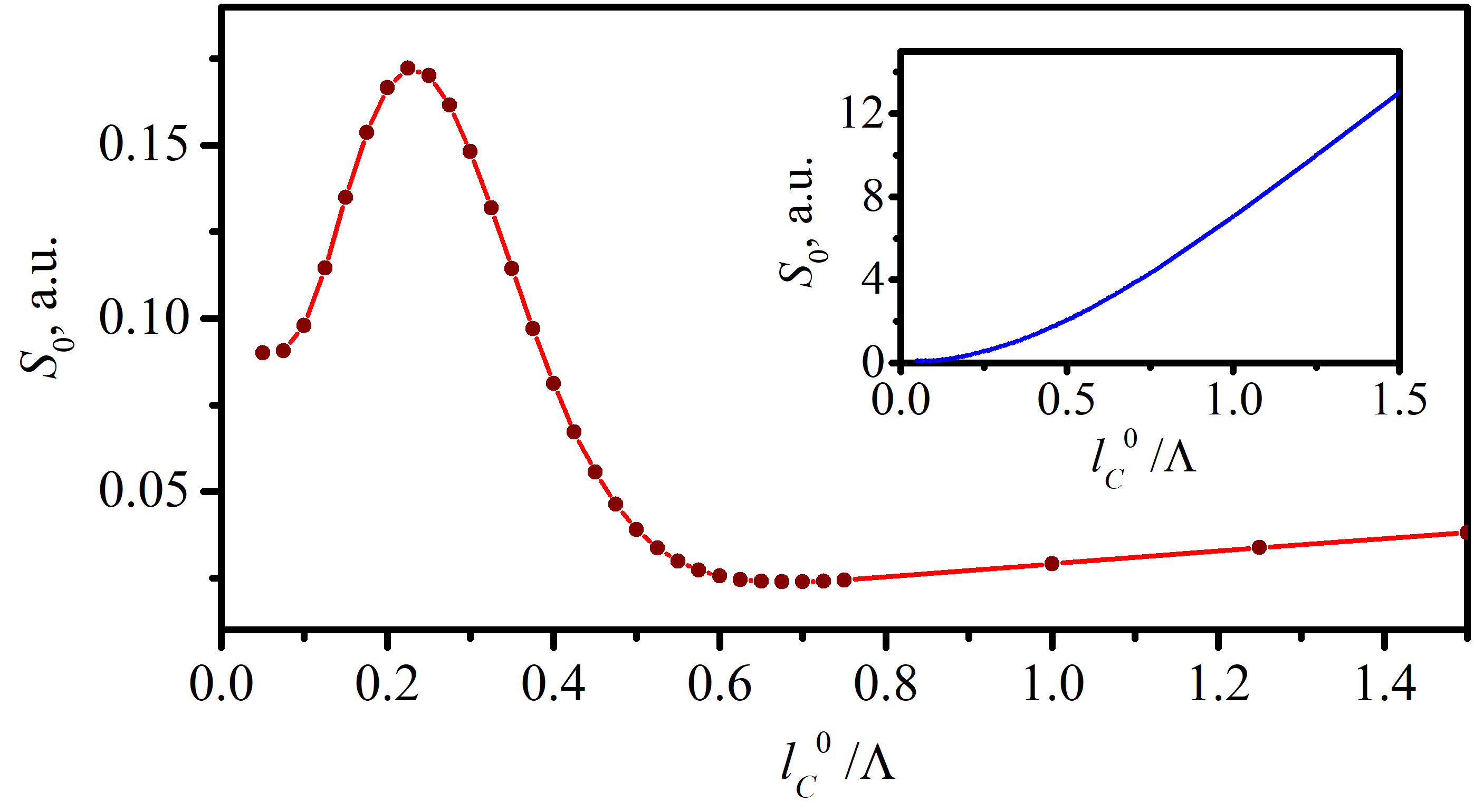
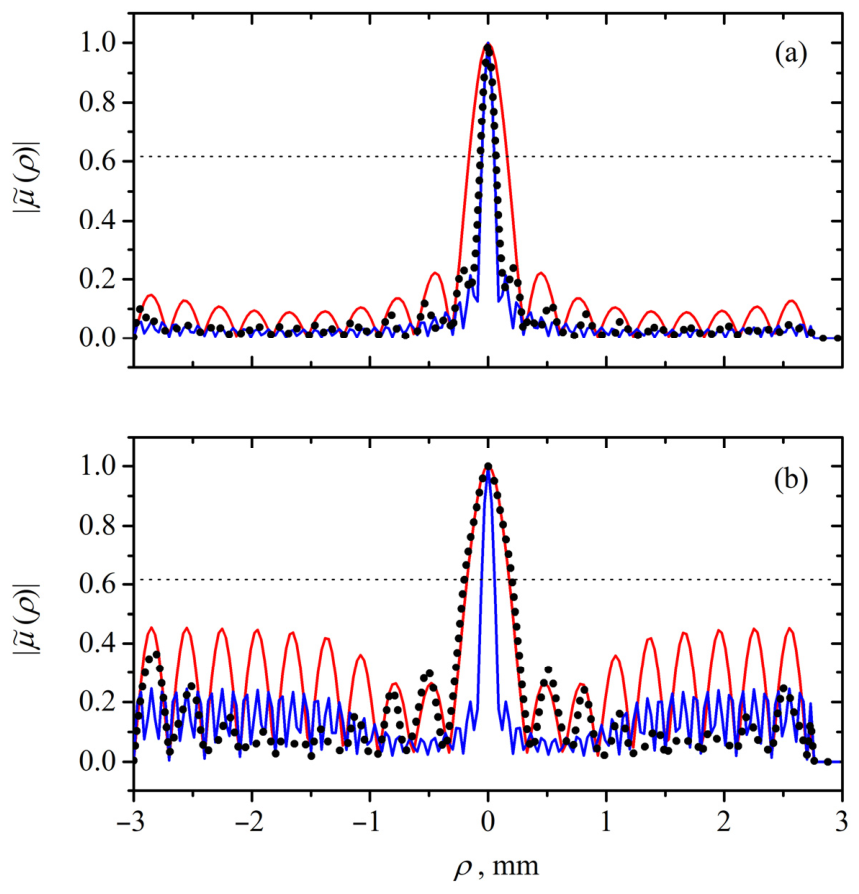
Figure 6 clearly demonstrates the property of the coherence-dependent variability of diffractive element width. Depending on the relation between the SCL of the incident light and the period of BPG, the PCL propagates either through a central slit or through the whole area of the diffractive element. Consequently, the dependence
exhibits a pronounced nonlinear behavior for the BPG-based aperture (blue curve in
Figure 6), whereas for fixed-width openings it remains quasi-linear (red curves in
Figure 6). The effect requires a specific range of SCLs relative to the BPG period (
). If the coherence length is too large, the grating demonstrates destructive interference; if it is too small, the grating-based structure approaches a conventional aperture.
Let us note that the location, the shape of the transition region, and the amount of the step height of the coherence length are not universal constants. They depend on the grating period, slit width, BPG strips width, phase modulation depth, propagation distance, incident CSD model, and the particular definition of spatial coherence length. Despite all possible variations in parameters, the general physical condition persists that the transition occurs when the spatial coherence length of the incident field becomes comparable to the grating period.
Note that the
dependence manifests itself in the coherent properties of the transmitted light. In particular, for a regular slit, the SCL of the transmitted light in the wave zone does not depend on the SCL of the incident light as a consequence of the Van Cittert–Zernike theorem [
15,
16]. On the contrary, for the complex diffractive element (BPG-based structure) depicted in
Figure 1, the effective width of the aperture would depend on the SCL of the incident light. Thus, the SCL of the transmitted light exhibits dependence on the SCL of the incident field even in the wave zone. In this context, the BPG serves as an interferometric modulator, providing a practical means to realize and control the observed nonlinear behavior.
The nonlinear dependence
shown in
Figure 6 is bounded and exhibits a sharp threshold-like transition, closely reminiscent of a sigmoid activation function widely employed in machine learning [
22,
23]. The common defining feature of such functions is the ability to mediate a smooth crossover between two distinct states. In this work, however, our goal was not to replicate a specific sigmoidal curve, but to demonstrate that the proposed physical system inherently provides a comparable switching behavior. Importantly, going beyond standard sigmoidal forms, the grating profile can be further tailored via apodization or chirping, offering a route to realize a broader family of activation functions.
Let us note that achieving the functional dependence for an electric field would require intensity-dependent optical properties and hence large field intensities. In contrast, the implementation for CSD does not require strong fields.
Equation (7) assumes a thin phase mask without diffraction inside the structure. The description of finite thickness requires more complex simulations. Real diffractive structures have finite thickness that may somewhat alter the results. The finite thickness of a diffractive grating may introduce material dispersion, loss, and internal diffraction and interference. These effects may modify the quantitative transfer curve but should not remove the basic coherence-gating mechanism if the required π phase contrast is preserved. Hence, the main conclusion of the paper—the transmission of the diffraction gratings depends on light coherence—remains valid.
5. Conclusions
In this work, we propose a novel approach for implementing nonlinear optical transformations based on the diffraction of PCL. The key idea is to introduce a dependence of the effective integration domain on the cross-spectral density of the optical field, which leads to a nonlinear integral operator governing light propagation.
We demonstrate that a simple diffractive structure consisting of an aperture combined with a phase grating exhibits a transmission behavior that depends on the spatial coherence of the incident radiation. This results in a coherence-dependent effective aperture size and enables the transfer of coherence information into the far field, in contrast to conventional diffraction systems.
Numerical simulations performed using the PyWolf framework confirmed that the SCL of the transmitted field depends on the coherence properties of the input field. This behavior can be interpreted as a nonlinear transformation of the optical signal, suggesting potential applications in diffractive neural networks, where such nonlinearity is essential.
In recent studies [
11,
14], partially coherent light was introduced into diffractive neural networks. However, coherence in these studies primarily acts as a property of the illumination that modifies the behavior of an otherwise linear diffractive architecture. By contrast, in the present work, the spatial coherence length directly controls the effective aperture width of the diffractive element and therefore changes the optical transfer function itself. Thus, the proposed coherence-gated mechanism is not intended as an alternative training strategy at this stage, but rather as a passive physical nonlinearity that could complement partially coherent diffractive neural networks. A quantitative comparison in terms of classification accuracy or scalability requires the implementation of a complete neural-network architecture based on the proposed element and is left for future work.
The proposed mechanism provides a pathway toward implementing nonlinear operations in purely passive optical systems without requiring high optical intensities or active elements. Future work will focus on analytical modeling of the effect, experimental validation, and the design of optimized diffractive structures capable of realizing specific nonlinear activation functions.
Overall, the results indicate that coherence-controlled diffraction provides a promising route toward implementing nonlinear operations in optical systems without relying on material nonlinearities.