


Abstract
Terahertz (THz) fingerprint detection is central to identifying characteristic absorption fingerprints of biomolecules derived from their intrinsic rotational and vibrational modes. The development of guided-mode resonance (GMR) technology together with pixelated design offers a new approach to enhance the recognition capability of such fingerprint spectra. Here, a novel secondary grating metasurface based on cycloolefin polymer (COP) is proposed, which adopts an ultra-minimalist dual-pixel complementary architecture to excite high-quality (Q)-factor GMR. Its spectral resolution does not exceed 50 GHz, enabling precise capture of target molecular characteristic information and meeting the requirements of broadband fingerprint sensing. More importantly, the design regulates the dual-pixel grating units through parameter gradient optimization and incorporates a dual regulation mode of static pixel-targeted coverage and dynamic angle fine tuning. By adjusting geometric parameters and incident angles, broadband coverage from 1.15 THz to 2.20 THz is achieved, which can accurately match the multi-fingerprint detection requirements of glutamic acid (Glu) and glutamine (Gln). This metasurface sensor, integrating the advantages of pixelation and high-Q-factor GMR characteristics, provides an effective strategy for enhanced broadband THz fingerprint sensing and shows broad application potential in the field of biochemical trace detection.
1. Introduction
Terahertz (THz) spectroscopy is important for label-free and non-destructive sensing because it captures characteristic absorption fingerprints corresponding to the intrinsic rotational and vibrational modes of biomolecules [1,2,3]. However, analytes are often measured in the form of millimeter-thick solid pellets [4]. The scale mismatch between THz wavelengths and the absorption cross-section of analytes results in weak light–matter interactions, which severely limits the practical use of THz technology in molecular fingerprint recognition. To address this limitation, metasurfaces have been introduced, which are artificially structured surfaces composed of subwavelength meta-atoms [5,6,7,8,9,10,11]. When their resonant frequencies coincide with molecular characteristic absorption fingerprints, the near-field enhancement effect significantly alters the linewidth and intensity of resonances, allowing analyte fingerprint spectra to be extracted from these variations [12,13,14,15,16,17,18,19,20]. Metasurfaces exhibit tunable resonant frequencies and strong localized field enhancement capability, demonstrating considerable potential in biosensing applications, particularly for rapid and accurate biomolecule detection.
As core amino acid metabolic molecules in organisms, glutamic acid (Glu) and glutamine (Gln) function not only as important quality control indicators in the food and pharmaceutical industries but also as specific biomarkers in tumor metabolic reprogramming processes [21,22,23,24,25,26]. Achieving trace and accurate detection of these two molecules has therefore become an important research demand in the field of THz biosensing. Glu shows characteristic fingerprint absorption peaks at 1.23 THz and 2.03 THz, while Gln exhibits a characteristic fingerprint absorption peak at 1.70 THz [27,28,29,30]. Accurate identification and detection of these characteristic peaks are essential for trace analysis of the two molecules. Guided-mode resonance (GMR) metasurfaces, which possess inherent advantages of strong localized electric field enhancement and a high quality (Q) factor, provide an effective technical pathway for amplifying weak absorption fingerprint signals of biomolecules [31,32,33]. Additionally, quasi-bound states in the continuum (quasi-BIC) metasensors have also emerged as promising candidates for high-sensitivity optical sensing by virtue of their prominent high-Q resonance characteristics [34,35,36,37,38]. Combining these metasurfaces with angle multiplexing and pixelated design further overcomes the frequency band coverage limitation of a single metasurface structure, thereby offering a feasible route for broadband detection of biomolecules with multiple fingerprint peaks [13,39].
Extensive studies have been conducted on THz metasurface sensing technology. Early investigations mainly focused on detection based on enhanced localized field effects, such as achieving a 300 GHz frequency shift at 0.91 THz for glucose detection [40] or detecting sepsis inflammatory factors using antibody-functionalized sensors [41]. These methods usually suffer from limited analyte specificity or dependence on complex biochemical modifications, which makes them difficult to adapt to diverse detection scenarios. Later studies strengthened molecular fingerprint coupling by optimizing resonance tuning strategies, for example, achieving specific recognition of lactose via resonance at 0.529 THz [42]. However, these approaches remain restricted by narrowband response characteristics and often require customized structural designs for different analytes, resulting in limited versatility. Notably, high-sensitivity designs and angle multiplexing strategies of high-Q-factor metasurfaces have gradually been extended to the THz band. For example, angle-multiplexed metasurfaces based on the GMR principle achieve spectral coverage over a specific range through incident angle scanning from 20° to 45° and successfully detect the characteristic absorption peaks of Glu enantiomers [43]. This demonstrates the feasibility of such technologies in the THz domain, although the overall coverage bandwidth remains relatively narrow and cannot fully satisfy the broadband detection requirements of biomolecules with multiple fingerprint peaks. Advancements in tunable THz metasurfaces have further expanded the accessible spectral range. Graphene-based reconfigurable metasurfaces enable broadband sensing but introduce complexities related to bias voltage regulation and strict environmental control [44]. In contrast, graphene metasurfaces based on Quasi-BIC achieve continuous tuning over specific frequency bands through Fermi-level modulation and significantly enhance the absorption signals of molecules such as lactose and tyrosine [6]. Recently, advanced active and tunable metasurfaces have also been developed to realize dynamic resonance regulation via external stimuli including voltage, light, and temperature, providing a flexible route for adaptive THz sensing [45,46]. However, such active platforms typically rely on additional functional layers and complicated control systems, which compromise structural simplicity, fabrication compatibility, and working stability. Nevertheless, the frequency coverage of a single structure is still limited, making it difficult to fully match the characteristic peak distributions of different biomolecules. To overcome the limitation of broadband detection, pixelated metasurface technology has been widely explored for spectral range expansion through multi-unit array design, with two-dimensional pixelated metasurfaces based on S-factor periodic scaling enabling parallel detection of multiple components via spatial–spectral mapping [47,48,49,50,51,52]. Some of these designs cover a relatively wide THz frequency band, which provides potential for multi-fingerprint peak detection. However, existing multi-pixelated technologies still exhibit several limitations. Subtle electromagnetic crosstalk may arise in high-frequency bands when detecting complex biomolecules with dense characteristic peaks affecting fingerprint peak recognition accuracy. Process errors such as edge burrs or uneven metal layer thickness may lead to inconsistent Q factors of metapixels resulting in non-uniform broadband enhancement effects. Their spectral expansion is also restricted by array scale, making it difficult to balance ultra-broadband coverage with structural simplicity. When detecting trace multi-component mixed samples the one-to-one matching mechanism between metapixels and molecular fingerprint peaks may produce signal crosstalk, requiring complex algorithms for auxiliary distinction and increasing practical application complexity [53,54]. Therefore, there remains an urgent need in THz molecular fingerprint sensing for a simplified design strategy that integrates stability and flexibility while enabling significant broadband signal enhancement.
In this study, a pixelated angle-multiplexed GMR secondary grating metasurface THz biosensor suitable for broadband fingerprint detection of biomolecules is introduced. Cycloolefin polymer (COP) with low dielectric loss and favorable processing compatibility is employed as the substrate material and an ultra-minimalist dual-pixel complementary architecture is constructed. Through two GMR grating units optimized by parameter gradient the sensor accurately covers the characteristic fingerprint peak ranges of Glu at 1.23 THz and 2.03 THz as well as Gln at 1.70 THz. Broadband detection is achieved while effectively avoiding the electromagnetic crosstalk problem typically associated with multi-pixel arrays. The study establishes a dual regulation mode combining static pixel targeted coverage and dynamic angle fine tuning. Continuous fine adjustment of resonance peaks is realized through angle scanning which adapts to slight fluctuations in biomolecular characteristic peaks and improves detection accuracy. This research provides a new technical scheme for rapid trace detection of small biomolecules and lays a crucial structural and methodological foundation for the practical development of THz broadband fingerprint biosensing technology.
2. Materials and Methods
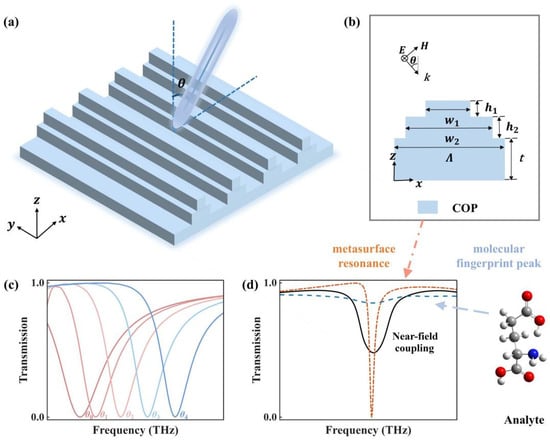
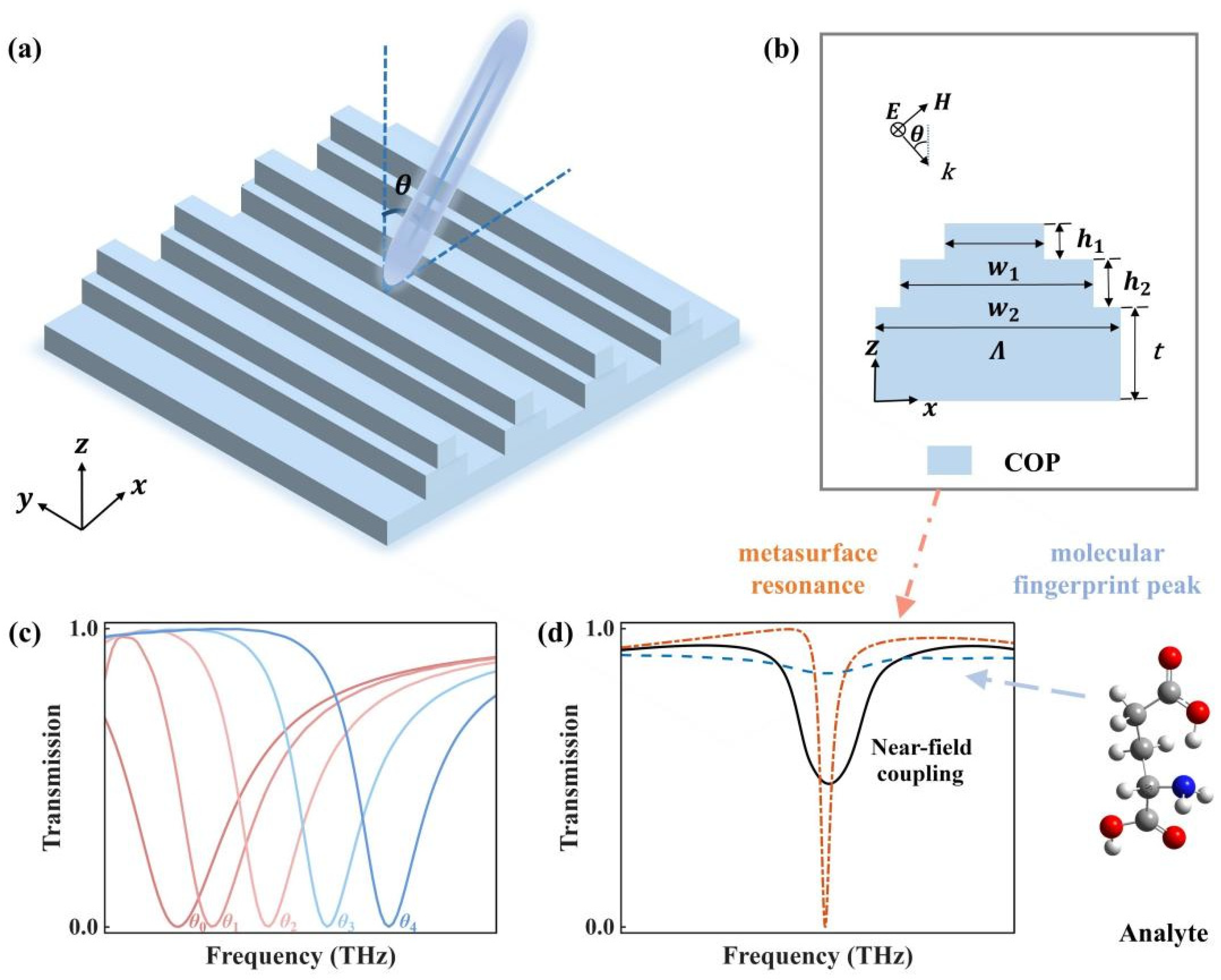
Angle multiplexing allows a single metasurface to encode different optical parameter values such as phase or amplitude, thereby enabling multifunctional devices. However, this flexibility has not yet been widely utilized in THz spectroscopy or sensing. Our angle multiplexed sensor exhibits narrowband resonant transmission at each incident angle θ when illuminated by a broadband light source. Importantly the metasurface establishes a correspondence between resonant frequency and incident angle, enabling each incident angle to be associated with a specific target frequency within the spectral range as shown in Figure 1a,c.
Figure 1.
(a) An all-cyclic olefin polymer (COP) secondary grating metasurface with guided mode resonance (GMR) produces broadband spectral coverage at specific resonance frequencies for different incident angles. (b) Geometric parameters of the structure. The symbols Λ, t, , , , and θ denote the period, height of the waveguide layer, thickness of the top grating layer, thickness of the inter grating layer, width of the top grating layer, width of the inter grating layer and adjustable incident angle of THz waves, respectively. (c) Continuous scanning of the incident angle generates multiple resonances over a broadband range, enabling surface-enhanced molecular absorption spectroscopy in the THz range. (d) Near-field coupling between the metasurface resonance spectra and the vibrational modes of the analyte results in clear attenuation of the resonance shape, correlated with the vibrational absorption spectra.
Our GMR metasurface not only offers angle multiplexing capability but also generates a strongly enhanced electric field near the resonators, thereby enabling high sensitivity. Figure 1d illustrates that the absorption spectrum of the analyte coated on the metasurface couples with the resonant spectrum, resulting in significant attenuation of the spectral profile. Analytes on the sensor surface are detected by measuring variations in resonant spectral intensity at each incident angle. The absorption spectrum of the analyte can be obtained by combining signal measurements collected at all angles.
The basic design of the metasurface is presented in Figure 1a,b. In this work, the secondary grating is defined as a two-layer stacked grating structure with a bottom waveguide layer. Compared with conventional double-layer GMR gratings, the proposed secondary grating maintains excellent sensing performance of double-layer GMR gratings while possessing a low aspect ratio, which significantly reduces fabrication difficulty. It consists of a periodically arranged array of COP secondary gratings with excellent optical transparency. In the THz region the refractive index of COP is about 1.54 [55]. The geometric parameters are set as Λ = 100 μm, t = 20 μm, = 40 μm, = 60 μm, = 10 μm and = 15 μm to evaluate the resonant performance of the metasurface. In addition the proposed COP metasurface can be fabricated through laser etching. This study employs the finite-difference time-domain simulation method to investigate the GMR mechanism and sensing performance in this structure. Within the simulation domain, periodic boundary conditions are applied in the x and y directions while a perfectly matched layer is used at the boundary in the z direction. In the simulation a tunable TE wave is incident with the electric field parallel to the analyte plane, ensuring effective interaction between the THz wave and the sample.
At the initial stage, when the THz wave is incident on the grating, diffraction takes place and wave vector compensation is produced. This behavior can be expressed by the Bragg coupling equation [56]:
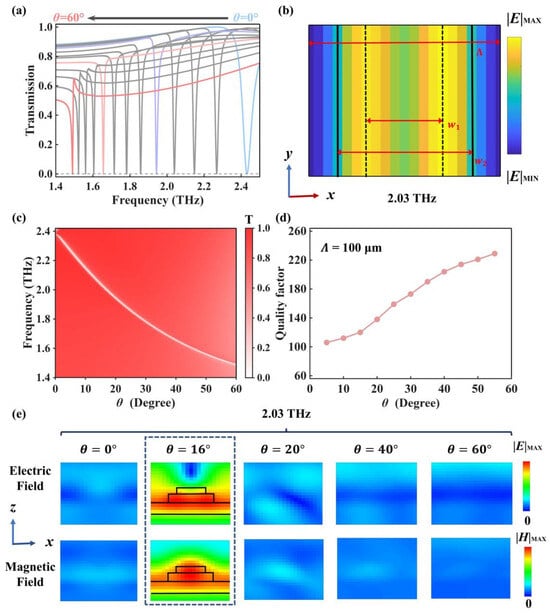
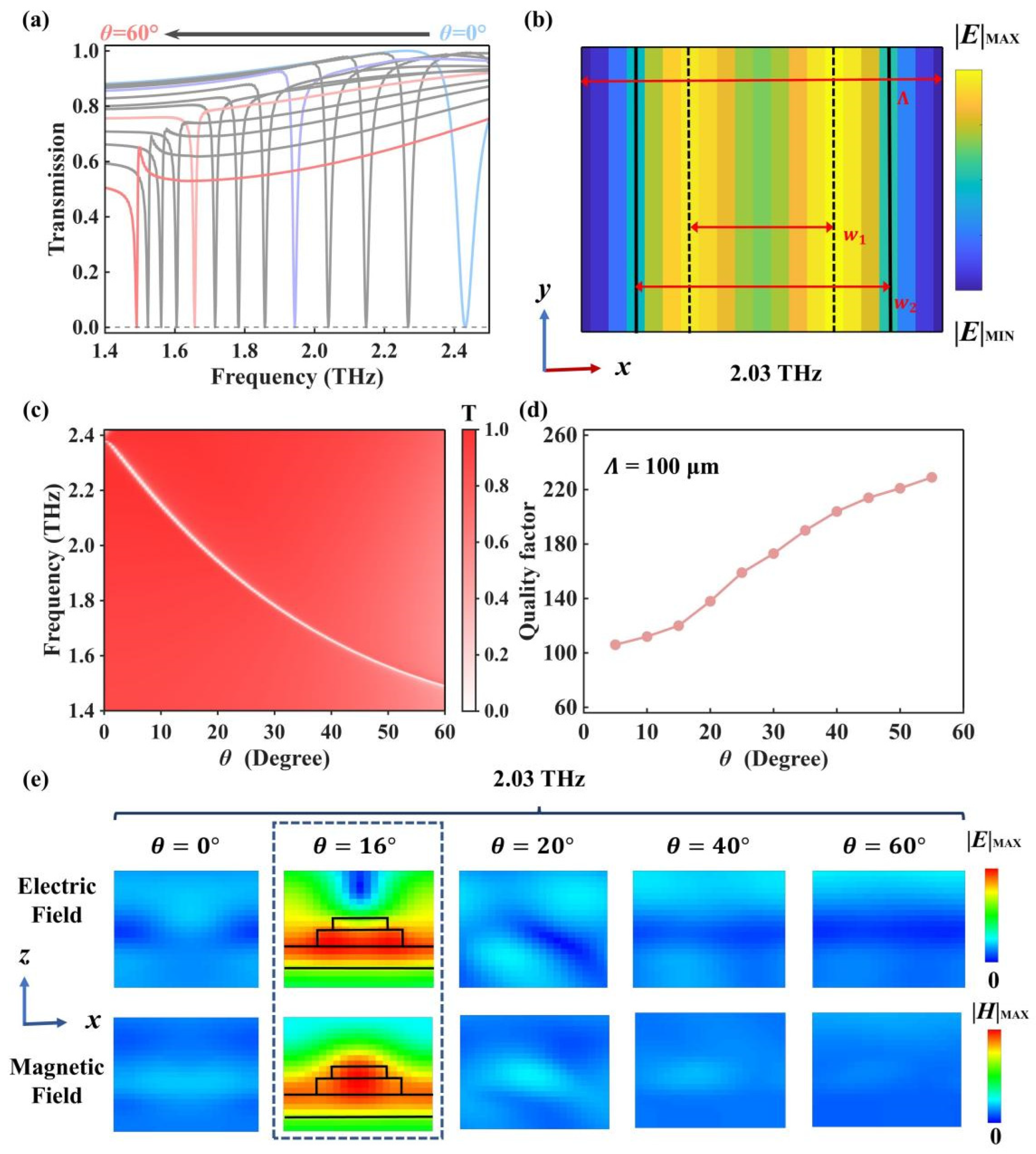
where k represents the wave vector of the diffracted wave, || = 2π/λ is the wave vector of the incident wave, λ is the wavelength, n is the refractive index of the environment, θ is the incident angle, and |Gx| = 2π/Λ is the reciprocal lattice vector determined by the unit period Λ in the x direction, while the integer i represents the grating order of Gx. When the wave vector of the diffracted wave becomes equal to that of the guided mode k = (where is the effective refractive index of the guided mode), excitation of the guided mode occurs within the waveguide (grating), a process referred to as GMR. After that, as the guided mode travels inside the waveguide, directional radiation is produced through the grating decoupling mechanism. The +1 diffraction order supplies the required wave vector compensation, whereas the −1 diffraction order gives inverse compensation, which results in decoupling of the guided mode. Because of this decoupling, radiation of the guided mode occurs along the direction defined by the horizontal component of the incident wave vector. In a transmissive secondary grating structure, both the radiated light and the reflected light propagate along the same direction. Owing to a phase difference of π, destructive interference occurs between these waves, and the transmitted energy is therefore almost completely canceled. Therefore an obvious dip appears in the transmission spectrum at the resonant wavelength. This resonant dip shows a narrow linewidth and high intensity, which is beneficial for sensing because it contributes to a high signal-to-noise ratio and high-resolution detection. For the typical structural parameters of Λ = 100 μm and θ = 16°, the theoretical resonance frequency estimated by Equation (1) is approximately 2 THz, which agrees well with the simulated resonance at 2.03 THz in Figure 2e.
Figure 2.
(a) Simulated transmission spectra of the sensor without the analyte for various θ (0° to 60° in 5° steps). The blue curve shows the transmission spectrum at an incident angle of 0°, the purple curve at 20°, the pink curve at 40°, and the red curve at 60°. (b) Electric field distribution in the x − y plane at 2.03 THz for an incident angle of 16°; the enhanced electric field is suitable for amplifying and detecting the vibrations of adsorbed analyte molecules. (c) Relationship between the GMR frequencies and θ for Λ = 100 μm. (d) The Q-factor of transmission dips at different incident angles. (e) Electric and magnetic field distributions at 2.03 THz for different incident angles on the angle-multiplexed metasurface sensor.
Figure 2a,c,d demonstrate the relationship between the transmission spectrum of the designed GMR metasurface and the incident angle. Each incident angle corresponds to a transmission spectrum with one resonant dip; the resonant frequency decreases as the incident angle increases and the Q-factor rises with increasing incident angle, where the Q-factor is defined as Q = /Δw, where w0 is the resonance frequency, and Δw is the full-width half-maximum (FWHM) of the resonance intensity. When the incident angle varies from 0° to 60° the GMR spans the range between 1.5 THz and 2.4 THz. In addition to angle tuning, GMR couples a large portion of the incident wave energy, amplifying the surface electric field around the grating as shown in Figure 2b, which is advantageous for sensing applications. After analyzing the electric and magnetic field distributions of the angle-multiplexed metasurface at different incident angles, it is observed that the resonant condition at an incident angle of 16° provides strong field enhancement at 2.03 THz as shown in Figure 2e. When the incident angle deviates from 16° the surface electric and magnetic fields weaken significantly due to the deviation of GMR from 2.03 THz. These results indicate that angle scanning can generate a series of resonant spectra enabling the detection of THz fingerprints of trace analytes.
3. Results and Discussion
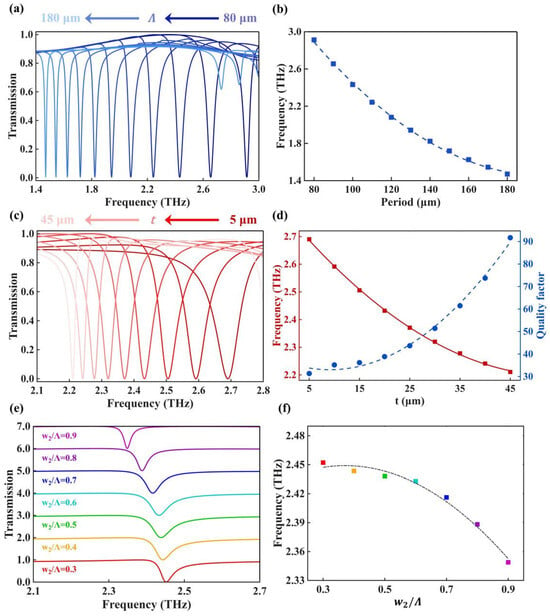
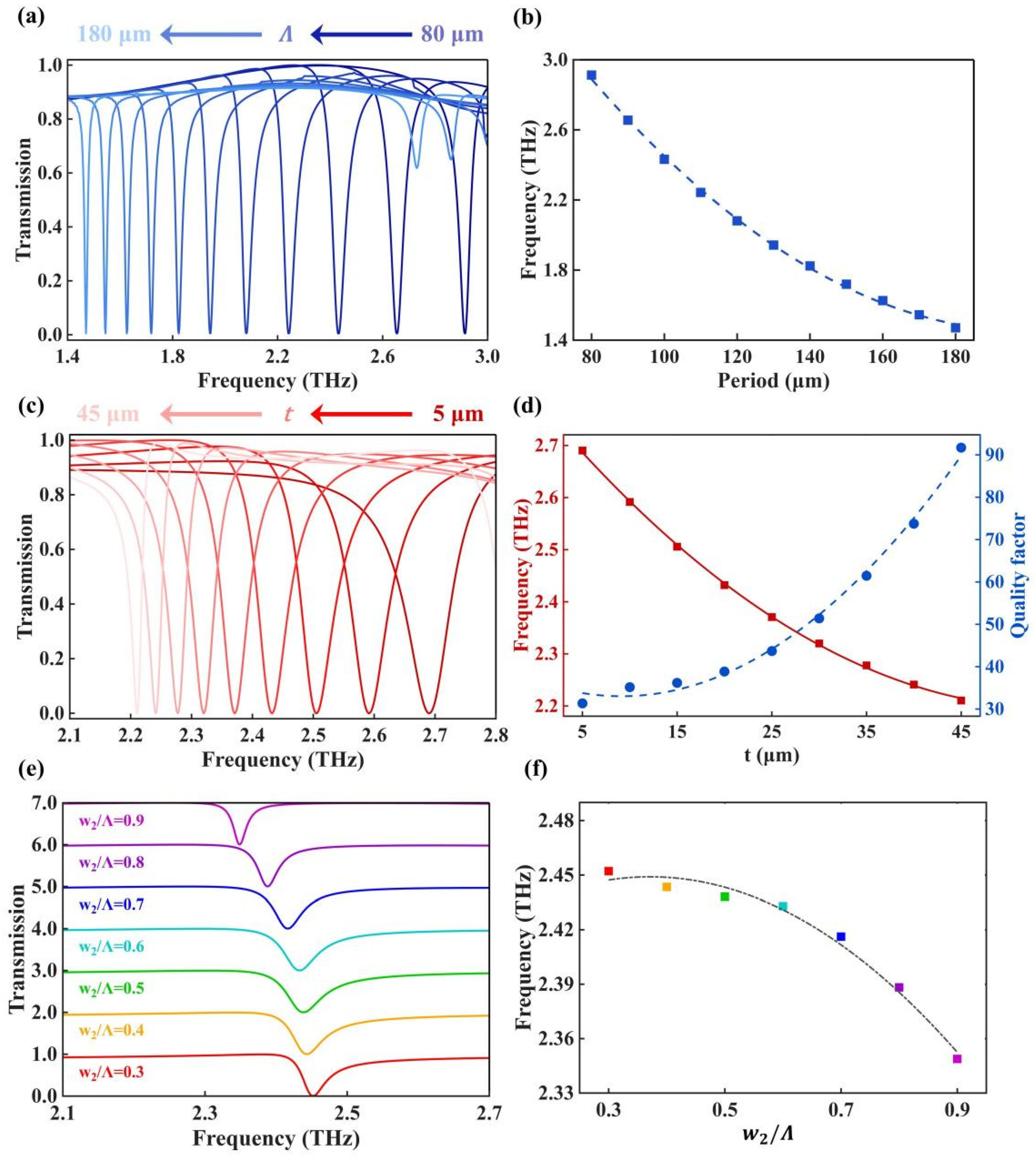
Figure 3 illustrates the gradient optimization of core geometric parameters of the secondary grating metasurface via the single-variable control method, clarifying the regulation rules of lattice period waveguide layer height and grating width ratio on GMR characteristics. As shown in Figure 3a,b, when the lattice period varies between 80 μm and 180 μm the resonant center frequency exhibits a redshift as the period increases. An excessively small period results in insufficient electromagnetic energy localization while an excessively large period introduces greater radiation loss, both of which reduce resonance quality. As presented in Figure 3c,d, when the waveguide layer height is adjusted between 5 μm and 45 μm the resonant frequency shows a slight redshift and the Q-factor increases significantly. This occurs because increasing the waveguide layer height strengthens electromagnetic mode confinement and reduces radiation loss. As depicted in Figure 3e,f the regulation of resonant frequency by the ratio of middle grating width to lattice period follows a redshift trend and fine adjustment of resonant frequency can be achieved by modifying this ratio. In summary these parameter regulation rules provide a quantitative basis for gradient optimization of the dual-pixel unit parameters. By setting the lattice period of Pixel 1 to 150 μm and Pixel 2 to 100 μm together with fine adjustment of waveguide layer height and grating width ratio, the final parameter settings are presented in Table 1, enabling the two pixels to collectively target and cover the low-frequency and high-frequency characteristic peaks of Glu and Gln, laying a structural foundation for broadband detection.
Figure 3.
(a) Simulated transmission spectra and (b) resonant frequencies and their corresponding fitted curves as a function of the lattice period. (c) Simulated transmission spectra and (d) fitting curves of resonant frequencies and Q-factors against waveguide layer height; the red curve denotes the resonant frequency, while the blue curve denotes the Q factor. (e) Simulated transmission spectra and (f) fitting curves of resonant frequencies as a function of the /Λ ratio. Colored dots represent the simulation data corresponding to the colored curves in panel (e), and the dash-dot line is the fitting curve.
Table 1.
Specific parameter settings of Pixel 1 and Pixel 2.
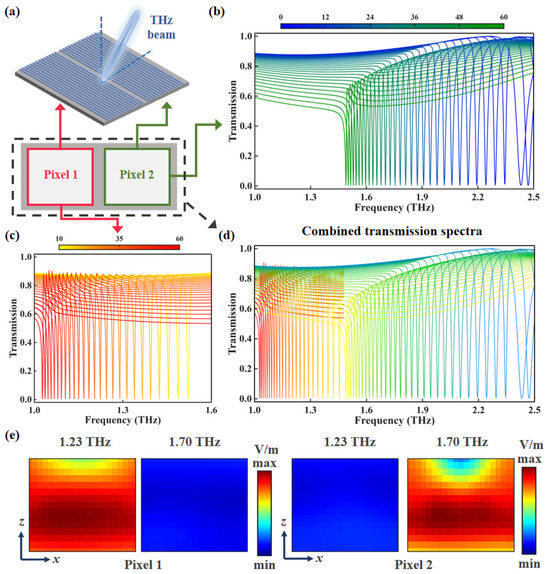
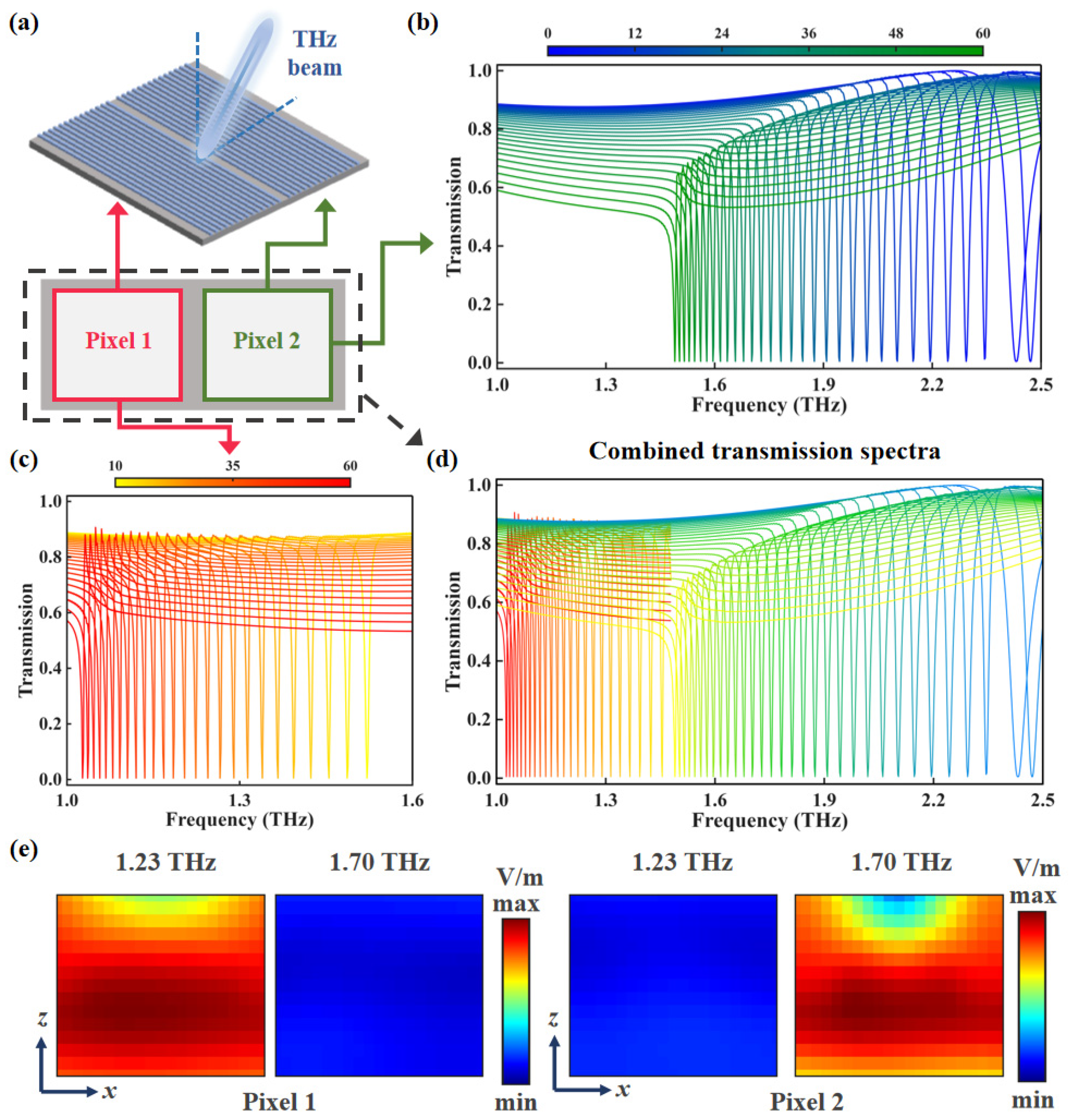
The ultra-minimalist dual-pixel complementary architecture designed based on the above parameter regulation rules exhibits excellent broadband response characteristics as shown in Figure 4 through angle scanning simulations from 0° to 60°. The resonant center frequency of a single pixel displays a linear redshift with increasing incident angle. The angle tuning bandwidth of Pixel 1 ranges between 1.0 THz and 1.5 THz, targeting the low-frequency characteristic peak of Glu at 1.23 THz. The tuning bandwidth of Pixel 2 ranges between 1.5 THz and 2.5 THz, covering the high-frequency characteristic peaks of Glu at 2.03 THz and Gln at 1.70 THz. The frequency bands of the two pixels are complementary and non-redundant and broadband coverage between 1.0 THz and 2.5 THz is achieved through the integration of angle multiplexing technology. After array combination of the two pixels, continuous resonance dips can be generated in the target frequency band through angle scanning. All resonant dips exhibit an FWHM not exceeding 50 GHz, maintaining the high-Q-factor characteristic. Quantitative evaluation indicates that the Q-factor remains above 100 across the working band from 1.15 THz to 2.20 THz, ensuring high spectral resolution and reliable resonance performance. The near-field enhancement factor is approximately 8 at 1.23 THz and about 5 at 1.70 THz, and each complementary pixel provides uniform and stable field enhancement within its respective frequency range. Although the absolute field enhancement differs between Pixel 1 and Pixel 2, the resonance linewidth and lineshape are well preserved. This guarantees that the reconstructed fingerprint spectrum is not significantly modulated and can faithfully reflect the intrinsic absorption characteristics of Glu and Gln. In addition, the transmission spectrum exhibits a stable baseline without obvious electromagnetic crosstalk, confirming that the proposed architecture effectively avoids the crosstalk issue commonly observed in multi-pixel arrays and maintains detection stability while still enabling broadband coverage. The slight discontinuity at around 1.42 THz in Figure 4d arises from the natural spectral transition between the complementary working bands of Pixel 1 and Pixel 2. This boundary feature does not influence the continuous broadband coverage from 1.15 THz to 2.20 THz for target molecular fingerprint detection. Meanwhile, such minor discontinuity can be effectively compensated for by properly tuning the incident angle to guarantee stable and continuous resonance enhancement. The complete design flow starts from single-variable parameter optimization including period, waveguide height, and grating width ratio, and then constructs the dual-pixel complementary architecture. According to Equation (1), the resonant frequency can be accurately determined by the structural period, incident angle, and effective refractive index of the guided mode. Based on theoretical calculations, Pixel 1 with a period of 150 μm is designed to cover the low-frequency range of 1.0–1.5 THz, while Pixel 2 with a period of 100 μm is designed to cover the high-frequency range of 1.5–2.5 THz. The two working bands are precisely separated at 1.5 THz without any spectral overlap. Only two complementary pixels are required to achieve full and seamless coverage of the target fingerprint band from 1.15 THz to 2.20 THz, thus avoiding redundant pixels and excessive structural complexity.
Figure 4.
(a) A tuned pixel array, where arrows of different colors represent the corresponding resonance curves of each structural unit in the transmission spectrum. (b) Normalized transmission spectra of Pixel 2, (c) Pixel 1, and (d) combined transmission spectra of the two pixels for varying incident angles (color bar denotes angles). (e) Simulated near-field electric field distributions at 1.23 THz and 1.70 THz for both Pixel 1 and Pixel 2 under their respective characteristic incident angles.
To further verify the field confinement and resonance mechanism, we provide the near-field electric field distributions at 1.23 THz and 1.70 THz for both Pixel 1 and Pixel 2 in Figure 4e. These two frequencies correspond exactly to the characteristic fingerprint peaks of Glu and Gln. The results consistently demonstrate strong electric field localization and efficient energy confinement inside the waveguide layer for both pixels under their respective operating angles. According to Equation (1), the resonance frequency can be linearly tuned by the incident angle, and the −1st-order diffraction mode provides accurate wavevector compensation to stably excite the guided mode. Such stable and strong field enhancement significantly boosts the light–matter interaction and ensures reliable coupling with molecular vibration fingerprints.
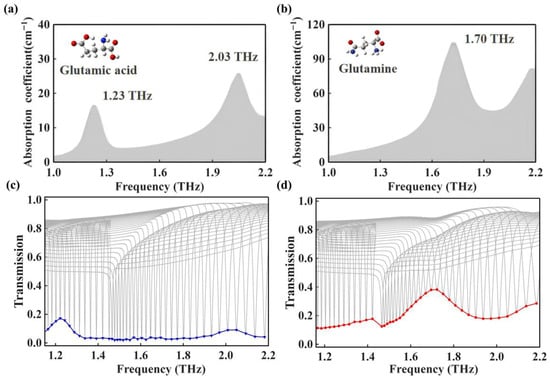
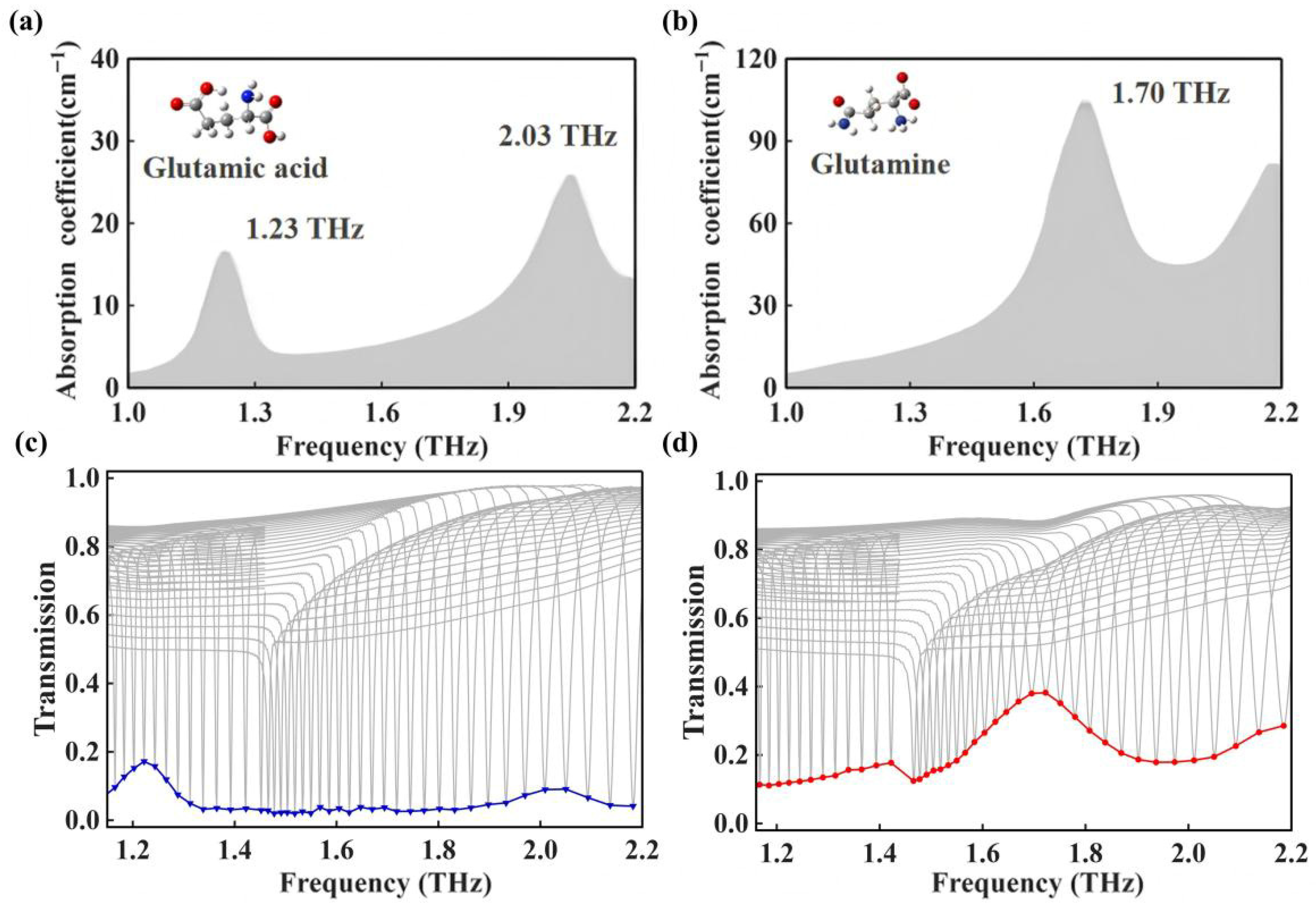
Glu and Gln are core amino acid metabolic molecules in biological systems, functioning not only as important quality control indicators in the food and pharmaceutical industries but also as specific biomarkers during tumor metabolic reprogramming. In this study, the characteristic absorption peaks of these two molecules were successfully identified using THz spectroscopy. As illustrated in Figure 5a,b, Glu shows clear characteristic absorption peaks at 1.23 THz and 2.03 THz, whereas the characteristic peak of Gln appears at 1.70 THz. These peaks mainly arise from intramolecular vibration modes and hydrogen-bond network interactions, which provide high molecular specificity for recognition.
Figure 5.
(a) Absorption coefficient spectrum of glutamic acid (Glu) exhibiting its characteristic fingerprint peaks at 1.23 THz and 2.03 THz. (b) Absorption coefficient spectrum of glutamine (Gln) with the characteristic fingerprint peak located at 1.70 THz. (c) Simulated transmission spectrum of the metasurface after Glu adsorption, showing clear resonant attenuation and peak shape distortion at the corresponding characteristic peaks. (d) Simulated transmission spectrum of the metasurface after Gln adsorption, presenting molecule-specific resonant spectral variations consistent with its absorption coefficient characteristics.
To verify the sensing capability of the metasurface, 5 μm thick layers of Glu and Gln were uniformly coated on the bottom surface of the grating respectively. Figure 5c,d show the transmission spectra and their envelope curves after analyte coating. The results reveal obvious resonant dips at the characteristic peaks of Glu and Gln and the envelope curves closely correspond to the absorption coefficient spectra of the molecules. When Glu and Gln molecules are adsorbed on the metasurface, significant attenuation of resonant dips and distortion of peak shapes occur in the transmission spectrum at the characteristic fingerprint peaks of the target molecules. Characteristic peaks of Glu appear at 1.23 THz and 2.03 THz respectively while that of Gln appears at 1.70 THz. Clear differences are observed in the peak shape distortion characteristics of different molecules and this molecule-specific variation forms the basis of the peak shape qualitative detection method.
To quantitatively evaluate the sensing performance, key indicators including sensitivity, limit of detection (LOD), repeatability, and selectivity are systematically analyzed. The maximum sensitivity reaches 150 GHz/RIU within the operating band. The LOD is calculated as about 150 μg/cm2 for both Glu and Gln. The sensor exhibits excellent repeatability with resonant intensity deviation below 3% over multiple repeated simulations. Furthermore, it presents superior selectivity to clearly distinguish Glu and Gln even in mixed samples, owing to the high-Q-factor and sharp resonance characteristics that highlight their intrinsic fingerprint spectral differences.
A performance comparison between the pixelated angle-multiplexed GMR secondary grating metasurface proposed in this study and recently reported THz sensors is presented in Table 2. Through the ultra-minimalist dual-pixel plus angle multiplexing scheme, broadband tuning between 1.15 THz and 2.20 THz is achieved while avoiding electromagnetic crosstalk and structural redundancy commonly found in multi-pixel arrays. Compared with quasi-BIC structures that also exhibit high-Q resonances, the proposed GMR secondary grating features a more stable broadband response, which is more favorable for practical THz fingerprint sensing applications. Furthermore, in contrast to conventional pixelated and angle-multiplexed metasensors, the presented dual-pixel complementary design avoids a complex multi-unit layout and frequent electromagnetic crosstalk. Unlike active metasensors that rely on external stimuli and additional regulatory devices, the all-passive, all-COP structure eliminates the requirements of bias circuits, stimulus systems, and complex operational conditions, thus exhibiting stronger stability, higher reliability, and easier integration toward actual detection scenarios. Meanwhile, the low-aspect-ratio secondary grating configuration significantly relieves fabrication constraints and reduces structural inconsistencies induced by manufacturing errors, further ensuring uniform and stable resonance enhancement throughout the working band. The sensor presents obvious and stable resonance intensity attenuation at the characteristic fingerprint frequencies of Glu and Gln. The spectral response exhibits molecule-dependent features that enable clear distinction between Glu and Gln. Nevertheless the sensor still has potential for further improvement. For example the angle scanning range can be reduced to between 0° and 30° to improve detection efficiency or surface functional modification may be introduced to enhance molecular adsorption selectivity, making it more suitable for detection in complex real samples.
Table 2.
THz molecular fingerprint sensing performance of recently reported metasurfaces.
4. Conclusions
To address the demand for rapid trace and broadband fingerprint detection of Glu and glutamine, this study develops a pixelated angle-multiplexed GMR secondary grating metasurface THz biosensor using COP as the structural material. The ultra-minimalist dual-pixel complementary architecture optimized via single-variable control precisely covers the characteristic peaks of the target molecules by utilizing key geometric parameter regulation rules, where a lattice period increase induces linear resonance redshift, waveguide layer height enhancement strengthens electromagnetic confinement, and grating width ratio adjustment enables fine frequency tuning. Combined with angle multiplexing the sensor achieves broadband coverage from 1.15 THz to 2.20 THz with continuous resonance dips and without obvious electromagnetic crosstalk, balancing detection range and operational stability. The low-aspect ratio stacking design of the secondary grating reduces fabrication difficulty and enhances localized electric fields through interlayer near-field coupling, thereby strengthening THz wave–molecule interactions, while incident angle fine tuning adapts to slight biomolecular peak fluctuations, improving detection accuracy. This sensor enables reliable qualitative identification of Glu and Gln based on their characteristic fingerprint-coupled resonance responses. Future surface functional modification and module miniaturization are expected to further expand its applications in food screening, pharmaceutical inspection, and clinical tumor detection. At present, the experimental fabrication and angle-resolved THz measurement of the proposed sensor are still in progress, and the main challenges include high-precision processing of the secondary grating, accurate angle-dependent THz-TDS testing, and uniform coating of trace analytes.
Author Contributions
Conceptualization, W.X., M.P., Y.S. and Y.Z.; methodology, W.X., Y.S. and Y.Z.; software, W.X. and M.P.; validation, W.X. and M.P.; formal analysis, W.X.; investigation, W.X., M.P., Q.H., S.S. and C.G.; resources, W.X., M.P., Q.H., S.S. and C.G.; data curation, W.X. and Y.S.; writing—original draft preparation, W.X. and Y.S.; writing—review and editing, W.X. and Y.S.; visualization, W.X.; supervision, Y.S. and Y.Z.; project administration, Y.S. and Y.Z.; funding acquisition, Y.S. All authors have read and agreed to the published version of the manuscript.
Funding
This work was supported by the Joint Funds of the National Natural Science Foundation of China (No. U25A20143); the National Key Research and Development Program of China (No. 2022YFA1405200); the National Natural Science Foundation of China (No. 62371272); the Natural Science Foundation of Shandong Province (Nos. ZR2023ZD08, ZR2024LLZ006); and the Key Technology Program of Qingdao (No. 23-1-2-qljh-5-gx).
Institutional Review Board Statement
Not applicable.
Informed Consent Statement
Not applicable.
Data Availability Statement
Data will be made available on request.
Conflicts of Interest
The authors declare that they have no known competing financial interests or personal relationships that could have appeared to influence the work reported in this paper.
Abbreviations
The following abbreviations are used in this manuscript:
| THz | Terahertz |
| GMR | Guided-mode resonance |
| Q-factor | Quality-factor |
| Glu | Glutamic acid |
| Gln | Glutamine |
| COP | Cycloolefin polymer |
References
- Jintamethasawat, R.; Somboonsaksri, P.; Termsaithong, N.; Chia, J.-Y.; Thongratkaew, S.; Nakason, K.; Ngernsutivorakul, T.; Sucharitpongpan, K.; Khemthong, P.; Srisuai, N.; et al. Identification of Important Sugar Binary Mixtures Found in Biorefineries Using Terahertz Time-Domain Spectroscopy. ACS Omega 2025, 10, 62872–62880. [Google Scholar] [CrossRef] [Scilit]
- Lien Nguyen, K.; Gladden, L.F.; Friščić, T.; Day, G.M.; Jones, W. Terahertz time-domain spectroscopy and the quantitative monitoring of mechanochemical cocrystal formation. Nat. Mater. 2007, 6, 206–209. [Google Scholar] [CrossRef] [Scilit]
- Yan, H.; Fan, W.-H.; Qin, C.; Jiang, X.-Q.; Zhang, Y.-M. Fingerprint terahertz spectroscopy combined with machine learning for multicomponent mixture analysis. Vib. Spectrosc. 2023, 128, 103581. [Google Scholar] [CrossRef] [Scilit]
- Lu, X.; Xu, L.; Luo, L.; Li, Z.; Chang, T.; Wei, D.; Cui, H.-L. Weak Value Amplified Precision Terahertz Spectroscopic Detection of Solid and Liquid Glucose Samples. ACS Photonics 2023, 10, 3149–3160. [Google Scholar] [CrossRef] [Scilit]
- Xie, Y.; Ma, Y.; Liu, X.; Khan, S.A.; Chen, W.; Zhu, L.; Zhu, J.; Liu, Q.H. Dual-Degree-of-Freedom Multiplexed Metasensor Based on Quasi-BICs for Boosting Broadband Trace Isomer Detection by THz Molecular Fingerprint. IEEE J. Sel. Top. Quantum Electron. 2023, 29, 8600110. [Google Scholar] [CrossRef] [Scilit]
- Zhao, J.; Wang, J. Quasi-Bound States in the Continuum-Enabled Wideband Terahertz Molecular Fingerprint Sensing Using Graphene Metasurfaces. Nanomaterials 2025, 15, 1178. [Google Scholar] [CrossRef] [Scilit]
- Xie, Y.; Liu, X.; Zhou, J.; Zhang, H.; Lin, J.-Y.; Chen, W.; Zhu, L.-G.; Meng, K.; Liu, Q.H.; Zhu, J. Enhancing Trace Terahertz Fingerprint Sensing by the Lossy Silicon Metagrating With a Gold Mirror. IEEE Trans. Microw. Theory Tech. 2024, 72, 2368–2377. [Google Scholar] [CrossRef] [Scilit]
- Shen, S.; Chen, L. Rapid Recognition of Glucose Molecular Fingerprint Using Transmissive Microfluidic Multiplexing Metasensor. IEEE Sens. J. 2024, 24, 16070–16076. [Google Scholar] [CrossRef] [Scilit]
- Zhang, X.; Wang, Y.; Li, J.; Fan, Y.; Bai, G.; Chen, X.; Ru, Y.; Wang, C. Fingerprint spectrum retrieval of ultra-low amino acids concentration achieved by angle tunable carbon nanotube terahertz metasurfaces. Chem. Eng. J. 2025, 520, 166389. [Google Scholar] [CrossRef] [Scilit]
- Yang, C.; Shen, Z.; Cui, Y.; Zhang, N.; Zhang, L.; Yan, R.; Chen, X. Terahertz molecular vibrational sensing using 3D printed anapole meta-biosensor. Biosens. Bioelectron. 2025, 278, 117351. [Google Scholar] [CrossRef] [Scilit]
- Yan, X.; Ma, S.; Zhang, Y.; Liang, L.; Yao, H.; Hu, X.; Yang, F.; Hou, Z.; Li, Z.; Huang, C.; et al. Terahertz metasurface sensor based on patterned metal slit structure for trace detection. Spectrochim. Acta Part A Mol. Biomol. Spectrosc. 2026, 350, 127390. [Google Scholar] [CrossRef] [Scilit] [PubMed]
- Zhu, J.; Li, X.; Yan, D.; Zhang, L. Parameter Multiplexing-Based Terahertz Enhanced Absorption Spectra Using Ultrathin Metal Groove Array. Plasmonics 2024, 19, 3359–3366. [Google Scholar] [CrossRef] [Scilit]
- Pan, M.; Ling, H.; Xin, D.; Zhang, X.; Shi, Y.; Zhang, Y. Angle-Scanning and Size-Scaling Pixelated Quasi-BIC Metasurface Array for Broadband Terahertz Fingerprint Biosensing. Photonics 2025, 12, 1127. [Google Scholar] [CrossRef] [Scilit]
- Yang, J.; Li, X.; Yan, D.; Zhang, L.; Zhao, Y.; Liu, H. Enhanced Trace Amount Terahertz Fingerprint Spectroscopy Using Symmetrical Spoof Surface Plasmon Metasurfaces. Plasmonics 2023, 18, 1083–1091. [Google Scholar] [CrossRef] [Scilit]
- Chen, D.; Li, X.; Zhang, L.; Yan, D. Enhancement of broadband terahertz trace absorption spectrum based on angular multiplexing of trapezoidal dielectric grating. Opt. Commun. 2025, 574, 131155. [Google Scholar] [CrossRef] [Scilit]
- Wang, Y.; Zhang, J.; Wang, M.; Song, G.; Zhang, B.; Wei, B.; Ma, Z.; Zhang, Y.; Lou, J.; Chen, Q. Ultrasensitive metasurface-based sensors for fingerprint spectra extraction of L-glutamate at ultra-low concentration. Opt. Commun. 2024, 550, 130005. [Google Scholar] [CrossRef] [Scilit]
- Wang, W.; Sun, M.; Lin, J.; Xue, Y.; Shi, Y. Terahertz Fingerprint Metasurface Sensor Based on Temperature Variation for Trace Molecules. Biosensors 2024, 14, 318. [Google Scholar] [CrossRef] [Scilit] [PubMed]
- Li, X.-J.; Yang, J.; Yan, D.-X.; Guo, S.-H.; Zhao, Y.; Xu, X.; Zhou, W.-D. Highly enhanced trace amount terahertz fingerprint spectroscopy by multiplexing surface spoof plasmon metasurfaces in a single layer. Opt. Commun. 2022, 525, 128777. [Google Scholar] [CrossRef] [Scilit]
- Mao, G.; Shi, T.; Huang, Y.; Zhong, S.; Sun, F.; Zeng, Q.; Zhong, Y.; Lin, T. Distance-multiplexed sensor with metal-dielectric grating composite structure for terahertz sensing enhancement. Opt. Laser Technol. 2025, 183, 112245. [Google Scholar] [CrossRef] [Scilit]
- Yu, W.; Pan, M.; Liu, S.; Li, H.; Nie, W.; Zhang, Y.; Shi, Y. Terahertz Broadband Bimodal Multiplexing Detection Based on Quasi-Bound States in the Continuum and Guided-Mode Resonance. Ann. Phys. 2025, 537, 2500022. [Google Scholar] [CrossRef] [Scilit]
- Horváthová, J.; Tobolková, B.; Kopuncová, M.; Polovka, M.; Durec, J.; Hrouzková, S. Free amino acid profile of orange and pineapple juices as a marker of geographical origin. J. Food Compos. Anal. 2025, 148, 108311. [Google Scholar] [CrossRef] [Scilit]
- Li, Y.-F. A hypothesis of monoamine (5-HT)—Glutamate/GABA long neural circuit: Aiming for fast-onset antidepressant discovery. Pharmacol. Ther. 2020, 208, 107494. [Google Scholar] [CrossRef] [Scilit] [PubMed]
- Bednarik, P.; Goranovic, D.; Svatkova, A.; Niess, F.; Hingerl, L.; Strasser, B.; Deelchand, D.K.; Spurny-Dworak, B.; Krssak, M.; Trattnig, S.; et al. 1H magnetic resonance spectroscopic imaging of deuterated glucose and of neurotransmitter metabolism at 7 T in the human brain. Nat. Biomed. Eng. 2023, 7, 1001–1013. [Google Scholar] [CrossRef] [Scilit]
- Ohtani, Y.; Tani, H.; Honda, S.; Nomoto-Takahashi, K.; Yatomi, T.; Yonezawa, K.; Tomiyama, S.; Nagai, N.; Kusudo, K.; Moriyama, S.; et al. Glutamate plus glutamine to GABA ratio as a predictor of ketamine response in treatment-resistant depression: A double-blind, randomized, open-label extension study. J. Affect. Disord. 2025, 383, 354–362. [Google Scholar] [CrossRef] [Scilit]
- Alhallaq, A.S.; Sultan, N.S. Fueling Prostate Cancer: The Central Role of Glutamine/Glutamate Metabolic Reprogramming. Asian Pac. J. Cancer Prev. APJCP 2025, 26, 3157–3174. [Google Scholar] [CrossRef] [Scilit]
- Sun, Y.; Cui, Y.; Luo, D.; Tian, C. Glutamine reprogramming affects the tumor microenvironment and immune response in hepatocellular carcinoma. Mol. Biol. Rep. 2025, 53, 144. [Google Scholar] [CrossRef] [Scilit]
- Wang, R.; Zhang, D.; Chen, L.; Zhang, N.; Li, D.; Jiang, R.; Zhang, X.; Yang, X.; Zhang, L.; Wang, S.; et al. Ultra-compact broadband terahertz spectroscopy sensor enabled by resonant-gradient metasurface. Nat. Commun. 2025, 16, 11462. [Google Scholar] [CrossRef] [Scilit] [PubMed]
- Li, Y.; Xu, L.; Li, H.; Xiong, G.; Liu, Q.; Yang, W.; Yang, S.; Deng, X. Impact of hydrogen bonding network configuration on intramolecular distortion in solid state: Studies on low-frequency vibrations of L-glutamic acid and L-glutamine. J. Mol. Struct. 2019, 1180, 636–641. [Google Scholar] [CrossRef] [Scilit]
- Yi, W.; Yu, J.; Xu, Y.; Wang, F.; Yu, Q.; Sun, H.; Xu, L.; Liu, Y.; Jiang, L. Broadband terahertz spectroscopy of amino acids. Instrum. Sci. Technol. 2017, 45, 423–439. [Google Scholar] [CrossRef] [Scilit]
- Wang, W.-N.; Zhang, Y.; Zhang, C.-L.; Li, H.-Q. Correlations between terahertz spectra and molecular structures of 20 standard α-amino acids. Wuli Huaxue Xuebao/Acta Phys.-Chim. Sin. 2009, 25, 2074–2079. [Google Scholar]
- Ma, L.; Li, L.; Wang, B.; Chen, Y.; Wang, S.; Cao, Y.; Sun, H.; Ma, Y.; Rao, X.; Rong, L.; et al. High-sensitivity biosensors based on reflection-type guided-mode-resonance secondary grating metasurfaces. Sens. Actuators B Chem. 2025, 434, 137609. [Google Scholar] [CrossRef] [Scilit]
- Fradkin, Z.; Piscklich, M.; Zohar, M.; Auslender, M. Numerical Study of Incidence Angle-Tuned, Guided-Mode Resonant, Metasurfaces-Based Sensors for Glucose and Blood-Related Analytes Detection. Sensors 2025, 25, 5852. [Google Scholar] [CrossRef] [Scilit]
- Yildirim, D.U.; Ghobadi, A.; Soydan, M.C.; Gokbayrak, M.; Toprak, A.; Butun, B.; Ozbay, E. Colorimetric and Near-Absolute Polarization-Insensitive Refractive-Index Sensing in All-Dielectric Guided-Mode Resonance Based Metasurface. J. Phys. Chem. C 2019, 123, 19125–19134. [Google Scholar] [CrossRef] [Scilit]
- Sang, T.; Dereshgi, S.A.; Hadibrata, W.; Tanriover, I.; Aydin, K. Highly efficient light absorption of monolayer graphene by quasi-bound state in the continuum. Nanomaterials 2021, 11, 484. [Google Scholar] [CrossRef] [Scilit]
- Wang, R.; Xu, L.; Huang, L.; Zhang, X.; Ruan, H.; Yang, X.; Lou, J.; Chang, C.; Du, X. Ultrasensitive Terahertz Biodetection Enabled by Quasi-BIC-Based Metasensors. Small 2023, 19, e2301165. [Google Scholar] [CrossRef] [Scilit] [PubMed]
- Sun, G.; Wang, Y.; Xie, R.; Chen, X.; Li, Y.; Chen, W.; Fan, K.; Cui, Z.; Zhao, X. Pushing Q-factor limit of guided resonances by harnessing topologically protected terahertz bound states in the continuum. Appl. Phys. Rev. 2025, 12, 011422. [Google Scholar] [CrossRef] [Scilit]
- Chen, W.; Wang, Y.; Cui, Z.; Sun, G.; Zhang, K. Quasi-Bound States in the Continuum and Sensing Performance With Polarization-Selective in All-Dielectric THz Metasurface. IEEE Sens. J. 2024, 24, 6085–6091. [Google Scholar] [CrossRef] [Scilit]
- Liu, B.; Peng, Y.; Jin, Z.; Wu, X.; Gu, H.; Wei, D.; Zhu, Y.; Zhuang, S. Terahertz ultrasensitive biosensor based on wide-area and intense light-matter interaction supported by QBIC. Chem. Eng. J. 2023, 462, 142347. [Google Scholar] [CrossRef] [Scilit]
- S, R.P.; Kumar, R.; Mitra, A. Electrically Reconfigurable Phase Change Material-Based Metamaterial Absorber for Broadband Molecular Fingerprint Retrieval. ACS Photonics 2024, 11, 1793–1803. [Google Scholar] [CrossRef] [Scilit]
- Tao, H.; Chieffo, L.R.; Brenckle, M.A.; Siebert, S.M.; Liu, M.; Strikwerda, A.C.; Fan, K.; Kaplan, D.L.; Zhang, X.; Averitt, R.D.; et al. Metamaterials on paper as a sensing platform. Adv. Mater. 2011, 23, 3197–3201. [Google Scholar] [CrossRef] [Scilit]
- Zhang, B.; Wang, R.; Du, X. Rapid and Highly Sensitive Detection of Sepsis Inflammatory Factors Based on a Plasmonic Terahertz-Metasurface Biosensor. IEEE Trans. Plasma Sci. 2024, 52, 1522–1530. [Google Scholar] [CrossRef] [Scilit]
- Han, B.; Han, Z.; Qin, J.; Wang, Y.; Zhao, Z. A sensitive and selective terahertz sensor for the fingerprint detection of lactose. Talanta 2019, 192, 1–5. [Google Scholar] [CrossRef] [Scilit]
- Sun, H.; Cao, Y.; Chen, Y.; Li, L.; Ma, L.; Jin, S.; Gu, G.; Song, X.; Wu, W.; Feng, Z. Angle-multiplexed guided mode resonance metasurfaces for broadband terahertz fingerprint detection. Photonics Res. 2025, 13, 3102–3110. [Google Scholar] [CrossRef] [Scilit]
- Liu, B.; Peng, Y.; Hao, Y.; Zhu, Y.; Chang, S.; Zhuang, S. Ultra-wideband terahertz fingerprint enhancement sensing and inversion model supported by single-pixel reconfigurable graphene metasurface. PhotoniX 2024, 5, 10. [Google Scholar] [CrossRef] [Scilit]
- Zhang, Z.; Wang, Z.; Zhang, C.; Yao, Z.; Zhang, S.; Wang, R.; Tian, Z.; Han, J.; Chang, C.; Lou, J.; et al. Advanced Terahertz Refractive Sensing And Fingerprint Recognition Through Metasurface-Excited Surface Waves. Adv. Mater. 2024, 36, e2308453. [Google Scholar] [CrossRef] [Scilit]
- Lou, J.; Jiao, Y.; Yang, R.; Huang, Y.; Xu, X.; Zhang, L.; Ma, Z.; Yu, Y.; Peng, W.; Yuan, Y.; et al. Calibration-free, high-precision, and robust terahertz ultrafast metasurfaces for monitoring gastric cancers. Proc. Natl. Acad. Sci. USA 2022, 119, e2209218119. [Google Scholar] [CrossRef] [Scilit] [PubMed]
- Sun, H.; Cao, Y.; Chen, Y.; Li, L.; Ma, L.; Jin, S.; Gu, G.; Song, X.; Wu, W.; Feng, Z. Enhanced Broadband Terahertz Trace Fingerprint Spectrum Utilizing Multiunit Fano Metasurfaces. ACS Photonics 2025, 12, 5302–5311. [Google Scholar] [CrossRef] [Scilit]
- Han, W.; Wang, P.; Zhang, C.; Xu, Y.; Wu, Z.; Wang, Q. Pixelated Toroidal Metasurface Sensor with Broadband Terahertz Fingerprint Enhancement for Biochemical Trace Detection. ACS Appl. Mater. Interfaces 2024, 16, 70795–70803. [Google Scholar] [CrossRef] [Scilit] [PubMed]
- Sun, L.; Xu, L.; Wang, J.; Jiao, Y.; Ma, Z.; Ma, Z.; Chang, C.; Yang, X.; Wang, R. A pixelated frequency-agile metasurface for broadband terahertz molecular fingerprint sensing. Nanoscale 2022, 14, 9681–9685. [Google Scholar] [CrossRef] [Scilit] [PubMed]
- Li, H.; Yu, W.; Pan, M.; Liu, S.; Nie, W.; Zhang, Y.; Shi, Y. Multi-Degree-of-Freedom Stretchable Metasurface Terahertz Sensor for Trace Cinnamoylglycine Detection. Biosensors 2024, 14, 602. [Google Scholar] [CrossRef] [Scilit]
- Xue, Z.; Xu, G.; Chen, J.; Fan, J.; Xing, H.; Zhou, Y.; Cong, L. Pixelated BIC metasurfaces for terahertz integrated sensing and imaging. Opto-Electron. Adv. 2026, 9, 250211. [Google Scholar] [CrossRef] [Scilit]
- Gu, W.; Zhang, X.; Liu, J.; Zheng, J.; Huang, H.; Jia, L.; Qu, X.; Zhang, F. Optical Angle Barcodes Enabled by a Pixelated Metasurface for Absolute Micro-Angle Measurement. Laser Photonics Rev. 2024, 18, 2300831. [Google Scholar] [CrossRef] [Scilit]
- Alnakhli, Z.; Liu, Z.; AlQatari, F.; Cao, H.; Li, X. UV-assisted nanoimprint lithography: The impact of the loading effect in silicon on nanoscale patterns of metalens. Nanoscale Adv. 2024, 6, 2954–2967. [Google Scholar] [CrossRef] [Scilit] [PubMed]
- Ding, W.; Yao, Z.; Zhao, M.; Shi, Y.; Hao, Y.; Sui, Z.; Wu, R. A Multi-Resolution Machine Learning Paradigm for Pixelated Metasurface Design. Laser Photonics Rev. 2026. [Google Scholar] [CrossRef] [Scilit]
- Kaji, T.; Tominari, Y.; Yamada, T.; Otomo, A.; Saito, S.; Morohashi, I. Terahertz-wave generation devices using electro-optic polymer slab waveguides and cyclo-olefin polymer clads. Opt. Express 2018, 26, 30466–30475. [Google Scholar] [CrossRef] [Scilit] [PubMed]
- Shen, Y.; Zhou, J.; Liu, T.; Tao, Y.; Jiang, R.; Liu, M.; Xiao, G.; Zhu, J.; Zhou, Z.-K.; Wang, X.; et al. Plasmonic gold mushroom arrays with refractive index sensing figures of merit approaching the theoretical limit. Nat. Commun. 2013, 4, 2381. [Google Scholar] [CrossRef] [Scilit]

Disclaimer/Publisher’s Note: The statements, opinions and data contained in all publications are solely those of the individual author(s) and contributor(s) and not of MDPI and/or the editor(s). MDPI and/or the editor(s) disclaim responsibility for any injury to people or property resulting from any ideas, methods, instructions or products referred to in the content. |
© 2026 by the authors. Licensee MDPI, Basel, Switzerland. This article is an open access article distributed under the terms and conditions of the Creative Commons Attribution (CC BY) license.