


Abstract
This article examines the features of the worldwide contributions to the specialized literature in labour relations in the period 1970–2016. The source considered has been the Scopus Elsevier database, together with bibliometric analysis techniques. Different aspects of the publications are analysed, such as publication type, field, language, subcategory and journal type, as well as the keyword occurrence frequency. The results of this work show that the most popular keywords were Trade Union, Employment, Labour Market and Industrial Relations. It is observed how the United States, being the most productive country, leads in almost all the keywords except in two, “Labour market” and “Working Conditions”, which are led by UK. If the keywords are studied only as geographical terms we can find the United States, Eurasia and India. The contributions are geographically and institutionally broken down. The most active categories are Social Sciences, Business, and Management and Accounting. The evolution of the most popular keywords indicates how in the last years “Trade Unions” “Industrial Relations” and “Personnel” have lost importance against “Labor Market” and “Employment”, showing new concerns in the labour relations field.
1. Introduction
Labour relations can be defined as the set of processes and activities that unions and employers develop and use to clarify, manage, reduce, and resolve conflicts between employees and their representatives while accommodating the various goals of each [1]. Thus, labour relations are the links established in the field of work [2]. They refer to the relations between labour and capital within the framework of the productive process [2]. Some authors extend this concept as tripartite consultation whereby workers‚ employers and government contribute to the development of labour standards and the protection of workers’ rights through voluntary interaction and dialogue [3]. Labour relations can be understood in a broad sense as the social transformations of work and employment [4,5], gender relations [6], or even all kinds of social policies [7]. Labour relations have a wide spectrum of study covering issues directly related to work and employment [1], but also from a multidisciplinary point of view that includes: Sociology [8]; Law [9,10,11]; Anthropology [12]; Philosophy [13]; Economics [14,15]; or Psychology [16], among other subjects.
Research related to labour relations has among its objectives the study of work from an interdisciplinary perspective for the improvement of employment and social inclusion [17]. We can find studies related to a multitude of disciplines, such as: human resources management [18]; health [19], safety [20] and hygiene [21], the sociology [22], the labour economy [23], labour policy [24]; the labour law [25] the history of labour law [26,27] and, nowadays, also; how information technology is changing social relations in workplaces [28].
Additionally, exits-related topics such as comparative and international study can also be included: the individual and collective status of the worker [29]; equality and discrimination at work [30]; the transition to the world of work, public policies in labour matters [31]; changes in labour regulation [25]; vulnerable workers [32]; precarious employment [33]; labour productivity [34]; the effectiveness of international labour regulations [35], and; the labour market [36].
The existence of two major databases, Web of Science (WoS) and Scopus, raises the important question of the comparability and stability of statistics obtained from different data sources [37]. Several studies have measured the overlap between databases and the impact of using different data sources for specific research fields on bibliometric indicators. In this regard, some studies related to citations conclude that Scopus citations are comparable to Web of Science citations when limiting the citation period to 1996 and onwards (the citation coverage of Scopus); each database covered about 90% of the citations located by the other [38]. However, related to the journal coverage of Web of Science and Scopus, a comparative analysis shows that the coverage of active scholarly journals in WoS (13,605 journals) is lower than Scopus (20,346 journals) [39], and the correlations between the measures obtained with both databases for the number of papers and the number of citations received by countries, as well as for their ranks, are extremely high (R2 ≈ 0.99) [40]. The advantages of Scopus are shown in several research papers and therefore also used for numerous bibliometric analysis [41,42,43].
The main objective of this work was to analyse the research state and trends in labour relations topic. More precisely, this study aims to analyse related to this topic: types and languages of publications, evolution of this scientific output, publication distribution by countries and institutions, distribution of output in subject categories and journals, and at answering the following research questions: what are the general trends of research in this field and what are the main interests of the countries that work on it, for that an extensive analysis of author keywords will be made.
2. Materials and Methods
In this study, a complete search of Elsevier’s Scopus database was conducted using the subfields key, authkey, title, indexterms and affilcountry to identify publications addressing the subject of labour relations. The following search query was used: (TITLE-ABS-KEY({Labour relations}OR{Labour relation}OR{Labor relation}OR{Labor relations}OR{Employment relation} OR{Employment relations})), and limited to the period 1970 to 2016. The records obtained were conveniently processed using spreadsheets and a specific open-source coding tool [44]. This application “is a standalone desktop application initially developed by Google for data clean-up and transformation to other formats” [45]. This methodology allowed the easy analysis of unsorted, conflictive or disorganised text, and very satisfactory results were obtained that would otherwise be nearly impossible to achieve given the large size of the database used. This methodology has been used with success in other bibliometric studies [46,47]. Publications from 1970–2016 that referred to Labour relations were evaluated based on the following aspects: document type and language; characteristics of scientific output; publication distribution by region and institution; distribution subject categories and journals, and; analysis of author keywords and index keywords.
3. Results
3.1. Types and Languages of Publications
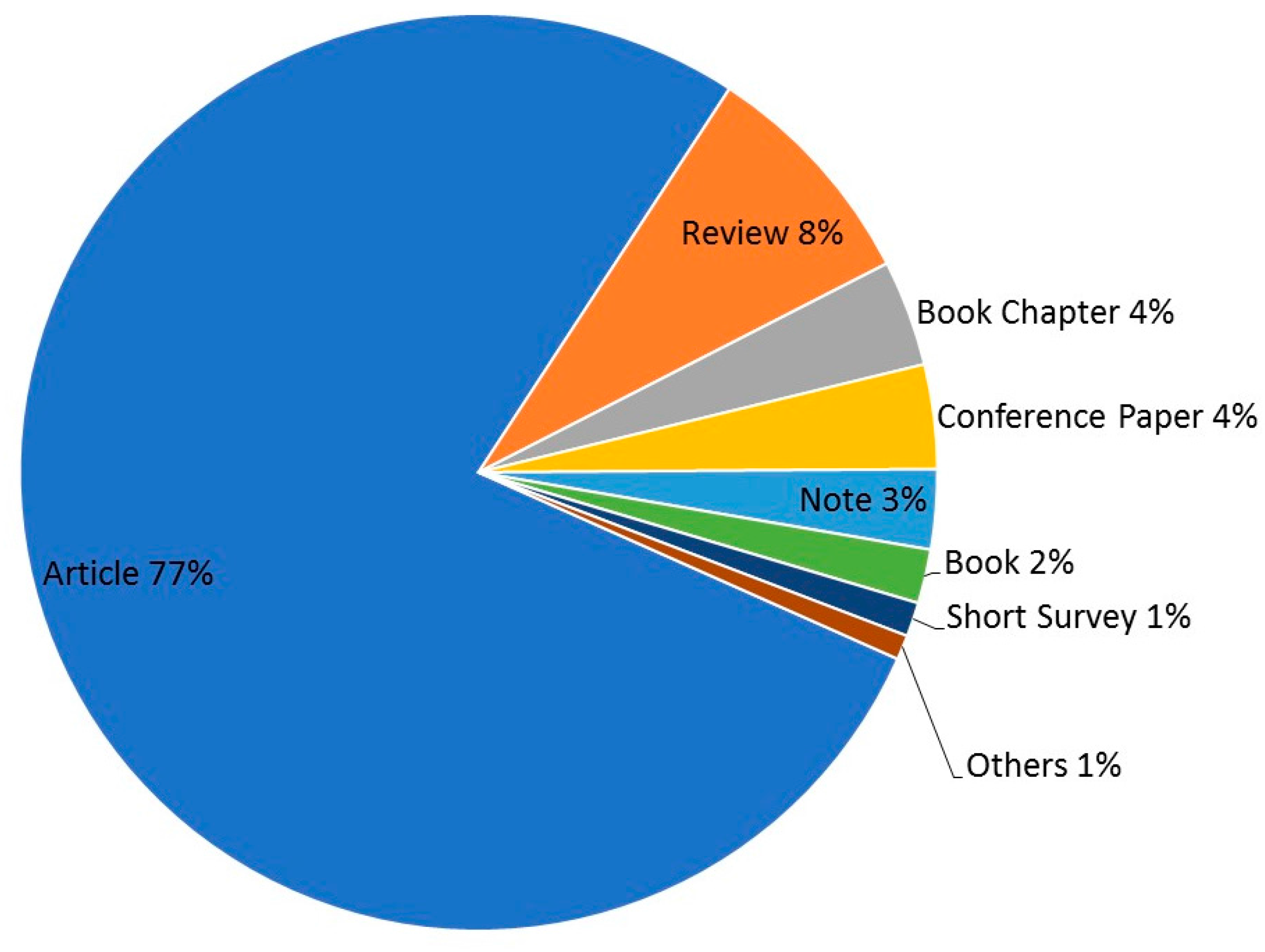
The search yielded 4394 documents of diverse origins, primarily articles (3401; 77%), book chapters (165; 4%) and conference papers (147; 4%) (see Figure 1). Review articles were found (at a lower frequency (364; 8%), and other publication types were found at significantly lower frequencies. It is observed from this first analysis that conference papers are not a frequent source of dissemination of these studies, since it has less than 3% of the data.
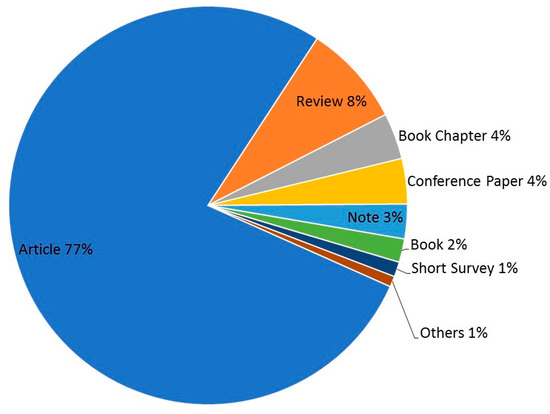
Figure 1.
Distribution of worldwide research from 1970–2016 on labour relations by type of document.
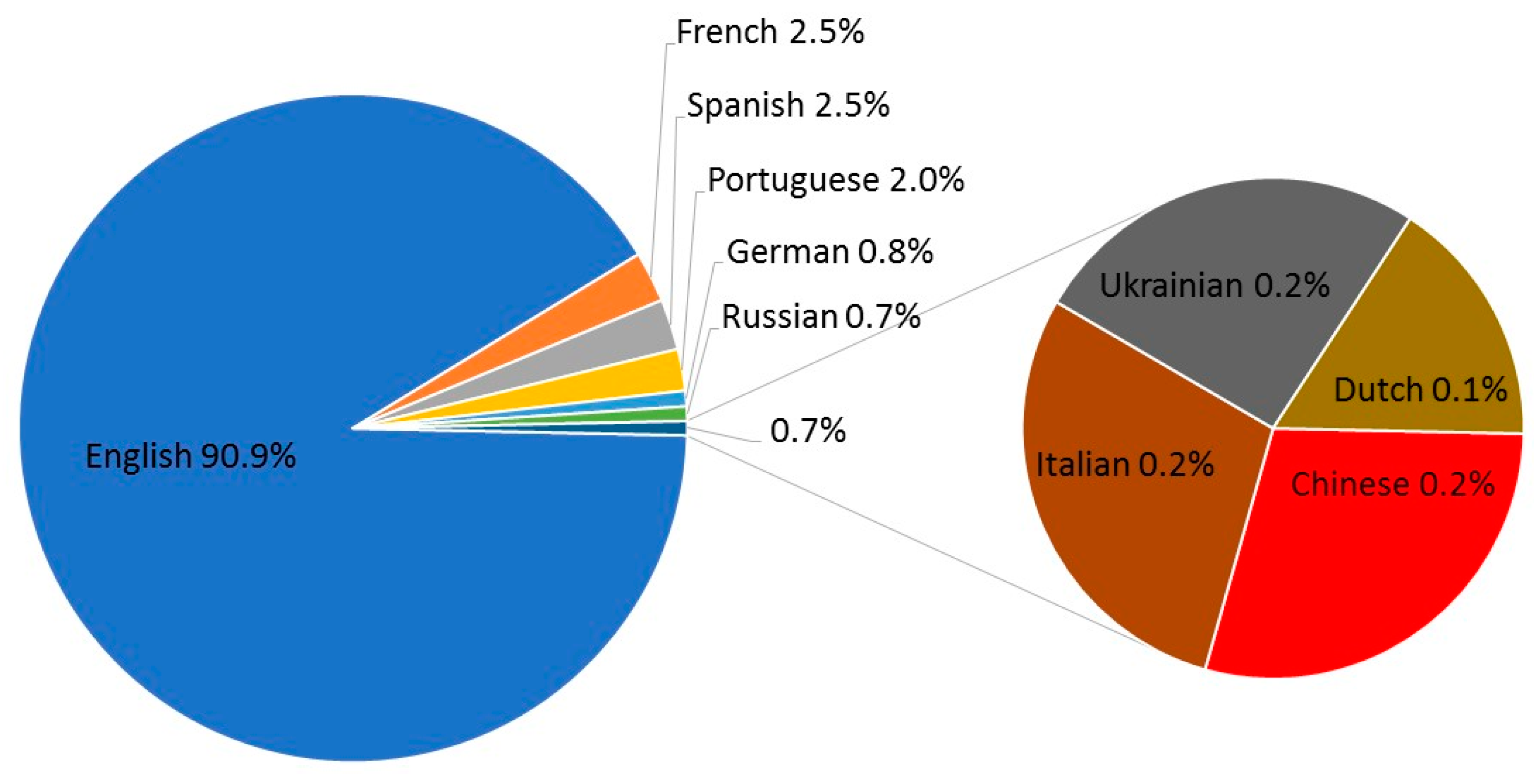
As for the language used in scientific dissemination, as expected we find English in 91% of cases, then follow with percentages slightly above 2% as French, Spanish and Portuguese, and below 1% we can find German, Russian, Ukrainian, Italian, Dutch or Chinese; see Figure 2.
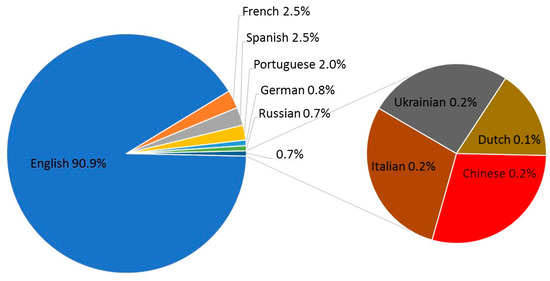
Figure 2.
Language distribution of worldwide of scientific output on labour relations.
3.2. Evolution of Scientific Output
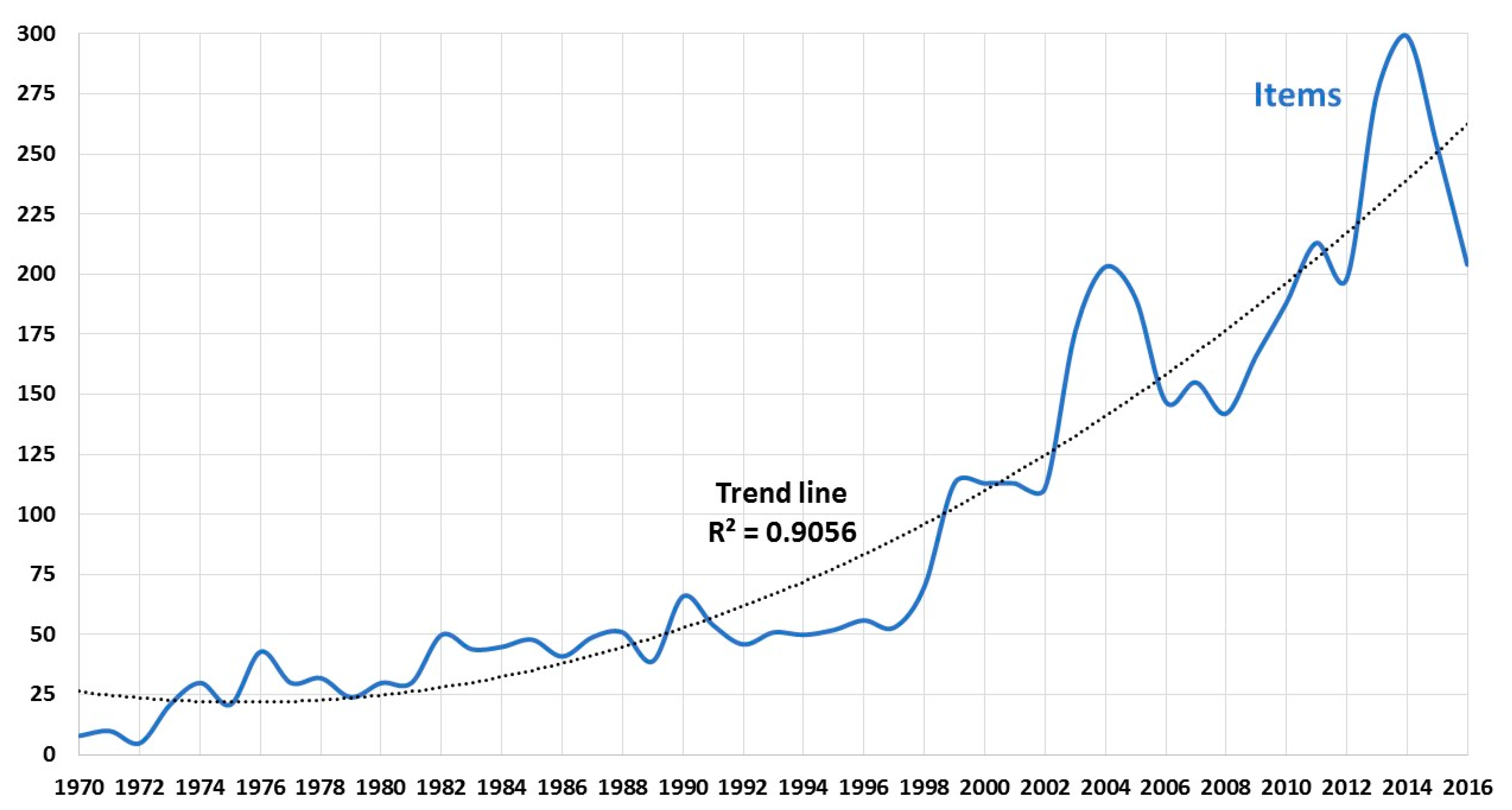
Figure 3 shows the temporal evolution of the publications analysed on the subject of labour relations from 1970–2016. A certain stability of scientific production was observed up to 1997 between 40–60 publications per year. From here begins a continuous growth, observing two relative highs, for the years 2004 and 2014. Probably the highest of 2004 is due to the fact that on 1 May 2004 the countries of Eastern Europe joined the EU: Czech Republic; Cyprus; the Czech Republic; Estonia; Hungary; Latvia; Lithuania; Malta, and; Poland. This massive incorporation could motivate numerous studies from the point of view of labour relations. It should be recalled that Point 7 of the Community Charter of the Fundamental Social Rights of Workers provides, inter alia [48] that “the completion of the internal market must lead to an improvement in the living and working conditions of workers in the European Community. This process must result from an approximation of these conditions while the improvement is being maintained, as regards in particular forms of employment other than open-ended contracts, such as fixed-term contracts, part-time working, temporary work and seasonal work”.
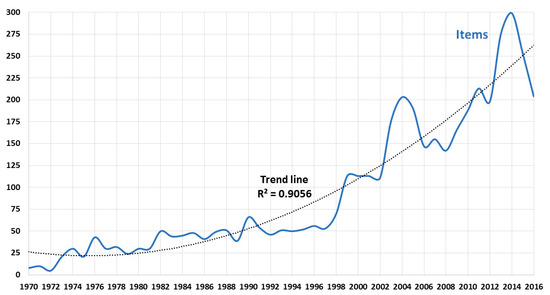
Figure 3.
Trends in publications on labour relations from 1970–2016.
The other major increase in publications is the period from 2008 to 2014, and coincides with the global financial crisis from 2008 to 2014 known as the Great Recession.
3.3. Publication Distribution by Countries and Institutions
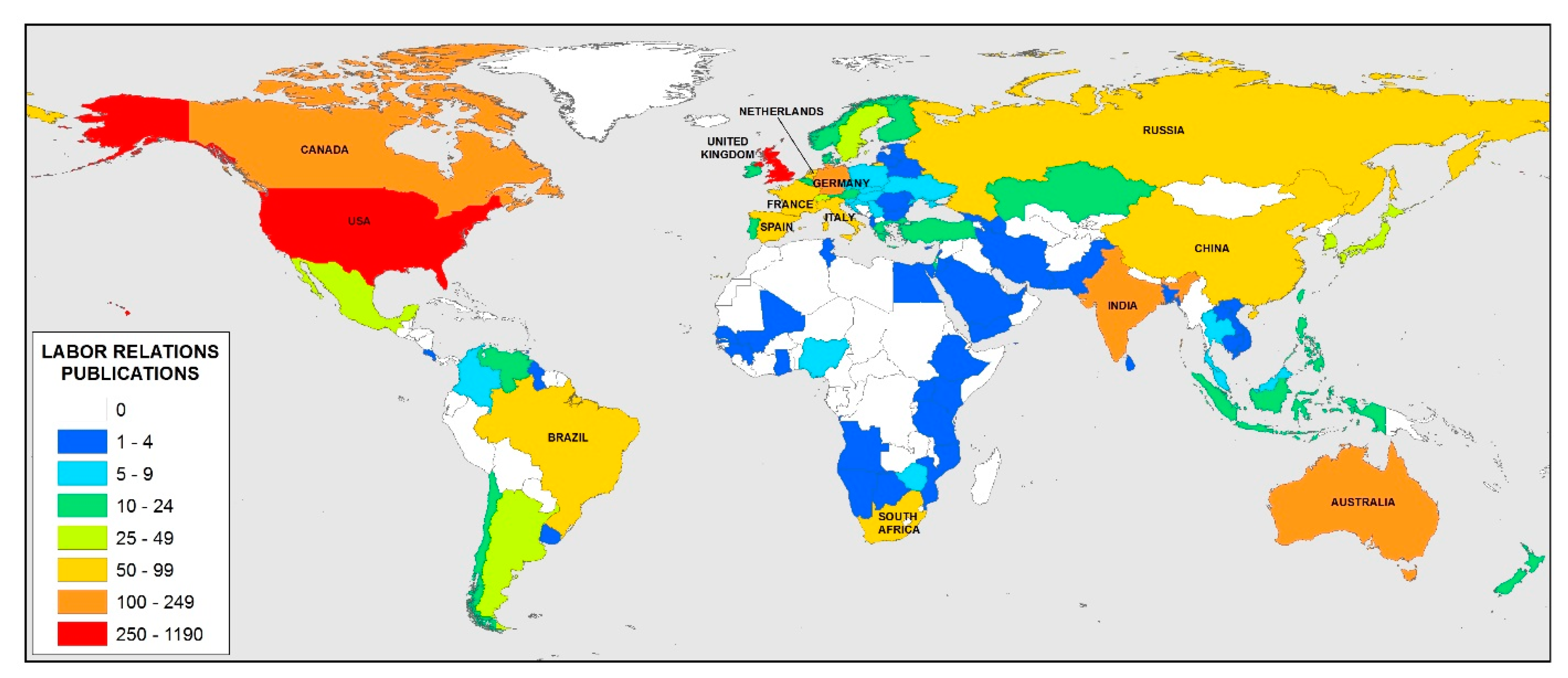
The countries that published the most throughout the years were from the United States, followed in second place by the UK with almost three times fewer publications; and third place is for Canada. It is observed that in general in Africa and much of Asia there is no research on this topic by these countries. Figure 4 shows scientific output by countries.
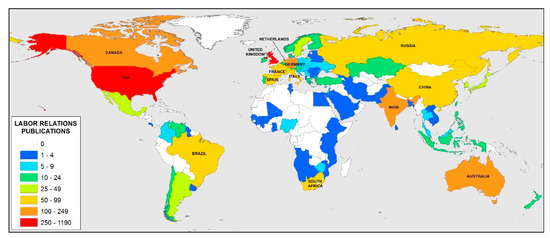
Figure 4.
Worldwide research on labour relations for the period 1970–2016.
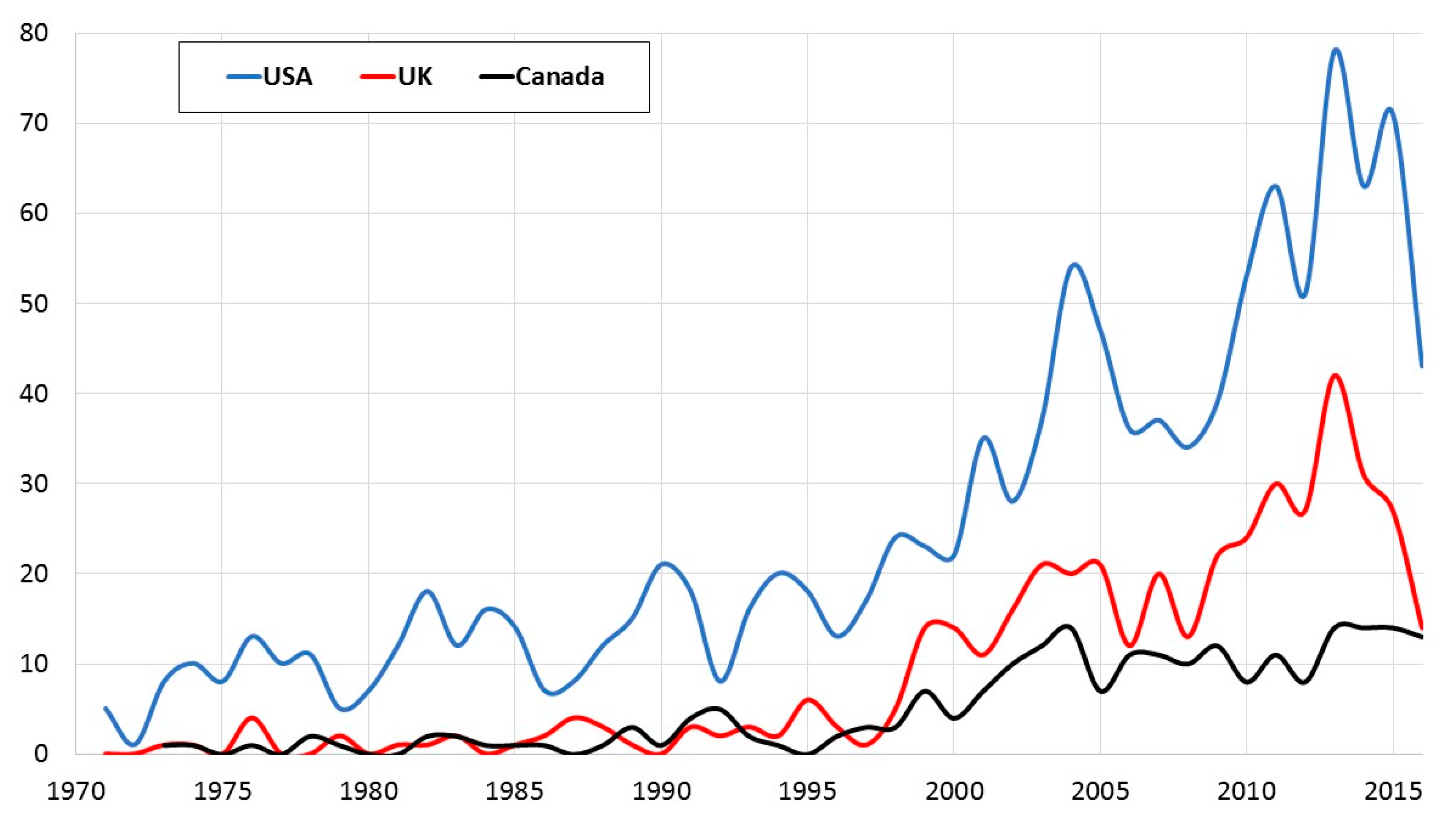
If the institutions are analysed according to the country to which they belong, it is observed that the United States has the most highly productive institutions and, therefore, is the country that marks the general trend. Nevertheless, it is observed how the UK also follows this trend; see Figure 5, where the publications trend of only first three countries are drawn. In the case of Canada, this trend can be seen to a certain degree, but not as marked as for the United States or the UK.
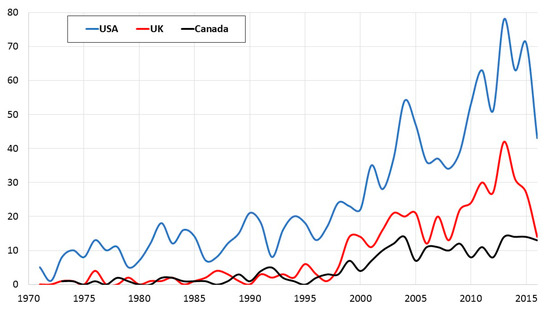
Figure 5.
Trends in publications on labour relations from 1970–2016 for the Top 3 countries.
The 10 most productive institutions are listed in Table 1 and classified as follow. First place is occupied by the most relevant institution, Cornell University (USA), followed by UC Berkeley (USA) and the London School of Economics and Political Science (UK) in third place. These institutions mainly belong to the most productive countries in this area as discussed above. If the publications of the main institutions are studied by their main keywords, it is observed that “employment” occupies the first place in four of this 10 institutions, leading this research, followed by “Trade Union” three times. If this analysis is extended to the three main keywords, “employment” appears in eight to 10 institutions, followed by “Labor market” and “Trade Union” in six of these institutions.

Table 1.
Rankings of the 10 most productive institutions.
3.4. Distribution of Output in Subject Categories and Journals
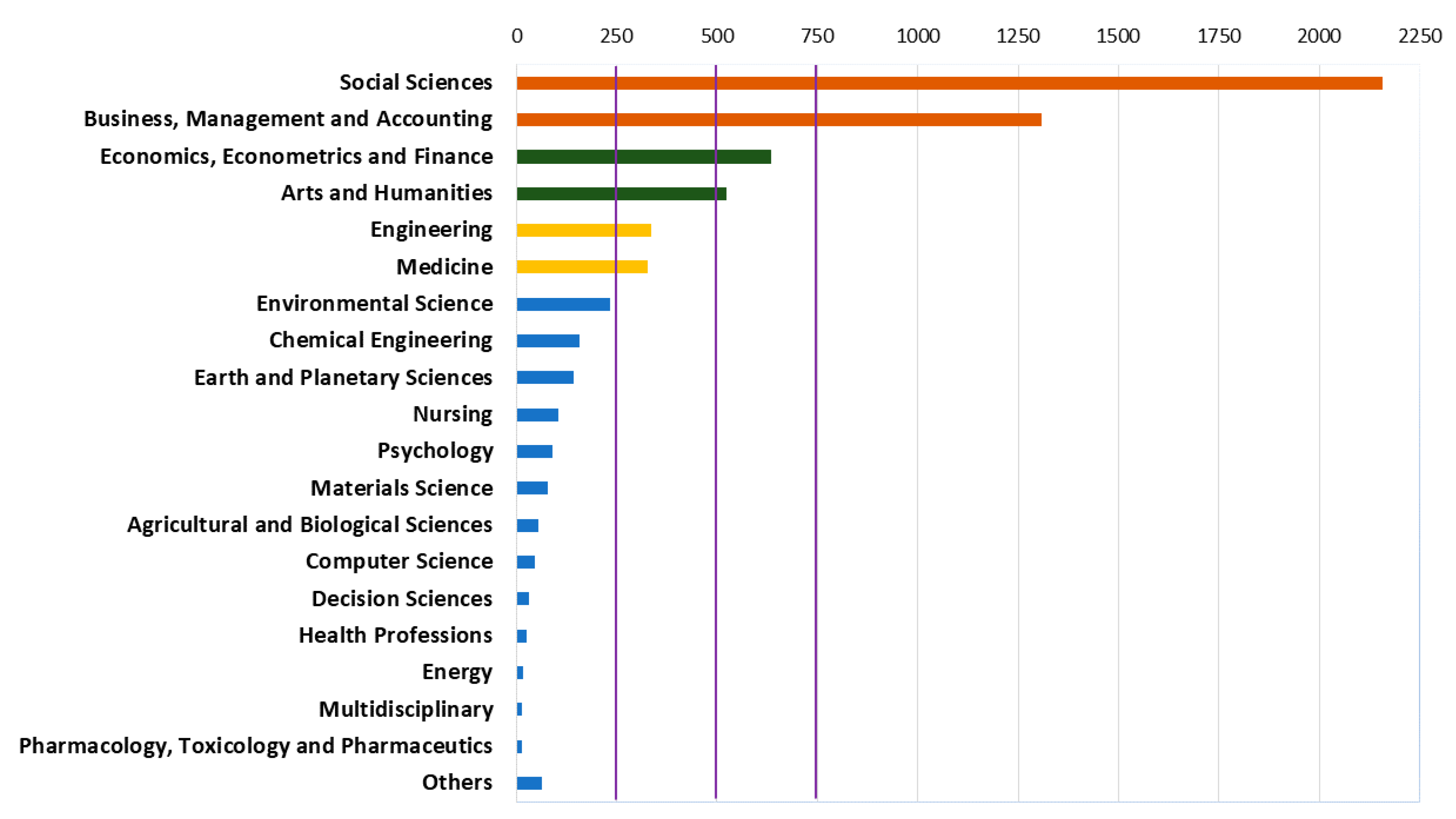
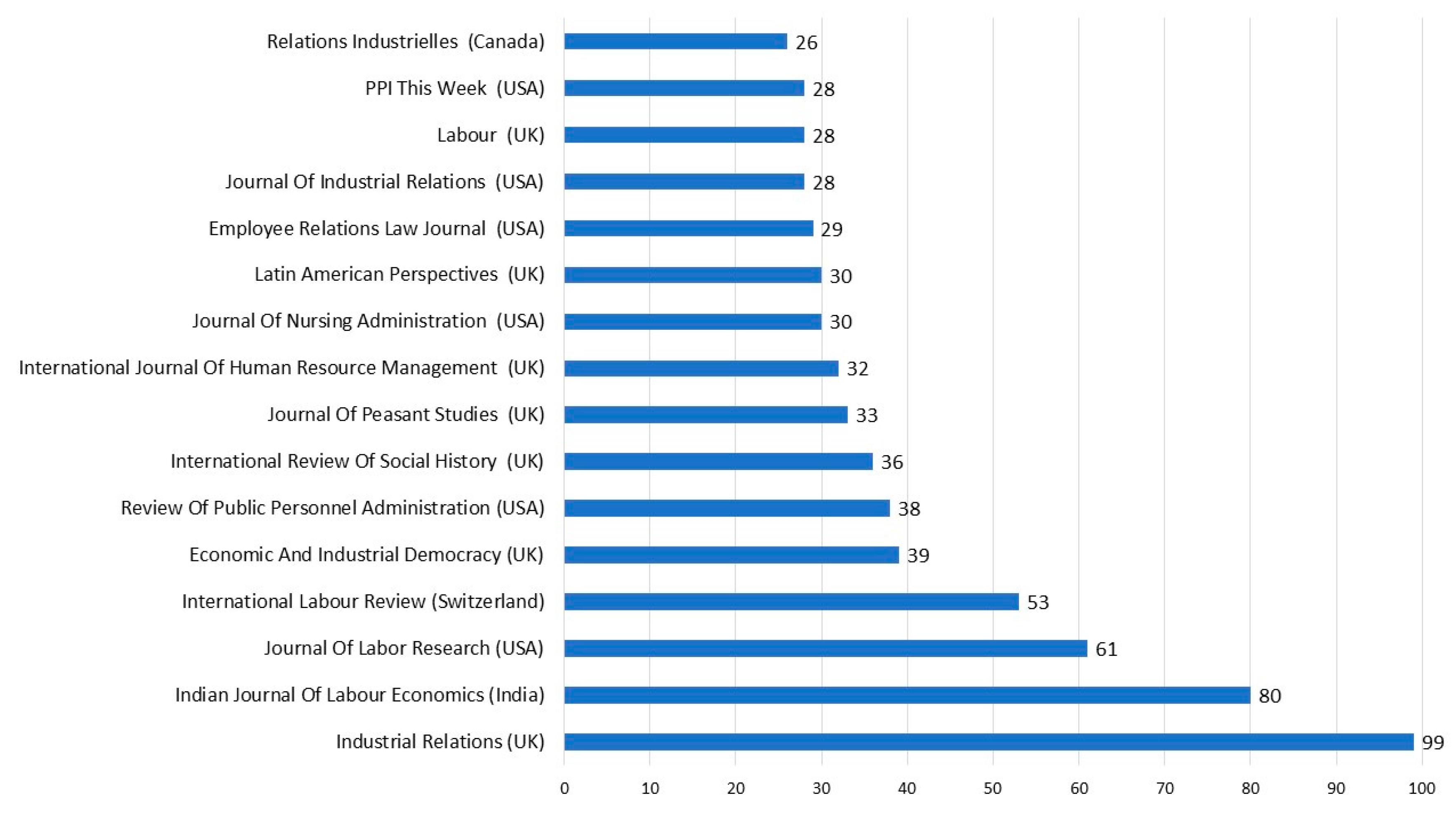
Figure 6 shows the distribution of publications by field as classified by Scopus (note that a single study may be indexed in more than one category). The highest number of publications corresponds to Social Sciences (34%), followed in second and third places by Business, Management and Accounting (20%) and Economics, Econometrics and Finance (10%) and, in fourth, fifth and sixth places, by Arts and Humanities (8%), Engineering (5%) and Medicine (5%). Every item that cannot be attributed to any of the above has been added in a single category (as others). Figure 7 shows the journals with the most publications on labour relations research in the period under study, including only those that have more than 25 publications, resulting in a total of 15 journals, where seven are from UK, six are from USA, one is from India, one is from Canada, and one is from Switzerland.
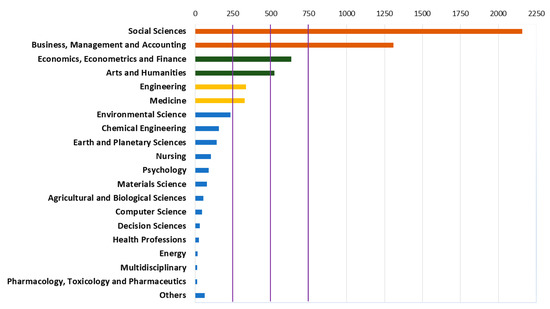
Figure 6.
Distribution of publications by field, as classified by Scopus.
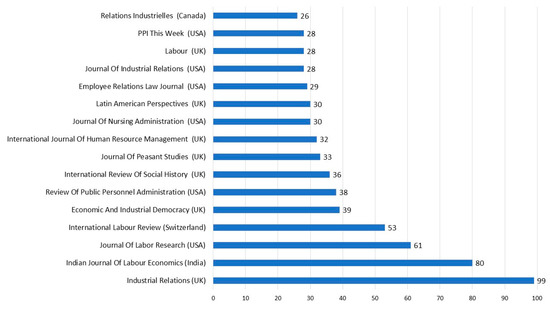
Figure 7.
Main sources for labour relations worldwide research.
3.5. Analysis of Author Keywords and Index Keywords
Analyses of keywords in scientific articles are of great interest for monitoring and identifying trends in different fields of science [49]. Authors tend to list a set of keywords to frame their publication in the field or subject matter they consider to be most closely related to the topic of their study. It is also common for editors to complete or expand such information with additional keywords (index keywords or index terms) obtained from thesaurus databases based on the subject matter of the text in the publication. The keyword analysis was divided into three sets: keywords which are related to a geographical area; keywords related to professions, and; topics.
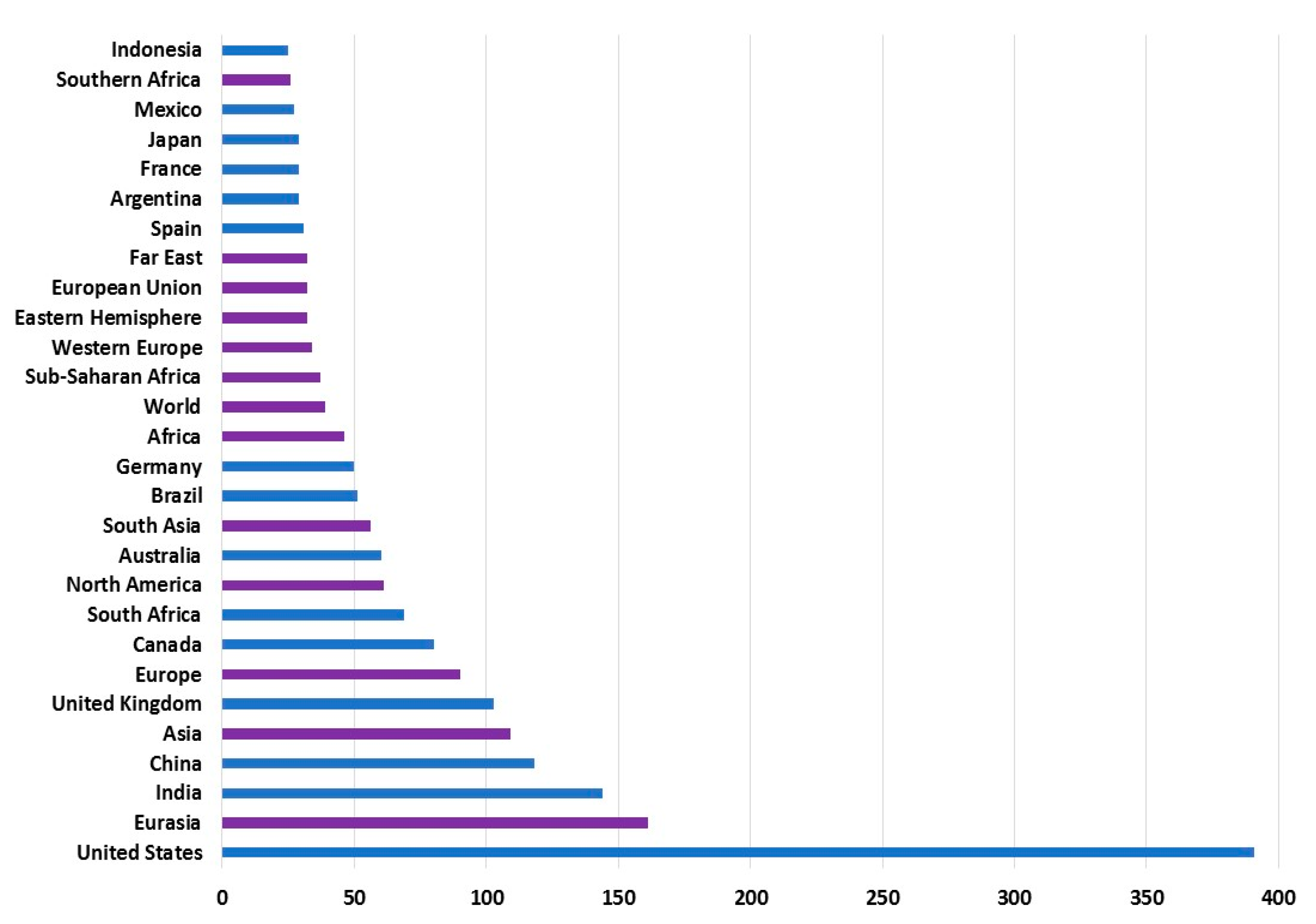
Figure 8 shows the keywords related to a geographical area of the period analysed here. In the figure are marked in blue those keywords that belong to a single country; as we can see, the United States comes first, India is second, and China is third. Also, purple was used for wider geographical areas, where the Eurasia, Asia and Europe are the highlighted positions. World studies are around 39 manuscripts. It should be noted that the geographic areas of Africa, Sub-Saharan Africa or Southern Africa have a notable presence among the geographical keywords taking into account that they are not among the main countries by number of publications, nor by institutions, nor have specific journals of this subject, which denotes a great outside concern for this area.
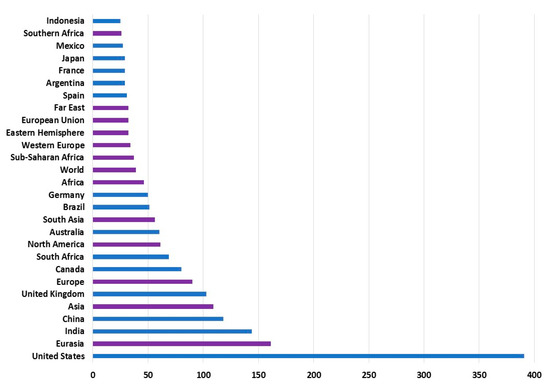
Figure 8.
Worldwide keywords related to a geographical area.
Table 2 shows the keywords related to professions, where Paper and Pulp Industry occupies the first position, followed by Nursing and, in third position, by Industrial Management. The overall health and hospital professions are the more studied because we found five keywords in the top 10: “Nursing”; “Personnel Administration Hospital”; “Hospital Personnel”; “Hospital Subdivisions and Components”, and; “Occupational Health”. This data can be related to the fact of the existence of specific journals for the study of these professions in particular. Examples of where these studies are being published are, for Nursing: the Journal of Nursing Administration; for Paper and Pulp Industry: Pulp and Paper, Pulp & Paper Week, or PPI Pulp and Paper International; for Hospital Professions: Hospitals, Hospital Progress, Hospital & Health Services Administration.
Table 2.
Keywords related to professions.
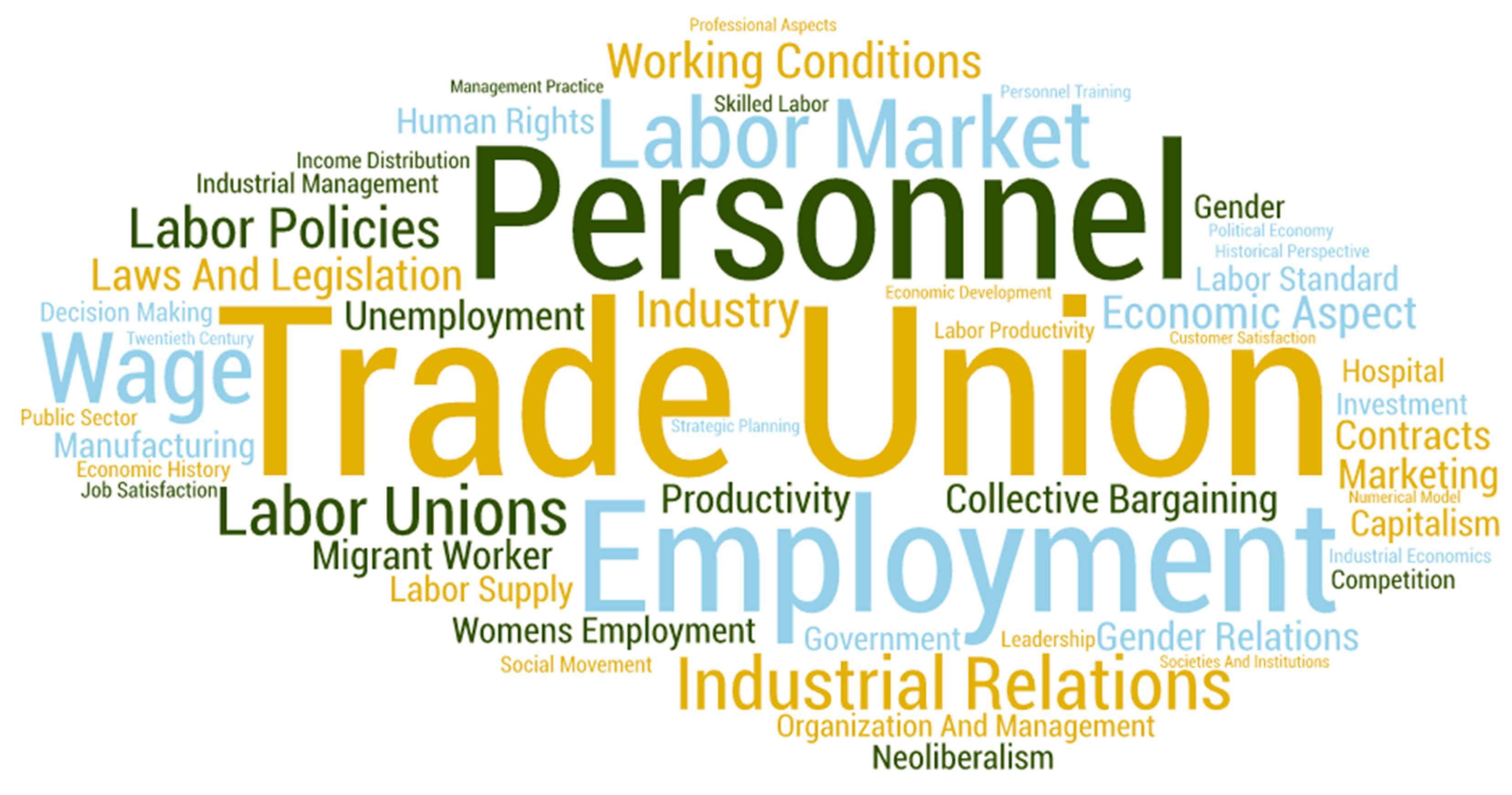
Table 3 shows the most common keywords excluding those from geographies and specific professions. It is observed how the Trade Union leads the keywords, related to Labour Unions in sixth position. The researchers’ next concern regarding labour relations has been Employment, which is also related to Unemployment and Labour Market; also, very important keywords found in this study. Another important topic is Personnel, in third position, which is related to Working Conditions and Organization and Management. Laws and Legislation occupies only the ninth position. Collective Bargaining, Wage and Economic Aspect are in 11th to 13th positions. Following these, we found another related group of keywords related to groups of disadvantaged workers: Women’s Employment, Migrant Worker or Gender Relations, 14th to 16th positions, respectively. Around position 20th we can find a group of keywords related to labour as resource, that is, Manufacturing, Labour Supply, Industry, Productivity or Labour Standard. Finally, a cloud word was made in order to have a visualization of most relevant keywords, see Figure 9.
Table 3.
Most relevant keywords related to labour relations.
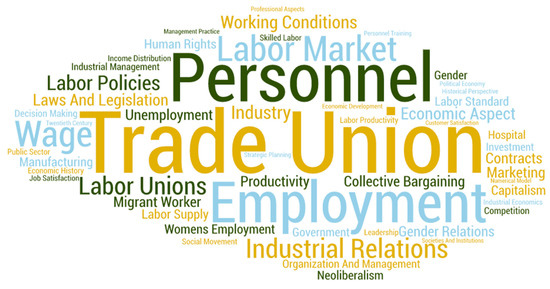
Figure 9.
Cloud word based on the main keywords related to labour relations worldwide research.
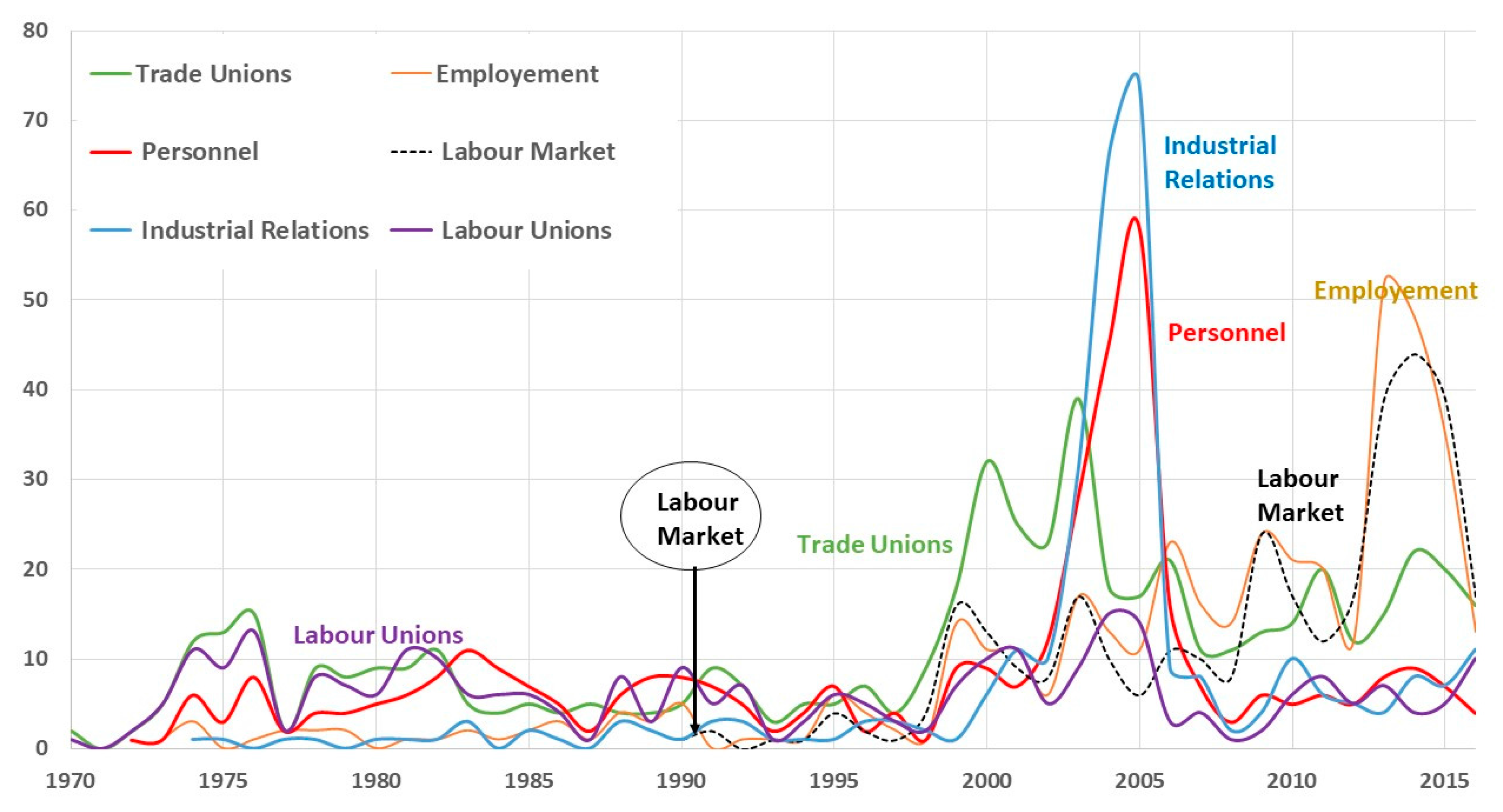
Studying the evolution of the main keywords in the analysed period, see Figure 10, it is observed that there are several periods in which certain keywords are emphasized over the rest. In the period 2000 to 2003, “Trade Unions” was the most used keyword, and from here it always maintains a prominent role, being in the top positions. From the period 2002 to 2005, the last year was marked by “Industrial relations” and “Personnel”, but after this period they returned to the general group. In the last period analysed, from 2007 to 2016, “Labor Market" and “Employment” stand out, which began to be more used since 1999, and in general have been increasing since then.
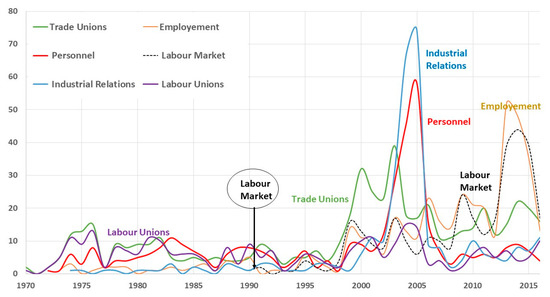
Figure 10.
Keywords evolution related to labour relations worldwide research (1970–2016).
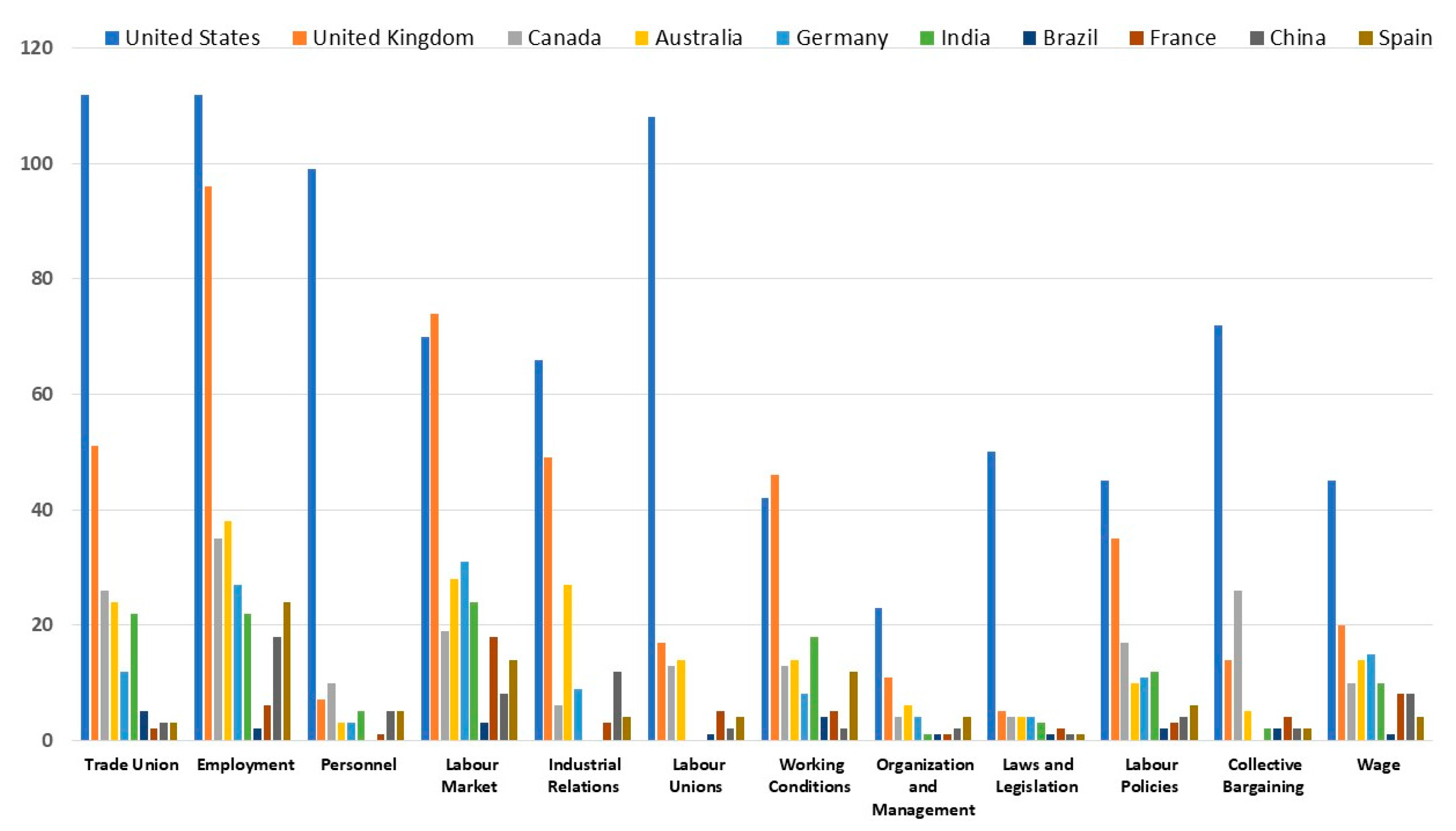
Another interesting analysis is to examine these main keywords by country; see Figure 11. It is observed how the United States, being the most productive country, leads in almost all the keywords except in two, “Labour market” and “Working conditions”, which are led by UK. Note, however, the great difference in “Laws and Legislation” and “Labour Unions” that, although they are led by the United States for the other countries, have little implication. On the other hand, a similar interest in absolute mode is shown for “Labour Policies”.
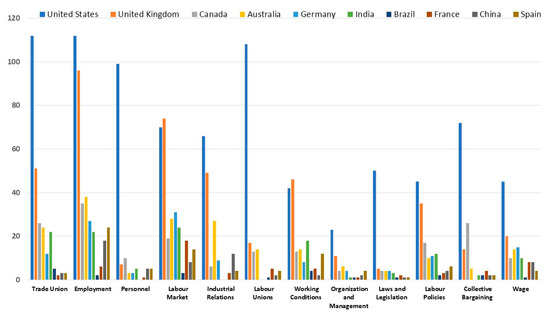
Figure 11.
Main keywords by countries related to labour relations.
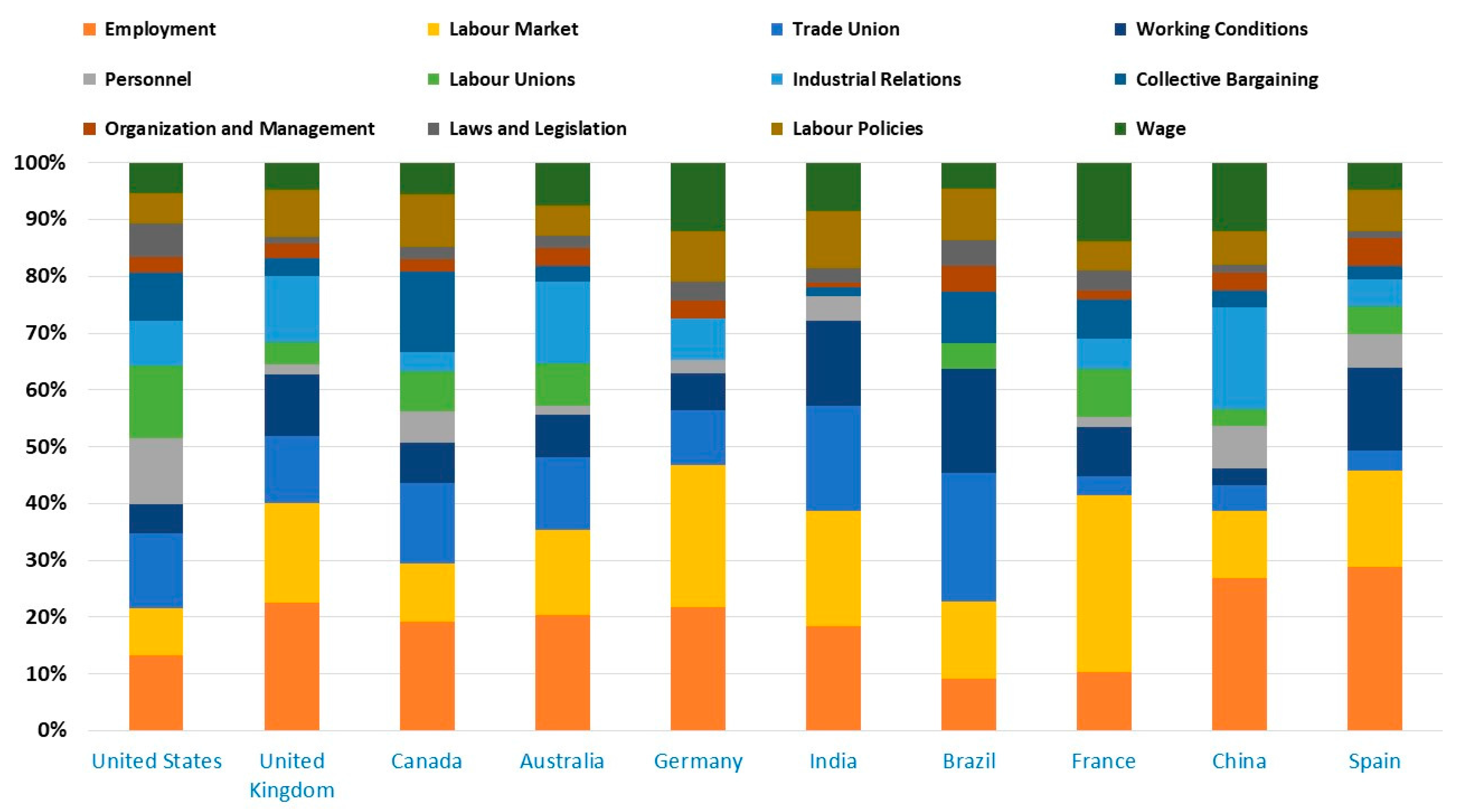
This study of keywords could not be complete without seeing the relative importance of the main keywords of publications for each country, whose percentages are represented by country in Figure 12. It is shown that in European countries like the UK, Germany, France and Spain, “Employment” and “Labor market” always occupy at least 40%, reflecting the concern or problem which represents in these areas, compared to other countries like the United States or Brazil where it is close to only 20%. “Trade Unions” plays a particularly important role in Brazil and India, as well as “Working Conditions”, which is also the case in Spain, where legislation is very advanced in this regard. The keyword of “Personnel” has a lot of weight in the United States, as it appears in 10% of its publications. For Australia and China, a very important issue is “Industrial Relations”.
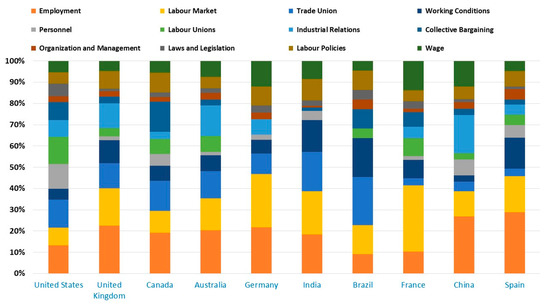
Figure 12.
Distribution of main keywords by country as a percentage of their own publications.
4. Discussion and Conclusions
The working world works out labour relations between team members and between the team and the rest of the institution. Labour relations influence not only the work environment but the constant exercise of each activity. They are a fundamental factor in any company, and can be a factor of success or failure of the organization itself.
Research in labour relations should play a fundamental role in this field. Specifically, the identification of opportunities for improvement, the creation of coalitions with all actors in labour relations that facilitate the transformation, the development of specific strategies to achieve concrete goals in terms of flexibility and productivity, management of resistances and barriers, the materialization of results in the short term, the creation of levers that allow to easily integrate new initiatives of change and, finally, the establishment of the metrics that allow to measure the connections of the process of change with the achieved business objectives. Within these metrics, bibliometric study can play a key role revealing the main research trends in this field.
Then, by conducting a worldwide bibliometric analysis of the topic of labour relations during the period 1970 to 2016, it has been observed that articles, including reviews, cover the 85% of communication in the topic of labour relations, as expected. In addition, these works are mainly published in English, but there is also a notable presence of the French and Spanish languages. The scientific interest in this subject has been increasing since the 1970s, reaching two historical maximums in 2004 and 2014, the first probably due by the fact that on 1 May 2004 the countries of Eastern Europe joined the EU, and the other maybe due to global financial crisis from 2008 to 2014 known as the Great Recession. Both events could have important repercussions in the world of labour relations. Regarding the countries that published the most throughout the years, the United States is in first place, followed by the UK in second place, and Canada in third place.
Given that these countries are the most productive institutions in this area, Cornell University can be highlighted as the most productive institution in the world. It has been observed that if the publications of the main institutions are studied by their main keywords, “Employment” appears in eight to 10 institutions, followed by “Labor market” and “Trade Union” in six of these institutions, highlighting the main concern for them. In the main countries involved in this research, there has been a change in the trend, from the concern for trade unions and perhaps the workplace towards employment and the labour market. This may be since in these countries working conditions and wages are acceptable, and the problem lies in the possible unemployment (employment). This question is observed geographically, where it is more accentuated in the European countries like the UK, Germany, France and Spain if they are compared to USA or Brazil. These data therefore act as an indicator, the economic evaluation of the studied countries. On the other hand, it has been seen labour law is an important issue in the field of labour relations, since it regulates the rights and obligations that it acquires from both the employer and the employee, as well as the state. For example, a key aspect is the value of the labour force that must correspond with the academic level, professional and experience in the economic sector to which it belongs; for that reason is of vital importance the collective bargaining.
Regarding the Subject Area, Social Sciences and Business, Management and Accounting collect more than 55% of the scientific output in this field. The analysis of the keywords reveals how certain geographic areas are specially studied by the outside as is the case of Africa, and in particular Sub-Saharan Africa and Southern Africa. If we pay attention to a single country, it is the United States, followed by India and China. The others keyword analysis related to jobs or related to industries specifically shows Paper and Pulp Industry in first position, followed by Nursing. Finally, the most studied topic related to labour relations are Trade Union, Employment, Personnel, and Labour Market, but there has also been concern about Working Conditions and Organization and Management or Laws and Legislation. Finally, there is a set of topics related to groups of disadvantaged workers, which were Women’s Employment, Migrant Worker or Gender Relations. The labour market increasingly demands better labour relations between its professionals. Therefore, it is also necessary to consider that part of this development effort must be a result of constant research in this sense of labour relations, which should be directed towards an improvement in the economy and therefore of the workers, and ultimately of the society as a whole.
Acknowledgments
The authors would like to thank to the CIAIMBITAL (University of Almeria, Ceia3) for its support.
Author Contributions
E.S.-M. and F.M.-A. conceived, designed the search and wrote the paper.
Conflicts of Interest
The authors declare no conflict of interest.
References
- Fossum, J.A. Labour Relations: Development, Structure, Process; Mcgraw Hill Higher Education: New York, NY, USA, 2014. [Google Scholar]
- Beauregard, T.A.; Henry, L.C. Making the link between work-life balance practices and organizational performance. Hum. Resour. Manag. Rev. 2009, 19, 9–22. [Google Scholar] [CrossRef]
- Camerer, C.F.; Hogarth, R.M. The effects of financial incentives in experiments: A review and capital-labor-production framework. J. Risk Uncertain. 1999, 19, 7–42. [Google Scholar] [CrossRef]
- Shen, J.; Benson, J. Tripartite consultation in China: A first step towards collective bargaining? Int. Labour Rev. 2008, 147, 231–248. [Google Scholar] [CrossRef]
- Glucksmann, M. Shifting boundaries and interconnections: Extending the ‘total social organisation of labour’. Sociol. Rev. 2005, 53, 19–36. [Google Scholar] [CrossRef]
- Knights, D.; Willmott, H. Labour Process Theory; Springer: Berlin, Gernmany, 2016. [Google Scholar]
- Rueschemeyer, D.; Skocpol, T. States, Social Knowledge, and the Origins of Modern Social Policies; Princeton University Press: Princeton, NJ, USA, 1996; p. 117. [Google Scholar]
- Cavalcanti, J.S.B.; Bendini, M.I. Globalization and change in labour relations in fruit regions of Brazil and Argentina. Res. Rural Sociol. Dev. 2014, 20, 3–32. [Google Scholar]
- Sobczak, A. Are codes of conduct in global supply chains really voluntary? From soft law regulation of labour relations to consumer law. Bus. Ethics Q. 2006, 16, 167–184. [Google Scholar] [CrossRef]
- Drummonds, H.H. Reforming labour law by reforming labour law preemption doctrine to allow the states to make more labour relations policy. La. Law Rev. 2009, 70, 97–191. [Google Scholar]
- Petrescu-Prahova, M.; Spiller, M.W. Women’s Wage Theft: Explaining Gender Differences in Violations of Wage and Hour Laws. Work Occup. 2016, 43, 371–400. [Google Scholar] [CrossRef]
- Wang, J. Local knowledge, state power, and the science of industrial labour relations: William Leiserson, David Saposs, and American labour economics in the interwar years. J. Hist. Behav. Sci. 2010, 46, 371–393. [Google Scholar] [CrossRef] [PubMed]
- Ford, M. Continuity and change in Indonesian labour relations in the habibie interregnum. Southeast Asian J. Soc. Sci. 2000, 28, 59–88. [Google Scholar] [CrossRef]
- Streeck, W. The uncertainties of management in the management of uncertainty: Employers, labor relations and industrial adjustment in the 1980s. Work Employ. Soc. 1987, 1, 281–308. [Google Scholar] [CrossRef]
- Danthine, J.-P.; Kurmann, A. The macroeconomic consequences of reciprocity in labour relations. Scand. J. Econ. 2008, 109, 857–881. [Google Scholar] [CrossRef]
- Behrens, C.K.; Sollenberger, J.R. The National Labour Relations Act: A potential legal constraint upon quality circles and other employer-sponsored employee committees. Labour Law J. 1983, 34, 776–780. [Google Scholar]
- Haidinger, B. Transnational (labour) relations in private homes. A question of gendered inequality. SWS Rundsch. 2012, 52, 412–430. [Google Scholar]
- Kalleberg, A.L. Flexible firms and labour market segmentation: Effects of workplace restructuring on jobs and workers. Work Occup. 2003, 30, 154–175. [Google Scholar] [CrossRef]
- Benavides, F.G. Ill health, social protection, labour relations, and sickness absence. Occup. Environ. Med. 2006, 63, 228–229. [Google Scholar] [CrossRef] [PubMed]
- Kandel, W.A.; Donato, K.M. Does unauthorized status reduce exposure to pesticides? Evidence from the national agricultural workers survey. Work Occup. 2009, 36, 367–399. [Google Scholar] [CrossRef]
- Mitchell, M.S.; Koen, C.M.; Darden, S.M. Dress codes and appearance policies: Challenges under federal legislation, part 3: Title VII, the Americans with Disabilities Act, and the National Labour Relations Act. Health Care Manag. 2014, 33, 136–148. [Google Scholar]
- Holst, H. ‘Commodifying institutions’: Vertical disintegration and institutional change in German labour relations. Work Employ. Soc. 2014, 28, 3–20. [Google Scholar] [CrossRef]
- Serebryakova, N.A.; Dorokhova, N.V.; Dashkova, E.S.; Isaenko, M.I. Directions of transformation of labour relations in the modern conditions. J. Appl. Econ. Sci. 2016, 11, 1542–1551. [Google Scholar]
- Avdagic, S. State-labour relations in East Central Europe: Explaining variations in union effectiveness. Socio-Econ. Rev. 2005, 3, 25–53. [Google Scholar] [CrossRef]
- Trubek, D.M.; Mosher, J.; Rothstein, J.S. Transnationalism in the regulation of labour relations: International regimes and transnational advocacy networks. Law Soc. Inq. 2000, 25, 1187–1211. [Google Scholar] [CrossRef]
- Kaufman, B. Divergent fates: Company unions and employee involvement committees under the railway labour and national labour relations acts. Labour Hist. 2015, 56, 423–458. [Google Scholar] [CrossRef]
- Jensen, H. A history of legal exclusion: Labour relations laws and British Columbia’s agricultural workers, 1937–1975. Labour/Le Trav. 2014, 73, 67–95. [Google Scholar]
- Elliott, C.S.; Long, G. Manufacturing rate busters: Computer control and social relations in the labour process. Work Employ. Soc. 2016, 30, 135–151. [Google Scholar] [CrossRef]
- Hebdon, R.; Mazerolle, M. Regulating Conflict in Public Sector Labour Relations: The Ontario Experience (1984–1993). Relat. Ind. 2003, 58, 667–686. [Google Scholar] [CrossRef]
- Timming, A.R. The effect of foreign accent on employability: A study of the aural dimensions of aesthetic labour in customer-facing and non-customer-facing jobs. Work Employ. Soc. 2017, 31, 409–428. [Google Scholar] [CrossRef]
- Cooper, B.S.; Sureau, J. Teacher unions and the politics of fear in labour relations. Educ. Policy 2008, 22, 86–105. [Google Scholar] [CrossRef]
- Thelen, K. The paradox of globalization: Labour Relations in Germany and Beyond. Comp. Political Stud. 2003, 36, 859–880. [Google Scholar] [CrossRef]
- Fyodorova, A.E.; Katashinskikh, V.S.; Dvorakova, Z. Precarious labour relations as a factor of social pollution. Econ. Reg. 2016, 12, 802–814. [Google Scholar] [CrossRef]
- Brady, D.; Kaya, Y.; Gereffi, G. Stagnating industrial employment in Latin America. Work Occup. 2011, 38, 179–220. [Google Scholar] [CrossRef]
- Glagoleva, N.N.; Glagolev, E.S. Social and labour relations: International practice of regulation. World Appl. Sci. J. 2013, 25, 983–987. [Google Scholar]
- Bernhardt, A. The role of labour market regulation in rebuilding economic opportunity in the United States. Work Occup. 2012, 39, 354–375. [Google Scholar] [CrossRef]
- Flatt, J.W.; Blasimme, A.; Vayena, E. Improving the Measurement of Scientific Success by Reporting a Self-Citation Index. Publications 2017, 5, 20. [Google Scholar] [CrossRef]
- Bar-Ilan, J. Citations to the “Introduction to informetrics” indexed by WOS, Scopus and Google Scholar. Scientometrics 2010, 82, 495–506. [Google Scholar] [CrossRef]
- Mongeon, P.; Paul-Hus, A. The journal coverage of Web of Science and Scopus: A comparative analysis. Scientometrics 2016, 106, 213–228. [Google Scholar] [CrossRef]
- Archambault, É.; Campbell, D.; Gingras, Y.; Larivière, V. Comparing bibliometric statistics obtained from the Web of Science and Scopus. J. Am. Soc. Inf. Sci. Technol. 2009, 60, 1320–1326. [Google Scholar] [CrossRef]
- Solomon, D. Types of open access publishers in Scopus. Publications 2013, 1, 16–26. [Google Scholar] [CrossRef]
- Rodrigues, R.S.; Taga, V.; Passos, M.F.D. Research Articles about Open Access Indexed by Scopus: A Content Analysis. Publications 2016, 4, 31. [Google Scholar] [CrossRef]
- Miguel, S.; Tannuri de Oliveira, E.F.; Cabrini Grácio, M.C. Scientific production on open access: A worldwide bibliometric analysis in the academic and scientific context. Publications 2016, 4, 1. [Google Scholar] [CrossRef]
- OpenRefine. Available online: http://openrefine.org (accessed on 1 July 2017).
- Montoya, F.G.; Montoya, M.G.; Gómez, J.; Manzano-Agugliaro, F.; Alameda-Hernández, E. The research on energy in Spain: A scientometric approach. Renew. Sustain. Energy Rev. 2014, 29, 173–183. [Google Scholar] [CrossRef]
- De la Cruz-Lovera, C.; Perea-Moreno, A.J.; de la Cruz-Fernández, J.L.; Alvarez-Bermejo, J.A.; Manzano-Agugliaro, F. Worldwide Research on Energy Efficiency and Sustainability in Public Buildings. Sustainability 2017, 9, 1294. [Google Scholar] [CrossRef]
- Garrido-Cardenas, J.A.; Manzano-Agugliaro, F. The metagenomics worldwide research. Curr. Genet. 2017, 63, 819–829. [Google Scholar] [CrossRef] [PubMed]
- EU. COUNCIL DIRECTIVE 1999/70/EC of 28 June 1999 Concerning the Framework Agreement on Fixed-Term Work Concluded by ETUC, UNICE and CEEP. 1999. Available online: http://eur-lex.europa.eu/legal-content/EN/TXT/PDF/?uri=CELEX:31999L0070&from=FR (accessed on 10 July 2017).
- Choi, J.; Yi, S.; Lee, K.C. Analysis of keyword networks in MIS research and implications for predicting knowledge evolution. Inf. Manag. 2011, 48, 371–381. [Google Scholar] [CrossRef]
© 2017 by the authors. Licensee MDPI, Basel, Switzerland. This article is an open access article distributed under the terms and conditions of the Creative Commons Attribution (CC BY) license (http://creativecommons.org/licenses/by/4.0/).