


Abstract
We used the classical Lie symmetry method to study the damped Klein–Gordon equation (Kge) with power law non-linearity . We carried out a complete Lie symmetry classification by finding forms for and . This led to various cases. Corresponding to each case, we obtained one-dimensional optimal systems of subalgebras. Using the subalgebras, we reduced the Kge to ordinary differential equations and determined some invariant solutions. Furthermore, we obtained conservation laws using the partial Lagrangian approach.
1. Introduction
The aim of this study was to perform a complete Lie point symmetry classification of the (1 + 1)-dimensional damped Klein–Gordon equation (Kge) with power law non-linearity:
where and represent the damping and power law non-linearity terms, respectively. The presence of the terms , , and introduces non-linearity into the equation, making it pertinent to analyze the non-linear dynamics of the significant system. For example, the non-linear term can introduce phenomena like solitons and shock waves. Equation (1) has a wide range of physical applications in quantum mechanics, non-linear dynamics, wave propagation, and applied mathematics research. In general, this equation presents an interplay between non-linearities and wave-like behavior, making it all-inclusive, from quantum field theory, particle physics, quantum mechanics, and mathematical physics to applied mathematics. The second-order partial differential Equation (1) is an extended form of the Klein–Gordon equation:
which appears in quantum mechanics and describes the motion of spinless scalar particles. Equation (1) can be constituted as a test case in applied mathematical research for analytical as well as numerical methods for solving Pdes. To find the Lie point symmetries of (1), we followed the classical Lie group approach proposed by Sophus Lie in 1881. The group symmetry method is feasible to find exact solutions, conservation laws when a Lagrangian exists, and reductions of differential equations. This approach is efficient to deal with linear and non-linear partial differential equations (Pdes) as well as ordinary differential equations (Odes). The reader is referred to the well-known books of Ovsiannikov [1], Bluman [2,3], Olver [4], and Ibragimov [5] for detailed explanations of this versatile method.
The classical approach has been widely applied to study the group properties of various non-linear partial differential equations, including the wave and heat equations, see for example [1,6]. Azad et al. investigated Equation (2) by the classical Lie approach. They performed group classification and obtained the symmetry generators for each case. Additionally, they provided reductions and some exact solutions of the Klein–Gordon equation [7].
This study involved finding the Lie point symmetries for all viable forms of the arbitrary functions and deducing the optimal system of one-dimensional subalgebras as well as the local conservation laws via the partial Lagrangian approach. Reducing the number of independent variables of Pdes and constructing conservation laws are two important applications for identifying the solutions and physical properties of the governing equations. We found the reductions of (1) via the optimal system of one-dimensional subalgebras, as these provided the possible combinations of Lie symmetries that are helpful for determining the reduced form of the original differential equation. The two main methods for finding the optimal system include the adjoint representation method presented by Olver [4] and the global matrix method given by Ovsiannikov [1]. In general, Lie symmetry analysis is indeed a flexible method to study diverse aspects of differential equations, including the identification of conserved vectors and the deduction of solitary wave solutions. Solitary waves frequently appear in different physical systems, like plasma physics, non-linear dynamics, and water waves. Also, conservation laws are highly important as they are used to find non-local symmetries, detect the integrability of Pdes, and check the accuracy and existence of numerical solution methods. The conserved currents are useful for finding the solutions of non-linear and linear differential equations by double reduction theory. Bokhari et al. proposed the generalization of double reduction theory to obtain an invariant solution for a non-linear system of qth order Pdes [8,9].
A number of approaches are available to find the conservation laws of differential equations. One of these methods is the partial Lagrangian approach introduced by Mahomed and Kara [10], which is an efficient technique to find the conservation laws without the existence of a typical Lagrangian. Other methods include the Noether approach [11], which relies on the existence of a Lagrangian; the multiplier approach; and the direct method [12].
Tian et al. proposed an effective, efficient, and direct approach to investigate symmetry-preserving discretization for a class of generalized higher-order equations and also promulgated the open problem regarding symmetries and multipliers relating to conservation laws [13]. Moreover, Tian et al. studied the conservation laws and solitary wave solutions for a fourth-order non-linear generalized Boussinesq water wave equation in [14] as well as the chiral non-linear Schrodinger equation in dimensions, see [15]. The authors also resolved the non-local symmetries and soliton–conoidal interaction solutions of the -dimensional Boussinesq equation in [16].
This paper is arranged as follows: in Section 2, we find the complete Lie point symmetries of the damped Klein–Gordon Equation (1) by deducing the particular forms of unknown arbitrary functions and . In Section 3, we list the optimal system of one-dimensional subalgebras and corresponding reductions for all the cases that arose in Section 1. The graphs of some of the exact solutions are displayed as well. In Section 4, the conservation laws, via the partial Lagrangian approach, are presented.
2. Lie Symmetry Classification
The principal Lie point symmetries of (1) are obtained in this section. Also, for all possible forms of smooth functions and , a complete Lie group classification is performed. For this, we take the Lie point symmetry generator as
According to Lie group theory, the invariance condition leading to Lie point symmetries of (1) is
where is the second-order prolongation required, which is up to the order of Equation (1) and is given by
where
and is the total derivative operator
We arrive at the following determining system of Pdes, after expansion of (4) and comparison of the coefficients of independent partial derivatives equated to zero,
By means of Equation (10), we easily have
Invoking Equations (7) and (12), we obtain
The following cases arise from Equation (13)
- 1.
- ,
- 2.
- Case 1:
- and
This implies
Using (12) in (8), we obtain
If is an arbitrary function of u, then
which then gives from (14)
implying that Hence, for arbitrary , Equation (1) has a two-dimensional principal Lie algebra, spanned by
Now, for the complete classification of (1), we look for all the choices for which the principal Lie algebra extends. For this, differentiation of (14) w.r.t. u gives
Two subcases arise here.
- 1.1.
- 1.2.
- Subcase 1.1:
In this case, from (15), we have
We now consider
This gives
Here, , and k are constants. From this, we have two more subcases, viz.
- 1.1.1.
- 1.1.2.
- Subcase 1.1.1:
By invoking (17) in (14) and equating the coefficients of different powers of u, we arrive at
which gives
provided , otherwise, there are two symmetry generators, and , which form the principal algebra. Equation (12) implies
Now, from (11), we have
The principal algebra in this case extends to the three-dimensional algebra spanned by and in addition to
provided
- Subcase 1.1.1.1:
If , then (18) gives as . This implies and
By inserting this value of into (8), we arrive at
In this case, we have
However, if , there is only the principal algebra generated by and After some manipulation, we deduce
and from (11), we determine
Differentiating w.r.t. t and u, respectively, gives
which in turn implies
The resultant equation yields
From (19), we obtain
Here, is constant. For these forms of and , the principal algebra occurs, since the determining system gives
- Subcase 1.1.1.1.1:
- If and
The infinitesimals in this case are
The algebra in this case extends the principal algebra as we also have
where
- Subcase 1.1.2:
This leads to
where and are constants. Substituting in (14) and equating the coefficients of different powers of u, we obtain the following infinitesimals:
This results in and only.
- Subcase 1.2:
If , then
For this form of , (14) results in
After some manipulations, we find
From here, we arrive at the following two subcases.
- Subcase 1.2.1:
In this subcase, we have
Now, (11) gives
which further leads to two subcases.
- Case A:
This yields the following form of f
The algebra in this case is three-dimensional, generated by
- Case B:
In this case, we deduce
where the infinitesimals
generate a four-dimensional Lie algebra with generator
together with , and from Case A.
- Subcase 1.2.1.1:
If then Therefore, (21) yields
Now from (11), we obtain
and this gives a three-dimensional Lie algebra spanned by the principal algebra in addition to
Herein, and are constants.
- Subcase 1.2.2:
For this case,
leads to two different subcases.
- Subcase 1.2.2.1:
Here, we have
For these forms of the functions, the principal algebra extends to three-dimensional with
along with , from Case A.
- Subcase 1.2.2.2:
In this case, is undetermined. Differentiating (11) twice with respect to u, we find
and by differentiation of the resulting equation w.r.t. t, we have
where
This gives rise to two subcases.
- Case C:
One has
and
The algebra in this case is spanned by , and
Here, and are constants.
- Case D:
- Case 2:
- and
For this case, (12) becomes
Now from (8), we have
and differentiation w.r.t. u yields
We then need to consider the following subcases:
- 2.1.
- 2.2.
- Subcase 2.1:
- Subcase 2.1.1:
From (26),
Now from Equations (11) and (23), we obtain
and differentiating this w.r.t. u, we arrive at
For arbitrary , only the principal algebra occurs. For not arbitrary, differentiating (28) with respect to x, we find
We consider
which gives
and thus (29) becomes
Here, , and are constants. By substituting the values in (27) and comparing the coefficients for different powers of u, we determine the following equations:
From (32), we have two possibilities, or
- Subcase 2.1.1.1:
- and
If then from (33), we have
- 1.
- If and , then generates the principal algebra only.
- 2.
The principal algebra extends to four dimensions generated by
Subcase 2.1.1.2: and
From Equation (33), we have two choices
- 1.
- If and , the Lie algebra in this case is five-dimensional with
- 2.
- If and , then the Lie algebra in this case is determined by and , which gives
- Subcase 2.1.2:
- Subcase 2.1.2.1:
- and
If from (35), we have two choices
- 1.
- If and , we obtain the principal algebra only.
- 2.
- If and , then the symmetry generators are
- Subcase 2.1.2.2:
- and
In this case, we have two possibilities from (35).
- 1.
- If , then
- 2.
- If , then the symmetry generators are and only.
- Subcase 2.2:
In this case, from (25), we have
Here we have two cases.
- Subcase 2.2.1:
If , then from (24), we deduce
After some manipulations, we have
and obtain the principal algebra along with
provided
- Subcase 2.2.1.1:
From (23) and (36), we find
with solution
provided Thus, from (11), we have
and
These forms of functions result in
Subsubcase 2.2.1.1.1:
In this case, Equation (37) gives
And after some calculations, we arrive at
The algebra in this case is spanned by the principal algebra and
Subcase 2.2.2:
- Case 3:
- and
This case reduces (25) to
Again we consider two subcases.
- Subcase 3.1:
- Subcase 3.1.1:
Following the usual steps, as we performed in the above cases, we obtain the following form of function f
which results in the principal algebra, and additionally
provided and Here, is constant.
- 1.
- If , then
- 2.
- If , then
- Subcase 3.1.2:
After some manipulations, we obtain
with the Lie algebra in this case being two-dimensional spanned by and .
- Subcase 3.2:
This case has the same Lie algebra as in Subcases 2.2.1 and 2.2.1.1.

Table 1.
Complete classification.
Table 2.
Complete classification.
Table 3.
Complete classification.
3. Optimal System of Subalgebras
To perform the reductions of (1) in an efficient way, we look for all the disjoint linear combinations of one dimensional subalgebras, partitioned into dissimilar classes. This can be accomplished by finding the optimal system of one dimensional subalgebra. In this section, we find the optimal system using an adjoint action representation method due to Olver [4] for each case discussed above.
To find the optimal system, we take a general element , given by
where the adjoint action representation is defined by
Applying (39) on the generic element (38), we obtain the following optimal system of one dimensional subalgebras for each case:
- Subcase 1.1.1:
- Subcase 2.1.2.2 (1)
- Subcase 3.1.1:
3.1. Reductions to Ordinary Differential Equations
In this section, we invoke the above optimal systems to perform reductions of (1) for each case. In some cases, we are able to find the exact invariant solutions.
3.2. Reductions for Arbitrary Functions and
We begin with . By the method of characteristics, we have
which yields the following invariants, and . Using these similarity variables, we determine the following reduced Ode,
Now, we consider the symmetry generator and have
which gives and . Hence, we obtain the reduced Ode
3.3. Reductions for Subcase 1.1.1
In this case, Equation (1) takes the form
For
we find the following invariants:
and corresponding to these, (40) reduces to
where and .
As for , the reduced Ode is the same as above. However, the similarity variables are
Likewise, for
the similarity transformations are and . According to these transformations, (40) takes the form
and this gives the traveling wave solution. Now, for the time translation generator,
we obtain
where and .
3.4. Reductions for Subcase 1.1.1.1.1
Equation (1) has the form
For the generator,
we find the following reduced form of (41):
where the invariants corresponding to this generator are
The symmetry generator
results in the Ode,
via the invariants and . Now for translation in x,
we have the invariants of the form and , which reduces (41) to
3.5. Reductions for Subcase 1.2.1 (A)
3.6. Reductions for Subcase 1.2.1 (B)
Equation (1) in this case admits the following form:
For
the Pde (43) reduces to the ordinary differential equation
by the similarity variables and
Also, leads to
subject to the invariants
and
For the generator
the invariants
result in the following reduced form of (43):
Now for , the reduced differential equation is given by
Similarly, associated with the time translation symmetry , (43) reduces to
Also, the symmetry generator has the invariant transformations
which transform (43) into the form
having the solution
In the same manner, for the translation symmetry in x, we deduce the following reduction:
The exact invariant solution corresponding to this is
with the graphical representation.
Figure 1 shows that the solution decreases exponentially in time. The terms and represent different components of the wave. As time increases, the shape and behavior of the solution will change with these components. Both components constitute a different decay rate of the wave. The rapid decay term causes faster damping of the wave.
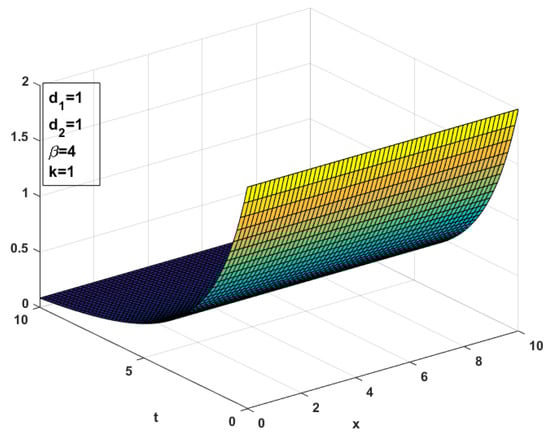
Figure 1.
3.7. Reductions for Subcase 1.2.1.1
Equation (1) becomes
The generator
having invariants
transforms (44) into
Similarly, leads to
where the similarity variables are
Moreover, the Lie generator gives the following reduced form of (44):
Now, for , we have
by means of the invariants and which yields the following exact invariant solution
3.8. Reductions for Subcase 1.2.2.1
3.9. Reductions for Subcase 1.2.2.2 (C)
Equation (1) for this case is
with the similarity variables
converts (46) to the Ode as
For , we derive the following similarity transformations:
which transforms (46) into
Also, for the traveling wave symmetry generator , we obtain the following reduction
Similarly, for , we obtain the reduction of (46) as
3.10. Reductions for Subcase 2.1.1.1 (2)
In this case, (1) can be written as
The symmetry generator reduces (47) to
where the similarity variables for this symmetry generator are
and
Likewise, has similarity variables and which transform (47) into
Now we consider , which has the respective invariants of the form
and for these invariants we arrive at the following reduced differential equation:
Now for we find
which results in the same reduced differential equation given above. The reduced Ode for is
3.11. Reductions for Subcase 2.1.1.2 (1)
In this case, (1) takes the form
The symmetry generator reduces (48) to
where the similarity variables for this symmetry generator are
and
For , the invariants are given by
that yields
Now for , the invariants
reduce (48) to
The reduction of (48) for is the same as given in (49), with respect to the following invariants:
The reduced differential equation for is
subject to and .
In a like manner, for , the reduction of (48) is given by
where the similarity variables for this symmetry generator are
and
Also, the Lie symmetry with respective invariants
gives the reduction
Similarly, for , the reduced form is
The reduced Ode for is
Associated to , the reduced form of (48) is given by
via the invariants
Similarly, for , we arrive at the reduced form
subject to the invariants
The corresponding invariant solution is
Graphically, this shows exponential decay.
Figure 2 shows exponential decay in the amplitude of the wave. As x increases, the amplitude of the wave swiftly diminishes. In other words, the wave spreads linearly with time t and then diminishes exponentially as we move along the x-axis in the positive direction due to the term . This solution illustrates the behavior of the wave that spreads and grows linearly with time while also decays in amplitude with spatial distance.
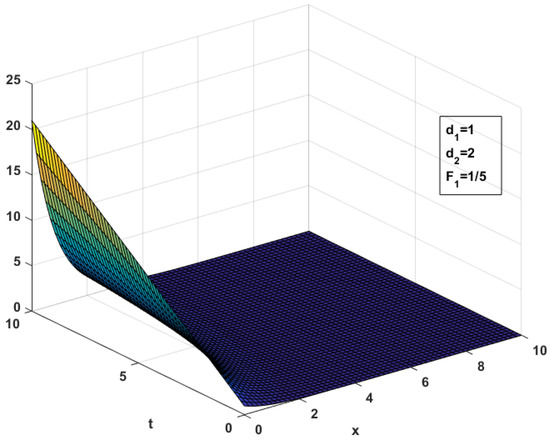
Figure 2.
3.12. Reductions for Subcase 2.1.1.2 (2)
Here, (1) becomes
We begin with for which the invariants
and
reduce (50) to the differential equation
For , we obtain the same reduced Ode, as given above. However, the similarity transformations for this symmetry generator are
Similarly, for , the invariants and results in the reduction
The reduced differential equation for the translational symmetry is
subject to and . This results in the following exact solution of (50)
and the graphical illustration of this solution is shown below.
Figure 3 shows the quadratic behavior of the solution that increases with time.
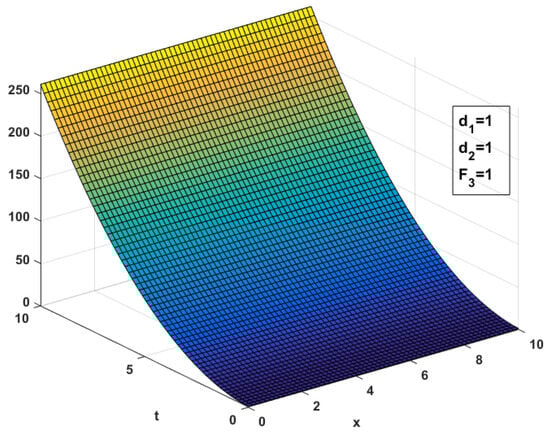
Figure 3.
3.13. Reductions for Subcase 2.1.2.1 (2)
In this case, (1) can be written as
The Lie symmetry generator reduces (51) to
where the similarity variables for this symmetry generator are
and
The reduction of (51) for is
Corresponding to , the invariants
lead to the following reduced differential equation
Also, , yields the following invariants:
and by using these invariants we deduce the same reduced differential equation as given above.
The reduction of (51) associated to is
3.14. Reductions for Subcase 2.1.2.2 (1)
In this case, (1) is
The symmetry generator reduces (52) to the Ode
where the similarity variables used are
and
Now, has the similarity variables
and by using these invariants, we arrive at
The similarity transformations
and
associated with transforms (52) into
Also, for , we have reduction
Similarly, for the similarity variables
reduce (52) to
For , we obtain the reduction of (52)
subject to
This reduced differential equation yields the following exact solution of (52):
Graphically, we have the following representation.
Figure 4 shows the diminishing behavior of the wave in both space and time. The combination of the exponential terms creates a solution that represents temporal and spatial decay. The graphs shows exponential decay as we move away from the origin. Moreover, the presence of the damping term A causes faster decay. The wave initially starts with the smaller amplitude and oscillations, but decays exponentially as it moves in both space and time. It can be seen from graphs that the wave decays with the increase in time and its oscillations become smaller and smaller.
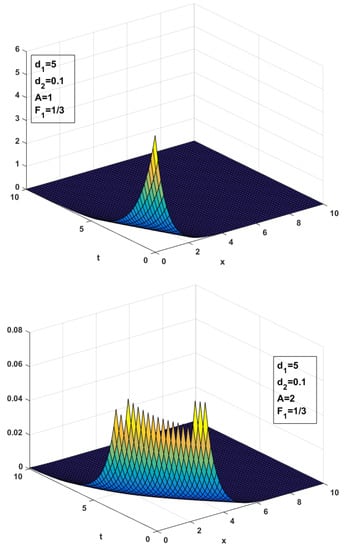
Figure 4.
The similarity variables
associated with give
For , the similarity variables
reduce (52) to the Ode
The symmetry generator results in the reduction
subject to
In a like manner, yields
3.15. Reductions for Subcase 2.2.1
Equation (1) in this respect takes the form
For generator , we obtain the reduced form of (53),
where the invariants associated with this generator are
Corresponding to , the invariants are
which yield the Ode
Now, we consider , which reduce (53) to the Ode
and this gives the traveling wave solution.
The symmetry generator gives the reduction
3.16. Reductions for Subcase 2.2.1.1
3.17. Reductions for Subcase 2.2.1.1.1
3.18. Reductions for Subcase 3.1.1
3.19. Reductions for Subcase 3.1.1 (1)
3.20. Reductions for Subcase 3.1.1 (2)
4. Conservation Laws
Conservation laws, central to symmetry analysis, arise as a result of Noether’s theorem, which connects continuous symmetries and conserved quantities of a system. In the framework of Noether’s theorem, a conservation law is a divergence expression, indicating that certain physical quantities remain conserved due to the symmetries embedded in a system described by differential equations. The study of these conserved quantities, inter alia, are useful for double reduction, linearization of Pdes and determining nonlocal symmetries of differential equations.
In this study, we find conservation laws via the partial Lagrangian approach due to Mahomed and Kara [10]. A partial Lagrangian of Equation (1) is of the form
where
The operator in Equation (3) associated with the Lagrangian (59) is called the partial Noether operator of Equation (1) if the condition below is satisfied, viz.
where,
are gauge terms depending on . From Equation (60), we arrive at the following set of determining equations:
From Equation (61), we have
Also, Equation (63) gives
Moreover, from Equation (62), we determine
with the conserved vectors arising as
subject to the condition
Now we consider different cases for arbitrary and
- Case 1:
- If , , and u are not related, then
- Case 2:
- If .
- Subcase 2.1:
- If is arbitrary function of u provided , the conserved vectors in this case are
So, we end up having the following conserved vectors:
Subcase 2.2: If , the conserved vectors in this case are
Herein , and are constants.
- Subcase 2.3:
- If is constant, the conserved vectors are
- Case 3:
- If and is not linear in u, then
- Case 4:
- If and is not linear in u, then
For , the following components are obtained:
where and are constants. Now, for , we deduce the following components of conserved quantities:
where and are constants. Hence, for constants and , there are two independent conserved quantities, i.e., and for () and (), respectively.
- Case 5:
- If .
In this case, we determine the conserved components as
Case 6: If is constant.
Here, we have different subcases.
- Subcase 6.1:
- If is a constant, the conserved vectors in this case are
- Subcase 6.2:
- If , the conserved vectors are
5. Conclusions
The complete Lie point symmetry classification of (1) was performed for the arbitrary smooth functions and . All possible choices for the extension of the principal Lie symmetry algebra were covered. The optimal system of one dimensional subalgebras was obtained for each case as arising from the symmetry Lie group classification. Reductions for all the cases were performed using the Lie subalgebras. Also, exact invariant solutions and their graphs were presented in some cases. Moreover, we have also studied the conservation laws via the partial Lagrangian approach. All the possible cases were discussed in order to find the conserved vectors of (1).
Author Contributions
F.A.: Carrying out all analysis, reduction and implementation, initial draft preparation. F.D.Z.: Formulation of problem, performing symmetry analysis, final manuscript. F.M.M.: Providing an outline of the work, conservation laws, checking all work. All authors have read and agreed to the published version of the manuscript.
Funding
This research received no external funding.
Data Availability Statement
The authors confirm that the data supporting the findings of this study are available within the article.
Conflicts of Interest
The authors declare no conflict of interest.
References
- Ovsiannikov, L.V. Group Analysis of Differential Equations; Academic Press: New York, NY, USA, 1982. [Google Scholar]
- Bluman, G.W.; Kumei, S. Symmetries and Differential Equations; Applied Mathematical Sciences; Springer: New York, NY, USA, 1989; Volume 81. [Google Scholar]
- Bluman, G.W.; Cheviakov, A.F.; Anco, S.C. Applications of Symmetry Methods to Partial Differential Equations; Springer: New York, NY, USA, 2010. [Google Scholar]
- Olver, P.J. Applications of Lie Groups to Differential Equations; Springer Science & Business Media: Berlin/Heidelberg, Germany, 1993; Volume 107. [Google Scholar]
- Ibragimov, N.H. CRC Handbook of Lie Group Analysis of Differential Equations; CRC Press: Boca Raton, FL, USA, 1995; Volume 3. [Google Scholar]
- Ames, W.F.; Lohner, R.J.; Adams, E. Group properties of utt = [f(u)ux]x. Int. J. Non-Linear Mech. 1981, 16, 439–447. [Google Scholar] [CrossRef]
- Azad, H.; Mustafa, M.T.; Ziad, M. Group classification, optimal system and optimal reductions of a class of Klein Gordon equations. Commun. Nonlinear Sci. Numer. Simul. 2010, 15, 1132–1147. [Google Scholar] [CrossRef]
- Bokhari, A.H.; Al-Dweik, A.Y.; Zaman, F.D.; Kara, A.H.; Mahomed, F.M. Generalization of the double reduction theory. Nonlinear Anal. Real World Appl. 2010, 11, 3763–3769. [Google Scholar] [CrossRef]
- Khalique, C.M.; Mahomed, F.M. Conservation laws for equations related to soil water equations. Math. Probl. Eng. 2005, 2005, 141–150. [Google Scholar] [CrossRef]
- Kara, A.H.; Mahomed, F.M. Noether-type symmetries and conservation laws via partial Lagrangians. Nonlinear Dyn. 2006, 45, 367–383. [Google Scholar] [CrossRef]
- Noether, A.E. Invariante variations probleme. Nachr. Akad. Wiss. Göttingen Math. Phys. KI. II 1991, 1, 186–207, English Translation in Transp. Theory Stat. Phys. 1991, 1, 186–207. [Google Scholar] [CrossRef]
- Anco, S.C.; Bluman, G. Direct Construction Method for Conservation laws of Partial Differential Equations Part I: Examples of Conservation law Classifications. Eur. J. Appl. Math. 2002, 13, 545–566. [Google Scholar] [CrossRef]
- Tian, S.F.; Xu, M.J.; Zhang, T.T. A symmetry-preserving difference scheme and analytical solutions of a generalized higher-order beam equation. Proc. R. Soc. A 2021, 477, 20210455. [Google Scholar] [CrossRef]
- Tian, S.F. Lie symmetry analysis, conservation laws and solitary wave solutions to a fourth-order nonlinear generalized Boussinesq water wave equation. Appl. Math. Lett. 2020, 100, 106056. [Google Scholar] [CrossRef]
- Mao, J.; Tian, S.F.; Zhang, T.; Yan, X.J. Lie symmetry analysis, conservation laws and analytical solutions for chiral nonlinear Schrödinger equation in (2 + 1)-dimensions. Nonlinear Anal. Model. Control 2020, 25, 358–377. [Google Scholar] [CrossRef]
- Feng, L.L.; Tian, S.F.; Zhang, T. Bäcklund transformations, nonlocal symmetries and soliton–cnoidal interaction solutions of the (2 + 1)-dimensional Boussinesq equation. Bull. Malays. Math. Sci. Soc. 2020, 43, 141–155. [Google Scholar] [CrossRef]
Disclaimer/Publisher’s Note: The statements, opinions and data contained in all publications are solely those of the individual author(s) and contributor(s) and not of MDPI and/or the editor(s). MDPI and/or the editor(s) disclaim responsibility for any injury to people or property resulting from any ideas, methods, instructions or products referred to in the content. |
© 2023 by the authors. Licensee MDPI, Basel, Switzerland. This article is an open access article distributed under the terms and conditions of the Creative Commons Attribution (CC BY) license (https://creativecommons.org/licenses/by/4.0/).