Article

Schinus terebinthifolia Raddi: Compounds Isolated by Countercurrent Chromatography and Biological Activities


by
Mara Junqueira Carneiro
1,
Alexandre Augusto Borghi
1,
Guilherme Perez Pinheiro
1,
Ana Lucia Tasca Gois Ruiz
1,
Daniela Mizobutti
2,
Elaine Minatel
2,
Lisieux Santana Juliao
3,
Svetlana Ignatova
4,
Peter Hewitson
4 and
Alexandra Christine Helena Frankland Sawaya
1,*
1
Faculty of Pharmaceutical Sciences, State University of Campinas, Campinas 13083-871, SP, Brazil
2
Institute of Biology, State University of Campinas, Campinas 13083-871, SP, Brazil
3
Department of Organic Chemistry, Institute of Chemistry, Federal Rural University of Rio de Janeiro, Rod. BR-465, km. 7, Seropédica 23890-000, RJ, Brazil
4
Department of Engineering, CEDPS, Brunel University of London, Uxbridge UB8 3PH, UK
*
Author to whom correspondence should be addressed.
Separations 2026, 13(4), 103; https://doi.org/10.3390/separations13040103
Submission received: 26 February 2026 / Revised: 17 March 2026 / Accepted: 20 March 2026 / Published: 25 March 2026

Abstract

The chemical composition of natural products is complex and the investigation of bioactivities of compounds of interest demands their isolation. S. terebinthifolia Raddi is a tree belonging to the Anacardiaceae family and is used in Brazilian folk medicine; its fruit (pink peppers) are used in cooking and its bark in phytomedicine. Extracts of other parts of this plant contain a plethora of components and merit further studies. Countercurrent chromatography (CCC) is frequently employed with natural products due to the high sample recovery rate. The objective of this work was to determine the best solvent system (SS) to fraction the ethanol extracts of leaves, flowers and fruit of Schinus terebinthifolia by CCC and isolate compounds of interest and elucidate their structures through nuclear magnetic resonance (NMR) and mass spectrometry (MS). In addition, antiproliferative, potential cell regeneration and antioxidant activities of the fractions of interest were evaluated. In the present work, three compounds were isolated; two were identified as anacardic acids [(6-(8′, 11′-heptadecadienyl)-salicylic acid and 6-(8′-heptadecenyl)-salicylic acid], as well as (Z)-masticadienoic acid. These compounds showed antiproliferative and potential cell regeneration activities as well as varying degrees of antioxidant capacity. Although these compounds present potential therapeutic activity, more studies are necessary to confirm their safety.

1. Introduction

There are diverse techniques to isolate compounds of complex matrices, like extracts from natural products. Countercurrent chromatography (CCC) is ever more frequently employed in work with natural products due to its high sample recovery rate [1,2]. This occurs because the material that was not obtained during the elution process can be obtained by extruding the stationary phase from the column. This way, nothing is retained by the column. Furthermore, CCC presents other advantages in relation to conventional liquid separation methods, such as a low risk of sample denaturation and no need to use expensive columns; it is possible to work in normal or reversed phase [3]. One such solvent system (SS) that has proven to be highly effective is the n-hexane/ethyl acetate/methanol/water system (HEMWat), which is most commonly used in CCC [4]. On the other hand, commonly, a large amount of organic solvent is used in this technique.
The extracts of Schinus terebinthifolia Raddi (Anacardiaceae) bark show wound-healing [5], antiulcer [6] and antioxidant [7] activity. Fruit extracts were described as anti-inflammatory [8] and antioxidant [9]; leaf extracts showed antioxidant [10] and antifungal [11] properties. The use of its fruit (pink peppers) in cooking gave rise to an important market to supplement the income of small producers [12].
A review of pink pepper’s many applications was published in 2022 [13]. Studies of the composition and activity of other parts of this interesting species have focused on its essential oil [14]. However, other forms of extraction can result in a plethora of components (and bioactivities) that are not found in the essential oil and merit further studies. The objective of this work was to fraction the ethanol extracts of leaves, flowers and fruit of S. terebinthifolia by CCC, isolate compounds of interest and elucidate their structures through NMR and MS. In addition, antiproliferative, potential of cell regeneration and antioxidant activities of fractions were evaluated.

2. Materials and Methods

2.1. Plant Material

Leaves, flowers and fruit were collected from the same individual of Schinus terebinthifolia located at Institute of Biology, State University of Campinas (UNICAMP), 22°49′18.6″ S 47°04′10.4″ W). The voucher of the individual was deposited at the UNICAMP Herbarium (UEC) numbered UEC 197984. The leaves were collected throughout the year of 2016, the flowers were collected in September 2016, and the fruit were collected in October 2016.

2.2. Ethanolic Extracts

The fresh plant material (leaves, flowers and fruit) was extracted with absolute ethanol in a ratio of 1:3 (g/mL), and the extraction was carried out using ultrasound for 30 min at room temperature and protected from light. After the first filtration, the residue was extracted again with half the volume of solvent from the first extraction for the exhaustive extraction of the plant material. The extracts were filtered, and solvent was removed in a Heidolph® rotary evaporator (Heidolph Instruments GmbH & Co. KG, Schwabach, Germany) under vacuum at 55 °C and 100 rpm and then concentrated under vacuum (SpeedVac, Thermo Fisher Scientific, Waltham, MA, USA) under the same conditions. This procedure resulted in oily–viscous crude extracts. The yield was 3% (m/m) for the leaf, 5% for the flower and 6% for the fruit extracts.

2.3. High-Performance Countercurrent Chromatography Separations

The crude extracts of leaf, flower and fruit were fractioned using MIDI equipment with a PFA column at 30 °C and atmospheric pressure. The column volume was 912.5 mL and its diameter was 4 mm. The SS used was HEMWat (6/1/6/1) to HEMWat (19/1/19/1), the mobile phase was the aqueous (lower) phase of HEMWat (6/1/6/1) and HEMWat (19/1/19/1) and the stationary phase was the organic (upper) phase of HEMWat (6/1/6/1); as in reverse-phase chromatography. The column was filled with upper phase [organic phase of HEMWat (6/1/6/1)], then the rotation (1250 rpm) was started. The lower phase [aqueous phase HEMWat (6/1/6/1)] was pumped into the column in the center-to-periphery direction (“head-to-tail” mode). After the equilibrium, the sample dissolved in HEMWat (6/1/6/1) lower phase was injected. The volume injected was 50 mL for leaf and fruit extracts and 25 mL for flower extracts; all extracts were in the same concentration, 100 mg/mL. The flow was 20 mL/min, increased to 40 mL/min at 15 min, and the SS was changed to the lower phase of HEMWat (19/1/19/1) after 40 min to allow the best separation. The total time of separation was 99 min. Fractions were collected every 2 min when the flow rate was 20 mL/min and every minute when the flow rate changed to 40 mL/min.

2.4. TLC Analysis

Analyses by thin-layer chromatography (TLC) were carried out using a normal-phase silica gel TLC Plates 60 F254 (Merck Art. 05554, Darmstadt, Germany). The mobile phase was CHCl3–EtOAc 2:1 (v/v), and the results were observed under visible and UV light. After the crude extracts were fractioned by CCC, their fractions were combined, according to the TLC results and concentrated in an evaporator under vacuum at 40 °C. This was possible because the CCC method was highly reproducible and the fractions were very similar.

2.5. LC-MS Analysis

The fractions obtained by CCC were analyzed by UHPLC-ESI-MS, with the electrospray ionization in positive and negative modes. The equipment was a UPLC Acquity chromatographer coupled a TQD Acquity Mass spectrometer (Micromass-Waters, Manchester, UK), using a C18 BEH Waters Acquity (2.1 mm × 50 mm × 1.7 mm) column, under the following conditions: solvent A (0.1% ammonium hydroxide solution in purified water), solvent B (HPLC grade Methanol); beginning 70% B, ramping to 100% B in 7 min, maintaining 100% B until 9 min, returning to the initial conditions in 9.1 min, and stabilizing until 12 min. The volume injected was 2 µL. The conditions of the mass spectrometer were as follows: capillary 3.00 k, cone 30 V, source temperature of 150 °C and desolvation temperature of 350 °C, full scan between m/z 100 and 1000.
The fractions of interest were analyzed by an Agilent Ultra-High-Performance Liquid Chromatograph coupled to a high-resolution mass spectrometer, (Agilent 6560 UHPLC-IM-QTOF, Santa Clara, CA, USA) for component identification. The analysis was performed with a Jetstream electrospray ion source in negative ion mode, a capillary voltage of −4000 V, and a fragmentor of −400 V, with a nebulization and sheath gas temperature of 150 °C and 360 °C, respectively. For compound identification, the MS/MS fragmentation was performed with collision energies between 10 and 40 V. The chromatographic separation was carried out on a Waters HSS-T3 2.1 × 50 mm, 1.8 µm column, at 40 °C, with a flow of 0.4 mL/min. Solvent A was purified water with 0.1% ammonium hydroxide and solvent B was methanol. The gradient started with 70% of B, ramping up to 100% of B in 7 min, maintaining until reaching 9 min, returning to 70% of B in 9.1, and maintaining this condition until reaching 12 min. The volume injected was 2 µL.

2.6. NMR Analyses

The enriched fractions obtained by CCC, analyzed by UHPLC-ESI-MS containing partially purified compounds, were subjected to NMR analysis to elucidate the structures of the main compound in each fraction. 1H (500 MHz), DEPT-Q (125 MHz), COSY, HSQC, and HMBC spectra were obtained using a Bruker Topspin 400 spectrometer (Rheinstetten, Germany) at room temperature. Tetramethylsilane was used as an internal standard. Deuterated chloroform (CDCl3) was used as the solvent.

2.7. Biological Activities

2.7.1. Antioxidant Capacity

DPPH Assay
Samples were subjected to DPPH testing according to the method described by [15]. The test was carried out in a 96-well microplate. The fractions were diluted in ethanol and tested in a concentration range that varied from 1 to 50 μg/mL in triplicate. In each well, we added 10 μL of sample, 50 μL of an ethanolic solution of DPPH (50 mM) and 180 μL of ethanol. Quercetin was used as a positive control at concentrations of 1 to 50 μg/mL in ethanol. Absolute ethanol was used as a negative control. The plate was kept protected from the light and absorbance was measured at 517 nm on the Molecular Devices SpectraMax M3® plate reader every 10 min for 60 min. The percentage of DPPH inhibition was calculated based on this equation:
D P P H ( % ) = ( A c A s / A c ) × 100 ;
where Ac is the absorbance of the control and as is the absorbance of the sample.
The EC50 value was calculated based on the straight line equation obtained with the percentage of DPPH reduction in relation to the tested concentrations. The data were subjected to statistical analysis by ANOVA and compared by the Tukey test with p ≤ 0.05.
Oxygen Radical Absorbance Capacity (ORAC) Assay
The determination of the peroxyl radical scavenging activity was conducted as reported by [16]. The samples (50 μL in ethanol) were incubated with the fluorescein solution (150 μL) at 37 °C. The test was carried out in a 96-well microplate. After 15 min, AAPH radical (50 μL) was added and fluorescence detection (ex. 485 nm/em. 535 nm) was measured every minute on the SpectraMax M5 (Molecular Devices, San Jose, CA, USA) at 37 °C. Trolox was used as a control standard and a curve of relative fluorescence intensity was constructed. Final results were calculated based on the difference in the area under the fluorescein decay curve between the blank and each sample. ORAC values were expressed as μM Trolox Equivalent (TE)/g.

2.7.2. Cell Viability—MTT

This test was based on a colorimetric method MTT (3-(4,5-dimethylthiazol-2-yl)2,5-diphenyl tetrazolium bromide) binds to the mitochondria of viable cells and forms formazan crystals, colored blue. The percentage of viable cells was calculated based on the absorbance obtained at 570 nm [17]. The test was carried out in partnership with the Muscular Plasticity Laboratory (Structural and Functional Biology Department—IB/UNICAMP).
Skeletal muscle cells from the pelvic muscle of mdx mice (X-linked muscular dystrophy) were used to perform primary cell cultures. These cells were cultivated in appropriated medium: DMEM, containing 10% (v/v) horse serum, 10% (v/v) fetal bovine serum, 2 mM L-glutamine and 1% (v/v) penicillin. Cells were pelleted in 96-well microplates covered with 0.1% (w/v) Matrigel for 24 h. After a period of cell adhesion to the plate (5 to 6 days), the medium was removed from the wells and the treatments of interest were added: fractions (7, 15, 30 e 60 µg/mL); control: mdx cells without treatment; blank: propylene glycol, the solvent used to dissolve the samples.
The plates were incubated at 37 °C in 5% CO2. The MTT was added 24 h after applying the treatments. The plates were incubated again at 37 °C in 5% CO2 for 3 h. The medium was removed and an equal amount of solvent composed of 30 mL of isopropanol with 100 µL of hydrochloric acid was added. The absorbance was measured at 570 nm on the BioTek Synergy Elisa reader. The data were processed by ANOVA and Tukey test (p < 0.05) using GraphPad Prism 8.0 software.

2.7.3. In Vitro Antiproliferative Activity

The four fractions were assessed in the following four human tumor cell lines, kindly provided by the National Cancer Institute (Frederick, MA, USA): MCF-7 (breast), 786-0 (renal), NCI-H460 (lung, non-small cells) and HT-29 (colon), and HaCaT (human keratinocytes, immortalized non-tumoral cell).
Assays were performed in a 96-well plate using six concentrations produced by 10-fold dilution (0.15–150 µg/mL). The activity was deduced from the concentration response, and GI50 parameters (growth inhibitory activity) were calculated. The test results were measured using the colorimetric sulphorhodamine B method, according to the NCI standard protocol, and doxorubicin (0.015–15 µg/mL) was used as the positive control [18].

3. Results

3.1. CCC Optimization

The first and most important step for a good separation of compounds using the CCC technique is the choice of the solvent system (SS). From previous knowledge of the general chemical composition of the extracts [19] and based on the literature regarding CCC [4,20], some SS composed of n-Hexane/Ethyl Acetate/Methanol/Water (HEMWat) were selected to determine the best SS for fractionating the S. terebinthifolia extracts. Initially, small amounts of the sample were dissolved in test tubes containing two-phase solvent system; the tubes were shaken and the compounds allowed to partition between the two phases. Initial TLC plates and LC-MS analyses were performed to determine the best systems. During initial tests, in addition to the SS, other analytical parameters were altered, such as flow rate and the chromatographic separation mode: reversed phase or normal phase and mobile phase with gradient or isocratic (Table 1).
The samples used for these tests were leaf extracts. Initially, a DE-SPECTRUM (Dynamic Extractions, Tredegar, UK), coupled to two Agilent HP1200 pumps (Santa Clara, CA, USA), Agilent HP1200 DAD detector (Santa Clara, CA, USA), and the Gilson FC202 automatic fraction collector (Villiers-le-Bel, France) was used, with a lower flow rate (2 mL/min). Then tests were scaled up using a preparative system, DE-Midi equipment (Dynamic Extractions, Slough, UK), coupled to two Knauer K-1800 pumps (Berlin, Germany), the Agilent HP1200 DAD detector (Santa Clara, CA, USA) with a preparative cell, and a Gilson FC202 automatic fraction collector (Villiers-le-Bel, France).
The first assay, Test I, was performed with the HEMWat (1/1/1/1) solvent system, normal phase, with the DE-SPECTRUM equipment. The non-polar fractions were not separated due the polar characteristics of this SS. Then another, less polar, ratio of the same SS was tested, isocratic HEMWat (6/1/6/1) reverse phase (Test II). The results showed a good separation of compounds that eluted in the beginning of the analysis; however, the non-polar fractions were still not well separated. Therefore, gradients were tested: gradient elution mode HEMWat (1/1/1/1) to (19/1/19/1) in reverse mode was tested to try to separate the polar and non-polar fractions but was not successful, because the compounds that eluted in the beginning of the chromatogram (polar compounds) were not separated suitably (Test III). The SS of test II showed a better separation of these compounds.
A new test was carried out with the more non-polar SS HEMWat (19/1/19/1) (Test IV) isocratic mode on the DE-Midi equipment at a higher flow rate (40 mL/min) but the fractions of the sample were not well separated. Another test (V) was performed with the step gradient of HEMWat of (6/1/6/1) to (19/1/19/1). This method resulted in the best separation of the compounds from the leaf extract, which was the most complex sample. The use of a gradient of a mobile-phase composition in CCC is particularly useful to apply a mixture of compounds with a wide polarity range as the ethanolic extracts of S. terebinthifolia. Therefore, this method was applied in to the leaf, flower and fruit extracts.
Separation by CCC resulted in 85 fractions that were grouped according to results observed on TLC plates. In the case of the leaf extract, similar fractions were grouped, resulting in 26 final fractions; for the flower extract, 22 final fractions were obtained; and from the fruit extract, it was 25 fractions. The TLC plates indicated that some fractions could present a large amount of a compound (Figures S1–S3, Supplementary Data). The fractions were dried, and the recovery of each extract after separation is shown in Table 2. The average of the stationary phase retention (Sf) in the column was 82%. Recovery of the fruit extract showed a lower yield, probably due to the presence of sugars in the extract that were lost during the drying process of the fractions.

3.2. Identification of Compounds

The LC-MS analysis confirmed that four fractions contained a high concentration of one compound (Figures S4–S11, Supplementary Data), and they are described in Table 3. However, as fraction Fr375 presented only 67% purity, it was not analyzed by NMR; the compound’s putative identification was based on high-resolution LC-MS analysis. The other three fractions were selected for NMR analysis in order to elucidate the structure of the principal compound. The spectra are shown in Supplentary Data (Figures S12–S17).
The MS and NMR analysis data of the Fr371 fraction were compared with the literature, and the compound was identified as 6-(8′,11′-heptadecadienyl)-salicylic acid, an anacardic acid with an alkyl chain containing 17 carbons and two unsaturations with double bonds [21], as shown in Figure S18—Supplementary Data.
The MS and NMR analysis data of the Fr373 fraction were also compared with the literature and indicate that this compound is 6-(8′-heptadecenyl)-salicylic acid, another anacardic acid with a hydrocarbon chain containing 17 carbons and one unsaturation with a double bond (Figure S19—Supplementary Data). The data of NMR are in the Supplementary Materials. This compound is reported for the first time in S. terebinthifolia, having been found in another species of the Anacardiaceae family [22].
The main compound (m/z 453) of the Fr453 fraction was identified as (Z)-masticadienonic acid, according to MS and NMR analysis and the literature. Its structure is shown in Figure S20 in the Supplementary Data.
The NMR spectrum of the major compound of Fr375 (m/z 375.2899) was not enough to identify the compound. The LC-MS analyses in comparison with the literature suggest an anacardic acid due the fragments 331, 119 and 106 [19,22].

3.3. Antioxidant Activity

The antioxidant capacity of the pink pepper fractions was evaluated by two methods with different mechanisms of action. DPPH indicates the sample’s ability to react with free radicals via hydrogen transfer; it is considered an indirect measurement of antioxidant capacity. In general, molecules with acid and phenolic sites are good H-donors [23]. A low DPPH radical inhibition percentage of 5% was observed for Fr371 and Fr373; however, Fr375 presented a much higher capacity (36%) by this method, which may occur due to the presence of other compounds in the fraction, enabling a synergism between them. The percentage of inhibition of the DPPH radical is presented in Table 4.
On the other hand, the ORAC method measures the capacity of a sample protect fluorescein from degradation (FL) and is considered a direct method. In this method, the highest result was obtained by Fr373, followed by Fr371. The other two fractions did not present results (Table 4).
Morais et al., 2017 [24] evaluated the antioxidant activity of three anacardic acid (monoene-C15:1, diene-C15:2 and triene-C15:3) by DPPH and observed that the presence of three double bonds greater the antioxidant activity of anacardic acid. The unsaturation present in anacardic acids could change the biological potential of the molecule. Some studies of the S. terebinthifolia extract showed a good antioxidant potential correlating this potential and the presence of phenolic compounds in extracts [10,25].

3.4. Cell Viability—MTT

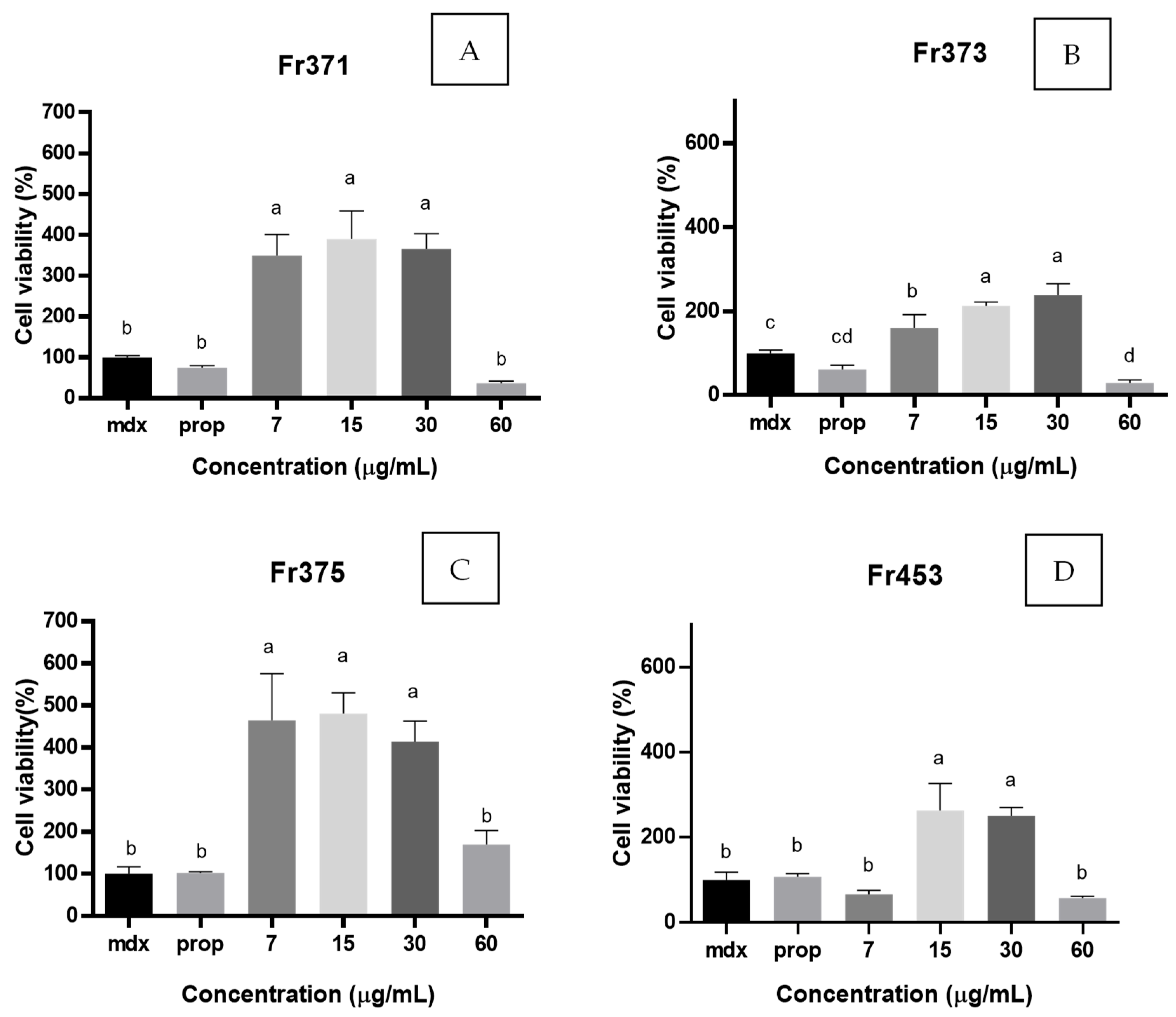
The MTT assay tests the capacity of the fractions to regenerate the cells (Figure 1). Fractions Fr371 and Fr375 showed the best results; however, all fractions had good results, mainly in the lower concentrations tested (7, 15 and 30 µg/mL). These results showed the potential of these compounds to help delay cell death and increase cell multiplication in the muscle tissue of the mdx cell line, especially at the lowest concentration tested.

3.5. In Vitro Antiproliferative Activity

Antiproliferative activity was evaluated according to the NCI protocol [18,26] with results classified based on CSIR criteria as inactive (I, TGI ≥ 50 μg/mL), weak (W, 15 ≤ TGI < 50 μg/mL), moderate (M, 6.25 ≤ TGI < 15 μg/mL) or potent (P, TGI < 6.25 μg/mL) [27].
Fraction Fr453 exhibited moderate cytostatic effect against MCF-7 (breast adenocarcinoma; TGI = 13.5 μg/mL) and NCI-H460 (non-small cell lung carcinoma; TGI = 6.4 μg/mL) cells, while the all the other evaluated fractions showed weak to inactive antiproliferative activity (Table 5). Notably, none of the fractions affected the proliferation of immortalized keratinocytes HaCaT (TGI > 150 μg/mL) under the experimental conditions.

4. Discussion

CCC is an important tool for isolating compounds in complex extracts, being fast and showing good material recovery. Three fractions were obtained with sufficient purity for NMR analysis and subsequent identification.
The Fr371 fraction was identified as the anacardic acid: 6-(8′,11′-heptadecadienyl)-salicylic acid, which was previously isolated from the hexane extract of S. terebinthifolia leaves and was active against the parasite Trypanosoma cruzi, which causes Chagas disease, as it altered the permeability of the parasite’s membrane [20].
The Fr373 fraction was identified as the anacardic acid, 6-(8′-heptadecenyl)-salicylic acid, reported in [30], and showed significant inhibitory effects on α-glucosidase as a mixed-type inhibitor.
Fraction Fr453 was identified as masticadienoic acid. This compound had already been identified in leaves and berries of S. terebinthifolia and been shown to be an inhibitor of phospholipase A2, with anti-inflammatory activity [8]. Furthermore, its antiparasitic potential was described in the literature [31]. A more recent study confirmed this activity via activation of regulatory T lymphocytes and production of inhibitory cytokines [32].
A recent study of the antioxidant capacity of pink pepper extracts via DPPH presented a 42.68 ± 0.05% [9] inhibition, which correlates well with the result for Fr375 (36%). On the other hand, the ORAC results in the same study (µMTE/g 43.40 ± 6.22) were lower than for Fr373 (µMTE/g 169.9 ± 45.1) but higher than the other fractions.
The enriched fractions showed the potential to regenerate healthy cells. The best results were observed with fractions Fr371 and Fr375, which showed cell viability around 400%, that is, an increase of 300%. The compounds were selectively cytotoxic for some tumoral cell lines, especially Fr453 against MCF-7 (breast), 786-0 (renal) and NCI-H460 (lung, non-small cell). Furthermore, they presented very low cytotoxic activity against human non-tumor cell lines (HaCaT = human keratinocytes, immortalized). These findings suggest that the evaluated fractions may be selective for tumor tissue, sparing highly proliferative normal tissues such as skin and bone marrow [33,34]. Anacardic acid was shown to be a potent inhibitor of tumor angiogenesis, acting on the Src/FAK/Rho GTPase signaling pathway, leading to significant suppression of prostate tumor growth [35]. Other studies have reported the potential of S. terebinthifolius and other plants of the Anacardiaceae family as anticancer agents [28,29].

5. Conclusions

Countercurrent chromatography proved to be an effective technique for isolating compounds from S. terebinthifolia extracts and is indicated for separating compounds of interest in complex matrices, such as extracts of natural products. The isolated compounds were two anacardic acids, [6-(8′, 11′-heptadecadienyl)-salicylic acid and 6-(8′-heptadecenyl)-salicylic acid], as well as (Z)-masticadienoic acid. These compounds, as well as the partially purified fraction Fr375, showed interesting biological properties, such as antioxidant potential and the capacity to regenerate cells. Furthermore, the combination of low cytotoxicity in non-tumoral cells and activity against selected tumoral lines is desirable for the discovery and development of anti-tumoral molecules. Therefore, more studies with these isolated compounds are necessary to confirm their biological potential and safety.

Supplementary Materials

The following supporting information can be downloaded at: https://www.mdpi.com/article/10.3390/separations13040103/s1, Figure S1: CCD plates of samples resulting from CCC fractionation of leaf extracts of Schinus terebinthifolia, developed with mobile phase Chloroform/Ethyl Acetate 2:1 (v/v). Visualized in visible light (1) and in UV light, 254 nm (2). A to Z fractions; Figure S2: CCD plates of samples resulting from CCC fractionation of flower extracts of Schinus terebinthifolia, developed with mobile phase Chloroform/Ethyl Acetate 2:1 (v/v). Visualized in visible light (A1) and in UV light, 254 nm (2). A to Z fractions; Figure S3: CCD plates of samples resulting from CCC fractionation of fruit extracts of Schinus terebinthifolia, developed with mobile phase Chloroform/Ethyl Acetate 2:1 (v/v). Visualized in visible light (1) and in UV light, 254 nm (2). A to Z fractions; Figure S4: Chromatogram ob-tained by LC-MS of fraction Fr371 of leaf extract from Schinus terebinthifolia; Figure S5: MS spectrum of m/z 371 of fraction Fr371 from Schinus terebinthifolia; Figure S6: Chromatogram obtained by LC-MS of fraction Fr373 of leaf extract from Schinus terebinthifolia; Figure S7: MS spectrum of m/z 373 of fraction Fr373 from Schinus terebinthifolia; Figure S8: Chromatogram obtained by LC-MS of fraction Fr375 of leaf extract from Schinus terebinthifolia; Figure S9: MS spectrum of m/z 375 of fraction Fr375 from Schinus terebinthifolia; Figure S10: Chromatogram obtained by LC-MS of fraction Fr453 of leaf extract from Schinus terebinthifolia; Figure S11: MS spectrum of m/z 453 of fraction Fr453 from Schinus terebinthifolia; Figure S12. 6-(8′, 11′-heptadecadienyl)-salicylic acid 1H NMR spectra (500 MHz, CDCl3); Figure S13: 6-(8′, 11′-heptadecadienyl)-salicylic acid 13C NMR spectra (500 MHz, CDCl3). (A) Total Spectra and (B) Zoom; Figure S14: 6-(8′-heptadecenyl)-salicylic acid 1H NMR spectra (500 MHz, CDCl3); Figure S15: 6-(8′-heptadecenyl)-salicylic acid 1H NMR spectra (500 MHz, CDCl3). (A) Total Spectrum and (B) Zoom; Figure S16: (Z)-masticadienoic 1H NMR spectra (500 MHz, CDCl3); Figure S17: (Z)-masticadienoic 13C NMR spectra (500 MHz, CDCl3). (A) Total Spectrum and (B) Zoom; Figure S18: Chemical structure of 6-(8′, 11′-heptadecadienyl)-salicylic acid; Figure S19: Chemical structure of 6-(8′-heptadecenyl)-salicylic acid; Figure S20: Chemical structure of (Z)-masticadienoic acid.

Author Contributions

Conceptualization, M.J.C., G.P.P., S.I. and A.C.H.F.S.; Methodology, M.J.C., A.A.B., E.M., S.I., P.H. and A.C.H.F.S.; Software, G.P.P.; Formal analysis, M.J.C., A.A.B., A.L.T.G.R., D.M. and L.S.J.; Investigation, M.J.C., A.A.B. and G.P.P.; Writing—original draft, M.J.C.; Writing—review and editing, A.A.B., G.P.P., A.L.T.G.R., D.M., L.S.J., S.I. and A.C.H.F.S.; Supervision, S.I.; Project administration, A.C.H.F.S.; Funding acquisition, M.J.C., E.M., S.I., P.H. and A.C.H.F.S. All authors have read and agreed to the published version of the manuscript.

Funding

This research was funded by São Paulo Research Foundation (FAPESP) (2016/11524-9; 2018/11069; 2018/11726-6) and, in part, by the Coordenação de Aperfeiçoamento de Pessoal de Nível Superior—Brasil (CAPES)—Finance Codes 001, National Council for Scientific and Technological Development (CNPq, grants #429463/2018-9, #303471/2022-0, #304839/2024-8 and #307549/2022-4), Fund for Support to Teaching, Research and Outreach Activities (FAEPEX/UNICAMP grants #2001/19; 255/20, 2235/21, and 2139/22).

Data Availability Statement

The original contributions presented in this study are included in the article/Supplementary Material. Further inquiries can be directed to the corresponding author.

Acknowledgments

We thank Institute of Biology of State University of Campinas, São Paulo Research Foundation (FAPESP), Fundação Coordenação de Aperfeiçoamento de Pessoal de Nível Superior (CAPES), The National Council for Scientific and Technological Development (CNPq) for financial support, and Brunel University London.

Conflicts of Interest

The authors declare no conflicts of interest.

Abbreviations

The following abbreviations are used in this manuscript:
HEMWatn-Hexane/Ethyl Acetate/Methanol/Water
UECUNICAMP Herbarium
SSSolvent System

References

  1. Marston, A.; Hostettmann, K. Developments in the Application of Counter-Current Chromatography to Plant Analysis. J. Chromatogr. A 2005, 1112, 181–194. [Google Scholar] [CrossRef]
  2. Liu, Y.; Friesen, J.B.; McAlpine, J.B.; Pauli, G.F. Solvent System Selection Strategies in Countercurrent Separation. Planta Med. 2015, 81, 1582–1591. [Google Scholar] [CrossRef]
  3. Ito, Y. Golden rules and pitfalls in selecting optimum conditions for high-speed counter-current chromatography. J. Chromatogr. A 2005, 1065, 145–168. [Google Scholar] [CrossRef] [PubMed]
  4. Ignatova, S.; Sumner, N.; Colclough, N.; Sutherland, I. Gradient Elution in Counter-Current Chromatography: A New Layout for an Old Path. J. Chromatogr. A 2011, 1218, 6053–6060. [Google Scholar] [CrossRef]
  5. Komatsu, D.; Hausen, M.A.; Eri, R.Y.; Leal, V.; Pedrini, F.; Yaksic, C.; Alves, T.F.R.; Chaud, M.V.; Fanelli, C.; Noronha, I.; et al. Alternative Cutaneous Substitutes Based on Poly(l-Co- d, l -Lactic Acid- Co-Trimethylene Carbonate) with Schinus terebinthifolius Raddi Extract Designed for Skin Healing. ACS Omega 2019, 4, 18317–18326. [Google Scholar] [CrossRef] [PubMed]
  6. Nunes-Neto, P.A.; Peixoto-Sobrinho, T.J.d.S.; Júnior, E.D.d.S.; da Silva, J.L.; Oliveira, A.R.d.S.; Pupo, A.S.; Araújo, A.V.; da Costa-Silva, J.H.; Wanderley, A.G. The Effect of Schinus terebinthifolius Raddi (Anacardiaceae) Bark Extract on Histamine-Induced Paw Edema and Ileum Smooth Muscle Contraction. Evid.-Based Complement. Altern. Med. 2017, 2017, 1416375. [Google Scholar] [CrossRef]
  7. Sereniki, A.; Linard-Medeiros, C.F.B.; Silva, S.N.; Silva, J.B.R.; Peixoto Sobrinho, T.J.S.; da Silva, J.R.; Alvesa, L.D.S.; Smailic, S.S.; Wanderley, A.G.; Lafayette, S.S.L. Schinus terebinthifolius Administration Prevented Behavioral and Biochemical Alterations in a Rotenone Model of Parkinson’S Disease. Braz. J. Pharmacogn. 2016, 26, 240–245. [Google Scholar] [CrossRef]
  8. Jain, M.K.; Yu, B.-Z.; Rogers, J.M.; Smith, A.E.; Boger, E.T.; Ostrander, R.L.; Rheingold, A.L. Specific Competitive Inhibitor of Secreted Phospholipase A2 from Berries of Schinus terebinthifolius. Phytochemistry 1995, 39, 537–547. [Google Scholar] [CrossRef]
  9. de Oliveira, V.S.; Cháves, D.W.H.; Gamallo, O.D.; Sawaya, A.C.H.F.; Sampaio, G.R.; Castro, R.N.; Torres, E.A.F.d.S.; Saldanha, T. Effect of Aroeira (Schinus terebinthifolius Raddi) Fruit against Polyunsaturated Fatty Acids and Cholesterol Thermo-Oxidation in Model Systems Containing Sardine Oil (Sardinella brasiliensis). Food Res. Int. 2020, 132, 109091. [Google Scholar] [CrossRef]
  10. Uliana, M.P.; Fronza, M.; da Silva, A.G.; Vargas, T.S.; de Andrade, T.U.; Scherer, R. Composition and Biological Activity of Brazilian Rose Pepper (Schinus terebinthifolius Raddi) Leaves. Ind. Crops Prod. 2016, 83, 235–240. [Google Scholar] [CrossRef]
  11. Johann, S.; Sá, N.P.; Lima, L.A.R.S.; Cisalpino, P.S.; Cota, B.B.; Alves, T.M.A.; Siqueira, E.P.; Zani, C.L. Antifungal Activity of Schinol and a New Biphenyl Compound Isolated from Schinus terebinthifolius Against the Pathogenic Fungus Paracoccidioides Brasiliensis. Ann. Clin. Microbiol. Antimicrob. 2010, 9, 30. [Google Scholar] [CrossRef]
  12. Labre, T.; Sales, V.; Thainara, D.O.; William, D.; Chávez, H.; Cabral, O.; Rosane, N.; Castro, N.; Geraldo, M.; Christine, A.; et al. Pink Pepper (Schinus terebinthifolius Raddi) as a Bio-Based Additive in Pork Salami: Lipid Oxidative Stability, Cholesterol Oxides Formation, Physicochemical Characteristics, and Sensory Acceptance. Eur. Food Res. Technol. 2025, 251, 2325–2341. [Google Scholar] [CrossRef]
  13. Locali-Pereira, A.R.; Lopes, N.A.; Regina, V. Pink Pepper (Schinus terebinthifolius Raddi) from Extracts to Application: Truths about a Fake Pepper. Food Rev. Int. 2022, 39, 5185–5214. [Google Scholar] [CrossRef]
  14. Junqueira Carneiro, M.; Perez Pinheiro, G.; Mara Baseggio, A.; Roberto Maróstica-Júnior, M.; Frankland Sawaya, A.C.H. Chemical Composition and Antioxidant Activity of Essential Oil from Male and Female Schinus terebinthifolius. Pharmacogn. Res. 2023, 15, 484–491. [Google Scholar] [CrossRef]
  15. Miliauskas, G.; Venskutonis, P.R.; Van Beek, T.A. Screening of Radical Scavenging Activity of Some Medicinal and Aromatic Plant Extracts. Food Chem. 2004, 85, 231–237. [Google Scholar] [CrossRef]
  16. Ou, B.; Hampsch-woodill, M.; Prior, R.L. Development and Validation of an Improved Oxygen Radical Absorbance Capacity Assay Using Fluorescein as the Fluorescent Probe. J. Agric. Food Chem. 2001, 49, 4619–4626. [Google Scholar] [CrossRef]
  17. Macedo, A.B.; Henrique, L.; Moraes, R.; Mizobuti, D.S. Low-Level Laser Therapy (LLLT) in Dystrophin-Deficient Muscle Cells: Effects on Regeneration Capacity. Inflamm. Response Oxidative Stress 2015, 10, e0128567. [Google Scholar] [CrossRef]
  18. Monks, A.; Scudiero, D.; Skehan, P.; Shoemaker, R.; Paull, K.; Vistica, D.; Hose, C.; Langley, J.; Cronise, P.; Vaigro-Wolff, A. Feasibility of a high-flux anticancer drug screen using a diverse panel of cultured human tumor cell lines. J. Natl. Cancer Inst. 1991, 83, 757–766. [Google Scholar] [CrossRef]
  19. Carneiro, M.J.; Pinheiro, G.P.; Ribeiro, E.; Antunes, M.; Hantao, L.W.; Moritz, T.; Sawaya, A.C.H.F. Schinus terebinthifolia Raddi—Untargeted Metabolomics Approach to Investigate the Chemical Variation in Volatile and Non-Volatile Compounds. Metabolites 2024, 14, 612. [Google Scholar] [CrossRef]
  20. Vieira, M.N.; das Costa, F.N.; Leitão, G.G.; Garrard, I.; Hewitson, P.; Ignatova, S.; Winterhalter, P.; Jerz, G. Schinus terebinthifolius Scale-up Countercurrent Chromatography (Part I): HIGH Performance Countercurrent Chromatography Fractionation of Triterpene Acids with off-Line Detection Using Atmospheric Pressure Chemical Ionization Mass Spectrometry. J. Chromatogr. A 2015, 1389, 39–48. [Google Scholar] [CrossRef]
  21. Umehara, E.; Costa, T.A.; Mendes, V.M.; Guadagnin, R.C.; Sartorelli, P.; Tempone, A.G.; Henrique, J.; Lago, G. Bioorganic Chemistry Differential Lethal Action of C17: 2 and C17: 0 Anacardic Acid Derivatives in Trypanosoma Cruzi—A Mechanistic Study. Bioorg. Chem. 2020, 102, 104068. [Google Scholar] [CrossRef] [PubMed]
  22. Erşan, S.; Güçlü Üstündaǧ, Ö.; Carle, R.; Schweiggert, R.M. Identification of Phenolic Compounds in Red and Green Pistachio (Pistacia vera L.) Hulls (Exo- and Mesocarp) by HPLC-DAD-ESI-(HR)-MSn. J. Agric. Food Chem. 2016, 64, 5334–5344. [Google Scholar] [CrossRef]
  23. Gulcin, İ.; Alwasel, S.H. DPPH Radical Scavenging Assay. Processes 2023, 11, 2248. [Google Scholar] [CrossRef]
  24. Morais, S.M.; Silva, K.A.; Araujo, H.; Vieira, I.G.P.; Alves, D.R.; Fontenelle, R.O.S.; Silva, A.M.S. Anacardic Acid Constituents from Cashew Nut Shell Liquid: NMR Characterization and the Effect of Unsaturation on Its Biological Activities. Pharmaceuticals 2017, 10, 31. [Google Scholar] [CrossRef]
  25. El-Massrry, K.F.; El-Ghorab, A.H.; Shaaban, H.A.; Shibamoto, T. Chemical Compositions and Antioxidant/Antimicrobial Activities of Various Samples Prepared from Schinus terebinthifolius Leaves Cultivated in Egypt. J. Agric. Food Chem. 2009, 57, 5265–5270. [Google Scholar] [CrossRef] [PubMed]
  26. Vaca Meza, E.T.; Vasquez-Kool, J.; Costilla Sánchez, N.I.; Vieira, A.; Rodrigues, R.A.F.; Sartoratto, A.; Flores Granados, A.D.P.; Marin Tello, C.L.; Ruiz, A.L.T.G. Chemical composition and anti-proliferative activity of essential oils from some medicinal plants from Cachicadán, Región La Libertad, Perú. Nat. Prod. Res. 2024, 38, 2145–2150. [Google Scholar] [CrossRef]
  27. Fouche, G.; Cragg, G.M.; Pillay, P.; Kolesnikova, N.; Maharaj, V.J.; Senabe, J. In vitro anticancer screening of South African plants. J. Ethnopharmacol. 2008, 119, 455–461. [Google Scholar] [CrossRef]
  28. da Silva, M.M.; Iriguchi, E.K.; Kassuya, C.A.L.; Vieira, M.D.C.; Foglio, M.A.; de Carvalho, J.E.; Ruiz, A.L.T.; Souza, K.d.P.; Formagio, A.S. Schinus terebinthifolius: Phenolic constituents and in vitro antioxidant, antiproliferative and in vivo anti-inflammatory activities. Rev. Bras. Farmacogn. 2017, 27, 445–452. [Google Scholar] [CrossRef]
  29. Kim, K.H.; Moon, E.; Choi, S.U.; Kim, S.Y.; Lee, K.R. Polyphenols from the bark of Rhus verniciflua and their biological evaluation on antitumor and anti-inflammatory activities. Phytochemistry 2013, 92, 113–121. [Google Scholar] [CrossRef]
  30. Jiang, Y.; Liu, F.; Zhang, D.; Fu, X.; Chen, S.; Wei, M.; Li, Z.; Lei, H.; Niu, H. Identification of Novel—Glucosidase Inhibitors from Syzygium jambos (L.) Using Spectroscopy and Molecular Docking. Plant Foods Hum. Nutr. 2024, 79, 73–82. [Google Scholar] [PubMed]
  31. Morais, T.R.; Da Costa-Silva, T.A.; Tempone, A.G.; Borborema, S.E.T.; Scotti, M.T.; De Sousa, R.M.F.; Araujo, A.C.C.; De Oliveira, A.; De Morais, S.A.L.; Sartorelli, P.; et al. Antiparasitic Activity of Natural and Semi-Synthetic Tirucallane Triterpenoids from Schinus terebinthifolius (Anacardiaceae): Structure/Activity Relationships. Molecules 2014, 19, 5761–5776. [Google Scholar] [CrossRef] [PubMed]
  32. Piñón-Zárate, G.; Reyes-Riquelme, F.; Sánchez-Monroy, M.B.; Velasco-Torrez, M.; Martínez-Vázquez, M.; Cárdenas-Monroy, C.A.; Hernandez-Téllez, B.; Jarquín-Yáñez, K.; Herrera-Enríquez, M.Á.; Castell-Rodríguez, A.E. Immunomodulatory Properties of Masticadienonic Acid and 3 α -Hydroxy Masticadienoic Acid in Dendritic Cells. Molecules 2022, 27, 1451. [Google Scholar] [CrossRef] [PubMed]
  33. Indrayanto, G.; Putra, G.S.; Suhud, F. Validation of in-vitro bioassay methods: Application in herbal drug research. Profiles Drug. Subst. Excip. Relat. Methodol. 2021, 46, 273–307. [Google Scholar] [CrossRef]
  34. Muller, P.Y.; Milton, M.N. The determination and interpretation of the therapeutic index in drug development. Nat. Rev. Drug Discov. 2012, 11, 751–761. [Google Scholar] [CrossRef]
  35. Wu, Y.; He, L.; Zhang, L.; Chen, J.; Yi, Z.; Zhang, J.; Liu, M. Anacardic Acid (6-Pentadecylsalicylic Acid) Inhibits Tumor Angiogenesis by Targeting Src/FAK/Rho GTPases Signaling Pathway. J. Pharmacol. Exp. Ther. 2011, 339, 403–411. [Google Scholar] [CrossRef] [PubMed]
Figure 1. Graphics of mdx cells viability, showing enriched fractions of S. terebinthifolia at different concentrations (7, 15, 30 e 60 µg/mL). (A) Fr371, (B) Fr373, (C) Fr375 e (D) Fr453. Different letters mean statistically different values according to the Tukey test with p < 0.05.
Separations 13 00103 g001
Table 1. Countercurrent chromatography assays to determine the parameters for fractionation of the ethanolic extracts of Schinus terebinthifolia.
AssaySS HEMWAT (v/v/v/v)Chromatography Separation ModeEquipmentFlow Rate (mL/min)Fraction Collector (min)Sample
I1/1/1/1NF isocaticDE-Spectrum23Leaves (100 mg/mL)
II6/1/6/1RF isocraticDE-Spectrum23
III1/1/1/1 to 19/1/19/1RF gradientDE-Midi242
IV19/1/19/1RF isocraticDE-Midi401
V6/1/6/1 to 19/1/19/1RF gradientDE-Midi20–402-1
NF: normal phase; RF: reverse phase; DE-Spectrum and DE-Midi—equipment.
Table 2. Ammount of crude extract and % yield after separation by CCC of the extracts of fruit, leaves and fruit.
ExtractAmount Crude Extract (g)Yield (%)
Leaves4894.5
Flowers 1073.3
Fruit4065.5
Table 3. Purity (%) of the four selected fractions od S. terebinhifolia extracts.
ExtractFraction(M-H) m/zPurity (%)
LeavesFr37137184
LeavesFr37537567
Flowers Fr37337382
FruitFr45345396
Table 4. Antioxidant activity of the four selected fractions of S. terebinhifolia extracts via DPPH and ORAC assays.
Sample%DPPHµmolar EqT/g
Fr3715.313.9 ± 3.6
Fr3735.4169.9 ± 45.1
Fr37536.0nd
Fr453ndnd
nd: not determined; EqT: Trolox equivalent.
Table 5. Antiproliferative activity of fractions of Schinus terebinthifolia’ extracts.
SampleMCF-7786-0NCI-H460HT-29HaCaT
TGITGITGITGITGI
Doxo>15>15>15>150.22 ± 0.08
Fr37323.3 ± 8.3 (W)35.3 ± 20.8 (W)15.1 ± 2.0 (W)21.5 ± 5.9 (W)>150 (I)
Fr45313.5 ± 10.1 (M)17.5 ± 5.3 (W)6.4 ± 1.6 (M)150 (I)>150 (I)
Fr37519.3 ± 12.5 (W)22.0 ± 11.1 (W)20.2 ± 5.8 (W)59.7 ± 18.2 (I)>150 (I)
Fr37124.8 ± 5.9 (W)44.7 ± 12.5 (W)33.6 ± 5.0 (W)36.6 ± 8.7 (W)> 150 (I)
Results of sample concentration required to completely inhibit cell proliferation (TGI, µg/mL), expressed as mean ± standard error, calculated by sigmoidal regression (Software Oring 8.0); concentrations tested: extracts and fractions = 0.15 to 150 µg/mL; Doxo = Doxorubicin (positive control) = 0.015 to 15 µg/mL; human tumor lines: MCF-7 = breast; 786-0 = renal; NCI-H460 = lung, non-small cell; HT-29 = colon. Human non-tumor cell line: HaCaT = human keratinocytes, immortalized non-tumoral cells. TGI: Total growth inhibition. Results classified according to CSIR’s criteria for extracts and fractions: inactive (I, TGI ≥ 50 μg/mL), weak (W, 15 μg/mL ≤ TGI < 50 μg/mL), moderate (M, 6.25 μg/mL ≤ TGI < 15 μg/mL) or potent (P, TGI < 6.25 μg/mL) activity [28,29].
Disclaimer/Publisher’s Note: The statements, opinions and data contained in all publications are solely those of the individual author(s) and contributor(s) and not of MDPI and/or the editor(s). MDPI and/or the editor(s) disclaim responsibility for any injury to people or property resulting from any ideas, methods, instructions or products referred to in the content.