


On 26 February 2020, Romania reported the first confirmed case of SARS-CoV-2 (severe acute respiratory syndrome coronavirus 2) – a 25-year-old man from Gorj county, Romania.
An epidemiological investigation in Gorj county was started on 25 February 2020 following the news that an Italian citizen who had just returned from Romania had been diagnosed with coronavirus disease-2019 (COVID-19) in Rimini, Italy. The Italian citizen (the patient zero) had visited Romania from 18 to 22 February and was initially considered to have developed symptoms following his return to Italy, where he first presented to the hospital. However, during a subsequent interview, the Italian patient stated publicly that he was already symptomatic and experiencing high-grade fever on the evening of his first day in Romania, and that he had a fever throughout his stay in Romania, but he did not seek medical assistance until after his return to Italy.
Following the diagnosis of the Italian patient with COVID-19 on 25 February 2020, the Romanian authorities launched a prompt epidemiological investigation; on the same day isolation at home was instituted for all his known contacts in Gorj and Dolj counties, and testing for SARS-CoV-2 was organized. On the morning of 26 February 2020, nasopharyngeal and pharyngeal swabs were collected from the contacts, including the current patient, who was asymptomatic at the time of testing; the samples were transported securely to Bucharest, and diagnostic RT-PCR was performed in the Molecular Diagnosis Laboratory of the National Institute for Infectious Diseases “Prof. Dr. Matei Balș”, Bucharest, Romania (NIID MB) following the WHO/Charité protocol. On the evening of the same day, 26 February, the RT-PCR result came back positive for one of the contacts – the current patient – and he was promptly transferred under strict isolation conditions to NIID MB, the designated center for managing the first alerts and cases of SARS-CoV-2 infection in Romania.
A complete medical history did not reveal any preexisting conditions, the patient confirmed having had contact with the Italian patient, albeit limited, at >2 meters distance, at work, in a warehouse, on 18 February 2020 (Figure 1). Upon his arrival at NIID MB, the patient was admitted to a designated facility within the institute, which encompasses two negative- pressure patient isolation and treatment rooms and an adjacent high-level biosafety laboratory. Upon admission, he was still asymptomatic, the clinical exam revealed mild pharyngeal congestion, mild conjunctival hyperemia, and non-tender laterocervical adenopathy, with normal pulmonary examination. Laboratory tests at the time of hospital admission revealed apparently normal blood count and normal biochemistry.
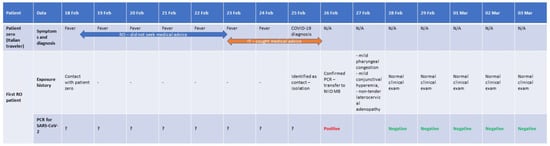
Figure 1.
Patient timeline, from exposure to viral clearance – first case of SARS-CoV-2 in Romania.
The patient remained asymptomatic throughout his hospital admission. On 28 February, on the 10th day since his contact with the Italian patient zero, SARS-CoV-2 was undetected by PCR in a nasopharyngeal swab, and it remained negative at subsequent daily consecutive tests through 03 March 2020, when the patient was discharged from the hospital, with recommendations to continue cautionary isolation for 14 more days. An extended epidemiological investigation was conducted by local authorities to identify all his potential contacts, as part of dedicated containment efforts, with over 50 samples collected from contacts having tested negative by PCR for SARS- CoV-2.
This case highlights the important role that epidemiological surveillance plays in the initial containment efforts for an emerging virus. Had surveillance not been performed, this first case would have gone unnoticed, since he remained asymptomatic throughout the period of PCR positivity for SARS-CoV-2. While data regarding the transmission from asymptomatic persons has initially been a matter of debate [1], it is now generally accepted that asymptomatic transmission can occur, and particularly in the pre-symptomatic period [2]. Since our patient was PCR-positive, it is neither impossible nor implausible for him to have transmitted the virus, had he remained in the community. At the moment, there is no way of knowing whether or not the limited nature of the contact with patient zero played a role in also limiting the viral inoculum and leading to an asymptomatic carriage of the virus, followed by viral clearance, rather than full-blown disease. Other host-related factors might also have contributed, including young age and the absence of comorbidities.
By the end of February, a total of three cases of COVID-19 had been confirmed in Romania, all in travelers returning from Italy [3]. During the first 10 days of March, confirmed cases were reported with a frequency of 0 to 4 cases per day, adding up to a total of 17 cases; an increase in the number of cases confirmed daily was subsequently recorded as secondary cases were also confirmed among direct contacts. The latest situation update reveals that by 26 May 2020, 3 months after the first confirmed case in Romania, 18,429 cases of COVID-19 have been confirmed nationwide, among which 11,874 recoveries and 1,210 deaths have been reported [4]. To limit the impact and propagation of the SARS-CoV-2 pandemic in Romania a state of emergency was instituted from 16 March to 14 May, followed by a state of alert. As efforts to contain the pandemic continue, on 26 May in Romania, 5,287 people are under quarantine, 75,782 people under home isolation, and a total of 385,728 SARS-CoV-2 PCR tests have been performed so far [4], as part of coordinated containment and mitigation efforts being deployed nationwide.
Author Contributions
The authors contributed equally to this manuscript.
Funding
The Romanian Center for Applied Bio- Molecular Research in Infectious Diseases was created within a project financed through the Sectoral Operational Programme Increasing of Economic Competitiveness (POS CCE) contract number 1871/49153.2.
Consent for publication
Written consent for publication was obtained from the patient.
Acknowledgments
The authors would like to thank the staff involved in this patient’s care, the staff actively managing COVID-19 cases within the National Institute for Infectious Diseases “Prof. Dr. Matei Balș” and nationwide, and the staff of the national health authorities involved in SARS-CoV-2 containment efforts.
Conflicts of Interest
All authors – none to declare.
References
- Study claiming new coronavirus can be transmitted by people without symptoms was flawed. Science. Available online: https://www.sciencemag.org/news/2020/02/paper-non- symptomatic-patient-transmitting-coronavirus-wrong (accessed on 3 March 2020).
- Tong ZD, Tang A, Li KF, et al. Potential presymptomatic transmission of SARS-CoV-2, Zhejiang Province, China, 2020. Emerg Infect Dis 2020, 26, 1052–1054. [Google Scholar] [CrossRef] [PubMed]
- Streinu-Cercel, A. SARS-CoV-2 in Romania – situation update and containment strategies. Germs 2020, 10, 8. [Google Scholar] [CrossRef]
- Ministerul Afacerilor Extene. Departamentul pentru Situații de Urgență. Informare – 26 mai 2020, ora 13:00. Available online: http://www.dsu.mai.gov.ro/informare-26-mai-2020-ora-1300/ (accessed on 28 May 2020).
© GERMS 2020.