Controlling Factors and Genetic Mechanism of Tight Sandstone Reservoir Development: A Case Study of the He 8 Member in the Central Linxing Area, Eastern Ordos Basin
Abstract
1. Introduction
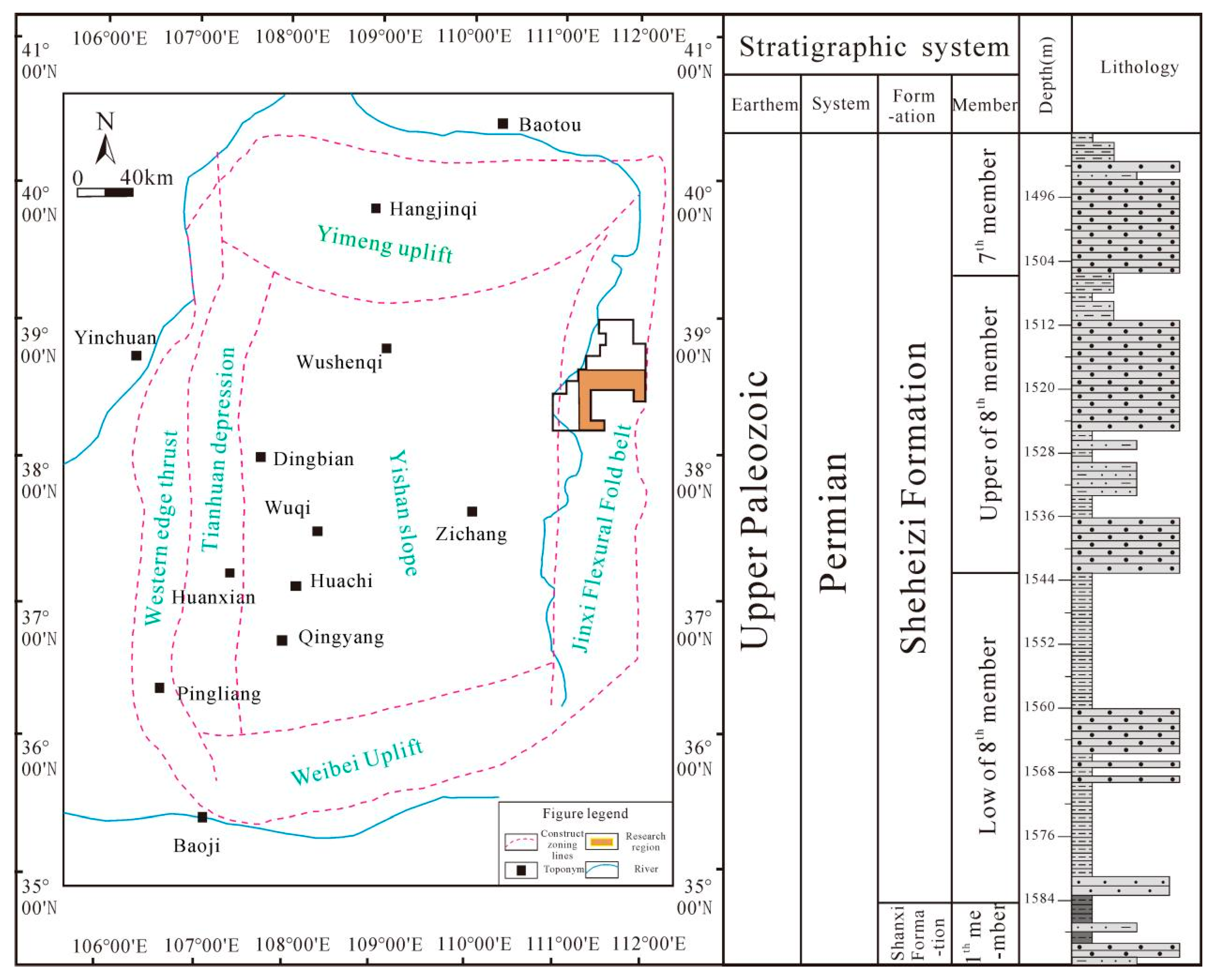
2. Geological Background
3. Materials and Methods
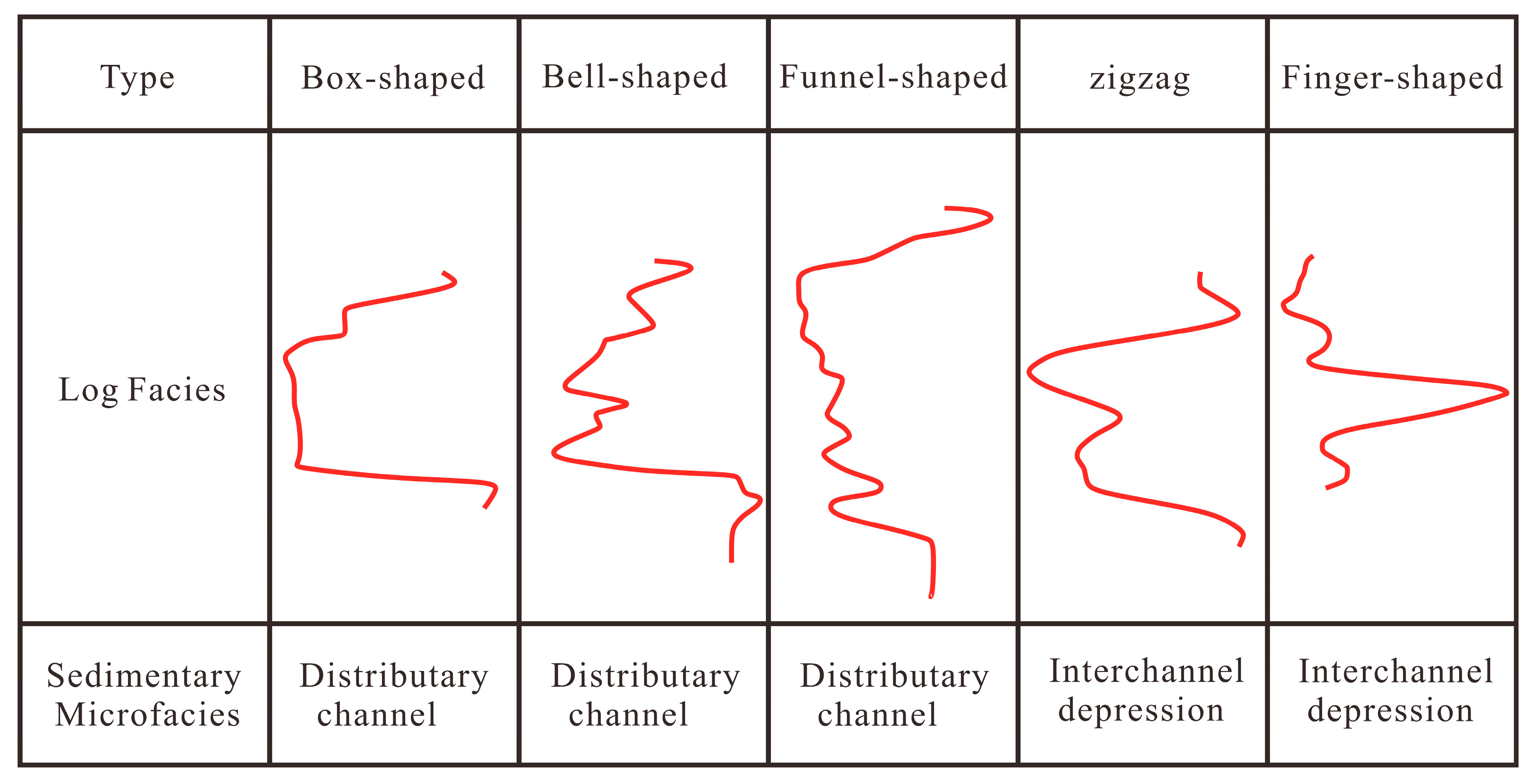
3.1. Identification of Sedimentary Microfacies Based on Log Facies Analysis
3.2. Diagenetic Process Identification and Diagenetic Evolution Sequence Analysis
3.3. Quantitative Evaluation of Porosity Evolution
- (1)
- Primary porosity: ϕ1(%) = 20.91 + 22.90/S0, where S0 is the sorting coefficient [31];
- (2)
- Post-compaction porosity: ϕ2(%) = C + P1PM/PT;
- (3)
- Porosity loss due to cementation: ϕ3(%) = clay mineral content + C;
- (4)
- Porosity increase from authigenic inter-crystalline pores: ϕ4 = P2PM/PT;
- (5)
- Post-cementation porosity: ϕ5(%) = ϕ2 − ϕ3 + ϕ4;
- (6)
- Porosity increase from dissolution: ϕ6(%) = P3PM/PT.
4. Results
4.1. Reservoir Characteristics
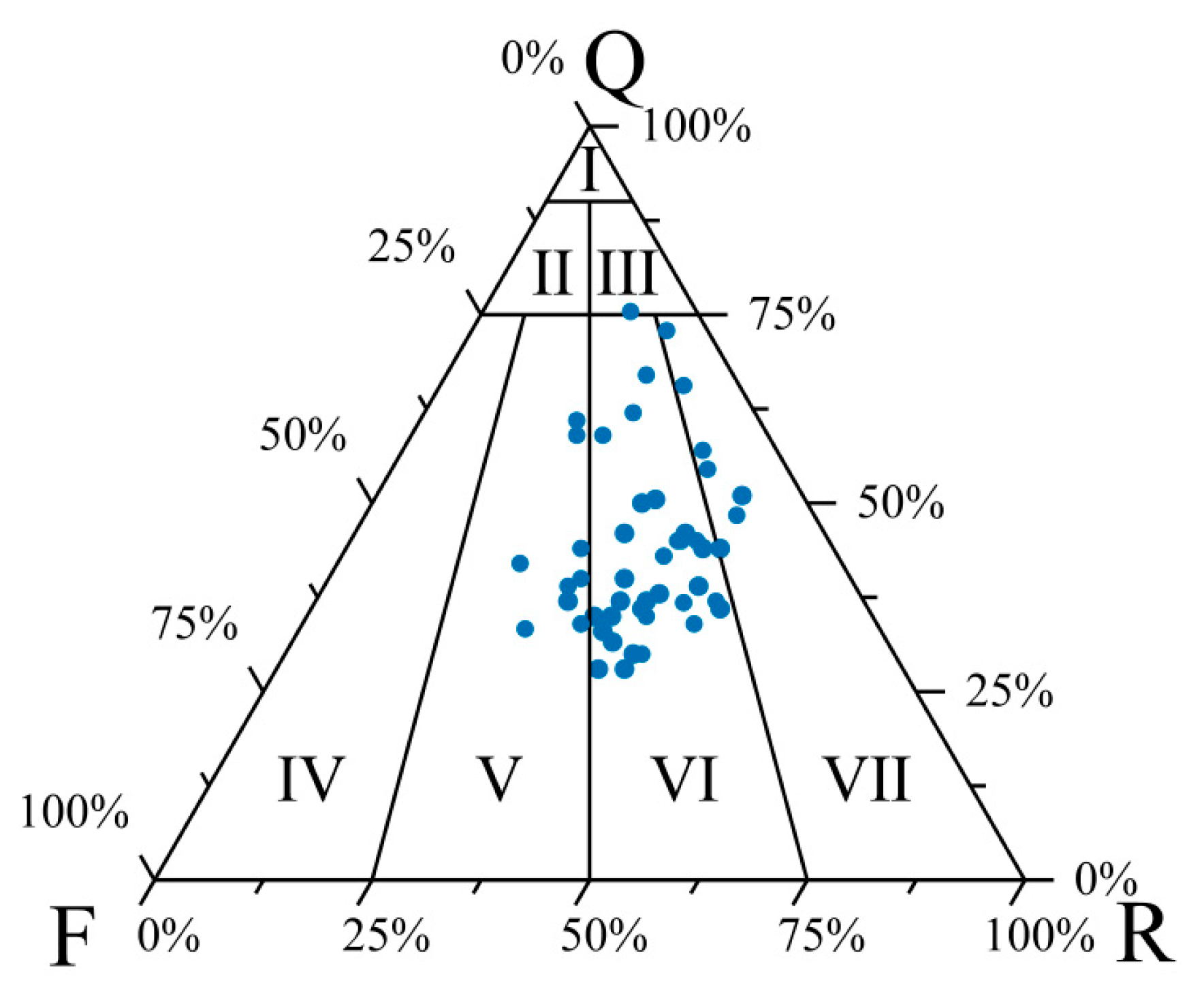
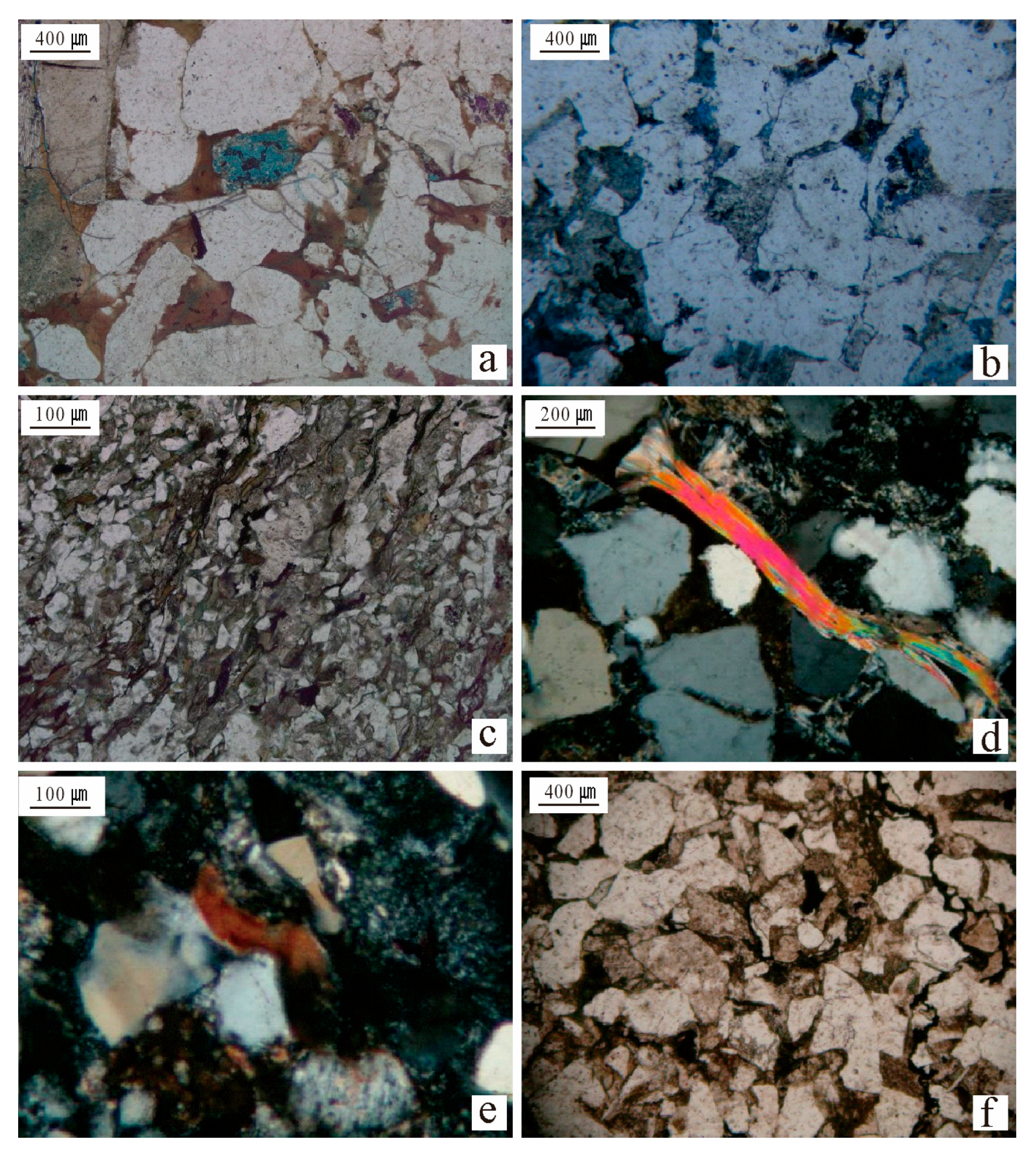
4.1.1. Petrographic Characteristics
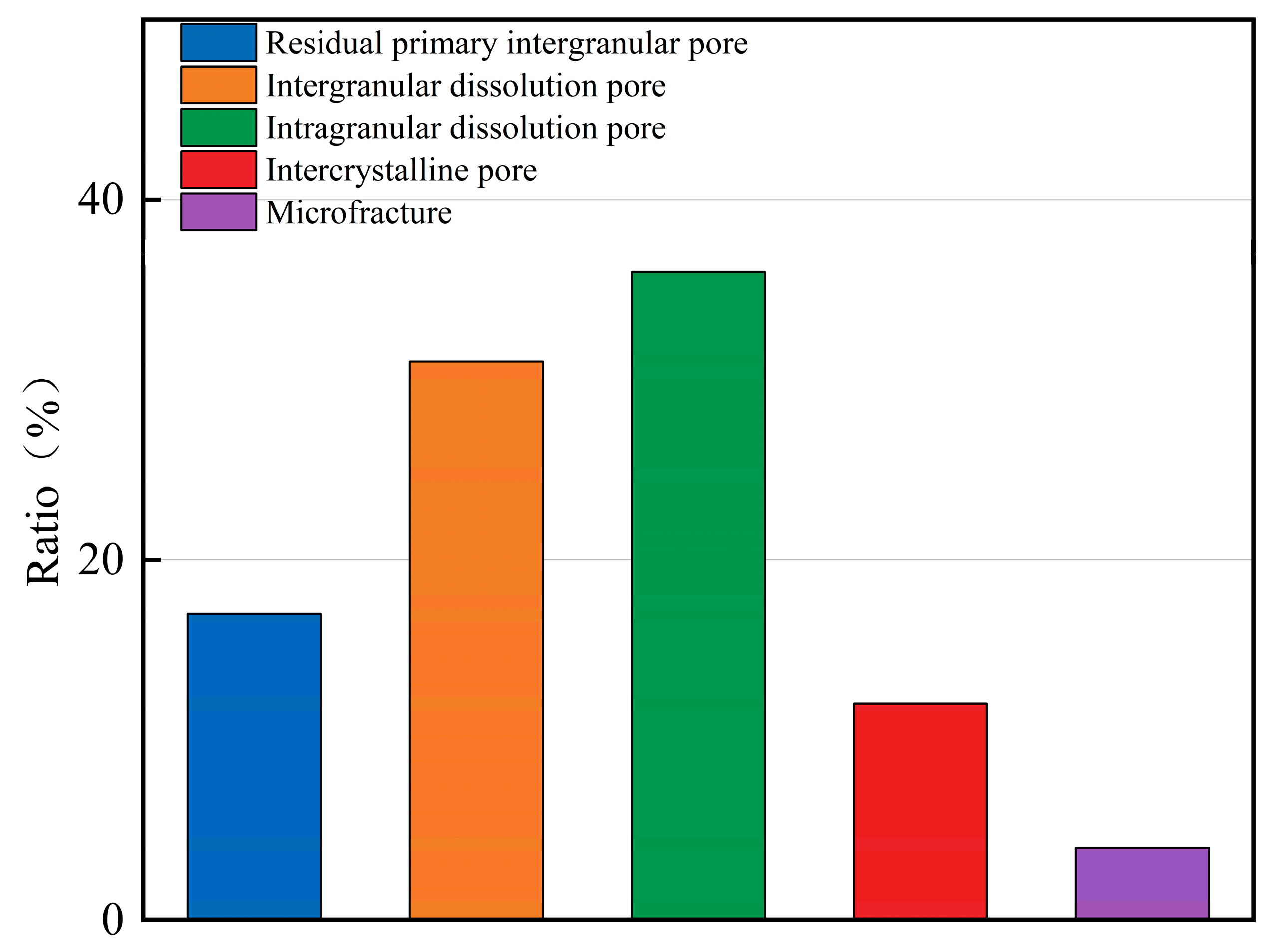
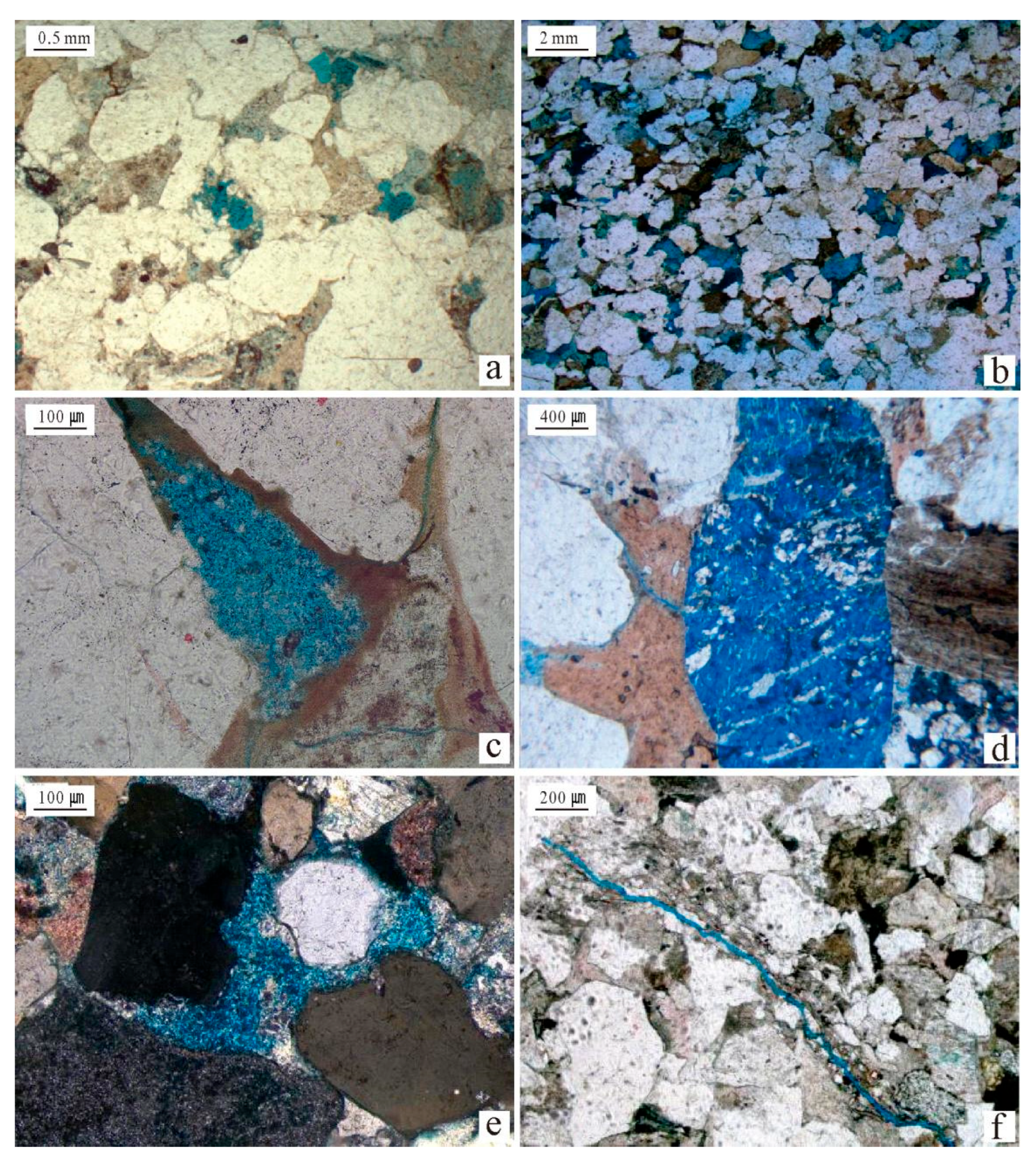
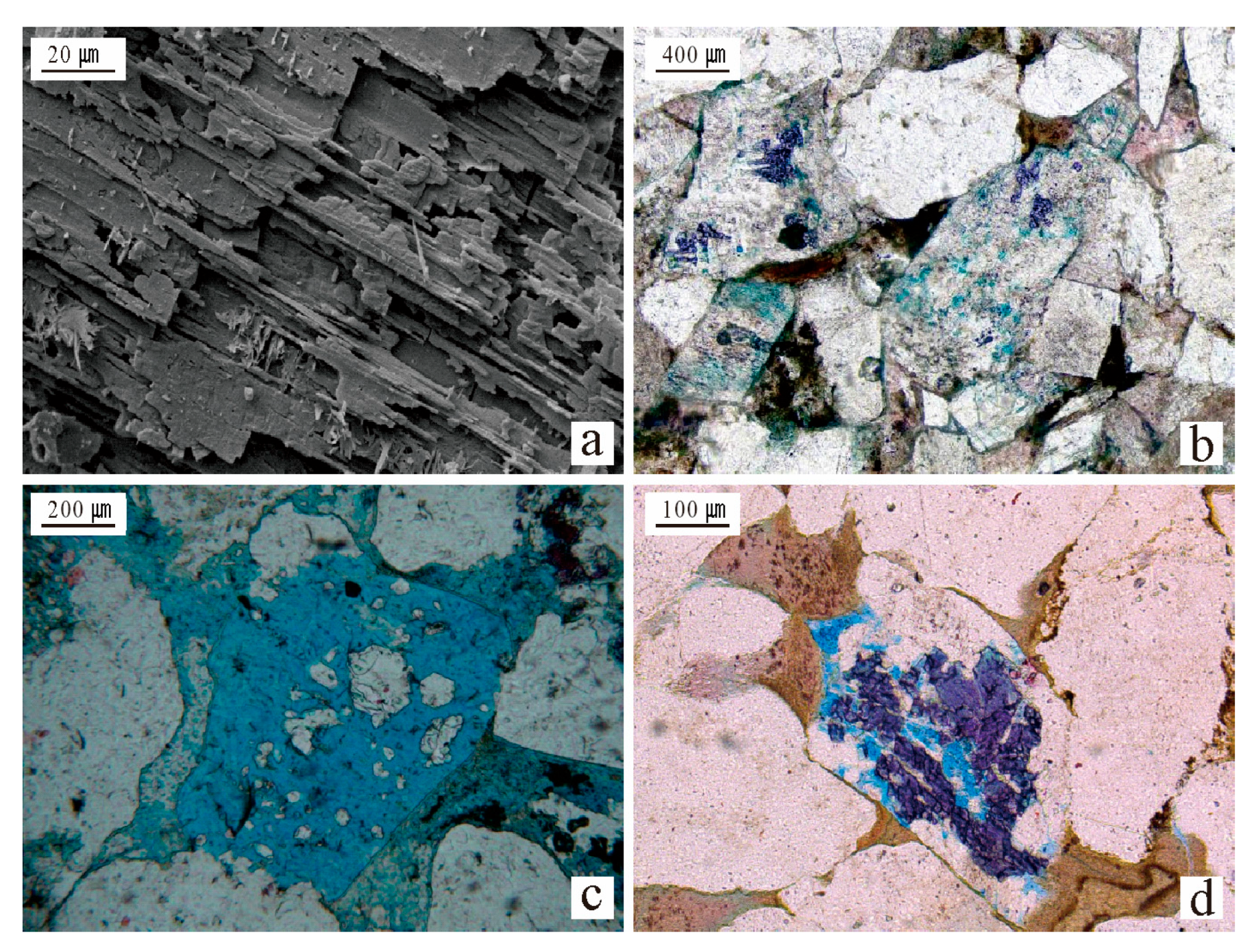
4.1.2. Pore-Scale Characteristics
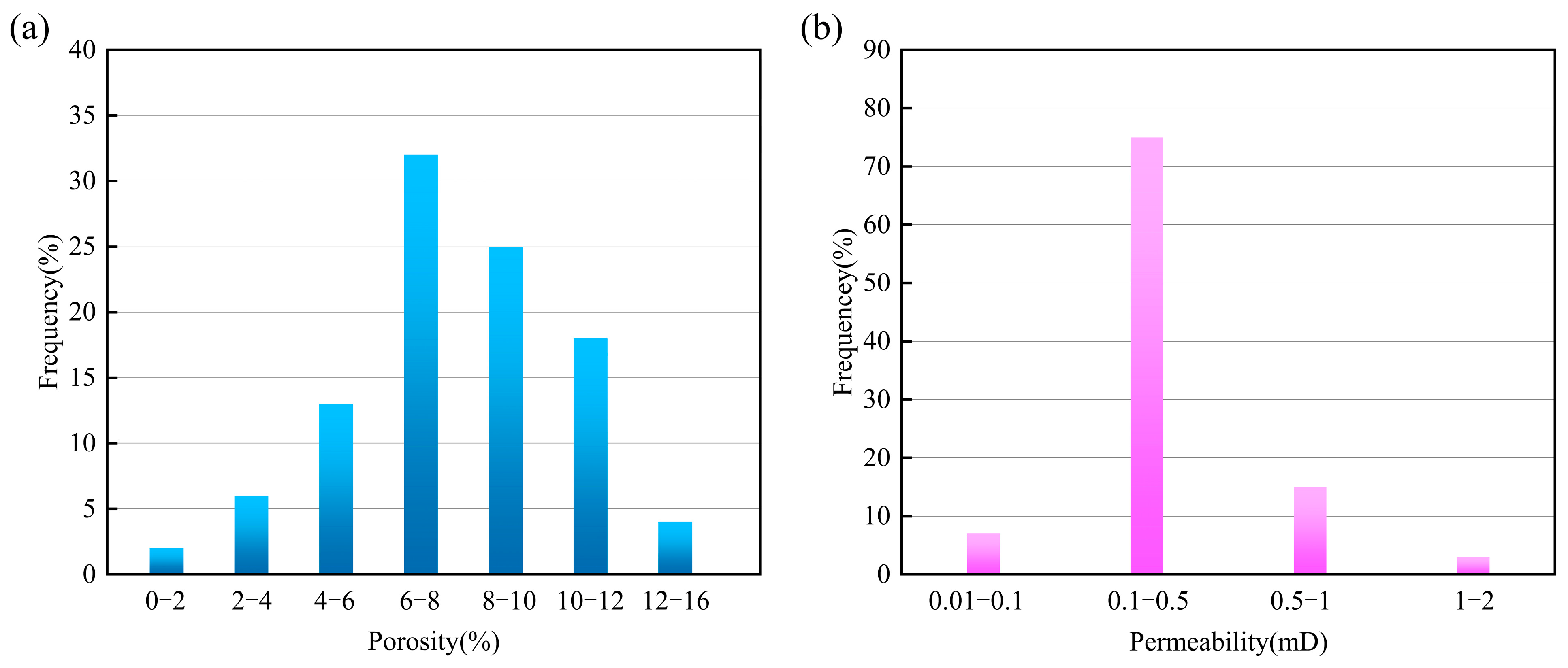
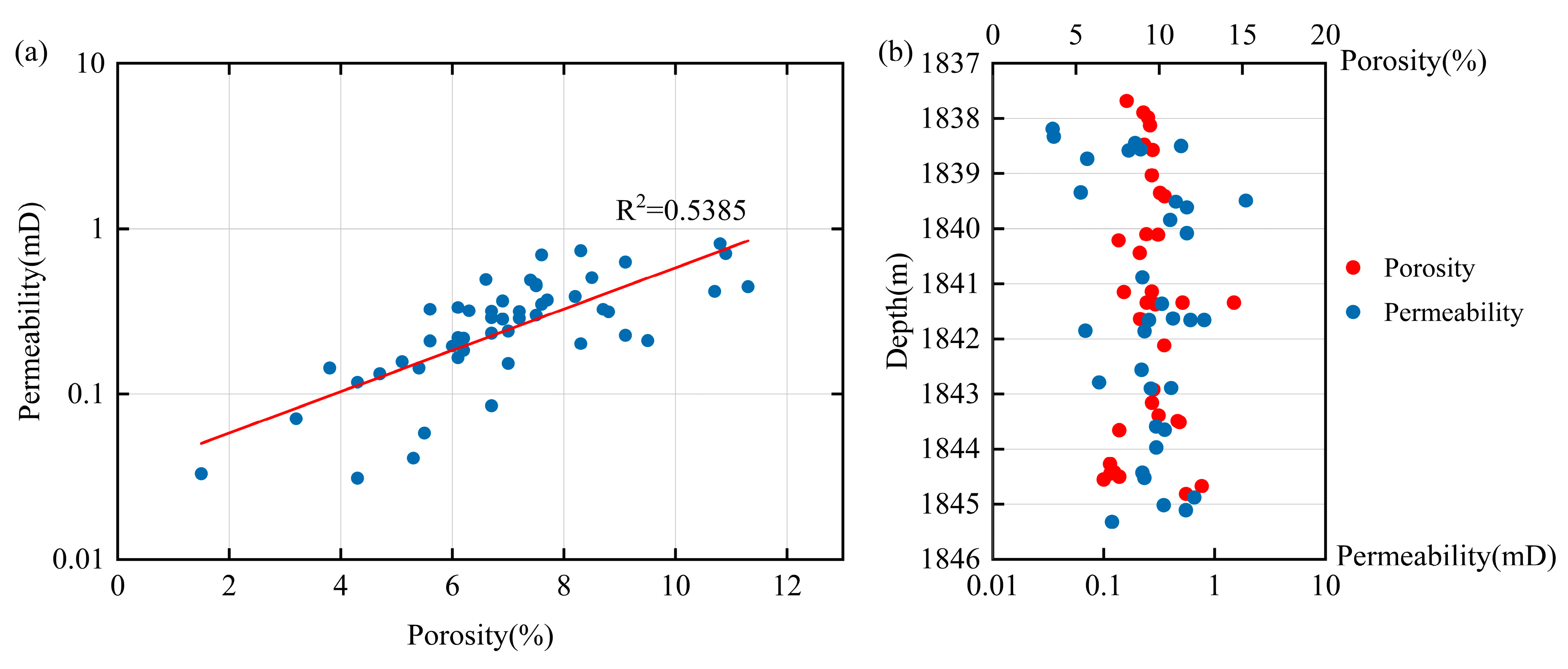
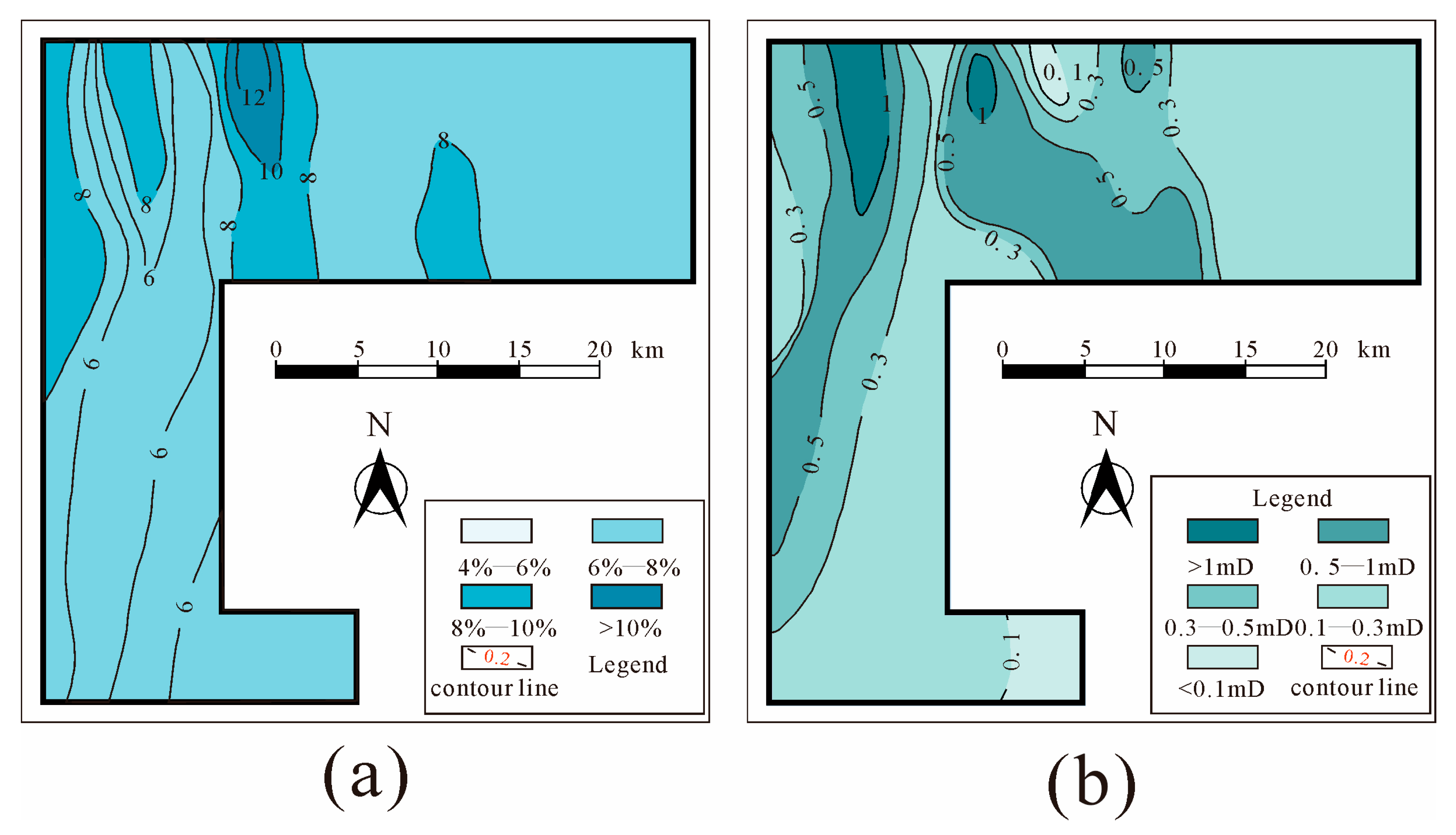
4.1.3. Reservoir Petrophysical Characteristics
4.2. Sedimentary Facies, Microfacies Types, and Distribution Characteristics
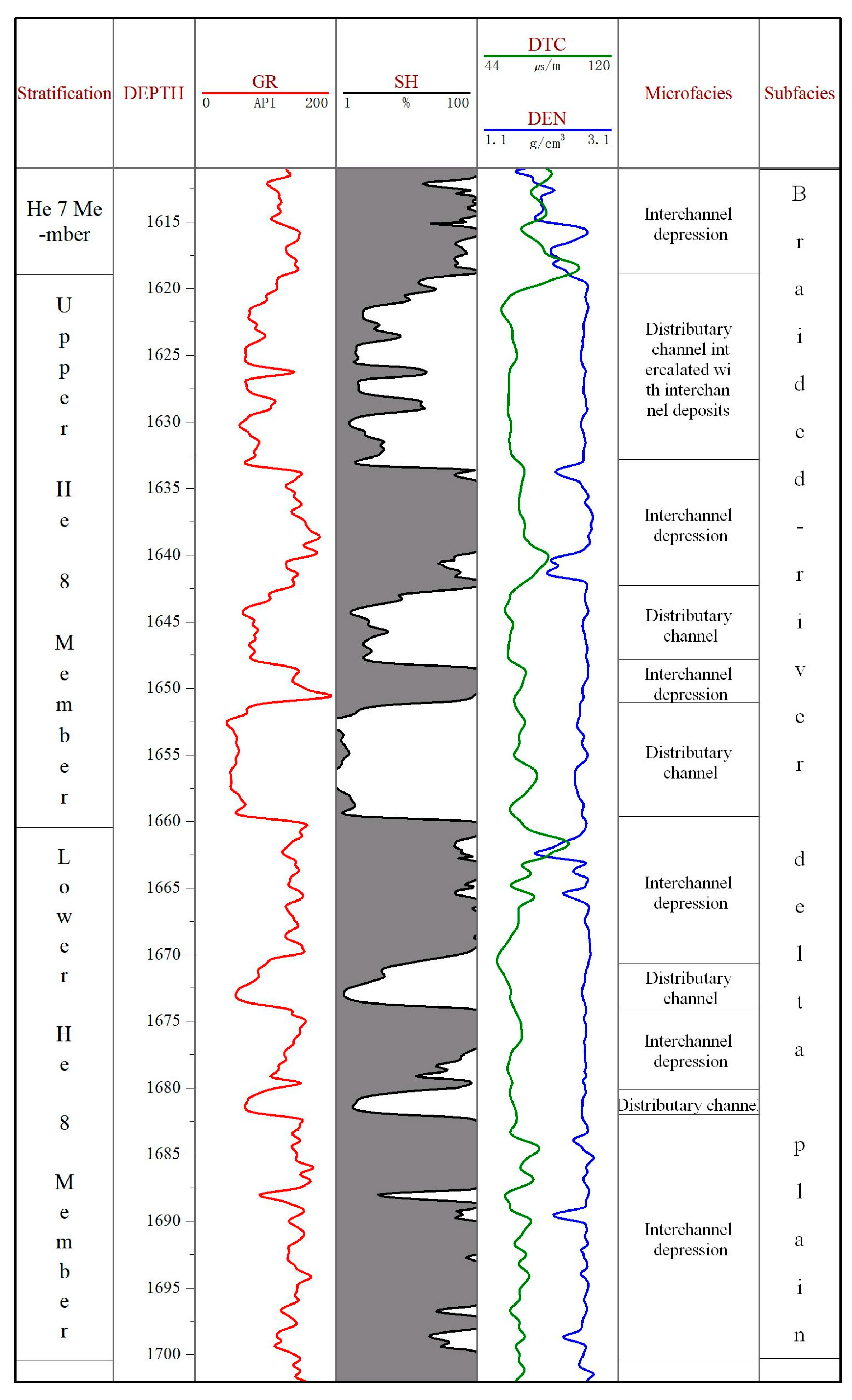
4.2.1. Sedimentary Microfacies Characteristics
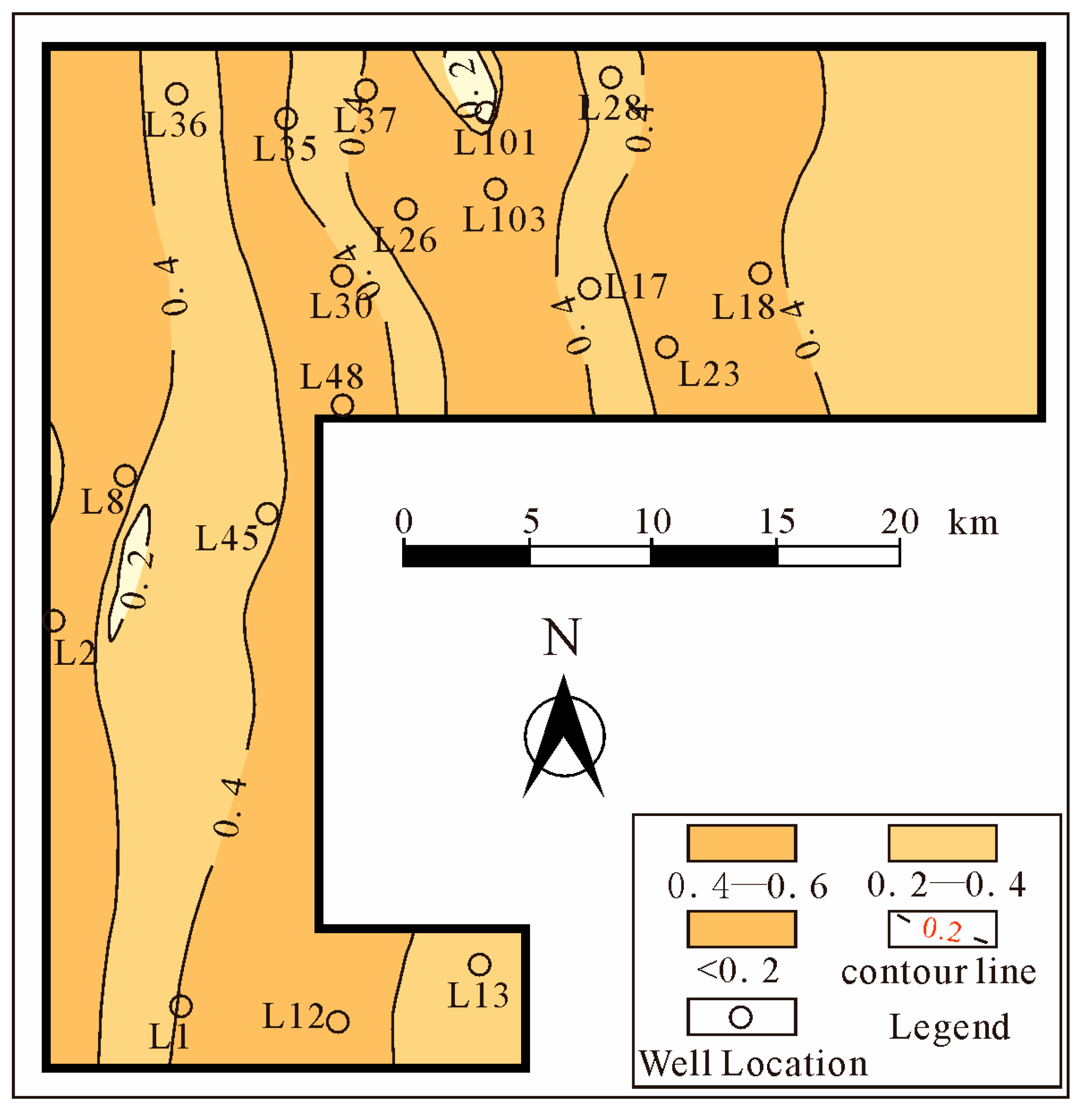
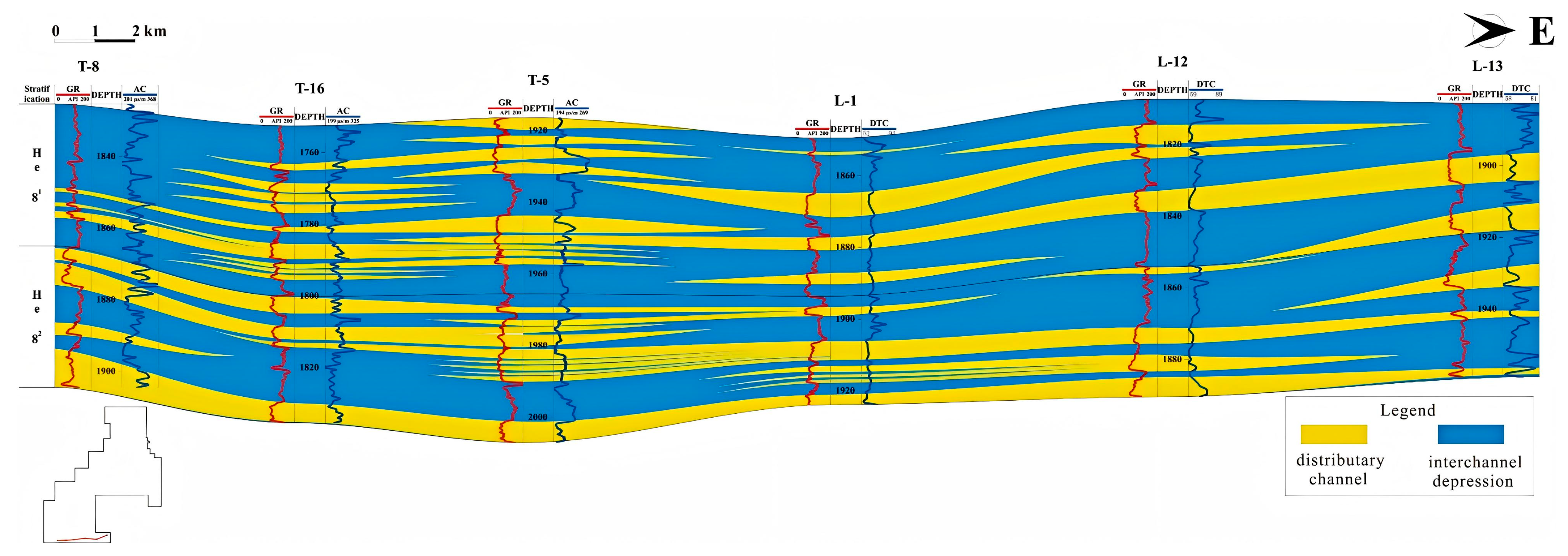
4.2.2. Distribution Characteristics of Sedimentary Facies
- (1)
- Planar Distribution
- (2)
- Vertical Distribution
4.3. Diagenetic Processes
4.3.1. Compaction
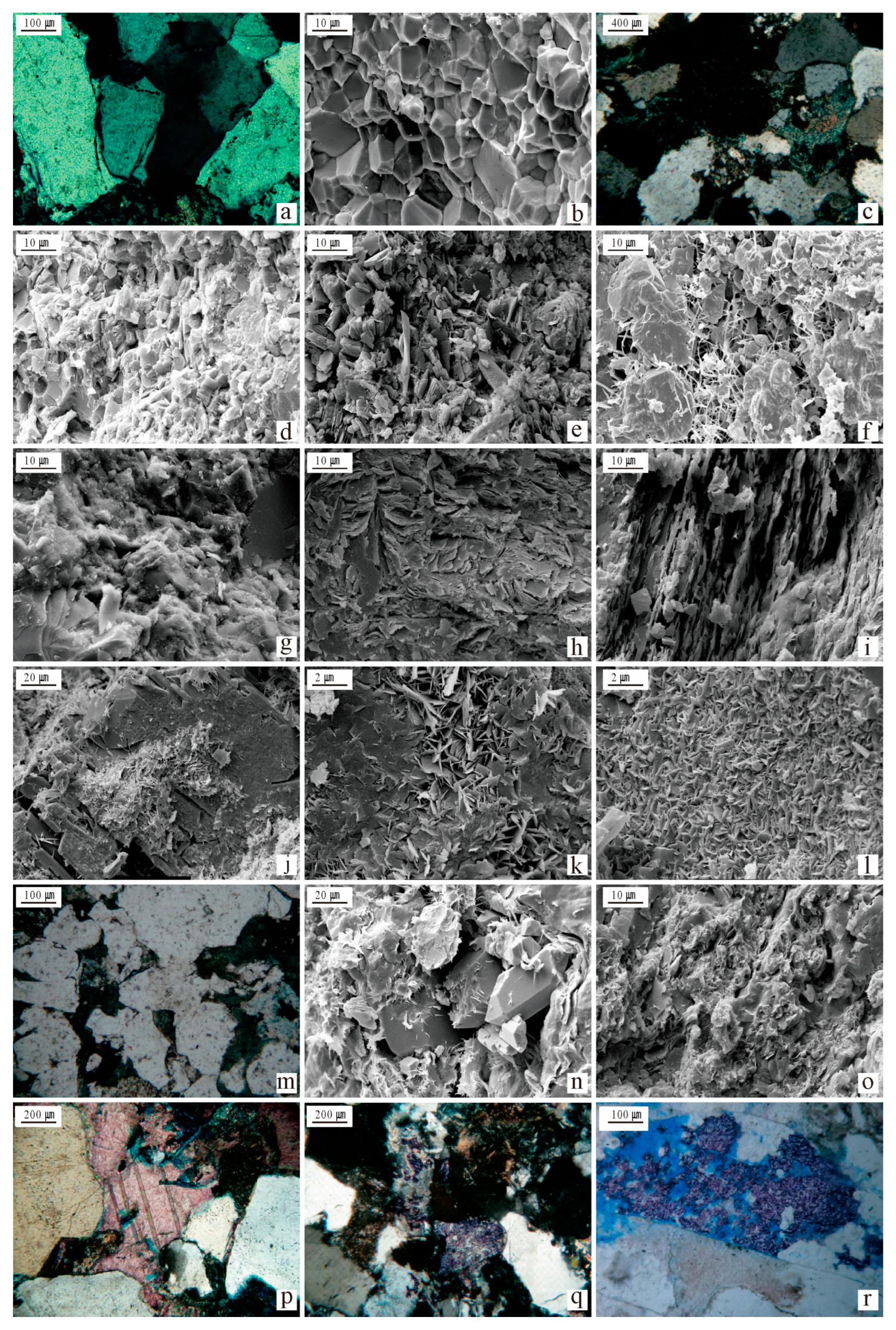
4.3.2. Cementation
- (1)
- Siliceous Cementation
- (2)
- Clay Mineral Cementation
- (3)
- Carbonate Cementation
4.3.3. Dissolution
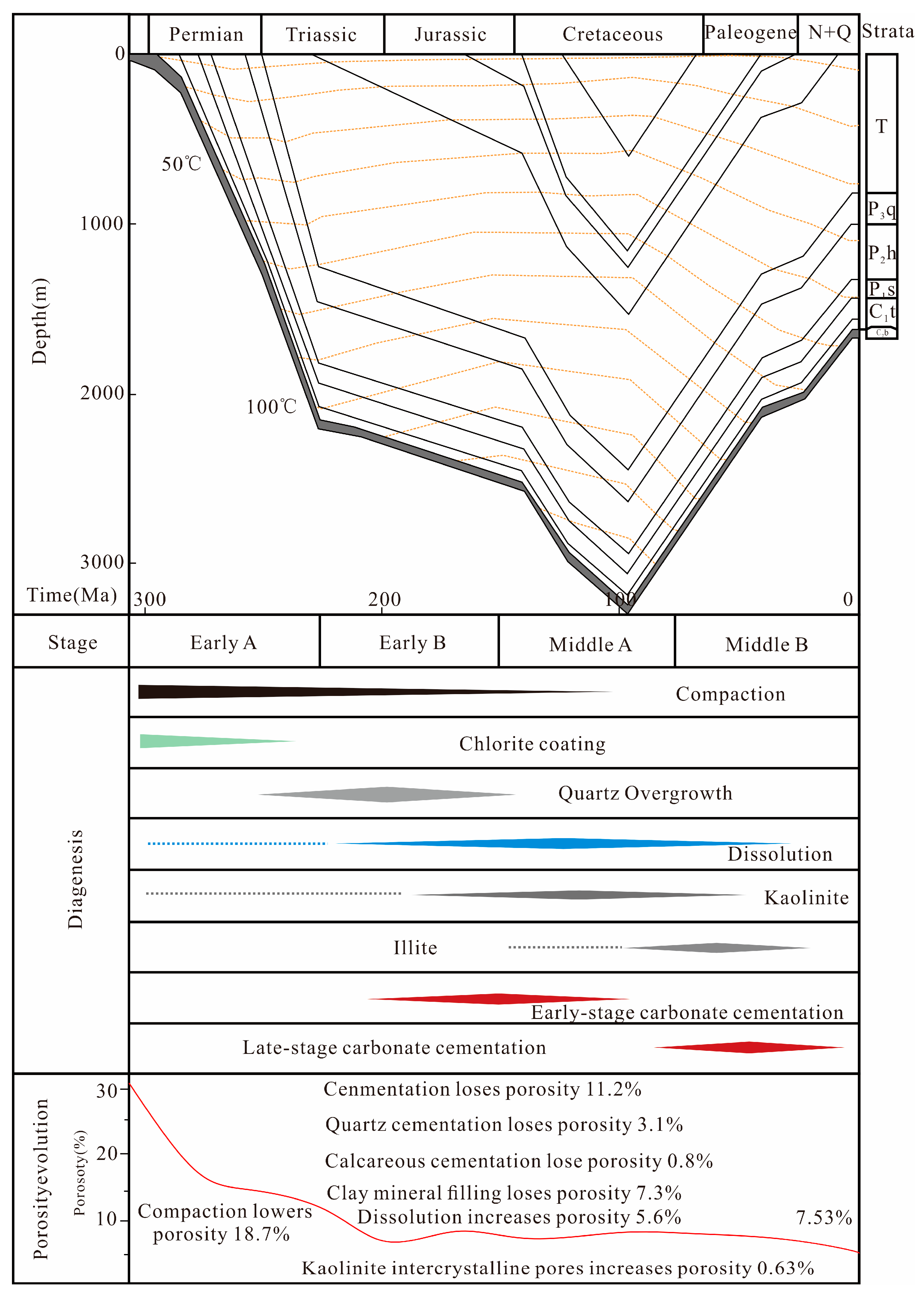
4.4. Quantitative Pore Evolution Characteristics
5. Discussion
5.1. Main Controlling Factors of Reservoir Development
5.1.1. Depositional Microfacies Control on Reservoir Scale and Distribution of Favorable Reservoirs
5.1.2. Diagenesis Controls the Reservoir Densification Process and Limited Porosity Enhancement
5.2. Diagenetic Evolution and Genetic Mechanism of the Tight Sandstone Reservoirs
5.2.1. Diagenetic Evolution Sequence
5.2.2. Tightening Mechanism of the Sandstone Reservoirs
- Stage I: Early Diagenetic Stage—Intense Compaction and Early Cementation Forming the Tight Foundation
- Stage II: Middle Diagenetic Stage A—Limited Dissolution Constrained by Ongoing Cementation
- Stage III: Middle Diagenetic Stage B—Waning Dissolution and Final Tight Reservoir Lock-in
6. Conclusions
- (1)
- Depositional microfacies provide foundational control of reservoir distribution. Distributary-channel microfacies are the only effective reservoir facies. The medium- to coarse-grained sandstones deposited in these channels provide the essential material foundation for high-quality reservoirs. Furthermore, the associated thick, well-connected sand bodies act as predominant conduits for later diagenetic fluids, thereby strictly controlling the spatial distribution of “sweet spots.” In contrast, interchannel microfacies, characterized by high clay content, thin sand bodies, and poor initial permeability, possess negligible reservoir potential.
- (2)
- Diagenetic modification is the decisive factor for reservoir quality. Quantitative porosity evolution analysis reveals that intense mechanical compaction is the predominant cause of porosity destruction, reducing porosity by 18.7% on average and accounting for 60% of the total loss. Cementation ranks as the second most significant process, responsible for an 11.4% porosity reduction (36.5% contribution). In contrast, multiphase dissolution serves as the key constructive process, enhancing porosity by approximately 5.6%; however, its effectiveness is spatially constrained by the pre-existing densely compacted framework.
- (3)
- A genetic model of densification is established, affirming a “dense before accumulation” scenario for the He 8 Member. The reservoirs had already reached tight conditions (average porosity < 8%) prior to the main phase of hydrocarbon charging, as evidenced by fluid inclusion data and burial history modeling. Consequently, “sweet spots” are interpreted as the coupled product of favorable depositional facies belts and localized constructive diagenetic alteration.
Author Contributions
Funding
Data Availability Statement
Conflicts of Interest
References
- Zou, C.; Li, S.; Xiong, B.; Yang, Z.; Liu, H.; Pan, S.; Ma, F.; Wang, Z. Concept, Connotation, Pathway and Significance of Total Energy System [J/OL]. Acta Petrolei Sinica, 1-20[2025-12-05]. Available online: https://link.cnki.net/urlid/11.2128.TE.20250911.1116.002 (accessed on 16 November 2025).
- Zou, C.; Li, S.; Xiong, B.; Yang, Z.; Liu, H.; Zhang, G.; Ma, F.; Pan, S.; Guang, C.; Liang, Y.; et al. The connotation, pathways and implications of building an “energy-powerful nation” in China. Pet. Explor. Dev. 2025, 52, 463–477. [Google Scholar] [CrossRef]
- Dai, J.; Ni, Y.; Wu, X. Tight sandstone gas in China and its significance for exploration and development. Pet. Explor. Dev. 2012, 39, 257–264. [Google Scholar] [CrossRef]
- Zou, C.; Zhao, Q.; Wang, H.; Sun, Q.; Shao, Y.; Hu, Z.; Zhang, C.; Sun, Y.; Wang, Z.; Liu, D. Unconventional oil and gas exploration and development theories and technologies enabling increases in China’s reserves and production. Pet. Sci. Technol. Forum 2021, 40, 72–79. [Google Scholar]
- Jia, A.; Wei, Y.; Guo, Z.; Wang, G.; Meng, W.; Huang, S. Current status and prospects of tight sandstone gas development in China. Nat. Gas Ind. 2022, 42, 83–92. [Google Scholar]
- Wei, G.; Zhang, F.; Li, J.; Yang, S.; Huang, C.; She, Y.; Ju, X.; Zhao, L. Advances in the accumulation theory of tight sandstone gas in China. Nat. Gas Geosci. 2016, 27, 199–210. [Google Scholar]
- Sun, L.; Zou, C.; Jia, A.; Wei, Y.; Zhu, R.; Wu, S.; Guo, Z. Development characteristics and trends of tight oil and gas in China. Pet. Explor. Dev. 2019, 46, 1015–1026. [Google Scholar] [CrossRef]
- Fu, J.; Yu, J.; Xu, L.; Niu, X.; Feng, S.; Wang, X.; You, Y.; Li, T. New advances in tight oil exploration and development and key controls on large-scale enrichment in the Ordos Basin. China Pet. Explor. 2015, 20, 9–19. [Google Scholar]
- Ji, G.; Jia, A.; Meng, D.; Guo, Z.; Wang, G.; Cheng, L.; Zhao, X. Efficient development and EOR strategies for large tight sandstone gas fields: A case study of the Sulige gas field, Ordos Basin. Pet. Explor. Dev. 2019, 46, 602–612. [Google Scholar] [CrossRef]
- Zhao, J.; Fu, J.; Yao, J.; Liu, X.; Wang, H.; Cao, Q.; Wang, X.; Ma, Y.; Fan, Y. Accumulation model of quasi-continuous tight sandstone giant gas fields in the Ordos Basin. Acta Pet. Sin. 2012, 33 (Suppl. S1), 37–52. [Google Scholar]
- Zou, C.; Zhu, R.; Wu, S.; Yang, Z.; Tao, S.; Yuan, X.; Hou, L.; Yang, H.; Xu, C.; Li, D.; et al. Types, characteristics, mechanisms and prospects of conventional and unconventional hydrocarbon accumulations: A case study of tight oil and tight gas in China. Acta Pet. Sin. 2012, 33, 173–187. [Google Scholar]
- Zhu, R.; Li, G.; Cui, J.; Huang, F.; Lu, X.; Guo, Z.; Cao, Z. Geological conditions for tight oil and gas formation and exploration prospects in China. Acta Pet. Sin. 2025, 46, 17–32. [Google Scholar]
- Fu, J.; Fan, L.; Liu, X.; Hu, X.; Li, J.; Ji, H. New advances, prospects and countermeasures for natural gas exploration in the Ordos Basin. China Pet. Explor. 2019, 24, 418–430. [Google Scholar]
- He, D.; Ma, Y.; Liu, B.; Cai, X.; Zhang, Y.; Zhang, J. Major advances and scientific issues in deep exploration of China’s petroliferous basins. Earth Sci. Front. 2019, 26, 1–12. [Google Scholar] [CrossRef]
- Fu, N.; Yang, S.; He, Q.; Xu, W.; Lin, Q. Conditions for efficient tight sandstone gas accumulation in the Linxing–Shenfu block on the eastern margin of the Ordos Basin. Acta Pet. Sin. 2016, 37 (Suppl. S1), 111–120. [Google Scholar]
- Shi, J.; Huang, W.; Lü, C.; Cui, X. Geochemical characteristics and geological implications of Upper Paleozoic mudstones in the Linxing area of the Ordos Basin. Acta Pet. Sin. 2018, 39, 876–889. [Google Scholar]
- Liu, J.; Zhu, G.; Liu, Y.; Zhao, W.; Du, J.; Yang, Q.; Mi, H.; Zhang, S. Breakthroughs and future challenges in deep CBM exploration on the eastern margin of the Ordos Basin: A case study of the Linxing–Shenfu block. Acta Pet. Sin. 2023, 44, 1827–1839. [Google Scholar]
- Liu, C.; Zhang, D.; Li, C.; Lu, Y.; Yu, S.; Guo, M. Accumulation conditions and main controlling factors of Upper Paleozoic tight sandstone gas reservoirs in the Linxing block, Ordos Basin. Pet. Geol. Exp. 2021, 42, 1146–1158. [Google Scholar]
- Zhao, Z.; Guo, Y.; Wang, Y.; Lin, D. Advances in structural evolution and paleogeography of the Ordos Basin. Spec. Oil Gas Reserv. 2012, 19, 15–20, 151. [Google Scholar]
- Liu, C.; Zhao, H.; Gui, X.; Yue, L.; Zhao, J.; Wang, J. Space-Time Coordinate of the Evolution and Reformation and MineralizationResponse in Ordos Basin. Acta Geol. Sin. 2006, 80, 617–638. [Google Scholar]
- Zhang, F. Compound ancient tectonic system and natural gas of Early Paleozoic in Ordos Basin. J. Geomech. 2002, 8, 193–200. [Google Scholar]
- Peng, H.; Chen, H.; Xiang, F.; Ye, L.; Li, G. Application of trace elements analysis on sedimentary environment environment identification-an example from the Permian Shanxi Formation in eastern Ordos Basin. Xinjiang Geol. 2006, 24, 202–205. [Google Scholar]
- Chen, B. Diagenesis of the Shihezi Formation Reservoirs in the Linxing Area, Ordos Basin. Master’s Thesis, China University of Petroleum (Beijing), Beijing, China, 2016. [Google Scholar]
- Huang, B.; Liu, C.; Zhang, J. Sedimentary characteristics of braided-river delta of the Shahezi Formation in the Xujiaweizi Fault Depression. Miner. Explor. 2019, 10, 756–760. [Google Scholar]
- Cao, J. Sedimentary Characteristics and Model of Large Shallow-Water Braided-River Deltas. Master’s Thesis, Changjiang University, Jingzhou, China, 2024. [Google Scholar] [CrossRef]
- Yan, C. Sand-Body Architecture and Distribution of the TIII-1 Sand Unit in the Santamu Oilfield Braided-River Delta Front. Master’s Thesis, Changjiang University, Jingzhou, China, 2024. [Google Scholar] [CrossRef]
- Xu, J. Study of braided-river delta facies of the Yingcheng Formation in the Shiwu Oilfield, southern Songliao Basin. West. Explor. Eng. 2016, 28, 24–27. [Google Scholar]
- Khalaf, M.S.; Soliman, N.; El-Banbi, A.H. Wellbore storage removal in pressure transient analysis for gas well. J. Pet. Sci. Eng. 2022, 208, 109712. [Google Scholar] [CrossRef]
- Chen, S. Automatic Identification of Lithology and Sedimentary Microfacies from Logging Curves. Ph.D. Thesis, Jilin University, Changchun, China, 2021. [Google Scholar] [CrossRef]
- Guo, L.; Chen, H.; Huang, X.; Wang, J.; Feng, C. Quantitative analysis of porosity evolution in feldspar-rich coarse clastic sandstones: A case study of Member 2 of the Shahejie Formation, northern Liaodong uplift, Bohai Bay Basin. Pet. Geol. Exp. 2020, 41, 874–883. [Google Scholar]
- Beard, D.C.; Weyl, P.K. Influence of texture on porosity and permeability of unconsolidated sand. AAPG Bull. 1987, 71, 485–491. [Google Scholar]
- Hu, K.; Wang, X. Relationship between porosity and permeability in different reservoir types. Petrochem. Ind. Appl. 2014, 33, 40–42. [Google Scholar]
- Liu, C.; Wang, Q.; Wang, Y. Controlling factors on reservoir development of the Upper Paleozoic He 8 Member in the central Linxing block, Ordos Basin. China Offshore Oil Gas 2018, 30, 50–61. [Google Scholar]
- Luo, J.; Liu, X.; Fu, X.; Li, M. Impacts of petrographic composition and diagenetic evolution on the quality and productivity of tight sandstone reservoirs: A case study of the Upper Paleozoic He 8 gas reservoirs in the Ordos Basin. Earth Sci.—J. China Univ. Geosci. 2014, 39, 537–545. [Google Scholar]
- Ma, P.; Lin, C.; Zhang, S.; Dong, C.; Wei, M. An overview on study of chlorite films in clastic reservoirs. J. Palaeogeogr. 2017, 19, 147–159. [Google Scholar]
- Wang, Q.; Ma, D.; Yu, F.; Ji, H.; Su, X.; Li, X.; Hao, L.; Wei, Z. Diagenetic evolution and quantitative porosity analysis of different grain-size sandstones in the Lower Shihezi Formation, Linxing area, Ordos Basin. Acta Sedimentol. Sin. 2017, 35, 163–172. [Google Scholar] [CrossRef]
- Li, L. Hydrocarbon Generation–Expulsion History of Upper Paleozoic Source Rocks and Stages of Natural Gas Accumulation in the Linxing Block, Ordos Basin. Master’s Thesis, China University of Petroleum (Beijing), Beijing, China, 2018. [Google Scholar] [CrossRef]
- Ma, X.; Zou, J.; Zhu, Y. Factors influencing the physical properties of tight sandstones in the He 8 Member, Linxing block, Ordos Basin. Geol. J. 2023, 47, 122–128. [Google Scholar]
- Liu, C. Coupling Between Reservoir Densification and Hydrocarbon Accumulation for Upper Paleozoic Sandstones in the Linxing Area, Ordos Basin. Master’s Thesis, China University of Petroleum (East China), Qingdao, China, 2019. [Google Scholar] [CrossRef]
- Zhao, F.; Wang, L.; Wu, P.; Xu, Y. Lower limits of effective reservoir properties and main controlling factors for the He 7–He 8 Members in the central Linxing area, Ordos Basin. Spec. Oil Gas Reserv. 2024, 31, 66–75. [Google Scholar]
- Zhu, P.; Huang, S.; Li, D.; Liu, Y. Effect and protection of chlorite on clastic reservoir rocks. J. Chengdu Univ. Technol. (Sci. Technol. Ed.) 2004, 31, 153–156. [Google Scholar]
- Sun, Q.; Sun, H.; Jia, B.; Yu, J.; Luo, W. Origin of chlorite and its relationship with high-quality tight sandstone reservoirs in the Xujiahe Formation, western Sichuan Basin. Pet. Geol. Exp. 2012, 33, 751–757. [Google Scholar]


| Pore Type | Porosity (%) | Sample | ||
|---|---|---|---|---|
| Minimum | Maximum | Average | Number | |
| Primary porosity, ϕ1 | 27.0 | 36.2 | 31.2 | 62 |
| Post-compaction porosity, ϕ2 | 8.29 | 15.4 | 12.5 | 62 |
| Porosity loss due to cementation, ϕ3 | 7.15 | 14.82 | 11.2 | 62 |
| Porosity increase from authigenic inter-crystalline pores, ϕ4 | 0 | 0.98 | 0.63 | 62 |
| Post-cementation porosity, ϕ5 | 0 | 5.29 | 1.93 | 62 |
| Porosity increase from dissolution, ϕ6 | 0 | 7.36 | 5.6 | 62 |
| Calculated porosity | 0 | 11.93 | 7.53 | 62 |
Disclaimer/Publisher’s Note: The statements, opinions and data contained in all publications are solely those of the individual author(s) and contributor(s) and not of MDPI and/or the editor(s). MDPI and/or the editor(s) disclaim responsibility for any injury to people or property resulting from any ideas, methods, instructions or products referred to in the content. |
© 2025 by the authors. Licensee MDPI, Basel, Switzerland. This article is an open access article distributed under the terms and conditions of the Creative Commons Attribution (CC BY) license (https://creativecommons.org/licenses/by/4.0/).
Share and Cite
Ren, D.; Zhang, J.; Zhang, F.; Zhang, T. Controlling Factors and Genetic Mechanism of Tight Sandstone Reservoir Development: A Case Study of the He 8 Member in the Central Linxing Area, Eastern Ordos Basin. Processes 2025, 13, 3975. https://doi.org/10.3390/pr13123975
Ren D, Zhang J, Zhang F, Zhang T. Controlling Factors and Genetic Mechanism of Tight Sandstone Reservoir Development: A Case Study of the He 8 Member in the Central Linxing Area, Eastern Ordos Basin. Processes. 2025; 13(12):3975. https://doi.org/10.3390/pr13123975
Chicago/Turabian StyleRen, Dawei, Jingong Zhang, Feng Zhang, and Tao Zhang. 2025. "Controlling Factors and Genetic Mechanism of Tight Sandstone Reservoir Development: A Case Study of the He 8 Member in the Central Linxing Area, Eastern Ordos Basin" Processes 13, no. 12: 3975. https://doi.org/10.3390/pr13123975
APA StyleRen, D., Zhang, J., Zhang, F., & Zhang, T. (2025). Controlling Factors and Genetic Mechanism of Tight Sandstone Reservoir Development: A Case Study of the He 8 Member in the Central Linxing Area, Eastern Ordos Basin. Processes, 13(12), 3975. https://doi.org/10.3390/pr13123975