


Abstract
This study discusses the calculation of entropy of discrete-time stochastic biological systems. First, measurement methods of the system entropy of discrete-time linear stochastic networks are introduced. The system entropy is found to be characterized by system matrices of the discrete-time biological systems. Secondly, the system entropy of nonlinear discrete-time stochastic biological systems is discussed and is calculated based on a global linearization method. The approximation of the values of system entropy of nonlinear stochastic systems needs to solve an optimization problem that is constrained by a kind of linear matrix inequality (LMI). Finally, a practical biochemical system is provided to verify the effectiveness of the proposed calculation method.
1. Introduction
In general, entropy is considered as a measure of the randomness or disorder of a physical or biological system under intrinsic random fluctuations and environmental disturbances [1,2,3,4,5]. According to the second law of thermodynamics, entropy is used to describe the dispersion of energy in a thermally isolated system, in which energy has a natural tendency to spontaneously change toward states with higher entropy [6,7,8]. In order to maintain life, biological systems need to exchange material and energy with their environment in a continual process, so they are open systems [9].
In this exchange process, the entropy of biological systems can maintain a dynamic balance [10]. Under such a background, the calculation of biological system entropy is particularly important. In the past few decades, the system entropy in biological networks has been extensively studied [11,12,13]. The discrete-time model plays an important role in numerical calculation, stochastic simulation and numerical analysis [14,15,16,17,18]. For continuous-time stochastic systems, the authors of [16] calculated the system entropy of biological systems from their system matrices by the global linearization technique. In this way, the measurement of the system entropy of nonlinear biological networks could be transformed to solve an optimization problem constrained by a set of LMIs. In this paper, we follow the line of [16] and extend the LMI method to the calculation of the discrete-time system entropy of stochastic biological networks. With the aid of the Matlab software package, we solve the corresponding LMI-constrained optimization problem to measure the discrete-time system entropy of a nonlinear biological network.
This paper is organized as follows. In Section 2, we discuss how to calculate the entropy of the discrete-time linear network. Section 3 gives the system entropy measurement of the discrete-time nonlinear random biological network. Section 4 presents how to calculate the system entropy in discrete-time nonlinear stochastic biological networks, which is approximated by the global linearization method. Lastly, in Section 5, an example is given to illustrate the measurement procedure and to validate the feasibility of the proposed system entropy measurement method.
2. System Entropy in Discrete-Time Linear Biological Networks
In this section, we consider a discrete-time linear network, which is described as follows:
where , , , denotes the biological network’s state vector, random input and output, respectively. is the finite terminal time. A, B and C are matrices with proper dimensions with the following formats:
The randomness of this system’s output can be measured by
while the randomness of input signals is denoted as
where denotes the expectation. Similar to the definitions of entropy in [16], the entropy of the input signal or output signal for a discrete-time system is also defined by
and the entropy of is defined by
Thus, it is natural to define the net signal entropy of a biological system as the discrete-time system entropy, i.e.,
Thus, if the system randomness r of System (1) is defined as the following
the system entropy is represented as
In order to calculate the system entropy s in (1), we have to calculate or approximate the system randomness first. Of course, it is not easy to approximate such randomness directly. Therefore, we need to estimate the system randomness indirectly as follows:
which is equivalent to
Here, denotes the upper bound of r.
We will decrease the upper bound to be as small as possible, to approach the randomness r of the discrete-time biological network (1), which is suggested in [16].
Proposition 1.
Suppose that a positive definite matrix p > 0 and a positive real number satisfy the following inequality:
Then, is an upper bound of the system randomness of network (1).
Proof.
Choose the Lyapunov function , then
Taking summation, and then taking expectation on both sides, we have
Recalling that , and , we have
Thus,
Completing the square on the right side, we obtain
where the notation denotes with . By inequality (4), there exists
Thus, we have
This shows that the randomness r of System (1) has an upper bound . □
By the Schur lemma, we know that the matrix inequality (4) equals the following LMI:
Thus, we can obtain the following corollary described by LMI (5).
Corollary 1.
Remark 1.
Compared with the results of Reference [16], the matrix inequality (4) that is obtained by the completing square method is different to the results of Proposition 2 of [16]. Moreover, the structure of LMI (5) for a discrete-time network is different to that of (12) for the continuous-time system discussed in [16].
From Equation (3), we can see that the upper bound of the discrete-time system randomness r is , i.e., . Thus, the calculation of the system randomness of network (1) can be estimated by the following problem:
with the constraint of LMI (5), where p > 0.
Based on (6), with the aid of Matlab’s LMI toolbox, we can decrease by the constraint of LMI in (5) until there is no positive matrix P appearing; then, the above LMI-constrained optimization problem can be solved, and the system randomness r can be estimated. Thus, the discrete-time system entropy of the linear stochastic System (1) can be obtained as . Moreover, the measurement of the system randomness r or system entropy s is dependent on matrices A, B and C in System (1) to some extent.
3. System Entropy in Discrete-Time Nonlinear Network
Nonlinear dynamic systems play an important role in biological networks, which causes the difficulty of estimating the entropy of such systems. Under this situation, the global linearized method is suggested [19,20,21,22,23,24,25,26,27], which is an interpolation method of local linearized systems of a nonlinear biological network. Suppose that the biological systems are described by the following discrete-time nonlinear stochastic biological network:
where , f is a function, denotes m external input signal and denotes m nonlinear couplings between the biological network and environment. denotes l nonlinear outputs.
Based on the ideas of the discrete-time system randomness of (3), we obtain the following proposition.
Proposition 2.
Suppose that there exists a positive definite matrix p > 0 and a positive real number that satisfy the following HJI:
Then, is an upper bound of the system randomness of network (7).
Proof.
Let , then
Taking summation, and then taking expectation on both sides, we obtain
Recalling that , and , we have
Thus,
Completing the square on the right side, we obtain
where the notation denotes with . By inequality (8), there exists
Thus, we have
This ends the proof. □
Remark 2.
Compared with the results of Proposition 4 in Reference [16], the HJI (8) in this paper does not depend on the input variables , but the HJIs in Proposition 4 of [16] include . Thus, the system randomness of network (7) can be obtained only by the coefficients , and , which is defined on the state space.
By Proposition 2, the system randomness r of network (7) can be approximated to solve the following optimization constrained by HJI:
The system randomness r of network (7) could be estimated by solving the following optimization:
with the constraint of HJI in (8).
Based on the above results, it is easy to obtain the system entropy as
We can obtain the system randomness r from the HJI-constrained optimization problem in (10) or (11). However, at present, there exists no efficient method to solve the HJI in (10) or (11) analytically or numerically. In this study, the global linearization method in [21,27] will be employed to interpolate several local linearized systems at the M matrices of the convex hull of the globalization systems to approach the nonlinear discrete-time biological systems in (7), to transform the difficult HJI-constrained optimization problem in (10) or (11) to an equivalent LMIs-constrained optimization problem for the calculation of system randomness in the following section.
4. The Global Linearization Method to Estimate System Entropy for Nonlinear Networks
In this section, the global linearization technique is suggested to help in estimating the system entropy of nonlinear stochastic systems in (7). The main idea of this method is described as follows: we convert the nonlinear system into a set of interpolated locally linearized networks in which the linear system’s entropy is easy to calculate and approximate [16,21,27]. Therefore, the estimation of system randomness and entropy can be transformed to solve the HJI-constrained optimization problems (10) efficiently.
We prefer the detailed theory of the global linearization method to Reference [21]. According to this method, the global linearized systems are constructed by the convex hull of M vertices defined in Equation (12) as follows:
Then, the state in the discrete-time nonlinear System (7) can be represented by those states of local linearized biological networks with (12) as follows:
Thus, the combination of linearized systems in (13) can be represented as:
where the interpolation function (for )
and for some satisfy and , while denotes the ith local operation point with local linearization [27], i.e., the trajectory of the nonlinear System (7) can be represented by the trajectories of the interpolated biological network in (14).
If the nonlinear biological network in Equation (7) could be approximated by the global linearization system in Equation (14), then we obtain the following result.
Proposition 3.
Suppose that a positive definite matrix p > 0 and a real number satisfy the following LIMs:
Then, is an upper bound of the system randomness of network (7).
Proof.
Let Lyapunov function , and the approximation of and are
and
Then, we have
where
Thus, we obtain the following result:
where , , .
This ends the proof. □
5. Example and Simulation
In this section, we consider a phosphorelay system in yeast, discussed in [16,23]; see Figure 1. This signal transduction pathway includes seven state variables: Sln1, Sln1H-P, Sln1D-P, Ypd1, Yod1-P, Ssk1, Ssk1-P. We prefer to References [16,23,25], for detailed information.
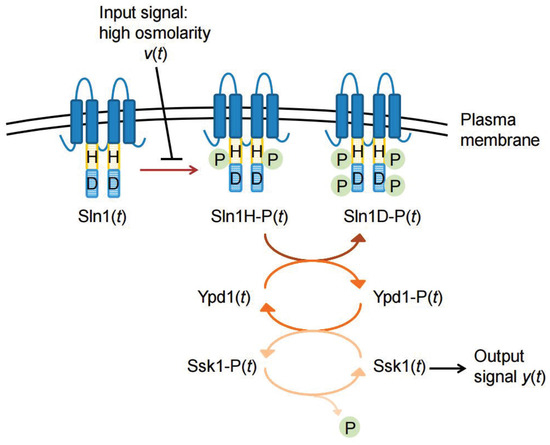
Figure 1.
Schematic representation of phosphorelay system.
The state is denoted by the following vector:
Suppose that the dynamic behavior of this system can be represented by discrete-time difference equations, which are seen as the discrete-time type of phosphorelay system discussed in [25]:
where and are the systematic characteristics, and is the random fluctuation. Figure 2 shows the trajectories of x with the systematic characteristics and , which is the standard Gaussian white noise with zero mean.
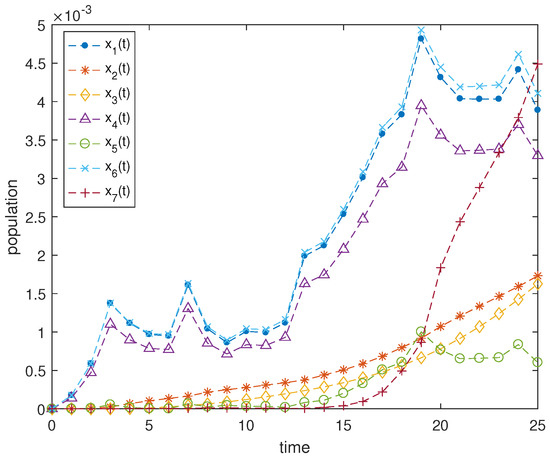
Figure 2.
Temporal profiles of the state variables of Sln-1-phosphorelay system in (20) at the systematic characteristic case: with .
In order to show the effects of systematic characteristics on system entropy, we take the three different systematic characteristics given in Table 1.

Table 1.
Systematic characteristics in three cases.
Due to the global linearization in (14), the approximation of discrete-time nonlinear network (20) can be presented by:
where denotes the the interpolation functions. denotes the M states of local linearization systems [26].
By solving the LMI-constrained optimization problem in Equation (18) for the above three system characteristic cases in Table 1, the positive definite matrices , and are obtained as follows:
Corresponding system entropy is calculated, and the result is shown in following Table 2.
Table 2.
System entropy of systems with three different systematic characteristics.
6. Conclusions
In this paper, the system entropy measurement of discrete-time nonlinear biological system is discussed. In order to overcome the nonlinear Hamilton-Jacobi inequality(HJI) in the measurement precedure, we extend the global linearization method in continuous-time system to the discrete-time system, so that the HJI-constrained optimization for the measurement of system entropy of discrete-time nonlinear biological system can be transformed to LMIs-constrained optimization problem to efficiently calculate the system entropy easily with the help of LMI Toobox in MATLAB. Moreover, the calculation methods of system entropy of more complex systems such as the nonlinear system with intrinsic randomness, stochastic systems driven by Markov processes are worth further study.
Author Contributions
Conceptualization, X.L.; methodology, X.L. and W.Z.; software, X.L., R.Z. and X.W.; validation, X.L. and R.Z.; formal analysis, X.L. and R.Z.; investigation, W.Z. and C.T.; writing—original draft preparation, X.L., X.W. and R.Z.; supervision, X.L., W.Z. and R.Z.; project administration, X.L. and R.Z.; funding acquisition, X.L., W.Z. and C.T. All authors have read and agreed to the published version of the manuscript.
Funding
This research was funded by the National Natural Science Foundation of China, grant numbers 61973198, 62173206; the Research Fund for the Taishan Scholar Project of Shandong Province of China; the Natural Science Foundation of Shandong Province of China, grant numbers ZR2020MF062, ZR2019QF005, ZR2021ZD13; the China Postdoctoral Science Foundation, grant number 2021M691849; the SDUST Research Fund, grant number 2015TDJH105.
Institutional Review Board Statement
Not applicable.
Informed Consent Statement
Not applicable.
Data Availability Statement
Not applicable.
Acknowledgments
We would like to thank the anonymous reviewers for their constructive suggestions to improve the quality of this paper.
Conflicts of Interest
The authors declare no conflict of interest.
References
- Lebiedz, D. Entropy-related extremum principles for model reduction of dissipative dynamical systems. Entropy 2010, 12, 706–719. [Google Scholar] [CrossRef]
- Baierlein, R. Thermal Physics; Cambridge University Press: Cambridge, UK, 1999. [Google Scholar]
- Mettetal, J.T.; Oudenaarden, A. Microbiology Necessary noise. Science 2007, 317, 463–464. [Google Scholar] [CrossRef]
- Pedraza, J.M.; Oudenaarden, A. Noise propagation in gene networks. Science 2005, 307, 1965–1969. [Google Scholar] [CrossRef]
- Mettetal, J.T.; Muzzey, D.; Pedraza, J.M.; Ozbudak, E.M.; Oudenaarden, A. Predicting stochastic gene expression dynamics in single cells. Proc. Natl. Acad. Sci. USA 2006, 103, 7304–7309. [Google Scholar] [CrossRef]
- Meirovitch, H. Methods for calculating the absolute entropy and free energy of biological systems based on ideas from polymer physics. J. Mol. Recogn. JMR 2010, 23, 153–172. [Google Scholar] [CrossRef]
- Salamon, P.; Ghochani, M.; Nulton, J.; Terrence, G. Shape Entropy and the Time Scales for Thermodynamics in Biological Systems. Biophys. J. 2012, 102, 505. [Google Scholar] [CrossRef]
- Mitrokhin, Y. Two faces of entropy and information in biological systems. J. Theor. Biol. 2014, 359, 192–198. [Google Scholar] [CrossRef]
- Chen, B.S.; Lin, X.Y.; Zhang, W.H. On the System Entropy and Energy Dissipativity of Stochastic Systems and Their Application in Biological Systems. Complexity 2018, 2018, 1628472. [Google Scholar] [CrossRef]
- Baez, J.; Pollard, B. Relative Entropy in Biological Systems. Entropy 2016, 18, 46. [Google Scholar] [CrossRef]
- Cofre, R.; Herzog, R.; Corcoran, D.; Rosas, F.E. A Comparison of the Maximum Entropy Principle Across Biological Spatial Scales. Entropy 2019, 21, 1009. [Google Scholar] [CrossRef] [Green Version]
- Ana, J.L.; Rigoberto, P.S. Entropy Application for Forecasting. Entropy 2020, 22, 604. [Google Scholar]
- Lucia, U. Irreversible entropy variation and the problem of the trend to equilibrium. Physics 2007, 376, 289–292. [Google Scholar] [CrossRef]
- Lucia, U. Irreversibility, entropy and incomplete information. Physics 2009, 388, 4025–4033. [Google Scholar] [CrossRef]
- Lucia, U. Maximum entropy generation and kappa-exponential model. Physics 2010, 389, 4558–4563. [Google Scholar]
- Chen, B.S.; Wong, S.W.; Li, C.W. On the calculation of systrm entropy in nonlinear stochastic biological networks. Entropy 2015, 17, 6801–6833. [Google Scholar] [CrossRef]
- Zhang, T.; Deng, F.; Sun, Y.; Shi, P. Fault estimation and fault-tolerant control for linear discrete time-varying stochastic systems. Sci. China Inf. Sci. 2021, 64, 200201. [Google Scholar] [CrossRef]
- Jiang, X.; Zhao, D. Event-triggered fault detection for nonlinear discrete-time switched stochastic systems: A convex function method. Sci. China Inf. Sci. 2021, 64, 200204. [Google Scholar] [CrossRef]
- Johansson, R. System Modeling and Identification; Springer: London, UK, 1993. [Google Scholar]
- Chen, B.S.; Li, C.W. On the Interplay between Entropy and Robustness of Gene Regulatory Networks. Entropy 2010, 12, 1071–1101. [Google Scholar] [CrossRef]
- Boyd, S.P.; Ghaoui, L.E.; Feron, E.; Balakrishnan, V. Linear Matrix Inequalities in System and Control Theory; SIAM: Philadelphia, PA, USA, 1994. [Google Scholar]
- Chen, B.S.; Wang, Y.C. On the attenuation and amplification of molecular noise in genetic regulatory networks. BMC Bioinform. 2006, 7, 52. [Google Scholar] [CrossRef]
- Chen, B.S.; Wang, Y.C.; Wu, W.S.; Li, W.H. A new measure of the robustness of biochemical networks. Bioinformatics 2005, 21, 2698–2705. [Google Scholar] [CrossRef]
- Chen, B.S.; Wu, W.S. Robust filtering circuit design for stochastic gene networks under intrinsic and extrinsic molecular noises. Math. Biosci. 2008, 211, 342–355. [Google Scholar] [CrossRef] [PubMed]
- Klipp, E.; Herwig, R.; Kowald, A.; Wierling, C.; Lehrach, H. Systems Biology in Practice: Concepts, Implementation and Application; Wiley-VCH: Hoboken, NJ, USA, 2005; pp. 1–465. [Google Scholar]
- Chen, B.S.; Chen, P.W. On the estimation of robustness and filtering ability of dynamic biochemical networks under process delays, internal parametric perturbations and external disturbances. Math. Biosci. 2009, 222, 92–108. [Google Scholar] [CrossRef] [PubMed]
- Chen, B.S.; Chen, W.H.; Wu, H.L. Robust H2/H∞ global linearization filter design for nonlinear stochastic systems. IEEE Trans. Circ. Syst. 2009, 56, 1441–1454. [Google Scholar]
Publisher’s Note: MDPI stays neutral with regard to jurisdictional claims in published maps and institutional affiliations. |
© 2022 by the authors. Licensee MDPI, Basel, Switzerland. This article is an open access article distributed under the terms and conditions of the Creative Commons Attribution (CC BY) license (https://creativecommons.org/licenses/by/4.0/).