


Abstract
Acute lung injury (ALI) is driven by a complex interplay between immune dysregulation and structural matrix remodeling. Although inflammation, oxidative stress, and disturbances in the coagulation–fibrinolysis system have long been recognized as core pathogenic drivers, growing evidence demonstrates that the extracellular matrix (ECM) functions as an active regulator of lung injury and repair rather than a passive structural scaffold. This review synthesizes current advances in ECM biology and immunopathology to delineate how ECM remodeling influences, and is concurrently shaped by, the inflammatory microenvironment. We outline how biochemical and physical modes of ECM remodeling engage in bidirectional crosstalk with the immune system. Emerging therapeutic strategies targeting this ECM–immune axis are critically evaluated, including modulation of protease activity, interventions that reprogram cell–matrix interactions, and approaches that restore ECM integrity using stem cells or engineered biomaterials. By redefining ALI as a disease of immune–matrix reciprocity, this review underscores the ECM as both a structural framework and a dynamic immunoregulatory hub, providing conceptual and mechanistic insights that may guide the development of precision therapies for ALI and related pulmonary disorders.
1. Introduction
Acute lung injury (ALI) and its more severe manifestation, the acute respiratory distress syndrome (ARDS), are heterogeneous clinical syndromes characterized by diffuse alveolar damage and severe impairment of gas exchange [1]. Although sepsis is a common precipitating condition in critically ill patients [2,3], ALI and ARDS may arise from a wide spectrum of direct and indirect insults to the lung. Direct pulmonary causes include bacterial or viral pneumonia, aspiration of gastric contents, lung or chest trauma, pulmonary hemorrhage, drowning, and inhalation of smoke or toxic gases. Indirect, extrathoracic causes originate outside the lung and include sepsis, transfusion-related lung injury, drug toxicity, severe non-thoracic trauma, disseminated intravascular coagulation, and acute pancreatitis [3,4,5]. In addition, ALI may develop secondary to other clinical conditions such as aspiration during anesthesia, burn-related infections, fat embolism, heat stroke, and prolonged exposure to environmental pollutants [3], underscoring the mechanistic heterogeneity and clinical breadth of this syndrome.
Irrespective of the initiating cause, ALI is defined by injury to both alveolar epithelial cells and pulmonary capillary endothelial cells, resulting in disruption of the alveolar capillary barrier, increased vascular permeability, and the development of noncardiogenic pulmonary edema. The relative contribution of epithelial and endothelial injury varies according to etiology, with direct pulmonary insults primarily targeting the alveolar epithelium, whereas indirect forms of ALI, particularly those associated with sepsis, are dominated by endothelial activation, systemic inflammation, and microvascular dysfunction. Despite these etiological differences, diverse forms of ALI converge on shared pathological pathways involving dysregulated inflammation, oxidative stress, and abnormalities in coagulation and fibrinolysis [3,6]. The resulting reductions in lung volume and compliance, together with severe ventilation–perfusion mismatch, manifest clinically as refractory hypoxemia and progressive respiratory failure [7] and may evolve into ARDS, a condition associated with high mortality, prolonged intensive care unit admission, and substantial long-term morbidity [8,9,10].
In contemporary clinical practice, the physiological abnormalities of ALI and ARDS are contextualized within standardized diagnostic frameworks. Early definitions culminated in the American–European Consensus Conference (AECC) criteria, which introduced the arterial oxygen tension to fraction of inspired oxygen ratio (PaO2/FiO2) as a central physiological parameter, defining ALI by a PaO2/FiO2 ratio of less than 300 mmHg and ARDS as its more severe subset with a ratio of less than 200 mmHg [11,12,13]. This framework was subsequently refined by the Berlin definition, which reclassified ARDS into mild, moderate, and severe categories based primarily on the degree of hypoxemia, with PaO2/FiO2 thresholds of 200–300 mmHg, 100–200 mmHg, and ≤100 mmHg, respectively, assessed under standardized ventilatory conditions including a minimum level of positive end-expiratory pressure (PEEP) or continuous positive airway pressure (CPAP) of 5 cm H2O [14,15]. The Berlin definition further integrates bilateral pulmonary opacities consistent with noncardiogenic pulmonary edema as an imaging criterion, thereby unifying physiological severity with structural lung injury [9]. These severity strata are associated with stepwise increases in mortality and duration of mechanical ventilation [16,17,18,19,20], underscoring the prognostic relevance of hypoxemia-based classification.
Most recently, the 2023 global definition of ARDS has been proposed to enhance early recognition. A major shift is that it applies to patients receiving any form of respiratory support, removing the previous Berlin requirement for a specific PEEP level. It broadens the criteria to include patients on high-flow nasal oxygen (HFNO) at ≥30 L/min. For hypoxemia assessment, it retains a PaO2/FiO2 threshold of ≤300 mmHg but alternatively accepts an SpO2/FiO2 ratio of ≤315 when arterial blood gas analysis is unavailable (and SpO2 is ≤97%). Regarding imaging, while chest radiograph or CT remains standard, lung ultrasound is now endorsed as a validated alternative when standard imaging is not accessible, increasing utility in resource-limited settings [21,22,23].
Within this refined clinical continuum, ALI/ARDS are increasingly recognized as dynamic disease states in which progressive epithelial and endothelial injury, inflammatory amplification, and extracellular matrix remodeling evolve in parallel. Importantly, expanded diagnostic criteria that enable earlier and less resource-dependent identification highlight that many extracellular matrix (ECM)–immune interactions are initiated before the onset of severe hypoxemia or established fibrotic remodeling. Recognition of these early, predominantly exudative and inflammatory stages is therefore critical for defining when matrix-driven inflammatory signaling is most active and potentially most amenable to therapeutic intervention [21].
Traditionally regarded as a passive structural scaffold, the ECM is now recognized as a dynamic and instructive component of the pulmonary microenvironment that actively regulates cellular behavior, immune responses, and tissue repair [24,25,26,27,28,29,30,31]. These matrix alterations are accompanied by profound changes in the ultrastructure of the alveolar septa, which form the histopathological basis of impaired gas exchange. In the lung, pathological remodeling of the ECM is not merely a consequence of injury but also a driver of sustained inflammation and aberrant healing. However, most current therapeutic strategies in ALI continue to focus predominantly on soluble inflammatory mediators [6], largely overlooking the role of the solid phase ECM microenvironment in shaping immune cell function.
Conceptualizing ALI as a disorder of immune–matrix reciprocity therefore provides a unifying framework that integrates structural pathology with immune dysregulation and repair processes, and highlights the ECM as a critical, yet underappreciated, regulator of lung injury and resolution. This review synthesizes current advances to delineate how biochemical and physical modes of ECM remodeling intersect with the immune pathways, shaping the onset, progression, and outcome of ALI. By integrating clinical staging with molecular and biophysical matrix remodeling, this framework aligns pathological timing with therapeutic opportunity. Understanding this multidirectional exchange may guide the development of targeted therapies that modulate the ECM–immune axis to restore lung homeostasis.
2. Structural and Histopathological Hallmarks of Acute Lung Injury
2.1. The Alveolar Septum and ECM in the Healthy Lung
The defining pathological feature of ALI is diffuse alveolar damage, which reflects profound disruption of the normal architecture of the alveolar septa [6,32]. In the healthy lung, gas exchange occurs across an exquisitely thin alveolar septum (or blood–air barrier). This barrier is formed by a continuous alveolar epithelium and a continuous capillary endothelium, which are closely apposed and structurally integrated by the ECM. The ECM within the septum is heterogeneous: basement membranes are specialized, dense layers that underlie and anchor the epithelial and endothelial cells, while the interstitial matrix occupies the space between these two basement membranes, providing elastic recoil [24,33,34].
Under physiological conditions, the alveolar basement membrane is enriched in laminins, type IV collagen, nidogen, and heparan sulfate proteoglycans (HSPGs), forming a dense, highly organized network that anchors epithelial and endothelial cells, maintains barrier integrity, and transduces homeostatic biochemical and mechanical signals. In contrast, the interstitial matrix is relatively sparse and compliant, composed primarily of elastin fibers interwoven with fibrillar collagens, providing elasticity and recoil essential for normal lung mechanics. Together, these matrix components maintain alveolar stability while permitting rapid deformation during respiration [35,36,37,38]. Importantly, the diverse clinical triggers of ALI converge on the ECM through distinct but overlapping injury paradigms. Direct pulmonary insults such as pneumonia and aspiration primarily initiate epithelial basement membrane disruption, whereas indirect systemic insults, including sepsis and transfusion-related lung injury, predominantly drive endothelial activation, plasma protein leakage, and fibrin-rich provisional matrix formation, together shaping the trajectory and pattern of ECM remodeling.
2.2. Compositional Shift of the ECM in ALI
In ALI, this finely tuned structural organization is profoundly disrupted. Early injury to alveolar epithelial and capillary endothelial cells leads to breakdown of the basement membrane, loss of epithelial anchorage, and increased vascular permeability [39,40,41]. One of the hallmark compositional shifts that defines ALI pathology is the degradation and loss of homeostatic matrix components, including laminin and elastin, accompanied by the accumulation of a provisional ECM rich in fibrin and fibronectin [40,42,43,44]. This provisional matrix originates largely from leaked plasma proteins, particularly fibrinogen, which extravasate into the alveolar space and are subsequently converted to fibrin [45,46]. Fibronectin, derived from both plasma and locally activated mesenchymal cells, further stabilizes this matrix and provides adhesive ligands for inflammatory cells.
2.3. Hyaline Membranes as Active Structural and Inflammatory Entities
A defining histopathological manifestation of ALI is the formation of hyaline membranes along the alveolar walls [47,48]. These structures are not inert deposits but represent active precipitates composed of fibrin polymers, plasma proteins, necrotic epithelial debris, and surfactant remnants [49]. Hyaline membranes physically line and occlude alveolar surfaces, markedly increasing diffusion distance and mechanically impairing gas exchange [50,51]. In addition to their barrier effects, these fibrin-rich matrices provide a bioactive scaffold that concentrates cytokines, chemokines, and damage-associated molecular patterns, thereby amplifying local inflammation and leukocyte retention [52].
As ALI evolves, persistent provisional matrix deposition within the alveolar and interstitial compartments further alters lung mechanics by increasing tissue stiffness and disrupting normal alveolar architecture. The transition from a laminin and elastin-dominated homeostatic matrix to a fibrin and fibronectin-rich inflammatory matrix, therefore, represents a central structural hallmark of ALI. This compositional shift not only reflects tissue injury but also actively shapes immune cell behavior, inflammatory persistence, and the balance between effective repair and pathological remodeling. Establishing this structural baseline is essential for interpreting how immune-mediated signaling intersects with ECM remodeling to drive both acute tissue damage and divergent repair trajectories in ALI.
3. Temporal Landscape of ECM Remodeling in ALI
3.1. Classical ALI Staging Revisited in the Context of ECM Remodeling
The pathological process of ALI can be divided into three stages: the acute or exudative phase (days 1–6), characterized by disruption of the alveolar–capillary barrier, formation of hyaline membranes, and infiltration of neutrophils and other inflammatory cells; the proliferative phase (days 7–14), marked by the proliferation of type II alveolar epithelial cells and fibroblasts, accompanied by early collagen deposition; and the fibrotic phase (after day 14), where continued activation of fibroblasts leads to abnormal ECM deposition and remodeling of the lung structure [8]. While this staging remains clinically useful, it underestimates the immediacy and biological complexity of ECM dynamics. Increasing evidence suggests that ECM remodeling does not merely emerge during the late fibrotic phase but is initiated within hours of injury and evolves continuously across all stages of ALI [27,42]. Thus, reconsidering classical ALI staging through the lens of ECM remodeling reveals a temporally overlapping, rather than sequential, process in which matrix turnover is deeply integrated with immune activation and barrier dysfunction (Figure 1).
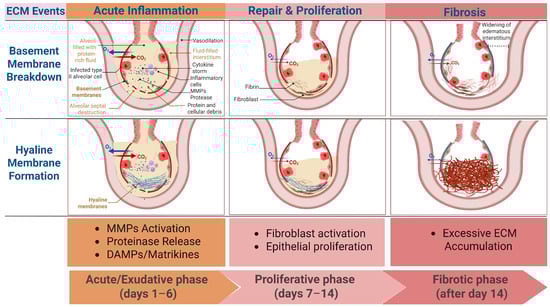
Figure 1.
Temporal dynamics of extracellular matrix (ECM) remodeling across the clinical phases of acute lung injure (ALI). This schematic illustrates the time-course of key ECM events in relation to the classical clinical phases of ALI (exudative, proliferative, and fibrotic). In the early exudative phase, injury to alveolar epithelial and endothelial cells leads to basement membrane degradation, driven predominantly by protease activation and inflammatory signaling. Concurrently, increased vascular permeability promotes plasma protein leakage and hyaline membrane formation, characterized by fibrin-rich provisional matrix deposition along the alveolar surface. As ALI progresses into the proliferative phase, ECM remodeling becomes more heterogeneous, with overlapping matrix degradation and early collagen synthesis. In the fibrotic phase, persistent injury and dysregulated repair result in excessive deposition of fibrillar collagen, leading to matrix stiffening and architectural distortion. Red arrows denote carbon dioxide (CO2), and blue arrows denote oxygen (O2). The thickness of the arrows is proportional to the reduction in gas exchange. MMPs: Matrix metalloproteinases; DAMPs: Damage-associated molecular patterns; Created in BioRender. Fy, X. (2025) https://BioRender.com/v8zewb9 (accessed on 17 November 2025).
3.2. Evidence for ECM Synthesis–Degradation Disequilibrium
Contrary to the traditional view that matrix deposition is a hallmark of the fibrotic phase, several clinical observations demonstrate that active ECM remodeling begins during the initial inflammatory stage. Collagen type III N-terminal propeptide has been detected in bronchoalveolar lavage fluid (BALF) and serum of ALI/ARDS patients early after injury, indicating the onset of type III collagen synthesis during the exudative phase [53,54,55]. Simultaneously, ECM degradation is markedly accelerated. Elevated levels of matrix metalloproteinases (MMPs), elastin degradation products, and the fibronectin EDA splice variant (A(+)FN) are consistently observed in BALF and plasma samples from ALI patients [56,57,58,59,60]. In coronavirus disease 2019 (COVID-19)-related acute lung injury, proteomic analyses further reveal profound reductions in core ECM constituents—including fibrillar collagens, glycoproteins, and proteoglycans [61]. Together, these findings indicate that early ECM remodeling in ALI is characterized by an active process of both synthesis and degradation, forming a pathological remodeling microenvironment.
Importantly, this early imbalance between ECM synthesis and degradation involves not only fibrillar proteins but also HSPGs, a regulatory ECM component often overlooked in discussions centered on MMPs [62]. Beyond collagen XVIII, transmembrane and matrix-associated HSPGs—including syndecans, glypicans, and perlecan—stabilize the alveolar and endothelial basement membranes and sequester cytokines and chemokines via their heparan sulfate glycosaminoglycan side chains [63,64]. During the initial inflammatory phase of ALI, increased vascular permeability and cytokine signaling rapidly activate heparanase, the sole endoglycosidase in humans and other mammals capable of degrading heparan sulfate [63,65,66]. Loss of heparan sulfate represents an upstream event in ECM remodeling that exposes previously shielded core proteins, thereby enabling subsequent MMP-mediated proteolysis [62]. In parallel, heparanase-mediated degradation of endothelial heparan sulfate facilitates leukocyte transendothelial migration and releases ECM-bound inflammatory mediators, amplifying tissue injury [67,68]. Consistent with these mechanisms, increased circulating heparan sulfate degradation activity and elevated heparanase expression have been reported in patients with sepsis-associated ALI and in human lung tissues exhibiting diffuse alveolar damage [65]. Collectively, these observations place HSPGs and heparanase at the intersection of inflammatory signaling, leukocyte recruitment, and downstream ECM breakdown, reinforcing the concept that ECM synthesis–degradation disequilibrium is established at the earliest stages of lung injury.
3.3. ECM as an Active Signaling in Early Lung Injury
The biological relevance of early ECM remodeling extends far beyond structural disruption. ECM breakdown generates bioactive fragments—matrikines, that function as endogenous danger signals capable of engaging pattern recognition receptors (PRRs) on immune cells [69,70,71]. In addition, when functional sites of an ECM fragment originate from cryptic domains within the parent matrix rather than exogenously created sites, such fragments are also referred to as matricryptins [72]. Hyaluronan oligosaccharides and elastin-derived matrikines, for instance, accumulate during early injury and act as damage-associated molecular patterns (DAMPs) that amplify inflammatory signaling [26,73,74,75,76]. These fragments initiate and perpetuate a feed-forward cascade: initial injury triggers ECM degradation; degradation products activate immune cells; activated immune cells release additional proteases and inflammatory mediators, which further intensify ECM turnover. This self-reinforcing loop delays alveolar–capillary barrier repair, sustains inflammation, and biases the lung toward aberrant fibroproliferation. Thus, the ECM in early ALI functions not as a passive scaffold but as a dynamic signaling organ that integrates injury cues, modulates immune activity, and influences the trajectory toward resolution or fibrosis.
4. Immune Dysregulation as a Driver of ECM Remodeling
4.1. Immune Activation and Amplification
Immune activation constitutes the earliest and most decisive event shaping ECM remodeling in ALI. Upon exposure to pathogens, resident alveolar macrophages detect pathogen-associated molecular patterns (PAMPs) or DAMPs via PRRs, initiating the release of pro-inflammatory cytokines (interleukin-1β, Tumour necrosis factor-alpha), chemokines, and reactive oxygen species (ROS) [77,78]. These mediators activate endothelial cells, upregulate intercellular cell adhesion molecule-1 (ICAM-1) and vascular cell adhesion molecule 1 (VCAM-1) expression, and orchestrate rapid recruitment of neutrophils from the circulation. Neutrophils entering the alveolar and interstitial compartments serve as dominant early effectors of ECM injury. Through the release of ROS, neutrophil elastase, and MMPs, as well as the formation of neutrophil extracellular traps (NETs) that locally concentrate and activate proteases, they directly degrade basement membrane components and disrupt the structural integrity of the alveolar septa [79,80].
Importantly, dysregulated macrophage and neutrophil activation not only sustains tissue injury but also converts ECM degradation into a secondary inflammatory signal. Proteolytic cleavage of collagen, laminin, and elastin generates ECM fragments that function as endogenous DAMPs, capable of activating PRRs such as Toll-like receptor 2 (TLR2) and Toll-like receptor 4 (TLR4) on macrophages and neutrophils [26]. This establishes a self-propagating amplification loop in which immune activation drives ECM degradation, and ECM-derived signals in turn reinforce immune activation.
4.2. Cytokine Networks as Modulators of ECM Remodeling
Pro-inflammatory cytokines act as central regulators of ECM turnover. interleukin-1β (IL-1β) and Tumour necrosis factor-alpha(TNF-α) induce transcriptional upregulation of multiple matrix metalloproteinases (MMP-1, MMP-8, MMP-9) while suppressing tissue inhibitors of metalloproteinases (TIMP-1/2), thus tipping the balance toward excessive ECM degradation [81,82,83,84,85,86,87,88,89,90]. This imbalance accelerates the breakdown of collagen, laminin, and elastin within the alveolar basement membrane. In contrast, Interleukin-6 (IL-6) and transforming growth factor-β (TGF-β) promote ECM accumulation via fibroblast activation and enhanced collagen and laminin synthesis, contributing to matrix stiffening and myofibroblast differentiation [91]. The coexistence of these opposing signals generates a dysregulated remodeling microenvironment characterized by concurrent degradation and pathological deposition rather than coordinated repair.
Clinical evidence underscores the pathological relevance of cytokine-driven protease imbalance. In a prospective cohort, altered serum TIMP-1/MMP-9 ratios correlated strongly with disease severity and early mortality in ALI patients, highlighting cytokine-mediated ECM dysregulation as both a mechanistic driver and a clinically informative biomarker [92].
4.3. Immune-Driven Protease Release and ECM Degradation
In addition to cytokines, immune cells act as direct executors of ECM degradation by releasing a spectrum of proteolytic enzymes. Neutrophils secrete elastase, which readily degrades elastin, fibronectin, and interstitial collagens [93]. Activated macrophages produce MMP-9 and MMP-12, whose activities contribute to basement-membrane disruption and loss of alveolar structural integrity [94,95]. Excess proteolysis liberates bioactive matrikines that activate PRRs, including TLR4, on macrophages and neutrophils, thereby amplifying inflammatory cytokine release and protease production [26]. Thus, ECM degradation functions not merely as a consequence of immune activation but as an active amplifier of immune dysregulation. For instance, low-molecular-weight fragments of hyaluronan and oxidatively modified ECM components engage TLR4-dependent NF-κB signaling in macrophages, driving secondary production of IL-1β and TNF-α and reinforcing protease-mediated matrix degradation [73,96].
Beyond facilitating matrix degradation, heparanase plays a pivotal role in immune cell trafficking during ALI [65]. Interendothelial migration of leukocytes from the circulation into inflamed lung tissue requires localized degradation of endothelial basement membrane heparan sulfate. Activated neutrophils and monocytes express and secrete heparanase, enabling them to breach the heparan sulfate-rich endothelial glycocalyx and basement membrane, thereby gaining access to the interstitial and alveolar compartments [62,97,98]. While facilitating leukocyte recruitment, excessive heparanase activity disrupts endothelial barrier integrity, exacerbates vascular leak, and accelerates ECM destabilization. In this manner, heparanase integrates immune activation with progressive matrix injury, coupling leukocyte infiltration to worsening structural damage.
Together, immune activation in ALI initiates a highly interconnected cascade wherein cytokines, ROS, and proteases jointly disrupt ECM homeostasis; in turn, ECM degradation products function as bioactive DAMPs that amplify immune activation, establishing a self-sustaining injury circuit.
5. Oxidative Stress and ECM Structural Damage
5.1. ROS-Mediated ECM Oxidation and Fragmentation
A central pathological driver in ALI is the imbalance between excessive ROS production and the capacity of the endogenous antioxidant defense system [3]. This redox dysregulation directly exacerbates structural and functional impairment of the alveolar-capillary barrier [3]. ROS exerts both direct and indirect effects on ECM homeostasis during ALI. Directly, ROS oxidize amino acid residues such as proline and lysine within collagen, HA, and elastin, thereby disrupting their tertiary structure and reducing the mechanical stability of the ECM scaffold [99,100,101,102,103,104]. Oxidative modification of ECM proteins further alters their binding affinities for integrins and growth factors, impairing downstream signaling cascades critical for tissue repair [105]. Indirectly, ROS upregulate MMP-2, MMP-9, and MMP-13 expression, while simultaneously suppressing TIMPs [106,107,108], thus amplifying ECM degradation. Moreover, ROS impair ECM synthesis by damaging the endoplasmic reticulum in fibroblasts, leading to reduced production of collagen [109].
5.2. Mitochondrial Dysfunction as an Upstream Driver of ECM Injury
Beyond serving as a source of ROS, mitochondrial dysfunction functions as a central signaling hub linking cellular stress to inflammatory activation and ECM remodeling. In injured alveolar epithelial cells and macrophages, pulmonary irritants induce mitochondrial damage, leading to cytosolic release of mitochondrial DAMPs, including mitochondrial ROS (mtROS), mitochondrial DNA (mtDNA), cardiolipin, and cytochrome c [110]. mtROS acts as a proximal inflammatory trigger by inducing mitochondrial damage that leads to the release of NLRP3-activating signals, leading to caspase-1 activation and subsequent maturation and release of IL-1β [3,111]. IL-1β serves as a critical molecular bridge between mitochondrial dysfunction and ECM remodeling by inducing transcription and activation of matrix metalloproteinases, including MMP-1, MMP-9, and MMP-13, thereby accelerating collagen and elastin degradation within the alveolar ECM [112,113,114,115,116]. In parallel, mtROS promotes nuclear translocation of NF-κB p65, further amplifying pro-inflammatory gene expression. mtDNA released into the cytosol functions as a ligand for TLR9, reinforcing NLRP3 inflammasome signaling [117]. Additional mitochondrial-derived cues, including cardiolipin and Ca2+ flux, directly activate NLRP3, while extracellular ATP released from injured cells engages the purinergic receptor P2X7, facilitating NLRP3 mitochondrial localization and further enhancing mtROS production [118,119].
Mitochondrial damage also promotes inflammatory cell recruitment. Release of N-formylated peptides activates formyl peptide receptor 1 (FPR1), while increased CXCL8 production further enhances neutrophil recruitment and inflammatory amplification [120,121]. Recruited neutrophils contribute to downstream ECM injury through the release of proteases and reactive oxygen species, reinforcing matrix degradation initiated by mitochondrial stress.
Defective mitophagy exacerbates this cascade by permitting accumulation of dysfunctional mitochondria, sustaining mtROS generation, and prolonging inflammasome signaling. In parallel, mitochondrial bioenergetic failure impairs ATP-dependent cytoskeletal organization and cell–matrix adhesion, rendering epithelial and endothelial cells more susceptible to detachment and death. Pyroptotic and apoptotic cell death associated with mitochondrial dysfunction releases additional DAMPs, including HMGB1 and oxidized phospholipids, which further enhance neutrophil recruitment and protease release [122,123,124].
Collectively, mitochondrial injury establishes a self-perpetuating feed-forward loop in which mtROS–NLRP3–IL-1β signaling drives MMP-mediated ECM degradation, while ECM damage and inflammatory cell recruitment generate secondary danger signals that reinforce inflammasome activation, neutrophilic inflammation, and progressive alveolar barrier disruption in ALI.
5.3. Surfactant Disruption and Secondary ECM Instability
Inactivation of pulmonary surfactant is a characteristic feature of ALI and predisposes the alveolar microenvironment to ECM injury by disrupting biomechanical homeostasis and immune regulation. Loss of surfactant increases alveolar surface tension, exposing epithelial cells to exaggerated mechanical stretch during respiration, which predisposes the alveolar–capillary barrier to structural damage [3,125,126]. Beyond its biophysical role, surfactant exerts critical control over innate immune signaling within the alveolar microenvironment. Among surfactant-associated proteins, surfactant protein D (SP-D) functions as a key immunomodulatory molecule that restrains TLR4-dependent inflammatory activation. SP-D interacts with the TLR4 complex via its carbohydrate recognition domain, thereby suppressing downstream PI3K/Akt and NF-κB signaling and limiting production of pro-inflammatory cytokines such as IL-1β and TNF-α [127,128,129]. Loss or inactivation of SP-D removes this inhibitory checkpoint, permitting exaggerated TLR4 signaling and sustained innate immune activation [127]. This inflammatory signaling cascade directly impacts ECM homeostasis. TLR4–NF-κB-dependent cytokine release promotes transcription and activation of matrix metalloproteinases, particularly MMP-13, leading to accelerated degradation of collagen and other structural ECM components. Consistent with this mechanism, SP-D has been shown to suppress MMP-13 expression and preserve collagen integrity, indicating that surfactant dysfunction facilitates ECM breakdown through defined immune signaling pathways rather than passive mechanical effects alone [127,130].
Collectively, oxidative stress in ALI drives ECM injury through a hierarchical and mechanistically interconnected network rather than through nonspecific oxidative damage alone. Together, these processes establish self-sustaining feed-forward loops in which oxidative stress, mitochondrial dysfunction, immune activation, and ECM degradation are mutually reinforcing. This reciprocal coupling of redox imbalance, inflammatory signaling, and matrix remodeling provides a mechanistic framework for understanding progressive alveolar–capillary barrier failure in ALI and highlights key molecular nodes—such as mtROS–NLRP3–IL-1β signaling and SP-D–TLR4 regulation—as potential therapeutic targets.
6. Coagulation–Fibrinolysis Imbalance and Matrix–Immune Coupling
6.1. Procoagulant Activation and Provisional Matrix Formation
The coagulation system is rapidly activated in ALI. Endotoxin- and cytokine-stimulated endothelial cells express tissue factor, initiating the extrinsic coagulation pathway and promoting fibrin deposition within the alveolar and microvascular compartments [131]. Platelet–neutrophil interactions facilitate NETs formation and immunothrombosis [132], generating a provisional ECM scaffold rich in fibrin and fibronectin. Beyond serving as a passive scaffold, the fibrin–fibronectin-rich provisional matrix actively regulates immune cell behavior. Fibrin engages integrins such as αMβ2 on neutrophils and macrophages, enhancing leukocyte adhesion, retention, and survival within the injured alveolar space [133]. Fibronectin further amplifies inflammatory signaling by promoting macrophage activation and fibroblast migration [134]. While transient matrix deposition supports early host defense, excessive and persistent accumulation drives fibroblast activation, myofibroblast differentiation, and collagen synthesis, thereby linking coagulation activation directly to pathological ECM remodeling and fibrotic progression [135,136,137,138]. Conversely, ECM components reciprocally modulate coagulation cascades. Collagen types I and III activate platelets via glycoprotein VI, while fibronectin binds coagulation factor XIII, promoting fibrin cross-linking and matrix stabilization [139,140,141]. This bidirectional interaction establishes a feed-forward loop in which coagulation and ECM remodeling mutually reinforce inflammatory amplification.
6.2. Impaired Fibrinolysis and Pro-Fibrotic Signaling
In parallel with procoagulant activation, ALI is characterized by profound suppression of fibrinolysis. Lung tissue and bronchoalveolar lavage fluid exhibit elevated expression of plasminogen activator inhibitor-1 (PAI-1), resulting in impaired plasmin generation and defective fibrin clearance [142]. Additionally, levels of activated protein C (APC), a critical anticoagulant and cytoprotective mediator, are markedly reduced in ALI patients. Both elevated PAI-1 and reduced APC levels correlate strongly with increased mortality, underscoring the clinical relevance of coagulation–fibrinolysis imbalance [143]. Importantly, PAI-1 exerts profibrotic effects independent of its antifibrinolytic function. By binding to vitronectin, an ECM glycoprotein, PAI-1 enhances integrin-mediated fibroblast adhesion and promotes differentiation into myofibroblasts, thereby accelerating ECM deposition and matrix stiffening [144,145,146]. Additionally, by inhibiting urokinase-type plasminogen activator (uPA), PAI-1 impairs the generation of plasmin, which is required for the proteolytic activation of latent TGF-β, a master regulator of fibrosis. This further disrupts normal repair and accelerates pathological ECM deposition [147,148,149]. Collectively, impaired fibrinolysis transforms the ECM into a fibrin-dominated, inflammation-permissive niche that sustains immune activation and drives fibrotic remodeling.
Collectively, immune dysregulation, oxidative stress, mitochondrial dysfunction, surfactant disruption, programmed cell death, and coagulation imbalance converge to drive ECM remodeling in ALI through tightly coupled signaling networks. Immune activation and redox stress initiate ECM degradation via protease release and mtROS–NLRP3–IL-1β–MMP signaling, while matrix-derived DAMPs, provisional fibrin matrices, and impaired fibrinolysis reciprocally amplify inflammatory and coagulative responses. These bidirectional feedback loops transform the ECM from a structural scaffold into an active signaling platform that sustains leukocyte recruitment, protease activity, and fibroproliferative remodeling. Together, these interconnected pathways create a self-perpetuating loop of inflammation, matrix degradation, and fibroproliferation, positioning ALI as a disease fundamentally rooted in reciprocal immune–ECM crosstalk (Figure 2).
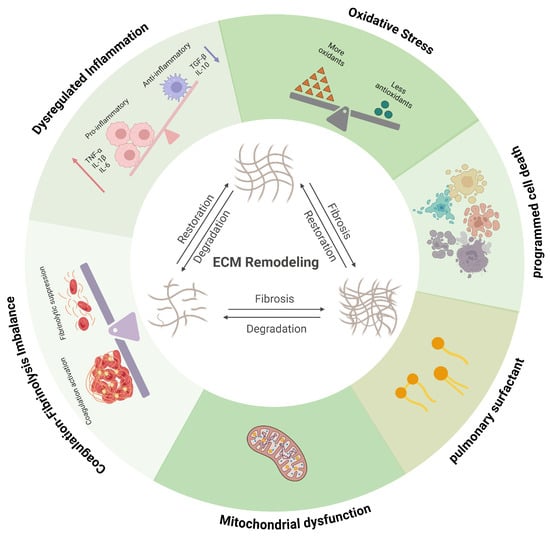
Figure 2.
Schematic representation of the pathological progression of ALI and its association with ECM remodeling. Immune dysregulation, oxidative stress, mitochondrial dysfunction, surfactant disruption, programmed cell death, and coagulation imbalance interact dynamically with ECM remodeling during ALI, forming tightly coupled and self-reinforcing pathogenic networks. Red arrows indicate increased protein levels of tumour necrosis factor-alpha (TNF-α), interleukin-1β (IL-1β), and interleukin-6 (IL-6); blue arrows indicate decreased protein levels of transforming growth factor-β (TGF-β) and interleukin-6 (IL-10). Created in BioRender. Fy, X. (2025) https://BioRender.com/o3pyrzl (accessed on 17 November 2025).
7. Biochemical Remodeling of the ECM and Immune Regulation
7.1. Collagen-Derived Matrikines and Immune Regulation
Collagen, the most abundant ECM component in lung tissue—particularly types I, III, and IV—plays a fundamental role in maintaining pulmonary structural integrity and homeostasis. During ALI, collagen undergoes dynamic cycles of degradation and synthesis, and its cleavage fragments are released into the alveolar space, airways, and circulation. Among the best-characterized collagen-derived matrikines are proline–glycine–proline (PGP) and its acetylated form (AcPGP). PGP is generated by sequential enzymatic cleavage of collagen through the concerted action of MMP-9/MMP-8 and prolyl endopeptidase (PE). Accumulated PGP acts as a potent neutrophil chemoattractant, amplifying inflammation and sustaining protease–antiprotease imbalance [150].
PGP functions as a matrikine by activating CXCR1/2 signaling pathways on neutrophils, thereby establishing a prototypical ECM–immune feedback loop: neutrophil-derived proteases generate PGP, which in turn recruits additional neutrophils and amplifies proteolytic ECM injury. However, PGP can be degraded by leukotriene A4 hydrolase (LTA4H), representing a secondary anti-inflammatory mechanism thatlimits sustained inflammation [151]. N-terminal acetylation yields AcPGP, a degradation-resistant ligand that sustains CXCR1/2-mediated neutrophil recruitment and inflammatory activation [152,153]. In experimental ALI models, elevated PGP and AcPGP levels correlate with excessive neutrophil infiltration, endothelial barrier dysfunction, and aggravated lung injury [152,154,155,156].
Beyond PGP/AcPGP, other collagen-derived fragments also exert diverse immunomodulatory effects. For instance, a peptide fragment DGGRYY from type I collagen activates neutrophils by binding to lymphocyte function-associated antigen 1 (LFA-1) [157]. Not all collagen-derived matrikines are pro-inflammatory. The tripeptide glycyl–L-histidyl–L-lysine (GHK), derived from type I collagen and the matricellular protein SPARC (Secreted Protein Acidic and Rich in Cysteine), enhances pulmonary antioxidant enzyme activity, suppresses IL-6 and TNF-α expression, and limits neutrophil infiltration, thereby mitigating lung injury [158,159,160]. Likewise, tumstatin, generated by MMP-9–mediated cleavage of type IV collagen, inhibits eosinophil and lymphocyte infiltration, displaying potent anti-inflammatory properties [161,162,163].
In addition, endostatin, a type XVIII collagen–derived matrikine, exhibits multifaceted biological effects in the injured lung. Its combined actions on neutrophil chemotaxis, platelet aggregation, and endothelial barrier disruption suggest that endostatin may act as a critical mechanistic link among these cellular events in the pathogenesis of ARDS, bridging inflammatory and vascular dysfunction within the remodeled ECM microenvironment [164]. Clinically, circulating endostatin has been identified as an early biomarker of COVID-19 disease severity, underscoring its potential as both a diagnostic and mechanistic indicator of pulmonary vascular injury and dysregulated ECM remodeling [165]. These findings highlight collagen-derived matrikines as active signaling intermediates rather than inert byproducts of matrix degradation.
Overall, collagen degradation in ALI generates a diverse repertoire of matrikines that actively regulate immune and vascular responses rather than serving as inert byproducts of tissue injury. Pro-inflammatory fragments such as PGP/AcPGP establish self-amplifying neutrophilic feedback loops, whereas anti-inflammatory peptides, including GHK and tumstatin, counterbalance excessive inflammation, highlighting collagen-derived signals as key determinants of immune–ECM reciprocity and disease trajectory in ALI.
7.2. Elastin-Derived Matrikines and Immune Regulation
Elastin fibers are essential for maintaining lung compliance and elastic recoil. In chronic obstructive pulmonary disease (COPD), for instance, diminished alveolar elastic recoil is intimately linked to elastin fibre structural abnormalities [166]. Proteolytic degradation of elastin during lung injury generates bioactive fragments that exert chemotactic and immunomodulatory effects. Elastin-derived peptides of 10–50 kDa efficiently recruit monocytes and macrophages to sites of injury, thereby amplifying inflammatory responses [167,168]. The elastin-derived hexapeptide VGVAPG exhibits chemotactic activity toward monocytes, macrophages, and fibroblasts, promoting immune cell accumulation and fibroblast activation within injured lung tissue [169,170]. Through engagement of elastin-binding receptors, these matrikines further reinforce inflammatory cell recruitment and ECM remodeling, linking mechanical fiber breakdown to immune dysregulation.
7.3. Hyaluronan-Derived Matrikines and Immune Regulation
Under physiological conditions, hyaluronan (HA) exists predominantly as high-molecular-weight (HMW) polymers that contribute to tissue hydration and structural stability. During lung injury and inflammation, oxidative stress and hyaluronidase activity generate low-molecular-weight HA fragments that accumulate at sites of injury. The clearance of these fragments—via the receptor CD44—is considered important in mitigating lung injury [171]. HA fragments activate macrophages and dendritic cells through TLR2 and TLR4 signaling, inducing the release of chemokines and pro-inflammatory cytokines [172,173,174]. In contrast, endogenous HMW HA delivers protective signals that promote epithelial survival and tissue repair [175,176,177]. Thus, HA metabolism exemplifies a size-dependent immune switch, whereby ECM fragmentation converts a homeostatic structural component into a potent inflammatory signal that amplifies immune activation and matrix degradation.
7.4. Fibrin/Laminin-Derived Matrikines and Immune Regulation
Fibrin turnover is closely linked to inflammatory signaling and tissue repair. Human fibrin peptide B, generated during fibrinogen cleavage, recruits neutrophils and fibroblasts, thereby contributing to inflammatory amplification and matrix deposition [178]. Similarly, laminin cleavage by neutrophil elastase releases matrikines that promote neutrophil recruitment and exacerbate lung injury [179]. These findings underscore that provisional matrix components not only provide structural support but also actively generate immunoregulatory signals that reinforce inflammation and delay resolution.
7.5. Heparan Sulfate Proteoglycans as Cytokine Reservoirs and Immune Modulators
HSPGs organize immune signaling within the pulmonary ECM by binding cytokines, chemokines, and growth factors, including IL-8, CXCL1, VEGF, FGF, and TGF-β [63]. In ALI, heparanase-mediated cleavage of heparan sulfate chains releases ECM-bound cytokines into the alveolar and interstitial spaces, abruptly amplifying immune cell recruitment and activation [62]. This disruption of cytokine compartmentalization transforms the ECM from a regulatory reservoir into a driver of uncontrolled inflammation, reinforcing immune dysregulation and impairing coordinated repair responses.
Collectively, ECM degradation in ALI generates a broad spectrum of matrikines and liberated cytokines that actively instruct immune and vascular responses rather than representing passive byproducts of tissue injury. Through receptor-specific signaling and self-amplifying feedback loops, these ECM-derived signals couple matrix breakdown to sustained inflammation, immune cell recruitment, and dysregulated repair, thereby shaping disease progression and resolution (Table 1).

Table 1.
Summary of extracellular matrix (ECM)-derived matrikines and their pathophysiological impact in acute lung injury (ALI).
8. Physical Remodeling of the ECM and Mechanoregulation of Immunity
8.1. Mechanical Cues as Immune Modulators
Mechanical forces are increasingly recognized as major determinants of immune cell behavior. Immune cells patrolling the lung microenvironment rely not only on receptor–ligand interactions but also on mechanical sensing to regulate migration, activation, differentiation, and effector functions [180,181,182,183]. In the mechanically dynamic lung, ECM biophysical properties serve as a primary interface through which cells perceive stress and convert it into intracellular signaling [26,184]. ALI disrupts these properties via edema, matrix degradation, and abnormal deposition, thereby altering the mechanical landscape that shapes immune responses.
8.2. Mechanotransduction Pathways in Immune Cells
Integrin-based mechanotransduction is the most deeply characterized pathway through which immune cells sense ECM physical cues. Engagement of ECM ligands activates focal adhesion complexes, including FAK and Src, which regulate downstream signaling cascades such as NF-κB and MAPK [180]. For example, mechanical stretch drives macrophages toward an M1-like pro-inflammatory phenotype through FAK/NF-κB signaling [185]. Beyond integrins, the Piezo family of mechanosensitive ion channels, especially Piezo1, links mechanical ventilation to Ca2+ influx, cytoskeletal reorganization, barrier disruption, and cytokine release (TNF-α, IL-1β, and IL-6) [186,187]. These pathways position ECM mechanics as an upstream regulator of immune activation, linking physical matrix alterations directly to inflammatory signaling cascades.
8.3. Immune Cell Sensitivity to ECM Stiffness
Monocytes and macrophages exhibit pronounced sensitivity to matrix rigidity. Stiff substrates intensify LPS-induced cytokine release and promote dendritic cell-like differentiation, while soft matrices bias macrophages toward immunoregulatory phenotypes [188,189,190]. These stiffness-dependent transitions influence phagocytosis, metabolism, and migratory capacity, thereby modulating the inflammatory landscape in ALI [191,192,193]. Such mechanosensitive plasticity underscores the importance of ECM mechanics as a regulator of both immune activation and resolution.
8.4. ECM Stiffening and Inflammation as a Positive Feedback Loop
ECM stiffening and inflammation reinforce each other through tightly coupled feedback mechanisms. Inflammatory cells release large amounts of MMPs, intensifying ECM degradation and disrupting the alveolar basement membrane and intact ECM architecture. Mechanically stressed fibroblasts differentiate into myofibroblasts, producing excessive collagen and generating heterogeneous fibroblast subpopulations that perpetuate matrix deposition [194]. The resulting stiffened matrix further amplifies mechanotransduction-driven inflammatory signaling, establishing a self-perpetuating loop that sustains immune activation and promotes fibroproliferative remodeling.
8.5. Altered Basement Membrane Architecture in ALI
A hallmark manifestation of ECM physical remodeling is the destruction of the alveolar–capillary barrier’s basement membrane, which tightly regulates cell and molecular transit across the barrier. Its disruption is a defining event in ALI, directly causing dysregulated immune cell localization and pulmonary oedema formation [195,196]. Macrophages mediate efficient barrier penetration via MT1-MMP-dependent basement membrane degradation; alternatively, they may traverse interstitial ECM without protease activity by altering their morphology [197,198]. Activated neutrophils release MMPs and neutrophil elastase, degrade matrix protein “low expression regions” (LERs) within the basement membrane, expand these LERs, and carry laminin fragments, thereby enhancing their penetration capacity [199,200,201]. Furthermore, expansion of LERs has been shown to facilitate monocyte infiltration [202].
Basement membrane destruction permits uncontrolled immune cell entry into the alveolar space, where neutrophils and macrophages release high levels of proteases and pro-inflammatory cytokines (TNF-α, IL-1β). Accumulation of edema fluid and cellular debris further impairs gas exchange, culminating in hypoxemia and respiratory failure.
9. Novel Intervention Strategies Targeting ECM Remodeling
In ALI, pathological remodeling of the ECM is not merely a consequence of structural destruction but a pivotal driver of disease progression. Recent advances have highlighted multiple therapeutic approaches that specifically target the processes of ECM remodeling. An intriguing study demonstrated that inhalation of exogenous soluble ECM can attenuate acute lung injury [203,204,205], supporting the feasibility of ECM-based cytoprotective interventions. Such ECM-derived therapeutics may function as adjuncts to standard treatments rather than stand-alone modalities. Such ECM-derived therapeutics may serve as adjuncts or enhancers to conventional treatment strategies. This section summarizes emerging approaches aimed at inhibiting excessive ECM degradation, modulating immune–matrix interactions, and promoting restoration of ECM homeostasis.
Despite these encouraging advances, translating ECM-targeted interventions into consistent clinical benefit remains challenging. A major obstacle lies in the pronounced phenotypic heterogeneity of ALI/ARDS, encompassing distinct inflammatory, endothelial, epithelial, and fibroproliferative endotypes that are insufficiently captured by current preclinical models. Consequently, therapeutic strategies that demonstrate robust efficacy in experimental settings often fail to achieve uniform benefit in unselected patient populations. These considerations underscore the need for precision stratification and stage-aware therapeutic approaches when targeting ECM remodeling in clinical practice.
9.1. Interventions Targeting the Protease System
MMPs play central roles in the pathological progression of ALI [71,206]. The protease network has emerged as a key therapeutic target in ALI. Current approaches include three main categories of protease-directed interventions: small-molecule inhibitors, antibody-based biologics, and endogenous TIMPs [207,208]. Small-molecule inhibitors act by binding to catalytic or allosteric domains of MMPs to suppress their proteolytic activity; multiple preclinical studies have demonstrated their capacity to attenuate ECM degradation and reduce lung injury in ALI models [209,210,211,212,213,214,215]. Representative compounds such as CGS27023AM (CGS) have been shown to mitigate neutrophil infiltration and vascular leakage-associated pulmonary edema, underscoring their therapeutic promise [216]. Indirect inhibition of MMP-dependent pathways has also gained attention. The synthetic inhibitor Z-Pro-prolinal suppresses prolyl PE, thereby reducing PGP formation and dampening neutrophil chemotaxis [217]. Compared with small molecules, antibody-based inhibitors offer greater target specificity and reduced off-target toxicity [218,219,220,221]. TIMPs, as endogenous broad-spectrum metalloproteinase inhibitors, contribute physiologically relevant, multi-target regulatory effects [56,87,222,223,224,225,226,227]. While native TIMPs act as broad-spectrum MMP inhibitors, protein engineering enables the design of variants with refined specificity [228,229].
Overall, future optimization should emphasize isoform specificity, reduced systemic toxicity, and combinatorial strategies aligned with anti-inflammatory therapy.
9.2. Interventions Modulating Cell–Matrix Interactions
Macrophage polarization profoundly influences ECM remodeling. The S1P receptor antagonist JTE-013 restores M1/M2 macrophage balance, thereby promoting inflammation resolution and restraining pathological ECM deposition [230]. This immune-reprogramming strategy provides an indirect yet effective means of modulating ECM dynamics.
Biomaterial-based interventions also offer innovative approaches to ECM repair. In tissue-engineered heart valves, functionalization of decellularized ECM scaffolds with red blood cell membranes (RBCM) improved hemocompatibility, promoted M2-type macrophage polarization, and facilitated ECM remodeling [231]. Such biomaterial-guided immunomodulation may provide transferable principles for pulmonary tissue repair.
Fibroblasts, the primary source of collagen, remain central executors of ECM remodeling. Stage-specific targeting—suppressing fibroblast hyperactivation during early inflammation and modulating collagen synthesis during later fibrosis—represents a rational therapeutic strategy.
9.3. Stem Cell-Based Strategies for ECM Regeneration
Mesenchymal stem cells (MSCs) have attracted growing interest for ALI therapy [232,233]. By releasing paracrine factors and extracellular vesicles (EVs), MSCs exert anti-inflammatory, anti-apoptotic, antibacterial, and pro-angiogenic effects, enhancing bacterial clearance, alveolar fluid reabsorption, and repair of injured barriers [13]. These multimodal activities attenuate lung and systemic injury [234,235]. In experimental LPS-induced ALI, preconditioning MSCs with low-dose TGF-β1 or genetically modifying cytoskeletal dynamics enhanced ECM-related reparative functions [236,237]. MSCs also promote macrophage polarization toward reparative phenotypes essential for ECM homeostasis [238]. However, therapeutic efficacy is highly microenvironment-dependent. Endothelial cell-derived EVs in ALI/ARDS suppress IDH2 in MSCs, reducing α-ketoglutarate, inhibiting TET dioxygenase activity, and impairing MSC repair potential [239].
Overall, MSC-based therapy provides an integrative solution for ALI via multiple molecular and cellular pathways. Yet, its efficacy is tightly governed by the local microenvironment. Deeper exploration of MSC–microenvironment interactions, particularly in overcoming metabolic and epigenetic suppression, will be critical for developing more effective ECM-regenerative and lung-repair strategies.
9.4. Nanotechnology-Enabled Targeted Delivery Systems
Nanotechnology enables microenvironment-responsive therapeutic delivery for ALI. A GPQ-modified nanoplatform responsive to MMP-9 (GPQ-EL-DNP) releases DNP locally in fibrotic regions, inducing controlled thermal modulation and altering collagen architecture to reduce ECM stiffness [240]. Another system, RGD-modified liposomes encapsulating methylprednisolone sodium succinate (MPSL-cRGD), competitively blocks αvβ6/αvβ5 integrins and alleviates vascular hyperpermeability [241]. Macrophage-targeted nanotherapies further allow for selective modulation of pro-inflammatory M1 cells with minimal systemic exposure [242]. Collectively, ECM-responsive nanocarriers offer spatiotemporally controlled, precision therapeutic delivery for ALI.
9.5. Multi-Target Modulation by Natural Compounds
Natural products often exert multi-node regulatory effects, advantageous for complex conditions such as ALI. Harpagide inhibits HIF-1α and activates Nrf2/HO-1, thereby reducing ECM deposition and oxidative injury [243]. PNSC5325 decreases inflammatory cytokines and MMP activity, mitigating early ECM over-degradation [244]. These studies collectively indicate that natural compounds exert synergistic regulation over multiple pathogenic nodes, providing a multi-target therapeutic strategy for ALI. Compared with single-target drugs, such pleiotropic agents show superior potential in maintaining ECM homeostasis and thus represent promising candidates for novel pharmacological development.
Together, these emerging therapeutic strategies underscore the conceptual shift toward viewing the ECM not simply as a structural scaffold but as a dynamic and regulatable biological system. Targeting ECM remodeling at the molecular, cellular, and microenvironmental levels holds substantial promise for improving outcomes in ALI, paving the way for next-generation interventions that integrate immune regulation, matrix preservation, and tissue repair. It is also important to recognize that advanced life-support modalities, such as extracorporeal membrane oxygenation (ECMO), may exert complex and sometimes paradoxical effects on lung integrity and ECM homeostasis [245]. While often lifesaving, extracorporeal circulation can amplify systemic inflammatory responses through blood–artificial surface interactions, as highlighted in large-animal studies, and may thereby influence ECM injury and remodeling [246]. This duality underscores the importance of considering supportive technologies within an integrated framework that balances respiratory support with preservation of matrix integrity.
10. Conclusions
The intricate interplay between ECM remodeling and immune responses constitutes a dynamic and interdependent network in ALI. However, distinguishing which ECM alterations act as causative drivers versus secondary consequences of tissue injury remains a major challenge. Historically, research has emphasized ECM deposition in fibrotic disorders as a terminal manifestation. Increasing evidence now indicates that ECM degradation, mediated primarily by proteases such as MMP-8, MMP-9, and neutrophil elastase, is equally critical in disease progression and closely linked to inflammatory storms. Notably, early ECM remodeling may precede cytokine surges and actively exacerbate inflammation [247]. Proteolytic degradation of ECM releases chemotactic matrikines that recruit additional immune cells; concurrently, remodeled ECM provides physical conduits for immune cell migration, together forming a self-amplifying inflammatory loop. Future investigations should leverage cell-specific gene-editing models—e.g., conditional deletion of ECM components or their receptors in fibroblasts or myeloid cells—combined with advanced live imaging to dynamically and causally dissect the functional roles of specific ECM elements during ALI progression.
Significant heterogeneity among ALI patients [4] and the limited translational fidelity of current animal models further complicate clinical application. Because ECM proteins are poorly soluble and structurally integrated into the lung scaffold, direct sampling during disease is technically challenging. Most studies rely on circulating biomarkers or bronchoalveolar lavage analyses, which restrict mechanistic interpretation. To overcome these limitations, integration of single-cell transcriptomics, spatial omics, and mass spectrometry imaging should be employed to delineate ECM remodeling patterns and associate them with clinical outcomes such as fibrotic propensity or relapse risk, thereby establishing a foundation for precision stratification and targeted therapy.
The ECM functions not as a static scaffold but as a dynamic regulatory network defined by both its physical (e.g., stiffness) and chemical (e.g., growth-factor sequestration) properties. Yet, its systemic regulatory principles remain poorly understood. Recent computational models based on spring-network simulations revealed that critical stiffness-percolation thresholds and initial damage topology (e.g., cluster coefficient and inter-cluster distance) determine tissue bifurcation toward healing or fibrosis [248]. To capture these dynamics, integrative approaches combining bioinformatics, modeling, and advanced 3D air–liquid interface cultures are required to elucidate how specific ECM attributes synergize or antagonize to shape immune cell responses and to identify nodal regulators within the network.
Importantly, ECM remodeling in ALI displays temporal duality: in the early phase, excessive degradation accelerates mediator diffusion and immune cell infiltration, whereas in the late phase, progressive deposition hampers functional regeneration. These stages overlap and interact, rather than occurring sequentially [27]. This phase-specific functional transition underscores the necessity of precise disease-stage delineation for effective intervention. Determining optimal therapeutic windows and developing adaptive, stage-responsive interventions are therefore imperative. Future strategies should aim to identify phase-specific biomarkers and design intelligent drug-delivery platforms that dynamically respond to disease progression, achieving truly spatiotemporal precision therapy.
In summary, the crosstalk between ECM remodeling and the immune system lies at the core of ALI pathogenesis. Future studies integrating multi-omics technologies, computational modeling, and genetic engineering will be essential to unravel the causal mechanisms of dynamic ECM remodeling. Concurrently, development of precise interventions capable of breaking the vicious cycle between inflammation and matrix remodeling, supported by cross-disciplinary collaboration and optimized preclinical models, will pave the way toward precision stratification and targeted treatment, ultimately improving ALI patient outcomes.
Author Contributions
Writing—original draft preparation, F.X.; writing-literature collection, F.X.; writing-figure preparation, F.X.; writing—review and editing, F.X.; conceptualization and supervision, Y.S., J.W., W.L., X.Z., Y.C., and J.C.; funding acquisition—J.C.; All authors have read and agreed to the published version of the manuscript.
Funding
This work was supported by grants from the Jiangsu Province Science and Technology Plan Project “Provincial Frontier Technology R&D Program” (BF2024054, J.C.), and also supported by the Basic Research Program of Jiangsu Province (No. BK20253013, J.C.) and the National Natural Science Foundation of China (No.82574059, J.C.). This work was also supported by grants from the National Key R&D Program of China (No. 2022YFC2504403, J.C.) and the National Natural Science Foundation of China (No.82373547, J.C.).
Institutional Review Board Statement
Not applicable.
Data Availability Statement
No new data were created or analyzed in this study.
Conflicts of Interest
The authors declare no conflicts of interest.
Abbreviations
The following abbreviations are used in this manuscript:
| ALI | acute lung injury |
| ECM | extracellular matrix |
| ARDS | acute respiratory distress syndrome |
| ICU | intensive care unit |
| AECC | American–European Consensus Conference |
| HA | hyaluronic acid |
| HSPGs | heparan sulfate proteoglycans |
| HFNO | high-flow nasal oxygen |
| BALF | bronchoalveolar lavage fluid |
| PPRs | pattern recognition receptors |
| PaO2/FIO2 | partial pressure of arterial oxygen to fraction of inspired oxygen |
| DAMPs | damage-associated molecular patterns |
| PAMPs | pathogen-associated molecular patterns |
| IL-1β | interleukin-1β |
| NETs | neutrophil extracellular traps |
| TLR2 | Toll-like receptor 2 |
| FPR1 | formyl peptide receptor 1 |
| MMPs | multiple matrix metalloproteinases |
| mtROS | mitochondrial ROS |
| mtDNA | mitochondrial DNA |
| TIMPs | tissue inhibitors of metalloproteinases |
| TGF-β | transforming growth factor-β |
| ROS | reactive oxygen species |
| PAI-1 | plasminogen activator inhibitor-1 |
| uPA | urokinase-type plasminogen activator |
| APC | activated protein C |
| PGP | proline–glycine–proline |
| PE | prolyl endopeptidase |
| CPAP | continuous positive airway pressure |
| PEEP | positive end-expiratory pressure |
| LTA4H | leukotriene A4 hydrolase |
| LFA-1 | lymphocyte function-associated antigen 1 |
| GHK | glycyl–L-histidyl–L-lysine |
| SPARC | Secreted Protein Acidic and Rich in Cysteine |
| COPD | chronic obstructive pulmonary disease |
| VGVAPG | Val-Gly-Val-Ala-Pro-Gly |
| HMW | high molecular weight |
| LER | low expression regions |
| CGS | CGS27023AM |
| RBCM | red blood cell membranes |
| MSCs | Mesenchymal stem cells |
| EVs | extracellular vesicles |
| ECMO | extracorporeal membrane oxygenation |
References
- Briel, M.; Meade, M.; Mercat, A.; Brower, R.G.; Talmor, D.; Walter, S.D.; Slutsky, A.S.; Pullenayegum, E.; Zhou, Q.; Cook, D.; et al. Higher vs. lower positive end-expiratory pressure in patients with acute lung injury and acute respiratory distress syndrome: Systematic review and meta-analysis. JAMA 2010, 303, 865–873. [Google Scholar] [CrossRef] [PubMed]
- Li, B.; Lin, W.; Hu, R.; Bai, S.; Ruan, Y.; Fan, Y.; Qiao, S.; Wen, X.; Liu, R.; Chen, H.; et al. Crosstalk between lung and extrapulmonary organs in sepsis-related acute lung injury/acute respiratory distress syndrome. Ann. Intensive Care 2025, 15, 97. [Google Scholar] [CrossRef]
- Liu, H.; Dong, J.; Xu, C.; Ni, Y.; Ye, Z.; Sun, Z.; Fan, H.; Chen, Y. Acute lung injury: Pathogenesis and treatment. J. Transl. Med. 2025, 23, 926. [Google Scholar] [CrossRef]
- Gorman, E.A.; O’Kane, C.M.; McAuley, D.F. Acute respiratory distress syndrome in adults: Diagnosis, outcomes, long-term sequelae, and management. Lancet 2022, 400, 1157–1170. [Google Scholar] [CrossRef]
- Xu, H.; Sheng, S.; Luo, W.; Xu, X.; Zhang, Z. Acute respiratory distress syndrome heterogeneity and the septic ARDS subgroup. Front. Immunol. 2023, 14, 1277161. [Google Scholar] [CrossRef] [PubMed]
- Verma, N.; Hochhegger, B.; Mukhopadhyay, S.; Teixeira, E.S.T.P.P.; Mohammed, T.L. Acute Lung Injury. J. Thorac. Imaging 2025, 40, e0820. [Google Scholar] [CrossRef]
- Mowery, N.T.; Terzian, W.T.H.; Nelson, A.C. Acute lung injury. Curr. Probl. Surg. 2020, 57, 100777. [Google Scholar] [CrossRef]
- Matthay, M.A.; Zemans, R.L. The acute respiratory distress syndrome: Pathogenesis and treatment. Annu. Rev. Pathol. 2011, 6, 147–163. [Google Scholar] [CrossRef]
- Matthay, M.A.; Ware, L.B.; Zimmerman, G.A. The acute respiratory distress syndrome. J. Clin. Investig. 2012, 122, 2731–2740. [Google Scholar] [CrossRef]
- Matuschak, G.M.; Lechner, A.J. Acute lung injury and the acute respiratory distress syndrome: Pathophysiology and treatment. Mo. Med. 2010, 107, 252–258. [Google Scholar] [PubMed]
- Bernard, G.R.; Artigas, A.; Brigham, K.L.; Carlet, J.; Falke, K.; Hudson, L.; Lamy, M.; Legall, J.R.; Morris, A.; Spragg, R. The American-European Consensus Conference on ARDS. Definitions, mechanisms, relevant outcomes, and clinical trial coordination. Am. J. Respir. Crit. Care Med. 1994, 149, 818–824. [Google Scholar] [CrossRef]
- Fan, E.; Needham, D.M.; Stewart, T.E. Ventilatory management of acute lung injury and acute respiratory distress syndrome. JAMA 2005, 294, 2889–2896. [Google Scholar] [CrossRef]
- Hu, Q.; Zhang, S.; Yang, Y.; Yao, J.Q.; Tang, W.F.; Lyon, C.J.; Hu, T.Y.; Wan, M.H. Extracellular vesicles in the pathogenesis and treatment of acute lung injury. Mil. Med. Res. 2022, 9, 61. [Google Scholar] [CrossRef]
- Ranieri, V.M.; Rubenfeld, G.D.; Thompson, B.T.; Ferguson, N.D.; Caldwell, E.; Fan, E.; Camporota, L.; Slutsky, A.S. Acute respiratory distress syndrome: The Berlin Definition. JAMA 2012, 307, 2526–2533. [Google Scholar] [CrossRef]
- Matthay, M.A.; Thompson, B.T.; Ware, L.B. The Berlin definition of acute respiratory distress syndrome: Should patients receiving high-flow nasal oxygen be included? Lancet Respir. Med. 2021, 9, 933–936. [Google Scholar] [CrossRef]
- Gattinoni, L.; Marini, J.J.; Collino, F.; Maiolo, G.; Rapetti, F.; Tonetti, T.; Vasques, F.; Quintel, M. The future of mechanical ventilation: Lessons from the present and the past. Crit. Care 2017, 21, 183. [Google Scholar] [CrossRef]
- Marcozzi, C.; Moriondo, A.; Solari, E.; Reguzzoni, M.; Severgnini, P.; Protasoni, M.; Passi, A.; Pelosi, P.; Negrini, D. Regional lung tissue changes with mechanical ventilation and fluid load. Exp. Lung Res. 2015, 41, 228–240. [Google Scholar] [CrossRef] [PubMed]
- Nieman, G.F.; Andrews, P.; Satalin, J.; Wilcox, K.; Kollisch-Singule, M.; Madden, M.; Aiash, H.; Blair, S.J.; Gatto, L.A.; Habashi, N.M. Acute lung injury: How to stabilize a broken lung. Crit. Care 2018, 22, 136. [Google Scholar] [CrossRef]
- Nieman, G.F.; Gatto, L.A.; Habashi, N.M. Impact of mechanical ventilation on the pathophysiology of progressive acute lung injury. J. Appl. Physiol. 2015, 119, 1245–1261, Erratum in J. Appl. Physiol. 2016, 121, 364. https://doi.org/10.1152/japplphysiol.00659.2015.. [Google Scholar] [CrossRef] [PubMed]
- Nieman, G.F.; Satalin, J.; Kollisch-Singule, M.; Andrews, P.; Aiash, H.; Habashi, N.M.; Gatto, L.A. Physiology in Medicine: Understanding dynamic alveolar physiology to minimize ventilator-induced lung injury. J. Appl. Physiol. 2017, 122, 1516–1522. [Google Scholar] [CrossRef] [PubMed]
- Wick, K.D.; Ware, L.B.; Matthay, M.A. Acute respiratory distress syndrome. BMJ 2024, 387, e076612. [Google Scholar] [CrossRef]
- Qian, F.; van den Boom, W.; See, K.C. The new global definition of acute respiratory distress syndrome: Insights from the MIMIC-IV database. Intensive Care Med. 2024, 50, 608–609. [Google Scholar] [CrossRef]
- Matthay, M.A.; Arabi, Y.; Arroliga, A.C.; Bernard, G.; Bersten, A.D.; Brochard, L.J.; Calfee, C.S.; Combes, A.; Daniel, B.M.; Ferguson, N.D.; et al. A New Global Definition of Acute Respiratory Distress Syndrome. Am. J. Respir. Crit. Care Med. 2024, 209, 37–47. [Google Scholar] [CrossRef]
- Burgstaller, G.; Oehrle, B.; Gerckens, M.; White, E.S.; Schiller, H.B.; Eickelberg, O. The instructive extracellular matrix of the lung: Basic composition and alterations in chronic lung disease. Eur. Respir. J. 2017, 50, 1601805. [Google Scholar] [CrossRef]
- Massey, V.L.; Beier, J.I.; Ritzenthaler, J.D.; Roman, J.; Arteel, G.E. Potential Role of the Gut/Liver/Lung Axis in Alcohol-Induced Tissue Pathology. Biomolecules 2015, 5, 2477–2503. [Google Scholar] [CrossRef]
- Sorokin, L. The impact of the extracellular matrix on inflammation. Nat. Rev. Immunol. 2010, 10, 712–723. [Google Scholar] [CrossRef] [PubMed]
- Zhang, F.; Fan, D.; Mo, X.N. Prohibitin and the extracellular matrix are upregulated in murine alveolar epithelial cells with LPS-induced acute injury. Mol. Med. Rep. 2018, 17, 7769–7773. [Google Scholar] [CrossRef] [PubMed]
- Ayala, P.; Torres, J.; Vivar, R.; Olmos, P.R.; Meneses, M.; Borzone, G.R. Changes in the pattern of fibrosis in the rat lung with repetitive orotracheal instillations of gastric contents: Evidence of persistent collagen accumulation. Am. J. Physiol. Lung Cell Mol. Physiol. 2018, 315, L390–L403. [Google Scholar] [CrossRef]
- Karsdal, M.A.; Nielsen, S.H.; Leeming, D.J.; Langholm, L.L.; Nielsen, M.J.; Manon-Jensen, T.; Siebuhr, A.; Gudmann, N.S.; Rønnow, S.; Sand, J.M.; et al. The good and the bad collagens of fibrosis—Their role in signaling and organ function. Adv. Drug Deliv. Rev. 2017, 121, 43–56. [Google Scholar] [CrossRef] [PubMed]
- Theocharis, A.D.; Skandalis, S.S.; Gialeli, C.; Karamanos, N.K. Extracellular matrix structure. Adv. Drug Deliv. Rev. 2016, 97, 4–27. [Google Scholar] [CrossRef]
- Kharitidi, D.; Apaja, P.M.; Manteghi, S.; Suzuki, K.; Malitskaya, E.; Roldan, A.; Gingras, M.C.; Takagi, J.; Lukacs, G.L.; Pause, A. Interplay of Endosomal pH and Ligand Occupancy in Integrin α5β1 Ubiquitination, Endocytic Sorting, and Cell Migration. Cell Rep. 2015, 13, 599–609. [Google Scholar] [CrossRef]
- Hughes, K.T.; Beasley, M.B. Pulmonary Manifestations of Acute Lung Injury: More Than Just Diffuse Alveolar Damage. Arch. Pathol. Lab. Med. 2017, 141, 916–922. [Google Scholar] [CrossRef]
- Knudsen, L.; Ochs, M. The micromechanics of lung alveoli: Structure and function of surfactant and tissue components. Histochem. Cell Biol. 2018, 150, 661–676. [Google Scholar] [CrossRef]
- Mayorca-Guiliani, A.E.; Leeming, D.J.; Henriksen, K.; Mortensen, J.H.; Nielsen, S.H.; Anstee, Q.M.; Sanyal, A.J.; Karsdal, M.A.; Schuppan, D. ECM formation and degradation during fibrosis, repair, and regeneration. npj Metab. Health Dis. 2025, 3, 25. [Google Scholar] [CrossRef]
- Leclech, C.; Natale, C.F.; Barakat, A.I. The basement membrane as a structured surface-role in vascular health and disease. J. Cell Sci. 2020, 133, jcs239889. [Google Scholar] [CrossRef]
- Jandl, K.; Marsh, L.M.; Hoffmann, J.; Mutgan, A.C.; Baum, O.; Bloch, W.; Thekkekara-Puthenparampil, H.; Kolb, D.; Sinn, K.; Klepetko, W.; et al. Basement Membrane Remodeling Controls Endothelial Function in Idiopathic Pulmonary Arterial Hypertension. Am. J. Respir. Cell Mol. Biol. 2020, 63, 104–117. [Google Scholar] [CrossRef]
- Thuringer, M.; Zent, R.; Lennon, R.; Plosa, E.J. Basement membranes in lung development, disease, and repair. Matrix Biol. 2025, 140, 123–132. [Google Scholar] [CrossRef] [PubMed]
- Hoffman, E.T.; Uhl, F.E.; Asarian, L.; Deng, B.; Becker, C.; Uriarte, J.J.; Downs, I.; Young, B.; Weiss, D.J. Regional and disease specific human lung extracellular matrix composition. Biomaterials 2023, 293, 121960. [Google Scholar] [CrossRef] [PubMed]
- Kligerman, S. Imaging of the Spectrum of Acute Lung Injury. Clin. Chest Med. 2024, 45, 357–371. [Google Scholar] [CrossRef]
- Liu, X.; Fang, Y.; Noble, P.W.; Que, J.; Jiang, D. Disruption of respiratory epithelial basement membrane in COVID-19 patients. Mol. Biomed. 2021, 2, 8. [Google Scholar] [CrossRef] [PubMed]
- Marquis, K.M.; Hammer, M.M.; Steinbrecher, K.; Henry, T.S.; Lin, C.Y.; Shifren, A.; Raptis, C.A. CT Approach to Lung Injury. Radiographics 2023, 43, e220176. [Google Scholar] [CrossRef]
- Fan, Y.; Moser, J.; Jongman, R.M.; Borghuis, T.; Vonk, J.M.; Timens, W.; van Meurs, M.; Pillay, J.; Burgess, J.K. Compositional changes of the lung extracellular matrix in acute respiratory distress syndrome. Am. J. Physiol. Cell Physiol. 2025, 328, C1279–C1292. [Google Scholar] [CrossRef]
- de Souza Xavier Costa, N.; Ribeiro Júnior, G.; do Nascimento, E.C.T.; de Brito, J.M.; Antonangelo, L.; Faria, C.S.; Monteiro, J.S.; Setubal, J.C.; Pinho, J.R.R.; Pereira, R.V.; et al. COVID-19 induces more pronounced extracellular matrix deposition than other causes of ARDS. Respir. Res. 2023, 24, 281. [Google Scholar] [CrossRef]
- Narasaraju, T.; Neeli, I.; Criswell, S.L.; Krishnappa, A.; Meng, W.; Silva, V.; Bila, G.; Vovk, V.; Serhiy, Z.; Bowlin, G.L.; et al. Neutrophil Activity and Extracellular Matrix Degradation: Drivers of Lung Tissue Destruction in Fatal COVID-19 Cases and Implications for Long COVID. Biomolecules 2024, 14, 236. [Google Scholar] [CrossRef] [PubMed]
- Cantor, J. The Role of the Extracellular Matrix in the Pathogenesis and Treatment of Pulmonary Emphysema. Int. J. Mol. Sci. 2024, 25, 10613. [Google Scholar] [CrossRef] [PubMed]
- Barker, T.H.; Engler, A.J. The provisional matrix: Setting the stage for tissue repair outcomes. Matrix Biol. 2017, 60–61, 1–4. [Google Scholar] [CrossRef] [PubMed]
- Xu, Z.; Shi, L.; Wang, Y.; Zhang, J.; Huang, L.; Zhang, C.; Liu, S.; Zhao, P.; Liu, H.; Zhu, L.; et al. Pathological findings of COVID-19 associated with acute respiratory distress syndrome. Lancet Respir. Med. 2020, 8, 420–422, Erratum in Lancet Respir. Med. 2020, 8, e26. https://doi.org/10.1016/s2213-2600(20)30076-x.. [Google Scholar] [CrossRef]
- Bradley, B.T.; Maioli, H.; Johnston, R.; Chaudhry, I.; Fink, S.L.; Xu, H.; Najafian, B.; Deutsch, G.; Lacy, J.M.; Williams, T.; et al. Histopathology and ultrastructural findings of fatal COVID-19 infections in Washington State: A case series. Lancet 2020, 396, 320–332, Erratum in Lancet. 2020, 396, 312. https://doi.org/10.1016/s0140-6736(20)31305-2.. [Google Scholar] [CrossRef]
- Majumdar, S.; Murphy, P.M. Chemokine Regulation During Epidemic Coronavirus Infection. Front. Pharmacol. 2020, 11, 600369. [Google Scholar] [CrossRef]
- Bisharyan, M.S.; Arsenyan, K.A.; Khachatryan, P.S.; Muradyan, M.Z.; Tonoyan, A.A. Histopathological autopsy findings in lungs of pregnant and postpartum women who died of COVID-19 infections. Rechtsmedizin 2023, 33, 403–409. [Google Scholar] [CrossRef]
- Lindstedt, S.; Wang, Q.; Niroomand, A.; Stenlo, M.; Hyllen, S.; Pierre, L.; Olm, F.; Bechet, N.B. High resolution fluorescence imaging of the alveolar scaffold as a novel tool to assess lung injury. Sci. Rep. 2024, 14, 6662. [Google Scholar] [CrossRef] [PubMed]
- Wight, T.N. Provisional matrix: A role for versican and hyaluronan. Matrix Biology 2017, 60–61, 38–56. [Google Scholar] [CrossRef]
- Marshall, R.P.; Bellingan, G.; Webb, S.; Puddicombe, A.; Goldsack, N.; McAnulty, R.J.; Laurent, G.J. Fibroproliferation occurs early in the acute respiratory distress syndrome and impacts on outcome. Am. J. Respir. Crit. Care Med. 2000, 162, 1783–1788. [Google Scholar] [CrossRef]
- Meduri, G.U.; Tolley, E.A.; Chinn, A.; Stentz, F.; Postlethwaite, A. Procollagen types I and III aminoterminal propeptide levels during acute respiratory distress syndrome and in response to methylprednisolone treatment. Am. J. Respir. Crit. Care Med. 1998, 158, 1432–1441, Erratum in Am. J. Respir. Crit. Care Med. 2013, 188, 1477. https://doi.org/10.1164/ajrccm.158.5.9801107.. [Google Scholar] [CrossRef]
- Entzian, P.; Hückstädt, A.; Kreipe, H.; Barth, J. Determination of serum concentrations of type III procollagen peptide in mechanically ventilated patients. Pronounced augmented concentrations in the adult respiratory distress syndrome. Am. Rev. Respir. Dis. 1990, 142, 1079–1082. [Google Scholar] [CrossRef]
- Fligiel, S.E.; Standiford, T.; Fligiel, H.M.; Tashkin, D.; Strieter, R.M.; Warner, R.L.; Johnson, K.J.; Varani, J. Matrix metalloproteinases and matrix metalloproteinase inhibitors in acute lung injury. Hum. Pathol. 2006, 37, 422–430. [Google Scholar] [CrossRef]
- O’Kane, C.M.; McKeown, S.W.; Perkins, G.D.; Bassford, C.R.; Gao, F.; Thickett, D.R.; McAuley, D.F. Salbutamol up-regulates matrix metalloproteinase-9 in the alveolar space in the acute respiratory distress syndrome. Crit. Care Med. 2009, 37, 2242–2249. [Google Scholar] [CrossRef]
- Lanchou, J.; Corbel, M.; Tanguy, M.; Germain, N.; Boichot, E.; Theret, N.; Clement, B.; Lagente, V.; Malledant, Y. Imbalance between matrix metalloproteinases (MMP-9 and MMP-2) and tissue inhibitors of metalloproteinases (TIMP-1 and TIMP-2) in acute respiratory distress syndrome patients. Crit. Care Med. 2003, 31, 536–542. [Google Scholar] [CrossRef] [PubMed]
- Ayala, P.; Vivar, R.; Montalva, R.; Olmos, P.; Meneses, M.; Borzone, G.R. Elastin degradation products in acute lung injury induced by gastric contents aspiration. Respir. Res. 2018, 19, 165. [Google Scholar] [CrossRef] [PubMed]
- Peters, J.H.; Grote, M.N.; Lane, N.E.; Maunder, R.J. Changes in plasma fibronectin isoform levels predict distinct clinical outcomes in critically ill patients. Biomark. Insights 2011, 6, 59–68. [Google Scholar] [CrossRef]
- Leng, L.; Cao, R.; Ma, J.; Mou, D.; Zhu, Y.; Li, W.; Lv, L.; Gao, D.; Zhang, S.; Gong, F.; et al. Pathological features of COVID-19-associated lung injury: A preliminary proteomics report based on clinical samples. Signal Transduct. Target. Ther. 2020, 5, 240. [Google Scholar] [CrossRef]
- Goligorsky, M.S.; Sun, D. Glycocalyx in Endotoxemia and Sepsis. Am. J. Pathol. 2020, 190, 791–798. [Google Scholar] [CrossRef]
- Greco, N.; Masola, V.; Onisto, M. Heparan Sulfate Proteoglycans (HSPGs) and Their Degradation in Health and Disease. Biomolecules 2025, 15, 1597. [Google Scholar] [CrossRef]
- Xie, M.; Li, J.P. Heparan sulfate proteoglycan—A common receptor for diverse cytokines. Cell Signal 2019, 54, 115–121. [Google Scholar] [CrossRef] [PubMed]
- Schmidt, E.P.; Yang, Y.; Janssen, W.J.; Gandjeva, A.; Perez, M.J.; Barthel, L.; Zemans, R.L.; Bowman, J.C.; Koyanagi, D.E.; Yunt, Z.X.; et al. The pulmonary endothelial glycocalyx regulates neutrophil adhesion and lung injury during experimental sepsis. Nat. Med. 2012, 18, 1217–1223. [Google Scholar] [CrossRef] [PubMed]
- Masola, V.; Bellin, G.; Gambaro, G.; Onisto, M. Heparanase: A Multitasking Protein Involved in Extracellular Matrix (ECM) Remodeling and Intracellular Events. Cells 2018, 7, 236. [Google Scholar] [CrossRef]
- Arokiasamy, S.; King, R.; Boulaghrasse, H.; Poston, R.N.; Nourshargh, S.; Wang, W.; Voisin, M.B. Heparanase-Dependent Remodeling of Initial Lymphatic Glycocalyx Regulates Tissue-Fluid Drainage During Acute Inflammation in vivo. Front. Immunol. 2019, 10, 2316. [Google Scholar] [CrossRef]
- Golden, G.J.; Toledo, A.G.; Marki, A.; Sorrentino, J.T.; Morris, C.; Riley, R.J.; Spliid, C.; Chen, Q.; Cornax, I.; Lewis, N.E.; et al. Endothelial Heparan Sulfate Mediates Hepatic Neutrophil Trafficking and Injury during Staphylococcus aureus Sepsis. mBio J. 2021, 12, e0118121. [Google Scholar] [CrossRef] [PubMed]
- Maquart, F.X.; Siméon, A.; Pasco, S.; Monboisse, J.C. Regulation of cell activity by the extracellular matrix: The concept of matrikines. J. Soc. Biol. 1999, 193, 423–428. [Google Scholar] [CrossRef]
- Maquart, F.X.; Pasco, S.; Ramont, L.; Hornebeck, W.; Monboisse, J.C. An introduction to matrikines: Extracellular matrix-derived peptides which regulate cell activity. Implication in tumor invasion. Crit. Rev. Oncol. Hematol. 2004, 49, 199–202. [Google Scholar] [CrossRef]
- Burgess, J.K.; Weckmann, M. Matrikines and the lungs. Pharmacol. Ther. 2012, 134, 317–337. [Google Scholar] [CrossRef]
- Davis, G.E.; Bayless, K.J.; Davis, M.J.; Meininger, G.A. Regulation of tissue injury responses by the exposure of matricryptic sites within extracellular matrix molecules. Am. J. Pathol. 2000, 156, 1489–1498. [Google Scholar] [CrossRef]
- Romo, M.; López-Vicario, C.; Pérez-Romero, N.; Casulleras, M.; Martínez-Puchol, A.I.; Sánchez, B.; Flores-Costa, R.; Alcaraz-Quiles, J.; Duran-Güell, M.; Ibarzábal, A.; et al. Small fragments of hyaluronan are increased in individuals with obesity and contribute to low-grade inflammation through TLR-mediated activation of innate immune cells. Int. J. Obes. 2022, 46, 1960–1969. [Google Scholar] [CrossRef]
- Hoarau, A.; Polette, M.; Coraux, C. Lung Hyaluronasome: Involvement of Low Molecular Weight Ha (Lmw-Ha) in Innate Immunity. Biomolecules 2022, 12, 658. [Google Scholar] [CrossRef] [PubMed]
- Yi, J.; Wang, Y.; Sui, H.; Chen, Z.; Ye, T.; Zhong, Y.; Qian, J.; Wu, B.; Huang, J.; Tian, T.; et al. Elastin-derived extracellular matrix fragments drive aging through innate immune activation. Nature Aging 2025, 5, 2380–2398. [Google Scholar] [CrossRef] [PubMed]
- Halsey, G.; Sinha, D.; Dhital, S.; Wang, X.; Vyavahare, N. Role of elastic fiber degradation in disease pathogenesis. Biochim. Et Biophys. Acta (BBA)-Mol. Basis Dis. 2023, 1869, 166706. [Google Scholar] [CrossRef] [PubMed]
- Kumar, V. Pulmonary Innate Immune Response Determines the Outcome of Inflammation During Pneumonia and Sepsis-Associated Acute Lung Injury. Front. Immunol. 2020, 11, 1722. [Google Scholar] [CrossRef]
- Wang, Z.; Wang, Z. The role of macrophages polarization in sepsis-induced acute lung injury. Front. Immunol. 2023, 14, 1209438. [Google Scholar] [CrossRef]
- Zou, S.; Jie, H.; Han, X.; Wang, J. The role of neutrophil extracellular traps in sepsis and sepsis-related acute lung injury. Int. Immunopharmacol. 2023, 124, 110436. [Google Scholar] [CrossRef]
- Scozzi, D.; Liao, F.; Krupnick, A.S.; Kreisel, D.; Gelman, A.E. The role of neutrophil extracellular traps in acute lung injury. Front. Immunol. 2022, 13, 953195. [Google Scholar] [CrossRef]
- Cho, C.; Kang, L.J.; Jang, D.; Jeon, J.; Lee, H.; Choi, S.; Han, S.J.; Oh, E.; Nam, J.; Kim, C.S.; et al. Cirsium japonicum var. maackii and apigenin block Hif-2α-induced osteoarthritic cartilage destruction. J. Cell Mol. Med. 2019, 23, 5369–5379. [Google Scholar] [CrossRef] [PubMed]
- Huuskonen, L.; Anglenius, H.; Ahonen, I.; Tiihonen, K. Effects of Bacterial Lysates and Metabolites on Collagen Homeostasis in TNF-α-Challenged Human Dermal Fibroblasts. Microorganisms 2023, 11, 1465. [Google Scholar] [CrossRef]
- Lee, C.W.; Lin, C.C.; Lin, W.N.; Liang, K.C.; Luo, S.F.; Wu, C.B.; Wang, S.W.; Yang, C.M. TNF-alpha induces MMP-9 expression via activation of Src/EGFR, PDGFR/PI3K/Akt cascade and promotion of NF-kappaB/p300 binding in human tracheal smooth muscle cells. Am. J. Physiol. Lung Cell Mol. Physiol. 2007, 292, L799–L812. [Google Scholar] [CrossRef] [PubMed]
- Al-Roub, A.; Akhter, N.; Al-Rashed, F.; Wilson, A.; Alzaid, F.; Al-Mulla, F.; Sindhu, S.; Ahmad, R. TNFα induces matrix metalloproteinase-9 expression in monocytic cells through ACSL1/JNK/ERK/NF-kB signaling pathways. Sci. Rep. 2023, 13, 14351. [Google Scholar] [CrossRef] [PubMed]
- Dai, J.; Shen, J.; Chai, Y.; Chen, H. IL-1β Impaired Diabetic Wound Healing by Regulating MMP-2 and MMP-9 through the p38 Pathway. Mediat. Inflamm. 2021, 2021, 6645766. [Google Scholar] [CrossRef]
- Huang, Q.; Lan, F.; Wang, X.; Yu, Y.; Ouyang, X.; Zheng, F.; Han, J.; Lin, Y.; Xie, Y.; Xie, F.; et al. IL-1β-induced activation of p38 promotes metastasis in gastric adenocarcinoma via upregulation of AP-1/c-fos, MMP2 and MMP9. Mol. Cancer 2014, 13, 18. [Google Scholar] [CrossRef]
- Kim, K.H.; Burkhart, K.; Chen, P.; Frevert, C.W.; Randolph-Habecker, J.; Hackman, R.C.; Soloway, P.D.; Madtes, D.K. Tissue inhibitor of metalloproteinase-1 deficiency amplifies acute lung injury in bleomycin-exposed mice. Am. J. Respir. Cell Mol. Biol. 2005, 33, 271–279. [Google Scholar] [CrossRef]
- Dik, W.A.; De Krijger, R.R.; Bonekamp, L.; Naber, B.A.; Zimmermann, L.J.; Versnel, M.A. Localization and potential role of matrix metalloproteinase-1 and tissue inhibitors of metalloproteinase-1 and -2 in different phases of bronchopulmonary dysplasia. Pediatr. Res. 2001, 50, 761–766. [Google Scholar] [CrossRef]
- Davey, A.; McAuley, D.F.; O’Kane, C.M. Matrix metalloproteinases in acute lung injury: Mediators of injury and drivers of repair. Eur. Respir. J. 2011, 38, 959–970. [Google Scholar] [CrossRef]
- Chen, G.; Ge, D.; Zhu, B.; Shi, H.; Ma, Q. Salvia miltiorrhiza Injection Alleviates LPS-Induced Acute Lung Injury by Adjusting the Balance of MMPs/TIMPs Ratio. Evid. Based Complement. Altern. Med. 2020, 2020, 9617081. [Google Scholar] [CrossRef]
- O’Reilly, S.; Ciechomska, M.; Cant, R.; van Laar, J.M. Interleukin-6 (IL-6) trans signaling drives a STAT3-dependent pathway that leads to hyperactive transforming growth factor-β (TGF-β) signaling promoting SMAD3 activation and fibrosis via Gremlin protein. J. Biol. Chem. 2014, 289, 9952–9960. [Google Scholar] [CrossRef]
- Lorente, L.; Martín, M.M.; Solé-Violán, J.; Blanquer, J.; Labarta, L.; Díaz, C.; Borreguero-León, J.M.; Orbe, J.; Rodríguez, J.A.; Jiménez, A.; et al. Association of sepsis-related mortality with early increase of TIMP-1/MMP-9 ratio. PLoS ONE 2014, 9, e94318. [Google Scholar] [CrossRef]
- Zeng, W.; Song, Y.; Wang, R.; He, R.; Wang, T. Neutrophil elastase: From mechanisms to therapeutic potential. J. Pharm. Anal. 2023, 13, 355–366. [Google Scholar] [CrossRef] [PubMed]
- Christopoulou, M.E.; Papakonstantinou, E.; Stolz, D. Matrix Metalloproteinases in Chronic Obstructive Pulmonary Disease. Int. J. Mol. Sci. 2023, 24, 3786. [Google Scholar] [CrossRef] [PubMed]
- Hussell, T.; Bell, T.J. Alveolar macrophages: Plasticity in a tissue-specific context. Nat. Rev. Immunol. 2014, 14, 81–93. [Google Scholar] [CrossRef] [PubMed]
- Silva de França, F.; Tambourgi, D.V. Hyaluronan breakdown by snake venom hyaluronidases: From toxins delivery to immunopathology. Front. Immunol. 2023, 14, 1125899. [Google Scholar] [CrossRef]
- Masola, V.; Greco, N.; Gambaro, G.; Franchi, M.; Onisto, M. Heparanase as active player in endothelial glycocalyx remodeling. Matrix Biol. Plus 2022, 13, 100097. [Google Scholar] [CrossRef]
- Goldberg, R.; Meirovitz, A.; Hirshoren, N.; Bulvik, R.; Binder, A.; Rubinstein, A.M.; Elkin, M. Versatile role of heparanase in inflammation. Matrix Biol. 2013, 32, 234–240. [Google Scholar] [CrossRef]
- Watson, W.H.; Ritzenthaler, J.D.; Roman, J. Lung extracellular matrix and redox regulation. Redox Biol. 2016, 8, 305–315. [Google Scholar] [CrossRef]
- Hayashi, A.; Ryu, A.; Suzuki, T.; Kawada, A.; Tajima, S. In vitro degradation of tropoelastin by reactive oxygen species. Arch. Dermatol. Res. 1998, 290, 497–500. [Google Scholar] [CrossRef]
- Kawaguchi, Y.; Tanaka, H.; Okada, T.; Konishi, H.; Takahashi, M.; Ito, M.; Asai, J. Effect of reactive oxygen species on the elastin mRNA expression in cultured human dermal fibroblasts. Free Radic. Biol. Med. 1997, 23, 162–165. [Google Scholar] [CrossRef]
- Kliment, C.R.; Tobolewski, J.M.; Manni, M.L.; Tan, R.J.; Enghild, J.; Oury, T.D. Extracellular superoxide dismutase protects against matrix degradation of heparan sulfate in the lung. Antioxid. Redox Signal. 2008, 10, 261–268. [Google Scholar] [CrossRef] [PubMed]
- Gao, F.; Koenitzer, J.R.; Tobolewski, J.M.; Jiang, D.; Liang, J.; Noble, P.W.; Oury, T.D. Extracellular superoxide dismutase inhibits inflammation by preventing oxidative fragmentation of hyaluronan. J. Biol. Chem. 2008, 283, 6058–6066. [Google Scholar] [CrossRef] [PubMed]
- Berdiaki, A.; Neagu, M.; Spyridaki, I.; Kuskov, A.; Perez, S.; Nikitovic, D. Hyaluronan and Reactive Oxygen Species Signaling-Novel Cues from the Matrix? Antioxidants 2023, 12, 824. [Google Scholar] [CrossRef]
- Yang-Jensen, K.C.; Jørgensen, S.M.; Chuang, C.Y.; Davies, M.J. Modification of extracellular matrix proteins by oxidants and electrophiles. Biochem. Soc. Trans. 2024, 52, 1199–1217. [Google Scholar] [CrossRef]
- Lominadze, D.; Tyagi, N.; Sen, U.; Ovechkin, A.; Tyagi, S.C. Homocysteine alters cerebral microvascular integrity and causes remodeling by antagonizing GABA-A receptor. Mol. Cell Biochem. 2012, 371, 89–96. [Google Scholar] [CrossRef]
- Qipshidze, N.; Tyagi, N.; Metreveli, N.; Lominadze, D.; Tyagi, S.C. Autophagy mechanism of right ventricular remodeling in murine model of pulmonary artery constriction. Am. J. Physiol. Heart Circ. Physiol. 2012, 302, H688–H696. [Google Scholar] [CrossRef]
- Poitevin, S.; Garnotel, R.; Antonicelli, F.; Gillery, P.; Nguyen, P. Type I collagen induces tissue factor expression and matrix metalloproteinase 9 production in human primary monocytes through a redox-sensitive pathway. J. Thromb. Haemost. 2008, 6, 1586–1594. [Google Scholar] [CrossRef] [PubMed]
- Bezerra, F.S.; Lanzetti, M.; Nesi, R.T.; Nagato, A.C.; Silva, C.P.E.; Kennedy-Feitosa, E.; Melo, A.C.; Cattani-Cavalieri, I.; Porto, L.C.; Valenca, S.S. Oxidative Stress and Inflammation in Acute and Chronic Lung Injuries. Antioxidants 2023, 12, 548. [Google Scholar] [CrossRef]
- Grazioli, S.; Pugin, J. Mitochondrial Damage-Associated Molecular Patterns: From Inflammatory Signaling to Human Diseases. Front. Immunol. 2018, 9, 832. [Google Scholar] [CrossRef]
- Liu, Y.; Zhang, Y.; You, G.; Zheng, D.; He, Z.; Guo, W.; Antonina, K.; Shukhrat, Z.; Ding, B.; Zan, J.; et al. Tangeretin attenuates acute lung injury in septic mice by inhibiting ROS-mediated NLRP3 inflammasome activation via regulating PLK1/AMPK/DRP1 signaling axis. Inflamm. Res. 2024, 73, 47–63. [Google Scholar] [CrossRef]
- Yang, L.; Ren, Q.; Wang, Y.; Zheng, Y.; Du, F.; Wang, F.; Zhou, J.; Gui, L.; Chen, S.; Chen, X.; et al. Research progress of mitochondrial dysfunction induced pyroptosis in acute lung injury. Respir. Res. 2024, 25, 398. [Google Scholar] [CrossRef]
- Pokharel, M.D.; Garcia-Flores, A.; Marciano, D.; Franco, M.C.; Fineman, J.R.; Aggarwal, S.; Wang, T.; Black, S.M. Mitochondrial network dynamics in pulmonary disease: Bridging the gap between inflammation, oxidative stress, and bioenergetics. Redox Biol. 2024, 70, 103049. [Google Scholar] [CrossRef] [PubMed]
- Zhang, H.; Tsui, C.K.; Garcia, G.; Joe, L.K.; Wu, H.; Maruichi, A.; Fan, W.; Pandovski, S.; Yoon, P.H.; Webster, B.M.; et al. The extracellular matrix integrates mitochondrial homeostasis. Cell 2024, 187, 4289–4304.e4226. [Google Scholar] [CrossRef] [PubMed]
- Romani, P.; Nirchio, N.; Arboit, M.; Barbieri, V.; Tosi, A.; Michielin, F.; Shibuya, S.; Benoist, T.; Wu, D.; Hindmarch, C.C.T.; et al. Mitochondrial fission links ECM mechanotransduction to metabolic redox homeostasis and metastatic chemotherapy resistance. Nat. Cell Biol. 2022, 24, 168–180. [Google Scholar] [CrossRef]
- Son, S.S.; Jeong, H.S.; Lee, S.W.; Lee, E.S.; Lee, J.G.; Lee, J.H.; Yi, J.; Park, M.J.; Choi, M.S.; Lee, D.; et al. EPRS1-mediated fibroblast activation and mitochondrial dysfunction promote kidney fibrosis. Exp. Mol. Med. 2024, 56, 2673–2689. [Google Scholar] [CrossRef] [PubMed]
- Lu, P.; Zheng, H.; Meng, H.; Liu, C.; Duan, L.; Zhang, J.; Zhang, Z.; Gao, J.; Zhang, Y.; Sun, T. Mitochondrial DNA induces nucleus pulposus cell pyroptosis via the TLR9-NF-κB-NLRP3 axis. J. Transl. Med. 2023, 21, 389. [Google Scholar] [CrossRef]
- Huang, L.S.; Anas, M.; Xu, J.; Zhou, B.; Toth, P.T.; Krishnan, Y.; Di, A.; Malik, A.B. Endosomal trafficking of two-pore K+ efflux channel TWIK2 to plasmalemma mediates NLRP3 inflammasome activation and inflammatory injury. Elife 2023, 12, e83842. [Google Scholar] [CrossRef]
- Hamzeh, O.; Rabiei, F.; Shakeri, M.; Parsian, H.; Saadat, P.; Rostami-Mansoor, S. Mitochondrial dysfunction and inflammasome activation in neurodegenerative diseases: Mechanisms and therapeutic implications. Mitochondrion 2023, 73, 72–83. [Google Scholar] [CrossRef]
- Kim, H.I.; Park, J.; Gallo, D.; Shankar, S.; Konecna, B.; Han, Y.; Banner-Goodspeed, V.; Capers, K.R.; Ko, S.G.; Otterbein, L.E.; et al. DANGER Signals Activate G -Protein Receptor Kinases Suppressing Neutrophil Function and Predisposing to Infection After Tissue Trauma. Ann. Surg. 2023, 278, e1277–e1288. [Google Scholar] [CrossRef]
- Pouwels, S.D.; Hesse, L.; Faiz, A.; Lubbers, J.; Bodha, P.K.; Ten Hacken, N.H.; van Oosterhout, A.J.; Nawijn, M.C.; Heijink, I.H. Susceptibility for cigarette smoke-induced DAMP release and DAMP-induced inflammation in COPD. Am. J. Physiol. Lung Cell Mol. Physiol. 2016, 311, L881–L892. [Google Scholar] [CrossRef]
- Liu, S.W.; Chen, Y.J.; Liu, Y.; Zhou, W.; Liu, X. Regulated programmed cell death in acute lung injury: From pathogenesis to therapy. Front. Immunol. 2025, 16, 1630015. [Google Scholar] [CrossRef]
- Sun, L.; Li, X.; Luo, Z.; Li, M.; Liu, H.; Zhu, Z.; Wang, J.; Lu, P.; Wang, L.; Yang, C.; et al. Purinergic receptor P2X7 contributes to abdominal aortic aneurysm development via modulating macrophage pyroptosis and inflammation. Transl. Res. 2023, 258, 72–85. [Google Scholar] [CrossRef]
- Zu, Y.; Mu, Y.; Li, Q.; Zhang, S.T.; Yan, H.J. Icariin alleviates osteoarthritis by inhibiting NLRP3-mediated pyroptosis. J. Orthop. Surg. Res. 2019, 14, 307. [Google Scholar] [CrossRef]
- Ji, Q.; Sun, Z.; Yang, Z.; Zhang, W.; Ren, Y.; Chen, W.; Yao, M.; Nie, S. Protective effect of ginsenoside Rg1 on LPS-induced apoptosis of lung epithelial cells. Mol. Immunol. 2021, 136, 168–174. [Google Scholar] [CrossRef] [PubMed]
- Batah, S.S.; Fabro, A.T. Pulmonary pathology of ARDS in COVID-19: A pathological review for clinicians. Respir. Med. 2021, 176, 106239. [Google Scholar] [CrossRef] [PubMed]
- Jiang, H.; Zhang, Y.; Hu, G.; Shang, X.; Ming, J.; Deng, M.; Li, Y.; Ma, Y.; Liu, S.; Zhou, Y. Innate/Inflammatory Bioregulation of Surfactant Protein D Alleviates Rat Osteoarthritis by Inhibiting Toll-Like Receptor 4 Signaling. Front. Immunol. 2022, 13, 913901. [Google Scholar] [CrossRef]
- Saka, R.; Wakimoto, T.; Nishiumi, F.; Sasaki, T.; Nose, S.; Fukuzawa, M.; Oue, T.; Yanagihara, I.; Okuyama, H. Surfactant protein-D attenuates the lipopolysaccharide-induced inflammation in human intestinal cells overexpressing toll-like receptor 4. Pediatr. Surg. Int. 2016, 32, 59–63. [Google Scholar] [CrossRef]
- Ohya, M.; Nishitani, C.; Sano, H.; Yamada, C.; Mitsuzawa, H.; Shimizu, T.; Saito, T.; Smith, K.; Crouch, E.; Kuroki, Y. Human pulmonary surfactant protein D binds the extracellular domains of Toll-like receptors 2 and 4 through the carbohydrate recognition domain by a mechanism different from its binding to phosphatidylinositol and lipopolysaccharide. Biochemistry 2006, 45, 8657–8664. [Google Scholar] [CrossRef]
- Yang, Z.; Jaeckisch, S.M.; Mitchell, C.G. Enhanced binding of Aspergillus fumigatus spores to A549 epithelial cells and extracellular matrix proteins by a component from the spore surface and inhibition by rat lung lavage fluid. Thorax 2000, 55, 579–584. [Google Scholar] [CrossRef] [PubMed]
- Zhang, H.; Zhou, Y.; Qu, M.; Yu, Y.; Chen, Z.; Zhu, S.; Guo, K.; Chen, W.; Miao, C. Tissue Factor-Enriched Neutrophil Extracellular Traps Promote Immunothrombosis and Disease Progression in Sepsis-Induced Lung Injury. Front. Cell Infect. Microbiol. 2021, 11, 677902. [Google Scholar] [CrossRef]
- Yang, J.; Zhou, X.; Qiao, X.; Shi, M. Friend or foe: The role of platelets in acute lung injury. Front. Immunol. 2025, 16, 1556923. [Google Scholar] [CrossRef] [PubMed]
- Flick, M.J.; Du, X.; Witte, D.P.; Jirousková, M.; Soloviev, D.A.; Busuttil, S.J.; Plow, E.F.; Degen, J.L. Leukocyte engagement of fibrin(ogen) via the integrin receptor alphaMbeta2/Mac-1 is critical for host inflammatory response in vivo. J. Clin. Investig. 2004, 113, 1596–1606. [Google Scholar] [CrossRef] [PubMed]
- Zuo, Z.; Yang, Z.; Zhao, J.; Han, L.; Yang, J.; Wang, Y.; Zhang, Z.; Zhou, D. Recombinant Human Fibronectin Mediates Macrophage Polarization via NF-κB/TGF-β1 Pathway to Enhance Fibroblast Proliferation. Biol. Cell 2025, 117, e70025. [Google Scholar] [CrossRef]
- Wilhelm, G.; Mertowska, P.; Mertowski, S.; Przysucha, A.; Strużyna, J.; Grywalska, E.; Torres, K. The Crossroads of the Coagulation System and the Immune System: Interactions and Connections. Int. J. Mol. Sci. 2023, 24, 12563. [Google Scholar] [CrossRef] [PubMed]
- Swieringa, F.; Spronk, H.M.H.; Heemskerk, J.W.M.; van der Meijden, P.E.J. Integrating platelet and coagulation activation in fibrin clot formation. Res. Pract. Thromb. Haemost. 2018, 2, 450–460. [Google Scholar] [CrossRef]
- Chambers, R.C. Procoagulant signalling mechanisms in lung inflammation and fibrosis: Novel opportunities for pharmacological intervention? Br. J. Pharmacol. 2008, 153, S367–S378. [Google Scholar] [CrossRef]
- Tolle, L.B.; Standiford, T.J. Danger-associated molecular patterns (DAMPs) in acute lung injury. J. Pathol. 2013, 229, 145–156. [Google Scholar] [CrossRef]
- Lecut, C.; Feijge, M.A.; Cosemans, J.M.; Jandrot-Perrus, M.; Heemskerk, J.W. Fibrillar type I collagens enhance platelet-dependent thrombin generation via glycoprotein VI with direct support of alpha2beta1 but not alphaIIbbeta3 integrin. Thromb. Haemost. 2005, 94, 107–114. [Google Scholar] [CrossRef]
- Yang, L.; Wu, H.; Lu, L.; He, Q.; Xi, B.; Yu, H.; Luo, R.; Wang, Y.; Zhang, X. A tailored extracellular matrix (ECM)—Mimetic coating for cardiovascular stents by stepwise assembly of hyaluronic acid and recombinant human type III collagen. Biomaterials 2021, 276, 121055. [Google Scholar] [CrossRef]
- Luyendyk, J.P.; Flick, M.J.; Wolberg, A.S. Factor XIII: Driving (cross-)links in hemostasis, thrombosis, and disease. Blood 2025, 146, 1412–1421. [Google Scholar] [CrossRef] [PubMed]
- D’Agnillo, F.; Walters, K.A.; Xiao, Y.; Sheng, Z.M.; Scherler, K.; Park, J.; Gygli, S.; Rosas, L.A.; Sadtler, K.; Kalish, H.; et al. Lung epithelial and endothelial damage, loss of tissue repair, inhibition of fibrinolysis, and cellular senescence in fatal COVID-19. Sci. Transl. Med. 2021, 13, eabj7790. [Google Scholar] [CrossRef]
- Ware, L.B.; Matthay, M.A.; Parsons, P.E.; Thompson, B.T.; Januzzi, J.L.; Eisner, M.D. Pathogenetic and prognostic significance of altered coagulation and fibrinolysis in acute lung injury/acute respiratory distress syndrome. Crit. Care Med. 2007, 35, 1821–1828. [Google Scholar] [CrossRef]
- Luo, M.; Ji, Y.; Luo, Y.; Li, R.; Fay, W.P.; Wu, J. Plasminogen activator inhibitor-1 regulates the vascular expression of vitronectin. J. Thromb. Haemost. 2017, 15, 2451–2460. [Google Scholar] [CrossRef]
- Li, N.; Lu, X.-y.; Zhang, J.-y.; Dang, L.-h.; Liu, J.-f.; Wu, F.-y.; Cao, X.-m.; Liang, X.-h.; Sun, J.-h. PAI-1 regulates extracellular matrix remodeling and alters fibroblast profibrotic ability in skeletal muscle repair. Exp. Cell Res. 2025, 450, 114677. [Google Scholar] [CrossRef]
- Ghosh, A.K.; Vaughan, D.E. PAI-1 in tissue fibrosis. J. Cell Physiol. 2012, 227, 493–507. [Google Scholar] [CrossRef] [PubMed]
- Zhang, H.; Xie, Z.; Xie, S.; Wu, J.; Khan, M.; Gao, P.; Li, J. Targeting Urokinase-type plasminogen activator receptor (uPAR) in cancer therapy: Insights from the development of small-molecule inhibitors. Bioorganic Chem. 2025, 163, 108773. [Google Scholar] [CrossRef]
- Andres, S.A.; Edwards, A.B.; Wittliff, J.L. Expression of urokinase-type plasminogen activator (uPA), its receptor (uPAR), and inhibitor (PAI-1) in human breast carcinomas and their clinical relevance. J. Clin. Lab. Anal. 2012, 26, 93–103. [Google Scholar] [CrossRef] [PubMed]
- Culej Bošnjak, D.; Balent, T.; Korać, P.; Antica, M.; Matulić, M. Urokinase Plasminogen Activation System Modulation in Transformed Cell Lines. Int. J. Mol. Sci. 2025, 26, 675. [Google Scholar] [CrossRef]
- Gaggar, A.; Jackson, P.L.; Noerager, B.D.; O’Reilly, P.J.; McQuaid, D.B.; Rowe, S.M.; Clancy, J.P.; Blalock, J.E. A novel proteolytic cascade generates an extracellular matrix-derived chemoattractant in chronic neutrophilic inflammation. J. Immunol. 2008, 180, 5662–5669. [Google Scholar] [CrossRef]
- Akthar, S.; Patel, D.F.; Beale, R.C.; Peiró, T.; Xu, X.; Gaggar, A.; Jackson, P.L.; Blalock, J.E.; Lloyd, C.M.; Snelgrove, R.J. Matrikines are key regulators in modulating the amplitude of lung inflammation in acute pulmonary infection. Nat. Commun. 2015, 6, 8423. [Google Scholar] [CrossRef]
- Weathington, N.M.; van Houwelingen, A.H.; Noerager, B.D.; Jackson, P.L.; Kraneveld, A.D.; Galin, F.S.; Folkerts, G.; Nijkamp, F.P.; Blalock, J.E. A novel peptide CXCR ligand derived from extracellular matrix degradation during airway inflammation. Nat. Med. 2006, 12, 317–323. [Google Scholar] [CrossRef]
- Xu, X.; Jackson, P.L.; Tanner, S.; Hardison, M.T.; Abdul Roda, M.; Blalock, J.E.; Gaggar, A. A self-propagating matrix metalloprotease-9 (MMP-9) dependent cycle of chronic neutrophilic inflammation. PLoS ONE 2011, 6, e15781. [Google Scholar] [CrossRef]
- Robison, S.W.; Li, J.; Viera, L.; Blackburn, J.P.; Patel, R.P.; Blalock, J.E.; Gaggar, A.; Xu, X. A mechanism for matrikine regulation in acute inflammatory lung injury. JCI Insight 2021, 6, e140750. [Google Scholar] [CrossRef] [PubMed]
- Sharma, N.S.; Lal, C.V.; Li, J.D.; Lou, X.Y.; Viera, L.; Abdallah, T.; King, R.W.; Sethi, J.; Kanagarajah, P.; Restrepo-Jaramillo, R.; et al. The neutrophil chemoattractant peptide proline-glycine-proline is associated with acute respiratory distress syndrome. Am. J. Physiol. Lung Cell Mol. Physiol. 2018, 315, L653–L661. [Google Scholar] [CrossRef] [PubMed]
- Hahn, C.S.; Scott, D.W.; Xu, X.; Roda, M.A.; Payne, G.A.; Wells, J.M.; Viera, L.; Winstead, C.J.; Bratcher, P.; Sparidans, R.W.; et al. The matrikine N-α-PGP couples extracellular matrix fragmentation to endothelial permeability. Sci. Adv. 2015, 1, e1500175. [Google Scholar] [CrossRef]
- Garnotel, R.; Monboisse, J.-C.; Randoux, A.; Haye, B.; Borel, J.P. The Binding of Type I Collagen to Lymphocyte Function-associated Antigen (LFA) 1 Integrin Triggers the Respiratory Burst of Human Polymorphonuclear Neutrophils: Role of calcium signaling and tyrosine phosphorylation of LFA 1. J. Biol. Chem. 1995, 270, 27495–27503. [Google Scholar] [CrossRef] [PubMed]
- Park, J.R.; Lee, H.; Kim, S.I.; Yang, S.R. The tri-peptide GHK-Cu complex ameliorates lipopolysaccharide-induced acute lung injury in mice. Oncotarget 2016, 7, 58405–58417. [Google Scholar] [CrossRef]
- Maquart, F.X.; Pickart, L.; Laurent, M.; Gillery, P.; Monboisse, J.C.; Borel, J.P. Stimulation of collagen synthesis in fibroblast cultures by the tripeptide-copper complex glycyl-L-histidyl-L-lysine-Cu2+. FEBS Lett. 1988, 238, 343–346. [Google Scholar] [CrossRef]
- Sage, E.H.; Reed, M.; Funk, S.E.; Truong, T.; Steadele, M.; Puolakkainen, P.; Maurice, D.H.; Bassuk, J.A. Cleavage of the matricellular protein SPARC by matrix metalloproteinase 3 produces polypeptides that influence angiogenesis. J. Biol. Chem. 2003, 278, 37849–37857. [Google Scholar] [CrossRef]
- Burgess, J.K.; Boustany, S.; Moir, L.M.; Weckmann, M.; Lau, J.Y.; Grafton, K.; Baraket, M.; Hansbro, P.M.; Hansbro, N.G.; Foster, P.S.; et al. Reduction of tumstatin in asthmatic airways contributes to angiogenesis, inflammation, and hyperresponsiveness. Am. J. Respir. Crit. Care Med. 2010, 181, 106–115. [Google Scholar] [CrossRef]
- Harkness, L.M.; Weckmann, M.; Kopp, M.; Becker, T.; Ashton, A.W.; Burgess, J.K. Tumstatin regulates the angiogenic and inflammatory potential of airway smooth muscle extracellular matrix. J. Cell Mol. Med. 2017, 21, 3288–3297. [Google Scholar] [CrossRef]
- Nissen, G.; Hollaender, H.; Tang, F.S.M.; Wegmann, M.; Lunding, L.; Vock, C.; Bachmann, A.; Lemmel, S.; Bartels, R.; Oliver, B.G.; et al. Tumstatin fragment selectively inhibits neutrophil infiltration in experimental asthma exacerbation. Clin. Exp. Allergy 2018, 48, 1483–1493. [Google Scholar] [CrossRef] [PubMed]
- Jandl, K.; Berg, J.L.; Birnhuber, A.; Fliesser, E.; Borek, I.; Seeliger, B.; David, S.; Schmidt, J.J.; Gorkiewicz, G.; Zacharias, M.; et al. Basement membrane product, endostatin, as a link between inflammation, coagulation and vascular permeability in COVID-19 and non-COVID-19 acute respiratory distress syndrome. Front. Immunol. 2023, 14, 1188079. [Google Scholar] [CrossRef]
- Asif, S.; Ruge, T.; Larsson, A.; Anderberg, S.B.; Lipcsey, M.; Frithiof, R.; Hultström, M. Plasma endostatin correlates with hypoxia and mortality in COVID-19-associated acute respiratory failure. Biomark. Med. 2021, 15, 1509–1517. [Google Scholar] [CrossRef] [PubMed]
- Mecham, R.P. Elastin in lung development and disease pathogenesis. Matrix Biol. 2018, 73, 6–20. [Google Scholar] [CrossRef] [PubMed]
- Hunninghake, G.W.; Davidson, J.M.; Rennard, S.; Szapiel, S.; Gadek, J.E.; Crystal, R.G. Elastin fragments attract macrophage precursors to diseased sites in pulmonary emphysema. Science 1981, 212, 925–927. [Google Scholar] [CrossRef]
- Senior, R.M.; Griffin, G.L.; Mecham, R.P. Chemotactic activity of elastin-derived peptides. J. Clin. Investig. 1980, 66, 859–862. [Google Scholar] [CrossRef]
- Senior, R.M.; Griffin, G.L.; Mecham, R.P.; Wrenn, D.S.; Prasad, K.U.; Urry, D.W. Val-Gly-Val-Ala-Pro-Gly, a repeating peptide in elastin, is chemotactic for fibroblasts and monocytes. J. Cell Biol. 1984, 99, 870–874. [Google Scholar] [CrossRef]
- Hance, K.A.; Tataria, M.; Ziporin, S.J.; Lee, J.K.; Thompson, R.W. Monocyte chemotactic activity in human abdominal aortic aneurysms: Role of elastin degradation peptides and the 67-kD cell surface elastin receptor. J. Vasc. Surg. 2002, 35, 254–261. [Google Scholar] [CrossRef]
- Teder, P.; Vandivier, R.W.; Jiang, D.; Liang, J.; Cohn, L.; Puré, E.; Henson, P.M.; Noble, P.W. Resolution of lung inflammation by CD44. Science 2002, 296, 155–158. [Google Scholar] [CrossRef]
- Jiang, D.; Liang, J.; Noble, P.W. Regulation of non-infectious lung injury, inflammation, and repair by the extracellular matrix glycosaminoglycan hyaluronan. Anat. Rec. 2010, 293, 982–985. [Google Scholar] [CrossRef]
- Termeer, C.; Benedix, F.; Sleeman, J.; Fieber, C.; Voith, U.; Ahrens, T.; Miyake, K.; Freudenberg, M.; Galanos, C.; Simon, J.C. Oligosaccharides of Hyaluronan activate dendritic cells via toll-like receptor 4. J. Exp. Med. 2002, 195, 99–111. [Google Scholar] [CrossRef]
- Termeer, C.C.; Hennies, J.; Voith, U.; Ahrens, T.; Weiss, J.M.; Prehm, P.; Simon, J.C. Oligosaccharides of hyaluronan are potent activators of dendritic cells. J. Immunol. 2000, 165, 1863–1870. [Google Scholar] [CrossRef]
- Jiang, D.; Liang, J.; Fan, J.; Yu, S.; Chen, S.; Luo, Y.; Prestwich, G.D.; Mascarenhas, M.M.; Garg, H.G.; Quinn, D.A.; et al. Regulation of lung injury and repair by Toll-like receptors and hyaluronan. Nat. Med. 2005, 11, 1173–1179. [Google Scholar] [CrossRef]
- Noble, P.W.; McKee, C.M.; Cowman, M.; Shin, H.S. Hyaluronan fragments activate an NF-kappa B/I-kappa B alpha autoregulatory loop in murine macrophages. J. Exp. Med. 1996, 183, 2373–2378. [Google Scholar] [CrossRef]
- Jiang, D.; Liang, J.; Noble, P.W. Hyaluronan as an immune regulator in human diseases. Physiol. Rev. 2011, 91, 221–264. [Google Scholar] [CrossRef] [PubMed]
- Senior, R.M.; Skogen, W.F.; Griffin, G.L.; Wilner, G.D. Effects of fibrinogen derivatives upon the inflammatory response. Studies with human fibrinopeptide B. J. Clin. Investig. 1986, 77, 1014–1019. [Google Scholar] [CrossRef] [PubMed]
- Mydel, P.; Shipley, J.M.; Adair-Kirk, T.L.; Kelley, D.G.; Broekelmann, T.J.; Mecham, R.P.; Senior, R.M. Neutrophil elastase cleaves laminin-332 (laminin-5) generating peptides that are chemotactic for neutrophils. J. Biol. Chem. 2008, 283, 9513–9522. [Google Scholar] [CrossRef] [PubMed]
- Du, H.; Bartleson, J.M.; Butenko, S.; Alonso, V.; Liu, W.F.; Winer, D.A.; Butte, M.J. Tuning immunity through tissue mechanotransduction. Nat. Rev. Immunol. 2023, 23, 174–188. [Google Scholar] [CrossRef]
- Lei, M.; Chen, G. Integration of mechanics and immunology: Perspective for understanding fibrotic disease mechanisms and innovating therapeutic strategies. Acta Biomater. 2025, 199, 35–49. [Google Scholar] [CrossRef] [PubMed]
- Gruber, E.J.; Leifer, C.A. Molecular regulation of TLR signaling in health and disease: Mechano-regulation of macrophages and TLR signaling. Innate Immun. 2020, 26, 15–25. [Google Scholar] [CrossRef]
- Solis, A.G.; Bielecki, P.; Steach, H.R.; Sharma, L.; Harman, C.C.D.; Yun, S.; de Zoete, M.R.; Warnock, J.N.; To, S.D.F.; York, A.G.; et al. Mechanosensation of cyclical force by PIEZO1 is essential for innate immunity. Nature 2019, 573, 69–74, Erratum in Nature. 2019, 575, E7. https://doi.org/10.1038/s41586-019-1485-8.. [Google Scholar] [CrossRef]
- Gentile, F.; Tirinato, L.; Battista, E.; Causa, F.; Liberale, C.; di Fabrizio, E.M.; Decuzzi, P. Cells preferentially grow on rough substrates. Biomaterials 2010, 31, 7205–7212. [Google Scholar] [CrossRef]
- Shan, S.; Fang, B.; Zhang, Y.; Wang, C.; Zhou, J.; Niu, C.; Gao, Y.; Zhao, D.; He, J.; Wang, J.; et al. Mechanical stretch promotes tumoricidal M1 polarization via the FAK/NF-κB signaling pathway. FASEB J. 2019, 33, 13254–13266. [Google Scholar] [CrossRef]
- Zhang, Y.; Jiang, L.; Huang, T.; Lu, D.; Song, Y.; Wang, L.; Gao, J. Mechanosensitive cation channel Piezo1 contributes to ventilator-induced lung injury by activating RhoA/ROCK1 in rats. Respir. Res. 2021, 22, 250. [Google Scholar] [CrossRef]
- Liang, G.P.; Xu, J.; Cao, L.L.; Zeng, Y.H.; Chen, B.X.; Yang, J.; Zhang, Z.W.; Kang, Y. Piezo1 induced apoptosis of type II pneumocytes during ARDS. Respir. Res. 2019, 20, 118. [Google Scholar] [CrossRef]
- Meli, V.S.; Atcha, H.; Veerasubramanian, P.K.; Nagalla, R.R.; Luu, T.U.; Chen, E.Y.; Guerrero-Juarez, C.F.; Yamaga, K.; Pandori, W.; Hsieh, J.Y.; et al. YAP-mediated mechanotransduction tunes the macrophage inflammatory response. Sci. Adv. 2020, 6, eabb8471. [Google Scholar] [CrossRef]
- Vining, K.H.; Marneth, A.E.; Adu-Berchie, K.; Grolman, J.M.; Tringides, C.M.; Liu, Y.; Wong, W.J.; Pozdnyakova, O.; Severgnini, M.; Stafford, A.; et al. Mechanical checkpoint regulates monocyte differentiation in fibrotic niches. Nat. Mater. 2022, 21, 939–950. [Google Scholar] [CrossRef] [PubMed]
- Kalashnikov, N.; Moraes, C. Substrate viscoelasticity affects human macrophage morphology and phagocytosis. Soft Matter 2023, 19, 2438–2445. [Google Scholar] [CrossRef] [PubMed]
- Scheraga, R.G.; Abraham, S.; Niese, K.A.; Southern, B.D.; Grove, L.M.; Hite, R.D.; McDonald, C.; Hamilton, T.A.; Olman, M.A. TRPV4 Mechanosensitive Ion Channel Regulates Lipopolysaccharide-Stimulated Macrophage Phagocytosis. J. Immunol. 2016, 196, 428–436. [Google Scholar] [CrossRef]
- Orsini, E.M.; Roychowdhury, S.; Gangadhariah, M.; Cross, E.; Abraham, S.; Reinhardt, A.; Grund, M.E.; Zhou, J.Y.; Stuehr, O.; Pant, B.; et al. TRPV4 Regulates the Macrophage Metabolic Response to Limit Sepsis-induced Lung Injury. Am. J. Respir. Cell Mol. Biol. 2024, 70, 457–467. [Google Scholar] [CrossRef]
- Sridharan, R.; Cavanagh, B.; Cameron, A.R.; Kelly, D.J.; O’Brien, F.J. Material stiffness influences the polarization state, function and migration mode of macrophages. Acta Biomater. 2019, 89, 47–59. [Google Scholar] [CrossRef]
- Tsukui, T.; Wolters, P.J.; Sheppard, D. Alveolar fibroblast lineage orchestrates lung inflammation and fibrosis. Nature 2024, 631, 627–634. [Google Scholar] [CrossRef] [PubMed]
- Roychaudhuri, R.; Hergrueter, A.H.; Polverino, F.; Laucho-Contreras, M.E.; Gupta, K.; Borregaard, N.; Owen, C.A. ADAM9 is a novel product of polymorphonuclear neutrophils: Regulation of expression and contributions to extracellular matrix protein degradation during acute lung injury. J. Immunol. 2014, 193, 2469–2482. [Google Scholar] [CrossRef]
- Wang, X.; Rojas-Quintero, J.; Wilder, J.; Tesfaigzi, Y.; Zhang, D.; Owen, C.A. Tissue Inhibitor of Metalloproteinase-1 Promotes Polymorphonuclear Neutrophil (PMN) Pericellular Proteolysis by Anchoring Matrix Metalloproteinase-8 and -9 to PMN Surfaces. J. Immunol. 2019, 202, 3267–3281. [Google Scholar] [CrossRef] [PubMed]
- Bahr, J.C.; Li, X.Y.; Feinberg, T.Y.; Jiang, L.; Weiss, S.J. Divergent regulation of basement membrane trafficking by human macrophages and cancer cells. Nat. Commun. 2022, 13, 6409. [Google Scholar] [CrossRef]
- Rowe, R.G.; Weiss, S.J. Breaching the basement membrane: Who, when and how? Trends Cell Biol. 2008, 18, 560–574. [Google Scholar] [CrossRef]
- Voisin, M.B.; Woodfin, A.; Nourshargh, S. Monocytes and neutrophils exhibit both distinct and common mechanisms in penetrating the vascular basement membrane in vivo. Arterioscler. Thromb. Vasc. Biol. 2009, 29, 1193–1199. [Google Scholar] [CrossRef] [PubMed]
- Voisin, M.B.; Pröbstl, D.; Nourshargh, S. Venular basement membranes ubiquitously express matrix protein low-expression regions: Characterization in multiple tissues and remodeling during inflammation. Am. J. Pathol. 2010, 176, 482–495. [Google Scholar] [CrossRef]
- Voisin, M.B.; Leoni, G.; Woodfin, A.; Loumagne, L.; Patel, N.S.; Di Paola, R.; Cuzzocrea, S.; Thiemermann, C.; Perretti, M.; Nourshargh, S. Neutrophil elastase plays a non-redundant role in remodeling the venular basement membrane and neutrophil diapedesis post-ischemia/reperfusion injury. J. Pathol. 2019, 248, 88–102. [Google Scholar] [CrossRef] [PubMed]
- Soehnlein, O.; Zernecke, A.; Eriksson, E.E.; Rothfuchs, A.G.; Pham, C.T.; Herwald, H.; Bidzhekov, K.; Rottenberg, M.E.; Weber, C.; Lindbom, L. Neutrophil secretion products pave the way for inflammatory monocytes. Blood 2008, 112, 1461–1471. [Google Scholar] [CrossRef] [PubMed]
- Wu, J.; Ravikumar, P.; Nguyen, K.T.; Hsia, C.C.; Hong, Y. Lung protection by inhalation of exogenous solubilized extracellular matrix. PLoS ONE 2017, 12, e0171165. [Google Scholar] [CrossRef]
- Olivares-Martínez, E.; Hernández-Ramírez, D.F.; Núñez-Álvarez, C.A.; Meza-Sánchez, D.E.; Chapa, M.; Méndez-Flores, S.; Priego-Ranero, Á.; Azamar-Llamas, D.; Olvera-Prado, H.; Rivas-Redonda, K.I.; et al. Polymerized Type I Collagen Downregulates STAT-1 Phosphorylation Through Engagement with LAIR-1 in Circulating Monocytes, Avoiding Long COVID. Int. J. Mol. Sci. 2025, 26, 1018. [Google Scholar] [CrossRef]
- Mendieta-Zerón, H.; Cruz-Arenas, E.; Díaz-Meza, S.; Cabrera-Wrooman, A.; Mandujano-Tinoco, E.A.; Salgado, R.M.; Tovar, H.; Muñiz-García, D.; Orozco-Castañeda, L.J.; Hernández-Enríquez, S.; et al. Pharmacological Immunomodulation via Collagen-Polyvinylpyrrolidone or Pirfenidone Plays a Role in the Recovery of Patients with Severe COVID-19 Through Similar Mechanisms of Action Involving the JAK/STAT Signalling Pathway: A Pilot Study. Adv. Respir. Med. 2025, 93, 24. [Google Scholar] [CrossRef] [PubMed]
- Ricard-Blum, S.; Vallet, S.D. Fragments generated upon extracellular matrix remodeling: Biological regulators and potential drugs. Matrix Biol. 2019, 75–76, 170–189. [Google Scholar] [CrossRef]
- McMahon, M.; Ye, S.; Pedrina, J.; Dlugolenski, D.; Stambas, J. Extracellular Matrix Enzymes and Immune Cell Biology. Front. Mol. Biosci. 2021, 8, 703868. [Google Scholar] [CrossRef]
- Fields, G.B. Mechanisms of Action of Novel Drugs Targeting Angiogenesis-Promoting Matrix Metalloproteinases. Front. Immunol. 2019, 10, 1278. [Google Scholar] [CrossRef]
- Dufour, A.; Sampson, N.S.; Li, J.; Kuscu, C.; Rizzo, R.C.; Deleon, J.L.; Zhi, J.; Jaber, N.; Liu, E.; Zucker, S.; et al. Small-molecule anticancer compounds selectively target the hemopexin domain of matrix metalloproteinase-9. Cancer Res. 2011, 71, 4977–4988, Erratum in Cancer Res. 2012, 72, 5141–5142. https://doi.org/10.1158/0008-5472.Can-10-4552.. [Google Scholar] [CrossRef]
- Alford, V.M.; Kamath, A.; Ren, X.; Kumar, K.; Gan, Q.; Awwa, M.; Tong, M.; Seeliger, M.A.; Cao, J.; Ojima, I.; et al. Targeting the Hemopexin-like Domain of Latent Matrix Metalloproteinase-9 (proMMP-9) with a Small Molecule Inhibitor Prevents the Formation of Focal Adhesion Junctions. ACS Chem. Biol. 2017, 12, 2788–2803. [Google Scholar] [CrossRef]
- Muhs, B.E.; Patel, S.; Yee, H.; Marcus, S.; Shamamian, P. Inhibition of matrix metalloproteinases reduces local and distant organ injury following experimental acute pancreatitis. J. Surg. Res. 2003, 109, 110–117. [Google Scholar] [CrossRef]
- Foda, H.D.; Rollo, E.E.; Drews, M.; Conner, C.; Appelt, K.; Shalinsky, D.R.; Zucker, S. Ventilator-induced lung injury upregulates and activates gelatinases and EMMPRIN: Attenuation by the synthetic matrix metalloproteinase inhibitor, Prinomastat (AG3340). Am. J. Respir. Cell Mol. Biol. 2001, 25, 717–724. [Google Scholar] [CrossRef]
- Steinberg, J.; Halter, J.; Schiller, H.J.; Dasilva, M.; Landas, S.; Gatto, L.A.; Maisi, P.; Sorsa, T.; Rajamaki, M.; Lee, H.M.; et al. Metalloproteinase inhibition reduces lung injury and improves survival after cecal ligation and puncture in rats. J. Surg. Res. 2003, 111, 185–195. [Google Scholar] [CrossRef]
- Carney, D.E.; Lutz, C.J.; Picone, A.L.; Gatto, L.A.; Ramamurthy, N.S.; Golub, L.M.; Simon, S.R.; Searles, B.; Paskanik, A.; Snyder, K.; et al. Matrix metalloproteinase inhibitor prevents acute lung injury after cardiopulmonary bypass. Circulation 1999, 100, 400–406. [Google Scholar] [CrossRef]
- Sochor, M.; Richter, S.; Schmidt, A.; Hempel, S.; Hopt, U.T.; Keck, T. Inhibition of matrix metalloproteinase-9 with doxycycline reduces pancreatitis-associated lung injury. Digestion 2009, 80, 65–73. [Google Scholar] [CrossRef] [PubMed]
- Gerber, A.; Goldklang, M.; Stearns, K.; Ma, X.; Xiao, R.; Zelonina, T.; D’Armiento, J. Attenuation of pulmonary injury by an inhaled MMP inhibitor in the endotoxin lung injury model. Am. J. Physiol.-Lung Cell. Mol. Physiol. 2020, 319, L1036–L1047. [Google Scholar] [CrossRef]
- Payne, G.A.; Sharma, N.S.; Lal, C.V.; Song, C.; Guo, L.; Margaroli, C.; Viera, L.; Kumar, S.; Li, J.; Xing, D.; et al. Prolyl endopeptidase contributes to early neutrophilic inflammation in acute myocardial transplant rejection. JCI Insight 2021, 6, e139687. [Google Scholar] [CrossRef]
- Amar, S.; Minond, D.; Fields, G.B. Clinical Implications of Compounds Designed to Inhibit ECM-Modifying Metalloproteinases. Proteomics 2017, 17, 1600389. [Google Scholar] [CrossRef]
- Fischer, T.; Riedl, R. Inhibitory Antibodies Designed for Matrix Metalloproteinase Modulation. Molecules 2019, 24, 2265. [Google Scholar] [CrossRef] [PubMed]
- Santamaria, S.; Yamamoto, K.; Botkjaer, K.; Tape, C.; Dyson, M.R.; McCafferty, J.; Murphy, G.; Nagase, H. Antibody-based exosite inhibitors of ADAMTS-5 (aggrecanase-2). Biochem. J. 2015, 471, 391–401. [Google Scholar] [CrossRef] [PubMed]
- Shiraishi, A.; Mochizuki, S.; Miyakoshi, A.; Kojoh, K.; Okada, Y. Development of human neutralizing antibody to ADAMTS4 (aggrecanase-1) and ADAMTS5 (aggrecanase-2). Biochem. Biophys. Res. Commun. 2016, 469, 62–69. [Google Scholar] [CrossRef]
- Gipson, T.S.; Bless, N.M.; Shanley, T.P.; Crouch, L.D.; Bleavins, M.R.; Younkin, E.M.; Sarma, V.; Gibbs, D.F.; Tefera, W.; McConnell, P.C.; et al. Regulatory effects of endogenous protease inhibitors in acute lung inflammatory injury. J. Immunol. 1999, 162, 3653–3662. [Google Scholar] [CrossRef]
- Mulligan, M.S.; Desrochers, P.E.; Chinnaiyan, A.M.; Gibbs, D.F.; Varani, J.; Johnson, K.J.; Weiss, S.J. In vivo suppression of immune complex-induced alveolitis by secretory leukoproteinase inhibitor and tissue inhibitor of metalloproteinases 2. Proc. Natl. Acad. Sci. USA 1993, 90, 11523–11527. [Google Scholar] [CrossRef]
- Shoari, A.; Coban, M.A.; Hockla, A.; Rezhdo, A.; Dimesa, A.M.; Raeeszadeh-Sarmazdeh, M.; Van Deventer, J.A.; Radisky, E.S. Directed evolution of metalloproteinase inhibitor TIMP-1 for selective inhibition of MMP-9 exploits catalytic and fibronectin domain interactions. J. Biol. Chem. 2025, 301, 110258. [Google Scholar] [CrossRef]
- Brew, K.; Nagase, H. The tissue inhibitors of metalloproteinases (TIMPs): An ancient family with structural and functional diversity. Biochim. Biophys. Acta 2010, 1803, 55–71. [Google Scholar] [CrossRef] [PubMed]
- Arpino, V.; Brock, M.; Gill, S.E. The role of TIMPs in regulation of extracellular matrix proteolysis. Matrix Biol. 2015, 44–46, 247–254. [Google Scholar] [CrossRef] [PubMed]
- Gill, S.E.; Huizar, I.; Bench, E.M.; Sussman, S.W.; Wang, Y.; Khokha, R.; Parks, W.C. Tissue inhibitor of metalloproteinases 3 regulates resolution of inflammation following acute lung injury. Am. J. Pathol. 2010, 176, 64–73. [Google Scholar] [CrossRef]
- Kalantar, M.; Hilpert, G.A.; Mosca, E.R.; Raeeszadeh-Sarmazdeh, M. Engineering metalloproteinase inhibitors: Tissue inhibitors of metalloproteinases or antibodies, that is the question. Curr. Opin. Biotechnol. 2024, 86, 103094. [Google Scholar] [CrossRef]
- Shoari, A.; Khalili-Tanha, G.; Coban, M.A.; Radisky, E.S. Structure and computation-guided yeast surface display for the evolution of TIMP-based matrix metalloproteinase inhibitors. Front. Mol. Biosci. 2023, 10, 1321956. [Google Scholar] [CrossRef] [PubMed]
- Wang, X.; Liu, C.; Li, X.; Guo, K.; Xu, S.; Zhou, J.; Wang, S.; Wu, X.; Yan, G.; Cui, H. JTE-013 reduces inflammation and improves pulmonary fibrosis by regulating the TRAF2/NF-κB/IGF-1 signaling pathway and macrophage polarization. Int. Immunopharmacol. 2025, 167, 115727. [Google Scholar] [CrossRef]
- Liu, Y.; Fan, P.; Xu, Y.; Zhang, J.; Xu, L.; Li, J.; Wang, S.; Li, F.; Chen, S.; Shi, J.; et al. Large-Scale Surface Modification of Decellularized Matrix with Erythrocyte Membrane for Promoting In Situ Regeneration of Heart Valve. Engineering 2024, 41, 216–230. [Google Scholar] [CrossRef]
- Cai, W.X.; Shen, K.; Cao, T.; Wang, J.; Zhao, M.; Wang, K.J.; Zhang, Y.; Han, J.T.; Hu, D.H.; Tao, K. Effects of exosomes from human adipose-derived mesenchymal stem cells on pulmonary vascular endothelial cells injury in septic mice and its mechanism. Zhonghua Shao Shang Yu Chuang Mian Xiu Fu Za Zhi 2022, 38, 266–275. [Google Scholar] [CrossRef]
- Zhu, B.H.; Lai, H.H.; Wei, C.R.; Shen, Z.; Sun, Y.; Zhu, F.; Wu, G.S. Effects and mechanism of annexin A1-overexpressing human adipose-derived mesenchymal stem cells in the treatment of mice with acute respiratory distress syndrome. Zhonghua Shao Shang Yu Chuang Mian Xiu Fu Za Zhi 2023, 39, 456–464. [Google Scholar] [CrossRef]
- Chen, J.; Ma, S.; Luo, B.; Hao, H.; Li, Y.; Yang, H.; Zhu, F.; Zhang, P.; Niu, R.; Pan, P. Human umbilical cord mesenchymal stromal cell small extracellular vesicle transfer of microRNA-223-3p to lung epithelial cells attenuates inflammation in acute lung injury in mice. J. Nanobiotechnol. 2023, 21, 295. [Google Scholar] [CrossRef] [PubMed]
- Hwang, S.; Kim, Y.E.; Yang, M.; Ahn, S.Y.; Sung, S.I.; Chang, Y.S. Extracellular vesicles from mesenchymal stromal cells: An emerging therapy for intractable neonatal disorders. Stem Cells Transl. Med. 2025, 14, szaf050. [Google Scholar] [CrossRef] [PubMed]
- Li, D.; Liu, Q.; Qi, L.; Dai, X.; Liu, H.; Wang, Y. Low levels of TGF-β1 enhance human umbilical cord-derived mesenchymal stem cell fibronectin production and extend survival time in a rat model of lipopolysaccharide-induced acute lung injury. Mol. Med. Rep. 2016, 14, 1681–1692. [Google Scholar] [CrossRef] [PubMed]
- Yin, X.; Zhou, W.F.; Hou, W.J.; Fan, M.Z.; Wu, G.S.; Liu, X.B.; Ma, Q.M.; Wang, Y.S.; Zhu, F. Effects of non-muscle myosin Ⅱ silenced bone marrow-derived mesenchymal stem cells transplantation on lung extracellular matrix in rats after endotoxin/lipopolysaccharide-induced acute lung injury. Zhonghua Shao Shang Yu Chuang Mian Xiu Fu Za Zhi 2022, 38, 422–433. [Google Scholar] [CrossRef]
- Lombardo, M.T.; Gabrielli, M.; Julien-Marsollier, F.; Faivre, V.; Le Charpentier, T.; Bokobza, C.; D’Aliberti, D.; Pelizzi, N.; Halimi, C.; Spinelli, S.; et al. Human Umbilical Cord-Mesenchymal Stem Cells Promote Extracellular Matrix Remodeling in Microglia. Cells 2024, 13, 1665. [Google Scholar] [CrossRef]
- Wu, X.; Tang, Y.; Lu, X.; Liu, Y.; Liu, X.; Sun, Q.; Wang, L.; Huang, W.; Liu, A.; Liu, L.; et al. Endothelial cell-derived extracellular vesicles modulate the therapeutic efficacy of mesenchymal stem cells through IDH2/TET pathway in ARDS. Cell Commun. Signal 2024, 22, 293. [Google Scholar] [CrossRef]
- Zhang, J.; Ji, K.; Ning, Y.; Sun, L.; Fan, M.; Shu, C.; Zhang, Z.; Tu, T.; Cao, J.; Gao, F.; et al. Biological Hyperthermia-Inducing Nanoparticles for Specific Remodeling of the Extracellular Matrix Microenvironment Enhance Pro-Apoptotic Therapy in Fibrosis. ACS Nano 2023, 17, 10113–10128. [Google Scholar] [CrossRef]
- Desu, H.R.; Thoma, L.A.; Wood, G.C. Nebulization of Cyclic Arginine-Glycine-(D)-Aspartic Acid-Peptide Grafted and Drug Encapsulated Liposomes for Inhibition of Acute Lung Injury. Pharm. Res. 2018, 35, 94. [Google Scholar] [CrossRef]
- Pang, P.; Liu, W.; Ma, S.; Liu, J.; Wu, S.; Xue, W.; Zhang, S.; Zhang, J.; Ji, X. Self-assembling natural flavonoid nanomedicines for alveolar macrophage reprogramming by restoring mitochondrial function in acute lung injury therapy. Chem. Eng. J. 2025, 506, 160171, Erratum in Chem. Eng. J. 2025, 522, 167936. https://doi.org/10.1016/j.cej.2025.160171.. [Google Scholar] [CrossRef]
- Wang, H.; Yang, J.; Zhang, Y.; Wang, J.; Song, S.; Gao, L.; Liu, M.; Chen, Z.; Li, X. Harpagide Confers Protection Against Acute Lung Injury Through Multi-Omics Dissection of Immune-Microenvironmental Crosstalk and Convergent Therapeutic Mechanisms. Pharmaceuticals 2025, 18, 1494. [Google Scholar] [CrossRef]
- Li, F.; Yan, W.; Chen, Z.; Dong, W.; Chen, Z. PNSC5325 prevents acute respiratory distress syndrome by alleviating inflammation and inhibiting extracellular matrix degradation of alveolar macrophages. Int. Immunopharmacol. 2024, 143, 113579. [Google Scholar] [CrossRef]
- Boesing, C.; Rocco, P.R.M.; Luecke, T.; Krebs, J. Positive end-expiratory pressure management in patients with severe ARDS: Implications of prone positioning and extracorporeal membrane oxygenation. Crit. Care 2024, 28, 277. [Google Scholar] [CrossRef]
- Teijeiro-Paradis, R.; Gannon, W.D.; Fan, E. Complications Associated With Venovenous Extracorporeal Membrane Oxygenation-What Can Go Wrong? Crit. Care Med. 2022, 50, 1809–1818. [Google Scholar] [CrossRef]
- Shimshoni, E.; Adir, I.; Afik, R.; Solomonov, I.; Shenoy, A.; Adler, M.; Puricelli, L.; Sabino, F.; Savickas, S.; Mouhadeb, O.; et al. Distinct extracellular-matrix remodeling events precede symptoms of inflammation. Matrix Biol. 2021, 96, 47–68. [Google Scholar] [CrossRef] [PubMed]
- Hall, J.K.; Bates, J.H.T.; Krishnan, R.; Kim, J.H.; Deng, Y.; Lutchen, K.R.; Suki, B. Elucidating the interaction between stretch and stiffness using an agent-based spring network model of progressive pulmonary fibrosis. Front. Netw. Physiol. 2024, 4, 1396383. [Google Scholar] [CrossRef] [PubMed]
Disclaimer/Publisher’s Note: The statements, opinions and data contained in all publications are solely those of the individual author(s) and contributor(s) and not of MDPI and/or the editor(s). MDPI and/or the editor(s) disclaim responsibility for any injury to people or property resulting from any ideas, methods, instructions or products referred to in the content. |
© 2025 by the authors. Licensee MDPI, Basel, Switzerland. This article is an open access article distributed under the terms and conditions of the Creative Commons Attribution (CC BY) license.