The Extracellular Matrix, the Silent ‘Architect’ of Glioma
 , , , ,
Abstract
1. Introduction
2. Extracellular Matrix Remodeling and Glioma
3. Biophysical Stress Beyond Stiffness
4. Extracellular Matrix Remodeling in Non-Tumor Niches
5. Extracellular Vesicles and Distant ECM Remodeling
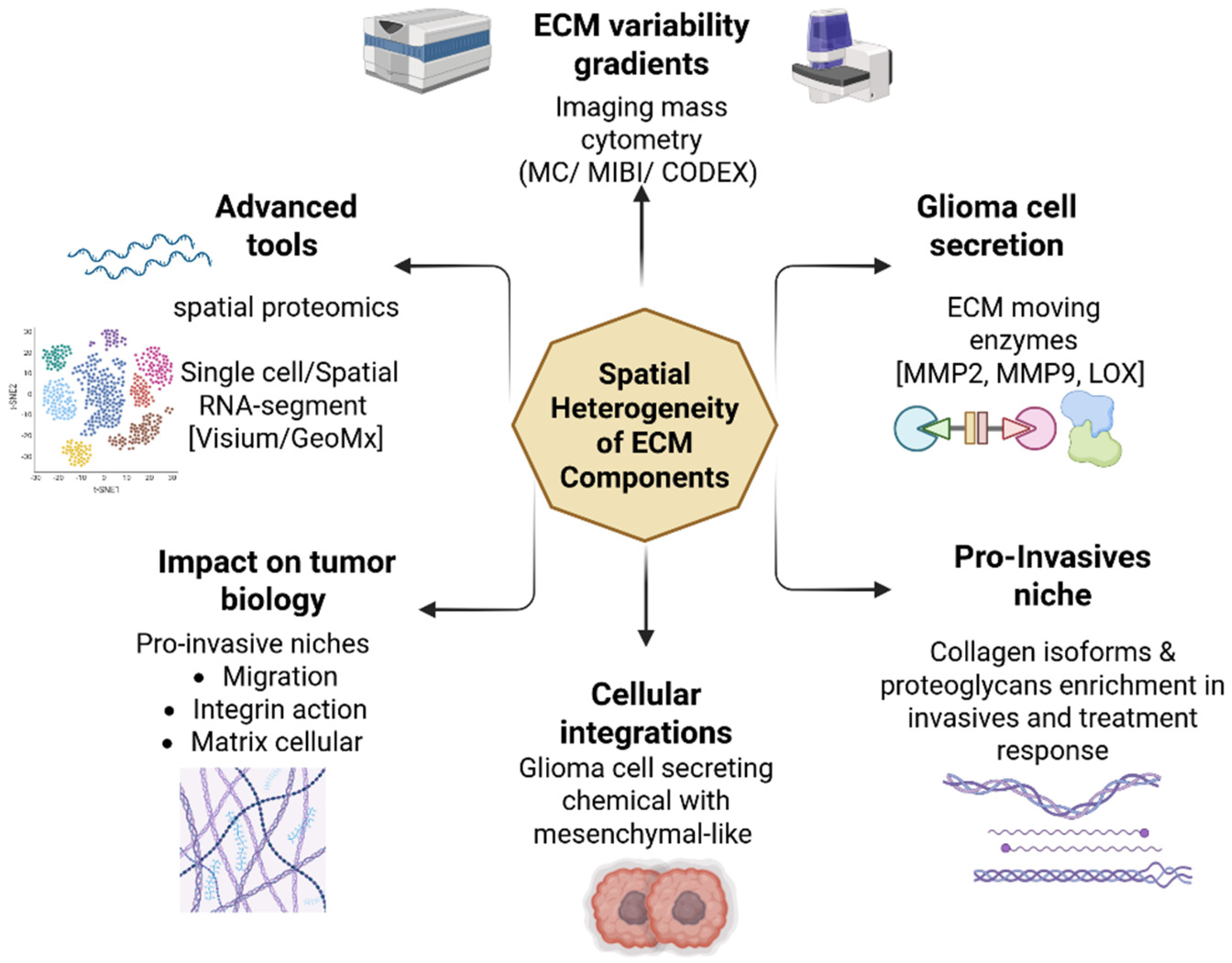
6. Spatial Heterogeneity of ECM Components
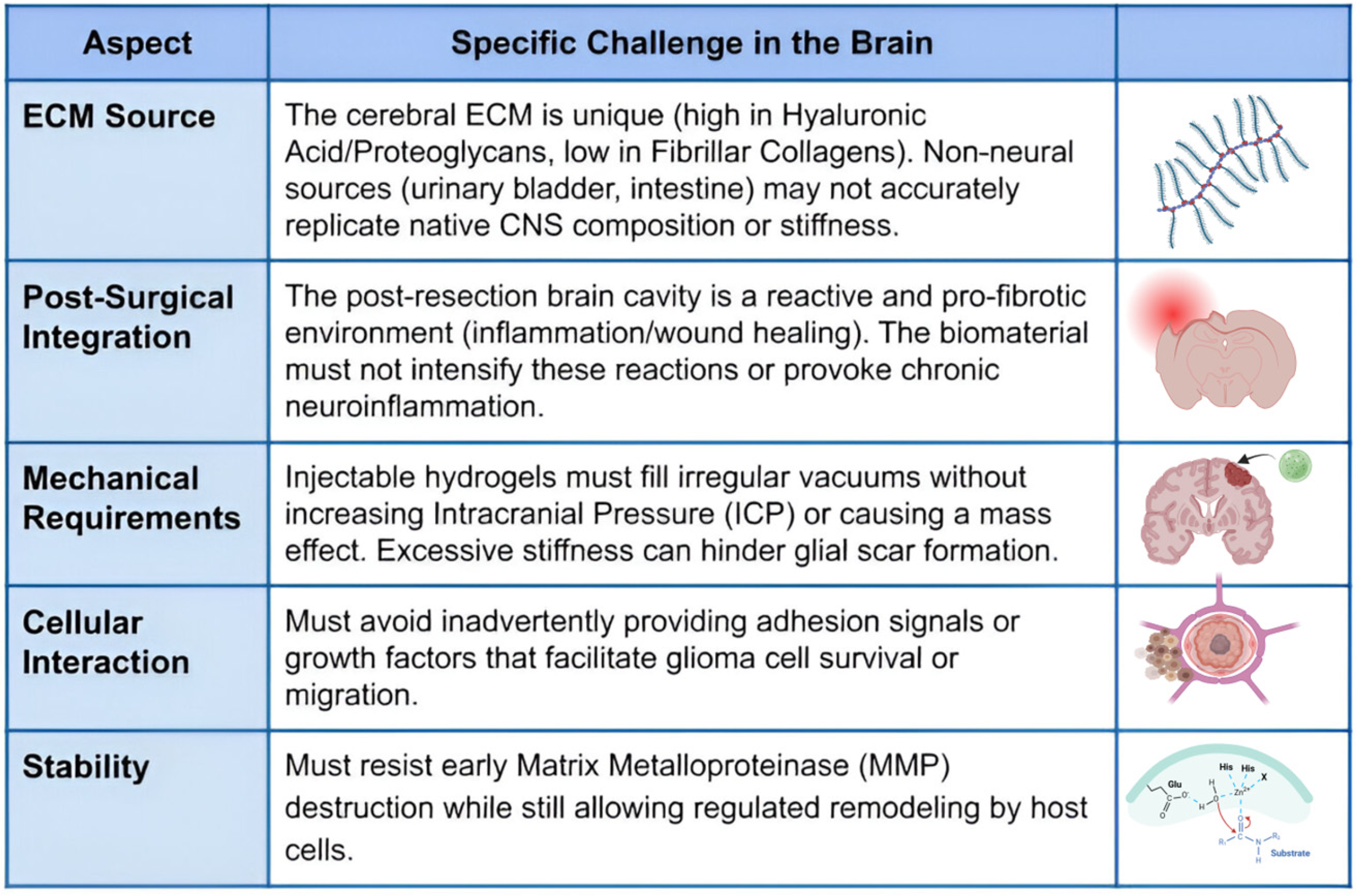
7. Extracellular Matrix-Based Biomaterials and Extracellular Matrix Hydrogels
8. Discussion
- Tumor adaptability and biomechanical compensation: Gliomas demonstrate significant plasticity. Focusing on a specific ECM component or remodeling enzyme frequently results in the compensatory activation of alternative signaling pathways or the upregulation of additional matrix components, thereby circumventing the therapeutic intervention and contributing to treatment resistance [166,167].
- Inadequate specificity in ECM-targeting: The extracellular matrix in the brain is essential for normal neural function. Broad-spectrum ECM-targeting agents exhibit insufficient specificity to differentiate between the pathological tumor matrix and the healthy brain matrix, resulting in significant neurotoxicity and restricting clinical applicability [168].
- Tumor heterogeneity, characterized by the spatial and temporal variability of the extracellular matrix (ECM), suggests that a uniform therapeutic approach is improbable to yield efficacy across the entire tumor mass or throughout the disease progression. The invasive margin, distinguished by elevated stiffness and particular extracellular matrix components, necessitates an alternative approach compared to the less rigid tumor core [169].
9. Clinical Trials and Limitations
10. Conclusions and Perspectives
Author Contributions
Funding
Data Availability Statement
Conflicts of Interest
Abbreviations
| ECM | Extracellular Matrix |
| GBM | Glioblastoma Multiforme |
| BBB | Blood–Brain Barrier |
| MMPs | Matrix Metalloproteinases |
| LOXs | Lysyl Oxidases |
| GSC | Glioma Stem Cells |
| FAKs | Focal Adhesion Kinases |
| YAP/TAZ | Yes-Associated Protein/Transcriptional Coactivator with PDZ-binding motif |
| PI3K/AKT | Phosphoinositide 3-Kinase/Protein Kinase B |
| MAPK | Mitogen-Activated Protein Kinase |
| ERK | Extracellular signal-Regulated Kinase |
| AFM | Atomic Force Microscopy |
| Evs | Extracellular Vesicles |
| CSF | Cerebrospinal Fluid |
| SVZ | Subventricular Zone |
| Cx43 | Connexin-43 |
| AQP4 | Aquaporin-4 |
| HSPGs | Heparan Sulphate Proteoglycans |
| HA | Hyaluronic Acid |
| DiI | 1,1′-dioctadecyl-3,3,3′,3′-tetramethylindocarbocyanine (DiIC18(3)) |
| MRE | Magnetic Resonance Elastography |
| MIBI | Multiplexed Ion Beam Imaging |
| CODEX | Co-Detection by Indexing |
References
- Xiao, W.; Wang, S.; Zhang, R.; Sohrabi, A.; Yu, Q.; Liu, S.; Ehsanipour, A.; Liang, J.; Bierman, R.D.; Nathanson, D.A.; et al. Bioengineered scaffolds for 3D culture demonstrate extracellular matrix-mediated mechanisms of chemotherapy resistance in glioblastoma. Matrix Biol. 2020, 85–86, 128–146. [Google Scholar] [CrossRef]
- Naba, A.; Clauser, K.R.; Ding, H.; Whittaker, C.A.; Carr, S.A.; Hynes, R.O. The extracellular matrix: Tools and insights for the “omics” era. Matrix Biol. 2016, 49, 10–24. [Google Scholar] [CrossRef] [PubMed]
- Frantz, C.; Stewart, K.M.; Weaver, V.M. The extracellular matrix at a glance. J. Cell Sci. 2010, 123, 4195–4200. [Google Scholar] [CrossRef] [PubMed]
- Dityatev, A.; Fellin, T. Extracellular matrix in plasticity and epileptogenesis. Neuron Glia Biol. 2008, 4, 235–247. [Google Scholar] [CrossRef]
- Miroshnikova, Y.A.; Mouw, J.K.; Barnes, J.M.; Pickup, M.W.; Lakins, J.N.; Kim, Y.; Lobo, K.; Persson, A.I.; Reis, G.F.; McKnight, T.R.; et al. Tissue mechanics promote IDH1-dependent HIF1α–tenascin C feedback to regulate glioblastoma aggression. Nat. Cell Biol. 2016, 18, 1336–1345. [Google Scholar] [CrossRef]
- Pickup, M.W.; Mouw, J.K.; Weaver, V.M. The extracellular matrix modulates the hallmarks of cancer. EMBO Rep. 2014, 15, 1243–1253. [Google Scholar] [CrossRef] [PubMed]
- Caffo, M.; Germanó, A.; Caruso, G.; Meli, F.; Galiatoto, S.; Sciacca, M.P.; Tomasello, F. An immunohistochemical study of extracellular matrix proteins laminin, fibronectin and type IV collagen in paediatric glioblastoma multiforme. Acta Neurochir. 2004, 146, 1113–1118. [Google Scholar] [CrossRef]
- Mammoto, T.; Jiang, A.; Jiang, E.; Panigrahy, D.; Kieran, M.W.; Mammoto, A. Role of Collagen Matrix in Tumor Angiogenesis and Glioblastoma Multiforme Progression. Am. J. Pathol. 2013, 183, 1293–1305. [Google Scholar] [CrossRef] [PubMed]
- Pontes, B.; Mendes, F.A. Mechanical Properties of Glioblastoma: Perspectives for YAP/TAZ Signaling Pathway and Beyond. Diseases 2023, 11, 86. [Google Scholar] [CrossRef]
- Dupont, S.; Morsut, L.; Aragona, M.; Enzo, E.; Giulitti, S.; Cordenonsi, M.; Zanconato, F.; Le Digabel, J.; Forcato, M.; Bicciato, S.; et al. Role of YAP/TAZ in mechanotransduction. Nature 2011, 474, 179–183. [Google Scholar] [CrossRef]
- Ulrich, T.A.; de Juan Pardo, E.M.; Kumar, S. The Mechanical Rigidity of the Extracellular Matrix Regulates the Structure, Motility, and Proliferation of Glioma Cells. Cancer Res. 2009, 69, 4167–4174. [Google Scholar] [CrossRef]
- Wang, D.; Anderson, J.C.; Gladson, C.L. The Role of the Extracellular Matrix in Angiogenesis in Malignant Glioma Tumors. Brain Pathol. 2005, 15, 318–326. [Google Scholar] [CrossRef]
- Aitchison, E.E.; Dimesa, A.M.; Shoari, A. Matrix Metalloproteinases in Glioma: Drivers of Invasion and Therapeutic Targets. BioTech 2025, 14, 28. [Google Scholar] [CrossRef]
- Pereira Ferrer, V.; Moura Neto, V.; Mentlein, R. Glioma infiltration and extracellular matrix: Key players and modulators. Glia 2018, 66, 1542–1565. [Google Scholar] [CrossRef] [PubMed]
- Brösicke, N.; Faissner, A. Role of tenascins in the ECM of gliomas. Cell Adhes. Migr. 2015, 9, 131–140. [Google Scholar] [CrossRef]
- Zhang, Q.; Xu, B.; Hu, F.; Chen, X.; Liu, X.; Zhang, Q.; Zuo, Y. Tenascin C Promotes Glioma Cell Malignant Behavior and Inhibits Chemosensitivity to Paclitaxel via Activation of the PI3K/AKT Signaling Pathway. J. Mol. Neurosci. 2021, 71, 1636–1647. [Google Scholar] [CrossRef] [PubMed]
- Zeng, H.; Xu, N.; Liu, Y.; Liu, B.; Yang, Z.; Fu, Z.; Lian, C. Genomic profiling of long non-coding RNA and mRNA expression associated with acquired temozolomide resistance in glioblastoma cells. Int. J. Oncol. 2017, 51, 445–455. [Google Scholar] [CrossRef] [PubMed]
- Kim, Y.; Kumar, S. CD44-mediated adhesion to hyaluronic acid contributes to mechanosensing and invasive motility. Mol. Cancer Res. 2014, 12, 1416–1429. [Google Scholar] [CrossRef]
- Lim, E.-J.; Suh, Y.; Yoo, K.-C.; Lee, J.-H.; Kim, I.-G.; Kim, M.-J.; Chang, J.H.; Kang, S.-G.; Lee, S.-J. Tumor-associated mesenchymal stem-like cells provide extracellular signaling cue for invasiveness of glioblastoma cells. Oncotarget 2017, 8, 1438–1448. [Google Scholar] [CrossRef]
- DePalma, T.J.; Sivakumar, H.; Skardal, A. Strategies for developing complex multi-component in vitro tumor models: Highlights in glioblastoma. Adv. Drug Deliv. Rev. 2022, 180, 114067. [Google Scholar] [CrossRef]
- Pasupuleti, V.; Vora, L.; Prasad, R.; Nandakumar, D.N.; Khatri, D.K. Glioblastoma preclinical models: Strengths and weaknesses. Biochim. Biophys. Acta Rev. Cancer 2024, 1879, 189059. [Google Scholar] [CrossRef]
- Quail, D.F.; Joyce, J.A. The microenvironmental landscape of brain tumors. Cancer Cell 2017, 31, 326–341. [Google Scholar] [CrossRef] [PubMed]
- Hatlen, R.R.; Rajagopalan, P. Environmental interplay: Stromal cells and biomaterial composition influence in the glioblastoma microenvironment. Acta Biomater. 2021, 132, 421–436. [Google Scholar] [CrossRef]
- Horta, M.; Soares, P.; Leita Pereira, C.; Lima, R.T. Emerging Approaches in Glioblastoma Treatment: Modulating the Extracellular Matrix Through Nanotechnology. Pharmaceutics 2025, 17, 142. [Google Scholar] [CrossRef]
- Tsidulko, A.Y.; Shevelev, O.B.; Khotskina, A.S.; Kolpakova, M.A.; Suhovskih, A.V.; Kazanskaya, G.M.; Volkov, A.M.; Aidagulova, S.V.; Zavyalov, E.L.; Grigorieva, E.V. Chemotherapy-Induced Degradation of Glycosylated Components of the Brain Extracellular Matrix Promotes Glioblastoma Relapse Development in an Animal Model. Front. Oncol. 2021, 11, 713139. [Google Scholar] [CrossRef]
- Ellert-Miklaszewska, A.; Poleszak, K.; Pasierbinska, M.; Kaminska, B. Integrin Signaling in Glioma Pathogenesis: From Biology to Therapy. Int. J. Mol. Sci. 2020, 21, 888. [Google Scholar] [CrossRef]
- D’Abaco, G.M.; Kaye, A.H. Integrins: Molecular determinants of glioma invasion. J. Clin. Neurosci. 2007, 14, 1041–1048. [Google Scholar] [CrossRef]
- Liu, E.; Li, W.; Jian, L.; Yin, S.; Yang, S.; Zhao, H.; Huang, W.; Zhang, Y.; Zhou, H. Identification of LOX as a candidate prognostic biomarker in Glioblastoma multiforme. Transl. Oncol. 2023, 36, 101739. [Google Scholar] [CrossRef]
- Liu, C.; Qiao, H.; Li, H.; Hu, X.; Yan, M.; Fu, Z.; Zhang, H.; Wang, Y.; Du, N. Exploring the role of LOX family in glioma progression and immune modulation. Front. Immunol. 2025, 16, 1512186. [Google Scholar] [CrossRef] [PubMed]
- Amendola, P.G.; Reuten, R.; Terra Erler, J. Interplay Between LOX Enzymes and Integrins in the Tumor Microenvironment. Cancers 2019, 11, 729. [Google Scholar] [CrossRef] [PubMed]
- Wei, R.; Zhou, J.; Bui, B.; Liu, X. Glioma actively orchestrates a self-advantageous extracellular matrix to promote recurrence and progression. BMC Cancer 2024, 24, 974. [Google Scholar] [CrossRef]
- Dinevska, M.; Widodo, S.S.; Furst, L.; Cuzcano, L.; Fang, Y.; Mangiola, S.; Neeson, P.K.D.; Ramsay, R.G.; Hutchinson, R.; MacKay, F.; et al. Cell signaling activation and extracellular matrix remodeling underpin glioma tumor microenvironment heterogeneity and organization. Cell. Oncol. 2023, 46, 589–602. [Google Scholar] [CrossRef]
- Mahesparan, R.; Read, T.A.; Lund-Johansen, M.; Skaftnesmo, K.O.; Bjerkvig, R.; Engerbraaten, O. Expression of extracellular matrix components in a highly infiltrative in vivo glioma model. Acta Neuropathol. 2003, 105, 49–57. [Google Scholar] [CrossRef]
- Singh, K.; Hotchkiss, K.M.; Patel, K.K.; Wilkinson, D.S.; Mohan, A.A.; Cook, S.L.; Sampson, J.H. Enhancing T Cell Chemotaxis and Infiltration in Glioblastoma. Cancers 2021, 13, 5367. [Google Scholar] [CrossRef]
- Bellail, A.C.; Hunter, S.B.; Brat, D.J.; Tan, C.; Van Meir, E.G. Microregional extracellular matrix heterogeneity in brain modulates glioma cell invasion. Int. J. Biochem. Cell Biol. 2004, 36, 1046–1069. [Google Scholar] [CrossRef] [PubMed]
- Khoonkari, M.; Liang, D.; Kamperman, M.; Kruyt, F.A.E.; van Rijn, P. Remodeling and homeostasis of the extracellular matrix: Implications for fibrotic diseases and cancer. Dis. Models Mech. 2011, 4, 165–178. [Google Scholar] [CrossRef]
- Pogoda, K.; Chin, L.; Georges, P.C.; Byfield, F.J.; Bucki, R.; Kim, R.; Weaver, M.; Wells, R.G.; Marcinkiewicz, C.; Janmey, P.A. Compression stiffening of brain and its effect on mechanosensing by glioma cells. New J. Phys. 2014, 16, 075002. [Google Scholar] [CrossRef] [PubMed]
- Umesh, V.; Rape, A.D.; Ulrich, T.A.; Kumar, S. Microenvironmental stiffness enhances glioma cell proliferation by stimulating epidermal growth factor receptor signaling. PLoS ONE 2014, 9, e101771. [Google Scholar] [CrossRef]
- Kh, A.G.; Domino, J.S.; Chamoun, R.; Thomas, S.M. Mechanical Properties in the Glioma Microenvironment: Emerging Insights and Theranostic Opportunities. Front. Oncol. 2022, 11, 805628. [Google Scholar] [CrossRef]
- Streitberger, K.J.; Reiss-Zimmermann, M.; Baptist Freimann, F.; Bayerl, S.; Guo, J.; Arlt, F.; Wuerfel, J.; Braun, J.; Hoffmann, K.-T.; Sack, I. High-resolution mechanical imaging of glioblastoma by multifrequency magnetic resonance elastography. PLoS ONE 2014, 9, e110588. [Google Scholar] [CrossRef]
- Deng, B.; Zhao, Z.; Kong, W.; Han, C.; Shen, X.; Zhou, C. Biological role of matrix stiffness in tumor growth and treatment. J. Transl. Med. 2022, 20, 540. [Google Scholar] [CrossRef]
- Lucci, G.; Agosti, A.; Ciarletta, P.; Giverso, C. Coupling solid and fluid stresses with brain tumour growth and white matter tract deformations in a neuroimaging-informed model. Biomech. Model. Mechanobiol. 2022, 21, 1483–1509. [Google Scholar] [CrossRef] [PubMed]
- Khoonkari, M.; Liang, D.; Kamperman, M.; Kruyt, F.A.E.; van Rijn, P. Physics of Brain Cancer: Multiscale Alterations of Glioblastoma Cells under Extracellular Matrix Stiffening. Pharmaceutics 2022, 14, 1031. [Google Scholar] [CrossRef]
- Yui, A.; Oudin, M.J. The Rigidity Connection: Matrix Stiffness and Its Impact on Cancer Progression. Cancer Res. 2024, 84, 958–960. [Google Scholar] [CrossRef]
- Cha, J.; Ding, E.A.; Carvalho, E.M.; Fowler, A.; Aghi, M.K.; Kumar, S. Collagen VI deposition primes the glioblastoma microenvironment for invasion through mechanostimulation of β-catenin signaling. PNAS Nexus 2024, 3, pgae355. [Google Scholar] [CrossRef] [PubMed]
- Payne, L.S.; Huang, P.H. The pathobiology of collagens in glioma. Mol. Cancer Res. 2013, 11, 1129–1140. [Google Scholar] [CrossRef] [PubMed]
- Hardee, M.E.; Zagzag, D. Mechanisms of glioma-associated neovascularization. Am. J. Pathol. 2012, 181, 1126–1141. [Google Scholar] [CrossRef]
- Hatoum, A.; Mohammed, R.; Zakieh, O. The unique invasiveness of glioblastoma and possible drug targets on extracellular matrix. Cancer Manag. Res. 2019, 11, 1843–1855. [Google Scholar] [CrossRef]
- Wade, A.; Robinson, A.; Engler, J.R.; Petritsch, C.; James, C.D.; Phillips, J.J. Proteoglycans and their roles in brain cancer. FEBS J. 2013, 280, 2399–2417. [Google Scholar] [CrossRef]
- Nakada, M.; Okada, Y.; Yamashita, J. The role of matrix metalloproteinases in glioma invasion. Front. Biosci. 2003, 8, e261–e269. [Google Scholar] [CrossRef]
- Marino, S.; Menna, G.; Di Bonaventura, R.; Lisi, L.; Mattogno, P.; Figa, F.; Bilgin, L.; D’Alessandris, Q.G.; Olivi, A.; Della Pepa, G.M. The extracellular matrix in glioblastomas: A glance at its structural modifications in shaping the tumoral microenvironment—A systematic review. Cancers 2023, 15, 1879. [Google Scholar] [CrossRef]
- Voutouri, C.; Polydorou, C.; Papageorgis, P.; Gkretsi, V.; Stylianopoulos, T. Hyaluronan-derived swelling of solid tumors, the contribution of collagen and cancer cells, and implications for cancer therapy. Neoplasia 2016, 18, 732–741. [Google Scholar] [CrossRef]
- Pogoda, K.; Bucki, R.; Byfield, F.J.; Cruz, K.; Lee, T.; Marcinkiewicz, C.; Janmey, P.A. Soft Substrates Containing Hyaluronan Mimic the Effects of Increased Stiffness on Morphology, Motility, and Proliferation of Glioma Cells. Biomacromolecules 2017, 18, 3040–3051. [Google Scholar] [CrossRef]
- Wiranowska, M.; Ladd, S.; Moscinski, L.C.; Hill, B.; Haller, E.; Mikecz, K. Modulation of hyaluronan production by CD44 positive glioma cells. Int. J. Cancer 2010, 127, 532–542. [Google Scholar] [CrossRef]
- Sadeghi, N.; Camby, I.; Goldman, S.; Gabius, H.J.; Balériaux, D.; Salmon, I.; Decaesteckere, C.; Kiss, R.; Metens, T. Effect of Hydrophilic Components of the Extracellular Matrix on Quantifiable Diffusion-Weighted Imaging of Human Gliomas: Preliminary Results of Correlating Apparent Diffusion Coefficient Values and Hyaluronan Expression Level. Am. J. Roentgenol. 2003, 181, 235–241. [Google Scholar] [CrossRef]
- de Sostoa, J.; Marinari, E.; Pedard, M.; Widmer, V.; Davanture, S.; Schaller, K.; Tissot, S.; De Palma, M.; Wolff, B.; Orend, G.; et al. Targeting the extracellular matrix with Tenascin-C-specific CAR T cells extends survival in preclinical models of glioblastoma. J. Immunother. Cancer 2025, 13, e011382. [Google Scholar] [CrossRef] [PubMed]
- Hirata, E.; Arakawa, Y.; Shirahata, M.; Yamaguchi, M.; Kishi, Y.; Okada, T. Endogenous tenascin-C enhances glioblastoma invasion with reactive change of surrounding brain tissue. Cancer Sci. 2009, 100, 1451–1459. [Google Scholar] [CrossRef]
- Rao, J.S. Molecular mechanisms of glioma invasiveness: The role of proteases. Nat. Rev. Cancer 2003, 3, 489–501. [Google Scholar] [CrossRef] [PubMed]
- Inoue, A.; Takahashi, H.; Harada, H.; Kohno, S.; Ohue, S.; Kobayashi, K.; Yano, H.; Tanaka, J.; Ohnishi, T. Cancer stem-like cells of glioblastoma characteristically express MMP-13 and display highly invasive activity. Int. J. Oncol. 2010, 37, 1121–1131. [Google Scholar] [CrossRef] [PubMed]
- Pullen, N.A.; Pickford, A.R.; Perry, M.A.; Jaworski, D.M.; Loverson, K.F.; Arthur, D.J.; Holliday, J.R.; Van Meter, T.E.; Peckham, R.; Younas, W.; et al. Current insights into matrix metalloproteinases and glioma progression: Transcending the degradation boundary. Met. Med. 2018, 5, 13–30. [Google Scholar] [CrossRef]
- Wang, C.; Tong, X.; Jiang, X.; Yang, F. Effect of Matrix Metalloproteinase-Mediated Matrix Degradation on Glioblastoma Cell Behavior in 3D PEG-based Hydrogels. J. Biomed. Mater. Res. Part A 2016, 105, 770–778. [Google Scholar] [CrossRef]
- Sato, Y.; Kiyozumi, D.; Futaki, S.; Nakano, I.; Shimono, C.; Kaneko, N.; Ikawa, M.; Okabe, M.; Sawamoto, K.; Sekiguchi, K. Ventricular-subventricular zone fractones are speckled basement membranes that function as a neural stem cell niche. Mol. Biol. Cell 2019, 30, 56–68. [Google Scholar] [CrossRef] [PubMed]
- Mercier, F. Fractones: Extracellular matrix niche controlling stem cell fate and growth factor activity in the brain in health and disease. Cell. Mol. Life Sci. 2016, 73, 4661–4674. [Google Scholar] [CrossRef] [PubMed]
- Kerever, A.; Schnack, J.; Veilinga, D.; Ichikawa, N.; Moon, C.; Arikawa-Hirasawa, E.; Efird, J.T.; Mercier, F. Novel extracellular matrix structures in the neural stem cell niche capture the neurogenic factor fibroblast growth factor 2 from the extracellular milieu. Stem Cells 2007, 25, 2146–2157. [Google Scholar] [CrossRef] [PubMed]
- Faissner, A.; Reinhard, J. The extracellular matrix compartment of neural stem and glial progenitor cells. Glia 2015, 63, 1330–1349. [Google Scholar] [CrossRef]
- Oushy, S.; Hellwinkel, J.E.; Wang, M.; Nguyen, G.J.; Gunaydin, D.; Harland, T.A.; Anchordoquy, T.J.; Graner, M.W. Glioblastoma multiforme-derived extracellular vesicles drive normal astrocytes towards a tumour-enhancing phenotype. Philos. Trans. R. Soc. Lond. B Biol. Sci. 2018, 373, 20160477. [Google Scholar] [CrossRef]
- Skog, J.; Würdinger, T.; van Rijn, S.; Meijer, D.H.; Gainche, L.; Curry, W.T.; Carter, B.S.; Krichevsky, A.M.; Breakefield, X.O. Glioblastoma microvesicles transport RNA and proteins that promote tumour growth and provide diagnostic biomarkers. Nat. Cell Biol. 2008, 10, 1470–1476. [Google Scholar] [CrossRef]
- D’Asti, E.; Garnier, D.; Lee, T.H.; Montermini, L.; Meehan, B.; Rak, J. Oncogenic extracellular vesicles in brain tumor progression. Front. Physiol. 2016, 7, 294. [Google Scholar] [CrossRef]
- Simon, T.; Jackson, E.; Giamas, G. Breaking through the glioblastoma micro-environment via extracellular vesicles. Oncogene 2020, 39, 4477–4490. [Google Scholar] [CrossRef]
- Del Bene, M.; Osti, D.; Faletti, S.; Beznoussenko, G.V.; DiMeco, F.; Pelicci, G. Extracellular vesicles: The key for precision medicine in glioblastoma. Neuro-Oncol. 2022, 24, 184–196. [Google Scholar] [CrossRef]
- Koessinger, D.; Novo, D.; Koessinger, A.; Campos, A.; Peters, J.; Dutton, L.; Paschke, P.; Zerbst, D.; Moore, M.; Mitchel, L.; et al. Glioblastoma extracellular vesicles influence glial cell hyaluronic acid deposition to promote invasiveness. Neuro-Oncol. Adv. 2023, 5, vdad067. [Google Scholar] [CrossRef]
- Matarredona, E.R.; Pastor, A.M. Extracellular vesicles-mediated communication between the glioblastoma and its microenvironment. Cells 2020, 9, 96. [Google Scholar] [CrossRef]
- Mondal, A.; Singh, D.K.; Panda, S.; Shiras, A. Extracellular Vesicles as Modulators of Tumor Microenvironment and Disease Progression in Glioma. Front. Oncol. 2017, 7, 144. [Google Scholar] [CrossRef]
- Romani, P.; Valcarcel-Jimenez, L.; Frezza, C.; Dupont, S. Crosstalk between mechanotransduction and metabolism. Nat. Rev. Mol. Cell Biol. 2021, 22, 22–38. [Google Scholar] [CrossRef] [PubMed]
- Reuss, M.; Groos, D.; Buchfelder, M.; Savaskan, N. The Acidic Brain—Glycolytic Switch in the Microenvironment of Malignant Glioma. Int. J. Mol. Sci. 2021, 22, 5518. [Google Scholar] [CrossRef] [PubMed]
- Virtuoso, A.; Giovannoni, R.; De Luca, C.; Gargano, F.; Cerasuolo, M.; Maggio, N.; Lavitrano, M.; Papa, M. The Glioblastoma Microenvironment: Morphology, Metabolism, and Molecular Signature of Glial Dynamics to Discover Metabolic Rewiring Sequence. Int. J. Mol. Sci. 2018, 22, 3301. [Google Scholar] [CrossRef] [PubMed]
- Rosberg, R.; Smolag, K.I.; Sjölund, J.; Johansson, E.; Bergelin, C.; Wahldén, J.; Pantazopoulou, V.; Ceberg, C.; Pietras, K.; Blom, A.M.; et al. Hypoxia-induced complement component 3 promotes aggressive tumor growth in the glioblastoma microenvironment. JCI Insight 2024, 9, e179854. [Google Scholar] [CrossRef]
- Linares, C.; Varghese, A.; Ghose, A.; Shinde, S.D.; Adeleke, S.; Sanchez, E.; Sheriff, M.; Chargari, C.; Rassy, E.; Boussios, S. Hallmarks of the Tumour Microenvironment of Gliomas and Its Interaction with Emerging Immunotherapy Modalities. Int. J. Mol. Sci. 2023, 24, 13215. [Google Scholar] [CrossRef]
- Di Vito, A.; Donato, A.; Bria, J.; Conforti, F.; La Torre, D.; Malara, N.; Donato, G. Extracellular Matrix Structure and Interaction with Immune Cells in Adult Astrocytic Tumors. Cell. Mol. Neurobiol. 2024, 44, 54. [Google Scholar] [CrossRef]
- Mai, Z.; Lin, Y.; Lin, P.; Zhao, X.; Cui, L. Modulating extracellular matrix stiffness: A strategic approach to boost cancer immunotherapy. Cell Death Dis. 2021, 15, 307. [Google Scholar] [CrossRef]
- Zhang, Y.; He, H.; Fu, X.; Liu, G.; Wang, H.; Zhong, W.; Xu, X.; Chen, B.; Mei, L. Glioblastoma-associated macrophages in glioblastoma: From their function and mechanism to therapeutic advances. Cancer Gene Ther. 2025, 32, 595–607. [Google Scholar] [CrossRef] [PubMed]
- Tataranu, L.G.; Turliuc, S.; Kamel, A.; Rizea, R.E.; Dricu, A.; Staicu, G.-A.; Carina Baloi, S.; Baez Rodriguez, S.M.; Manole, A.I.M. Glioblastoma Tumor Microenvironment: An Important Modulator for Tumoral Progression and Therapy Resistance. Curr. Issues Mol. Biol. 2024, 46, 9881–9894. [Google Scholar] [CrossRef]
- Xiao, W.; Sohrabi, A.; Seidlits, S. Integrating the Glioblastoma Microenvironment into Engineered Experimental Models. Future Sci. OA 2017, 3, FSO189. [Google Scholar] [CrossRef]
- Suarez-Meade, P.; Whitehead, R.; Clemenceau, J.; Norton, E.; Tanmay, K.; Hong, C.; Teeter, C.; Aramburu, M.; Chaichana, K.; Rosenfeld, S.S. TMIC-67. Emerging role of extracellular matrix stiffness as a hallmark of glioblastoma: Insight to mechanical memory formation and prolonged invasion in the tumor periphery. Neuro-Oncol. 2024, 26 (Suppl. 8), viii313. [Google Scholar] [CrossRef]
- Mierke, C.T. Impact of the ECM on the Mechanical Memory of Cancer Cells. Cells 2025, 14, 1707. [Google Scholar] [CrossRef] [PubMed]
- Castillo, C.; Grieco, M.; D’Amone, S.; Lolli, M.G.; Ursini, O.; Cortese, B. Hypoxia effects on glioblastoma progression through YAP/TAZ pathway regulation. Cancer Lett. 2024, 588, 216792. [Google Scholar] [CrossRef]
- Castellan, M.; Guarnieri, A.; Fujimura, A.; Zanconato, F.; Battilana, G.; Panciera, T.; Sladitscheck, H.L.; Contessotto, P.; Citron, A.; Grilli, A.; et al. Single-cell analyses reveal YAP/TAZ as regulators of stemness and cell plasticity in glioblastoma. Nat. Cancer 2020, 2, 174–188. [Google Scholar] [CrossRef]
- Seker-Polat, F.; Degirmenci, N.P.; Solaroglu, I.; Bagci-Onder, T. Tumor Cell Infiltration into the Brain in Glioblastoma: From Mechanisms to Clinical Perspectives. Cancers 2022, 14, 443. [Google Scholar] [CrossRef]
- Fukuya, Y.; Ikuta, S.; Maruyama, T.; Nitta, M.; Saito, T.; Tsuzuki, S.; Chernov, M.; Kawamata, T.; Muragaki, Y. Tumor recurrence patterns after surgical resection of intracranial low-grade gliomas. J. Neuro-Oncol. 2019, 144, 519–528. [Google Scholar] [CrossRef]
- Kim, S.; Lim, E.; Yoo, K.; Zhao, Y.; Kang, J.; Jim, E.; Shin, I.; Kang, S.; Lim, H.W.; Lee, S. Glioblastoma-educated mesenchymal stem-like cells promote glioblastoma infiltration via extracellular matrix remodelling in the tumour microenvironment. Clin. Transl. Med. 2022, 12, e997. [Google Scholar] [CrossRef]
- Vamsi Kondapaneni, R.; Kumar Gurung, S.; Nakod, P.S.; Goodarzi, K.; Yakati, V.; Lenart, N.A.; Rao, S.S. Glioblastoma mechanobiology at multiple length scales. Biomater. Adv. 2024, 160, 213860. [Google Scholar] [CrossRef]
- Broders-Bondon, F.; Nguyen Ho-Bouldoires, T.H.; Fernandez-Sanchez, M.E.; Farge, E. Mechanotransduction in tumor progression: The dark side of the force. J. Cell Biol. 2018, 217, 1571–1587. [Google Scholar] [CrossRef]
- Huang, L.; Zhan, J.; Li, J.; Huang, K.; Zhu, X.; Li, J. The roles of extracellular vesicles in gliomas: Challenge or opportunity? Life Sci. 2024, 358, 123150. [Google Scholar] [CrossRef]
- Yekula, A.; Yekula, A.; Muralidharan, K.; Kang, K.; Karter, B.S.; Balaj, L. Extracellular Vesicles in Glioblastoma Tumor Microenvironment. Front. Immunol. 2020, 10, 3137. [Google Scholar] [CrossRef]
- Matias, D.; Balça-Silva, J.; da Graça, G.C.; Wanjiru, C.M.; Macharia, L.W.; Pires Nascimento, C.; Roque, N.R.; Coelho-Aguilar, J.M.; Pereira, C.M.; Dos Santos, M.F.; et al. Microglia/Astrocytes–Glioblastoma Crosstalk: Crucial Molecular Mechanisms and Microenvironmental. Front. Cell. Neurosci. 2018, 12, 235. [Google Scholar] [CrossRef]
- Matias, D.; Predes, D.; Niemeyer Filho, P.; Lopes, M.C.; Abreu, J.G.; Lima, F.R.S.; Moura Neto, V. Microglia-glioblastoma interactions: New role for Wnt signaling. Biochim. Biophys. Acta-Rev. Cancer 2017, 1868, 333–340. [Google Scholar] [CrossRef] [PubMed]
- Cunha Barbosa, L.; Cardoso Machado, G.; Heringer, M.; Pereira Ferrer, V. Identification of established and novel extracellular matrix components in glioblastoma as targets for angiogenesis and prognosis. Neurogenetics 2024, 25, 249–262. [Google Scholar] [CrossRef]
- Chen, C.-R.; Chang, R.-S.; Chen, C.-S. Identification of Prognostic Genes in Gliomas Based on Increased Microenvironment Stiffness. Cancers 2022, 14, 3659. [Google Scholar] [CrossRef] [PubMed]
- Pombero, A.; García-López, R.; Martínez, S. Pericyte–Glioblastoma Cell Interaction: A Key Target to Prevent Glioblastoma Progression. Cells 2023, 12, 1324. [Google Scholar] [CrossRef] [PubMed]
- Taylor, K.R.; Barron, T.; Hui, A.; Spitzer, A.; Yalçin, B.; Elvec, A.E.; Geraghty, A.C.; Hartmann, G.G.; Arzt, M.; Gillespie, S.M.; et al. Glioma synapses recruit mechanisms of adaptive plasticity. Nature 2023, 623, 366–374. [Google Scholar] [CrossRef]
- Duan, K.; Liu, Z.-J.; Hu, S.-Q.; Huo, H.-Y.; Xu, Z.-R.; Ruan, J.-F.; Sun, Y.; Dai, L.; Yan, C.; Xiong, W.; et al. Lactic acid induces lactate transport and glycolysis/OXPHOS interconversion in glioblastoma. Biochem. Biophys. Res. Commun. 2018, 503, 888–894. [Google Scholar] [CrossRef]
- Barzehgar Behrooz, A.; Talaie, Z.; Jusheghani, F.; Los, M.K.; Klonisch, T.; Ghavami, S. Wnt and PI3K/Akt/mTOR Survival Pathways as Therapeutic Targets in Glioblastoma. Int. J. Mol. Sci. 2022, 23, 1353. [Google Scholar] [CrossRef] [PubMed]
- Brighi, C.; Puttick, S.; Rose, S.; Whittaker, A.K. The potential for remodelling the tumour vasculature in glioblastoma. Adv. Drug Deliv. Rev. 2018, 136–137, 49–61. [Google Scholar] [CrossRef]
- Sun, R.; Kim, A.H. The multifaceted mechanisms of malignant glioblastoma progression and clinical implications. Cancer Metastasis Rev. 2022, 41, 871–898. [Google Scholar] [CrossRef]
- Aguilera-Márquez, J.D.R.; de Dios-Figueroa, G.T.; Reza-Saldivar, E.E.; Camacho-Villegas, T.A.; Canales-Aguirre, A.A.; Lugo-Fabres, P.H. Biomaterials: Emerging systems for study and treatment of glioblastoma. Neurol. Perspect. 2022, 2, S31–S42. [Google Scholar] [CrossRef]
- Chen, J.; Wu, Q.; Berglund, A.; Macaulay, R.; Mulé, J.; Etame, A. Tumor-Associated Macrophages in Glioblastoma: Mechanisms of Tumor Progression and Therapeutic Strategies. Cells 2025, 14, 1458. [Google Scholar] [CrossRef]
- Mahaffey, B.J.; Fowler, Z.P.; Lung, Z.; Dang, V.; Lee, H.; Johnson, A.M.; Munoz, M.A.; Goodin, D.A.; Frieboes, H.B.; Williams, B.J.; et al. The prognostic effect of mechanical, ultrastructural, and ECM signatures in glioblastoma core and rim. Appl. Bioeng. 2024, 8, 036101. [Google Scholar] [CrossRef] [PubMed]
- Rey, J.A.; Ewing, J.R.; Sarntinoranont, M. A computational model of glioma reveals opposing, stiffness-sensitive effects of leaky vasculature and tumor growth on tissue mechanical stress and porosity. Biomech. Model. Mechanobiol. 2021, 20, 1981–2000. [Google Scholar] [CrossRef]
- Stylianopoulos, T.; Martin, J.D.; Snuderl, M.; Mpekris, F.; Jain, S.R.; Jain, R.K. Coevolution of solid stress and interstitial fluid pressure in tumors during progression: Implications for vascular collapse. Cancer Res. 2013, 73, 3833–3841. [Google Scholar] [CrossRef]
- Provenzano, P.; Cuevas, C.; Chang, A.; Goel, V.; Von Hoff, D.; Hingorani, S. Enzymatic targeting of the stroma ablates physical barriers to treatment of pancreatic ductal adenocarcinoma. Cancer Cell 2012, 21, 418–429. [Google Scholar] [CrossRef] [PubMed]
- Nia, H.T.; Datta, M.; Kumar, A.S.; Siri, S.; Ferraro, G.B.; Chatterjee, S.; McHugh, J.M.; Ng, P.R.; West, T.R.; Rapalino, O.; et al. Solid Stress Estimations via Intraoperative 3D Navigation in Patients with Brain Tumors. Clin. Cancer Res. 2025, 31, 3571–3580. [Google Scholar] [CrossRef]
- Nia, H.; Munn, L.; Jain, R.K. Physical traits of cancer. Science 2020, 370, eaaz0868. [Google Scholar] [CrossRef]
- Wu, J.; Li, R.; Wang, J.; Zhu, H.; Ma, Y.; You, C.; Shu, K. Reactive Astrocytes in Glioma: Emerging Opportunities and Challenges. Int. J. Mol. Sci. 2025, 26, 2907. [Google Scholar] [CrossRef]
- Riemenschneider, M.J.; Mueller, W.; Betensky, R.A.; Mohapatra, G.; Louis, D.N. In situ analysis of integrin and growth factor receptor signaling pathways in human glioblastomas suggests overlapping relationships with focal adhesion kinase activation. Am. J. Pathol. 2005, 167, 1379–1387. [Google Scholar] [CrossRef]
- Cieśluk, M.; Pogoda, K.; Piktel, E.; Wnorowska, U.; Deptula, P.; Bucki, R. Mechanical Properties of the Extracellular Environment of Human Brain Cells Drive the Effectiveness of Drugs in Fighting Central Nervous System Cancers. Brain Sci. 2022, 12, 927. [Google Scholar] [CrossRef]
- Kim, O.-H.; Jahan Tulip, I.; Kang, H.; Chang, E.S.; Lee, H.J. Compression force promotes glioblastoma progression through the Piezo1-GDF15-CTLA4 axis. Oncol. Rep. 2024, 53, 2. [Google Scholar] [CrossRef]
- Kalli, M.; Voutouri, C.; Minia, A.; Pliaka, V.; Fotis, C.; Alexopoulos, L.G.; Stylianopoulos, T. Mechanical Compression Regulates Brain Cancer Cell Migration Through MEK1/Erk1 Pathway Activation and GDF15 Expression. Front. Oncol. 2019, 9, 992. [Google Scholar] [CrossRef] [PubMed]
- Grossen, A.; Smith, K.; Coulibaly, N.; Arbuckle, B.; Evans, A.; Wilhelm, S.; Jones, K.; Dunn, I.; Towner, R.; Wu, D.; et al. Physical Forces in Glioblastoma Migration: A Systematic Review. Int. J. Mol. Sci. 2022, 23, 4055. [Google Scholar] [CrossRef]
- Seano, G.; Nia, H.; Emblem, K.E.; Datta, M.; Ren, J.; Shanmugarajan, K. Solid stress in brain tumours causes neuronal loss and neurological dysfunction and can be reversed by lithium. Nat. Biomed. Eng. 2019, 3, 230–245. [Google Scholar] [CrossRef] [PubMed]
- Mohiuddin, E.; Wakimoto, H. Extracellular matrix in glioblastoma: Opportunities for emerging therapeutic approaches. Am. J. Cancer Res. 2021, 11, 3742–3754. [Google Scholar] [PubMed] [PubMed Central]
- Nia, H.T.; Datta, M.; Seano, G.; Huang, P.; Munn, L.L.; Jain, R.K. In vivo compression and imaging in mouse brain to study cancer mechanobiology. Nat. Protoc. 2017, 15, 2321–2340. [Google Scholar] [CrossRef]
- Norton, E.S.; Whaley, L.A.; Ulloa-Navas, M.J.; García-Tárraga, P.; Meneses, K.M.; Lara-Velazquez, M.; Zarco, N.; Carrano, A.; Quiñones-Hinojosa, A.; García-Verdugo, J.M.; et al. Glioblastoma disrupts the ependymal wall and extracellular matrix structures of the subventricular zone. Fluids Barriers CNS 2022, 19, 58. [Google Scholar] [CrossRef]
- Kemmerer, C.L.; Schittenhelm, J.; Dubois, E.; Neumann, L.; Häsler, L.M.; Lambert, M.; Renovanz, M.; Kaeser, S.A.; Tabatabai, G.; Ziemann, U.; et al. Cerebrospinal fluid cytokine levels are associated with macrophage infiltration into tumor tissues of glioma patients. BMC Cancer 2021, 21, 1108. [Google Scholar] [CrossRef] [PubMed]
- Ziu, M.; Ole Schmidt, N.; Cargioli, T.G.; Aboody, K.S.; McL Black, P.; Carroll, R.S. Glioma-produced extracellular matrix influences brain tumor tropism of human neural stem cells. J. Neuro-Oncol. 2006, 79, 125–133. [Google Scholar] [CrossRef]
- Kerever, A.; Arikawa-Hirasawa, E. Optimal Extracellular Matrix Niches for Neurogenesis: Identifying Glycosaminoglycan Chain Composition in the Subventricular Neurogenic Zone. Front. Neuroanat. 2021, 15, 764458. [Google Scholar] [CrossRef]
- Xu, D.; Zhou, J.; Mei, H.; Li, H.; Sun, W.; Xu, H. Impediment of Cerebrospinal Fluid Drainage Through Glymphatic System in Glioma. Front. Oncol. 2022, 11, 790821. [Google Scholar] [CrossRef] [PubMed]
- Glantz, M.; Kesari, S.; Recht, L.; Fleischhack, G.; Van Horn, A. Understanding the Origins of Gliomas and Developing Novel Therapies: Cerebrospinal Fluid and Subventricular Zone Interplay. Semin. Oncol. 2009, 36, S17–S24. [Google Scholar] [CrossRef]
- Lim, D.A.; Cha, S.; Mayo, M.C.; Chen, M.H.; Keles, E.; VandenBerg, S.; Berger, M.S. Relationship of glioblastoma multiforme to neural stem cell regions predicts invasive and multifocal tumor phenotype. Neuro-Oncol. 2007, 9, 424–429. [Google Scholar] [CrossRef] [PubMed]
- Goffart, N.; Kroonen, J.; Rogister, B. Glioblastoma-initiating cells: Relationship with neural stem cells and the micro-environment. Cancers 2013, 5, 1049–1071. [Google Scholar] [CrossRef]
- Hallal, S.; Mallawaaratchy, D.M.; Wei, H.; Ebrahimkhani, S.; Stringer, B.W.; Day, B.W.; Boyd, A.W.; Guillemin, G.J.; Buckland, M.E.; Kaufman, K.L. Extracellular vesicles released by glioblastoma cells stimulate normal astrocytes to acquire a tumor-supportive phenotype via p53 and MYC signalling pathways. Mol. Neurobiol. 2019, 56, 4566–4581. [Google Scholar] [CrossRef]
- Castañeyra-Ruiz, L.; González-Marrero, I.; García-Abad, L.H.; Gonzalez-Arnay, E.; Camacho, M.; Carmona-Calero, E.M.; Lee, S.; Tran, C.T.Q.; Hanak, B.W.; Muhonen, M.; et al. Aquaporin-4 in glioblastoma: A nexus of glymphatic dysfunction, edema, immune evasion, and treatment resistance. Front. Cell. Neurosci. 2025, 19, 1685491. [Google Scholar] [CrossRef]
- Rubenstein, B.M.; Kaufman, L.J. The Role of Extracellular Matrix in Glioma Invasion: A Cellular Potts Model Approach. Biophys. J. 2008, 95, 5661–5680. [Google Scholar] [CrossRef]
- Oishi, T.; Koizumi, S.; Kurozumi, K. Molecular Mechanisms and Clinical Challenges of Glioma Invasion. Brain Sci. 2022, 12, 291. [Google Scholar] [CrossRef] [PubMed]
- Faisal, S.M.; Comba, A.; Varela, M.L.; Argento, A.E.; Brumley, E.; Abel, C., II; Castro, M.G.; Lowenstein, P.R. The complex interactions between the cellular and non-cellular components of the brain tumor microenvironmental landscape and their therapeutic implications. Front. Oncol. 2022, 12, 1005069. [Google Scholar] [CrossRef]
- Schiera, G.; Di Liegro, C.M.; Vento, F.; Di Liegro, I. Role of Extracellular Vesicles in the Progression of Brain Tumors. Biology 2024, 13, 586. [Google Scholar] [CrossRef]
- Choi, D.; Montermini, L.; Kim, D.-K.; Meehan, B.; Roth, F.P.; Rack, J. The Impact of Oncogenic EGFRvIII on the Proteome of Extracellular Vesicles Released from Glioblastoma Cells. Mol. Cell. Proteom. 2018, 17, 1948–1964. [Google Scholar] [CrossRef] [PubMed]
- Krapež, G.; Kouter, K.; Jovcevska, I.; Videtic Paska, A. Dynamic Intercell Communication between Glioblastoma and Microenvironment through Extracellular Vesicles. Biomedicines 2022, 10, 151. [Google Scholar] [CrossRef]
- Yeat, N.Y.; Chen, R.-H. Extracellular vesicles: Biogenesis mechanism and impacts on tumor immune microenvironment. J. Biomed. Sci. 2025, 32, 85. [Google Scholar] [CrossRef] [PubMed]
- Dai, J.; Jiang, Y.; Hu, H.; Zhang, S.; Chen, Y. Extracellular vesicles as modulators of glioblastoma progression and tumor microenvironment. Pathol. Oncol. Res. 2024, 30, 1611549. [Google Scholar] [CrossRef]
- Marhuenda, E.; Fabre, C.; Zhang, C.; Martin-Fernandez, M.; Iskratsch, T.; Saleh, A.; Bauchet, L.; Cambedouzou, J.; Hugnot, J.P.; Duffau, H.; et al. Glioma stem cells invasive phenotype at optimal stiffness is driven by MGAT5 dependent mechanosensing. J. Exp. Clin. Cancer Res. 2021, 40, 139. [Google Scholar] [CrossRef]
- Rape, A.; Ananthanarayanan, B.; Kumar, S. Engineering strategies to mimic the glioblastoma microenvironment. Adv. Drug Deliv. Rev. 2014, 79–80, 172–183. [Google Scholar] [CrossRef] [PubMed]
- Ghoroghi, S.; Mary, B.; Asokan, N.; Goetz, J.G.; Hyenne, V. Tumor extracellular vesicles drive metastasis (it’s a long way from home). FASEB BioAdvances 2021, 3, 930–943. [Google Scholar] [CrossRef]
- Sykova, E.; Nicholson, C. Diffusion in brain extracellular space. Physiol. Rev. 2008, 88, 1277–1340. [Google Scholar] [CrossRef]
- Belousov, A.; Titov, S.; Shved, N.; Garbuz, M.; Malykin, G.; Gulaia, V.; Kagansky, A.; Kumeiko, V. The Extracellular Matrix and Biocompatible Materials in Glioblastoma Treatment. Front. Bioeng. Biotechnol. 2019, 7, 341. [Google Scholar] [CrossRef] [PubMed]
- Balakrishnan, A.; Roy, S.; Fleming, T.; Leong, H.S.; Schuurmans, C. The Emerging Role of Extracellular Vesicles in the Glioma Microenvironment: Biogenesis and Clinical Relevance. Cancers 2020, 12, 1964. [Google Scholar] [CrossRef]
- Cela, I.; Capone, E.; Trevisi, G.; Sala, G. Extracellular vesicles in glioblastoma: Biomarkers and therapeutic tools. Semin. Cancer Biol. 2024, 101, 25–43. [Google Scholar] [CrossRef]
- Neftel, C.; Laffy, J.; Filbin, M.G.; Hara, T.; Shore, M.E.; Rahme, G.J.; Richman, A.R.; Silverbush, D.; Shaw, M.L.; Hebert, C.M.; et al. An integrative model of cellular states, plasticity, and genetics for glioblastoma. Cell 2019, 178, 835–849. [Google Scholar] [CrossRef] [PubMed]
- Day, Z.I.; Roberts-Thomson, S.; Nouri, Y.J.; Dalton, N.S.; Wang, S.S.; Davenport, A.; Ludlow, L.E.; Hulett, M.D.; Cross, R.S.; Jenkins, M.R. Defining the extracellular matrix for targeted immunotherapy in adult and pediatric brain cancer. npj Precis. Oncol. 2025, 9, 184. [Google Scholar] [CrossRef]
- Mizraei, R.; D’Mello, C.; Liu, M.; Nikolic, A.; Kumar, M.; Visser, F.; Bose, P.; Gallo, M.; Wee Yong, V. Single-Cell Spatial Analysis Identifies Regulators of Brain Tumor-Initiating Cells. Cancer Res. 2023, 83, 1725–1741. [Google Scholar] [CrossRef]
- Thoppey Manoharan, V.; Abdelkareem, A.; Gill, G.; Brown, S.; Gillmore, A.; Courtney, H.; Seo, H.; Narta, K.; Grewal, S.; Dang, N.H.; et al. Spatiotemporal modeling reveals high-resolution invasion states in glioblastoma. Genome Biol. 2024, 25, 264. [Google Scholar] [CrossRef]
- Lam, K.H.B.; Leon, A.J.; Hui, W.; Che-Eun Lee, S.; Batruch, I.; Faust, K.; Klekner, A.; Hutóczki, G.; Koritzinsky, M.; Richer, M.; et al. Topographic mapping of the glioblastoma proteome reveals a triple-axis model of intratumoral heterogeneity. Nat. Commun. 2022, 13, 116. [Google Scholar] [CrossRef]
- Patel, A.P.; Tirosh, I.; Trombetta, J.J.; Shalek, A.K.; Gillespie, S.M.; Wakimoto, H.; Cahill, D.P.; Nahed, B.V.; Curry, W.T.; Martuza, R.L.; et al. Single-cell RNA-seq highlights intratumoral heterogeneity in primary glioblastoma. Science 2014, 344, 1396–1401. [Google Scholar] [CrossRef]
- He, Z.; Liu, Z.; Wang, Q.; Sima, X.; Zhao, W.; He, C.; Yang, W.; Chen, H.; Gong, B.; Song, S.; et al. Single-cell and spatial transcriptome assays reveal heterogeneity in gliomas through stress responses and pathway alterations. Front. Immunol. 2024, 15, 1452172. [Google Scholar] [CrossRef]
- Vehlow, A.; Klapproth, E.; Jin, S.; Hannen, R.; Hauswald, M.; Bartsch, J.W.; Nimsky, C.; Temme, A.; Leitinger, B.; Cordes, N. Interaction of discoidin domain receptor 1 with a 14-3-3-Beclin-1-Akt1 complex modulates glioblastoma therapy sensitivity. Cell Rep. 2019, 26, 3672–3683. [Google Scholar] [CrossRef]
- Liu, M.; Ji, Z.; Jain, V.; Smith, V.L.; Hocke, E.; Patel, A.P.; McLendon, R.E.; Ashley, D.M.; Gregory, S.G.; López, G.Y. Spatial transcriptomics reveals segregation of tumor cell states in glioblastoma and marked immunosuppression within the perinecrotic niche. Acta Neuropathol. Commun. 2024, 12, 64. [Google Scholar] [CrossRef] [PubMed]
- Jang, H.J.; Park, J.-W. Microenvironmental Drivers of Glioma Progression. Int. J. Mol. Sci. 2025, 26, 2108. [Google Scholar] [CrossRef] [PubMed]
- Yu, K.K.H.; Basu, S.; Baquer, G.; Ahn, R.; Gantchev, J.; Jindal, S.; Regan, M.S.; Abou-Mrad, Z.; Prabhu, M.C.; Williams, M.J.; et al. Investigative needle core biopsies support multimodal deep-data generation in glioblastoma. Nat. Commun. 2025, 16, 3957. [Google Scholar] [CrossRef]
- Moffet, J.J.D.; Fatunla, O.E.; Freytag, L.; Kriel, J.; Jones, J.J.; Roberts-Thomson, S.J.; Pavenko, A.; Scoville, D.K.; Zhang, L.; Liang, Y.; et al. Spatial architecture of high-grade glioma reveals tumor heterogeneity within distinct domains. Neuro-Oncol. Adv. 2023, 5, vdad142. [Google Scholar] [CrossRef] [PubMed]
- Harwood, D.S.L.; Pedersen, V.; Bager, N.S.; de Schmidt, A.Y.; Stannius, T.O.; Areskeviciute, A.; Josefsen, K.; Noroxe, D.S.; Scheie, D.; Rostalski, H.; et al. Glioblastoma cells increase expression of notch signaling and synaptic genes within infiltrated brain tissue. Nat. Commun. 2024, 15, 7857. [Google Scholar] [CrossRef]
- Tankov, S.; Walker, R. Glioma-Derived Extracellular Vesicles—Far More Than Local Mediators. Front. Immunol. 2021, 12, 679954. [Google Scholar] [CrossRef]
- Araujo-Abad, S.; Manresa-Manresa, A.; Rodríguez-Cañas, E.; Fuentes-Baile, M.; García-Morales, P.; Mallavia, R. Glioblastoma-Derived Small Extracellular Vesicles: Nanoparticles for Glioma Treatment. Int. J. Mol. Sci. 2023, 24, 5910. [Google Scholar] [CrossRef]
- de Almeida Sassi, F.; Lunardi Brunetto, A.; Schwartsmann, G.; Roesler, R.; Abujamra, A.L. Glioma Revisited: From Neurogenesis and Cancer Stem Cells to the Epigenetic Regulation of the Niche. J. Oncol. 2012, 2012, 537861. [Google Scholar] [CrossRef]
- Ruiz-Garcia, H.; Alvarado-Estrada, K.; Schiapparelli, P.; Quinones-Hinojosa, A.; Trifiletti, D.M. Engineering Three-Dimensional Tumor Models to Study Glioma Cancer Stem Cells and Tumor Microenvironment. Front. Cell. Neurosci. 2020, 14, 558381. [Google Scholar] [CrossRef]
- Raju, R.; AlSawaftah, N.M.; Husseini, G.A. Modeling of brain tumors using in vitro, in vivo, and microfluidic models: A review of the current developments. Heliyon 2024, 10, e31402. [Google Scholar] [CrossRef] [PubMed]
- Soles, A.; Selimovic, A.; Sbrocco, K.; Ghannoum, F.; Hamel, K.; Labrada Moncada, E.; Gilliat, S.; Cvetanovic, M. Extracellular Matrix Regulation in Physiology and in Brain Disease. Int. J. Mol. Sci. 2023, 24, 7049. [Google Scholar] [CrossRef] [PubMed]
- Raghavan Krishnaswamy, V.; Benbenishty, A.; Blinder, P.; Sagi, I. Demystifying the extracellular matrix and its proteolytic remodeling in the brain: Structural and functional insights. Cell. Mol. Life Sci. 2019, 76, 3229–3248. [Google Scholar] [CrossRef]
- Khodve, G.; Banerjee, S.; Kumari, M.; Ravichandiran, V.; Banerjee, S.; Roy, S. Exploration of biomaterial and stem cell-based strategies for promoting neuronal regeneration and creating engineered 3D in-vitro disease models. J. Transl. Med. 2025, 23, 1197. [Google Scholar] [CrossRef]
- Mischenko, T.A.; Klimenko, M.O.; Guryev, E.L.; Savelyev, A.G.; Krysko, D.V.; Gudkov, S.V. Enhancing glioma treatment with 3D scaffolds laden with upconversion nanoparticles and temozolomide in orthotopic mouse model. Front. Chem. 2024, 12, 1445664. [Google Scholar] [CrossRef] [PubMed]
- Song, B.; Wang, X.; Qin, L.; Hussain, S.; Liang, W. Brain gliomas: Diagnostic and therapeutic issues and the prospects of drug-targeted nano-delivery technology. Pharmacol. Res. 2024, 206, 107308. [Google Scholar] [CrossRef]
- Shadab, A.; Farokhi, S.; Fakouri, A.; Mohagheghzadeh, N.; Noroozi, A.; Sadat Razavi, Z.; Rouzbahani, A.K.; Zalpoor, H.; Mahjoor, M. Hydrogel-based nanoparticles: Revolutionizing brain tumor treatment and paving the way for future innovations. Eur. J. Med. Res. 2025, 30, 71. [Google Scholar] [CrossRef]
- van der Sanden, B.; Ratel, D.; Berger, F.; Wion, D. Glioma Recurrence following Surgery: Peritumoral or Perilesional? Front. Neurol. 2016, 7, 52. [Google Scholar] [CrossRef]
- Cornelison, R.C.; Munson, J.M. Perspective on Translating Biomaterials into Glioma Therapy: Lessons from In Vitro Models. Front. Mater. 2018, 5, 27. [Google Scholar] [CrossRef]
- Majic, B.; Novak, M.; Lah, T.; Krizaj, I. Bioactive peptides from venoms against glioma progression. Front. Oncol. 2022, 12, 9658822. [Google Scholar] [CrossRef] [PubMed]
- Galindo, A.N.; Frey Rubio, D.A.; Hettiaratchi, M.H. Biomaterial strategies for regulating the neuroinflammatory response. Mater. Adv. 2024, 5, 4025–4054. [Google Scholar] [CrossRef] [PubMed]
- Huang, L.; Wu, Z.; ZhuGe, Q.; Zheng, W.; Shao, B.; Wang, B.; Sun, F.; Jin, K. Glial Scar Formation Occurs in the Human Brain after Ischemic Stroke. Int. J. Med. Sci. 2014, 11, 344–348. [Google Scholar] [CrossRef]
- Ciprian Macarie, A.; Suveges, S.; Okasha, M.; Hossain-Ibrahim, K.; Steele, J.D.; Trucu, D. Post-operative glioblastoma cancer cell distribution in the peritumoural oedema. Front. Oncol. 2024, 14, 1447010. [Google Scholar] [CrossRef]
- Brockman, M.A.; Ulbricht, U.; Grüner, K.; Fillbrandt, R.; Westphal, M.; Lamszus, K. Glioblastoma and Cerebral Microvascular Endothelial Cell Migration in Response to Tumor-associated Growth Factors. Neurosurgery 2003, 52, 1391–1399. [Google Scholar] [CrossRef]
- Collins, M.N.; Zamboni, F.; Serafin, A.; Escobar, A.; Stepanian, R.; Culebras, M.; Reis, R.L.; Oliveira, J.M. Emerging scaffold- and cellular-based strategies for brain tissue regeneration and imaging. In Vitro Models 2022, 1, 129–150. [Google Scholar] [CrossRef]
- Ananthanarayanan, B.; Kim, Y.; Kumar, S. Elucidating the mechanobiology of malignant brain tumors using a brain matrix-mimetic hyaluronic acid hydrogel platform. Biomaterials 2011, 32, 7913–7923. [Google Scholar] [CrossRef] [PubMed]
- Isik, S.; Yucel, D.; Hasirci, V. Development of a Hydrogel Platform with GBM and Microglia: A Potential Glioblastoma Tumor Model. ACS Appl. Bio Mater. 2025, 8, 7757–7770. [Google Scholar] [CrossRef]
- Iturrioz-Rodríguez, N.; Sampron, N.; Matheu, A. Current advances in temozolomide encapsulation for the enhancement of glioblastoma treatment. Theranostics 2023, 13, 2734–2756. [Google Scholar] [CrossRef] [PubMed]



| Functional Implication in Tumor Progression | Glioma/Tumor Microenvironment ECM | Normal Brain Tissue ECM | Component/Characteristic | References |
|---|---|---|---|---|
| Elevated stiffness promotes tumor cell migration, invasion, proliferation, and resistance to apoptosis. | High (Increased deposition of collagen and fibronectin) | Low (Soft tissue, dominated by proteoglycans) | Stiffness | [5,11,37,38,39,40,41,42,43,44] |
| Provides fibrillar scaffolds for cell invasion and facilitates tumor angiogenesis. | Increased Collagen I, III, V, and VI (in tumor stroma and perivascular space) | Predominantly Collagen IV (in vascular basement membrane); low abundance in the parenchyma. | Collagens | [8,12,45,46,47,48,49,50,51] |
| Increases interstitial pressure, promotes cell motility and invasion through interaction with receptors like CD44. | Overexpression and fragmentation; presence of low molecular weight HA. | Mainly high molecular weight, uniform and regulated distribution. | Hyaluronan (HA) | [18,49,52,53,54,55] |
| Anti-adhesive molecule that promotes cell migration. Induces chemotherapy resistance (via PI3K/Akt) [16] and is a target for immunotherapy (CAR-T) [56]. | Marked overexpression, especially at the invasive front and in hypoxic areas | Very low or absent expression in the adult brain, except in neurogenic niches. | Tenascin C (TnC) | [7,14,35,48,49,51,57] |
| Mediates cell adhesion, migration, and contributes to chemotherapy resistance. | High expression in the perivascular stroma and tumor microenvironment. | Low expression, mainly associated with vasculature. | Fibronectin (FN) | [1,7,14,27,33,48,51] |
| ECM degradation, facilitating invasion, angiogenesis, and the release of sequestered growth factors. | High activity (e.g., MMP-2, MMP-9, MMP-14) | Low activity, strictly regulated for physiological turnover. | Matrix Metalloproteinases (MMPs) | [13,48,50,58,59,60,61] |
| It is hypothesized that glioma stem cells (GSCs) exploit this ECM and factor rich niche for maintenance and to promote recurrence. | Glioblastoma infiltrates and alters the SVZ, potentially co-opting fractones. | Specialized ECM structures in the subventricular zone (SVZ), rich in HSPGs (Perlecan), that sequester growth factors (FGF2). | Fractones (SVZ Niche) | [62,63,64,65] |
| “Educate” stromal cells (astrocytes, microglia) to deposit a pro-tumoral ECM (HA, TnC), prepare pre-metastatic niches, and suppress immunity. | Tumor EVs loaded with oncoproteins, miRNAs, MMPs (e.g., PODXL, MMP-9), and pro-remodeling factors. | Physiological EVs for cell-to-cell communication. | Glioma-derived Extracellular Vesicles (EVs) | [66,67,68,69,70,71,72,73] |
| Acidosis and hypoxia induce the expression of ECM remodeling genes (COL, LOX, TnC) and promote an invasive and immunosuppressive phenotype. | Metabolic acidosis (lactate accumulation from aerobic glycolysis). Hypoxia. | Oxidative metabolism, neutral pH. | Microenvironment Metabolism | [74,75,76,77] |
| Cross-link collagen fibers, increasing ECM stiffness and stability, which promotes invasion and enhances integrin signaling. | Overexpression of LOX and LOXL family members. | Low basal expression. | Modifying Enzymes (LOX/LOXL) | [28,29,30,45] |
| Creates a profoundly immunosuppressive microenvironment (“cold tumor”) that is a major barrier to immunotherapy. | Remodeled and immunomodulatory ECM. Increased stiffness and components like HA and TnC suppress T-cell infiltration and function, while recruiting and polarizing macrophages (GAMs) towards a pro-tumoral phenotype. | ECM supports neuronal function and homeostatic immune surveillance. | Immune Cell Interaction | [78,79,80,81,82] |
Disclaimer/Publisher’s Note: The statements, opinions and data contained in all publications are solely those of the individual author(s) and contributor(s) and not of MDPI and/or the editor(s). MDPI and/or the editor(s) disclaim responsibility for any injury to people or property resulting from any ideas, methods, instructions or products referred to in the content. |
© 2026 by the authors. Licensee MDPI, Basel, Switzerland. This article is an open access article distributed under the terms and conditions of the Creative Commons Attribution (CC BY) license.
Share and Cite
Rubio, C.; Pérez-Villavicencio, J.; Esteban-Román, N.F.; Lee, Á.; Reyes-Soto, G.; Rubio-Osornio, M. The Extracellular Matrix, the Silent ‘Architect’ of Glioma. Biomedicines 2026, 14, 205. https://doi.org/10.3390/biomedicines14010205
Rubio C, Pérez-Villavicencio J, Esteban-Román NF, Lee Á, Reyes-Soto G, Rubio-Osornio M. The Extracellular Matrix, the Silent ‘Architect’ of Glioma. Biomedicines. 2026; 14(1):205. https://doi.org/10.3390/biomedicines14010205
Chicago/Turabian StyleRubio, Carmen, Javier Pérez-Villavicencio, Nadia F. Esteban-Román, Ángel Lee, Gervith Reyes-Soto, and Moisés Rubio-Osornio. 2026. "The Extracellular Matrix, the Silent ‘Architect’ of Glioma" Biomedicines 14, no. 1: 205. https://doi.org/10.3390/biomedicines14010205
APA StyleRubio, C., Pérez-Villavicencio, J., Esteban-Román, N. F., Lee, Á., Reyes-Soto, G., & Rubio-Osornio, M. (2026). The Extracellular Matrix, the Silent ‘Architect’ of Glioma. Biomedicines, 14(1), 205. https://doi.org/10.3390/biomedicines14010205