Abstract
Background: p73, a member of the p53 family of transcription factors, plays important roles in DNA repair, cell proliferation, angiogenesis, invasion, metastasis, immune evasion, and cytotoxic therapy response. The clinicopathological significance of p73 in breast cancer, particularly in the context of TP53 mutation, remains largely unknown. Methods: Clinicopathological significance of p73 and p53 protein expression was evaluated in 1369 invasive BC and 317 ductal carcinomas in situ (DCIS), including in p53 wild-type or p53 mutant tumours. p73 transcripts and splice variants were investigated in breast cancer genomes (TCGA). Results: High cytoplasmic p73 was significantly associated with high tumour grades, high pleomorphism scores, high mitotic scores, high risk Nottingham prognostic index, negative expression of oestrogen receptors (ERs), triple negative phenotypes (all p values ≤ 0.01), and poor breast cancer specific survival (BCSS) (p = 0.013). In TP53 mutant breast cancers, high p73 was significantly associated with aggressive histopathological features (all p ≤ 0.001) and poor BCSS (p = 0.001) but not in p53 wild-type tumours. Conclusions: Cytoplasmic p73 may be a marker of aggressive phenotype and worse prognosis, particularly in p53 mutant breast cancer. p73, in conjunction with altered p53 expression, may be involved in breast cancer pathogenesis.
1. Introduction
Breast cancer is the most common malignancy among women and a major global health burden, accounting for 25.1% of all female cancers in 2012, with 1.67 million new cases and over 520,000 deaths [1]. Incidence continues to rise, with projections of 3.2 million new cases annually by 2050 [2], and by 2018, approximately 2.1 million cases and 626,679 deaths were reported worldwide [3]. Breast cancer is biologically heterogeneous, comprising subtypes such as Luminal A, Luminal B, HER2-enriched, and triple-negative, each with distinct prognoses and therapeutic responses [4]. Triple-negative breast cancer is often more aggressive and disproportionately prevalent among African American and Hispanic women, highlighting the need for molecular stratification [4]. While incidence is higher in developed countries, mortality remains higher in low-resource regions due to limited healthcare access [4]. Ductal carcinoma in situ (DCIS) and invasive breast cancer (IBC) represent sequential stages of breast cancer progression, with DCIS confined to the ductal system and IBC characterised by stromal invasion and metastatic potential. Although both share common genetic alterations, IBC frequently acquires additional mutations that facilitate invasion and dissemination [5,6]. High-grade DCIS is more likely to progress to IBC, highlighting the contribution of genetic and epigenetic changes in this transition [7]. Clonal analyses further indicate that IBC can evolve directly from DCIS through shared mutational events [8]. There is an ongoing need to understand molecular alterations that drive DCIS to IBC phenotypes.
TP73 is a member of the TP53 family of transcription factors [9,10,11]. TP73 has roles in neurodevelopment, tissue homeostasis, and cancer [10,11,12,13,14,15,16,17]. The structural features of TP73 include three basic functional domains: the transactivation domain (TA), the core DNA-binding domain (DBD), and the oligomerisation domain (OD). TP73 also has a SAM (sterile alpha motif) domain in the C-terminus that promotes the stability of the TP73 protein [11,13,17]. Although TP73 is a structural and functional homologue of TP53, it is rarely mutated in solid tumours [10,11,12,13,14,15,16,17]. However, multiple isoforms can be transcribed from the p73 locus [11,13,17]. Alternative splicing at the 5’end generates TA, ΔN, Δ Ex2p73, ΔEx2/3p73, and Δ N’p73 isoforms. At the same time, C-terminal splice variants include α, β, γ, δ, ε, ζ, η, η ∗, η1, and θ isoforms. Δ Ex2p73, ΔEx2/3p73, and ΔN’p73 isoforms partially or entirely lack the transactivation domain and can have a dominant negative (DN) effect over the TA isoform. The DN isoforms include ΔNp73 and ΔN. The TAp73 isoform is a tumour suppressor, but ΔNp73 has oncogenic potential. TP73 knockout mice exhibit complex phenotypes. Total TP73 knockout mice show developmental abnormalities, and TP73+/− heterozygous mice develop cancers. TAp73−/− mice show an increased susceptibility to cancer, but ΔNp73−/− mice do not develop cancers [11]. Taken together, these studies reveal complex biological functions for various TP73 isoforms [11,13,17]. Moreover, TP73 isoforms display an array of protein–protein interactions with nuclear (such as MDM2, YAP1, CDK complex, WT1, Sp1, MCL1, SUMO1, PTEN, MM1, and others) and cytoplasmic proteins (such as NGFR, PKP1, KCK, NEDL2, amphiphysinIIb-1, Wwox, and others) to regulate cellular homeostasis (reviewed in [11,13,17]). Current pre-clinical studies suggest that the TA/DN isoform ratio influences overall cellular phenotype rather than overexpression of a specific TP73 isoform or a specific class of TP73 isoforms [11,13,17].
During cancer pathogenesis, TP73 may promote genomic instability, pro-proliferative signalling, evasion of growth suppression, activation of invasion and metastasis, angiogenesis, immune evasion, altered cellular energetics, neoneurogenesis, and cytotoxic therapy resistance [10,11,12,13,14,15,16,17]. TP73 dysregulation has been shown in cancer cell lines. TP73 transcripts are overexpressed in breast cancer cell lines. In human cancers, higher levels of TP73 in breast cancer tissue compared to normal breast tissue have been reported [18,19]. However, current research on TP73 in breast cancer is limited and often contradictory, underscoring the need for further investigation. TP73 participates in complex regulatory networks that influence tumour progression. Additional regulatory layers include non-coding RNAs and genetic polymorphisms: TP73-AS1 has been implicated in promoting proliferation and invasion [20,21], whereas certain polymorphisms, such as G4A, show no clear association with breast cancer risk [22]. Most available studies are based on small cohorts, limiting statistical power and clinical applicability, particularly regarding prognosis and treatment response. To clarify TP73’s role, future research should employ larger, more diverse cohorts and integrate analyses of isoform expression, non-coding RNA interactions, and genetic variation.
There is functional cross-talk between p73 and p53 proteins. They share significant structural and functional homology, including conserved DNA-binding and oligomerisation domains [17]. In addition, p73 and p53 proteins regulate overlapping sets of target genes involved in apoptosis, cell cycle control, DNA repair, and genomic stability, thereby functioning as critical tumour suppressors [13,16]. However, unlike TP53, which is frequently mutated in breast and other human cancers, TP73 mutations are rare, and its role is largely thought to be mediated through differential expression of its isoforms [11,18]. Importantly, wild-type p53 can cooperate with p73 to enforce tumour-suppressive pathways, whereas mutant p53 exerts dominant-negative effects by binding and functionally inactivating p73 [12,14,15]. This cross-talk is particularly relevant in breast cancer, where TP53 mutations are frequent, often in aggressive subtypes such as triple-negative and HER2-enriched tumours [4]. Thus, the biological and clinical effects of TP73 in breast cancer must be interpreted in the context of TP53 mutation status, since mutant p53 not only disrupts its own tumour-suppressive functions but also impairs p73 activity, potentially converting p73 from a tumour suppressor into a factor permissive of oncogenesis [12,15].
To address these gaps, we conducted a large-scale analysis of P73/p53 expression in 1,369 invasive breast cancers and 317 DCIS lesions. By integrating mRNA, isoform, and protein-level analyses with TP53 mutation status and clinicopathologic data, we aimed to clarify the role of TP73 in breast cancer biology, define its interplay with TP53, and assess its potential as a prognostic and therapeutic biomarker. Recent post-2020 transcriptomic studies, including the EMBER platform [23], profiling of triple-negative inflammatory breast cancer, Indian breast cancer transcriptomics [24], multi-country Latin American cohorts [25], and spatial transcriptomics of triple-negative breast cancer [26], further highlight the importance of transcriptomic context in interpreting p73 function and subtype-specific biology.
2. Materials and Methods
2.1. Patients
We conducted this study in a large series of invasive primary breast cancer (invasive BC) cases consecutively treated at Nottingham University Hospitals (NUHs) between 1986 and 2006. All patients in this cohort were treated in a single institution and have been evaluated in several biomarker studies. Table 1 summarises patient demographics. Patients were treated with standard surgery (mastectomy or wide local excision) and radiotherapy. Patients did not receive systemic adjuvant treatment (AT) before 1989. After 1989, AT was given based on prognostic and predictive factor status, including the Nottingham Prognostic Index (NPI), oestrogen receptor-α (ER-α) status, and menopausal status. Patients with low-risk NPI scores of <3.4 did not receive AT. High-risk pre-menopausal patients with NPI scores of ≥3.4 received classical Cyclophosphamide, Methotrexate, and 5-Fluorouracil (CMF) chemotherapy; patients with ER-α positive tumours were also offered HT. Postmenopausal patients with NPI scores of ≥3.4 and ER-α positivity were treated with HT, and ER-α-negative patients were treated with classical CMF chemotherapy. Median follow-up was 111 months (range: 1 to 233 months). Breast cancer-specific survival (BCSS) and the development of loco-regional and distant metastases (DMs) were maintained on a prospective basis. BCSS was defined as the number of months from diagnosis to the occurrence of BC-related death. DM-free survival was defined as the number of months from diagnosis to the occurrence of DM relapse. Survival was censored if the patient was still alive at the time of analysis, lost to follow-up, or died from other causes. This study was approved by the Yorkshire and the Humber Leeds East Research Ethics Committee (REC Reference: 19/YH/0293, 21 August 2019) under the IRAS Project ID: 266925. Informed consent was obtained from all individuals prior to surgery to use their tissue materials in research. All samples used in this study were pseudo-anonymised and collected prior to 2006 and stored in compliance with the UK Human Tissue Act. The Reporting Recommendations for Tumor Marker Prognostic Studies (REMARK) criteria, recommended by McShane et al. [27], were followed throughout this study.
Table 1.
Demographics of invasive breast cancer (IBC) cohort.
2.2. Tissue Microarray (TMA) and Immunohistochemistry (IHC)
Tumour samples were previously arrayed as Tissue Microarrays (TMAs) using the Grand Master® (3D HISTECH®, Budapest, Hungary). For immunohistochemical staining, sections 4 μm thick were cut. Immunohistochemical staining was conducted using the Shandon Sequenza chamber system (REF: 72110017, Biohub, Cheshire, UK) in combination with Novolink Max Polymer Detection System (RE7280-K: 1250 tests, Buffalo Grove, IL, USA) and the Leica Bond Primary Antibody Diluent (AR9352 Buffalo Grove, IL, USA), each used according to the manufacturer’s instructions (Leica Microsystems, Buffalo Grove, IL, USA). Pre-treatment antigen retrieval was performed on the TMA sections using sodium citrate buffer (pH 6.0) and heated for 20 min at 95 °C in a microwave (Whirlpool JT359 Jet Chef 1000W, Peterborough, UK). A set of slides was incubated for 1 h at room temperature with rabbit monoclonal p73 (Abcam, Ab189896, Cambridge, Cambridgeshire, UK)) (dilution 1:500). Immunohistochemical staining for p53 has been described previously [28]. Briefly, monoclonal mouse anti-human p53 [clone DO7] (Novocastra) was used and diluted at a 1:50 ratio in Leica antibody diluent (RE AR9352, Leica, Biosystems, Newcastle Upon Tyne, Tyne and Wear, UK) and incubated for 30 min at room temperature. Immunostaining for p53 showed only nuclear expression. A total of 1369 cases had sufficient invasive tumours (>15% of TMA core) for immunohistochemical staining.
2.3. Evaluation of Immunohistochemical Staining
Whole field inspection of the core was scored, and the subcellular localisation of each marker was identified (nuclear, cytoplasmic, or membranous). The intensities of staining within subcellular compartments were assessed and categorised as follows: 0 = no staining, 1 = weak staining, 2 = moderate staining, and 3 = strong staining. The percentage of tumour cells in each category was estimated (0–100%). The Histochemical score (H-score) was calculated by multiplying the staining intensity by the percentage of staining (range: 0–300). A mean H-score of ≤43 was used as the cut-off for p73 cytoplasmic expression. For p53, a 10% cut-off was used as the optimal threshold for dichotomising p53 expression into negative (wild-type) and positive (mutant) tumours. The whole cohort was categorised according to p53 status into wild-type tumours (p53−) and TP53 mutant tumours (p53+), and clinicopathological variables were investigated for interaction with TP53.
2.4. Statistical Analysis
A Chi-squared test was used to evaluate the association with clinical and pathological parameters. All tests were 2-tailed. The Kaplan–Meier method was used for survival rate determination, and the results were compared by the log-rank test. The Statistical Package for the Social Sciences (SPSS, version 22, Chicago, IL, USA) software for Windows was utilised for all analyses. A p-value of less than 0.05 was identified as statistically significant.
2.5. Transcriptomic Analysis
For TP73 mRNA expression analysis in normal and breast tumour tissue, we investigated a publicly available RNA-seq gene expression data set (tnmplot.com) [28]. Detailed methods are described by Bartha et al. [28]. Briefly, data processing and analysis features of the TNM-plotter pipeline were developed in R version 3.6.1. Comparison of the normal and tumorous samples was performed by the Mann–Whitney U test. The statistical significance cut-off was set at p < 0.01 [28]. Prognostic significance of TP73 mRNA was evaluated using publicly available gene expression data at http://bcgenex.ico.unicancer.fr/BC-GEM/GEM-Accueil.php?js=1 (accessed on 1 June 2023) [29].
2.6. Bioinformatics Analysis
DESeq2 was used to compare RNA expression in TCGA-BRCA samples categorised by the presence or absence of TP53 coding variants [30]. The VolcaNoseR shinyapp (https://goedhart.shinyapps.io/VolcaNoseR (accessed on 1 June 2023)) was used to prepare a volcano plot to depict differential expression in TCGA-BRCA cases dichotomised based on TP53 coding variants. The TSV database was also used to compare P73 transcript level expression in non-malignant vs. malignant breast cancer specimens in the TCGA-BRCA cohort [28,30]. Transcript-level expression estimates for the TCGA-BRCA cohort were accessed from https://osf.io/gqrz9/ (accessed on 1 June 2023), and differential expression in samples with and without TP53 coding variants was identified using DESeq2.
2.7. Western Blot Analyses
MCF-10-A, DCIS, MCF-7, T47D, and MDA-MB-231 cell lines were harvested, lysed in RIPA buffer (R0278, Sigma), followed by the addition of protease cocktail inhibitor (P8348, Sigma, UK), phosphatase inhibitor cocktail 2 (P5726, Sigma, UK), and phosphatase inhibitor cocktail 3 (P0044, Sigma, Gillingham, Dorset, UK), and the sample was stored at −20 °C. BCA Protein Assay Kit (23227, Thermo Fisher, Loughborough, UK) was used for protein quantification. Membranes were incubated with primary antibody anti-p73 (1:5000, ab189896, Abcam, Cambridge, Cambridgeshire, UK) at 4 °C overnight, then washed and incubated with β-actin (1:1000, ab8226, Abcam, Cambridge, Cambridgeshire, UK) at room temperature for 1 h. Membranes were later washed and incubated with infrared dye-labelled secondary antibodies (LiCor, Cambridge, Cambridgeshire, UK) [IRDye 800CW donkey anti-rabbit IgG (926-32213) and IRDye 680CW donkey anti-mouse IgG (926-68072)] at a dilution of 1:10,000 for 60 min. The scanning of membranes was performed using the Li-Cor Odyssey Imaging System.
3. Results
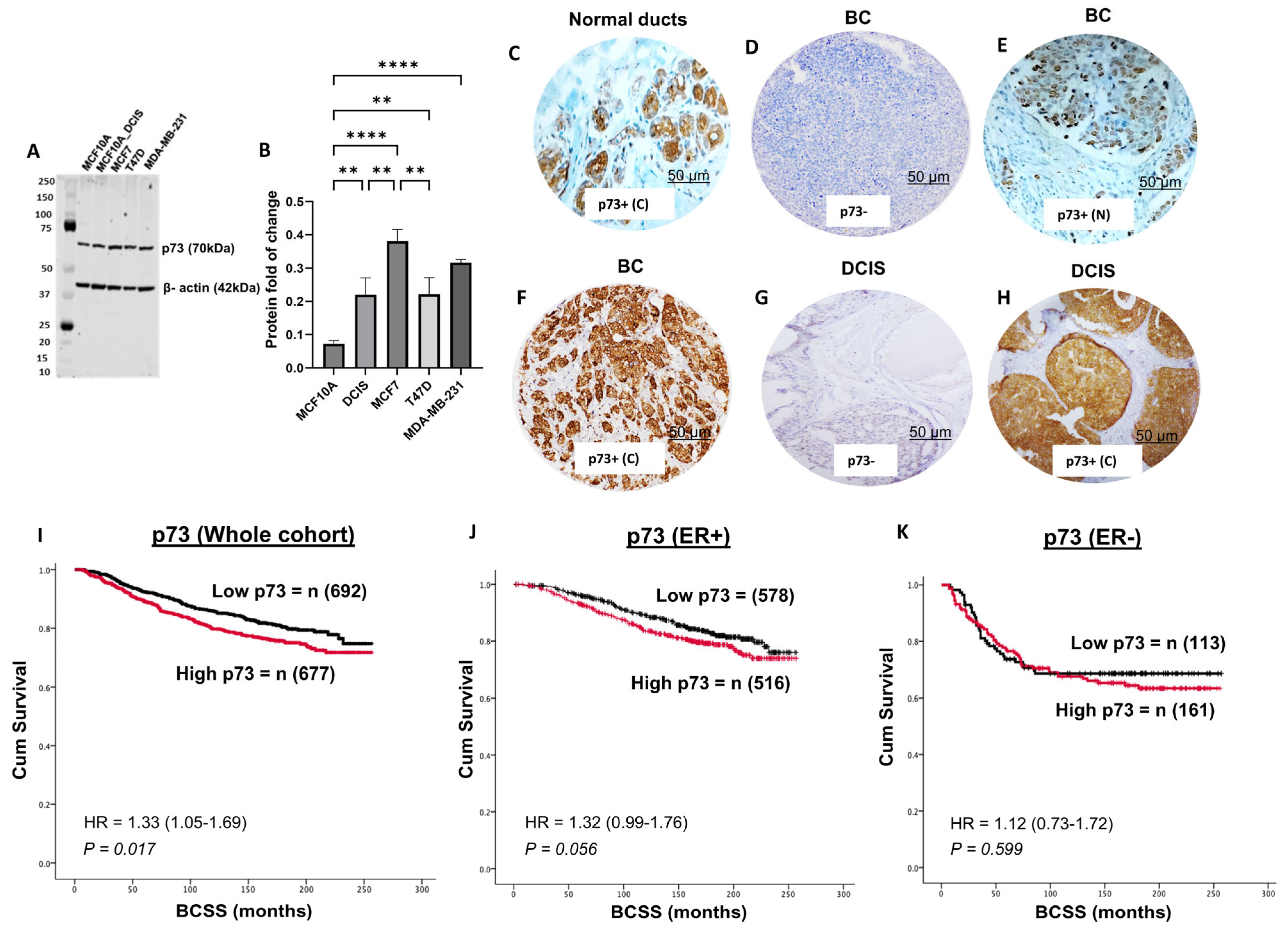
We initially evaluated the expression of p73 protein in a panel of normal (MCF10A), DCIS (MCF10A_DCIS), ER+ invasive breast cancer (MCF-7, T47D), and triple-negative (MDA-MB-231) breast cancer cell lines. Normal epithelial cells (MCF10A) have low levels of p73; breast cancer cell lines have high expression of p73 (Figure 1A,B). We proceeded to immunohistochemical evaluation in clinical cohorts.
Figure 1.
p73 protein expression and breast cancer. (A) Western blot of p73 protein expression in a panel of normal (MCF10A), DCIS (MCF10A_DCIS), ER+ (MCF7, T47D), and triple negative (MDA-MB-231) breast cancer cell lines. (B) Protein quantification. p73 in breast cancer specimens (imaged at ×20 magnification). (C) Normal breast ducts. (D) Negative p73 in invasive BC. (E) Nuclear p73 in invasive BC. (F) Cytoplasmic expression of p73 in invasive BC. (G) Negative expression of p73 in DCIS. (H) Cytoplasmic p73 in DCIS. (I) Cytoplasmic p73 expression and Kaplan–Meier curve for breast cancer specific survival (BCSS) in the whole cohort. (J) Cytoplasmic p73 expression and Kaplan–Meier curve for BCSS in ER+ cohort. (K) Cytoplasmic p73 expression and Kaplan–Meier curve for BCSS in ER- cohort. ** = p-Value < 0.01; **** = p-Value < 0.0001; BC = breast cancer; DCIS = ductal carcinoma in situ; C= cytoplasmic; N = nuclear.
3.1. p73 Protein Expression and Invasive BC
We assessed p73 expression in normal breast ducts of 57 samples and observed cytoplasmic staining only (Figure 1C). In tumours, nuclear expression of p73 was surprisingly rare (Figure 1E), observed in only 14/1369 (1%) of tumours and, therefore, not suitable for clinicopathological association studies. On the other hand, cytoplasmic staining of p73 was seen in 677/1369 (49.4%) tumours (Figure 1F). We proceeded to clinicopathological evaluation in BC. High cytoplasmic p73 levels were significantly associated with features characteristic of aggressive behaviour, including high-grade, pleomorphism, high mitotic index, high-risk Nottingham Prognostic Index (NPI), ER-negative, and triple-negative (TNBC) (all p-values ≤ 0.01) (Table 2). In the whole cohort, high p73 was associated with poor outcome in terms of shorter breast cancer-specific survival (BCSS) (p = 0.017) (Figure 1I). In ER+ breast cancers, high p73 levels were borderline non-significant for shorter BCSS (p= 0.056) (Figure 1J) and non-significant in ER- breast cancers (p = 0.599) (Figure 1K).
Table 2.
Cytoplasmic p73 protein expression and clinicopathological associations.
3.2. TP73 mRNA Expression and Invasive BC
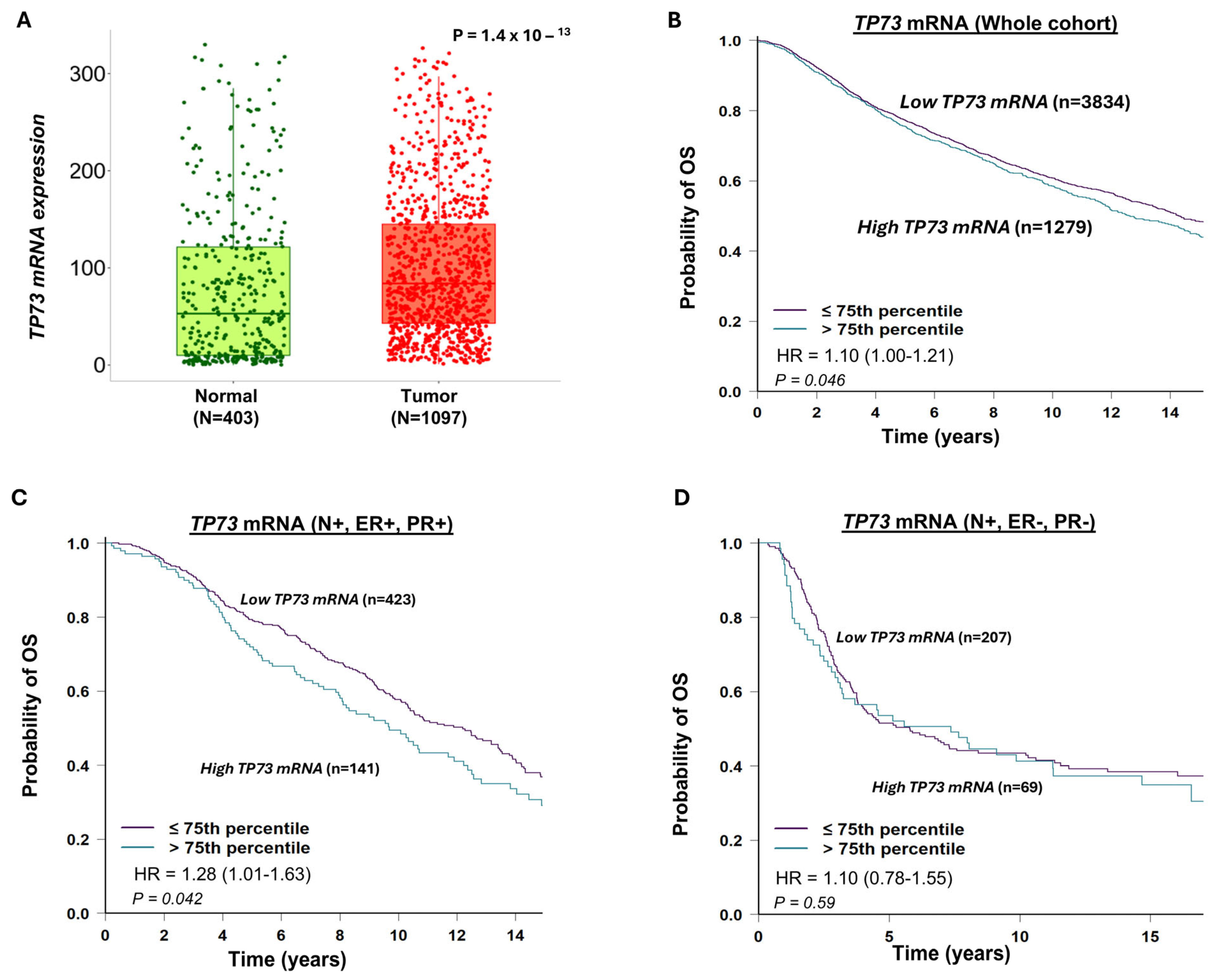
As shown in Figure 2A, TP73 mRNA expression was significantly higher in breast tumour tissue compared to normal breast tissue (p < 0.0001). High TP73 mRNA expression was significantly linked with poor survival in the whole cohort (Figure 2B), in lymph node+/ER+/PR+ breast cancers (Figure 2C), but not in lymph node+/ER-/PR- breast cancers (Figure 2D).
Figure 2.
TP73 mRNA expression and breast cancer. (A) TP73 transcripts in normal and breast cancer tissue. The data shows high TP73 levels in tumour tissue. (B) TP73 transcripts and Kaplan–Meier curve for breast cancer specific survival (BCSS) in the whole cohort. The data shows that high TP73 levels are associated with poor survival in the whole cohort. (C) TP73 transcripts and Kaplan–Meier curve for BCSS in node-positive (N+), ER+, and PR- cohorts. The data shows that high TP73 levels are associated with poor survival in node-positive, ER+ breast cancers. (D) TP73 transcripts and Kaplan–Meier curve for BCSS in node-positive (N+), ER-, and PR- cohorts. The data shows no significant associations in node-positive, ER-positive breast cancers. OS = overall survival.
3.3. p53 and Invasive BC
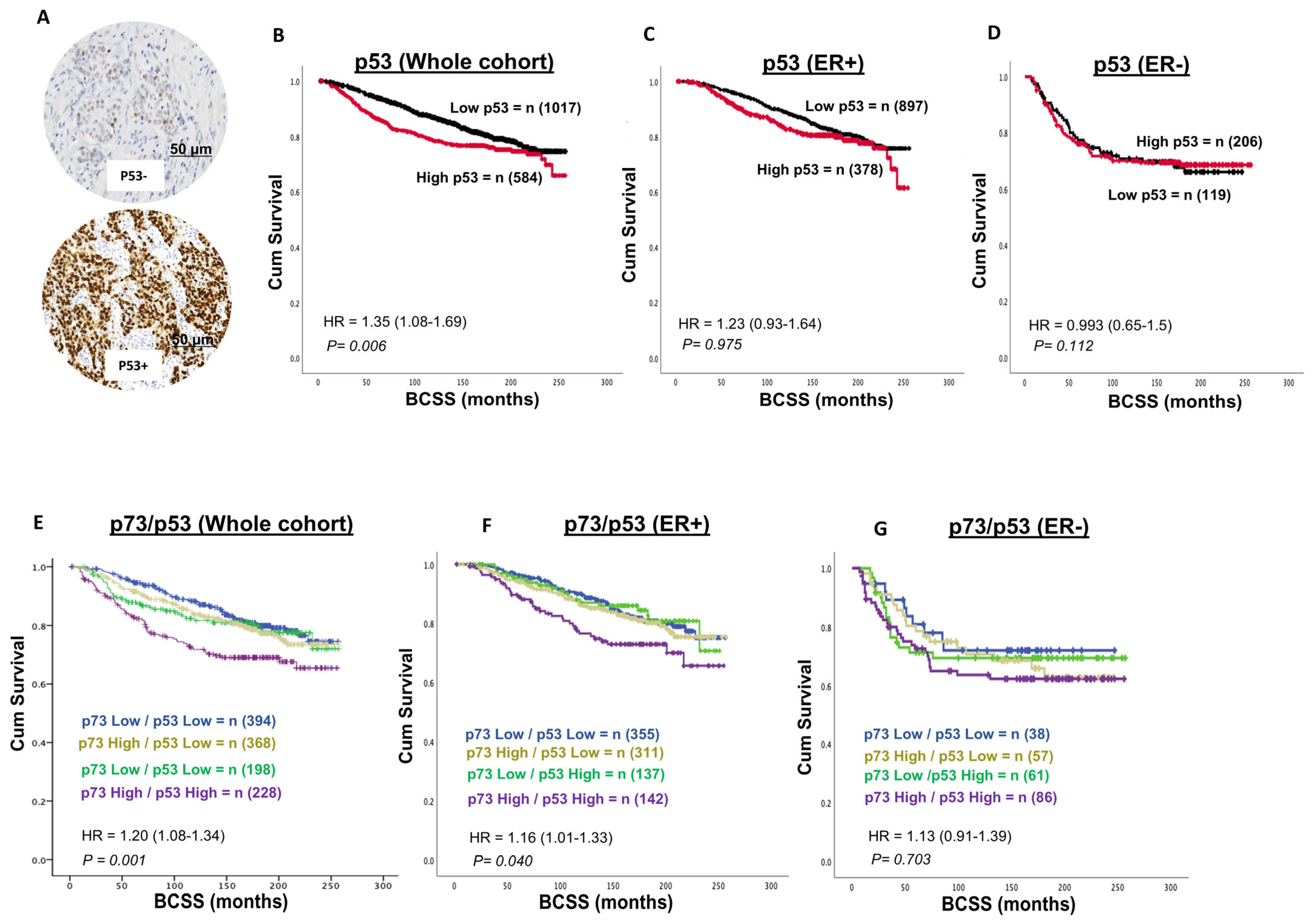
A total of 1601 invasive breast cancers (IBCs) were suitable for p53 immunohistochemical analysis. p53 nuclear positivity was seen in 584/1601 (34.4%) of tumours. p53 positivity was significantly associated with features characteristic of aggressive behaviour, including high-grade, dedifferentiation, pleomorphism, high mitotic index, lymphovascular invasion, high-risk Nottingham Prognostic Index (NPI), HER-2+, ER negative, and triple-negative breast cancers (TNBCs) (all p-values ≤ 0.01) (Table 3). In the whole cohort, high p53 expression was associated with a poorer outcome in terms of shorter breast cancer-specific survival (BCSS) (p = 0.006) (Figure 2B) but not in ER+(Figure 2C) or ER- tumours (Figure 2D).
Table 3.
p53 protein expression in breast cancer.
3.4. p73-p53 Co-Expression in Invasive BC
A total of 1188 invasive breast cancers (IBCs) were suitable for P73-p53 co-expression analysis. High p73/high p53 expression was observed in 228/1188 (19.1%) tumours and strongly associated with high-grade, dedifferentiation, pleomorphism, high mitotic index, lymphovascular invasion, high-risk Nottingham Prognostic Index (NPI), stage 3 disease, HER-2+, ER negative, PR negative and triple-negative breast cancers (TNBCs) (all p-values ≤ 0.01) (Table 3). In the whole cohort, high p73-high p53 co-expression was associated with a poor outcome, characterised by shorter breast cancer-specific survival (BCSS) (p = 0.001) (Figure 3E), including in ER+ (p = 0.040) (Figure 3F) but not in ER- breast cancer (Figure 3G). Taken together, the data suggests that dysregulation of p73 expression can influence breast cancer pathogenesis and prognosis. To explore whether p73 dysregulation is an early event, we investigated a cohort of 317 non-invasive DCIS.
Figure 3.
p53-p73 co-expression and breast cancer. (A) Representative images of negative and positive p53 staining in breast cancer (×20 magnification). (B) p53 expression and Kaplan–Meier curve for breast cancer specific survival (BCSS) in the whole cohort. The data shows that a high p73 level is associated with poor survival in the whole cohort. (C) p53 expression and Kaplan–Meier curve for BCSS in the ER+ cohort. The data shows no significant associations. (D) p53 expression and Kaplan–Meier curve for BCSS in the ER- cohort. The data shows no significant associations. (E) p73-p53 co-expression and Kaplan–Meier curve for breast cancer specific survival (BCSS) in the whole cohort. The data shows that tumours with high p73-p53 expression have poor survival in the whole cohort. (F) p73-p53 co-expression and Kaplan–Meier curve for BCSS in ER+ cohort. The data shows that tumours with high p73-p53 expression have poor survival in the ER+ cohort. (G) p73-p53 co-expression and Kaplan–Meier curve for BCSS in ER- cohort. The data shows no significant associations. BCSS = breast cancer-specific survival.
3.5. TP73 Transcripts in BC-TCGA
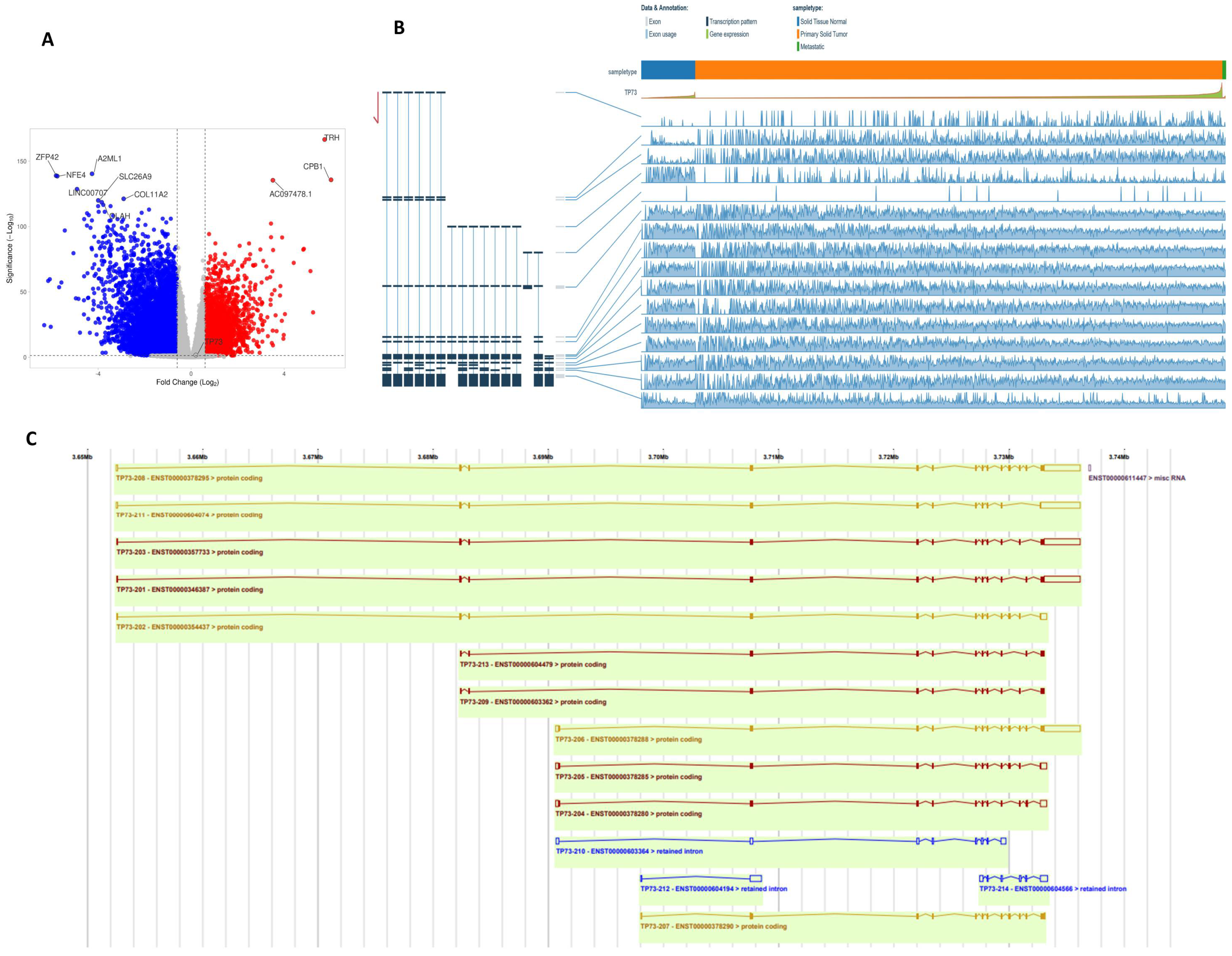
Using RNAseq data from the TCGA-BRCA cohort, we first dichotomised based on TP53 coding variants. DESeq2 was used to identify 6266 significantly differentially expressed genes (logFC ±≥2, padj < 0.05) (Figure 4A). We then compared TP73 mRNA expression in the TCGA-BRCA cohort stratified by the presence of TP53 coding variants. Of the 1090 cases included in this cohort, 340 harboured coding variants in the TP53 gene, including stop gain, missense variants, frameshift, splice acceptor, and in-frame variants. No information was available for 109 cases, and the remaining 631 cases had no changes in TP53 coding. DESeq2 was used to compare expression in cases with and without TP53 variants and showed that expression of TP73 was modestly differentially expressed (log2FC = 0.201; padj = 0.021158) in cases harbouring TP53 variants. We then evaluated TP73 transcript expression in WT TP53 vs. mutant TP53 primary breast cancer. The TSV database was also used to compare TP73 transcript level expression in non-malignant vs. malignant breast cancer specimens in the TCGA-BRCA cohort (https://bmcgenomics.biomedcentral.com/articles/10.1186/s12864-018-4775-x) (accessed on 1 August 2023). Transcript-level expression estimates were determined in the TCGA-BRCA cohort using Kallisto and were accessed from https://osf.io/gqrz9/ (accessed on 1 August 2023). Transcripts with a mean expression <0.1 counts in the cohort were excluded from the analysis. DESeq2 was used to compare global transcript level expression on primary and metastatic breast cancer specimens stratified by the presence or absence of TP53 coding variants. There was no significant difference (±1.5-fold change; padj < 0.05) in any TP73 transcripts expressed in the BRCA cohort (ENST00000378295, ENST00000378288, ENST00000378295, and ENST00000378288). Expression of ENST00000378295 was 1.19-fold higher in primary BCa tumours with normal TP53 expression as compared to those primary tumours harbouring TP53 coding variants (Figure 4B). Canonical TP73 transcripts reported in the ENSEMBL database are shown in Figure 4C. We evaluated TP73 transcript expression in WT TP53 non-malignant vs. TP53 wild-type primary breast cancer. Expression of the ENST00000378288 transcripts was significantly higher (3.244-fold, p < 0.05) in non-malignant breast specimens relative to primary tumours. In contrast, ENST00000378295 P73 transcripts were significantly lower (3.38, padj < 0.05) in non-malignant breast specimens relative to primary tumours. TP73 transcript expression in non-malignant breast tissue from patients harbouring tumour TP53 variants vs. TP53 mutant primary breast cancer was then investigated. In patients harbouring TP53 mutations, expression of the ENST00000378295 alone was significantly lower (-2.56-fold change, p adj < 0.05) in non-malignant vs. primary breast cancer. Although previous reports identified oncogenic roles for ΔNp73, the current study did not show such an association. We speculate that this may be related to the size of the cohort. Additional bioinformatic studies in larger cohorts with sequencing data will be required to investigate this further. Taken together, the data show a complex expression pattern of TP73 isoform transcripts in breast cancer.
Figure 4.
Bioinformatics analysis. (A) RNAseq data from the TCGA-BRCA cohort were dichotomised on the basis of TP53 coding variants. DESeq2 was used to identify 6266 significantly differentially expressed genes (logFC ±≥2, p adj < 0.05). (B) Expression of TP73 isoforms in the TCGA-BRCA cohort was assessed in the TSVdb [17]. (C) Canonical TP73 transcripts reported in the ENSEMBL database are presented. Note: Of the 1090 cases included in this cohort, 340 harboured coding variants in the TP53 gene, including stop gain, missense variants, frameshift, splice acceptor, and in-frame variants. No information was available for 109 cases, and the remaining 631 cases had no changes in TP53 coding. Please also see Supplementary Figures S2 and S3 for magnified images.
3.6. p73 and p53 Protein Expression in DCIS
Patient demographics are summarised in Table 4. A total of 131/317 (41%) of DCIS showed cytoplasmic expression of p73 (Figure 1E,F), and 59/317 (19%) of DCIS showed nuclear expression of p73. We did not observe any significant association between p73 expression and clinicopathological features (Supplementary Tables S1 and S2) or survival outcomes (Supplementary Figure S1A,B). High nuclear p53 was significantly associated with ER-, PR-, HER2+, and high Ki67 DCIS (Supplementary Table S3). Low nuclear p53 was associated with shorter local recurrence-free interval (Supplementary Figure S1C). When p73 and p53 were combined, we did not observe any significant clinicopathological association (Supplementary Table S4) or survival outcomes (Supplementary Figure S1D,E).
Table 4.
Demographics of ductal carcinoma in situ (DCIS) cohort.
4. Discussion
The transcription factor p73 has pleiotropic functions during neurodevelopment, tissue homeostasis, and cancer pathogenesis [9,10,11,12,13,14,15,16,30]. Given the multiple splice variants of p73 with distinct biological functions [11,13,17], the precise role of p73 in breast cancer pathogenesis remains undefined. Here, we have conducted the largest study to date of p73 expression in clinical breast cancers. At the transcriptomic level, TP73 mRNA expression was high in tumour tissue compared to normal tissue and linked with shorter survival outcomes. In the TCGA-BC cohorts harbouring TP53 variants, TP73 transcripts were differentially expressed. Low-abundance transcripts (<100 counts) were filtered, and differentially expressed transcripts in breast cancer patients stratified on the basis of the presence or absence of p53 coding variants were identified by DESeq2. While this analysis identified 17493 differentially expressed transcripts, two expressed TP73 transcripts (ENST00000378295.8, ENST00000378288.8) were not altered by p53 variants under the criteria defined (>1.5-fold change, pAdj < 0.05). We identified 6266 differentially expressed genes (>2-fold change, padj < 0.05) in TCGA primary breast cancer cases, dichotomised based on the presence or absence of TP53 variants. This represents ~10% of the genes 60486 analysed. We then investigated TP73 splice variants in the TCGA-BC cohort. We did not observe any difference in the expression of TP73 splice variants expressed in the BRCA cohort (ENST00000378295, ENST00000378288, ENST00000378295, and ENST00000378288). Expression of ENST00000378295 was modestly higher in primary BC tumours with normal TP53 as compared to those primary tumours harbouring TP53 coding variants. Interestingly, the ENST00000378288 transcripts were significantly higher in non-malignant breast specimens relative to primary tumours. In contrast, ENST00000378295 TP73 transcripts were significantly lower in non-malignant breast specimens relative to primary tumours. Taken together, our data demonstrate a complex expression pattern of TP73 isoform transcripts in breast cancer.
Although complex, the overall biological effect of p73 isoforms is likely influenced by the TA/DN isoform ratio as opposed to the overexpression of a specific p73 isoform or a specific class of p73 isoforms in cells [11,13,17]. Therefore, we proceeded to immunohistochemical evaluation of p73 in a large cohort of breast cancer patients. In invasive breast cancer, we surprisingly observed only cytoplasmic p73 staining. Nuclear p73 staining was rare. High cytoplasmic p73 protein level was associated with aggressive phenotypes and poor survival. Wwox, a tumour suppressor protein, has previously been shown to be involved in cytoplasmic sequestration of p73 [31]. Whether the functional association between Wwox and p73 could account for the cytoplasmic staining of P73 observed in the current study is unknown. Detailed mechanistic studies would be required to confirm this hypothesis. Wwox has been shown to inhibit the apoptotic activity of p73 [31]. In addition, the cytoplasmic localisation of p73 and its interaction with other proteins, including HCK and amphiphysin IIb-1, may also inhibit apoptotic activity of p73 [32] and could contribute to aggressive phenotypes observed in the current study. The cohort spanning 1986–2006 was selected for protein analysis due to its comprehensive clinical annotation, long-term follow-up, and availability of well-preserved archival tissue suitable for biomarker analysis. Importantly, the cohort followed standardised treatment protocols, as detailed in Section 2, which helps to minimise variability and supports the robustness of the findings. While treatment practices have evolved, our study focused primarily on molecular associations rather than treatment outcomes, and this is acknowledged as a limitation. A further limitation of our study is that we did not investigate individual p73 splice variants due to the non-availability of antibody clones that recognise specific p73 splice variants. We have used a Rabbit monoclonal anti-p73 antibody (Abcam clone -ab189896) for the IHC studies. The antibody, as indicated by the manufacturer (Product datasheet: Anti-p73 antibody [EPR18409(T)(MIX)] ab189896), has been shown to recognise the C-terminal fragment of p73, which contains amino acids 380-636. The data imply that the antibody recognises all splice variants, and the levels may indicate the total p73 expression in cells. However, a limitation is that we cannot rule out the possibility of cross-reaction with other structurally similar proteins, such as p63 or even unrelated antigens with shared epitopes.
In DCIS, p73 did not influence clinical outcome, suggesting a role in the pathogenesis of invasive cancers only. In tumours with mutant p53, we show that high p73 was not only associated with aggressive pathology but also shorter survival in patients. However, a limitation of our study is the assumption that TP53 mutations would result in overexpression of p53 protein, causing higher p53 staining intensity, and wild-type protein would stain with low intensity. However, this categorisation strategy leaves out the category of mutations that lead to null expression, and these tumours may have been grouped with tumours with wild-type TP53. In a previous study, the expression levels of TAp73 and DeltaTAp73 (DeltaEx2p73, DeltaEx2/3p73, and DeltaNp73) were evaluated in 60 breast cancer samples. Both suppressor and oncogenic isoforms of p73 were significantly co-upregulated in tumours in that study [33]. In another small study, similarly, p73 overexpression was observed in a panel of breast cancer cell lines and human breast cancer tissue [34]. However, neither of these studies investigated the clinicopathological significance of p73 and its impact on survival in the context of p53 variants. p73 overexpression has also been described in other solid tumours, including ovarian cancer, liver cancer, bladder cancer, prostate cancer, and colorectal cancers [11,13,30]. In contrast, loss of p73 has been shown in pancreatic cancers [35]. It has been shown previously that the ratio between TA and δN splice variant expression can influence biology and prognosis. Accordingly, δNp73 overexpression correlated with aggressive features and poor prognosis in neuroblastoma, prostate, head and neck, and cervical cancers [11,13,30]. In the current study on breast cancer, however, we did not observe any significant differences in splice variant expression in the large TCGA-BC data set.
Our study demonstrates that cytoplasmic p73 expression is associated with aggressive tumour features and poor outcomes in invasive breast cancer, particularly in tumours harbouring TP53 mutations. However, the underlying mechanism of cytoplasmic sequestration of p73 remains unknown and is a limitation of our study. This observation suggests that subcellular localisation modulates p73 tumour-suppressive function, consistent with prior reports of cytoplasmic sequestration mediated by Wwox, HCK, and amphiphysin IIb-1, which inhibit p73 transcriptional and apoptotic activity [31,32]. In TP53-mutant tumours, these interactions may exacerbate loss of tumour suppression, highlighting a critical cross-talk between p53 and p73 in determining tumour behaviour [12,14,15]. Interestingly, p73 expression was not prognostic in DCIS, suggesting that dysregulation may be a later event in tumour progression. This raises the possibility that p73, particularly its cytoplasmic sequestration, could serve as a marker for transition from in situ to invasive disease, warranting longitudinal validation. Understanding the mechanisms underlying cytoplasmic retention, including interactions with Wwox and other regulatory proteins, may provide insight into the stepwise progression of breast cancer [31,32]. From a translational perspective, cytoplasmic p73 could serve as a prognostic biomarker, especially in TP53-mutant tumours. Immunohistochemical assessment of p73, with attention to subcellular localisation, could complement standard clinical markers such as ER, PR, HER2, Ki67, and p53, enabling more precise risk stratification. Moreover, functional inactivation of p73 in the cytoplasm identifies a potential therapeutic target: agents that restore nuclear localisation or transcriptional activity of p73 could reinstate tumour-suppressive programmes, particularly in tumours lacking functional p53 [9,10,11,13,18]. Isoform-specific effects could further guide targeted interventions, such as inhibiting oncogenic ΔTAp73 isoforms or enhancing tumour-suppressive TAp73 activity [17]. Integration of large-scale transcriptomic data further contextualises these findings. The EMBER platform [23] and other post-2020 studies [24,25,26] highlight heterogeneity in breast cancer subtypes and transcriptomic signatures, reinforcing the relevance of TP73 isoform analysis and its interplay with TP53 status. Such integration allows for more precise predictions of tumour behaviour and identification of patients who may benefit from p73-targeted therapies. Overall, this study contributes to the field by linking p73 biology directly to TP53 status, emphasising the importance of isoform balance, localisation, and functional interactions in breast cancer pathogenesis. By combining mRNA, isoform, and protein-level analyses, our work advances mechanistic understanding and establishes a framework for precision oncology strategies that exploit TP53–TP73 pathways. Future research should focus on mechanistic validation of cytoplasmic p73 regulation, functional assessment of isoform-specific activity, and development of therapeutic approaches to restore p73 tumour-suppressive function, ultimately improving outcomes for patients with TP53-mutant breast cancers. In this study, TP53 mutation status was inferred using immunohistochemistry (IHC), with strong nuclear staining indicating mutation and weak or absent staining suggesting a wild-type status. While this approach is widely used, it has inherent limitations. Tumours harbouring null mutations, truncating variants, or mutations leading to unstable p53 protein may be misclassified as wild-type, potentially confounding the assessment of p73–p53 interactions [36]. As we did not have TP53 sequencing data to define TP53 mutations in our cohort, this may influence the interpretation of p73-p53 interactions.
5. Conclusions
Here, we show that high cytoplasmic p73 is linked with aggressive pathology, such as high tumour grade, high pleomorphism scores, high mitotic scores, high-risk Nottingham Prognostic Index, ER negativity, triple-negative phenotype, and poor survival, particularly in TP53 mutant breast cancers. Our data suggest that cytoplasmic p73 could be a useful stratification tool. Integrating immunohistochemical assessment of p73 into clinical workflows could complement existing markers, enhancing precision oncology strategies. Future studies should focus on validating cytoplasmic p73 as a prognostic biomarker, elucidating the mechanistic basis of its cytoplasmic sequestration, and developing therapies that restore its tumour-suppressive function. Large-scale transcriptomic resources [28,29,30] provide a valuable framework for such investigations, offering subtype-specific insights and enabling more personalised therapeutic approaches.
Supplementary Materials
The following supporting information can be downloaded at https://www.mdpi.com/article/10.3390/biomedicines13102484/s1, Supplementary Table S1: Cytoplasmic TP73 and DCIS. Supplementary Table S2: Nuclear TP73 and DCIS. Supplementary Table S3: Nuclear TP53 and DCIS. Supplementary Table S4: TP73/TP53 co-expression and DCIS. Supplementary Figure S1: Cytoplasmic TP73 expression and survival. Supplementary Figure S2: Bioinformatics analysis. Enlarged image of expression of TP73 isoforms in the TCGA-BRCA cohort was assessed in the TSVdb. Please see main Figure 4B for further details. Supplementary Figure S3: Bioinformatics analysis. Enlarged image of Canonical TP73 transcripts reported in the ENSEMBL database are presented.
Author Contributions
Conceptualisation: N.P.M., E.A.R. and S.M.; methodology: A.S. (Ahmed Shoqafi), A.I., A.L. and S.M.; formal analysis: A.S. (Ahmed Shoqafi), A.I., A.L., M.S.T., A.S. (Amera Sheha), S.A., I.M., M.A., J.N.J. and S.M.; data curation: A.S. (Ahmed Shoqafi), A.I., A.L., M.S.T., A.S. (Amera Sheha), S.A., I.M., M.A., J.N.J., N.P.M., A.R.G. and S.M.; writing—original draft preparation: A.S. (Ahmed Shoqafi), A.I., A.L., M.S.T., S.A., I.M., M.A., J.N.J., N.P.M., E.A.R., A.R.G. and S.M.; writing—review and editing: A.S. (Ahmed Shoqafi), A.I., A.L., M.S.T., A.S. (Amera Sheha), S.A., I.M., M.A., J.N.J., N.P.M., E.A.R., A.R.G. and S.M.; supervision: S.M. All authors have read and agreed to the published version of the manuscript.
Funding
This research received no external funding.
Institutional Review Board Statement
This study was approved by the Yorkshire and the Humber Leeds East Research Ethics Committee (REC Reference: 19/YH/0293 under the IRAS Project ID: 266925. Ethical approval (REC Reference: 19/YH/0293) was obtained on 21 August 2019, enabling the retrospective analysis of archival breast cancer samples collected between 1986 and 2006. These samples were originally collected under institutional protocols that included consent for future research use. The 2019 approval specifically covers the use of these anonymised archival materials in accordance with current ethical standards and governance frameworks. This ensures compliance with contemporary regulations while respecting the original consent process.
Informed Consent Statement
Informed consent was obtained from all individuals prior to surgery to use their tissue materials in research.
Data Availability Statement
Raw data will be made available upon reasonable request.
Acknowledgments
The work presented in the manuscript is derived from the first author’s PhD thesis, available at https://eprints.nottingham.ac.uk/80298/ (accessed on 1 April 2025).
Conflicts of Interest
The authors declare no conflicts of interest.
Abbreviations
The following abbreviations are used in this manuscript:
| BCSS | Breast cancer-specific survival |
| TA | Transactivation domain |
| DCIS | Ductal carcinoma in situ |
| NPI | Nottingham Prognostic Index |
| IHC | Immunohistochemistry |
References
- Ghoncheh, M.; Mohammadian-Hafshejani, A.; Salehiniya, H. Incidence and Mortality of Breast Cancer and their Relationship to Development in Asia. Asian Pac. J. Cancer Prev. 2015, 16, 6081–6087. [Google Scholar] [CrossRef]
- Tao, Z.; Shi, A.; Lu, C.; Song, T.; Zhang, Z.; Zhao, J. Breast Cancer: Epidemiology and Etiology. Cell Biochem. Biophys. 2015, 72, 333–338. [Google Scholar] [CrossRef]
- Sharma, R. Global burden of breast cancer: Current statistics and projections. J. Glob. Oncol. 2021, 7, 567–579. [Google Scholar]
- Khalid, M.S.A.; Patel, D.; Sharma, S. Breast cancer subtypes: Incidence, distribution, and clinical significance. Front. Oncol. 2024, 14, 1123456. [Google Scholar]
- Bergholtz, H.; Lien, T.G.; Swanson, D.M.; Frigessi, A.; Oslo Breast Cancer Research Consortium (OSBREAC); Daidone, M.G.; Tost, J.; Wärnberg, F.; Sørlie, T. Contrasting DCIS and invasive breast cancer by subtype suggests basal-like DCIS as distinct lesions. NPJ Breast Cancer. 2020, 6, 26. [Google Scholar] [CrossRef] [PubMed]
- Cowell, C.F.; Weigelt, B.; Sakr, R.A.; Ng, C.K.; Hicks, J.; King, T.A.; Reis-Filho, J.S. Progression from ductal carcinoma in situ to invasive breast cancer: Revisited. Mol. Oncol. 2013, 7, 859–869. [Google Scholar] [CrossRef] [PubMed]
- Simpson, P.T.; Reis-Filho, J.S.; Gale, T.; Lakhani, S.R. Molecular evolution of breast cancer. J. Pathol. 2005, 205, 248–254. [Google Scholar] [CrossRef]
- Kaplan, H.G.; Dowdell, A.K.; Berry, A.B.; Shimol, R.B.; Robinson, F.L.; Carney, C.A.; Piening, B.D. Multi-omic profiling of simultaneous ductal carcinoma in situ and invasive breast cancer. Breast Cancer Res. Treat. 2024, 205, 451–464. [Google Scholar] [CrossRef]
- Marabese, M.; Vikhanskaya, F.; Broggini, M. p73: A chiaroscuro gene in cancer. Eur. J. Cancer 2007, 43, 1361–1372. [Google Scholar] [CrossRef]
- Oswald, C.; Stiewe, T. In good times and bad: p73 in cancer. Cell Cycle 2008, 7, 1726–1731. [Google Scholar] [CrossRef]
- Rufini, A.; Agostini, M.; Grespi, F.; Tomasini, R.; Sayan, B.S.; Niklison-Chirou, M.V.; Conforti, F.; Velletri, T.; Mastino, A.; Mak, T.W.; et al. p73 in Cancer. Genes. Cancer 2011, 2, 491–502. [Google Scholar] [CrossRef]
- Irwin, M.S.; Miller, F.D. p73: Regulator in cancer and neural development. Cell Death Differ. 2004, 11 Suppl. S1, S17–S22. [Google Scholar] [CrossRef]
- Logotheti, S.; Richter, C.; Murr, N.; Spitschak, A.; Marquardt, S.; Putzer, B.M. Mechanisms of Functional Pleiotropy of p73 in Cancer and Beyond. Front. Cell Dev. Biol. 2021, 9, 737735. [Google Scholar] [CrossRef] [PubMed]
- Maas, A.M.; Bretz, A.C.; Mack, E.; Stiewe, T. Targeting p73 in cancer. Cancer Lett. 2013, 332, 229–236. [Google Scholar] [CrossRef] [PubMed]
- Ozaki, T.; Nakagawara, A. p73, a sophisticated p53 family member in the cancer world. Cancer Sci. 2005, 96, 729–737. [Google Scholar] [CrossRef]
- Rozenberg, J.M.; Zvereva, S.; Dalina, A.; Blatov, I.; Zubarev, I.; Luppov, D.; Bessmertnyi, A.; Romanishin, A.; Alsoulaiman, L.; Kumeiko, V.; et al. Dual Role of p73 in Cancer Microenvironment and DNA Damage Response. Cells 2021, 10, 3516. [Google Scholar] [CrossRef] [PubMed]
- Stiewe, T.; Pützer, B.M. Role of p73 in malignancy: Tumor suppressor or oncogene? Cell Death Differ. 2002, 9, 237–245. [Google Scholar] [CrossRef]
- Dominguez, G.; Silva, J.M.; Silva, J.; Garcia, J.M.; Sanchez, A.; Navarro, A.; Gallego, I.; Provencio, M.; España, P.; Bonilla, F. Wild type p73 overexpression and high-grade malignancy in breast cancer. Breast Cancer Res. Treat. 2001, 66, 183–190. [Google Scholar] [CrossRef]
- Schwartz, D.I.; Lindor, N.M.; Walsh-Vockley, C.; Roche, P.C.; Mai, M.; Smith, D.I.; Liu, W.; Couch, F.J. p73 mutations are not detected in sporadic and hereditary breast cancer. Breast Cancer Res. Treat. 1999, 58, 25–29. [Google Scholar] [CrossRef]
- Yao, J.; Xu, F.; Zhang, D.; Yi, W.; Chen, X.; Chen, G.; Zhou, E. TP73-AS1 promotes breast cancer cell proliferation through miR-200a-mediated TFAM inhibition. J. Cell Biochem. 2018, 119, 680–690. [Google Scholar] [CrossRef]
- Zou, Y.L.X.; Wang, Y.; Guo, J. TP73-AS1 functions as an oncogene in breast cancer via modulation of p73 isoforms. J. Cell Biochem. 2018, 119, 3797–3805. [Google Scholar]
- Tavakkol Afshari, Z.; Gholizadeh, Z.; Nikpoor, A.R.; Tavakkol, A.J.; Ganjali, R.; Homaei, S.F.; Jamialahmadi, K. A Case-Control Study on the p73 G4A Gene Polymorphism and Susceptibility to Breast Cancer in an Iranian Population. Iran J. Public Health. 2019, 48, 1855–1860. [Google Scholar] [CrossRef]
- Ronchi, C.; Haider, S.; Brisken, C. EMBER creates a unified space for independent breast cancer transcriptomic datasets enabling precision oncology. NPJ Breast Cancer. 2024, 10, 56. [Google Scholar] [CrossRef]
- Manjunath, S.S.R. A comprehensive study of mRNA and long noncoding RNAs in Indian breast cancer patients reveals subtype-specific alterations. BMC Cancer 2022, 22, 145. [Google Scholar]
- Llera, A.S.; Abdelhay, E.S.F.W.; Artagaveytia, N.; Daneri-Navarro, A.; Müller, B.; Velazquez, C.; Alcoba, E.B.; Alonso, I.; Alvesda, Q.D.B.; Binato, R.; et al. The Transcriptomic Portrait of Locally Advanced Breast Cancer and Its Prognostic Value in a Multi-Country Cohort of Latin American Patients. Front Oncol. 2022, 12, 835626. [Google Scholar] [CrossRef] [PubMed]
- Wang, X.; Venet, D.; Lifrange, F.; Larsimont, D.; Rediti, M.; Stenbeck, L.; Dupont, F.; Rouas, G.; Garcia, A.J.; Craciun, L.; et al. Spatial transcriptomics reveals substantial heterogeneity in triple-negative breast cancer with potential clinical implications. Nat. Commun. 2024, 15, 10232. [Google Scholar] [CrossRef] [PubMed]
- McShane, L.M.; Altman, D.G.; Sauerbrei, W.; Taube, S.E.; Gion, M.; Clark, G.M. Reporting recommendations for tumour MARKer prognostic studies (REMARK). J. Natl. Cancer Inst. 2005, 97, 1180–1184. [Google Scholar] [CrossRef] [PubMed]
- Bartha, A.; Gyorffy, B. TNMplot.com: A Web Tool for the Comparison of Gene Expression in Normal, Tumor and Metastatic Tissues. Int. J. Mol. Sci. 2021, 22. [Google Scholar] [CrossRef]
- Jézéquel, P.; Campone, M.; Gouraud, W.; Guérin-Charbonnel, C.; Leux, C.; Ricolleau, G.; Campion, L. bc-GenExMiner: An easy-to-use online platform for gene prognostic analyses in breast cancer. Breast Cancer Res. Treat. 2012, 131, 765–775. [Google Scholar] [CrossRef]
- Sun, W.; Duan, T.; Ye, P.; Chen, K.; Zhang, G.; Lai, M.; Zhang, H. TSVdb: A web-tool for TCGA splicing variants analysis. BMC Genom. 2018, 19, 405. [Google Scholar] [CrossRef]
- Aqeilan, R.I.; Pekarsky, Y.; Herrero, J.J.; Palamarchuk, A.; Letofsky, J.; Druck, T.; Trapasso, F.; Han, S.Y.; Melino, G.; Huebner, K.; et al. Functional association between Wwox tumour suppressor protein and p73, a p53 homolog. Proc. Natl. Acad. Sci. USA 2004, 101, 4401–4406. [Google Scholar] [CrossRef]
- Ozaki, T.; Kubo, N.; Nakagawara, A. p73-Binding Partners and Their Functional Significance. Int. J. Proteom. 2010, 2010, 283863. [Google Scholar] [CrossRef]
- Dominguez, G.; Garcia, J.M.; Pena, C.; Silva, J.; Garcia, V.; Martinez, L.; Maximiano, C.; Gomez, M.E.; Rivera, J.A.; Garcia-Andrade, C.; et al. DeltaTAp73 upregulation correlates with poor prognosis in human tumours: Putative in vivo network involving p73 isoforms, p53, and E2F-1. J. Clin. Oncol. 2006, 24, 805–815. [Google Scholar] [CrossRef] [PubMed]
- Zaika, A.I.; Kovalev, S.; Marchenko, N.D.; Moll, U.M. Overexpression of the wild type p73 gene in breast cancer tissues and cell lines. Cancer Res. 1999, 59, 3257–3263. [Google Scholar]
- Loukopoulos, P.; Shibata, T.; Katoh, H.; Kokubu, A.; Sakamoto, M.; Yamazaki, K.; Kosuge, T.; Kanai, Y.; Hosoda, F.; Imoto, I.; et al. Genome-wide array-based comparative genomic hybridization analysis of pancreatic adenocarcinoma: Identification of genetic indicators that predict patient outcome. Cancer Sci. 2007, 98, 392–400. [Google Scholar] [CrossRef] [PubMed]
- Kim, M.; Lee, M.; Lee, A.; Choi, B.O.; Park, W.C.; Kim, S.H.; Lee, J.; Kang, J. Correlating p53 immunostaining patterns with somatic TP53 mutation and functional properties of mutant p53 in triple-negative breast cancer. Histopathology 2025, 87, 299–309. [Google Scholar] [CrossRef] [PubMed]
Disclaimer/Publisher’s Note: The statements, opinions and data contained in all publications are solely those of the individual author(s) and contributor(s) and not of MDPI and/or the editor(s). MDPI and/or the editor(s) disclaim responsibility for any injury to people or property resulting from any ideas, methods, instructions or products referred to in the content. |
© 2025 by the authors. Licensee MDPI, Basel, Switzerland. This article is an open access article distributed under the terms and conditions of the Creative Commons Attribution (CC BY) license (https://creativecommons.org/licenses/by/4.0/).