Variables Impacting the Quality of Care Provided by Professional Caregivers for People with Mental Illness: A Systematic Review
 ,
,  , ,
, ,  and
and
Abstract
1. Introduction
2. Materials and Methods
2.1. Information Sources
2.2. Eligibility Criteria
2.2.1. Inclusion Criteria
2.2.2. Exclusion Criteria
2.3. Search Strategy
2.4. Data Collection
2.5. Selection Process
3. Results
4. Discussion
5. Conclusions
Author Contributions
Funding
Institutional Review Board Statement
Informed Consent Statement
Data Availability Statement
Acknowledgments
Conflicts of Interest
Appendix A

| Section and Topic | Item | Checklist Item | Location Where Item Is Reported |
|---|---|---|---|
| Title | |||
| Title | 1 | Identify the report as a systematic review. | 1 |
| Abstract | |||
| Abstract | 2 | See the PRISMA 2020 for Abstracts checklist. | 1 |
| Introduction | |||
| Rationale | 3 | Describe the rationale for the review in the context of existing knowledge. | 1–3 |
| Objectives | 4 | Provide an explicit statement of the objective(s) or question(s) the review addresses. | 3 |
| Methods | |||
| Eligibility criteria | 5 | Specify the inclusion and exclusion criteria for the review and how studies were grouped for the syntheses. | 3–4 |
| Information sources | 6 | Specify all databases, registers, websites, organisations, reference lists and other sources searched or consulted to identify studies. Specify the date when each source was last searched or consulted. | 3 |
| Search strategy | 7 | Present the full search strategies for all databases, registers and websites, including any filters and limits used. | 4 |
| Selection process | 8 | Specify the methods used to decide whether a study met the inclusion criteria of the review, including how many reviewers screened each record and each report retrieved, whether they worked independently, and if applicable, details of automation tools used in the process. | 4 |
| Data collection process | 9 | Specify the methods used to collect data from reports, including how many reviewers collected data from each report, whether they worked independently, any processes for obtaining or confirming data from study investigators, and if applicable, details of automation tools used in the process. | 4 |
| Data items | 10a | List and define all outcomes for which data were sought. Specify whether all results that were compatible with each outcome domain in each study were sought (e.g., for all measures, time points, analyses), and if not, the methods used to decide which results to collect. | 4 |
| 10b | List and define all other variables for which data were sought (e.g., participant and intervention characteristics, funding sources). Describe any assumptions made about any missing or unclear information. | 4 | |
| Study risk of bias assessment | 11 | Specify the methods used to assess risk of bias in the included studies, including details of the tool(s) used, how many reviewers assessed each study and whether they worked independently, and if applicable, details of automation tools used in the process. | 3–4 |
| Effect measures | 12 | Specify for each outcome the effect measure(s) (e.g., risk ratio, mean difference) used in the synthesis or presentation of results. | NA |
| Synthesis methods | 13a | Describe the processes used to decide which studies were eligible for each synthesis (e.g., tabulating the study intervention characteristics and comparing against the planned groups for each synthesis (item #5)). | 4 |
| 13b | Describe any methods required to prepare the data for presentation or synthesis, such as handling of missing summary statistics, or data conversions. | 4 | |
| 13c | Describe any methods used to tabulate or visually display results of individual studies and syntheses. | 4 | |
| 13d | Describe any methods used to synthesize results and provide a rationale for the choice(s). If meta-analysis was performed, describe the model(s), method(s) to identify the presence and extent of statistical heterogeneity, and software package(s) used. | NA | |
| 13e | Describe any methods used to explore possible causes of heterogeneity among study results (e.g., subgroup analysis, meta-regression). | NA | |
| 13f | Describe any sensitivity analyses conducted to assess robustness of the synthesized results. | NA | |
| Reporting bias assessment | 14 | Describe any methods used to assess risk of bias due to missing results in a synthesis (arising from reporting biases). | - |
| Certainty assessment | 15 | Describe any methods used to assess certainty (or confidence) in the body of evidence for an outcome. | - |
| Results | |||
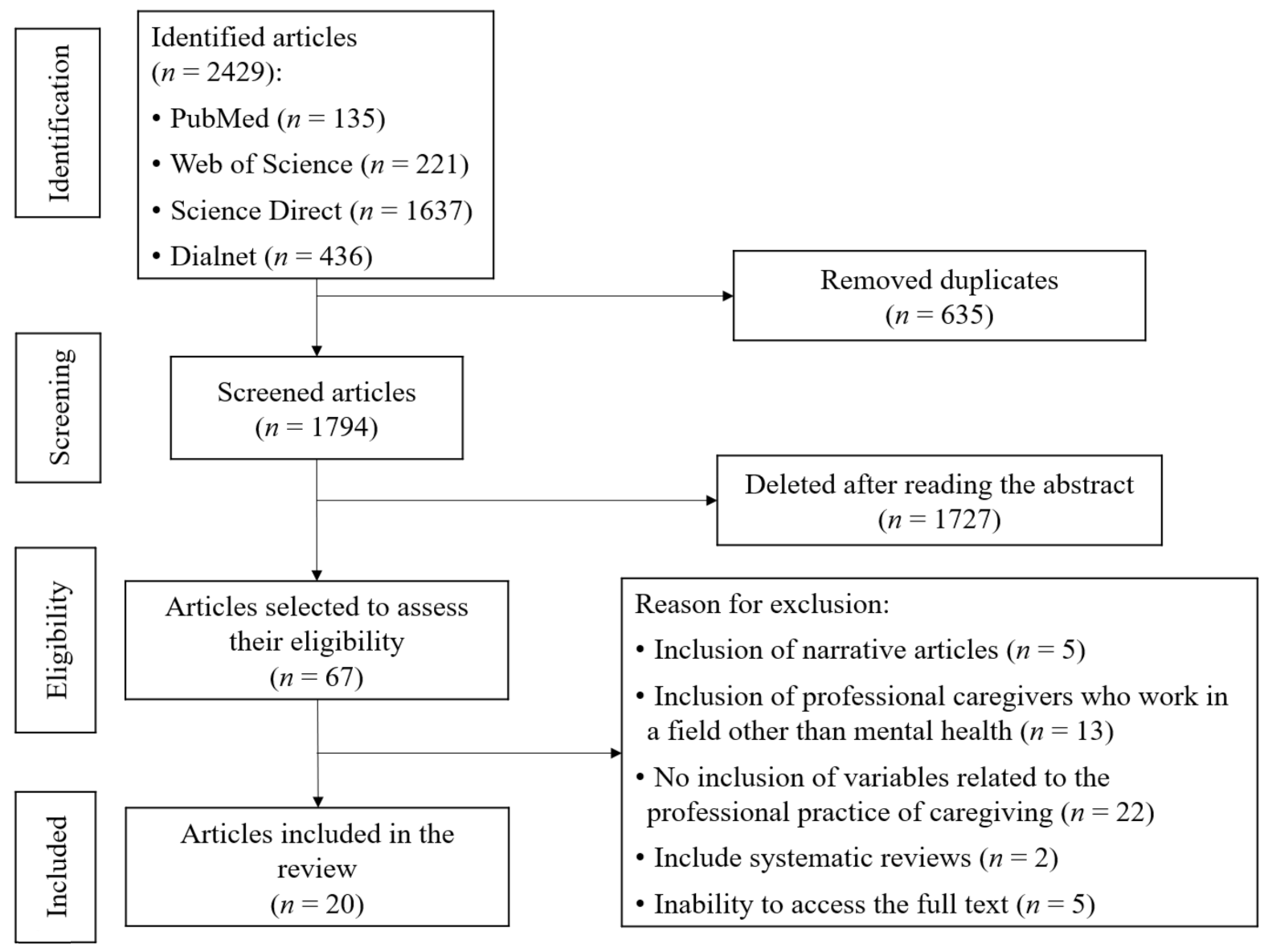
| Study selection | 16a | Describe the results of the search and selection process, from the number of records identified in the search to the number of studies included in the review, ideally using a flow diagram. | 5 |
| 16b | Cite studies that might appear to meet the inclusion criteria, but which were excluded, and explain why they were excluded. | 5 | |
| Study characteristics | 17 | Cite each included study and present its characteristics. | 6–14 |
| Risk of bias in studies | 18 | Present assessments of risk of bias for each included study. | - |
| Results of individual studies | 19 | For all outcomes, present, for each study: (a) summary statistics for each group (where appropriate), and (b) an effect estimate and its precision (e.g., confidence/credible interval), ideally using structured tables or plots. | NA |
| Results of syntheses | 20a | For each synthesis, briefly summarize the characteristics and risk of bias among contributing studies. | 6–13 |
| 20b | Present results of all statistical syntheses conducted. If meta-analysis was done, present for each the summary estimate and its precision (e.g., confidence/credible interval) and measures of statistical heterogeneity. If comparing groups, describe the direction of the effect. | NA | |
| 20c | Present results of all investigations of possible causes of heterogeneity among study results. | NA | |
| 20d | Present results of all sensitivity analyses conducted to assess the robustness of the synthesized results. | NA | |
| Reporting biases | 21 | Present assessments of risk of bias due to missing results (arising from reporting biases) for each synthesis assessed. | - |
| Certainty of evidence | 22 | Present assessments of certainty (or confidence) in the body of evidence for each outcome assessed. | - |
| Discussion | |||
| Discussion | 23a | Provide a general interpretation of the results in the context of other evidence. | 15–17 |
| 23b | Discuss any limitations of the evidence included in the review. | 16 | |
| 23c | Discuss any limitations of the review processes used. | 17 | |
| 23d | Discuss implications of the results for practice, policy, and future research. | 17 | |
| Other Information | |||
| Registration and protocol | 24a | Provide registration information for the review, including register name and registration number, or state that the review was not registered. | 3 |
| 24b | Indicate where the review protocol can be accessed, or state that a protocol was not prepared. | 3 | |
| 24c | Describe and explain any amendments to information provided at registration or in the protocol. | - | |
| Support | 25 | Describe sources of financial or non-financial support for the review, and the role of the funders or sponsors in the review. | 18 |
| Competing interests | 26 | Declare any competing interests of review authors. | 18 |
| Availability of data, code and other materials | 27 | Report which of the following are publicly available and where they can be found: template data collection forms; data extracted from included studies; data used for all analyses; analytic code; any other materials used in the review. | - |
References
- World Health Organization. International Classification of Functioning, Disability and Health; World Health Organization: Geneva, Switzerland, 2001. [Google Scholar]
- American Psychiatric Association. What Is Mental Illness? American Psychiatric Association: Washington, DC, USA, 2020. [Google Scholar]
- Reed, G.M.; Spaulding, W.D.; Bufka, L.F. The relevance of the international classification of functioning, disability and health (ICF) to mental disorders and their treatment. Alter 2009, 3, 340–359. [Google Scholar] [CrossRef] [Scilit]
- Confederation of Mental Health in Spain. Guía de Estilo Sobre Salud Mental para Medios de Comunicación: Las Palabras sí Importan; Confederación SALUD MENTAL ESPAÑA: Madrid, Spain, 2018. [Google Scholar]
- Rodríguez-Rodríguez, P. El apoyo informal a las personas mayores en España y la protección social a la dependencia. Del familismo a los derechos de ciudadanía. Rev. Esp. Geriatr. Gerontol. 2005, 40, 5–15. [Google Scholar] [CrossRef] [Scilit]
- Méndez, I.; Secanilla, E.; Martínez, J.P.; Navarro, J. Estudio comparativo de burnout en cuidadores profesionales de personas mayores institucionalizadas con demencias y otras enfermedades. Eur. J. Investig. Health Psychol. Educ. 2011, 1, 61–70. [Google Scholar] [CrossRef] [Scilit]
- Cerquera, C.A.M.C.; Galvis, A.M.J.G. Efectos de cuidar personas con Alzheimer: Un estudio sobre cuidadores formales e informales. Pensam. Psicol. 2014, 12, 149–167. [Google Scholar] [CrossRef] [Scilit]
- Vásquez-Manrique, J.F.; Maruy-Saito, A.; Verne-Martin, E. Frecuencia del síndrome de burnout y niveles de sus dimensiones en el personal de salud del servicio de emergencia de pediatría del Hospital Nacional Cayetano Heredia en el año 2014: Lima, Perú. Rev. Neuro Psiquiatr. 2014, 77, 168–174. [Google Scholar] [CrossRef] [Scilit]
- Freudenberger, H.J. Staff burnout. J. Soc. Issues 1974, 30, 159–165. [Google Scholar] [CrossRef] [Scilit]
- Crespo, M.; Fernández-Lansac, V. Resiliencia en cuidadores familiares de personas mayores dependientes. An. Psicol. 2015, 31, 19–27. [Google Scholar] [CrossRef] [Scilit]
- Kramer, B.J. Gain in the caregiving experience: Where are we? What next? Gerontologist 1997, 37, 218–232. [Google Scholar] [CrossRef] [Scilit]
- Rodriguez, L.M.; Martí-Vilar, M.; Reig, J.E.; Mesurado, B. Empathy as a predictor of prosocial behavior and the perceived seriousness of delinquent acts: A cross-cultural comparison of Argentina and Spain. Ethics Behav. 2019, 31, 91–101. [Google Scholar] [CrossRef] [Scilit]
- Correa, M.C. Aproximaciones epistemológicas y conceptuales de la conducta prosocial. Zona Próx. 2017, 27, 3–21. [Google Scholar] [CrossRef] [Scilit]
- Moeller-Saxone, K.; Davis, E.; Stewart, D.E.; Diaz-Granados, N.; Herrman, H. Promoting resilience in adults with experience of intimate partner violence or child maltreatment: A narrative synthesis of evidence across settings. J. Public Health 2015, 37, 125–137. [Google Scholar] [CrossRef] [Scilit]
- Lazarus, R.; Folkman, S. Estrés y Procesos Cognitivos; Martínez Roca S.A.: Barcelona, Spain, 1986. [Google Scholar]
- Mayer, J.D.; Salovey, P.; Caruso, D. Models of emotional intelligence. In Handbook of Human Intelligence; Sternberg, R.J., Ed.; Cabridge University Press: New York, NY, USA, 2000; pp. 396–420. [Google Scholar]
- Gázquez, J.J.; Fuentes, M.D.C.P.; Del Mar Molero, M.; Mercader, I. Inteligencia emocional y calidad de vida del cuidador familiar de pacientes con demencia. Rev. Comun. Salud 2015, 5, 1–15. [Google Scholar] [CrossRef] [Scilit]
- Page, M.J.; McKenzie, J.E.; Bossuyt, P.M.; Boutron, I.; Hoffmann, T.C.; Mulrow, C.D.; Shamseer, L.; Tetzlaff, J.M.; Akl, E.A.; Brennan, S.E.; et al. The PRISMA 2020 statement: An updated guideline for reporting systematic reviews. BMJ 2021, 372, n71. [Google Scholar] [CrossRef] [Scilit]
- Cooke, A.; Smith, D.; Booth, A. Beyond PICO: The SPIDER tool for qualitative evidence synthesis. Qual. Health Res. 2012, 22, 1435–1443. [Google Scholar] [CrossRef] [Scilit]
- Grégoire, G.; Derderian, F.; Le Lorier, J. Selecting the language of the publications included in a meta-analysis: Is there a Tower of Babel bias? J. Clin. Epidemiol. 1995, 48, 159–163. [Google Scholar] [CrossRef] [Scilit]
- Covidence. Systematic Review Software; Veritas Health Innovation: Melbourne, Australia, 2014. [Google Scholar]
- Giménez-Díez, D.; Maldonado-Alía, R.; Torrent-Solà, L.; Granel, N.; Bernabeu-Tamayo, M.D. Nurses’ Experiences of Care at Crisis Resolution Home Treatment Teams: A case study research. J. Psychiatr. Ment. Health Nurs. 2021, 29, 48–56. [Google Scholar] [CrossRef] [Scilit]
- Allen, D.; Spencer, G.; McEwan, K.; Catarino, F.; Evans, R.; Crooks, S.; Gilbert, P. The Schwartz Centre Rounds: Supporting mental health workers with the emotional impact of their work. Int. J. Ment. Health Nurs. 2020, 29, 942–952. [Google Scholar] [CrossRef] [Scilit]
- Avery, J.; Schreier, A.; Swanson, M. A complex population: Nurse’s professional preparedness to care for medical-surgical patients with mental illness. Appl. Nurs. Res. 2020, 52, 151232. [Google Scholar] [CrossRef] [Scilit]
- Fleury, M.J.; Sabetti, J.; Grenier, G.; Bamvita, J.M.; Vallée, C.; Cao, Z. Work-related variables associated with perceptions of recovery-oriented care among Quebec mental health professionals. BJPsych Open 2018, 4, 478–485. [Google Scholar] [CrossRef] [Scilit]
- Pileño, M.E.; Morillo, J.; Morillo, A.; Losa-Iglesias, M. The mental health team: Evaluation from a professional viewpoint. A qualitative study. Arch. Psychiatr. Nurs. 2018, 32, 206–214. [Google Scholar] [CrossRef] [Scilit]
- Goetz, K.; Kleine-Budde, K.; Bramesfeld, A.; Stegbauer, C. Working atmosphere, job satisfaction and individual characteristics of community mental health professionals in integrated care. Health Soc. Care Community 2017, 26, 176–181. [Google Scholar] [CrossRef] [Scilit]
- Suyi, Y.; Meredith, P.; Khan, A. Effectiveness of mindfulness intervention in reducing stress and burnout for mental health professionals in Singapore. Explore 2017, 13, 319–326. [Google Scholar] [CrossRef] [Scilit]
- Yang, B.X.; Stone, T.E.; Davis, S.A. The effect of a community mental health training program for multidisciplinary staff. Arch. Psychiatr. Nurs. 2017, 32, 413–417. [Google Scholar] [CrossRef] [Scilit]
- Frajo-Apor, B.; Pardeller, S.; Kemmler, G.; Hofer, A. Emotional intelligence and resilience in mental health professionals caring for patients with serious mental illness. Psychol. Health Med. 2015, 21, 755–761. [Google Scholar] [CrossRef] [Scilit]
- Sørlie, T.; Borg, M.; Flage, K.B.; Kolbjørnsrud, O.B.; Haugen, G.B.; Benth, J.; Ruud, T. Training frontline workforce on psychosis management: A prospective study of training effects. Int. J. Ment. Health Syst. 2015, 9, 38. [Google Scholar] [CrossRef] [Scilit]
- Utrera, E.; López, P.; Lopera, M.; Rosado, M. Efectividad de una intervención sobre inteligencia emocional en enfermeras especialistas en salud mental. NURE Investig. Rev. Cient. Enferm. 2014, 11, 4. [Google Scholar]
- Veage, S.; Ciarrochi, J.; Deane, F.P.; Andresen, R.; Oades, L.G.; Crowe, T.P. Value congruence, importance and success and in the workplace: Links with well-being and burnout amongst mental health practitioners. J. Context. Behav. Sci. 2014, 3, 258–264. [Google Scholar] [CrossRef] [Scilit]
- Irvine, A.B.; Billow, M.B.; Bourgeois, M.; Seeley, J.R. Mental illness training for long term care staff. J. Am. Med. Dir. Assoc. 2012, 13, 81.e7–e13. [Google Scholar] [CrossRef] [Scilit]
- Rossi, A.; Cetrano, G.; Pertile, R.; Rabbi, L.; Donisi, V.; Grigoletti, L.; Curtolo, C.; Tansella, M.; Thornicroft, G.; Amaddeo, F. Burnout, compassion fatigue, and compassion satisfaction among staff in community-based mental health services. Psychiatry Res. 2012, 200, 933–938. [Google Scholar] [CrossRef] [Scilit]
- Wilrycx, G.K.; Croon, M.A.; Van den Broek, A.H.; Van Nieuwenhuizen, C. Mental health recovery: Evaluation of a recovery-oriented training program. Sci. World J. 2012, 2012, 820846. [Google Scholar] [CrossRef] [Scilit]
- Piat, M.; Ricard, N.; Sabetti, J.; Beauvais, L. The values and qualities of being a good helper: A qualitative study of adult foster home caregivers for persons with serious mental illness. Int. J. Nurs. Stud. 2007, 44, 1418–1429. [Google Scholar] [CrossRef] [Scilit]
- Angermeyer, M.C.; Bull, N.; Bernert, S.; Dietrich, S.; Kopf, A. Burnout of caregivers: A comparison between partners of psychiatric patients and nurses. Arch. Psychiatr. Nurs. 2006, 20, 158–165. [Google Scholar] [CrossRef] [Scilit]
- Rose, J.; Glass, N. Community mental health nurses speak out: The critical relationship between emotional wellbeing and satisfying professional practice. Collegian 2006, 13, 27–32. [Google Scholar] [CrossRef] [Scilit]
- Acker, G.M. The effect of organizational conditions (Role conflict, role ambiguity, opportunities for professional development, and social support) on job satisfaction and intention to leave among social workers in mental health care. Community Ment. Health J. 2004, 40, 65–73. [Google Scholar] [CrossRef] [Scilit]
- Barnes, G.E.; Toews, J. Mental health professionals’ knowledge in the field of caring for chronic mental disorders. Soc. Sci. Med. 1985, 21, 1229–1233. [Google Scholar] [CrossRef] [Scilit]
- Saito, Y.; Igarashi, A.; Noguchi-Watanabe, M.; Takai, Y.; Yamamoto-Mitani, N. Work values and their association with burnout/work engagement among nurses in long-term care hospitals. J. Nurs. Manag. 2018, 26, 393–402. [Google Scholar] [CrossRef] [Scilit]
- Wang, H.; Hall, N.C. When “I care” is not enough: An interactional analysis of teacher values, value congruence, and well-being. Teach. Teach. Educ. 2019, 86, 102906. [Google Scholar] [CrossRef] [Scilit]
- Rose, J.; Glass, N. An Australian investigation of emotional work, emotional well-being and professional practice: An emancipatory inquiry. J. Clin. Nurs. 2010, 19, 1405–1414. [Google Scholar] [CrossRef] [Scilit]
- Boamah, S.A.; Read, E.A.; Laschinger, H.K.S. Factors influencing new graduate nurse burnout development, job satisfaction and patient care quality: A time-lagged study. J. Adv. Nurs. 2017, 73, 1182–1195. [Google Scholar] [CrossRef] [Scilit]
- Tsai, Y.; Wu, S.W. The relationships between organisational citizenship behaviour, job satisfaction and turnover intention. J. Clin. Nurs. 2010, 19, 3564–3574. [Google Scholar] [CrossRef] [Scilit]
- Zheng, Z.; Gangaram, P.; Xie, H.; Chua, S.; Ong, S.B.C.; Koh, S.E. Job satisfaction and resilience in psychiatric nurses: A study at the Institute of Mental Health, Singapore. Int. J. Ment. Health Nurs. 2017, 26, 612–619. [Google Scholar] [CrossRef] [Scilit] [PubMed]
- Leggat, S.G.; Bartram, T.; Casimir, G.; Stanton, P. Nurse perceptions of the quality of patient care: Confirming the importance of empowerment and job satisfaction. Health Care Manag. Rev. 2010, 35, 355–364. [Google Scholar] [CrossRef] [Scilit] [PubMed]
- Choi, J.; Boyle, D.K. RN workgroup job satisfaction and patient falls in acute care hospital units. J. Nurs. Adm. 2013, 43, 586–591. [Google Scholar] [CrossRef] [Scilit]
- Yamamoto-Mitani, N.; Saito, Y.; Takaoka, M.; Takai, Y.; Igarashi, A. Nurses’ and care workers’ perception of care quality in Japanese long-term care wards: A qualitative descriptive study. Glob. Qual. Nurs. Res. 2018, 5, 2333393618812189. [Google Scholar] [CrossRef] [Scilit] [PubMed]
- Harris, B.; Panozzo, G. Barriers to recovery-focused care within therapeutic relationships in nursing: Attitudes and perceptions. Int. J. Ment. Health Nurs. 2019, 28, 1220–1227. [Google Scholar] [CrossRef] [Scilit] [PubMed]
- Davidson, L.; González-Ibáñez, À. La recuperación centrada en la persona y sus implicaciones en salud mental. Rev. Asoc. Esp. Neuropsiquiatr. 2017, 37, 189–205. [Google Scholar] [CrossRef]
- Solomon, B.C.; Nikolaev, B.N.; Shepherd, D.A. Does educational attainment promote job satisfaction? The bittersweet trade-offs between job resources, demands, and stress. J. Appl. Psychol. 2021, 107, 1227–1241. [Google Scholar] [CrossRef] [Scilit]
- Kavanaugh, J.; Duffy, J.A.; Lilly, J. The relationship between job satisfaction and demographic variables for healthcare professionals. Manag. Res. News 2006, 58, 567–571. [Google Scholar] [CrossRef] [Scilit]
- Muralidharan, A.; Mills, W.L.; Evans, D.R.; Fujii, D.; Molinari, V. Preparing long-term care staff to meet the needs of aging persons with serious mental illness. J. Am. Med. Dir. Assoc. 2019, 20, 683–688. [Google Scholar] [CrossRef] [Scilit]
- Mukesh, K.; Palayat, A.M.; Yesudas, K.F.; Divakaran, B. Attitude towards mental illness among staff nurses in a tertiary care hospital-a hospital-based cross-sectional study. J. Evol. Med. Dent. Sci. 2017, 6, 2231–2236. [Google Scholar] [CrossRef] [Scilit]
- O’Connor, K.; Neff, D.M.; Pitman, S. Burnout in mental health professionals: A systematic review and meta-analysis of prevalence and determinants. Eur. Psychiatry 2018, 53, 74–99. [Google Scholar] [CrossRef] [Scilit] [PubMed]
- Mijakoski, D.; Karadzhinska-Bislimovska, J.; Stoleski, S.; Minov, J.; Atanasovska, A.; Bihorac, E. Job demands, burnout, and teamwork in healthcare professionals working in a general hospital that was analysed at two points in time. Open Access Maced. J. Med. Sci. 2018, 6, 723–729. [Google Scholar] [CrossRef] [Scilit] [PubMed]
- Klein, A.; Taieb, O.; Xavier, S.; Baubet, T.; Reyre, A. The benefits of mindfulness-based interventions on burnout among health professionals: A systematic review. Explore 2020, 16, 35–43. [Google Scholar] [CrossRef] [Scilit] [PubMed]
- Dhinsa, T.J.; Dean, P.H.; Strahlendorf, C. Addressing social and emotional aspects of providing healthcare using Schwartz Rounds as an example. UBC Med. J. 2021, 12, 22–24. [Google Scholar]
- Aryankhesal, A.; Mohammadibakhsh, R.; Hamidi, Y.; Alidoost, S.; Behzadifar, M.; Sohrabi, R.; Farhadi, Z. Interventions on reducing burnout in physicians and nurses: A systematic review. Med. J. Islam. Repub. Iran. 2019, 33, 77. [Google Scholar] [CrossRef] [Scilit]
- Birkle, C.; Pendlebury, D.A.; Schnell, J.; Adams, J. Web of Science as a data source for research on scientific and scholarly activity. Quant. Sci. Stud. 2020, 1, 363–376. [Google Scholar] [CrossRef] [Scilit]
- Bramer, W.M.; Rethlefsen, M.L.; Kleijnen, J.; Franco, O.H. Optimal database combinations for literature searches in systematic reviews: A prospective exploratory study. Syst. Rev. 2017, 6, 245. [Google Scholar] [CrossRef] [Scilit]
- Web of Science Group. Editorial Selection Process. Clarivate. Available online: https://clarivate.com/webofsciencegroup/solutions/%20editorial-selection-process/ (accessed on 28 October 2019).
- United Nations, Department of Economic and Social Affairs, Population Division. World Population Ageing 2019: Highlights; United Nations: New York, NY, USA, 2019. [Google Scholar]

| Authors and Year | Aims | Methodology and Presence of Control Group | Participants and Country | Variables or Themes and Results | Limitations |
|---|---|---|---|---|---|
| Giménez-Díez et al., (2021) [22] | Explore nurses’ perceptions and constructions about care in crisis resolution home treatment teams (CRHTT) services | Case study Qualitative (semi-structured interviews) No control group | 10 nurses who had worked or were working in CRHTT, Spain | Nurses’ perspectives of the care provided, nursing setting of care at home and nursing care plan at home; nurses believed that providing home care facilitates an intimate perspective, which creates a special bond with patients and instils personal satisfaction with their work; nurses felt more involved and responsible when they were close to patients and applied care adapted to real needs, often establishing a close relationship with the patient. | The study explored mental health nursing experiences in a specific setting; it may have been appropriate to conduct a focus group to gain feedback on the participants’ initial analysis; qualitative studies have limited data extrapolation; the sample size can be considered insufficient or biased; this study is difficult to replicate in other contexts. |
| Allen et al., (2020) [23] | Evaluate mental health professionals experience of the rounds using a mixed-methods approach comprising data collection through standardized evaluation forms, focus groups, and facilitator notes taken during the rounds | Long-term study Quantitative (standardized evaluation) and qualitative (focus groups and round facilitators notes) No control group | 150 mental health professionals, United Kingdom | Relevance of the rounds to the participants’ work, expression of emotions, sharing similar emotions and experiences, feelings of guilt; the rounds were rated as helpful, insightful and relevant. Participants commented that the rounds had helped them feel able to express both negative and positive feelings they had towards users, and this was considered beneficial for themselves and for their relationships with their patients | None described |
| Avery et al., (2020) [24] | Explore characteristics of variables (personal, educational and professional) more frequently associated with and more predictive of nursing preparedness | Descriptive correlational design Quantitative (scales and surveys) No control group | 260 nurses from a tertiary health system, United States | Characteristics of variables (personal, educational and professional) associated with preparedness; the three characteristics of professional experiences that best prepare a nurse to care for this population are mentorship, frequency of care and continuing education. | Findings were dependent on perceptions of participants as opposed to observed or measured data; participant responses were aggregated, therefore, determination of response variation from nurses employed at small versus large or urban versus rural hospitals was not possible. |
| Fleury et al., (2018) [25] | Identify variables associated with perceived recovery-oriented care among mental health professionals | Cross-sectional study Quantitative (scales and questionnaires) No control group | 315 mental health professionals and 41 managers of service networks, Canada | Recovery-oriented care, team support, team autonomy, involvement in decisions, team reflexivity, team conflict, team collaboration, job satisfaction, trust, team climate; work in primary care or outpatient mental health services, team support, knowledge-sharing, team reflexivity, trust, belief in multidisciplinary collaboration and frequency of interaction with other organizations are significantly and positively related to recovery-oriented care. | Impossibility of making causal inferences due to cross-sectional design; no links established between recovery-oriented care and patient outcomes in terms of personal recovery; results based on only four regions of Quebec. |
| Pileño et al., (2018) [26] | Analyze the organizational culture of the team of professionals working in the mental health network | Descriptive, inductive study Qualitative (in-depth interview and focused interview) No control group | 55 mental health professionals, Spain | Main theme: the team. Five subthemes: (1) getting along on the unit; (2) getting along with patients; (3) personal resources for dealing with patients; (4) adaptive resources of team members; (5) team resources. | Inability to obtain access to a hospital and lack of cooperation from certain staff members when participating in in-depth interviews. |
| Goetz et al., (2017) [27] | Evaluate aspects of job satisfaction and the work atmosphere of mental health professionals who work in the comprehensive care model and explore associations between satisfaction with different aspects of their work, individual characteristics, work atmosphere, and general job satisfaction | Exploratory study Quantitative (scales) No control group | 321 community mental health professionals, Germany | Job satisfaction and working atmosphere; intrinsic motivational elements such as satisfaction with the amount of responsibility, with job recognition, with the amount of variety at work, and with freedom of working method increased overall job satisfaction. | Possible selection bias |
| Suyi et al., (2017) [28] | Examine the effectiveness of a mindfulness program in increasing mindfulness and compassion and reducing stress and exhaustion, among mental health professionals | Non-experimental design, pre- and post-testing with follow-up Quantitative (scales and questionnaires) No control group | 37 professionals working at a mental health institute, Singapore | Mindfulness, compassion, stress and burnout; significant improvement in four of the five mindfulness facets and in compassion levels, and a significant reduction in stress following intervention, but no change was observed for burnout. | Small sample size; participants from the same institution; lack of control group; experimental and social desirability bias (the researcher was the instructor for the program); study not generalizable to other health professionals. |
| Yang et al., (2017) [29] | Provide an interdisciplinary community mental health training program and assess the effect of training on staff knowledge of mental health and confidence in their roles | Group design with pre- and post-testing Quantitative (scales and questionnaires) No control group | 48 mental health professionals, China | Community mental health knowledge and confidence in managing people with mental health issues; the score on every item, except the item on empathy and the total/average score, was significantly increased. | Non-objective measure of knowledge improvement; transfer of learning to the workplace was not measured. |
| Frajo-Apor et al., (2015) [30] | Investigate emotional intelligence and resilience in mental health professionals compared to a control group who did not work in healthcare | Cross-sectional design Quantitative (test and scales) With control group | 61 mental health professionals and 61 participants working in unrelated areas, Austria | Emotional intelligence and resilience; the two groups did not differ significantly from each other, neither in terms of emotional intelligence nor resilience; positive correlation between emotional intelligence and resilience; mental health professionals were not more resilient than the general population. | None described |
| Sørlie et al., (2015) [31] | Increase skills, joint understanding, and collaboration in working with people with severe mental illness | Prospective study of longitudinal cohort Quantitative (scales and questionnaires) No control group | 1258 professionals working in different services related to mental health, Norway | Understanding psychosis, building relationships, using own reactions, multidisciplinary collaboration, teamwork and collaboration and supporting relatives; significant increase in participants’ experienced competence in all variables, especially for the understanding of psychosis and relationship building; no significant variance at the program level. | The study focused solely on the changes in competence experienced by the participants, and not on whether patients experienced an improvement in services; data used was collected between 1999 and 2005. |
| Utrera et al., (2014) [32] | Evaluate the effectiveness of a training program in emotional intelligence for levels of satisfaction, emotional intelligence and stress in nurses treating patients diagnosed with borderline personality disorder | Quasi-experimental, prospective longitudinal design Quantitative (scales and inventories) No control group | 77 nurses in a mental health unit, Spain | - | Possible social desirability bias (participants’ responses aimed at giving a good image of themselves); possible learning bias (repeated use of same measurement instrument); limited ability to generalize results. |
| Veage et al., (2014) [33] | Explore the life values of mental health professionals, their personal values relating to work, and the links between these values and well-being and exhaustion | Correlational study Quantitative (scales and inventories) No control group | 106 mental health professionals working for nongovernmental organizations, Australia | Burnout, psychological well-being, personal life values and personal values related to work; congruence between life values and personal work-related values was related to greater well-being and less burnout; honesty, clearly defined work, competence, and fulfilment of obligations were associated with less exhaustion and greater well-being. | Results not generalizable to other professions; inability to determine the causal direction |
| Irvine et al., (2012) [34] | Evaluate an internet-based training program on mental illness for nursing assistants, and explore its effects and acceptance in health professionals | Randomized treatment/control pre-post design for nursing assistants; quasi-experimental pre-post design for health professionals Quantitative (scales and interviews) With control group | 70 nursing assistants and 16 health professionals, USA | Knowledge, self-efficacy, knowledge of myths versus facts, attitudes, self-efficacy and behavioral intentions; significant and medium-to-large effects were obtained on five of the six outcome measures (except self-efficacy) for nurse aides; significant effects on five of six outcome measures (except myths), with medium-large effect sizes. | Need for follow-up evaluations, preferably with in vivo evaluation; impossibility of verifying selection criteria; small sample size. |
| Rossi et al., (2012) [35] | Evaluate exhaustion, compassion fatigue, and satisfaction with compassion among community mental health services staff | Cross-sectional design Quantitative (scales and questionnaires) No control group | 260 community mental health service professionals, Italy | Burnout, compassion fatigue and compassion satisfaction; distressed workers had a mean value of compassion satisfaction significantly lower than the nondistressed workers; workers with psychological distress reported both higher burnout and compassion fatigue scores; significant increase in the burnout and compassion fatigue scores was also detected for each additional year spent. | Impossibility of determining causality; potentially significant variables not included; possible type II errors due to small sample size. |
| Wilrycx et al., (2012) [36] | To investigate the effectiveness of a recovery-oriented training program on the knowledge and attitudes of mental health professionals about the recovery of people with severe mental illness | Two-group multiple intervention interrupted time series design (a variant of the staggered wedge test design) Quantitative (questionnaires and inventories) No control group | 210 mental health professionals, Netherlands | Recovery knowledge and knowledge attitudes; significant increase in both variables. | No reference data to compare; absence of data from psychosocial studies; too many measurement points made it difficult to maintain cooperation and motivation of the mental health professionals. |
| Piat et al., (2007) [37] | Examine caregivers’ and residents’ perspectives on the support relationship in adult care homes | Inductively focused design within a naturalistic paradigm Qualitative (semi-structured interviews) No control group | 20 caregivers in care homes, Canada | Ten themes: (1) the qualities and skills of caregivers; (2) how caregivers learned their job; (3) perceived difficulties, needs and expectations of residents; (4) goals in caring for residents; (5) approaches to helping; (6) caregiver–resident relationships; (7) caregiver–professional relationships; (8) differences between caregiving and professional helping; (9) caregivers’ time allocation between work, family and social life; and (10) the advantages and disadvantages of caregiving. | The sample was not representative of all caregivers in care homes; small sample; possible social desirability bias; need for comparative studies between formal and informal caregivers. |
| Angermeyer et al., (2006) [38] | Examine the similarities and differences between levels of exhaustion in family members and nurses caring for patients with mental illness | Cross-sectional design Quantitative (inventories and scales) No control group | 94 partners of people with depression, 39 partners of people with schizophrenia, and 128 health professionals in a psychiatric hospital, Germany | Burnout; about one fourth of the respondents in both groups showed a high degree of burnout, but no significant differences were found in the three dimensions of burnout (emotional exhaustion, depersonalization, and personal accomplishment) for the two groups of caregivers. | Low response rate; only partners of people with schizophrenia and depression were interviewed; the results might not be generalizable beyond Germany. |
| Rose and Glass (2006) [39] | Examine the degree of emotional well-being in community mental health nurses and identify factors that impact their professional practice | Descriptive, inductive design Qualitative (interviews) No control group | 5 nurses in community mental health centers, Australia | Three themes: (1) being able to speak out (or not); (2) being autonomous (or not); (3) being satisfied (or not). | None described |
| Acker (2004) [40] | Examine the relationship between the organizational conditions of mental health agency workers and their job satisfaction | Cross-sectional design Quantitative (scales) No control group | 259 professionals working for mental health agencies, USA | Role conflict, role ambiguity, social support, extent of opportunities for professional development, type of work activities, job satisfaction and intention to leave; both role conflict and role ambiguity had statistically significant negative correlations with job satisfaction and positive correlations with intention to leave; social support had statistically significant positive correlations with job satisfaction and negative correlations with intention to leave; opportunities for professional development were positively correlated with job satisfaction and negatively correlated with intention to leave; role conflict also had statistically significant negative correlations with social support. | Possible influence situational state of mind when responding about job satisfaction. |
| Barnes and Toews (1985) [41] | Examine the knowledge of mental health workers about the principles of care for chronic mental illness | Cross-sectional design Quantitative (test) No control group | 246 professionals working for mental health associations, Canada | Knowledge in the field of caring for chronic mental disorders; mental health professionals were moderately knowledgeable on this topic (mean score 66%); errors made were more commonly in the direction of overenthusiastic support for the community approach; there were no differences in knowledge scores by a demographic or professional status variables included in this study. | None described |
Publisher’s Note: MDPI stays neutral with regard to jurisdictional claims in published maps and institutional affiliations. |
© 2022 by the authors. Licensee MDPI, Basel, Switzerland. This article is an open access article distributed under the terms and conditions of the Creative Commons Attribution (CC BY) license (https://creativecommons.org/licenses/by/4.0/).
Share and Cite
Bru-Luna, L.M.; Martí-Vilar, M.; Merino-Soto, C.; Salinas-Escudero, G.; Toledano-Toledano, F. Variables Impacting the Quality of Care Provided by Professional Caregivers for People with Mental Illness: A Systematic Review. Healthcare 2022, 10, 1225. https://doi.org/10.3390/healthcare10071225
Bru-Luna LM, Martí-Vilar M, Merino-Soto C, Salinas-Escudero G, Toledano-Toledano F. Variables Impacting the Quality of Care Provided by Professional Caregivers for People with Mental Illness: A Systematic Review. Healthcare. 2022; 10(7):1225. https://doi.org/10.3390/healthcare10071225
Chicago/Turabian StyleBru-Luna, Lluna M., Manuel Martí-Vilar, César Merino-Soto, Guillermo Salinas-Escudero, and Filiberto Toledano-Toledano. 2022. "Variables Impacting the Quality of Care Provided by Professional Caregivers for People with Mental Illness: A Systematic Review" Healthcare 10, no. 7: 1225. https://doi.org/10.3390/healthcare10071225
APA StyleBru-Luna, L. M., Martí-Vilar, M., Merino-Soto, C., Salinas-Escudero, G., & Toledano-Toledano, F. (2022). Variables Impacting the Quality of Care Provided by Professional Caregivers for People with Mental Illness: A Systematic Review. Healthcare, 10(7), 1225. https://doi.org/10.3390/healthcare10071225