


Abstract
In this note, we propose a new construction of cyclotomic p-adic L-functions that are attached to classical modular cuspidal eigenforms. This allows for us to cover most known cases to date and provides a method which is amenable to generalizations to automorphic forms on arbitrary groups. In the classical setting of over , this allows for us to construct the p-adic L-function in the so far uncovered extremal case, which arises under the unlikely hypothesis that p-th Hecke polynomial has a double root. Although Tate’s conjecture implies that this case should never take place for , the obvious generalization does exist in nature for Hilbert cusp forms over totally real number fields of even degree, and this article proposes a method that should adapt to this setting. We further study the admissibility and the interpolation properties of these extremal p-adic L-functions , and relate to the two-variable p-adic L-function interpolating cyclotomic p-adic L-functions along a Coleman family.
1. Introduction
Let be a modular cuspidal eigeform for with nebentypus and weight . The study of the complex L-function attached to the automorphic representation of generated by f is a very important topic in modern Number Theory. Understanding this complex valued analytic function is the key point for some of the most important problems in mathematics, such as the Birch and Swinnerton–Dyer conjecture.
Back in the middle of the seventies, Vishik [1] and Amice-Vélu [2] defined a p-adic measure of that is associated with f, under the hypothesis that p does not divide N. The construction of this measure was the starting point for the theory of p-adic L-functions attached to modular cuspforms. The p-adic L-function is a -valued analytic function that interpolates the critical values of the L-function . The function is defined by means of as
where and are, respectively, the p-adic exponential and p-adic logarithm functions.
Mazur, Tate, and Teitelbaum extended, in [3], the definition of to more general situations and proposed a p-adic analogue of the Birch and Swinnerton–Dyer conjecture, replacing the complex L-function with its p-adic counterpart . It has been shown that is directly related with the (p-adic, or eventually l-adic) cohomology of modular curves, and this makes the p-adic Birch and Swinnerton–Dyer conjectures become more tractable. In fact, the theory of p-adic L-functions has grown tremendously during the last years. Many results, whose complex counterparts are inaccessible with current techniques, have been proven in the analogous p-adic scenarios.
1.1. Main Results
In this note, we provide a reinterpretation of the construction of the p-adic measures . Our approach exploits the theory of automorphic representations and, in that sense, it is similar to the construction that was provided by Spiess in [4] for weights strictly greater than 2. This opens the door to possible generalizations of p-adic measures attached to automorphic representations of of any weight, for any number field F.
We are able to construct in every possible situation, except when the local automorphic representation attached to f is supercuspidal, and we hope that our work clarifies why it is not expected to find good p-adic measures in the latter case.
We obtain a genuinely new construction in the unlikely setting where the p-th Hecke polynomial has a double root. In this case, our main result (Theorem 5) reads, as follows:
Theorem 1.
Let be a cuspform, and assume that has a double root α. Subsequently, there exists a locally analytic p-adic measure of , such that, for any locally polynomial character with :
Here, denotes the complex the L-function of π that is twisted by , and we have set
where is the Gauss sum attached to .
We call the extremal p-adic measure. Coleman and Edixhoven showed in [5] that never has double roots if the weight is 2, namely, . Moreover, they showed that assuming Tate’s conjecture the polynomial can never be a square for general weights . Because we believe in Tate’s conjecture, we expect that this situation never occurs; hence, surely the hypothesis of the theorem is never fulfilled and can never be constructed. Because these extremal scenarios do appear in nature for other reductive groups, for instance, for where F is a totally real number field of even degree over (see [6], Section 3.3.1), we believe that our result above is potentially powerful. We plan to employ the approach of this note to cover these cases in the near future.
Notice that, in the unlikely situation of the above theorem, the two p-adic measures and coexist. Thus, one can define the p-adic L-function
called the extremal p-adic L-function, which coexists with , and satisfies the interpolation property (1) with completely different Euler factors from the classical scenario.
In the non-critical setting, namely when the roots of the Hecke polynomial are distinct, there is a classical result that relates to a two-variable p-adic L-function that interpolates , as g ranges over a Coleman family passing through f. In [7], Betina and Williams have recently extended this result to this critical setting. They construct an element
where is the -algebra of locally analytic distributions of and T is certain Hecke algebra defining a connected component of the eigencurve. Because an element of the Coleman family corresponds to a morphism , the function is characterized by the property
where is a constant normalized so that . The following result that was proved in Section 7.4 relates to our extremal p-adic measure :
Theorem 2.
Let the element corresponding to . We have that
This last result implies that these extremal p-adic L-functions are analogous to the so-called secondary p-adic L-functions that are defined by Bellaïche in [8].
1.2. Summary and Structure of the Paper
This paper consists of two principal achievements: on the one hand, we provide a reinterpretation of the p-adic cyclotomic distributions giving rise to the p-adic L-functions . After recalling the classical theory in Section 3, we introduce, in Section 4, our construction. Thanks to its local nature, this construction is available in every possible situation, except when the associated local automorphic representation is supercuspidal. We also provide sufficient conditions for our locally constant distributions to be extended to admissible locally analytic measures. Moreover, we exploit the automorphic nature of our construction in order to compute the interpolation properties of , namely, the relation between such p-adic distributions and the classical L-functions .
On the other hand, exploiting the same techniques used in this new reinterpretation of the classical p-adic cyclotomic distributions , we introduce, in Section 5, a genuinely new type of p-adic distribution . Because such distribution is included in the formalism of the construction described above, we can prove its admissibility and, as shown in Theorem 1, we can describe its interpolation properties. Thus, extends to a locally analytic p-adic measure, giving rise to the extremal p-adic L-function .
There are several classical results that help in understanding better the classical p-adic measures . The first one is the relation between and the so-called overconvergent modular symbols. Such overconvergent modular symbols are locally analytic extensions of the modular symbols attached to f. Pollack and Stevens showed, in [9], that we can obtain the p-adic measures alternatively by evaluating the corresponding overconvergent modular symbols at the degree zero divisor . It is rather natural to ask ourselves whether there is an analogous description for . In Section 6, we prove that this is indeed the case, and can be realized as the evaluation of the corresponding overconvergent modular symbol at .
The second classical result relies on the relation with the eigencurve. The eigencurve is a rigid analytic space, whose points classify eigenvalues of the Hecke operators acting on the spaces of modular forms of any weight. For many interesting arithmetic applications, such as the Iwasawa Main Conjecture, it is convenient to construct a function on the eigencurve, with values in certain -algebra of locally analytic distributions of , whose evaluation at the set of eigenvalues that are associated with f is given by . In the non-critical setting, the construction of this two-variable p-adic L-function is rather classical, but, in our critical setting, it is a very recent result due to Betina and Williams in [7]. In Section 7, we are able to relate our new p-adic measure with . Indeed, we prove, in Theorem 2, that the derivative of with respect to is given by the measure .
1.3. Conclusions and Future Research
This new reinterpretation of the construction of has some interesting advantages. On the one side, it is purely automorphic and local. It relies on the construction of a well-behaved local morphism from the space of locally constant functions of to the underlying space of the local automorphic representation that is associated with f (see Section 4.4). This formalism is totally transferable to the case of any automorphic representation of over any number field, because it only depends on the behaviour of the local automorphic representation. Hence, we expect to be able to construct p-adic measures and p-adic L-functions that are associated with any automorphic representation of for any weight over any number field. Some of the cases in this research line correspond to the work of Spiess in [4]. Moreover, if we exchange by any torus in , for any p-adic field F, we expect to generalize the morphisms in order to obtain anti-cyclotomicp-adic L-functions that are associated with automorphic forms over quaternion algebras and certain quadratic extensions of the base field, extending our results in [10]. Hence, this formalism opens the door to many possible generalizations in many new and interesting scenarios.
On the other side, because the existence of is subject to the existence of a morphism with good properties, we expect that our work can shed some light on the problem of determining the existence of admissible p-adic L-functions when the local automorphic representation is supercuspidal. After a preliminary study of the possible morphisms in this situation, we believe that such an admissible measure may not exist, and it would be an interesting line of research to study whether that is indeed the case.
The main feature of the article is this new extremal p-adic measure that arises under the unlikely hypothesis that the p-th Hecke polynomial has a double root. This hypothesis is equivalent to the non semi-simplicity of the Hecke operator , and it is excluded for over while assuming Tate’s conjecture. Although we have already noted that this construction can be generalized to the Hilbert setting where there are concrete examples where this hypothesis actually occur, such an irregular situation over is still interesting, as it is considered in this article. Indeed, the existence of with the mentioned interpolation properties and its relation with the two variable p-adic L-function could lead to a better understanding of the semi-simplicity of . The idea is to derive a contradiction starting from this irregular setting by exploring the properties of .
1.4. Notation
For any ring R, we denote by the R-module of homogeneous polynomials in two variables with coefficients in R, endowed with an action of :
We denote by and . Similarly, we define the (right-) action of on the set of modular forms of weight
We will denote by the Haar measure of so that . Similarly, we write for the Haar measure of so that . By abuse of notation, will will also denote by the corresponding Haar measure of the group of ideles .
For any local character , write
2. Local Integrals
In this section will be a non-trivial additive character, such that .
Lemma 1.
For all and , we have
In particular,
Proof.
We compute
To deduce the second part, notice that
Hence the result follows. □
Lemma 2.
Let be a character of conductor . Let be an open subgroup. We have
Proof.
We compute
Hence the integral must be zero if . Moreover, if ,
and the result follows. □
3. Classical Cyclotomic p-Adic L-Function
3.1. Classical Modular Symbols
Let be a modular cuspidal newform of weight level and nebentypus .
By definition, we have
for any . Hence, if we denote by the group of degree zero divisors of with the natural action of , we obtain the Modular Symbol:
Notice that -equivariance follows from relation
deduced from the above equality and the fact that normalizes . The following result is well known and classical:
Proposition 1.
There exists periods , such that
for some , where is the ring of coefficients of f.
3.2. Classical p-Adic Distributions
Given , we will assume that f is an eigenvector for the Hecke operator with eigenvalue . Let be a non-zero root of the Hecke polynomial .
We will construct distributions of locally polynomial functions of of degree less that k attached to f (and in case ). Because the open sets ( and ) form a basis of , it is enough to define the image of , for any
where and . It defines a distribution because satisfies additivity, namely, since
it can be shown that
because, by (3), we have that , where
The following result shows that, under certain hypothesis, we can extend to a locally analytic measure.
Theorem 3
(Visnik, Amice-Vélu). Fix an integer h, such that . Suppose that α satisfies . Therefore, there exists a locally analytic measure satifying:
- , for any locally polynomial function of degree strictly less than h.
- For any ,
- If is convergent on , then
If we assume that there exists such a root with , then we define and the (cyclotomic) p-adic L-function:
Remark 1.
Write the -representation generated by f. For any , write
4. p-Adic L-Functions
In this section, we provide a reinterpretation of the distributions . Let be a cuspidal newform as above and let p be any prime. Fix the embedding
Assumption 1.
Assume that there exists a -equivariant morphisms
where L is certain finite extension of the coefficient field , and V is certain model over L of the local automorphic representation generated by f. Additionally, assume that, for big enough n,
where m is fixed, do not depend neither s nor n, and .
4.1. p-Adic Distributions
Let us consider the subgroup
By strong approximation we have that . Thus, for any , where , are well defined up to multiplication by . Write . By strong multiplicity one, is one dimensional. Therefore, and . Notice that we have a natural morphism
Remark 2.
If then . This implies that, for any , we have for all . By (3), this implies that , for all , where the action of is given by
Remark 3.
By definition, for any , we have
For any , such that where , we can choose such that and , for . Let us choose , and we have
This implies that, if is the central character of ,
Hence, , where .
Let be the space of locally polynomial functions of of degree less that k. Notice that we have a -equivariant isomorphism
where stands for the twist by the character .
Fixing , we define the distributions that are attached to f and :
4.2. Admissible Distributions
We have just constructed a distribution
This section is devoted to extend this distribution to a locally analytic measure .
Definition 1.
Write the usual normalized p-adic valuation. For any , a distribution ish-admissible if
for some fixed , and any which is polynomical in a small enough . We will denote a previous relation by
Proposition 2.
If , a h-admissible the distribution μ can be extended to a locally analytic measure, such that
for any which is analytic in .
Proof.
Notice that any locally analytic function is topologically generated by functions of the form , where . By definition, we have defined the values when . If , we define , where
This definition agrees with when because when , hence
The limit converges because is Cauchy. Indeed by additivity
where . Because
we have that .
It is clear by the definition that for all and N. Moreover, it extends to a locally analytic measure by continuity, which is determined by the image of locally polynomial functions of degree at most h. □
Notice that, for all ,
Using property (9) and Remarks 2 and 3, we compute that
Notice that for some big enough , where the subindex indicates that the action of is given by the character . By Manin’s trick, we have that
Because , and the functions generate , we obtain that
for some fixed . We deduce the following result.
Theorem 4.
Fix an embedding . We have that is -admissible.
Definition 2.
If we assume that , we define the cyclotomic p-adic measure attached to f and δ
4.3. Interpolation Properties
Given the modular form , we can define an automorphic form associated with f. Indeed, one has that , hence can be seen as the -invariant function of , whose restriction to is
Given , we compute
This implies that, if we consider the automorphic representation generated by , and the -equivariant morphism
we have that
Let H be the maximum subgroup of such that is constant, for all . Notice that . Moreover, for all , the automorphic form is -invariant when embedded in by means of (8). Hence, if we consider , then we have
where , for all , and is or , depending on whether m is even or odd.
Let be a locally polynomial character. This implies that , for some natural and some locally constant character . In particular . We deduce that
where .
Let be a global additive character and we define the Whittaker model element
This element admits a expression , if . Moreover, by Theorem 3.5.5 in [11], it provides the Fourier expansion
We compute
By definition of , when the element correspond to the new-vector, thus by Proposition 3.5.3 in [11]
By Section 3.5 of [11], We conclude
where the Euler factor
4.4. The Morphisms
In this section, we will construct morphisms satisfying Assumption 1. The only case that will be left is the case when is supercuspidal. In this situation, we will not be able to construct admissible p-adic distributions.
Let be the local representation. Let be the Whittaker functional, and let us consider the Kirillov model that is given by the embedding
Recall that the Kirillov model lies in the space of locally constant functions endowed with the action
We construct the -equivariant morphism
for a well chosen locally constant function . Notice that, if for H small enough
This implies that, in order to choose , we need to control how looks like:
- By Theorem 4.7.2 in [11], if principal series then consists on functions , such that for , andfor some constants and .
- By Theorem 4.7.3 in [11], if a special representation such that then consists on functions , such that for , andfor some constant C.
- By Theorem 4.7.1 in [11], if is supercuspidal then .
By Lemmas 1 and 2 we have that for y with big absolute value. This implies that
- In case with , we can choose
- In case with , we can choose
- In case , we have
- In case supercuspidal, it is not possible to choose any .
We have to prove whether satisfies the property (9): if is invariant under the action of ,
because .
4.5. Computation Euler Factors
We first define the Gauss sum attached to a character:
Definition 3.
For any character of conductor ,
The following result describes the Euler factors in each of the situations:
Proposition 3.
We have the following cases:
- If ,where r is the conductor of .
- If ,
Proof.
In order to compute the Euler factors , we have to compute the local periods
Recalling that is H-invariant, we obtain
In case , we have that ; hence, by Lemmas 1 and 2
because and
part follows.
In case , we have that ; hence, we compute
where the second equality follows from the identity . The result then follows. □
5. Extremal p-Adic L-Functions
If or with unramified, then the Hecke polynomial , where . This implies that, if has small enough valuation, then we can always construct -admissible distributions and . In fact, if and is also unramified, we can sometimes construct a second -admissible distribution .
By previous computations, the interpolation property implies that, for any locally polynomial character ,
with
This interpolation formula coincides (up to constant) with the classical interpolation formula of the distribution that is defined in Section 3.2. Indeed, it is easy to prove that is proportional to (see Equation (15)); hence, the fact that is proportional to follows from (4), (11) and property (9). In fact, if is a character, then all of the the admissible p-adic distributions that are constructed in this paper are twists of the p-adic distributions described in Section 3.2 (also in [3]); hence, for those situations, we only provide a new interpretation of classical constructions.
The only genuine new construction is for the case and .
Theorem 5.
Let be a newform, and assume that . There exists a -admissible distribution of , such that, for any locally polynomial character ,
with
Proof.
The only thing that is left to prove is that is -admissible, but this directly follows from Theorem 4 and the fact that
Hence, . □
Remark 4.
Notice that has been constructed as the sum
Definition 4.
We call extremal p-adic measure. Because , by Proposition 2, we can extend to a locally analytic measure. Hence, we define the extremal p-adic L-function
Hence, we conclude that, in the conjecturally impossible situation that , two p-adic L-functions coexist
Their corresponding interpolation properties look similar, but they have completely different Euler factors.
Alternative Description
In the classical setting that us described in Section 3 ( unramified), p-adic distributions are given by Equation (4), while extremal p-adic distributions satisfy
where and . Using the relations (13), we compute the action of the Hecke operator on :
because . Similarly,
Hence, and are basis of the generalized eigenspace of , in which is the eigenvector and is the newform. This implies that (up to constant) , where is the p-specialization defined in Section 3.2, while we have that . We conclude that, in terms of the classical definitions given in Section 3.2, the extremal distribution can be described as
6. Overconvergent Modular Symbols
For any , let . We denote, by , the ring of affinoid function on . The ring has structure of -Banach algebra with the norm . Denote, by , the continuous dual. It is also a Banach space with the norm
We define
where the projective limit is taken with respect the usual maps , . Because these maps are injective and compact, the space is endowed with structure of Frechet space.
Given an affinoid -algebra R and a character , such that , we can define an action of the monoid
on and given by
Write for the space with the corresponding action. Similarly, we define
where the second equality follows from Lemma 3.2 in [8]. Compatibility with base change and Lemma 3.5 in [8] imply that, given a morphism of affinoid -algebras , we have isomorphisms
Definition 5.
We call the space the space of modular symbols of weight w. We denote, by , the subgroup of of elements that are fixed or multiplied by by the involution given by .
The action of on induces an action of on given by the Formula (5).
Assume that R is reduced and its norm extends the norm of . Write as usual , so that . Let us consider
Given and ,
A polynomial is -dominant if it has degree and, for all , we have . We say that is ν-adapted if there exists a (unique) decomposition , where is a -dominant polynomial of degree and .
Because satisfies property (Pr) of Section 2 of [12] and acts compactly, then one can define the characteristic power series of acting on . We say that R is ν-adapted for some , if F is -adapted. If this is the case, then we can define the submodule of slope bounded by ν modular symbols as the kernel of in .
We write for the intersection
in , for any .
6.1. Control Theorem
Let us consider the character
We have a morphism of -modules
This provides a morphism
Theorem 6
(Steven’s control Theorem). The above morphism induces an isomorphism of -vector spaces
Proof.
See Theorem 7.1 in [13] and Theorem 5.4 in [9]. □
6.2. Extremal Modular Symbols
Let , as before, and assume that the Hecke polynomial has a double root . We have defined admissible locally analytic measures that are characterized by
for any . Our aim is to describe as the evaluation at of certain overconvergent modular symbol .
Notice that, if we write and ,
Moreover, the elements for all , , and these functions form a dense set in .
Lemma 3.
For any divisor , the expression
extends to a measure in .
Proof.
We have to show additivity, namely, since
we have to show that
Indeed, we have that , thus the above equation follows from the fact that satisfies .
On the other hand, any locally analytic function is topologically generated by functions of the form , where . The functions are generated by , when ; hence, our distribution must be determined by
If , we define , where
The limit converge because is Cauchy, indeed by additivity
where . Because
we have that . Hence, we have extended to a locally analytic measure by continuity, which is determined by the image of locally polynomial functions of degree at most k. □
The above lemma implies that . Let us check that it is -equivariant: For any , it is easy to show that , where . Thus by (7)
where the last equality has been obtained from the fact that and is -invariant for all n. One easily checks that is in the corresponding -subspace
From the definition, it is easy to check the following result
Proposition 4.
The measures and can be obtained as
where .
6.3. Action of
Recall that the action of on provides an action of the Hecke operator ; the aim of this section is to compute . Notice that it is enough to compute the image of the functions :
Because , we deduce that
where is the classical overconvergent modular symbol corresponding through Theorem 6 to the eigenvector with the eigenvalue given by .
6.4. Specialization of
Theorem 6 asserts that the morphism of (17) becomes an isomorphism when we restrict ourselves to generalized eigenspaces for with valuation of the eigenvector strictly less than . We have seen that lives in the eigenspace of eigenvalue , and we know that . Thus, it bijectively corresponds to an element of . We can easily compute the image just calculating the image of the polynomical functions :
Thus, , that corresponds via Eichler–Shimura to the modular form . This fact fits with Theorem 6 since belongs to the generalized eigenspace, indeed, .
7. Extremal p-Adic L-Functions in Families
7.1. Weight Space
Let be the standard one-dimensional weight space. It is a rigid analytic space that can classify characters of , namely,
If L is any normed extension of , we write for the continuous morphism of groups corresponding to a point .
If , then the morphism for all defines a point in that we will also denote by k. Thus , and we call points in inside integral weights.
If is an admissible affinoid of , the immersion defines an element , such that, for every , we have . By Lemma 3.3 in [8], there exists , such that the morphism
belongs to . We say that W is nice if the points are dense in W and both R and are PID, where is the unit ball for the supremum norm in R.
7.2. The Eigencurve
For a fixed nice affinoid subdomain of , we can consider the R-modules , for . By Proposition 3.6 in [8], we have that the space is potentially orthonormalizable Banach R-module. The elements of the Hecke algebra act continuously and acts compactly.
If we consider , Theorem 3.10 in [8] asserts that, for any and any real number , there natural -equivariant morphism
is always injective and surjective except when and the sign ± is −1.
The R-modules for all are all -adapted if one is, in which case we say that is -adapted. If W is -adapted, the restriction maps define isomorphisms between the R-modules for all . Thus, we obtain an isomorphism
as seen in Proposition 3.11 in [8].
The eigencurves can be constructed as the union of local pieces
where is a real and W is a nice affinoid subspace adapted to . By definition,
where is the R-subalgebra of generated by the image of the Hecke algebra .
Remark 5.
The cuspidal parts of and coincide by Theorem 3.27 in [8]; hence, we will sometimes identify certain neighbourhoods of cuspidal points.
7.3. Specialization
Let and write for the image of the composition.
In analogy with previous definition, we write for the -subalgebra of the endomorphism ring generated by the image of the Hecke algebra . By definition, there is a correspondence between points and systems of -eigenvalues appearing in . For any such x, we denote, by
the generalized eigenspace of the corresponding eigenvalues. Similarly, we denote, by , the localization of at the maximal ideal corresponding to x. We have that
Because, by definition , we have a natural specialization map
By Lemme 6.6 in [14] the morphism is surjective for all and its kernel is nilpotent. In particular,
Given , we can consider the rigid analytic localization of at the maximal ideal corresponding to x. Notice that, if we denote by the rigid analytic localization of at the maximal ideal corresponding to w, then is naturally a -algebra. Localizing at x, we obtain a surjective local morphism of finite local -algebras with nilpotent kernel
Lemma 4.
We have that
where X corresponds to the element of the Hecke algebra .
Proof.
Equation (22) shows that is the -subalgebra of the endomorphism ring that is generated by the image of the Hecke algebra . By Theorem 6, we have
Hence, we can embed
Hecke operators and act by scalar matrices, and the action of the operator is described in Section 6.3. More precisely, is given by the matrix with respect to the basis . Thus, and the result follows. □
Definition 6.
Any classical cuspidal non-critical corresponds to a p-stabilized normalized cuspidal modular symbol of weight . In this situation, we write
Analogously, in our irregular situation that is given by , we write
7.4. Two Variable p-Adic L-Functions
In this irregular situation, Betina and Williams define, in [7], two variable p-adic L-functions that interpolate the p-adic L-functions as runs over classical points in a neighbourhood of . In this section, we recall their construction and we give a relation between and .
Proposition 5.
The space is a free -module of rank one.
Proof.
Proposition 4.10 in [7]. □
Corollary 1.
After possibly shrinking W, there exists a connected component through x, such that T is Gorestein and
is a free T-module of rank one.
Proof.
Corollary 4.11 in [7]. □
From the formalism of Gorestein rings, it follows that the R-linear dual is free of rank one over T. Let be the -algebra of locally analytic distributions of . We have a natural morphism that is provided by the extension-by-zero map. This induces a morphism and a R-linear morphism
Because V is a connected component of the eigencurve, is a direct summand of . Thus, the restriction of defines an element of .
Definition 7.
By choosing a basis of over T, the above construction provides
called the the two variables p-adic L-function.
Write , and let us consider the morphism
given by (23) and Lemma 4. This provides a point lying above .
Theorem 7.
For any corresponding to a small slope p-stabilized cuspidal eigenform,
for some . We can normalize by choosing the right T-basis of , so that . Moreover, for a good choice of ,
Proof. 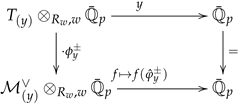
The first part of this theorem corresponds to Theorem 5.2 in [7]. Here, we can extend their arguments to also deduce the second part of the theorem.
By definition
For any point , write . If we denote , we have
because is a finite free -module. By Proposition 4.3 in [7] and the control Theorem 6, the composition (21) provides an isomorphism
We observe that, since
a -basis for is given by with and . Notice first that the point factors through , and it fits into the commutative diagram
Because corresponds to the specialization of up to constant, we compute
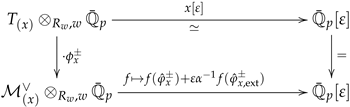
for some , so that . This proves the first assertion. For the second, notice that and we have the commutative diagram
Because by (18) we have . Again, we compute
and the result follows. □
Notice that there is no canonical choice of , even though we impose . In fact, with is also a basis, so that . For any such a change of basis, we obtain
The following result does not depend on the choice of the generator :
Corollary 2.
Let the element corresponding to . Subsequently,
Funding
This research was funded by DGICYT [grant number MTM2015-63829-P] and European Research Council (ERC) under the European Union’s Horizon 2020 research and innovation programme [grant number 682152].
Institutional Review Board Statement
Not applicable.
Informed Consent Statement
Not applicable.
Data Availability Statement
Not applicable.
Acknowledgments
The author would like to thank David Loeffler, Víctor Rotger and Chris Williams for their comments and discussions throughout the development of this paper.
Conflicts of Interest
The author declares no conflict of interest.
References
- Vishik, M.M. Non-archimedean measures connected with dirichlet series. Math. USSR 1976, 28, 216–228. [Google Scholar] [CrossRef]
- Amice, Y.; Vélu, J. Distributions p-adiques associées aux séries de hecke. Astérisque 1975, 24–25, 119–131. [Google Scholar]
- Mazur, B.; Tate, J.; Teitelbaum, J. On p-adic analogues of the Birch and Swinnerton-Dyer conjecture. Invent. Math. 1986, 84, 1–48. [Google Scholar] [CrossRef]
- Spiess, M. On special zeros of p-adic L-functions of Hilbert modular forms. Invent. Math. 2014, 196, 69–138. [Google Scholar] [CrossRef]
- Coleman, R.F.; Edixhoven, B. On the semi-simplicity of the Up-operator on modular forms. Math. Ann. 1998, 310, 119–127. [Google Scholar] [CrossRef]
- Chiriac, L. Special Frobenius Traces in Galois Representations. Ph.D. Thesis, California Institute of Technology, Pasadena, CA, USA, 2015. [Google Scholar]
- Betina, A.; Williams, C. Arithmetic of p-irregular modular forms: Families and p-adic L-functions. 2020; preprint. [Google Scholar]
- Bellaïche, J. Critical p-adic L-functions. Invent. Math. 2012, 189, 1–60. [Google Scholar] [CrossRef]
- Pollack, R.; Stevens, G. Critical slope p-adic L-functions. J. Lond. Math. Soc. 2013, 87, 428–452. [Google Scholar] [CrossRef]
- Molina, S. Anticyclotomic p-adic L-functions and the exceptional zero phenomenon. Trans. Am. Math. Soc. 2019, 372, 2659–2714. [Google Scholar] [CrossRef]
- Bump, B. Automorphic Forms and Representations; Cambridge University Press: Cambridge, MA, USA, 1984. [Google Scholar]
- Buzzard, K. Eigenvarieties. Lond. Math. Soc. Lect. Note Ser. 2007, 1, 59–120. [Google Scholar]
- Stevens, G. Rigid analytic modular symbols. 1994; preprint. [Google Scholar]
- Chenevier, G. Familles p-adiques de formes automorphes pour Gln. J. Reine Angew. Math. 2004, 570, 143–217. [Google Scholar] [CrossRef]
Publisher’s Note: MDPI stays neutral with regard to jurisdictional claims in published maps and institutional affiliations. |
© 2021 by the author. Licensee MDPI, Basel, Switzerland. This article is an open access article distributed under the terms and conditions of the Creative Commons Attribution (CC BY) license (http://creativecommons.org/licenses/by/4.0/).