Abstract
In this paper, we consider an elliptic problem in a domain perforated along the boundary. By setting a homogeneous Dirichlet condition on the boundary of the cavities and a homogeneous Neumann condition on the outer boundary of the domain, we prove higher integrability of the gradient of the solution to the problem.
1. Introduction
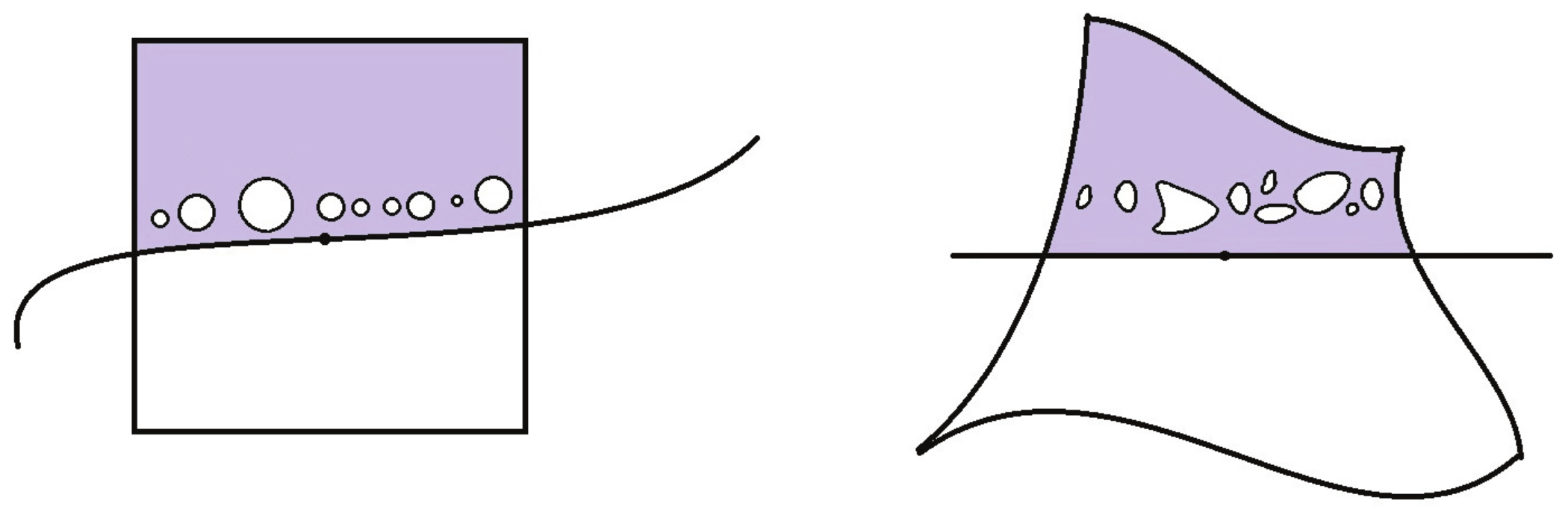
This paper confronts the estimates of solutions to an elliptic problem in domains perforated along the boundary (see Figure 1).
Figure 1.
Domain perforated along the boundary.
For the following homogeneous Dirichlet problem in a bounded domain:
with uniformly elliptic measurable and symmetric matrix , that is, , and the following:
and with the right hand side as , where , a higher integrability of the gradient of solutions (Meyers estimates) in a plane domain was proved in [1]. In other words, it was proved that the gradient of the solution is integrable at the power greater than two:
In a multidimensional case, the same result for domains with sufficiently smooth boundary was proved in [2]. It should be noted that higher integrability of the gradient of solutions to the Dirichlet problem in a bounded domain with Lipschitz boundary for p-Laplacian with variable p was obtained in [3].
The Meyers estimate (higher integrability) of solutions to a Zaremba problem with rapidly changing type of boundary conditions in a plane domain for the Laplacian can be observed in [4]. The uniformly elliptic operators in the multidimensional case can be observed in [5].
Some other integral estimates of solutions can be found in [6,7,8,9]. In paper [10], one can find the integral estimates in domains perforated along the boundary.
It should be noted that similar mathematical models and problems appear in many applications, for instance, in mechanics of aircraft and space structures, theory of bridge constructions, hudrodynamics of bodies with complicated microstructure, etc. For more details, refer to [11].
This paper is devoted to obtaining the Meyers estimates for the gradient of the solution to an elliptic problem on a perforated slope along the boundary. Thus, by assuming a homogeneous Dirichlet condition at the cavity boundary and a Neumann homogeneous condition at the outer boundary of the domain, higher integrability of the gradient of the solution is proved.
2. Setting of the Problem and Formulation of the Main Result
Consider a domain , , with Lipschitz boundary (Lipschitz domain). Denote by the hypersurface lying in on the distance from the boundary . Here, is a small parameter. Suppose that are balls centered on this hypersurface with radii , . Denote , . Here, is an integer and tends to infinity as .
The domain is called a Lipschitz domain, if for any point there exists an open cube Q centered in , with edges of the length parallel to the coordinate axes such that is a graph of the Lipschitz function with Lipschitz constant L independent of . Here, are new coordinates with origin in .
Consider in the domain , the following problem:
where is an outward conormal derivative of the function , and the components of the vector-function are functions from . In order to define the solution to problem (4) denoted by , the completion of the set of infinitely smooth functions in is required, vanishing in the vicinity of , with respect to the following norm.
The function is called a solution to problem (4), if the following integral identity:
holds for any test–function (see [12,13]).
We now study the question of higher integrability of the gradient of the solution to problem (4).
Let us describe the structure of the set . Consider a compact set . Define the capacity for by the following formula.
Let be an open ball centered in with radius r, and let be -dimensional measure of the set E (see for the definition, for instance [14]). Assume that the following is the case.
Denote by the boundary layer along the boundary with a thickness that equals to , including all the cavities.
Suppose that for and , either we have the following inequality:
or the the following inequality:
where the positive constant does not depend on and r.
Note that the condition (8) is stronger but is easier to test. In addition, one can observe that under any of these conditions for any , the Friedrichs inequality of the following:
holds, which by means of the Lax–Milgram Lemma (see [15]) results in the existence of a unique solution to problem (4).
3. Proof of the Main Result
Proof of Theorem 1.
First of all we estimate the gradient of a solution to problem (2) in the neighbourhood of the boundary of the domain. Let us locally transform the coordinates in the vicinity of the boundary and, more precisly, in the neighbourhood of an arbitrary point . By denoting the following:
consider a local Cartesian coordinate system with its origin in and that is given in this coordinate system by the following equation:
where g is a Lipschitz function with the Lipschitz constant L. We assume that the following:
satisfies . By changing the following variables:
we have the following:
for . Denote by the domain after the transformation of the coordinates (see Figure 2). □
Figure 2.
Transformation of the cube .
Lemma 1.
The domain contains the following cube.
Proof.
Suppose that and for some and . It is easy to observe that the following is the case:
due to the fact that function g is Lipschitz and ; thus, we have the following.
Consequently, the following is the case.
Moreover, by taking the following:
we complete the proof. □
Now problem (2) in perforated semicube has the following form.
Here, , and are the images under transformation (10) of the domains , and , respectively, and the following:
satisfies and
where depends on from (1) and the constant L of the function g. Note that the following is the case:
and is the respective conormal derivative.
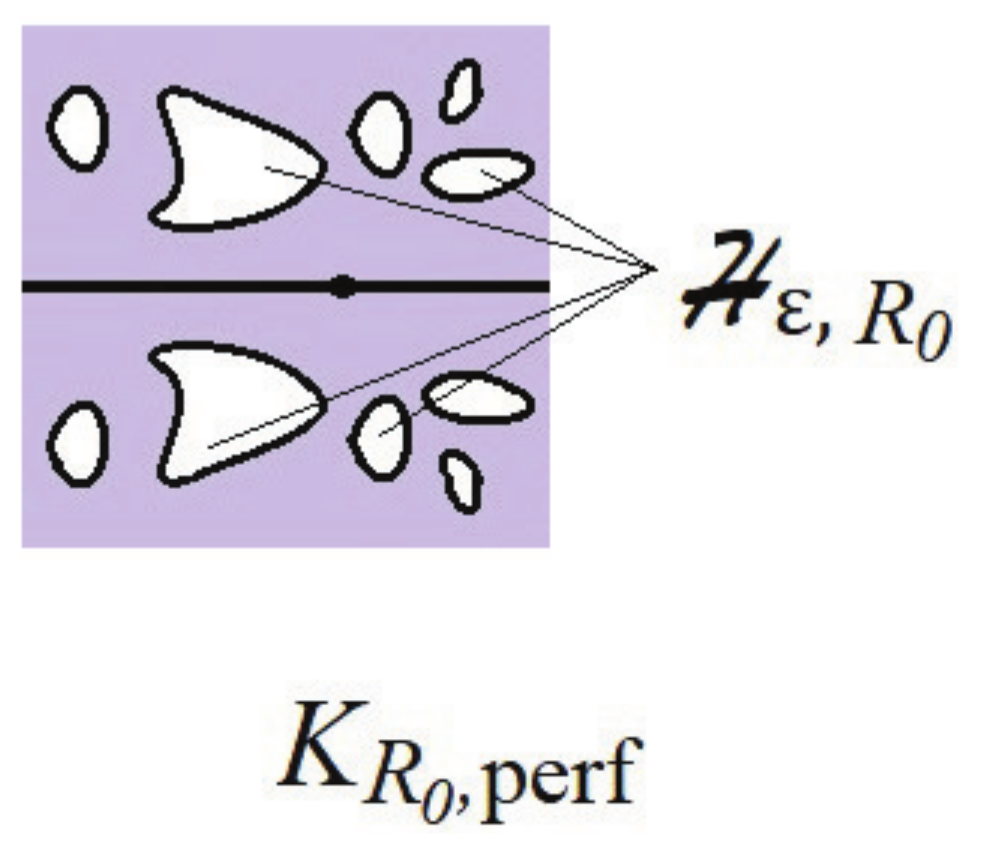
Denote by the domain , and let be the union . Denote also by the cavities (pores) in (see Figure 3).
Figure 3.
Cube .
Let us extend the solution to problem (12) by zero inside the pores and then extend it with respect to the hyperplane . We retain the same notation for the extended function. The extended function satisfies the following problem.
Here, we have the following:
with a positive definite matrix satisfying , as . Moreover, are odd extensions of the functions from (13), and are even extensions of , . The vector function in (16) is defined by the following relations: as , are the even extension of the components from (12), and is the odd extension of .
Clearly the solution to problem (16) is the function , which satisfies the integral identity (see (5)):
for any . Here, is the closure of the set of infinitely smooth functions in , vanishing in a vicinity of and by the following norm.
We denote by the open cube centered in with edges of the length parallel to the coordinate axes. Moreover, we assume that the following is the case.
Denote the following:
where is the d-dimensional measure of the cube .
- Consider the case and take in (17) the test-function , where the following is the case.Here, the cutoff function satisfies the following.Next, the lemma is devoted to the Caccioppoli inequality.Lemma 2.ProofThen, by using the Poincaré–Sobolev inequality:By taking defined in (19) and substituting the test function in the integral identity (17), we have the following.Since , then by inequality , we derive the following.Using the inequalities (21) and (22) and the ellipticity of problem (16), we obtain the following.Finally, bearing in mind that in and , we obtain inequality (20). The lemma is proved. □with , we deduce from (23) the following.
- Consider the case . Taking in (17) the test-function with defined in (19), we come to (20) with ; hence, we have the following.Now, we estimate the first term in the right hand side of (25). If , then there exists such that . Denote by z the pre-image (the inverse image) of point with respect to transformation (10). Note that the pre-image of the cube contains the ball , with a positive constant c dependent on L and d. Due to (7), we have the following.Hence, by using the definition (6), we obtain . Keeping in mind the imbedding theorem (see [1] (§14.1.2)), we estimate the following.If we use condition (8), then, bearing in mind the estimate from Proposition 4 from [1] (§13.1.1), we also obtain (26). Thus, estimate (25) results in inequality (24). Next, estimate (24) for any cubes and the Gehring Lemma (see [16,17] and also [18] (Ch. VII)) produces the following inequality:if , , with positive constant . Rewriting (27) and keeping in mind the properties of the extended functions, we have the following.Considering the inverse to (10) transformation, we conclude that the pre-image of is contained in , and the pre-image of cube contains the domain , where . By means of (15) and (28), we obtain the following:or the following.Due to the arbitrariness of point and the compactness of boundary , one can find such finite cover of such that the closed set:is contained in the union of the sets , where . By summarizing the following inequalities:we derive the following.The internal estimate of the following:follows from [2]. Finally, we have (9).Remark 1.
4. One Application
Let us consider the following problem:
where is a constant in two-dimensional domain perforated along the boundary with the limit Robin (Fourier) problem of the following form.
Note that sequence is uniformly bounded in the Sobolev space ; hence, the existence of the limit function is obvious. We study the rate of convergence of the solution to solution in the Sobolev space .
Assume that is the polar system of coordinates centered in (the center of the circle ). Consider the following cut-off function.
Then, substitute the test-function , in the integral identity of problem (29).
In order to estimate the rate of convergence depending on , we subtract the following integral identity:
of the limit problem (30) from integral identity (31). We obtain the following.
Rewriting (33) and keeping in mind the ellipticity of the operator by means of the Cauchy inequality and the equivalence of the norms in the Sobolev space, we derive the following.
The first term in the right hand side of inequality (34) is easy to estimate (due to the Cauchy inequality) by the following.
Here, is the number of circles, and is the diameter of the circle, where the integral is nontrivial, since .
Next, we estimate the second term at the right hand side of (34) and show the difference between inequalities with and without the Meyers estimate.
- Without MeyersWe have the following.The number of circles can be the following:where constant satisfies . In this case, we have the final estimate.
- With MeyersSuppose that the following is the case.
We obtain the following.
In this case, to retain the same logarithmic rate of convergence as in (35), the number of circles is as follows.
Alternatively, by keeping the logarithmic number of holes , we obtain the power estimate of convergence.
5. Discussion
Analogous results can be obtained for general perforated domains and porous media with periodic, almost periodic, nonperiodic and random structures.
6. Materials and Methods
In this paper, we used integral estimates of different types, Sobolev inequalities and Sobolev embedding theorems. It should be noted that the obtained inequalities (higher integrability) allowed increasing the rate of convergence and a priori estimates of solutions to homogenization problems in domains perforated along the boundary (refer to such problems with regular estimates, for example, in [10]). Similar problems with concentrated masses along the boundary can be observed in [19]. We also note recent investigations on the topic raised in paper ([20,21,22]).
Funding
This work was supported by RUSSIAN SCIENCE FOUNDATION grant number 20-11-20272.
Institutional Review Board Statement
Not applicable.
Informed Consent Statement
Not applicable.
Data Availability Statement
Not applicable.
Acknowledgments
I would very much like to thank the reviewers for their valuable and important comments, which have significantly improved the quality of the paper.
Conflicts of Interest
The author declares no conflict of interest.
References
- Bojarski, B.V. Generalized soluions of a system of differential equations of the first order of elliptic type with discontinuous coefficients. Mat. Sb. N. S. 1957, 43, 451–503. [Google Scholar]
- Meyers, N.G. An Lp—Estimate for the gradient of solutions of second order elliptic deivergence equations. Ann. Della Sc. Norm. Super. Pisa-Cl. Sci. 1963, 17, 189–206. [Google Scholar]
- Zhikov, V.V. On some Variational Problems. Russ. J. Math. Phys. 1997, 5, 105–116. [Google Scholar]
- Alkhutov, Y.A.; Chechkin, G.A. Increased integrability of the gradient of the solution to the zaremba problem for the poisson equation. In Doklady Mathematics; Pleiades Publishing: New York, NY, USA, 2021; Volume 103, pp. 69–71. [Google Scholar]
- Alkhutov, Y.A.; Chechkin, G.A. The Meyer’s estimate of solutions to zaremba problem for second-order elliptic equations in divergent form. C. R. Méc. 2021, 349, 299–304. [Google Scholar] [CrossRef]
- Kon’kov, A.A. Comparison theorems for second-order elliptic inequalities. Nonlinear Anal. Theory Methods Appl. 2004, 59, 583–608. [Google Scholar] [CrossRef]
- Kon’kov, A.A. On comparison theorems for elliptic inequalities. J. Math. Anal. Appl. 2012, 388, 102–124. [Google Scholar] [CrossRef][Green Version]
- Kon’kov, A.A. On properties of solutions of quasilinear second-order elliptic inequalities. Nonlinear Anal. Theory Methods Appl. 2015, 123–124, 89–114. [Google Scholar] [CrossRef]
- Kon’kov, A.A. Geometric eatimates of solutions of quasilinear elliptic inequalities. Izv. Math. 2020, 84, 1056–1104. [Google Scholar] [CrossRef]
- Chechkin, G.A.; Koroleva, Y.O.; Persson, L.-E.; Wall, P. On spectrum of the laplacian in a circle perforated along the boundary: Application to a friedrichs–Type Inequality. Int. J. Differ. Equ. 2011, 2011, 619623. [Google Scholar] [CrossRef]
- Angiulli, G.; Calcagno, S.; De Carlo, D.; Laganá, F.; Versaci, M. Second-order parabolic equation to model, analyze, and forecast thermal-stress distribution in aircraft plate attack wing–fuselage. Mathematics 2020, 8, 6. [Google Scholar] [CrossRef]
- Sobolev, S.L. Some Applications of Functional Analysis in Mathematical Physics, 3rd ed.; Translations of Mathematical Monographs; American Mathematical Society: Providence, RI, USA, 1991; Volume 90. [Google Scholar]
- Bers, L.; John, F.; Schechter, M. Partial Differential Equations. Lectures in Applied Mathematics; Inderscience Publishers: Geneva, Switzerland, 1964. [Google Scholar]
- Iosida, K. Functional Analysis; Springer: Berlin/Heidelberg, Germany, 1965. [Google Scholar]
- Lax, P.D.; Milgram, A. Parabolic equations, Contributions to the theory of Partial Differential Equations. Ann. Math. Stud. 1954, 33, 167–190. [Google Scholar]
- Gehring, F.W. The Lp—integrability of the partial derivatives of a quasiconformal mapping. Acta Math. 1973, 130, 265–277. [Google Scholar] [CrossRef]
- Giaquinta, M.; Modica, G. Regularity results for some classes of higher order nonlinear elliptic systems. Crelle’s J. (J. Reine Angew. Math.) 1979, 311/312, 145–169. [Google Scholar]
- Skrypnik, I.V. Methods for Analysis of Nonlinear Elliptic Boundary Value Problems; Translations of Mathematical Monographs; American Mathematical Society: Providence, RI, USA, 1994; Volume 139. [Google Scholar]
- Chechkin, G.A.; Chechkina, T.P. Random homogenization in a domain with light concentrated masses. Mathematics 2020, 8, 788. [Google Scholar] [CrossRef]
- Anop, A.; Chepurukhina, I.; Murach, A. Elliptic problems with additional unknowns in boundary conditions and generalized sobolev spaces. Axioms 2021, 10, 292. [Google Scholar] [CrossRef]
- Motreanu, D.; Tornatore, E. Quasilinear dirichlet problems with degenerated p-Laplacian and convection term. Mathematics 2021, 9, 139. [Google Scholar] [CrossRef]
- Motreanu, D.; Sciammetta, A.; Tornatore, E. A sub-supersolution approach for robin boundary value problems with full gradient dependence. Mathematics 2020, 8, 658. [Google Scholar] [CrossRef]
Publisher’s Note: MDPI stays neutral with regard to jurisdictional claims in published maps and institutional affiliations. |
© 2021 by the author. Licensee MDPI, Basel, Switzerland. This article is an open access article distributed under the terms and conditions of the Creative Commons Attribution (CC BY) license (https://creativecommons.org/licenses/by/4.0/).