


Abstract
Symmetric varieties are normal equivarient open embeddings of symmetric homogeneous spaces, and they are interesting examples of spherical varieties. We prove that all smooth Fano symmetric varieties with Picard number one admit Kähler–Einstein metrics by using a combinatorial criterion for K-stability of Fano spherical varieties obtained by Delcroix. For this purpose, we present their algebraic moment polytopes and compute the barycenter of each moment polytope with respect to the Duistermaat–Heckman measure.
1. Introduction
A Kähler metric on a complex manifold is said to be Kähler–Einstein if the Riemannian metric defined by its real part has constant Ricci curvature. The existence of Kähler–Einstein metrics on Fano manifolds has become a central topic in complex geometry in recent years. In contrast to Calabi–Yau and general type [1,2], Fano manifolds do not necessarily have a Kähler–Einstein metric in general, and there are obstructions based on the (holomorphic) automorphism group.
The first obstruction was discovered by Matsushima in [3]. He proved that the reductivity of the automorphism group is a necessary condition for the existence of Kähler–Einstein metrics. Later, Futaki [4] proved that the existence of Kähler–Einstein metrics implies that the Futaki invariant, a functional on the Lie algebra of the automorphism group, vanishes. As a generalization of this invariant on test configurations, Tian [5,6] and Donalson [7] introduced a certain algebraic stability condition, which is called the K-stability. The famous Yau–Tian–Donaldson conjecture predicts that the existence of a Kähler–Einstein metric on a Fano manifold is equivalent to the K-stability. Eventually, this conjecture was solved by Chen–Donaldson–Sun [8,9,10] and Tian [11].
Despite of these obstructions, each Fano homogeneous manifold admits a Kähler–Einstein metric [12,13]. Therefore, one can expect the existence of a Kähler–Einstein metric on a Fano manifold if it has large automorphism group. A natural candidate is the almost-homogeneous manifold, that is, a manifold with an open dense orbit of a complex Lie group. For the case of toric Fano manifolds, Wang and Zhu [14] proved that the existence of a Kähler–Einstein metric is equivalent to the vanishing of the Futaki invariant. In fact, this was based on the theorem by Mabuchi [15], which says that the Futaki invariant vanishes if and only if the barycenter of the moment polytope is the origin. This gave us a powerful combinatorial criterion for the existence of a Kähler–Einstein metric on a toric Fano manifold, which is much easier to check than the K-stability condition.
An important class of almost-homogeneous varieties is spherical varieties including toric varieties, group compactifications ([16]), and symmetric varieties. A normal variety is called spherical if it admits an action of a reductive group of which a Borel subgroup acts with an open orbit on the variety. As a generalization of Wang and Zhu’s work, Delcroix [17] extended a combinatorial criterion for K-stability of Fano spherical manifolds, in terms of its moment polytope and spherical data. In particular, this criterion is also applicable to smooth Fano symmetric varieties (see Corollary 5.9 of [17]).
By combining the above criterion and Ruzzi’s classification [18] of smooth Fano symmetric varieties with Picard number one, we prove the following.
Theorem 1.
All smooth Fano symmetric varieties with Picard number one admit Kähler–Einstein metrics.
For this theorem, the condition on the Picard number is crucial because a smooth Fano symmetric variety with higher Picard number may have no Kähler–Einstein metrics. For example, the blow-up of the wonderful compactification of along the closed orbit does not admit any Kähler–Einstein metrics (see Example 5.4 of [16]). Moreover, we note that Delcroix already provided the existence of Kähler–Einstein metrics on smooth Fano embedding of , and group compactifications of and , respectively (see Example 5.13 of [17]). The above theorem leads us to complete all remaining cases of smooth Fano symmetric varieties with Picard number one also admit Kähler–Einstein metrics.
2. Criterion for Existence of Kähler–Einstein Metrics on Symmetric Varieties
Let G be a connected reductive algebraic group over .
2.1. Spherical Varieties and Algebraic Moment Polytopes
We review general notions and results about spherical varieties. The normal equivariant embeddings of a given spherical homogeneous space are classified by combinatorial objects called colored fans, which generalize the fans appearing in the classification of toric varieties. We refer to the works in [19,20,21] as references for spherical varieties.
Definition 1.
A normal variety X equipped with an action of G is called spherical if a Borel subgroup B of G acts on X with an open and dense orbit.
Let be an open dense G-orbit of a spherical variety X and T a maximal torus of B. By definition, the spherical weight lattice of is a subgroup of characters of (nonzero) B-semi-invariant functions in the function field , that is,
where . Note that every function in is determined by its weight up to constant because , that is, any B-invariant rational function on X is constant. The spherical weight lattice is a free abelian group of finite rank. We define the rank of as the rank of the lattice . Let denote its dual lattice together with the natural pairing .
As the open B-orbit of a spherical variety X is an affine variety, its complement has pure codimension one and is a finite union of B-stable prime divisors.
Definition 2.
For a spherical variety X, B-stable but not G-stable prime divisors in X are called colors of X. A color of X corresponds to a B-stable prime divisor in the open G-orbit of X. We denote by the set of colors of X (or ).
As a B-semi-invariant function in is unique up to constant, we define the color map by for , where is the discrete valuation associated to a divisor D, that is, is the vanishing order of f along D. Unfortunately, the color map is generally not injective. In addition, every discrete -valued valuation of the function field induces a homomorphism defined by , so that we get a map . Luna and Vust [22] showed that the restriction of to the set of G-invariant discrete valuations on is injective. From now on, we will regard a G-invariant discrete valuation on as an element of via the map , and in order to simplify the notation will be written as for a G-stable divisor E in X.
Let L be a G-linearized ample line bundle on a spherical G-variety X. By the multiplicity-free property of spherical varieties, the algebraic moment polytope encodes the structure of representation of G in the spaces of multi-sections of tensor powers of L.
Definition 3.
The algebraic moment polytope of L with respect to B is defined as the closure of in , where is a finite set consisting of (dominant) weights λ such that . Here, means the irreducible representation of G with highest weight λ.
For a compact connected Lie group K and a compact connected Hamiltonian K-manifold , Kirwan [23] proved that the intersection of the image of M through the moment map with the positive Weyl chamber with respect to a Borel subgroup B of G is a convex polytope, where G is the complexification of K. The algebraic moment polytope for a polarized G-variety X was introduced by Brion in [24] as a purely algebraic version of the Kirwan polytope. This is indeed the convex hull of finitely many points in (see the work in [24]). Moreover, if X is smooth, then can be interpreted as the Kirwan polytope of with respect to the action of a maximal compact subgroup K of G, where is a K-invariant Kähler form in the first Chern class .
Example 1 (Equivariant compactifications of reductive groups).
Any reductive group G is spherical with respect to the action of by left and right multiplication from the Bruhat decomposition. Let us consider the wonderful compactification of a simple algebraic group G of adjoint type constructed by De Concini and Procesi [25]. As a specific example, the wonderful compactification of the projective general linear group has the action of induced by the multiplication of matrices on the left and on the right. It is known that the spherical weight lattice of the wonderful compactification of a simple algebraic group G of adjoint type coincides with the root lattice of G. As the anticanonical line bundle is isomorphic to ,
where denotes the fundamental weight of . Repeating this calculation for tensor powers , we obtain
Therefore, the algebraic moment polytope of the wonderful compactification of is a closed interval in , where denotes the simple root of .
2.2. Symmetric Spaces and Symmetric Varieties
For an algebraic group involution of a connected reductive algebraic group G, let be the subgroup consisting of elements fixed by . If H is a closed subgroup of G such that the identity component of H coincides with the identity component of , then the homogeneous space is called a symmetric homogeneous space. By taking a universal cover of G, we can always assume that G is simply connected. When G is simply connected, by (see Section 8.1 in [26]) is connected and H is a closed subgroup between and its normalizer in G, that is, .
Definition 4.
A normal G-variety X together with an equivariant open embedding of a symmetric homogeneous space is called a symmetric variety.
Vust proved that a symmetric homogeneous space is spherical (see in [27], Theorem 1 in Section 1.3). By using the Luna–Vust theory on spherical varieties, Ruzzi [18] classified the smooth projective symmetric varieties with Picard number one from the classification of corresponding colored fans. As a result, there are only six nonhomogeneous smooth projective symmetric varieties with Picard number one, and their restricted root systems (see Section 2.3 for the definition) are of either type or type . Moreover, Ruzzi gave geometric descriptions of them in [28].
In the case that the restricted root system is of type (Theorem 3 of the work in [28]), the symmetric varieties are the smooth equivariant completions of symmetric homogeneous spaces , , , , and are isomorphic to a general hyperplane section of rational homogeneous manifolds which are in the third row of the geometric Freudenthal–Tits magic square.
Remark 1.
Though all the rational homogeneous manifolds admit Kähler–Einstein metrics, a general hyperplane section of a rational homogeneous manifold is not necessarily the case. For example, a general hyperplane section of the Grassmannian , called an odd symplectic Grassmannian of isotropic planes, does not admit Kähler–Einstein metrics by the Matsushima theorem in [3] because the automorphism group of the odd symplectic Grassmannian is not reductive (see Theorem 1.1 in [29]).
In the case that the restricted root system is of type (Theorem 2 of [28]), the symmetric varieties are the smooth equivariant completions of either or . The smooth equivariant completion with Picard number one of the symmetric space , called the Cayley Grassmannian, and the smooth equivariant completion with Picard number one of the symmetric space , called the double Cayley Grassmannian, have been studied by Manivel [30,31].
Their geometric properties including the dimension, the Fano index, the restricted root system are listed in Table 1. For the deformation rigidity properties of smooth projective symmetric varieties with Picard number one, see in [32].

Table 1.
Nonhomogeneous smooth projective symmetric varieties with Picard number one.
2.3. Existence of Kähler–Einstein Metrics on Symmetric Varieties
We recall Delcroix’s criterion for K-stability of smooth Fano symmetric varieties in [17].
For an algebraic group involution of G, a torus T in G is split if for any . A torus T is maximally split if T is a -stable maximal torus in G which contains a split torus of maximal dimension among split tori. Then, descends to an involution of for a maximally split torus T, and the rank of a symmetric homogeneous space is equal to the dimension of a maximal split subtorus of T.
Let be the root system of G with respect to a maximally split torus T. By Lemma 1.2 of [25], we can take a set of positive roots such that either or is a negative root for all ; then, we denote , where . The set is a (possibly non-reduced) root system, which is called the restricted root system. Let denote the cone generated by positive restricted roots in .
Proposition 1
(Corollary 5.9 of [17]). Let X be a smooth Fano embedding of a symmetric homogeneous space . Then X admits a Kähler–Einstein metric if and only if the barycenter of the moment polytope with respect to the Duistermaat–Heckman measure
is in the relative interior of the translated cone , where κ denotes the Killing form on the Lie algebra of G.
In fact, this result is a direct consequence of a combinatorial criterion for the existence of a Kähler–Ricci soliton on smooth Fano spherical varieties obtained by Delcroix (see in [17], Theorem A). The proof consists of the existence of a special equivariant test configuration with horospherical central fiber and the explicit computation of the modified Futaki invariant on Fano horospherical varieties.
3. Moment Polytopes of Smooth Fano Symmetric Varieties and Their Barycenters
We prove in this section our main result Theorem 1. The proof combines Proposition 1 together with the following result allowing us to compute (algebraic) moment polytopes of Fano symmetric varieties.
Proposition 2.
Let X be a smooth Fano embedding of a symmetric space . Then, there exist integers such that a Weil divisor represents the anticanonical line bundle for colors and G-stable divisors in X, and the moment polytope is , where the polytope is the convex hull of the set
in and its dual polytope is defined as .
This statement is a specialization of a result of Gagliardi and Hofscheier ([33], Section 9) in which they studied the anticanonical line bundle on a Gorenstein Fano spherical variety. It is based on the works of Brion [34,35] on algebraic moment polytopes and anticanonical divisors of Fano spherical varieties. For the convenience of the reader, we provide a sketch of the proof.
Proof.
Let us recall results about the anticanonical line bundle on a spherical variety from Sections 4.1 and 4.2 in [35]. For a spherical G-variety X, there exists a B-semi-invariant global section with . Furthermore, the B-weight of this section s is the sum of such that does not stabilize the open B-orbit in X. Thus, when X is a symmetric variety associated to an involution of G, the weight of s is equal to .
For a Gorenstein Fano spherical variety X, Brion obtained the relation between the moment polytope and a polytope associated to the anticanonical divisor in Proposition 3.3 of [34]. More precisely, if X is a smooth Fano embedding of , then the moment polytope is and a polytope associated to the anticanonical (Cartier) divisor is the dual polytope . □
Let be the root system of G with respect to a maximally split torus T. Fix a set of positive roots such that either or is a negative root for all . We recall that the coroot of a root is defined as the unique element in the Lie algebra of T such that for all . Given a set of simple roots , we define the fundamental weights dual to the coroots by requiring for .
3.1. Smooth Fano Embedding of with Picard Number One
Considering the involution of defined by sending g to the inverse of its transpose , which is usually called of Type AI, the subgroup fixed by is . As for , the set is empty and the restricted root system is the double of the root system . The spherical weight lattice is formed by for weights . Thus, the dual lattice is generated by half of the coroots from the relation . In general, Vust [36] proved that when G is semisimple and simply connected, the spherical weight lattice of the symmetric space is the lattice of restricted weights determined by the restricted root system, which implies that is the lattice generated by restricted coroots forming a root system dual to the restricted root system .
Let be the smooth Fano embedding of with Picard number one. Using the description in [28], we know that the two colors and the G-stable divisor E in have the images , and in , respectively. Recall from Theorem 6 of the work in [28] that the maximal colored cones of its colored fan are and . Then, we have two relations and , so that in the Picard group .
Proposition 3.
Let be the smooth Fano embedding of with Picard number one. The moment polytope is the convex hull of three points 0, , in .
Proof.
From the colored data of and the G-orbit structure of , we know the relation of the anticanonical divisor. Using Proposition 2, , , and are used as inward-pointing facet normal vectors of the moment polytope . First, gives an inequality
because . Similarly, as gives a domain , the images of two colors determine the positive Weyl chamber. Last, gives a domain . Thus the moment polytope is the intersection of three half-spaces, so that it is the convex hull of three points 0, , in . □
Corollary 1.
The smooth Fano embedding of with Picard number one admits a Kähler–Einstein metric.
Proof.
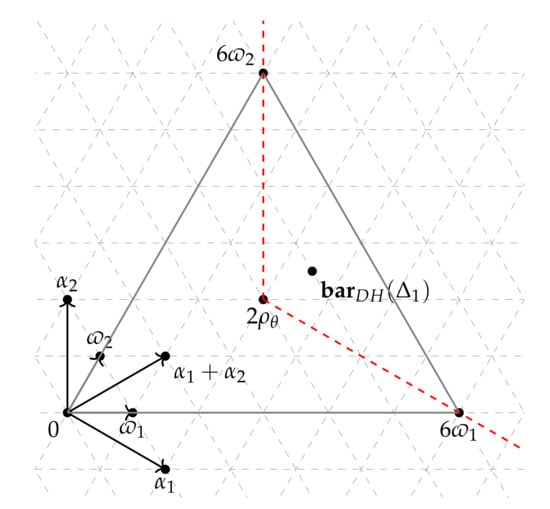
Choosing a realization of the root system in the Euclidean plane with and , for we obtain its Duistermaat–Heckman measure
From Proposition 3, we can compute the volume
and the barycenter
of the moment polytope with respect to the Duistermaat–Heckman measure. Therefore, is in the relative interior of the translated cone (see Figure 1), so admits a Kähler–Einstein metric by Proposition 1. □
Figure 1.
.
3.2. Smooth Fano Embedding of with Picard Number One
Any reductive algebraic group L is a symmetric homogeneous space under the action of the group for the involution , . If T is a maximal torus of L, then is a maximal torus of G and we get the spherical weight lattice
Thus, can be identified with by the projection to the first coordinate. Under this identification, the restricted root system is identified with the root system of L with respect to T, and the dual lattice is generated by the coroots , where .
Let be the smooth Fano embedding of with Picard number one. Using the description in [28], we know that the two colors and the G-stable divisor E in have the images , and in , respectively.
Proposition 4.
Let be the smooth Fano symmetric embedding of with Picard number one. The moment polytope is the convex hull of three points 0, , in .
Proof.
From the colored data of and the G-orbit structure of , we know the relation of the anticanonical divisor. Using Proposition 2, , , and are used as inward-pointing facet normal vectors of the moment polytope . First, gives an inequality
because . Similarly, as gives a domain , the images of two colors determine the positive Weyl chamber. Lastly, gives a domain . Thus, the moment polytope is the intersection of three half-spaces, so that it is the convex hull of three points 0, , in . □
Corollary 2.
The smooth Fano embedding of with Picard number one admits a Kähler–Einstein metric.
Proof.
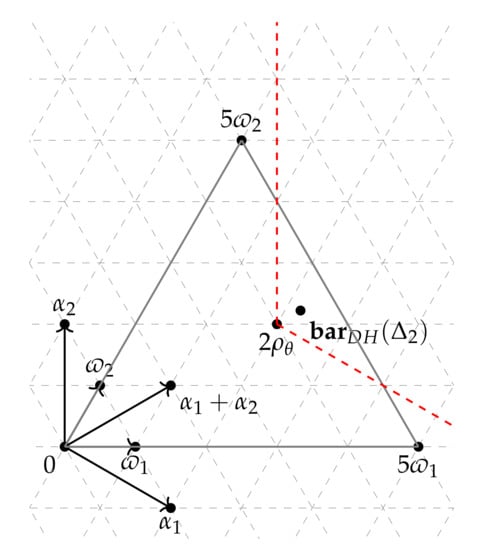
As in the proof of Corollary 1, we choose a realization of the root system in the Euclidean plane with and . Then, the Duistermaat–Heckman measure on the moment polytope is given as
From Proposition 4, we can compute
and the barycenter
of the moment polytope with respect to the Duistermaat–Heckman measure. Therefore, is in the relative interior of the translated cone (see Figure 2), so admits a Kähler–Einstein metric by Proposition 1. □
Figure 2.
.
3.3. Smooth Fano Embedding of with Picard Number One
Recall the involution of Type AII. Let be an involution of defined by , where is the block diagonal matrix formed by . Then, is the group of elements that preserve a nondegenerate skew-symmetric bilinear form . We can check that the restricted root system is the root system of type with multiplicity four, and the spherical weight lattice is generated by for weights , where denotes a split subtorus of dimension two in a maximal torus . In fact, if we choose the torus of diagonal matrices as T, then the maximal split torus consists of diagonal matrices of the form with and . Denoting by for the characters defined by
we have the restricted root system of type . Then, the dual lattice is generated by the coroots .
Let be the smooth Fano embedding of with Picard number one. Using the description in [28], we know that the two colors and the G-stable divisor E in have the images , and in , respectively.
Proposition 5.
Let be the smooth Fano symmetric embedding of with Picard number one. The moment polytope is the convex hull of three points 0, , in .
Proof.
From the colored data of and the G-orbit structure of , we know the relation of the anticanonical divisor. Using Proposition 2, , and are used as inward-pointing facet normal vectors of the moment polytope . Like the previous computations, and determine the positive restricted Weyl chamber. Indeed, gives an inequality
because . As gives a domain , the moment polytope is the intersection of this half-space with the positive restricted Weyl chamber. Thus is the convex hull of three points 0, , in . □
Corollary 3.
The smooth Fano embedding of with Picard number one admits a Kähler–Einstein metric.
Proof.
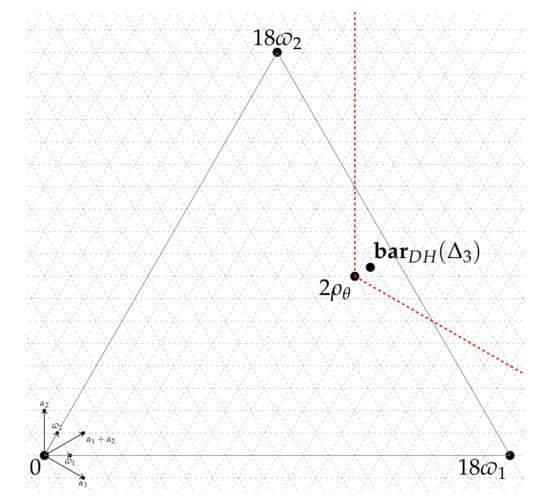
As the multiplicity of each restricted root in the restricted root system is four, the Duistermaat–Heckman measure on is given as
Then, the barycenter
is in the relative interior of the translated cone (see Figure 3). Therefore, admits a Kähler–Einstein metric by Proposition 1. □
Figure 3.
.
3.4. Smooth Fano Embedding of with Picard Number One
Let be the involution on the simple algebraic group of Type EIV. Then, is isomorphic to the simple algebraic group , and the restricted root system is the root system of type generated by the simple restricted roots with multiplicity eight. The spherical weight lattice is generated by for weights , where denotes a split subtorus of dimension two in a maximal torus , so that the dual lattice is generated by the coroots .
Let be the smooth Fano embedding of with Picard number one. Using the description in [28], we know that the two colors and the G-stable divisor E in have the images , and in , respectively.
Proposition 6.
Let be the smooth Fano symmetric embedding of with Picard number one. The moment polytope is the convex hull of three points 0, , in .
Proof.
From the colored data of and the G-orbit structure of , we know the relation of the anticanonical divisor. Using Proposition 2, , and are used as inward-pointing facet normal vectors of the moment polytope . In particular, and determine the positive restricted Weyl chamber. Indeed, gives an inequality
because . As gives a domain , the moment polytope is the intersection of this half-space with the positive restricted Weyl chamber. Thus is the convex hull of three points 0, , in . □
Corollary 4.
The smooth Fano embedding of with Picard number one admits a Kähler–Einstein metric.
Proof.
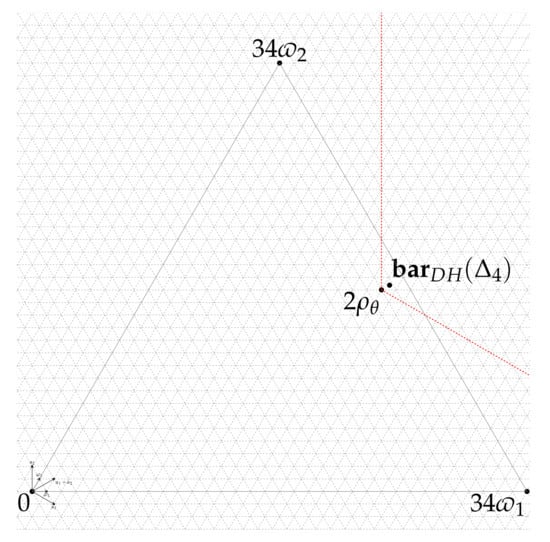
As the multiplicity of each restricted root in the restricted root system is eight, the Duistermaat–Heckman measure on is given as
Then, the barycenter
is in the relative interior of the translated cone (see Figure 4). Therefore, admits a Kähler–Einstein metric by Proposition 1. □
Figure 4.
.
3.5. Smooth Fano Embedding of with Picard Number One
Let be the unique nontrivial involution on the simple algebraic group . Then, is isomorphic to , but is empty and the restricted root system is the root system of type . The spherical weight lattice is generated by for weights of a maximal torus , so that the dual lattice is generated by the coroots .
Let be the smooth Fano embedding of with Picard number one. Using the description in [28], we know that the two colors and the G-stable divisor E in have the images , and in , respectively. Recall that the maximal colored cone of its colored fan is from Theorem 6 of [28]. Then we have two relations and , so that in .
Choose a realization of the root system in the Euclidean plane with and . Then, the complex Lie group has six positive roots:
From the relation , the fundamental weights corresponding to the system of simple roots are , .
Proposition 7.
Let be the smooth Fano symmetric embedding of with Picard number one. The moment polytope is the convex hull of three points 0, , in .
Proof.
From the colored data of and the G-orbit structure of , we know the relation of the anticanonical divisor. Using Proposition 2, , and are used as inward-pointing facet normal vectors of the moment polytope . As before, and determine the positive Weyl chamber. Indeed, gives an inequality
because . As gives a domain from and , the moment polytope is the intersection of this half-space with the positive Weyl chamber. Thus, is the convex hull of three points 0, , in . □
Corollary 5.
The smooth Fano embedding of with Picard number one admits a Kähler–Einstein metric.
Proof.
and the barycenter
of the moment polytope with respect to the Duistermaat–Heckman measure. Therefore, is in the relative interior of the translated cone (see Figure 5), so admits a Kähler–Einstein metric by Proposition 1. □
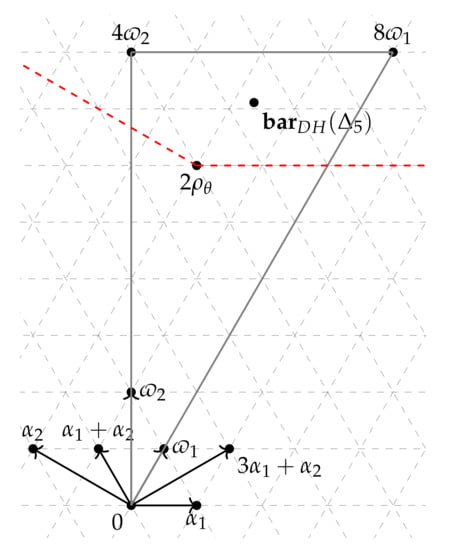
For , the Duistermaat–Heckman measure on is given as
From Proposition 7, we can compute the volume
Figure 5.
.
3.6. Smooth Fano Embedding of with Picard Number One
As explained in Section 3.2, the simple algebraic group can be considered as a symmetric homogeneous space under the action of the group for the involution , . The spherical weight lattice can be identified with the character group of a maximal torus by the projection to the first coordinate, and the dual lattice is generated by the coroots .
Let be the smooth Fano embedding of with Picard number one. Using the description in [28], we know that the two colors and the G-stable divisor E in have the images , , and in , respectively.
Proposition 8.
Let be the smooth Fano symmetric embedding of with Picard number one. The moment polytope is the convex hull of three points 0, , in .
Proof.
From the colored data of and the G-orbit structure of , we know the relation of the anticanonical divisor. Using Proposition 2, , , and are used as inward-pointing facet normal vectors of the moment polytope . As , gives an inequality
Therefore, and determine the positive Weyl chamber. In the same way, as gives a domain , the moment polytope is the intersection of this half-space with the positive Weyl chamber. Thus is the convex hull of three points 0, , in . □
Corollary 6.
The smooth Fano embedding of with Picard number one admits a Kähler–Einstein metric.
Proof.
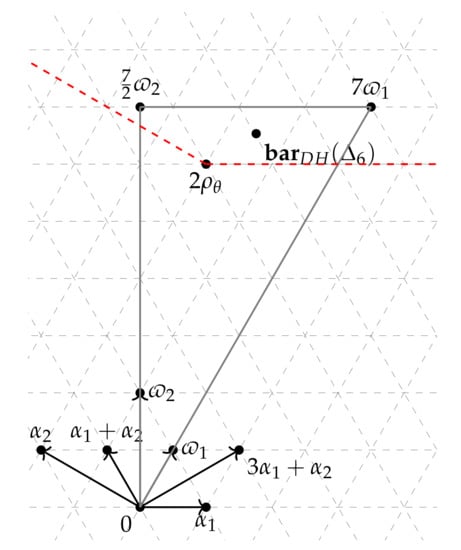
We can compute the barycenter of with respect to the Duistermaat–Heckman measure
from
As and the cone is generated by the vectors and , the barycenter is in the relative interior of the translated cone (see Figure 6). Therefore, admits a Kähler–Einstein metric by Proposition 1. □
Figure 6.
.
Finally, by Ruzzi’s classification of the smooth projective symmetric varieties with Picard number one in [18], Corollaries 1–6 imply the following statement. Therefore, we conclude Theorem 1.
Theorem 2.
All smooth Fano symmetric varieties with Picard number one admit Kähler–Einstein metrics.
Author Contributions
Project administration, K.-D.P.; Writing—original draft, S.Y.; Writing—review & editing, J.-H.L. All authors have read and agreed to the published version of the manuscript.
Funding
Jae-Hyouk Lee was supported by the National Research Foundation of Korea (NRF) grant funded by the Korea government (MSIT) (NRF-2019R1F1A1058962). Kyeong-Dong Park was supported by the Institute for Basic Science (IBS-R003-D1) and by the National Research Foundation of Korea (NRF) grant funded by the Korea government (MSIT) (NRF-2019R1A2C3010487). Sungmin Yoo was supported by the Institute for Basic Science (IBS-R003-D1).
Acknowledgments
Kyeong-Dong Park would like to express thanks to Jihun Park and Eunjeong Lee for their interests and helpful comments.
Conflicts of Interest
The authors declare no conflict of interest.
References
- Aubin, T. Équations du type Monge–Ampère sur les variétés kählériennes compactes. Bull. Sci. Math. 1978, 102, 63–95. [Google Scholar]
- Yau, S.-T. On the Ricci curvature of a compact Kähler manifold and the complex Monge–Ampère equation, I. Commun. Pure Appl. Math. 1978, 31, 339–411. [Google Scholar] [CrossRef]
- Matsushima, Y. Sur la structure du groupe d’homéomorphismes analytiques d’une certaine variété kählérienne. Nagoya Math. J. 1957, 11, 145–150. [Google Scholar] [CrossRef]
- Futaki, A. An obstruction to the existence of Einstein Kähler metrics. Invent. Math. 1983, 73, 437–443. [Google Scholar] [CrossRef]
- Tian, G. The K-energy on hypersurfaces and stability. Commun. Anal. Geom. 1994, 2, 239–265. [Google Scholar] [CrossRef]
- Tian, G. Kähler–Einstein metrics with positive scalar curvature. Invent. Math. 1997, 130, 1–37. [Google Scholar] [CrossRef]
- Donaldson, S.K. Scalar curvature and stability of toric varieties. J. Differ. Geom. 2002, 62, 289–349. [Google Scholar] [CrossRef]
- Chen, X.; Donaldson, S.; Sun, S. Kähler–Einstein metrics on Fano manifolds. I: Approximation of metrics with cone singularities. J. Am. Math. Soc. 2015, 28, 183–197. [Google Scholar] [CrossRef]
- Chen, X.; Donaldson, S.; Sun, S. Kähler–Einstein metrics on Fano manifolds. II: Limits with cone angle less than 2π. J. Am. Math. Soc. 2015, 28, 199–234. [Google Scholar] [CrossRef]
- Chen, X.; Donaldson, S.; Sun, S. Kähler–Einstein metrics on Fano manifolds. III: Limits as cone angle approaches 2π and completion of the main proof. J. Am. Math. Soc. 2015, 28, 235–278. [Google Scholar] [CrossRef]
- Tian, G. K-stability and Kähler–Einstein metrics. Commun. Pure Appl. Math. 2015, 68, 1085–1156. [Google Scholar] [CrossRef]
- Koszul, J.-L. Sur la forme hermitienne canonique des espaces homogènes complexes. Can. J. Math. 1955, 7, 562–576. [Google Scholar] [CrossRef]
- Matsushima, Y. Remarks on Kähler–Einstein manifolds. Nagoya Math. J. 1972, 46, 161–173. [Google Scholar] [CrossRef]
- Wang, X.-J.; Zhu, X. Kähler–Ricci solitons on toric manifolds with positive first Chern class. Adv. Math. 2004, 188, 87–103. [Google Scholar] [CrossRef]
- Mabuchi, T. Einstein–Kähler forms, Futaki invariants and convex geometry on toric Fano varieties. Osaka J. Math. 1987, 24, 705–737. [Google Scholar]
- Delcroix, T. Kähler–Einstein metrics on group compactifications. Geom. Funct. Anal. 2017, 27, 78–129. [Google Scholar] [CrossRef]
- Delcroix, T. K-stability of Fano spherical varieties. Ann. Sci. Éc. Norm. Supér. 2020, 53, 615–662. [Google Scholar] [CrossRef]
- Ruzzi, A. Smooth projective symmetric varieties with Picard number one. Int. J. Math. 2011, 22, 145–177. [Google Scholar] [CrossRef]
- Gandini, J. Embeddings of spherical homogeneous spaces. Acta Math. Sin. (Engl. Ser.) 2018, 34, 299–340. [Google Scholar] [CrossRef]
- Knop, F. The Luna–Vust theory of spherical embeddings. In Proceedings of the Hyderabad Conference on Algebraic Groups (Hyderabad, 1989); Manoj Prakashan: Madras, India, 1991; pp. 225–249. [Google Scholar]
- Timashev, D.A. Homogeneous spaces and equivariant embeddings. In Encyclopaedia of Mathematical Sciences; Springer: Heidelberg, Germany, 2011; Volume 138, p. 8. [Google Scholar]
- Luna, D.; Vust, T. Plongements d’espaces homogènes. Comment. Math. Helv. 1983, 58, 186–245. [Google Scholar] [CrossRef]
- Kirwan, F. Convexity properties of the moment mapping. III. Invent. Math. 1984, 77, 547–552. [Google Scholar] [CrossRef]
- Brion, M. Sur L’image de L’application Moment, Séminaire D’algèbre Paul Dubreil et Marie-Paule Malliavin (Paris, 1986); Lecture Notes in Mathematics; Springer: Berlin, Germany, 1987; Volume 1296, pp. 177–192. [Google Scholar]
- De Concini, C.; Procesi, C. Complete Symmetric Varieties. In Invariant Theory (Montecatini, 1982); Lecture Notes in Mathematics; Springer: Berlin, Germany, 1983; Volume 996, pp. 1–44. [Google Scholar]
- Steinberg, R. Endomorphisms of Linear Algebraic Groups. In Memoirs of the American Mathematical Society; No. 80; American Mathematical Society: Providence, RI, USA, 1968. [Google Scholar]
- Vust, T. Opération de groupes réductifs dans un type de cônes presque homogènes. Bull. Soc. Math. France 1974, 102, 317–333. [Google Scholar] [CrossRef]
- Ruzzi, A. Geometrical description of smooth projective symmetric varieties with Picard number one. Transform. Groups 2010, 15, 201–226. [Google Scholar] [CrossRef]
- Mihai, I.A. Odd symplectic flag manifolds. Transform. Groups 2007, 12, 573–599. [Google Scholar] [CrossRef][Green Version]
- Manivel, L. The Cayley Grassmannian. J. Algebra 2018, 503, 277–298. [Google Scholar] [CrossRef]
- Manivel, L. The double Cayley Grassmannian. arXiv 2020, arXiv:2004.00313. [Google Scholar]
- Kim, S.-Y.; Park, K.-D. On the deformation rigidity of smooth projective symmetric varieties with Picard number one. C. R. Math. Acad. Sci. Paris 2019, 357, 889–896. [Google Scholar] [CrossRef]
- Gagliardi, G.; Hofscheier, J. Gorenstein spherical Fano varieties. Geom. Dedic. 2015, 178, 111–133. [Google Scholar] [CrossRef]
- Brion, M. Groupe de Picard et nombres caractéristiques des variétés sphériques. Duke Math. J. 1989, 58, 397–424. [Google Scholar] [CrossRef]
- Brion, M. Curves and Divisors in Spherical Varieties, Algebraic Groups and Lie Groups; Australian Mathematical Society Lecture Notes; Cambridge University Press: Cambridge, MA, USA, 1997; Volume 9, pp. 21–34. [Google Scholar]
- Vust, T. Plongements d’espaces symétriques algébriques: Une classification. Ann. Scuola Norm. Sup. Pisa Cl. Sci. 1990, 17, 165–195. [Google Scholar]
Publisher’s Note: MDPI stays neutral with regard to jurisdictional claims in published maps and institutional affiliations. |
© 2021 by the authors. Licensee MDPI, Basel, Switzerland. This article is an open access article distributed under the terms and conditions of the Creative Commons Attribution (CC BY) license (http://creativecommons.org/licenses/by/4.0/).