


Abstract
We work on special divisor classes on blow-ups of Hirzebruch surfaces over the field of complex numbers, and extend fundamental properties of special divisor classes on del Pezzo surfaces parallel to analogous ones on surfaces . We also consider special divisor classes on surfaces with respect to monoidal transformations and explain the tie-ups among them contrast to the special divisor classes on del Pezzo surfaces. In particular, the fundamental properties of quartic rational divisor classes on surfaces are studied, and we obtain interwinded relationships among rulings, exceptional systems and quartic rational divisor classes along with monoidal transformations. We also obtain the effectiveness for the rational divisor classes on with positivity condition.
MSC:
14J26; 14E05
1. Introduction
In this article, we work over the field of complex numbers. Algebraic surfaces birational to the projective plane are rational surfaces. When a rational surface has no ()-curve, the rational surface is either a projective plane or a Hirzebruch surface. According to the blow-up/down of ()-curves, it is natural to expect analogies between the studies of blown-up projective planes and the blown-up Hirzebruch surfaces [1,2,3]. For del Pezzo surfaces, ()-curves are rational and the configuration of ()-curves are closely related to the vertices of Gosset polytopes [4,5]. Moreover, the rational divisor classes D on del Pezzo surfaces with , are fundamental objects and it turns out that these are also understood by the symmetry of Gosset polytopes. Therefore, we introduce rational divisor classes on Hirzebruch surfaces and study the fundamental properties along the symmetry of Gosset polytopes.
A del Pezzo surface is a smooth irreducible surface such that the anticanonical divisor class is ample. Each del Pezzo surface can be constructed by blowing up at r points () in a general position unless it is (for this case we get ). For each , we consider rational divisor classes D with .
For , we call the rational divisor classes as special divisor classes denoted by another notations.
We call a special divisor class in as a root d. We define a reflection on in by
and the reflections given by roots generate the Weyl group for each where the extended list of contains , and . This reflection on Pic can be extended to a map of . Moreover, since the reflection preserves the intersection and , the Weyl group acts on each subset of consisting of divisor classes satisfying , for fixed integers and . Thus, there is a natural representation of on .
A line l is a special divisor class in including a smooth rational curve embedded by a linear system as a projective line. For , the set of lines in is finite, and the Weyl group is its symmetry group. Moreover, is bijective to the set of vertices in a Gosset polytope , a r-dimensional semiregular polytope of the Coxeter group , discovered by Gosset. In particular, the set of 27-lines on is bijective to the set of vertices of a Gosset polytope , and Coxeter [6] used the bijection to study the geometry of . The bijection between the set of vertices in and the set of lines is applied in many different research fields [7]. In particular, the classical approach to the configurations of lines on del Pezzo surfaces can be found in the study of Du Val [8], and recently applications of the configurations of lines via representation theory are studied by Manivel [9].
A ruling with in is a divisor class in which gives a fibration of over . Since a ruling in consists of a sum of two lines, the quadratic relations are related to rulings. Batyrev and Popov [10] conjectured that generators of Cox ring of for have quadratic relations. There are several partial results [11,12,13,14,15] to work for the conjecture of Batyrev and Popov which is finally proved in [16,17]. Moreover, the first author [4] showed that rulings in correspond to -crosspolytopes of the polytope , and studied more in [5].
An exceptional system with in is a divisor class in whose linear system gives a regular map from to . For , each linear system with the above conditions contains a twisted cubic curve. In fact, there is a correspondence between exceptional systems in and -simplexes of the polytope [4]. These divisor classes play an important role in the first author’s works [4,5].
By using the special divisor classes defined above, we can derive more relations on top of the bijection between vertices in and lines in . In [4], the first author showed that the convex hull of in is the Gosset polytope and extends the bijection to correspondences between special divisor classes (. skew m-lines , rulings, and exceptional systems) in and faces (. -simplexes , crosspolytope facets, and -simplex facets) in . Moreover, in [5] the configurations of lines are studied according to the combinatorial data of the polytope along the above correspondences between basic divisor classes and faces in the Gosset polytopes.
As an extension of the studies of special divisor classes on a del Pezzo surface, we consider the blow-ups of Hirzebruch surfaces. Let be a Hirzebruch surface which is a rational ruled surface considered as a -fibration over containing a special section, which is a -curve. The Hirzebruch surfaces have only one ruling except for . For , a Hirzebruch surface is a relatively minimal rational surface which is not the projective plane . In particular, is a blow-up of the projective plane at one point. As a del Pezzo surface is a blown-up surface of , we consider rational surfaces given by blowing up of Hirzebruch surfaces at r points in general position according to the study on del Pezzo surfaces.
Definition 1
([18], Definition 2.1). Distinct points on are in general position if a point for each is not in the special section on for and there are no two points for in a same fiber of a -fibration over .
For , with is considered as a blown-up of a projective plane at points in general position. We define as . For , with is also a blown-up . When , a blown-up Hirzebruch surface has a relative minimal rational surface .
As a positivity condition of a del Pezzo surface came from an ampleness of the anticanonical divisor class, we need a positive self intersection number of the canonical divisor class on a surface (i.e., ). The positivity of implies that the intersection matrix of the orthogonal complement of is negative definite by Hodge index theorem.
As our approach to a blow-up of a Hirzebruch surface is relatively new, in Section 2.1 we discuss about non-negative dimensions of linear systems of some divisor classes D in the Picard group of a blown-up Hirzebruch surface such that , for an integer . We obtain a criterion of the effectiveness for the divisor class D as follows.
Theorem 1
(Theorem 2). For integers , and , each divisor class D in such that , is effective, and the dimension of the linear system is greater than or equal to .
Then, we extend the results [4] for del Pezzo surfaces to roots, lines, rulings and exceptional systems for blown-up Hirzebruch surfaces. We provide correspondences in [19] that are compatible with the Weyl group between special divisor classes in the Picard group and subpolytopes of a Gosset polytope .
In this article, we focus on explaining relations among roots, lines, rulings and exceptional systems on each surface with respect to monoidal transformations. These relations for roots and lines via monoidal transformations are obtained as straightforward comparisons, but rulings on and exceptional systems on involve nontrivial issues. To resolve these issues, we consider quartic rational divisor classes, skew a-lines and sextic divisor classes. In particular, we show that sextics on consist of two Weyl orbits and use them to understand exceptional systems on via monoidal transformations.
2. Rational Divisor Classes on Blown-Up Hirzebruch Surfaces
The Picard group of a Hirzebruch surface is generated by a class f representing a fiber and the class s of the special section of a -fibration over , namely, , where and . As Hirzebruch surfaces are ruled, all the fibers are isomorphic and numerically equivalent. The canonical divisor class is given as . For further detail, see ([3] Chapter III).
In this section, we consider rational surfaces obtained by the blow-up of at r points in general position. Then has a natural fibration and its general fiber is . We consider a rational divisor class as an element of
namely, for some and , where is the i-th exceptional divisor class on .
We define rational divisor classes on .
Definition 2.
For , the is a set of rational divisor classes on with self intersection number defined as
In [19], the authors introduced the following special divisor classes (roots, lines, rulings, and exceptional systems) on as an extension of study on special divisor classes on del Pezzo surfaces. It was naturally obtained that the parallel study on to the one on correspondences between special divisor classes on del Pezzo surfaces and subpolytopes of Gosset polytopes.
We also add one more rational divisor classes to our attention.
When we fix a fibration and its general fiber , for each subset of , we define and by
Note that we often omit the subscript (e.g., denote as ) if there is no confusion.
2.1. Linear Systems of Special Divisor Classes
For and , if then we verify that there is a linearly equivalent effective divisor class for each rational divisor class .
Lemma 1.
When and , each rational divisor class in satisfies a, . Moreover, a is positive if , , , and b is positive if .
Proof.
From and , we induce
By combining these equations, we have
When and , we get . Moreover, if , then . When and , we also obtain because and there is no with and .
We consider the following cases to conclude . (i) If , and , then by Equation (1). (ii) If , and , then there is the only divisor class in so that . (iii) If , and , then since Equation (1) implies . (iv) If , and , then there are the divisor classes , for some so that .
One can easily obtain a is positive if and in (i). □
Remark 1.
When and , we also obtain and for .
Remark 2.
For , and the number of elements of is finite by (2) in Lemma 1.
Now, we consider the effectiveness of rational divisor classes in when , and as follows.
Theorem 2.
For integers , and , each rational divisor class is effective and the dimension of the corresponding linear system is greater than or equal to .
Proof.
When we have
for by Lemma 1, where is the set of i such that for .
We assume that for some i and consider
to get
Here the first equality is obtained from
which is given by the fact is birational to a Hirzebruch surface, and the second equality is deduced from
since for all . Therefore, we obtain
and moreover,
It implies When , we obtain with and by Remark 1 if it exists. Hence each special divisor class for , and is effective. □
Remark 3.
Lahyane showed in ([20] Lemma 2.2) that every line is effective on a smooth rational surface such that the anticanonical divisor class is nef. It implies an effectiveness of a line in for with under Jiang’s stronger definition, ([21] Remark 7.1), than Definition 1. Because Jiang [21] provided under the definition, ([21] Remark 7.1), that is nef for in Example 7.1 when , and in Theorem 7.2 when .
Lahyane and Harbourne gave an effectiveness criterion for a line on a smooth rational surface with in ([22] Lemma 3.2). Their result contains the effectiveness of lines in for which is a part of Theorem 2.
3. Positivity Condition of the Canonical Divisor Classes
In this section we extend the study on special divisor classes on del Pezzo surfaces in [4,5] to analogous ones of blown-up Hirzebruch surfaces. Corresponding issues on special divisor classes on Hirzebruch surfaces via Weyl action to related divisors on del Pezzo surfaces are explained in [19].
From now on, we focus on the blow-up of a Hirzebruch surface at r points in general position only for , so that we have the positivity condition,
Due to this condition, the intersection matrix of the orthogonal complement of in is negative definite by Hodge index theorem.
The Picard group is generated by a general fiber f and the special p-section s (i.e., -curve) of a fibration over , and r exceptional curves , on over . As we know from Remark 2, each of , , , and has a finite number of elements. As Lemma 1, by solving the corresponding systems of integer equations
for , we obtain the following tables. We also apply the similar procedure to , , ,and .
Remark 4.

The numerical data in the Table 1 and Table 2 are independent of p because each of them presents the cardinal of the orbit(s) given by Weyl group whose nature is determined by in Section 3.2.
Table 1.
Numbers of elements of .
Table 2.
Numbers of elements of .
3.1. Monoidal Transformations
From Table 1 and Table 2, we derive interesting relationships among , , and along with monoidal transformations described in below.
We consider the birational morphism given by the blow-up of a point in , which is not in the -section (i.e., -curve), to an exceptional divisor class on . Here, we observe that is also a line on satisfying . In fact, for any line l and ruling with on a blown-up Hirzebruch surface , is also a line satisfying . From this choice of -curve , we get another birational morphism given by blowing down . Here, since , the exceptional curve is blown down to a point y in the p-section in . We denote and as total transforms induced from and respectively.
The above is depicted as the following diagram (Figure 1). This diagram is extended not only infinitely up but also infinitely to the right.
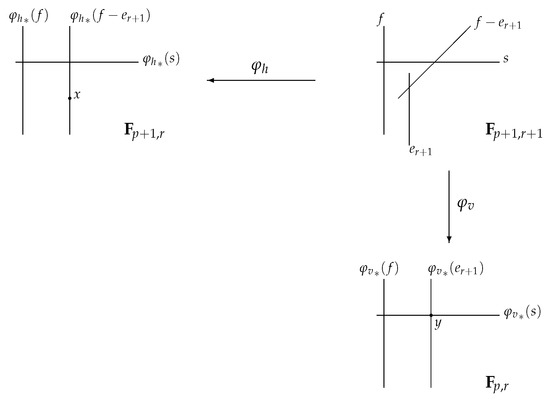
Figure 1.
Monoidal transformations.
Moreover, we can make the following diagram (Figure 2) for from the above elementary transformation.
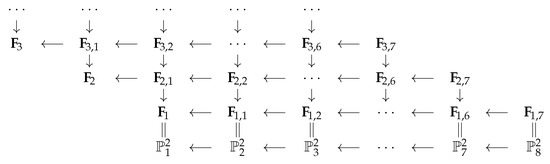
Figure 2.
Chain of monoidal transformations.
Here, is r-th blow-up of the projective plane at r points in general position.
3.2. Root Systems and Weyl Groups
When , since the blown-up Hirzebruch surfaces can be considered as del Pezzo surfaces , the numerical data in Table 1 and Table 2 match with those of del Pezzo surfaces in [4]. Furthermore, as those special divisor classes on the del Pezzo surfaces are identified as orbits of Weyl groups given by the root spaces in [4], we can also obtain the parallel results for the special divisor classes on by considering the root system on and the corresponding E-type Weyl group action.
Here, we introduce the simple roots of root systems on so that we can see the corresponding Weyl group is E-type. Further study on along the Weyl action and corresponding Gosset polytopes was dealt in [19].
Once we have the positivity condition , the inner product given by the intersection on induces a negative definite metric on in where each root defines a natural reflection. To define reflections on in , we consider a root system
with simple roots
corresponding to Coxeter–Dynkin diagram of type (Figure 3).
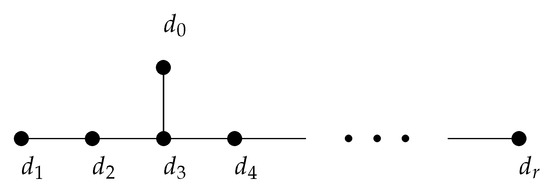
Figure 3.
Coxeter–Dynkin diagram of type .
Since each element d in defines a reflection on in ,
the corresponding Weyl group is where . If we add the orthogonality condition to f, then the corresponding Weyl group will be -type, where each root system is determined by and . The similar consideration for del Pezzo surfaces can be found in [18,23,24] with an orthogonality condition to the fixed fiber class.
4. Special Divisor Classes and Monoidal Transformations
In this section we deal with a relation among rulings, exceptional systems and quartic rational divisor classes on via monoidal transformations. We require the positivity condition of
and so r is to be an integer or 7.
To characterize special divisor classes via monoidal transformations, we consider the intersection between a line and since the birational maps and are defined by the choices of -curves contained in special divisor classes lines. Then, we identify the subset of special divisor classes with a fixed intersection by other special divisor classes or certain rational divisor classes. For roots and lines, the tie-ups of special divisors with others are obtained by straightforward comparisons via monoidal transformations. We need to resolve nontrivial issues involved for rulings and the exceptional systems on . For rulings on , we use skew a-lines which are given by where are disjoint lines. For the exceptional systems, we consider sextic divisor classes on and their orbit structures induced by Weyl group. Then the rational quartic divisor classes appear to characterize the exceptional systems via monoidal transformations.
We note that , and we remark that (resp. ) because each exceptional system e (resp. quartic rational divisor class q) satisfies (resp. ) by Lemma 1. Thus, it is rather natural for us to consider , and instead of , and .
4.1. Lines and Monoidal Transformations
4.1.1. Intersection between Lines
For any two lines and on , by Hodge index theorem and , we have
and we obtain
Therefore, the possible intersection numbers between lines are given as
4.1.2. Lines via Monoidal Transformations
According to the list of intersections of lines, we describe .
Theorem 3.
For ,
where
Proof.
We consider the map induced by a line .
For each line in the set on , we consider the following cases according to the intersection .
(Case 1) for
Such corresponds to a line on with . Thus we have
(Case 2) for
Such can be written as with a divisor class on satisfying
Thus is a ruling on with and
(Case 3) for
Such can be written as with satisfying
Moreover, .
When , is the only divisor class on satisfying the above conditions. Thus
When , such corresponds to a line on via . Therefore
(Case 4) for
Such can be written as with satisfying
Moreover, .
In fact, is the only divisor class on with the above conditions. Thus, we have
and we conclude
By applying a similar process for , we derive the equality for and obtain
□
4.2. Roots and Monoidal Transformations
4.2.1. Intersection between a Line and a Root
For any two roots and on , by Hodge index theorem and , we have
Thus we obtain
For a line and a root on , we have
and it implies
Thus, the possible intersection numbers between lines and roots are given as
4.2.2. Roots via Monoidal Transformations I
According to the list of intersections of lines and roots, we describe .
Theorem 4.
For ,
where
Proof.
We consider the map given by a line .
For each root in the set on , we consider the following cases according to the intersection .
(Case 1) for
Such corresponds to a root on with . Thus
(Case 2) for
Such can be written as with satisfying
Thus is a line on with , and so
(Case 3) for
Such can be written as with satisfying
Moreover, . In fact, is the only possible on with the above conditions. Thus and
By applying a similar process for , we derive the equality for and obtain
□
4.2.3. Roots via Monoidal Transformations II
For a root and a ruling on , we have
and it implies
Thus, the possible intersection numbers between rulings and roots are given as
We observe that a root on with cannot satisfy both and . Moreover, we obtain another version of Theorem 4 as follows.
Theorem 5.
For ,
where
Proof.
We consider the following cases according to the intersection numbers for roots in the set on . Note that .
(Case 1) (and ) for
Such corresponds to a root on with . Thus we have
(Case 2) and for
By applying Theorem 4, as in (Case 1) we get
Moreover, when , if , then by the (Case 3) in the proof of Theorem 4. Therefore, for we also get
(Case 3) and for (By Theorem 4, there are no other cases.)
Here,
When , since , .
When or, there are possible cases or . For the case , the root can be written as for a divisor class D on with . Moreover, satisfies
If , such a divisor class D on must be . Therefore,
If , such a divisor class D on corresponds to a line l on via satisfying . Thus, we have
where with is a line on . By applying a similar procedure to the case , we conclude
Similarly, by applying for we obtain
□
4.3. Rulings and Monoidal Transformations
4.3.1. Intersection between a Line and a Ruling
For a line and a ruling on , the possible intersection numbers between lines and rulings are given by the following lemma.
Lemma 2.
The possible intersection numbers between lines and rulings are given as
Proof.
For a line and a ruling on , we have
and it impiles
Thus, the possible intersection numbers between lines and rulings are given as
For by applying the Hodge inequality to get (resp. ), there is a constant with (resp. ). Since (resp. ), the constant is equal to (resp. ). But (resp. ) which is impossible since . □
4.3.2. Rulings via Monoidal Transformations
Now, we consider monoidal transformations for given by lines and on . According to Lemma 2, the case (i.e., the case ) involves more nontrivial issues than the others so that we deal with them after the next theorem for the cases .
Theorem 6.
For a fixed line on ,
where
Proof.
We consider the map induced by a line on .
For each ruling in the set on , the intersection number may vary as in Lemma 2, and we check the following cases.
(Case 1) for
Such ruling corresponds to a ruling on . Thus we have
(Case 2) for
Such ruling can be written as with a divisor class D on satisfying
Thus the divisor class D on is an exceptional system on , and we get
(Case 3) for
Such ruling can be written as with a divisor class D on satisfying
When , is the only divisor class on satisfying the above conditions for D. Thus we have
When , such corresponds to a line on via . Therefore
Similarly, by considering a line on and we also derive the equality for including
□
4.3.3. Skew A-Lines on
In the following, we need to define skew 2-lines, skew 3-lines, and skew r-lines on . A divisor class in is called a skew a-line if it can be written as a sum of disjoint lines on , namely,
Remark 9.
We use a term of a skew a-line on even if the disjoint a-lines are not really skew because we follow the ([4] Section 5) and ([19] Section 2.3).
Note that for each skew a-line, the choice of disjoint lines representing the skew a-line is unique up to permutation (see [4,19]). We denote the set of skew a-lines on as
In [4,19], we know that is bijectively related to simplexes in corresponding a Gosset polytope . In particular, skew 2-lines (resp. skew 3-lines ) is bijectively related to edges (resp. 2-simplexes) of a Gosset polytope , and so (resp. ). We can also get . Moreover, each skew a-line satisfies and , and the converse is also true for by checking the numbers of divisor classes satisfying equations in the below (Table 3).
Table 3.
Number of .
Thus we obtain the following lemma which is also known to hold true for del Pezzo surfaces ([4] Theorem 5.2).
Lemma 3.
For , a divisor class on with and is a skew a-line on .
4.3.4. Rulings on via Monoidal Transformations
Now we consider , i.e., .
Theorem 7.
For a fixed line on , we have
Proof.
We consider the map induced by a line on .
For each ruling in the set on , may vary as in Lemma 2, and we check the following cases.
As in Theorem 6, the cases and are given as
and
respectively.
(Case )
Again as in Theorem 6, such ruling can be written as with satisfying
Since and , by Lemma 3 the divisor class is bijectively related to a skew 2-line on , namely in . Thus we have
(Case )
As the above, a ruling with can be written as with a divisor class on satisfying and . Since and , the divisor class is bijectively related to an exceptional system on . Therefore, we obtain
(Case )
A ruling with can be written as with a divisor class on satisfying and . Since and , the divisor class is bijectively related to a ruling on so that we have
Similarly, we derive the equality for □
4.4. Exceptional Systems and Monoidal Transformations
We introduce sextic divisor classes to appear on the way to monoidal transformations for exceptional systems on . We also study basic properties of these divisor classes. The properties are not crucial to understand the monoidal transformations for exceptional systems, but since these divisor classes were not considered beforehand, we study their properties for the sake of completeness.
4.4.1. Sextic Divisor Classes on
To study monoidal transformations for exceptional systems on , we need to introduce a sextic divisor class D via the anti-canonical degree with respect to the canonical divisor class on which is given by and its set is denoted as
Either direct computation or by applying Lattice theory to and , we obtain . By considering Weyl action of , we know that there are more than one orbit in . To characterize elements of each orbit we introduce
for each in . In the following, by checking that is in or not, we identify each orbit in .
Now we prove that consists of two orbits of action.
(1) (Orbit I) We consider a subset of given as
which consists of elements. The -Weyl group preserves and transitively acts on the set of rulings on . Thus it forms a single orbit. Note that . Moreover, we conclude that the set of such divisor classes is bijectively related to the set of rulings on which contains elements, and we obtain the following lemma.
Lemma 4.
For a sextic divisor class in , is in if and only if is a ruling.
(2) (Orbit II)
As in [4,19], each exceptional system on corresponds to a 6-simplex consisting of a skew 7-line via . For each line in the skew 7-line, we consider a divisor class
which satisfies and . We define a subset of
Indeed, this is an orbit, since -Weyl group acts trivially on and transitively on the set of exceptional systems, and the isotropy group acts transitively on the skew 7-lines.
Lemma 5.
For each in ,is not in and is uniquely determined.
Proof.
Since , is not in .
To show is uniquely determined, we consider two pairs, and , of an exceptional system and a line which satisfy . Without losing the generality, we may assume and .
First of all, we observe is not related to the exceptional system via a skew 7-line (i.e. for all ). Indeed, suppose that for some j. We have and since and . It gives a contradiction by . Thus is not one of in .
Since is not related to the exceptional system via a skew 7-line , we have
Indeed, the possible intersection number among two lines is , and when (See Section 4.1.1). Observe that a skew 7-line consists of 7-lines whose 7 is the maximum t for which there exists a t-skew line (See ([4] Table 2 and Theorem 5.1) and [19]). So any line which is not in the skew 7-line must have a positive intersection number with the skew 7-line.
Thus . It implies which is impossible.
Hence is uniquely determined. □
By applying Lemma 5, we conclude the subset consists of elements. Since , these two forms, and , are disjoint orbits of the set of sextic divisors.
In summary we have
Proposition 1.
Moreover, for each in , D is in iff is in , and is in iff is not in .
4.4.2. Intersection between a Line and an Exceptional System
For a line and an exceptional system on , the possible intersection numbers between lines and exceptional systems are given by the following lemma.
Lemma 6.
The possible intersection numbers between lines and exceptional systems are given as
Proof.
For a line and an exceptional system on , we have
and it implies
Thus, the possible intersection numbers between lines and exceptional systems are given as
For by applying Hodge inequality to get (resp. ), there is a constant with (resp. ). Since (resp. ), the constant is equal to (resp. ). But (resp. ) which is impossible since .
For , as the above, to get (resp. ), (resp. ) for some constant n. Since (resp. ), the constant is equal to (resp. ). But (resp. ) which is impossible since . □
4.4.3. Exceptional Systems via Monoidal Transformations
Now, we consider monoidal transformations for given by lines and on . According to Lemma 6, the case (i.e., the case ) involves more nontrivial issues than the others so that we deal with them after the following theorem for the cases .
Theorem 8.
For a fixed line on ,
where
Proof.
We consider the map induced from a line on .
For each exceptional system in the set on , the intersection number may vary as in Lemma 6, and we check the following cases according to them.
(Case 1) for
An exceptional system on with corresponds to an exceptional system on . Thus we have
(Case 2) for
Such exceptional system can be written as with a divisor class on satisfying
Therefore, the divisor class is a quartic rational divisor class on , and so
(Case 3) for
Such can be written as with satisfying
When , is the only divisor class on satisfying the above conditions for D. Thus
When , such corresponds to a line on via . Therefore
(Case 4) or 3
(i) An exceptional system on with can be written as with a divisor class on satisfying and . Since and , the divisor class is bijectively related to a skew 2-line by Lemma 3. Thus we have
(ii) An exceptional system on with can be written as with a divisor class on satisfying and . Since and , the divisor class is bijectively related to an exceptional system on . Therefore, we obtain
Similarly, we derive the equality for and obtain
□
4.4.4. Exceptional Systems of via Monoidal Transformations
We deal with the case (i.e., the case ) as follows. In this case we use sextic divisor classes to describe exceptional systems via monoidal transformations.
Theorem 9.
For a fixed line on ,
where
Proof.
We consider the map induced by a line on .
For each exceptional system in the seton , may vary as in Lemma 6, and we check each case of .
As in Theorem 8, the cases and are given as
and
respectively.
(Case )
An exceptional system on with can be written as with a divisor class on satisfying and . The divisor class is the only class with the given condition for D. Thus, we have
(Case )
An exceptional system on satisfying can be written as with a divisor class on satisfying and . By applying Lemma 3 to and , the divisor class is bijectively related to a skew 3-line of on . Thus, we obtain
(Case )
An exceptional system on satisfying can be written as with a divisor class D on satisfying and which is a sextic divisor in on (See Section 4.4.1). Thus, we obtain
(Case )
An exceptional system on with can be written as with a divisor class D on satisfying and . By applying Lemma 3 to and , the divisor class is bijectively related to a skew 3-line of on . Thus, we obtain
(Case )
Such exceptional system can be written as with a divisor class on satisfying and . Since and , the divisor class is bijectively related to a quartic rational divisor class on . Therefore, we have
(Case )
Such exceptional system can be written as with a divisor class on satisfying and . Since and , the divisor class corresponds an exceptional system on . Therefore, we have
(Case )
An exceptional system on with can be written as with a divisor class D on satisfying and . Since and , the divisor class is the only class with the given condition. Thus, we have
Similarly, we obtain the equality for . □
Remark 12.
We use Table 2 with skew 3-lines on (resp. ) and sextic divisor classes on (resp. ) to obtain the following.
Author Contributions
The researching and writing the article was done by both authors. Both authors have read and agreed to the published version of the manuscript.
Funding
The first author was supported supported by the National Research Foundation of Korea (NRF) grant funded by the Korea government (MSIT) (No. 2019R1F1A1058962). The second author was supported by Basic Science Research Program through the National Research Foundation of Korea (NRF) funded by the Ministry of Education (No. 2017R1D1A1B03028273) and by Basic Science Research Program through the National Research Foundation of Korea (NRF) funded by the Ministry of Education: NRF-2018R1D1A1B07048385.
Conflicts of Interest
The authors declare no conflict of interest.
References
- Barth, W.; Peters, C.; Van de Ven, A. Compact Complex Surfaces; Ergebnisse der Mathematik und ihrer Grenzgebiete (3) [Results in Mathematics and Related Areas (3)]; Springer: Berlin, Germany, 1984; Volume 4, p. x+304. [Google Scholar]
- Bădescu, L. Algebraic Surfaces; Springer: New York, NY, USA, 2001. [Google Scholar]
- Beauville, A. Surfaces Algébriques Complexes; Avec Une Sommaire en Anglais, Astérisque, No. 54; Société Mathématique de France: Paris, France, 1978; p. iii+172. [Google Scholar]
- Lee, J.H. Gosset polytopes in Picard groups of del Pezzo surfaces. Canad. J. Math. 2012, 64, 123–150. [Google Scholar] [CrossRef]
- Lee, J.H. Configurations of lines in del Pezzo surfaces with Gosset polytopes. Trans. Am. Math. Soc. 2014, 366, 4939–4967. [Google Scholar] [CrossRef]
- Coxeter, H.S.M. The polytope 221, whose twenty-seven vertices correspond to the lines on the general cubic surface. Amer. J. Math. 1940, 62, 457–486. [Google Scholar] [CrossRef]
- Manin, Y.I. Cubic Forms: Algebra, Geometry, Arithmetic; North-Holland: Amsterdam, The Netherlands, 1974. [Google Scholar]
- du Val, P. On the Directrices of a Set of Points in a Plane. Proc. Lond. Math. Soc. 1933, 35, 23–74. [Google Scholar] [CrossRef]
- Manivel, L. Configurations of lines and models of Lie algebras. J. Algebra 2006, 304, 457–486. [Google Scholar] [CrossRef]
- Batyrev, V.V.; Popov, O.N. The Cox ring of a del Pezzo surface. In Arithmetic of Higher-Dimensional Algebraic Varieties (Palo Alto, CA, 2002); Progr. Math.; Birkhäuser: Boston, MA, USA, 2004; Volume 226, pp. 85–103. [Google Scholar]
- Derenthal, U. Universal torsors of del Pezzo surfaces and homogeneous spaces. Adv. Math. 2007, 213, 849–864. [Google Scholar] [CrossRef][Green Version]
- Laface, A.; Velasco, M. Picard-graded Betti numbers and the defining ideals of Cox rings. J. Algebra 2009, 322, 353–372. [Google Scholar] [CrossRef][Green Version]
- Serganova, V.V.; Skorobogatov, A.N. Del Pezzo surfaces and representation theory. Algebra Number Theory 2007, 1, 393–419. [Google Scholar] [CrossRef]
- Serganova, V.V.; Skorobogatov, A.N. On the equations for universal torsors over del Pezzo surfaces. J. Instig. Math. Jussieu 2010, 9, 203–223. [Google Scholar] [CrossRef][Green Version]
- Stillman, M.; Testa, D.; Velasco, M. Gröbner bases, monomial group actions, and the Cox rings of del Pezzo surfaces. J. Algebra 2007, 316, 777–801. [Google Scholar] [CrossRef][Green Version]
- Sturmfels, B.; Xu, Z. Sagbi bases of Cox-Nagata rings. J. Eur. Math. Soc. 2010, 12, 429–459. [Google Scholar] [CrossRef]
- Testa, D.; Várilly-Alvarado, A.; Velasco, M. Cox rings of degree one del Pezzo surfaces. Algebra Num. Theory 2009, 3, 729–761. [Google Scholar] [CrossRef][Green Version]
- Matsuzawa, J.I. Root systems and periods on Hirzebruch surfaces. Publ. Res. Inst. Math. Sci. 1993, 29, 411–438. [Google Scholar] [CrossRef]
- Lee, J.H.; Shin, Y. E-polytopes in Picard groups of smooth rational surfaces. Symmetry 2016, 8, 27. [Google Scholar] [CrossRef]
- Lahyane, M. Irreducibility of the (−1)-classes on smooth rational surfaces. Proc. Am. Math. Soc. 2005, 133, 2219–2224. [Google Scholar] [CrossRef]
- Jiang, C. Bounding the volumes of singular weak log del Pezzo surfaces. Int. J. Math. 2013, 24, 1350110. [Google Scholar] [CrossRef]
- Lahyane, M.; Harbourne, B. Irreducibility of −1-classes on anticanonical rational surfaces and finite generation of the effective monoid. Pac. J. Math. 2005, 218, 101–114. [Google Scholar] [CrossRef]
- Leung, N.C. ADE-bundles over rational surfaces, configuration of lines and rulings. arXiv 2000, arXiv:math/0009192. [Google Scholar]
- Leung, N.C.; Zhang, J. Moduli of bundles over rational surfaces and elliptic curves. I. Simply laced cases. J. Lond. Math. Soc. 2009, 80, 750–770. [Google Scholar] [CrossRef]
© 2020 by the authors. Licensee MDPI, Basel, Switzerland. This article is an open access article distributed under the terms and conditions of the Creative Commons Attribution (CC BY) license (http://creativecommons.org/licenses/by/4.0/).