


Abstract
In the paper, we consider an elliptic problem in a domain with singular stochastic perturbation of the density located near the boundary, depending on a small parameter. Using the boundary homogenization methods, we prove the compactness theorem and study the behavior of eigenelements to the initial problem as the small parameter tends to zero.
1. Introduction
Boundary value problems in domains with concentrated masses attracted the attention of scientists at the turn of XIX-th and XX-th centuries. The first mathematical paper [1] devoted to studying this problem was published in 1913. There Krylov considers the problem of vibrations of a string with concentrated masses. A study of the eigenfrequencies of vibrations of a string with a concentrated mass at one point is also given in Appendix to Ch. 2 in [2], including the limit behaviour of solutions as the mass goes to zero or infinity. The paper [3] was the first to consider the problem where the concentrated mass belongs to an -neighbourhood of an interior point, å being a small parameter that describes the concentration and size of the mass. Another approach was used in [4,5,6]. Oleinik introduced a new basic parameter of a body with concentrated masses, the ratio between the adjoined additional mass and the mass of the whole system. She described local oscillations in the vicinity of the concentrated mass. In [4,5,6], this was done for all dimensions and arbitrary masses. The one-dimensional case with one concentrated mass was studied in [7]. The case of finitely many concentrated masses was considered in [8]. The analogous problem for the elasticity system of equations was studied in [9,10] (see also [11,12,13]). In the papers [14,15] the authors constructed the asymptotic expansions of eigenvalues and eigenfunctions to the problem. The case of a three-dimensional linear stationary elasticity system is considered in [16] (see also [17]). A problem on oscillations of a membrane is analyzed in [18].
Papers [19,20,21,22,23,24] deal with to the asymptotic analysis of vibrations of a body with many small dense inclusions situated periodically along the boundary. Analogous problems are considered in [25,26,27]. The paper [28] is devoted to asymptotic analysis of the problem for a linear stationary elasticity system with non-periodic rapidly alternating boundary conditions and with many concentrated masses near the boundary. A problem on the linear stationary elasticity system in domains with stiff concentrated masses is studied in [29]. Paper [30] (see also [31]) is devoted to a detailed study of the behaviour of the eigenelements of the Laplace operator in a domain with non-periodic “light” concentrated masses. A multi-dimensional problem in a domain with periodic “light” masses is considered in [32] (see also [33]). The authors presented estimates for the rate of convergence of the eigenvalues and eigenfunctions of the given problem to the corresponding eigenvalues and eigenfunctions of the homogenized problem. In the paper [34] one can find non-periodic problem with rapidly changing type of boundary conditions.
In [35,36], the authors studied close problems for complex medium and nonlinear situation modeled transport in porous materials including regions with both high and low diffusivities.
In papers [37,38] the authors constructed complete asymptotic expansions for eigenpairs of two-dimensional spectral problems in domains with periodically situated “light” masses. Some of these results were mentioned in [39,40].
In papers [41,42,43,44,45], the authors studied spectral problems in thick cascade junctions with concentrated masses. There is a complete classification of homogenized spectral problems in such domains, as well as local vibrations of the masses.
In this paper, we consider randomly situated “light” concentrated masses on the boundary and prove the convergence results for the spectrum. It appears that the limit (homogenized) problem is deterministic (non random). Some results were shown in [46].
2. Compactness Theorem
Suppose that D is a bounded domain in with a sufficiently smooth boundary. We consider a family of boundary value problems depending on the small parameter .
where is a piece of the boundary of the domain D, having a fine-grained structure with -scale, and is a fixed part of the boundary . On this part of the boundary, we set the homogeneous Dirichlet boundary condition. On the remaining part of the boundary we set a Neumann boundary condition with the right-hand side independent of the small parameter, and is the outward normal vector to the boundary . Here,
where f is sufficiently smooth function and is a small domain with sufficiently smooth boundary, . We assume that the thickness of is of order , i.e., , if , where (see Figure 1).
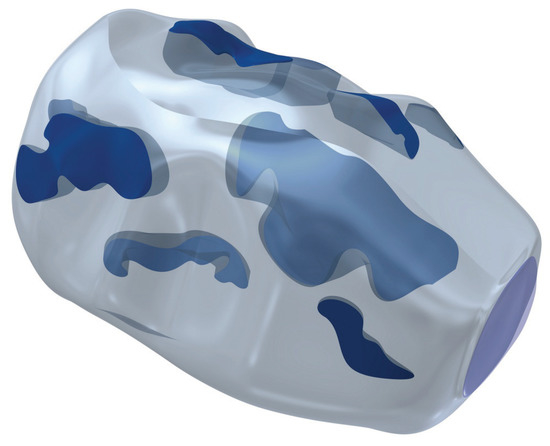
Figure 1.
Domain with non-trivial micro structure near the boundary.
Within the paper we use the definition from [47].
Definition 1.
A family of closed sets we call SELFSIMILAR, if there exist constants and independent of ε, such that for any and for any smooth function with support not intersecting with , the following inequality
holds true.
We also use the Poincaré and the Friedrichs inequalities in the following form. There exists a constant which only depends on the domain D such that for any function which is continuously differentiable on D the inequality
holds true, and the inequality
holds true whenever also vanishes on .
Our requirements for the smoothness of the boundary and of the regularity of the set are necessary only to the extent that the inequalities (3) and (4) are satisfied.
The following asymptotic properties take place.
Theorem 1.
Assume that the family is selfsimilar, , where is the mutual number to the number s from Definition 1, i.e., Then
- (i)
- the sequence , the solutions to problem (1) is bounded in the space as ;
- (ii)
- there exists a measurable function and a subsequence independent of , such that weakly converges to in as ;
- (iii)
- the sequence is compact in where , and the subsequence strongly converges in to the function which satisfies the problem
Proof.
To prove (iii) we use the following Lemma from [47].
Lemma 1.
Let D be a domain with a smooth boundary. If the sequence of solutions of the Poisson equation with sufficiently smooth right-hand side in D, is weakly compact in , . Then it is strongly compact in , .
Remark 1.
In [47], this statement is proved for a sequence of harmonic functions but the proof can be easily modified for the sequence of solutions to the Poisson equation in D.
Now the statement (iii) follows form this Lemma and both (i), (ii).
To show (i) we write down the integral identity of the problem (1). We have
for any smooth v with compact support in . Denote by the closure by the Sobolev norm of the set of smooth functions with compact support in . By means of the Lax–Milgram Lemma (see, for instance [48]) applied to the functionals in left- and right-hand sides of (7) on , using (3) and (4), we conclude that there exists a unique solution .
Remark 2.
Substituting in (7), we get
Note that . Using (3), the Friedrichs type inequalities (5) and
we deduce the following estimates:
here, the constant does not depend on . Thus, we proved the statement (i).
Let us consider an auxiliary problem (same as problem (1) with )
The integral identity of this problem in has the form
The solution satisfies the bounds analogous to (9), i.e.,
with the constant independent of . From (12) we conclude that it is possible to choose a sequence which converges to 0, such that the restrictions of to weakly converge in . Denote by the limit function on . It is easy to show, that The nonnegativity of this function follows from the maximum principle for solutions of elliptic equations.
Let us substitute in the identities (7) and (11) and respectively, where is an arbitrary function. Subtracting these identities from each other, we obtain
It can be shown that the left-hand side and the first term in the right-hand side of (13) converge to zero as In fact the boundedness of and in follow from (9) and (12) and the Poincaré inequality; hence, sequences of these functions of the form and are strongly compact in and converge to zero in the -norm, . Therefore, the sequence converge to zero in . Thus, in the products under the integrals of the left-hand side of (13) one multiplier is bounded in as and another tends to zero, and the first term in the right-hand side also converges to zero, since and the sequences and converge to zero.
In the second term of the right-hand side of (13) we pass to the limit as . The function weakly converges to in The functions are bounded in . Taking a subsequence from the subsequence such that weakly converges in to some limit function on , and pass to the limit on this subsubsequence. We get
Since is an arbitrary function on , the function , i.e., is independent of the choice of the subsubsequence. Therefore, the whole subsequence has a unique limit. This proves Theorem 1. □
3. Random Structure
In this section, we describe the structure of micro inhomogeneous sets near the boundary. To describe the family in detail we use an approach from [48,49].
3.1. Notation
Let be a probability space with a semigroup of mappings measurable in and preserving the measure on . We assume the following group property to be satisfied: for any and any
Definition 2.
A measurable function is called a RANDOM STATISTICALLY HOMOGENEOUS, if it has the form , where ϕ is a Borel measurable function on .
Definition 3.
A random subset of is called HOMOGENEOUS, if its indicator function is statistically homogeneous.
The family on forms an -dimensional dynamical system. In the further analysis we assume T to be ERGODIC, i.e., any -measurable function on , invariant with respect to this semigroup T, is almost everywhere a constant. Under this assumption, the following Birkhoff theorem holds true (see, for instance, [48,49]).
Theorem 2
(The Birkhoff theorem). For any function and any bounded domain we have
almost surely.
Here, we used the notation for the mathematical expectation and for the volume of a domain. From the Birkhoff theorem, one can conclude that the family of functions weakly converges almost surely to in as , i.e., for any function , and any bounded domain we have
for almost all .
3.2. Some Examples
3.2.1. Periodic Case
Let be the unit cube . On we have a dynamical system . The Lebesque measure is invariant and ergodic due to this dynamical system. The realization of the function has the form .
3.2.2. Quasi-Periodic Case
Let be a unit cube in , be a Lebesque measure on it. For we set , where is a matrix . Obviously, the mapping preserve the measure on . The dynamical system is ergodic if and only if for any integer vector .
Thus, is the space of periodic functions of d variables, and the realizations have the form . These realizations are called QUASI-PERIODIC FUNCTIONS, if is continuous on .
3.3. Structure of
In this subsection, we use the results from [47]. We use statistically homogeneous functions to construct families of micro inhomogeneous sets with cellular structure. if is statistically homogeneous, then its homothetic contractions in times form such a family on -dimensional manifold . Onwards we use the notation for statistically homogeneous sets in as well as for sets in , defined by where x is a local coordinate on , and z is a coordinate along the normal to .
To avoid some simple technical difficulties, we consider and consider the case, when rapidly changing boundary conditions in (1) are set only on one (lower) face of the cube, on other faces we assume homogeneous Dirichlet boundary condition to be satisfied. Thus where is the lower face of the cube. Also we denote by the other faces of the cube .
For having the family to be selfsimilar in the sense of Definition 1, we demand the statistically homogeneous set to satisfy an additional property, which we call nondegeneracy.
Definition 4.
A random statistically homogeneous closed subset is called NONDEGENERATE, if there exists a positive statistically homogeneous function , such that for almost all ω and for any function with support of φ disjoint from , the following inequality:
holds true, wherein
with some .
The non-degeneracy condition of we use below for studying the auxiliary problem (24). The estimates (14) and (15) guarantee its solvability. In [50] the author used analogous conditions for porous medium.
Assume that is a union in of balls with radii centered in isolated points . And respectively is a union in of semiballs () with radii centered in the same isolated points . The balls are allowed to intersect (see Figure 2). Denote by the distance from to the nearest center , is the radius of the ball centered in , nearest to y. If is statistically homogeneous domain, then the random functions and are also statistically homogeneous.
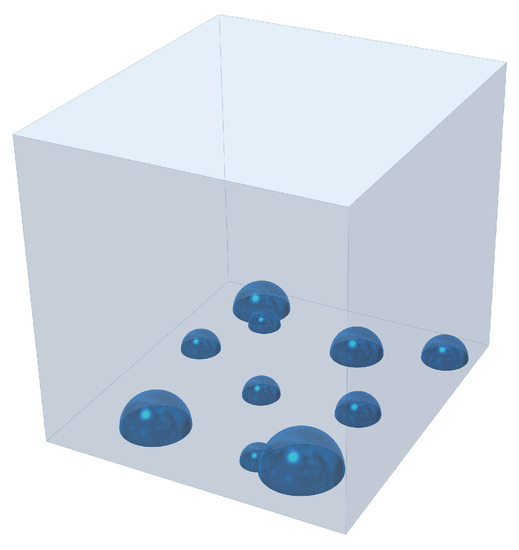
Figure 2.
Cube with concentrated masses near the boundary.
Let us construct h from (14) using the functions and .
Lemma 2.
The inequality (14) holds true, if
Proof.
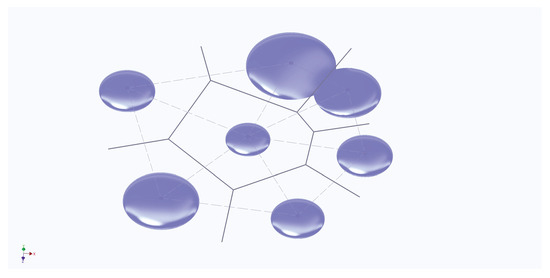
We split into measurable subsets , consisting of points for which is the nearest center (see Figure 3). According to our assumption, the set has no accumulation points, hence are polyhedra. In each of them we set the polar system of coordinates where and are polar angles. Obviously, the polyhedra are starshaped with respect to the center, hence their boundaries are defined in polar coordinates by unique functions Inside the polyhedra the function are equal to the respective constants
Figure 3.
The Voronoy diagram.
For any point with coordinates , we set and construct a point with coordinates Connect the points M and by the curve l in the cylinder which is defined in the cylindrical coordinates by the equation
Consider an arbitrary function with compact support, for which we verify the inequality (14). In each cylinder we have if We represent the value of in the point in the form of the integral over the curve l, i.e.,
where is the derivative along the curve Obviously, Using the Cauchy–Schwartz–Bunjakovskii inequality, we deduce
Denote
Integrating with respect to the polar angles and taking the summation over all polyhedra , we get the left hand side of the inequality (14). Due to (19) we derive the estimate
In this estimate we replace the variables by the variables The Jacobian has the form
It is easy to prove the following inequalities:
Thus,
The choice of leads to
for any and R. Keeping in mind (20), replacing the variables by and increasing the domain of integration, we derive
Finally, integrating over the polar angles and taking the summation on i, we obtain (14). Lemma is proved. □
4. Deterministic Homogenized Problem
4.1. Statement of the Main Theorem
In this section we give more precise asymptotics of solutions to the problem (1) in the case is taken as the non-degenerate statistically homogeneous set . In addition, the set is taken as the non-degenerate statistically homogeneous set .
Recall that we consider D, the unit cube with , where Q is the lower face of the cube and .
The following statement describe the solution of the homogenized problem.
Theorem 3.
Suppose that in Definition 4 is a non-degenerate closed subset with . Then the family is selfsimilar with and the solutions to the problem in (1) satisfy the conditions of Theorem 1. In addition the limit function is unique and deterministic (nonrandom). The boundary function does not depend on the choice of the limiting subsequence , it is equal to zero on and on Q it is equal to a positive constant.
4.2. Auxiliary Results
Let be the Descartes coordinate in (). Denote by the linear space of those functions with realizations which are smooth functions in and which together with their derivatives are uniformly bounded in . Moreover, these functions have their support in and are bounded in the -direction.
For non-degenerate domains the functions from have the following properties.
Lemma 3.
For any functions the following estimates
hold true. Here is a weight–function as in Definition 4, t is a number and is a positive constant,
Proof.
Denote by B and balls in centered in the same point with radii R and , respectively. Construct smooth cut–off function with the support in , such that on B, , Substituting , , in the inequality (14), we get
which leads to the following estimate:
here we used the inequality for an arbitrary and the properties of the cut–off function Dividing both sides of (23) by the volume of the ball B and passing to the limit as , we deduce
According to the ergodic theorem both limits do exist. Then, passing to the limit as m and r go to zero, we obtain (21). The estimate (22) is obtained by means of the Hölder inequality
Keeping in mind that we conclude that the second multiplier in the right–hand side is bounded due to (15). Lemma 3 is proved now. □
Let us consider an auxiliary problem in :
where
The equations and boundary conditions in (24) correspond to the auxiliary problem (10) and formally can be obtained by the change of variables . The solution is defined in the closure of with respect to an appropriate norm.
Note that due to the invariance of the measure with respect to the right–hand side of (21) does not depend on . We take this expression as the square of the new norm. Denote by the completion of with respect to this new norm. The inequality (22) shows us, that for functions one can define the trace , and the trace operator continuously maps to .
The realization of the function we call a solution of the auxiliary problem (24), if it satisfies the integral identity
for any function
Due to Lemma 3 the bilinear form and the linear functional in (26) satisfy the conditions of the Lax–Milgram lemma (see, for instance [48]). Thus, the unique solution to the problem (24) does exist. Besides, substituting in (26), applying the Cauchy–Swartz–Bunjakovski inequality, the Friedrichs inequality and (21), we derive the estimate
The realization of the solution to problem (24) does not only satisfy the equation in (26), but also as a function from
Lemma 4.
For almost all the realization of the solution to the problem (24) belongs to and satisfies the integral identity
for sufficiently small ε and any smooth function with compact support in
The proof can be found in [49] (see also [47]).
4.3. Proof of Theorem 3
Proof.
Let us prove the selfsimilarity of the family Consider a smooth function in with its support in Assume that , , Using the Hölder inequality, we get
where Q is the lower face of the cube D, and is the weight–function from the definition (19).
Changing variables in the inequality (14), we estimate the first multiplier in the right–hand side of (30) by the integral over the cube D. We have
Due to the Birkhoff theorem the second multiplier has almost surely the finite limit since Thus (30) leads to the inequality (3). Hence, the family is almost surely selfsimilar, and for the solutions satisfies the conditions of the Theorem 1.
The boundary function is the limit for the solutions of the auxiliary problem (10). Under the conditions of the Theorem 3 on , hence on the faces of D, except Q, independent of the choice of the subsequence Let us show, that on Q the boundary function is defined uniquely and is equal to a positive nonrandom constant.
Suppose is a smooth function in the cube D with its support contained in , i.e., on all faces of the cube, except Q.
Substituting in the identity (29), where is a solution of the problem (10), and in the identity (11), subtracting them from each other, we deduce
Passing to the limit as , we conclude that the left-hand side and the first term in the right–hand side converge to zero as we have got in (13) (see the proof of Theorem 1). Now let us study the behavior of the second term in the right-hand side. The function weakly converges to in due to the ergodicity, and the function converges to on some subsequence due to Theorem 1. The function has been chosen arbitrarily on Q, hence independently of the choice of the subsequence. Consequently, the whole sequence on Q converges to this nonrandom limit. Finally, substituting in the identity (26), we get Moreover, in the case, when almost surely coincides with The function satisfies the estimate (27).
Theorem 3 is proved. □
5. Convergence of the Spectrum
In this section, we use the approach from [51] to the spectral problem associated with the boundary–value problem (1) with . We consider the following spectral problems:
and
here, are orthogonal bases in . The sets are the corresponding eigenvalues such that
and they repeat with respect to their multiplicities.
For the sake of completeness, we state here the results on spectral convergence for positive, selfadjoint and compact operators on Hilbert spaces (see [51], Section 3.1, for the proof).
Theorem 4.
Let and be two separable Hilbert spaces with the scalar products and , respectively. Let and . Let be a linear subspace of such that . We assume that the following properties are satisfied:
- There exists such that , for all and certain positive constant .
- The operators and are positive, compact and selfadjoint. Moreover, are bounded by a constant, independent of ε.
- for all
- The family of operators is uniformly compact, i.e., for any sequence in such that is bounded by a constant independent of ε, we can extract a subsequence , that verifies the following:as for certain .
Let and be the sequences of the eigenvalues of and , respectively, with the classical convention of repeated eigenvalues. Let and (, respectively) be the corresponding eigenfunctions in , which are assumed to be orthonormal (, respectively).
Then, for each k, there exists a constant , independent of ε, such that
where . Moreover, if has multiplicity s (), then for any w eigenfunction associated with , with , there exists a linear combination of eigenfunctions of , associated with such that
where the constant is independent on ε.
We denote by the weighted space with the scalar product
We denote by the space , the scalar product being
We define the operator
where is the solution of problem
We define the operator
where u is the solution of problem
Now, considering the operators and , it is easy to establish the positiveness, self–adjointness and compactness of the operators and , respectively. In particular, the compactness of both operators follows from the compactness of the imbedding of into the space
Let be , which satisfies , and let be the operator , where is the indicator function of .
Let us verify the conditions of Theorem 4 (Theorem 1.4 from [51], Section 3.1).
. Obviously,
as . Hence, we conclude that this condition is fulfilled with
Let us prove that norms are uniformly bounded with respect to Keeping in mind the equivalence of norms and using the Friedrichs inequalities, we obtain
Thus, holds true and Condition is fulfilled.
By Theorem 3 Condition is satisfied. Let us consider this condition in more detail. Using the definitions of the operators , for any and applying the Friedrichs inequality for , we have
Thus, Condition is valid.
Let us verify the last condition, . If a sequence is bounded in , then by standard arguments we deduce that the solutions to the problem (33) are uniformly bounded with respect to in Therefore, there exists and a subsequence such that in and weakly in . Thus,
and, then, we obtain that:
and Condition is fulfilled.
Now, we consider the spectral problems:
and
According to our definitions and , where and are the eigenvalues of problems (31) and (32), respectively.
Finally, applying Theorem 4 (Theorems 1.4 and 1.7 in [51], Section 3.1), we prove the following statements.
Theorem 5.
6. Discussion
The obtained results show that, due to the Birkhoff theorem, the behavior of random statistically homogeneous concentrated masses distributed on the boundary of the domain has similar type as the behavior of locally periodic concentrated masses on the boundary.
7. Materials and Methods
In the paper, we used boundary homogenization methods as well as methods of stochastic analysis. It should be noted that the obtained inequalities allowed us to prove the embedding theorems and trace theorems for the random functional spaces.
Author Contributions
All authors contribute equally to the manuscript. All authors have read and agreed to the published version of the manuscript.
Funding
The GAC was funded by RUSSIAN SCIENCE FOUNDATION grant number 20-11-20272.
Acknowledgments
We would like to thank the referees for their comments and suggestions that helped improve the presentation of the results.
Conflicts of Interest
The authors declare no conflict of interest.
References
- Krylov, A.N. On some differential equations of mathematical physics having applications in technical questions. Trans. Nikolay Marit. Acad. 1913, 2, 325–348. (In Russian) [Google Scholar]
- Tikhonov, A.N.; Samarskii, A.A. Equations of Mathematical Physics, 4th ed.; Pergamon Press: Oxford, UK, 1963. [Google Scholar]
- Sanchez-Palencia, É. Perturbation of eigenvalues in thermoelasticity and vibration of systems with concentrated masses. In Lecture Notes in Phys. No. 195; Springer: Berlin, Germany, 1984; pp. 346–368. [Google Scholar]
- Oleinik, O.A. On eigenvibrations of bodies with concentrated masses. In Current Problems of Applied Math. and Mathematical Physics; Nauka: Moscow, Russia, 1988; pp. 101–128. (In Russian) [Google Scholar]
- Oleinik, O.A. On spectra of some singularly perturbed operators. Uspekhi Mat. Nauk 1987, 3, 221–222. [Google Scholar]
- Oleinik, O.A. Homogenization problems in elasticity. Spectra of singularly perturbed operators. In Non-Classical Continuum Mechanics, London MATH. Soc. Lecture Notes Series No. 122; Cambridge University Press: Cambridge, UK, 1987; pp. 188–205. [Google Scholar]
- Golovaty, Y.D.; Nazarov, S.A.; Oleinik, O.A.; Soboleva, T.S. Eigenoscillations of a string with an additional mass. Sibirsk. Mat. Zh. 1988, 5, 71–91. [Google Scholar] [CrossRef]
- Oleinik, O.A.; Soboleva, T.S. On eigenvibrations of a nonhomogenious string with a finite number of adjoined masses. Uspekhi Mat. Nauk 1988, 4, 187–188. [Google Scholar]
- Golovaty, Y.D. On the eigenvibrations and eigenfrequencies of an elastic rod with adjoined mass. Uspekhi Mat. Nauk 1988, 4, 173–174. [Google Scholar]
- Golovaty, Y.D. On the characteristic frequencies of a clamped plate with adjoined mass. Uspekhi Mat. Nauk 1988, 5, 185–186. [Google Scholar] [CrossRef]
- Nazarov, S.A. Concentrated masses problems for a spatial elastic body. C. R. Acad. Sci. Paris Sér. I Math. 1993, 316, 627–632. [Google Scholar]
- Argatov, I.I.; Nazarov, S.A. Junction problems of shashlik (skewer) type. C. R. Acad. Sci. Paris Sér. I Math. 1993, 316, 1329–1334. [Google Scholar]
- Golovaty, Y.D. Spectral properties of oscillatory systems with adjoined masses. Trudy Moskov. Mat. Obshch. 1992, 54, 29–72. [Google Scholar]
- Golovaty, Y.D.; Nazarov, S.A.; Oleinik, O.A. The asymptotic behaviour of eigenvalues and eigenfunctions in problems on vibrations of a medium with singular perturbation of the density. Uspekhi Mat. Nauk 1988, 5, 189–190. [Google Scholar] [CrossRef]
- Golovaty, Y.D.; Nazarov, S.A.; Oleinik, O.A. Asymptotic expansions of eigenvalues and eigenfunctions in problems on oscillations of a medium with concentrated perturbations. Trudy Mat. Inst. Steklov. 1990, 192, 42–60. [Google Scholar]
- Sanchez-Palencia, É.; Tchatat, H. Vibration de systèmes élastiques avec masses concentrées. Rend. Sem. Mat. Univ. Politec. Torino 1984, 42, 43–63. [Google Scholar]
- Golovaty, Y.D.; Lavrenyuk, A.S. Asymptotic expansions of local eigenvibrations for a plate with density perturbed in a neighbourhood of a one-dimensionalmanifold. Mat. Stud. 2000, 1, 51–62. [Google Scholar]
- Leal, C.; Sanchez-Hubert, J. Perturbation of the eigenvalue of a membrane with a concentrated mass. Q. J. Appl. Math. 1989, 1, 93–103. [Google Scholar] [CrossRef]
- Lobo, M.; Pérez, E. On vibrations of a body with many concentrated masses near the boundary. Math. Models Methods Appl. Sci. 1993, 3, 249–273. [Google Scholar] [CrossRef]
- Lobo, M.; Pérez, E. Vibrations of a membrane with many concentrated masses near the boundary. Math. Models Methods Appl. Sci. 1995, 5, 565–585. [Google Scholar] [CrossRef]
- Lobo, M.; Pérez, E. High frequency vibrations in a stiff problem. Math. Models Methods Appl. Sci. 1997, 7, 291–311. [Google Scholar] [CrossRef]
- Lobo, M.; Pérez, E. A skin effect for systems with many concentrated masses. C. R. Acad. Sci. Paris Sér. IIb 1999, 327, 771–776. [Google Scholar] [CrossRef]
- Gómez, D.; Lobo, M.; Pérez, E. On the eigenfunctions associated with the high frequencies in systems with a concentratedmass. J. Math. Pures Appl. 1999, 78, 841–865. [Google Scholar] [CrossRef]
- Lobo, M.; Pérez, E. The skin effect in vibrating systems with many concentrated masses. Math. Methods Appl. Sci. 2001, 24, 59–80. [Google Scholar] [CrossRef]
- Oleinik, O.A.; Sanchez-Hubert, J.; Yosifian, G.A. On vibration of a membrane with concentrated masses. Bull. Sci. Math. 1991, 1, 1–27. [Google Scholar]
- Sanchez-Hubert, J.; Sanchez-Palencia, É. Vibration and Coupling of Continuous Systems. Asymptotic Methods; Springer: Berlin/Heidelberg, Germany, 1989. [Google Scholar]
- Sanchez-Hubert, J. Perturbation des valeurs propres pour des systèmes avec masse concentrée. C. R. Acad. Sci. Paris Sér. II 1989, 309, 507–510. [Google Scholar]
- Doronina, E.I.; Chechkin, G.A. On natural oscillations of a body with many concentrated masses located nonperiodically along the boundary. Trudy Mat. Inst. Steklov. 2002, 236, 158–166. [Google Scholar]
- Rybalko, V. Vibration of elastic systems with a large number of tiny heavy inclusions. Asymptot. Anal. 2002, 1, 27–62. [Google Scholar] [CrossRef]
- Chechkin, G.A.; Pérez, E.; Yablokova, E.I. Non-periodic boundary homogenization and light concentrated masses. Indiana Univ. Math. J. 2005, 54, 321–348. [Google Scholar] [CrossRef]
- Pérez, E.; Chechkin, G.A.; Yablokova, E.I. On eigenvibrations of a body with light concentrated masses on the surface. Uspekhi Mat. Nauk 2002, 6, 195–196. [Google Scholar] [CrossRef]
- Chechkin, G.A. On an estimate of solutions of boundary-value problems in domains with concentrated masses periodically situated along the boundary. The case of light masses. Mat. Zametki 2004, 76, 928–944. [Google Scholar]
- Chechkin, G.A. On vibrations of bodies with concentratedmasses placed on the boundary. Uspekhi Mat. Nauk 1995, 4, 105–106. [Google Scholar]
- Chechkin, G.A.; Oleinik, O.A. On Asymptotics of Solutions and Eigenvalues of the Boundary Value Problems with Rapidly Alternating Boundary Conditions for the System of Elasticity. Rend. Lincei Mat. Appl. Ser. IX 1996, 1, 5–15. [Google Scholar]
- Van Noorden, T.L.; Muntean, A. Homogenisation of a locally periodic medium with areas of low and high diffusivity. Eur. J. Appl. Math. 2010, 5, 493–516. [Google Scholar] [CrossRef]
- Khoa, V.A.; Muntean, A. Asymptotic analysis of a semi-linear elliptic system in perforated domains: Well-posedness and correctors for the homogenization limit. J. Math. Anal. Appl. 2016, 439, 271–295. [Google Scholar] [CrossRef]
- Chechkin, G.A. Asymptotic Expansion of Eigenvalues and Eigenfunctions of an Elliptic Operator in a Domain with Many “Light” Concentrated Masses Situated on the Boundary. Two-Dimensional Case. Izv. Math. 2005, 4, 805–846. [Google Scholar] [CrossRef]
- Chechkin, G.A. Asymptotic Expansion of Eigenelements of the Laplace Operator in a Domain with a Large Number of “Light” Concentrated Masses Sparsely Situated on the Boundary. Two-Dimensional Case. Trans. Moscow Math. Soc. 2009, 70, 71–134. [Google Scholar] [CrossRef]
- Chechkin, G.A. On the vibration of a partially fastened membrane with many light concentrated masses on the boundary. C. R. Acad. Sci. Paris Sér. II 2004, 332, 949–954. [Google Scholar] [CrossRef]
- Chechkin, G.A. Splitting a multiple eigenvalue in the problem on concentrated masses. Uspekhi Mat. Nauk 2004, 4, 205–206. [Google Scholar] [CrossRef]
- Chechkin, G.A.; Mel’nyk, T.A. Asymptotics of eigenelements to spectral problem in thick cascade junction with concentrated masses. Appl. Anal. 2012, 6, 1055–1095. [Google Scholar] [CrossRef]
- Mel’nik, T.A.; Chechkin, G.A. On new types of vibrations of thick cascade junctions with concentrated masses. Dokl. Akad. Nauk 2013, 6, 642–647. [Google Scholar] [CrossRef]
- Chechkin, G.A.; Mel’nyk, T.A. Spatial-skin effect for eigenvibrations of a thick cascade junction with “heavy” concentrated masses. Math. Methods Appl. Sci. 2014, 1, 56–74. [Google Scholar] [CrossRef]
- Chechkin, G.A.; Mel’nyk, T.A. High frequency cell-vibrations and spatial skin-effect in thick cascade junction with heavy concentrated masses. C. R. Méc. 2014, 4, 221–228. [Google Scholar] [CrossRef]
- Mel’nik, T.A.; Chechkin, G.A. Eigenvibrations of Thick Cascade Junctions with “Super Heavy” Concentrated Masses. Izv. Math. 2015, 3, 467–511. [Google Scholar]
- Chechkin, G.A.; Chechkina, T.P. Asymptotic Behavior of Spectrum of an Elliptic Problem in a Domain with Aperiodically Distributed Concentrated Masses. C. R. Méc. 2017, 10, 671–677. [Google Scholar] [CrossRef]
- Beliaev, A.Y.; Chechkin, G.A. Averaging Operators with Boundary Conditions of Fine—Scaled Structure. Math. Notes 1999, 4, 418–429. [Google Scholar] [CrossRef]
- Chechkin, G.A.; Piatnitski, A.L.; Shamaev, A.S. Homogenization. Methods and Applications; American Mathematical Society: Providence, RI, USA, 2007. [Google Scholar]
- Jikov, V.V.; Kozlov, S.M.; Oleinik, O.A. Homogenization of Differential Operators and Integral Functionals; Springer: Berlin, Germany, 1994. [Google Scholar]
- Beliaev, A.Y.; Kozlov, S.M. Darcy Equation for Random Porous Media. Comm. Pure Appl. Math 1996, 1, 1–34. [Google Scholar] [CrossRef]
- Oleinik, O.A.; Shamaev, A.S.; Yosifian, G.A. Mathematical Problems in Elasticity and Homogenization; North-Holland: Amsterdam, The Netherlands, 1992. [Google Scholar]
© 2020 by the authors. Licensee MDPI, Basel, Switzerland. This article is an open access article distributed under the terms and conditions of the Creative Commons Attribution (CC BY) license (http://creativecommons.org/licenses/by/4.0/).