


Abstract
In this work, a family of ruled surfaces named generalized null scrolls in Minkowski 3-space are investigated via the defined structure functions. The relations between the base curve and the ruling flow of the generalized null scroll are revealed. The Gaussian curvature, mean curvature, second Gaussian curvature and the second mean curvature are given and related to each other. Last but not least, the generalized null scrolls whose base curves are k-type null helices are discussed and several examples are presented.
1. Introduction
In the modern surface model systems, the immersed surfaces swept out by a straight line moving along a curve play an important role, which are the simplest foliated submanifolds and called ruled submanifolds. Such submanifolds can be applied in physics, motion analysis, manufacturing of products, designing cars, ships and many other model-based objects and so on. For a view of geometry, ruled submanifolds are essential for studying kinematical and positional spatial mechanisms.
Due to their particular geometry properties and structures, ruled submanifolds are widely discussed from different viewpoints not only in Euclidean space but also in Minkowski space. In Minkowski space, the ruled submanifolds have been divided into several kinds according to the causal characters of the base curves and the ruling flows [1,2]. Among of them, the ruled submanifolds with lightlike rulings are very particular because the norm of lightlike vector vanishes everywhere. In Minkowski 3-space, if the base curve is a lightlike curve, then the ruled surface with lightlike ruling is called a null scroll which has been studied by many geometers [3,4,5]. Furthermore, the null scroll under a Cartan Frenet frame is called a B-scroll [6]. In 2006, Kim, Y. H. [7] extended the B-scroll in Minkowski 3-space into higher dimensional Minkowski space, which is then called a generalized B-scroll and the properties of such surfaces are studied through its Gauss map. In 2015, one of the authors proposed the concept of the structure function for null curves [8], which has been regarded as a useful research tool for the problems related to null curves. Motivated by this idea, in this paper, we define a new kind of ruled surfaces named the generalized null scrolls (GNS) by omitting the normalized constraint of transversality of null scrolls, and we focus on the geometric properties of GNS via the new defined structure functions.
The paper is organized as follows. In Section 2, some basic facts including the Frenet formulae and the structure function of null curves are reviewed, then a new surface GNS is defined based on the concept of the null scrolls. The geometric properties such as the Gaussian curvature, mean curvature, second Gaussian curvature and the second mean curvature of GNS are shown and related by the new defined structure functions of GNS together with the distribution parameter in Section 3. Last, the generalized null scrolls whose base curves are k-type null helices are characterized and several examples are presented explicitly.
Throughout this paper, we assume that all the geometric objects under consideration are smooth and all surfaces are connected unless otherwise stated.
2. Preliminaries
Let be the Minkowski 3-space with natural Lorentzian metric
in terms of the natural coordinate system . A vector v in is said to be spacelike, timelike and lightlike (null) if or , and , respectively. The norm of a vector v is defined by . An arbitrary curve is spacelike, timelike or lightlike if its tangent vector is spacelike, timelike or lightlike, correspondingly. At the same time, a surface is said to be timelike, spacelike or lightlike if its normal vector is spacelike, timelike or lightlike, respectively.
Let be a curve, where is an open interval on a real line and a transversal vector field along . Then the immersion X parameterized by
is called a ruled surface with base curve and ruling flow . Such kinds of surfaces in have been classified into five types according to the causal character of the base curve and the ruling flow (for the details see [2]). Among of them, for the ruled surfaces with lightlike rulings, the base curves can be null curves or non-null curves obviously. However, the ruled surfaces with non-null base curves are equivalent to the ones with null base curves via the appropriate method as stated in [3], at the same time, the normalization condition should be satisfied. Therefore, without loss of generality, we always can choose a null curve as the base curve of a ruled surface with lightlike ruling and is satisfied in .
Proposition 1
([8]). Let be a null curve parameterized by the null arc length s(i.e., ) in . Then there exists a unique Cartan frame such that
where , .
And
In the sequel, and is called the tangent, principal normal and binormal vector field of , respectively. From (1), it is easy to know that . The function is called the null curvature of which is an invariant under Lorentzian transformations [9,10]. Hence, a null curve is only determined by its null curvature.
At the same time, for a null curve with null curvature , we can find a function which is related to the null curvature as
and is called the structure function of [8]. In terms of the structure function g, the representation formulae for a null curve can be given as follows:
Proposition 2
([8]). Let be a null curve parameterized by null arc length parameter s in . Then it can be represented as
where is the structure function of .
Definition 1
([2]). Let be a null curve parameterized by null arc length, and a transversal null vector field along . Then the immersion
is called a null scroll, which satisfies .
Remark 1
([6]). In particular, a null scroll is said to be a B-scroll if its base curve is under Cartan Frenet frame and .
Next, we talk about a more general case based on the concept of null scrolls by omitting the normalization conditions of null scrolls, i.e., .
Definition 2.
Let be a null curve parameterized by null arc length, a transversal null vector field along . Then the immersion parameterized by
is called a generalized null scroll, which satisfies and .
Remark 2.
For convenience, we abbreviate the generalized null scroll as GNS.
It is well-known that a ruled surface is said to be developable if . Throughout this article, we consider non-developable ruled surfaces, i.e., skew ruled surfaces. Then, the striction curve and the distribution parameter for a non-developable GNS X can be well-defined. Geometrically, the striction curve is the locus of the central point which is the foot of the common perpendicular on the main ruling, it can be defined by [11]
At the same time, the distribution parameter of X can be arrived as [11]
It is clear that vanish nowhere for a non-developable GNS X. Without loss of generality, we may choose the striction curve as the base curve of X, i.e., throughout this paper.
3. The Geometric Properties of GNS
Let be a GNS in and s the null arc length parameter of the base curve . Since is a transversal vector along , then it can be decomposed by the Cartan frame of as
For some smooth functions and , from Proposition 1, it is easy to get
Based on the assumption that is the striction curve, i.e., , together with (7), we have . Hence, we have from (6)
Furthermore, since , from (8), we have Assume , then , i.e., X is developable. Hence and
Thus, and can be rewritten as
and
Therefore, we obtain
Considering the base curve is decided by the null curvature , then from (10), X is determined by completely. We call the functions the structure functions of the GNS. Next, we are concerned with the relationships between the base curve and the ruling flow via the defined structure functions .
Because is a null vector field, i.e., , we can regard it as a curve on the lightlike cone with Cartan frame , which satisfies
and where is the arc length parameter of and is the cone curvature [12]. Here the notation “·” expresses the derivative with respect to .
From (15), we have
Taking inner product on both sides of (17), from Proposition 1, we have . Hence , then
Furthermore, by taking the inner product on both sides of (19), we get
By (14), the cone curvature of is given by
Theorem 1.
Let be a GNS with null arc length parameter of in and the arc length parameter of . Then the frame of , and the frame of are related by
where for , for .
Theorem 2.
Let be a GNS with null arc length parameter of in and the arc length parameter of . Then the cone curvature of can be expressed by
Next, we focus on the geometric properties of the GNS X in . Based on the discussion stated above, the GNS X can be represented by
Then, the component functions of the first fundamental form I of X are
Since and everywhere, then X is non-degenerate and the unit normal vector field n on X can be given by
where for , for . Since , we have
Theorem 3.
A GNS is a timelike surface in Minkowski 3-space.
Moreover, through direct calculations, we have
Therefore, the component functions of the second fundamental form of X are given by
It is readily seen that the second fundamental form of X is non-degenerate due to X being non-developable. On X, the second fundamental form can be regarded as a new pseudo-Riemannian metric. In this case, we can define the Gaussian curvature and the mean curvature of the second fundamental form, denoted by and respectively.
By Briosch’s formulae in Minkowski 3-space, the curvature is called the second Gaussian curvature which is defined by [13]:
Similarly, the curvature is called the second mean curvature which is defined by [14]
where denotes the Laplacian operator of non-degenerate second fundamental form , that is,
where denotes the matrix of the second fundamental form with its inverse , the indices belong to , and is the rectangular coordinate system .
And by (28) and (33), the Laplacian operator of non-degenerate second fundamental form is written by
Theorem 4.
Let X be a GNS in . Then the Gaussian curvature K, the mean curvature H, the second Gaussian curvature , and the second mean curvature satisfy
where φ is the distribution parameter of X.
From the above theorem, the following conclusions are straightforward.
Corollary 1.
Let X be a GNS in . Then the following statements are equivalent:
- 1.
- X has constant distribution parameters;
- 2.
- X has constant Gaussian curvature;
- 3.
- X has constant mean curvature;
- 4.
- X has constant second Gaussian curvature;
- 5.
- X has constant second mean curvature.
At the same time, since , we have
Corollary 2.
A GNS in is totally umbilical.
Corollary 3.
Let be a GNS in with nonzero constant structure function . Then the following statements hold:
- 1.
- X is congruent to a B-scroll up to a transformation;
- 2.
- X is the binormal surface of its base curve ;
- 3.
- The curvatures of and are all decided by the null curvature of as follows:
Proof of Corollary 3.
Definition 3
([7]). For a pair , , of the curvatures and of a surface M in , if M satisfies
Then it is said to be a -Weingarten surface, where Φ is the Jacobi function defined by .
Because the curvatures and are all functions of s, a GNS X satisfies Jacobian conditions , obviously. Then we have
Theorem 5.
A GNS in is -Weingarten surface, where and .
4. Special Generalized Null Scrolls
In this section, let us characterize the GNS whose base curve is a k-type null helix in .
Definition 4
([15]). Let be a null curve framed by in . If there exists a nonzero constant vector field such that (,, respectively) is a constant, then it is said to be a k-type (, respectively) null helix and V is called the axis of .
Remark 3
([15]). For a null curve with null curvature , it is a 1-type or 3-type null helix if and only if is a constant and it is a 2-type null helix if and only if , where and are constants.
Proposition 3.
Proof of Proposition 3.
When the base curve is a 1-type or 3-type null helix, the null curvature is a constant. Let , , by (2)
Solving the above Riccati Equation (36), the structure function of is as follows:
- When , ;
- When ,
- When
Substituting the above conclusions into (3) together with (10), through direct calculations, the base curve and the ruling can be expressed by:
- When , we havewhere
- When , we havewhere
- When we havewhere
From the expression of and stated above, the results can be achieved. ☐
From Proposition 3 and Corollary 3, the following result is obvious.
Corollary 4.
Let be a GNS in with nonzero constant structure functions and the base curve is a 1-type (or 3-type) null helix with null curvature . Then, the GNS can be written by
- 1.
- When , , Whereand
- 2.
- When , , Whereand
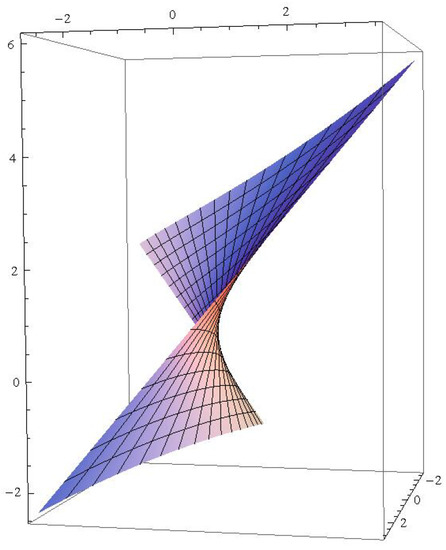
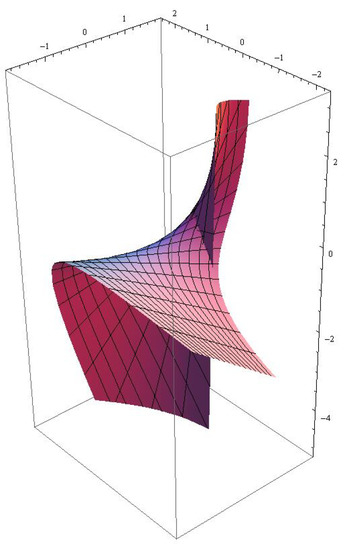
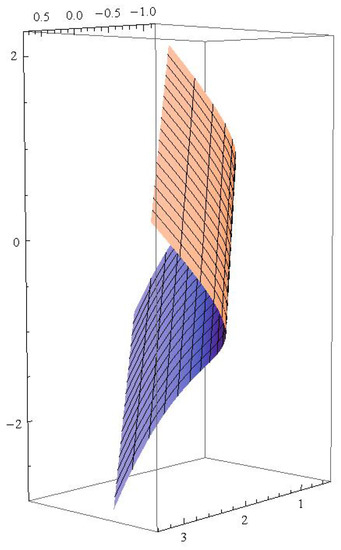
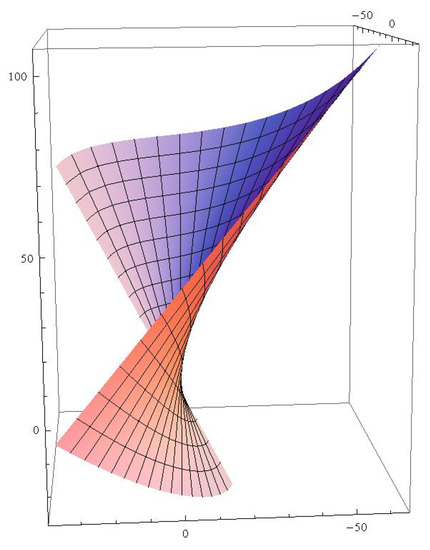
Example 1.
Let be a GNS in Proposition 3 with . Then
Proposition 4.
Proof of Proposition 4.
When the base curve is a 2-type null helix, the null curvature is , where and are constants. By an appropriate parameter transformation and from (2), we have
Solving the above differential Equation (44), the structure functions of are as follows:
- or for and ;
- or for and
- or , for and .
Similar to Proposition 3, the base curve and the ruling can be represented by
- When , (), we havewhere
- When , we havewhere
- When , we havewhere
From the expression of and stated above, the results can be obtained. ☐
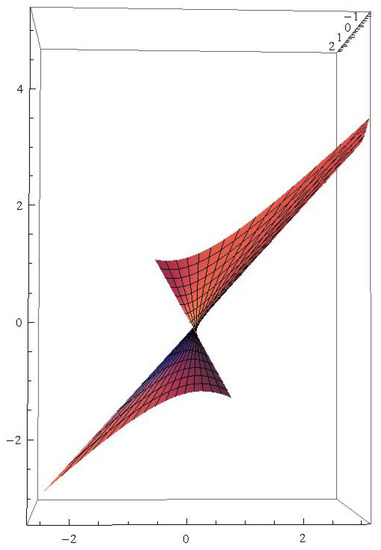
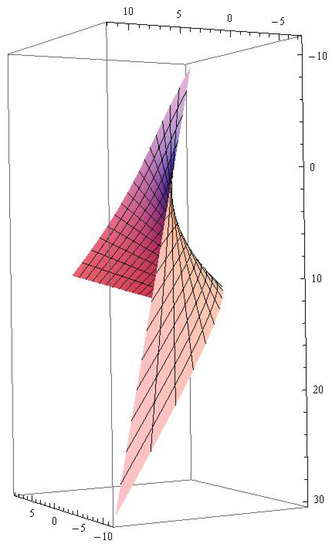
Example 2.
Let be a GNS in Proposition 4.
Remark 4.
Through the above two examples, we have presented a method to characterize GNS by the defined structure functions explicitly. This work can be generalized to a large class of surfaces and applied into CAD (CAGD) or product design etc.
Author Contributions
J.Q. and X.F. set up the problem and computed the details. S.D.J. checked and polished the draft.
Funding
The first author was supported by NSFC (No.11801065,11371080) and the third author was supported by the National Research Foundation of Korea (NRF) grant funded by the Korea government (MSIP) (NRF-2018R1A2B2002046).
Acknowledgments
We thank the referee for the careful review and the valuable comments to improve the paper.
Conflicts of Interest
The authors declare no conflict of interest.
References
- Kim, Y.H.; Yoon, D.W. On non-developable ruled surface in Lorentz-Minkowski 3-spaces. Taiwan J. Math. 2007, 11, 197–214. [Google Scholar] [CrossRef]
- Kim, Y.H.; Yoon, D.W. Classification of ruled surfaces in Minkowski 3-spaces. J. Geom. Phys. 2004, 49, 89–100. [Google Scholar] [CrossRef]
- Barros, M.; Ferrandez, A. How big is the family of stationary null scrolls? J. Geom. Phys. 2013, 64, 54–60. [Google Scholar] [CrossRef]
- Choi, S.M.; Ki, U.H.; Suh, Y.J. On the Gauss map of null scrolls. Tsukuba J. Math. 1998, 22, 273–279. [Google Scholar] [CrossRef]
- Pak, J.S.; Yoon, D.W. On null scrolls satisfying the condition ΔH = AH. Commun. Korean Math. Soc. 2000, 15, 533–540. [Google Scholar]
- Graves, L.K. Codimension one isometric immersions between Lorentz spaces. Trans. Am. Math. Soc. 1979, 252, 367–392. [Google Scholar] [CrossRef]
- Kim, Y.H. Differential geometry of generalized B-scroll and II-Weingarten surfaces of Minkowski space. Proc. Natl. Inst. Math. Sci. 2006, 6, 67–76. [Google Scholar]
- Qian, J.; Kim, Y.H. Directional associated curves of a null curve in . Bull. Korean Math. Soc. 2015, 52, 183–200. [Google Scholar] [CrossRef]
- Ferrandez, A.; Gimenez, A.; Lucas, P. Null helices in Lorentzian space form. Int. J. Mod. Phys. A 2001, 12, 4845–4863. [Google Scholar] [CrossRef]
- Inoguchi, J.; Lee, S. Null curves in Monkowski 3-space. Int. Electron. J. Geom. 2008, 1, 40–83. [Google Scholar]
- Yayli, Y. On the motion of the Frenet vectors and spacelike ruled surfaces in the Minkowski 3-space. Math. Comput. Appl. 2000, 5, 49–55. [Google Scholar] [CrossRef]
- Liu, H. Curves in the lightlike cone. Contrib. Algebra Geom. 2004, 45, 291–303. [Google Scholar]
- Blair, D.E.; Koufogiorgos, T. Ruled surfaces with vanishing second Gaussian curvature. Monatshefte Math. 1992, 113, 177–181. [Google Scholar] [CrossRef]
- Dillen, F.; Sodsiri, W. Ruled surfaces of Weingarten type in Minkowski 3-space. J. Geom. 2005, 83, 10–21. [Google Scholar] [CrossRef]
- Qian, J.; Liu, H.; Jin, G. Lightlike Helices in 3D Minkowski Space. J. Northeast. Univ. (Nat. Sci.) 2012, 33, 1800–1802. [Google Scholar]
© 2019 by the authors. Licensee MDPI, Basel, Switzerland. This article is an open access article distributed under the terms and conditions of the Creative Commons Attribution (CC BY) license (http://creativecommons.org/licenses/by/4.0/).