


Abstract
This paper introduces a new family of q-special polynomials, termed q-general Bell polynomials, and systematically explores their structural and analytical properties. We establish their generating functions, derive explicit series representations, and develop recurrence relations to characterize their combinatorial behavior. Additionally, we characterize their quasi-monomial properties and construct associated differential equations governing these polynomials. To demonstrate the versatility and applicability of this family, we investigate certain examples, including the q-Gould–Hopper–Bell and q-truncated exponential-Bell polynomials, deriving analogous results for each. Further, we employ computational tools in Mathematica to examine zero distributions and produce visualizations, offering numerical and graphical insights into polynomial behavior.
Keywords:
q-special polynomials; q-Bell polynomials; q-recurrence relations; differential equations; generating function; zero distributions MSC:
05A30; 11B73; 11B83; 33C47
1. Introduction
q-calculus represents both a generalization and an adaptation of classical calculus. The discipline first emerged in the 18th century [1,2], propelled by its utility across diverse areas of mathematics, physics, and engineering. Interest in q-series concepts with origins in the 1800s experienced a resurgence in the 1980s following breakthroughs in quantum groups, whose development and applications in modern mathematics and physics revitalized the study of this historically rich field. q-series, serving as an extension of hypergeometric series, have garnered significant attention in recent research. This surge in interest stems from their unexpected applications across diverse disciplines, including quantum groups, statistical mechanics, and transcendental number theory, highlighting their broad relevance in contemporary mathematics and physics.
A central focus in the study of q-calculus lies in q-special functions, which are intrinsic to the field and form a bridge between mathematics and physics. In the realm of mathematical physics, a variety of q-special polynomials and functions have been formulated and utilized to serve as representations within quantum algebra [3].
The fundamental principles and nomenclature of q-calculus have been extensively established in the works of Andrews, Gasper, Ernst, and others [4,5,6]. These q-analogues are pivotal for analyzing and extending classical special functions, thereby enriching the understanding of their properties in diverse contexts. In recent years, a growing body of research on q-special polynomials has further underscored their significance within both theoretical and applied mathematical fields.
Additionally, q-special polynomials such as q-Bernoulli, q-Euler, q-Appell, q-Sheffer–Appell, q-Fubini–Appell, and q-modified-Laguerre–Appell polynomials have been extensively investigated, with their properties and applications documented in numerous studies over time [7,8,9,10,11,12].
The q-shifted factorial is given as follows [6]:
The q-number for and the q-factorial function [6] are, respectively, defined by
and
The q-binomial coefficient is specified by [6]
The q-derivative for a function at a point is defined as follows [6]:
It is also worth noting that
The functions
are termed q-exponential functions [13] and possess the following identities:
The q-definite integral of a function can be expressed as follows [6]:
and
The q-dilation operator [3] is defined for any function as
and fulfills the following property:
The q-derivative of is given by
where
Bell polynomials are widely regarded as highly significant among special polynomials, owing to their broad applications in diverse mathematical contexts (see [14,15,16,17,18]). Furthermore, they hold critical importance in the analysis of water wave phenomena, driving progress in fields such as mechanical engineering, energy development, marine and offshore engineering, hydraulic engineering, and other related disciplines [19,20,21,22]. The Bell polynomials are defined by [17,18]
The 2-variable Bell polynomials (2VBelP) are defined by [23]
The q-analogue of the Bell polynomials (denoted ) [24] has the following generating function:
For , the q-Bell polynomials (q-BelP) reduce to the q-Bell numbers [25], that is,
Further, the 2-variable q-BelP polynomials (2Vq-BelP) are defined as
Bell numbers, polynomials, and their q-analogues have been extensively studied by numerous researchers, with significant properties explored in works such as [16,17,18,23,25] and references therein. Additionally, these mathematical objects play a vital role in diverse fields, including analytic number theory, physics, and related disciplines.
The 2-variable general polynomials (2VGP) are specified by [26]:
where
The q-analogue of the 2VGP , is denoted by [27] and defined by
where
Significant members of the 2-variable q-general polynomials (2Vq-GP) family are obtained by making suitable selections for the function , such as
- If , the 2Vq-GP reduce to the q-Gould–Hopper polynomials (q-GH) [27], where are defined byand series representation asFor , the q-GHP reduce to 2-variable q-Hermite polynomials (2vq-HP) [28].
- If , the 2Vq-GP reduce to 2-variable q-Laguerre polynomials (2vq-LP) [29], where are defined bywhere denotes the 0th order q-Tricomi functions, which are defined by
- If , the 2Vq-GP reduce to the q-Hermite–Appell polynomials (q-HAP) [30], where are defined by
- If , the 2Vq-GP reduce to 2-variable q-truncated exponential polynomials of order s (2Vq-TEP) [31], where are defined by
- If , the 2Vq-GP reduce to 2-variable q-truncated exponential Appell polynomials (2Vq-TEAP) [31], where are defined byFor , the 2Vq-TEAP reduce to q-truncated exponential Appell polynomials (q-TEAP) [28], which are defined by
The family of q-special polynomials, including q-Bell polynomials, q-general polynomials, and specific members of the q-general class such as q-Gould–Hopper, q-Laguerre, q-Hermite, and q-truncated exponential polynomials form a dynamically growing area of mathematical research. This expansion is supported by extensive investigations, as highlighted in works such as Alam et al. [27] introduced the 2-variable q-General–Appell polynomials and studied the related properties; Raza et al. [28] established the 2-variable q-Hermite polynomials; Fadel et al. [29] investigated the Bivariate q-Laguerre–Appell polynomials; Costabile et al. [31] defined and studied the q-truncated exponential Appell polynomials, and Wani et al. [32] discussed the certain advancement in multidimensional q-Hermite polynomials.
In recent years, researchers have increasingly focused on developing and analyzing considerable classes of q-special polynomials, particularly generalized classes, as evidenced by works such as [27,30,31,33,34] and related references.
The key novelty of this work lies in the establishment of a new generalized family of q-special polynomials. This versatile family can be considered a generalization of many special polynomials, including the q-Bell, 2-variable q-general, q-Gould–Hopper, q-Laguerre, q-Hermite, q-Hermite–Appell, q-truncated exponential, q-Gould–Hopper–Bell, q-Laguerre–Bell, q-Hermite–Bell, q-Hermite–Appell–Bell, and q-truncated exponential-Bell polynomials, which expands the theory of special function by introducing and systematically studying a new, broad class of q-special polynomials and their properties.
This article is structured as follows: In Section 2, we employ the replacement technique to construct the class of q-general Bell polynomials by synthesizing standard polynomials, q-general polynomials, and q-Bell polynomials. The generating function is introduced. Additionally, explicit series formulations linked to these polynomials are rigorously established. In Section 3, the associated recurrence relations, quasi-monomial characteristics, and a q-differential equation are systematically analyzed and formalized. Section 4 explores specific applications, including the q-Gould–Hopper–Bell polynomials and the q-truncated exponential-Bell polynomials, with analogous theoretical frameworks developed for each case. Furthermore, computational tools in Mathematica are utilized to investigate the zero distributions of these polynomials, accompanied by graphical visualizations that provide numerical and illustrative perspectives on their properties. For a consolidated overview of the polynomials and their associated symbols, refer to Table A1.
2. q-General Bell Polynomials
Assume that . This section presents a new class of generalized q-special polynomials, the q-general Bell polynomials (q-GBelP), characterized by their generating functions. Certain series representations are also formulated.
Theorem 1.
The q-general Bell polynomials have the following generating function:
Proof.
We begin with the generating relation (19) and replace with . Subsequently, we expand the function on the l.h.s. of the resulting equation and replace the powers of , i.e., with the corresponding polynomials in the l.h.s. and by in the r.h.s. We then have
Further, by summing the series on the l.h.s. and then substituting Equation (22) into the resulting equation, we obtain
Remark 1.
Setting in generating relation (32), we obtain the 2-variable q-general Bell polynomials , as defined by
By suitable selections of variables and the function , we obtain certain members of the q-general Bell polynomials. These members are mentioned in Table 1.

Table 1.
Some members of the q-GBelP .
Next, in view of generating function (32), we establish certain series representations for the q-GBelP .
Theorem 2.
For and , the q-GBelP satisfy the following series representation:
Proof.
Based on Equations (17) and (22), Equation (32) can be expressed as
which, when employing the Cauchy product rule [35], leads to
Comparing coefficients of like powers of in the above equation establishes assertion (37). □
Similarly, the following theorem can be proven.
Theorem 3.
For and , the q-GBelP satisfy the following series representations:
Theorem 4.
For , , and , the q-GBelP satisfy the following series representation:
Proof.
Comparing coefficients of like powers of in the above equation establishes assertion (42). □
The q-analogue of Stirling numbers of the second kind is given by [24]
Theorem 5.
For , , and , we have
Proof.
Comparison of the coefficients of identical powers of in the above equation establishes the assertion in Equation (45). □
Now, let us recall the 2-variable q-tangent polynomials [36], which are given by
Theorem 6.
The q-GBelP satisfy the following representation:
3. Recurrence Formulae and Quasi-Monomial Characteristics
In this section, we establish some q-recurrence relations and quasi-monomial properties associated with q-GBelP
.
Theorem 7.
The q-GBelP admit the following q-recurrence formula:
Proof.
By taking the q-partial derivative of generating relation (32) with respect to and utilizing Equation (10), we have
Remark 2.
Taking in (50), we have
Theorem 8.
For q-GBelP , the following q-recurrence formula holds:
where
Proof.
Consider the generating function
Theorem 9.
The q-GBelP admit the following q-recurrence formula:
Proof.
By taking the q-partial derivative of generating relation (32) with respect to and utilizing Equation (10), we find
Similarly, we can prove the following result.
Theorem 10.
The q-GBelP admit the following q-recurrence formula:
Theorem 11.
The q-GBelP satisfy the following q-recurrence relation:
Proof.
Consider the generating function
Proceeding, we take the q-partial derivative with respect to ϰ on both sides of Equation (23), which leads to
In view of Equations (6), (19), (36), (62) and (64), Equation (63) can be expressed as
which (using the Cauchy product rule) yields
Finally, comparing coefficients of ϰ results in Equation (61). □
Theorem 12.
For q-GBelP , the following q-integral formula holds:
Proof.
Taking the q-definite integration of generating relation (32) with respect to and using Equation (10), we obtain
In line with the monomiality principle [37], a polynomial set is termed quasi-monomial if it is possible to define “q-multiplicative” () and “q-derivative” () operators for which
respectively, for all . Moreover, these q-operators satisfy the following relations
The principle of monomiality, being a powerful tool for the analysis of q-special polynomials, motivates our examination of the quasi-monomiality of the q-GBelP .
Theorem 13.
For q-GBelP , the associated q-multiplicative and q-derivative operators demonstrating their quasi-monomial nature are
and
respectively.
Proof.
Obviously, we have
The q-partial derivative of Equation (32) with respect to ϰ yields
which on using (13) becomes
which on using relation (76) on the left-hand side becomes
Next, after replacing ω with on the right-hand side, we equate the coefficients of corresponding powers of ϰ (on both sides) to obtain
Theorem 14.
The q-GBelP satisfy the following differential equation:
4. Applications
This section presents applications associated with the our family, q-GBelP . Specific illustrative examples are analyzed to demonstrate their properties and utility. Additionally, the zero distributions of the q-GBelP are investigated, offering insights into their structural and analytical behavior.
Examples
The q-Gould–Hopper, q-Laguerre, q-Hermite, q-Appell, and q-truncated exponential polynomials are vital components in diverse expansions and approximation formulas, forming the foundation for advancements in classical and numerical analysis. These polynomials, along with their associated q-numbers, are further instrumental in the analytic theory of numbers. Specific members of the broader q-general family can be derived through a suitable selection of the function . Here, we present key results for the corresponding members of the q-GBelP , by examining illustrative examples that highlight their structural and analytic properties.
Example 1.
q-Gould–Hopper–Bell Polynomials.
In view of Equations (37), (40), (41), (42), (45) and (48), certain series representations of the q-GHBelP are given as follows:
From Equations (50), (53), (58), (60), (61), and (67), we obtain the following q-recurrence relations for the q-GHBelP :
For q-GHBelP , the associated q-multiplicative and q-derivative operators demonstrating their quasi-monomial nature are
and
respectively.
From Equation (83), we find the following differential equation, which is satisfied by he q-GHBelP :
Next, we explore the distributions of zeros and present graphical illustrations of the q-GHBelP for specific parameter values and indices.
Certain interesting zeros of the q-GHBelP , for and are shown in Figure 1.
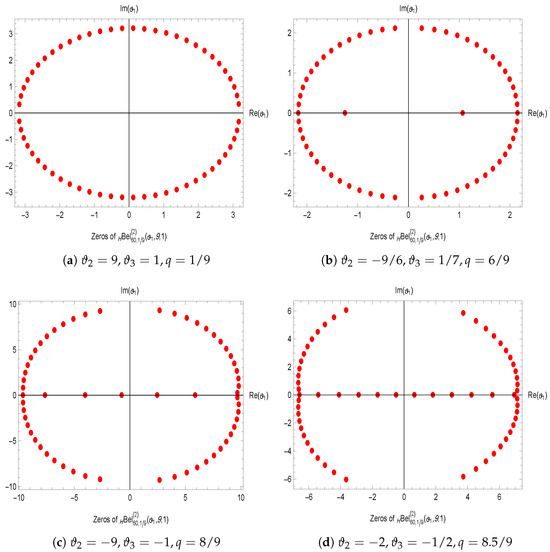
Figure 1.
Zeros of with degree .
The stacking structures of approximation zeros for the q-GHBelP (, ) yield 3D structures, as shown in Figure 2.
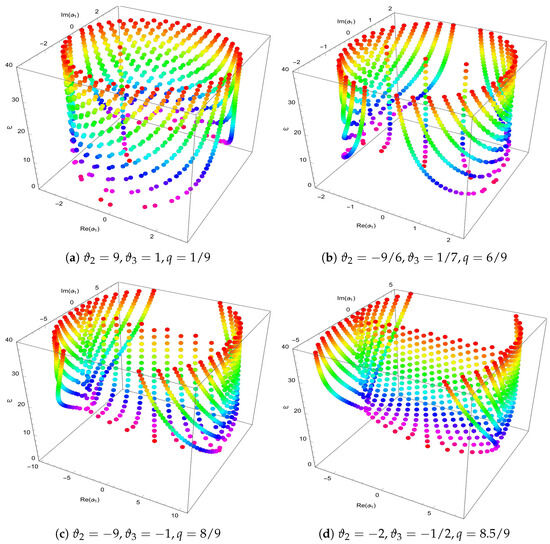
Figure 2.
Stacking structure zeros of . This figure shows the 3D plot of the zeros of the q-GHBelP , for and .
Example 2.
q-Truncated Exponential-Bell Polynomials.
Taking in Equation (32), we obtain
where are referred to as the q-truncated exponential Bell polynomials of order s (q-TEBelP).
In view of Equations (37), (40), (41), (42), (45) and (48), certain series representations of the q-TEBelP are given as follows:
From Equations (50), (53), (58), (60), (61) and (67), we obtain the following q-recurrence relations for the q-TEBelP :
For q-TEBelP , the associated q-multiplicative and q-derivative operators demonstrating their quasi-monomial nature are
and
respectively.
From Equation (83), we find the following differential equation, which is satisfied by the q-TEBelP :
Next, we explore the distributions of zeros and present graphical illustrations of the q-GHBelP for specific parameter values and indices.
Certain interesting zeros of the q-TEBelP for and are shown in Figure 3.
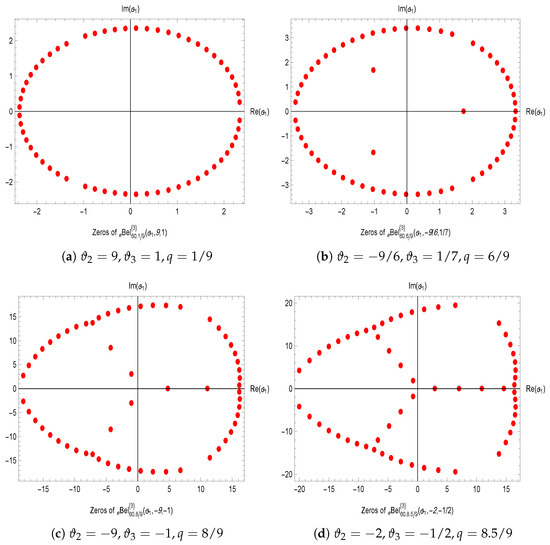
Figure 3.
Zeros of with degree .
The stacking structures of approximation zeros of the q-TEBelP , for and give 3D structures, which are presented in Figure 4.
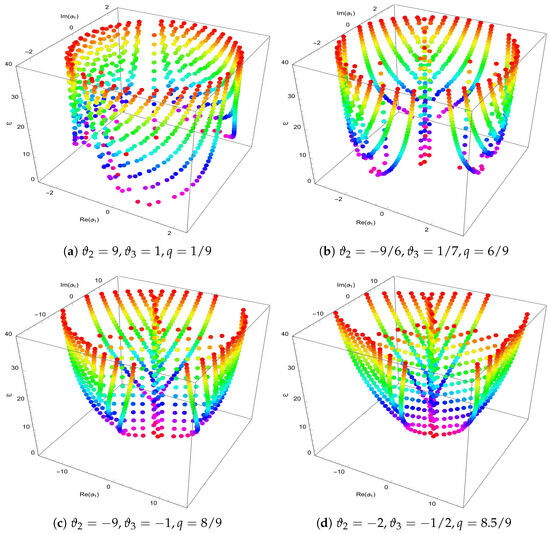
Figure 4.
Stacking structure zeros of . This figure shows the 3D plot of the zeros of the TGHBelATP , for and .
Further, we can present more examples for our established family q-GBelP based on suitable selections for the function , as follows:
- If , the q-GBelP reduce to q-Laguerre–Bell polynomials (q-LBelP) , which are defined by
- If , the q-GBelP reduce to the q-Hermite–Appell–Bell polynomials (q-HABelP) , which are defined by
- If , the q-GBelP reduce to q-truncated exponential-Appell–Bell polynomials of order s (q-TEABelP) , which are defined byFor , the q-TEABelP reduce to q-truncated exponential-Appell–Bell polynomials of order 2 (q-TEABelP) , which are defined by
5. Conclusions
The generalized formulation of special polynomials has attracted considerable interest within the research community. This paper introduces a new class of special polynomials, the q-general Bell polynomials, and investigates their properties. The key findings are as follows:
- Introduction of a New Polynomial Family: A generalized family of q-special polynomials, termed q-general Bell polynomials, were introduced through generating function and series representations.
- Fundamental Properties: Some explicit representations and q-recurrence relations for these polynomials were established, which helps to clarify their combinatorial nature.
- Structural Characteristics: The quasi-monomial properties of the q-general Bell polynomials were examined, and the differential equation that governs them was constructed.
- Specific Instances and Adaptability: The versatility of this new family of polynomials was demonstrated through the analysis of specific cases, including the q-Gould–Hopper–Bell and q-truncated exponential-Bell polynomials. For each of these specific instances, analogous structural and combinatorial results were derived.
- Applications: This study demonstrates the properties and applications of the q-general Bell polynomials through the analysis of specific examples. Furthermore, an investigation into their zero distributions provides key insights into their structural and analytical characteristics.
- Computational Analysis: To provide numerical and visual insights into the behavior of these polynomials, computational analyses were performed using Mathematica to explore the distribution of their zeros and to generate graphical representations.
In summary, this study provides a unifying theoretical framework for a diverse set of special polynomial families. It also lays the groundwork for future investigations into the theoretical extensions and practical applications of these polynomials in fields such as mathematical physics, combinatorics, and approximation theory. Potential future research could relate our introduced family to the results that are given in [38,39,40]. Further studies may also explore the degenerate forms of these polynomials.
Author Contributions
Conceptualization, M.S.A. and A.M.; Formal analysis, A.M.; Investigation, M.S., W.E.A. and A.A.; Methodology, M.S.; Project administration, K.A.; Resources, N.H.; Software, N.H.; Supervision, K.A.; Validation, M.S.A. and A.A.; Visualization, A.M.; Writing—original draft, A.M.; Writing—review and editing, M.S., K.A. and W.E.A. All authors have read and agreed to the published version of the manuscript.
Funding
This research was funded by Qassim University grant number QU-APC-2025.
Data Availability Statement
The original contributions presented in the study are included in the article; further inquiries can be directed to the corresponding authors.
Acknowledgments
The researchers would like to thank the Deanship of Graduate Studies and Scientific Research at Qassim University for financial support (QU-APC-2025).
Conflicts of Interest
The authors declare no conflicts of interest.
Appendix A
A summary of the polynomials and their respective notations as presented in this study is provided in Table A1.
Table A1.
Polynomials and their notations.
Table A1.
Polynomials and their notations.
| Notation | Polynomials | Notation | Polynomials |
|---|---|---|---|
| Bell polynomials | 2-variable q-truncated exponential | ||
| -Appell polynomials | |||
| 2-variable Bell polynomials | q-general Bell polynomials | ||
| q-Bell polynomials | 2-variable q-general Bell polynomials | ||
| 2-variable q-Bell polynomials | q-Gould–Hopper–Bell polynomials | ||
| 2-variable general polynomials | q-truncated exponential-Bell | ||
| q-Gould–Hopper polynomials | polynomials of order s | ||
| 2-variable q-Laguerre polynomials | |||
| q-Hermite–Appell polynomials | |||
| 2-variable q-truncated exponential | |||
| polynomials of order s |
References
- Jackson, F.H. On q-functions and a certain difference operator. Trans. R. Soc. Edinb. 1908, 46, 253–281. [Google Scholar] [CrossRef]
- Jackson, F.H. On q-definite integrals. Q. J. Pure Appl. Math. 1910, 41, 193–203. [Google Scholar]
- Floreanini, R.; Vinet, L. Quantum algebras and q-special functions. Ann. Phys. 1993, 221, 53–70. [Google Scholar] [CrossRef]
- Ernst, T. A Comprehensive Treatment of q-Calculus; Springer Science & Business Media: Berlin/Heidelberg, Germany, 2012. [Google Scholar]
- Gasper, G.; Rahman, M. Basic Hypergeometric Series, 2nd ed.; Cambridge University Press: Cambridge, UK, 2004; Volume 96. [Google Scholar]
- Andrews, G.E.; Askey, R.; Roy, R. Special Functions; Cambridge University Press: Cambridge, UK, 1999; Volume 71. [Google Scholar]
- Kim, T.; Kim, D.S.; Kwon, H.I.; Seo, J.J.; Dolgy, D.V. Some identities of q-Euler polynomials under the symmetric group of degree n. J. Nonlinear Sci. Appl. 2016, 9, 1077–1082. [Google Scholar] [CrossRef][Green Version]
- Yasmin, G.; Muhyi, A.; Araci, S. Certain results of q-Sheffer-Appell polynomials. Symmetry 2019, 11, 159. [Google Scholar] [CrossRef]
- Muhyi, A.; Araci, S. A note on q-Fubini-Appell polynomials and related properties. J. Funct. Spaces 2021, 2021, 3805809. [Google Scholar] [CrossRef]
- Fadel, M.; Muhyi, A. On a family of q-modified-Laguerre-Appell polynomials. Arab J. Basic Appl. Sci. 2024, 31, 165–176. [Google Scholar] [CrossRef]
- Aral, A.; Gupta, V.; Agarwal, R.P. Applications of q-Calculus in Operator Theory; Springer: New York, NY, USA, 2013. [Google Scholar]
- Mahmudov, N.I. On a class of q-Bernoulli and q-Euler polynomials. Adv. Differ. Equ. 2013, 2013, 108. [Google Scholar] [CrossRef]
- Alatawi, M.S.; Khan, W.A.; Ryoo, C.S. Explicit properties of q-cosine and q-sine array-type polynomials containing symmetric structures. Symmetry 2022, 14, 1675. [Google Scholar] [CrossRef]
- Benbernou, S.; Gala, S.; Ragusa, M.A. On the regularity criteria for the 3D magnetohydrodynamic equations via two components in terms of BMO space. Math. Methods Appl. Sci. 2014, 37, 2320–2325. [Google Scholar] [CrossRef]
- Boas, R.P.; Buck, R.C. Polynomial Expansions of Analytic Functions; Springer: Berlin/Heidelberg, Germany, 2013. [Google Scholar]
- Tanny, S.M. On some numbers related to the Bell numbers. Can. Math. Bull. 1974, 17, 733–738. [Google Scholar] [CrossRef]
- Carlitz, L. Some remarks on the Bell numbers. Fibonacci Q. 1980, 18, 66–73. [Google Scholar] [CrossRef]
- Kim, D.S.; Kim, T. Some identities of Bell polynomials. Sci. China Math. 2015, 58, 2095–2104. [Google Scholar] [CrossRef]
- Gao, X.Y.; Guo, Y.J.; Shan, W.R. Beholding the shallow water waves near an ocean beach or in a lake via a Boussinesq-Burgers system. Chaos Solitons Fractals 2021, 147, 110875. [Google Scholar] [CrossRef]
- Gao, X.Y.; Guo, Y.J.; Shan, W.R. Bilinear forms through the binary Bell polynomials, N solitons and Bäcklund transformations of the Boussinesq-Burgers system. Commun. Theor. Phys. 2020, 72, 095002. [Google Scholar] [CrossRef]
- Gao, X.Y.; Guo, Y.J.; Shan, W.R. Scaling transformation on a (2+1)-dimensional Boiti-Leon-Pempinelli system. Rom. Rep. Phys. 2021, 73, 111. [Google Scholar]
- Gao, X.Y.; Guo, Y.J.; Shan, W.R. Generalized (2+1)-dimensional dispersive long-wave system: Scaling transformations and N solitons. Eur. Phys. J. Plus 2021, 136, 893. [Google Scholar] [CrossRef]
- Duran, U.; Araci, S.; Acikgoz, M. Bell-based Bernoulli polynomials with applications. Axioms 2021, 10, 29. [Google Scholar] [CrossRef]
- Kim, T.; Kim, D.S.; Kim, H.K. On q-derangement numbers and polynomials. Fractals 2022, 30, 2240200. [Google Scholar] [CrossRef]
- Kim, T.; Kim, D.S. Truncated polynomials associated with degenerate Bell polynomials. Russ. J. Math. Phys. 2021, 28, 342–355. [Google Scholar] [CrossRef]
- Khan, S.; Raza, N. General-Appell polynomials. Int. J. Anal. 2013, 2013, 708907. [Google Scholar] [CrossRef]
- Alam, N.; Khan, W.A.; Kizilates, C.; Ryoo, C.S. Two variable q-General-Appell polynomials. Mathematics 2025, 13, 765. [Google Scholar] [CrossRef]
- Raza, N.; Fadel, M.; Nisar, K.S.; Zakarya, M. On 2-variable q-Hermite polynomials. AIMS Math. 2021, 6, 8705–8727. [Google Scholar] [CrossRef]
- Fadel, M.; Raza, N.; Al-Gonah, A.; Duran, U. Bivariate q-Laguerre-Appell polynomials. Appl. Math. Sci. Eng. 2024, 32, 2412545. [Google Scholar] [CrossRef]
- Fadel, M.; Alatawi, M.S.; Khan, W.A. q-Hermite-based Appell polynomials. Mathematics 2024, 12, 1358. [Google Scholar] [CrossRef]
- Costabile, F.A.; Khan, S.; Ali, H. q-truncated exponential-Appell polynomials. Mathematics 2024, 12, 3862. [Google Scholar] [CrossRef]
- Wani, S.A.; Riyasat, M.; Khan, S.; Ramirez, W. Certain advancement in multidimensional q-Hermite polynomials. Rep. Math. Phys. 2024, 94, 117–141. [Google Scholar] [CrossRef]
- Riyasat, M.; Khan, S. q-Hermite based hybrid polynomials. Glas. Mat. Ser. III 2018, 53, 9–31. [Google Scholar] [CrossRef]
- Zayed, M.; Wani, S.A.; Ramírez, W.; Cesarano, C. Advancements in q-Hermite-Appell polynomials: A three-dimensional exploration. AIMS Math. 2024, 9, 26799–26824. [Google Scholar] [CrossRef]
- Hardy, G.H. Divergent Series; American Mathematical Society: Providence, RI, USA, 2000; Volume 334. [Google Scholar]
- Yasmin, G.; Muhyi, A. 2-variable q-generalized tangent-Apostol type polynomials. J. Math. Comput. Sci. 2021, 22, 238–251. [Google Scholar] [CrossRef]
- Dattoli, G. Hermite-Bessel and Laguerre-Bessel functions. In Advanced Special Functions and Applications; Aracne: Rome, Italy, 2000; Volume 1, pp. 147–164. [Google Scholar]
- Nápoles Valdés, J.E.; Castillo Medina, J.A.; Guzmán, P.M.; Lugo, L.M. A New Local Fractional Derivative of q-Uniform Type. Discontinuity Nonlinearity Complex. 2019, 8, 101–109. [Google Scholar] [CrossRef]
- Bermudo, S.; Kórus, P.; Nápoles Valdés, J.E. On q-Hermite-Hadamard inequalities for general convex functions. Acta Math. Hungar. 2020, 162, 365–378. [Google Scholar] [CrossRef]
- Castillo Medina, J.A.; Cruz García, S.; Nápoles Valdés, J.E.; Galeana Moyaho, T. Some New Results in the q-Calculus. Discontinuity Nonlinearity Complex. 2021, 10, 755–763. [Google Scholar] [CrossRef]
Disclaimer/Publisher’s Note: The statements, opinions and data contained in all publications are solely those of the individual author(s) and contributor(s) and not of MDPI and/or the editor(s). MDPI and/or the editor(s) disclaim responsibility for any injury to people or property resulting from any ideas, methods, instructions or products referred to in the content. |
© 2025 by the authors. Licensee MDPI, Basel, Switzerland. This article is an open access article distributed under the terms and conditions of the Creative Commons Attribution (CC BY) license (https://creativecommons.org/licenses/by/4.0/).