1. Introduction
When representing interconnection networks, it is customary to employ graphs wherein the vertices represent the processing nodes within the system and the edges signify the communication links between these nodes. The process of assigning colors to the edges of a graph G is known as edge coloring, which is essentially a function mapping the edge set to the set of natural numbers. This coloring scheme enables us to distinguish between different communication paths within the network based on the colors assigned to their corresponding edges. A path in G is defined as either a single vertex or a sequence of distinct vertices, where each consecutive pair of vertices , forms an edge in G. In a graph G, where u and v are distinct vertices belonging to the vertex set , a path linking u and v is defined as a path. In an edge-colored graph G, where neighboring edges might share the same color, a path is termed a rainbow path if none of its edges share the same color. Consequently, an edge-colored graph G is rainbow connected if every pair of vertices u and v is connected by a rainbow path. An edge coloring c that ensures the rainbow connectedness of G is referred to as a rainbow coloring. If k colors are utilized in this coloring scheme, then c is recognized as a rainbow k-coloring. The rainbow connection number of a connected graph G, denoted as rc(G), represents the smallest number of colors required to render G rainbow connected.
The concept of rainbow coloring in graphs was first introduced by Chartrand et al. [
1] and has garnered significant attention due to its practical applications, particularly around ensuring the secure transfer of classified information among various agencies [
2]. This method is particularly crucial in scenarios where intermediary agencies are involved, as it facilitates secure communication by assigning unique passwords between the agencies. When pairs of agencies establish one or more secure paths, each with its distinct set of passwords, this establishes a secure network and reveals the rainbow connection inherent within the system. This revelation acts as a formidable deterrent against potential intruders, enhancing the overall security posture of the communication network.
Extensive discussions surrounding the problem and its myriad applications have been meticulously explored from a combinatorial perspective, as evidenced by the publication of over 150 papers dedicated to this subject matter. Furthermore, ongoing research endeavors continue to yield significant advancements, particularly in the exploration of various variants of rainbow coloring across diverse graph families. For a comprehensive overview of these developments, interested readers can refer to authoritative sources such as surveys [
3,
4] and a dedicated book [
5], which provide insightful insights and analyses into the evolving landscape of rainbow coloring within graph theory.
Extensive research has been conducted on the rainbow connection number and rainbow coloring, exploring these concepts from both algorithmic and graph-theoretic perspectives. Scholars have delved into various aspects of these topics, investigating their theoretical foundations as well as their practical implications. Notably, Chakraborty et al. demonstrated that determining the rainbow connection number of a general graph is NP-hard [
6]. In fact, even deciding whether
is already known to be an NP-complete problem. Similarly, determining whether a given edge-colored graph is rainbow connected is also NP-complete [
6]. An easy observation is that
if and only if
G is a complete graph. In [
7], Caro et al. provided valuable insights into the conditions under which the rainbow connection number of a graph
G equals 2. Chartrand et al. investigated the rainbow connection numbers of a diverse range of graph structures, including complete graphs, trees, cages, wheel graphs, bipartite graphs, and multipartite graphs [
1,
8]. Over the last decade, several researchers have studied the bounds of the rainbow connection numbers on 3-connected graphs [
9], Cayley graphs [
10], the comb product of graphs [
11], the power graph of a finite group [
12,
13], and several graph operations such as the Cartesian product, lexicographic product, strong product, and union [
14,
15].
This paper directs its focus towards elucidating the methodologies involved in constructing rainbow colorings for both a given
WK-recursive network and a
WK-recursive pyramid. WK-recursive networks, initially introduced in [
16], represent a class of interconnection networks characterized by their recursive scalability. These networks are constructed hierarchically through the grouping of basic modules, resulting in structures that offer remarkable regularity and scalability. This inherent modular design of WK-recursive networks aligns well with the requirements of distributed systems, as highlighted in [
16,
17], comprising a multitude of computing elements. Building upon the foundation laid down by WK-recursive networks, the WK-recursive pyramid emerges as an interconnection network tailored for massively parallel computers, as outlined in [
18]. Utilizing the innate hierarchy at each tier, WK-recursive pyramids demonstrate adeptness in addressing a spectrum of issues in graph theory, digital geometry, image processing, and machine vision [
18]. Additionally, the fault-tolerant characteristics of WK-recursive pyramids position them as promising networks for dependable computing [
18]. In addition to their rainbow connectivity, WK-recursive pyramids exhibit several other advantageous properties. Notably, they boast small average distances and diameters along with substantial connectivity, scalability, and expandability. These attributes render WK-recursive pyramids highly suitable for both medium and large networks, presenting an optimal choice for scenarios in which efficiency and robustness are paramount considerations. Moreover, when compared to conventional mesh and traditional pyramid interconnection topologies, WK-recursive pyramids emerge as the superior alternative, offering enhanced performance and flexibility for a diverse range of applications, as highlighted in [
18]. Wang and Hsu [
19] provided upper bounds on the size of the rainbow connection numbers in WK-recursive networks and WK-recursive pyramids. In this paper, we revise and improve their results.
The remainder of this article is organized as follows.
Section 2 delves into the rainbow connection numbers of
. Building upon the findings regarding WK-recursive networks,
Section 3 extends the investigation further to provide and determine upper bounds for the size of the rainbow connection numbers of
. In the final section of this paper, we provide concluding remarks that summarize the key findings and contributions discussed throughout the study.
2. Results on WK-Recursive Networks
For , the set is shortly denoted by and the complement of a subset S of is denoted by .
Definition 1 ([
16])
. is a WK-recursive network with amplitude d and expansion level t. Vertex is labeled as a t-digit radix d number. An edge is called a substituting edge
. A vertex is called a j-frontier
. An edge is said to be a j-flipping edge
. An open edge
is an edge incident on , and is called a corner vertex.
The open edge is reserved for further expansion; hence, its other end vertex is unspecified. For a vertex , let and denote the leftmost i digits and the i-th rightmost digit of the address of v, respectively (that is, and ); in particular, . For any j-flipping edge , . A vertex can be denoted using a sequence of symbols drawn from the set , where ∗ is a “don’t care” symbol. The labeling represented by depicts a set of vertices where the addresses differ solely in the digit .
For vertices
u and
v in
G, the
distance between
u and
v, denoted
, is the length of the shortest
path in
G. The
diameter of a graph
G is defined as the maximum distance over all pairs of vertices in
G. For a connected graph
G,
, where
denotes the diameter of
G. The inequality is true because any rainbow path between two vertices of distance
must use at least
different colors.
is a class of recursively scalable networks of
[
20]. We define
as a subgraph of
induced by the set of vertices
, that is,
is an embedded
with the identifier
.
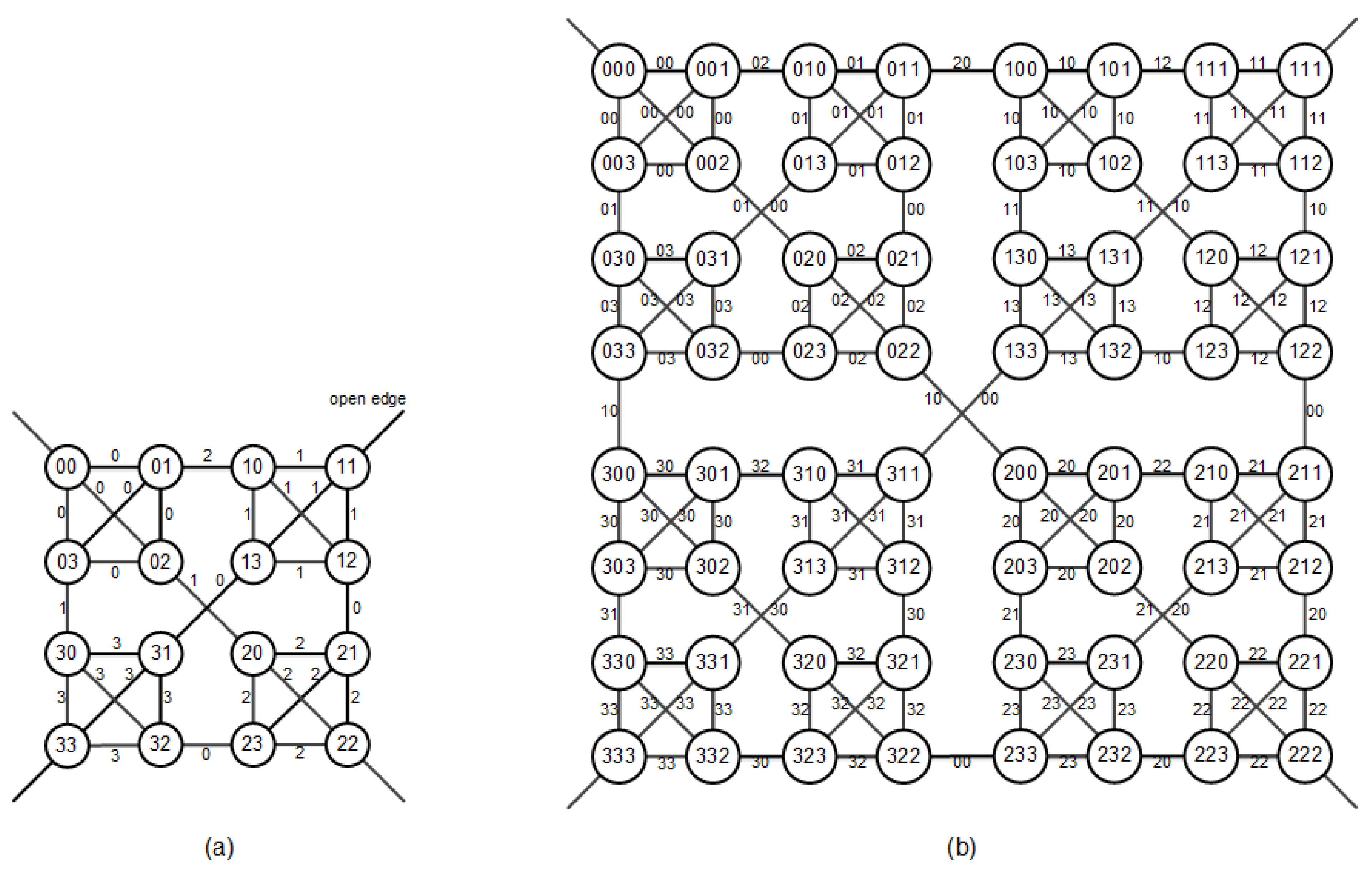
Figure 1 depicts
and
. In
Figure 1a, the edge
is identified as a substituting edge, whereas the edge
serves as the 1-flipping edge, connecting the 1-frontiers 01 and 10. Open edges are incident with the corner vertices
, and 33. The values of
, and
are
, and 1, respectively. In
Figure 1b,
is a subgraph of
induced by the set of vertices
.
has the 2-flipping edges
, and
.
Chartrand et al. provided the rainbow connection numbers of complete graphs, trees, and cycles as the following results [
1].
Proposition 1 - (a)
if and only if G is a tree.
- (b)
if and only if G is a complete graph.
- (c)
if G is a cycle of order .
Because is in fact a path of length , the next result follows directly from Proposition 1(a).
Corollary 1. For , .
Because the diameter of a graph is a trivial lower bound, . In standard practice, the color number assigned to an edge is typically denoted as , where i represents the string of digits and d denotes the base in which it is expressed. This notation allows for clear and concise representation of the assigned color, facilitating ease of interpretation and communication within the context of edge coloring in graphs.
Theorem 1. For , , where .
Proof. We provide an edge coloring
of
. For a vertex
, let all substituting edges incident on
v be assigned the color
. Then,
are needed to color the substituting edges. Taking
Figure 1b as an example, every substituting edge incident on the vertex 310 is assigned the color
. The color assigned to a
j-flipping edge
is defined by
Again using
Figure 1b as an example, the 1-flipping edge
is assigned the color
and the 2-flipping edge
is assigned the color
. The colors assigned to the edges of the subnetwork
range from
to
. We employ an inductive approach in order to show that
constitutes a rainbow coloring of
, specifically working on induction with respect to
t. When
,
takes the form of a complete graph with
d vertices. According to Proposition 1(b),
. We assume that this holds true for
, and now proceed to examine the case when
. Recall that
are
d copies of
embedded in
. Fro the inductive hypothesis, each
is colored by using
colors. Let
and
be two nonadjacent vertices of
. If
, then
u and
v are in the same subnetwork
; thus, according to the inductive hypothesis, the assertion holds. Conversely,
u and
v reside in distinct subnetworks, with
u belonging to subnetwork
and
v to subnetwork
.
From the inductive hypothesis, we have a rainbow
path
with edge colors ranging from
to
, and a rainbow
path
with edge colors ranging from
to
. Our objective at this point is to demonstrate that the color number assigned to the
k-flipping edge
is not in
. If
, then
. Clearly,
. For the case
, we obtain
. When
, we have
. Therefore, the concatenation of the path
,
k-flipping edge
e, and path
constructs a rainbow
path. □
The exact value of is deduced directly from Theorem 1.
Corollary 2. .
Furthermore, we aim to narrow down the difference between the lower and upper bounds of for .
Theorem 2. For , .
Proof. Because diam, we have . To show the lower bound of , we can assume, to the contrary, that for ; that is, any two vertices u and v are connected by a rainbow path of length . Let u be the corner vertex 00 and let . Because is the unique rainbow path, the edges and are assigned with three distinct colors (0, 1, and 2). Without loss of generality, let be assigned the color 1, that is, every substituting edge incident with 10 is colored 1. Similarly, for each , every substituting edge incident with is colored 1 to reveal the fact that is the unique rainbow path, where . This implies that every edge of is colored 1. For the same reason, all edges of a subnetwork , must be assigned the same color, and this must be distinct from the color assigned to the edges of , where . Thus, , which is a contradiction. We now construct an edge coloring to prove . A d-cycle is called an outer cycle of . For every , we refer the rainbow coloring of Proposition 1(c) and let the edges of be assigned the colors range from 0 to . Let each substituting edge not in an outer cycle be assigned the color and every flipping edge not in an outer cycle be assigned the color . We claim that the edge coloring c is a rainbow -coloring of . Let and be two nonadjacent vertices of and , and let be the outer cycle containing u and v, respectively. Recall that vertices and are both frontiers and that the flipping edge is assigned the color in c. We now show that u and v are connected by a rainbow path. Because u and v are not adjacent, and cannot both be frontiers. If u is a frontier, then is a rainbow path due to and . For the same reason, is a rainbow path when v is a frontier. For the case in which neither u nor v is a frontier, let P be a path from the vertex to v such that P is a subpath of the outer cycle of . Because P is a rainbow path and the edge of P is assigned the color , the concatenation of the path and P is a rainbow path. □
The exact value of follows directly.
Corollary 3. .
3. Results on WK-Recursive Pyramids
In this section, we present our methodology for edge coloring of WK-recursive pyramids, aiming to determine an upper bound for their rainbow connection numbers. Our approach involves developing a systematic edge coloring scheme tailored specifically for WK-recursive pyramids. Before delving into the coloring process, we provide a comprehensive definition of WK-recursive pyramids, elucidating their structural characteristics and recursive construction principles.
Definition 2. An n-dimensional WK-recursive pyramid [18], denoted , consists of a set of vertices . The subgraph induced by the vertex set , denoted , is connected as a and called layer l. The apex is . A vertex v with the addressing scheme is a vertex at layer l. The part of the address determines the address of v within . The children of v are the d vertices with the address scheme . The parent vertex of v, denoted by , is the vertex . An edge incident to a vertex and its parent vertex is called a vertical edge, while every edge within a layer is called a horizontal edge. is a complete graph of order . Throughout the remainder of the paper, we focus our analysis on cases where n is greater than or equal to 2. A vertex is an ancestor of v if u lies along the shortest path from v to the apex of the pyramid. has a small diameter , while the of for each large i has a large diameter . The spirit of our algorithm is based on the following proposition.
Proposition 2. Let , ; if , then in every rainbow path there are an even number of vertical edges between layers and i.
We propose an edge coloring
on
to establish an upper bound of
. Let
denote the color number assigned to the edge
e and
for an edge set
E. For a dedicated layer number
, the layers
are called
small layers, while the layers
are said to be
large layers. For every two vertices
u and
v of a small layer
L, we need to ensure that there is a rainbow
path containing only horizontal edges. If
L is a large layer, then, from Proposition 2, we want to establish a rainbow
path that contains even number of vertical edges. The edge coloring of a small layer
follows from the rainbow coloring
defined in
Section 2, while
for each small layer
. Let the vertical edges between small layers
and
i be assigned a color
, and let each large layer
be partitioned into
subnetworks
of expansion level
. Every subnetwork with an address scheme
in
is regarded as a basic colored module and has a rainbow
-coloring
. All horizontal edges between two basic colored modules are not in any rainbow path, and can be left empty or simply assigned a color 0. We let all vertical edges incident on the vertices in
and their parent vertices be assigned identical colors, and assign the vertical edges incident on two distinct subnetworks of a layer distinct colors. Then,
colors are needed for assignment to the vertical edges between large layers, as there are
subnetworks of expansion level
in a large layer. The formal definitions of the edge coloring
on the substituting edges, flipping edges, and vertical edges are described as follows.
Definition 3. Let be a substituting edge,
a j-flipping edge, and
a vertical edge of .
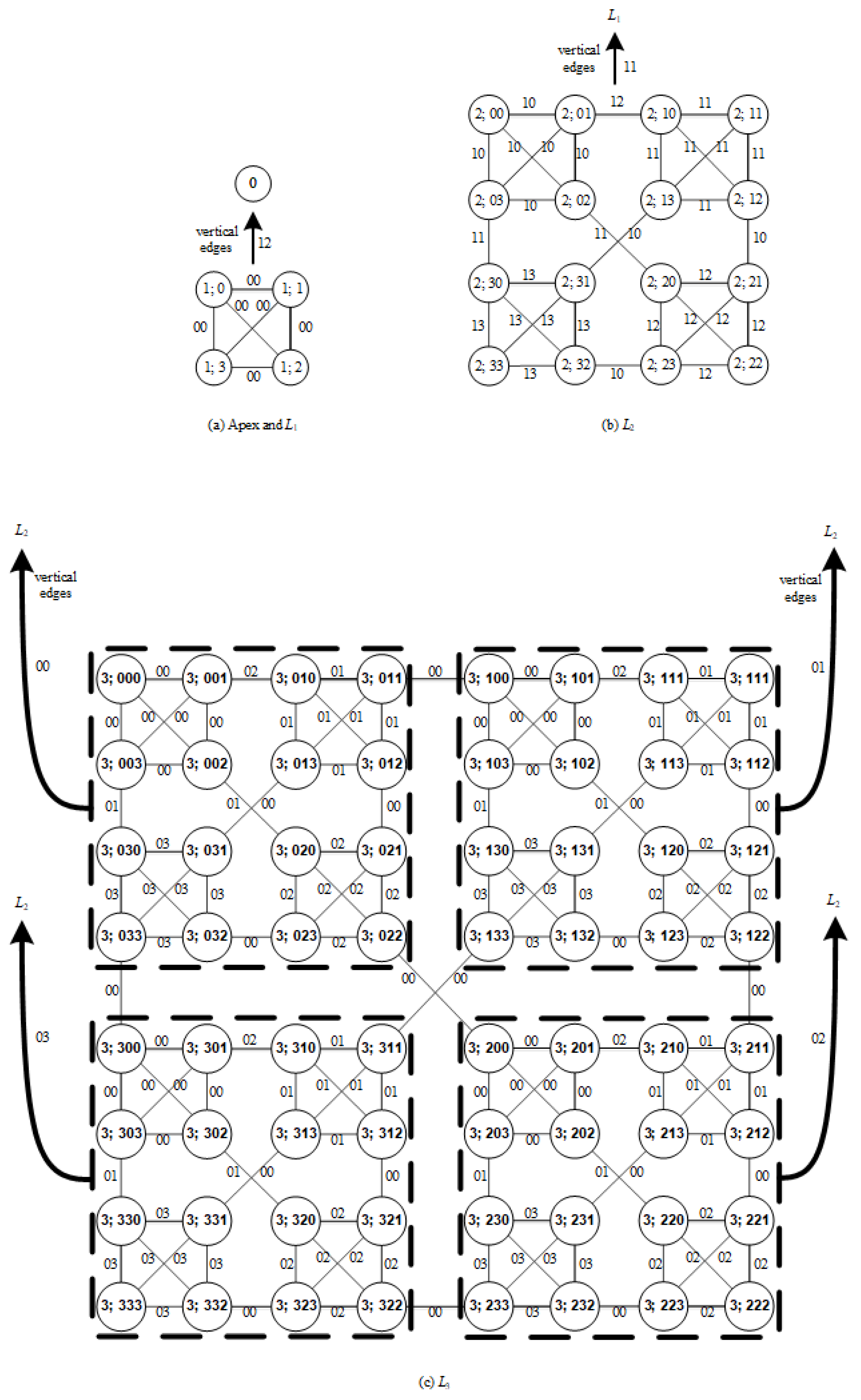
Figure 2 demonstrates the coloring
on
, where
and
.
has only one large layer
under
. In
Figure 2c,
is partitioned into
subnetworks. Each subnetwork within
operates as an independent basic color module, and as such is allocated the identical set of colors. From Theorem 1, the edges of each basic color module are assigned the color numbers in
. The vertical edges
, from Definition 3, are assigned the color
. Here,
is the layer
. From Definition 3, every horizontal edge of
is assigned a color greater than the color numbers used in a large layer (refer to
Figure 2b). Then, the horizontal edge of
is assigned the color numbers in
.
Figure 2a depicts the edge coloring on the small layer
which connects to the apex. We now demonstrate that
constitutes a rainbow coloring specifically tailored for a WK-recursive pyramid. This involves proving that
satisfies the necessary conditions for rainbow connectedness within the structure of the pyramid. Consider the function
, which is defined as the layer number of vertex
v.
Theorem 3. The edge coloring is a rainbow coloring on , where .
Proof. Let . If s and t are on the same subnetwork, then per Theorem 2 there exists a rainbow path. When s and t reside in distinct subnetworks, we explore three cases based on their respective layer numbers and .
It is confirmed that vertex s is an ancestor of vertex t, establishing their hierarchical relationship within the network. We define P as the path consisting solely of vertical edges, adhering to the criteria outlined in Definition 3. According to this definition, the edges comprising P are assigned unique color numbers, ensuring that no two edges within P share the same color.
Consider , the ancestor of t located on layer ; according to Definition 3, we can establish the existence of a rainbow path, denoted as , which exclusively comprises vertical edges. Additionally, because layer constitutes a subnetwork, from Theorem 2 we can derive the presence of a rainbow path, referred to as , consisting solely of layer edges. It is evident that the combination of paths and forms a rainbow path, thereby establishing connectivity between vertices s and t within the network.
Consider two vertices and located on layer x, serving as the respective ancestors of vertices s and t. According to Definition 3, we can establish the presence of a rainbow path, , and a rainbow path, , both comprised exclusively of vertical edges. Notably, the color numbers associated with and are less than or equal to and , respectively. Because layer corresponds to a , as established by Theorem 2, we can deduce the existence of a rainbow path, denoted as , consisting exclusively of layer edges. Remarkably, each layer edge within possesses color numbers that surpass those of any vertical edge in and . As a consequence, combining the paths and yields the formation of a rainbow path. □
The rainbow coloring problem on the network
is approached as a minimax optimization challenge. This involves the task of determining an optimal solution, denoted as
Theorem 4. Let , where . Proof. Based on the results on WK-recursive networks, we will determine the value
In such situations, we need to decide the values of
and
. For the large layer
, if we apply the rainbow coloring
on
directly, than
colors are needed to color the edges of
. Actually,
is instead partitioned into subnetworks to satisfy the inequality
. Then,
In contrast, the small layer
should not be partitioned due to
. Then,
From inequalities (1) and (2), we have
. Then,
At this juncture, we are prepared to delve into a discussion regarding the two values
and
. Because
and
,
, we let
, where
. We let
and
for each
. Clearly, the sequence
increases proportionally with the common ratio
d, while
decreases with a ratio near
. Actually,
. Three cases can be considered depending on the values of
and
:
1: . The difference of and is the minimum among all differences of and . Then, ; thus, for the case (see Table 3).
2: . The difference of and is the minimum among all differences of and . Then, ; thus, for the case (see Table 2).
3: There exists an such that and ; then, , and an upper bound of is established (see Table 3). □
In
Table 1, the grey cell
is the minimum of
, and
, while the grey cell
is the maximum of
, and
. Obviously, the difference of
and
is the minimum among all differences of
and
. Therefore, we obtain a rainbow
-coloring
on
when
.
Table 2 and
Table 3 provide the upper bounds of
and
, respectively.