


Abstract
Using the monophonic paths in the theory of directed graphs, this paper constructs a new topology called the out mondirected topology, which characterizes the graphs that induce indiscrete or discrete topology. We give and study some of the relations and properties, such as the relationship between the isomorphic relation, in directed graphs and the homeomorphic property in out mondirected topological spaces, compactness, -connectedness, connectedness and -discrete properties. Finally, we apply our results of out mondirected topological spaces in the nervous system of the human body, such as in the messenger signal network, in diagrams of sensory neuron cells and in models of two distinct nicotinic receptor types based on the second messenger signal.
MSC:
05C99; 18F60; 05C20
1. Introduction
The graph theory and general topology are important topics in the field of mathematics. Several researchers have studied the relation between general topology and graph theory by constructing some topologies on a vertex set of graphs and on the edge set for undirected simple graphs or directed graphs. Most of these constructions were on the set of vertices in the theory of undirected simple graphs. In the theory of undirected graphs, Jafarian et al. [1] introduced and investigated the graphic topological space of a graph ℵ as a pair , where is an Alexandroff topology on , which is induced by a sub-basis and is in the family of the open neighborhoods of the vertices in ℵ. In 2018, Nada et al. [2] presented a relation on graphs to induce new types of topological structures. Abdu and Kilicman [3], in 2018, introduced new constructions of topologies, i.e., incidence topology, on the set of vertices for undirected simple graphs without isolated vertices. These topologies have a sub-basis given by . Kilicman and Abdu [4] used the directed graphs to introduce two constructions of topologies on the set , which is called compatible edge topology and incompatible edge topology. In 2019, Gamorez et al. [5] constructed the topology of undirected simple graphs and described the topological spaces that are induced by the tensor product of two graphs and an edge corona. Through using the hop neighborhoods of a graph under the notions of unary and binary operations, Nianga and Canoy [6], in 2019, constructed a topology of undirected simple graphs, and, in [7], they introduced some topologies on the vertex set in the theory of undirected simple graphs using the class of open hop neighborhoods. Sari and Kopuzlu [8], in 2020, generated a topology on the vertex set in the theory of undirected simple graphs without the isolated vertices , and they also presented the openness and the continuity of functions via the topologies generated by the graphs. In 2021, Zomam et al. [9] introduced and investigated some conditions for the local and finite properties of graphs to obtain an Alexandroff property for graphic topological spaces. In [10], Anabel and Sergio used monophonic eccentric neighborhoods to define a new neighborhood system and to construct a topology on the vertex set in the theory of undirected graphs. In this type of construction, they characterized the graphs that induce a particular point topology, a discrete topology and an indiscrete topology. In [11], Chiaselotti et al. applied rough set theory to information tables induced from finite directed graphs without loops and multiples arcs, that is, they used the adjacency matrix of a digraph as a particular type of information table and explored, on digraphs, the notions of indiscernibility partitions, lower and upper approximations, generalized core, reducts and the discernibility matrix. In the theory of directed graphs, the pathless directed topological spaces on the vertex set were introduced by Othman et al. [12] in 2022. They presented the relation between the pathless directed topological spaces and the relative topologies and E-generated subdirected graphs, and they also studied some of the properties of pathless topologies with some applications on the blood circulation in the human body. Othman et al. [13], in 2023, introduced the concept of a C-set as a subset of the vertex set in a directed graph to construct a topology on , which is called -directed topological spaces. In 2023, Abu-Gdairi et al. [14] introduced the novel 1-neighborhood system (1-NS) tools, and they used this system with rough set generalizations to construct a new topology, which they called the heart topological graph model. They introduced algorithms for decision making and for generating graph topologies, that is, they explained the role of the topological visualization in the medical field by conducting graph analysis and constructing rough sets using neighborhood systems. In [15], Atik et al. applied rough set theory to information tables induced from finite directed graphs without loops and multiples arcs, that is, they used the adjacency matrix of a digraph as a particular type of information table, and they explored, on digraphs, the notions of indiscernibility partitions, lower and upper approximations, generalized core, reducts and the discernibility matrix. In [16], Shokry and Aly introduced some neighborhood systems to construct a new topology in the theory of graphs, and they also applied some topological properties on a graph in a medical application of the human heart.
This paper consists of six sections with an introduction section. Section 2 introduces a new class of monophonic paths called the m-negative path class. We have constructed a new topology in the theory of directed graphs using m-negative paths, which are called out mondirected topologies, and also we characterized those directed graphs that induce the indiscrete out mondirected topologies or discrete topologies. Section 3 shows the homeomorphic property in out mondirected topologies and its relations with graphic isomorphic relations in directed simple graphs. In Section 4, we present some of the fundamental topological properties on out mondirected topologies such as connectedness, compactness, etc. We define a new class of connected graphs and discrete topologies, say -connectedness and -discrete, respectively. Section 5 includes some examples to illustrate how our results are applicable, that is, it presents the connectedness, -connectedness and the -discrete properties of diagrams of the networks in the nervous system of the human body, such as diagrams of sensory neuron cells [17] and models of two distinct nicotinic receptor types based on the second messenger signal, the classification of cholinergic receptors and the classification of adrenergic receptors, which are introduced by [18]. The discussion and conclusions are presented in Section 6.
By a directed graph ℵ, we mean the pair of a non-empty vertex set and directed edge set . If is an edge in with the initial point and end point , then denotes and . The two directed edges and are said to have the same direction (or adjacent directed edges) if or . For any , is the number of elements of the set that join with x; is the number of elements of the set that arrived in x; and is the number of elements of the set that started from x. For , the edge is called a loop. If two directed edges have the same initial vertex and the same end vertex, then they are called parallel edges. A directed graph ℵ is called a simple graph if it is without loops and parallel edges. In any simple directed , if there is directed edge from x into y, it will be denoted by , where . In this paper, a directed path P will be defined as an alternating sequence of distinct directed edges and distinct vertices of the form . The directed path that starts and ends at the same vertex is called a closed directed path. A directed graph ℵ is called weakly connected if an undirected graph is connected, where denotes the graph that is obtained by replacing all of the directed edges of ℵ with undirected edges. A directed graph ℵ is called connected if, for any , there is a directed path from x into y or from y into x. A directed graph ℵ is called strongly connected if we can move along the directed edges from any vertex into any other vertex in . A directed graph ℵ is called a finite if and are both finite sets, and it is called locally finite if is a finite number for all . The cycle directed graph with is a simple directed graph with n vertices and n edges such that for all . By , we mean a complete bipartite directed graph with , which is defined as a simple directed graph, where its vertices can be partitioned into two subsets with n vertices and with m vertices; there is no edge with endpoints in the same subset; no directed edge with initial points in ; and every vertex in directs by directed edges to all the vertices in . A complete bipartite directed graph with is a simple directed graph whose vertices can be partitioned into two subsets, i.e., with n vertices and with m vertices, such that no directed edge has both endpoints in the same subset and every possible directed edge that could connect vertices in different subsets is part of the graph. A complete directed graph with is a simple directed graph with n vertices such that for all . For any simple graph and for , the open in-neighborhood of a is the family of all the elements such that there is and the open out-neighborhood of a is the family of all the elements such that there is . For the vertex , the closed in-neighborhood of a is given by and the closed out-neighborhood of a is given by . For the vertex , the open neighborhood of a is given by and the closed neighborhood of a is given by A directed edge joining two non-adjacent vertices in a directed path P in a graph ℵ is called a chord of a path P, and a chordless directed path P is called a monophonic directed path with , which denotes the length of P.
2. The Out Mondirected Topological Spaces
Let be any simple directed graph. A monophonic directed path P is called an m-negative path if for some , where denotes the set of all vertices of P. A vertex is called an m-negative vertex of a vertex if there is an m-negative path P between them where the length is greater than one (i.e., ). For the vertex , the m-negative open neighborhood of x is the set of all the m-negative vertices of x, and the m-negative closed neighborhood of x is . The set of all the m-negative closed neighborhoods of the vertices in ℵ will be denoted by . For any simple directed graph , the out mondirected topology on is denoted by and is defined by a topology generated by a sub-basis .
Example 1.
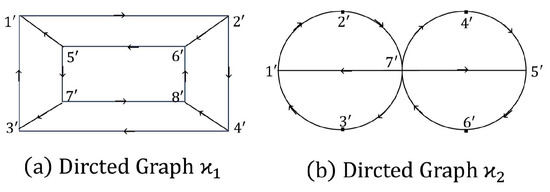
The directed graph has the vertices , , and , which satisfy the property in Figure 1a. As such, the sub-basis is given by where
Note that is a discrete topology on . Also note that, in Figure 1b, only . The sub-basis is given by
where
Figure 1.
The out mondirected topology on and .
Let be any directed graph. It is clear that if is an isolated vertex then the set is an open set in the out mondirected topological space . Also, if is an isolated directed edge, then the sets and are open sets. Furthermore, if we isolate the path P in ℵ of length two of the form or , then the sets , , and are also open sets.
In a complete bipartite directed graph with , all of the directed paths are of length one. As such, the out mondirected topological space will be a discrete space.
Proposition 1.
The out mondirected topological space of a complete bipartite directed graph is a discrete space.
Proof.
Let and . Since , then or . Suppose that . Let be any vertex. By the definition of , there are two directed edges: and . Hence, any monophonic directed path between x and y will be of length one. As such, . Let be any vertex. Then, any monophonic directed path of x and y has the length two. Since for all , and for all , , then , that is, for all . Similarly, for all , that is, the out mondirected topological space of the complete bipartite directed graph is a discrete space. □
Note that, in a directed graph with , for any , there are two directed edges and , that is, any monophonic directed path between x and y and also for all , will be of length one. In this case, we also obtained for all , that is, the out mondirected topological space of the complete directed graph is a discrete space.
To obtain the out mondirected topological space in a cycle directed graph with , there is no need to determine the monophonic directed paths and their lengths since for all , that is, for all , and the out mondirected topological space of the complete directed graph is a discrete space.
The following theorem shows an Alexandroff topological property of the out mondirected topological spaces in locally finite simple directed graphs. By LS-directed graph, we mean a locally finite simple directed graph.
Theorem 1.
The out mondirected topological space in any LS-directed graph is an Alexandroff space.
Proof.
Let be a LS-directed graph and C be any nonempty subset of . Let be the collection of all the m-negative closed neighborhoods of the elements of C. We will prove that is an open set in . Let , then for all . Hence, for all , that is, . Since ℵ is locally finite, then is finite and so is C finite. Hence, is an open set, that is, the out mondirected topological space is an Alexandroff space. □
In any LS-directed graph , through using an Alexandroff topological property of the out mondirected topological spaces , the smallest open set including is denoted by . As we have mentioned previously, if is an isolated vertex, then , and if is an isolated directed edge, then and . Also, if we have the isolated path P in ℵ of length two of the form or , then , and .
Theorem 2.
Let be any LS-directed graph and Then, is the intersection of all m-negative closed neighborhoods including x.
Proof.
From the definition of the sub-basis , is an open set in the out mondirected topological space for all . From an Alexandroff topological property of the out mondirected topological spaces in Theorem 1, is an open set. If , then we can easily obtain . Hence, is an open set including x. Since is the smallest open set including x, then On the other hand, since is the intersection of all open sets including x, then let for some subsets F of . Then, for all , and this implies for all , that is, . Hence, As such, , that is, is the intersection of all m-negative closed neighborhoods, including x. □
Theorem 3.
Let be any LS-directed graph and be any two vertices. Then, if and only if .
Proof.
Let be any two vertices and . By the Theorem above, . Since , then . Hence, . On the other hand, let . Through using Theorem above, we can obtain . Then, , that is, for all . This implies for all . Hence, . □
Theorem 4.
Let be any LS-directed graph. Then, for all , and if and only if the out mondirected topological space is a discrete.
Proof.
Let x be any vertex in . It is clear that . Suppose that is any vertex. If , then, by Theorem 3, , and this is a contradiction with the hypothesis. Hence, for all , that is, is a discrete. On the other hand, it is clear that for all . □
Let be any LS-directed graph and . Recall [19], where the closure set of H was defined as the intersection of all the closed sets including H in the out mondirected topological space and is denoted by . Recall [19], where if and only if for every open set O including x, .
Proposition 2.
Let be any LS-directed graph and . Then, for all .
Proof.
Let . Then, for every open set O including , . Since for all , then for all , that is, for all . Hence, for all . □
It is clear from the proposition above for any LS-directed graph and for any vertex , for all .
Remark 1.
For any simple graph and , if and only if .
3. Graphical Isomorphisms
Let and be the two SL-directed graphs without isolated vertices. If there is a bijective function such that if and only if for all , then we say that the two graphs and are isomorphic and we write . The function of a topological space into a topological space is called continuous if for all . A function is called a closed function if is a closed set in for all closed sets . A function is called a homeomorphism if it is bijective, closed function and continuous function [19].
Theorem 5.
Let and be two LS-directed graphs. A function is continuous in the out mondirected topological spaces in if and only if implies for all .
Proof.
Suppose that for all , implies . Let G be any subset of and . If , then for some . Hence, . By the hypothesis, we obtain . This implies Hence, is continuous. On the other hand, let be continuous and be any two vertices such that . By Remark 1, we obtain , and, by the continuity of , we have
Again, by Remark 1, we obtain . □
Theorem 6.
Let and be two LS-directed graphs. If a function is onto and for all , where implies , then the function χ is a closed function.
Proof.
Let G be any closed set in . Since is onto it, then there is a function such that . Now, we prove that is continuous. Let be arbitrary vertices such that . Hence, . By the hypothesis, we obtain . By Theorem 5, is continuous. Hence, is a closed set and so is a closed function. □
Theorem 7.
Let and be two LS-directed graphs. If a function is a closed function and one to one, then for all , implies .
Proof.
Let be any two vertices such that . Since is one to one, then there is a function such that . Since is one to one and a closed function, then it is clear to see that is continuous. This implies that , that is, . □
Remark 2.
It is easy, via the previous theorems, to obtain a bijective function of the two LS-directed graphs and , which are a homeomorphism if and only if, for all , if and only if .
As we mentioned previously, the out mondirected topological spaces and of a cycle directed graph and a complete directed graph , respectively, are discrete spaces. Since , then and are homeomorphic, while the graphs and are not isomorphic. The following theorem shows that the isomorphic relation of LS-directed graphs without isolated vertices gives us the homeomorphic property of their out mondirected topological spaces.
Theorem 8.
Let and be two LS-directed graphs without isolated vertices. If , then there is a homeomorphism between two out mondirected topological spaces and .
Proof.
Let be a bijective function such that if and only if for all . Let such that y is an m-negative vertex of x. Then, there is an m-negative path
with and for some . By the isomorphic relation of and , we obtain
with and for some , that is, is an m-negative path from a vertex into a vertex . Hence, is an m-negative vertex of . Thus, for all , if and only if . Then, by Remark 2, is a homeomorphism of the out mondirected topological spaces into . □
4. On Some Fundamental Properties
For the compactness property of the out mondirected topological space of any SL-directed graph , it is clear that is a compact space if is finite. The converse of this fact need not be true.
Example 2.
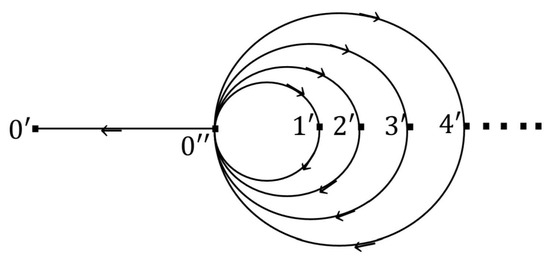
In Figure 2, the SL-directed graph with the infinite vertex set has the sub-basis , which is given by , where for all and . The out mondirected topology of a graph ℵ is given by
Figure 2.
The compactness property.
The out mondirected topological space is a compact space, while is an infinite set.
The following theorems discuss the connectedness property in the class of the SL-directed graphs and their out mondirected topological spaces.
Theorem 9.
Let be any LS-directed graph. If is a connected space and ℵ does not have isolated vertices, then ℵ is a weakly connected graph.
Proof.
Let not be a weakly connected LS-directed graph. Then, the corresponding undirected graph is disconnected. Consider the family of all components in , where for all . Now, for all , , then is a proper nonempty open subset of , where . Then, is also a proper nonempty open subset of , that is, is not a connected space and this contradicts the connectedness of . Hence, ℵ is a weakly connected graph. □
The converse of the theorem above need not be true, the out mondirected topological space of a cycle directed graph is a discrete space and so is a disconnected space, while is weakly connected. Also, the cycle directed graph is a connected graph while the out mondirected topological space is disconnected. The complete directed graph is a strongly connected graph while the out mondirected topological space is disconnected.
Let be any LS-directed graph. Define by the subset of , including all vertices x where , that is, . An LS-directed graph is called a -connected graph if the subgraph of ℵ, which is induced by , is weakly connected. The out mondirected topological space is called a -discrete if the relative topology is a discrete topology on a set . The cycle directed graph with is an -connected graph since , and the out mondirected topological space is -discrete. The complete directed graph with is an -connected graph since , and the out mondirected topological space is -discrete. The complete bipartite directed graph with is not a -connected graph since , and the subgraph induced by is not weakly connected, while the out mondirected topological space is -discrete. The complete bipartite directed graph with is a -connected graph since . Also, the out mondirected topological space is -discrete. In Figure 2, the set of the graph is given by . The subgraph is not weakly connected while the out mondirected topological space is not -discrete.
Recall [19], where, in a topological space , a subset G is called dense in X if , that is, if for all open sets H. It is clear that Amiri et al. [1] introduced the graphic topological spaces in the undirected graph theory and proved that the graphic topological space of any locally finite graph ℵ is an Alexandroff space. As such, here in this paper, for SL-directed graphs , we studied the graphic topological space in the following theorems of the corresponding undirected graph . As such, for any , denotes the smallest open set, including a.
Theorem 10.
Let be a -connected graph. Then, the set of all vertices in with degrees greater than one is dense in .
Proof.
Let . Since is the smallest open set including x, then, to prove that for all open sets O in , it will prove that for all . Let . Since x is not isolated, then there is such that . Hence, . Thus, , that is, there exists some such that . Then, , that is, for all . Hence, is dense in . □
Theorem 11.
Let be a -connected graph, γ the family of the smallest open sets of all vertices in and the family of all minimal sets in γ. If is minimally dense in , then there is a function such that for all .
Proof.
By the form of , the intersection of every pair of the distinct elements of is an empty set. Since in , then there are some for all . Since and , then , and it is clear that , that is, . If , then, similarly, we obtain . Hence, . Then, and this contradiction. As such, . Hence, we define a function of into by sending into the single element of . Now, we will prove that is on. If we let , then we prove that such that . If , then there is such that is a proper subset of . Then, . As such, we obtain and this contradiction. Hence, such that . □
Theorem 12.
Let be a -connected graph, γ the collection of the smallest open sets of all the vertices in and the collection of all the minimal sets in γ. If is a function such that for all , then is a minimal dense in .
Proof.
Note that for all there is such that and . Hence, we obtain , that is, is dense in . To prove that is minimally dense in , let and . Suppose that such that . Then, there is such that and . Since and , that is, . Then, we have and so , and this is a contradiction, that is, . □
Theorem 13.
-connectedness is an isomorphic property in the class of LS-directed graphs without isolated vertices.
Proof.
Let and be two LS-directed graphs without isolated vertices. Let be -connected, and let . We will prove that is -connected. Since , then there is a bijective function such that if and only if for all . Let such that b is an m-negative vertex of a. Then, by the proof of Theorem 8, is an m-negative vertex of . Hence, if and only if for all . Now, suppose that is not -connected. Then, there are at least two vertices such that there is no path between them in . Since is bijective, then there are such that and . Since , then . Since and are not joining by the path in , then a and b are also not joining by the path in . Hence, is not weakly connected, that is, is not -connected and is a contradiction. Therefore, is -connected. □
Theorem 14.
-discrete is a topological property in class of the LS-directed graphs without isolated vertices.
Proof.
Let and be two LS-directed graphs without isolated vertices. Let be -discrete, and let there be a homeomorphism . We will prove that is -discrete. Let be arbitrary. Since is bijective, then there is such that . Since is -discrete, then is an open set in a relative topological space . Since is an open function and bijective, then is an open set in a relative topological space , that is is -discrete. □
5. On the Nervous System of the Human Body
Recall [18], where it was shown that the nervous system involves a complex network of nerves, the spinal cord and the brain. This system plays important role in sending messages back and forth between the body and the brain. We know that all the body’s functions are controlled by the brain. From the brain down through the back runs the spinal cord, which includes threadlike nerves that branch out to every body part. This network of nerves sends messages back and forth from the brain to different body parts (see Figure 3). In this section, we show the -connectedness and -discrete properties of the corresponding graphs for the diagrams of networks in the nervous system of the human body, such as diagrams of the sensory neuron cells [17] and models of two distinct nicotinic receptor types based on the second messenger signal [18].
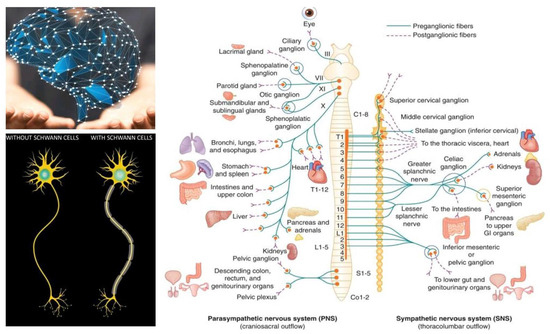
Figure 3.
Diagram of the nervous system and nero cells.
Firstly, we studied the above diagram, which presents the vestibular sensory and somatosensory pathways with their integration into the brain and spinal cord, as shown in Figure 4a [17]. Note that the graph in Figure 4b is an LS-directed graph and approximates the vestibular sensory and somatosensory pathways with their integration into the brain and spinal cord, which has the vertices set
which has 19 vertices. The graph ℵ is connected but not a -connected graph since the subgraph is not weakly connected with the vertex set . The out mondirected topological space of ℵ has the sub-basis with the m-negative open neighborhoods
for all The smallest openings of all the vertices were singles except , and . As such, the out mondirected topological space of ℵ was not discrete nor -discrete, and it was disconnected by two disjoint open sets and .
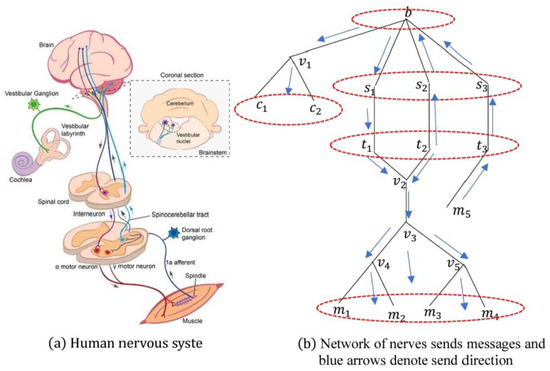
Figure 4.
The somatosensory and vestibular sensory pathways.
For a more special study, we will show the previous properties of the corresponding graph of the diagram that presents the sensory neurons in the nervous system of a human body. Recall [17], where it was shown that neurons are the cells that make up the nervous system and the brain. They are the main units that send and receive signals, which allow us to feel the external world, move our muscles, form memories, think, and much more. The sensory neuron is a nerve cell that is activated by sensory input from the environment and has four forms, which are multipolar, pseudounipolar, bipolar, and unipolar, as presented in Figure 5a. For the multipolar sensory neuron cell, the graph in Figure 5b is a LS-directed graph and presents the multipolar sensory neuron cell with the vertex set
which has 23 vertices. The graph is a connected and not -connected graph since the subgraph is not weakly connected with the vertex set . The out mondirected topological space of has the sub-basis with the m-negative open neighborhoods
for all , and The smallest openings of all the vertices were singles except for all . As such, the out mondirected topological space of is not discrete nor -discrete, and it is disconnected by two disjoint open sets, such as, for example, and . The study of the pseudounipolar sensory neuron cell was conducted in a similar fashion to the study of the multipolar sensory neuron cell. For the bipolar sensory neuron cell, the graph shown in Figure 6a, which is an LS-directed graph, was constructed, and it presents the multipolar sensory neuron cell with the vertex set , which has 10 vertices. The graph is a connected and -connected graph since the subgraph is weakly connected with the vertex set . The out mondirected topological space of has the sub-basis with the single m-negative open neighborhoods of all the vertices; as such, the smallest opening of all the vertices were singles. The out mondirected topological space of is discrete and -discrete, and so it is disconnected space. For the unipolar sensory neuron cell, the graph shown in Figure 6b, which is an LS-directed graph, was constructed, and it presents the unipolar sensory neuron cell with the vertex set , which has 10 vertices. The graph is a connected but not -connected graph since the subgraph is not weakly connected with the vertex set . The out mondirected topological space of has the sub-basis with the m-negative open neighborhoods
and for all . The smallest openings of all the vertices were singles except and . As such, the out mondirected topological space of is not discrete nor -discrete, and it is disconnected by two disjoint open sets, such as, for example, and .
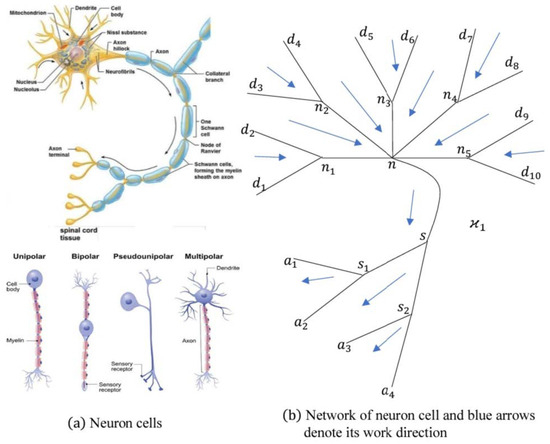
Figure 5.
The sensory neuron cells: multipolar and pseudounipolar.
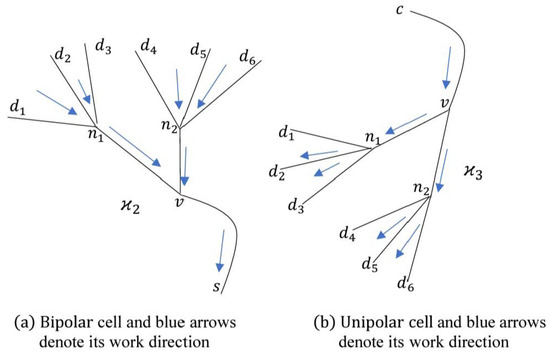
Figure 6.
The sensory neuron cells: bipolar and unipolar.
Finally, we showed the connectedness, -connectedness and -discrete properties of the corresponding graphs for the diagrams of two models of two distinct nicotinic receptor types based on the second messenger signal, classification of cholinergic receptors and the classification of adrenergic receptors, which are introduced by [18]. For the model of the classification of cholinergic receptors, as shown in Figure 7a, the corresponding graph is connected with the vertex set
which has 16 vertices and is shown in Figure 7b. Additionally, it is not a -connected graph since the subgraph is not weakly connected with the vertex set . The out mondirected topological space of has the sub-basis with the m-negative open neighborhoods
and for all , The smallest openings of all the vertices are singles except and . As such, the out mondirected topological space of is not discrete nor -discrete, and it is disconnected by two disjoint open sets and . For the model of the classification of adrenergic receptors shown in Figure 8a, a corresponding graph was connected, as shown in Figure 8b, with the vertex set
which has 19 vertices and is not a -connected graph since the subgraph is not weakly connected with the vertex set . The smallest openings of all the vertices are singles except , , , and . As such, the out mondirected topological space of is not discrete nor -discrete, and it is disconnected by two disjoint open sets and .
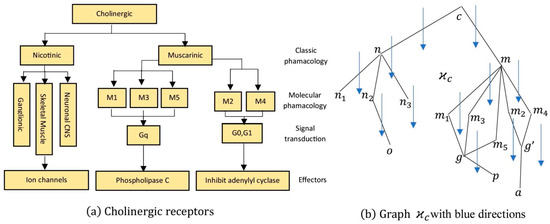
Figure 7.
The classification of cholinergic receptors with their networks.
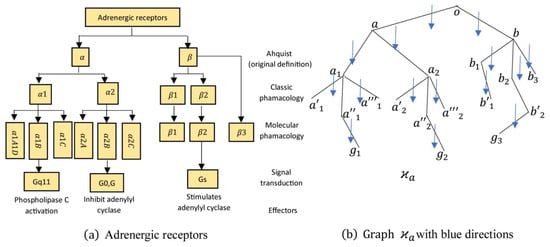
Figure 8.
The classification of adrenergic receptors with their networks.
6. Conclusions
As we know that monophonic paths are special cases when it comes to paths, this special case was used to define the notion of the m-negative paths, which we were able to, in this work, construct, i.e., the notion of out mondirected topological space in the theory of directed graphs. We showed the relationship between the graphic isomorphic relation for the directed simple graphs and the homeomorphic property of the out mondirected topologies. Next, we used this relationship together with the connectedness and discrete properties to introduce the notions of -connectedness and -discrete. In using the last properties, we showed the connectedness and discreteness in the representation theory of the diagrams, such as diagrams of sensory neuron cells, of the networks introduced in [17] for the nervous system of the human body. Furthermore, the connectedness and discrete properties of the models of the two distinct nicotinic receptor types based on the second messenger signal [18], the classification of cholinergic receptors and classification of adrenergic receptors were studied. For future research, we suggest constructing a neighborhood system using monophonic eccentric vertices to study the connectedness and discrete properties in the representation theory of diagrams of the sensory neuron cells in the human body.
Author Contributions
Conceptualization, F.H.D. and A.S.; Methodology, F.H.D., A.K. and A.S.; Validation, F.H.D., A.S., A.K. and M.B.M.; Investigation, F.H.D., A.S. and A.K.; Resources, F.H.D., A.K., E.E.A. and M.B.M.; Writing—original draft, A.S., A.K., E.E.A. and M.B.M.; Writing—review & editing, A.K. and E.E.A. All authors have read and agreed to the published version of the manuscript.
Funding
This research was funded by the Deanship of Scientific Research at the University of Ha’il—Saudi Arabia through project number RG-24 104.
Data Availability Statement
The original contributions presented in this study are included in the article. Further inquiries can be directed to the corresponding author.
Conflicts of Interest
The authors declare no conflicts of interest.
References
- Jafarian, A.S.; Jafarzadeh, A.; Khatibzadeh, H. An Alexandroff topology on graphs. Bull. Iran. Math. Soc. 2013, 39, 647–662. [Google Scholar]
- Nada, S.; El Atik, A.E.F.; Atef, M. New types of topological structures via graphs. Math. Method Appl. Sci. 2018, 41, 5801–5810. [Google Scholar] [CrossRef]
- Kiliçman, A.; Abdu, K.A. Topological spaces associated with simple graphs. J. Math. Anal. 2018, 9, 44–52. [Google Scholar]
- Abdu, K.A.; Kiliçman, A. Topologies on the edges set of directed graphs. Int. J. Math. Anal. 2018, 12, 71–84. [Google Scholar] [CrossRef]
- Gamorez, A.; Canoy, S. Topologies induced by neighbourhoods of a graph under some binary operations. Eur. J. Pure Appl. Math. 2019, 12, 749–755. [Google Scholar] [CrossRef]
- Nianga, C.G.; Canoy, S. On topologies induced by graphs under some unary and binary operations. Eur. J. Pure Appl. Math. 2019, 12, 499–505. [Google Scholar] [CrossRef]
- Nianga, C.G.; Canoy, S. On a finite topological space induced by Hop neighbourhoods of a graph. Adv. Appl. Dis. Math. 2019, 21, 79–89. [Google Scholar]
- Sari, H.K.; Kopuzlu, A. On topological spaces generated by simple undirected graphs. AIMS Math. 2020, 5, 5541–5550. [Google Scholar] [CrossRef]
- Zomam, H.O.; Othman, H.A.; Dammak, M. Alexandroff spaces and graphic topology. Adv. Math. Sci. J. 2021, 10, 2653–2662. [Google Scholar] [CrossRef]
- Anabel, E.G.; Sergio, R.C. On a topological space generated by Monophonic eccentric neighbourhoods of a graph. Eur. J. Pure App. Math. 2021, 14, 695–705. [Google Scholar]
- Chiaselotti, G.; Ciucci, D.; Gentile, T.; Infusino, F. Rough set theory and digraphs. Fund. Inform. 2017, 153, 291–325. [Google Scholar] [CrossRef]
- Othman, A.; Ayache, A.; Saif, A. On L2-directed topological spaces in directed graphs theory. Filomat 2023, 37, 10005–10013. [Google Scholar] [CrossRef]
- Othman, A.; Al-Shamiri, M.; Saif, A.; Acharjee, S.; Lamoudan, T.; Ismail, R. Pathless directed topology in connection to the circulation of blood in the heart of human body. AIMS Math. 2022, 7, 18158–18172. [Google Scholar] [CrossRef]
- Abu-Gdairi, R.; El-Atik, A.A.; El-Bably, M.K. Topological visualization and graph analysis of rough sets via neighborhoods: A medical application using human heart data. AIMS Math. 2023, 8, 26945–26967. [Google Scholar] [CrossRef]
- El Atik, A.E.; Nawar, A.; Atef, M. Rough approximation models via graphs based on neighborhood systems. Granul. Comput. 2021, 6, 1025–1035. [Google Scholar] [CrossRef] [PubMed]
- Shokry, M.; Aly, R.E. Topological properties on graph vs medical application in human heart. Int. J. Appl. Math. 2013, 15, 1103–1109. [Google Scholar]
- Akay, T.; Murray, A.J. Relative Contribution of Proprioceptive and Vestibular Sensory Systems to Locomotion: Opportunities for Discovery in the Age of Molecular Science. Int. J. Mol. Sci. 2021, 22, 1467. [Google Scholar] [CrossRef] [PubMed]
- Johnson, J.O. Autonomic Nervous System Physiology; University of New Mexico: Albuquerque, NM, USA, 2016. [Google Scholar]
- Dugundji, J. Topology; Allyn and Bacon, Inc.: Boston, MA, USA, 1966. [Google Scholar]
Disclaimer/Publisher’s Note: The statements, opinions and data contained in all publications are solely those of the individual author(s) and contributor(s) and not of MDPI and/or the editor(s). MDPI and/or the editor(s) disclaim responsibility for any injury to people or property resulting from any ideas, methods, instructions or products referred to in the content. |
© 2024 by the authors. Licensee MDPI, Basel, Switzerland. This article is an open access article distributed under the terms and conditions of the Creative Commons Attribution (CC BY) license (https://creativecommons.org/licenses/by/4.0/).