Abstract
In this research article, we define some categories of open sets over a generalized topological space given together with a primal collection. In addition, we clarify some of its characteristics and investigate the relationships between these concepts in the space under consideration. The topic of continuity occupies a large space in topological theory and is one of the most important topics therein. Researchers have examined it in light of many variables. We followed the same approach by studying the concept of continuity between two generalized topological spaces in light of the primal collection under the name
-continuity. We also made a decomposition of this type of function in light of these weak categories of open sets.
Keywords:
generalized topological space; primal topology; MSC:
54A05; 54A10
1. Introduction
In the field of topology, accurate solutions to many issues cannot be found. For example, proximity space, compactifications, and closure space problems. This has led topologists to provide some tools such as nets, ideals, filters, and grills.
Recently, primal set theory has attracted significant attention from researchers. One of the most important properties under study is the qualitative behavior of the operators that are defined via the primal set.
The above-mentioned tools were employed very well in this regard. Topologists provided associated topological spaces, which were considered triple variables with different behaviors. The primal generalized topological space was studied based on these ideas and methodologies.
In another investigation, topologists introduced different forms of open sets with slightly different features. This kind of work has been on the rise among scientific production in the field of topology. The corresponding concepts of topological theory are affected by this methodology of research. The matter of continuity receives a lot of attention within this approach. This idea has given rise to several decompositions of continuous functions.
Our article contains five sections. This section contains two subsections: first, we provide a literature review connected to this study; second is a brief introduction to the basic definitions, characteristics, and theorems. Section 2 describes the methods that were used in this study. Section 3 contains the main results that appear during the two parts. We provide the definitions of some classes of open sets over a generalized primal topological space. In addition, we present a deep discussion of their properties. We provide a detailed answer to the question: “Are the properties of these classes that are applied in a topological space applicable in a generalized primal topological space too?” In addition, we will present new results and study the relationship among them.
In Section 4, we introduce a new kind of continuity within this new structure, which is named -continuity, then use the new categories that are given in Section 3 to find some kind of -continuity function. Later, we study the relationship among these categories and establish a decomposition of this type of continuity. Section 5 is a brief discussion of the important findings that came out during the study.
1.1. Literature Review
From the previous literature, we realized that the idea of “semi-open sets” appeared around 1963, when Levine [1] introduced this notion over a topological space as follows: is deemed semi-open when where indicates the interior of while indicates the closure of Note that is semi-open; hence, E is named semi-closed. This concept has garnered significant attention from researchers because of its important applications in topology theory (see [2,3,4]).
Moreover, other structures have been defined. For example, is named pre-open [5] (respectively, regular open [5], -open [6], -open [7], b-open [8]) when (respectively,
Császár [9] established the concept of “generalized” in 1997, defining it as a collection that satisfied the following two requirements: (i) ; and (ii) for all we have where and is a family of the power set . The collection is considered a generalized topological space. Some research has studied the previous types of weak open sets in a generalized topology (see [10,11]).
According to [12], each member belonging to this space is named a -open set, as well as -closed, which symbolizes its complements. In addition, symbolizes the entire set of -closed sets, while and symbolize the closure and interior of E, respectively, which are described as in the general situation.
Moreover, as per the results of [13], we have , and . In addition, if thus E is considered as -open, and if then E is considered as -closed and This space required a lot of intention, study, and research (see [14,15,16,17,18]).
On the other hand, some classical structures appeared. “Filter” [19], “ideal” [20], and the well-known structure “grill” [21] were introduced as useful tools for learning topological concepts with numerous significant uses in general topology. The associated topology of a grill has been described and examined in [22]. This space has received significant attention from researchers. Some operators with good properties were defined and investigated (see [23,24,25]).
In 2022, Acharjee [26] proposed the dual structure of a grill; it was given the name “primal.” A collection of is known as primal on whenever the following conditions are true (i) ; and (ii) if with then (iii) If then or A topological space with a primal collection given on is named a primal topological space and denoted by The primal topology has been rigorously studied, and its properties have been investigated (see [26,27,28]).
In 2023, a new category of generalized topology was presented via the concept of the primal by Al-Saadi and Al-Malki [29], whose structure was named a generalized primal topological space. Moreover, some properties were studied, and some theories and results were mentioned.
1.2. Space
Throughout this section, we will recall the fundamental definitions and results about spaces, which are presented in [29].
Definition 1.
The symbol references a generalized primal topological space ( space), which is a generalized topological space together with a primal set over
Remark 1.
-open sets is the symbol for the element of this space, and -closed sets denotes their complement.
The entire set of -closed symbols is referred to as In addition, denotes the closure of
Definition 2.
Suppose that is a space. Define an operator and we have
Remark 2.
ψ is named as a generalized primal neighbourhood system over a space The entire set of a generalized primal neighbourhood system over is symbolized via
Definition 3.
Suppose that is a space. Let Define an operator Hence, an element belongs to iff for all
Theorem 1.
Suppose that is a space. Let Thus, when is -open.
Theorem 2.
Suppose that is a space. Let Hence, the following is always true:
- (i)
- (ii)
- is -closed,
- (iii)
- (iv)
- whenever
- (v)
- (vi)
Theorem 3.
Suppose that is a space. Let , and is a primal over Hence, for every -open set we have
Lemma 1.
Suppose that is a space. Let Thus, when is not a primal.
Theorem 4.
Suppose that is a space. Let Hence,
Corollary 1.
Suppose that is a space. Let , and is not a primal. Hence,
Definition 4.
Suppose that is a space. Let Define an operator given by
Remark 3.
The next result states that the operator is formalized as a Kuratowski’s closure operator.
Theorem 5.
Suppose is a space. The following holds for :
- (i)
- (ii)
- (iii)
- (iv)
- whenever
- (v)
Theorem 6.
Suppose that is a space. Let Thus, whenever E is -open.
2. Methodology
In this part, we introduce the methodologies used. To investigate our aims, we followed the traditional strategies in math. This study is based on projecting one of the important tools in topology, which is called a “primal collection”, into the field of “generalized topology.” This methodology led to the definition of a more general space with different characteristics. Then, we explored all the facts and features to satisfy our aims. We begin with the basic definitions, properties, and theorems of both fields. The operator can be considered a pivotal tool in the study, which led to many different results. Therefore, we used it to define some kinds of weak open sets. Consequentially, we proceed to the proper application of these new general weak open sets. The relationships among all concepts are drawn in two simple graphs for the reader.
3. Main Results
This part of the article provides the primary findings, given in two subsections. The first one presents some classes of -open sets and examines their fundamental characteristics and relationships. The second subsection is more in-depth and complicated because it presents more classes of -open sets depending on the first four concepts. Therefore, a lot of complex results that are connected to the notions appear together.
3.1. Some Classes of -Open Sets
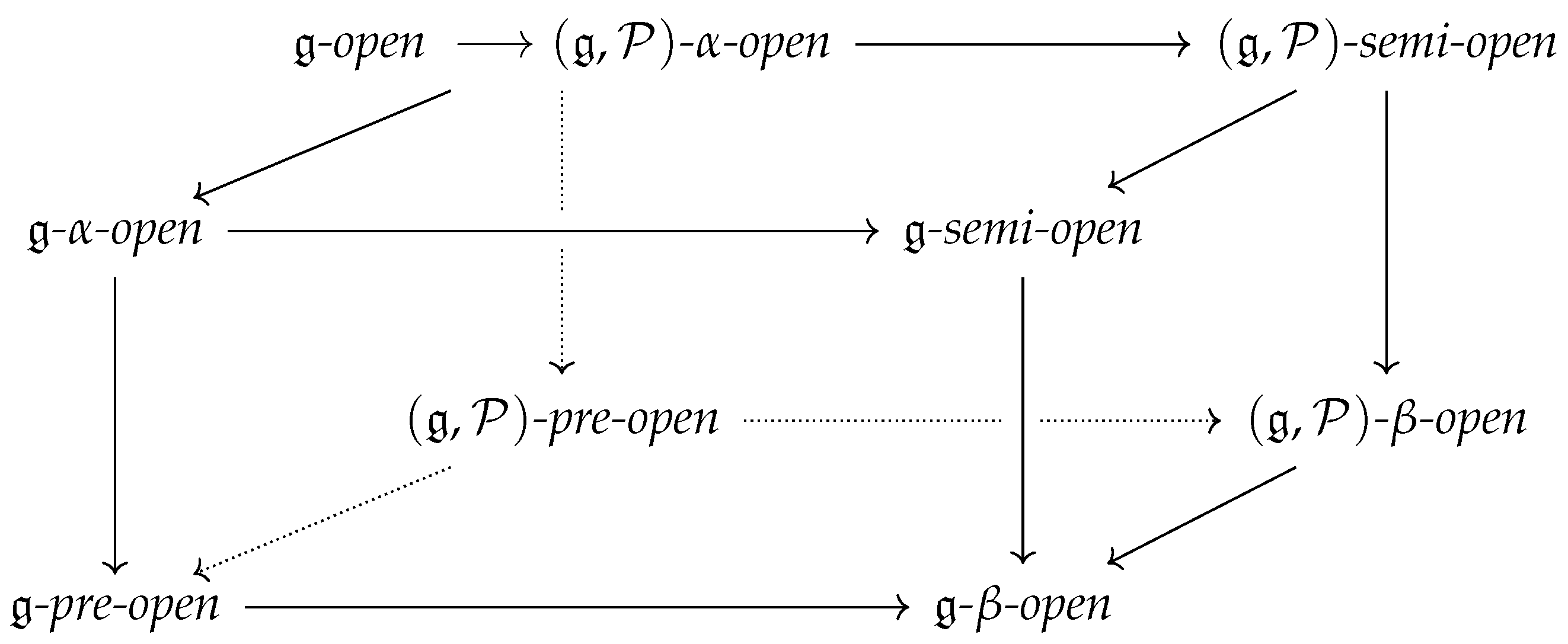
This part of the section is focused on four types of weak -open sets, given the definitions of them in light of a new operator Moreover, we study the relationships between them by giving proofs or inducing counterexamples. Finally, we present a diagram of these results.
Definition 5.
Suppose that is a space. Take Thus,
- (i)
- When E is named a -semi-open set.
- (ii)
- When E is named a -pre-open set.
- (iii)
- When E is named a -regular open set.
- (iv)
- When E is named a -β-open set.
- (v)
- When E is named a -α-open set.
The whole set of -semi-open sets is symbolized by while the whole set of -pre-open sets is symbolized by Moreover, the whole set of --open sets is symbolized by while is the symbolization of all --open sets.
Example 1.
Suppose that is a space, where , and . Consider Thus, E is -β-open.
Example 2.
Suppose that is a space, where , and . Consider Thus, E is -semi-open.
Example 3.
Suppose that is a space, where , and . Consider Thus, E is -pre-open.
Definition 6.
Suppose that is a space. Take When is a -semi-open (respectively, -pre-open, - regular open, -α-open, -β-open), thus E is named a -semi-closed (respectively, -pre-closed, - regular closed, -α-closed, -β-closed).
Theorem 7.
Suppose that is a space. Then, the following holds:
- (i)
- Each -semi-open set is -semi-open.
- (ii)
- Each -α-open set is -α-open.
- (iii)
- Each -β-open set is -β-open.
- (iv)
- Each -pre-open set is -pre-open.
Proof.
(i) Consider E as -semi-open. Thus,
from Theorem 2 (ii). Hence, implies Therefore, E is -semi-open.
In a similar manner, we can also prove the rest of the statements. □
Theorem 8.
Suppose that is a space with Thus, the following holds:
- (i)
- E forms a -α-open set iff E is -semi-open as well as -pre-open.
- (ii)
- Considering E as -semi-open, E is -β-open.
- (iii)
- Considering E as -pre-open, E is -β-open.
Proof.
(i) Consider E as --open. Therefore, E is contained in Since is contained in This implies,
which is contained in Therefore, E is -pre-open. In addition,
This means that E is contained in
Conversely, whenever E is -semi-open and -pre-open, , which is contained in
Therefore,
(ii) Consider E as -semi-open. Thus, from Theorem 7 (i). However, ; thus, Therefore, we are done.
(iii) Consider E as -pre-open. Thus,
which proves the claim. □
Corollary 2.
Suppose that is a space. Thus, the following holds:
- (i)
- (ii)
- (iii)
Proposition 1.
Suppose that is a space. Hence, for all , the following statements are equivalent:
- (i)
- E is -regular open;
- (ii)
- E is -semi-closed as well as -open;
- (iii)
- E is -pre-open as well as -semi-closed;
- (iv)
- E is -α-open as well as -β-closed;
- (v)
- E is -α-open as well as -semi-closed;
- (vi)
- E is -open as well as -β-closed.
Proof.
From this, the proof comes automatically. □
Remark 4.
Based on the previous results, a conclusion is drawn as follows:
Remark 5.
The next examples illustrate that the opposite direction of the relationship in Figure 1 is not always satisfied.
Figure 1.
Relationships between the -open set and other types of open sets in space.
Example 4.
In Example 1, we note that:
- (i)
- E is -semi-open, where However, E is not -semi-open, where
- (ii)
- E is -β-open, where However, E is not -semi-open.
- (iii)
- E is -β-open. However, E is not -pre-open, where .
Example 5.
In Example 2, E is -semi-open, where However, E is not -α-open.
Example 6.
In Example 3, E is -pre-open, where However, E is not -α-open.
Proposition 2.
Suppose that is a space. Thus, the following holds:
- (i)
- The countable union of -semi-open sets is -semi-open.
- (ii)
- The countable union of -pre-open sets is -pre-open.
- (iii)
- The countable union of -α-open sets is -α-open.
- (iv)
- The countable union of -β-open sets is -β-open.
Proof.
(i) Consider as a collection of -semi-open sets. Thus, Hence,
Therefore, is -semi-open.
In the same way, we can prove (ii), (iii), and (iv). □
Corollary 3.
Suppose that is a space. All of the collections and β form generalized primal topological spaces with a primal set over
3.2. Regular -Semi-Open and -Dense
Throughout this section, we will give definitions of other types of weak -open sets and explain some of the properties and relationships of the previous notions. In addition, we give a comparison between the properties that satisfy in topological spaces but not in the case of spaces.
Definition 7.
Suppose that is a space, with If there is -regular open set F satisfying then E is called regular -semi-open.
Proposition 3.
Suppose that is a space, with Thus, the following are equivalent:
- (i)
- E is regular -semi-open;
- (ii)
- E is -semi-open as well as -semi-closed;
- (iii)
- E is -β-open as well as -semi-closed;
- (iv)
- E is -semi-open as well as -β-closed.
Proof.
The claim was proven directly from Proposition 1. □
Remark 6.
By using Proposition 3, we can note that whenever E is regular -semi-open, is regular -semi-open as well.
Definition 8.
Suppose that is a space. Let If . Thus, E is named a -dense set.
Moreover, E is named -dense whenever is -dense or
Remark 7.
In a space, the -dense sets need not be -pre-open sets, unlike in topological spaces. The next example shows that.
Example 7.
Suppose that is a space, where , and
Hence, we have and
Therefore, E is -dense, which means it is not a -pre-open set.
Lemma 2.
Suppose that is a space. Take When F is -open,
Proof.
Consider F as -open. Thus,
This implies
Via Theorem 6, we get
Therefore, □
Theorem 9.
Suppose that is a space. For the following holds.
- (i)
- E is -semi-open.
- (ii)
- E is -semi-open ⟺ ∃ a -open set F satisfying
- (iii)
- For Hence, G is -semi-open whenever E is -semi-open.
- (iv)
- Whenever E is -semi-open and F is -open, is -semi-open.
Proof.
(i) Suppose that E is -semi-open. Thus, Hence, From Theorem 5 (iii), we get In addition, is monotonic. Then, contained in E, which implies is contained in
Conversely, let Then, is contained in However, ; hence,
(ii) Suppose that E is -semi-open. Hence, Consider Thus, F is a subset of which is contained in , and F is -open.
Conversely, suppose that for -open set F. Thus, Thus, implies Therefore, E is -semi-open.
(iii) Consider E as -semi-open. By (ii), ∃-open set F satisfying Therefore,
This implies
Therefore, G is -semi-open.
(iv) Consider E as -semi-open and F as -open. Then, Hence, from Lemma 2, we get
Hence, we prove the claim. □
Theorem 10.
Suppose that is a space. Let When E is -semi-closed,
Proof.
The complement of E is -semi-open, whenever E is -semi-closed. Thus, by definition, From Theorem 7 (i), we have
Therefore, □
Remark 8.
(i) It is important to know that the inverse of this theory is not necessarily true; this is explained in detail in the next example.
(ii) With extra conditions, the inverse is always true, as the next result shows.
Example 8.
Suppose that is a space, where , and . Thus, we have Hence, implies However, and Thus, Hence, Therefore, is not -semi-open, and E is not -semi-closed.
Theorem 11.
Suppose that is a space and for Hence, iff E is -semi closed.
Proof.
Consider By this hypothesis, we obtain
Hence, is -semi-open. The other direction is directly from Theorem 10. □
Theorem 12.
Suppose that is a space. The following holds for
- (i)
- Whenever E is a -pre-closed set,
- (ii)
- Whenever E is a -α-closed set,
- (iii)
- Whenever E is a -β-closed set,
Proof.
(i) Since E is -pre-closed, its complement is -pre-open. Hence, by definition, By Theorem 7 (iv), we obtain
Hence,
The proofs of (ii) and (iii) come in the same way. □
Theorem 13.
Suppose that is a space. When E is -pre-open, thus E can be written as the intersection of -dense set and -regular open set.
Proof.
Consider E as -pre-open. Then, Then, E can be represented as
Now, let Let Thus, F is -regular open. In addition, since Hence,
Thus, , which means that G is -dense set. Hence, we are done. □
Corollary 4.
For a space, whenever E is -pre-closed, E is the union of which is a -regular closed set, and for which
Theorem 14.
Suppose that is a space. When E is -semi-open, E can be written as the intersection of a set where is -dense and -regular closed set
Proof.
Consider E as -semi open. Thus, Then, E can be represented as
Now, let and . Thus, G is -regular closed. In addition, since However, , and is -open. This implies
Thus, □
Corollary 5.
In a space, whenever E is -semi-closed, E is the union of which is a -regular open set, and whose closure is in a space
Proposition 4.
Suppose that is a space. For , the following holds:
- (i)
- Whenever and
- (ii)
- Whenever and
- (iii)
- Whenever
Proof.
By using Theorem 8 and Corollary 2, the proof comes directly. □
4. Decomposition of -Continuity
This part of the article provides an important application of the findings in the preceding section. We will give the concept of -continuity, which is based on the -open set. Then, we present some kinds of continuity that are based on the weak -open sets. The relationship between these concepts will be studied and drawn in a simple graph. The study of this combination led to the decomposition of this kind of -continuity.
Definition 9.
Suppose that and are spaces. Suppose that is -open. Define a function Hence, is named -continuous iff is -open.
Definition 10.
Suppose that is a space and is a space. Hence, is named -semi-continuous (respectively, -pre-continuous, -α-continuous, -β-continuous) if every where is -open is - semi-open (respectively, -pre-open, -α-open, -β-open).
Theorem 15.
Consider Thus, the following are equivalent:
- (i)
- is -α-continuous;
- (ii)
- and satisfy and there exists satisfying and
- (iii)
- is -closed and -closed.
Proof.
For every , suppose that with . Since is --continuous, is --open with Let Hence, and
Suppose that where Hence, Thus, by (ii), there exists a --open set such that and Hence,
Thus, Therefore, is --continuous.
The proof of the rest of the equivalents is obvious. □
Theorem 16.
Consider Thus, we have:
- (i)
- is -α-continuous iff is -semi continuous as well as -pre continuous.
- (ii)
- Each -semi-continuous as well as each -pre-continuous set is -β-continuous.
Proof.
It comes automatically from Theorem 8. □
The next theorem is based on the fact, shown in [7], that follows: If is a topological space, then the collection of all -open sets on forms a topology finer than .
Theorem 17.
A function is -α-continuous iff is -continuous.
Proof.
Suppose that is --continuous. By Corollary 3, the collection forms a space finer than Hence, is -continuous.
Conversely, suppose that is -continuous. By Corollary 2 (ii), every -open set is --open. Hence, is --continuous. □
Theorem 18.
Consider Hence, is a -α-continuous iff the graph function given by , is -α-continuous.
Proof.
Let be --continuous. Consider and as open sets in with Thus, there exist and satisfying
However, is a --continuous; thus, there exists a --open set , and From Proposition 4, we determine that is --open. Hence,
Therefore, is --continuous.
Conversely, let be --continuous. Let and be an open set in with Thus, is open in However, is --continuous, thus there exists a --open set satisfying and Thus, Therefore, is --continuous. □
Definition 11.
Consider Thus, is named -irresolute if for all -semi open in we have that is also -semi open in
Remark 9.
By Theorem 7 and Corollary 2, we obtain:
The conclusion in Remark 9 does not always hold; the next examples show that.
Example 9.
Suppose that is a space, where and
Consider given by
Hence, is -semi-continuous.
However, it is not -continuous, since which is not -open.
Example 10.
Suppose that is a space, where and
Consider given by
Hence, is -semi-continuous.
However, it is not -continuous, since which is not -semi-open.
Definition 12.
Consider Hence, is named -semi-open (respectively, -semi-closed) if for any -open set (respectively, -closed set ) in is -semi-open (resp. is -semi-closed) in
Remark 10.
From the above definitions, we conclude that:
- (i)
- Each -open function is -semi-open.
- (ii)
- Each -semi-open (respectively, -semi-closed) function is -semi-open (respectively, -semi-closed).
The converse of Remark 10 is not always true; the next examples show that.
Example 11.
Suppose that is a space, where and
Suppose that is a space, where
Consider Hence, the identity function is -semi-open.
However, it is not -open.
Example 12.
Suppose that is a space, where , and Suppose that is a space, where Consider Hence, the identity function is -semi-open. However, it is not -semi-open, where
Theorem 19.
Consider to be -semi-open function iff and for any generalized neighbourhood of there exists a -semi-open in satisfying
Proof.
Consider as a -semi-open function. Suppose that , and is any generalized neighbourhood of Hence, satisfies However, is -semi-open, thus (say) is a -semi-open set such that
Conversely, let Thus, for any there exists -semi-open set satisfying Hence, By Proposition 2, is a -semi-open set. Therefore, is a -semi-open function. □
Theorem 20.
Consider as a -semi-open function. Whenever and is a closed set satisfying there exists a -semi-open in satisfying and
Proof.
Consider as a -semi-open function. Let and be a closed set satisfying Hence, is -open. Thus, is -semi-open. Thus, is -semi-closed. Hence, implies Therefore, □
Corollary 6.
Consider as a -semi-open function. Whenever and is a closed set satisfying there exists a -semi-closed satisfying and
Based on the last few results, we can present the following theorem:
Theorem 21.
Consider as a bijection. Hence, the following are equivalent:
- (i)
- is -semi-continuous;
- (ii)
- is -semi-open;
- (iii)
- is -semi-closed.
Proof.
It is proven consequentially from these definitions, Theorem 19, and Corollary 6. □
Remark 11.
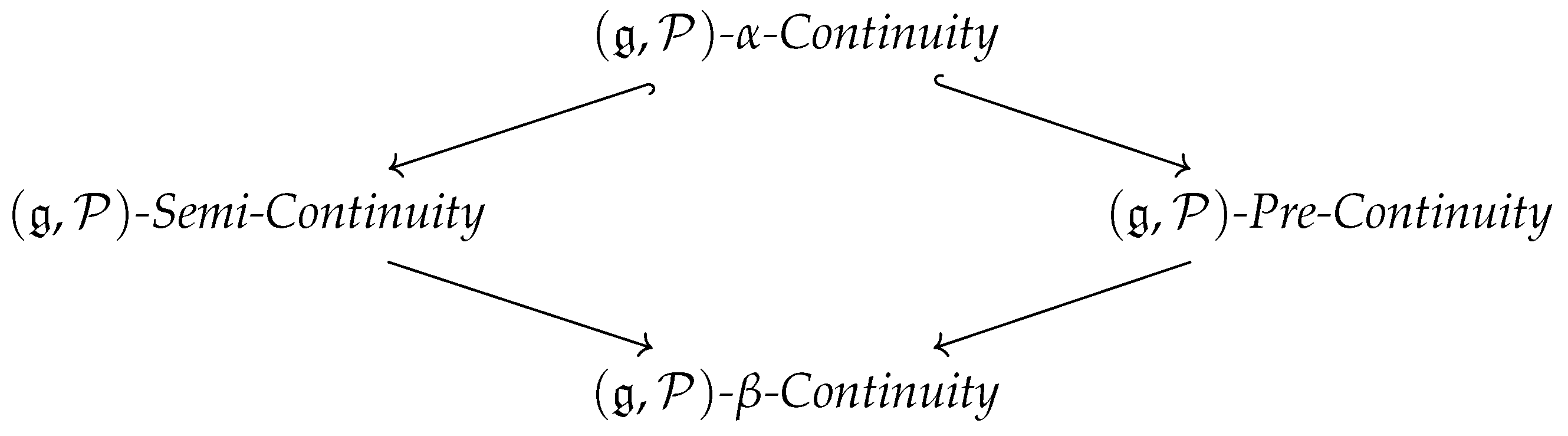
Based on Theorem 16, we obtain:
The following examples illustrate that the opposite direction of the relationship in Figure 2 is not always satisfied.
Figure 2.
The relationship between the previous kinds of -continuity.
Example 13.
Suppose that is a space, where , and Suppose that is a space, where Consider Hence, the identity function is -β-continuous. However, it is not -semi-continuous, since is not -semi-open. In addition, it is not -pre-continuous, since is not -pre-open.
Example 14.
Suppose that is a space, where , and . Suppose that is a space, where and Consider , as given by
Hence, Thus, is -pre-continuous, where However, E is not -α-continuous.
Definition 13.
Suppose that is a space and is a space. A function is named -regular continuous (respectively, regular -semi-continuous) if every where is -open; is -regular open (respectively, regular -semi-open).
Theorem 22.
Thus, the following are equivalent:
- (i)
- is -regular continuous;
- (ii)
- is -pre-continuous as well as -semi-closed;
- (iii)
- is -α-continuous as well as -semi-closed.
Proof.
It is proven consequentially from Proposition 1. □
Corollary 7.
Thus, the following are equivalent:
- (i)
- is regular -semi-continuous;
- (ii)
- is -semi-continuous as well as -semi-closed;
- (iii)
- is -β-continuous as well as -semi-closed.
Proof.
It is proven consequentially from Proposition 3. □
5. Discussion
Al-Saadi and Al-Malki [25] introduced a new space with special characteristics in 2023. Their structure was named a generalized primal topological space.
In this paper, we covered some categories of weak -open sets. First, in Section 3, we gave their definitions via a specific kind of operator. Later, we investigated the relationship among them by giving proofs or counterexamples, then showed the conclusion in a simple diagram. In addition, we discussed their properties and theories.
Moreover, via a study of the relationship between the notion of -dense sets and the notion of -pre-open sets, we provided an answer to the question: “Are the properties of these classes that are applied in a topological space applicable in a generalized primal topological space too?” The results appeared in Remarks 7 and 8 in detail.
In Section 4, the concept of “continuity” was given attention when we presented the definition of -continuity between two spaces. We presented -continuity via the weak -open sets that were introduced in Section 3. Lately, we have performed a decomposition of this type of continuity.
This paper opens the way for many research projects by defining more classes of open sets and finding more relationships between them, as well as studying more topological properties of them, such as continuity, separation axioms, and other topological properties.
Author Contributions
Conceptualization, H.A.-S. and H.A.-M.; methodology, H.A.-S. and H.A.-M.; formal analysis, H.A.-S. and H.A.-M.; writing—original draft, H.A.-S. and H.A.-M.; writing—review and editing, H.A.-S. and H.A.-M.; funding acquisition, H.A.-S. All authors have read and agreed to the published version of the manuscript.
Funding
This research received no external funding.
Data Availability Statement
No new data were created or analyzed in this study. Data sharing is not applicable to this article.
Conflicts of Interest
The authors declare no conflicts of interest.
References
- Levine, N. Semi-open and semi-continuity in topological spaces. Am. Math. Mon. 1963, 70, 36–41. [Google Scholar] [CrossRef]
- Al-Ghour, S.; Mansur, K. Between open sets and semi-open sets. Univ. Sci. 2018, 23, 9–20. [Google Scholar] [CrossRef]
- Darwesh, H. A new type of semi-open sets and semi-continuity in topological spaces. Zan. J. Pur. Appl. Sci. 2011, 23, 82–94. [Google Scholar]
- Srinivasa, V. On Semi-open sets and semi-separability. Glob. J. Inc. 2013, 13, 17–20. [Google Scholar]
- Mashhour, A.; Abd El-Monsef, M.; El-Deeb, S. On precontinuous and weak precontinuous mappings. Proc. Math. Phys. Soc. Egypt 1982, 53, 47–53. [Google Scholar]
- Abd El-Monswf, M.; El-Deeb, S.; Mahmoud, R. β-open sets and β-continuous mappings. Bull. Fac. Sci. Assiut Univ. 1983, 12, 77–90. [Google Scholar]
- Najastad, O. On some classes of nearly open sets. Pac. J. Math. 1965, 15, 961–970. [Google Scholar] [CrossRef]
- Andrijevic, D. On b-open sets. Mat. Vesn. 1996, 48, 59–64. [Google Scholar]
- Császár, A. Generalized open sets. Acta Math. Hung. 1997, 75, 65–87. [Google Scholar] [CrossRef]
- Aponte, E.; Subramanian, V.; Macias, J.; Krishnan, M. On semi-continuous and clisquish functions in generalized topological spaces. Axioms 2023, 12, 130. [Google Scholar] [CrossRef]
- Korczak-Kubiak, E.; Loranty, A.; Pawlak, R.J. Baire generalized topological spaces, generalized metric spaces and infinite games. Acta Math. Hung. 2013, 140, 203–231. [Google Scholar] [CrossRef]
- Császár, A. Generalized topology, generalized continuity. Acta Math. Hung. 2002, 96, 351–357. [Google Scholar] [CrossRef]
- Császár, A. Remarks on quasi topologyies. Acta. Math. Hung. 2008, 119, 197–200. [Google Scholar] [CrossRef]
- Császár, A. Separation axioms for generalized topologies. Acta Math. Hung. 2004, 104, 63–69. [Google Scholar] [CrossRef]
- Ge, X.; Ge, Y. μ-Separations in generalized topological spaces. Appl. Math. J. Chin. Univ. 2010, 25, 243–252. [Google Scholar] [CrossRef]
- Császár, A. Generalized open sets in generalized topologies. Acta Math. Hung. 2005, 106, 53–66. [Google Scholar] [CrossRef]
- Császár, A. Extremally disconnected generalized topologies. Ann. Univ. Sci. Bp. 2004, 47, 91–96. [Google Scholar]
- Császár, A. δ- and θ-modifications of generalized topologies. Acta. Math. Hung. 2008, 120, 275–279. [Google Scholar] [CrossRef]
- Kuratowski, K. Topology, 1st ed.; Elsevier: Amsterdam, The Netherlands, 1966. [Google Scholar]
- Janković, D.; Hamlett, T. New topologies from old via ideals. Am. Math. Mon. 1990, 97, 295–310. [Google Scholar] [CrossRef]
- Choquet, G. Sur les notions de filtre et de grille. Comptes Rendus Acad. Sci. Paris 1947, 224, 171–173. [Google Scholar]
- Roy, B.; Mukherjee, M. On a typical topology induced by a grill. Soochow J. Math. 2007, 33, 771–786. [Google Scholar]
- Al-Omari, A.; Noiri, T. On ΨG-sets in grill topological spaces. Filomat 2011, 25, 187–196. [Google Scholar] [CrossRef]
- Al-Omari, A.; Noiri, T. On Ψ*-operator in ideal m-spaces. Bol. Soc. Paran. Math. 2012, 30, 53–66. [Google Scholar] [CrossRef]
- Al-Omari, A.; Noiri, T. On ΨG-operator in grill topological spaces. An. Univ. Oradea Fasc. Mat. 2012, 19, 187–196. [Google Scholar]
- Acharjee, S.; Özkoç, M.; Issaka, F. Primal topological spaces. arXiv 2022. [Google Scholar] [CrossRef]
- AL-Omari, A.; Acharjee, S.; Özkoç, M. A new operator of primal topological spaces. arXiv 2022. [Google Scholar] [CrossRef]
- Mejías, L.; Vielma, J.; Guale, A.; Pineda, E. Primal topologies on finite-dimensional vector spaces induced by matrices. Int. J. Math. Sci. 2023. [Google Scholar] [CrossRef]
- Al-Saadi, H.; Al-Malki, H. Generalized primal topological spaces. AIMS Math. 2023, 8, 24162–24175. [Google Scholar] [CrossRef]
Disclaimer/Publisher’s Note: The statements, opinions and data contained in all publications are solely those of the individual author(s) and contributor(s) and not of MDPI and/or the editor(s). MDPI and/or the editor(s) disclaim responsibility for any injury to people or property resulting from any ideas, methods, instructions or products referred to in the content. |
© 2024 by the authors. Licensee MDPI, Basel, Switzerland. This article is an open access article distributed under the terms and conditions of the Creative Commons Attribution (CC BY) license (https://creativecommons.org/licenses/by/4.0/).