Abstract
Nonautonomous nonlinear (NN) systems have broad application prospects and significant research value in nonlinear science. In this paper, a new synchronization type—namely, generalized bi-variable function projective synchronization (GBVFPS)—is proposed. The scaling function matrix of GBVFPS is not one-variable but bi-variable. This indicates that the GBVFPS can be transformed into various synchronization types such as projective synchronization (PS), modified PS, function PS, modified function PS, and generalized function PS. In order to achieve the GBVFPS in two different NN systems with various perturbations, by designing a novel Zhang neuro-PID controller, an effective and anti-perturbation GBVFPS control method is proposed. Rigorous theoretical analyses are presented to prove the convergence performance and anti-perturbation ability of the GBVFPS control method, especially its ability to suppress six different perturbations. Besides, the effectiveness, superiority, and anti-perturbation ability of the proposed GBVFPS control method are further substantiated through two representative numerical simulations, including the synchronization of two NN chaotic systems and the synchronization of two four-dimensional vehicular inverted pendulum systems.
Keywords:
Zhang neuro-proportional integral derivative control; generalized bi-variable function projective synchronization; nonautonomous nonlinear systems; temporally varying perturbations; four-dimensional vehicular inverted pendulum systems MSC:
93C10; 93C15; 93C95
1. Introduction
With the rapid development of modern science, nonlinear science has become one of the important factors driving the overall progress of modern science. Nonlinear science has extensive and significant application value in various fields of science and technology, such as nonlinear optimization [1], nonlinear neural networks [2], nonlinear dynamic systems [3,4,5], fractional order nonlinear systems [6], nonlinear differential equations [7,8,9], and so on. At present, most of the researches are focused on autonomous nonlinear systems. However, lots of real-world systems are highly related to temporally varying coefficient function; thus, nonautonomous nonlinear (NN) systems have great research value and extensive application prospects in various fields. For example, Lancelotti et al. studied the positive solutions of NN critical elliptic problems in unbounded domains [10]. The extinction relationship of two species of NN competitive systems was studied in [11]. Lenka et al. investigated the asymptotic stability of NN fractional-order systems [12].
Synchronization is a typical and important dynamic behavior in nonlinear science. Due to its potential applications in multimotor driving systems [13], chaotic systems [6,14], diagnosis and recognition [15], image encryption [16], chemical reaction [17], and secure communication [18], various types of synchronization have been extensively exploited and investigated in recent years. Specially, many valuable results have been presented, such as complete synchronization (CS) [19,20,21], anti-synchronization (AS), lag synchronization [22], generalized synchronization [23], combination synchronization [24], projective synchronization (PS) [25], modified projective synchronization (MPS) [26], function projective synchronization (FPS) [27], modified function projective synchronization (MFPS) [28], and generalized function projective synchronization (GFPS) [29].
In order to tackle synchronization problems with more complicated relationships between systems and improve the flexibility of the synchronization approach, a generalized bi-variable function projection synchronization (GBVFPS) for two different NN systems is designed and proposed. Unlike the investigated synchronization types in previous researches [25,26,27,28,29], the scaling function matrix of GBVFPS is not one-variable but bi-variable—that is, in the proposed GBVFPS type, the scaling function matrix is bi-variable, which is related to both time variable t and state variable of the driving system. Therefore, the proposed GBVFPS is an improvement and extension of PS, FPS, MPS, GFPS, and MFPS. This not only enriches the theoretical research of synchronization but also enables synchronization to be applied to more complicated situations.
In the hardware-implementation process of many systems, temporally varying perturbations are inevitable. Sometimes, temporally varying perturbations may affect the stability and accuracy of the studied system and even lead to the failure of the target task [30,31]. How to reduce the impact of various temporally varying perturbations has received widespread attention and become an interesting research direction. For instance, in [32], Su et al. provided a practical fixed-time control method for synchronization of chaotic neural networks with perturbations. In [33], Yu et al. constructed a multiple-input multiple-output secure communication method for a four-wing chaotic system in the presence of temporally varying perturbations. In [34], an anti-perturbation distributed network is designed for the cooperative motion control of redundant robot manipulators. Generally, NN systems are affected by internal temporally varying noises and internal temporally varying uncertainties. For simplicity, in this paper, these two types of temporally varying perturbations are collectively termed as mixed temporally varying perturbation (MTVP). However, most researchers study one or two MTVPs without conducting a comprehensive and systematic study of MTVPs. Due to the existence of MTVPs in various forms in NN systems, this paper formally discusses six different types of perturbations, including zero perturbation, bounded constant perturbation, linear-form MTVP, exponential-form MTVP, sine-form MTVP, and exponential-sine-form MTVP.
As a widely applicable and efficient method, the Zhang neural dynamics (ZND) method has been systematically proposed and studied since 2001 [35,36,37,38]. Compared with the direct dynamics (DD) method [39], the ZND method not only makes full use of the time derivative information but also contains error feedback information, which can accurately and efficiently solve temporally varying problems, such as temporally varying quadratic programming [40,41], temporally varying nonlinear optimization [42], temporally varying reciprocal solving [43], temporally varying matrix square root solving [44], temporally varying matrix pseudoinverse solving [45,46], and temporally varying matrix decomposition [47]. Although the ZND method has been widely applied by researchers to solve various temporally varying problems, few researchers have used the ZND method to design a suitable controller for dealing with the synchronization problem of NN systems. In addition, when there are various perturbations in the studied systems, exclusively using the ZND method may make it difficult to obtain the desired results. In view of this, it is necessary, valuable, and challenging to exploit a new and effective method to overcome the knotty perturbation problem.
Inspired by the above discussions, in this paper, a Zhang neuro-proportional integral derivative (neuro-PID) controller is designed and proposed for tackling the GBVFPS problem of two different NN systems with various perturbations. Specifically, the main contributions of this paper are illustrated as follows.
- (1)
- A new synchronization type, namely GBVFPS, is proposed. The scaling factor of GBVFPS is a bi-variable scaling function matrix, marking a significant progress and breakthrough in the field of synchronization research.
- (2)
- Unlike existing studies, this paper investigates the synchronization of NN systems with six different perturbations. By designing a novel Zhang neuro-PID controller, an effective and anti-perturbation GBVFPS control method is proposed.
- (3)
- Rigorous theoretical analyses are provided to prove the convergence performance and anti-perturbation ability of the GBVFPS control method, especially its ability to suppress six different perturbations.
- (4)
- Two representative numerical simulations and comparisons further substantiate the effectiveness, superiority, and anti-perturbation ability of the proposed GBVFPS control method.
For better readability, the abbreviations are presented in Table 1. The remaining arrangements of this paper are structured as follows. In Section 2, the preliminaries for NN systems are provided. Specifically, the definitions of GBVFPS and exponential convergence are presented. In Section 3, the GBVFPS control and theoretical analyses are provided for two different NN systems with six different perturbations. Numerical simulations on NN chaotic systems and four-dimensional vehicular inverted pendulum (FDVIP) systems are conducted in Section 4. Finally, the conclusion of this paper is given in Section 5.
Table 1.
Abbreviations.
2. Preliminaries
In order to lay the foundation for further discussion and better obtain the main results, some necessary preliminaries for NN systems are presented as follows.
The NN system, which is considered as the driving system, is described as
where denotes the temporally varying state vector, stands for the first order time derivative of , and is used to denote the initial state vector. In addition, is a temporally varying nonlinear continuous vector-valued function.
To achieve the GBVFPS of the driving system (1) and another different NN system, the corresponding response system is given by
where represents the temporally varying state vector, is the first order time derivative of , denotes the initial state vector, and is the control input vector to be designed. In addition, is a differentiable temporally varying nonlinear vector-valued function. In this paper, we consider the decomposable function , where is a temporally varying nonlinear continuous vector-valued function, is a differentiable full-row-rank temporally varying matrix-valued function. In this case, the response system (2) is rewritten as
It is well known that perturbations are not only inevitable and ubiquitous in practical systems but are also temporally varying rather than a fixed constant. In order to make the research results better for application in practice, we study the NN system with MTVP. Therefore, the driving system (1) with MTVP is presented as
where represents the MTVP. Similarly, the response system (3) with MTVP is presented by
where stands for the MTVP. The purpose of designing is to make the driving system (4) and response system (5) to achieve GBVFPS with various MTVPs.
For the convenience of presentation and theoretical analyses, the following two definitions are provided.
Definition 1.
For Equation (6), it must be particularly pointed out that the bi-variable scaling function matrix can be transformed into various forms of matrices. Generally speaking, different mathematical expressions of correspond to different synchronization types. For instance, when , the GBVFPS becomes MFPS, where denotes a diagonal matrix and , , represents the ith function on the diagonal of the diagonal matrix. While , the GBVFPS turns into FPS. The GBVFPS changes into MPS when . In particular, when , the GBVFPS changes into GFPS. All in all, when turns into a different form of mathematical expression, its corresponding synchronization type subsequently changes. For the convenience of presentation and readability, the relationships between and various synchronization types are summarized in Table 2.
Table 2.
Relationships between and various synchronization types.
Definition 2.
For the GBVFPS of two different NN systems, starting from an initial vector , the GBVFPS error vector is said to be exponentially convergent to zero if it satisfies
where denotes a constant vector and constant denotes the exponential convergence speed.
3. GBVFPS Control and Theoretical Analyses
In this section, a novel Zhang neuro-PID controller is designed to handle the GBVFPS problem of two different NN systems with various perturbations. Six theorems are presented to show the convergence performance and anti-perturbation ability of the proposed GBVFPS control method.
3.1. GBVFPS Control
First, in view of Definition 1, driving system (4), and response system (5), the GBVFPS error system with MTVP is expressed as
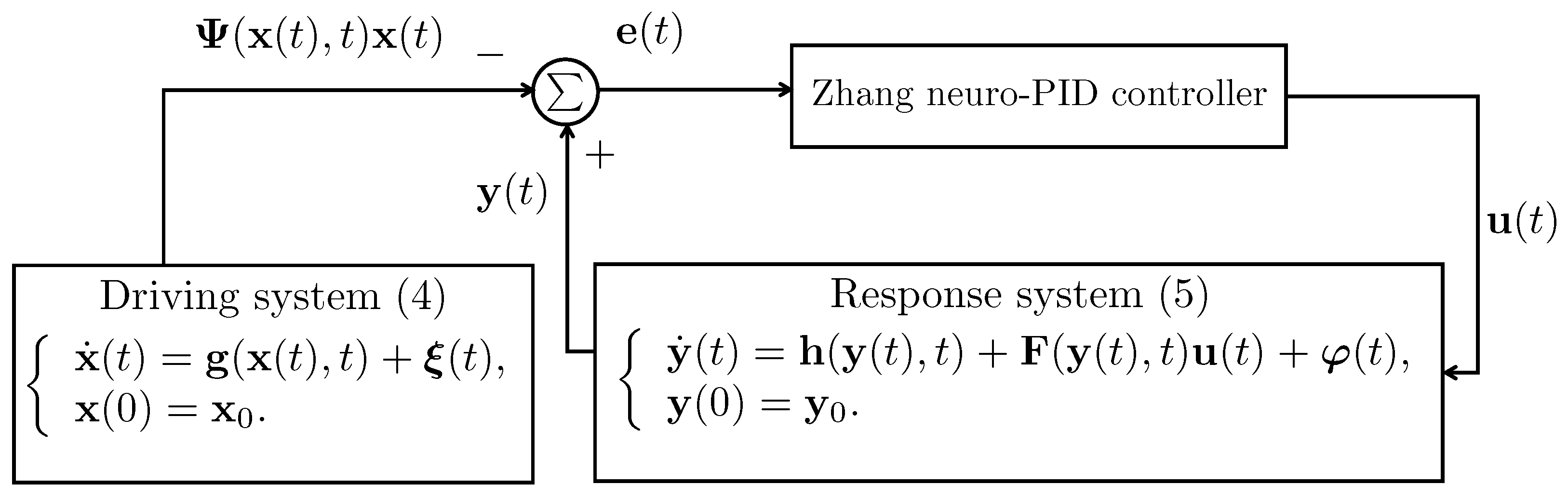
where generally represents the initial error vector, denotes the derivative of with respect to t, is the initial bi-variable scaling function matrix, and represents the MTVP. For better presentation and understanding, the architecture of GBVFPS for the driving system (4) and response system (5) with MTVP is displayed in Figure 1.
Then, an effective controller needs to be designed so that driving system (4) and response system (5) with MTVP can achieve GBVFPS. On the basis of the ZND method [48], the first ZND error function containing an integral term is defined as
By utilizing the ZND design formula , with being a flexible and changeable design parameter to control the convergence speed [49], we obtain
Subsequently, the second ZND error function is constructed as
By making use of the ZND design formula , the derivative of is formulated as
Substituting Equation (12) into the GBVFPS error system with MTVP (8), the Zhang neuro-PID controller is designed as
Reformulating (13), the Zhang neuro-PID controller is rewritten as
Remark 1.
Note that the first and second parts of the Zhang neuro-PID controller (14) contain the proportional and integral information of the GBVFPS error vector , respectively. The remaining part of the Zhang neuro-PID controller (14) includes the derivatives of system and bi-variable scaling function matrix. Referring to the PID [41], the designed Zhang neuro-PID controller (14) has the PID characteristics, effectively suppressing the impact of various perturbations on NN systems. From controller (13), we know that the controller involves matrix inversion operation, leading to a computational complexity of . In addition, from the design process, the parameters and have physical meaning. In a practical physical sense, the parameters and generally correspond to the reciprocal of the capacitance parameter [35]. Therefore, the parameters and should be set to be large enough for hardware allowances or appropriately large for actual control purposes.
Remark 2.
It is worth noting that this paper studies the GBVFPS problem of two different NN systems. On one hand, NN systems are temporally varying nonlinear systems with complicated nonlinear dynamic characteristics. On the other hand, the scaling factor of the GBVFPS is a bi-variable scaling function matrix. Both of these aspects make the GBVFPS problem pretty troublesome and interesting. Therefore, by designing two ZND error functions and utilizing the ZND design formula twice, the GBVFPS control method with a Zhang neuro-PID controller is proposed to handle the GBVFPS problem.
3.2. Theoretical Analyses
In this subsection, the effectiveness of the proposed GBVFPS control method is theoretically analyzed. Specifically, this subsection investigates the convergence performance and anti-perturbation ability of the GBVFPS error system (8) with six different perturbations under Zhang neuro-PID controller (13), where six different types of perturbations are zero perturbation, bounded constant perturbation, linear-form MTVP, exponential-form MTVP, sine-form MTVP, and exponential-sine-form MTVP. The specific six different types of perturbations and their characteristics are exhibited in Table 3.
Table 3.
Six different types of perturbations and their characteristics.
Theorem 1.
Consider the zero perturbation and the GBVFPS problem of NN systems (4) and (5) starting with random generated initial vectors , and initial bi-variable scaling function matrix . When the perturbation and the design of the Zhang neuro-PID controller is shown in controller (13), the GBVFPS error system (8) converges to zero globally and exponentially.
Proof.
First, we prove the global convergence performance of the GBVFPS error function . Substituting the designed Zhang neuro-PID controller (13) into the GBVFPS error system (8) with zero perturbation , we obtain
Thus, the derivative of the GBVFPS error vector is simplified as
The Lyapunov function candidate for the ith subsystem is constructed as
Generally, the Lyapunov function candidate is guaranteed to be positive definite—in other words, for any or , and for . Besides, when , . More importantly, the derivative of with respect to t is
According to the Lyapunov theory [50], of the ith subsystem globally converges to zero for any . Therefore, the GBVFPS error system (8) converges to zero globally.
Next, the detailed theoretical proof of the exponential convergence performance of GBVFPS error system (8) is presented. On the basis of the ZND error function, we have . Let , , , and be the ith element of , , , and , respectively. Then, , , and . Thereby, the ith subsystem of Equation (16) is rewritten as
In view of the differential equation theory [50], the characteristic equation of Equation (17) is
Evidently, the two roots of characteristic Equation (18) are and . From the previous parameter settings, parameters and can be changed according to the actual situation. Therefore, we roughly divide parameters and into the following two situations for discussion.
(1) If , the general solution of differential Equation (17) is obtained by
where and . For reading convenience as well as for completeness, Equation (19) is rewritten as
and, further, we have
Let , we obtain
Thus, the result is obtained as
(2) If , the general solution of differential Equation (17) is obtained as
where and . Therefore, we further obtain
and
Finally, the following inequality is obtained:
In view of Lemma 1 in [37], we have
where constant denotes the exponential convergence speed. Thus, the result is obtained as
According to Definitions 1 and 2, the GBVFPS error system (8) without perturbations converges to zero globally and exponentially. The proof is thus completed. □
Theorem 2.
Consider the bounded constant perturbation and the GBVFPS problem of NN systems (4) and (5). Starting with random generated initial vectors , and initial bi-variable scaling function matrix . When the perturbation is a constant vector and the design of the Zhang neuro-PID controller is shown in controller (13), the GBVFPS error system (8) converges to zero as time t goes.
Proof.
Substituting the designed Zhang neuro-PID controller (13) into the GBVFPS error system (8) with bounded constant perturbation , we obtain
Hence, the derivative of the GBVFPS error vector is simplified as
The ith subsystem of Equation (21) is reformulated as
By applying Laplace transform [51] to the above equation, we have
By rearranging the above equation, we further obtain
Then, the above equation is rewritten as
By virtue of the final value theorem [50], we obtain
Thus, the result is obtained as That is, the GBVFPS error system (8) with bounded constant perturbation converges to zero. The proof is completed. □
Theorem 3.
Consider the linear-form MTVP and the GBVFPS problem of NN systems (4) and (5) starting with random generated initial vectors , and initial bi-variable scaling function matrix . When the MTVP is a temporally varying linear function vector with being a constant vector, and the Zhang neuro-PID controller is shown in controller (13), then the GBVFPS error system (8) is bounded with steady-state GBVFPS error .
Proof.
Substituting the designed Zhang neuro-PID controller (13) into the GBVFPS error system (8) with linear-form MTVP , we have
Thus, the derivative of the GBVFPS error vector is simplified as
Then, the ith subsystem of Equation (23) is rewritten as
By employing Laplace transform to the above equation, the following equation is derived:
By rearranging the above equation, we further have
Then, the following equation is further derived:
According to the final value theorem [8], we obtain
Therefore, the GBVFPS error system (8) with linear-form MTVP is bounded with steady-state GBVFPS error . The proof is completed. □
Theorem 4.
Consider the exponential-form MTVP and the GBVFPS problem of NN systems (4) and (5) starting with random generated initial vectors , and initial bi-variable scaling function matrix . When the MTVP is a function vector in temporally varying exponential-form, where operator ⊙ is the Hadamard product between two vectors and with being positive constant, and the Zhang neuro-PID controller is presented in controller (13), then the GBVFPS error system (8) converges to zero.
Proof.
Substituting the designed Zhang neuro-PID controller (13) into the GBVFPS error system (8) with exponential-form MTVP , we obtain
Hence, the derivative of the GBVFPS error vector is simplified as
Then, the ith subsystem of Equation (25) is rewritten as
Similarly, we obtain the following explicit form:
Next, by adjusting the above explicit expression, we obtain
The detailed mathematical expression of is expressed as
Finally, as time t goes, tends to zero—that is,
Thus, the result is obtained as Therefore, the GBVFPS error system (8) with exponential-form MTVP converges to zero. The proof is completed. □
Theorem 5.
Consider the sine-form MTVP and the GBVFPS problem of NN systems (4) and (5) starting with random generated initial vectors , and initial bi-variable scaling function matrix . When the MTVP is a function vector in temporally varying sine-form, where with being constant, and the Zhang neuro-PID controller is shown in controller (13), then the GBVFPS error system (8) converges to zero.
Proof.
The proof is omitted due to the similarity with Theorem 4. □
In some complicated actual environments, the temporally varying perturbations to the NN system may change along with environments. In order to make the results of our research better apply to the actual situation, the exponential-sine-form MTVP is investigated.
Theorem 6.
Consider the exponential-sine-form MTVP and the GBVFPS problem of NN systems (4) and (5) starting with random generated initial vectors , and initial bi-variable scaling function matrix . When the MTVP is a function vector with a combination of temporally varying exponential and sine forms, and the Zhang neuro-PID controller is presented in controller (13), then the GBVFPS error system (8) converges to zero as time t goes.
Proof.
Substituting the designed Zhang neuro-PID controller (13) into the GBVFPS error system (8) with exponential-sine-form MTVP , we obtain
Thus, the derivative of the GBVFPS error vector is simplified as
Thus, the ith subsystem of Equation (27) is rewritten as
Similarly, the following equation is obtained:
Then, multiplying both sides of the above equation by simultaneously, the following expression is obtained:
By rearranging the above equation, we further obtain
Similarly, we have
Therefore, the result is derived as That is, the GBVFPS error system (8) with exponential-sine-form MTVP converges to zero. The proof is completed. □
Remark 3.
According to [34,42,52], the integration of error function is critical to minimize the steady-state error, ensuring that the system eventually reaches the desired state. Specifically, the integral term within a controller progressively sums the error. This cumulative effect prompts the controller to make appropriate adjustments to effectively minimize the steady-state error and ensure a stable response of the system. Generalized from [34,42,52], in the rigorous proofs of Theorems 1–6, integrating the error function can effectively suppress the impact of various perturbations, thus improving the anti-perturbation ability of the proposed GBVFPS control method.
4. Numerical Simulations and Comparisons
In this section, two numerical simulations, including the synchronization of two NN chaotic systems and the synchronization of two FDVIP systems, are provided to verify the effectiveness of the proposed GBVFPS control method. In addition, comparative experiments are conducted to further illustrate the anti-perturbation ability and superiority of the proposed GBVFPS control method.
4.1. Chaotic System Synchronization Example
In this example, the designed Zhang neuro-PID controller is used to synchronize two different three-dimensional NN chaotic systems with six different perturbations (i.e., zero perturbation, bounded constant perturbation, linear-form MTVP, exponential-form MTVP, sine-form MTVP, and exponential-sine-form MTVP).
Consider that the driving system is a three-dimensional NN chaotic system with MTVP, which is described by
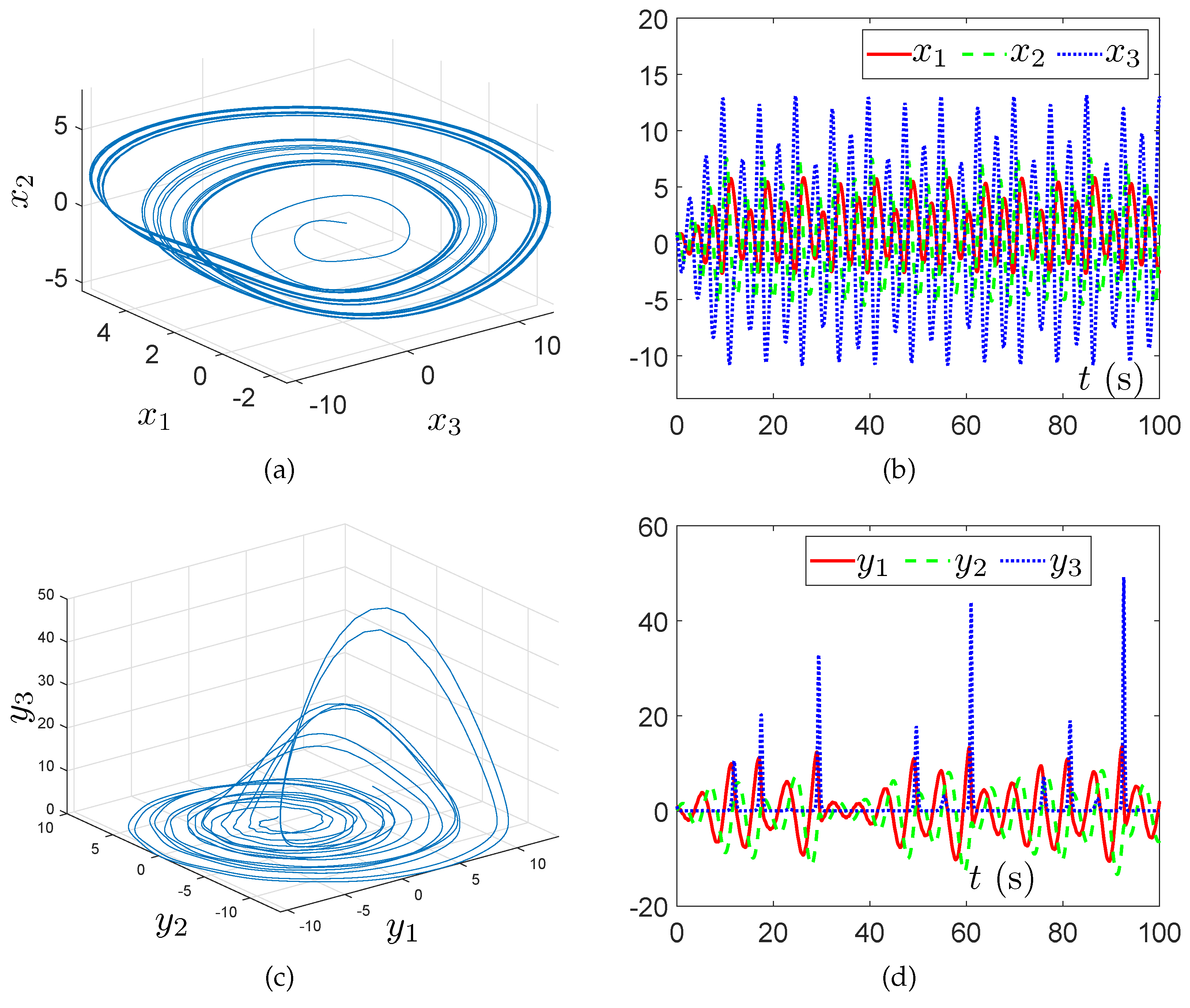
where is the ith state variable with the index and represents the ith MTVP. Besides, , , and . When the driving system (28) is not affected by various perturbations (i.e., ), the driving system (28) is chaotic, and its chaotic attractor is exhibited in Figure 2a. Besides, Figure 2b depicts the trajectories of state variables .
The controlled response system, which is a three-dimensional NN chaotic system with MTVP, is expressed as
where is the ith state variable, stands for the ith MTVP, is the ith designed controller, and represents the ith differentiable temporally varying nonlinear function. Let , , , , , and . When the response system (29) is free from MTVP—i.e., —the response system (29) is chaotic, and its chaotic attractor is presented in Figure 2c. Besides, Figure 2d depicts the trajectories of state variables .
In the process of numerical simulation, both NN chaotic systems (28) and (29) start with randomly generated initial values, the parameters and . is MTVP, where and represent the ith MTVP of NN chaotic systems (28) and (29), respectively. Furthermore, stands for the ith bi-variable scaling function factor, which is constructed as
Next, numerical experiments are conducted on the following six different perturbations to show the validity and anti-perturbation ability of the proposed GBVFPS control method.
- (1)
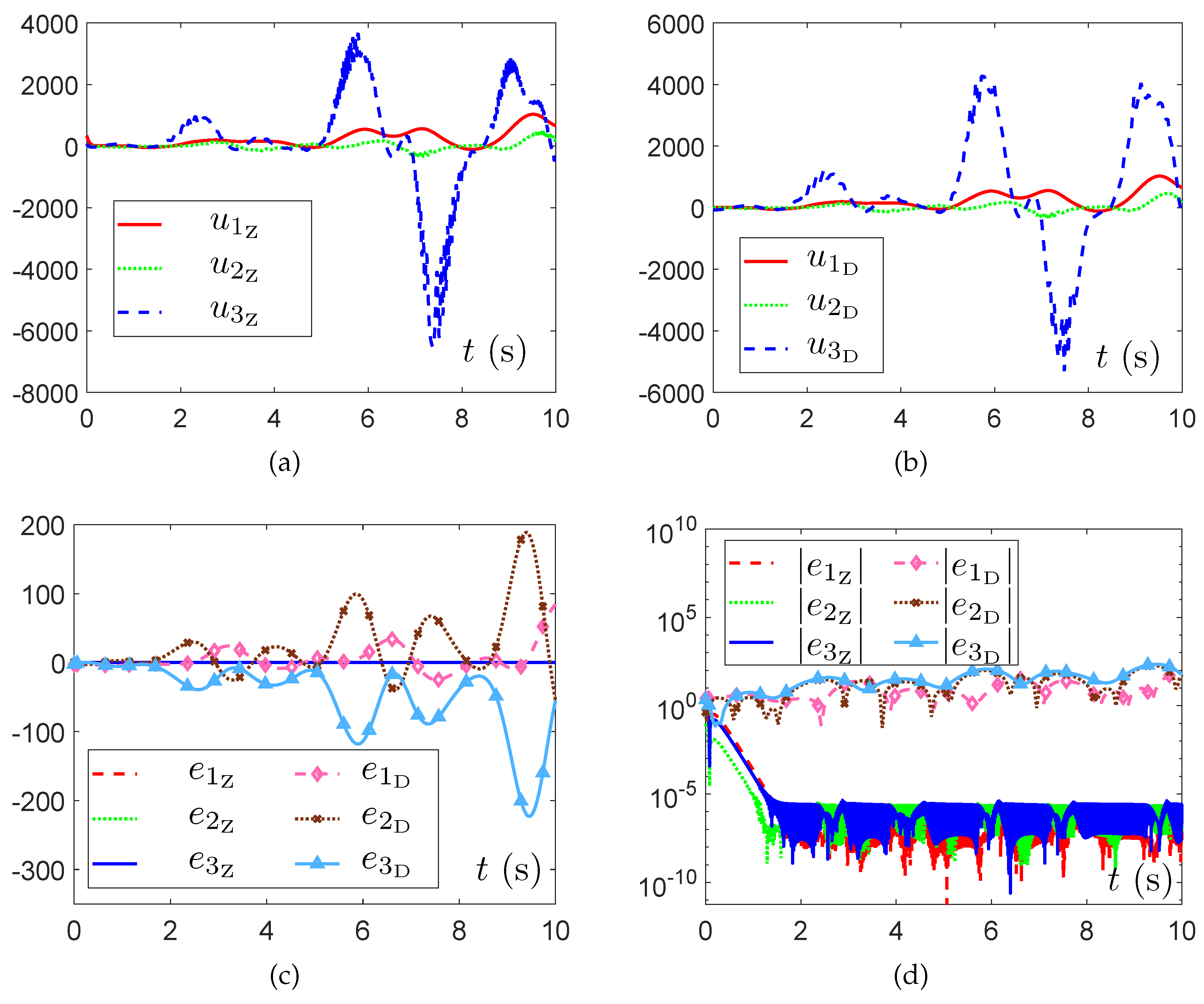
- Consider the zero perturbation, i.e., and . The corresponding numerical simulation results are shown in Figure 3 and Figure 4.
- (2)
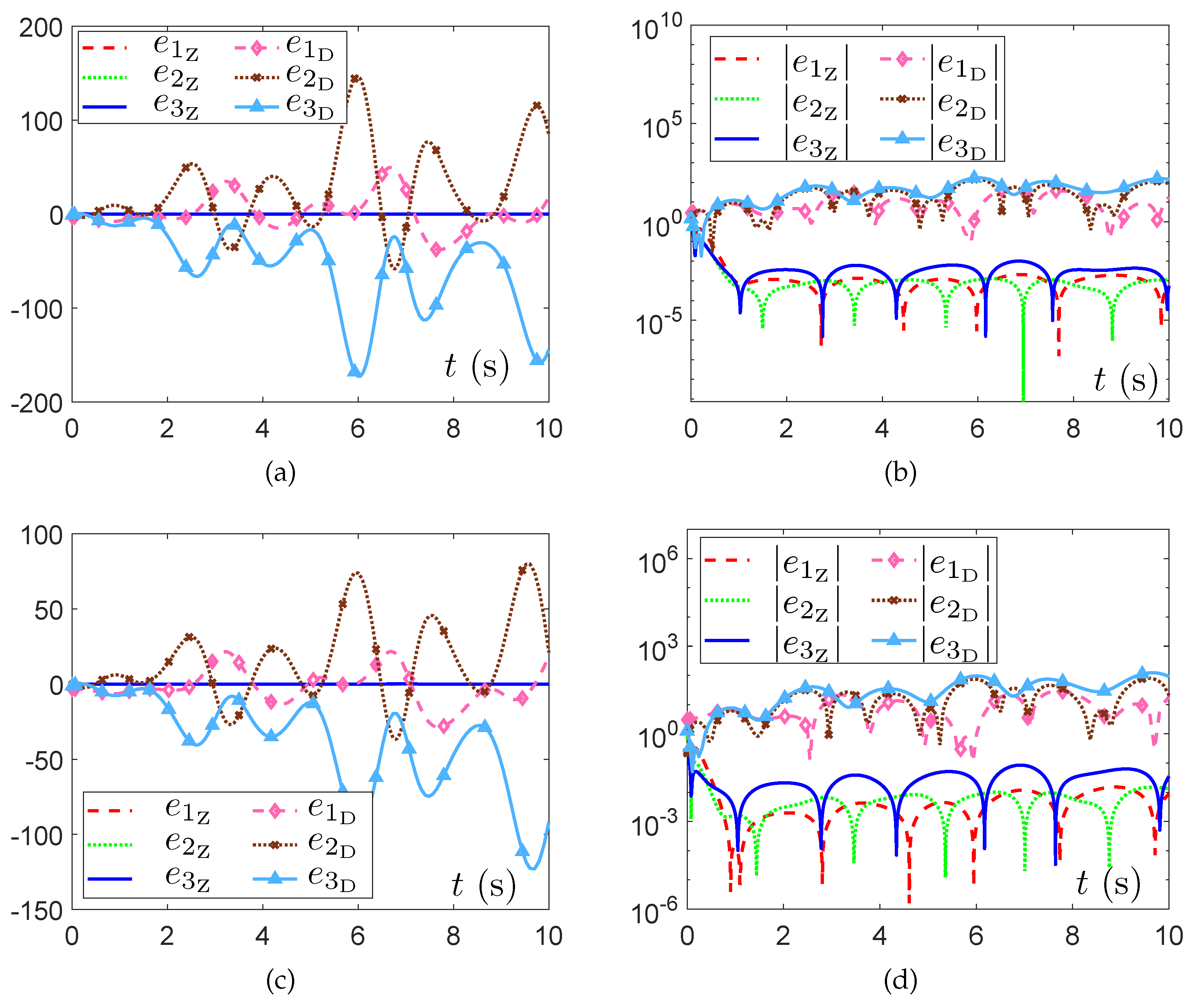
- Consider the bounded constant perturbation, i.e., , , , , , and . The corresponding numerical simulation results are displayed in Figure 5a,b.
Figure 5. Simulation results of GBVFPS for NN chaotic systems (28) and (29) with different perturbations based on Zhang neuro-PID controller and DD controller. (a) GBVFPS errors and with bounded constant perturbations. (b) Residual errors and with bounded constant perturbations. (c) GBVFPS errors and with linear-form MTVP. (d) Residual errors and with linear-form MTVP. - (3)
- Consider the linear-form MTVP , where and stand for constant vectors. In this case, the linear-form MTVP is expressed asThe simulation results are shown in Figure 5c,d.
- (4)
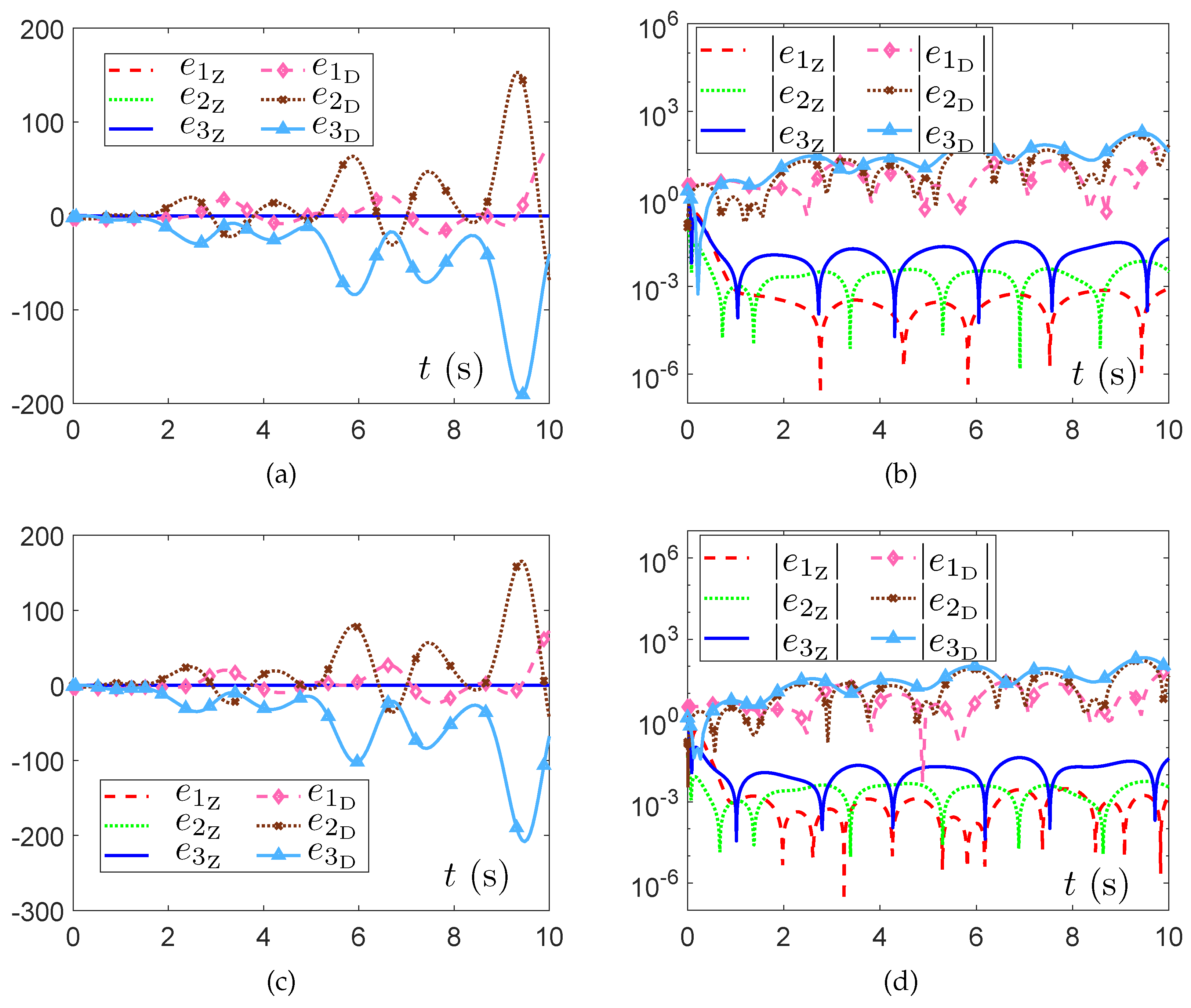
- Consider the exponential-form MTVP , where and are constant vectors and . In this case, the exponential-form MTVP is considered asThe simulation results are displayed in Figure 6a,b.
Figure 6. Simulation results of GBVFPS for NN chaotic systems (28) and (29) with different perturbations based on Zhang neuro-PID controller and DD controller. (a) GBVFPS errors and with exponential-form MTVP. (b) Residual errors and with exponential-form MTVP. (c) GBVFPS errors and with sine-form MTVP. (d) Residual errors and with sine-form MTVP. - (5)
- Consider the sine-form MTVP , where . In this case, the sine-form MTVP is considered asThe simulation results are exhibited in Figure 6c,d.
- (6)
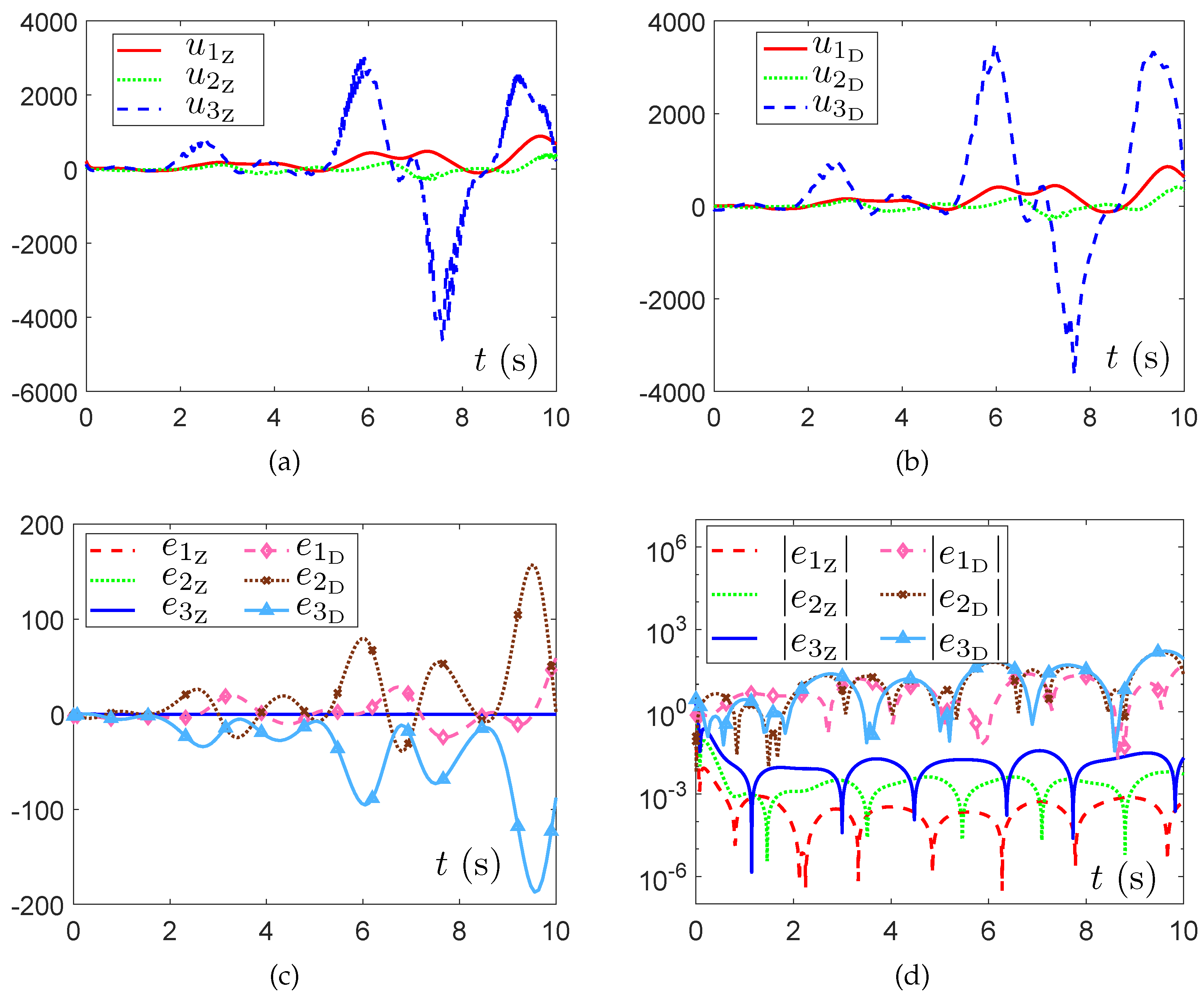
- Consider the exponential-sine-form MTVP . In this case, the exponential-sine-form MTVP is considered asThe simulation results are shown in Figure 7.
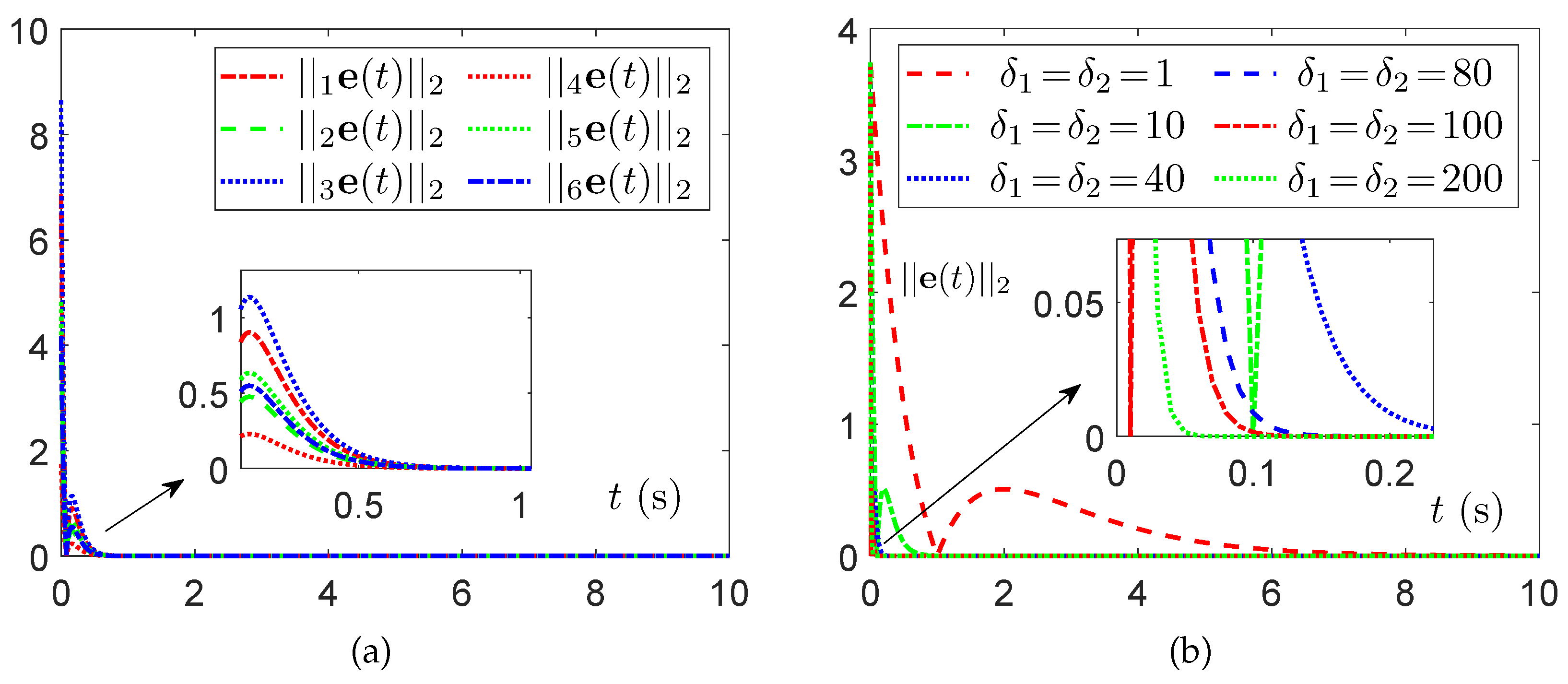
Specifically, with zero perturbation, the trajectories of GBVFPS errors starting from six different sets of random initial vectors with and are displayed in Figure 3a. Besides, the trajectories of GBVFPS errors with six different sets of parameter values are shown in Figure 3b. As the parameter values increase, the convergence rate of increases. Figure 3a,b illustrate that the GBVFPS control method is insensitive to initial values and sensitive to parameter variations. In addition, the trajectories of control inputs and with zero perturbation are displayed in Figure 4a,b, respectively. The trajectories of control inputs and with exponential-sine-form MTVP are exhibited in Figure 7a,b, respectively. Evidently, both the Zhang neuro-PID controller and DD controller are feasible during execution.
Furthermore, in the case of zero perturbation, bounded constant perturbation, linear-form MTVP, exponential-form MTVP, sine-form MTVP, and exponential-sine-form MTVP, the GBVFPS errors are exhibited in Figure 4c, Figure 5a,c, Figure 6a,c and Figure 7c, respectively. The corresponding residual errors are illustrated in Figure 4d, Figure 5b,d, Figure 6b,d and Figure 7d, respectively. From the figures, the GBVFPS errors generated by the Zhang neuro-PID controller converge to zero quickly, and the residual errors are mostly between orders and . Especially, with zero perturbation, the residual errors are mostly about order . However, the GBVFPS errors generated by DD controller cannot converge to zero, and residual errors are greater than order 10.
In summary, the DD controller designed by DD method fails to solve the GBVFPS problem of two different NN chaotic systems with various perturbations. In contrast, the Zhang neuro-PID controller effectively and accurately solves the GBVFPS problem of NN chaotic systems (28) and (29) with various perturbations. Thus, the numerical simulation results substantiate the superiority of the designed Zhang neuro-PID controller as well as the effectiveness and anti-perturbation ability of the proposed GBVFPS control method.
4.2. FDVIP System Synchronization Example
To illustrate that the proposed GBVFPS type is an important breakthrough in the field of synchronization research, in this example, four representative synchronization simulations of two different FDVIP systems with exponential-sine-form MTVP are considered. Besides, the proposed Zhang neuro-PID controller and the existing DD controller are applied to tackle this challenging perturbation problem.
The driving system is considered as the following FDVIP system with exponential-sine-form MTVP:
where denotes the jth exponential-sine-form MTVP with the index , and the exponential-sine-form MTVP is designed as
The response system is considered as the following FDVIP system with exponential-sine-form MTVP:
where represents the jth controller and represents the jth exponential-sine-form MTVP, which is described as
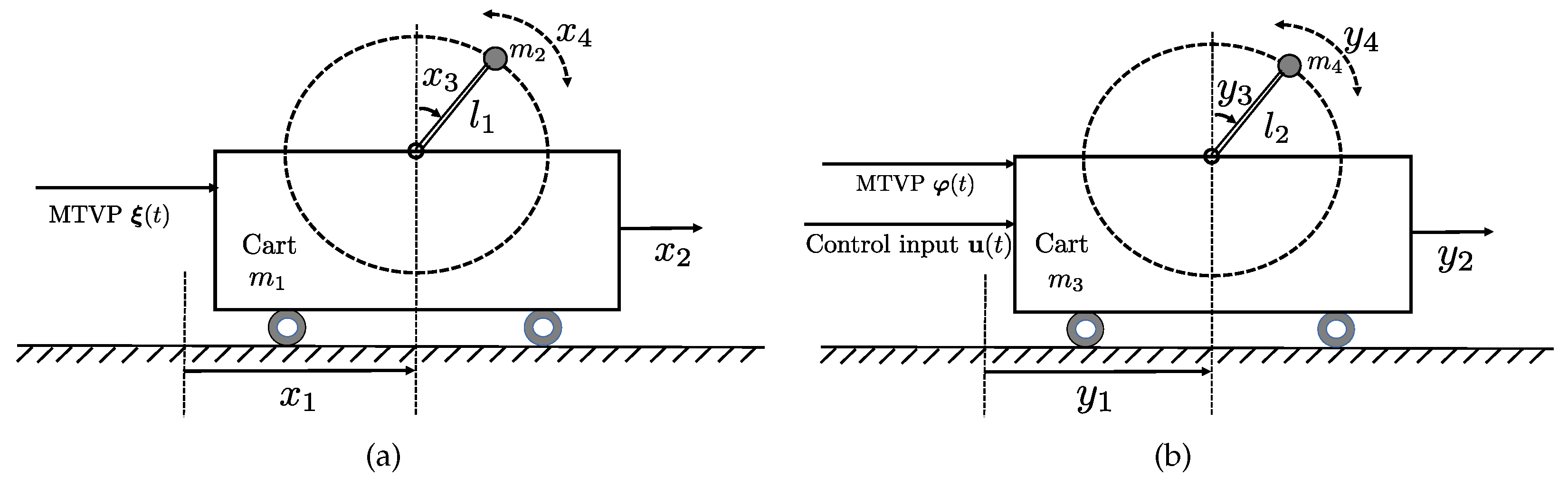
Let , , , , , and . For better understanding and presentation, two mathematical models of FDVIP systems (35) and (36) with exponential-sine-form MTVP are presented in Figure 8. In addition, some relevant parameters of the FDVIP systems (35) and (36) are exhibited in Table 4.
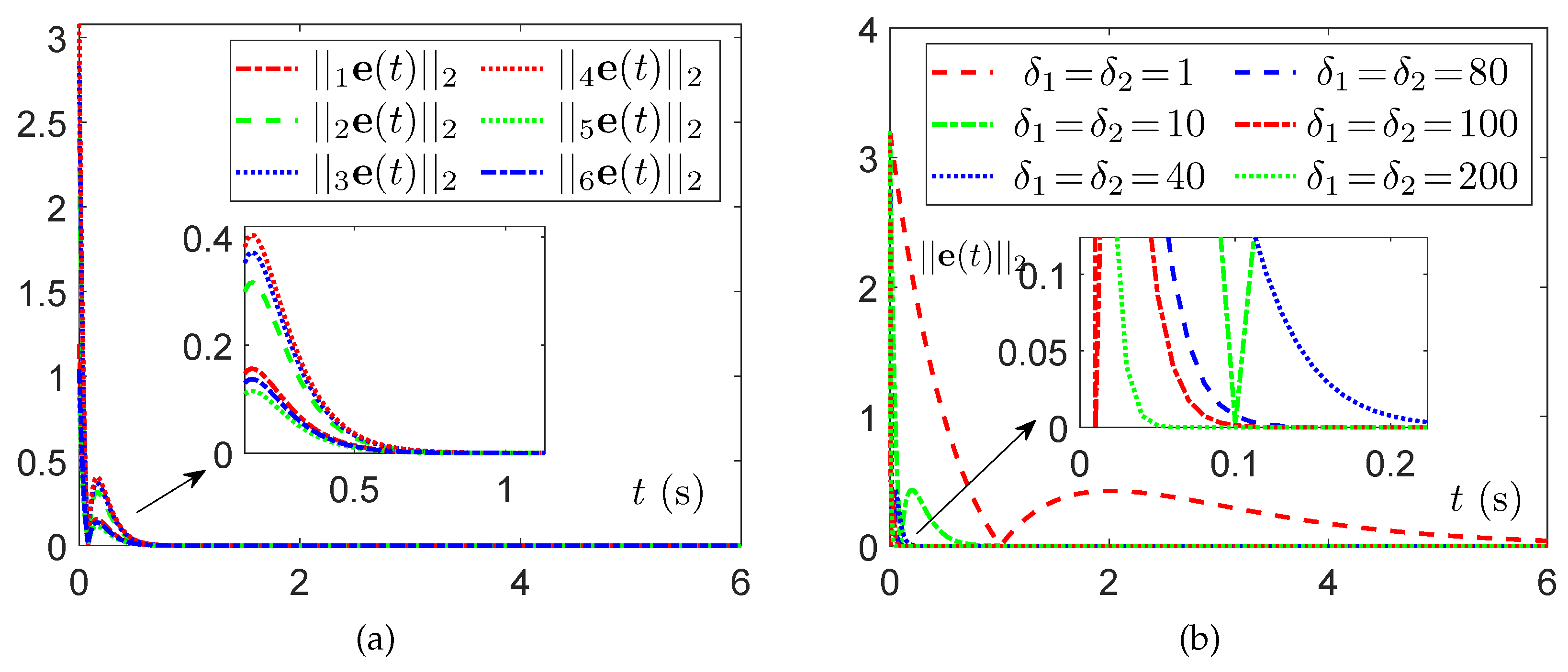
With zero perturbation, the trajectories of GBVFPS errors starting from six different sets of random initial vectors with and are displayed in Figure 9a. Besides, the trajectories of GBVFPS errors with six different sets of parameter values are shown in Figure 9b. As the parameter values increase, the convergence rate of increases. Figure 9a,b illustrate that the GBVFPS control method is insensitive to initial values and sensitive to the parameter variations.
Next, by changing the mathematical expression of the bi-variable scaling function factors , the GBVFPS becomes a different synchronization type. For the sake of simplicity, we only simulate four different situations, namely, MPS, MFPS, GFPS, and GBVFPS.
- (1)
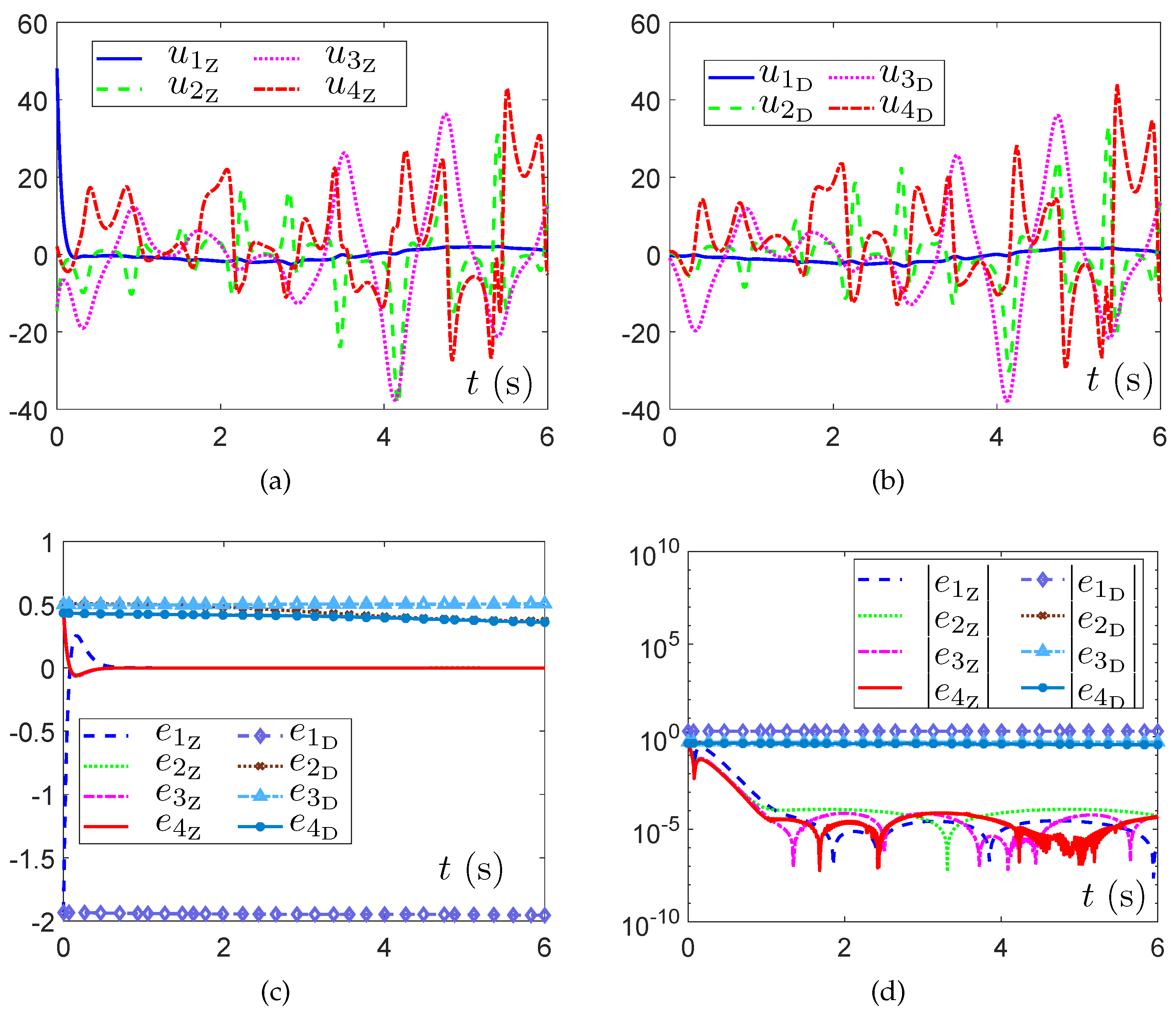
- Considering the bi-variable scaling function factors being constant factors—that is, , , , and . In this situation, the GBVFPS turns into MPS and the corresponding simulation results are presented in Figure 10.
- (2)
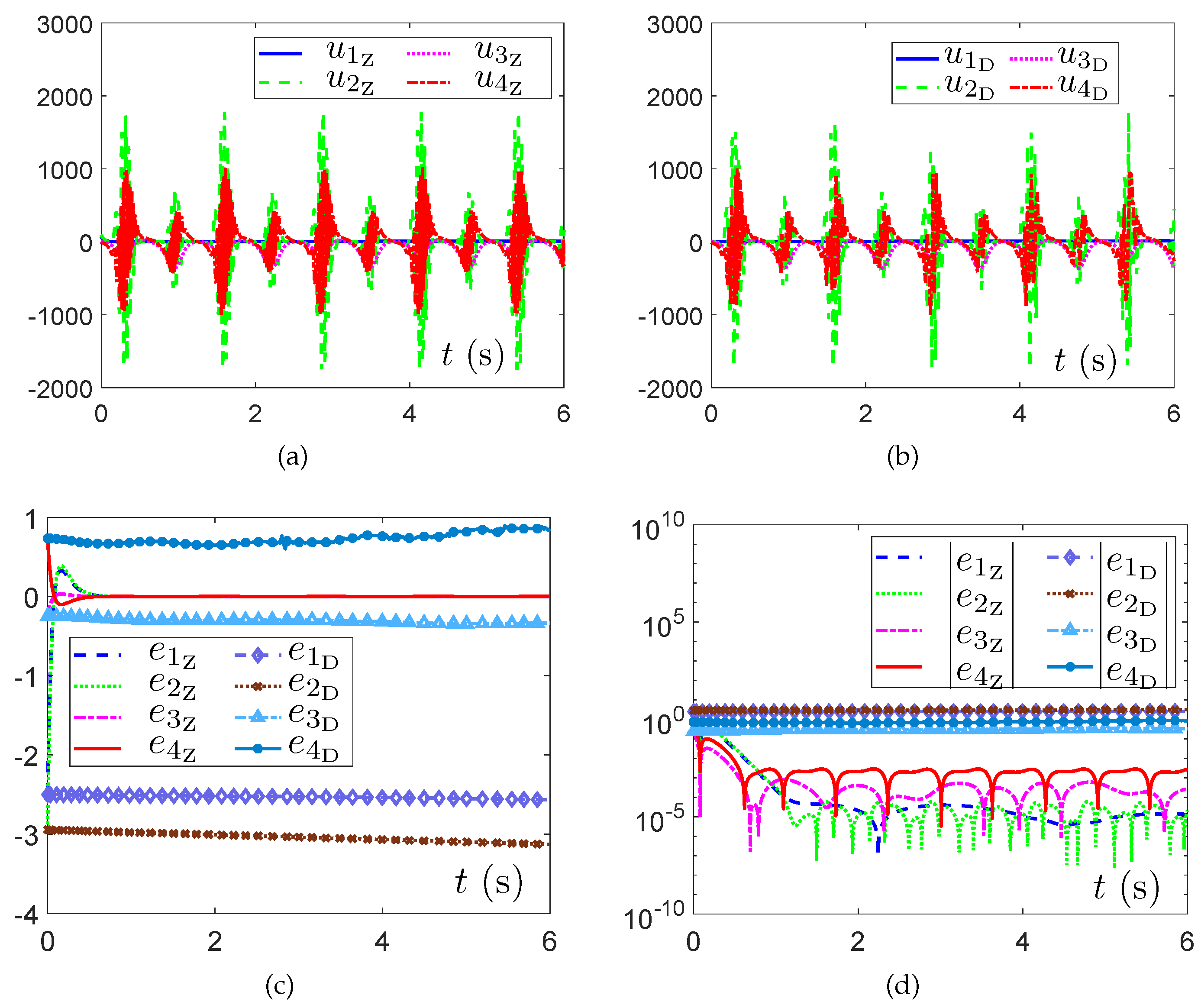
- Consider the bi-variable scaling function factors being related to t, which are expressed asIn this situation, the GBVFPS becomes MFPS and the corresponding simulation results are given in Figure 11.
- (3)
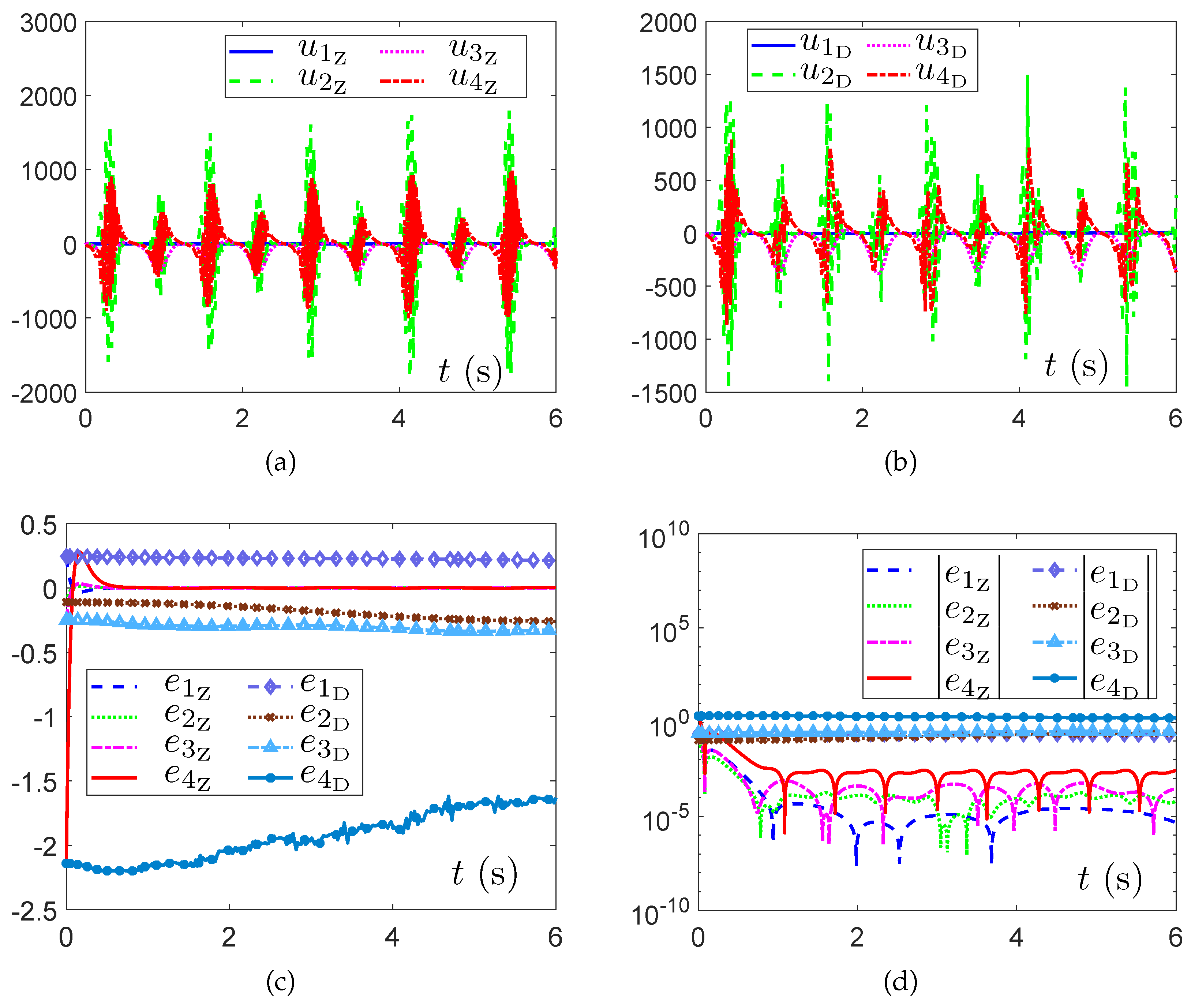
- Consider the bi-variable scaling function factors being related to , which are constructed asIn this situation, the GBVFPS is changed into GFPS and the corresponding simulation results are displayed in Figure 12.
- (4)
- Considering the bi-variable scaling function factors being related to t and , which are formulated asIn this situation, the synchronization type becomes GBVFPS. By utilizing the proposed GBVFPS control, the corresponding simulation results are exhibited in Figure 13.
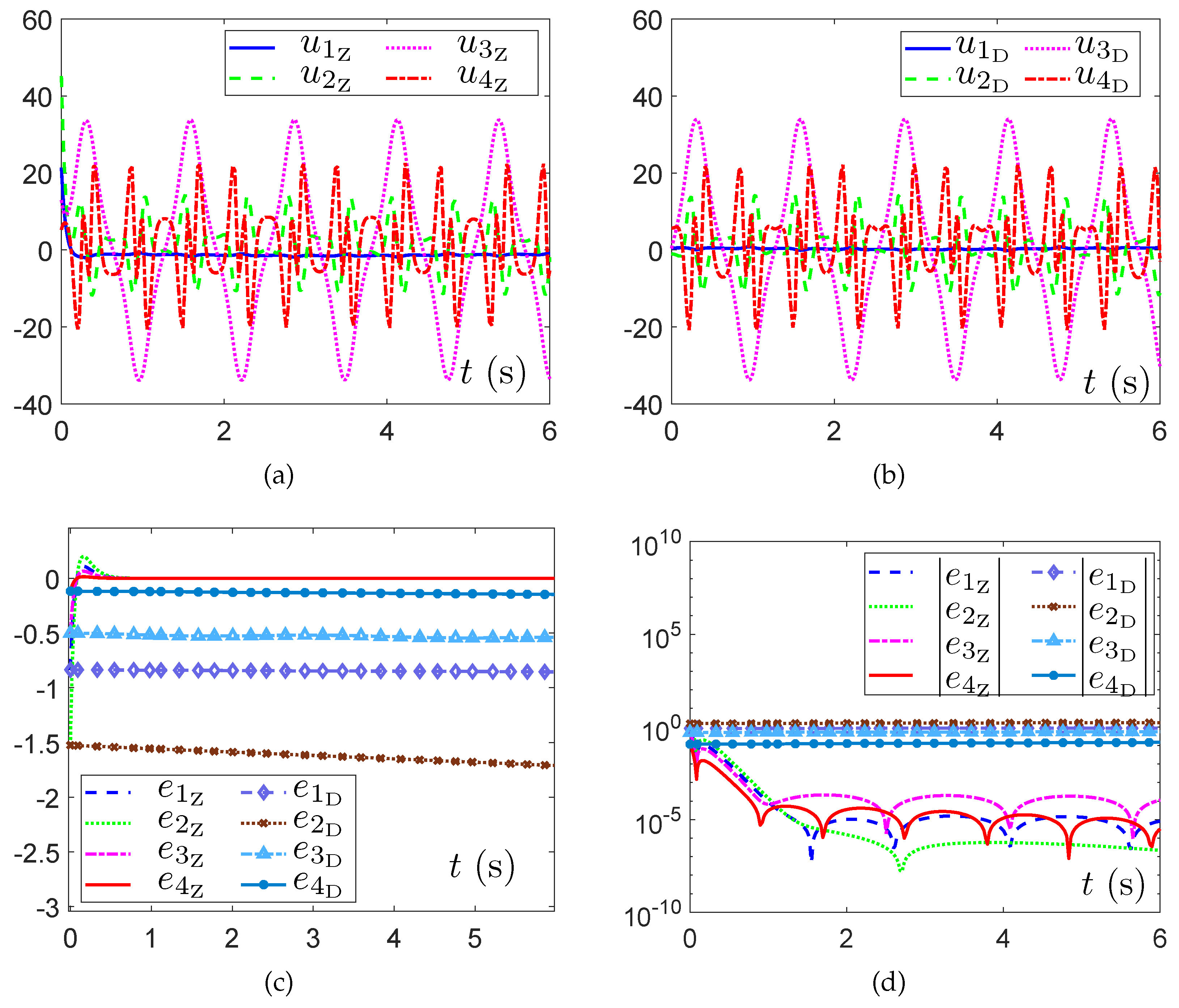
Specifically, the trajectories of control inputs generated by Zhang neuro-PID controller are displayed in Figure 10a, Figure 11a, Figure 12a and Figure 13a. In addition, for comparison, the trajectories of control inputs generated by DD method are illustrated in Figure 10b, Figure 11b, Figure 12b and Figure 13b. Evidently, both the Zhang neuro-PID controller and DD controller are feasible during execution.
Furthermore, the trajectories of the MPS errors, MFPS errors, GFPS errors, and GBVFPS errors are illustrated in Figure 10c, Figure 11c, Figure 12c, and Figure 13c, respectively. Besides, the trajectories of the corresponding residual errors are displayed in Figure 10d, Figure 11d, Figure 12d and Figure 13d, respectively. From the figures, we see that the MPS errors, MFPS errors, GFPS errors, and GBVFPS errors generated by the Zhang neuro-PID controller converge to zero quickly, and the corresponding residual errors are mostly about order . However, the MPS errors, MFPS errors, GFPS errors, and GBVFPS errors generated by DD controller no longer converge to zero, and the corresponding residual errors are larger than order 1.
In summary, the designed Zhang neuro-PID controller is superior to the DD controller and has the ability to suppress various perturbations. Besides, from the simulation results, the proposed GBVFPS type can be transformed into various types of synchronization, such as MPS, MFPS, and GFPS, to meet the requirements of different synchronization types for driving system and response system in different situations.
5. Conclusions
In this paper, a new GBVFPS type for NN systems synchronization was proposed. The scaling function matrix of GBVFPS is bi-variable, which is related to time t and the state variable of the driving system. So, the GBVFPS is an improvement and promotion of existing synchronization types, such as PS, MPS, FPS, MFPS, and GFPS. This indicates that the proposed GBVFPS has a significant driving and breakthrough effect on synchronization research. In addition, the NN systems with six different perturbations were investigated and presented, including zero perturbation, bounded constant perturbation, linear-form MTVP, exponential-form MTVP, sine-form MTVP, and exponential-sine-form MTVP. To achieve GBVFPS for two different NN systems with six different perturbations, the Zhang neuro-PID controller was designed. The convergence properties and anti-perturbation ability of the proposed GBVFPS control method were proved via rigorous theoretical analyses. Moreover, numerical simulations on NN chaotic systems and FDVIP systems were performed to further verify the effectiveness, superiority, and anti-perturbation ability of the proposed GBVFPS control method. Finally, some meaningful and promising future research directions are given as follows.
- (1)
- Designing a different synchronization control method that does not require matrix inversion operation will significantly improve the real-time processing capability.
- (2)
- Conducting more systematic synchronization research and experimental validation in ships, helicopters, robotics, and so on.
- (3)
- Exploring control methods for NN systems with unknown parameters.
- (4)
- Conducting discrete-time synchronization research for better application to computer control.
Author Contributions
Conceptualization, Y.Z.; methodology, M.H. and Y.Z.; software, M.H.; validation, M.H. and Y.Z.; formal analysis, M.H. and Y.Z.; investigation, M.H. and Y.Z.; resources, M.H. and Y.Z.; data curation, M.H. and Y.Z.; writing—original draft preparation, M.H.; writing—review and editing, M.H. and Y.Z.; visualization, M.H. and Y.Z.; supervision, Y.Z.; project administration, Y.Z.; funding acquisition, Y.Z. All authors have read and agreed to the published version of the manuscript.
Funding
This work is supported by the National Natural Science Foundation of China under Grant 62376290 and Natural Science Foundation of Guangdong Province under Grant 2024A1515011016.
Data Availability Statement
Data are contained within the article.
Conflicts of Interest
The authors declare no conflicts of interest.
References
- Liao, B.; Huang, Z.; Cao, X.; Li, J. Adopting nonlinear activated Beetle Antennae Search algorithm for fraud detection of public trading companies: A computational finance approach. Mathematics 2022, 10, 2160. [Google Scholar] [CrossRef]
- Xiao, L.; Zhang, Y.; Hu, Z.; Dai, J. Performance benefits of robust nonlinear zeroing neural network for finding accurate solution of Lyapunov equation in presence of various noises. IEEE Trans. Ind. Inform. 2019, 15, 5161–5171. [Google Scholar] [CrossRef]
- Guo, P.; Zhang, Y. Tracking control for triple-integrator and quintuple-integrator systems with single input using Zhang neural network with time delay caused by backward finite-divided difference formulas for multiple-order derivatives. Mathematics 2022, 10, 1440. [Google Scholar] [CrossRef]
- Su, H.; Luo, R.; Huang, M.; Fu, J. Fast convergence control of a class of uncertain chaotic systems with input nonlinearity by using a new sliding mode controller. Eur. J. Control 2023, 69, 100751. [Google Scholar] [CrossRef]
- Glushkov, A.V.; Buyadzhi, V.V.; Kvasikova, A.S.; Ignatenko, A.V.; Kuznetsova, A.A.; Prepelitsa, G.P.; Ternovsky, V.B. Non-linear chaotic dynamics of quantum systems: Molecules in an electromagnetic field. In Quantum Systems in Physics, Chemistry and Biology; Springer International Publishing: Cham, Switzerland, 2017; pp. 169–180. [Google Scholar]
- Luo, R.; Huang, M.; Su, H. Robust control and synchronization of 3-D uncertain fractional-order chaotic systems with external disturbances via adding one power integrator control. Complexity 2019, 2019, 8417536. [Google Scholar] [CrossRef]
- Verhulst, F. Nonlinear Differential Equations and Dynamical Systems; Springer: Berlin, Germany, 1990. [Google Scholar]
- Arnold, V.I. Geometrical Methods in the Theory of Ordinary Differential Equations; Springer: Berlin, Germany, 1983. [Google Scholar]
- Vedenov, A.A.; Ezhov, A.A.; Levchenko, E.B. Nonlinear dynamical systems with memory and functions of neuron ensembles. In Nonlinear Waves Struct. Bifurc. 1987, 394, 53–69. [Google Scholar]
- Lancelotti, S.; Molle, R. Positive solutions for autonomous and non-autonomous nonlinear critical elliptic problems in unbounded domains. Nonlinear Differ. Equ. Appl. 2020, 27, 8. [Google Scholar] [CrossRef]
- Chen, F.; Xie, X.; Miao, Z.; Pu, L. Extinction in two species nonautonomous nonlinear competitive system. Appl. Math. Comput. 2016, 274, 119–124. [Google Scholar] [CrossRef]
- Lenka, B.K.; Bora, S.N. New asymptotic stability results for nonautonomous nonlinear fractional order systems. IMA J. Math. Control Inf. 2022, 39, 951–967. [Google Scholar] [CrossRef]
- Wang, M.; Ren, X.; Chen, Q. Cascade optimal control for tracking and synchronization of a multimotor driving system. IEEE Trans. Control Syst. Technol. 2019, 27, 1376–1384. [Google Scholar] [CrossRef]
- Huang, M.; Luo, R.; Fu, J.; Su, H. Synchronization of a class of time-varying delay chaotic systems with external disturbances via impulsive intermittent control. Int. J. Control Autom. Syst. 2023, 21, 1507–1517. [Google Scholar] [CrossRef]
- Yau, H.; Wang, C.; Chang, J.; Su, X. A study on the application of synchronized chaotic systems of different fractional orders for cutting tool wear diagnosis and identification. IEEE Access 2019, 7, 15903–15911. [Google Scholar] [CrossRef]
- Volos, C.K.; Kyprianidis, I.M.; Stouboulos, I.N. Image encryption process based on chaotic synchronization phenomena. Signal Process. 2013, 93, 1328–1340. [Google Scholar] [CrossRef]
- Shabunin, A.; Astakhov, V.; Demidov, V.; Provata, A.; Baras, F.; Nicolis, G.; Anishchenko, V. Modeling chemical reactions by forced limit-cycle oscillator: Synchronization phenomena and transition to chaos. Chaos Solitons Fractals 2003, 15, 395–405. [Google Scholar] [CrossRef]
- Hashemi, S.; Pourmina, M.A.; Mobayen, S.; Alagheband, M.R. Design of a secure communication system between base transmitter station and mobile equipment based on finite-time chaos synchronisation. Int. J. Syst. Sci. 2020, 51, 1969–1986. [Google Scholar] [CrossRef]
- Huang, M.; Luo, R.; Fu, J.; Su, H. Robust exponential synchronization of a class of chaotic systems with variable convergence rates via the saturation control. Complexity 2020, 2020, 8293190. [Google Scholar] [CrossRef]
- Su, H.; Luo, R.; Fu, J.; Huang, M. Fixed time control and synchronization of a class of uncertain chaotic systems with disturbances via passive control method. Math. Comput. Simul. 2022, 198, 474–493. [Google Scholar] [CrossRef]
- Tian, Y.P.; Chun, S.; Chen, G.; Zong, S.; Huang, Y.; Wang, B. Delay compensation-based time synchronization under random delays: Algorithm and experiment. IEEE Trans. Control Syst. Technol. 2021, 29, 80–95. [Google Scholar] [CrossRef]
- Tang, Y.; Qiu, R.; Fang, J.; Miao, Q.; Xia, M. Adaptive lag synchronization in unknown stochastic chaotic neural networks with discrete and distributed time-varying delays. Phys. Lett. A 2008, 372, 4425–4433. [Google Scholar] [CrossRef]
- Huang, Y.; Chen, W.; Ren, S.; Zheng, Z. Analysis and pinning control for generalized synchronization of delayed coupled neural networks with different dimensional nodes. J. Frankl. Inst. 2018, 355, 5968–5997. [Google Scholar] [CrossRef]
- Luo, R.; Wang, Y.; Deng, S. Combination synchronization of three classic chaotic systems using active backstepping design. Chaos 2011, 21, 043114. [Google Scholar]
- Boubellouta, A.; Boulkroune, A. Intelligent fractional-order control-based projective synchronization for chaotic optical systems. Soft Comput. 2018, 23, 5367–5384. [Google Scholar] [CrossRef]
- Farivar, F.; Shoorehdeli, M.A.; Nekoui, M.A.; Teshnehlab, M. Synchronization of underactuated unknown heavy symmetric chaotic gyroscopes via optimal Gaussian radial basis adaptive variable structure control. IEEE Trans. Control Syst. Technol. 2013, 21, 2374–2379. [Google Scholar] [CrossRef]
- Botmart, T.; Weera, W.; Hongsri, A.; Yotha, N.; Niamsup, P. Dissipative pinning sampled-data control for function projective synchronization of neural networks with hybrid couplings and time-varying delays. IEEE Access 2022, 10, 58647–58666. [Google Scholar] [CrossRef]
- Tirandaz, H.; Karmi-Mollaee, A. Modified function projective feedback control for time-delay chaotic Liu system synchronization and its application to secure image transmission. Optik 2017, 147, 187–196. [Google Scholar] [CrossRef]
- Yu, Y.; Li, H. Adaptive generalized function projective synchronization of uncertain chaotic systems. Nonlinear Anal. Real World Appl. 2010, 11, 2456–2464. [Google Scholar] [CrossRef]
- Li, J.; Qu, L.; Li, Z.; Liao, B.; Li, S.; Rong, Y.; Liu, Z.; Liu, Z.; Lin, K. A novel zeroing neural network for solving time-varying quadratic matrix equations against linear noises. Mathematics 2023, 11, 475. [Google Scholar] [CrossRef]
- He, Y.; Liao, B.; Xiao, L.; Han, L.; Xiao, X. Double accelerated convergence ZNN with noise-suppression for handling dynamic matrix inversion. Mathematics 2022, 10, 50. [Google Scholar] [CrossRef]
- Su, H.; Luo, R.; Huang, M.; Fu, J. Practical fixed time active control scheme for synchronization of a class of chaotic neural systems with external disturbances. Chaos Solitons Fractals 2022, 157, 111917. [Google Scholar] [CrossRef]
- Yu, F.; Wang, C. Secure communication based on a four-wing chaotic system subject to disturbance inputs. Optik 2014, 125, 5920–5925. [Google Scholar] [CrossRef]
- Jin, L.; Li, S.; Xiao, L.; Lu, R.; Li, B. Cooperative motion generation in a distributed network of redundant robot manipulators with noises. IEEE Trans. Syst. Man Cybern. Syst. 2018, 48, 1715–1724. [Google Scholar] [CrossRef]
- Zhang, Y.; Yi, C. Zhang Neural Networks and Neural-Dynamic Method; Nova Science Publishers: New York, NY, USA, 2011. [Google Scholar]
- Liao, B.; Hua, C.; Cao, X.; Katsikis, V.N.; Li, S. Complex noise-resistant zeroing neural network for computing complex time-dependent Lyapunov equation. Mathematics 2022, 10, 2817. [Google Scholar] [CrossRef]
- Chen, D.; Zhang, Y.; Li, S. Zeroing neural-dynamics approach and its robust and rapid solution for parallel robot manipulators against superposition of multiple disturbances. Neurocomputing 2018, 275, 845–858. [Google Scholar] [CrossRef]
- Ding, Y.; Jia, H.; Zhang, Y.; Qiu, B. High-order modeling, zeroing dynamics control, and perturbations rejection for non-linear double-holding water tank. Mathematics 2023, 11, 2989. [Google Scholar] [CrossRef]
- Zhang, Y.; Shi, N.; Yang, M.; Guo, J.; Chen, J. Output optimization of scalar and 2-dimension time-varying nonlinear systems using zeroing dynamics. Asian J. Control 2021, 23, 1643–1657. [Google Scholar] [CrossRef]
- Liao, B.; Wang, Y.; Li, W.; Peng, C.; Xiang, Q. Prescribed-time convergent and noise-tolerant Z-type neural dynamics for calculating time-dependent quadratic programming. Neural Comput. Appl. 2021, 33, 5327–5337. [Google Scholar] [CrossRef]
- Yan, D.; Li, C.; Wu, J.; Deng, J.; Zhang, Z.; Yu, J.; Liu, P.X. A novel error-based adaptive feedback zeroing neural network for solving time-varying quadratic programming problems. Mathematics 2024, 12, 2090. [Google Scholar] [CrossRef]
- Shi, Y.; Zhang, Y. Discrete time-variant nonlinear optimization and system solving via integral-type error function and twice ZND formula with noises suppressed. Soft Comput. 2018, 22, 7129–7141. [Google Scholar] [CrossRef]
- Sun, Z.; Li, F.; Zhang, B.; Sun, Y.; Jin, L. Different modified zeroing neural dynamics with inherent tolerance to noises for time-varying reciprocal problems: A control-theoretic approach. Neurocomputing 2019, 337, 165–179. [Google Scholar] [CrossRef]
- Xiao, L. Accelerating a recurrent neural network to finite-time convergence using a new design formula and its application to time-varying matrix square root. J. Frankl. Inst. 2017, 354, 5667–5677. [Google Scholar] [CrossRef]
- Zhang, Y.; Ling, Y.; Yang, M.; Yang, S.; Zhang, Z. Inverse-free discrete ZNN models solving for future matrix pseudoinverse via combination of extrapolation and ZeaD formulas. IEEE Trans. Neural Netw. Learn. Syst. 2021, 32, 2663–2675. [Google Scholar] [CrossRef] [PubMed]
- Lei, Y.; Dai, Z.; Liao, B.; Xia, G.; He, Y. Double features zeroing neural network model for solving the pseudoninverse of a complex-valued time-varying matrix. Mathematics 2022, 10, 2122. [Google Scholar] [CrossRef]
- Chen, J.; Kang, X.; Zhang, Y. Continuous and discrete ZND models with aid of eleven instants for complex QR decomposition of time-varying matrices. Mathematics 2023, 11, 3354. [Google Scholar] [CrossRef]
- Zhang, Y.; Yi, C.; Guo, D.; Zheng, J. Comparison on Zhang neural dynamics and gradient-based neural dynamics for online solution of nonlinear time-varying equation. Neural Comput. Appl. 2010, 20, 1–7. [Google Scholar] [CrossRef]
- Zhang, Y.; Xiao, L.; Xiao, Z.; Mao, M. Zeroing Dynamics, Gradient Dynamics, and Newton Iterations; CRC Press: Boca Raton, FL, USA, 2015. [Google Scholar]
- Oppenheim, A.V.; Willsky, A.S.; Nawab, S.H. Signals and Systems; Prentice Hall: Upper Saddle River, NJ, USA, 1996. [Google Scholar]
- Perko, L. Differential Equations and Dynamical Systems; Springer: New York, NY, USA, 2001. [Google Scholar]
- Healey, M. Principles of Automatic Control; English Universities Press: London, UK, 1975. [Google Scholar]
Disclaimer/Publisher’s Note: The statements, opinions and data contained in all publications are solely those of the individual author(s) and contributor(s) and not of MDPI and/or the editor(s). MDPI and/or the editor(s) disclaim responsibility for any injury to people or property resulting from any ideas, methods, instructions or products referred to in the content. |
© 2024 by the authors. Licensee MDPI, Basel, Switzerland. This article is an open access article distributed under the terms and conditions of the Creative Commons Attribution (CC BY) license (https://creativecommons.org/licenses/by/4.0/).