


Abstract
Optimal Reactive Power Dispatch (ORPD) is one of the main challenges in power system operations. ORPD is a non-linear optimization task that aims to reduce the active power losses in the transmission grid, minimize voltage variations, and improve the system voltage stability. This paper proposes an intelligent augmented social network search (ASNS) algorithm for meeting the previous aims compared with the social network search (SNS) algorithm. The social network users’ dialogue, imitation, creativity, and disputation moods drive the core of the SNS algorithm. The proposed ASNS enhances SNS performance by boosting the search capability surrounding the best possible solution, with the goal of improving its globally searched possibilities while attempting to avoid getting locked in a locally optimal one. The performance of ASNS is evaluated compared with SNS on three IEEE standard grids, IEEE 30-, 57-, and 118-bus test systems, for enhanced results. Diverse comparisons and statistical analyses are applied to validate the performance. Results indicated that ASNS supports the diversity of populations in addition to achieving superiority in reducing power losses up to 22% and improving voltage profiles up to 90.3% for the tested power grids.
Keywords:
social network search; effective exploitation strategy; electrical power grids; optimal reactive power dispatch; voltage profile; power losses MCS:
68T20
1. Introduction
1.1. Motivation
With the recent massive increase in the cost of petroleum fuel and its direct and indirect impact on people’s daily lives, focus has shifted to optimizing active and reactive power flow in order to improve the economics and security of power system operations. Furthermore, increasing power consumption is critical for assisting the electrical power industry in planning and ensuring the appropriate operation of electrical power infrastructure [1,2]. Optimal Power Flow (OPF) is a non-convex, non-continuous, non-linear, large-scale, and constrained optimization problem through which control variables are optimized while satisfying both equality and inequality constraints.
The process of reaching parameter values that minimize the overall function is called optimization. Most search algorithms suffer from local minimum where the algorithm manages to find the minimal value within the nearby points but perhaps fails to reach the minimal value in all other possible places in the problem state space. The key point is to find global optima. Global optimization is a major issue that faces search algorithms. The key motivation of this research is to reach a global optima in the ORPD problem work space [3].
ORPD is one of the challenges of OPF and one of the most important responsibilities in the power system network operation [3,4]. The primary goal of the ORPD is to reduce real power losses and voltage variations while improving system voltage stability, considering several equality and inequality constraints, including voltages of generators, power flows through the lines, voltages of load buses, reactive power production, and transformer taps. Furthermore, ORPD aims to determine the best-operating settings of the control variables, such as transformer tap, generator voltage, and the number of compensation devices to be switched [5].
1.2. Literature Review
In recent years, a range of novel and meta-heuristic optimization techniques have been effectively presented for solving engineering problems. They are becoming increasingly prominent in several academic fields for tackling difficult optimization problems. These stochastic techniques are applied in several aspects of power system optimization. An improved chaotic harmony search optimizer has been introduced, integrating the chaotic patterns for generating random numbers with uniform distribution to solve the dispatch problem while combining environmental and economic objectives [6]. In [7], a biogeography-based optimizer (BBO) has been used for OPF issues with valve point non-linearities, but it has only been evaluated for small IEEE 9-bus and 30-bus systems. In [8], a modified version of the Slime-Mould algorithm (SMA) has been applied to solve the economic-emission dispatch problem, with updated equations from the sine–cosine technique included to increase the SMA’s performance. In addition, a moth flame algorithm has been utilized for the unit commitment problem in order to find the optimal scheduling of the generation units [9]. Furthermore, an artificial gorilla algorithm has been developed for solving the multi-dimensional optimal power flow problem [10], while a genetic algorithm combining a time series has been presented to search for the optimal allocation of reactive power compensation devices considering the impacts of distributed generators [11].
Over the past few years, many optimizers have been introduced to tackle the ORPD issues. Conventional optimization approaches such as linear programming [12], the Newton method [13], quadratic programming [14], and the interior-point method [15] were the most widely employed optimizers in the early years. In [16], a fuzzy-based procedure (FLP) approach was used to maximize the impact of preventive control activities related to reactive power to overcome any emergency circumstance that arose. FLP was used in this work to reduce violation limitations and provide an appropriate reactive power reserve for multi-operating scenarios. However, these approaches frequently have drawbacks, such as converging to the nearest optimum, incapability of dealing with non-linear and non-convex limitations, discontinuity forms of objective functions, and situations with many local minimum locations. As a result, new strategies for overcoming these limitations have to be developed.
Evolutionary computing optimizers have been used for solving the ORPD as QEA [17], PSO [18], hybrid PSO [19], BFA [20], adaptive real-coded GA [21], CLPSO [22], harmony search algorithm [23], GSA [24], DE algorithm [25], hybrid PSO and ICA [26], and exchange market algorithm [27].
Recently, a novel improved ALO algorithm [28,29], GB-WCA [30], multi-objective ALO algorithm [31], hybrid swarm intelligence [32], enhanced teaching learning-based optimization algorithm [33], ILAO [34], tunicate swarm algorithm [35], and AEO [36] have been employed to solve the OPRD with consideration of different constraints. In [37], an improved variant of the evaporation rate water cycle algorithm (ERWCA) has been presented to regulate the directional overcurrent relays in power systems. In this study, an oppositional learning strategy with Levy-flight was incorporated into ERWCA to prevent landing on the local optimum and increase the convergence rate, and it was validated on the CEC’2017 test suite and compared to other algorithms. In [38], a beetle antenna search algorithm was implemented to address the optimal active power dispatch in addition to enhancing the electrical performance of power networks by reducing fuel expenditure, air pollution, and power losses.
In The hybrid multi-swarm PSO algorithm was demonstrated in [25] to overcome the problem of OPRD while increasing the voltage profile and reducing real power loss. In [39], the EFA has been utilized to solve the ORPD and optimally active problems. In [40], the MODE has been characterized as solving the OPRD by reducing the power loss, the voltage deviation, and increasing the voltage stability. In [41], the convex quadratic optimization program has been elaborated to sustain the voltage bus even in the unbalanced distribution system. In [42], QODE has been successfully applied to solve the ORPD problem by reducing the power loss, improving the voltage profile, and increasing the voltage stability.
While in [43], FA has been combined with the APT-FPSO and applied to the ORPD problem with IEEE 30-bus, IEEE 57-bus, and IEEE 118-bus, considering the voltage stability index and voltage magnitude deviations. In [44], the ABC algorithm has been applied on ORPD IEEE 30- and 57-bus grids with consideration of voltage stability enhancement, real power loss minimization, and voltage deviation minimization. In [45], SHADE has been applied to ORPD IEEE 30-bus and 57-bus with steady-state voltage deviation and real power loss. To address the reactive power flow issue in power systems, accelerated bio-inspired optimization (ABO) was used [46]. Despite the fact that the results were significant, the obtained operating points in this study required feasibility validations.
In [47], a SCA was being used to handle the ORPD issue more efficiently than other meta-heuristic techniques. However, because this was a single objective minimization work, only power losses were considered. In [48], a WOA has been utilized to solve the ORPD task with applications on the IEEE 14-bus, IEEE 30-bus, and practical Algerian electrical network. In this study, the performance of WOA showed efficient performance compared to PSO and PSO-TVAC. However, the reported comparisons were only performed as a single objective optimization for network losses. In [49], a SBDE algorithm has been presented to handle the ORPD issue and achieve the maximum reduction of grid losses. However, the performance assessment of the presented SBDE algorithm compared with the GA was only applied to small grids of IEEE 14- and IEEE 30-bus grids.
In 2022, different studies have been proposed to solve ORPD issues, as in [50], an IMPA is introduced. IMPA improved the marine predator algorithm exploration and exploitation techniques by updating the predator position to be near the best predator using spiral movement. The IMPA was only tested using the IEEE 30-bus system and showed superiority over the original MPA. In [51], the CTFWO algorithm was introduced. The CTFWO algorithm enhances the exploration rate of the conventional TFWO using chaotic maps. The CTFWO was tested on two bus systems, the IEEE 30-bus and IEEE 57-bus. In [52], the authors introduced the CAC-DE hybrid approach, through which the best compromise solution is found using Fuzzy Logic. CAC-DE has effectively reduced the power loss, but it has not performed the same for the Voltage Stability Index. Furthermore, the authors proposed new algorithms in radial distribution networks for reducing energy loss and capacitor investment in order to reduce costs [53]. They proposed a hybridization of evolutionary algorithms with a sensitivity-based decision-making technique for the optimal planning of shunt capacitors [54] and a novel combined evolutionary algorithm for the optimal planning of distributed generators [55]. Finally, ref. [56] finds optimal solutions for the placement of reactive and active power generation components in distribution networks using a high-performance meta-heuristic algorithm.
1.3. Research Gap
The SNS algorithm was driven by social networking participants in various moods such as imitation, discussion, disputation, and creativity in attitudes used to express people’s new ideas on current events [57]. To begin, an imitation mood is created in which people must evaluate the viewpoints of other individuals in order to copy other users in expressing their particular opinions. Secondly, the dialogue mood is simulated, in which people may link and share the perspectives of others. Thirdly, the disputation mood is simulated, in which people can debate their opinions with a group of other users. Fourthly, the creativity mood is simulated, in which people analyze a topic that is generally related to their fresh convictions. According to [58], the SNS algorithm was used for OPF in its traditional configuration, but its related reliability required additional supports and adaptations in the fields of power simulations and optimizations, mathematical benchmarking frameworks, and complex engineering challenges. As a result, in this article, an ASNS algorithm for multi-dimensional ORPD in power grids is presented. Two enhancements are incorporated to improve the performance of the SNS algorithm. In the beginning, an effective exploitation strategy is intended to increase the seeking of the best view by all users. Second, because exploiting support is necessary towards the end of iterations, an adjustable variable is provided for this procedure. As this value grows, so does the level of support for the exploiting feature provided by the offered effective strategy [59].
1.4. Problem Statement
ORPD is one of the most important responsibilities in power system network operations. It targets determining the best-operating settings of the control variables, such as transformer tap, generator voltage, and the number of compensation devices to be switched. The primary goal of the ORPD is to reduce real power losses and voltage variations while improving system voltage stability. Several equality and inequality constraints must be handled, including voltages of generators, power flows through the lines, voltages of load buses, reactive power production, and transformer taps.
1.5. Major Contributions of this Study and Paper Organization
The following are the major contributions described in this work:
- A novel ASNS algorithm with an effective exploitation strategy is introduced.
- A novel ASNS algorithm-inspired scheme for handling the ORPD problem is offered and scrutinized on three typical IEEE test grids of different sizes.
- A test is executed to authenticate the statistical efficacy of the suggested ASNS-inspired scheme.
- The suggested ASNS algorithm presents a robust and straightforward solution for the ORPD problem under two-goal functions of minimizing grid losses and voltage deviations.
- The simulation results disclose the dominance of the suggested ASNS algorithm over many solvers that were recently reported in the literature.
The following portions of this work are organized as follows: Section 2 presents the design framework for the ORPD optimization problem. Section 3 also establishes the basic SNS and the suggested ASNS, whereas Section 4 defines the discussions and simulation findings. Finally, Section 5 concludes this paper.
2. ORPD Formulation
In the ORPD issue, the decision variables are the generator voltages that are denoted by (VG1, VG2, …, VGNG), the transformer tap settings that are denoted by (Ta1, Ta2, …, TaNT), and the reactive power (VAr) supplied by switched capacitors and reactors, which are denoted by (Qr1, Qr2, …, QrNr), respectively. The values NG, Nr, and NT indicate the number of generators, the number of VAr sources, and the number of on-load tap transformers. The dependent variables include load bus voltage magnitudes, VAr outputs of the generators, and transmission line loadings, which are demonstrated by (VL1, …, VLNPQ), (QG1, QG2, …, QGNG), and (SF1, …, SFNL), respectively. The values NPQ and NL indicate the number of load buses and the number of transmission lines. As a result, the ORPD problem may be mathematically stated as shown in the following equation:
2.1. Problem Objectives
The primary goal of the ORPD issue is to reduce two technical objectives: real power losses in the transmission grid and voltage variations across the buses. Therefore, both technical objectives are investigated as follows:
2.1.1. Total Grid Losses
The minimization of TGLs in MW can be computed as [60]:
2.1.2. Voltage Profile Improvement
The voltage profile gets improved by reducing the total voltage deviation (TVD) for the buses by 1 p.u. as follows:
2.1.3. Voltage Stability Improvement
This objective function is introduced in order to improve voltage stability by decreasing the maximum voltage stability index (L-index), which is used in [61]. The L-index for each bus j (Lj) is established as follows:
To increase the system’s VSI, the maximum L-index should be reduced as follows:
2.2. Problem Constraints
2.2.1. The Inequality Constraints
The power system has to satisfy different inequality constraints corresponding to the operational variables. For the decision variables, Equations (7)–(9) describe the inequality constraints of the generator voltages, the transformer tap settings, and the reactive power injected into switched capacitors and reactors, respectively [62].
For the dependent variables, Equations (10)–(12) describe the inequality constraints of the load bus voltage magnitudes, the reactive power outputs of the generators, and transmission line loadings, respectively:
2.2.2. The Equality Constraints
These constraints are represented by the load flow balance equations, as denoted in Equations (13) and (14):
where Pgi is the output power of each generator (i); PLi and QLi are the active and reactive power demands of each load (i); Bij is the mutual susceptance between bus i and j, respectively; Gij is the conductance of every line connecting buses i and j; θ, V, and Nb are the phase angle, voltage, and number of buses, respectively; and Qgi is the VAr output of each generator (i).
3. Proposed ASNS for Solving the ORPD Problem
3.1. Basic SNS Algorithm
The SNS framework is derived from participants on social networking sites, where people try to be attractive and express a variety of moods [57]. Such attitudes are techniques for sharing people’s fresh perspectives on a new occurrence. Firstly, the imitation mood is simulated, in which people must consider the perspectives of various individuals to emulate other users in expressing their personal thoughts. Secondly, the dialogue mood is simulated, in which people may link and share the perspectives of others. Thirdly, the disputation mood is simulated, in which people can debate their opinions with a group of other users. Fourthly, the creativity mood is simulated, in which people analyze a topic that is generally related to their fresh convictions. The four inspired moods of the SNS are mathematically described as:
3.1.1. Imitation
If there is a new event with an interesting notion, members can imitate renowned people by attempting to publish a thread that discusses this topic. This state of mind could be expressed as follows:
3.1.2. Dialogue
People may learn more about an event by exchanging thoughts with one another from various points of view and then generating a fresh perspective on the event. This state of mind can be expressed numerically as:
The term [sign(fi − fj)(Ui − Uj)] illustrates the diversity in the viewpoints of the users.
3.1.3. Disputation
People in this mood can communicate and advocate their viewpoints with remarks or discussions; however, they could be persuaded by other established commentators to exchange ideas about a specific issue. This state of mind can be expressed as:
where the mean vector within a group or commenters’ views of friends is defined in Equation (18):
3.1.4. Creativity
Users can express themselves creatively and innovatively regarding a given topic. As a result, a fresh concept will be generated, and this mood can be expressed as:
3.1.5. Rules Related to the Network
Each social network defines a set of roles for its users, and these roles are regarded by all users from shared perspectives. The following factors are used to limit the users’ perspectives:
3.1.6. Rules for Publishing
The SNS method is produced by various moods, in which every user’s viewpoint is modified and fresh views are adopted based on their merit. To demonstrate, if the new idea is superior to the existing one, it will be approved. As a result, the value of a new idea can be quantitively estimated by its fitness function as follows:
To design SNS, the starting viewpoint for every user may be created as:
3.2. ASNS with an Effective Exploitation Strategy
To increase the performance of the algorithm, an ASNS algorithm with EES is used. The performance of the SNS algorithm is improved with two adjustments. In the beginning, an EES is intended to improve the search capability for of all users. As a result, the basic SNS’s upgrading process has been adjusted, and the viewpoints of many users have been altered as follows:
Second, because exploitation support is required at the end of iterations, an adjustable parameter (α) is created using Equation (26) [63,64]:
Using this formula, this parameter is grown directly proportional to the number of iterations until it reaches 0.5 of its upper level. The offered EES gives more support for the exploitative feature as this value increases. The suggested EES in Equation (26) is not engaged until more than half of the iterations have been completed, as indicated in [64]. As a consequence of this stance, the ASNS’s superior diversifying skills in uncovering newer prospective sectors are retained. Moreover, since the variable (α) grows directly proportional to the number of repetitions, the proposed EES is integrated with increasing likelihood. Consequently, the greater the number of repetitions, the further the search is reduced to the region encircling the user’s greatest viewpoint. This phase fosters exploitation while simultaneously enabling the discovery of a diverse variety of new viable locations.
According to this method, considerable assistance aims at boosting the search capability of the basic SNS algorithm to surround the best perspective solution, to improve its globally searching possibilities, and to avoid getting locked in a locally optimal solution.
3.3. Proposed ASNS with EES for Solving the ORPD Problem
When dealing with the mentioned ORPD problems, the equality and inequality restrictions are considered. The NRA is used to meet the equality criteria that defines power flow balancing equations. It represents the steady-state operation of electricity networks and satisfies the balancing restrictions.
As a result, the NRA, which is employed by MATPOWER, constitutes a critical foundation for showing three-phase power grids [65]. Furthermore, the decision/dependent variable constraints must be preserved. The operational limitations of independent variables in Equations (7)–(9) can be rewritten as follows:
As demonstrated, the variables keep reaching their limits; however, if one of them exceeds the limit, it is reproduced at random within the necessary bounds. Furthermore, the fitness function broadens and penalizes the restrictions of the second classification. As a result, if the user vectors surpass any of the relevant limitations, they will be eliminated in the following round. As stated in Equation (30), those notions can be utilized to create the considered fitness.
where fj indicates each fitness function; Pen1 is the penalty coefficient for any violation in load voltage; Pen2 is the penalty coefficient for any violation in reactive power output from generators; and Pen3 is the penalty coefficient for any violation in line power flow. Where ΔVLm, ΔSFL, and ΔQGk are presented as:
Figure 1 displays the stages of the designed ASNS for ORPD.
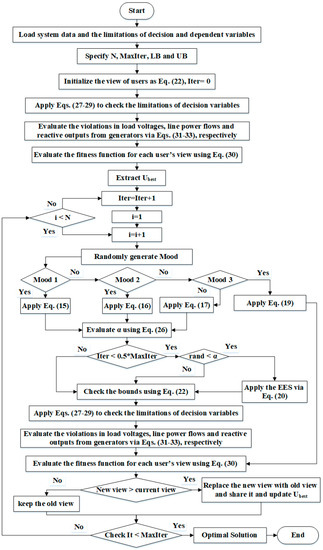
Figure 1.
Proposed ASNS for solving the ORPD problem.
4. Simulation Results
Three distinct standard IEEE grids were utilized as case studies for comparative purposes to investigate the capacity to handle the ORPD challenge as well as the resilience of the suggested ASNS in finding high-quality solutions. The SNS and ASNS algorithms were implemented in the MATLAB software language. The data for three power grids are provided in Table 1, and the entire dataset is derived from [29], while all the limits on control variables used here for all test systems are summarized in Appendix A. The three power grids represent real case studies, where the IEEE 30-bus grid test case represents a simple approximation of the American Electric Power system, while the IEEE 57-bus and IEEE 118-bus grids represent simple approximations of the American Electric Power system in the U.S. Midwest [66].

Table 1.
Information from the studied systems.
The SNS and the suggested ASNS algorithms were implemented by adjusting the size of the population and the maximum number of iterations to 50 and 300 for the first grid, 100 and 300 for the second grid, and 100 and 600 for the third grid.
The relation of proposed method parameters to system parameters can be clearly described with Equation (34):
The findings of each approach were acquired for each study case by executing 30 tests. The following two cases are being investigated:
- Case 1: Minimization of the TGLs described in Equation (2).
- Case 2: Minimization of the TVD described in Equation (3).
- Case 3: Minimization of the VSI described in Equation (6).
4.1. Results of the First Grid
As illustrated in Figure 2, this grid comprises of 30-bus and 41-branch generators, 4 on-load tap changing transformers, and 9 shunted compensators. The entire dataset for lines, buses, and the limits of reactive power generation is utilized [67,68]. The limits for the generator voltage and tap settings are 1.1000 and 0.9000 p.u., respectively. The limits of voltage for the load buses are considered to be 1.0500 and 0.9500 p.u., respectively. The SNS and proposed ASNS algorithms are implemented in the first case, and the best control settings are presented in Table 2. The basic SNS algorithm reduces TGLs from 5.7960 MW to 4.5208 MW when compared to the initial case; however, the proposed ASNS algorithm achieves the lowest power losses of 4.5206 MW when compared to 5.7960 MW in the initial instance. This is a 22% reduction. The resulting solutions are contrasted with previously reported findings for minimizing the losses and utilizing the same circumstances, as summarized in Table 2, which shows that the proposed ASNS algorithm outperforms numerous strategies in minimizing the TGLs. ILAO [34], SCA [47], WOA [48], HFA [69], QOTLBO [70], CLPSO [22], ABC [28], ALO [28], MPA [50], MFA [71], and AEO [36] achieve TGLs of 4.5217, 4.7086, 4.5943, 4.529, 4.5594, 4.5615, 4.6110, 4.5900, 4.5335, 4.5340, and 4.5262, respectively.
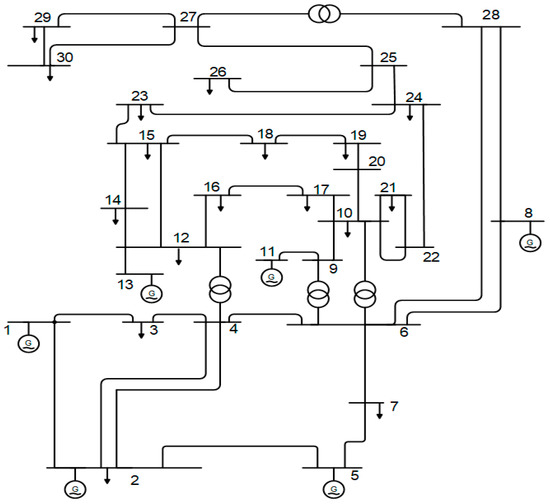
Figure 2.
IEEE 30-bus grid [72].
Table 2.
Optimal results for Case 1 of the IEEE 30-bus grid.
Furthermore, the convergent properties of the proposed ASNS and SNS for Case 1 of the IEEE 30-bus grid are depicted in Figure 3. As shown, the curve describes the minimization of the total power losses throughout the iterations, while the small shape provides a zoning on the range [4.5–4.85] MW. The variation of the losses starts at a high value of 6.4500 MW at the fifth iteration and continues decreasing, reaching 4.5892, 4.5313, and 4.5206 MW at iterations 100, 200, and 300, respectively.
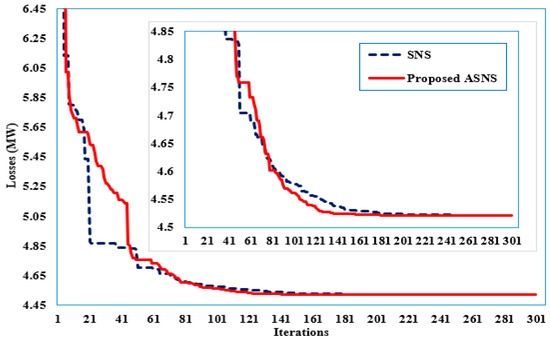
Figure 3.
Convergence features of the ASNS and SNS for Case 1 of the IEEE 30-bus grid.
Figure 4 depicts the voltage levels acquired employing the SNS and ASNS algorithms. It is confirmed that the voltages on all system buses maintain within the acceptable voltage limitations. In addition, the voltages employed by the suggested SNS and ASNS are significantly higher than in the initial case.
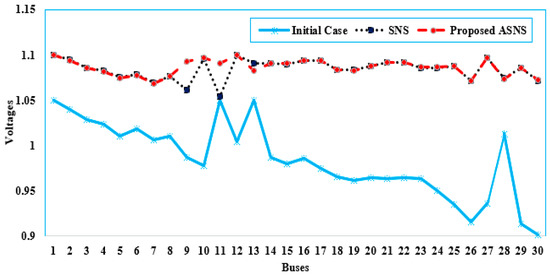
Figure 4.
Voltage Profile of the proposed ASNS and SNS for Case 1 of the IEEE 30-bus grid.
In the second case, the minimization of TVD is considered where the SNS and proposed ASNS algorithms are executed, and the optimal control variables are shown in Table 3. The basic SNS algorithm reduces TVD from 0.8691 p.u. to 0.0846 p.u. when compared to the initial case; however, the proposed ASNS algorithm achieves the lowest TVD value of 0.08435 p.u. when compared to 0.8691 p.u. in the initial instance. This is a 90.3 percent reduction. The resulting solutions are contrasted with previously reported findings for minimizing the losses and utilizing the same circumstances, as summarized in Table 3, which shows that the proposed ASNS algorithm outperforms numerous strategies in minimizing the TGLs. LAO, ILAO [34], IPG-PSO [73], improved GSA [74], HFA [69], and QOTLBO achieved TVDs of 0.0945, 0.0876, 0.0892, 0.08968, 0.0980, and 0.0856, respectively.
Table 3.
Optimal results for Case 2 of the IEEE 30-bus grid.
Furthermore, the convergent properties of the proposed ASNS and SNS for Case 2 of the IEEE 30-bus grid are depicted in Figure 5. As shown, the curve describes the minimization of the throughput of the iterations, while the small shape provides the range [0.08–0.2] p.u. The TVD starts at a high value of 1.4052 p.u. at the fifth iteration and continues decreasing, reaching 658, 0.1076, 0.09821, and 0.0856 p.u. at iterations 50, 100, 200, and 300, respectively.
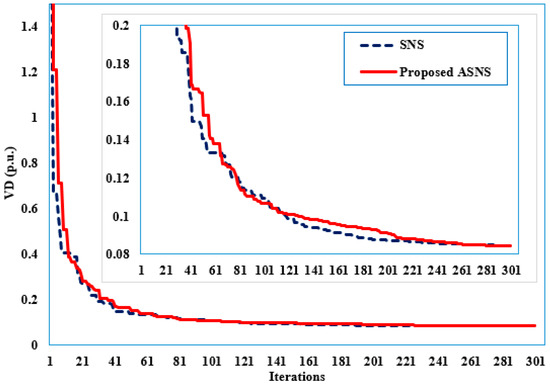
Figure 5.
Convergence features of the proposed ASNS and SNS for Case 2 of the IEEE 30-bus grid.
Figure 6 depicts the voltage values acquired employing the proposed SNS and ASNS algorithms. As shown, the voltages employing the suggested SNS and ASNS are significantly better than in the initial case. Based on the suggested SNS and ASNS, the voltages at all buses are very close to the preferred flat voltage of 1 p.u.
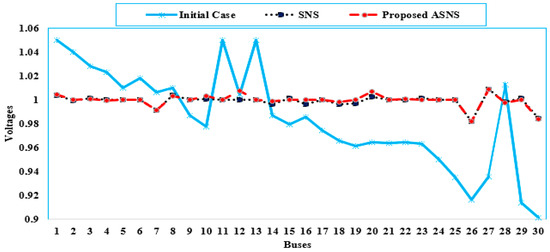
Figure 6.
Voltage Profile of the proposed ASNS and SNS for Case 2 of the IEEE 30-bus grid.
In the third case, the minimization of VSI is considered where the SNS and ASNS algorithms are executed, and the optimal control variables are shown in Table 4. The basic SNS algorithm reduces VSI from 0.1720 p.u. to 0.1248 p.u. when compared to the initial case; however, the proposed ASNS algorithm achieves the lowest VSI index of 0.1243 p.u. when compared to 0.1720 p.u. in the initial instance. This is a 27.7 percent reduction.
Table 4.
Optimal results for Case 3 of the IEEE 30-bus grid.
Table 5 compares the resulting solutions to previously reported findings in order to minimize the VSI objective. Furthermore, the convergent properties of the proposed ASNS and SNS for Case 3 of the IEEE 30-bus grid are depicted in Figure 7. As shown, the curve describes the minimization of the throughput of the iterations, while the small shape is provided on the range [0.1230–0.1480] p.u. The VSI starts at a high value of 0.1511 p.u. at the fifth iteration and continues decreasing, reaching 0.1259, 0.1249, and 0.1243 p.u. at iterations 100, 200, and 300, respectively.
Table 5.
Comparative results for Case 3 of the IEEE 30-bus grid.
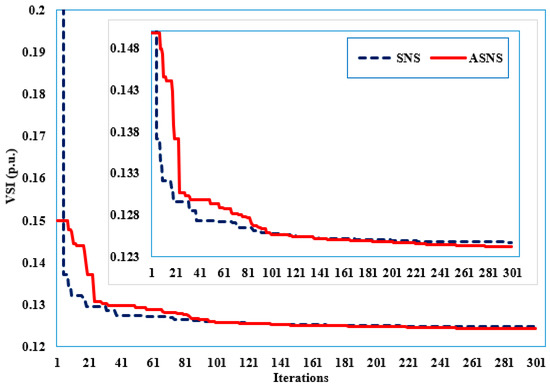
Figure 7.
Convergence features of the proposed ASNS and SNS for Case 3 of the IEEE 30-bus grid.
As shown, the proposed ASNS algorithm outperforms numerous strategies in minimizing the VSI. ABC [44], GA [75], SQP, RGA, and CMAES [76] achieve VSIs of 0.1280, 0.1807, 0.1570, 0.1386, and 0.1382, respectively.
On the other side, taking into consideration the tap-changing transformers and shunt capacitors as discrete variables, Table 6 shows the corresponding results of the proposed ASNS algorithm for the three cases studied above. As shown, the outcomes are very similar. For the first case, the TGLs are minimized from 5.7960 to 4.5206 and 4.5222 MW, considering the continuous and discrete nature of tap-changing transformers and shunt capacitors. Furthermore, the TVD is minimized from 0.8691 to 0.08435 and 0.1037 p.u., while the VSI is minimized from 0.1720 to 0.1243 and 0.1241 p.u., respectively, considering the continuous and discrete nature of tap-changing transformers and shunt capacitors.
Table 6.
Results for Cases 1–3 of the IEEE 30-bus grid considering the continuous and discrete nature of tap-changing transformers and shunt capacitors.
4.2. Results of the Second Grid
The second grid comprises of 57-bus, 80-line, 7-generator and 15 on-load tap changing transformers, and 3 shunted compensators. The limits for the generator voltage and tap settings are 1.1000 and 0.9000 p.u., respectively. The minimum and maximum values for the shunt reactive power injections at buses 18, 25, and 53 are 10.0000, 5.9000, and 6.3000 MVAr, respectively.
In the first case, the SNS and proposed ASNS algorithms are implemented, and the best control settings are presented in Table 7. Furthermore, their convergent properties are depicted in Figure 8. The basic SNS algorithm reduces TGLs from 27.8640 MW to 23.9700 MW when compared to the initial case; however, the proposed ASNS algorithm achieves the lowest power losses of 23.8440 MW when compared to 27.8640 MW in the initial instance. This is a 14.42 % reduction.
Table 7.
Optimal results for Cases 1–3 of the IEEE 57-bus grid.
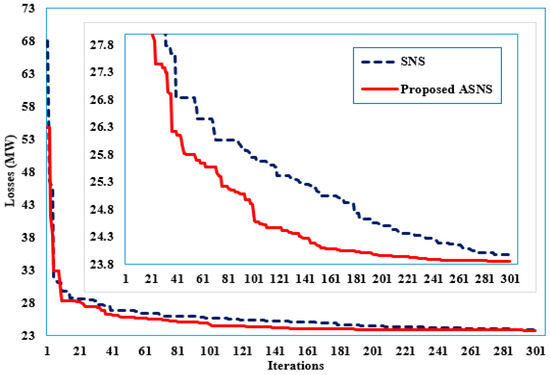
Figure 8.
Convergence features of the proposed ASNS and SNS for Case 1 of the IEEE 57-bus grid.
The minimization of TVD is considered in the second case. Furthermore, the optimal control variables are shown in Table 7, while the convergent properties of the SNS and proposed ASNS algorithms are depicted in Figure 9. The basic SNS algorithm reduces TVD from 1.3586 p.u. to 0.6520 p.u. when compared to the initial case; however, the proposed ASNS algorithm achieves the lowest TVD of 0.6400 p.u. when compared to 1.3586 p.u. in the initial instance. This is a 52.85 percent reduction. For this case, Figure 10 depicts the voltage values acquired employing the proposed SNS and ASNS algorithms. As shown, there have been great improvements in the voltages based on the SNS and ASNS, where the voltages at all buses are very close to the preferred flat voltage of 1.0000 p.u. In addition, the minimum voltage of 0.9359 p.u. at bus 31 is greatly enhanced to be 1.0000 and 0.9800 p.u. based on the SNS and ASNS algorithms, respectively.
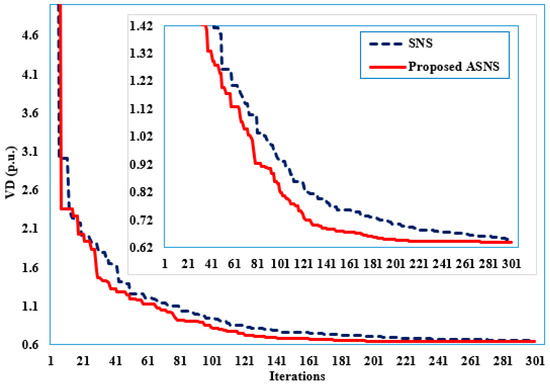
Figure 9.
Convergence features of the proposed ASNS and SNS for Case 2 of the IEEE 57-bus grid.
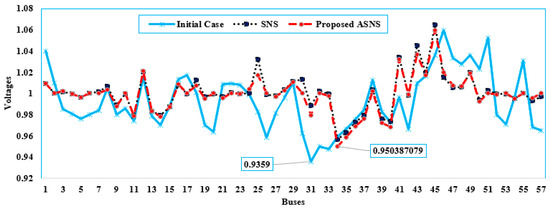
Figure 10.
Voltage Profile of the proposed ASNS and SNS for Case 2 of the IEEE 57-bus grid.
The minimization of VSI is considered in the third case. Furthermore, the optimal control variables are shown in Table 7, while the convergent properties of the SNS and proposed ASNS algorithms are depicted in Figure 11. The basic SNS algorithm reduces VSI from 0.3000 p.u. to 0.2591 p.u. when compared to the initial case; however, the proposed ASNS algorithm achieves the lowest VSI of 0.2542 p.u. when compared to 0.3000 p.u. in the initial instance, with a reduction of 15.33%.
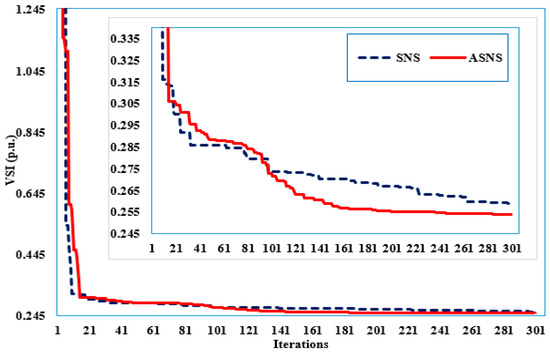
Figure 11.
Convergence features of the proposed ASNS and SNS for Case 3 of the IEEE 57-bus grid.
Table 8 illustrates a comparative result of the obtained objectives based on the SNS and ASNS algorithms and other reported findings of several recent algorithms. For the first case, the proposed ASNS obtains the lowest minimum, mean, and maximum TGLs of 23.8441, 23.9695, and 24.4367, respectively. This comparison derives the superior performance of the proposed ASNS against BSA [77], SCA [47], SMA [78], improved SMA [78], SOA [79], ABC [44], and PSO-ICA [26]. Despite the improved SMA [78], which provides the lowest standard deviation of 0.0617 , the maximum TGLs recorded by the proposed ASNS of 24.4367 MW are better than the best TGLs obtained by it with 24.5856 MW.
Table 8.
Comparative results for Cases 1 and 2 of the IEEE 57-bus grid.
For the second case, the proposed ASNS obtains the lowest minimum, mean, and maximum TVD of 0.6405, 0.6653, and 0.7230, while the basic SNS achieves counterparts of 0.6520, 0.7018, and 0.8237, respectively. This comparison derives the superior performance of the proposed ASNS against the oppositional GSA (OGSA) [80], GB-WCA [30], and WCA [30], which acquire TVDs of 0.6982, 0.6501, and 0.6631, respectively. For the third case, the proposed ASNS obtains the lowest minimum, mean, and maximum VSIs of 0.2542, 0.2586, 0.2,680, and 0.0029, while the basic SNS achieves counterparts of 0.2591, 0.2650, 0.2714, and 0.0036, respectively. This comparison derives the superior performance of the proposed ASNS against HBO [81], and improved HBO [81] which acquire TVDs of 0.6291 and 0.5085, respectively.
4.3. Results of the Third Grid (Large-Scale Case Study)
The proposed SNS and ASNS optimizers are implemented to solve the ORPD problem for the large-scale IEEE 118-bus power grid, and to illustrate and appraise their competency in solving larger-scale ORPD challenges. The grid’s complete data can be obtained in [65]. In the first case, the SNS and proposed ASNS algorithms are implemented, and the best control settings are presented in Table 9. Furthermore, their convergent properties are depicted in Figure 12. The proposed ASNS algorithm successfully achieves the minimum TGL of 85.9111 MW, whereas the basic SNS algorithm reduces it to 87.3385 MW.
Table 9.
Optimal results for Case 1 of the IEEE 118-bus grid.
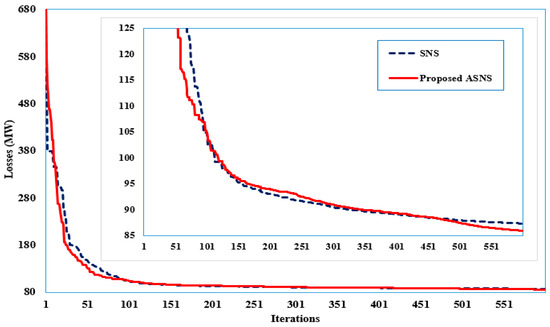
Figure 12.
Convergence features of the proposed ASNS and SNS for Case 1 of the large-scale IEEE 118-bus grid.
For the second case, Table 10 illustrates a comparative result for the obtained objectives based on the SNS and ASNS algorithms and other reported findings of several recent algorithms. As shown, the proposed ASNS obtains the lowest minimum, mean, and maximum TGLs of 85.9111, 87.8445, and 89.7491 MW, respectively. This comparison derives the superior performance of the proposed ASNS against MPA [78], SMA [78], improved SMA [78], OGSA [80], GB-WCA [30], WCA [30], and PSO-ICA [26]. In the second case, the minimization of TVD is considered, and the optimal control variables are shown in Table 11, where the convergent properties of the SNS and proposed ASNS algorithms are depicted in Figure 13. The proposed ASNS algorithm successfully achieves the minimum TVD of 2.9878 p.u., whereas the basic SNS algorithm reduces it to 3.1799 p.u.
Table 10.
Comparative results for Case 1 of the IEEE 118-bus grid.
Table 11.
Optimal results for Case 2 of the IEEE 118-bus grid.
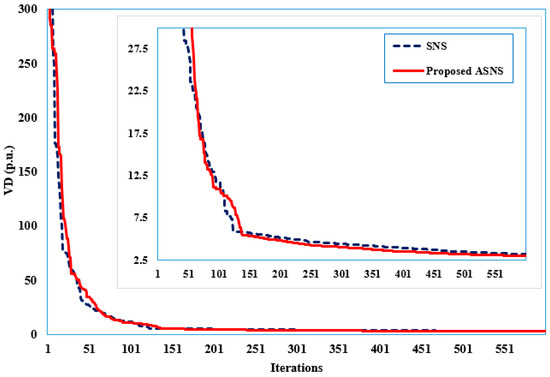
Figure 13.
Convergence features of the ASNS and SNS for Case 2 of IEEE 118-bus grid.
The minimization of VSI is considered in the second case. Furthermore, the optimal control variables are shown in Table 12, while the convergent properties of the SNS and proposed ASNS algorithms are depicted in Figure 14. The proposed ASNS algorithm successfully achieves the minimum VSI of 0.0620 p.u., where the basic SNS algorithm reduces it to 0.0645 p.u.
Table 12.
Optimal results for Case 3 of the IEEE 118-bus grid.
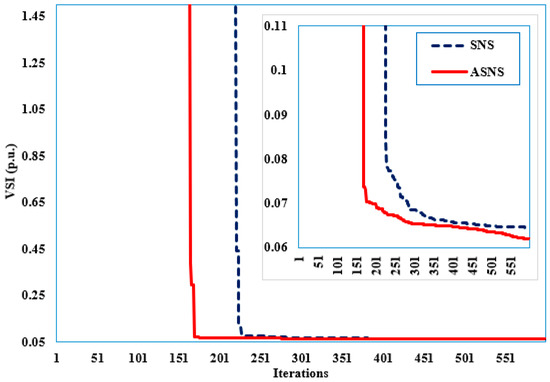
Figure 14.
Convergence features of the proposed ASNS and SNS for Case 3 of the IEEE 118-bus grid.
4.4. SNS versus Proposed ASNS: Statistical Comparisons
To justify the rate of convergence of the proposed ASNS, the computational times (CPU times) of the SNS and ASNS are tabulated for the IEEE 30-, 57-, and 118-bus systems in Table 13. As shown, there is no significant difference between the SNS and ASNS in the computation time when solving the ORPD problem. In addition, the validation of the generators’ reactive power is demonstrated for IEEE 30-, 57-, and 118-bus systems, as stated in Appendix A.
Table 13.
Average computational time per iteration using ASNS and SNS.
For the sake of assessing the robustness study, the acquired minimum values of the TGLs and TVDs of the 30-runs are analyzed using the SNS and the proposed ASNS algorithms. Their spread and centers for both cases studied of the IEEE 30-, IEEE 57-, and IEEE 118-bus grids are described in Figure 15 via a Box and Whiskers plot. Furthermore, Table 14 displays the detailed robustness indices for Cases 1–3 of the IEEE 30-bus grid, and the percentage of improvement is evaluated to illustrate the difference between the results achieved by using SNS and ASNS regarding the medium-test system IEEE 30. Additionally, Figure 16 describes the obtained fitness values for both cases for the large-scale IEEE 118-bus grid. To investigate the analysis of the SNS and ASNS in terms of average success rate and convergence characteristics, minimizing the losses (Case 1) for the IEEEE 30-bus system is considered. At various percentages of convergence, including 70, 80, 90, and 100%, the absolute difference between the best and worst, its percentage, and the success rate are computed. Table 15 tabulates the related absolute difference between the best and worst and the best percentage, while Figure 17 depicts the regarded success rate. To investigate the robustness of the proposed algorithm parameters on the system behavior, the algorithm parameters are varied in terms of the number of search individuals and the maximum number of iterations, and the success rate is computed for minimizing the losses (Case 1) for the IEEE 30-bus system. The results are tabulated in Table 16.
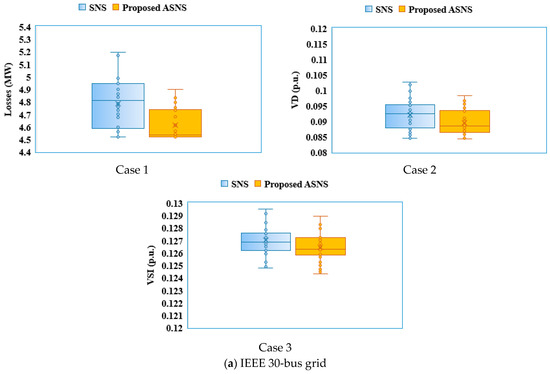
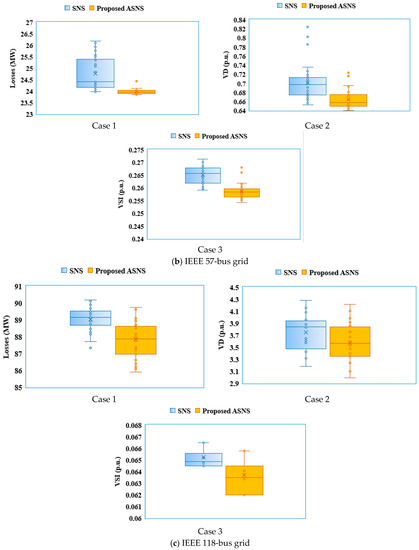
Figure 15.
Box and Whiskers plot for the SNS and proposed ASNS of the IEEE 30-, IEEE 57-, and IEEE 118-bus grids.
Table 14.
Detailed robustness indices for Cases 1-3 of the IEEE 30-bus grid.
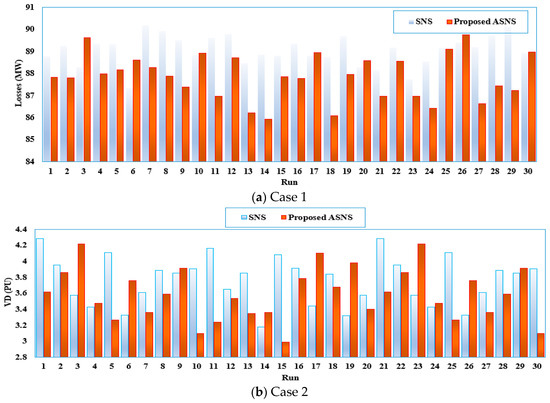
Figure 16.
Obtained fitness values for SNS and proposed ASNS of the IEEE 118-bus grids.
Table 15.
Absolute difference between the best and worst of SNS and ASNS for minimizing the losses (Case 1) for the IEEE 30-bus system.
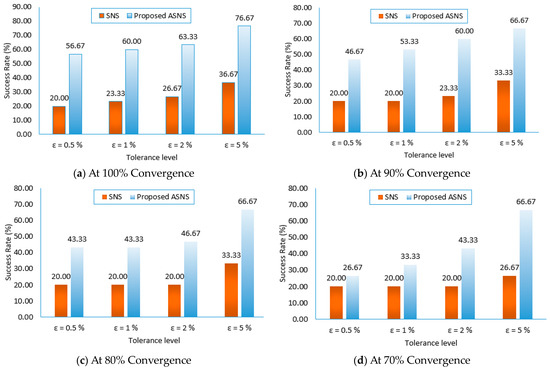
Figure 17.
Success rates of SNS and ASNS for Case 1 for the IEEE 30-bus system.
Table 16.
Success rates for different values of the ASNS parameters used for minimizing the losses (Case 1) for the IEEE 30-bus system.
Moreover, the effectiveness and performance of the envisaged ASNS and SNS are explored on 25 benchmark functions classified into unimodal, multimodal, fixed, and variable-dimension benchmark functions. Table 17 tabulates their full data in terms of their names, variable lengths, and permissible experiment intervals. The number of search individuals is 30 for the SNS and improved ASNS algorithms, and the maximum number of iterations is 1000. The simulations are performed thirty times. For this purpose, Table 17 provides detailed comparisons in terms of the mean, best, and standard deviation using ASNS and SNS as benchmark functions.
Table 17.
Comparisons of the mean, best, and standard deviation using ASNS and SNS for benchmark functions.
4.5. Discussion Analysis
The proposed ASNS and the original SNS algorithms derive adequate validation of the practical constraints related to the generators’ reactive power, which is demonstrated for IEEE 30-, 57-, and 118-bus systems. Based on the statistical comparisons via Figure 15, the proposed ASNS algorithm shows superior performance compared to the SNS algorithm for all cases studied of the IEEE 30-, IEEE 57-, and IEEE 118-bus grids.
For the IEEE 30-bus grid (Figure 15a), the proposed ASNS algorithm obtains the lowest minimum, mean, and maximum TGLs in the first case of 4.5207, 4.6154, and 4.8987 MW, respectively. Similarly, in the second case, it obtains the lowest minimum, mean, and maximum TVDs of 0.0843, 0.0896, and 0.0983 MW, respectively. Furthermore, the proposed ASNS algorithm provides the smallest standard deviations of TGLs of 0.1254 and TVD of 0.0041, respectively, relative to the SNS algorithm with TGLs of 0.1916 and TVD of 0.005.
As shown in Table 14, great improvement in the standard deviation is obtained with 34.5600, 18.7139, and 17.3804%, respectively, for Cases 1–3. Added to that, a great improvement in the maximum value is obtained with 5.6675, 4.2217, and 1.2360%, respectively, for Cases 1–3. Furthermore, significant improvements in the mean value are obtained with 3.5852, 2.6837, and 1.0783%, respectively, for Cases 1–3. For obtaining the minimum value, the obtained improvement is 0.0036, 0.3085, and 2.1955%, respectively, for Cases 1–3.
Similar findings are attained for the IEEE-57 bus grid (Figure 15b), where the proposed ASNS algorithm provides the smallest standard deviations of TGLs of 0.1119 and TVDs of 0.0207, respectively, relative to the SNS algorithm with TGLs of 0.7348 and TVDs of 0.0407.
For the IEEE 118-bus grid (Figure 15c), the proposed ASNS algorithm provides higher standard deviations of TGLs of 1.0300 and TVDs of 0.3300, respectively, relative to the SNS algorithm with TGLs of 0.6735 and TVDs of 0.3079. Despite that, the majority of the obtained fitness values for both cases are significantly lower than their counterparts using the SNS algorithm, as described in Figure 16.
From both Table 15 and Figure 17, the ASNS provides higher exploitation ability, which is increased with increasing the convergence level. It can be noted that:
- The proposed ASNS always achieves a lower difference percentage compared to the SNS. At 100% convergence, it has 8.36% while the SNS has 14.87%.
- The proposed ASNS always achieves a higher success rate compared to the SNS.
- At 90% and 100% convergence, the proposed ASNS provides approximately 2.5 times the success rate compared to the SNS. At 70% and 80% convergence, the ASNS provides approximately double the success rate of the SNS.
Furthermore, as shown in Table 16, increasing the maximum number of iterations increases the success rate. For example, at 50 search individuals, the success rate increases from 20% at 150 iterations to 33.33% at 200 iterations to 56.66% at 250 iterations to 76.66% at 300 iterations. Furthermore, the higher the number of search individuals, the higher the improvement of the success rate. For example, at 300 iterations, the success rate increased from 6.66% at 15 search individuals to 16.66% at 25 search individuals to 26.66% at 40 search individuals to 76.66% at 50 search individuals.
Nevertheless, higher robustness and effectiveness of the proposed improvements to the ASNS algorithm are demonstrated since the proposed ASNS successfully obtains the lowest mean, best, and standard deviation for the majority of the considered benchmark functions, as shown in Table 17.
4.6. Parameter Tuning of SNS and ASNS Algorithms
To demonstrate parameter tuning, the SNS and ASNS algorithms are used with varying numbers of search agents and iterations while power loss minimization is considered. At first, the IEEE 30-bus system is simulated, and Figure 18 describes the corresponding curves for both algorithms.
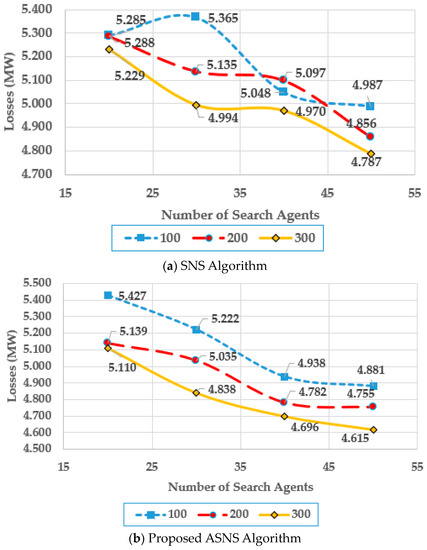
Figure 18.
Parameter Tuning of SNS and ASNS Algorithms for Case 1 for the IEEE 30-bus system.
As shown, the lowest power losses are achieved at 50 search agents and 300 iterations for both algorithms. Therefore, the SNS and ASNS algorithms are set to have these characteristics as stated in Table A1 in Appendix A. Furthermore, for both algorithms, increasing the number of iterations and the search agents results in reduced power losses. The proposed ASNS algorithm shows great superiority compared to the original SNS for most of the combinations of the iterations and the search agents. For example, at 300 iterations, the proposed ASNS algorithm provides a reduction in power losses of 2.29, 3.11, 5.51, and 3.59% at a number of search agents of 20, 30, 40, and 50, respectively.
Furthermore, the IEEE 57-bus system is simulated, and Figure 19 depicts the relevant contours for both methods. As demonstrated, the suggested ASNS algorithm outperforms the original SNS for the majority of cycles and search agent combinations. At 100 rounds, the suggested ASNS algorithm reduces power losses by 2.29, 3.71, 4.28, and 4.76% at search agent counts of 30, 40, and 50, respectively. At 200 rounds, the suggested ASNS algorithm reduces power losses by 4.36, 5.76, and 4.83% at search agent counts of 30, 40, and 50, respectively. At 300 rounds, the suggested ASNS algorithm improves power losses by 3.97, 3.95, and 3.19% at search agent counts of 30, 40, and 50, respectively.
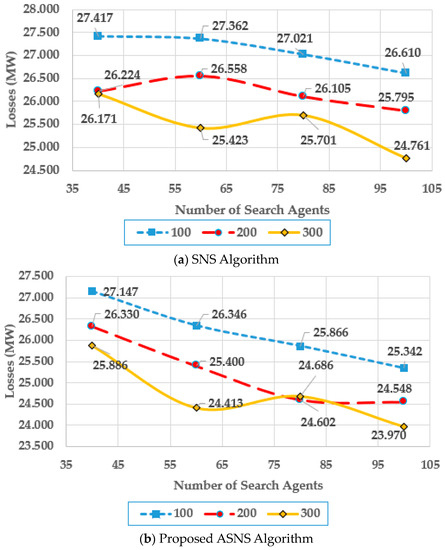
Figure 19.
Parameter Tuning of SNS and ASNS Algorithms for Case 1 for IEEE 57-bus system.
Furthermore, for both algorithms, increasing the number of iterations and search agents results in a greater decrease in power losses. Both methods attain the lowest power losses at 100 search agents and 300 iterations. As a result, the SNS and ASNS algorithms are configured to have the traits listed in Table A1 in Appendix A.
Finally, the IEEE 118-bus system is simulated, and Figure 20 describes the corresponding curves for both algorithms.
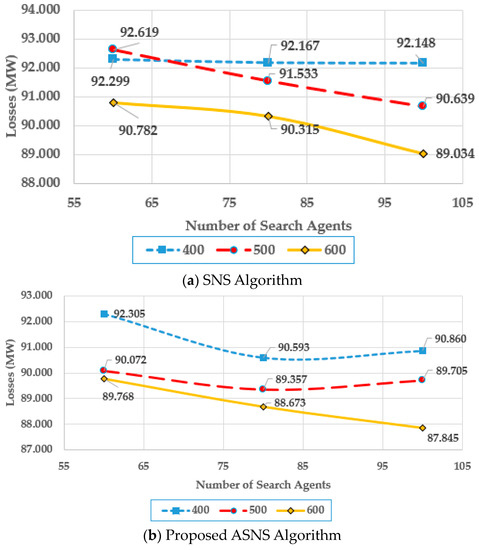
Figure 20.
Parameter Tuning of SNS and ASNS Algorithms for Case 1 for the IEEE 118-bus system.
As demonstrated, the suggested ASNS algorithm outperforms the original SNS for most of the repetition and search agent combinations. For example, at 600 iterations, the proposed ASNS algorithm provides a reduction in power losses of 1.12, 1.82, and 1.34% at a number of search agents of 60, 80, and 100, respectively. Furthermore, for both algorithms, increasing the number of iterations and search agents results in a greater decrease in power losses. Both algorithms attain the lowest power losses at 100 search agents and 600 rounds. Therefore, the SNS and ASNS algorithms are set to have these characteristics as stated in Table A1 in Appendix A.
5. Conclusions
This study introduces an intelligent optimizer used for finding the optimal scheduling of reactive ORPD power resources (i.e., ASNS). ASNS aims to reduce real power losses and voltage variations while avoiding falling into local optima through two strategies: effective exploitation and adaptable parameter strategies. Simulations were conducted using three standard grids, the IEEE 30-, 57-, and 118-bus. The performance validation across companies’ diverse comparisons and statistical analyses is compared with the state of the art. The proposed analysis demonstrates the capability of the ASNS to tackle the ORPD issues with effective and robust performance. The proposed ASNS shows superiority over the state of the art and achieves a great reduction of power losses ( 22%, 14.42%, and 1.62%) and a higher improvement of voltage profiles of 90.3%, 52.85%, and 6.07% for IEEE 30-, IEEE 57-, and IEEE 118-bus grids, respectively. Furthermore, the simulation results show that the ASNS algorithm supports the diversity of populations.
The main objectives that are usually utilized in the ORPD problem are power loss, voltage profile, and voltage stability. Usually, they are very important measures that reflect the technical performance of the steady state operating condition of the system under study. On the other side, some other objectives could be considered for future work, such as reactive power reserve margin maximization and loadability enhancement. Therefore, the future of this study covers two categories. The first aims to solve other complex problems such as OPF for different power system requirements, adding new constraints and limitations for AC/DC grids with the high penetration of renewable energy resources. On the other hand, from the standpoint of solution methodology, developing other optimization algorithms to solve the considered problems.
Author Contributions
Conceptualization, A.S.; Methodology, A.S.; Software, S.S. and A.S.; Validation, A.S.; Formal analysis, R.E.-S.; Investigation, S.S. and R.E.-S.; Resources, R.E.-S.; Data curation, A.S. and M.G.; Writing—original draft, A.S.; Writing—review & editing, S.S. and R.E.-S.; Visualization, M.G.; Supervision, S.S. and M.G.; Project administration, M.G.; Funding acquisition, S.S. All authors have read and agreed to the published version of the manuscript.
Funding
This research work was funded by Institutional Fund Projects under grant no. (IFPIP: 593-612-1443). The authors gratefully acknowledge technical and financial support from Ministry of Education and King Abdulaziz University, DSR, Jeddah, Saudi Arabia.
Conflicts of Interest
The authors declare no conflict of interest.
Abbreviations
| ABC | Artificial bee colony |
| ABO | Accelerated bio-inspired optimizer |
| AEO | Artificial ecosystem optimizer |
| ALO | Ant lion optimizer |
| APT-FPSO | Adaptive particularly tunable fuzzy particle swarm optimization |
| ASNS | Augmented social network search |
| BBO | Biogeography based optimizer |
| BFA | Bacteria foraging-based algorithm |
| BSA | Backtracking search algorithm |
| CAC-DE | Continuous ant colony-based differential evolution |
| CLPSO | Comprehensive learning particle swarm optimization |
| CMAES | Covariance matrix adopted evolutionary strategy |
| CTFWO | Chaotic turbulent flow of water-based optimization |
| DE | Differential evolution |
| EES | Effective exploitation strategy |
| EFA | Enhanced firefly algorithm |
| ERWCA | Evaporation rate water cycle algorithm |
| FLP | Fuzzy-based procedure |
| GA | Genetic algorithm |
| GB-WCA | Gaussian bare-bones water cycle algorithm |
| GSA | Gravitational search algorithm |
| HBO | Heap-based optimizer |
| HFA | Hybrid firefly algorithm |
| ICA | Imperialist competitive algorithm |
| ILAO | improved lightning attachment procedure optimizer |
| IMPA | Improved version of the marine predator algorithm |
| IMPA | Improved marine predators’ algorithm |
| IPG-PSO | Improved pseudo-gradient particle swarm optimization |
| MFA | Moth-flame optimization |
| MODE | Multi-objective differential evolution |
| MPA | Marine predators’ algorithm |
| NRA | Newton-Raphson algorithm |
| OGSA | Oppositional GSA |
| OPF | Optimal power flow |
| ORPD | Optimal reactive power dispatch |
| p.u. | Per unit |
| PSO | Particle swarm optimization |
| PSO-TVAC | PSO with time-varying acceleration coefficients |
| PSO-ICA | Particle swarm optimization-imperialism competitive algorithm |
| QEA | Quantum-inspired evolutionary algorithm |
| QODE | Quasi-oppositional differential evolution |
| QOTLBO | Quasi-oppositional teaching-learning based optimization |
| RGA | Real coded genetic algorithm |
| SBDE | Self-balanced differential evolution |
| SCA | Sine-cosine Algorithm |
| SHADE | Successful history-based adaptive Differential Evolution algorithm |
| SMA | Slime-mould algorithm |
| SNS | Social network search |
| SOA | Seeker optimization algorithm |
| SQP | Sequential quadratic programming |
| TGLs | Total grid losses |
| TVD | Total voltage deviation |
| VSI | Voltage stability index |
| WCA | Water cycle algorithm |
| WOA | Whale optimization algorithm |
| Symbols | |
| N | Number of objectives |
| F | Vector of n objectives |
| Xu and Xv | Dependent and independent variables, respectively |
| Gij | Conductance of every link connecting buses i and j |
| θ, V and Nb | Phase angle, voltage, and number of buses, respectively |
| View | The reference voltage of buses which is taken as 1 p.u. |
| Lj | L-index for each bus j |
| δi and δj | Phase angles of the voltage at buses i and j, respectively |
| YLL and YLG | Sub-matrices of Y-Bus matrix |
| VG1, VG2, …, VGNG | Generator voltages |
| Ta1, Ta2, …, TaNT | Transformer tap settings |
| Qr1, Qr2, …, QrNr | Reactive power (VAr) supplied by switched capacitors and reactors |
| NG, Nr and NT | Number of generators, number of the VAr sources, and number of on-load tap transformers, respectively |
| VL1, …, VLNPQ | Load bus voltage magnitudes |
| QG1, QG2, …, QGNG | VAr outputs of the generators |
| SF1, …, SFNL | Transmission line loadings |
| SFL and NL | Power flows in line L and the number of transmission lines, respectively |
| PL, QL and Bij | Active and reactive power demand, and mutual susceptance between bus i and j, respectively |
| Ui and Uj | Vectors of the user’s view of i and j, respectively |
| r1 and r2 | Random vectors which are, respectively, inside the ranges [0, 1] and [−1, 1]. |
| Uk | Randomly selected event vector |
| Umean | Mean vector within a group or commenters of views of friends |
| Ngroup | Number of users in the group |
| The current idea of the user i about each variable d | |
| Ubest | Best viewpoint among the users that get the lowest fitness for every iteration |
| LBd and UBd | Lower and upper limits of the variable d, accordingly |
| MaxIter | Maximum number of iterations |
| N | Number of users |
Appendix A
For both SNS and ASNS algorithms, Table A1 describes the number of search individuals and the maximum number of iterations. Furthermore, it contains all the limits on control variables (LB, UB) used herein for all test systems (IEEE 30-, 57-, and 118-bus systems).
Table A1.
Parameters of the ASNS and SNS for ORPD applications.
Table A1.
Parameters of the ASNS and SNS for ORPD applications.
| Items and Studied Systems | IEEE 30-Bus System | IEEE 57-Bus System | IEEE 118-Bus System | |
|---|---|---|---|---|
| N | 50 | 100 | 100 | |
| MaxIter | 300 | 300 | 600 | |
| Generator voltages (p.u.) | LB | 0.9000 | 0.9000 | 0.9400 |
| UB | 1.1000 | 1.1000 | 1.0600 | |
| Tap-changing transformers (p.u.) | LB | 0.9000 | 0.9000 | 0.9000 |
| UB | 1.1000 | 1.1000 | 1.1000 | |
| Shunt Capacitors (MVAr) | LB | 0 | 0 | 0 |
| UB | −30.0000 | 10.0000, 5.9000, and 6.3000 | 30.0000 | |
Additionally, Table A2, Table A3 and Table A4 provide the generators’ reactive power for IEEE 30-, 57-, and 118-bus systems.
Table A2.
Generators’ reactive power for the IEEE 30-bus system.
Table A2.
Generators’ reactive power for the IEEE 30-bus system.
| QMAX | QMIN | Case 1-SNS | Case 1-ASNS | Case 2-SNS | Case 2-ASNS | Case 3-SNS | Case 3-ASNS | |
|---|---|---|---|---|---|---|---|---|
| QG 1 | 200 | −20 | −11.0933 | −10.0538 | −20 | −19.9097 | −11.6589 | −17.1944 |
| QG 2 | 100 | −20 | 15.7518 | 15.5574 | −6.8016 | −7.4537 | 15.6506 | −13.3928 |
| QG 5 | 80 | −15 | 24.4079 | 24.0469 | 37.5118 | 37.6167 | 15.8655 | 44.3173 |
| QG 8 | 60 | −15 | 29.0434 | 28.8129 | 38.7653 | 42.4471 | 56.6655 | 58.8949 |
| QG 11 | 50 | −10 | −2.9666 | −0.9345 | 1.45 | 0.4212 | 1.9563 | 6.465 |
| QG 13 | 60 | −15 | −7.156 | −13.3821 | −2.8688 | −4.786 | 0.4302 | 1.2194 |
Table A3.
Generators’ reactive power for the IEEE 57-bus system.
Table A3.
Generators’ reactive power for the IEEE 57-bus system.
| QMAX | QMIN | Case 1-SNS | Case 1-ASNS | Case 2-SNS | Case 2-ASNS | Case 3-SNS | Case 3-ASNS | |
|---|---|---|---|---|---|---|---|---|
| QG 1 | 200 | −140 | 25.5118 | 24.9556 | −4.5304 | −6.9715 | 110.6362 | 18.4536 |
| QG 2 | 50 | −17 | 49.4901 | 50 | 43.1114 | 44.316 | 19.51 | 37.5813 |
| QG 3 | 60 | −10 | 45.8101 | 47.6413 | 57.4301 | 59.8936 | 9.9011 | 19.4484 |
| QG 6 | 25 | −8 | −5.5959 | 0.2218 | 14.8235 | 18.9114 | −2.8447 | 18.2721 |
| QG 8 | 200 | −140 | 69.586 | 66.5433 | 16.1191 | 8.1599 | 48.3652 | 68.1371 |
| QG 9 | 9 | −3 | 7.1224 | 8.8809 | 9 | 9 | 4.8712 | 1.0238 |
| QG 12 | 155 | −150 | 75.7926 | 71.2139 | 149.7989 | 154.1204 | 100.0011 | 136.6506 |
Table A4.
Generators’ reactive power for the IEEE 118-bus system.
Table A4.
Generators’ reactive power for the IEEE 118-bus system.
| QMAX | QMIN | Case 1-SNS | Case 1-ASNS | Case 2-SNS | Case 2-ASNS | Case 3-SNS | Case 3-ASNS | |
|---|---|---|---|---|---|---|---|---|
| QG 1 | 15 | −5 | 14.5662 | 14.5171 | 14.6358 | 14.7846 | 5.0759 | 7.8489 |
| QG 4 | 300 | −300 | 24.0705 | −5.7346 | −158.184 | −42.621 | −136.723 | −45.0406 |
| QG 6 | 50 | −13 | 25.8123 | 20.798 | 4.1469 | 24.9696 | 22.6758 | −7.127 |
| QG 8 | 300 | −300 | −25.5407 | 5.4553 | 179.2201 | 122.6642 | 178.53 | 94.9364 |
| QG 10 | 200 | −147 | −100.486 | −101.849 | −89.6337 | −102.598 | −26.3501 | −21.9034 |
| QG 12 | 120 | −35 | 53.7451 | 47.5395 | 99.0349 | 108.5367 | 76.6854 | 22.4387 |
| QG 15 | 30 | −10 | 11.6375 | 17.6951 | −4.5287 | −9.7037 | −0.1446 | −4.803 |
| QG 18 | 50 | −16 | 38.4646 | 20.1267 | −13.2123 | −10.1985 | 35.1172 | 11.0603 |
| QG 19 | 24 | −8 | 13.4858 | 17.414 | −5.3478 | −1.8856 | 4.004 | −7.1696 |
| QG 24 | 300 | −300 | −8.0755 | 6.6627 | 24.6526 | 7.9436 | −19.9092 | 43.1933 |
| QG 25 | 140 | −47 | 79.5415 | 50.3089 | −19.0465 | 80.2624 | −24.6135 | −32.0925 |
| QG 26 | 1000 | −1000 | −93.8935 | −64.4136 | −71.0957 | −129.847 | 33.0448 | −69.801 |
| QG 27 | 300 | −300 | 24.8739 | 20.9573 | 12.6348 | 71.796 | 70.9331 | 101.5602 |
| QG 31 | 300 | −300 | 30.6733 | 22.3169 | 91.0509 | 60.4686 | 27.5755 | 14.6481 |
| QG 32 | 42 | −14 | 9.9814 | 17.4136 | 9.809 | 21.75 | −10.8293 | 7.3427 |
| QG 34 | 24 | −8 | 13.5709 | −6.4994 | −1.1196 | 5.37 | 4.1177 | 14.9506 |
| QG 36 | 24 | −8 | 7.427 | 2.3472 | −3.3417 | −5.6468 | −6.9791 | 7.5597 |
| QG 40 | 300 | −300 | 34.2823 | 33.0815 | 68.7116 | 93.961 | −91.0034 | 50.7242 |
| QG 42 | 300 | −300 | 19.9429 | 20.2193 | 46.3348 | 33.4737 | 183.3751 | 50.9194 |
| QG 46 | 100 | −100 | 2.58 | −11.4573 | 5.3837 | 11.5149 | 41.3022 | 35.5478 |
| QG 49 | 210 | −85 | 49.9421 | 51.7827 | 139.1609 | 76.4511 | 209.4643 | 207.6757 |
| QG 54 | 300 | −300 | 42.6336 | 34.5675 | 49.4748 | 53.0367 | 7.9369 | −5.374 |
| QG 55 | 23 | −8 | 16.2703 | 11.3564 | −6.2283 | 20.4349 | 15.1702 | 10.8474 |
| QG 56 | 15 | −8 | 1.1199 | 4.943 | −6.5023 | −5.3435 | −6.4955 | 5.9728 |
| QG 59 | 180 | −60 | 91.1813 | 108.4431 | 139.8281 | 96.177 | 13.9116 | 28.593 |
| QG 61 | 300 | −100 | −2.492 | −18.1329 | −18.0023 | −93.7582 | −14.4094 | −97.3926 |
| QG 62 | 20 | −20 | −3.1049 | 7.5193 | −6.57 | −4.0851 | −13.9373 | −8.5001 |
| QG 65 | 200 | −67 | 16.9089 | 3.2103 | −8.3426 | −66.4617 | 16.5881 | 86.23 |
| QG 66 | 200 | −67 | −61.7869 | −65.5083 | −34.4029 | −65.5431 | −59.0314 | 49.8348 |
| QG 69 | 300 | −300 | −134.618 | −110.43 | −98.2275 | −181.783 | 161.5133 | 186.1353 |
| QG 70 | 32 | −10 | 10.3158 | 19.4645 | 1.7462 | 31.0587 | 27.373 | 25.3555 |
| QG 72 | 100 | −100 | −6.4364 | −13.4015 | 2.4662 | 1.6687 | −18.189 | −22.4441 |
| QG 73 | 100 | −100 | −3.1452 | −5.3301 | 26.1035 | 12.8339 | −21.4349 | −35.1946 |
| QG 74 | 9 | −6 | 7.992 | 6.6092 | 6.3794 | 3.7695 | 6.2625 | −3.1613 |
| QG 76 | 23 | −8 | 22.8668 | 22.0407 | 16.8353 | 20.2507 | 19.5854 | 22.912 |
| QG 77 | 70 | −20 | 56.9625 | 60.605 | 36.5389 | 46.2464 | 46.2572 | 46.2732 |
| QG 80 | 280 | −165 | 39.3082 | 3.2877 | 240.1401 | 230.5782 | −123.555 | −136.336 |
| QG 85 | 23 | −8 | 19.3618 | 18.9086 | 18.0338 | 22.8371 | 14.0021 | 16.052 |
| QG 87 | 1000 | −100 | −0.5023 | 0.025 | 12.7369 | 10.2115 | 8.7072 | 5.9641 |
| QG 89 | 300 | −210 | 0.1398 | 24.1265 | −123.079 | −116.085 | −28.4652 | −11.6247 |
| QG 90 | 300 | −300 | 51.6318 | 37.6659 | 210.6461 | 199.8874 | 72.1733 | 45.8006 |
| QG 91 | 100 | −100 | −3.3313 | −1.1698 | −51.9619 | −60.1563 | 4.301 | 27.8025 |
| QG 92 | 9 | −3 | 0.821 | 5.5476 | −2.7115 | −2.5073 | −0.4118 | −2.8518 |
| QG 99 | 100 | −100 | −3.6525 | −6.4569 | 34.6788 | 38.4328 | 17.4873 | −16.9542 |
| QG 100 | 155 | −50 | 33.2354 | 59.9011 | −40.3621 | −49.2498 | 63.7574 | 19.4836 |
| QG 103 | 40 | −15 | 15.7092 | 2.3865 | 10.6147 | 24.2089 | 1.3529 | 39.2042 |
| QG 104 | 23 | −8 | 19.9708 | 8.3988 | 9.961 | 15.3062 | 17.6745 | 4.8378 |
| QG 105 | 23 | −8 | 18.0353 | 8.845 | 12.829 | −6.6591 | 3.9311 | 20.6032 |
| QG 107 | 200 | −200 | −1.2282 | −10.9052 | 55.4818 | 50.2043 | 16.5422 | 27.9711 |
| QG 110 | 23 | −8 | 19.8166 | 10.8218 | 0.0812 | 1.6577 | 16.7011 | 16.1153 |
| QG 111 | 1000 | −100 | −1.189 | −2.5185 | −9.6835 | −19.4414 | 6.8634 | −19.2893 |
| QG 112 | 1000 | −100 | 13.0845 | 12.7739 | 34.4648 | 43.5942 | 18.6459 | 40.1109 |
| QG 113 | 200 | −100 | −7.4075 | −12.5293 | 62.0482 | −99.4147 | −59.7926 | 18.0029 |
| QG 116 | 1000 | −1000 | 27.7889 | 10.5345 | −275.617 | 4.7293 | −66.9456 | −155.514 |
References
- Chen, X.; Li, K.; Xu, B.; Yang, Z. Biogeography-based learning particle swarm optimization for combined heat and power economic dispatch problem. Knowl.-Based Syst. 2020, 208, 106463. [Google Scholar] [CrossRef]
- Acharya, S.; Ganesan, S.; Kumar, D.V.; Subramanian, S. A multi-objective multi-verse optimization algorithm for dynamic load dispatch problems. Knowl.-Based Syst. 2021, 231, 107411. [Google Scholar] [CrossRef]
- Naderi, E.; Narimani, H.; Pourakbari-Kasmaei, M.; Cerna, F.V.; Marzband, M.; Lehtonen, M. State-of-the-Art of Optimal Active and Reactive Power Flow: A Comprehensive Review from Various Standpoints. Processes 2021, 9, 1319. [Google Scholar] [CrossRef]
- Bentouati, B.; Khelifi, A.; Shaheen, A.M.; El-Sehiemy, R.A. An enhanced moth-swarm algorithm for efficient energy management based multi dimensions OPF problem. J. Ambient Intell. Humaniz. Comput. 2020, 12, 1–21. [Google Scholar] [CrossRef]
- Muhammad, Y.; Khan, R.; Raja, M.A.Z.; Ullah, F.; Chaudhary, N.I.; He, Y. Solution of optimal reactive power dispatch with FACTS devices: A survey. Energy Rep. 2020, 6, 2211–2229. [Google Scholar] [CrossRef]
- Rezaie, H.; Kazemi-Rahbar, M.H.; Vahidi, B.; Rastegar, H. Solution of combined economic and emission dispatch problem using a novel chaotic improved harmony search algorithm. J. Comput. Des. Eng. 2019, 6, 447–467. [Google Scholar] [CrossRef]
- Roy, P.K.; Ghoshal, S.P.; Thakur, S.S. Biogeography based optimization for multi-constraint optimal power flow with emission and non-smooth cost function. Expert Syst. Appl. 2010, 37, 8221–8228. [Google Scholar] [CrossRef]
- Hassan, M.H.; Kamel, S.; Abualigah, L.; Eid, A. Development and application of slime mould algorithm for optimal economic emission dispatch. Expert Syst. Appl. 2021, 182, 115205. [Google Scholar] [CrossRef]
- Bhadoria, A.; Marwaha, S. Moth flame optimizer-based solution approach for unit commitment and generation scheduling problem of electric power system. J. Comput. Des. Eng. 2020, 7, 668–683. [Google Scholar] [CrossRef]
- Shaheen, A.; Ginidi, A.; El-Sehiemy, R.; Elsayed, A.; Elattar, E.; Dorrah, H.T. Developed Gorilla Troops Technique for Optimal Power Flow Problem in Electrical Power Systems. Mathematics 2022, 10, 1636. [Google Scholar] [CrossRef]
- Lujano-Rojas, J.M.; Zubi, G.; Dufo-Lopez, R.; Bernal-Agustin, J.L.; Atencio-Guerra, J.L.; Catalao, J.P.S. Embedding quasi-static time series within a genetic algorithm for stochastic optimization: The case of reactive power compensation on distribution systems. J. Comput. Des. Eng. 2020, 7, 177–194. [Google Scholar] [CrossRef]
- Deeb, N.I.; Shahidehpour, S.M. An Efficient Technique for Reactive Power Dispatch Using a Revised Linear Programming Approach. Electr. Power Syst. Res. 1988, 15, 121–134. [Google Scholar] [CrossRef]
- Venkatesh, S.V.; Liu, W.H.E.; Papalexopoulos, A.D. A Least Squares Solution for Optimal Power Flow Sensitivity Calculation. IEEE Trans. Power Syst. 1992, 7, 1394–1401. [Google Scholar] [CrossRef]
- Quintana, V.H.; Santos-Nieto, M. Reactive-power dispatch by successive quadratic programming. IEEE Trans. Energy Convers. 1989, 4, 425–435. [Google Scholar] [CrossRef]
- Granville, S. Opiimal reactive dispatch through interior point methods. IEEE Trans. Power Syst. 1994, 9, 136–146. [Google Scholar] [CrossRef]
- El-Sehiemy, R.A.; El Ela, A.A.A.; Shaheen, A. A multi-objective fuzzy-based procedure for reactive power-based preventive emergency strategy. Int. J. Eng. Res. Afr. 2015, 13, 91–102. [Google Scholar] [CrossRef]
- Vlachogiannis, J.G.; Lee, K.Y. Quantum-inspired evolutionary algorithm for real and reactive power dispatch. IEEE Trans. Power Syst. 2008, 23, 1627–1636. [Google Scholar] [CrossRef]
- Yoshida, H.; Kawata, K.; Fukuyama, Y.; Takayama, S.; Nakanishi, Y. A Particle swarm optimization for reactive power and voltage control considering voltage security assessment. IEEE Trans. Power Syst. 2000, 15, 1232–1239. [Google Scholar] [CrossRef]
- Esmin, A.A.A.; Lambert-Torres, G.; Zambroni de Souza, A.C. A hybrid particle swarm optimization applied to loss power minimization. IEEE Trans. Power Syst. 2005, 20, 859–866. [Google Scholar] [CrossRef]
- Tripathy, M.; Mishra, S. Bacteria foraging-based solution to optimize both real power loss and voltage stability limit. IEEE Trans. Power Syst. 2007, 22, 240–248. [Google Scholar] [CrossRef]
- Subbaraj, P.; Rajnarayanan, P.N. Optimal reactive power dispatch using self-adaptive real coded genetic algorithm. Electr. Power Syst. Res. 2009, 79, 374–381. [Google Scholar] [CrossRef]
- Mahadevan, K.; Kannan, P.S. Comprehensive learning particle swarm optimization for reactive power dispatch. Appl. Soft Comput. 2010, 10, 641–652. [Google Scholar] [CrossRef]
- Sivasubramani, S.; Swarup, K.S. Multi-objective harmony search algorithm for optimal power flow problem. Int. J. Electr. Power Energy Syst. 2011, 33, 745–752. [Google Scholar] [CrossRef]
- Duman, S.; Sönmez, Y.; Güvenç, U.; Yörükeren, N. Optimal reactive power dispatch using a gravitational search algorithm. IET Gener. Transm. Distrib. 2012, 6, 563–576. [Google Scholar] [CrossRef]
- Singh, H.; Srivastava, L. Modified Differential Evolution algorithm for multi-objective VAR management. Int. J. Electr. Power Energy Syst. 2014, 55, 731–740. [Google Scholar] [CrossRef]
- Mehdinejad, M.; Mohammadi-Ivatloo, B.; Dadashzadeh-Bonab, R.; Zare, K. Solution of optimal reactive power dispatch of power systems using hybrid particle swarm optimization and imperialist competitive algorithms. Int. J. Electr. Power Energy Syst. 2016, 83, 104–116. [Google Scholar] [CrossRef]
- Rajan, A.; Malakar, T. Exchange market algorithm based optimum reactive power dispatch. Appl. Soft Comput. 2016, 43, 320–336. [Google Scholar] [CrossRef]
- Mouassa, S.; Bouktir, T.; Salhi, A. Ant lion optimizer for solving optimal reactive power dispatch problem in power systems. Eng. Sci. Technol. an Int. J. 2017, 20, 885–895. [Google Scholar] [CrossRef]
- Li, Z.; Cao, Y.; Van Dai, L.; Yang, X.; Nguyen, T.T. Finding solutions for optimal reactive power dispatch problem by a novel improved antlion optimization algorithm. Energies 2019, 12, 2968. [Google Scholar] [CrossRef]
- Heidari, A.A.; Ali Abbaspour, R.; Rezaee Jordehi, A. Gaussian bare-bones water cycle algorithm for optimal reactive power dispatch in electrical power systems. Appl. Soft Comput. J. 2017, 57, 657–671. [Google Scholar] [CrossRef]
- Mouassa, S.; Bouktir, T. Multi-objective ant lion optimization algorithm to solve large-scale multi-objective optimal reactive power dispatch problem. COMPEL Int. J. Comput. Math. Electr. Electron. Eng. 2019, 38, 304–324. [Google Scholar] [CrossRef]
- Shareef, S.M.; Srinivasa Rao, R. Optimal reactive power dispatch under unbalanced conditions using hybrid swarm intelligence. Comput. Electr. Eng. 2018, 69, 183–193. [Google Scholar] [CrossRef]
- Lenin, K. Minimization of real power loss by enhanced teaching learning based optimization algorithm Corresponding Author. Int. J. Robot. Autom. 2020, 9, 1–5. [Google Scholar] [CrossRef]
- Ebeed, M.; Ali, A.; Mosaad, M.I.; Kamel, S. An improved lightning attachment procedure optimizer for optimal reactive power dispatch with uncertainty in renewable energy resources. IEEE Access 2020, 8, 168721–168731. [Google Scholar] [CrossRef]
- El-Sehiemy, R.A. A novel single/multi-objective frameworks for techno-economic operation in power systems using tunicate swarm optimization technique. J. Ambient Intell. Humaniz. Comput. 2022, 13, 1073–1091. [Google Scholar] [CrossRef]
- Mouassa, S.; Jurado, F.; Bouktir, T.; Raja, M.A.Z. Novel design of artificial ecosystem optimizer for large-scale optimal reactive power dispatch problem with application to Algerian electricity grid. Neural Comput. Appl. 2021, 33, 7467–7490. [Google Scholar] [CrossRef]
- Korashy, A.; Kamel, S.; Houssein, E.H.; Jurado, F.; Hashim, F.A. Development and Application of Evaporation Rate Water Cycle Algorithm for Optimal Coordination of Directional Overcurrent Relays. Expert Syst. Appl. 2021, 185, 115538. [Google Scholar] [CrossRef]
- Qian, J.; Wang, P.; Pu, C.; Chen, G. Joint application of multi-object beetle antennae search algorithm and BAS-BP fuel cost forecast network on optimal active power dispatch problems. Knowl.-Based Syst. 2021, 226, 107149. [Google Scholar] [CrossRef]
- Liang, R.H.; Wang, J.C.; Chen, Y.T.; Tseng, W.T. An enhanced firefly algorithm to multi-objective optimal active/reactive power dispatch with uncertainties consideration. Int. J. Electr. Power Energy Syst. 2015, 64, 1088–1097. [Google Scholar] [CrossRef]
- Basu, M. Multi-objective optimal reactive power dispatch using multi-objective differential evolution. Int. J. Electr. Power Energy Syst. 2016, 82, 213–224. [Google Scholar] [CrossRef]
- Robbins, B.A.; Domínguez-García, A.D. Optimal Reactive Power Dispatch for Voltage Regulation in Unbalanced Distribution Systems. IEEE Trans. Power Syst. 2016, 31, 2903–2913. [Google Scholar] [CrossRef]
- Basu, M. Quasi-oppositional differential evolution for optimal reactive power dispatch. Int. J. Electr. Power Energy Syst. 2016, 78, 29–40. [Google Scholar] [CrossRef]
- Nasouri Gilvaei, M.; Jafari, H.; Jabbari Ghadi, M.; Li, L. A novel hybrid optimization approach for reactive power dispatch problem considering voltage stability index. Eng. Appl. Artif. Intell. 2020, 96, 103963. [Google Scholar] [CrossRef]
- Ettappan, M.; Vimala, V.; Ramesh, S.; Kesavan, V.T. Optimal reactive power dispatch for real power loss minimization and voltage stability enhancement using Artificial Bee Colony Algorithm. Microprocess. Microsyst. 2020, 76, 103085. [Google Scholar] [CrossRef]
- Biswas, P.P.; Suganthan, P.N.; Mallipeddi, R.; Amaratunga, G.A.J. Optimal reactive power dispatch with uncertainties in load demand and renewable energy sources adopting scenario-based approach. Appl. Soft Comput. 2019, 75, 616–632. [Google Scholar] [CrossRef]
- Zhang, X.; Yu, T.; Yang, B.; Cheng, L. Accelerating bio-inspired optimizer with transfer reinforcement learning for reactive power optimization. Knowl.-Based Syst. 2017, 116, 26–38. [Google Scholar] [CrossRef]
- Saddique, M.S.; Bhatti, A.R.; Haroon, S.S.; Sattar, M.K.; Amin, S.; Sajjad, I.A.; ul Haq, S.S.; Awan, A.B.; Rasheed, N. Solution to optimal reactive power dispatch in transmission system using meta-heuristic techniques―Status and technological review. Electr. Power Syst. Res. 2020, 178, 106031. [Google Scholar] [CrossRef]
- ben oualid Medani, K.; Sayah, S.; Bekrar, A. Whale optimization algorithm based optimal reactive power dispatch: A case study of the Algerian power system. Electr. Power Syst. Res. 2018, 163, 696–705. [Google Scholar] [CrossRef]
- Suresh, V.; Kumar, S.S. Optimal reactive power dispatch for minimization of real power loss using SBDE and DE-strategy algorithm. J. Ambient Intell. Humaniz. Comput. 2020, 1–15. [Google Scholar] [CrossRef]
- Ebeed, M.; Alhejji, A.; Kamel, S.; Jurado, F. Solving the Optimal Reactive Power Dispatch Using Marine Predators Algorithm Considering the Uncertainties in Load and Wind-Solar Generation Systems. Energies 2020, 13, 4316. [Google Scholar] [CrossRef]
- Abd-El Wahab, A.M.; Kamel, S.; Hassan, M.H.; Mosaad, M.I.; AbdulFattah, T.A. Optimal Reactive Power Dispatch Using a Chaotic TurbulentFlow of Water-Based Optimization Algorithm. Mathematics 2022, 10, 346. [Google Scholar] [CrossRef]
- PG, A.K.; Devaraj, D. Hybrid CAC-DE in optimal reactive power dispatch (ORPD) for renewable energy cost reduction. Sustain. Comput. Inform. Syst. 2022, 35, 100688. [Google Scholar] [CrossRef]
- Kien, L.C.; Nguyen, T.T.; Pham, T.D.; Nguyen, T.T. Cost reduction for energy loss and capacitor investment in radial distribution networks applying novel algorithms. Neural Comput. Appl. 2021, 33, 15495–15522. [Google Scholar] [CrossRef]
- Mahfoud, R.J.; Alkayem, N.F.; Sun, Y.; Haes Alhelou, H.; Siano, P.; Parente, M. Improved hybridization of evolutionary algorithms with a sensitivity-based decision-making technique for the optimal planning of shunt capacitors in radial distribution systems. Appl. Sci. 2020, 10, 1384. [Google Scholar] [CrossRef]
- Jamil Mahfoud, R.; Sun, Y.; Faisal Alkayem, N.; Haes Alhelou, H.; Siano, P.; Shafie-khah, M. A novel combined evolutionary algorithm for optimal planning of distributed generators in radial distribution systems. Appl. Sci. 2019, 9, 3394. [Google Scholar] [CrossRef]
- Le Kien, C.; Tuyet, Y.; Thi, N.; Phan, T.M.; Nguyen, T.T. Finding Optimal Solutions for the Placement of Reactive and Active Power Generation Components in Distribution Networks Using a High-Performance Metaheuristic Algorithm. Int. Trans. Electr. Energy Syst. 2022, 2022, 3761983. [Google Scholar]
- Talatahari, S.; Bayzidi, H.; Saraee, M. Social Network Search for Global Optimization. IEEE Access 2021, 9, 92815–92863. [Google Scholar] [CrossRef]
- El-Sehiemy, R.; Elsayed, A.; Shaheen, A.; Elattar, E.; Ginidi, A. Scheduling of Generation Stations, OLTC Substation Transformers and VAR Sources for Sustainable Power System Operation Using SNS Optimizer. Sustainability 2021, 13, 11947. [Google Scholar] [CrossRef]
- Shaheen, A.M.; Elsayed, A.M.; Ginidi, A.R.; El-Sehiemy, R.A.; Elattar, E. Enhanced social network search algorithm with powerful exploitation strategy for PV parameters estimation. Energy Sci. Eng. 2022, 10, 1398–1417. [Google Scholar] [CrossRef]
- Shaheen, A.M.; El-Sehiemy, R.A.; Farrag, S.M. A novel framework for power loss minimization by modified wind driven optimization algorithm. In Proceedings of the 2018 International Conference on Innovative Trends in Computer Engineering, ITCE, Aswan, Egypt, 19–21 February 2018; IEEE: Piscataway, NJ, USA, 2018; Volume 2018. [Google Scholar]
- Shaheen, A.M.; Spea, S.R.; Farrag, S.M.; Abido, M.A. A review of meta-heuristic algorithms for reactive power planning problem. Ain Shams Eng. J. 2018, 9, 215–231. [Google Scholar] [CrossRef]
- Shaheen, A.M.; El-Sehiemy, R.A.; Farrag, S.M. Optimal reactive power dispatch using backtracking search algorithm. Aust. J. Electr. Electron. Eng. 2016, 13, 200–210. [Google Scholar] [CrossRef]
- Ginidi, A.R.; Elsayed, A.M.; Shaheen, A.M.; Elattar, E.E.; El-Sehiemy, R.A. A Novel Heap based Optimizer for Scheduling of Large-scale Combined Heat and Power Economic Dispatch. IEEE Access 2021, 9, 83695–83708. [Google Scholar] [CrossRef]
- Shaheen, A.M.; Elsayed, A.M.; Ginidi, A.R.; El-Sehiemy, R.A.; Elattar, E. A heap-based algorithm with deeper exploitative feature for optimal allocations of distributed generations with feeder reconfiguration in power distribution networks. Knowl.-Based Syst. 2022, 241, 108269. [Google Scholar] [CrossRef]
- Zimmerman, R.D.; Murillo-Sánchez, C.E.; Thomas, R.J. Matpower [Software]. Available online: https://matpower.org (accessed on 2 January 2023).
- Electric Grid Test Cases. Available online: https://electricgrids.engr.tamu.edu/electric-grid-test-cases/ (accessed on 2 January 2023).
- Elattar, E.E.; Shaheen, A.M.; Elsayed, A.M.; El-Sehiemy, R.A. Optimal power flow with emerged technologies of voltage source converter stations in meshed power systems. IEEE Access 2020, 8, 166963–166979. [Google Scholar] [CrossRef]
- Ghasemi, M.; Taghizadeh, M.; Ghavidel, S.; Aghaei, J.; Abbasian, A. Solving optimal reactive power dispatch problem using a novel teaching-learning-based optimization algorithm. Eng. Appl. Artif. Intell. 2015, 39, 100–108. [Google Scholar] [CrossRef]
- Rajan, A.; Malakar, T. Optimal reactive power dispatch using hybrid Nelder-Mead simplex based firefly algorithm. Int. J. Electr. Power Energy Syst. 2015, 66, 9–24. [Google Scholar] [CrossRef]
- Mandal, B.; Roy, P.K. Optimal reactive power dispatch using quasi-oppositional teaching learning based optimization. Int. J. Electr. Power Energy Syst. 2013, 53, 123–134. [Google Scholar] [CrossRef]
- Mei, R.N.S.; Sulaiman, M.H.; Mustaffa, Z.; Daniyal, H. Optimal reactive power dispatch solution by loss minimization using moth-flame optimization technique. Appl. Soft Comput. 2017, 59, 210–222. [Google Scholar]
- Shaheen, A.M.; El-Sehiemy, R.A.; Ginidi, A.R.; Ghoneim, S.S.M.; Alharthi, M.M. Multi-objective jellyfish search optimizer for efficient power system operation based on multi-dimensional OPF framework. Energy 2021, 237, 121478. [Google Scholar] [CrossRef]
- Polprasert, J.; Ongsakul, W.; Dieu, V.N. Optimal reactive power dispatch using improved pseudo-gradient search particle swarm optimization. Electr. Power Compon. Syst. 2016, 44, 518–532. [Google Scholar] [CrossRef]
- Chen, G.; Liu, L.; Zhang, Z.; Huang, S. Optimal reactive power dispatch by improved GSA-based algorithm with the novel strategies to handle constraints. Appl. Soft Comput. 2017, 50, 58–70. [Google Scholar] [CrossRef]
- Devaraj, D.; Roselyn, J.P. Genetic algorithm based reactive power dispatch for voltage stability improvement. Int. J. Electr. Power Energy Syst. 2010, 32, 1151–1156. [Google Scholar] [CrossRef]
- Jeyadevi, S.; Baskar, S.; Babulal, C.K.; Willjuice Iruthayarajan, M. Solving multiobjective optimal reactive power dispatch using modified NSGA-II. Int. J. Electr. Power Energy Syst. 2011, 33, 219–228. [Google Scholar] [CrossRef]
- Shaheen, A.M.; El-Sehiemy, R.A.; Farrag, S.M. Integrated Strategies of Backtracking Search Optimizer for Solving Reactive Power Dispatch Problem. IEEE Syst. J. 2018, 12, 424–433. [Google Scholar] [CrossRef]
- Wei, Y.; Zhou, Y.; Luo, Q.; Deng, W. Optimal reactive power dispatch using an improved slime mould algorithm. Energy Rep. 2021, 7, 8742–8759. [Google Scholar] [CrossRef]
- Dai, C.; Chen, W.; Zhu, Y.; Zhang, X. Seeker optimization algorithm for optimal reactive power dispatch. IEEE Trans. Power Syst. 2009, 24, 1218–1231. [Google Scholar]
- Shaw, B.; Mukherjee, V.; Ghoshal, S.P. Solution of reactive power dispatch of power systems by an opposition-based gravitational search algorithm. Int. J. Electr. Power Energy Syst. 2014, 55, 29–40. [Google Scholar] [CrossRef]
- Elsayed, S.K.; Kamel, S.; Selim, A.; Ahmed, M. An Improved Heap-Based Optimizer for Optimal Reactive Power Dispatch. IEEE Access 2021, 9, 58319–58336. [Google Scholar] [CrossRef]
Disclaimer/Publisher’s Note: The statements, opinions and data contained in all publications are solely those of the individual author(s) and contributor(s) and not of MDPI and/or the editor(s). MDPI and/or the editor(s) disclaim responsibility for any injury to people or property resulting from any ideas, methods, instructions or products referred to in the content. |
© 2023 by the authors. Licensee MDPI, Basel, Switzerland. This article is an open access article distributed under the terms and conditions of the Creative Commons Attribution (CC BY) license (https://creativecommons.org/licenses/by/4.0/).