1. Introduction
With the rapid growth of network resources and data, cloud computing has risen rapidly in the field of computer applications [
1,
2]. The purpose of cloud computing is to reduce the computing task burden of end users and complete the majority of computing in the cloud by large data center networks. Data center networks are infrastructures of cloud computing and innovation platforms of next-generation networks. Data center network research has become a popular aspect in academia and industry. Scholars have proposed many data center networks, for example, Fat-Tree [
3], DCell [
4,
5,
6], BCube [
7,
8], VL2 [
9], CamCube [
10], Ficonn [
11], FSquare [
12], BCDC [
13,
14], and so on. Because of its desirable features, such as symmetry, small diameter, high fault tolerance, and so on, BCube has become a main data center network. It supports one-to-one and one-to-several traffic patterns [
15]. It has good communication performances because it can build serveral vertex disjoint paths of shorter lengths [
16]. The embedding of the path or the cycle is one of the main research topics in networks because many effective algorithms for solving various graph problems have been developed on the basis of paths and cycles [
17,
18,
19,
20] and some parallel applications [
21,
22]. Hamiltonian path and Hamiltonian cycle embeddings are important properties because the occurrence of congestion and deadlock can be effectively reduced or even avoided by multi-cast algorithms based on Hamiltonian paths and Hamiltonian cycles [
23]. Consequently, there are a great number of research findings on Hamiltonian properties on particular network topologies, such as hypercube [
24], cross cube [
25,
26], twist cube [
27,
28,
29], extended cube [
30],
k-ary
n-cube [
31,
32,
33], and DCell [
34,
35].
In practical applications, the failure of components or physical connections in data center networks is inevitable. Fault tolerance is a vital aspect to measure the performance of networks [
36,
37]. Edge connectivity is the main feature used to assess the fault tolerance of networks, which is often exactly equivalent to a network’s minimum degree. and the set of faulty edges that make it disconnected is often connected to a node whose degree is exactly equivalent to this network’s minimum degree. In general, that all the faulty edges are concentrated on the adjacent edges of a certain node is almost impossible. Harary [
38] proposed the concept of edge connectivity under some conditions in 1983. There are several related studies on this topic, such as conditional edge connectivity [
39,
40], extra edge connectivity [
41,
42], and component edge connectivity [
43]. In practical applications, the distribution of fault elements may be scattered. The fault elements may be distributed in different dimensions in networks. It is necessary to study the fault situation in terms of dimensions. It is inevitable that switches in data center networks will fail. If a switch is faulty, the servers connecting to it are disconnected from each other. Faulty switches will have a more destructive effect on the stability of the networks. So, we research the fault tolerance of BCube when considering faulty switches and faulty links/edges that distribute in different dimensions.
A data center network can be denoted with a graph, where nodes are servers, edges are links connecting servers, and switches can be considered transparent devices. The topological properties of data center networks are critical to data center performance.
is a
k-dimensional BCube that is constructed with
n-port switches, where
and
[
7]. The graph
can be viewed as the topological structure of
, where switches are considered to be transparent [
44]. In this paper, we give the corresponding relation between
and
and research the connectivity, fault-tolerant Hamiltonian connectivity, and Hamiltonicity of
when the faulty elements distribute in different dimensions.
We give the definitions of
and
. We research the connectivity, fault-tolerant Hamiltonian connectivity, and Hamiltonicity of
in
Section 3. We analyze the performance of the results through computer simulation experiments in
Section 4. Finally, in
Section 5, we draw some conclusions.
2. Preliminaries
In this section, we begin by introducing some notations. Next, we give the definitions and properties of and . We also show the corresponding relations between and .
The graph-theoretical terminologies and notations mainly follow [
45]. Given an undirected simple graph
,
denotes the
node set, and
represents the
edge set. For any node
u in
G, let
be the set of its neighbors. The degree of
u, marked as
, is the number of neighbors of
u. A
path is a sequence of neighboring nodes in which all nodes are different except possibly
. If a path travels through each node of
G precisely once, it is called a Hamiltonian path. A path that starts and finishes at the same node is said to be a cycle. A cycle containing all of
G’s nodes is known as a Hamiltonian cycle. If
G has a Hamiltonian cycle,
G is Hamiltonian. If there is a Hamiltonian path linking any two different nodes in
G, then
G is said to be Hamiltonian-connected. For
, let
,
, ⋯,
be
n disjoint graphs. The union of
, represented by
, is the graph with the node set
and the edge set
for any two positive integers
i and
j with
. The graph
is isomorphic to the graph
if there exists a bijection
:
such that
if and only if
, represented by
.
is used to represent the integer set
for any two positive integers
i and
j with
.
The BCube can be recursively defined, which contains three types of elements, namely switches, servers, and links. Multi-port servers are connected to switches with a fixed number of ports by links. For any integers
and
, a server
y of
can be denoted by
. Each switch in
can be represented by
, where
l is the level(or dimension) of the switch and
. A link is represented by
. Each server with
ports is linked to one switch at every level. These levels are recorded from Level 0 to Level
k. Obviously, there exist
switch levels and
servers in
. Each level has
switches. Following [
7], we define
recursively.
Definition 1 ([
7])
. The definition of is as below.(1) For , contains one switch with an n-port and n servers, which are connected to the switch.
(2) For , contains switches with an n-port and n disjoint copies of , where:
α For every , we obtain the subgraph by prefixing the label of every server with j in one copy of ;
β For any , a server is connected to the switch if and only if , where j denotes the j-th port of the switch to which the server is connected to.
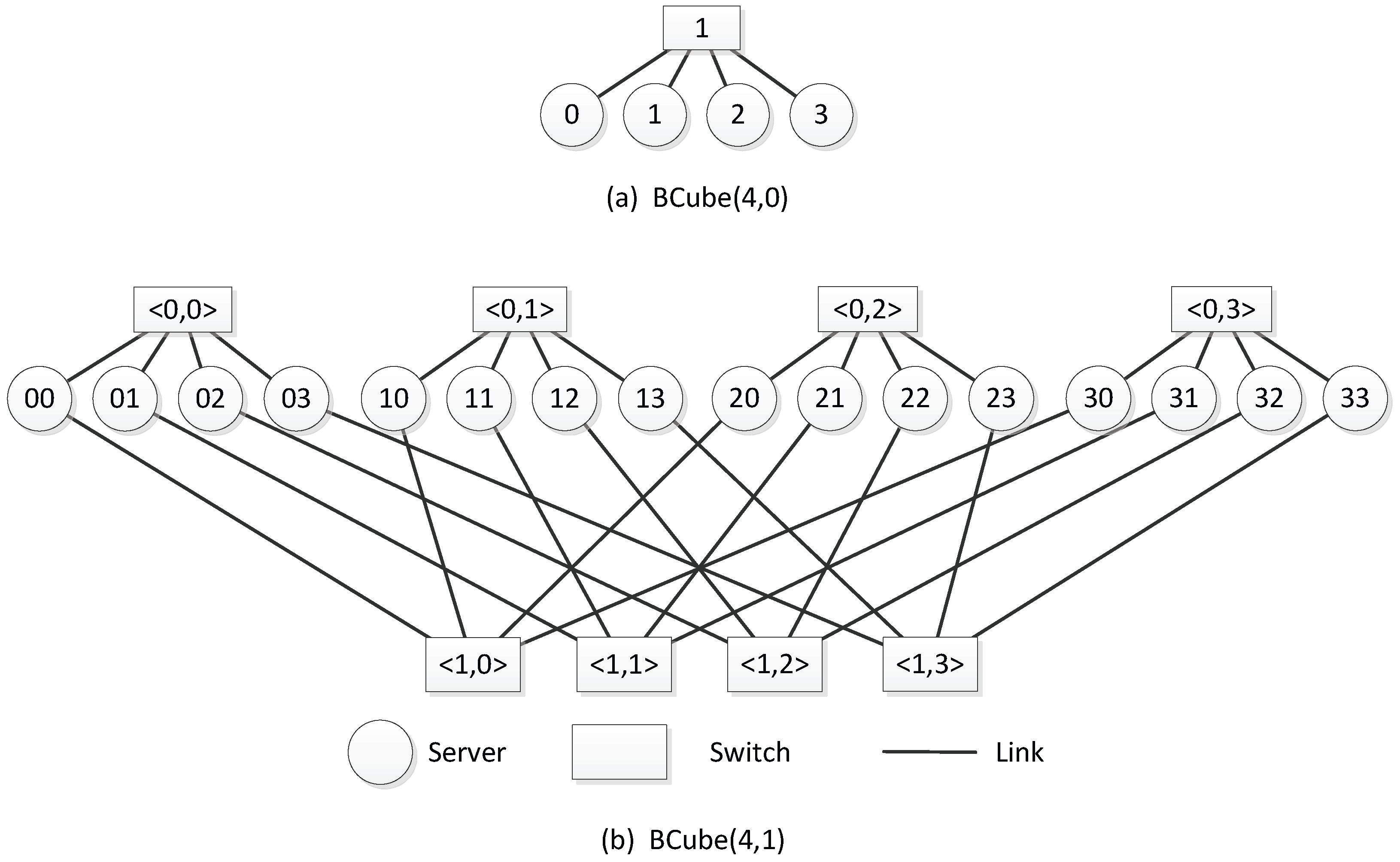
has four servers and one four-port switch (see
Figure 1).
contains four disjoint copies of
, which are connected by four four-port Level 1 switches (see
Figure 1). Each server has two ports in
.
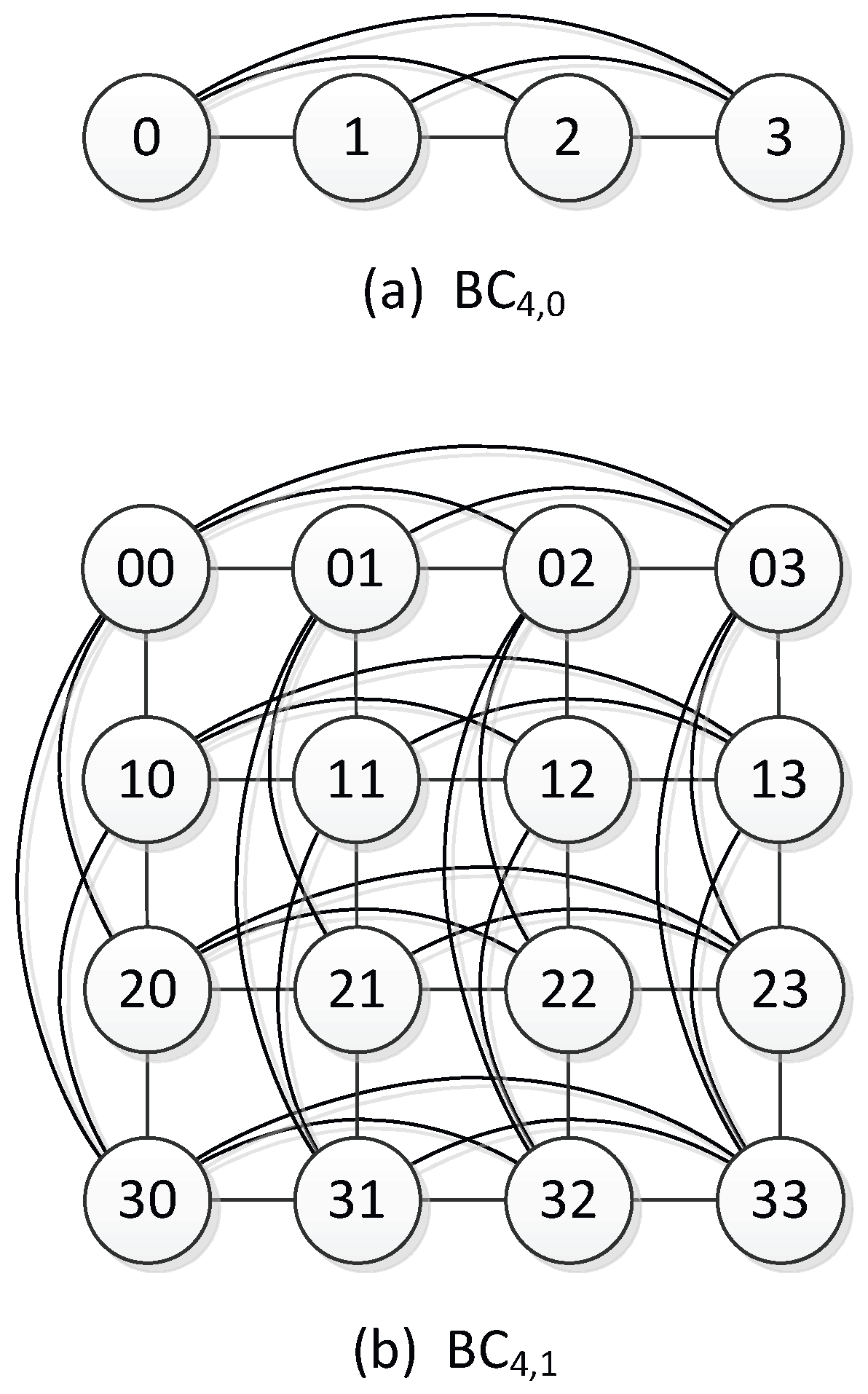
By making all switches transparent, we can obtain the topological structure of BCube. The topological structure of is represented by , which is defined as follows.
Definition 2. Given two integers k, n, and , is represented by a simple undirect graph ,, where and . For any two nodes and , if and only if there exists an integer such that and for all . We say is an i-dimensional edge, denoted by i-edge. We set being the set of all i edges of .
A graph can be decomposed into n disjoint subgraphs: , , …, along dimension k, where , for every , is a subgraph of induced by . Any two subgraphs are connected by the k-edges, which correspond to the Level k switches in . Clearly, each is isomorphic to for . The subgraph of , , is also the topological structure of the subgraph of making switches transparent. Along k different dimensions, can be decomposed into n copies of .
and
are shown in
Figure 2.
is a kind of generalized hypercube. The graph
is isomorphic to the hypercube
. For any node
y in
, the degree of
y is
.
is a highly symmetric network with vertex symmetry and edge symmetry.
The corresponding relation between the elements in
and the elements in
will be discussed below. Let
z be one of the elements in
. If the element
z is a server, it corresponds to a node in
. If the element
z is a switch, it corresponds to an edge subset
and
y are two distinct nodes, which correspond to two distinct servers of
connected by the switch
If the element
z is a link, it corresponds to an edge subset
and
v are two distinct nodes, which correspond to two servers of
connected through the link
z}. Given an integer
l,
, if the element
z is a switch of
in Level
l, it corresponds to the edge subset of
, which has
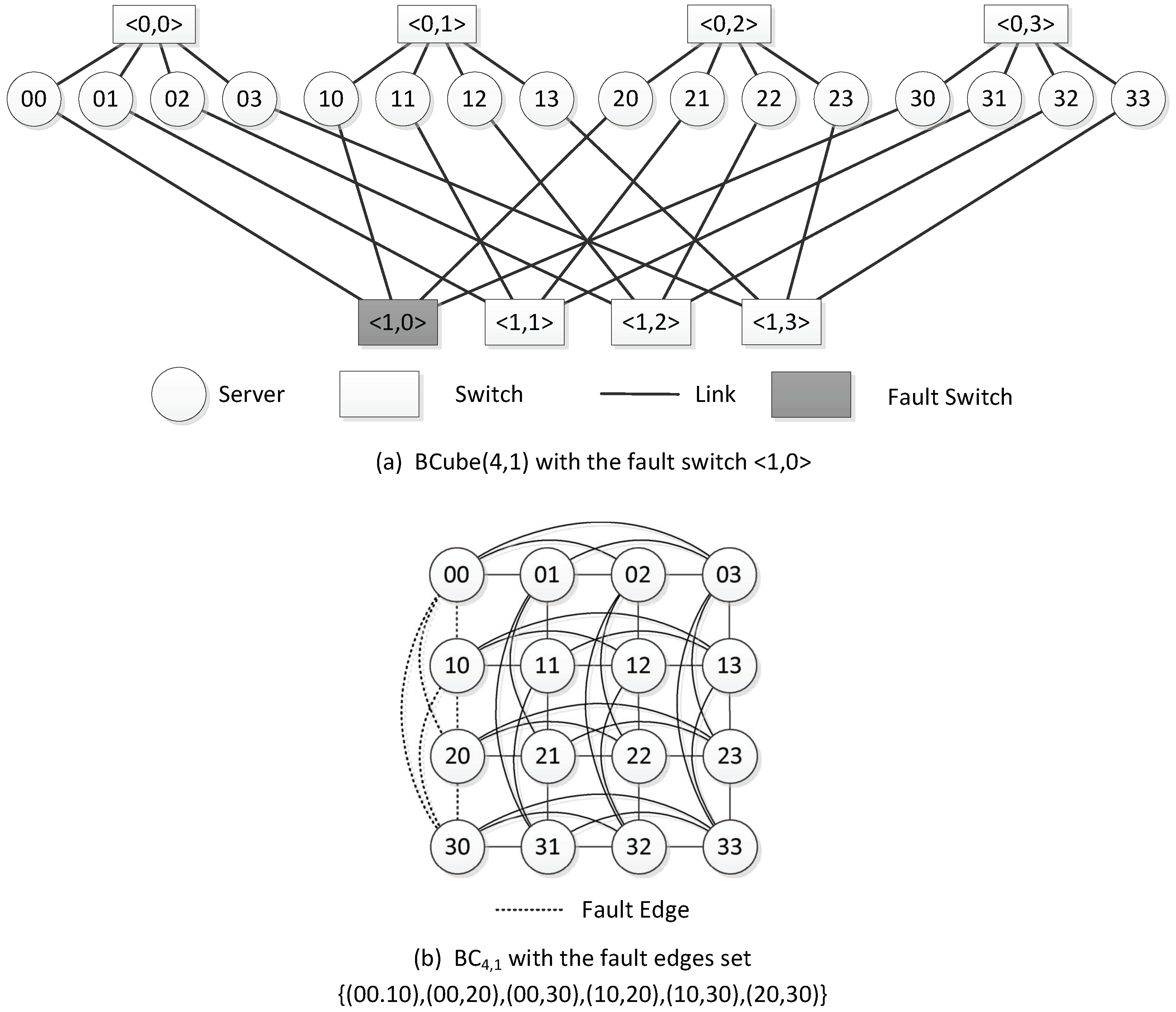
edges. As shown in
Figure 3, the corresponding element of the fault switch
in
is the edge subset
in
.
We let be a set, each element of which is a faulty edge subset in , which is affected by a broken switch in . And let be the set, each element of which is a faulty edge subset in , which is caused by a broken switch of in Level i, with . Clearly, . Let be the set of the faulty edges in which is not caused by faulty switches. Let u and v be two servers in . If a faulty edge exists, the server u is unable to communicate with the server v. Furthermore, let be the set of the i-edges in the faulty edge set , . We let , , , , , , , , . Because is able to reflect the characteristics of , we will carry out the below study on .
3. Fault-Tolerant Properties of
Considering that is edge symmetric and node symmetric, we assume . For , we set for each and for each . Note that the subgraph of induced by is isomorphic to . The graph is isomorphic to the -dimensional hypercube . The relevant conclusions have been drawn and will be presented in another paper. So, we discuss the properties of for in this paper.
Theorem 1. For any faulty set F of , , is connected if and for each .
Proof. The proof of this theorem is by induction on k. Obviously, is connected if . Suppose that this theorem holds on , where and . Since is edge symmetric, we assume that . Then, . For , let be the set, each element of which is a faulty edge subset in , which is caused by a faulty switch in in Level i with . . Let be the edge subset of the faulty i-edges in . . Let , , . Since , for each j. Hence, , for each ; that is, . , . By induction hypothesis, is connected for each . Since , there is an edge e between and such that for each . Hence, is connected. □
We use the following example to show that the bound is tight.
Example 1. Let us consider that for some with fixed t. We discuss two cases.
Case 1. . We set and assume that all the switches are faulty, which are connected with the node u and . Obviously, , for . Then, is disconnected since and one component of is the node u.
Case 2. . Let B be the connected subgraph of which is induced by . Obviously, B is isomorphic to . Then, we have for each , and for each . We set . We have (1) , (2) , and (3) for each . Then, is not connected and one component of it is the subgraph B.
Theorem 2 ([
46])
. For , let with and . Let be the set of faulty elements in . For any two nodes and , there is a fault-free Hamiltonian path in where (1) For any integer , is Hamiltonian-connected. (2) There exist at least three fault-free k-edges between any two distinct graphs in the subgraph set A. Theorem 3. For , let F be any faulty set of , , is Hamiltonian-connected if and .
Proof. is Hamiltonian-connected if and . So, we discuss the case .
can be divided into n subgraphs for . For each , is Hamiltonian-connected because it is a complete graph with n nodes. Since , there is no fault element in , . Since , there are at least three fault-free switches in Level 1 in . We consider any three fault-free switches. We assume these switches individually connect with the nodes , and , for . For any two nodes , , , we divide into two cases to discuss the existence of a Hamiltonian path connecting the nodes u and v in .
Case 1. .
By Theorem 2, there exists a fault-free Hamiltonian path connecting u and v in .
Case 2. .
W.L.O.G., we suppose . We have two subcases.
Case 2.1. .
We assume that
. Since
is a complete graph, there is an edge
and a path
, which contains all the nodes in
. By Theorem 2, a fault-free Hamiltonian path
exists, which connects
and
in
. So,
,
,
,
,
,
,
,
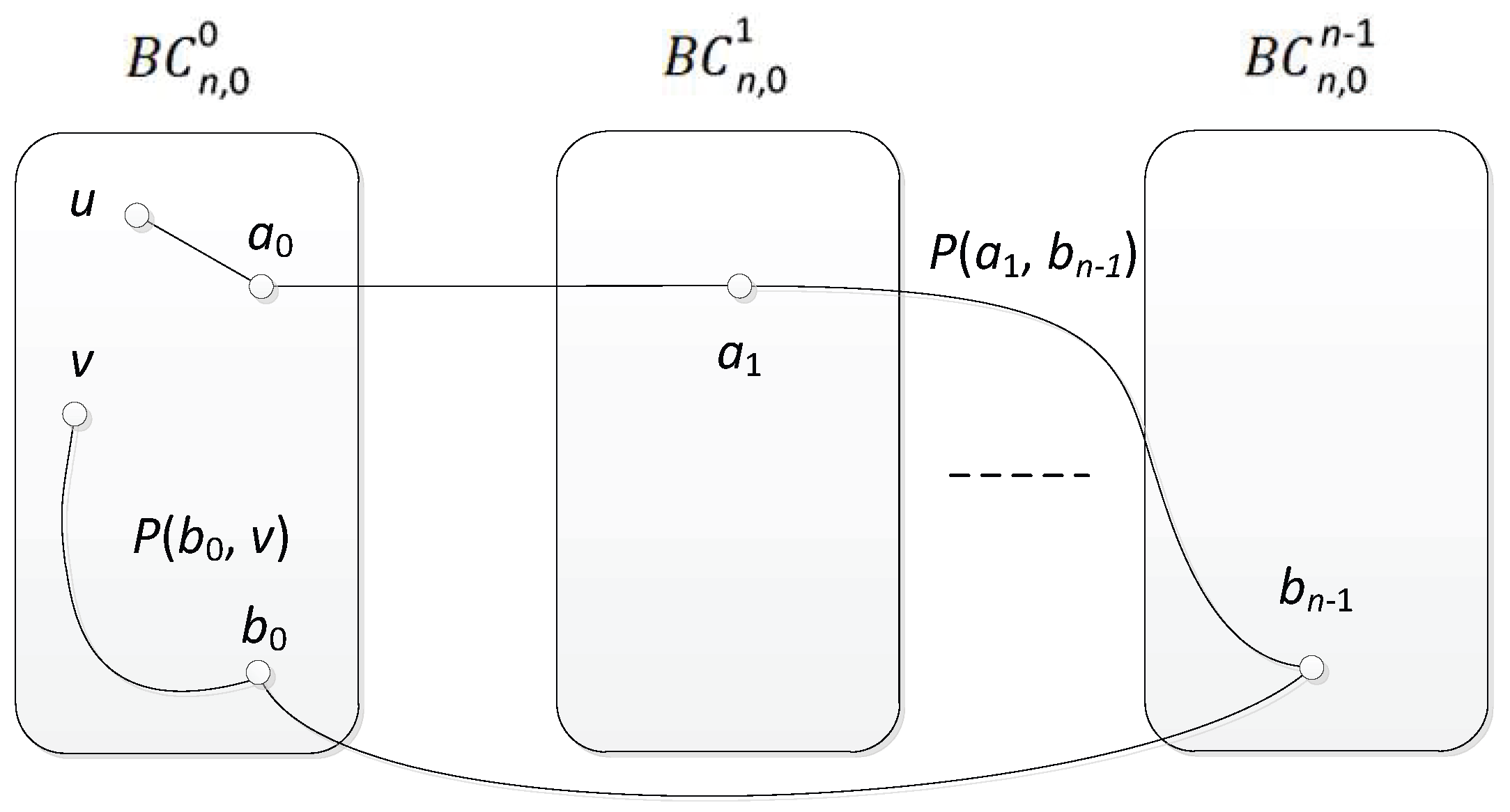
is a fault-free Hamiltonian path connecting
u and
v in
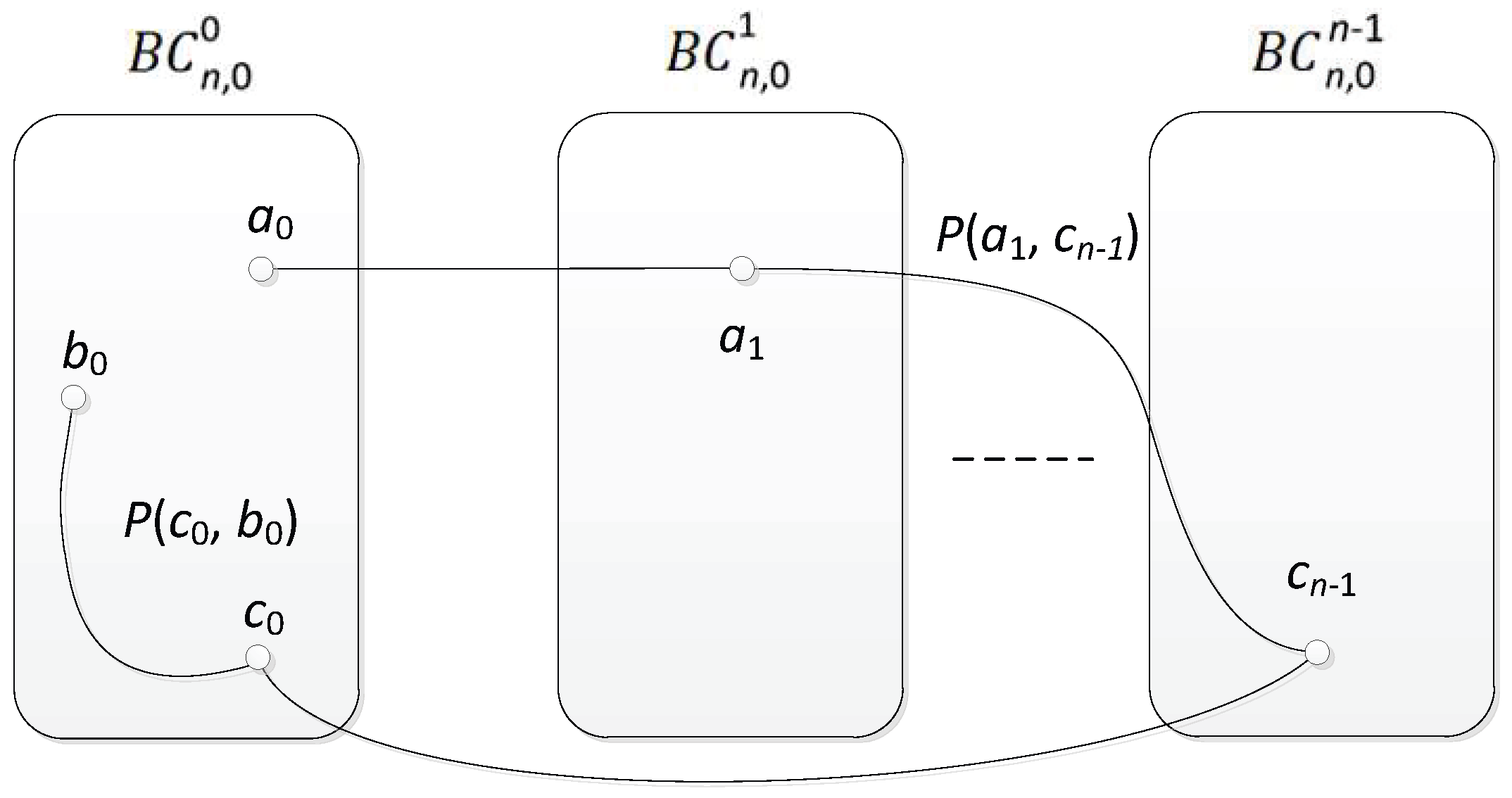
(see
Figure 4).
Case 2.2. .
We assume that
,
. Since
is a complete graph,
is also a complete graph. In
, there is a Hamiltonian path
connecting
and
. By Theorem 2, a Hamiltonian path
exists, which connects
and
in
. So,
is a Hamiltonian path connecting
u and
v in
. So,
is Hamiltonian-connected if
and
(see
Figure 5). □
Theorem 4. For and , let F be any faulty set of , , is Hamiltonian-connected if for each and , .
Proof. The proof of this theorem is by induction on k. By Theorem 3, is Hamiltonian-connected if and . Assume that this theorem holds on with , .
For , let be the set, each element of which is a faulty edge set in , which is caused by a faulty switch in in Level i with . . Let be the edge subset of the faulty i-edges in . . . Since , for each . Hence, for , and , . By induction hypothesis, is Hamiltonian-connected for each . Since , there are more than three fault-free edges between and for in . By Theorem 2, for any two nodes , , and , a Hamiltonian path exists, which connects u and v in .
Here, we consider the situation . W.L.O.G., we suppose . So, . In , there is a Hamiltonian path of length . Since , there exists an edge on the Hamiltonian path such that the two Level k switches are fault-free in , which connect with the nodes u and v individually. Let . Let be the node that connects to the same Level k switch with the node . Let be the node that connects to the same Level k switch with the node . By Theorem 2, a Hamiltonian path exists, which connects and in . Then, , , , , is a fault-free Hamiltonian path connecting u and v in . So, is Hamiltonian-connected if for each and , . □
Theorem 5. For and n mod , , let F be any faulty set of , , is Hamiltonian if for each and , , .
Proof. By Theorem 4,
is Hamiltonian-connected for each
. Since
, there are at least two fault-free switches in Level
k in
. So, we assume that one switch connects with the nodes
, and the other connects with the nodes
,
,
. By Theorem 4,
is Hamiltonian-connected for each
. So, there is a Hamiltonian path
or
between
and
in
. Since
n is even, the cycle
is a Hamiltonian cycle in
. So,
is Hamiltonian for
and
n mod
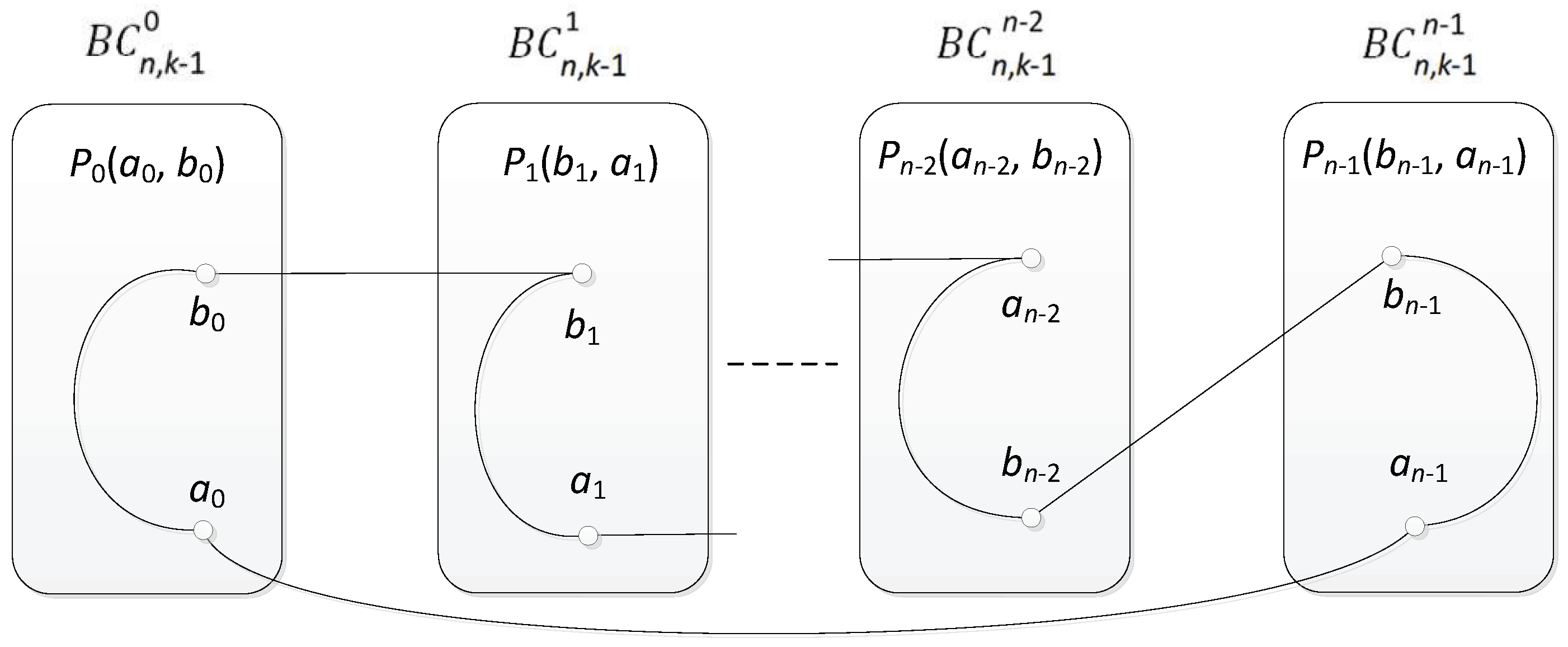
, as shown in
Figure 6. □
Note that there is no Hamiltonian cycles in for if n is odd. We have the theorem below for odd number n.
Theorem 6. For and n mod , , let F be any faulty set F of , , is Hamiltonian if for each and , , .
Proof. By Theorem 4, is Hamiltonian-connected for each . Since , there are at least three fault-free switches in Level k in . So, we assume that one switch connects with the nodes , one switch connects with the nodes , and the other connects with the nodes , , . By Theorem 4, is Hamiltonian-connected for each .
So, there is a Hamiltonian path
,
or
between any two nodes of
in
. Since
n is odd, the cycle
,
,
,
,
,
,
,
,
…,
,
,
is a Hamiltonian cycle in
. So,
is Hamiltonian for
and
n mod
if
for each
and
,
,
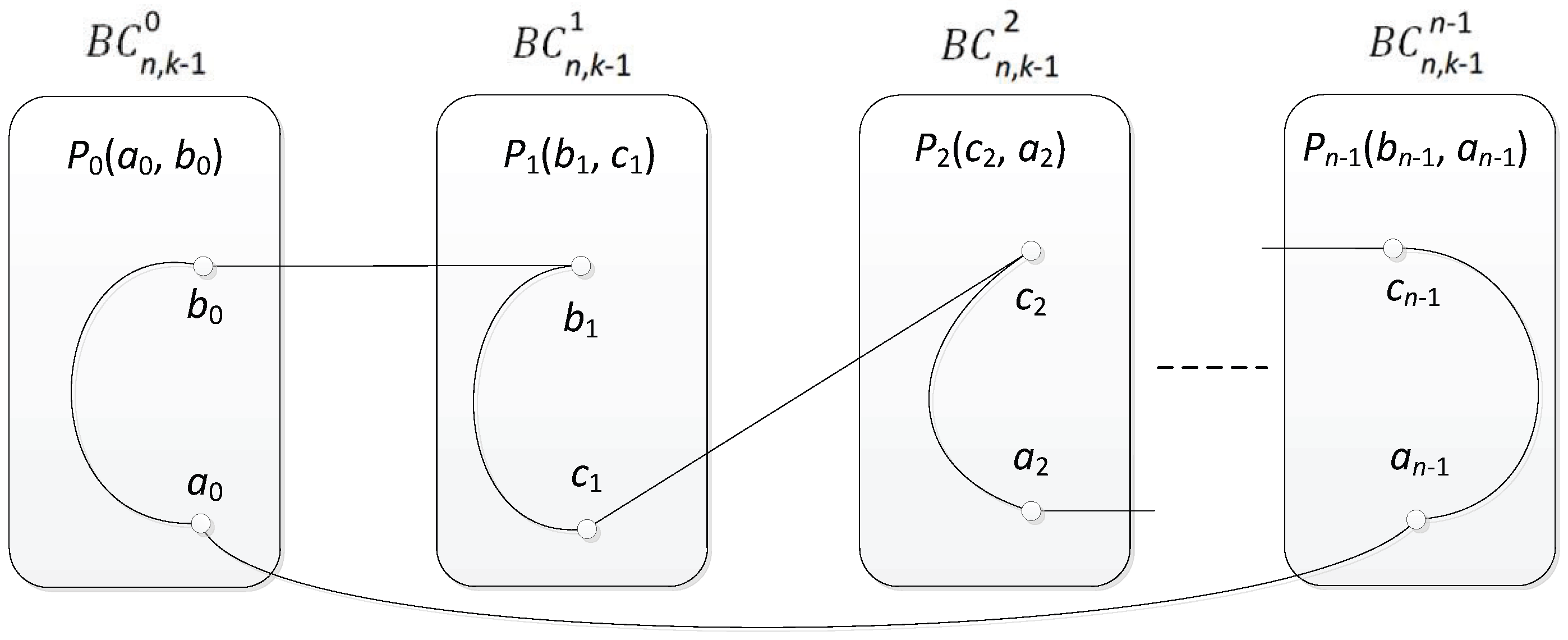
, as shown in
Figure 7. □