Abstract
In this paper, we carry out a systematic study to discover the properties of a subclass of meromorphic starlike functions defined using the Mittag–Leffler three-parameter function. Differential operators involving special functions have been very useful in extracting information about the various properties of functions belonging to geometrically defined function classes. Here, we choose the Prabhakar function (or a three parameter Mittag–Leffler function) for our study, since it has several applications in science and engineering problems. To provide our study with more versatility, we define our class by employing a certain pseudo-starlike type analytic characterization quasi-subordinate to a more general function. We provide the conditions to obtain sufficient conditions for meromorphic starlikeness involving quasi-subordination. Our other main results include the solution to the Fekete–Szegő problem and inclusion relationships for functions belonging to the defined function classes. Several consequences of our main results are pointed out.
1. Introduction
and will represent the sets of complex numbers, negative integers and natural numbers, respectively. We let to denote a punctured open unit disk. Furthermore, we let denote the class of all analytic functions, except for a pole of order p at the origin and p-valent in the unit disc of the form
Two well-known subclasses of are the so-called meromorphic starlike functions of order and meromorphic convex functions of order , which have the analytic characterization of the form
respectively. We let and denote the class of meromorphic starlike functions of order and meromorphic convex functions of order , respectively. Furthermore, we let denote the class of functions analytic in with and . will denote the well-known class functions with a positive real part, which has the usual normalization . For the development and study of various subclasses of meromorphic functions, refer to [1,2].
Hadamard product and subordination are the two primary tools that are employed to study various geometrically defined subclasses of analytic and meromorphic functions. Here, we let * and ≺ denote the Hadamard product and subordination, respectively. For two functions given by (1) and , the Hadamard product (or convolution) of f and g is defined by
The Hadamard product acts as a bridge for studying geometric function theory in duality with the theory of special functions. Pertaining to the class of meromorphic functions, the study by Liu and Srivastava [3] is the most prominent study of this duality theory. Using the Hadamard product, they defined a differential operator (popularly known as the Liu–Srivastava operator) involving a generalized hypergeometric function. Here, we avoid stating the Liu–Srivastava operator, as it requires much supplementary information to be disseminated.
Several families of integral operators and differential operators were introduced using the Hadamard product (or convolution). Motivated by the work of Aouf [4] (also see [5,6,7]), in this paper we will introduce a family of differential and integral operators involving the Mittag–Leffler three-parameter function.
First, we will begin with a brief introduction of the Mittag–Leffler function. The Mittag–Leffler function arises naturally in the solutions of fractional integro-differential equations. For a detailed study on the Mittag–Leffler function and its applications, refer to [8,9,10,11]. Prabhakar [12] Equation 1.3) studied a singular integral equation with a generalized Mittag–Leffler three-parameter function in the kernel, which is defined by
where will be used to denote the usual Pochhammer symbol defined by
The function is an entire function of order . For particular values of the parameter, coincides with well-known elementary functions, and some special functions. For example,
where error function and the complementary error function are defined by the formula
The following relationship between the Prabhakar function and generalized hypergeometric function is known to hold:
where (the generalized hypergeometric function) is defined by the formula
Corresponding to , we define the function
We now define the following operator by
where and . If , then from (5) and (6) we may easily deduce that
Remark 1.
A new symmetric differential operator introduced by Aldawish and Ibrahim in [13] is closely related to our operator .
Let denote the class of functions if and let denote the class of functions if . Using the well-known Miller–Mocanu lemma and following the steps as in [14] (Theorem 2.1), we can obtain the following inclusion relationships if is greater than zero
and
Haji Mohd and Darus in [15] brought the concept of quasi-subordination into spotlight, though introduced by Robertson [16] in 1970. The versatility of the quasi-subordination is that it unifies two popular tools of Univalent Function Theory, namely majorization and subordination. Recently, several authors have introduced and studied various classes of analytic functions using quasi-subordination; see [17,18,19,20,21] and the references provided therein. We let represent quasi-subordination. For detailed discussion and formal definition of the quasi-subordination, refer to [15].
The paper is structured as follows. In the present section, we define some presumably new subclasses of meromorphic functions using the operator and quasi-subordination. In Section 2, we provide and discuss some results which will be used to prove our main results. Our main results are provided in Section 3 and Section 4, which include the subordination condition and initial coefficient bounds of the Laurent’s series expansion.
Meromorphic multivalent functions have been studied by various authors, such as Mogra [22,23], Uralegaddi and Ganigi [24], Aouf [4,25,26], and Srivastava et al. [27]. For studies related to meromorphic functions involving linear operators, see [3,28,29]. Motivated by Aouf [4], Arif et al. [30] and [31] (Definition 2), we now define the following.
Definition 1.
Let , , , and . We denote the class consisting of functions in satisfying the subordination condition
where .
Definition 2.
Let , , and . We denote the class consisting of functions in satisfying the subordination condition
where .
Remark 2.
The class was mainly motivated by the recent study of Karthikeyan et al. [32]. The classes and reduces to several well-known class by varying the parameters involved, for example refer to [33] (Remark 1.1).
2. Preliminaries
In this section, we will present some results that would help us to obtain our main results.
To obtain some conditions of starlikeness, we need the following well-known Miller–Mocanu lemma.
Lemma 1
([34], Theorem 3.6.1). Let the function q be univalent in the open unit disc Ω. Let θ and ϕ be analytic in a domain D containing with when . Set , . Suppose that
- 1.
- Q is starlike univalent in Ω, and
- 2.
- .
If
then and q is the best dominant.
Now, we state the following results, which will be used in proving the coefficient inequalities.
Lemma 2
([35], p. 41). If , then for all , and the inequality is sharp for , .
Lemma 3
([36]). If , and v is complex number, then
and the result is sharp for the functions
To highlight the applications of all our main results, we will use the following class introduced and studied by Aouf [37] (Equation 1.4) (also see [38]).
A function if and only if
where is the Schwartz function. The class is a generalization of Janowski functions [39].
3. Starlikeness of and Using Quasi-Subordination
Henceforth, we let denote
In this section, we will obtain conditions for starlikeness using quasi-subordination. Recall that if there exists a function such that .
Theorem 1.
Let the function Φ be convex univalent in Ω with . If the function satisfies the conditions
then
where , implies . Moreover, the function is the best dominant of the left-hand side of (9).
Proof.
If we define the function p by
Although the function has a pole of order p at , it can be seen that p is analytic in using the assumption (11) and (12). To prove the assertion of the theorem, we need to establish . Let ; using logarithmic differentiation we have
Then the subordination (1) is equivalent to
Setting
then and are analytic functions in , with . Therefore
and
The function is convex univalent in , since is a convex univalent function in . Now, using this fact, it follows that
hence Q is a starlike univalent function in . Furthermore, the convexity of together with the assumption that implies
Since both of the conditions of Lemma 1 are satisfied, it follows that (14) implies , and is the best dominant of , which proves the assertion of the theorem. □
Theorem 2.
If the function satisfies the conditions
then
where , implies
and this result is sharp.
Proof.
If we define the functions
then p has no singularity in , and is a convex univalent function in with , . Proceeding as in the proof of Theorem 1, we obtain
Since the principle of subordination is invariant under translation, we have
which is an assertion of Theorem 2. □
If we let , in Theorem 2, we obtain
Corollary 1.
If the function satisfies the condition
then
where , implies
and this result is sharp.
If we let in Corollary 1, we obtain
Corollary 2.
If the function satisfies the condition then
where , implies
and this result is sharp.
For completeness, we just state the conditions for starlikeness of the class .
Theorem 3.
Let the function Φ be convex univalent in Ω with . If the function satisfies the conditions
then
where , implies . Moreover, the function is the best dominant of the left-hand side of (8).
Remark 3.
Several well-known subordination results involving the class of meromorphic functions can be obtained as an application of our result by varying the parameters involved in Theorem 3.
4. Solution to Fekete–Szegő Problem for the Functions of and
In this section, we obtain some interesting coefficient inequalities for functions belonging to the classes and .
Theorem 4.
If with , then for all we have
The inequality is sharp for each .
Proof.
If , there exist the analytic functions and , with , , such that
Define the function by
We can note that and (see Lemma 2). Using (15), it is easy to see that
From [19] (Equation 3.7) (also see [40]), we have
The left-hand side of (16) will be
Corollary 3.
If satisfies the condition
then for all we have
The inequality is sharp for each .
Proof.
The function has the Maclaurin series expansion of the form
Replacing and with and , respectively, in Theorem 4, we obtain the assertion of the Theorem. □
Letting and in Corollary 3, we obtain the following result.
Corollary 4.
If satisfies the condition
then for all we have
The inequality is sharp for each .
Letting , and in Corollary 3, we obtain the following result.
Corollary 5.
If satisfies the condition
then for all we have
The inequality is sharp for each .
Remark 4.
For the choice of , and in Corollary 5, we obtain the Fekete–Szegő inequality for the class .
Now, we will obtain the Fekete–Szegő inequality for functions in .
Theorem 5.
If with , then for all we have
where κ is given by
The inequality is sharp for each .
Proof.
Letting and in Theorem 5, we obtain the following result:
Corollary 6.
If satisfies the condition
then for all we have
The inequality is sharp for each .
If we let and in Corollary 6, we obtain
Corollary 7.
If satisfies the condition
then for all we have
The inequality is sharp for each .
Applications in the Bernoulli Lemniscate and Nephroid Domains
Mendiratta et al. in [41] defined a class of functions subordinate to
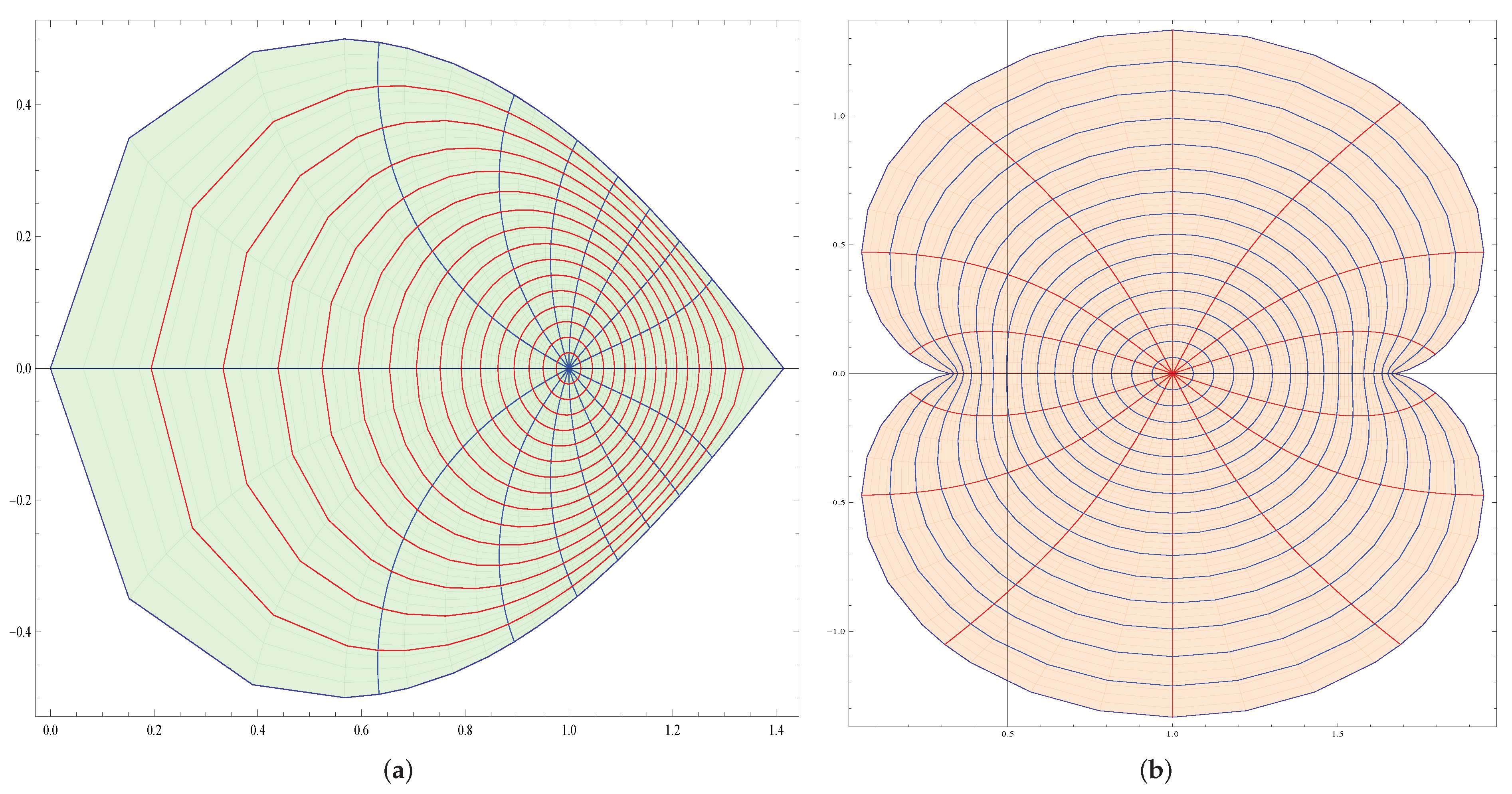
The function maps the unit disc onto interior of the left half of the shifted lemniscate of Bernoulli (see Figure 1a). The function has a Maclaurin series of the form
In [42], Wani and Swaminathan introduced and studied a class of functions subordinate to . The function maps the unit disc onto a region bounded by the nephroid (see Figure 1b), which is symmetric about the real axis.
Figure 1.
(a) Mapping of under . (b) Mapping of under the transformation .
If we let , , and in Theorem 5, we obtain
Corollary 8.
If satisfies the condition
then for all we have
The inequality is sharp for each .
If we let , , and in Theorem 5, we obtain
Corollary 9.
If satisfies the condition
then for all we have
The inequality is sharp for each .
5. Discussion
As a preclude to the Conclusions section, in this section we will highlight the significance of our main results and their applications in detail. With a primary motive to consolidate the study of the famous -convex function with starlike and convex functions, Al-Oboudi in [43] defined an operator containing a convex combination of analytic functions. However, the same meromorophic analogue of the Al-Oboudi operator could not be defined to unify the meromorphic -convex function with other geometrically defined subclasses of . Aouf in [4] intelligently defined an Al-Oboudi-type operator for functions in in such a way that normalization could be retained. In this paper, we extend the operator defined by Aouf in [4] by replacing f with , where * denotes the Hadamard product and is the normalized meromorphic function with the Prahakar function in the kernel.
The family of functions (see Definition 1) is defined to include or unify the study of -pseudo starlike functions. Furthermore, to add more versatility to our study, we defined the class by subjecting a certain analytic characterization quasi-subordinate to a more general function. The other class (see Definition 2) was defined to extend the study of Ghoos et al. [31].
The other significant deviation from previous studies is that we obtain conditions so that -pseudo starlike functions are quasi-subordinate to a general function. Hence, if we let , then our results in Section 3 will reduce to a subordination condition for starlikeness. The method to obtain the solution to the Fekete–Szegő problem of and is the same as that employed by various authors. However, several new and classical results can be obtained as a special case of our main results.
6. Conclusions
The extension and unification of various well-known classes of functions were the main objective of this paper. We defined a new family of multivalent meromorphic functions of complex order using a differential operator, to unify the study of various classes of meromorphic functions. Inclusion relations, Fekete–Szegő inequalities and sufficient conditions for starlikeness for the defined function class were established.
Author Contributions
Conceptualization, D.B., K.R.K. and E.U.; methodology, D.B., K.R.K. and E.U.; software, D.B., K.R.K. and E.U.; validation, D.B., K.R.K. and E.U.; formal analysis, D.B., K.R.K. and E.U.; investigation, D.B., K.R.K. and E.U.; resources, D.B., K.R.K. and E.U.; data curation, D.B., K.R.K. and E.U.; writing—original draft preparation, K.R.K. and E.U.; writing—review and editing, D.B., K.R.K. and E.U.; visualization, D.B., K.R.K. and E.U.; supervision, D.B., K.R.K. and E.U.; project administration, D.B., K.R.K. and E.U. All authors have read and agreed to the published version of the manuscript.
Funding
This research study received no external funding.
Institutional Review Board Statement
Not applicable.
Informed Consent Statement
Not applicable.
Data Availability Statement
No data were used to support this study.
Acknowledgments
The authors thank the referees for their comments and suggestions, which improved the presentation of the results.
Conflicts of Interest
The authors declare no conflict of interest.
References
- Goodman, A.W. Univalent Functions; Mariner Publishing Co., Inc.: Tampa, FL, USA, 1983; Volume I. [Google Scholar]
- Hayman, W.K. Multivalent Functions; Cambridge Tracts in Mathematics and Mathematical Physics, No. 48; Cambridge University Press: Cambridge, UK, 1958. [Google Scholar]
- Liu, J.-L.; Srivastava, H.M. A linear operator and associated families of meromorphically multivalent functions. J. Math. Anal. Appl. 2001, 259, 566–581. [Google Scholar] [CrossRef]
- Aouf, M.K. A class of meromorphic multivalent functions with positive coefficients. Taiwan. J. Math. 2008, 12, 2517–2533. [Google Scholar] [CrossRef]
- Aouf, M.K.; Seoudy, T.M. Some families of meromorphic p-valent functions involvinga new operator defined by generalized Mittag–Leffler function. J. Egypt. Math. Soc. 2018, 26, 406–411. [Google Scholar] [CrossRef][Green Version]
- Murugusundaramoorthy, G.; Aouf, M.K. Families of meromorphic multivalent functions associated with the Dziok-Raina operator. Int. J. Anal. Appl. 2005, 2, 1–18. [Google Scholar]
- Liu, J.-L.; Srivastava, H.M. Classes of meromorphically multivalent functions associated with the generalized hypergeometric function. Math. Comput. Model. 2004, 39, 21–34. [Google Scholar] [CrossRef]
- Ayub, U.; Mubeen, S.; Abdeljawad, T.; Rahman, G.; Nisar, K.S. The new Mittag–Leffler function and its applications. J. Math. 2020, 2020, 2463782. [Google Scholar] [CrossRef]
- Gorenflo, R.; Kilbas, A.A.; Rogosin, S.V. On the generalized Mittag–Leffler type functions. Integral Transform. Spec. Funct. 1998, 7, 215–224. [Google Scholar] [CrossRef]
- Kilbas, A.A.; Srivastava, H.M.; Trujillo, J.J. Theory and Applications of Fractional Differential Equations; North-Holland Mathematics Studies 204; Elsevier Science B.V.: Amsterdam, The Netherlands, 2006. [Google Scholar]
- Purohit, S.D.; Kalla, S.L. A generalization of q-Mittag–Leffler function. Mat. Bilten 2011, 35, 15–26. [Google Scholar]
- Prabhakar, T.R. A singular integral equation with a generalized Mittag Leffler function in the kernel. Yokohama Math. J. 1971, 19, 7–15. [Google Scholar]
- Aldawish, I.; Ibrahim, R.W. Solvability of a New q-Differential Equation Related to q-Differential Inequality of a Special Type of Analytic Functions. Fractal Fract. 2021, 5, 228. [Google Scholar] [CrossRef]
- Selvaraj, C.; Karthikeyan, K.R. Some inclusion relationships for certain subclasses of meromorphic functions associated with a family of integral operators. Acta Math. Univ. Comen. (N.S.) 2009, 78, 245–254. [Google Scholar]
- Haji Mohd, M.; Darus, M. Fekete–Szegő problems for quasi-subordination classes. Abstr. Appl. Anal. 2012, 2012, 192956. [Google Scholar] [CrossRef]
- Robertson, M.S. Quasi-subordination and coefficient conjectures. Bull. Am. Math. Soc. 1970, 76, 1–9. [Google Scholar] [CrossRef]
- Altınkaya, S. Application of quasi-subordination for generalized Sakaguchi type functions. J. Complex Anal. 2017, 2017, 3780675. [Google Scholar] [CrossRef]
- Atshan, W.G.; Rahman, I.A.R.; Lupaş, A.A. Some results of new subclasses for bi-univalent functions using quasi-subordination. Symmetry 2021, 13, 1653. [Google Scholar] [CrossRef]
- Karthikeyan, K.R.; Murugusundaramoorthy, G.; Cho, N.E. Some inequalities on Bazilevič class of functions involving quasi-subordination. AIMS Math. 2021, 6, 7111–7124. [Google Scholar] [CrossRef]
- Ramachandran, C.; Soupramanien, T.; Sokół, J. The Fekete-Szegö functional associated with k-th root transformation using quasi-subordination. J. Anal. 2020, 28, 199–208. [Google Scholar] [CrossRef]
- Ramachandran, C.; Soupramanien, T.; Vanitha, T. Estimation of coefficient bounds for the subclasses of analytic functions associated with Chebyshev polynomial. J. Math. Comput. Sci. 2021, 11, 3232–3243. [Google Scholar]
- Mogra, M.L. Meromorphic multivalent functions with positive coefficients. I. Math. Jpn. 1990, 35, 1–11. [Google Scholar]
- Mogra, M.L. Meromorphic multivalent functions with positive coefficients. II. Math. Jpn. 1990, 35, 1089–1098. [Google Scholar]
- Uralegaddi, B.A.; Ganigi, M.D. Meromorphic multivalent functions with positive coefficients. Nepali Math. Sci. Rep. 1986, 11, 95–102. [Google Scholar]
- Aouf, M.K. On a class of meromorphic multivalent functions with positive coefficients. Math. Jpn. 1990, 35, 603–608. [Google Scholar] [CrossRef]
- Aouf, M.K. A generalization of meromorphic multivalent functions with positive coefficients. Math. Jpn. 1990, 35, 609–614. [Google Scholar]
- Srivastava, H.M.; Hossen, H.M.; Aouf, M.K. A unified presentation of some classes of meromorphically multivalent functions. Comput. Math. Appl. 1999, 38, 63–70. [Google Scholar] [CrossRef][Green Version]
- Elrifai, E.A.; Darwish, H.E.; Ahmed, A.R. On certain subclasses of meromorphic functions associated with certain differential operators. Appl. Math. Lett. 2012, 25, 952–958. [Google Scholar] [CrossRef]
- Lashin, A.Y. On certain subclasses of meromorphic functions associated with certain integral operators. Comput. Math. Appl. 2010, 59, 524–531. [Google Scholar] [CrossRef]
- Arif, M.; Ahmad, B. New subfamily of meromorphic multivalent starlike functions in circular domain involving q-differential operator. Math. Slovaca 2018, 68, 1049–1056. [Google Scholar] [CrossRef]
- Ghoos Ali Shah, S.; Hussain, S.; Rasheed, A.; Shareef, Z.; Darus, M. Application of quasisubordination to certain classes of meromorphic functions. J. Funct. Spaces 2020, 2020, 4581926. [Google Scholar]
- Karthikeyan, K.R.; Murugusundaramoorthy, G.; Bulboacă, T. Properties of λ-pseudo-starlike functions of complex order defined by subordination. Axioms 2021, 10, 86. [Google Scholar] [CrossRef]
- Bulut, S.; Adegani, E.A.; Bulboacă, T. Majorization results for a general subclass of meromorphic multivalent functions. Politeh. Univ. Buchar. Sci. Bull. Ser. A Appl. Math. Phys. 2021, 83, 121–128. [Google Scholar]
- Bulboacă, T. Differential Subordinations and Superordinations; Recent Results; House of Science Book Publishing: Cluj-Napoca, Romania, 2005. [Google Scholar]
- Pommerenke, C. Univalent Functions; Vandenhoeck & Ruprecht: Göttingen, Germany, 1975. [Google Scholar]
- Ma, W.C.; Minda, D. A unified treatment of some special classes of univalent functions. In Lecture Notes Analysis, I, Proceedings of the Conference on Complex Analysis, Tianjin, China, 19–23 June 1992; International Press Inc.: Cambridge, MA, USA, 1992; pp. 157–169. [Google Scholar]
- Aouf, M.K. On a class of p-valent starlike functions of order α. Int. J. Math. Math. Sci. 1987, 10, 733–744. [Google Scholar] [CrossRef]
- Breaz, D.; Karthikeyan, K.R.; Senguttuvan, A. Multivalent Prestarlike Functions with Respect to Symmetric Points. Symmetry 2022, 14, 20. [Google Scholar] [CrossRef]
- Janowski, W. Some extremal problems for certain families of analytic functions I. Ann. Pol. Math. 1973, 10, 297–326. [Google Scholar] [CrossRef]
- Mohankumar, D.; Senguttuvan, A.; Karthikeyan, K.R.; Ganapathy Raman, R. Initial coefficient bounds and fekete-szego problem of pseudo-Bazilevič functions involving quasi-subordination. Adv. Dyn. Syst. Appl. 2021, 16, 767–777. [Google Scholar]
- Mendiratta, R.; Nagpal, S.; Ravichandran, V. A subclass of starlike functions associated with left-half of the lemniscate of Bernoulli. Int. J. Math. 2014, 25, 1450090. [Google Scholar] [CrossRef]
- Wani, L.A.; Swaminathan, A. Starlike and convex functions associated with a nephroid domain. Bull. Malays. Math. Sci. Soc. 2021, 44, 79–104. [Google Scholar] [CrossRef]
- Al-Oboudi, F.M. On univalent functions defined by a generalized Sălăgean operator. Int. J. Math. Math. Sci. 2004, 2004, 1429–1436. [Google Scholar] [CrossRef]
Publisher’s Note: MDPI stays neutral with regard to jurisdictional claims in published maps and institutional affiliations. |
© 2022 by the authors. Licensee MDPI, Basel, Switzerland. This article is an open access article distributed under the terms and conditions of the Creative Commons Attribution (CC BY) license (https://creativecommons.org/licenses/by/4.0/).