


Abstract
This paper introduces a new concept called cyclic associative semihypergroup (CA-semihypergroup). The relationships among CA-semihypergroups, Semihypergroups and LA-semihypergroups are studied through some interesting examples. The relationships among various NET-CA-semihypergroups are also studied. The main properties of strong pure neutrosophic extended triplet CA-semihypergroups (SP-NET-CA-semihypergroups) are obtained. In particular, the algorithm of a generated CA-semihypergroup of order tm+n by two known CA-semihypergroups of order m and n is proven, and a CA-semihypergroup of order 19 is obtained by using a Python program. Moreover, it is proven that five different definitions, which can all be used as the definition of SP-NET-CA-Semihypergroup, are equivalent.
1. Introduction
The associative law
is an important operation law of binary operation. If we replace x with y, y with z, z with x in identity (1), then the identity (1) becomes
(x y) z = x (y z),
(y z) x = y (z x).
Clearly, the identity (2) is also associative. This shows that associative law reflects the symmetry of binary operation. Similarly, other types of nonassociative laws such as
and so on also reflect their own symmetries.
(x y) z = (z x) y, Left weakly Novikov law,
(x y) z = x (z y), Tarski’s associative law,
(x y) z = (z y) x, Left invertive law,
x (y z) = z (y x), Grassman’s associative law,
Today, nonassociativity is applied to many scientific and technological fields, among which are physics (see [1]), functional equations (see [2]), nonassociative rings and nonassociative algebras (see [3,4,5,6,7]), image processing (see [8]), networks (see [9]) and so on. This paper examines a type of nonassociative algebraic structure with cyclic associative law.
More than 70 years ago, L. Byrne took the following two formulas
(x y) z = (y z) x,
x y′ = z z′ ⇄ x y = x,
z (x y) = x (y z).
Furthermore, using identity (4), we have
x (y z) = y (z x).
Therefore, in this paper, (4) and (5) are still called cyclic associative law.
Since the concept of cyclic associative law appeared, it has been used in many research fields. In 1995 M. Kleinfeld discussed rings satisfying cyclic associative law (CA-rings) (see [12]). After that, A. Behn, I. Correa and I.R. Hentzel studied semiprimality and nilpotency of CA-rings in 2008 (see [13]). D. Samanta and I.R. Hentzel studied CA-rings satisfying (a, a, b) = (b, a, a) in 2019 (see [14]). Besides these, cyclic associative law is used to study other algebraic structures. In 2016 M. Iqbal, I. Ahmad, M. Shah and M.I. Ali defined AG-groupoids with cyclic associative law (CA-AG-groupoid) and studied their properties (see [15]). M. Iqbal and I. Ahmad then further studied this algebraic structure, obtaining some interesting results (see [16,17]). In 2019 Zhang, X.H., Ma, Z.R. and Yuan W.T. introduced the concepts of CA-Groupoid and CA-NET-Groupoid and showed that each CA-NET-groupoid can be expressed as the union of disjoint subgroups (see [18]). A year later, Yuan W.T., and Zhang, X.H. studied CA-NET-Groupoids with Green relations and proved some important results (see [19]). Shortly afterward, an algebraic structure called variant CA-Groupoid was defined by Ma, Z.R., Zhang, X.H. and Smarandache F., and the construction methods were obtained (see [20]).
It is well known that hyperstructure theory is a natural extension of traditional algebraic structure and has been applied in many fields such as artificial intelligence, automata, codes, cryptography, graphs and hypergraphs, geometry, probabilities, binary relations, relation algebras, median algebras, C-algebras, fuzzy sets and rough sets and lattices. In recent years, some new hyperstructures have been introduced and studied. In 2018 M. Gulistan, S. Nawaz and N. Hassan introduced the notion of NT-LA-semihypergroup and gave an interesting application example in [21]. In 2019 X.H. Zhang, F. Smarandache and Y.C. Ma gave the definitions of an NET-semihypergroup and an NET-hypergroup and obtained the main properties and characteristics of this kind of algebraic structure in [22]. In 2020 M.H. Hu, F. Smarandache and X.H. Zhang studied the properties and construction methods of an SP-NET-LA-semihypergroup and found that the symmetry of this algebraic structure is not perfect (see [23]). In addition, there are some related studies (see [24,25,26,27,28,29,30,31]).
Building on the achievements of our predecessors, in this paper we mainly study a class of binary hypergroupoids with cyclic associative law, which is called CA-semihypergroup. The specific content is as follows:
In Section 2 the concept of CA-semihypergroup is introduced and the relationships of several algebraic structures (including CA-semihypergroups, LA-semihypergroups and Semihypergroups) are studied. The generation algorithm of higher-order CA-semihypergroup is proven. A CA-semihypergroup of order 19 is generated by using a Python program.
In Section 3 the concepts of various Net-CA-semihypergroups are given, and the relationships of these algebraic structures (including LR-Net-CA-semihypergroups, RL-Net-CA-semihypergroups, RR-Net-CA-semihypergroups, LL-Net-CA-semihypergroups, R-Regular-CA-semihypergroups, L-Regular-CA-semihypergroups and S-Regular-CA-semihypergroups) are studied based on some examples.
In Section 4 the concepts of various pure Net-CA-semihypergroups are given. Then an important theorem is proven step-by-step through an ingenious method. This theorem shows that an SP-NET-CA-semihypergroup can be defined in five different ways. Finally, the main properties of an SP-NET-CA-semihypergroup are obtained.
In Section 5 we list the main conclusions of this paper and what topics we will research in the future.
2. Cyclic Associative Semihypergroups (CA-Semihypergroups)
Definition 1.
A binary pair (V, ⋆) is called a binary hypergroupoid if V is a nonempty set,
is a mapping and P * (V) is the set of all nonempty subsets of V.
⋆: V × V → P * (V)
If v ∈ V, W, K ∈ P * (V), the following notations will be used:
W ⋆ {v} = W ⋆ v,
{v} ⋆ K = v ⋆ K.
Definition 2.
Suppose (C, ⋆) is a binary hypergroupoid such that
for all u, v, w ∈ C. Under condition (6), (C, ⋆) is said to be a cyclic associative semihypergroup (written simply as CA-semihypergroup). Here is a more precise way of stating (6):
u ⋆ (v ⋆ w) = w ⋆ (u ⋆ v)
By (6) and (7), for all r, u, v, w ∈ C, we have
That is,
(r ⋆ u) ⋆ (v ⋆ w) = (w ⋆ r) ⋆ (v ⋆ u).
Similarly, we have
(r ⋆ s) ⋆ ((t ⋆ u) ⋆ (v ⋆ w)) = (u ⋆ r) ⋆ ((t ⋆ s) ⋆ (v ⋆ w)).
Note that the following equations still hold for all U, V, W, R, S, T ∈ P * (C).
U ⋆ (V ⋆ W) = W ⋆ (U ⋆ V),
(R ⋆ U) ⋆ (V ⋆ W) = (W ⋆ R) ⋆ (V ⋆ U),
(R ⋆ S) ⋆ ((T ⋆ U) ⋆ (V ⋆ W)) = (U ⋆ R) ⋆ ((T ⋆ S) ⋆ (V ⋆ W)).
If we replace cyclic associative law with associative law, then (C, ⋆) is said to be a semihypergroup. If we replace cyclic associative law with left invertive law, then (C, ⋆) is said to be an LA-semihypergroup. Since the three algebraic structures are different, we will discuss the relationships among CA-semihypergroups, LA-semihypergroups and Semihypergroups based on some examples.
Example 1.

Consider the binary hypergroupoid (C = {0, 1, 2, 3}, ⋆) whose multiplication table is exhibited below (see Table 1):
Table 1.
The binary hyperoperation ⋆ on C.
Using a Python program, we know that (C, ⋆) is not only a CA-semihypergroup but also an LA-semihypergroup. However, (C, ⋆) is not a Semihypergroup because
(3 ⋆ 3) ⋆ 3 = {0,2} ⋆ 3 = (0 ⋆ 3)∪(2 ⋆ 3) = {0}∪{0} = {0},
3 ⋆ (3 ⋆ 3) = 3 ⋆ {0,2} = (3 ⋆ 0)∪(3 ⋆ 2) = {0}∪{1} = {0,1},
(3 ⋆ 3) ⋆ 3 ≠ 3 ⋆ (3 ⋆ 3). Associative law does not hold.
Example 2.
Consider the binary hypergroupoid (C = {0, 1, 2, 3}, ⋆) whose multiplication table is exhibited below (see Table 2):
Table 2.
The binary hyperoperation ⋆ on C.
Using a Python program, we know that (C, ⋆) is a CA-semihypergroup, but neither an LA-semihypergroup nor a Semihypergroup because
(2 ⋆ 3) ⋆ 3 = {0} ⋆ 3 = {0},
(3 ⋆ 3) ⋆ 2 = {0,3} ⋆ 2 = (0 ⋆ 2)∪(3 ⋆ 2) = {0}∪{1} = {0,1},
3 ⋆ (3 ⋆ 2) = 3 ⋆ {1} = 3 ⋆ 1 = {0},
(2 ⋆ 3) ⋆ 3 ≠ (3 ⋆ 3) ⋆ 2, Left invertive law does not hold.
(3 ⋆ 3) ⋆ 2 ≠ 3 ⋆ (3 ⋆ 2). Associative law does not hold.
Example 3.
Consider the binary hypergroupoid (C = {0, 1, 2, 3}, ⋆) whose multiplication table is exhibited below (see Table 3):
Table 3.
The binary hyperoperation ⋆ on C.
Using a Python program, we know that (C, ⋆) is a Semihypergroup, but neither a CA-semihypergroup nor an LA-semihypergroup because
3 ⋆ (2 ⋆ 3) = 3 ⋆ {0} = {0},
3 ⋆ (3 ⋆ 2) = 3 ⋆ {0,2} = (3 ⋆ 0)∪(3 ⋆ 2) = {0}∪{0,2} = {0,2},
3 ⋆ (2 ⋆ 3) ≠ 3 ⋆ (3 ⋆ 2). Cyclic associative law does not hold
(2 ⋆ 3) ⋆ 3 = {0} ⋆ 3 = {0},
(3 ⋆ 3) ⋆ 2 = {0,3} ⋆ 2 = (0 ⋆ 2)∪(3 ⋆ 2) = {0}∪{0,2} = {0,2},
(2 ⋆ 3) ⋆ 3 ≠ (3 ⋆ 3) ⋆ 2. Left invertive law does not hold.
Example 4.
Consider the binary hypergroupoid (C = {0, 1, 2, 3}, ⋆) whose multiplication table is exhibited below (see Table 4):
Table 4.
The binary hyperoperation ⋆ on C.
Using a Python program, we know that (C, ⋆) is not only an LA-semihypergroup but also a Semihypergroup.
However, (C, ⋆) is not a CA-semihypergroup because
3 ⋆ (2 ⋆ 3) = 3 ⋆ {1,3} = (3 ⋆ 1)∪(3 ⋆ 3) = {0,1,3}∪{0,1,3} = {0,1,3},
3 ⋆ (3 ⋆ 2) = 3 ⋆ {2,3} = (3 ⋆ 2)∪(3 ⋆ 3) = {2,3}∪{0,1,3} = {0,1,2,3},
3 ⋆ (2 ⋆ 3) ≠ 3 ⋆ (3 ⋆ 2). Cyclic associative law does not hold.
Example 5.
Consider the binary hypergroupoid (C = {0, 1, 2, 3}, ⋆) whose multiplication table is exhibited below (see Table 5):
Table 5.
The binary hyperoperation ⋆ on C.
Using a Python program, we know that (C, ⋆) is an LA-semihypergroup, but neither a CA-semihypergroup nor a Semihypergroup because
3 ⋆ (2 ⋆ 3) = 3 ⋆ {0} = 3 ⋆ 0 = {0},
3 ⋆ (3 ⋆ 2) = 3 ⋆ {0,2} = (3 ⋆ 0)∪(3 ⋆ 2) = {0}∪{0,2} = {0,2},
(3 ⋆ 3) ⋆ 2 = {1,2} ⋆ 2 = (1 ⋆ 2)∪(2 ⋆ 2) = {0}∪{0} = {0},
3 ⋆ (2 ⋆ 3) ≠ 3 ⋆ (3 ⋆ 2), Cyclic associative law does not hold.
(3 ⋆ 3) ⋆ 2 ≠ 3 ⋆ (3 ⋆ 2). Associative law does not hold.
Example 6.
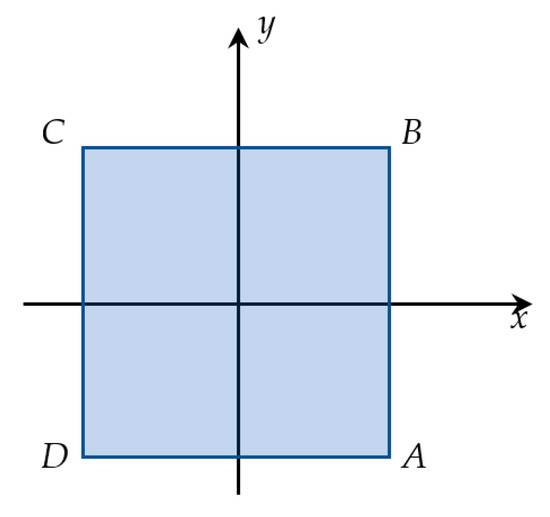
Let be a square having sides of length 1 and vertices {A, B, C, D}, drawin the x-y plane so that its center is at the origin and its sides are parallel to the axes (see Figure 1).
Figure 1.
Square .
Assume that, each element of which is a plane motion of the square. Element I represents a rotation of around the origin. Elements R, and represent, and of counterclockwise rotations around the origin, respectively. Elements L, and represent, and of clockwise rotations around the origin, respectively. The binary hyperoperation ⋆ is given inTable 6:
Table 6.
The binary hyperoperation ⋆ on M.
Using a Python program, it is quite easy to verify that (M, ⋆) is a CA-semihypergroup, an LA-semihypergroup and a Semihypergroup. Moreover, (M, ⋆) is commutative.
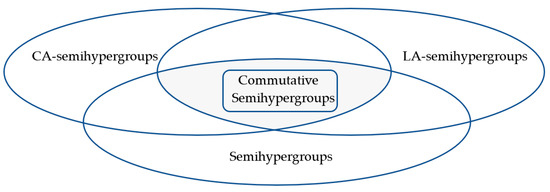
According to Examples 1–6, we can chart the relationships among CA-semihypergroups, LA-semihypergroups and Semihypergroups (see Figure 2).
Figure 2.
The relationships among some algebraic systems.
Definition 3.
When (M, ▴1) and (C, ▴2) are CA-semihypergroups, the mapping φ: M → C is said to be a good homomorphism if
for all α, β ∈ M. A bijective good homomorphism is an isomorphism. When f: M → C is an isomorphism, we write f: (M, ▴1) ≈ (C, ▴2) and say that (M, ▴1) and (C, ▴2) are isomorphic.
φ(α▴1β) = φ(α)▴2φ(β)
Theorem 1.
Let (C1, ▴1) be a CA-semihypergroup of order m, (C2, ▴2) be a CA-semihypergroup of order n.
Denote C = C1∪C2 (C1∩C2 = Φ) and define the binary hyperoperation ▴ in C as follows:
- (a)
- if u, v ∈ C1, then u▴v = u▴1 v;
- (b)
- if u, v ∈ C2, then u▴v = u▴2 v;
- (c)
- if u ∈ C1, v ∈ C2, then u▴v = u;
- (d)
- if u ∈ C2, v ∈ C1, then u▴v = v;
- (e)
- if u ∈ C2, v ∈ C1, w ∈ C1, then u▴(v▴w) = w▴(u▴v);
Then (C, ▴) is a CA-semihypergroup of order m + n.
Proof.
To prove that (C, ▴) is a CA-semihypergroup, we have to show that it satisfies cyclic associative law. That is,
for all u, v, w ∈ C. We shall discuss several cases.
u▴(v▴w) = w▴(u▴v)
Case 1. u, v, w ∈ C1 or u, v, w ∈ C2. Since C1, C2 are CA-semihypergroups, u▴(v▴w) = w▴(u▴v).
Case 2. u ∈ C2, v ∈ C2, w ∈ C1.
Case 3. u ∈ C1, v ∈ C2, w ∈ C2. By (c) and (d), we have
w▴(u▴v) = w▴u = u = v▴u = v▴(w▴u).
By the conclusion of Case 2, we obtain
v▴(w▴u) = u▴(v▴w).
Thus u▴(v▴w) = w▴(u▴v).
Case 4. u ∈ C1, v ∈ C1, w ∈ C2. By (d) and (c), we have
Case 5. u ∈ C2, v ∈ C1, w ∈ C2. By (c) and (d), we have
u▴(v▴w) = u▴v = v = v▴(u▴w).
By the conclusion of Case 3, (c) and (d), we obtain
v▴(u▴w) = w▴(v▴u) = w▴v = w▴(u▴v).
Thus u▴(v▴w) = w▴(u▴v).
Case 6. u ∈ C2, v ∈ C1, w ∈ C1. By (e), we have u▴(v▴w) = w▴(u▴v).
Case 7. u ∈ C1, v ∈ C2, w ∈ C1. By (e), we have
v▴(w▴u) = u▴(v▴w).
By the conclusion of Case 4, we obtain
w▴(u▴v) = v▴(w▴u).
Thus u▴(v▴w) = w▴(u▴v). In conclusion, (C, ▴) is a CA-semihypergroup of order m + n. □
Theorem 2.
Let (C1, ▴1) be a commutative CA-semihypergroup of order m, (C2, ▴2) be a CA-semihypergroup of order n, and C1∩C2 = Φ.
- (1)
- Denote C = C1∪C2, and define the binary hyperoperation ▴ in C as follows:
- (a)
- if u, v ∈ C1, then u▴v = u▴1 v;
- (b)
- if u, v ∈ C2, then u▴v = u▴2 v;
- (c)
- if u ∈ C1, v ∈ C2, then u▴v = u;
- (d)
- if u ∈ C2, v ∈ C1, then u▴v = v;
Then (C, ▴) is a CA-semihypergroup of order m + n.
- (2)
- Suppose (M, ⋆) and (C, ▴) are isomorphic. Denote P = C1∪M, and define the binary hyperoperation ▪ in P as follows:
- (e)
- if u, v ∈ C1, then u▪v = u▴1 v;
- (f)
- if u, v ∈ M, then u▪v = u⋆v;
- (g)
- if u ∈ C1, v ∈ M, then u▪v = u;
- (h)
- if u ∈ M, v∈ C1, then u▪v = v;
Then (P, ▪) is a CA-semihypergroup of order m + (m + n).
Proof.
(1) By the proof of Theorem 1, we just need to prove Cases 6–7.
Case 6. u ∈ C2, v ∈ C1, w ∈ C1. Since (C1, ▴1) is a commutative CA-semihypergroup, we have
w▴v = v▴w.
Thus w▴(u▴v) = w▴v = v▴w = v▴(w▴u). By the proof of Case 4 in Theorem 1, we get
v▴(w▴u) = u▴(v▴w).
Thus u▴(v▴w) = w▴(u▴v).
Case 7. u ∈ C1, v ∈ C2, w ∈ C1. By the proof of Case 6, we have
v▴(w▴u) = u▴(v▴w).
By the proof of Case 4 in Theorem 1, we get
w▴(u▴v) = v▴(w▴u).
Thus u▴(v▴w) = w▴(u▴v). In conclusion, (C, ▴) is a CA-semihypergroup of order m + n.
(2) By Theorem 2 (1), we can get Theorem 2 (2). □
Remark 1.
We can easily prove that the following two conditions are equivalent.
- Condition 1:
- (a)
- if u, v ∈ C1, then u▴v = u▴1 v;
- (b)
- if u, v ∈ C2, then u▴v = u▴2 v;
- (c)
- if u ∈ C1, v ∈ C2, then u▴v = u;
- (d)
- if u ∈ C2, v ∈ C1, then u▴v = v;
- (e)
- if u ∈ C2, v ∈ C1, w ∈ C1, then u▴(v▴w) = w▴(u▴v).
- Condition 2:
- (f)
- if u, v ∈ C1, then u▴v = u▴1 v;
- (g)
- if u, v ∈ C2, then u▴v = u▴2 v;
- (h)
- if u ∈ C1, v ∈ C2, then u▴v = u;
- (i)
- if u ∈ C2, v ∈ C1, then u▴v = v;
- (j)
- C1 is a commutative CA-semihypergroup.
Remark 2.
Applying Theorem 2 (1) once and then Theorem 2 (2) t − 1 (t ≥ 2) times, we can get a CA-semihypergroup of order tm + n.
Example 7.
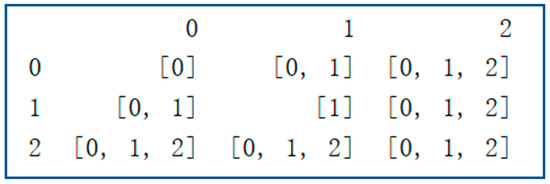
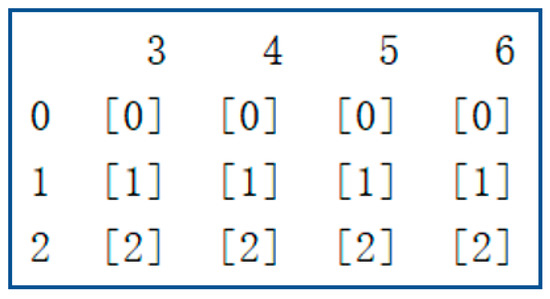
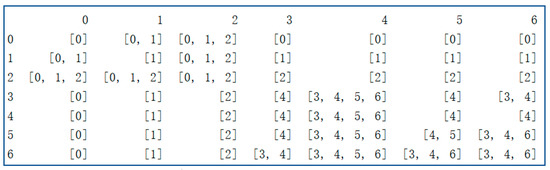
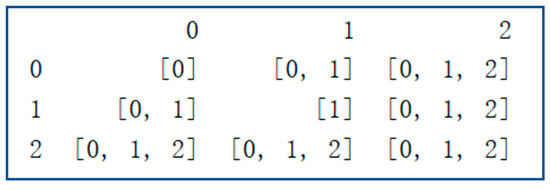
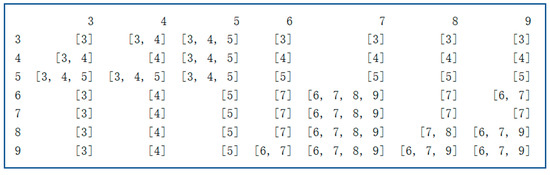
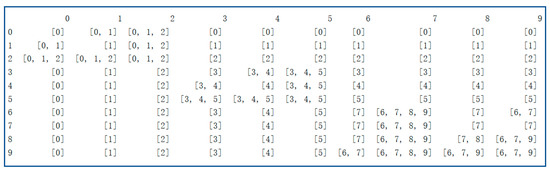
Let C1 = {0, 1, 2} and C2 = {3, 4, 5, 6} define the binary hypergroupoid (C1, ▴1) and (C2, ▴2) as shown inTable 7 and Table 8.
Table 7.
The binary hypergroupoid (C1, ▴1).
Table 8.
The binary hypergroupoid (C2, ▴2).
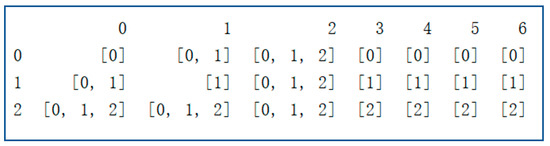
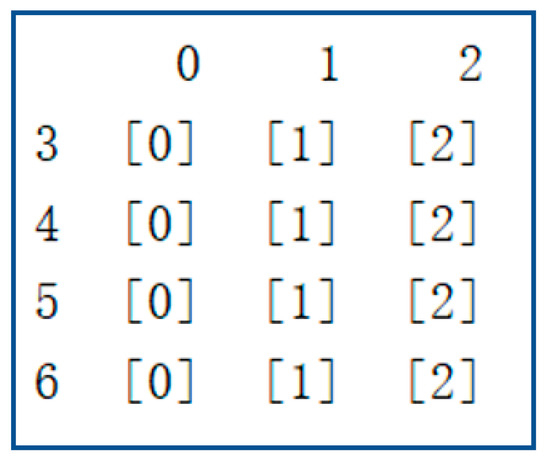
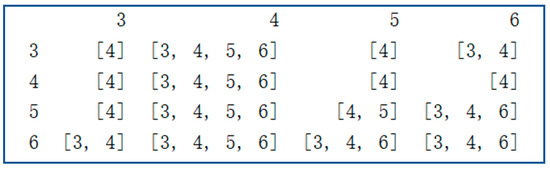
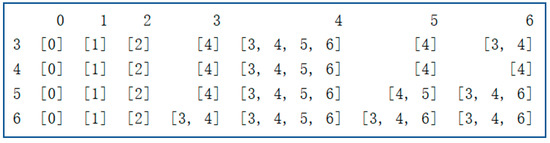
Using a Python program, it is quite easy to verify that (C1, ▴1) is a commutative CA-semihypergroup of order 3, (C2, ▴2) is a noncommutative CA-semihypergroup of order 4, and C1∩C2 = Φ. By Theorem 2 (1), we know that the binary hypergroupoid (C, ▴) = (C1∪C2, ▴) = ({0, 1, 2, 3, 4, 5, 6}, ▴) (see Table 9) is a CA-semihypergroup of order 3 + 4. We continue to apply Theorem 2 (2) to (C1, ▴1) and (M, ⋆), where (M, ⋆) ≈ (C, ▴) and C1∩M = Φ (see Table 7, Table 9 and Table 10). Then the binary hypergroupoid (P, ▪) = (C1∪M, ▪) = ({0, 1, 2, 3, 4, 5, 6, 7, 8, 9}, ▪) (see Table 7, Table 10 and Table 11) is a CA-semihypergroup of order 3 + (3 + 4).
Table 9.
The binary hypergroupoid (C, ▴).
Table 10.
The binary hypergroupoid (M, ⋆).
Table 11.
The binary hypergroupoid (P, ▪).
These results are obtained by using a Python program. Here, we introduce the main function (see Python function concat_CA) in this Python program. Python function concat_CA has three variables. The first variable, CA1, represents a symmetric CA-semihypergroup. The second variable, CA2, represents another asymmetric CA-semihypergroup. The third variable, n minus 1, represents the number of iterations. When CA1 = (C1, ▴1), CA2 = (C2, ▴2), n = 2, by steps 2–3 of function conca_CA, we have p = 3, q = 4; By step 4 of function concat_CA, we can get a dataframe as follows(see Figure 3):
Figure 3.
Top left (running result of Python).
Figure 4.
Top right (running result of Python).
Figure 5.
Upper half (running result of Python).
Figure 6.
Lower left (running result of Python).
Figure 7.
Lower right (running result of Python).
Figure 8.
Lower half (running result of Python).
Figure 9.
(C, ▴) (running result of Python).
The program enters a while loop starting at step 25 of function concat_CA. By steps 26–30 of function concat_CA, we can get new CA1 and CA2, as follows (seeFigure 10 and Figure 11):
Figure 10.
New top left (running result of Python).
Figure 11.
New lower right (running result of Python).
If the Boolean expression in step 31 evaluates True, then the program executes recursive function concat_CA(CA1, CA2, n) until it breaks out of the while loop. Now that CA1 = (C1, ▴1), CA2 = (C2, ▴2) n = 2, we get a CA-semihypergroup as follows(see Figure 12):
Figure 12.
(P, ▪) (running result of Python).
In the same way, we can get the following CA-semihypergroups (seeTable 12, Table 13 and Table 14). When CA1 = C1, CA2 = C2, n = 3, we get a CA-semihypergroup of order 13 (see Table 12). When CA1 = C1, CA2 = C2, n = 4, we get a CA-semihypergroup of order 16 (see Table 13). When CA1 = C1, CA2 = C2, n = 5, we get a CA-semihypergroup of order 19 (see Table 14).
| Python function concat_CA |
| 1: def concat_CA(CA1,CA2,n): |
| 2: p = CA1.shape [1] # Obtain the order of the first CA-semihypergroup |
| 3: q = CA2.shape [1] # Obtain the order of the second CA-semihypergroup |
| 4: df1 = pd.dataframe.from_records(CA1, columns = list(rang(p))) # top left |
| 5: arr1 = np.zeros((p,q),int) |
| 6: list1 = np.array(arr1).tolist() |
| 7: k = −1 |
| 8: for item in list1: |
| 9: k += 1 |
| 10: for i in range(len(item)): |
| 11: item[i] = [k] |
| 12: arr2 = np.array(list1) |
| 13: df2 = pd.dataframe.from_records(arr2, columns = list(range(p,p + q))) # top right |
| 14: df3 = pd.concat([df1,df2], axis = 1) # upper half |
| 15: arr3 = arr2.swpaxes(1,0) # transpose |
| 16: df4 = pd.dataframe.from_records(arr3, list(range(p,p + q))) # lower left |
| 17: df5 = pd.dataframe(CA2, index = list(range(p,p + q)), columns = list(range(p,p + q))) |
| 18: df6 = pd.concat([df4,df5], axis = 1, ignore_index = True) # lower half |
| 19: global df_lastCA |
| 20: df_lastCA = pd.concat([df3,df6], axis = 0) # generating CA |
| 21: CA2 = np.array(df_lastCA) |
| 22: CA1_copy = copy.deepcopy(CA1) |
| 23: global isgo |
| 24: isgo = True |
| 25: while isgo: |
| 26: CA1 = CA1_copy # new top left |
| 27: CA2 = chang_list(CA2) |
| 28: CA2_copy = copy.deepcopy(CA2) |
| 29: df_lastCA = pd.Dataframe(CA2_copy) # save the final CA-semihypergroup |
| 30: CA2 = change2(CA2,CA1.shape [1]) # generating isomorphic CA2 (new lower right) |
| 31: if CA2.shape [1] < int(3*n + 4): # recursive condition |
| 32: concat_CA(CA1,CA2,n) # recursive |
| 33: elif CA2.shape [1] = = int(3*n + 4): # the ending condition of recursiveisgo |
| 34: isgo = False # break out of the while loop |
| 35: return df_lastCA # return the final CA-semihypergroup |
Table 12.
CA-semihypergroup of order 13.
Table 13.
CA-semihypergroup of order 16.
Table 14.
CA-semihypergroup of order 19.
3. Neutrosophic Extended Triplet CA-Semihypergroups (NET-CA-Semihypergroups)
Definition 4.
A CA-semihypergroup (C, ⋆) is called:
- (1)
- an RL-NET-CA-semihypergroup, if for any u ∈ C, there exist in C two elements v and w, such that
u ∈ u ⋆ v, and v ∈ w ⋆ u.
We call v, w, (u, v, w) a right neutral of element u, a left opposite of element u corresponding to v, and an RL-NET-hyper-neutrosophic-triplet.
- (2)
- an LR-NET-CA-semihypergroup, if for any u ∈ C, there exist in C two elements v and w, such that
u ∈ v ⋆ u, and v ∈ u ⋆ w.
- (3)
- an RR-NET-CA-semihypergroup, if for any u ∈ C, there exist in C two elements v and w, such that
u ∈ u ⋆ v, and v ∈ u ⋆ w.
- (4)
- an LL-NET-CA-semihypergroup, if for any u ∈ C, there exist in C two elements v and w, such that
u ∈ v ⋆ u, and v ∈ w ⋆ u.
- (5)
- an NET-CA-semihypergroup, if for any u ∈ C, there exist in C two elements v and w, such that
u ∈ (v ⋆ u)∩(u ⋆ v), and v ∈ (w ⋆ u)∩(u ⋆ w).
In addition, similar to Definition 4 (1), we can give the corresponding definitions of neutral, opposite, and hyper-neutrosophic-triplet in Definition 4 (2), (3), (4) and (5).
Definition 5.
A CA-semihypergroup (C, ⋆) is said to be
- (1)
- an R-Regular-CA-semihypergroup, if for any a ∈ C, there exists in C element t, such that
a ∈ a ⋆ (t ⋆ a).
- (2)
- an L-Regular-CA-semihypergroup, if for any a ∈ C, there exists in C element s, such that
a ∈ (a ⋆ s ) ⋆ a.
- (3)
- an S-Regular-CA-semihypergroup, if for any a ∈ C, there exists in C element r, such that
a ∈ a⋆(r⋆ a) and a ∈ (a⋆ r) ⋆a.
Remark 3.
Every RR-NET-CA-semihypergroup is a CA-semihypergroup.
Remark 4.
Every S-Regular-NET-CA-semihypergroup is an L-Regular-NET-CA-semihypergroup.
Example 8.
Consider the binary hypergroupoid (C = {0, 1, 2}, ⋆), whose multiplication table is exhibited below (see Table 15).
Table 15.
The binary hypergroupoid (C, ⋆).
Using the Python program, we know (C, ⋆) is a CA-semihypergroup. However, (C, ⋆) is not an RR-NET-CA-semihypergroup, because for each x ∈ C, 2 ∉ (2 ⋆ x).
Proposition 1.
Every RL-NET-CA-semihypergroup is an RR-NET-CA-semihypergroup; the converse is also true.
Proof.
Let (C, ⋆) be an RL-NET-CA-semihypergroup, then for any u ∈ C, there exist v, w ∈ C, such that
hence,
that is, there exists r ∈ u ⋆ w, such that
u ∈ u ⋆ v, and v ∈ w ⋆ u,
u ∈ u ⋆ r.
In other words, for any u ∈ C, there exist r, w ∈ C, such that
u ∈ u ⋆ r, and r ∈ u ⋆ w.
Hence, (C, ⋆) is an RR-NET-CA-semihypergroup.
Conversely, if (C, ⋆) is an RR-NET-CA-semihypergroup, then for any u ∈ C, there exist v, w ∈ C, such that
hence,
that is, there exists r ∈ w ⋆ u, such that
u ∈ u ⋆ v, and v ∈ u ⋆ w,
u ∈ u ⋆ r.
In other words, for any u ∈ C, there exist r, w ∈ C, such that
u ∈ u ⋆ r, and r ∈ w ⋆ u.
Hence, (C, ⋆) is an RL-NET-CA-semihypergroup. □
Proposition 2.
Every R-Regular-CA-semihypergroup is an RL-NET-CA-semihypergroup; the converse is also true.
Proof.
Let (C, ⋆) be an RL-NET-CA-semihypergroup, then for any u ∈ C, there exist v, w ∈ C, such that
hence,
that is, for any u ∈ C, there exists w ∈ C, such that
By Definition 5 (1), (C, ⋆) is an R-Regular-CA-semihypergroup.
u ∈ u ⋆ v, and v ∈ w ⋆ u,
u ∈ u ⋆ v ⊆ u ⋆ (w ⋆ u),
u ∈ u ⋆ (w ⋆ u).
On the other hand, if (C, ⋆) is an R-Regular-CA-semihypergroup, then for any u ∈ C, there exists w ∈ C, such that
that is, there exists r ∈ w ⋆ u, such that
In other words, for any u ∈ C, there exist r, w ∈ C, such that
Hence, (C, ⋆) is an RL-NET-CA-semihypergroup. □
u ∈ u ⋆ r.
u ∈ u ⋆ r, and r ∈ w ⋆ u.
Proposition 3.
Every LR-NET-CA-semihypergroup is an RR-NET-CA-semihypergroup, but the converse is not true.
Proof.
Suppose that (C, ⋆) is an LR-NET-CA-semihypergroup, for any u ∈ C, there exist v, w ∈ C, such that
by cyclic associative law, we get
that is, there exists r ∈ (u ⋆ w) ⋆ v, such that
Furthermore, by Equation (10), we have
that is, there exists t ∈ w ⋆ (u ⋆ w), such that
In other words, for any u ∈ C, there exist r, t ∈ C, such that
Hence, (C, ⋆) is an RR-NET-CA-semihypergroup. □
u ∈ v ⋆ u, and v ∈ u ⋆ w,
u ∈ u ⋆ r.
r ∈ u ⋆ t.
u ∈ u ⋆ r, and r ∈ u ⋆ t.
Example 9.
Consider the binary hypergroupoid (C = {0, 1, 2}, ⋆), whose multiplication table is exhibited below (seeTable 16).
Table 16.
The binary hypergroupoid (C, ⋆).
Using the Python program, we know that (C, ⋆) is an RR-NET-CA-semihypergroup, and
Hence, (0, 0, 0), (0, 0, 1),(0, 0, 2) (1, 1, 1), (1, 1, 2),(1,2,1),(2,1,1),(2,1,2) are all RR-NET-hyper-neutrosophic-triplets. Moreover, (C, ⋆) is an RR-NET-CA-semihypergroup. However, for any x ∈ C, 2 ∉ (x ⋆ 2). This implies (C, ⋆) is not an LR-NET-CA-semihypergroup.
0 ∈ (0 ⋆ 0), 0 ∈ (0 ⋆ 0); 0 ∈ (0 ⋆ 0), 0 ∈ (0 ⋆ 1);
0 ∈ (0 ⋆ 0), 0 ∈ (0 ⋆ 2); 1 ∈ (1 ⋆ 1), 1 ∈ (1 ⋆ 1);
1 ∈ (1 ⋆ 1), 1 ∈ (1 ⋆ 2); 1 ∈ (1 ⋆ 2), 2 ∈ (1 ⋆ 1);
2 ∈ (2 ⋆ 1), 1 ∈ (2 ⋆ 1); 2 ∈ (2 ⋆ 1), 1 ∈ (2 ⋆ 2).
Proposition 4.
Let (C, ⋆) be a CA-semihypergroup, then (C, ⋆) is an LR-NET-CA-semihypergroup, if and only if, (C, ⋆) is an L-Regular-CA-semihypergroup.
Proof.
By a method similar to Proposition 2, we can prove Proposition 4. □
Proposition 5.
Every LL-NET-CA-semihypergroup is an LR-NET-CA-semihypergroup, but the converse is not true.
Proof.
Suppose that (C, ⋆) is an LL-NET-CA-semihypergroup, for any u ∈ C, there exist v, w ∈ C, such that
thus,
that is, there exists r ∈ w ⋆ v, such that
In other words, for any u ∈ C, there exist v, r ∈ C, such that
Hence, (C, ⋆) is an LR-NET-CA-semihypergroup. □
u ∈ v ⋆ u, and v ∈ w ⋆ u,
v ∈ u ⋆ r.
u ∈ v ⋆ u, and v ∈ u ⋆ r.
Example 10.
Consider the binary hypergroupoid (C = {0, 1, 2}, ⋆), whose multiplication table is exhibited below (seeTable 17).
Table 17.
The binary hypergroupoid (C, ⋆).
Using the Python program, we know that (C, ⋆) is a CA-semihypergroup, and
Hence, (0, 2, 1), (1, 0, 1), (1, 1, 0) (1, 1, 1), (1, 1, 2), (1,2,1), (2,2,1), (2,2,2) are all LR-NET-hyper-neutrosophic- triplets. Moreover, (C, ⋆) is an LR-NET-CA-semihypergroup. However, 0 ∉ (0 ⋆ 0), 0 ∉ (1 ⋆ 0), and when 0 ∈ (2 ⋆ 0), there is not x in C, such that 2 ∈ (x ⋆ 0). It implies (C, ⋆) is not an LL-NET-CA-semihypergroup.
0 ∈ (2 ⋆ 0), 2 ∈ (0 ⋆ 1); 1 ∈ (0 ⋆ 1), 0 ∈ (1 ⋆ 1);
1 ∈ (1 ⋆ 1), 1 ∈ (1 ⋆ 0); 1 ∈ (1 ⋆ 1), 1 ∈ (1 ⋆ 1);
1 ∈ (1 ⋆ 1), 1 ∈ (1 ⋆ 2); 1 ∈ (2 ⋆ 1), 2 ∈ (1 ⋆ 1);
2 ∈ (2 ⋆ 2), 2 ∈ (2 ⋆ 1); 2 ∈ (2 ⋆ 2), 2 ∈ (2 ⋆ 2).
Example 11.
Consider the binary hypergroupoid (C = {0, 1, 2}, ⋆), whose multiplication table is exhibited below (seeTable 18).
Table 18.
The binary hypergroupoid (C, ⋆).
Using the Python program, we know that (C, ⋆) is a CA-semihypergroup, and
hence, (C, ⋆) is an S-Regular-CA-semihypergroup. Furthermore, we know that (C, ⋆) is not an LL-NET-CA-semihypergroup. Because, 1 ∉ (1 ⋆ 1), 1 ∉ (2 ⋆ 1), and when 1 ∈ (0 ⋆ 1), there is not x in C, such that 0 ∈ (x ⋆ 1).
0 ∈ 0 ⋆ (0 ⋆ 0), 0 ∈ (0 ⋆ 0) ⋆ 0;
1 ∈ 1 ⋆ (0 ⋆ 1), 1 ∈ (1 ⋆ 0) ⋆ 1;
2 ∈ 2 ⋆ (0 ⋆ 2), 2 ∈ (2 ⋆ 0) ⋆ 2;
Proposition 6.
Each NET-CA-semihypergroup is an LL-NET-CA-semihypergroup.
Proof.
Assume that (C, ⋆) is a NET-CA-semihypergroup. Then, for any u ∈ C, there exist v, w ∈ C, such that
Hence,
Thus, (C, ⋆) is an LL-NET-CA-semihypergroup. □
u ∈(v ⋆ u)∩(u ⋆ v), and v ∈(w ⋆ u)∩(u ⋆ w).
u ∈ v ⋆ u, and v ∈ w ⋆ u.
Proposition 7.
Each NET-CA-semihypergroup is an S-Regular-CA-semihypergroup.
Proof.
Let (C ⋆) be a NET-CA-semihypergroup. By Definition 4 (5), there exist v, w ∈ C, such that
for any u ∈ C. Hence,
that is,
hence, (C, ⋆) is an S-Regular-NET-CA-semihypergroup. □
u ∈ (v ⋆ u)∩(u ⋆ v), and v ∈ (w ⋆ u)∩(u ⋆ w);
u ∈ u ⋆ v, and v ∈ w ⋆ u
u ∈ v ⋆ u, and v ∈ u ⋆ w
u ∈ u ⋆ (w ⋆ u), u ∈(u ⋆ w) ⋆ u,
Figure 13 shows the relationships among various Net-CA-semihypergroups discussed in this section.
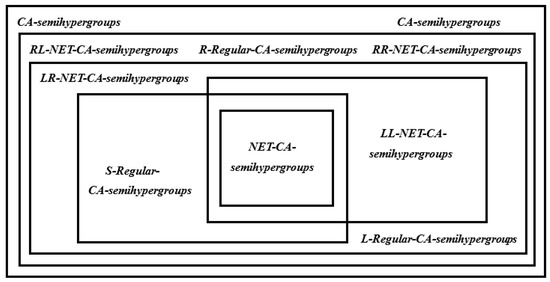
Figure 13.
The relationships among various Net-CA-semihypergroups.
4. Strong Pure Neutrosophic Extended Triplet CA-Semihypergroups (SP-NET-CA-Semihypergroups)
Definition 6.
A CA-semihypergroup (C, ⋆) is called:
- (1)
- PRL-NET-CA-semihypergroup, if for any u∈ C, there exist v∈ C and w∈C, such that
u = u ⋆ v, and v = w ⋆ u.
Furthermore, we call v, w, and (u, v, w) a right neutral of element u, a left opposite of element u corresponding to v, and a PRL-NET-hyper-neutrosophic-triplet. The notation { }rn(u) represents the set of all right neutrals of element u. The notation { }la(u)v represents the set of all left opposites of element u corresponding to a certain v, where v is a right neutral of element u.
- (2)
- PLR-NET-CA-semihypergroup, if for any u ∈ C, there exist v ∈ C and w ∈ C, such that
u = v ⋆ u, and v = u ⋆ w;
- (3)
- PRR-NET-CA-semihypergroup, if for any u ∈ C, there exist v ∈ C and w ∈ C, such that
u = u ⋆ v, and v = u ⋆ w;
- (4)
- PLL-NET-CA-semihypergroup, if for any u ∈ C, there exist v ∈ C and w ∈ C, such that
u = v ⋆ u, and v = w ⋆ u;
- (5)
- P-NET-CA-semihypergroup, if for any u ∈ C, there exist v ∈ C and w ∈ C, such that
u = (v ⋆ u)∩(u ⋆ v), andv = (w ⋆ u)∩(u ⋆ w);
- (6)
- SP-NET-CA-semihypergroup, if for any u ∈ C, there exist v ∈ C and w ∈ C, such that
u = v ⋆ u = u ⋆ v, and v = w ⋆ u = u ⋆ w.
In addition, similar to Definition 6 (1), we can give the corresponding definitions of neutral, opposite, hyper-neutrosophic-triplet, the set of all neutrals of an element and the set of all opposites of the element corresponding to a certain neutral in Definition 6 (2), (3), (4), (5), (6).
Remark 5.
Every SP-NET-CA-semihypergroup is a P-NET-CA-semihypergroup. Every P-NET-CA-semihypergroup is an NET-CA-semihypergroup.
Remark 6.
Every SP-NET-CA-semihypergroup must be a PRL-NET-CA-semihypergroup, a PLR-NET-CA-semihypergroup, a PRR-NET-CA-semihypergroup, and a PLL-NET-CA-semihypergroup.
Theorem 3.
and v is unique.
Let (C, ⋆) be a PRL-NET-CA-semihypergroup, then for any u ∈ C,
- (1)
- if (u, v, w) is a PRL-NET-hyper-neutrosophic-triplet, then
v ⋆ v = v,
- (2)
- (C, ⋆) is a PLR-NET-CA-semihypergroup.
Proof.
(1) Let (C, ⋆) be a PRL-NET-CA-semihypergroup. Thus, there exist v ∈ { }rn(u), and w ∈ { }la(u)v, such that
for any u∈ C. Hence,
This shows that v is idempotent. On the other hand, by u = u ⋆ v, we have
That is, if (C, ⋆) is a PRL-NET-CA-semihypergroup, then for any u ∈ C, there exist v ∈ C, and w ∈ C, such that
To show that v is unique, suppose that there exist two elements q ∈ { }rn(u), and t ∈ { }la(u)q, such that
then
By q = t ⋆ u, we have
Both sides of v = w ⋆ u multiply by q,
By v = v ⋆ v, we get
Hence v = q ⋆ v = v ⋆ q = q, we have proven Theorem 3 (1).
u = u ⋆ v, and v = w ⋆ u,
v = w ⋆ u
= w ⋆ (u ⋆ v) Using cyclic associative law
= v ⋆ (w ⋆ u) By v = w ⋆ u
= v ⋆ v.
v ⋆ u = v ⋆ (u ⋆ v) Using cyclic associative law
= v ⋆ (v ⋆ u) Using cyclic associative law
= u ⋆ (v ⋆ v) By v = v ⋆ v
= u ⋆ v = u By u = u ⋆ v.
u = u ⋆ v = v ⋆ u, and v = w ⋆ u.
u = u ⋆ q, and q = t ⋆ u,
u = u ⋆ q = q ⋆ u, and q = t ⋆ u.
v ⋆ q = v ⋆ (t ⋆ u) Using cyclic associative law
= u ⋆ (v ⋆ t) Using cyclic associative law
= t ⋆ (u ⋆ v) By u = u ⋆ v
= t ⋆ u = q By q = t ⋆ u.
q ⋆ v = q ⋆ (w ⋆ u) Using cyclic associative law
= u ⋆ (q ⋆ w) Using cyclic associative law
= w ⋆ (u ⋆ q) By u = u ⋆ q
= w ⋆ u = v By v = w ⋆ u
q ⋆ v = q ⋆ (v ⋆ v) Using cyclic associative law
= v ⋆ (q ⋆ v) Using cyclic associative law
= v ⋆ (v ⋆ q) By v ⋆ q = q
= v ⋆ q.
(2) Let (u, v, w) be an RL-NET-hyper-neutrosophic-triplet of (C, ⋆). According to the proof of (1), there exist v, and w, such that
u = u ⋆ v = v ⋆ u, and v = w ⋆ u.
Then, we have
Obviously, u ⋆ r is a nonempty set, and v is unique. Hence for each r ∈ w ⋆ v, equation u ⋆ r = v holds. That is, for any u ∈ C, there exist v ∈ { }ln(u), and r ∈ { }ra(u)v, such that
It implies that (u, v, r) is a PLR-NET-hyper-neutrosophic-triplet of (C, ⋆). Hence (C, ⋆) is a PLR-NET-CA-semihypergroup. □
v = w ⋆ u …….By u = v ⋆ u
= w ⋆ (v ⋆ u) Using cyclic associative law
u = v ⋆ u, and v = u ⋆ r.
Theorem 4.
Every PLR-NET-CA-semihypergroup is an SP-NET-CA-semihypergroup.
Proof.
Let (C, ⋆) be a PLR-NET-CA-semihypergroup. Then for any u ∈ C, there exist v ∈ { }ln(u), and w ∈ { }ra(u)v, such that
By v = u ⋆ w, we have
Both sides of u ⋆ w = v multiply by u, we get
That is, if (C, ⋆) is a PLR-NET-CA-semihypergroup, then for any u ∈ C, there exist v ∈ C, and w ∈ C, such that
Hence, for this v, there exist x ∈ { }ln(v), y ∈ { }ra(v)x, such that
Both sides of u ⋆ w = v multiply by x, we have
Furthermore, we get
Thus w ⋆ (x ⋆ u) = v. On the other hand,
Hence
It implies that for any u ∈ C, there exist v, w ∈ C, such that
In other words, (C, ⋆) is an SP-NET-CA-semihypergroup. □
u = v ⋆ u, and u ⋆ w = v.
v ⋆ v = v ⋆ (u ⋆ w) Using cyclic associative law
= w ⋆ (v ⋆ u) By u = v ⋆ u
= w ⋆ u.
u ⋆ v = u ⋆ (u ⋆ w) ……………Using cyclic associative law
= w ⋆ (u ⋆ u) ……………Using cyclic associative law
= u ⋆ (w ⋆ u) ……………By v ⋆ v = w ⋆ u
= u ⋆ (v ⋆ v) ……………Using cyclic associative law
= v ⋆ (u ⋆ v) ……………Using cyclic associative law
= v ⋆ (v ⋆ u) = v ⋆ u = u …By v ⋆ u = u.
u = u ⋆ v = v ⋆ u, and u ⋆ w = v.
v = x ⋆ v = v ⋆ x, and v ⋆ y = x.
x ⋆ (u ⋆ w) = x ⋆ v = v.
x ⋆ (u ⋆ w) = w ⋆ (x ⋆ u), Using cyclic associative law.
u = u ⋆ v by x ⋆ v = v
= u ⋆ (x ⋆ v) ………Using cyclic associative law
= v ⋆ (u ⋆ x) ………Using cyclic associative law
= x ⋆ (v ⋆ u) = x ⋆ u, By v ⋆ u = u.
w ⋆ u = w ⋆ (x ⋆ u) = v. By u = x ⋆ u, w ⋆ (x ⋆ u) = v.
u = v ⋆ u = u ⋆ v, u ⋆ w = w ⋆ u = v.
Theorem 5.
Every PRR-NET-CA-semihypergroup is a PLR-NET-CA-semihypergroup.
Proof.
Suppose that (C, ⋆) is a PRR-NET-CA-semihypergroup. Thus, there exist v ∈ { }rn(u), w ∈ { }ra(u)v, such that
for any u ∈ C. Hence, for this v, there exist x ∈ { }rn(v), y ∈ { }ra(v)x, such that
Both sides of v ⋆ x = v multiply by u,
Furthermore, we have
Thus x ⋆ u = u. On the other hand,
That is, for any u ∈ C, there exist v, w ∈ C, such that
Thus, (C, ⋆) is a PLR-NET-CA-semihypergroup. □
u = u ⋆ v, and u ⋆ w = v
v = v ⋆ x, and v ⋆ y = x.
u ⋆ (v ⋆ x) = u ⋆ v = u.
u ⋆ (v ⋆ x) = x ⋆ (u ⋆ v) = x ⋆ u.
v ⋆ u = v ⋆ (x ⋆ u) = u ⋆ (v ⋆ x) = u ⋆ v = u.
u = v ⋆ u, and u ⋆ w = v.
Theorem 6.
Every PLL-NET-CA-semihypergroup is a PRL-NET-CA-semihypergroup.
Proof.
Let (C, ⋆) be a PLL-NET-CA-semihypergroup. Then for any u ∈ C, there exist v ∈ { }ln(u), w ∈ { }la(u)v, such that
Furthermore, we have
By u = v ⋆ (u ⋆ v), and w ⋆ u = v, we get
That is, for any u ∈ C, there exist v, w ∈ C, such that
Thus, (C, ⋆) is a PRL-NET-CA-semihypergroup. □
u = v ⋆ u, and w ⋆ u = v.
u = v ⋆ u = v ⋆ (v ⋆ u) = u ⋆ (v ⋆ v) = v ⋆ (u ⋆ v).
u ⋆ v = (v ⋆ (u ⋆ v)) ⋆ (w ⋆ u) Using Equation (11)
= (u ⋆ v) ⋆ (w ⋆ (u ⋆ v)) Using cyclic associative law
= (u ⋆ v) ⋆ (v ⋆ (w ⋆ u)) By w ⋆ u = v
= (u ⋆ v) ⋆ (v ⋆ v) ……Using Equation (8)
= (v ⋆ u) ⋆ (v ⋆ v) ……By v ⋆ u = u
= u ⋆ (v ⋆ v) …………Using cyclic associative law
= v ⋆ (u ⋆ v) = u ………Using u = v ⋆ (u ⋆ v).
u = u ⋆ v, and w ⋆ u = v.
In fact, we have proven the following theorem.
Theorem 7.
Definition 6 (1), (2), (3), (4), (6) are equivalent.
Proof.
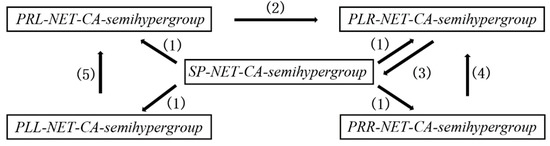
see Figure 14. □
Figure 14.
How we proved Theorem 7: Where (1) = Remark 6; (2) = Theorem 3; (3) = Theorem 4; (4) = Theorem 5; (5) = Theorem 6.
Finally, we discuss the properties of SP-NET-CA-semihypergroup.
Proposition 8.
is an SP-NET-CA-hyper-neutrosophic-triplet;
is an SP-NET-CA-hyper-neutrosophic-triplet;
is an SP-NET-CA-hyper-neutrosophic-triplet;
(v, v, s) is an SP-NET-CA-hyper-neutrosophic-triplet.
Suppose (C, ⋆) is an SP-NET-CA-semihypergroup,
- (1)
- if (u, v, w) is an SP-NET-CA-hyper-neutrosophic-triplet, then
v* v = v, and v is unique;
- (2)
- if (u, v, w) is an SP-NET-CA-hyper-neutrosophic-triplet, then (v, v, v) is an SP-NET-CA-hyper-neutrosophic-triplet;
- (3)
- if (u, v, w) is an SP-NET-CA-hyper-neutrosophic-triplet, then for any t ∈ v ⋆ w, (u, v, t) is an SP-NET-CA-hyper-neutrosophic-triplet;
- (4)
- if (u, v, w), (v, v, r) are two SP-NET-CA-hyper-neutrosophic-triplets, then
for any t ∈ r ⋆ w, (u, v, t)
- (5)
- if (u, v, w), (r, s, t) are two SP-NET-CA-hyper-neutrosophic-triplets, then
v ⋆ s = s ⋆ v;
- (6)
- if (u, v, w), (r, s, t) are two SP-NET-CA-hyper-neutrosophic-triplets, and |u ⋆ r|= |v ⋆ s| = 1, then
for any q ∈ t ⋆ w, (u ⋆ r, v ⋆ s, q)
- (7)
- if (u, v, w), (r, v, t) are two SP-NET-CA-hyper-neutrosophic-triplets, and |u ⋆ r| = 1, then
for any q ∈ t ⋆ w, (u ⋆ r, v, q)
- (8)
- if (u, v, w), (w, s, t) are two SP-NET-CA-hyper-neutrosophic-triplets, then
v = s ⋆ v = v ⋆ s, and
Proof.
(1) Let (u, v, w) be an SP-NET-CA-hyper-neutrosophic-triplet, then (u, v, w) is a PRL-NET-CA-hyper-neutrosophic-triplet. By Theorem 3 (1), we have
and v is unique.
v ⋆ v = v,
(2) By Proposition 8 (1), if v is neutral of element u, then v ⋆ v = v ⋆ v = v. It implies that v is neutral of element v, and v ∈ { }anti(v)v. Thus, (v, v, v) is an SP-NET-CA-hyper-neutrosophic-triplet.
(3) Suppose that (u, v, w) is an SP-NET-CA-hyper-neutrosophic-triplet, then
In addition,
Obviously, u ⋆ t is a nonempty set, and there is only one element in . Thus, for any t ∈ v ⋆ w, u ⋆ t = v. That is, (u, v, t) is a PRR-NET-CA-hyper-neutrosophic-triplet, so (u, v, t) is an SP-NET-CA-hyper-neutrosophic-triplet.
u = u ⋆ v = v ⋆ u, v = u ⋆ w = w ⋆ u.
(4) Suppose that (u, v, w) is an SP-NET-CA-hyper-neutrosophic-triplet, then for any u ∈ C,
(v, v, r) is an SP-NET-CA-hyper-neutrosophic-triplet, we have
u = v ⋆ u = u ⋆ v, v = u ⋆ w = w ⋆ u.
v ⋆ v = v ⋆ v = v, v = r ⋆ v = v ⋆ r.
In addition,
Obviously, u ⋆ t is a nonempty set, and there is only one element v in . Thus, for any t ∈ r ⋆ w, u ⋆ t = v. That is, (u, v, t) is a PRR-NET-CA-hyper-neutrosophic-triplet, so (u, v, t) is an SP-NET-CA-hyper-neutrosophic-triplet.
(5) Since (u, v, w), (r, s, t) are SP-NET-CA-hyper-neutrosophic-triplets, then
For this s, there is n ∈ C, which is neutral of s, such that
Furthermore, we get
v ⋆ v = v, s ⋆ s = s.
s = n ⋆ s = s ⋆ n, n ⋆ n = n.
v ⋆ s = (v ⋆ v) ⋆ [(n ⋆ s) ⋆ (s ⋆ n)] Using Equation (9)
= (s ⋆ v) ⋆ [(n ⋆ v) ⋆ (s ⋆ n)] Using Equation (8)
= (s ⋆ v) ⋆ [(n ⋆ n) ⋆ (s ⋆ v)] By n ⋆ n = n
= (s ⋆ v) ⋆ [n ⋆ (s ⋆ v)] Using cyclic associative law
= (s ⋆ v) ⋆ [v ⋆ (n ⋆ s)] By n ⋆ s = s
= (s ⋆ v) ⋆ (v ⋆ s) Using Equation (8)
= (s ⋆ s) ⋆ (v ⋆ v) = s ⋆ v By s ⋆ s = s, v ⋆ v = v.
(6) Since (u, v, w) is an SP-NET-CA-hyper-neutrosophic-triplet, then
(r, s, t) is an SP-NET-CA-hyper-neutrosophic-triplet, we have
By Proposition 8 (5), we get
u = u ⋆ v = v ⋆ u, v = u ⋆ w = w ⋆ u.
r = s ⋆ r = r ⋆ s, s = r ⋆ t = t ⋆ r.
(u ⋆ r) ⋆ (v ⋆ s) = (u ⋆ r) ⋆ (s ⋆ v) Using Equation (8)
= (v ⋆ u) ⋆ (s ⋆ r) By u = v ⋆ u, r = s ⋆ r
= u ⋆ r.
On the other hand,
That is, for any q ∈ t ⋆ w, (u ⋆ r) ⋆ q is a nonempty set, and there is only one element v ⋆ s in . It implies that for any q ∈ t ⋆ w, (u ⋆ r) ⋆ q = v ⋆ s. So far, we have proven that there exist v ⋆ s, and q ∈ t ⋆ w, such that
(u ⋆ r) ⋆ (v ⋆ s) = u ⋆ r, and (u ⋆ r) ⋆ q = v ⋆ s.
Thus, (u ⋆ r, v ⋆ s, q) is a PRR-NET-CA-hyper-neutrosophic-triplet. Moreover, (u ⋆ r, v ⋆ s, q) is an SP-NET-CA-hyper-neutrosophic-triplet.
(7) Let v = s in Proposition 8 (6), we can get the conclusion.
(8) Since (u, v, w) is an SP-NET-CA-hyper-neutrosophic-triplet, then
Since (w, s, t) is an SP-NET-CA-hyper-neutrosophic-triplet, we have
By Proposition 8 (5), we have
u = u ⋆ v = v ⋆ u, v = u ⋆ w = w ⋆ u.
w = w ⋆ s = s ⋆ w.
v ⋆ s = s ⋆ v By v = w ⋆ u
= s ⋆ (w ⋆ u) Using cyclic associative law
= u ⋆ (s ⋆ w) By w = s ⋆ w
= u ⋆ w = v.
On the other hand, by Proposition 8 (1), we have
That is, for this v, there exist v, s, such that
Thus, (v, v, s) is an SP-NET-CA-hyper-neutrosophic-triplet. □
v* v = v* v = v.
v* v = v* v = v,
v ⋆ s = s ⋆ v = v.
5. Conclusions
The concepts of various CA-semihypergroups are introduced for the first time in this paper. By comparing with other algebraic structures, we found that CA-semihypergroup, which is different from Semihypergroup and AG-semihypergroup, is a special kind of nonassociative algebra. However, if the commutative law is satisfied, these three kinds of algebraic structures are all commutative semihypergroups. We also found that R-Regular-CA-semihypergroup and L-Regular-CA-semihypergroup are two different algebraic structures, because association law does not hold. This is different from semihypergroups. For semihypergroups, R-Regular and L-Regular are equivalent. Through studying the relationships and characteristic of various CA-semihypergroups, we discovered that one kind of CA-semihypergroups, SP-NET-CA-semihypergroups, has very good symmetry and can be defined by relatively weak conditions. Most importantly, we designed a recursive algorithm to construct high-order asymmetric CA-semihypergroups and implemented it with a Python program. The main results of this paper are listed below:
- (1)
- Let (C1, ▴1), (C2, ▴2) be two CA-semihypergroups, and (C = C1 ∪ C2 (C1 ∩ C2 = Φ), ▴) satisfy the conditions in Theorem 1 Then (C, ▴) is a CA-semihypergroup (see Theorem 1).
- (2)
- Let (C1, ▴1) be a commutative CA-semihypergroup, (C2, ▴2) be a CA-semihypergroup, (C = C1 ∪ C2 (C1 ∩ C2 = Φ), ▴) satisfy the conditions in Theorem 2. Then (C, ▴) is a CA-semihypergroup (see Theorem 2, Example 7, and Python function concat_CA)
- (3)
- RL-NET-CA-semihypergroups, RR-NET-CA-semihypergroups and R-Regular-CA-semihypergroups are three fully equivalent algebraic structures (see Proposition 1 and Proposition 2)
- (4)
- LR-NET-CA-semihypergroups and L-Regular-CA-semihypergroups are two fully equivalent algebraic structures (see Proposition 4).
- (5)
- Every PRL-NET-CA-semihypergroup is a PLR-NET-CA-semihypergroup (see Theorem 3).
- (6)
- Every PLR-NET-CA-semihypergroup is an SP-NET-CA-semihypergroup (see Theorem 4).
- (7)
- Every PRR-NET-CA-semihypergroup is a PLR-NET-CA-semihypergroup (see Theorem 5).
- (8)
- Every PLL-NET-CA-semihypergroup is a PRL-NET-CA-semihypergroup (see Theorem 6).
- (9)
- The relations among various P-NET-CA-semihypergroups (see Theorem 7 and Figure 15).
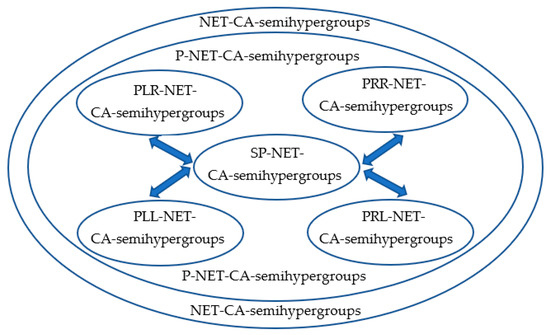 Figure 15. The relations among various P-NET-CA-semihypergroups.
Based on the research in this paper, we will also focus on the research of nonassociative algebra, such as hyperideals of CA-semihypergroups, CA-semihypergroup homomorphisms, simple CA-semihypergroups, ordered CA-semihypergroups, and so on in the future.
Author Contributions
M.H. and X.Z. initiated the research; M.H. wrote final version of the paper. All authors have read and agreed to the published version of the manuscript.
Funding
This research was funded by the National Natural Science Foundation of China (Grant No. 62081240416).
Institutional Review Board Statement
Not applicable.
Informed Consent Statement
Not applicable.
Conflicts of Interest
The authors declare no conflict of interest.
References
- Okubo, S. Introduction to Octonion and Other Non-Associative Algebras in Physics; Cambridge University Press: Cambridge, UK, 1995. [Google Scholar]
- Maksa, G. Cm solutions of some functional equations of associative type. Ann. Univ. Sci. Bp. Sect. Comp. 2004, 24, 125–132. [Google Scholar]
- Zhan, J.M.; Tan, Z.S. Left weakly Novikov algebra. J. Math. 2005, 25, 135–138. [Google Scholar]
- Sabinin, L.; Sbitneva, L.; Shestakov, I. Non-Associative Algebras and Its Applications; CRC Press: Boca Raton, FL, USA, 2006. [Google Scholar]
- Behn, A.; Correa, I.; Hentzel, I.R. On Flexible Algebras satisfying x (yz) = y (zx). Algebra Colloq. 2010, 17, 881–886. [Google Scholar] [CrossRef]
- Shah, T.; Razzaque, A.; Rehman, I.; Gondal, M.A.; Faraz, M.I.; Shum, K.P. Literature survey on non-associative rings and developments. Eur. J. Pure Appl. Math. 2019, 12, 370–408. [Google Scholar] [CrossRef]
- Chajda, I.; Halaš, R.; Länger, H. Operations and structures derived from non-associative MV-algebras. Soft Comput. 2019, 23, 3935–3944. [Google Scholar] [CrossRef]
- Lazendic, S.; Pizurica, A.; De Bie, H. Hypercomplex algebras for dictionary learning. In Proceedings of the Early Proceedings of the AGACSE 2018 Conference, Campinas, São Paulo, Brazil, 23–27 July 2018; pp. 57–64. [Google Scholar]
- Hirsch, R.; Jackson, M.; Kowalski, T. Algebraic foundations for qualitative calculi and networks. Theor. Comput. Sci. 2019, 768, 99–116. [Google Scholar] [CrossRef]
- Byrne, L. Two brief formulations of Boolean algebra. Bull. Am. Math. Soc. 1946, 52, 269–272. [Google Scholar] [CrossRef][Green Version]
- Sholander, M. Medians, lattices, and trees. Proc. Am. Math. Soc. 1954, 5, 808–812. [Google Scholar] [CrossRef]
- Kleinfeld, M. Rings with x (yz) = y (zx). Commun. Algebra 1995, 23, 5085–5093. [Google Scholar] [CrossRef]
- Behn, A.; Correa, I.; Hentzel, I.R. Semiprimality and nilpotency of non-associative rings satisfying x (yz) = y (zx). Commun. Algebra 2008, 36, 132–141. [Google Scholar] [CrossRef]
- Samanta, D.; Hentzel, I.R. Non-associative rings satisfying a (bc) = b (ca) and (a,a,b) = (b,a,a). Commun. Algebra 2019, 47, 3915–3920. [Google Scholar] [CrossRef]
- Iqbal, M.; Ahmad, I.; Shah, M.; Ali, M.I. On cyclic associative Abel-Grassman groupoids. Br. J. Math. Comput. Sci. 2016, 12, 1–16. [Google Scholar] [CrossRef]
- Iqbal, M.; Ahmad, I. On further study of CA-AG-groupoids. Proc. Pak. Acad. Sci. A Phys. Comput. Sci. 2016, 53, 325–337. [Google Scholar]
- Iqbal, M.; Ahmad, I. Ideals in CA-AG-groupoids. Indian J. Pure Appl. Math. 2018, 49, 265–284. [Google Scholar] [CrossRef]
- Zhang, X.H.; Ma, Z.R.; Yuan, W.T. Cyclic Associative Groupoids (CA-Groupoids) and Cyclic Associative Neutrosophic Extended Triplet groupoids (CA-NET-Groupoids). Neutrosophic Sets Syst. 2019, 29, 19–29. [Google Scholar]
- Yuan, W.T.; Zhang, X.H. Regular CA-Groupoids and Cyclic Associative Neutrosophic Extended Triplet Groupoids (CA-NET-Groupoids) with Green Relations. Mathematics 2020, 8, 204. [Google Scholar] [CrossRef]
- Ma, Z.R.; Zhang, X.H.; Smarandache, F. Some Results on Various Cancellative CA-Groupoids and Variant CA-Groupoids. Symmetry 2020, 12, 315. [Google Scholar] [CrossRef]
- Gulistan, M.; Nawaz, S.; Hassan, N. Neutrosophic Triplet Non-Associative Semihypergroups with Application. Symmetry 2018, 10, 613. [Google Scholar] [CrossRef]
- Zhang, X.H.; Samarandache, F.; Ma, Y.C. Neutrosophic Extended Triplet Semihypergroups and Regular Hypergroups. Symmetry 2019, 11, 1217. [Google Scholar] [CrossRef]
- Hu, M.H.; Smarandache, F.; Zhang, X.H. ON Neutrosophic Extended Triplet LA-hypergroups and Strong Pure LA-semihypergroups. Symmetry 2020, 12, 163. [Google Scholar] [CrossRef]
- Smarandache, F. Neutrosophic Perspectives: Triplets, Duplets, Multisets, Hybrid Operators, Modal Logic, Hedge Algebras. And Applications; Pons Publishing House: Brussels, Belgium, 2017. [Google Scholar]
- Smarandache, F.; Ali, M. Neutrosophic triplet group. Neural Comput. Appl. 2018, 29, 595–601. [Google Scholar] [CrossRef]
- Zhang, X.H.; Hu, Q.Q.; Smarandache, F.; An, X.G. On neutrosophic triplet groups: Basic properties, NT-subgroups, and some notes. Symmetry 2018, 10, 289. [Google Scholar] [CrossRef]
- Jaíyéolá, T.G.; Smarandache, F. Some sesults on neutrosophic triplet group and their applications. Symmetry 2018, 10, 202. [Google Scholar] [CrossRef]
- Wu, X.Y.; Zhang, X.H. The decomposition theorems of AG-neutrosophic extended triplet loops and strong AG-(l, l)-loops. Mathematics 2019, 7, 268. [Google Scholar] [CrossRef]
- Ma, Y.C.; Zhang, X.H.; Yang, X.F.; Zhou, X. Generalized neutrosophic extended triplet group. Symmetry 2019, 11, 327. [Google Scholar] [CrossRef]
- Zhang, X.H.; Wang, X.J.; Smarandache, F.; Jaíyéolá, T.G.; Lian, T.Y. Singular neutrosophic extended triplet groups and generalized groups. Cogn. Syst. Res. 2019, 57, 32–40. [Google Scholar] [CrossRef]
- Zhang, X.H.; Du, Y.D. A Class of BCI-algebra and Quasi-hyper BCI-algebra. Axioms, 2022; in press. [Google Scholar]
Publisher’s Note: MDPI stays neutral with regard to jurisdictional claims in published maps and institutional affiliations. |
© 2022 by the authors. Licensee MDPI, Basel, Switzerland. This article is an open access article distributed under the terms and conditions of the Creative Commons Attribution (CC BY) license (https://creativecommons.org/licenses/by/4.0/).