


Abstract
In this article, we introduce a new mixed-type iterative algorithm for approximation of common fixed points of two multivalued almost contractive mappings and two multivalued mappings satisfying condition in hyperbolic spaces. We consider new concepts of weak -stability and data dependence results involving two multivalued almost contractive mappings. We provide examples of multivalued almost contractive mappings to show the advantage of our new iterative algorithm over some exiting iterative algorithms. Moreover, we prove several strong ∆-convergence theorems of our new algorithm in hyperbolic spaces. Furthermore, with another novel example, we carry out a numerical experiment to compare the efficiency and applicability of a new iterative algorithm with several leading iterative algorithms. The results in this article extend and improve several existing results from the setting of linear and CAT(0) spaces to hyperbolic spaces. Our main results also extend several existing results from the setting of single-valued mappings to the setting of multivalued mappings.
Keywords:
weak w2-stability; multivalued almost contractive mappings; multivalued mappings satisfying condition (E); data dependence; strong and ∆-convergence MSC:
05A30; 30C45; 11B65; 47B38
1. Introduction
In fixed point theory, the role played by ambient spaces is paramount. Several problems in diverse fields of science are naturally nonlinear. Therefore, transforming the linear version of a given problem into its equivalent nonlinear version is very pertinent. Moreover, studying various problems in spaces without a linear structure is significant in applied and pure sciences. Several efforts have been made to introduce a convex-like structure on a metric space. Hyperbolic space is one of the spaces that posses this structure.
In this paper, our studies will be carried out in the setting of hyperbolic space studied by Kohlenbach [1]. This notion of hyperbolic space is more restrictive than the notion of hyperbolic space considered in [2] and more general than the notion of hyperbolic space studied in [3]. Banach and CAT(0) spaces are well known to be special cases of hyperbolic spaces. Moreover, the class of hyperbolic spaces properly contains a Hilbert ball endowed with hyperbolic metric [4], Hadamard manifolds, -trees, and the Cartesian product of Hilbert spaces.
Definition 1.
A hyperbolic space in the sense used by Kohlenbach [1] is a metric space with a convexity mapping that satisfies
- (C1)
- ;
- (C2)
- ;
- (C3)
- ;
- (C4)
- ,
for all and . A nonempty subset of a hyperbolic space is termed convex, if , for all and .
Suppose and , the notation is used for . The following also holds for the more general setting of convex metric space [5]: for any and , and . Consequently, , and .
The notion of multivalued contraction mappings and nonexpasive mappings using the Hausdorff metric was initiated by Nadler [6] and Markin [7]. The theory of multivalued mappings has several applications in convex optimization, game theory, control theory, economics, and differential equations.
Let be a metric space and a nonempty subset of . The subset is called proximal if for all , there exists a member w in such that
Let denote the collection of all nonempty proximal bounded and closed subsets of , and the collection of all nonempty closed bounded subsets. The Hausdorff distance on is defined by
A point is called a fixed point of the multivalued mapping if . Let denote the set of all fixed points of . A multivalued mapping is called nonexpansive if , for all and it is called quasi-nonexpansive if such that , for all and . In 2007, the notion of single-valued almost contractive mappings of Berinde [8] was extended to multivalued almost contractive mappings by M. Berinde and V. Berinde [9], as follows.
Definition 2.
A multivalued mapping is said to be almost contractive if there exist and such that the following inequality holds:
In 2008, Suzuki [10] introduced a generalized class of nonexpansive mappings, which is also known as condition , and further showed that the class of mapping satisfying condition is more general than the class of nonexpansive mappings. In 2011, Eslami and Abkar [11] defined the multivalued version of condition as follows.
Definition 3.
A multivalued mapping is said to satisfy condition if the following inequalities hold:
Very recently, García–Falset et al. [12] defined a new single-valued mapping called condition . This class of mappings is weaker than the class of nonexpansive mappings and stronger than the class of quasi-nonexpansive mappings. Recently, Kim et al. [13] defined the multivalued and hyperbolic space version of the class of mappings satisfying condition . The authors also established some existence and convergence results for such mappings.
Definition 4.
A multivalued mapping is said to satisfy condition if the following inequality holds:
The mapping is said to satisfy condition whenever satisfies condition for some .
The studies involving multivalued nonexpansive mappings are known to be more difficult than the concepts involving single-valued nonexpansive mappings. For the approximation of fixed points of various mappings, iterative methods are well known to be essential. In recent years, several authors have introduced and studied different iterative algorithms for approximating fixed points of multivalued nonexpansive mappings as well as multivalued mappings satisfying condition (see [13,14,15,16,17,18] and the references in them).
In 2007, Argawal et al. [19] introduced the S-iterative algorithm for single-valued contraction mappings. In 2014, Chang et al. [15] considered the mixed-type S-iterative algorithm in hyperbolic spaces for multivalued nonexpansive mappings as follows:
where , , and are real sequences in (0,1).
In addition, in [13] Kim et al. considered the multivalued and hyperbolic space version of S-iterative algorithm for fixed points multivalued mappings satisfying condition as follows:
where , , and are real sequences in (0,1).
It is worth noting that the iterative algorithm (4) involves two multivalued mappings and the iterative algorithm (5) involves one multivalued mapping and the class of mappings considered by Kim et al. [13] is more general than the class of mappings considered by Chang et al. [15].
In 2019, Chuadchawnay et al. [20] studied the iterative algorithm (4) for common fixed points of two multivalued mappings satisfying condition in hyperbolic spaces.
Very recently, Ahmad et al. [21] developed the hyperbolic space version of the F iterative algorithm [22]. The authors obtained some fixed point convergence results for single-valued mappings satisfying condition and single-valued almost contractive mappings. Furthermore, they obtained data dependence and weak -stability results for single-valued almost contractive mappings. At the same time, they also raised the following interesting open questions:
Open Question 1.
Is it possible to establish all the results of Ahmad et al. [21] in the setting of multivalued mappings?
Open Question 2.
Is it possible to establish all the results of Ahmad et al. [21] in the setting of common fixed points?
Remark 1.
It is worth mentioning that, as far as we know, there are no works in the literature concerning stability and data dependence results of mixed-type iterative algorithms for single-valued and multivalued mappings in hyperbolic spaces. Therefore, one of our aims in this article is to fill such gaps and hence give affirmative answers to the above Open Questions 1–2.
It is well known that common fixed point problems have direct application with minimization problems [23].
Motivated and inspired by the above results, in this paper, we introduce the following mixed-type hyperbolic space version of the novel iterative algorithm considered in [24]:
where , are real sequences in (0,1) and , , , . We prove strong convergence theorems of the iterative method (6) for common fixed points of two multivalued almost contractive mappings. Next, we present some novel numerical examples to compare the efficiency and applicability of our new iterative algorithm (6) with many leading iterative algorithms in the current literature. Moreover, we study new concepts of weak -stability and data-dependence results of (6) for two multivalued almost contractive mappings. Furthermore, we prove strong and ∆ convergence results of (6) for common fixed points of two multivalued mappings satisfying the condition . We provide another example and with the aid of the example, we show the advantage of our iterative method (6) over some existing iterative methods in terms of rate of convergence. Our results give affirmative answers to the two above Open Questions 1 and 2 raised by Ahmad [21].
2. Preliminaries
A hyperbolic space is termed uniformly convex [5], if, given and , there exists , such that for any ,
provided and . A mapping which ensures that for any and , is said to be a modulus of uniform convexity. The mapping is termed monotone if for fixed , it decreases with s; that is, , for all .
In 2007, with a modulus of uniform convexity quadratic in , Leustean [25] showed that CAT(0) space are uniformly convex hyperbolic spaces. This implies that the class of uniformly convex hyperbolic spaces are a natural generalization of both CAT(0) space and uniformly convex Banach spaces [5].
Next, we give the definition of ∆-convergence. In view of this, we consider the following concept which will be useful in the definition. Let denote a nonempty subset of the metric space and be any bounded sequence in . For all , we define
- asymptotic radius of at m as
- asymptotic radius of relative to as
- asymptotic center of relative to as
It is known that every sequence that is bounded has a unique asymptotic center with respect to each closed convex subset in Banach spaces and CAT(0) spaces. If the asymptotic center is taken with rest to , then we simply denote it by .
The following lemma by Leustean [25] shows that the above property holds in a complete uniformly convex hyperbolic space.
Lemma 1
([25]). Let be a complete, uniformly convex hyperbolic space with a monotone modulus of uniform convexity Θ. Then, for any sequence that is bounded in , it has a unique asymptotic center with respect to any nonempty closed convex subset of .
Now, we further consider some definitions and lemmas that will be useful in proving our main results as follows.
Definition 5.
A sequence in is said to be ∆-convergent to an element m in , if m is the unique asymptotic center of every subsequence of . For this, we write and say m is the ∆-limit of .
Lemma 2
([23]). Assume that is a uniformly convex hyperbolic space with the monotone modulus of uniform convexity Θ. Let and be a sequence in for some . Suppose and are sequences in such that , and for some , and then we get .
Lemma 3
([26]). Let and be non-negative sequences for which one assumes that there exists a such that, for all , and
is satisfied, where for all , and . Then the following holds:
Definition 6
([26]). Let , be two self-mappings on . We say that is an approximate operator of if for all , we have that holds for any .
Definition 7
([27]). Two sequences and are said to be equivalent if
Definition 8
([28]). Let be a metric space, be a self-map and for arbitrary , is the iterative algorithm defined by
Assume that as , for all and for any sequence which is equivalent to , and we have
and then we say that the iterative algorithm (8) is weak -stable with respect to .
Proposition 1
([13]). Suppose is a multivalued mapping satisfying condition , such that , and then is a multivalued quasi-nonexpansive mapping.
Lemma 4
([13]). Let be a complete uniformly convex hyperbolic space with a monotone modulus of uniform convexity Θ, and let be a nonempty closed convex subset of . Let be a multivalued mapping which satisfies condition with convex values. Suppose is a sequence in with and , then .
Lemma 5
([15]). Let be a complete uniformly convex hyperbolic space with a monotone modulus of uniform convexity Θ and be a sequence which is bounded in such that . Suppose that is a subsequence of such that , and the sequence is convergent, and then we have .
3. Convergence Results for Two Multivalued, Almost Contraction Mappings
Theorem 3.
Let be a nonempty closed convex subset of a hyperbolic space and (i=1,2) be two multivalued almost contraction mappings. Let and for each . Let be the sequence defined by (6). Then, converges to a point in F.
Proof.
Because and , it follows that . Thus, (9) becomes
Because and , it follows that . Thus, (9) becomes
Inductively, we obtain
Because , it follows that . □
Next, we give examples of two multivalued almost contractive mappings that are neither contraction nor nonexpansive mappings. With the provided example, we also compare the efficiency of our iterative algorithm (6) with some existing methods.
Example 1.
Let with the distance metric and . Let be defined by
and
Because every nonexpansive mapping is continuous, we know that and are not multivalued nonexpansive mappings because of their discontinuity at and hence, they are not multivalued contraction mappings. Next, we show that is a multivalued almost contractive mapping. In view of this, we consider the following cases.
Case I:
When , we have
Case II:
When , we have
Case III:
When and , we have
Case IV:
When and , we have
From all the above cases, we have seen that satisfies (1) for and .
Similarly, we can show that satisfies (1) for and . Clearly, .
Now, for control parameters , for all and starting point , then by using MATLAB R2015a, we obtain the following Table 1 and Table 2 and Figure 1 and Figure 2.

Table 1.
Convergence behavior of various iterative algorithms.
Table 2.
Convergence behavior of various iterative algorithms.
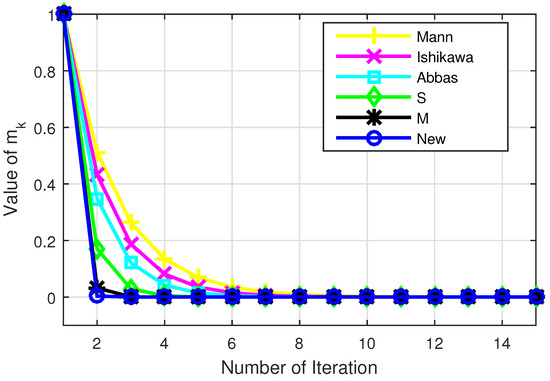
Figure 1.
Graph corresponding to Table 1.
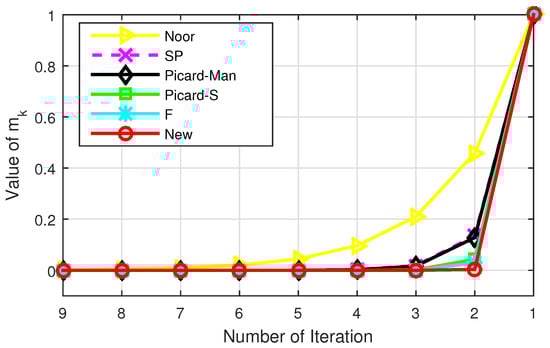
Figure 2.
Graph corresponding to Table 2.
4. Weak -Stability Results for Two Multivalued Almost Contractive Mappings
In this section, we first give the definition of -stability involving two mappings in hyperbolic space. After this, we prove that our new iterative algorithm (6) is weak -stable with respect to two multivalued almost contractive mappings.
Definition 9.
Let be a hyperbolic space, be two self-maps, and arbitrary , be the iterative algorithm defined by
Assume that as , for all and for any sequence which is equivalent to , we have
Then we say that the iterative algorithm (15) is weak -stable with respect to .
Theorem 4.
Suppose that all the assumptions in Theorem 3 are satisfied. Then, the sequence defined by (6) is weak -stable with respect to and .
Proof.
Suppose is the sequence defined by (6) and an equivalent sequence of . We define by
where , are real sequences in (0,1) and , , , .
Because and , it follows that . Thus, (17) becomes
By Theorem 3, . Consequently, we have . Moreover, by the equivalence of and , we have .
Hence, our new iterative sequence (6) is weak -stable with respect to and . □
5. Data Dependence Results for Two Multivalued Almost Contractive Mappings
In this section, we show that our new iterative method (6) is data dependent with respect to two multivalued almost contractive mappings.
Theorem 5.
Let be a nonempty closed convex subset of a hyperbolic space and (i=1,2) be two multivalued almost contractive mappings. Let (i=1,2) be two multivalued approximate operators of and , respectively, such that (i=1,2) for all . If is the sequence defined by (6) for two multivalued almost contractive mappings and . Then, we define an iterative sequence as follows:
where , are real sequences in (0,1) such that and , , , . If , for each , and for each such that as , and we have
where ϵ is a fixed number.
6. ∆-Convergence and Strong Converges Results for Two Multivalued Mappings
In this section, we establish ∆-convergence and strong convergence theorems of our new iterative algorithm (6) for common fixed points of two multivalued mappings satisfying condition . Throughout the remaining part of this article, let denote a complete uniformly convex hyperbolic space with a monotone modulus of convexity and let be a nonempty closed convex subset of .
Theorem 6.
Let be a nonempty closed convex subset of and be two multivalued mappings satisfying condition with convex values. Let and for each . Let be the sequence defined by (6). Then, ∆-converges to a common fixed point of and .
Proof.
The proof will be divided into the following three steps:
Step 1:
First, we show that exists for each . By Proposition 1, we know that are multivalued quasi-nonexpansive mappings. Therefore, for all and by (6), we obtain
This implies that the sequence is non-increasing and bounded below. Thus, exists for each .
Step 2:
Next, we show that
From Step 1, it is established that for all , exists. Let
If , then we get
Consequently, we obtain the following inequalities
and
From Lemma 2, we obtain
In addition,
implies that
Finally, by (6), we obtain
Because , we get
Because satisfies condition , we obtain
Hence, , .
Step 3: Finally, we show that the sequence is ∆-convergent to a point in . In view of this, it suffices to show that
and has only one point. Set . Then a subsequence of exists such that . From Lemma 1, a subsequence of exists such that . Because , by Lemma 4, we know that . By the convergence of , then from Lemma 5, we obtain . This implies that . Now, we show that the set contains exactly one element. For this, let be a subsequence of with and . We have already seen that and . Conclusively, by the convergence of , then by Lemma 5, we obtain . It follows that . This completes the proof. □
Next, we establish some strong convergence theorems.
Theorem 7.
Let be a nonempty closed compact subset of and be two multivalued mappings satisfying condition with convex values. Let and for each . Let be the sequence defined by (6). Then, converges strongly to a point in F.
Proof.
For all and , we can assume that is a bounded closed and convex subset of . By the compactness of , we know that is a nonempty compact convex subset and bounded proximal subset in . It follows that . Thus, all the assumptions in Theorem 6 are performed. Hence, from Theorem 6, we have that exists and , for each and . By the compactness of , we are sure of the existence of a subsequence of with . By using condition for some and for each , we have
This shows that . By the strong convergence of to and the existence of from Theorem 6, it is implied that the sequence converges strongly to . □
Theorem 8.
Let be a nonempty closed compact subset of and be two multivalued mappings satisfying condition with convex values. Let and for each . Let be the sequence defined by (6). Then, converges strongly to a point in F if and only if .
Proof.
Suppose that . From (32), we have , for all . It follows that . Therefore, exists and . Thus, there exists a subsequence of the sequence such that for all , where is a sequence in F. In view of (32), we obtain
By using (60) and the concept of triangle inequality, then we get
It follows clearly that is a Cauchy sequence in and moreover, it is convergent to some . Because for all ,
and as , it is implied that , and hence, and strongly converges to p. Because exists, it is implied that converges strongly to p. □
Theorem 9.
Let be a nonempty closed compact subset of and be two multivalued mappings satisfying condition with convex values. Let and for each . Let be the sequence defined by (6). Assume that there exists an increasing self-function f defined on such that with for all and , and we have
Then, the sequence converges strongly to a point in F.
Proof.
It is established in Theorem 6 that . Hence, one can assume that
Thus, it is implied that . Because f is an increasing self-function defined on with , we know that . The conclusion of the proof follows from Theorem 8. □
7. Numerical Example
In this section, we provide examples of mappings which satisfy condition but do not satisfy condition (C). We carry out numerical experiment to show the efficiency and applicability of new method (6) with some existing iterative methods.
Example 2.
Let with the distance metric and . Let be defined by
and
for all .
Clearly, . Because and are not continuous at and 2, respectively, so and are not nonexpansive mappings. Next, we show that and do not satisfy condition . For , let and . Then,
However,
Thus, does not satisfy condition .
Similarly, for and , we can show that does not satisfy condition .
Finally, we show that and are multivalued mappings satisfying condition . First, we consider and the following possible cases:
Case 1:
If , then
Therefore,
Case 2:
If , then
Therefore,
Case 3:
If and , then
Therefore,
Case 4:
If and , then
Therefore,
For all , we seen that satisfies (1) for some . Hence, is a multivalued mapping satisfying condition .
Following the same approach above, we can show that is a multivalued mapping satisfying condition for some .
Now, for control parameters , for all and starting point . Then by using MATLAB R2015a, we obtain the following Table 3 and Table 4 and Figure 3 and Figure 4.
Table 3.
Convergence behavior of various iterative algorithms.
Table 4.
Convergence behavior of various iterative algorithms.

Figure 3.
Graph corresponding to Table 3.
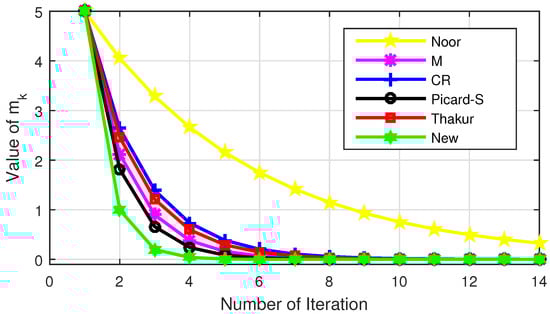
Figure 4.
Graph corresponding to Table 4.
8. Conclusions
- (i)
- In this work, we have introduced a new iterative algorithm (6) in hyperbolic spaces.
- (ii)
- We have proven the strong convergence of the newly defined iterative algorithm (6) to the common fixed point of two multivalued almost contractive mappings.
- (ii)
- We have also provided some examples of multivalued, almost contractive mappings. We show with the aid of the examples that our iterative algorithm (6) converges faster than many existing iterative algorithms.
- (iii)
- We have introduced the concepts of weak -stability and data dependence results involving two multivalued almost contractive mappings. These concepts are relatively new in the literature.
- (iv)
- We have proved several strong and ∆-convergence results of (6) for the common fixed point of multivalued mappings satisfying condition .
- (v)
- We presented interesting examples of mappings which satisfy condition but do not satisfy condition . We further performed numerical experiments to compare the efficiency and applicability of our iterative method with some leading iterative algorithms.
- (vi)
- The results in this article extend and generalize the results in [24,39] and several others from the setting of Banach spaces to the setting hyperbolic spaces. Moreover, our results improve and generalize the results in [22,24,39] and several others from the setting of single-valued mappings to the setting of multivalued mappings. In addition, we improve and extend the results in [22,24,39] from the setting of fixed points of single mapping to the setting common fixed points of two mappings.
- (vii)
- Our results give affirmative answers to the two interesting open questions raised by Ahmad et al. [21].
- (viii)
- The main results derived in this article continue to be true in linear and CAT(0) spaces, because the hyperbolic space properly includes these spaces.
Author Contributions
Conceptualization, J.A.A.; Supervision, G.C.U. and O.K.N.; Writing—original draft, A.E.O.; Writing—review & editing, R.G. All authors have read and agreed to the published version of the manuscript.
Funding
This research received no external funding.
Data Availability Statement
The data used to support the findings of this study are included within the article.
Conflicts of Interest
The authors declare that they have no competing interests.
References
- Kohlenbach, U. Some logical metatheorems with applications in functional analysis. Trans. Am. Soc. 2005, 357, 89–128. [Google Scholar] [CrossRef]
- Goebel, K.; Kirk, W.A. Iteration processes for nonexpansive mappings Topological Methods in Nonlinear Functional Analysis. Contemp. Math. 1983, 21, 115–123. [Google Scholar]
- Reich, S.; Shafrir, I. Nonexpansive iterations in hyperbolic spaces. Nonlinear Anal. 1990, 15, 537–558. [Google Scholar] [CrossRef]
- Goebel, K.; Reich, S. Uniform Convexity, Hyperbolic Geometry, and Nonexpansive Mappings; Marcel Dekker: New York, NY, USA, 1984. [Google Scholar]
- Imdad, M.; Dashputre, S. Fixed point approximation of Picard normal S-iteration process for generalized nonexpansive mappings in hyperbolic spaces. Math. Sci. 2016, 10, 131–138. [Google Scholar] [CrossRef]
- Nadler, S.B. Multivalued contraction mappings. Pacific J. Math. 1969, 30, 475–488. [Google Scholar] [CrossRef]
- Markin, J. Continuous dependence of fixed point sets. Proc. Am. Math. Soc. 1973, 38, 545–547. [Google Scholar] [CrossRef]
- Berinde, V. Approximating fixed points of weak contractions using the Picard iteration. Nonlinear Anal. Forum 2004, 9, 43–53. [Google Scholar]
- Berinde, M.; Berinde, V. On a general class of multivalued weakly Picard mappings. J. Math. Anal. 2007, 326, 772–782. [Google Scholar] [CrossRef]
- Suzuki, T. Fixed point theorems and convergence theorems for some generalized nonexpansive mappings. J. Math. Anal. Appl. 2008, 340, 1088–1095. [Google Scholar] [CrossRef]
- Eslamian, M.; Abkar, A. One-step iterative process for finite family of multivalued mappings. Math. Comput. Model. 2011, 54, 105–111. [Google Scholar] [CrossRef]
- García-Falset, J.; Llorens-Fuster, E.; Suzuki, T. Fixed point theory for a class of generalized nonexpansive mappings. J. Math. Anal. Appl. 2011, 375, 185–195. [Google Scholar] [CrossRef]
- Kim, J.K.; Pathak, R.P.; Dashputre, S.; Diwan, S.D.; Gupta, R. Convergence theorems for generalized nonexpansive multivalued mappings in hyperbolic spaces. SpringerPlus 2016, 5, 912. [Google Scholar] [CrossRef] [PubMed]
- Abdeljawad, T.; Ullah, K.; Ahmad, J.; Mlaiki, N. Iterative approximation of endpoints for Multivalued Mappings in Banach spaces. J. Funct. Spaces 2020, 2020, 2179059. [Google Scholar] [CrossRef]
- Chang, S.; Wanga, G.; Wanga, L.; Tang, Y.K.; Mab, Z.L. ∆-convergence theorems for multivalued nonexpansive. Appl. Math. Comput. 2014, 249, 535–540. [Google Scholar]
- Karahan, I.; Jolaoso, L.O. A three steps iterative process for approximating the fixed points of multivalued generalized α–nonexpansive mappings in uniformly convex hyperbolic spaces. Sigma J. Eng. Nat. Sci. 2020, 38, 1031–1050. [Google Scholar]
- Okeke, G.A.; Abbas, M.; de la Sen, M. Approximation of the mixed Point of multivalued quasi-nonexpansive mappings via a faster iterative process with applications. Discret. Dyn. Nat. Soc. 2020, 2020, 8634050. [Google Scholar] [CrossRef]
- Shrama, N.; Mishra, L.N.; Mishra, V.N.; Almusawa, H. Endpoint Approximation of Standard Three-Step Multi-Valued Iteration Algorithm for Nonexpansive Mappings. Appl. Math. Inf. Sci. 2021, 15, 73–81. [Google Scholar]
- Agarwal, R.P.; O’Regan, D.; Sahu, D.R. Iterative construction of fixed points of nearly asymptotically nonexpansive mappings. J. Nonlinear Convex Anal. 2007, 8, 61–79. [Google Scholar]
- Chuadchawnay, P.; Farajzadehz, A.; Kaewcharoeny, A. On convergence theorems for two generalized nonexpansive multivalued mappings in hyperbolic spaces. Thai J. Math. 2019, 17, 445–461. [Google Scholar]
- Ahmad, J.; Ullah, K.; Arshad, M. Convergence, weak w2 stability, and data dependence results for the F iterative scheme in hyperbolic spaces. Numer. Algorithms 2022. [Google Scholar] [CrossRef]
- Ali, J.; Jubair, M.; Ali, F. Stability and convergence of F iterative scheme with an application to the fractional differential equation. Eng. Comput. 2020, 38, 693–702. [Google Scholar] [CrossRef]
- Khan, A.R.; Fukhar-ud-din, H.; Khan, M.A.A. An implicit algorithm for two finite families of nonexpansive maps in hyperbolic spaces. Fixed Point Theory Appl. 2012, 2012, 54. [Google Scholar] [CrossRef]
- Ofem, A.E.; Udofia, U.E.; Igbokwe, D.I. New iterative algorithm for solving constrained convex minimization problem and Split Feasibility Problem. Eur. J. Math. Anal. 2021, 1, 106–132. [Google Scholar] [CrossRef]
- Leuştean, L. A quadratic rate of asymptotic regularity for CAT(0) space. J. Math. Anal. Appl. 2007, 325, 386–399. [Google Scholar] [CrossRef]
- Soltuz, S.M.; Grosan, T. Data dependence for Ishikawa iteration when dealing with contractive like operators. Fixed Point Theory Appl. 2008, 2008, 242916. [Google Scholar] [CrossRef]
- Cardinali, T.; Rubbioni, P. A generalization of the Caristi fixed point theorem in metric spaces. Fixed Point Theory 2010, 11, 3–10. [Google Scholar]
- Timis, I. On the weak stability of Picard iteration for some contractive type mappings, Annals of the University of Craiova. Math. Comput. Sci. Ser. 2010, 37, 106–114. [Google Scholar]
- Mann, W.R. Mean value methods in iteration. Proc. Am. Math. Soc. 1953, 4, 506–510. [Google Scholar] [CrossRef]
- Ishikawa, S. Fixed points and iteration of a nonexpansive mapping in a Banach space. Proc. Am. Math. Soc. 1976, 59, 65–71. [Google Scholar] [CrossRef]
- Abbas, M.; Nazir, T. A new faster iteration process applied to constrained minimization and feasibility problems. Mat. Vesnik 2014, 66, 223–234. [Google Scholar]
- Ullah, K.; Arshad, M. Numerical Reckoning Fixed Points for Suzuki’s Generalized Nonexpansive Mappings via New Iteration Process. Filomat 2018, 32, 187–196. [Google Scholar] [CrossRef]
- Noor, M.A. New approximation schemes for general variational inequalities. J. Math. Anal. Appl. 2000, 251, 217–229. [Google Scholar] [CrossRef]
- Phuengrattana, W.; Suantai, S. On the rate off convergence of Mann, Ishikawa, Noor and SP iterations for continuous functions on an arbitrary interval. J. Comput. Appl. Math. 2011, 235, 3006–3014. [Google Scholar] [CrossRef]
- Khan, H.S. A Picard-Man hybrid iterative process. Fixed Point Theory Appl. 2013, 2013, 69. [Google Scholar] [CrossRef]
- Güsoy, F. A Picard-S iterative Scheme for Approximating Fixed Point of Weak-Contraction Mappings. Filomat 2014, 30, 2829–2845. [Google Scholar] [CrossRef]
- Thakurr, B.S.; Thakur, D.; Postolache, M. A new iterative scheme for numerical reckoning of fixed points of Suzuki’s generalized nonexpansive mappings. Appl. Math. Comput. 2016, 275, 147–155. [Google Scholar] [CrossRef]
- Chugh, R.; Kumar, V.; Kumar, S. Strong convergence of a new three step iterative scheme in Banach spaces. Am. J. Comput. Math. 2012, 2, 345–357. [Google Scholar] [CrossRef]
- Ofem, A.E.; Udofia, U.E.; Igbokwe, D.I. A robust iterative approach for solving nonlinear Volterra Delay integro-differential equations. Ural. Math. J. 2021, 7, 59–85. [Google Scholar] [CrossRef]
Publisher’s Note: MDPI stays neutral with regard to jurisdictional claims in published maps and institutional affiliations. |
© 2022 by the authors. Licensee MDPI, Basel, Switzerland. This article is an open access article distributed under the terms and conditions of the Creative Commons Attribution (CC BY) license (https://creativecommons.org/licenses/by/4.0/).