1. Introduction
The phenomenon by which a large population of elements oscillating with different natural frequencies lock to a common frequency is called synchronization. Such phenomena have been observed in many real-world systems, such as rhythmic response patterns of pacemaker cells in the heart [
1], a synchronously flashing group of fireflies [
2,
3], crickets that chirp in unison [
4], etc. Arrays of lasers and superconducting Josephson junctions are examples in physics that obey collective synchronization [
5,
6].
One of the most successful approaches for exploring and analyzing synchronization phenomenon for the population of elements as an ensemble of phase oscillators is given by Kuramoto [
7], which treats each oscillator only by their phases [
8]. The oscillators proposed in his model are assumed to be non-linear, and there is a weak but uniform coupling between every oscillator (all-to-all coupling).
There is a threshold
for the coupling strength
K, which characterizes the interaction term in the Kuramoto mathematical model, above which a phase transition analogous to magnetic phase transition occurs [
9]. In other words, the system shifts from an incoherent state to a partially synchronized state and ultimately to the fully synchronized one with
. Kuramoto’s original model can be considered a basic model in the sense that it describes oscillators of the fixed natural frequencies
, connected via ‘all-to-all’ uniform
K [
10] and solvable only in the thermodynamic limit (
). However, the real-world systems that exhibit synchronous behavior consist of a finite number of oscillators, and the coupling is expected to be perturbed by time-dependent external factors. Some of the promising examples include the natural firing rate of neurons in the brain, which correspond to the natural frequencies, and the degree of excitation/inhibition from neurons to stimulate a neuron via a dendrite (modeled as time-dependent coupling strength) [
10,
11,
12].
To address the inevitable influence of external fields, this paper incorporates a time-dependent coupling strength of the form
as suggested in [
10,
11,
13] and also mentioned in [
14] with a slightly different scope. However, the term
plays the same role as the uniform coupling strength of Kuramoto’s original model, a different approach from [
10,
11,
13]. The influence of the external field can be oscillatory, so the choice of the term
is justifiable.
The above form of is tested here for an 32 oscillators system, an even power of 2 oscillators and a representative of a small number of finite oscillators such as synchronously clapping audiences at an orchestra.
This paper also intends to use coupling strength
in the form of a step function. Unlike the trigonometric function,
, which acts continuously in the system of oscillators, a different (higher) value of coupling strength
K acts for only a certain time interval where the order parameter
, a key indicator that reflects the synchronous behavior of oscillators (
Section 2), goes beyond its pre-defined threshold value. It is assumed that the system of such oscillators’ assembly preserves its autonomy except at some intervals of time where
r approaches some threshold value.
serving as a step-function has been tested in various articles, notably in [
15], which aims to implement this approach for two oscillators’ assembly. However, the approach implemented here is unique in the sense that
only takes a higher value if the order parameter
goes beyond a certain threshold. Additionally, the step-function model of
tested here is for 32 oscillators, which can serve as a representative for a wide range of finite oscillators exhibiting synchronous behavior in nature.
As mentioned earlier, there is a phase transition from an incoherent state to being partially synchronized in the coupling strength
and finally to the fully synchronized state for
. The testing of synchronized states at some value of
K greatly depends on the critical value
for the given oscillators’ assembly. However, such critical value has only been found analytically in the infinite oscillators’ assembly so far. Still, this paper picks the value of
equal to the critical value associated with infinite oscillators that comes from Equation (
8). The synchronization pattern, if observed in the vicinity of such analytical value, will help us to locate the respective
of finite oscillators more precisely.
The following two methods will be followed to observe the impact of external fields,
Step function: can be used except for the order parameter , where a higher is applied to elevate oscillators so that they maintain their synchronized state;
Trigonometric function: can be set in the vicinity of to observe whether the perturbation part can make an impact to elevate the oscillators into the synchronized state.
The synchronization events observed in nature have displayed their synchronous behavior persistently, despite the presence of external fields, so the results from this proposed work are expected to find a close match between time-dependent and uniform parameters. In the case of a step function, its usefulness lies in whether the oscillators maintain the synchrony with the boost of a higher coupling strength K value for .
2. Kuramoto Model with the Infinite Number of Oscillators
In a system of
N phase oscillators, each oscillating with natural frequencies
, the time evolution of phase
of the j
th oscillator is given by following Kuramoto [
7] equation:
where
, is the homogeneous all-to-all coupling strength. The factor
ensures that the system converges in the thermodynamic limit (as
). The frequencies
are distributed according to some probability density
, where
is assumed to be unimodal and symmetric about the mean frequency
i.e.,
[
6,
16]. For example,
can be a Gaussian distribution or a Cauchy–Lorentzian distribution. Non-identical values of the frequency of each individual, especially in the context of biological oscillators such as fireflies, reflect their inevitable variability found in nature [
17].
Equation (
1) can be related to a physically sensible quantity called order parameter
, which is simply an average (centroid vector of the phase distribution) of the complex number (
Z) that represents the phase of the oscillators with each moving in a unit circle.
Multiplying Equation (
2) by
, the following relation is obtained.
Now, comparing the imaginary part of the above relation and making the substitution in Equation (
1), we find:
In the thermodynamic limit, oscillators are expected to be distributed with a probability density
. Now, the arithmetic mean in Equation (
2) becomes an average over phase and frequency:
For
, Equation (
5) becomes
Therefore, as and the oscillators are out of synchrony.
However for
,
These integrals are equal to 1 as they are the integral of densities over the entire range. It means
and there is perfect synchrony among the oscillators [
7,
16]. For the intermediate range of coupling strength,
(with
, critical coupling strength; defined in Equation (
8)), some of the oscillators are phase-locked (
) and others rotate out of synchrony with the locked oscillators [
8].
Kuramoto obtained the exact solution of
after evaluating the contribution of both drifting and locked oscillators (Equation (
5)) as
where g(0) is the frequency distribution of interest, evaluated at
.
For the Gaussian distribution of frequencies that is used in this research, the approximate solution or
near the bifurcating point
is given by [
8]
where
is the second derivative of
evaluated at
.
2.1. Synchronization Visualization
The exact solution for the critical coupling strength
given in Equation (
8) is achievable as
. The numerical solution of
oscillators for this work will pick the value of
that comes from Equation (
8).
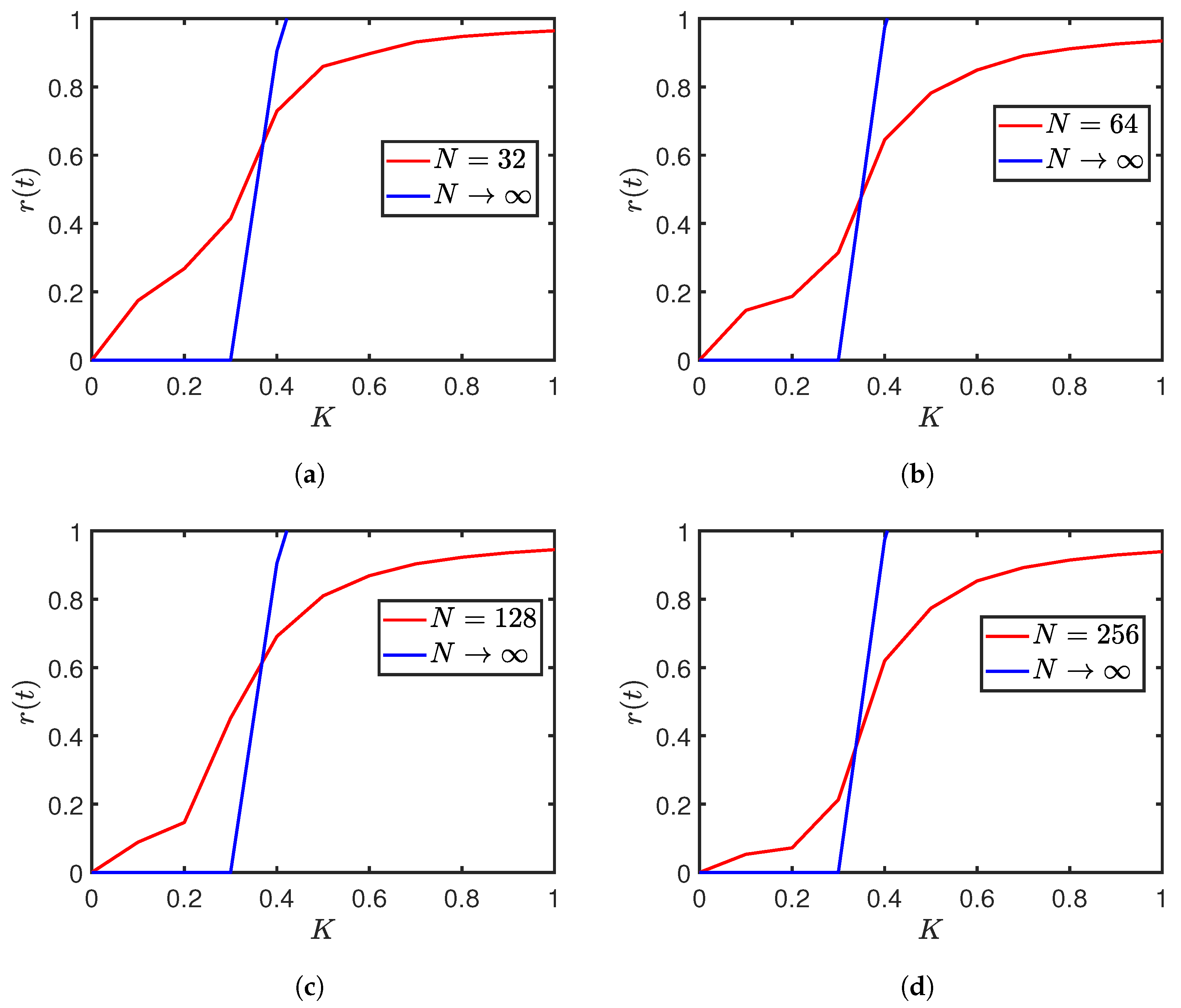
Figure 1 compares the behavior of
versus
K for four different assemblies of oscillators, with numbers ranging from 32 to 256 near the onset of the synchronization. The natural frequencies
are drawn from the Gaussian. The number of oscillators used in four cases replicates the number in various synchronized events of nature, such as fireflies displaying synchrony. As
N increases, the bifurcation point approaches its counterpart for
. In the case of 32 oscillators, however, there is a larger discrepancy.
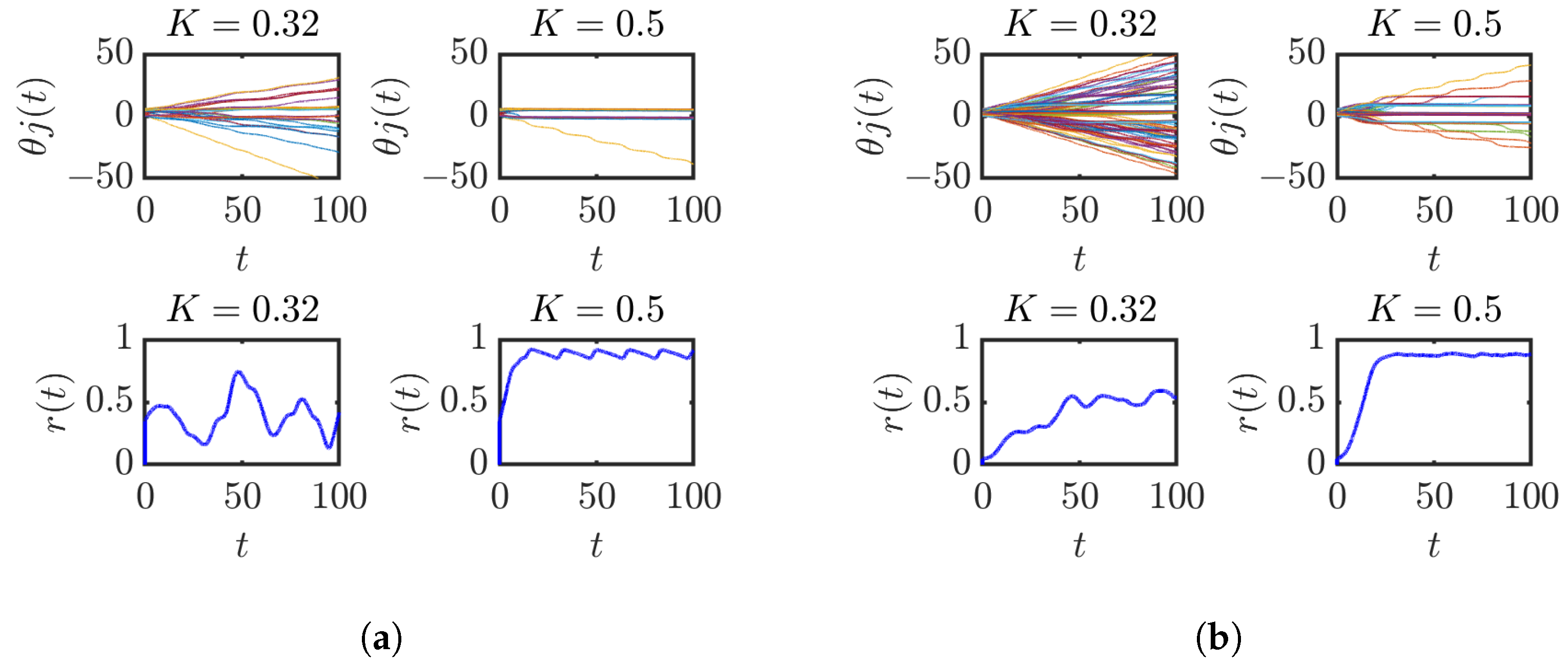
Figure 2a displays the finite size effect on the temporal evolution of phase angle
and the order parameter
of the 32 oscillators. The use of
for dealing with 32 oscillators cannot be justified; however,
keeps the finite size effect on the sideline. The phases of oscillators start gathering coherently for
. The fluctuation (
) of
is significantly higher in the 32 oscillator case compared to
Figure 2b, which uses 256 oscillators.
2.2. Time-Dependent Parameters
The inherent time-variability of oscillators can be addressed by incorporating time-dependent coupling strength in Kuramoto’s original model, which assumes all-to-all homogeneous coupling K.
In this research work, the following form of
has been used:
where
is the uniform coupling strength with the value chosen in the vicinity of
. Other parameters,
A and
, represent the amplitude and frequency of the perturbation term, respectively.
Now, we introduce
for the system of
oscillators as:
The natural frequencies
are chosen randomly from the standard Gaussian density function. The amplitude
A and frequency
of the perturbation term have also been treated as variables separately to see their impact on the synchronization pattern in the
vs.
t graph using Equation (
2).
3. Results
As discussed in
Section 2, the main objective of this work is to check for the similarity in
and
vs.
t graphs using the time-dependent and uniform coupling strengths in the vicinity of
.
Numerical integration of Equation (
11) was carried out using the Runge–Kutta 4th order method, with a time step of
throughout 100 (some unit of time). The values of
have been chosen in the vicinity of critical coupling strength
based on Equation (
8). The natural frequencies of the oscillators were randomly chosen to be from standard Gaussian distribution with mean
and standard deviation
. Initial phases
were also randomly chosen in the range of [0,
]. A default setting of the random number generation was used to ensure the same numbers were being used in the successive iteration.
Now, the standard Gaussian distribution of natural frequencies given by
From the above equation .
Critical coupling strength
based on Equation (
8) equals to
3.1. Using Periodic Function as Perturbation
The comparisons were made in the vs. t graphs using the uniform and time-varying coupling strengths. Additionally, the response of was observed more closely in by varying amplitude A and frequency of the perturbation term separately.
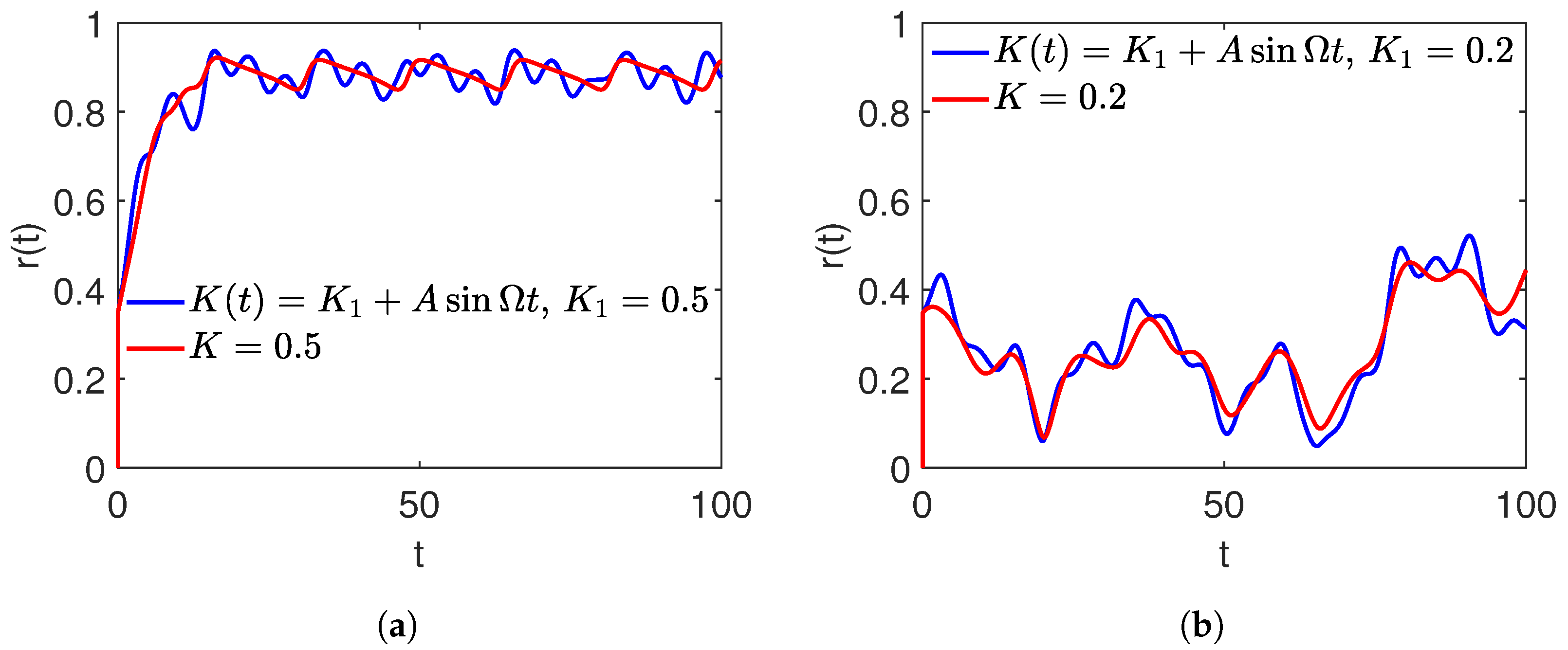
The temporal evolution of
in
Figure 3a for the
&
with
are similar from the perspectives of their synchronization pattern. The extra oscillatory behavior in the graph is simply due to the sinusoidal term embedded in
. Similar trends are observed even for the
&
in
Figure 3b, except for the fact that they no longer exhibit the coherent behavior.
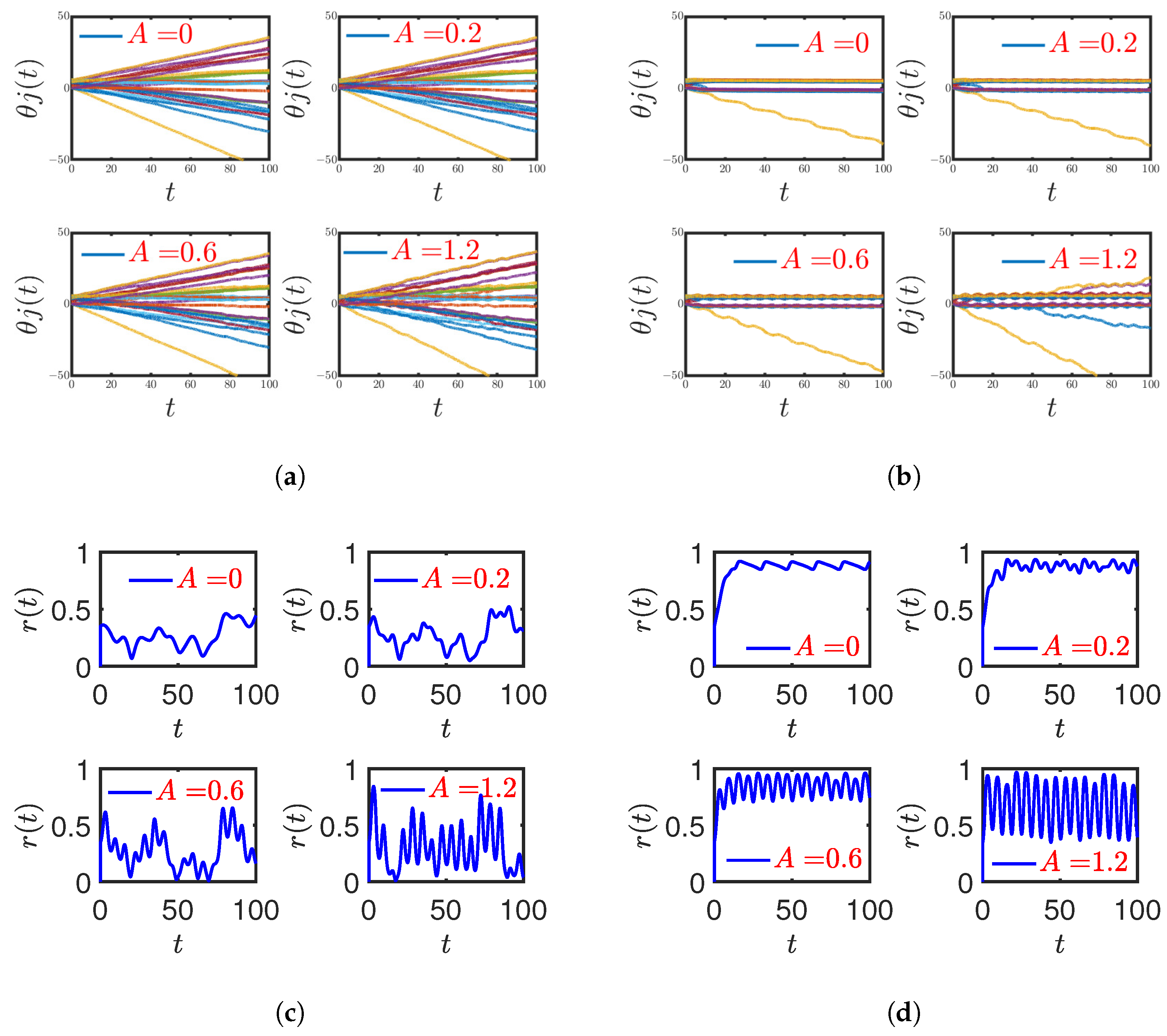
Figure 4a,c display the time evolution of
and
with variable
A for
. The oscillators remain out of synchrony except for some periodic peaks at which
. It is usually seen if amplitude
A goes on increasing.
Similarly,
Figure 4b,d show
and
vs.
t plots for
, using different
A values. As
, which is well above
, the oscillators display synchronous behavior. However, oscillators start losing their rhythmic pattern when
A increases significantly. The impact of various values
in
was not significant in both regions, mainly from the perspective of reshaping the synchronization pattern.
3.2. Using Step Function as a Perturbation
An alternative approach that essentially replaces the sinusoidal function as a perturbation term is to provide a uniform but higher value of coupling strength for the time at which order parameter goes below some threshold value . A step function may fulfill such requirements and thus keep oscillators in their synchronized state persistently. A system of such oscillators displays autonomous behavior, except for , where a uniform but higher value of is applied to maintain the synchronized state of oscillators.
One important assumption is made in the numerical solution using the additional coupling strength in the form of a step function.
The threshold value of the order parameter selected in the vs. t graph, below which an additional value of coupling strength () is applied, is a tentative mid-value (). Oscillations observed in the vs. t graph above are assumed to be holding the synchronous behavior of oscillators.
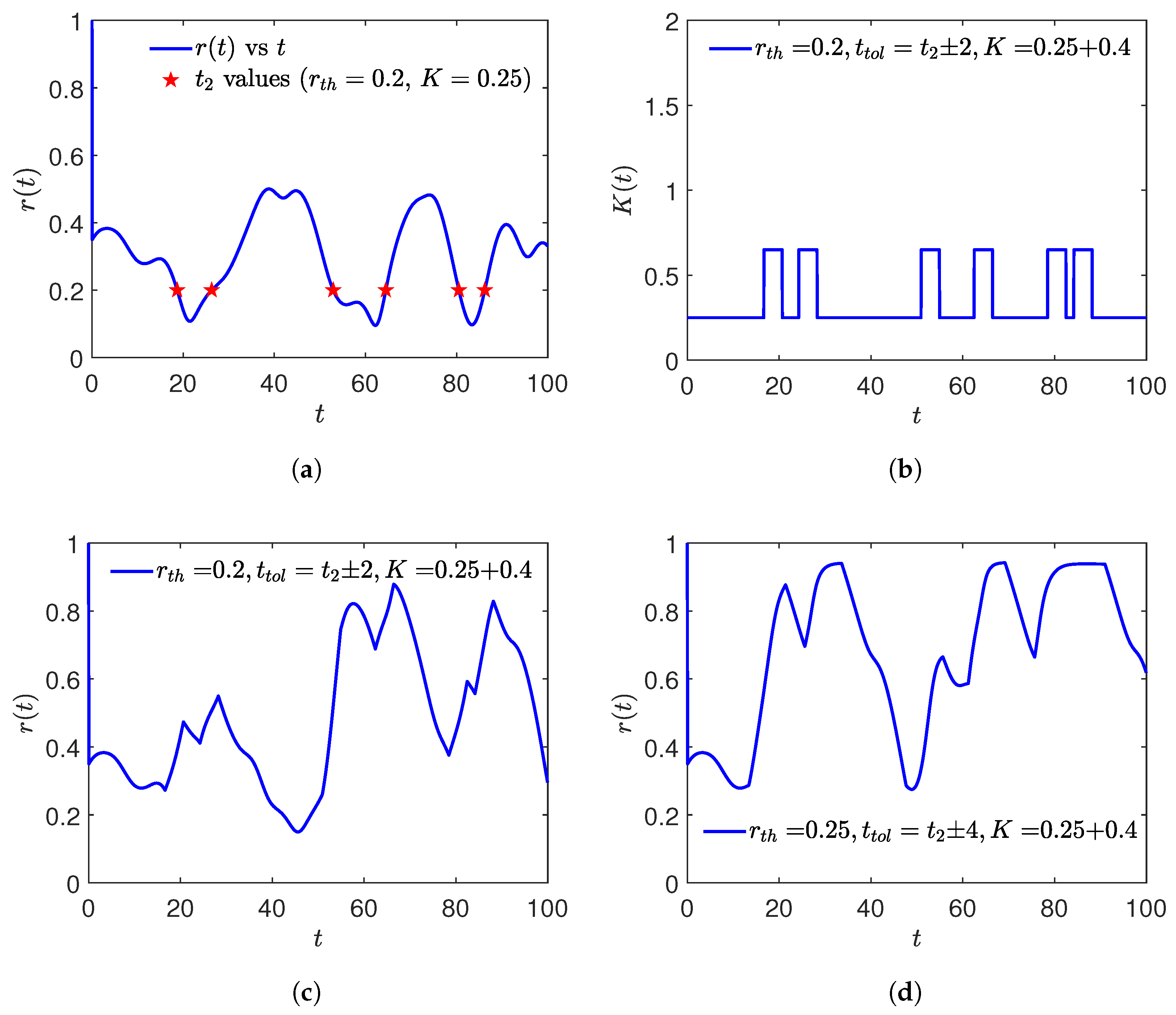
The order parameter
vs.
t graph (
Figure 5a) looks very random in the case of 32 oscillators. Additionally, the lack of precise information regarding the critical coupling strength
gives the real difficulty in the numerical solution. The extrapolation technique by which special time points
, which correspond to the
, are estimated, fails to reflect the closer values. There is a discrepancy between actual time points corresponding to
and the estimated
(represented by red asterisk in
Figure 5a).
Figure 5c (corresponding
K vs.
t plot in
Figure 5b) reflects such discrepancy, as
occasionally goes below its threshold value
. However, such occasional drifting can be eliminated if the tolerance value is increased. The higher the tolerance, the more of these
points are boosted with the additional coupling strength
, thus ultimately, preserving the synchronous behavior. This will also increase the average value of the coupling strength
, as
will be applied for a longer interval of time.
Figure 5d, which is generated using
, does not include such occasional drifting of the oscillators or, to be more precise, the order parameter
at least does not go beyond
.
4. Conclusions and Discussions
This paper was focused on the synchronization of finite phase oscillators using time-dependent coupling strength
. In contrast, the original Kuramoto model [
7] was formulated for infinite oscillators using a homogeneous all-to-all coupling strength,
K.
Keeping synchronization phenomena exhibited by different real-world examples, such as periodic flashing of fireflies, in consideration, the choice of using finite oscillators is a necessity. Additionally, considering the influence of external fields on the behavior of each oscillator in the form of a perturbation term makes the original Kuramoto model more realistic. Finding a good match between time-dependent and uniform cases is a required outcome, as real-life synchronization events have been in existence despite the influence of external factors.
A similar pattern observed in
and
vs.
t graphs for uniform and time-dependent coupling strengths have a broad indication in nature: time variability is expected but well-adjusted by the oscillators displaying the synchronous behavior.
A and
of the perturbation part had little impact on the
vs.
t graphs. However, the drifting of oscillators even with
was noticeable for higher values of
A (
Figure 4b).
The numerical solution that involved the step function (
Section 3.2) was carried out with the assumption that the persistence of such synchronized states can be achieved by supplying higher coupling strength
in the system of oscillators if the order parameter
goes beyond some threshold
. Such thresholds are user-defined, which means a limit can be set for the oscillator’s phase difference from each other that can still be included in the group of oscillators that are displaying the synchronous behavior. For example, a firefly (oscillator) flashing with some period plus some margin can still be included in the main group of fireflies that are exhibiting synchronous behavior. Mathematically, they can be kept in one group if their frequencies are within some value of
. The synchronous behavior of oscillators is always ensured for
if
is precisely known. Thus,
Section 3.2 is simply trying to figure out whether such synchronized states are achievable for the coupling strength
which is, in general, kept less than
, except for the occasional cases (
), where a higher
acts for a brief period.
This approach, however, does not provide a conclusive picture. This is mainly due to the uncertainties associated with
for 32 oscillators. The other parameters such as
,
,
, and
also come with some degree of uncertainties because of
. However, such a limitation was essentially overcome using the higher tolerance values as in
Figure 5d.