Systemwide Social and Emotional Learning in Action: Insights from a Research-Practice Partnership with Leaders, Educators, and Students
 , , ,
, , , 
Abstract
1. Introduction
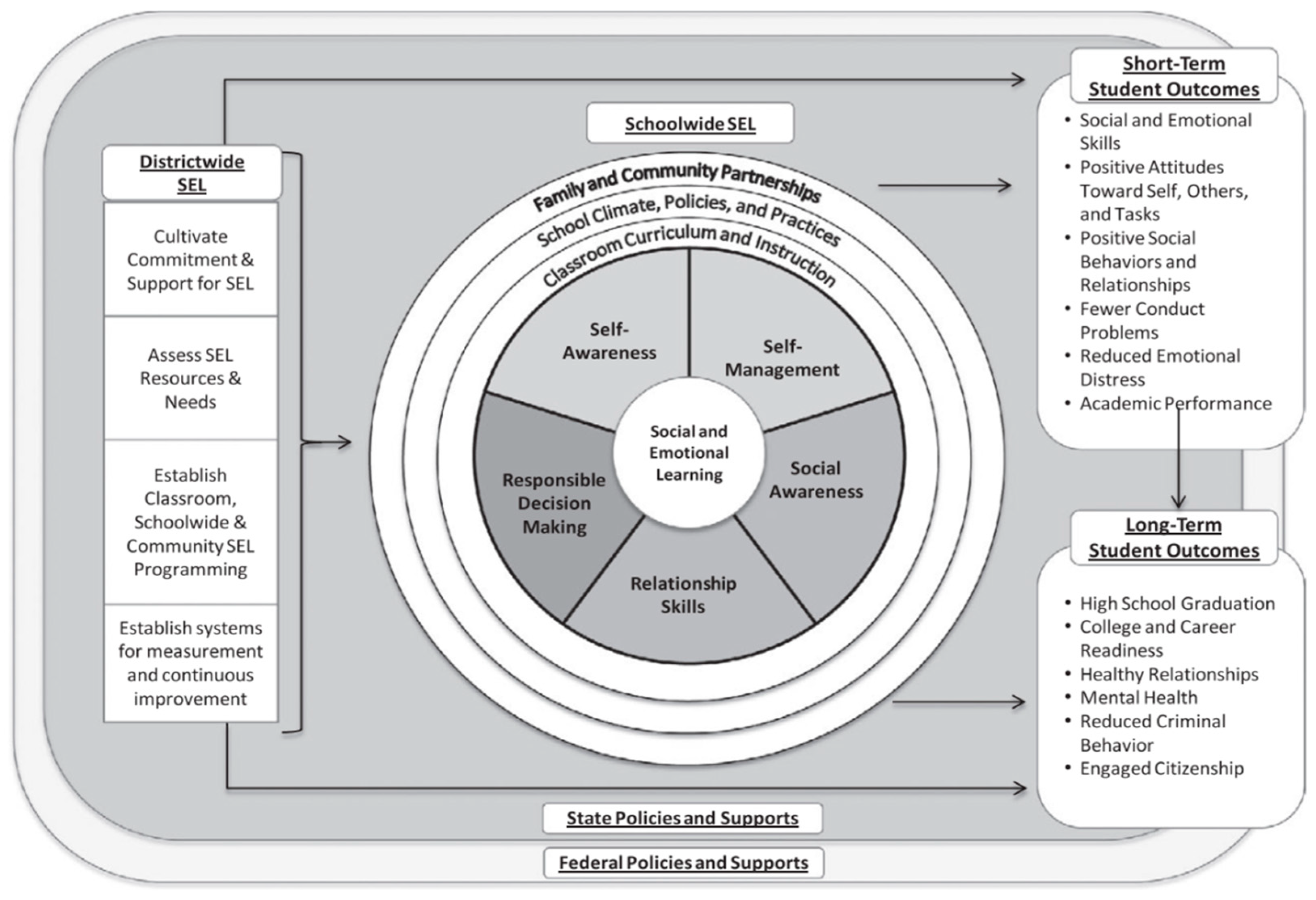
1.1. CASEL Framework for Systemwide SEL
1.2. Facilitators of Systemwide SEL
1.3. Challenges to Systemwide SEL
1.4. Purpose of Study
- (1)
- What are the facilitators of systemwide SEL implementation at the student, educator, and leadership levels? We defined facilitators as actions or processes of SEL implementation that are helpful to and supportive of school engagement and meaningful learning.
- (2)
- What are the challenges to systemwide SEL implementation at the student, educator, and leadership levels? We defined challenges as actions or processes of SEL implementation that are unhelpful and disruptive to school engagement and meaningful learning.
2. Method
2.1. Participants and Procedures
2.2. Protocol Measures
2.3. Analysis
3. Results
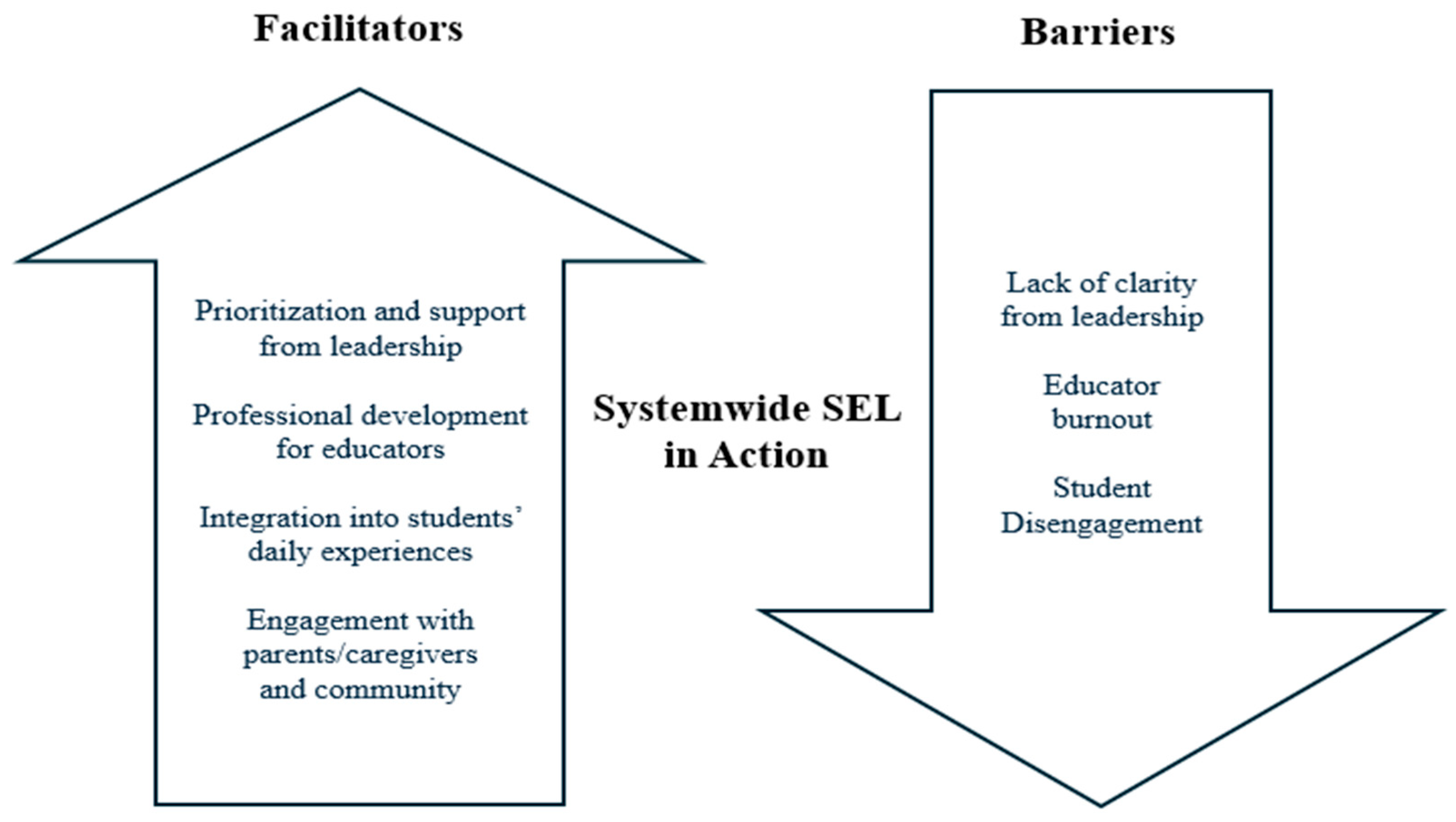
3.1. Facilitators of Systemwide SEL in Schools
3.1.1. Prioritization and Support from Leadership
3.1.2. Professional Development for Educators
3.1.3. Integration into Students’ Daily Experiences
3.1.4. Engagement with Parents/Caregivers and Community
3.2. Challenges to Systemwide SEL in Schools
3.2.1. Lack of Clarity from Leadership
3.2.2. Educator Burnout
3.2.3. Student Disengagement
4. Discussion
4.1. Practical Implications
4.2. Limitations and Future Directions
4.3. Conclusions
Supplementary Materials
Author Contributions
Funding
Institutional Review Board Statement
Informed Consent Statement
Data Availability Statement
Acknowledgments
Conflicts of Interest
References
- Aldridge, J. M., & McLure, F. I. (2024). Preparing schools for educational change: Barriers and supports—A systematic literature review. Leadership and Policy in Schools, 23(3), 486–511. [Google Scholar] [CrossRef] [Scilit]
- Arce-Trigatti, P., Chukhray, I., & López Turley, R. N. (2018). Research–practice partnerships in education. In B. Schneider (Ed.), Handbook of the sociology of education in the 21st century. Springer. [Google Scholar] [CrossRef] [Scilit]
- Barnes, T. N., & McCallops, K. (2019). Perceptions of culturally responsive pedagogy in teaching SEL. Journal for Multicultural Education, 13(1), 70–81. [Google Scholar] [CrossRef] [Scilit]
- Berg, J., Osher, D., Same, M. R., Nolan, E., Benson, D., & Jacobs, N. (2017). Identifying, defining, and measuring social and emotional competencies. American Institutes for Research. [Google Scholar]
- Braun, V., & Clarke, V. (2012). Thematic analysis. In H. Cooper, P. M. Camic, D. L. Long, A. T. Panter, D. Rindskopf, & K. J. Sher (Eds.), APA handbook of research methods in psychology, Vol. 2. Research designs: Quantitative, qualitative, neuropsychological, and biological (pp. 57–71). American Psychological Association. [Google Scholar] [CrossRef] [Scilit]
- Bronfenbrenner, U. (1977). Toward an experimental ecology of human development. American Psychologist, 32(7), 513–531. [Google Scholar] [CrossRef]
- Bronfenbrenner, U., & Morris, P. (2007). The bioecological model of human development. In W. Damon, R. M. Lerner, & R. M. Lerner (Eds.), Handbook of child psychology. John Wiley & Sons. [Google Scholar] [CrossRef] [Scilit]
- Camangian, P., & Cariaga, S. (2022). Social and emotional learning is hegemonic miseducation: Students deserve humanization instead. Race Ethnicity and Education, 25(7), 901–921. [Google Scholar] [CrossRef] [Scilit]
- Chu, L., & DeArmond, M. (2021). Approaching SEL as a whole-school effort, not an add-on: Lessons from two charter networks. Center on Reinventing Public Education. [Google Scholar]
- Cipriano, C., Ahmad, E., McCarthy, M. F., Ha, C., & Ross, A. (2025). Illustrating the need for centering student identity in universal school-based social and emotional learning. Social and Emotional Learning: Research, Practice, and Policy, 5, 100088. [Google Scholar] [CrossRef] [Scilit]
- Cipriano, C., Ha, C., Wood, M., Sehgal, K., Ahmad, E., & McCarthy, M. F. (2024). A systematic review and meta-analysis of the effects of universal school-based SEL programs in the United States: Considerations for marginalized students. Social and Emotional Learning: Research, Practice, and Policy, 3, 100029. [Google Scholar] [CrossRef] [Scilit]
- Cipriano, C., & McCarthy, M. F. (2023). Towards an inclusive social and emotional learning. Social and Emotional Learning: Research, Practice, and Policy, 2, 100008. [Google Scholar] [CrossRef] [Scilit]
- Cipriano, C., Strambler, M. J., Naples, L. H., Ha, C., Kirk, M., Wood, M., Sehgal, K., Zieher, A. K., Eveleigh, A., McCarthy, M., Funaro, M., Ponnock, A., Chow, J. C., & Durlak, J. (2023). The state of evidence for social and emotional learning: A contemporary meta-analysis of universal school-based SEL interventions. Child Development, 94(5), 1181–1204. [Google Scholar] [CrossRef] [Scilit]
- Coburn, C. E., & Penuel, W. R. (2016). Research–practice partnerships in education: Outcomes, dynamics, and open questions. Educational Researcher, 45(1), 48–54. [Google Scholar] [CrossRef] [Scilit]
- Coburn, C. E., Penuel, W. R., & Geil, K. E. (2013). Practice partnerships: A strategy for leveraging research for educational improvement in school districts. William T. Grant Foundation. [Google Scholar]
- Collaborative for Academic, Social, and Emotional Learning. (n.d.). Advancing social and emotional learning. Available online: https://casel.org (accessed on 1 June 2025).
- Darling-Hammond, L., Schachner, A. C., Wojcikiewicz, S. K., & Flook, L. (2022). Educating teachers to enact the science of learning and development. Applied Developmental Science, 28(1), 1–21. [Google Scholar] [CrossRef] [Scilit]
- Domitrovich, C. E., Durlak, J. A., Staley, K. C., & Weissberg, R. P. (2017). Social-emotional competence: An essential factor for promoting positive adjustment and reducing risk in school children. Child Development, 88(2), 408–416. [Google Scholar] [CrossRef] [Scilit] [PubMed]
- Durlak, J. A., Weissberg, R. P., Dymnicki, A. B., Taylor, R. D., & Schellinger, K. B. (2011). The impact of enhancing students’ social and emotional learning: A meta-analysis of school-based universal interventions. Child Development, 82(1), 405–432. [Google Scholar] [CrossRef] [Scilit] [PubMed]
- Farrell, C. C., Penuel, W. R., Allen, A., Anderson, E. R., Bohannon, A. X., Coburn, C. E., & Brown, S. L. (2022). Learning at the boundaries of research and practice: A framework for understanding research–practice partnerships. Educational Researcher, 51(3), 197–208. [Google Scholar] [CrossRef] [Scilit]
- Goldratt, E. M. (1999). Theory of constraints. North River Press. [Google Scholar]
- Grant, N., Meyer, J. L., & Strambler, M. J. (2023). Measuring social and emotional learning implementation in a research-practice partnership. Frontiers in Psychology, 14, 1052877. [Google Scholar] [CrossRef] [Scilit]
- Greenberg, M. T. (2023). Evidence for social and emotional learning in schools. Learning Policy Institute. [Google Scholar]
- Ha, C., Craig, M., & Roehrig, A. D. (2025). Insights from culturally relevant reading education for underrepresented students: Building social and emotional learning environments and enhancing reading outcomes. The Urban Review, 57, 265–288. [Google Scholar] [CrossRef] [Scilit]
- Jagers, R. J., Rivas-Drake, D., & Williams, B. (2019). Transformative social and emotional learning (SEL): Toward SEL in service of educational equity and excellence. Educational Psychologist, 54(3), 162–184. [Google Scholar] [CrossRef] [Scilit]
- Jones, S. M., Bouffard, S. M., & Weissbourd, R. (2013). Educators’ social and emotional skills vital to learning. Phi Delta Kappan, 94(8), 62–65. [Google Scholar] [CrossRef] [Scilit]
- Lee, E. O., Michael, E., & Benner, G. J. (2024). Navigating the challenges of structured social and emotional programming. Education and Treatment of Children, 47(4), 393–400. [Google Scholar] [CrossRef] [Scilit]
- Mahoney, J. L., Weissberg, R. P., Greenberg, M. T., Dusenbury, L., Jagers, R. J., Niemi, K., Schlinger, M., Schlund, J., Shriver, T. P., VanAusdal, K., & Yoder, N. (2021). Systemic social and emotional learning: Promoting educational success for all preschool to high school students. The American Psychologist, 76(7), 1128–1142. [Google Scholar] [CrossRef] [Scilit]
- McCarthy, M. F., Herskowitz, E. A., Barnes, S. P., Ng, Z. J., Ha, C., & Cipriano, C. (2026). Navigating social and emotional learning evidence in a polarized socio-political environment: A qualitative pilot study of SEL stakeholders. Social and Emotional Learning: Research, Practice, and Policy, 7, 100170. [Google Scholar] [CrossRef] [Scilit]
- Melnick, H., & Martinez, L. (2019). Preparing teachers to support social and emotional learning: A case study of San Jose State University and Lakewood Elementary School. Learning Policy Institute. Available online: https://learningpolicyinstitute.org/sites/default/files/product-files/SEL_CaseStudies_SJSU_Lakewood_REPORT.pdf (accessed on 1 June 2025).
- Ng, Z. J., Foster, B., Ellis, T. L., Barnes, S. P., Hoffmann, J. D., & Cipriano, C. (2025). Promoting data literacy: Using social and emotional learning assessment data to inform teaching and learning. Behavioral Sciences, 15(12), 1728. [Google Scholar] [CrossRef] [Scilit]
- Osher, D., Kidron, Y., Brackett, M., Dymnicki, A., Jones, S., & Weissberg, R. P. (2016). Advancing the science and practice of social and emotional learning: Looking back and moving forward. Review of Research in Education, 40(1), 644–681. [Google Scholar] [CrossRef] [Scilit]
- Osher, D., Pittman, K., Young, J., Smith, H., Moroney, D., & Irby, M. (2020). Thriving, robust equity, and transformative learning & development. American Institutes for Research and Forum for Youth Investment. [Google Scholar]
- Panorama Education. (n.d.). Systemic SEL: A comprehensive guide. Available online: https://www.panoramaed.com/blog/systemic-sel-comprehensive-guide#:~:text=Systemic%20SEL%20Resources-,What%20is%20Systemic%20SEL?,learning%20environments%20for%20young%20people (accessed on 1 June 2025).
- Ramirez, T., Brush, K., Raisch, N., Bailey, R., & Jones, S. M. (2021). Equity in social emotional learning programs: A content analysis of equitable practices in PreK-5 SEL programs. Frontiers in Education, 6, 679467. [Google Scholar] [CrossRef] [Scilit]
- Rechsteiner, B., Kyndt, E., Compagnoni, M., Wullschleger, A., & Maag Merki, K. (2024). Bridging gaps: A systematic literature review of brokerage in educational change. Journal of Educational Change, 25(2), 305–339. [Google Scholar] [CrossRef] [Scilit]
- Rogers, E. (2003). Diffusion of innovations (5th ed). Free Press. [Google Scholar]
- Rush, K., Hata, M., Hon, D., & O’Neil, L. V. (2025). Implementation of transformative SEL standards for preparing future educators: A case study. Social and Emotional Learning: Research, Practice, and Policy, 5, 100115. [Google Scholar] [CrossRef] [Scilit]
- Singh, N. C., & Duraiappah, A. (2020). Rethinking learning: A review of social and emotional learning for education systems. UNESCO MGIEP. [Google Scholar]
- Slovák, P., Rowan, K., Frauenberger, C., Gilad-Bachrach, R., Doces, M., Smith, B., Kamb, R., & Fitzpatrick, G. (2016, February 27–March 2). Scaffolding the scaffolding: Supporting children’s social-emotional learning at home. 19th ACM Conference on Computer-Supported Cooperative Work & Social Computing (pp. 1751–1765), San Francisco, CA, USA. [Google Scholar] [CrossRef] [Scilit]
- Thierry, K. L., Page, A., Currie, C., Posamentier, J., Liu, Y., Choi, J., Randall, H., Rajanbabu, P., Kim, T. E., & Widen, S. C. (2022). How are schools implementing a universal social–emotional learning program? Macro-and school-level factors associated with implementation approach. Frontiers in Education, 7, 1044835. [Google Scholar] [CrossRef] [Scilit]
- Tiippana, N., Korhonen, T., Reinius, H., & Hakkarainen, K. (2025). Research–practice partnership as a school development method: Educators’ experiences on collaborative school development process and outcomes. School Effectiveness and School Improvement, 36(1), 1–26. [Google Scholar] [CrossRef] [Scilit]
- Vera, E. M. (2023). Social emotional learning and cultural relevancy: Real world challenges. Preventing School Failure: Alternative Education for Children and Youth, 67(4), 233–245. [Google Scholar] [CrossRef] [Scilit]
- Weissberg, R. P. (2019). Promoting the social and emotional learning of millions of schoolchildren. Perspectives on Psychological Science, 14(1), 65–69. [Google Scholar] [CrossRef] [Scilit]
- Weissberg, R. P., Durlak, J. A., Domitrovich, C. E., & Gullotta, T. P. (2015). Social and emotional learning: Past, present, and future. In J. A. Durlak, C. E. Domitrovich, R. P. Weissberg, & T. P. Gullotta (Eds.), Handbook for social and emotional learning (pp. 3–19). Guilford. [Google Scholar]
- Williams, M., & Moser, T. (2019). The art of coding and thematic exploration in qualitative research. International Management Review, 15(1), 45–72. [Google Scholar]
- Yoder, N., & Dang, A. (2023). We have an SEL policy! Now what? Social and Emotional Learning: Research, Practice, and Policy, 2, 100019. [Google Scholar] [CrossRef] [Scilit]
- Zieher, A. K., Bailey, C. S., Cipriano, C., McNaboe, T., Smith, K., & Strambler, M. J. (2024). Considering the “How” of SEL: A framework for the pedagogies of social and emotional learning. Social and Emotional Learning: Research, Practice, and Policy, 3, 100030. [Google Scholar] [CrossRef] [Scilit]
- Zins, J. E., & Elias, M. J. (2007). Social and emotional learning: Promoting the development of all students. Journal of Educational and Psychological Consultation, 17(2–3), 233–255. [Google Scholar] [CrossRef] [Scilit]



| SEL Specialist 1 identifies as a white woman born and raised in England with a master’s degree in developmental psychology. She has a strong interest in special education, working with children with developmental challenges and advocating for inclusion. SEL Specialist 1 is excited to learn how to support students through SEL. |
| SEL Specialist 2 identifies as an Indian/Pakistani woman who grew up in New Jersey. She holds a master’s degree in educational leadership and has experience teaching math in high school. SEL Specialist 2 is excited to collaborate with students to help them achieve their potential. |
| SEL Specialist 3 identifies as a Hispanic man who grew up in a middle-class family in urban New York. He holds a bachelor’s degree in cognitive neuroscience and has experience in mentoring, tutoring, and coaching students. SEL Specialist 3 also has working experience as a mental health counselor in a community crisis stabilization unit. |
| SEL Specialist 4 identifies as a daughter of Haitian immigrants who grew up in a Caribbean enclave in New York. She holds a master’s degree in education. SEL Specialist 4 strongly believes that SEL is paramount to educational excellence and equity. |
| SEL Specialist 5 identifies as a Black woman who grew up with her pastoral father in Louisiana after the loss of her mother at an early age. She holds a master’s degree in social work and is a licensed social worker. SEL Specialist 5 enjoys working with children and strives for social inclusion and understanding in the school and community, particularly for students of color. |
| SEL Specialist 6 identifies as a White/Chinese introverted woman who grew up in a middle-class family in Canada. She holds a master’s degree in education. SEL Specialist 6 supports student learning within and beyond the classroom through her lived experiences interacting and working with racially, ethnically, and economically diverse populations. |
| SEL Specialist 7 identifies as a Hispanic woman who grew up in New Jersey. She is pursuing a master’s degree in business administration and has experience teaching math and design in high school. SEL Specialist 7 strongly believes in the importance of SEL in educational excellence, particularly for adolescents. |
| SEL Specialist 8 identifies as a white woman who grew up in a middle-class family in the suburbs of New York. She holds a master’s degree in social work and is a licensed social worker. SEL Specialist 8 believes that it is important to center equity in education and support the social-emotional wellness of individuals. |
| SEL Specialist 9 identifies as a Black cisgender woman who grew up in the suburbs of California. She holds a bachelor’s degree in women, gender, and sexuality studies, and has a teaching credential. Drawing from her background as a minority, SEL Specialist 9 supports SEL work with emphasis on minority groups. |
| Coder 1 identifies as an Asian immigrant cisgender woman with a doctorate in school psychology. She grew up in Singapore and has lived in the Northeastern and Southern regions of the United States for over ten years. Coder 1 is an associate research scientist on the project. She is also a licensed child psychologist and a certified school psychologist. She interprets this work through the lens of her minority identities and by leveraging her experiences as a research, clinician, and educator. |
| Coder 2 identifies as a bilingual Latina, daughter of immigrants, with a doctorate in applied developmental and educational psychology. Her own experiences illuminate the marginalization, heterogeneity, and resilience of cultural and linguistic minority students and educators. Coder 2 is a postdoctoral associate on the project. She interprets this work through a critical and asset-based lens. |
| Coder 3 identifies as a Black woman with a bachelor’s degree in psychology. She grew up in a middle-class family in Texas. Coder 3 is a postgraduate associate on the project. She believes in the importance of advancing SEL implementation to benefit students of color, their educators, and the wider school community. |
| Coder 4 identifies as a white cisgender man with a bachelor’s degree in psychology. He grew up in a middle-class family with a father who has a law degree. Coder 4 is a postgraduate associate on the project. He strongly believes in the importance of emotional intelligence in social, professional, and educational settings. |
| Coder 5 identifies as a white woman with learning disabilities. She is pursuing a bachelor’s degree in psychology. Coder 5 is a student research assistant on the project. She is excited to learn more about social and emotional learning in education. |
| Coder 6 identifies as an Asian American cisgender woman with a bachelor’s degree in psychology. She grew up in California and New York with her white adoptive parents. Coder 6 is a postgraduate associate on the project. She is excited to learn more about social and emotional learning, particularly in relation to adolescent development. |
| Coder 7 identifies as a Black cisgender woman who grew up in the suburbs of Michigan and Texas. She is pursuing a bachelor’s degree in psychology (with a concentration in mental health) and has experience as a behavior technician for children with autism spectrum disorder and a volunteer mentor for children in multiple organizations. Coder 7 is a student research assistant on the project. She is interested in the emotional development of children and adolescents, specifically those with marginalized identities. |
| Coder 8 identifies as a queer white woman with Ashkenazi Jewish and Pakistani ancestry. She grew up in New York and has a bachelor’s degree in psychology and education. Coder 8 is a research assistant on the project. She is passionate about educational equity with a focus on students with disabilities. |
| Coder 9 identifies as a primarily white female with a Black and Ashkenazi Jewish background. She grew up in Arizona and is pursuing a bachelor’s degree in psychology (with a concentration in education studies). Coder 9 is a student research assistant on the project. She feels strongly about the potential that education has in the academic, social, and emotional lives of students, and wants to look at ways that schools can reach that potential. |
| Coder 10 identifies as a Hispanic cisgender woman born in Ecuador and immigrated to the United States with her family. She grew up in a working-class family in a small city in New Jersey and is pursuing a bachelor’s degree in psychology (with a concentration in education studies). Coder 10 is a student research assistant on the project. She is passionate about educational equity across socioeconomic and cultural dimensions, with a focus on disabilities. |
Disclaimer/Publisher’s Note: The statements, opinions and data contained in all publications are solely those of the individual author(s) and contributor(s) and not of MDPI and/or the editor(s). MDPI and/or the editor(s) disclaim responsibility for any injury to people or property resulting from any ideas, methods, instructions or products referred to in the content. |
© 2026 by the authors. Licensee MDPI, Basel, Switzerland. This article is an open access article distributed under the terms and conditions of the Creative Commons Attribution (CC BY) license.
Share and Cite
Ng, Z.J.; Ha, C.; Zieher, A.; Foster, B.; Ellis, T.; Adams, D.; Cipriano, C. Systemwide Social and Emotional Learning in Action: Insights from a Research-Practice Partnership with Leaders, Educators, and Students. Educ. Sci. 2026, 16, 659. https://doi.org/10.3390/educsci16040659
Ng ZJ, Ha C, Zieher A, Foster B, Ellis T, Adams D, Cipriano C. Systemwide Social and Emotional Learning in Action: Insights from a Research-Practice Partnership with Leaders, Educators, and Students. Education Sciences. 2026; 16(4):659. https://doi.org/10.3390/educsci16040659
Chicago/Turabian StyleNg, Zi Jia, Cheyeon Ha, Almut Zieher, Britney Foster, Troya Ellis, David Adams, and Christina Cipriano. 2026. "Systemwide Social and Emotional Learning in Action: Insights from a Research-Practice Partnership with Leaders, Educators, and Students" Education Sciences 16, no. 4: 659. https://doi.org/10.3390/educsci16040659
APA StyleNg, Z. J., Ha, C., Zieher, A., Foster, B., Ellis, T., Adams, D., & Cipriano, C. (2026). Systemwide Social and Emotional Learning in Action: Insights from a Research-Practice Partnership with Leaders, Educators, and Students. Education Sciences, 16(4), 659. https://doi.org/10.3390/educsci16040659