
Article

Evaluating the Effects of the Crescendo Programme on Music and Self-Regulation with 5–6-Year-Old Pupils: A Quasi-Experimental Study


1
School of Social Science, Education and Social Work, Queen’s University, Belfast BT7 1NN, UK
2
School of Nursing and Midwifery, Queen’s University Belfast, Belfast, BT7 1NN, UK
*
Author to whom correspondence should be addressed.
Educ. Sci. 2026, 16(1), 92; https://doi.org/10.3390/educsci16010092
Submission received: 26 September 2025 / Revised: 9 December 2025 / Accepted: 19 December 2025 / Published: 8 January 2026
(This article belongs to the Special Issue Social and Emotional Learning and Wellbeing in Education)

Abstract

Crescendo is a music-based social and emotional learning (SEL) programme designed for primary/elementary school children living in disadvantaged communities. It is a community-led, orchestra-delivered, and evidence-informed initiative aimed at improving children’s musical and SEL outcomes through sustained engagement. Children growing up in socioeconomically disadvantaged areas often experience challenges with SEL and limited access to orchestral music education. However, emerging research suggests a relationship between music participation and SEL development. This study evaluated the initial impact of Crescendo on 559 children aged 5–6 in their first year of participation (Year 1 of 7). A quasi-experimental, rolling cohort design compared pupils in four participating Crescendo schools with pupils in four matched control schools not receiving the programme. Outcome measures included music skills (beat, pitch, and reaction to music) and SEL (behavioural self-regulation). The findings indicated significant positive effects of the programme across all outcome domains, with moderate effects observed in self-regulation (Cohen’s d = 0.29) and reaction to music (Cohen’s d = 0.21) compared to control schools. These results suggest that collaboration between orchestral musicians and educators can positively influence young children’s musical and SEL development in resource-constrained settings. The findings also underscore the importance of clearly defined programme models to support replication and scalability.

1. Introduction

Universal programmes aim to support the participation of all children, regardless of academic ability or social and emotional development. During the early years, universal programmes are particularly important as they offer opportunities for learning and peer interaction, which foster the development of academic and social and emotional learning (SEL) skills. This is especially crucial for young children experiencing challenges in psychosocial development due to neurocognitive difficulties or disadvantaged home environments (Noble et al., 2007).
There is a well-evidenced relationship between socioeconomic status and child development. For example, in a longitudinal cohort study of typically developing children and adolescents aged 4–22 years, Hair et al. (2015) found that poverty exerts an indirect influence on academic achievement through its impact on children’s brain structure, thereby suggesting a neurodevelopmental pathway linking socioeconomic disadvantage to learning outcomes. Moreover, children from low-income families scored, on average, 4–7 points lower on standardised academic tests (p < 0.05).
The specific relationship between poverty, social deprivation, and reduced emotional wellbeing is well established (Eamon, 2001; Kirkbride et al., 2024). Kirkbride et al. (2024) report that individuals exposed to greater social disadvantage, including poverty, housing instability, limited access to education and employment, and broader social deprivation, are significantly more likely to experience mental and emotional health problems, such as depression, anxiety, and psychotic disorders, across the life course. Therefore, early childhood programmes must provide inclusive, engaging, and developmentally appropriate conditions that accommodate children from diverse biopsychosocial backgrounds (Arasomwan & Mashiy, 2021; Gay, 2018; Zhukov et al., 2021). Furthermore, it is essential that universal programmes targeting SEL use evidence-informed approaches, such as the SAFE (Sequenced, Active, Focused, Explicit) framework (Durlak et al., 2011).
It is also important that young children are not excluded from participating in arts and cultural activities that support SEL development. Higher music education, including orchestral music, contributes significantly to cultural capital and community engagement (Gaunt et al., 2021). However, research shows that children from disadvantaged communities often lack opportunities to participate in orchestral music and performance (Boal-Palheiros et al., 2022; Ellis, 2021; Osborne et al., 2016; Williams & Berthelsen, 2019; Williams et al., 2023), with the cost of instruments and tuition being a major barrier (D’Alexander, 2015; Ellis, 2021; Sportsman, 2011). This highlights the need to develop inclusive music education programmes that are accessible to children from resource-constrained backgrounds.

1.1. Social and Emotional Learning and Music

Social and emotional learning (SEL) is essential for educational success, health, and psychological wellbeing (Greenberg et al., 2017). The Collaborative for Academic, Social, and Emotional Learning (CASEL) framework defines SEL as comprising five core competencies: self-awareness, self-management, social awareness, relationship skills, and responsible decision-making (Borowski, 2019). A growing body of research suggests a connection between SEL development and music engagement (Boal-Palheiros & Ilari, 2023; Dumont et al., 2017; Edgar, 2013, 2017; Küpana, 2015; Sportsman, 2011; Zhang & Talib, 2023; Poland, 2021).
This paper focuses on one specific aspect of SEL: self-regulation. In the CASEL framework, self-regulation falls under the self-management domain, and within the social cognitive theory framework of Schunk and Zimmerman (2012), it is described as operant self-regulation involving goal-setting, self-monitoring, and strategic behavioural control.
Several international initiatives, such as El Sistema (Booth & Tunstall, 2016; Bolden et al., 2021; Govias, 2011; Ilari et al., 2016; Sperling et al., 2023), Big Noise (Moore & Harkins, 2017; Harkins et al., 2016; Jindal-Snape et al., 2021), and In Harmony (Hallam & Burns, 2023; Howell, 2021; Lord et al., 2013), have integrated orchestral music as a tool for supporting children’s broader development. Proponents of El Sistema claim that ensemble music can have a socially transformative impact, enriching the lives of children, their families, and their communities by fostering deep engagement (Burns & Galbraith, 2016; Moore & Harkins, 2017).
Despite growing enthusiasm for orchestra-related programmes, they are often delivered as supplementary activities outside of the school day, raising concerns around accessibility, cost, and time demands for disadvantaged families (Fasano et al., 2019). Although programme structures vary, common features of orchestra-related programmes include the following:
  • A programme linked to an orchestra where orchestra-linked staff work within schools to deliver music lessons;
  • Instrumental instruction in small or full class groups with orchestra-related instruments (e.g., showcasing an instrument, i.e., violin, piano, flute, and bass);
  • Participation in ensemble performance (e.g., students’ recitals or collaborative performances with orchestra-linked musicians);
  • Visits and demonstrations by orchestral musicians playing music typical of a specific instrument (e.g., Peter & the Wolf by Prokofiev or folk or popular music);
  • Musicianship activities focusing on rhythm, pitch singing, and body and classroom percussion (e.g., teachers guiding students to practice rhythm and pitch by singing ‘Jingle Bells’).
However, several critiques have been levelled at these programmes. First, many lack clearly defined theoretical models and fail to specify intervention components (Poland, 2021), which hinders replication, evaluation, and comparison across settings. Second, there is a scarcity of robust impact evaluations assessing effects on children’s developmental outcomes (Boal-Palheiros & Ilari, 2023; Haley, 2001; Kraus et al., 2014; Provenzano et al., 2020; Dyson & Raffo, 2007; Poland et al., 2023). One exception is an experimental evaluation of El Sistema (Alemán et al., 2016), which reported small effects on children’s self-control (effect size = 0.01, p = 0.06) and behavioural difficulties (effect size = 0.08, p = 0.09); however, reinforcing previous criticisms, the intervention in the study was not well defined.
Third, some critiques highlight a mismatch between public claims of inclusion and actual practices, suggesting that these programmes may exclude marginalised children in practice (Baker, 2022). The Crescendo programme evaluated in this paper aims to address these limitations by offering a clearly defined, inclusive, and school-integrated approach to orchestral music and SEL development in disadvantaged communities.

1.2. Crescendo in Practice

Crescendo is a social and emotional learning (SEL) and music education programme targeting primary-aged school children in socioeconomically disadvantaged areas (Poland et al., 2023). The programme is community-led and currently delivered through a collaboration between local community organisations, a regional orchestra in Northern Ireland (NI), and a local university (Innovation Zones at Queen’s University Belfast). Delivery takes place within primary schools located in two economically and socially marginalised communities that differ in religious and political demographics and were historically impacted by the Northern Ireland conflict, known as the ‘Troubles’ (McBride, 2023).
Post-conflict communities in Northern Ireland continue to experience high levels of marginalisation, educational disadvantage, and sectarian division (Browne & Dwyer, 2014). Children in economically deprived contexts often face challenges in developing social relationships, emotional recognition, and emotional regulation (Cipriano et al., 2023). However, research suggests that participation in arts-based activities, including music, may enhance adaptability, focus, and self-discipline in these students (Sportsman, 2011). Furthermore, music is increasingly recognised for its peacebuilding potential in divided societies (Howell, 2021).
Crescendo offers universal, inclusive lessons for all children in participating schools from Year 1 to Year 7, effectively making it a seven-year developmental programme. The programme is designed to be inclusive of all children, regardless of physical, psychological, or social circumstances (Poland, 2021). Importantly, it also serves children from both Catholic and Protestant communities, contributing to cross-community engagement and reconciliation in the Northern Ireland context (Poland et al., 2023).
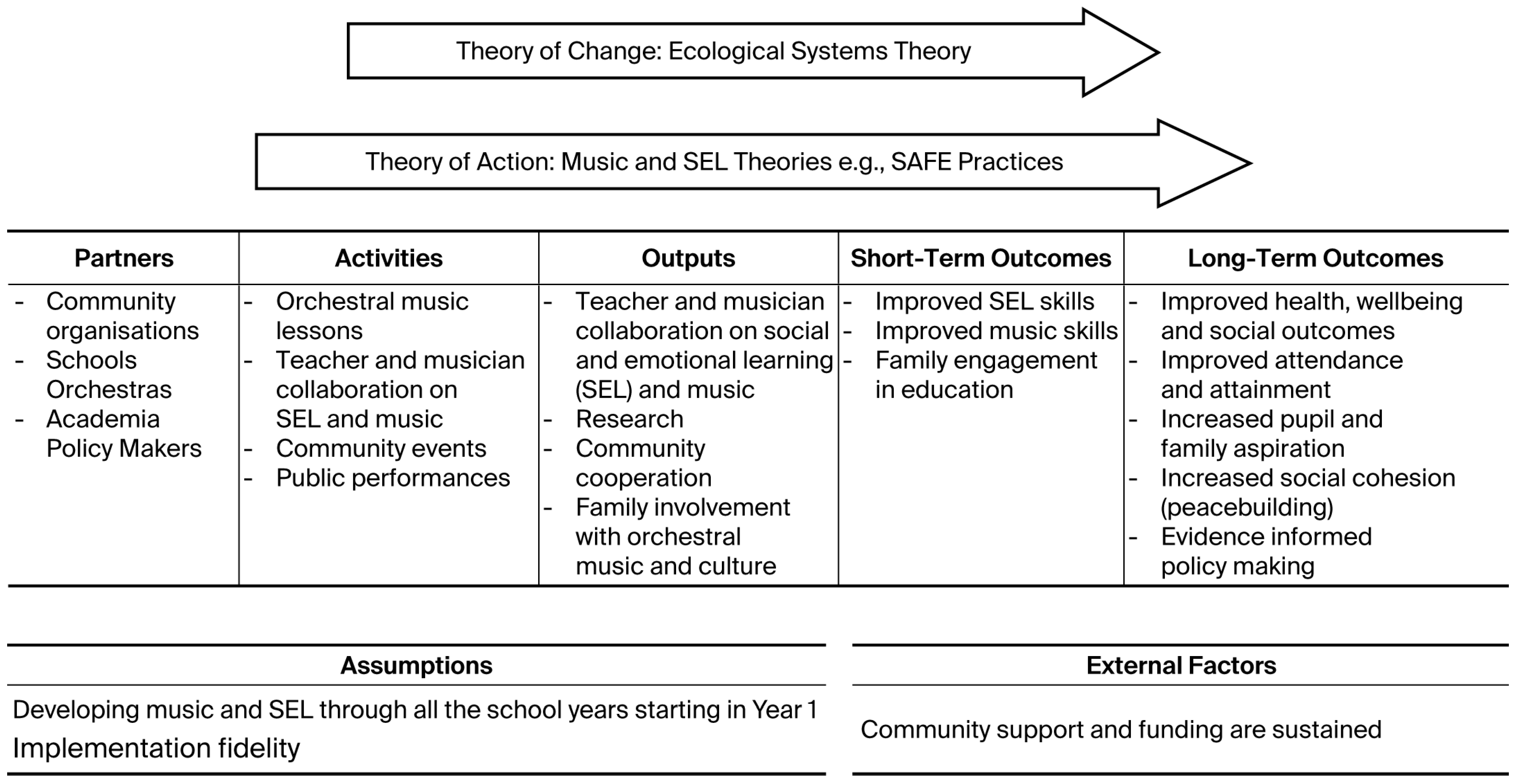
To address critiques of existing orchestral programmes, particularly those modelled on El Sistema, regarding lack of theoretical clarity and implementation detail, the Crescendo model is described using both a logic model (Figure 1) and the Template for Intervention Description and Replication (TIDieR) checklist (Table 1). The logic model outlines the programme’s theoretical foundations, inputs (resources), outputs (activities), and intended outcomes. The TIDieR checklist provides detailed information on the specific components and delivery of the Year 1 version of Crescendo, which targets children aged 5–6. These frameworks enhance the transparency and replicability of Crescendo for researchers, practitioners, and policymakers (Hoffmann et al., 2014), and support future adaptation, scaling, and implementation with fidelity.

1.3. Theoretical Underpinning

The main theory of change underpinning Crescendo is Bronfenbrenner’s Ecological Systems Theory (EST) (Bronfenbrenner, 1979), which conceptualises child development as occurring within a nested set of environmental systems, ranging from immediate settings such as family and school (microsystems) to broader societal and policy contexts (macrosystems). Crucially, the theory posits that children are not only influenced by these systems but also act upon them, creating a dynamic, reciprocal process. Bronfenbrenner and Morris (2006) later refined the model into the Process–Person–Context–Time (PPCT) framework, emphasising the importance of developmental processes over time.
Applied to Crescendo, this theoretical model recognises that programme delivery within the school setting can generate ripple effects, impacting not just individual students, but families, school environments, and the wider community. In this sense, Crescendo positions children as potential agents of change, with the programme acting as a mechanism to support both individual development and broader system-level transformation (Paquette & Ryan, 2001). This perspective expands the familiar adage ‘it takes a village to raise a child’ (Reupert et al., 2022) to include ‘it takes children to raise the village’, and, in Northern Ireland’s divided context, potentially ‘raise many villages.’
The theory of action for Crescendo draws on core principles of social and emotional learning (SEL). Specifically, it follows the SAFE framework (Sequenced, Active, Focused, Explicit), an evidence-informed model for effective SEL programme design (Durlak et al., 2011; Taylor et al., 2017). Crescendo realises these principles as follows: Sequenced: SEL and musical learning are developmentally structured across the seven-year programme, beginning with the development of basic music and SEL skills (e.g., beat and self-regulation) and focusing on more advanced skills in the later years (e.g., ensemble playing and relationship skills). Active: Children engage directly through singing and instrumental instruction, using music-making as a context to practise SEL competencies such as self-management and relationship skills. Focused: Dedicated time and roles are assigned to SEL and music skill development, led collaboratively by musicians and classroom teachers. Explicit: SEL goals are made transparent to all stakeholders, and programme fidelity is supported through the use of the Crescendo logic model (see Figure 1).
By combining Bronfenbrenner’s ecological perspective with the SAFE principles of SEL, Crescendo is positioned as both a child development intervention and a community-strengthening initiative (O’Hare et al., 2022). Its universal, long-term design ensures both depth and breadth of impact.

1.4. Outcomes

As a seven-year developmental programme, Crescendo is designed to support the progressive acquisition of both musical and social–emotional learning (SEL) skills. In the early years, the focus is on foundational skills such as self-regulation, while more complex SEL competencies, such as interpersonal relationships and responsible decision-making, are introduced and strengthened in later stages (Poland et al., 2023). Similarly, the music curriculum begins with core musical elements such as beat and pitch, progressing to more advanced instrumental and ensemble performance skills in later years.
Crescendo articulates a broad set of long-term outcomes for multiple stakeholder groups, including pupils, teachers, families, communities, researchers, and policymakers. For pupils, the development of social and emotional learning (SEL) skills, particularly self-regulation, is foundational to academic success. The ability to manage attention, emotions, and behaviours directly influences a child’s capacity to engage in learning tasks. A large body of research, spanning over four decades, links SEL competencies to improved academic attainment (Corcoran et al., 2018; Durlak et al., 2022).
Beyond academic outcomes, early self-regulation is associated with a wide range of positive life-course outcomes across domains such as health, wellbeing, employment, and justice. A meta-analytic review by Robson et al. (2020) states:
‘Self-regulation in early school years was positively related to academic achievement (math and literacy) and negatively related to externalising problems (aggressive and criminal behaviour), depressive symptoms, obesity, cigarette smoking and illicit drug use, in later school years (~age 13). Results also showed that self-regulation in early school years was negatively related to unemployment, aggressive and criminal behaviour, depression and anxiety, obesity, cigarette smoking, alcohol and substance abuse, and symptoms of physical illness in adulthood (~age 38).’
This evidence underscores the importance of self-regulation as a skill that should be developed in the early years. Crescendo does not ignore the importance of co-regulation and relationship skills, but this is targeted later in the Crescendo model and not focused on in this study. Regardless, this evidence provides a strong rationale for embedding high-quality, evidence-informed self-regulation development in early years education settings for future readiness and wellbeing. Furthermore, Crescendo, through its integrated and sustained approach, aims to support such development not only for individual pupils but also as a catalyst for wider community wellbeing and resilience.
In addition, family engagement in education is recognised as a critical factor in children’s educational success. Studies consistently show that parental involvement in schooling is positively associated with academic performance, motivation, and wellbeing (Nye et al., 2006). Crescendo supports these pathways to success by actively engaging families in the educational process and fostering school–community collaboration.

1.5. Activities and Outputs

A key feature of Crescendo delivery is the collaborative partnership between teachers and musicians, working together to develop both social–emotional learning (SEL) and music skills. This professional collaboration between instrumental music teachers (music experts) and class teachers (pedagogical experts) ensures a balanced and sustained focus on Crescendo’s core outcomes in music and SEL.
Musicians work alongside teachers during Crescendo lessons, employing consistent SEL development techniques such as classroom management strategies (e.g., the ‘eyes on me’ cue to gain attention). Meanwhile, teachers reinforce the musical content throughout the rest of the school week, for example, by revisiting songs and musical activities introduced in Crescendo sessions.
Learning occurs not only with students but also among educators and music associates, as Crescendo facilitates knowledge exchange and capacity building between these professional groups (B. A. Johnstone, 2016; A. B. Johnstone, 2019). Although the specific musical development strategies used in Crescendo are not explicitly detailed, the music outcomes, such as mastery of pitch and beat, are explicitly targeted.
The music associate delivering the lessons is a recognised community musician affiliated with the orchestra. Additionally, orchestral players visit the schools during Crescendo, particularly in the later years, enhancing students’ exposure to professional musicianship.
Finally, Crescendo includes a variety of community celebration events throughout the year, fostering engagement among parents and the wider community. The programme culminates in a final celebratory concert held at a prestigious venue, further strengthening community participation and pride.

1.6. Inputs

The logic model in Figure 1 illustrates the diverse range of stakeholders involved in implementing Crescendo. The collaboration between community organisations, the orchestra, and academic partners ensures that the programme is community-led, high-quality, and grounded in robust research and evaluation, addressing the common criticisms regarding the lack of rigorous evaluation in similar initiatives.

1.7. Research Questions

This study evaluates outcomes and processes for children aged 5–6 in their first year of participation in the Crescendo programme, as outlined in the TIDieR checklist (Table 2).
This study addresses the following research questions:
  • Outcome evaluation: Does participation in Crescendo improve self-regulation in 5–6-year-old children? (self-regulation);
  • Outcome evaluation: Does participation in Crescendo improve pitch, beat perception, and reaction to music in 5–6-year-old children? (pitch, beat, and reaction to music).
Implementation process evaluation: What are stakeholders’ perspectives on the implementation processes of the programme?

2. Methodology

2.1. Design

This study employs a mixed-methods design. A quasi-experimental approach evaluates outcomes addressing research questions 1 and 2. Qualitative data explores stakeholder views on implementation processes (research question 3). Although Crescendo has several features outlined in the logic model and TIDieR checklist, the day-to-day implementation and engagement are informed by key stakeholder perspectives gathered through a participatory process. Between 2018 and 2022, views from parents, pupils, music associates, and school staff were collected via interviews and focus groups at various time points. This qualitative data is not subjected to thematic analysis; rather, it illustrates how stakeholders’ voices are integrated into the implementation process and provides insight into the mechanisms influencing programme outcomes. For further extensive background on qualitative methods and closer exploration of relationships between qualitative and quantitative data, see Poland (2021).
All quantitative analyses were conducted using IBM SPSS Statistics (Version 29). Missing data were examined for both patterns and proportion (<5% across variables). Cases with incomplete data were treated using listwise deletion, as the level of missingness was minimal and random.

2.2. Ethics

Ethical approval for all data collection and use in this study was granted by a university research ethics committee.

2.3. Participants

This quasi-experimental evaluation involved 559 children in total, comparing Year 1 pupils in four Crescendo schools to those in four matched control schools without Crescendo provision. The Crescendo schools were an opportunity sample, as Crescendo was already being delivered in these four schools. The control schools were chosen and matched based on their location in a disadvantaged community; in fact, they were chosen from the same two communities in West Belfast where Crescendo had already been established. Arguably, this controlled for a significant amount of community-level/place-based variability. In addition, pupil gender and pupil pre-test scores were covariates controlled for in the regression analysis.
The quasi-experimental design therefore included 559 pupils within eight schools (four Crescendo and four matched control schools). Although statistical power was primarily constrained by the number of school clusters in the opportunity sample, a sample size calculation for a power =80% to detect a typically moderate educational effect size (d = 0.3) at a significance level of 0.05 would require a sample of 178 in each group. This N was exceeded in both the intervention and control groups.
All eight schools are situated within disadvantaged neighbourhood renewal areas as defined by Northern Ireland Statistics and Research Agency (NISRA, 2024), the 36 areas in Northern Ireland with the highest levels of deprivation. The schools and communities are segregated by religion into Catholic and Protestant areas, which is typical in Northern Ireland. Although this demographic context is provided in Table 3, it was not included in the data analysis.

2.4. Participant Flow Chart

The flow chart (Table 1) shows the number of pupils assessed for the four different outcome variables (self-regulation, beat, pitch, and reaction to music). The pre- and post-music assessments were conducted in 2021. However, the pre- and post-self-regulation assessment used a rolling cohort design with pupils from Crescendo schools being pre- and post-assessed in two different cohorts (2018 & 2021).

2.5. Outcome Measures

This study includes two main outcome measures: a self-regulation assessment conducted by class teachers and a music assessment conducted by an orchestral musician. Both assessments were conducted before and after the Crescendo programme delivery (pre/post). The same trained music assessor conducted the music assessments for all children in both Crescendo and control schools. Teachers assessed pupils within their own classes. For further extensive background on outcome measures and their development, see Poland (2021).

2.5.1. Self-Regulation Measurement

Behavioural self-regulation was measured using questions adopted from the Child Self-Regulation and Behaviour Questionnaire (CSBQ; Howard & Melhuish, 2017). This subscale specifically targets behavioural self-regulation in children aged 5–6. Behavioural self-regulation is defined as the observable manifestations of cognitive and emotional self-regulation (Geng, 2021; McClelland et al., 2007), making it feasible for teachers to assess observable behaviours in this study.
The six items are as follows:
  • Regularly unable to sustain attention;
  • Waits their turn in activities;
  • Good at following instructions;
  • Not able to sit still when necessary;
  • Is cooperative;
  • Is impulsive.
Responses are scored on a five-point Likert scale ranging from 1 (Not true) to 5 (Very true) (Howard & Melhuish, 2017). Items 1, 4, and 6 are reverse-scored. The scale demonstrates very good reliability, with a Cronbach’s alpha of 0.89 reported in previous research (Howard & Melhuish, 2017) and 0.83 in this study.

2.5.2. Music Assessment

Music skills were assessed using the Early Years Musicality Measure (EYMM; O’Hare et al., 2025), building on pilot work by (Poland et al., 2023) and incorporating elements from the Sounds of Intent (2024), particularly criteria R4 and R5 from the framework:
R1: 
Encounters sounds.
R2: 
Shows an awareness of sound.
R3: 
Reacts to simple patterns in sound.
R4: 
Recognises musical motifs and the relationships between them.
R5: 
Attends to whole pieces of music, anticipating prominent structural features and responding to general characteristics.
The music assessor evaluates three domains: beat, pitch, and reaction to music.
Beat:
The assessor first demonstrates a nursery rhyme by clapping to the beat and then asks children to clap along to a different nursery rhyme without clapping themselves. Children are rated on a scale from 1 to 5:
  • 1 = Very little attempt;
  • 2 = Attempts clapping, but with little or no regular rhythm;
  • 3 = Claps with some regular rhythm but not in time with the beat;
  • 4 = Claps a regular rhythm in time with the beat for a short period;
  • 5 = Claps in time with the beat for most or all of the rhyme.
Pitch:
The assessor sings two notes per child, asking whether they are the same or different. The notes are always at least a tone apart. If the child detects a difference, they are asked if the second note is higher or lower, and whether the notes are close together (tone interval) or far apart (fifth or sixth interval). Scores are as follows:
  • 1 = Does not recognise that pitches were sung;
  • 2 = Does not recognise differences between pitches;
  • 3 = Recognises pitches are different;
  • 4 = Identifies whether the second pitch is higher or lower;
  • 5 = Identifies whether pitches are far apart or close together.
Reaction to Music:
Children are scored on a 1 to 5 scale based on their engagement, mapped to the Sounds of Intent framework:
  • 1 = Little to no focused engagement (below R3);
  • 2 = Attentive to music for short periods;
  • 3 = Emotionally engages or reacts to musical features (tempo, dynamics), verbally or visually;
  • 4 = Sustained engagement for most of the piece, including criteria from 2 and 3;
  • 5 = Engages with music as a ‘narrative in sound’ (above R5).
Note: Since these assessments are single-point observations, reliability metrics (e.g., Cronbach’s alpha) cannot be calculated.

3. Results

The findings in this study draw on both quantitative and qualitative data, which have been analysed below.

3.1. Quantitative Data

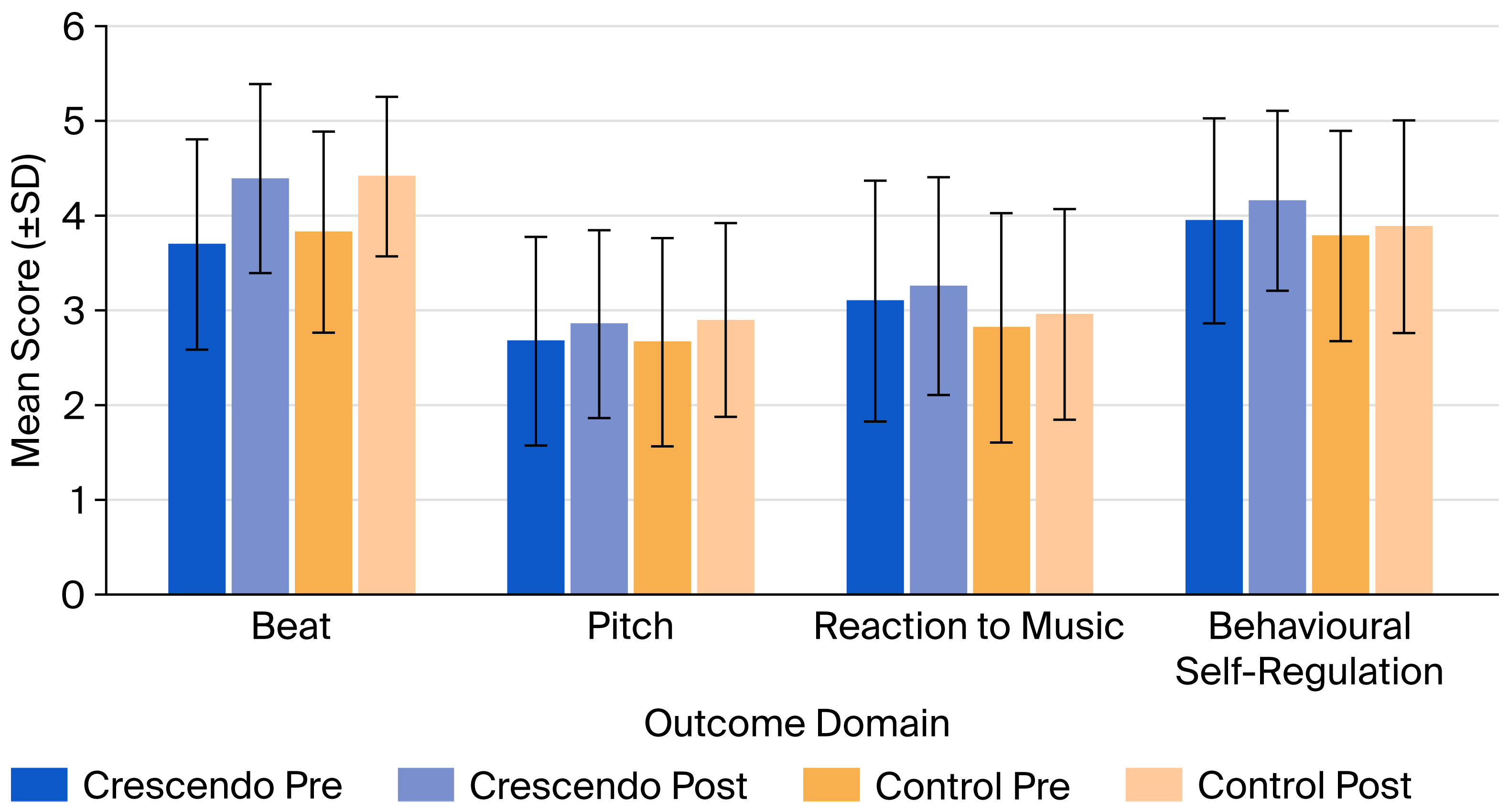
As can be seen from Table 4 and graphically in Figure 2, scores across all four outcomes increased for both the intervention and control groups between pre-test and post-test. To test whether the outcomes in the intervention group increased more than in the control group, a linear multiple regression model was conducted for each outcome, which controlled for both the relevant pre-test score and gender. The beta coefficient associated with the group allocation variable (intervention or control) was interpreted as the difference (on average) between intervention and control at post-test. The dependent variable for each model was the relevant outcome score at post-test.
Table 5 reports the results of the four regression models. The beta coefficient associated with the group allocation variable (Intervention) was negative or zero, and not statistically significant (<0.05) for two outcomes: pitch and beat.
For the two other outcomes—reaction to music and behavioural self-regulation—pupils in the intervention group had higher scores than the control group at post-test, demonstrating large effect sizes: reaction to music, d = 0.21 (p = 0.09), and behavioural self-regulation, d = 0.29 (p = 0.001) (see Table 6). Model 4 (self-regulation outcome) is based on a larger sample of data than models 1–3 (music outcomes). There was a larger sample for the self-regulation analyses compared to the music outcome analyses. The reason for this was that a rolling cohort design was used for the self-regulation analysis. That is, we had two cohorts with the same pre/post-Crescendo data collected in the same way, with the same-aged pupils, in the same classes, and in the same schools. The only difference was that it was collected 3 years earlier. Ultimately, it gave us a bigger sample size and data collected over a longer time period of Crescendo delivery. This increased the statistical power and generalisability of the findings. We did not have equivalent data for the music outcome data over the two cohorts.

3.2. Qualitative Data

An important aspect of Crescendo implementation is involving and acting on the voices of the key stakeholders within the four local schools that deliver Crescendo. Pupils, musicians, teachers, and principals have contributed to many of the design and implementation features of Crescendo to date. In the main, all the key stakeholders viewed participation in Crescendo as positive, with a range of benefits for each of the stakeholder groups. These engagements and benefits are highlighted in the paragraphs below.

3.2.1. Students’ Perspectives on Crescendo

Students expressed engagement with the Crescendo programme and consistently described the sessions as enjoyable and motivating. As one pupil noted, ‘I really like it because it’s fun and we get to play instruments’ (Student A). Beyond enjoyment, pupils also recognised long-term benefits, often linking their participation to future opportunities. For example, one student explained, ‘I like this experience because when we grow up and apply for jobs or university, we can say we can play an instrument’ (Student B). The programme also provided pupils with performance experiences with orchestral that they considered meaningful. Reflecting on their visit to the Ulster Hall, a pupil recalled, ‘When we went to the Ulster Hall, we had the chance to hear the Ulster Orchestra and even play along with them’ (Student C).
Taken together, these comments illustrate that pupils not only found Crescendo highly engaging, but also perceived the programme as offering valuable developmental opportunities, both musically and for their broader future pathways.

3.2.2. Parents’ Perspectives on Crescendo

Parents also reported strong engagement with the Crescendo programme and described clear benefits for their children. One parent highlighted the enjoyment their child experienced and the noticeable increase in confidence: ‘Our child really enjoys the Crescendo programme. She is now more willing to try new things in music, and her confidence has grown a lot’ (Parent A). Parents themselves also expressed enthusiasm for being more involved in the programme, noting that participation helped them feel connected to their child’s learning. As one parent explained, ‘I’d like to be more involved, perhaps taking part once every term, so I can see what the children are doing’ (Parent B).
Collectively, these accounts illustrate that parents not only value the benefits the programme brings to their children, particularly in confidence and musical exploration, but also demonstrate their high engagement and a desire for deeper involvement in Crescendo activities.

3.2.3. Musicians’ Perspectives on Crescendo

Musicians are key partners in the implementation of the Crescendo programme, and their insights played an important role in informing its ongoing design and development. Several musicians described being highly engaged in the process and expressed a strong commitment to strengthening links between the programme, families, and schools. Reflecting on a recent Crescendo music festival, one musician explained how parental involvement had evolved: ‘Parents joined in and tried some of the same activities as the children. They were a bit shy at first, but once they were together in a group, most of them really got involved’ (Musician A).
Musicians also highlighted potential benefits for programme development, particularly in expanding opportunities for parental engagement. As one musician suggested, this could take various forms, including ‘parent observation—where parents can come to watch the children’s sessions, parent–child activity workshops, sessions designed specifically for adults or families, or even small pop-up performances led by one or two musicians after regular classes’ (Musician A).
These perspectives indicate that musicians are not only active contributors to Crescendo’s delivery but also perceive clear developmental benefits both in strengthening parent–child musical interactions and in enhancing the overall richness and sustainability of the programme.

3.2.4. Teachers’ Perspectives on Crescendo

Teachers across all participating schools demonstrated strong engagement with the Crescendo programme. Their feedback underscored the value they placed on providing musical opportunities that many children might not otherwise experience. As one teacher explained, ‘Many of our children don’t have access to arts or music outside school … they wouldn’t get these opportunities anywhere else, and Crescendo gives them that chance’ (Teacher A).
Across schools, teachers consistently described Crescendo as bringing significant enjoyment and engagement to the classroom. An experienced teacher reflected on the observable improvements in focus and participation: ‘Some of our children struggle with attention and listening, and I think the music sessions really help. The sessions are short and clear, which is just right for them’ (Teacher B). Another teacher added, ‘There’s no doubt—they really enjoy it. You can see it in their attitudes, their expressions, their level of engagement. I’ve taught Year 1 for 17 years, and I can tell when something works. This works’ (Teacher C).
Teachers also identified specific benefits for pupils with additional needs, noting that the programme supported attention, listening, and participation. One teacher commented, ‘I really feel the Crescendo programme is beneficial for children with hearing or attention difficulties’ (Teacher D). In addition, teachers observed positive responses from parents, particularly during performances. As one teacher described, ‘Parents were genuinely delighted. They were proud to see their children on stage, and I know many of the children kept singing the songs at home for their families’ (Teacher E).
Together, these accounts demonstrate that teachers are not only highly invested in Crescendo but also perceive substantial benefits for children’s engagement, confidence, attention, and family involvement.

3.2.5. Principals’ Perspectives on Crescendo

School leaders also demonstrated strong engagement with the Crescendo programme and highlighted its broader benefits for the whole school community. Several principals described the programme as having a noticeably positive impact on pupils, families, and staff. As one principal observed, ‘From a whole-school community perspective, it has given everyone a significant lift—even the staff’ (Principal A).
Principals consistently emphasised the sense of pride generated through pupils’ participation and performances. Reflecting on a school event, one principal commented, ‘Of course they were proud. They were amazed at what the children achieved at such a young age—I was too’ (Principal B).
Another principal highlighted the wider community significance of collaborating with a prestigious professional orchestra, noting the programme’s symbolic and practical value: ‘After a year of hard work, there was a huge sense of pride. Having an organisation as renowned as the Ulster Orchestra involved so wholeheartedly means a great deal. It sends a powerful message to the local community, and you can see that pride in the way children talk about it—and in how their parents talk about it’ (Principal C).
Collectively, these accounts indicate that principals are not only deeply supportive of Crescendo but also perceive substantial benefits for school culture, community identity, and the overall visibility and value placed on the arts within their schools.
In summary, Crescendo received unanimous endorsement from all the main stakeholders in terms of engagement and benefits. This provides evidential support for Crescendo’s underpinning theory of change, i.e., Ecological Systems Theory (Bronfenbrenner & Morris, 2006) and the EST Process–Person–Context–Time (PPCT) framework, which highlights the positive two-way interactions between children and their support systems.

4. Discussion

This paper has presented the findings from a quasi-experimental controlled trial evaluating the effects of Crescendo on outcomes for primary school pupils in disadvantaged communities in Northern Ireland. It also demonstrates how stakeholder feedback actively informs Crescendo’s ongoing implementation. This study makes a significant contribution to both the national and international literature, representing one of the few controlled trial evaluations of early years orchestral music programmes targeting schools in disadvantaged areas.
The main quantitative findings revealed improvements across all measured outcomes in Crescendo schools over the delivery period. Significant effects were found for improvements in pupil self-regulation and reaction to music compared to the control group. The effect size for self-regulation was d = 0.29 (p < 0.01), and for music appreciation was d = 0.21 (p < 0.1). According to Kraft (2020), who analysed 1942 effect sizes from 747 educational RCTs, effect sizes above 0.2 are considered large for educational programmes, with classifications as follows: less than 0.05 = small effect, 0.05 to less than 0.20 = medium effect, and 0.20 or greater = large effect. The strong impact of Crescendo on self-regulation is particularly noteworthy given the holistic benefits that early self-regulation development has on future readiness and long-term wellbeing (Robson et al., 2020).
Qualitative data provided insight into the mechanisms underlying these positive effects. Stakeholders—including students, teachers, parents, musicians, and principals—consistently reported high levels of engagement, enjoyment, and sustained motivation, indicating that Crescendo cultivated an emotionally supportive and stimulating learning environment. Students emphasised the fun and interactive nature of the sessions, while teachers noted improvements in pupils’ attention, listening skills, and participation—behaviours closely aligned with the mechanisms proposed in social–emotional learning (SEL) development theory. Taken together, these perspectives support the interpretation that Crescendo’s impact on self-regulation derives not only from musical instruction itself but also from the relational, motivational, and participatory contexts established through the programme.
In contrast to the significant gains observed in self-regulation and musical responsiveness, no measurable effects were found for the two additional musical outcomes—beat and pitch. This likely reflects the broader challenges associated with assessing early musical development, an area that remains both complex and under-researched. Further work is needed to strengthen the reliability, validity, and developmental sensitivity of measures in this domain. This study contributes to these efforts by providing preliminary evidence for a promising tool—the Early Years Measure of Music (EYMM; O’Hare et al., 2025). However, in the present study, both beat and pitch were assessed using single-item indicators, which inherently limit reliability. Consistent with this limitation, the regression models for these outcomes yielded very low R2 values even after controlling for baseline performance, indicating that the measures captured only a small proportion of variance. By contrast, the musical appreciation measure displayed higher explanatory power and correspondingly stronger evidence of improvement.
Another factor to consider is that both the Crescendo and comparison groups showed substantial gains in beat accuracy (d = 0.65 and 0.62, respectively). These large overall improvements may have masked any additional incremental effect attributable to the Crescendo programme.
The qualitative evidence provides further insight into these findings. Teachers and musicians reported marked individual differences in beat and pitch development, particularly among pupils with attention difficulties or additional learning needs. These accounts corroborate the quantitative limitations, namely the reliance on single-item measures, low model fit, and substantial within-group variability and suggest that the inconsistent findings for beat and pitch may reflect both measurement challenges and the naturally uneven developmental trajectories characteristic of early musical skills.
Several points merit consideration alongside these positive findings. Firstly, while this study reports positive effects, further research is required to clarify why and how these effects occur. Despite the literature supporting links between music and behavioural outcomes, the specifics of these relationships remain unclear. This often stems from a lack of specificity regarding the behavioural outcomes targeted by music programmes and the scarcity of validated early years music outcome measures. Moreover, music instruction alone cannot be expected to sustainably improve behavioural outcomes without explicit behavioural intervention. Prior rigorous evaluations have found only weak effects of music programmes on behaviour (Alemán et al., 2016). However, Crescendo addresses this by having teachers collaborate closely with music associates to support social and emotional learning (SEL) development.
Furthermore, the broader context of SEL development must be acknowledged, as schools do not operate in isolation. Community organisations, families, and parents are critical stakeholders in implementing programmes like Crescendo. The enjoyment reported by all stakeholder groups feeds into wider areas such as school attendance, children’s confidence, academic attainment, and transitions between school stages. Crescendo also provides unique musical engagement opportunities for children who might otherwise lack access, thereby addressing inequalities in social capital and contributing to health equity by developing SEL skills like self-regulation.
Finally, similar large-scale music education initiatives have been implemented internationally, such as ‘El Sistema’ in Venezuela, ‘In Harmony’ in the United Kingdom, and the ‘Harmony Project’ in the United States. Although these programmes have provided evidence of positive impacts (though mostly qualitative) beyond musical ability, including improvements in behaviour, academic achievement, and social–emotional development, they have also been criticised for lacking theoretical clarity and transparency in implementation and rigorous evaluation.
In contrast, Crescendo distinguishes itself from most orchestral programmes that prioritise musical proficiency by explicitly integrating social and emotional learning (SEL) as a central pedagogical focus, positioning music as a vehicle for developing self-regulation, peer relationships, and wellbeing. Furthermore, its delivery model, pairing classroom teachers with professional musicians, promotes continuity and capacity building within schools. The use of a logic model and the TIDieR framework further enhances conceptual coherence and implementation transparency. In addition, the quasi-experimental evaluation in this study provides a robust quantitative evaluation of Crescendo’s effects on outcomes. These features address long-standing criticisms of music-based programmes, particularly those concerning theoretical inconsistency and variation in delivery across contexts.
The qualitative findings add a relational dimension to this discussion. Across all stakeholder groups, a recurring theme was the strong sense of pride, confidence, and community belonging fostered by Crescendo. Parents and principals noted that the programme raised children’s aspirations and strengthened home–school connections, while musicians highlighted the value of shared intergenerational and community-based musical experiences. These relational benefits align closely with Crescendo’s theory of change and suggest that the programme operates not only through musical or behavioural pathways but also through broader social and emotional mechanisms—enhancing confidence, fostering a sense of belonging, promoting family engagement, and enriching school and community culture. Taken together, the integrated evidence indicates that Crescendo’s influence extends well beyond narrow musical outcomes, contributing meaningfully to school climate, community wellbeing, and the social and emotional development of children in disadvantaged areas.

4.1. Future Research

Essentially, this study is the start of a journey to see ‘if’ Crescendo works, and, for that matter, only ‘if’ a portion of it works (i.e., the Year 1 portion). Few randomised controlled trials (RCTs) have examined ‘if’ orchestral programmes work in disadvantaged communities. Now that Crescendo’s logic model has been developed and outcome measures tested, these tools can support a future RCT to evaluate Crescendo’s effects more definitively.
Another important direction is understanding the wider benefits and radiance effects of Crescendo and similar programmes. This study provides only a six-month snapshot of a seven-year programme without looking at many potential additional benefits for pupils, parents, schools, and communities. For instance, schools have reported that Crescendo enhances their ability to foster a community focus. Parents have expressed interest in engaging at multiple levels. Moreover, Crescendo has helped unite communities through a shared interest in child and family development and music, creating social interdependence among groups historically divided by political differences. As noted by Howell (2021), Crescendo may hold substantial peace-building potential.
However, the work outlined above will only provide better answers to the ‘if’ Crescendo works question. It is equally important to explore ‘how’ and for ‘who’ it works. Future research should build on this initial work to develop more theory-driven study designs and analyses. For example, path analysis or structural equation modelling could explore the relationships between activities and proximal and distal outcomes, such as the relationships between music and self-regulation outcomes. In addition, realist evaluation and implementation science methods can explore implementation processes and programme theories in more detail. Overall, there is rich ground for future research.
Finally, future studies could further validate and extend these findings by incorporating neuroscientific approaches, such as EEG or fNIRS, to examine how participation in Crescendo influences the neural correlates of self-regulation and musical engagement.

4.2. Limitations

Several limitations should be acknowledged. First, the quasi-experimental design may introduce bias, though the schools were well matched geographically and socioeconomically, all being in neighbourhood renewal areas, but random assignment was not possible in this case. This may have resulted in some unmeasured differences between groups, thereby affecting the observed results. Therefore, future research should aim to strengthen causal inference through randomised controlled trial (RCT) designs to more rigorously assess the effectiveness and external validity of the programme. Second, while outcome measures were carefully tailored to Crescendo’s early years targets, music assessment in early childhood remains underdeveloped, limiting some conclusions. Third, as Crescendo is a seven-year programme, this evaluation captures only an early snapshot, although the rolling cohort design allowed for some longer-term outcome assessment.

5. Conclusions

Crescendo seeks to demystify orchestral music and embed it meaningfully into the lives of children, young people, and families from disadvantaged backgrounds. This study demonstrates the programme’s potential to enhance both musical and social–emotional learning outcomes among young participants. Yet, these findings may represent only the early evidence of Crescendo’s long-term and holistic benefits arising from its whole-child, whole-family, and whole-community approach.
Beyond its immediate outcomes, the results carry important implications for education policy. By providing evidence that music-based interventions can strengthen self-regulation and wellbeing in resource-constrained settings, this study supports policies that prioritise equitable access to high-quality arts education as part of broader strategies for social inclusion and child development. Scaling such programmes requires sustained investment, intersectoral collaboration, and policy frameworks that recognise the arts as a vital component of education and wellbeing.
At the level of educational practice and community development, Crescendo offers a transferable model for integrating orchestral participation into everyday school life. It highlights the importance of teacher–musician partnerships, family engagement, and culturally relevant pedagogy in supporting children’s holistic growth. Ultimately, initiatives like Crescendo have the potential not only to enrich learning but also to foster empathy, belonging, and cohesion within and across divided communities, demonstrating the power of music to contribute to social harmony and peace.

Author Contributions

L.O. (Liam O’Hare), C.P., L.O. (Leeanne O’Hara), A.G., J.W., S.M. and L.D. contributed to: Conceptualization; Methodology; Formal Analysis; Investigation; Data Curation; Writing—Original Draft Preparation; Writing—Review & Editing; L.O. (Liam O’Hare) led on Funding Acquisition and Project Administration. All authors have read and agreed to the published version of the manuscript.

Funding

This research was funded by the Northern Ireland Government through the Department for the Economy and Urban Villages initiative.

Institutional Review Board Statement

The study was conducted in accordance with the Declaration of Helsinki, and approved by the Ethics Committee of Queen’s University Belfast (SSESW, 26 January 2018).

Informed Consent Statement

Informed consent was obtained from all parents of pupils in the study through opt-out consent letters. This is common practice for large-scale educational trials in schools.

Data Availability Statement

Anonymised data may be available on discussion with the corresponding author.

Acknowledgments

The authors would like to acknowledge the following people and organisations in the completion of this research: All pupil participants and their families, the teachers and principals in the participant schools, the Crescendo Committee, Queen’s University Belfast Innovation Zones, Cecily Smith Nesbitt and the Crescendo delivery team, i.e., Ulster Orchestra (and music associates), Colin Neighbourhood Partnership, Shankill Children and Young People’s Zone.

Conflicts of Interest

The authors declare no conflicts of interest.

Abbreviations

The following abbreviations are used in this manuscript:
SELSocial and emotional Learning
CASELCollaborative for Academic, Social, and Emotional Learning
TIDieRTemplate for Intervention Description and Replication
ESTEcological Systems Theory
PPCTProcess–Person–Context–Time
SAFESequenced, Active, Focused, Explicit
SDStandard Deviation
EYMMEarly Years Music Measure

References

  1. Alemán, X., Duryea, S., Guerra, N. G., McEwan, P. J., Munoz, R., Stampini, M., & Williamson, A. A. (2016). The effects of musical training on child development: A randomized trial of El Sistema in Venezuela. Prevention Science, 18(7), 865–878. [Google Scholar] [CrossRef]
  2. Arasomwan, D. A., & Mashiy, N. J. (2021). Early childhood care and education educators’ understanding of the use of music-based pedagogies to teach communication skills. South African Journal of Childhood Education, 11(1), a896. [Google Scholar] [CrossRef]
  3. Baker, G. (2022). Afterword: Beyond social inclusion. In Music and social inclusion (pp. 252–260). Routledge. [Google Scholar]
  4. Boal-Palheiros, G., Figueira, P., & Castro, S. L. (2022). Musical and cognitive abilities in children from disadvantaged backgrounds. Revista Electrónica de LEEME, 49, 85–100. [Google Scholar] [CrossRef]
  5. Boal-Palheiros, G., & Ilari, B. (2023). Music, drama, and social development in Portuguese children. Frontiers in Psychology, 14, 1093832. [Google Scholar] [CrossRef] [PubMed]
  6. Bolden, B., Corcoran, S., & Butler, A. (2021). A scoping review of research that examines El Sistema and Sistema-inspired music education programmes. Review of Education, 9(3), e3267. [Google Scholar] [CrossRef]
  7. Booth, E., & Tunstall, T. (2016). Playing for their lives: The global El Sistema movement for social change through music. WW Norton & Company. [Google Scholar]
  8. Borowski, T. (2019). OECD’s conceptual framework for the study on social and emotional skills. Measuring SEL. [Google Scholar]
  9. Bronfenbrenner, U. (1979). The ecology of human development: Experiments by nature and design. Harvard University Press. [Google Scholar]
  10. Bronfenbrenner, U., & Morris, P. A. (2006). The bioecological model of human development. In W. Damon, & R. M. Lerner (Eds.), Handbook of child psychology: Vol. 1. Theoretical models of human development (6th ed., pp. 793–828). John Wiley. [Google Scholar]
  11. Browne, B., & Dwyer, C. (2014). Navigating risk: Understanding the impact of the conflict on children and young people in northern Ireland: Special issue: Northern Ireland: 20 years after the cease-fires. Studies in Conflict and Terrorism, 37(9), 792–805. [Google Scholar] [CrossRef]
  12. Burns, S., & Galbraith, M. (2016). In harmony Liverpool, impact on early years education: Executive summary. Liverpool Philharmonic. Available online: https://www.liverpoolphil.com/media/190702/in-harmony-liverpool-impact-on-early-years-education-executive-summary.pdf (accessed on 21 November 2024).
  13. Cipriano, C., Strambler, M. J., Naples, L. H., Ha, C., Kirk, M., Wood, M., Sehgal, K., Zieher, A. K., Eveleigh, A., McCarthy, M., Funaro, M., Ponnock, A., Chow, J. C., & Durlak, J. (2023). The state of evidence for social and emotional learning: A contemporary meta-analysis of universal school-based SEL interventions. Child Development, 94(5), 1181–1204. [Google Scholar] [CrossRef]
  14. Corcoran, R. P., Cheung, A. C., Kim, E., & Xie, C. (2018). Effective universal school-based social and emotional learning programs for improving academic achievement: A systematic review and meta-analysis of 50 years of research. Educational Research Review, 25, 56–72. [Google Scholar] [CrossRef]
  15. D’Alexander, C. M. (2015). Voices from within: Perceptions of community youth orchestras and musical identities of child musicians [Doctoral dissertation, University of Southern California]. [Google Scholar]
  16. Dumont, E., Syurina, E. V., Feron, F. J., & van Hooren, S. (2017). Music interventions and child development: A critical review and further directions. Frontiers in Psychology, 8, 1694. [Google Scholar] [CrossRef]
  17. Durlak, J. A., Mahoney, J. L., & Boyle, A. E. (2022). What we know, and what we need to find out about universal, school-based social and emotional learning programs for children and adolescents: A review of meta-analyses and directions for future research. Psychological Bulletin, 148(11–12), 765. [Google Scholar]
  18. Durlak, J. A., Weissberg, R. P., Dymnici, A. B., Taylor, R. D., & Schellinger, K. B. (2011). The impact of enhancing students’ social and emotional learning: A meta-analysis of school-based universal interventions. Child Development, 82(1), 405–432. [Google Scholar] [CrossRef]
  19. Dyson, A., & Raffo, C. (2007). Education and disadvantage: The role of community-oriented schools. Oxford Review of Education, 33(3), 297–314. [Google Scholar]
  20. Eamon, M. K. (2001). The effects of poverty on children’s socioemotional development: An ecological systems analysis. Social Work, 46(3), 256–266. [Google Scholar]
  21. Edgar, S. N. (2013). Introducing social emotional learning to music education professional development. Update: Applications of Research in Music Education, 31(2), 28–36. [Google Scholar] [CrossRef]
  22. Edgar, S. N. (2017). Music education and social emotional learning: The heart of teaching music. GIA Publications. [Google Scholar]
  23. Ellis, J. (2021). Facilitating educational opportunities and raised self-esteem in disadvantaged young people in Southeast Wales: Effects of the Junior Rock Music Academy widening participation programme. Journal of Popular Music Education, 5(1), 71–87. [Google Scholar]
  24. Fasano, M. C., Semeraro, C., Cassibba, R., Kringelbach, M. L., Monacis, L., De Palo, V., Vuust, P., & Brattico, E. (2019). Short-term orchestral music training modulates hyperactivity and inhibitory control in school-age children: A longitudinal behavioural study. Frontiers in Psychology, 10, 438622. [Google Scholar] [CrossRef]
  25. Gaunt, H., Duffy, C., Coric, A., González Delgado, I. R., Messas, L., Pryimenko, O., & Sveidahl, H. (2021). Musicians as “makers in society”: A conceptual foundation for contemporary professional higher music education. Frontiers in Psychology, 12, 713648. [Google Scholar] [CrossRef] [PubMed]
  26. Gay, G. (2018). Culturally responsive teaching: Theory, research, and practice (J. A. Banks, Ed.; 3rd ed.). Multicultural Education Series. Teachers College Press. [Google Scholar]
  27. Geng, Z. (2021). Examining the characteristics of behavioural, cognitive and emotional aspects of self-regulation and their associations with academic achievement among Chinese preschool children [Master’s dissertation, University of Oxford]. [Google Scholar]
  28. Govias, J. A. (2011). The five fundamentals of El Sistema. Canadian Music Educator, 53(1), 21–23. [Google Scholar]
  29. Greenberg, M., Domitrovich, C., Weissberg, R., & Durlak, J. (2017). Social and emotional learning as a public health approach to education. The Future of Children, 27(1), 13–32. [Google Scholar] [CrossRef]
  30. Hair, N. L., Hanson, J. L., Wolfe, B. L., & Pollak, S. D. (2015). Association of child poverty, brain development, and academic achievement. JAMA Pediatrics, 169(9), 822–829. [Google Scholar] [CrossRef]
  31. Haley, J. A. (2001). The relationship between instrumental music instruction and academic achievement in fourth grade students [Doctoral dissertation, Pace University]. [Google Scholar]
  32. Hallam, S., & Burns, S. (2023). Supporting musical progression for children from very disadvantaged communities participating in the English’ In Harmony’ program. Music and Arts in Action, 8(2), 34–59. [Google Scholar]
  33. Harkins, C., Garnham, L., Campbell, A., & Tannahill, C. (2016). Hitting the right note for child and adolescent mental and emotional wellbeing: A formative qualitative evaluation of Sistema Scotland’s “Big Noise” orchestral programme. Journal of Public Mental Health, 15(1), 25–36. [Google Scholar] [CrossRef]
  34. Hoffmann, T. C., Glasziou, P. P., Boutron, I., Milne, R., Perera, R., Moher, D., Altman, D. G., Barbour, V., Macdonald, H., Johnston, M., Lamb, S. E., Dixon-Woods, M., McCulloch, P., Wyatt, J. C., Chan, A. W., & Michie, S. (2014). Better reporting of interventions: Template for intervention description and replication (TIDieR) checklist and guide. British Medical Journal, 348, g1687. [Google Scholar] [CrossRef] [PubMed]
  35. Howard, S. J., & Melhuish, E. (2017). An early years toolbox for assessing early executive function, language, self-regulation, and social development: Validity, reliability, and preliminary norms. Journal of Psychoeducational Assessment, 35(3), 255–275. [Google Scholar]
  36. Howell, G. (2021). Harmonious relations: A framework for studying varieties of peace in music-based peacebuilding. Journal of Peacebuilding & Development, 16(1), 85–101. [Google Scholar]
  37. Ilari, B. S., Keller, P., Damasio, H., & Habibi, A. (2016). The development of musical skills of underprivileged children over the course of 1 year: A study in the context of an El Sistema-inspired program. Frontiers in Psychology, 7, 62. [Google Scholar] [CrossRef] [PubMed]
  38. Jindal-Snape, D., Asi, D., Robb, A., Barrable, A., Murray, C., Ross, E., & Austin, H. (2021). Sistema Scotland: Evaluation of big noise Douglas. Abertay University. [Google Scholar]
  39. Johnstone, A. B. (2019). Professional collaboration in the Wider Opportunities instrumental programme. British Journal of Music Education, 36(3), 253–266. [Google Scholar]
  40. Johnstone, B. A. (2016). Teachers working together in the wider opportunities instrumental programme in the primary school [Unpublished Doctor thesis, University of Greenwich]. [Google Scholar]
  41. Kirkbride, J. B., Anglin, D. M., Colman, I., Dykxhoorn, J., Jones, P. B., Patalay, P., Pitman, A., Soneson, E., Steare, T., Wright, T., & Griffiths, S. L. (2024). The social determinants of mental health and disorder: Evidence, prevention and recommendations. World Psychiatry, 23(1), 58. [Google Scholar] [CrossRef] [PubMed]
  42. Kraft, M. A. (2020). Interpreting effect sizes of education interventions. Educational Researcher, 49, 241–253. [Google Scholar] [CrossRef]
  43. Kraus, N., Hornickel, J., Strait, D. L., Slater, J., & Thompson, E. (2014). Engagement in community music classes sparks neuroplasticity and language development in children from disadvantaged backgrounds. Frontiers in Psychology, 5, 116155. [Google Scholar] [CrossRef]
  44. Küpana, M. N. (2015). Social emotional learning and music education. SED-Sanat Eğitimi Dergisi, 3(1), 75–88. [Google Scholar]
  45. Lord, P., Sharp, C., Dawson, A., Mehta, P., White, R., & Jeffes, J. (2013). Evaluation of in harmony: Year 1. Interim report. National Foundation for Educational Research. [Google Scholar]
  46. McBride, Ian. (2023). Ethnicity and conflict: The northern Ireland troubles. Journal of British Studies, 62(3), 618–639. [Google Scholar] [CrossRef]
  47. McClelland, M., Cameron, C., Connor, C., Farris, C., Jewkes, A., & Morrison, F. (2007). Links between behavioral regulation and preschoolers’ literacy, vocabulary, and math skills. Developmental Psychology, 43(4), 947–959. [Google Scholar] [CrossRef] [PubMed]
  48. Moore, K., & Harkins, C. (2017). Evaluating Sistema Scotland—Big noise torry: Initial findings report contact. Glasgow Centre for Population Health. Available online: https://makeabignoise.org.uk/uploads/Evaluation%20Reports/Big_Noise_Torry_Evaluation_Report_FINAL3.pdf (accessed on 21 November 2024).
  49. Noble, K. G., McCandliss, B. D., & Farah, M. J. (2007). Socioeconomic gradients predict individual differences in neurocognitive abilities. Developmental Science, 10(4), 464–480. [Google Scholar] [CrossRef]
  50. Northern Ireland Statistics and Research Agency (NISRA). (2024). Neighbourhood renewal areas. Available online: https://www.nisra.gov.uk/support/geography/neighbourhood-renewal-areas-dfc (accessed on 21 November 2024).
  51. Nye, C., Turner, H., & Schwartz, J. (2006). Approaches to parent involvement for improving the academic performance of elementary school age children. Campbell Systematic Reviews, 2(1), 1–49. [Google Scholar] [CrossRef]
  52. O’Hare, L., Orr, K., Waite, S. J., O’Hara, L., Sweet, D., Gildea, A., Redpath, J., Davidson, R., Dunne, L., & Miller, S. (2022). Conversations. “The story I want my life to be”. Queen’s University Belfast. Available online: https://pure.qub.ac.uk/files/385367633/Conversations_Report_V3_Final.pdf (accessed on 21 November 2024).
  53. O’Hare, L., Poland, C., O’Hara, L., Wang, J., & Smith Nesbitt, C. (2025). Early years musicality measure (EYMM). Innovation Zones, Queen’s University Belfast. [Google Scholar]
  54. Osborne, M. S., McPherson, G. E., Faulkner, R., Davidson, J. W., & Barrett, M. S. (2016). Exploring the academic and psychosocial impact of El Sistema-inspired music programs within two low socio-economic schools. Music Education Research, 18(2), 156–175. [Google Scholar] [CrossRef]
  55. Paquette, D., & Ryan, J. (2001). Bronfenbrenner’s ecological systems theory. Available online: https://www.academia.edu/download/44165922/bronfenbrenners_ecological.pdf (accessed on 21 November 2024).
  56. Poland, C. (2021). A feasibility study of a school-based music and social and emotional learning programme for children aged 4–5 [Doctoral dissertation, Queen’s University Belfast]. [Google Scholar]
  57. Poland, C., O’Hare, L., & O’Hara, L. (2023). Crescendo: Using a music education programme to improve social outcomes in disadvantaged communities. In Music and social inclusion (pp. 115–129). Routledge. [Google Scholar]
  58. Provenzano, A. M., Spencer, M. S., Hopkins, M., Ellis, J., Reischl, C. H., Karr, K., & Savas, S. A. (2020). Effects of a university–school partnered after-school music program on developmental health, social, and educational outcomes. Journal of the Society for Social Work and Research, 11(3), 443–462. [Google Scholar]
  59. Reupert, A., Straussner, S. L., Weimand, B., & Maybery, D. (2022). It takes a village to raise a child: Understanding and expanding the concept of the “Village”. Frontiers in Public Health, 10, 756066. [Google Scholar] [CrossRef]
  60. Robson, D. A., Allen, M. S., & Howard, S. J. (2020). Self-regulation in childhood as a predictor of future outcomes: A meta-analytic review. Psychological Bulletin, 146(4), 324. [Google Scholar]
  61. Schunk, D. H., & Zimmerman, B. J. (2012). Self-regulation and learning. In Handbook of psychology (2nd ed., vol. 7). John Wiley & Sons, Inc. [Google Scholar]
  62. Sounds of Intent. (2024). Sounds of Intent: An inclusive framework of musical engagement. Available online: https://soundsofintent.org/en/home/index (accessed on 21 November 2024).
  63. Sperling, J., Lee, V. K., Schmid, L., Gray, M., & Kim, J. Y. (2023). An randomized study of El Sistema-inspired youth music education programming: Evidence addressing executive function and social–emotional learning. Psychology of Aesthetics, Creativity, and the Arts, 19(6), 1332–1344. [Google Scholar]
  64. Sportsman, E. L. (2011). Development of musicianship and executive functioning among children participating in a music program. ProQuest Dissertations Publishing. [Google Scholar]
  65. Taylor, R., Oberle, E., Durlak, J. A., & Weissberg, R. P. (2017). Promoting positive youth development through school-based social and emotional learning interventions: A meta- analysis of follow-up effects. Child Development, 88, 1156–1171. [Google Scholar]
  66. Williams, K. E., Bentley, L. A., Savage, S., Eager, R., & Nielson, C. (2023). Rhythm and movement delivered by teachers supports self-regulation skills of preschool-aged children in disadvantaged communities: A clustered RCT. Early Childhood Research Quarterly, 65, 115–128. [Google Scholar] [CrossRef]
  67. Williams, K. E., & Berthelsen, D. (2019). Implementation of a rhythm and movement intervention to support self-regulation skills of preschool-aged children in disadvantaged communities. Psychology of Music, 47(6), 800–820. [Google Scholar]
  68. Zhang, F., & Talib, M. B. A. (2023). Orff-based music education: A systematic review of its effects on social emotional competence in primary school students. Educational Administration: Theory and Practice, 29(4), 789. [Google Scholar] [CrossRef]
  69. Zhukov, K., Barrett, M. S., & Welch, G. F. (2021). Developing a child and adolescent chorister engagement survey: Probing perceptions of early collective experiences and outcomes. Music & Science, 4, 2059204320983215. [Google Scholar] [PubMed]
Figure 1. Overarching Crescendo logic model.
Education 16 00092 g001
Figure 2. Mean pre- and post-test scores (±SD) for the Crescendo and control groups across four outcome domains.
Education 16 00092 g002
Table 1. Participant flow through the study.
Control ParticipantsCrescendo Participants
Four Control Schools from Colin and Shankill Area
(No Crescendo) Within Designated Neighbourhood
Renewal Areas (Pupils = 255)
Four Crescendo Schools from Colin and Shankill Area
Receiving Crescendo Since 2017 Within Designated
Neighbourhood Renewal Areas (Pupils = 304)
Cohort 2018
Self-regulation at pre-test (n = 143) and post-test (n = 142)
Cohort 2021
Self-regulation at pre-test (n = 146) and post-test (n = 148)
Beat at pre-test (n = 134) and post-test (n = 120)
Pitch at pre-test (n = 135) and post-test (n = 123)
Reaction to music at pre-test (n = 136) and post-test (n = 123)
Cohort 2021
Self-regulation at pre-test (n = 244) and post-test (n = 216)
Beat at pre-test (n = 179) and post-test (n = 202)
Pitch at pre-test (n = 183) and post-test (n = 203)
Reaction to music at pre-test (n = 185) and post-test (n = 205)
Table 2. TIDieR checklist (Hoffmann et al., 2014) for Crescendo (Year 1 version for pupils aged 5–6 evaluated in this study).
No.Item
1Crescendo Year 1: a music education and social–emotional learning (SEL) programme for Year 1 pupils in disadvantaged communities.
2An evaluation study focused on Year 1 pupils, examining key outcomes: musicality (beat, pitch, reaction to music) and self-regulation.
3Lessons are collaboratively constructed by musicians and supported by teachers’ classroom management techniques targeting SEL development.
4Pupils attend 16 weekly music classes across the second and third terms of their first primary school year. Lessons include singing, playing basic instruments, introductory musical activities, and listening to visiting classical musicians. Core skills taught include beat and pitch recognition and repetition. Pupils also learn a group/class song performed at the end-of-year inter-school gala alongside other year groups in a civic venue with the national orchestra.
5Provision is delivered through three primary agents: (1) Music associates (community musicians employed by the orchestra) deliver weekly Crescendo lessons; (2) Classroom teachers provide supplementary lessons integrated throughout the school week; (3) Visiting orchestral musicians perform live at least twice during the 16-lesson period.
6Pupils receive face-to-face instruction in classroom settings, and are exposed to classical music live through visiting musicians and via recordings (CD/video).
7Crescendo lessons occur during a timetabled class period in the participating schools, usually within the pupils’ regular classroom.
8Crescendo is delivered 16 times, with each lesson lasting 25 min, during the latter two school terms (mid-January to mid-June), culminating in a gala concert.
9Personalisation and adaptation to suit individual classes are implemented by respective music associates. Teachers provide after-class material accordingly.
10Each music associate interprets standardised lesson plans, allowing them to select their own class songs to teach throughout Crescendo.
11Crescendo fidelity is maintained through: focus on self-regulation, pitch, beat, and positive reaction to music across all 16 lessons; delivery in disadvantaged communities; community involvement in planning; orchestral support; collaboration between teachers and musicians; active singing and music-making; universal access to all pupils aged 5–6; and an end-of-year public performance with community and family participation.
12Delivery quality is ensured by continuous professional development workshops for both teachers and music associates prior to programme delivery.
Table 3. Primary school children in research by school and community area.
SchoolSchool ReligionNumber of PupilsPercent of Total PupilsMaleFemale
School A (Crescendo, Shankill Area)Protestant407.21822
School B (Crescendo, Shankill Area)Protestant366.41818
School C (Crescendo, Colin Area)Catholic9316.64845
School D (Crescendo, Colin Area)Catholic13524.27164
Total Crescendo 30454.4155149
School E (Control, Shankill Area)Protestant346.11717
School F (Control, Shankill Area)Protestant7513.43144
School G (Control, Colin Area)Catholic397.01722
School H (Control, Colin Area)Catholic10719.15453
Total Control 25545.6119136
Overall Total 559100.0274285
Table 4. Comparison of mean pre-test and post-test scores for the Crescendo and control groups for each outcome.
OutcomeCrescendo
Mean (SD) n
Effect Size (d)
[95% CI]
Control
Mean (SD) n
Effect Size (d)
[95% CI]
PrePostPrePost
Music Outcomes
Beat3.69
(1.11)
134
4.38
(1.00)
120
0.65
[0.40, 0.90]
3.82
(1.06)
179
4.41
(0.84)
202
0.62
[0.41, 0.83]
Pitch2.67
(1.1)
135
2.85
(0.99)
123
0.17
[−0.07, 0.42]
2.66
(1.1)
183
2.89
(1.02)
203
0.22
[0.02, 0.42]
Reaction to music3.09
(1.27)
136
3.25
(1.15)
123
0.13
[−0.11, 0.37]
2.81
(1.21)
185
2.95
(1.11)
205
0.12
[−0.08, 0.32]
Social and Emotional Learning
Behavioural self-regulation3.94
(1.08)
289
4.15
(0.95)
290
0.20
[0.04, 0.37]
3.78
(1.12)
244
3.88
(1.12)
216
0.09
[−0.09, 0.27]
Table 5. Linear regression models for each outcome, using the post-test score as the dependent variable.
Model 1
Beat
Model 2
Pitch
Model 3
Reaction to Music
Model 4
Behavioural Self-Regulation
Unstandardised Beta Coefficients
(Standard Error)
Sig.
Crescendo−0.10−0.0010.230.19
(0.11)(0.12)(0.13)(0.06)
0.380.990.090.001
Gender−0.08−0.01−0.280.01
(0.11)(0.12)(0.13)(0.06)
0.490.920.030.83
Pre-test0.120.060.220.75
(0.05)(0.06)(0.05)(0.03)
0.020.32<0.01<0.001
Constant4.042.712.510.97
(0.23)(0.18)(0.17)(0.12)
<0.01<0.01<0.01<0.001
Adjusted R20.02−0.010.080.62
Model N266269272490
Table 6. The raw post-test mean scores (and standard deviations) for the Crescendo and control groups and their associated effect sizes for each outcome.
OutcomePost-Test Means
(Standard Deviation)
Sig.Effect Size (Cohen’s d)
[95% CI]
CrescendoControl
Music Outcomes
Beat4.38 (1.00)4.41 (0.84)0.38−0.11 [−0.36, 0.13]
Pitch2.85 (0.99)2.89 (1.02)0.99−0.00 [−0.24, 0.24]
Reaction to music3.25 (1.15)2.95 (1.11)0.090.21 [−0.03, 0.45]
Social and Emotional Learning
Self-regulation4.15 (0.95)3.88 (1.12)<0.0010.29 [0.11, 0.47]
Disclaimer/Publisher’s Note: The statements, opinions and data contained in all publications are solely those of the individual author(s) and contributor(s) and not of MDPI and/or the editor(s). MDPI and/or the editor(s) disclaim responsibility for any injury to people or property resulting from any ideas, methods, instructions or products referred to in the content.