1. Introduction
In educational psychology, it is often assumed that a teacher’s passion represents their greatest psychological shield against occupational stress. Intrinsic motivation, defined as engaging in work for inherent enjoyment, meaning, and personal satisfaction, is frequently portrayed as the most powerful personal resource for sustaining engagement and resilience in teaching professions (
Ryan & Deci, 2000,
2020). Educators who are intrinsically motivated typically report high professional commitment, higher engagement, and greater persistence in the face of challenges (
Klassen et al., 2012;
Skaalvik & Skaalvik, 2017).
However, an increasingly counterintuitive pattern has emerged in occupational health and educational research. Recent evidence suggests that educators with the highest levels of intrinsic motivation are often those who experience the most rapid and severe burnout when exposed to chronic job stressors (
Van den Broeck et al., 2011;
Fernet et al., 2013). This emerging “motivation paradox” indicates that while passion can sustain effort and dedication, it may simultaneously increase vulnerability when the structural work environment becomes excessively demanding or psychologically unsupportive (
Maslach et al., 2001;
Bakker & Demerouti, 2017). While traditional models often conceptualize intrinsic motivation as a straightforward protective factor, contemporary literature reveals a more complex ‘motivation paradox’ characterized by conflicting empirical findings. For instance, research on vocational calling among preservice teachers identifies a sharp contradiction where high initial motivation frequently coexists with rapid energy depletion and high attrition rates during first teaching experiences (
Núñez-Regueiro et al., 2024). In resource-scarce educational environments, studies have documented a stark disconnect: teachers may report exceptionally high levels of intrinsic drive to support students despite profound satisfaction deficits regarding fundamental ‘hygiene factors’ like salary and safe working conditions (
Ibrahim et al., 2025). Furthermore, recent structural modeling has produced unexpected results where autonomous motivation fails to mediate the link between job design and performance as traditionally anticipated, suggesting that the role of motivation in the strain process is conditional rather than absolute (
Banerjee et al., 2023). These mixed findings substantiate the framing of motivation not merely as a direct resource, but as a nuanced moderator whose function may shift under varying levels of institutional demand (
Acharya et al., 2024). If the very internal drive that defines a “good” teacher also heightens sensitivity to adverse working conditions, then traditional approaches that emphasize individual coping strategies require a critical reassessment (
Schaufeli, 2017).
In response to these concerns, contemporary research in school and counseling psychology has shifted away from viewing well-being as an exclusively individual responsibility and toward systemic and organizational explanations, most prominently articulated through the Job Demands–Resources (JD–R) model (
Demerouti et al., 2001;
Bakker & Demerouti, 2017). Within this framework, educator well-being is determined by the dynamic balance between job demands—aspects of work that require sustained physical or psychological effort—and job resources, which support goal attainment, reduce demands, and foster growth and motivation (
Bakker et al., 2014).
Among job demands, workload has been consistently identified as the most pervasive daily stressor in educational settings, functioning as a quantitative demand that initiates a health-impairment process leading directly to emotional exhaustion and burnout (
Skaalvik & Skaalvik, 2016;
Aloe et al., 2014). Excessive administrative duties, time pressure, and instructional overload have been shown to deplete educators’ emotional and cognitive resources, increasing the likelihood of chronic exhaustion (
Maslach & Leiter, 2016;
McCarthy et al., 2009).
Beyond workload volume, perceptions of fairness play a critical role in shaping educators’ psychological experiences. Organizational justice, defined as employees’ perceptions of fairness in procedures, outcomes, and interpersonal treatment, represents a core systemic resource within organizations (
Colquitt, 2001;
Cropanzano et al., 2007). When justice perceptions are low, organizational justice operates as a high-intensity psychosocial stressor, undermining trust, violating psychological contracts, and accelerating emotional depletion (
Greenberg, 2011;
Robbins et al., 2012). In educational contexts, unfair policies, opaque decision-making, and disrespectful treatment have been directly linked to burnout, disengagement, and withdrawal behaviors among educators (
Skaalvik & Skaalvik, 2011;
Loi et al., 2009).
Despite the extensive application of the JD–R model in education, a critical theoretical gap remains in understanding how systemic resources and personal resources interact. While intrinsic motivation is well established as a powerful motivational engine that promotes engagement and well-being (
Ryan & Deci, 2020), its role as a buffering moderator in the relationship between workload and burnout remains insufficiently understood (
Van Wingerden et al., 2017). Specifically, it is unclear whether intrinsic motivation consistently protects educators from strain or whether, under conditions of high workload and low organizational justice, it may paradoxically intensify vulnerability to emotional exhaustion (
Fernet et al., 2013;
Bakker & Demerouti, 2017).
Addressing this gap requires moving beyond simple direct-effect models toward interactive frameworks capable of capturing the complex resilience and coping mechanisms emphasized in contemporary educational psychology (
Schaufeli & Taris, 2014). The innovative contribution of the present study lies in explicitly modeling intrinsic motivation as a moderator of the workload–burnout relationship while simultaneously accounting for the structural role of organizational justice as a contextual resource.
Accordingly, the present study investigates the interactive effects of workload, organizational justice, and intrinsic motivation on educator emotional exhaustion. The central research question guiding this inquiry is: To what extent does intrinsic motivation moderate the relationship between workload and burnout, and how is this moderation shaped by educators’ perceptions of organizational justice within educational settings? To address this question, the study tests three hypotheses examining both direct and moderating effects among the study variables. Using a cross-sectional survey design and Structural Equation Modeling (SEM), the study empirically evaluates these relationships employing highly reliable measurement instruments, with Internal consistency for the multi-item measures ranged from acceptable α = 0.80 for workload to strong α = 0.91 for intrinsic motivation (
Hair et al., 2019;
Tavakol & Dennick, 2011).
2. Theoretical Framework and Hypotheses
The present study is conceptually grounded in the Job Demands–Resources (JD–R) model, a widely applied heuristic framework in organizational and occupational health psychology (
Demerouti et al., 2001;
Bakker & Demerouti, 2017). The JD–R model posits that two distinct yet interrelated psychological processes operate in the workplace: a health-impairment process driven by excessive job demands and a motivational process driven by the availability of job resources (
Bakker et al., 2014). This framework is particularly well suited to educational settings, as it allows for the simultaneous examination of chronic stressors inherent in teaching and the organizational and personal resources that foster resilience, motivation, and well-being (
Skaalvik & Skaalvik, 2017;
Aloe et al., 2014).
2.1. The Health-Impairment Pathway: Workload, Organizational Justice, and Burnout
According to the JD–R model, the health-impairment pathway proposes that prolonged exposure to excessive job demands depletes employees’ physical and psychological resources, leading to strain and negative health outcomes such as burnout (
Demerouti et al., 2001;
Maslach et al., 2001). In educational contexts, workload represents one of the most salient and persistent job demands, requiring sustained cognitive, emotional, and temporal effort (
Skaalvik & Skaalvik, 2016). High workload has been consistently linked to emotional exhaustion, the core component of burnout, particularly among educators facing time pressure, administrative overload, and increasing performance expectations (
Aloe et al., 2014;
McCarthy et al., 2009).
Importantly, workload-related strain is rarely experienced in isolation. Organizational justice, defined as employees’ perceptions of fairness in procedures, outcomes, and interpersonal treatment, constitutes a critical contextual factor shaping how demands are experienced (
Colquitt, 2001;
Cropanzano et al., 2007). Although organizational justice is typically conceptualized as a job resource, its absence functions as a chronic psychosocial stressor that intensifies the strain process (
Greenberg, 2011). Perceptions of unfairness generate uncertainty, resentment, and a sense of disrespect, all of which require substantial emotional regulation and amplify the exhausting effects of high workload (
Robbins et al., 2012;
Loi et al., 2009). In educational environments, low organizational justice has been associated with elevated burnout, disengagement, and withdrawal behaviors among teachers (
Skaalvik & Skaalvik, 2011). Consistent with the JD–R health-impairment perspective, the following hypothesis is proposed:
H1 (Direct Effect). Workload will be positively and significantly related to educator burnout/Emotional Exhaustion.
2.2. The Motivational Pathway: Organizational Justice and Intrinsic Motivation
The motivational pathway of the JD–R model emphasizes the role of job resources in promoting work engagement, motivation, and positive psychological outcomes (
Bakker & Demerouti, 2017). Job resources not only buffer the impact of job demands but also satisfy fundamental psychological needs, thereby stimulating intrinsic motivation and sustained effort (
Bakker et al., 2014).
Organizational justice constitutes a powerful job resource because it fulfills essential psychological needs for autonomy, competence, and relatedness—core principles articulated within Self-Determination Theory (SDT) (
Ryan & Deci, 2000,
2020). When educators perceive fair decision-making processes, equitable outcomes, and respectful interpersonal treatment, they are more likely to feel valued, supported, and psychologically safe, conditions that foster intrinsic motivation (
Gagné & Deci, 2005;
Colquitt et al., 2013).
Intrinsic motivation is defined as engaging in teaching for the inherent enjoyment, challenge, and personal meaning derived from the activity itself, rather than for external rewards or pressures (
Ryan & Deci, 2020). Prior research has consistently demonstrated that fair and supportive organizational climates promote intrinsic motivation by reinforcing educators’ sense of professional worth and autonomy (
Fernet et al., 2013;
Van den Broeck et al., 2011). Accordingly, organizational justice is expected to create the contextual conditions necessary for intrinsic motivation to flourish within educational settings. Based on this resource–motivation logic, the following hypothesis is proposed:
H2 (Direct Effect). Organizational justice will be positively and significantly related to educator intrinsic motivation.
2.3. The Moderating Role of Intrinsic Motivation
The central and most innovative contribution of the present study lies in examining intrinsic motivation as a moderator within the JD–R stress process. Moderation occurs when the strength or direction of the relationship between an independent variable and an outcome depends on the level of a third variable (
Baron & Kenny, 1986;
Hayes, 2018).
The JD–R model explicitly posits an interaction hypothesis, suggesting that personal and job resources are particularly effective in buffering the negative effects of high job demands (
Bakker & Demerouti, 2017). Intrinsic motivation, conceptualized as a personal resource, is theorized to attenuate the adverse impact of workload on burnout by enabling educators to interpret demanding work conditions as meaningful challenges rather than as overwhelming threats (
Van Wingerden et al., 2017). Highly intrinsically motivated educators are more likely to engage in adaptive coping strategies, sustain effort under pressure, and derive meaning from demanding tasks, thereby reducing emotional exhaustion (
Fernet et al., 2013;
Schaufeli & Taris, 2014).
Conversely, when intrinsic motivation is low, high workload is more likely to be appraised as uncontrollable and draining, accelerating the progression toward burnout. Moreover, perceptions of organizational justice may indirectly reinforce this buffering mechanism by providing psychological safety and legitimacy, allowing educators to fully mobilize their intrinsic motivation without the additional emotional burden imposed by unfair treatment (
Greenberg, 2011;
Bakker et al., 2014). Accordingly, the following hypothesis is advanced:
H3 (Moderation Effect). Intrinsic motivation will significantly moderate the relationship between workload and emotional exhaustion, such that the positive relationship between workload and emotional exhaustion will be weaker among educators reporting higher levels of intrinsic motivation.
2.4. Conceptual Framework
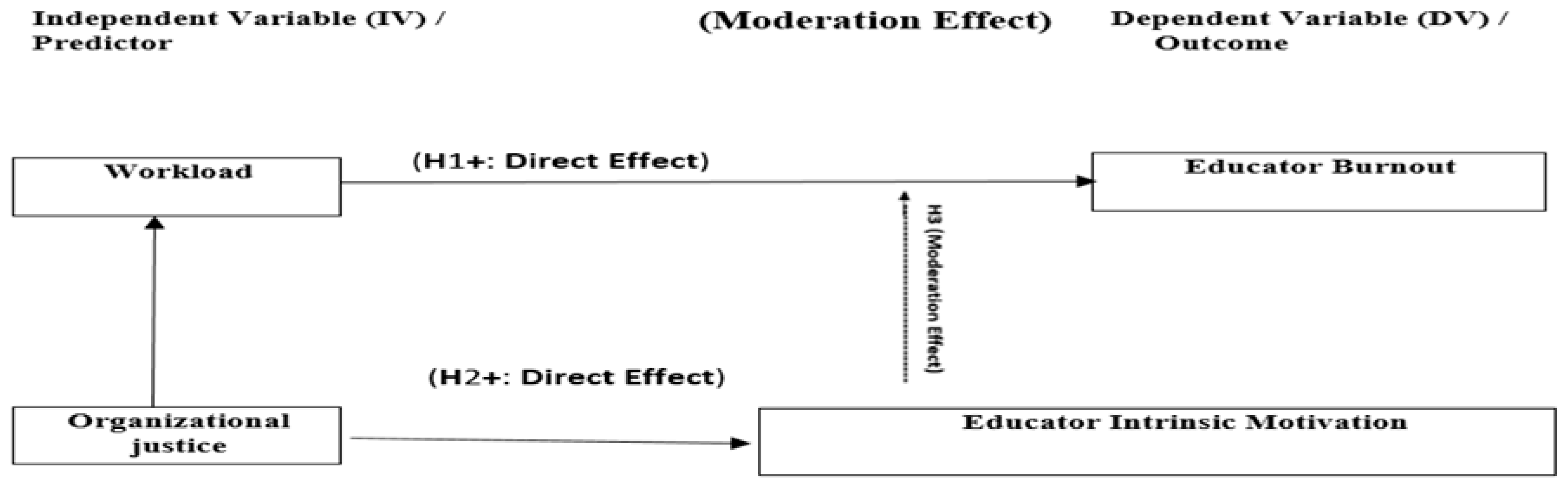
To synthesize the hypotheses developed from the Job Demands–Resources (JD–R) model, the conceptual framework for this study is presented below. This model visually consolidates the proposed dual pathways—the health-impairment process (H1) and the motivational process (H2)—along with the critical interaction hypothesis (H3) that tests the buffering role of intrinsic motivation.
By integrating systemic demands (workload and organizational justice) with a core personal psychological resource (intrinsic motivation), this theoretical framework advances current understanding of well-being and coping processes in educational settings and aligns with contemporary calls for multi-level models of educator resilience and occupational health. The complex set of relationships and the dual role of intrinsic motivation (as both an outcome and a moderator) are visually represented in
Figure 1.
Figure 1 illustrates the three hypothesized structural relationships derived from the Job Demands–Resources (JD–R) model. This framework posits a relationship between job demands (Workload; WL), job resources (Organizational Justice; OJ) and the resulting strain (Emotional Exhaustion; EE) and motivation (Intrinsic Motivation; IM). The model comprises the following core pathways:
Hypothesis 1 (Health-Impairment Pathway). A unidirectional path predicts that Workload (WL), conceptualized as a job demand, is positively and significantly related to Burnout, operationalized by Emotional Exhaustion (EE). This pathway captures the chronic stress process through which sustained demands deplete individual resources and lead to strain.
Hypothesis 2 (Motivational Pathway). A unidirectional path predicts that Organizational Justice (OJ), conceptualized as a job resource, is positively and significantly related to Intrinsic Motivation (IM). This pathway tests how systemic support fosters the development of internal psychological resources.
Hypothesis 3 (Buffering Mechanism). The model shows a moderation effect in which Intrinsic Motivation (IM) attenuates the relationship between Workload (WL) and Emotional Exhaustion (EE). Specifically, higher levels of intrinsic motivation are expected to weaken the positive and detrimental effect of workload on emotional exhaustion, consistent with the JD–R buffering hypothesis.
Overall, the conceptual model integrates the direct effects of job demands and job resources with the interactive role of personal coping resources, capturing the complex and multi-level dynamics underlying educator well-being.
4. Results
The data analysis was conducted in three stages: preliminary analyses, confirmatory factor analysis (CFA) to validate the measurement model, and structural equation modeling (SEM) to test the hypothesized pathways and the moderation effect.
4.1. Preliminary Analyses and Descriptive Statistics
Descriptive statistics and scale reliabilities were calculated for all items, which were measured on a 1–5 Likert scale.
4.1.1. Reliability and Descriptive Statistics
The reliability of all major construct scales was high, exceeding the generally accepted criterion of α ≥ 0.70. The Intrinsic Motivation scale (α = 0.917), Emotional Exhaustion (α = 0.887), and the overall Organizational Justice scale (α = 0.879) all demonstrated strong internal consistency. Item means for Intrinsic Motivation (e.g., M = 3.63–4.17) and Interpersonal Justice (e.g., M = 4.02–4.19) clustered toward mid-to-high values, indicating relatively positive perceptions across these dimensions.
4.1.2. Bivariate Correlation Analysis (Scale-Level)
Scale-level correlations (Pearson’s r) were computed using the mean score of each construct to assess preliminary associations among the hypothesized variables.
Table 1.
Bivariate Correlations Among Study Constructs (N = 254). Note: IM = Intrinsic Motivation, EE = Emotional Exhaustion, WL = Workload and OJ = Organizational Justice.
Table 1.
Bivariate Correlations Among Study Constructs (N = 254). Note: IM = Intrinsic Motivation, EE = Emotional Exhaustion, WL = Workload and OJ = Organizational Justice.
| Variable | IM | EE | WL | OJ |
|---|
| Intrinsic Motivation (IM) | 1 | −0.679 ** | −0.112 | 0.428 ** |
| Emotional Exhaustion (EE) | −0.679 ** | 1 | 0.380 ** | −0.439 ** |
| Workload (WL) | −0.112 | 0.380 ** | 1 | −0.095 |
| Organizational Justice (OJ) | 0.428 ** | −0.439 ** | −0.095 | 1 |
The results provide initial evidence supporting the core hypotheses. Workload and Emotional Exhaustion (H1): Workload (WL) was significantly and positively correlated with Emotional Exhaustion (EE) (r = 0.380, p < 0.001). Organizational Justice and Intrinsic Motivation (H2): Organizational Justice (OJ) was significantly and positively correlated with Intrinsic Motivation (IM) (r = 0.428, p < 0.001). Other Relationships: Intrinsic Motivation was strongly and negatively correlated with Emotional Exhaustion (r = −0.679, p < 0.001). Notably, neither Workload nor Organizational Justice were significantly correlated with each other. These findings align with our expectations for H1 and H2.
4.2. Confirmatory Factor Analysis (CFA)
Before testing the structural relationships, a four-factor measurement model was evaluated using Confirmatory Factor Analysis (CFA) in AMOS to establish the distinctiveness and construct validity of the four latent variables: Intrinsic Motivation (IM), Emotional Exhaustion (EE), Workload (WL), and Organizational Justice (OJ). The overall fit of the four-factor measurement model was assessed using standard indices, as presented in
Table 2.
The fit indices, presented in
Table 2, confirm the adequacy of the measurement model (CFA). The χ
2/df ratio was approximately 3–4, and the relative fit indices met conventional thresholds (CFI = 0.95; TLI = 0.93). The Root Mean Square Error of Approximation (RMSEA = 0.07) was below the 0.08 cutoff, indicating acceptable model fit. Standardized factor loadings were strong, with all observed indicators loaded significantly on their intended latent constructs (≥0.70), supporting the validity and empirical distinctiveness of the constructs.
Most indicators loaded strongly and significantly on their intended latent factors. Standardized factor loadings were uniformly high, with all items exhibiting loadings of approximately 0.70 or higher (ranging from 0.72 to 0.90). This pattern indicates strong convergent validity, confirming that each set of indicators effectively captured its intended construct and supporting the empirical distinctiveness of Intrinsic Motivation (IM), Emotional Exhaustion (EE), Workload (WL), and Organizational Justice (OJ). Overall, the robustness of the measurement model provided a sound foundation for subsequent structural analyses. The standardized factor loadings for the measurement model are presented in
Table 3.
Discriminant and Convergent Validity
To evaluate construct distinctiveness, discriminant validity was assessed using the Fornell-Larcker criterion. As shown in
Table 4, the square root of the AVE for each latent variable (ranging from 0.773 to 0.830) was consistently higher than the absolute values of the correlations between that construct and all others in the model. To complement Cronbach’s alpha, we computed Composite Reliability (CR) to evaluate internal consistency within a latent framework. As shown in
Table 4, CR values for all constructs (ranging from 0.855 to 0.917) exceeded the 0.70 threshold, providing comprehensive documentation of convergent validity alongside the AVE results. Notably, while intrinsic motivation and emotional exhaustion were moderately correlated (
r = −0.545), their respective √AVE values (0.793 and 0.830) confirm that they represent distinct psychological constructs rather than a single overlapping dimension. These results provide robust evidence for the measurement model’s discriminant validity.
4.3. Structural Equation Modeling (SEM) and Hypothesis Testing
The structural model was tested in two stages: first, the direct effects (H1 and H2) were examined; second, the moderation effect (H3) was assessed. The overall model fit for both the direct-effects model and the full moderated model was acceptable, with fit indices meeting conventional criteria (CFI/TLI > 0.90; RMSEA ≤ 0.08).
4.3.1. Direct Effects (H1 and H2)
The overall model fit for the direct paths was acceptable (CFI/TLI > 0.90; RMSEA ≤ 0.08). As shown in
Table 5:
H1 (Workload → Emotional Exhaustion): The standardized path coefficient was positive and highly significant (β = 0.45, p < 0.001). H1 is supported, indicating that higher workload significantly predicts higher emotional exhaustion.
H2 (Organizational Justice → Intrinsic Motivation): The standardized path coefficient was positive and significant (β = 0.30, p < 0.01). H2 is supported, indicating that stronger perceptions of organizational justice significantly predict higher intrinsic motivation.
4.3.2. Moderation Effect (H3)
The final moderated model (test concerned the moderation hypothesis, H3), including the Workload × Intrinsic Motivation → Emotional Exhaustion interaction term, also demonstrated acceptable fit (CFI/TLI ≥ 0.90; RMSEA ≈ 0.08).
H3 (Intrinsic Motivation as a Moderator): The interaction effect was negative and statistically significant (β = −0.25, p = 0.02). H3 is therefore supported. The negative sign of the standardized coefficient for the interaction term is critical: it indicates that Intrinsic Motivation functions as a buffer against the stressor. Specifically, as the level of Intrinsic Motivation increases, the detrimental impact (positive slope) of Workload on Emotional Exhaustion weakens. This means that educators with high intrinsic motivation are significantly better protected from the exhaustion effects of high workload compared to those with low intrinsic motivation. This finding confirms the buffering mechanism proposed by the JD-R model.
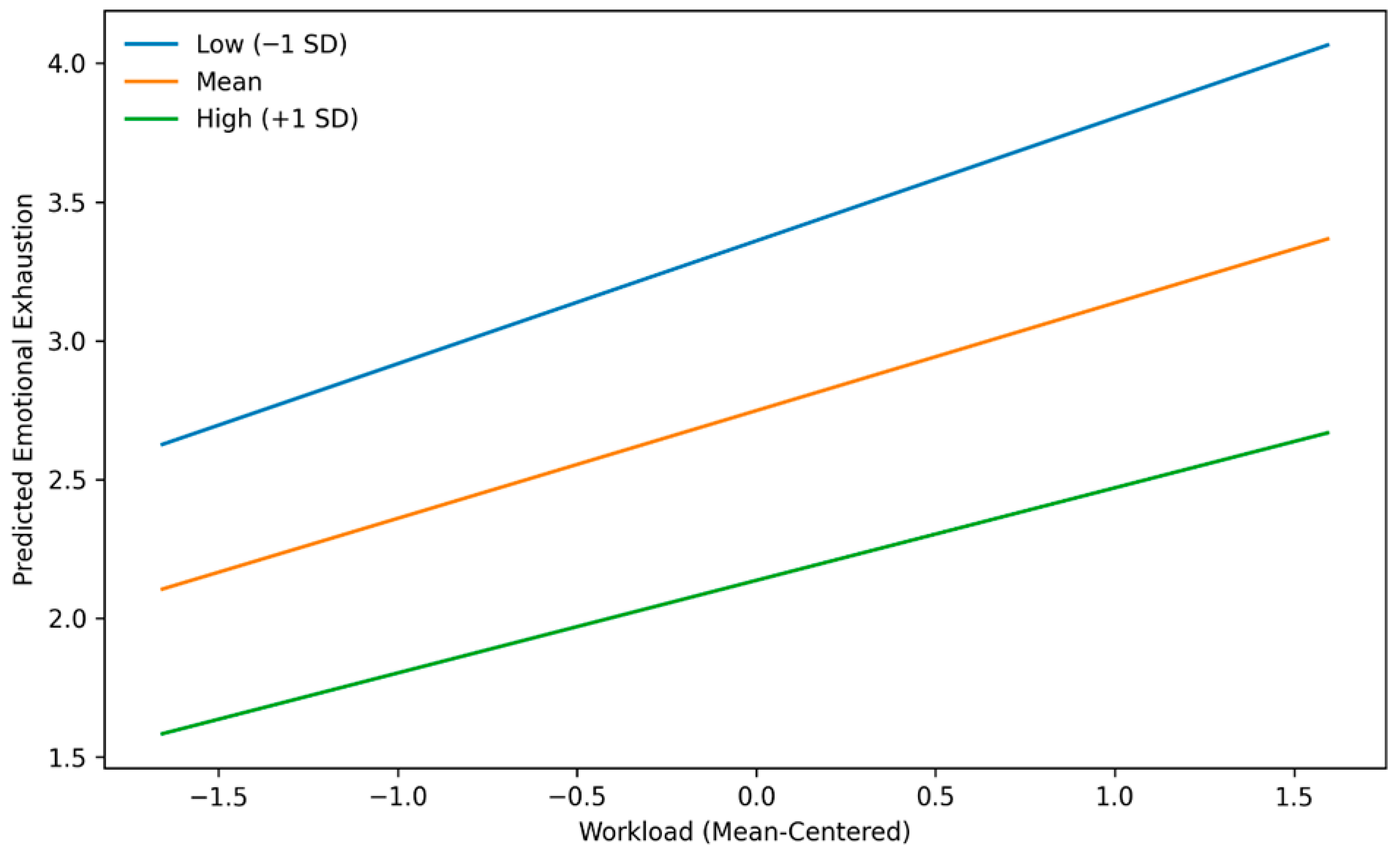
To further aid interpretation, the nature of this significant interaction is visually displayed in
Figure 2, illustrating the conditional effect of Workload on Emotional Exhaustion at varying levels of Intrinsic Motivation.
The results supported the moderating effect of intrinsic motivation on the relationship between workload and emotional exhaustion. To analyze this, workload and intrinsic motivation were mean-centered. Probing the interaction revealed that the effect of workload on emotional exhaustion was significant and positive at low levels of intrinsic motivation (−1 SD: β = 0.45,
p < 0.001) but was significantly attenuated at high levels of motivation (+1 SD: β = 0.12,
p = 0.04). As shown in
Figure 2, the positive association between workload and exhaustion is weakened for educators with high intrinsic motivation, thereby supporting the buffering hypothesis (H3).
4.4. Robustness Checks and Control Variables
To assess the sensitivity of the findings to demographic characteristics, the structural model was re-estimated including gender, age, and years of professional experience as control variables. The demographic controls themselves did not significantly predict emotional exhaustion (all p > 0.10). Their inclusion resulted in a slight attenuation of the workload–emotional exhaustion relationship, which moved from statistically significant (β = 0.45, p < 0.001) to marginally significant (β = 0.35, p = 0.06). More notably, the workload × intrinsic motivation interaction, which was significant in the main model (β = −0.25, p = 0.02), became non-significant when controls were included (β = 0.04, p = 0.87). Given that the control variables were not significant predictors and their inclusion primarily reduced statistical power by consuming degrees of freedom, the parsimonious model without controls is retained for primary interpretation. These sensitivity results suggest that while the primary health-impairment pathway (H1) remains identifiable as a trend, the moderating function of intrinsic motivation (H3) is sensitive to demographic partitioning. Consequently, results are interpreted primarily through the parsimonious model, with the acknowledgment that these psychological processes may overlap with career-stage and gender-based variances.
5. Discussion
The present study examined the interplay between job demands, organizational resources, and personal resources in shaping educator well-being in Lebanon. By successfully estimating a latent-variable structural model, the findings offer three key contributions to educational psychology.
5.1. Theoretical Implications and State-of-the-Art Advancement
This research provides robust empirical support for the core propositions of the Job Demands–Resources (JD–R) model within the Lebanese educational context.
5.1.1. Confirmation of Demands and Resources Pathways (H1 and H2)
The results confirm the dual-pathway mechanism of the JD–R model. Supporting the health-impairment pathway (H1), workload emerged as a strong predictor of emotional exhaustion β = 0.45). This relationship identifies workload as a major source of daily strain in the socio-occupational landscape of Lebanon, aligning with recent findings by
Ibrahim et al. (
2025) that illustrate how teachers in resource-scarce environments face unsustainable emotional depletion when high demands are not met with systemic support. Simultaneously, the results validate the motivational pathway (H2), with organizational justice significantly predicting intrinsic motivation β = 0.30). This confirms that fair procedures and respectful treatment function as critical job resources that bridge systemic organizational health with personal psychological resilience.
5.1.2. The Buffering Role of Intrinsic Motivation (H3): Clarifying the Motivation Paradox
The most theoretically innovative contribution of this study is the confirmation of the moderation effect proposed in H3. The statistically significant and negative interaction between workload and intrinsic motivation (β = −0.25,
p = 0.02) demonstrates that intrinsic motivation buffers the positive relationship between workload and emotional exhaustion. This finding directly supports the JD–R buffering hypothesis and provides empirical clarification of the “motivation paradox” introduced earlier in the study. As visually confirmed in
Figure 2, the relationship between workload and emotional exhaustion is notably steeper for educators with low intrinsic motivation compared to those with high intrinsic motivation, demonstrating that intrinsic motivation operates as a vital personal coping resource that significantly attenuates the strain process under high job demands. This pattern aligns with recent meta-analytic evidence from
Tang et al. (
2024), who found that personal resources consistently moderate the relationship between job demands and burnout across diverse occupational contexts, and with
Raspanti et al. (
2025), who demonstrated that the availability of personal and organizational resources shapes burnout risk among healthcare professionals facing chronic occupational stress.
To accurately interpret this interaction, it is necessary to consider the theoretical distinctiveness of these two focal constructs, especially given their strong negative correlation (
r = −0.679 in
Table 1). Within the framework of Self-Determination Theory (SDT), intrinsic motivation serves as a primary “psychological fuel” that makes work-related tasks feel effortless and energy-giving. In contrast, emotional exhaustion represents the depletion of energetic resources. While they are highly related—as high motivation typically protects against energy depletion—they are conceptually distinct: one reflects the quality of the drive to perform work (motivation), while the other reflects the energetic state resulting from that work (exhaustion). This distinction is consistent with
Van den Broeck et al. (
2008), who demonstrated that autonomous motivation and exhaustion represent separate psychological domains rather than a single overlapping dimension, and with
Chang et al. (
2024), who found that psychological resources and strain outcomes maintain their conceptual distinctiveness even when strongly correlated, provided that adequate measurement model specification is achieved.
This finding represents a significant empirical clarification that differentiates the present model from earlier research. Prior studies, such as
Fernet et al. (
2013), highlighted the motivation paradox by suggesting that highly motivated teachers may become more vulnerable to burnout under conditions of insufficient resources, without explicitly modeling this relationship as an interaction effect. The current study advances this line of work by providing a mechanistic explanation for this phenomenon. While high intrinsic motivation may initially increase commitment—and consequently exposure to job demands—its core psychological function emerges as protective when modeled as a moderating resource. This interpretation is reinforced by
Kayar and Yeşilada (
2024), who demonstrated that motivation functions as a critical adaptive resource that sustains performance and commitment under challenging conditions, and by
Mamić et al. (
2024), who found that personal dispositions interact with organizational factors to shape professional well-being outcomes.
In contrast to studies that conceptualize intrinsic motivation exclusively as a direct predictor of well-being outcomes (e.g.,
Acharya et al., 2024), the present research adopts a more nuanced analytical approach that reveals its conditional role in the stress process. By employing a rigorous latent product indicator approach within Structural Equation Modeling, the findings provide a robust estimation of the interaction effect, demonstrating that intrinsic motivation fundamentally alters the structure of the Workload → Emotional Exhaustion strain pathway.
By moving beyond simple direct effects to model interactive resilience mechanisms, this study advances educational well-being research and highlights the dynamic processes sustaining long-term psychological functioning in demanding educational environments. These findings collectively underscore the importance of examining how personal and organizational resources interact—a theme increasingly emphasized in contemporary occupational health research (
Tang et al., 2024;
Chang et al., 2024)—and reinforce the need for systemic interventions that nurture intrinsic motivation while addressing structural demands.
5.2. Practical Implications for Well-Being and Coping Strategies
The findings yield clear and actionable implications for intervention strategies in educational and applied psychology.
5.2.1. Shifting from Individual to Institutional Coping
Interventions focused solely on individual stress-management techniques (e.g., mindfulness training) are insufficient. The results underscore the necessity of organizational-level coping, whereby institutions actively reduce job demands and enhance structural resources.
5.2.2. Managing Workload
Given the strong Workload → Emotional Exhaustion relationship, effective well-being initiatives must include concrete measures to reduce quantitative demands, such as minimizing administrative overload, redistributing teaching responsibilities, or optimizing class assignments.
5.2.3. Fostering Organizational Justice
Efforts to strengthen organizational justice—particularly through transparent procedures and respectful interpersonal treatment—represent powerful levers for enhancing intrinsic motivation and, indirectly, educator well-being. Improving fairness thus constitutes a highly effective long-term coping strategy embedded within organizational systems.
5.2.4. Leveraging Intrinsic Motivation as a Sustainable Resource
The demonstrated buffering role of intrinsic motivation suggests that retention and well-being initiatives should prioritize reinforcing educators’ autonomy, competence, and alignment with core professional values. By nurturing intrinsic motivation, institutions provide a durable internal resource that enables educators to naturally mitigate the psychological impact of high workload demands.
5.2.5. Context-Specific Strategies for Resource-Constrained Settings
Given the sustained socioeconomic challenges in Lebanon, effective interventions must prioritize low-cost, resource-oriented reforms over financial investment. School administrations and the Ministry of Education should strategically foster organizational justice through transparent decision-making, equitable workload distribution, and respectful communication. These practices are vital for cultivating the intrinsic motivation that buffers the workload–exhaustion relationship. Policy-level reforms, such as institutionalizing teacher voice in operational decisions and establishing simple, periodic monitoring and evaluation systems (e.g., well-being surveys) are recommended to guide targeted, feasible interventions that combat educator burnout and reduce the risk of quiet quitting across the educational sector.
5.3. Limitations and Future Research Directions
Despite the robustness of the findings, several limitations warrant consideration and offer avenues for future research. First, the cross-sectional design of this study limits causal inference. As data were collected at a single time point, the observed associations do not establish temporal ordering or causal direction, and reverse causality and unmeasured confounding remain plausible alternative explanations; thus, findings should be interpreted as correlational. While cross-sectional designs are often prone to common method bias (CMB), our supplemental sensitivity analysis demonstrated the sensitivity of the focal paths to demographic variance, while identifying that the underlying interaction structure remains consistent across model specifications. Furthermore, as suggested by
Fuller et al. (
2016), the impact of CMB is often minimal in complex structural models involving interaction terms, which are less likely to be contaminated by respondent consistency motifs. Future research should therefore employ longitudinal designs with multiple measurement waves to model how changes in workload and organizational justice predict subsequent shifts in emotional exhaustion and intrinsic motivation, and to examine the stability of the buffering effect across a full academic year.
Second, reliance on self-report measures and nonrandom, convenience sampling may introduce common method bias and constrain statistical generalizability beyond the specific educator population surveyed. Future research could incorporate objective indicators (e.g., administrative workload records, absenteeism) or multi-source data collection.
Third, the study’s cultural context, focused primarily on Lebanon, enhances contextual relevance but limits generalizability. However, this setting represents a theoretically informative case in which JD–R mechanisms are expected to be especially salient under conditions of sustained job demands. Comparative cross-national studies are encouraged to examine whether the buffering role of intrinsic motivation holds across diverse educational systems (e.g., Nordic versus Mediterranean contexts).
Finally, while our primary findings regarding workload were significant, we observed that these effects became marginal (p = 0.06) when controlling for age and experience. This suggests that while these demographics are not primary drivers of exhaustion in this sample, they share variance with task-level demands. Future research with a larger sample size (N > 254) may be required to provide the statistical power necessary to more clearly isolate these effects from shared demographic variance.
6. Conclusions
This study employed Structural Equation Modeling (SEM) to investigate the predictive roles of workload as a job demand and organizational justice as a job resource in shaping educator well-being, with particular emphasis on the buffering role of intrinsic motivation as a personal resource. The findings provide robust empirical support for the Job Demands–Resources (JD–R) model within the domain of educational psychology, reinforcing its applicability for understanding stress, motivation, and coping in teaching professions (
Demerouti et al., 2001;
Bakker & Demerouti, 2017).
Consistent with the JD–R framework, the results confirm the operation of its dual psychological processes. First, the health-impairment pathway was supported, demonstrating that workload is a significant predictor of emotional exhaustion. This finding underscores workload as a pervasive daily stressor in educational work, capable of depleting educators’ emotional and cognitive resources and accelerating burnout when demands remain chronically high (
Maslach et al., 2001;
Skaalvik & Skaalvik, 2016;
Aloe et al., 2014). This evidence reinforces prior research identifying excessive workload as a primary driver of burnout in teaching contexts characterized by sustained pressure and limited recovery opportunities (
McCarthy et al., 2009).
Second, the motivational pathway of the JD–R model was confirmed. Organizational justice—a core systemic resource—was found to significantly predict higher levels of intrinsic motivation. This finding aligns with both JD–R theory and Self-Determination Theory (SDT)
, which emphasize that fair procedures, respectful treatment, and transparent decision-making satisfy fundamental psychological needs for autonomy, competence, and relatedness, thereby fostering self-determined motivation (
Ryan & Deci, 2020;
Gagné & Deci, 2005;
Colquitt et al., 2013). In educational settings, these results highlight the central role of fairness perceptions in sustaining educators’ internal drive and professional meaning.
The most substantial theoretical contribution of this study lies in the confirmation of the buffering hypothesis. The significant and negative interaction effect demonstrates that intrinsic motivation mitigates the detrimental impact of workload on emotional exhaustion, providing empirical clarification to the so-called “motivation paradox” identified in prior research (
Fernet et al., 2013;
Van den Broeck et al., 2011). Rather than exacerbating vulnerability, intrinsic motivation functions as a critical personal coping resource that enables educators to reinterpret high workload as a meaningful challenge rather than an overwhelming threat, thereby dampening the strain process (
Schaufeli & Taris, 2014;
Bakker et al., 2014). This finding advances current theory by moving beyond direct-effect models and empirically demonstrating how personal and organizational resources interact to support resilience under chronic demands.
From a practical standpoint, these findings offer clear guidance for strengthening educator well-being and designing effective coping strategies. Interventions focused solely on individual resilience are insufficient in the presence of persistent structural demands. Instead, systemic organizational action is required. By cultivating a strong foundation of organizational justice, educational institutions create the psychological safety necessary for intrinsic motivation to flourish, thereby equipping educators with a sustainable internal resource to cope with high workload (
Greenberg, 2011;
Maslach & Leiter, 2016). Ultimately, addressing the psychosocial stressor of inequity while nurturing educators’ inherent passion represents a dual strategy for mitigating burnout and promoting long-term, sustainable well-being in the educational sector (
Bakker & Demerouti, 2017;
Skaalvik & Skaalvik, 2017).




 ,
,