1. Introduction
The accelerated development of the Internet since its inception, coupled with the expansion of connection coverage areas and a decrease in the cost of Internet-connected technology, has facilitated the rapid adoption of its use (
Marengo et al., 2022;
Hugo et al., 2020). In relation to this phenomenon,
Yang et al. (
2022) argue that the widespread use of virtual communication resources among Internet users facilitates the emergence of new forms of social interaction between individuals.
Consequently, social networks have become an essential part of people’s lives worldwide, with an estimated 4.5 billion users utilizing the services of Facebook, WhatsApp, YouTube, Telegram, TikTok, Instagram, LinkedIn, Pinterest, Twitter, and Snapchat, among others (
Miñan Olivos et al., 2023). A meta-regression conducted by
Cheng et al. (
2021) revealed that addiction to this type of resource had a statistically significant moderating effect on cultural individualism, indicating a higher prevalence of this problem in countries with collectivist social policies.
In 2021,
Valencia Ortiz et al. (
2021) proposed that people found a way to escape the real (offline) world through social media in virtual space. In this context, they can avoid physical contact during socialization, facilitating the initiation and maintenance of relationships when it is difficult to do so directly. This resource is easily accessible, enables simultaneous communication regardless of the number of contacts and physical distance, allows Internet users to maintain their anonymity, and allows the course of communication to be controlled; this constitutes a risk for adequate psychosocial development in individuals (
Acosta Tobón et al., 2022;
Aliverdi et al., 2022;
Marengo et al., 2022).
In this regard,
Cheng et al. (
2021) agree that social media addiction represents a health problem that manifests itself through the appearance of discomfort, anxiety, compulsive behavior, sleep disorders, obesity, lower back problems, fatigue, and procrastination, directly affecting people’s professional, academic, economic, and social performance. The presence of social media addiction is more notable among the young and adolescent population (
Amador Ortíz, 2021;
Ghozali et al., 2024;
Marino et al., 2020;
Sümen & Evgin, 2021;
Li et al., 2018;
Uma et al., 2020;
Zhao et al., 2022).
Compulsive behavior of uncontrollable consumption.
Decreased capacity for self-control.
Urgent need to mitigate a negative or dysphoric emotional state: depression, irritability, or anxiety, among others.
A perception that some symptoms, such as mood swings, salience, tolerance problems, relapses, and withdrawal symptoms, can only be alleviated by using this internet resource.
The multidimensional nature of social media addiction was highlighted by
Shong and Jia (
2024). These authors emphasized the need to implement action plans based on a thorough diagnosis of the situation in each context. In this regard, Basauri
Delgado (
2023) systematized a set of risk factors through a review of published research results:
Presence of other addictions, including online gaming, shopping, sex, drugs, and alcohol, among others.
Dependence on cell phone use at all times, without it being necessary.
Perception of feeling positive or desirable emotions when connected.
Manifestation of psychological symptoms, including negative affect, anxiety, suicidal ideation, attachment problems, sleep latency, frustration, depression, stress, sleep disorders, and need for appreciation from others.
Indicators of dependence on social media use based on time spent, frequency of connection, types of emotional reactions, misperceptions of the benefits they offer, and purposes for which they are used (socializing, entertainment, marketing, fun, etc.), among others.
Ways in which some cognitive elements are presented, including control, absorption, dissociation, metacognition, distraction, automatic thoughts, cognitive–emotional regulation, and perception of the usefulness of technology.
The manifestation of certain psychosocial elements includes attachment to parents, social isolation, a need for emotional support, a sense of not receiving social support, a feeling of hopelessness regarding the effectiveness of socialization, reactive restriction, loneliness, and excessive reliance on group networks for family interaction.
Various researchers have linked addictive behavior related to the use of social media with the postponement of academic activities by students. This affects their academic performance and generates a predisposition to cyberbullying, which manifests as aggression and interpersonal conflicts, in addition to the inappropriate use of information and communications technologies (ICT) in daily life (
Salari et al., 2025;
Colonio Caro, 2023).
In this regard, the term “academic engagement” is defined as the magnitude of effort that students exert during the training process, consciously seeking to achieve optimal learning outcomes. This is reflected in the way they overcome the difficulties inherent in curricular and extracurricular activities and tasks (
Torres-Escobar & Botero, 2021).
According to
Fuster Guillen and Baños Chaparro (
2021), adequate commitment among university students fosters their development of autonomy, passion for their studies, critical thinking, and physical and psychological well-being, among other positive effects. This, in turn, reduces university dropout rates and strengthens interpersonal relationships with their peers and teachers.
The state of academic commitment in university students can be influenced by various dimensions, including the effectiveness of self-learning strategies, the level of family support in providing professional training, the quality of teaching staff performance, and the relevance of institutional educational policy guidelines (
Perkmann et al., 2021).
The motivation that university students have for their professional training is a factor that influences their levels of academic engagement (
Remo Cossu & Awidi, 2022;
Haseli Songhori & Salamti, 2024). Therefore, teachers must employ teaching strategies aimed at stimulating intrinsic learning in their students (
Ramesh et al., 2023). Likewise, institutional authorities could generate incentives in this regard, such as extracurricular training activities; scholarships; awards for scientific, academic, sports, and cultural merits; and implementation of spaces that develop proactivity and leadership (teaching assistantships, research incubators), among other possible actions (
Froment et al., 2023;
Shomotova & Ibrahim, 2025).
The level of academic engagement in higher education students can be expressed through various emotional, behavioral, and cognitive dimensions; among which are institutional attachment, participation and attention in class, dedication to learning, interest in ensuring quality in completing academic tasks, and success in their social integration into the university context during curricular and extracurricular activities (
Lizarte Simón et al., 2024).
As early as 1978,
Rosenshine and Berliner (
1978) proposed the importance of exploring all elements that could potentially impact academic engagement, considering this variable to be the primary regulator of school dropout. This position was supported by
Tortosa Martínez et al. (
2022). In this regard, a model implemented by
López Angulo et al. (
2021) revealed a direct and negative effect of academic engagement on the intention to drop out of school (β = −0.489;
p < 0.001), accounting for 24% of the variability.
The negative effects of addiction on individuals’ commitment to their duties are well-documented; however, few publications report on the effects of excessive social media use on university students’ academic engagement.
The research process presented here started with the following question:
What predictive power does social media addiction have on academic engagement among students enrolled in the Faculty of Health Sciences at the National University of Chimborazo during the first academic term of 2023?
The objective was to analyze the predictive capacity of social media addiction on academic engagement among students enrolled in the Faculty of Health Sciences at the National University of Chimborazo during the first academic term of 2023.
Taking into consideration the proposed objective, the following research hypothesis was established:
The high level of addiction to social media may significantly explain the insufficient academic engagement of university students in health sciences careers.
2. Materials and Methods
The researchers proposed a quantitative study with a non-experimental design, analytical scope, and cross-sectional approach in a health professional training setting at an Ecuadorian university. It was approved by the UNACH Research Committee through Resolution No. 40-CIV-16-02-2022.
2.1. Participants
The entire population was included in this study, which consisted of 1200 students between the ages of 18 and 27, among whom the average age was 21.4 years, and 65.3% were female, enrolled in the first through sixth semesters in the Faculty of Health Sciences at the National University of Chimborazo, Ecuador, during the first academic term of 2023.
The population distribution according to enrollment characteristics was as follows:
According to career (Clinical Psychology 181, Medicine 243, Nursing 247, Clinical Laboratory 200, Physical Therapy 165, and Dentistry 164).
According to semester (First 248, Second 255, Third 180, Fourth 117, Fifth 165, and Sixth 235).
2.2. Data Collection
During the research process, two instruments were applied: the Social Media Addiction Questionnaire (ARS) and the Utrecht Work Engagement Scale (UWES-S-17), which are described below.
The ARS consists of 24 items that measure three dimensions using a scale of five possible values: (0) never, (1) rarely, (2) sometimes, (3) almost always, and (4) always (
Escurra Mayaute & Salas Blas, 2014). The dimensions are as follows:
Obsession with the use of social networks, which is associated with an individual’s uncontrollable impulse to connect to the Internet, which can generate anxiety (items 2, 3, 5, 6, 7, 13, 15, 19, 22, and 23).
Lack of personal control, based on insufficient capacity for behavioral self-regulation of the compulsion to use social networks (items 4, 11, 12, 14, 20, and 24).
Excessive use of social networks, which establishes the extent of a person’s use that exceeds their needs (items 1, 8, 9, 10, 16, 17, 18, and 21).
This instrument was validated by
Roque Herrera et al. (
2024), who found a high overall internal consistency (α = 0.954), with values across its dimensions ranging from 0.823 to 0.901. They also determined a
p-value of 0.000 in Bartlett’s sphericity test, in addition to an overall KMO of 0.966 and figures between 0.853 and 0.930 in its dimensions. In this regard, the results of a systematic bibliographic review conducted by
Guzmán Brand and Gélvez García (
2023) showed that the ARS was the most widely used instrument in the compiled studies.
The UWES-S-17 includes 17 items that are measured using a seven-value scale: (0) not at all, (1) almost not at all, (2) rarely, (3) sometimes, (4) quite a bit, (5) frequently, and (6) always. These ratings allow for determining the overall scale and that of the three dimensions it measures (
Cruzat Aliaga, 2020), as follows:
Vigor represents energy, will, persistence, and mental resilience in carrying out academic efforts, including when coping with difficulties (items 1, 4, 8, 12, 15, and 17).
Dedication represents the intensity with which a student engages in academic self-preparation with a sense of meaning, inspiration, enthusiasm, pride, and ability to overcome challenges (items 2, 5, 7, 10, and 13).
Absorption represents the intensity of concentration in academic self-training, measuring the level of focus on completing the task (items 3, 6, 9, 11, 14, and 16).
The validity of the UWES-S-17 was established by
Tristán Monrroy et al. (
2021) through a study involving 223 students from the Autonomous University of San Luis Potosí, which found 66.82% of explained variance and a satisfactory model fit (RMSEA = 0.048 and CFI = 0.990).
2.3. Procedure
Throughout this study, the researchers adhered to the corresponding ethical principles. Participants provided their informed consent, ensuring respect for their autonomy; the study also obtained the appropriate institutional authorization for the application of the instrument. The data were organized using SPSS 23.0 software, and the results were used solely for scientific and academic purposes, with no malicious intent.
2.4. Statistical Analysis Procedure
The data were initially processed using descriptive statistical methods, which involved relative frequencies that allowed the study variables to be characterized within the study’s context.
The analysis of the predictive capacity of social media addiction on academic engagement was carried out using a simple linear regression model (which analyzed only the two main variables), following the methodology implemented by
Bermejo Salmon (
2020). Additionally, a multiple linear regression model was applied using a linear function with the independent variables, which included the global level of addiction to the use of social media and its respective dimensions (obsession, lack of control in its use, and excessive use). This model made it possible to categorize the participants into a level or group based on the values of the dependent variable.
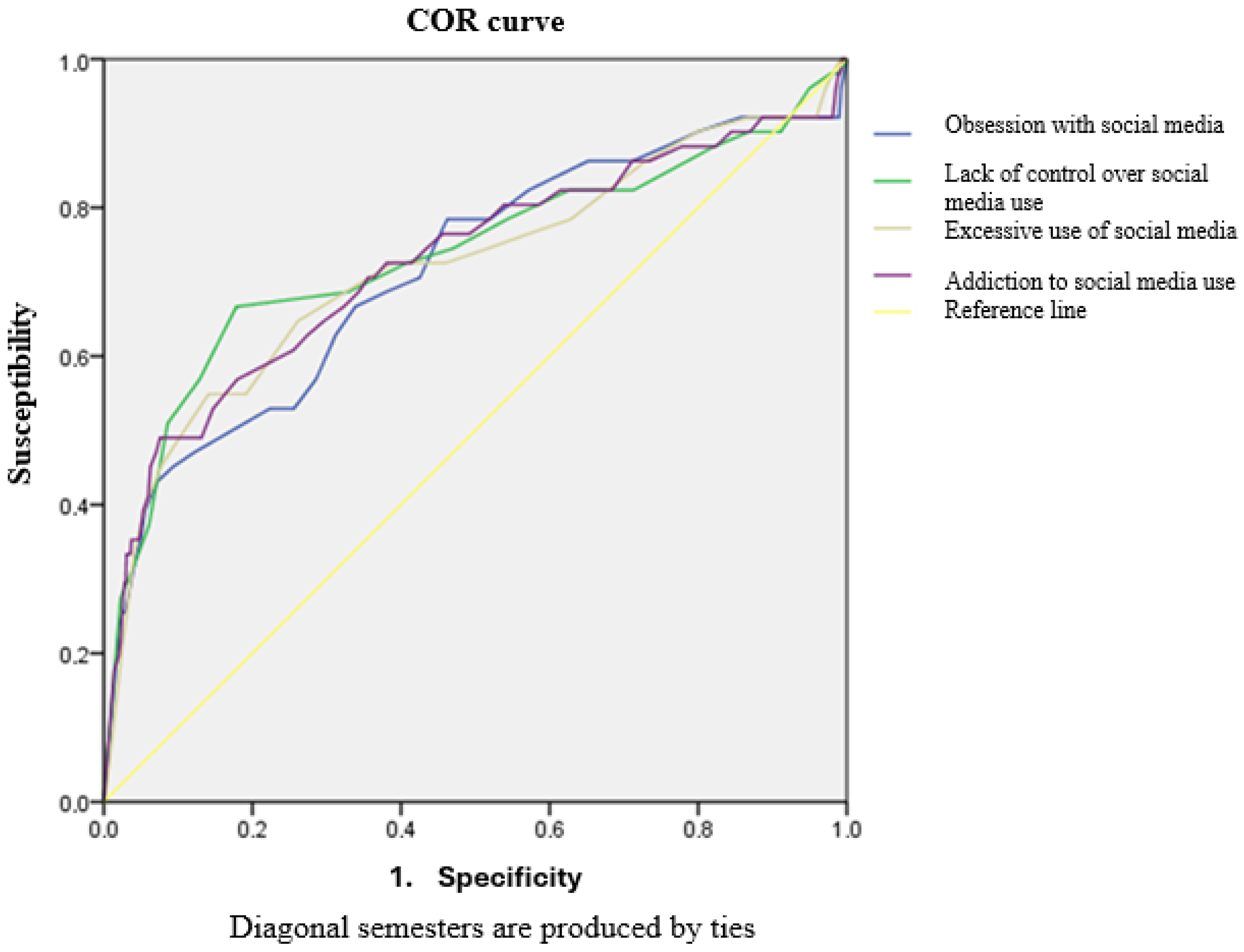
This analysis assessed the degree of impact, and the factors that affect the level of addiction to social networks, using the following tests and inferential analyses: R2 of Cox and Snell and R2 of Nagelkerke (as indicators of goodness of fit), ANOVA (to establish the predictive statistical significance of the independent variables), collinearity analysis (which specifies the presence of biases and the tolerance of the model), and COR curve analysis (
Fuster Rico et al., 2024) (to determine the discrimination capacity for students with insufficient academic commitment).
4. Discussion
Consistent with the theoretical positioning of the authors of this study,
Hrivnák and Jarábková (
2022) acknowledged that the appropriate use of social media for academic purposes has a high beneficial potential for students. These authors researched 776 postgraduate students from different universities in Slovakia, observing a positive impact on the development of cooperation between researchers and academic engagement. In this regard,
Estevez et al. (
2023) reported that peer support on social media can influence stress through emotional engagement, thereby serving as a pathway to academic engagement. Therefore, it is important to point out that teachers should take advantage of the potential of this Internet resource during the teaching–learning process, instilling its responsible use. This deduction can also be supported from the results of a study on 308 students from Shiraz University, Iran, which showed an indirect and positive effect of digital informal learning on the relationship between students’ digital competence and their academic engagement, which was also supported by the results (β = 0.22;
p = 0.0001) (
Heidari et al., 2021).
Likewise, when investigating academic engagement among Argentine university students during the COVID-19 pandemic,
Rigo (
2021) observed, through the statements obtained in the qualitative phase, that participants positively valued social media as a means of collaborative work, allowing them to share information and interact while completing teaching tasks and activities. This benefitted their involvement, dedication, and satisfaction with learning, in addition to increasing their interest in the professional career they were pursuing; therefore, the appropriate use of social media can benefit students’ academic engagement.
Through modeling,
Acosta Gonzaga (
2023) established the effects of academic engagement on behavioral, emotional, metacognitive, cognitive, and learning involvement, as well as a statistically significant (
p < 0.01) and positive correlation between metacognitive engagement and academic performance. These findings corroborate the importance of academic engagement in students’ academic success.
However,
Amador Ortíz (
2021) found a statistically significant association between academic failure and obsession, as well as excessive use of social media (
p < 0.05). Fifty-eight percent of participants with a high level of social media addiction experienced academic failure, which is a finding that is indirectly consistent with those of the present study. This does not coincide with the findings of the present study, since more than 90% of the population had an average level of social media addiction, suggesting that efforts should focus on the dimension related to excessive use.
On the other hand,
Bautista Quispe et al. (
2023) found a moderate, negative, and statistically significant correlation between social media addiction and its dimensions with academic self-regulation (r = −0.410;
p < 0.05), a factor that influences educational engagement. Likewise,
Tanhan et al. (
2024) developed a model that yielded a predictive capacity of social media addiction on cognitive flexibility, with a negative and significant effect (F = 64.26; R
2 = 0.14;
p < 0.01), explaining 14% of the variance. These results are indirectly consistent with those obtained in the present research, which showed a negative and significant relationship with respect to academic engagement (
p < 0.01), showing that decreasing levels of addiction to social networks can improve the way in which students approach their learning.
Coinciding with the results obtained about the significant (
p < 0.01) predictive capacity of the dimensions of social media addiction,
Yana Salluca et al. (
2022) also found that social media addiction was strongly and positively correlated with academic procrastination, an indicator of low academic engagement (r = 0.710;
p = 0.01). Similarly,
Caratıquıt and Caratıquıt (
2023) reported a positive, moderate, and significant relationship between social media addiction and academic procrastination (β = 0.442,
p < 0.001), as well as a negative and low-intensity relationship with academic performance (β = −0.113,
p = 0.008). Thus, educational actions aimed at eliminating addiction to social networks will also decrease academic procrastination in university students. In accordance with this,
Junco (
2012) established that frequent Facebook checking (β = −0.068,
p < 0.01) and video game abuse (β = −0.118,
p < 0.001) were negative predictors of academic engagement. Likewise, constant chatting on Facebook was a negative predictor of the time students spent preparing for class.
In Nantong University in Jiangsu, China,
Mou et al. (
2024) developed a sequential model that found a statistically significant pathway: social anxiety → social media addiction → academic engagement → academic performance. This pathway was also significant (R 2 = −0.013; 95% CI: between −0.018 and −0.008), accounting for 6.8% of the total effect. Therefore, they deduced that social media addiction played a partial mediating role in the relationship between social anxiety and academic performance. These findings are very similar to those obtained in the present study in the multiple linear regression model (6.9% explanation,
p = 0.000); in addition to reinforcing the support regarding the negative impact of social media addiction and low academic commitment on student performance.
Problematic internet use includes the misuse of social media as an important dimension. This variable showed significant predictive power for academic engagement in the present study (
p < 0.001). Accordingly, in another study involving 4852 adolescents from various regions of mainland China,
Liu et al. (
2022) found a significant negative correlation between problematic internet use and academic engagement (
p < 0.05). Their mediating model explained 35.9% of the variance in academic engagement, revealing a direct effect and an indirect effect on the following trajectories: problematic internet use → depression → insomnia → academic engagement; problematic internet use → depression → academic engagement; and problematic internet use → anxiety → academic engagement.
In accordance with the results obtained, two indirect indicators considered as potential unwanted consequences of social media addiction were analyzed in two investigations.
Polanco et al. (
2023) determined that victimization during peer relationships negatively predicted academic engagement (β = −0.17;
p < 0.05) in 204 students from two public schools.
Peker (
2024) found that time management had a significant predictive capacity for academic engagement (β = 0.52; SE = 0.06;
p < 0.001) among 242 university students majoring in Psychology and Sociology. These data suggest that programs are needed to promote the appropriate and ethical use of social networks as a means of interaction between peers in order to avoid aggressive communication behaviors that can lead to online harassment, which reduces the effectiveness of collaborative academic activities through this medium.
Trejos Gil et al. (
2023) investigated a population of 381 university students from Medellín, Colombia, using a model, and found that the variant including the factors of anxiety, connection, and social networks explained 11.17% of the variance in engagement. This agrees with the results obtained in this study (11.2%;
p = 0.000), which indicate that measures to promote the appropriate use of social networks among students can be implemented as part of pedagogical strategies aimed at increasing their academic engagement.
Limitations and Future Perspectives
The main limitation of this study was the model’s adjustment to the dimensions of a single instrument from which the data were obtained, and thus, from which both main variables were measured. It is recommended that future studies employ other valid instruments that include additional factors, thereby increasing the number of possible variants.
By assessing future prospects, the results obtained can serve as a basis for subsequent studies and as a diagnostic basis for establishing policies and strategies by the authorities of the institution where the research was conducted, with the aim of reducing social media addiction and increasing academic engagement, which will positively impact school dropout rates.
5. Conclusions
The results show a predominance of average levels of academic engagement and social media addiction. The researchers established a statistically significant correlation between these two variables and their respective dimensions, which was negative and of mild to moderate intensity in all cases.
The simple linear regression model was statistically significant and showed a moderate capacity to explain and predict the state of academic engagement based on social media addiction, with no collinearity observed.
The multiple linear regression model was also statistically significant, reflecting a low explanatory and predictive capacity for academic engagement, considering social media obsession, lack of social media use control, and excessive social media use as independent variables, and indicating that there was no collinearity.
The ROC curve parameters demonstrated statistical significance, and a moderate ability to discriminate against insufficient academic engagement was established.
This model made adjustments to the dimensions of a single instrument, from which the data were obtained. In future studies valid instruments must be employed that include additional factors, increasing the number of possible variants.
The results serve as a basis for future studies and as a diagnostic basis for establishing policies and strategies in the institution where the research was conducted to increase academic engagement and reduce social media addiction.
The main theoretical contribution of the research consists of identifying social media addiction as a variable capable of affecting academic engagement in university students.
Thus, the results indicate that higher education institutions should implement measures to promote the appropriate use of social networks among students as part of pedagogical strategies aimed at increasing their academic engagement.




 ,
,