University Dropout in Granada: A Biographical Narrative Study Addressing Student Diversity Based on External Factors

 , , and
Abstract
1. Introduction
1.1. University Study Dropout and Inclusive Education
Pedagogical and Inclusive Skills in University Teachers
- Instructional design: The ability to develop clear, structured study plans aligned with measurable learning objectives, integrating activities that promote the active participation of students.
- Student-centered teaching: The application of methodologies such as project-based learning, collaborative learning, and the use of practical cases, which encourage student commitment and autonomy.
- Formative assessment: The use of assessment tools not only to measure academic performance, but also to provide constructive feedback that drives personal and academic growth.
2. Materials and Methods
2.1. Instrument
2.2. Population and Sample
3. Data Analysis
3.1. Biographical Narrative Coding
3.2. Construction of Boolean Conditions and Truth Table
3.3. Logical Minimization with AQUAD 8
3.4. Integration of Narrative and Boolean Analyses
4. Results
4.1. Analysis of the Result of Implicants with AQUAD
4.2. Quantitative Analysis of the Table of Truth
5. Discussion
6. Conclusions
Implications of This Study and Future Recommendations for Strengthening Inclusive Education
Author Contributions
Funding
Institutional Review Board Statement
Informed Consent Statement
Data Availability Statement
Conflicts of Interest
Appendix A
- (1)
- bCDEfgIj covers cases 10 and 17.
- (2)
- bCDEfhIj covers cases 11 and 17.
- (1)
- acDEFgHIj covers case 15.
- (2)
- aCdEFGHIJ covers case 19.
- (1)
- acDEFgHIj covers case 15.
- (2)
- aCdEFGHIJ covers case 19.
- (1)
- AbDEfgIj covers cases 10 and 17.
- (2)
- AbDEfhIj covers cases 11 and 17.
- (1)
- abcDFHIJ covers cases 5 and 8.
- (2)
- AbcDEgHIj covers case 21.
- (3)
- aBCdFHIJ and aBCdEGHIJ cover case 19.
- (4)
- abcDfHIj and AbCDfhIj cover no cases.
- (a)
- abcDeFhiJ covers case 4.
- (b)
- abcDEfHIj covers case 7.
- (c)
- AbCDEfhIj covers case 11.
- (d)
- abcDEFHIJ covers cases 5 and 8.
- (e)
- aBCdEFHIJ covers case 19.
References
- Acevedo Calamet, F. (2020). Factores explicativos del abandono de los estudios en la educación superior en contextos socio-académicos desfavorables. Revista Española de Pedagogía, 78(276), 253–270. [Google Scholar] [CrossRef]
- Aldowah, H., Al-Samarraie, H., Alzahrani, A. I., & Alalwan, N. (2020). Factors affecting student dropout in MOOCs: A cause-and-effect decision-making model. Journal of Computing in Higher Education, 32, 429–454. [Google Scholar] [CrossRef]
- Androulakis, G. S., Georgiou, D. A., Kiprianos, P., & Stamelos, G. (2021). The role of the academic factor in student’s tendency to university drop out. Journal of Education and Human Development, 10(1), 1–18. [Google Scholar] [CrossRef]
- Arce, M., Crespo, B., & Míguez-Álvarez, C. (2015). Higher education drop-out in Spain-particular case of universities in Galicia. International Education Studies, 8(5), 247264. [Google Scholar] [CrossRef]
- Belloc, F., Maruotti, A., & Petrella, L. (2010). University drop-out: An Italian experience. Higher Education, 60, 127–138. [Google Scholar] [CrossRef]
- Bennasar-García, M. I., Guerrero, J. A., & Zambrano-Leal, N. Y. (2021). Pedagogy and university teacher training today in Latin America, an epistemological vision. Praxis & Saber, 12(29), 184–200. [Google Scholar] [CrossRef]
- Bolívar, A., Domingo, J., & Fernández, M. (2001). Biographical-narrative research in education. La Muralla. [Google Scholar]
- Connelly, M., & Clandinin, J. (1995). Stories of experience and educational research. In J. Larrosa, R. Arnaus I Morral, V. Rosa Ferrer Cerveró, N. Pérez de Lara Ferré, F. M. Conelly, J. Clandinin, & M. Greene (Eds.), Let me tell you. Essays on narrative and education (pp. 11–59). Laertes/Psicopedagogía. [Google Scholar]
- Constante-Amores, A., Florenciano Martinez, E., Navarro Asencio, E., & Fernandez-Mellizo, M. (2021). Factors associated with university dropout. Education XX1, 24(1), 17–44. [Google Scholar] [CrossRef]
- Esteban, M., Bernardo, A. B., Tuero, E., Cerezo, R., & Núñez, J. C. (2016). Context does matter: Identifying relationships between degree dropout and contextual variables. European Journal of Education and Psychology, 9(2), 79–88. [Google Scholar] [CrossRef]
- Fernández Cruz, M., Álvarez Ferrándiz, D., Fernández García-Valdecasas, F. B., & González Castellón, E. (2024). Dropout in Andalusian universities: Prediction and prevention. Frontiers in Education, 8, 1304016. [Google Scholar] [CrossRef]
- Ferreyra, M. M., Diaz, L. D., Urzúa, S., & Bassi, M. (2021). The fast track to new skills: Short higher education programmes in Latin America and the Caribbean. World Bank Publications. [Google Scholar]
- Freixa Niella, M., Llanes Ordóñez, J., & Venceslao Pueyo, M. (2017). El abandono en el recorrido formativo del estudiante de ADE de la Universidad de Barcelona. Revista De Investigación Educativa, 36(1), 185–202. [Google Scholar] [CrossRef]
- Galve-González, C., Blanco, E., Vázquez-Merino, D., Herrero, F. J., & Bernardo, A. B. (2022). Influence of satisfaction, expectations and perception of performance on university dropout during the pandemic. Journal of Studies and Research in Psychology and Education, 9(2), 226–244. [Google Scholar] [CrossRef]
- García, F., & Morales, T. (2017). Pedagogical competencies that characterize a university teacher: Case study in higher education institutions. University Training, 10(4), 37–48. [Google Scholar] [CrossRef]
- González-Ramírez, T., & Pedraza-Navarro, I. (2017). Socio-family variables associated with dropping out of university studies. Educatio Sigle XXI, 35(2), 365–388. [Google Scholar] [CrossRef] [PubMed][Green Version]
- Herbaut, E. (2020). Overcoming failure in higher education: Social inequalities and compensatory advantage in dropout patterns. Acta Sociológica, 64, 383–402. [Google Scholar] [CrossRef]
- Instituto Nacional de Estadística (INE). (2022). Early school leaving among people aged 18 to 24. Spain and EU-28. Available online: https://www.ine.es/jaxiT3/Datos.htm?t=12543 (accessed on 24 November 2023).
- Johnstone, L. (2004). Mixed methods, mixed methodology health services research in practice. Qualitative Health Research, 14(2), 259–271. [Google Scholar] [CrossRef]
- Kocsis, Á., & Molnár, G. (2024). Factors influencing academic performance and dropout rates in higher education. Oxford Review of Education, 3, 1–19. [Google Scholar] [CrossRef]
- Lizarte Simón, E. J. (2017). Analysis of student dropout at the University of Granada. The case of the faculty of education sciences. University of Granada. [Google Scholar]
- López-Aguilar, D., Álvarez-Pérez, P. R., & Garcés-Delgado, Y. (2021). El engagement académico y su incidencia en el rendimiento del alumnado de grado de la Universidad de La Laguna. RELIEVE. Revista Electrónica de Investigación y Evaluación Educativa, 27(1). [Google Scholar] [CrossRef]
- Marczuk, A., & Strauss, S. (2023). Does context matter? The gendered impact of study conditions on dropout intentions from higher education. Zeitschrift für Erziehungswissenschaft, 26(5), 1349–1371. [Google Scholar] [CrossRef]
- Masutha, M. (2022). Highs, lows and turning points in marginalised transitions and experiences of noncompletion amongst pushed dropouts in South African higher education. Education Sciences, 12(9), 608. [Google Scholar] [CrossRef]
- Medialdea, A. L. (2014). Reasons and explanatory factors for university academic dropout in the field of social sciences [Doctoral thesis, Pablo de Olavide University]. REBIUN Library Network Repository. Available online: https://hdl.handle.net/10433/888 (accessed on 15 April 2023).
- Medialdea, A. L., Villalba Egea, M., & Oria Segura, M. R. (2017). Improving guidance processes to reduce university dropout rates. In Avances en liderazgo y mejora de la educación. Redes de Investigación sobre Liderazgo y Mejora de la Educación (RILME) (pp. 394–398). Available online: https://repositorio.uam.es/handle/10486/679623 (accessed on 12 January 2024).
- Miranda Rodríguez, V. J., & Alarcón Díaz, H. H. (2021). Effects of risk factors on the interruption of studies in young university students during COVID-19. From the South, 13(2), e0002. [Google Scholar] [CrossRef]
- Mortagy, Y., Boghikian-Whitby, S., & Helou, I. (2018). An analytical investigation of the characteristics of the dropout students in higher education. Issues in Informing Science and Information Technology, 15, 249–278. [Google Scholar] [CrossRef]
- Munizaga Mellado, F. R., Cifuentes Orellana, M. B., & Beltrán Gabrie, A. J. (2018). Student retention and dropout in Higher Education in Latin America and the Caribbean: A systematic review. Education Policy Analysis Archives, 26, 61. [Google Scholar] [CrossRef]
- Müller, L., & Klein, D. (2022). Social inequality in dropout from higher education in Germany. Towards combining the student integration model and rational choice Theory. Research in Higher Education, 64, 300–330. [Google Scholar] [CrossRef]
- Nurmalitasari, Awang Long, Z., & Faizuddin Mohd Noor, M. (2023). Factors influencing dropout students in higher education. Education Research International, 2023(1), 7704142. [Google Scholar] [CrossRef]
- Pérez-Rodríguez, N., de-Alba-Fernández, N., & Navarro-Medina, E. (2021). The contents of citizenship education. Itineraries of change in university teacher training. University Training, 14(3), 149–162. [Google Scholar] [CrossRef]
- Rodríguez-Sabiote, C. (2019). Diagnostic evaluation of needs in an environmental education center through data multiple triangulations. Educaçao e Pesquisa, 45(1), 1–18. [Google Scholar] [CrossRef]
- Rodríguez-Sabiote, C., & Gutiérrez-Pérez, J. (2005). A validation model for empirical studies in educational research using triangulation procedures. Application to a case study on dysfunctions and mismatches associated with the reform of a university curriculum. Portuguese Journal of Pedagogy, 39(1), 135–157. [Google Scholar]
- Rodríguez Sabiote, C., Pozo Llorente, T., & Gutiérrez Pérez, J. (2006). Analytical triangulation as a resource for the validation of recurrent survey studies and replication research in higher education. RELIEVE, 12(2), 289–305. Available online: http://www.uv.es/RELIEVE/v12n2/RELIEVEv12n2_6.htm (accessed on 1 May 2024). [CrossRef][Green Version]
- Romito, M., Pilutti, S., & Contini, D. (2020). Why do students leave university? Qualitative research at an Italian higher education institution. European Journal of Education, 55, 456–470. [Google Scholar] [CrossRef]
- Sánchez-Cabero, R., Ariguita-García, A., Gil-Pareja, D., Sánchez-Rico, A., Martínez-López, F., & Sierra-Macarron, L. (2022). Measuring the relation between academic performance and emotional intelligence at university level after the COVID-19 pandemic using TMMS-24. Sustainability, 14, 3142. [Google Scholar] [CrossRef]
- Talsma, K., Robertson, K., Thomas, C., & Norris, K. (2021). COVID-19 beliefs, self-efficacy and academic performance in first-year university students: Cohort comparison and mediation analysis. Frontiers in Psychology, 12, 643408. [Google Scholar] [CrossRef]
- Tayebi, A., Gómez, J., & Delgado, C. (2021). Analysis on the lack of motivation and dropout in engineering students in Spain. IEEE Access, 9, 66253–66265. [Google Scholar] [CrossRef]


| Participants | AANT | BPRI | CSEC | DORI | ELAB | FACA | GCAB | HPER | IFOR | JCON |
|---|---|---|---|---|---|---|---|---|---|---|
| 1 | a | b | c | D | E | f | g | H | I | j |
| 2 | a | b | c | D | e | F | g | H | i | J |
| 3 | a | b | C | D | E | F | g | H | I | j |
| 4 | a | b | c | D | e | F | G | h | i | J |
| 5 | a | b | c | D | E | F | G | H | I | J |
| 6 | a | b | c | d | E | f | g | H | I | j |
| 7 | a | b | C | D | E | f | G | H | I | j |
| 8 | a | b | c | D | E | F | G | H | I | J |
| 9 | a | b | c | D | E | F | g | H | I | j |
| 10 | A | B | C | D | E | f | g | H | I | j |
| 11 | A | b | C | D | E | f | G | h | I | j |
| 12 | a | b | c | D | e | f | g | H | i | j |
| 13 | a | b | c | D | e | F | g | H | I | j |
| 14 | a | b | c | D | E | F | g | H | i | J |
| 15 | a | B | c | D | E | F | g | H | I | j |
| 16 | a | b | c | D | E | F | g | h | I | j |
| 17 | A | b | C | D | E | f | g | h | i | j |
| 18 | a | b | c | D | E | F | g | H | I | j |
| 19 | a | B | C | d | E | F | G | H | I | J |
| 20 | a | b | c | D | E | f | g | h | I | j |
| 21 | A | b | c | D | E | F | g | H | I | j |
| Condition (Outcome) | Essential Implicant(s) | Cases Covered | Profile Interpretation |
|---|---|---|---|
| AANT = TRUE (university background) | bCDEfgIj (cases 10, 17); bCDEfhIj (cases 11, 17) | 10, 11, 17 | Students without primary school success (b) but with good secondary performance (C), adequate guidance (D), and generally positive work experiences (E). They tend to recognize a few causes of dropout (g) and show heterogeneous post-dropout trajectories (I/j). Even with relatively favorable trajectories, contextual and personal factors eventually lead to dropout. |
| BPRI = TRUE (primary school success) | acDEFgHIj (case 15); aCdEFGHIJ (case 19) | 15, 19 | Students who were successful in primary school (B) but often show mixed trajectories later. In both implicants, the absence of a strong university background (a) coexists with positive work experiences (E), satisfactory post-dropout personal and training paths (H, I), and limited recognition of multiple causes of dropout (g). Dropout is linked to tensions between academic history, work, and expectations. |
| CSEC = TRUE (secondary school success) | AbDEfgIj (cases 10, 17); AbDEfhIj (cases 11, 17) | 10, 11, 17 | Students with a university family background (A) and good secondary performance (C), who also report adequate guidance (D) and positive work experiences (E). Despite these favorable conditions, they either have neutral/negative university experiences (f) or recognize few causes of dropout (g). Their narratives reflect the paradox of dropping out after being relatively successful students. |
| DORI = FALSE (insufficient academic/vocational guidance) | aBCEFGHIJ (case 19); abcEfgHIj (case 6) | 6, 19 | Two main configurations characterize students who perceive deficient guidance. In one (aBCEFGHIJ), students show academic success and positive trajectories but still report a lack of genuinely helpful orientation. In the other (abcEfgHIj), students accumulate fragile academic trajectories and limited recognition of the causes of dropout. In both cases, guidance is perceived as misaligned or absent at key decision points. |
| ELAB = FALSE (no positive work experiences) | abcDFgHiJ (case 2); abcDFGhiJ (case 4); abcDFgHIj (case 13); abcDfgHij (case 12) | 2, 4, 12, 13 | Students with weak academic histories (a/b/c for background and success) and no positive work experiences. The different implicants show slight variations in guidance (D) and recognition of causes (G/H/I/J), but all reflect a lack of stabilizing work anchors. Their narratives emphasize uncertainty, economic vulnerability, and the absence of meaningful work projects that could support persistence at university. |
| FACA = TRUE (positive academic experiences during university) | abcDFHIJ (cases 5, 8); AbcDEgHIj (case 21); aBCdFHIJ (case 19); aBCdEGHIJ (case 19) | 5, 8, 19, 21 | These profiles correspond to students who, despite reporting positive academic experiences at university (F), still drop out. Combinations vary in prior academic success (B, C) and work experiences (E), but all share relatively successful performance and satisfactory post-dropout trajectories (H, I). Their stories underline that good grades alone do not guarantee persistence when degrees are misaligned with interests or life circumstances. |
| GCAB = TRUE (recognition of multiple causes of dropout) | abcDeFhiJ (case 4); abcDEfHIj (case 7); AbCDEfhIj (case 11); abcDEFHIJ (cases 5, 8); aBCdEFHIJ (case 19) | 4, 5, 7, 8, 11, 19 | Students who explicitly identify several, interconnected reasons for dropout (GCAB = TRUE). Across these implicants, they combine academic difficulties, guidance issues, work pressures, and personal factors. Their narratives reveal a reflective stance: they articulate dropout as the result of complex constellations rather than a single cause, showing high awareness of structural and biographical constraints. |
| HPER = TRUE (satisfactory personal trajectory after dropout) | abcEfgIj (cases 1, 6); abcDEfIj (cases 1, 7); abcDFgiJ (cases 2, 14); abcDFgIj (cases 9, 13, 18); abDEFgIj (cases 3, 9, 18); acDEFgIj (cases 9, 15, 18); bcDEFgIj (cases 9, 18, 21) | 1, 2, 3, 6, 7, 9, 13, 14, 15, 18, 21 | Multiple essential implicants converge on students who, after dropping out, manage to reorient their lives in a satisfactory way. Despite differences in prior academic success and work experiences, these configurations share relatively positive post-dropout personal (H) and often training (I) trajectories. These profiles show resilience and the capacity to reconstruct biographical projects beyond the abandoned degree. |
| IFOR = FALSE (no successful training trajectory after dropout) | abcDFgHJ (cases 2, 14) | 2, 14 | Students who, after leaving university, do not consolidate a coherent or successful training pathway. In both cases, the absence of a positive educational trajectory (I = FALSE) coexists with limited recognition of multiple causes (g) and non-satisfactory personal outcomes (h/J). Their narratives highlight fragmented, uncertain transitions and difficulties in redefining their educational projects. |
| JCON = TRUE (good quality advice) | aBCdEFGHI (case 19) | 19 | A singular profile in which the student reports good quality advice (J = TRUE) together with generally positive academic and work trajectories (B, C, E, F, H, I), but still drops out. This case illustrates the limits of guidance when broader structural or personal constraints (economic pressures, mismatch with interests, family expectations) continue to weigh heavily on students’ decisions. |
| Nº Participants Who Highlighted the Categories | AANT | BPRI | CSEC | DORI | ELAB | FACA | GCAB | HPER | IFOR | JCON |
|---|---|---|---|---|---|---|---|---|---|---|
| 4 | 1 | 6 | 19 | 17 | 13 | 6 | 15 | 16 | 6 | |
| % of presence of each category over total participants | 19% | 4.7% | 28.5% | 90.47% | 80.95% | 61.90% | 28.5% | 71.42% | 76.19% | 28.5% |
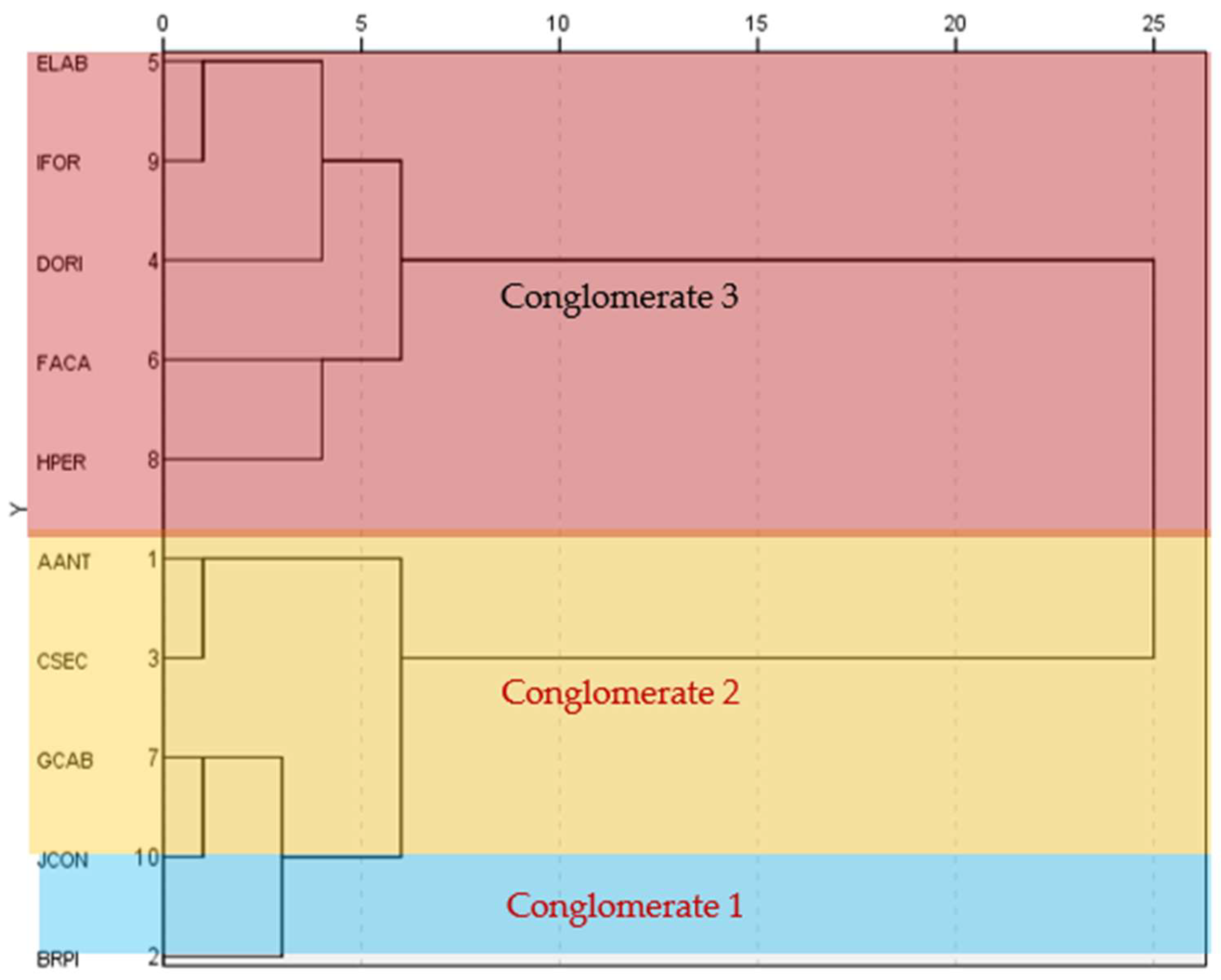
| Category | Conglomerate Belonging |
|---|---|
| AANT | 2 |
| BRPI | 1 |
| CSEC | 2 |
| DORI | 3 |
| ELAB | 3 |
| FACA | 3 |
| GCAB | 2 |
| HPER | 3 |
| IFOR | 3 |
| JCON | 2 |
Disclaimer/Publisher’s Note: The statements, opinions and data contained in all publications are solely those of the individual author(s) and contributor(s) and not of MDPI and/or the editor(s). MDPI and/or the editor(s) disclaim responsibility for any injury to people or property resulting from any ideas, methods, instructions or products referred to in the content. |
© 2026 by the authors. Licensee MDPI, Basel, Switzerland. This article is an open access article distributed under the terms and conditions of the Creative Commons Attribution (CC BY) license.
Share and Cite
Álvarez-Ferrandiz, D.; Armenteros-Mayoral, J.C.; Alvarez-Rodríguez, J.; Rodríguez-Sabiote, C. University Dropout in Granada: A Biographical Narrative Study Addressing Student Diversity Based on External Factors. Educ. Sci. 2026, 16, 125. https://doi.org/10.3390/educsci16010125
Álvarez-Ferrandiz D, Armenteros-Mayoral JC, Alvarez-Rodríguez J, Rodríguez-Sabiote C. University Dropout in Granada: A Biographical Narrative Study Addressing Student Diversity Based on External Factors. Education Sciences. 2026; 16(1):125. https://doi.org/10.3390/educsci16010125
Chicago/Turabian StyleÁlvarez-Ferrandiz, Daniel, Juan Carlos Armenteros-Mayoral, José Alvarez-Rodríguez, and Clemente Rodríguez-Sabiote. 2026. "University Dropout in Granada: A Biographical Narrative Study Addressing Student Diversity Based on External Factors" Education Sciences 16, no. 1: 125. https://doi.org/10.3390/educsci16010125
APA StyleÁlvarez-Ferrandiz, D., Armenteros-Mayoral, J. C., Alvarez-Rodríguez, J., & Rodríguez-Sabiote, C. (2026). University Dropout in Granada: A Biographical Narrative Study Addressing Student Diversity Based on External Factors. Education Sciences, 16(1), 125. https://doi.org/10.3390/educsci16010125