
Article

Print Exposure Interaction with Neural Tuning on Letter/Non-Letter Processing During Literacy Acquisition: An ERP Study on Dyslexic and Typically Developing Children

by
Elizaveta Galperina
1,2,*,
Olga Kruchinina
1,2,
Polina Boichenkova
1 and
Alexander Kornev
1,*
1
Federal State Budgetary Educational Institution, Higher Education Saint Petersburg State Pediatric Medical University of the Ministry of Health of the Russian Federation, St. Petersburg 194100, Russia
2
Sechenov Institute of Evolutionary Physiology and Biochemistry of the Russian Academy of Sciences, St. Petersburg 194223, Russia
*
Authors to whom correspondence should be addressed.
Languages 2026, 11(1), 15; https://doi.org/10.3390/languages11010015
Submission received: 5 June 2025 / Revised: 8 January 2026 / Accepted: 8 January 2026 / Published: 14 January 2026

Abstract

Background/Objectives: The first step in learning an alphabetic writing system is to establish letter–sound associations. This process is more difficult for children with dyslexia (DYS) than for typically developing (TD) children. Cerebral mechanisms underlying these associations are not fully understood and are expected to change during the training course. This study aimed to identify the neurophysiological correlates and developmental changes of visual letter processing in children with DYS compared to TD children, using event-related potentials (ERPs) during a letter/non-letter classification task. Methods: A total of 71 Russian-speaking children aged 7–11 years participated in the study, including 38 with dyslexia and 33 TD children. The participants were divided into younger (7–8 y.o.) and older (9–11 y.o.) subgroups. EEG recordings were taken while participants classified letters and non-letter characters. We analyzed ERP components (N/P150, N170, P260, P300, N320, and P600) in left-hemisphere regions of interest related to reading: the ventral occipito-temporal cortex (VWFA ROI) and the inferior frontal cortex (frontal ROI). Results: Behavioral differences, specifically lower accuracy in children with dyslexia, were observed only in the younger subgroup. ERP analysis indicated that both groups displayed common stimulus effects, such as a larger N170 for letters in younger children. However, their developmental trajectories diverged. The DYS group showed an age-related increase in the amplitude of early components (N/P150 in VWFA ROI), which contrasts with the typical decrease observed in TD children. In contrast, the late P600 component in the frontal ROI revealed an age-related decrease in the DYS group, along with overall reduced amplitudes compared to their TD peers. Additionally, the N320 component differentiated stimuli exclusively in the DYS group. Conclusions: The data obtained in this study confirmed that the mechanisms of letter recognition in children with dyslexia differ in some ways from those of their TD peers. This atypical developmental pattern involves a failure to efficiently specialize early visual processing, as evidenced by the increasing N/P150. Additionally, there is a progressive reduction in the cognitive resources available for higher-order reanalysis and control, indicated by the decreasing frontal P600. This disruption in neural specialization and automation ultimately hinders the development of fluent reading.

1. Introduction

1.1. Cognitive Processes of Reading

The first step in learning an alphabetic writing system is establishing letter–sound associations—a process that proves more challenging for children with dyslexia (DYS) than for typically developing (TD) children, with the underlying cerebral mechanisms remaining incompletely understood and expected to evolve during training. Most neurolinguistic research has concentrated on English; however, Russian has unique phonological, orthographic, and instructional characteristics that may influence these neural mechanisms involved in literacy acquisition, making it essential to study reading development in Russian-speaking children within their native educational contexts. Phonologically, Russian includes contrasts between hard and soft consonants, extensive vowel reduction, and a variable stress system—key features that affect the perception and production of syllabic structures (Kornev et al., 2010; Skurikhina et al., 2014; Ladefoged et al., 2006; Trubach et al., 2023). Orthographically, it adheres to the morphological principle of consistent morpheme spelling while maintaining a close alignment with pronunciation (relatively transparent orthography), with successful literacy development relying on accurate syllabic segmentation (Šipka & Browne, 2024). Pedagogically, reading instruction advances through stages: letter–sound, syllabic, whole-word, and fluent reading, with dyslexic children often facing challenges at the syllabic stage (Kornev et al., 2010; Rakhlin et al., 2017). These linguistic and educational aspects likely have specific impacts on the development of neural systems that support reading (Richlan, 2020), and their interrelated nature complicates the separation of individual effects. Before formal alphabet instruction—which typically begins around age five in Russia, with most six- to seven-year-olds entering first grade already demonstrating basic phonological awareness and emerging decoding skills—children must develop an awareness of speech segments that correspond to letters (Van Orden & Kloos, 2005; Yap & Liow, 2016), including the phonetic structure of words and the ability to break them down into syllables and sounds (Kornev et al., 2010; Yap & Liow, 2016).
The automatized and invariant recognition of letters, regardless of font or context, represents a crucial milestone (Dehaene, 2010). This ability reflects the print sensitivity effect, which is stronger for printed text than for non-print stimuli, such as false font characters, and serves as a neural marker of developing reading skills (Amora et al., 2022; Galperina et al., 2022b). Subsequently, children learn to merge several letters or syllables into a phonological word, followed by lexical access (Kornev et al., 2010, 2014; Van Orden & Kloos, 2005; Yap & Liow, 2016). Children exhibit considerable individual variability in the pace and quality of these initial skill developments (Fletcher et al., 2011; Lachmann & van Leeuwen, 2014; Ramus, 2002; van Dijk & Kintsch, 2014). It is believed that one of the causes of this variability lies in the unique psychophysiological mechanisms underlying skill formation. Ten to fifteen percent of kids struggle and fall behind in learning how to decode (Kornev, 2003; Kornev et al., 2010). Approximately 5–6% of Russian-speaking students exhibit severe and persistent difficulties with decoding and are diagnosed with dyslexia. The most prominent symptom is slow word reading, often employing a letter-by-letter strategy, which can prevent automatic learning of letter–sound associations (Dorofeeva, 2025; Kornev, 2003; Kornev et al., 2010, 2014). However, data on how age, literacy training, and print exposure influence these developmental changes in dyslexic individuals remain limited. These factors are notably under-researched in Russian-speaking children with dyslexia.

1.2. ERPs Related to Print Recognition

Along with the establishment of letter–sound correspondences, at the neural level, a new functional network emerges. Usually, in alphabetic writings such as Russian, it occupies the left ventral occipito-temporal cortex (visual word form area, VWFA), inferior frontal gyrus, and temporo-parietal regions (Casarotto et al., 2008; Dȩbska et al., 2023; Dehaene & Cohen, 2011; Dehaene-Lambertz et al., 2018; Karipidis et al., 2021; McCandliss et al., 2003; Yablonski et al., 2024).
Currently, ERP is one of the most widely used methods in cognitive neuroscience for studying the physiological correlates of sensory, perceptual, and cognitive activity related to information processing, particularly in the areas of reading and letter–sound correspondences. The ERP components are defined by their functional significance, location, and research paradigm (Grainger & Holcomb, 2009), and are also influenced by age (Gupta & Prasad, 2025; L. A. F. Silva et al., 2017), cognitive development level, and the presence or absence of a functional deficit (for example, dyslexia) (Dehaene, 2010).
The early component is labeled the N/P150 by Grainger and Holcomb (Grainger & Holcomb, 2009). This response features a positive polarity that is concentrated over the occipital scalp sites, while the negative polarity effect occurs at anterior sites. It was originally described as a response to target words that are repetitions of a previous prime word, as opposed to targets that are unrelated to their prime words.
The next component, the N170, recorded in the parietotemporal regions, reflects visuo-orthographic sensitivity and is widely regarded as a neural correlate of print sensitivity (Allison et al., 1999; Amora et al., 2022; Blackburne et al., 2014; Fraga-González et al., 2021; Galperina et al., 2022a; Maurer et al., 2024; Varga et al., 2021). It is important to note that, unlike in adults, the N170 in children is more symmetrically distributed across the occipito-temporal regions, peaking in a wide range from 150 to 325 ms (Brem et al., 2009; Henderson et al., 2003; Maurer et al., 2005, 2006, 2007). It has been shown that the development of trajectories for the N170 amplitude follows an inverted U-shape: it increases at the beginning of alphabet learning and then decreases with age as learners transition from reading individual letters to reading larger units, such as syllables and whole words (Amora et al., 2022; Araújo et al., 2012, 2015; Varga et al., 2021). Reduced amplitudes of early components have been reported in children with dyslexia (Amora et al., 2022; Araújo et al., 2012, 2015; Varga et al., 2021).
Later ERP components also contribute to understanding higher-level print processing. The P2/P260 is associated with orthographic encoding and the difficulty of integrating orthography and phonology (Appelbaum et al., 2009; Coch & Meade, 2016; Holcomb et al., 1992; Martin et al., 2006; McCandliss et al., 1997). For example, in 8–11-year-old children, the P2 was larger for false font strings than letter strings, reflecting coarse encoding for orthography (Coch & Meade, 2016). The N300/N320 reflects grapheme-to-phoneme mapping and phonological comparison processes (Hasko et al., 2012; Spironelli et al., 2010; Spironelli & Angrilli, 2009). The P600, or late positive components (LPCs), although traditionally linked to sentence-level syntax processing, has also been implicated in letter- and word-level reanalysis and memory-related processing (Aurnhammer et al., 2023; Canette et al., 2020; Canseco-Gonzalez, 2000; Friederici, 1995; Kaan et al., 2000; Niharika & Prema Rao, 2020; Rüsseler et al., 2003; Schmidt-Kassow & Kotz, 2009). Together, these ERP markers provide a developmental profile of print recognition and its neural efficiency.
When determining the functional significance of a specific ERP component, it is important to consider not only the specifics of the research paradigm and the component’s location but also how the amplitude and latency of many ERP components change with age (Gupta & Prasad, 2025) and schooling (Vandecruys et al., 2024), as well as being influenced by the presence of reading difficulties (Dehaene, 2010; Shaywitz et al., 1998). According to numerous studies, children show greater amplitude and latency in a number of ERP components (Gupta & Prasad, 2025; L. A. F. Silva et al., 2017). Additionally, distinct developmental trajectories have been identified for children with dyslexia.

1.3. Differences in ERPs for Dyslexic and Typically Developing Children

Research has revealed that children with dyslexia follow distinct developmental trajectories compared to their typically developing (TD) peers. Dyslexic readers often display reduced N170 effects, indicating weaker specialization for print in the VWFA (Araújo et al., 2012; Maurer et al., 2011). They may also exhibit atypical patterns in later components, such as diminished LPC/P600 amplitudes during reading tasks (Hasko et al., 2012; P. B. Silva et al., 2022). These findings suggest a failure of automatization in orthographic and phonological integration, leading dyslexic children to rely more heavily on effortful, compensatory strategies (Kornev, 2003; Shaywitz et al., 1998; Varga et al., 2021). Structural and functional neuroimaging studies support this interpretation, highlighting altered connectivity and activation in frontal and temporo-parietal regions (Hernández-Vásquez et al., 2023; Hoeft et al., 2007; Papagiannopoulou & Lagopoulos, 2016; Raschle et al., 2011; Richards & Berninger, 2008; Wang et al., 2020).
Significant structural brain alterations have been identified in children with developmental dyslexia, which supports the idea that these physical changes could underlie the cognitive impairments associated with the disorder (Hoeft et al., 2007; Raschle et al., 2011). Hernández-Vásquez et al. provided a comprehensive review summarizing findings from various electrophysiological studies, consistently reporting that functional impairments in dyslexia involve abnormal activation in the left hemisphere’s occipito-temporal cortex (OTC), temporal parietal cortex (TPC), and inferior frontal gyrus (IFG). They emphasized the value of some EEG signs for the early prediction of dyslexia (Hernández-Vásquez et al., 2023). Such predictors are the reduced ERP effect of N170, P300, N300, and P600 (Araújo et al., 2015; Karipidis et al., 2021; Maurer et al., 2007). Beyond phonological decoding, current theoretical accounts emphasize that reading fluency relies on the integration of orthographic, phonological, and attentional/sensory systems. It also involves reanalyzing information when automatic processes fail, requiring higher-order cognitive control—such as executive functions and interference management—which depends on the interaction between the prefrontal cortex and other brain regions (Smith-Spark & Gordon, 2022). However, there remains very little ERP research on the role of the frontal lobes in concert with other regions in the initial stages of literacy acquisition.
Importantly, TD children show an inverted U-shaped developmental trajectory in ERP print sensitivity, whereas the developmental course in dyslexia is less clearly understood (Di Pietro et al., 2023; Fraga-González et al., 2021; Maurer et al., 2011; Varga et al., 2021). It remains unclear whether dyslexic readers pass through these stages more slowly or follow some other way of print sensitivity development.

1.4. Research Gaps

Despite substantial progress in understanding the neural correlates of reading, several key gaps remain. First, most ERP research has focused on word- or pseudoword-level processing, with fewer studies examining the more fundamental and critical stage of single-letter recognition, particularly in relatively transparent orthographies such as Russian. Second, early ERP components (e.g., N170) have been extensively studied, while later components (N320, P600) have attracted less attention. However, these later components may be related to integration, reanalysis, and higher-order cognitive control in reading, all of which are implicated in dyslexia. Third, the changes in print sensitivity among dyslexic children during the sequential phase of learning to read are not well characterized. Finally, it is unknown whether the developmental trajectories of these ERP components in dyslexia are simply delayed or qualitatively different.

1.5. Current Study

The present study investigates the neurophysiological mechanisms of letter and non-letter processing in Russian-speaking children with dyslexia compared to typically developing peers.
Our aims were as follows:
  • To identify ERP correlates of print recognition in dyslexic and typically developing children.
  • To examine age-related changes in these ERP markers across the groups.
  • To test for qualitative differences in the age-related changes in early (N/P150, N170) and late (P600) ERP components associated with letter processing between children with dyslexia and TD children.
Hypothesis 1:
We hypothesize that print recognition in children with dyslexia and in typically developing (TD) children will engage a sequence of ERP components—N/P150, N170, P260, P300, N320, and P600—recorded over the VWFA and frontal regions. We further predict that children with dyslexia will show relatively preserved early components associated with basic visual–orthographic processing (N/P150, N170), but atypical amplitude and/or latency of later components (P300, N320, and P600), reflecting alterations in higher-order integration, reanalysis, and cognitive control processes.
Hypothesis 2:
We hypothesize that TD children will show an age-related decrease in early components (N/P150), while children with dyslexia will show a different, potentially reversed, pattern.
Hypothesis 3:
The patterns of change in the amplitudes of the N/P150 and/or N170 and P600 components with age will differ between the children with dyslexia and TD children.
The selection of regions of interest (ROIs) in the present study was guided by prior research on the neural reading network. Key components of this network include the left IFG and occipito-temporal regions, along with their functional connectivity. Di Pietro et al. (2023) demonstrated significant developmental changes in cortical activation associated with print and speech-sound processing within this left-hemispheric network, which includes the superior temporal gyrus (STG), ventral occipito-temporal cortex (vOTC), and IFG (Di Pietro et al., 2023). Meanwhile, only trends were detected for vOTC and IFG activation; STG activation increases at the onset of reading acquisition in typically developing readers, following a U-shaped pattern. In contrast, children who later struggle with reading do not show this increase.
EEG studies indicate that the disparities between children with dyslexia and their typically developing counterparts are predominantly situated in the left temporo-parietal areas (Cainelli et al., 2023). During the early stages of reading acquisition, letter–sound integration engages both the IFG and vOTC (Karipidis et al., 2021). Within the vOTC, the VWFA is particularly critical for print sensitivity, demonstrating preferential responses to letters, bigrams, and words compared to other visual categories, such as objects or faces (Dȩbska et al., 2023; Dehaene & Cohen, 2011; McCandliss et al., 2003). Complementary EEG–fMRI studies of single-letter processing confirm that both temporo-parietal and frontal regions are involved, supporting their role in letter recognition and explicit verbal–motor articulation (Casarotto et al., 2008).
Using a letter/non-letter classification paradigm, we examined behavioral performance and ERP correlates in younger (7–8 years) and older (9–11 years) age groups. Specifically, we focused on early (N/P150, N170, P260, and P300) and late (N320 and P600) ERP components recorded from the VWFA and relevant frontal regions.

2. Materials and Methods

2.1. Subjects

Primary school children 7 to 11 years of age (n = 72, mean age 8.92 ± 0.9, 45 males) were recruited from St. Petersburg schools (Table 1). The required sample size was calculated a priori using G*Power 3.1.9.4. To detect an effect size of Cohen’s *d* = 0.25 with 90% statistical power and a two-tailed alpha of 0.05, a total sample of 64 participants (16 per subgroup) was deemed necessary. All children were Russian-speaking monolinguals and passed the kindergarten preparatory tutoring in literacy skills. The exclusion criteria were developmental language disorder, intellectual disability, vision, hearing, and/or verified organic brain damage disorders. Parents or legal representatives signed informed consent for their children to participate in the study.
All participants were assessed using the Standardized Assessment of Reading Skills (SARS) (Kornev et al., 2010; Kornev & Ishimova, 2010). The reading skills assessment was distributed to the 2nd–4th graders. Based on the standard reading quotient (SRQ), thirty-eight children who scored below 1.5 standard deviations from the mean were classified as the dyslexia group (DYS), coded F81.0 according to ICD-10. These children exhibited slow and non-fluent reading, but made few errors. Thirty-four children with an SRQ above 1.5 standard deviations from the mean comprised the TD group. As expected, a Mann–Whitney U-test revealed between-group (DYS vs. TD) significant differences in SRQ (SRQ1, U = 209.50, p < 0.007; and SRQ2, U = 186.50, p < 0.023).
We excluded one TD subject from the ERP analysis due to EEG artifacts, resulting in the analysis of 71 records. We used an exclusion criterion of excluding participants with an excessive number of rejected artifacts (e.g., more than 25% of rejected trials). All participants were divided into two age subgroups: 7–8 years old (1st and 2nd grade primary school students—TD1 and DYS1) and 9–11 years old (3rd and 4th grade students—TD2 and DYS2). The study was conducted at the end of the academic year. The diagnosis of dyslexia for children from the DYS1 subgroup was confirmed by means of SARS assessment in the 2nd grade (Kornev & Ishimova, 2010). TD individuals and children with dyslexia in each age subgroup were compared to validate the accuracy of the comparison; no age-related differences were found (TD1 and DYS1, t = −0.8, p = 0.4; TD2 and DYS2, t = 0.38, p = 0.7). The reading abilities changed with age in TD children according to SRQ (TD1 vs. TD2, Mann–Whitney U-test for SRQ1, U = 214.00, p < 0.005 and for SRQ2, U = 230.00, p < 0.001, Table 1), but not in the DYS group (DYS1 vs. DYS2, Mann–Whitney U test for SRQ1, U = 72.00, p = 0.23, and for SRQ2, U = 49.00, p = 0.1).

2.2. Test

2.2.1. Standardized Assessment of Reading Skills (SARS)

SARS is the standard method for diagnosing dyslexia in Russia (Kornev, 2003; Kornev & Ishimova, 2010). This method involves two texts, each containing 90 to 100 words, which the child reads aloud at their own pace. Comprehension is evaluated through responses to 10 standardized questions. The number of words read correctly in the first minute, as well as the number of errors made, is recorded. The raw reading speed indices for each text are then converted into standard reading quotients (SRQ). An SRQ score that is 1.5 standard deviations below the mean is used as the threshold for diagnosing dyslexia.

2.2.2. Stimuli

Both capital and regular letters of the Russian alphabet, except for two letters (“ь” and “ъ”), which have no sounds of their own, were chosen for the stimuli. For each letter, the alike paired non-letter character was found, for example, the pair for “c” was “(”. All letters and characters were designed in the Times New Roman font, size 36, and were presented twice during the experimental session n = 31 × 2 × 2 = 124). The common number of stimuli in the test was 248.

2.2.3. Paradigm

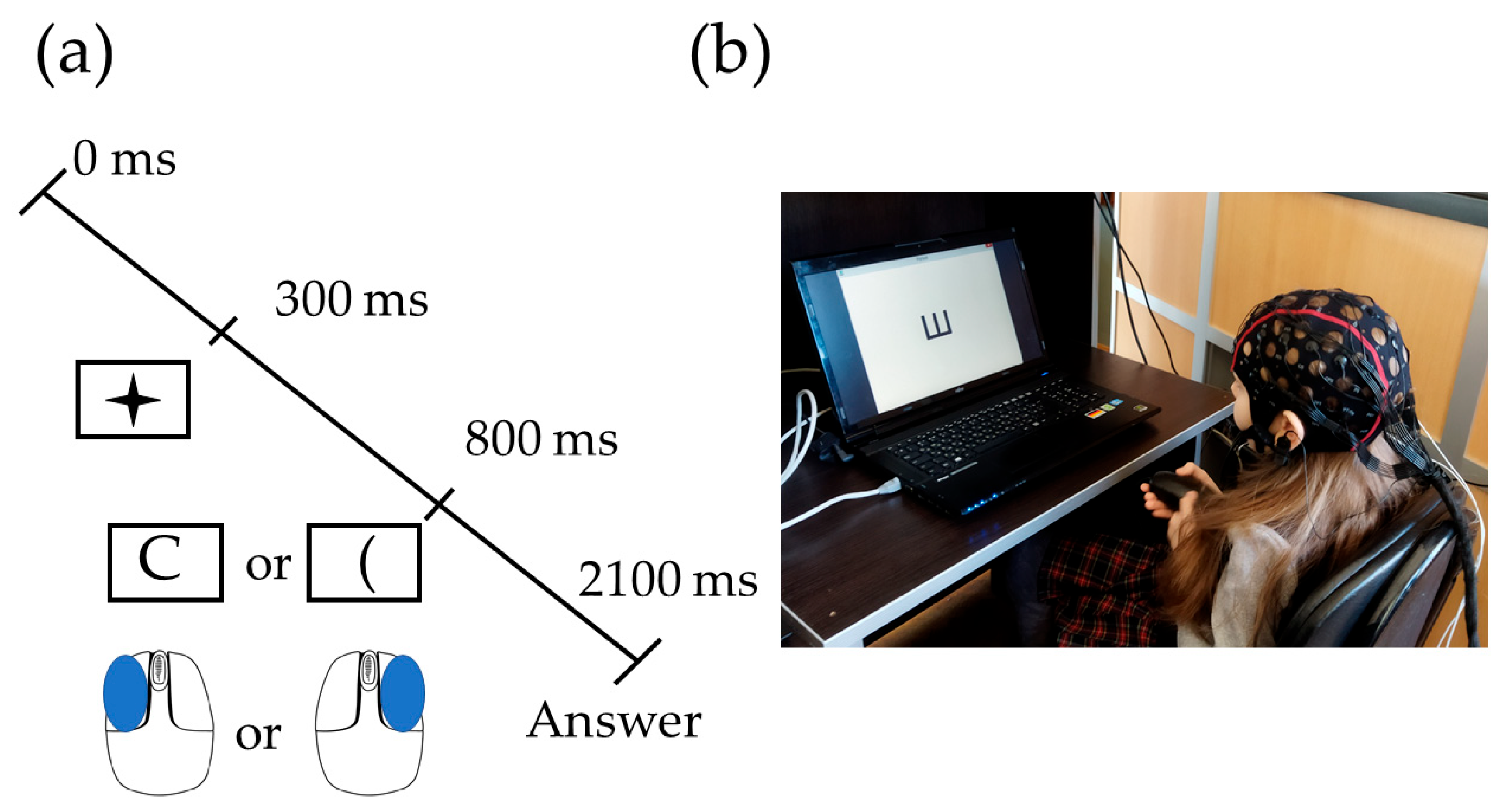
The letter/non-letter classification task was conducted as a paradigm. The structure and the timeline of the test are presented in Figure 1. The experiments were designed in Psytask (version 1.57.21) software. At the beginning of each trial, a fixation cross was presented at the center of the screen for 300 ms, followed by the stimulus for 500 ms. Participants were instructed to press one mouse button for letters and the other for non-letters. The assignment of letter/non-letter to the right or left button was randomized for each participant. A response was considered valid if it occurred between 100 ms and 2100 ms after the stimulus onset. To prevent motor laterality from affecting the event-related potentials, the responding hand (right or left) was counterbalanced across participants. The interval between trials varied randomly from 300 ms to 500 ms to avoid monotony. The two types of stimuli were distributed randomly throughout the test.

2.3. Procedure: EEG Registration

The EEG was continuously recorded from silver-silver chloride electrodes at 31 sites (according to the 10–20 International System of Electrode Placement) in the band 0.53–70 Hz, sampling frequency 250 Hz per channel, using the united ear electrode as a reference, the ground electrode was placed on the subject’s head between the electrodes FCz and Fz (Mitsar-EEG-ERP 31/8, St-Petersburg, Russia). The electrodes were secured in an elastic electrode cap. An EOG was recorded from two electrodes at the outer canthi of both eyes (horizontal EOG) and from single electrodes on the infraorbital and supraorbital ridges of the right eye (vertical EOG). Electrode impedances were kept below 10 kΩ. EEG data were digitized online at a rate of 250 Hz and stored on a hard drive for further analysis.
During the EEG registration, the children sat comfortably in a chair facing the presentation laptop, where they performed the aforementioned tests. The laptop screen, measuring 17.3 inches, was positioned in front of them, displaying the stimuli. Stimuli were presented on a monitor screen. The viewing angle corresponded to the angles from −15° to 15°. The stimuli were located in the center; the room illumination level was 200–300 Lux. The complete experimental session did not exceed 30 min.
Before the test, a training session was conducted to familiarize the subject with the test procedure. Training was considered successful if the subject selected the correct button three times in a row for each stimulus.

2.4. Data Processing and Analysis

2.4.1. Behavioral Data

The mistakes (%), omissions (%), and correct answers (%) were calculated for the letter/non-letter classification tasks in each subject. A statistical analysis was run in IBM SPSS Statistics version 26. A Shapiro–Wilk test was used to assess the normality of data distribution. As not all studied parameters showed normal distributions, significant differences in parameters were identified in the groups using the nonparametric Mann–Whitney U-test with the Bonferroni correction for the number of comparisons. The text contains mean values and 95% confidence intervals of the mean. Differences were considered statistically significant at p ≤ 0.05.

2.4.2. EEG Data

ERP Analysis
EEG processing and the calculation of event-related potentials (ERPs) were conducted using the program “WinEEG” (version 2.140.113). To remove very slow drifts and muscle artifacts from the EEG, a digital band-pass filter with cutoff frequencies of 1.6 to 30 Hz was applied. The independent component method was employed to eliminate oculomotor artifacts and myograms (Chaumon et al., 2015). The number of selected ICA components ranged from 2 to 4. Specifically, 1 to 2 components were allocated to vertical eye movements and blinks in the frontal leads, 1 component was allocated to horizontal eye movements in the anterior temporal leads, and 1 component was assigned to occipital activity or to address local canal noise if it occurred.
Record fragments containing other types of artifacts were removed from processing based on visual analysis. For participants with DYS and TD participants, respectively, an average of 0.7%/0.4% of trials were rejected for the letters, 0.6%/0.4% of trials for the non-letters. No differences were observed in the number of artifacts removed between dyslexic children and typically developing children (U = 1842.5, p = 0.9). After trial rejection, data were averaged by condition for each participant. Epochs were segmented from 300 ms before to 1000 ms after stimulus onset and were baseline corrected using the 300 ms interval prior to the stimulus onset. Evoked potentials were calculated from the onset of stimulus presentation for each of the 31 leads. For the ERP analysis, a time window of 1000 ms from the beginning of the stimulus was used.
The relevant record fragments for test trials were averaged separately for each task (letters and non-letter characters) and each subject. The resulting mean number of averaged EEG fragments across subjects was 99.5 ± 15.7 for letters and 101.8 ± 17.4 for non-letters, both from artifact-free trials for each type of Stimulus.
Single-site ERPs were averaged according to four ROIs.
Regions of Interest
In this study, we explored the activity under the electrodes related to the left ventral occipito-parieto-temporal cortex (P3, T5, and O1, referred to as the VWFA ROI) and the left inferior frontal cortex (F7, F3, FT3, and FC3, referred to as the left frontal ROI), along with their right homologues (right frontal ROI—F8, F4, FT4, and FC4; right homologues of VWFA ROI—P4, T6, and O2).
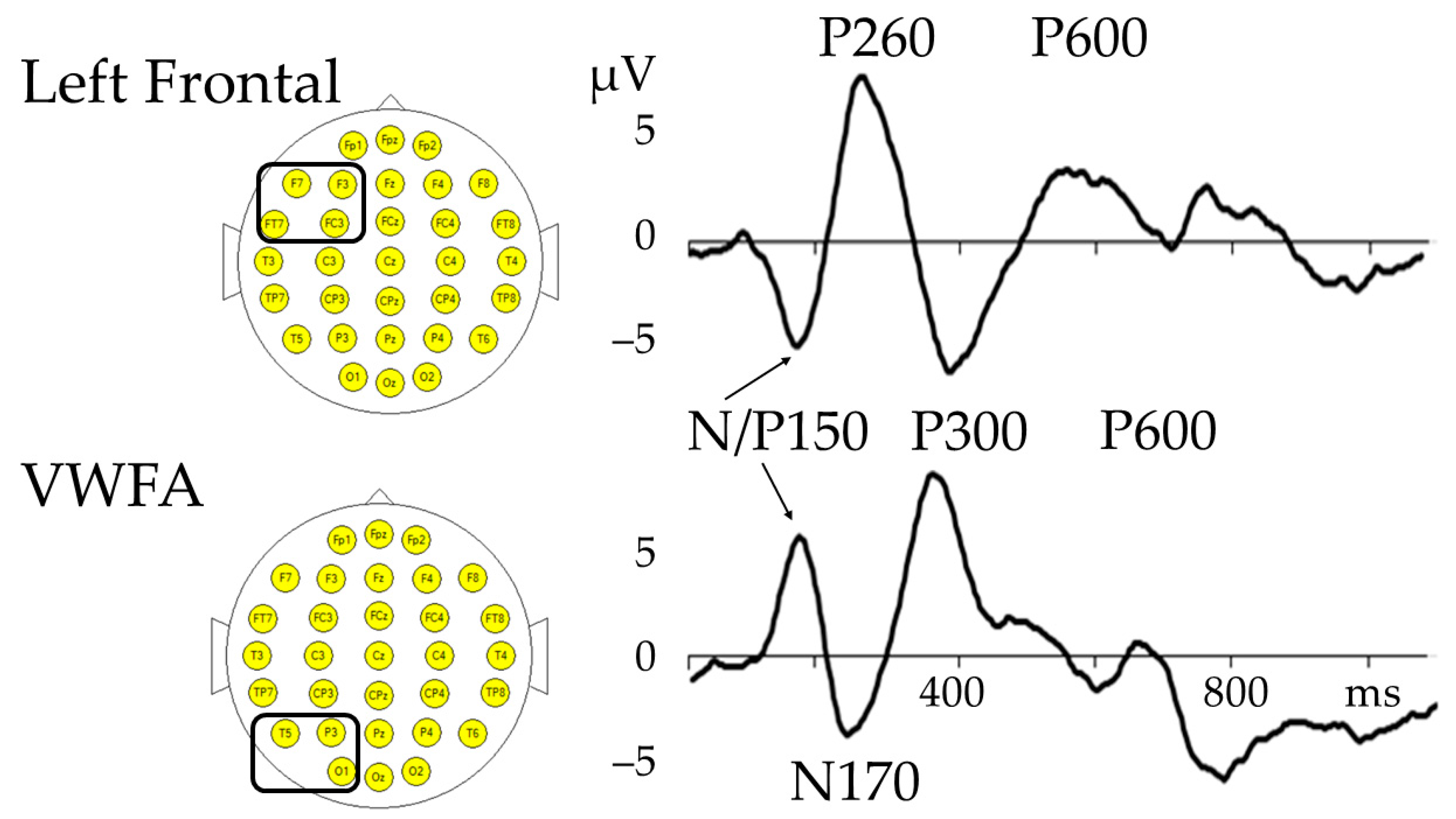
Main ERP components were identified based on their deflection, topography, and latency. Positive (P) and negative (N) components were identified for the VWFA and its homolog in the right hemisphere in the following time windows: P 120–180 ms (refer to as N/P150), N 200–252 ms (N170), P 300–400 ms (P300), and P 640–680 ms (P600). For the frontal ROIs, components were identified in the following windows: N 132–184 ms (N/P150), P 224–284 ms (P260), N 336–448 ms (N320), and P 520–868 ms (P600) (Figure 2).
Statistical Analysis µV
For each group, we compared the mean amplitudes of the ERP components during the following TW: 120–180 ms (positive), 200–252 ms (negative), 300–400 ms (positive), and 640–680 ms (positive) for the VWFA; 132–184 ms (negative), 224–284 ms (positive), 336–448 ms (negative), and 520–868 ms (positive) for the frontal ROI. Time windows were determined for each ROI based on the available literature and a visual inspection of the overall average waveforms in our dataset. We then calculated the precise boundaries of these time windows as the time points at which the amplitude decreased to half the peak value (i.e., the full width at half maximum, FWHM). This provided an objective indicator for defining the final window and calculating the average amplitude within it. A statistical analysis was run in IBM SPSS Statistics version 26. The data were tested for normal distribution using the Shapiro–Wilk test (p = 0.2), and Levene’s test was used to assess the equality of variances (homogeneity of variance) for a variable across groups (p = 0.5). A mixed-design ANOVA was conducted with Stimuli (letters and non-letters) as the within-subjects factor and Status (TD and DYS) and Age (7–8 years old, 9–11 years old) as between-subjects factors, separately for the ROIs in the left and right hemispheres. Statistical analysis of within- and between-subject effects was performed on the mean amplitude of each component. To identify intragroup differences, the Bonferroni correction for multiple comparisons was used. The results were considered significant at p < 0.05. Data are presented as means with 95% confidence intervals.

3. Results

3.1. Behavioral Results (Accuracy)

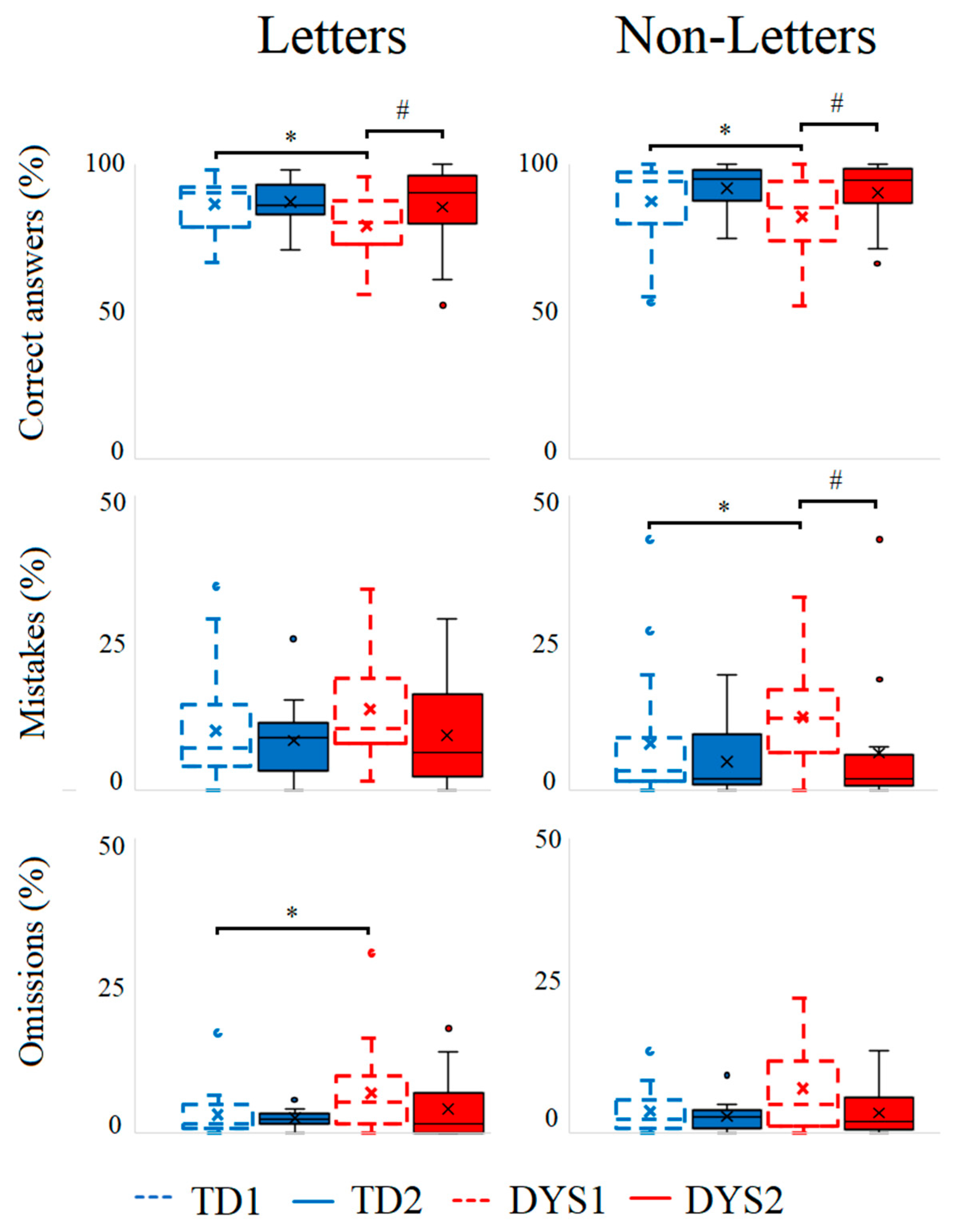
The statistical analysis revealed no significant influence of Stimulus type on accuracy scores in both groups (p = 0.4). The between-group difference in the accuracy scores in favor of TD children was revealed only in the young participants (TD1 vs. DYS1, Figure 3). Only DYS1 participants showed higher omission scores in letter recognition (Mann–Whitney U-test, U = 283.5, p = 0.02) and higher mistake scores in a non-letter recognition task (U = 273.00, p = 0.04) compared to TD1. Thus, the classification task accuracy was higher in TD1 compared to DYS1.
The significant age differences were obtained in performance of the task only in the DYS group (Figure 3): between the DYS1 and DYS2 subgroups, there was a difference in correct letter recognition (U = 216.00, p = 0.03), and in correct non-letter character recognition (U = 219.5, p = 0.02).

3.2. ERP Results

3.2.1. N/P150

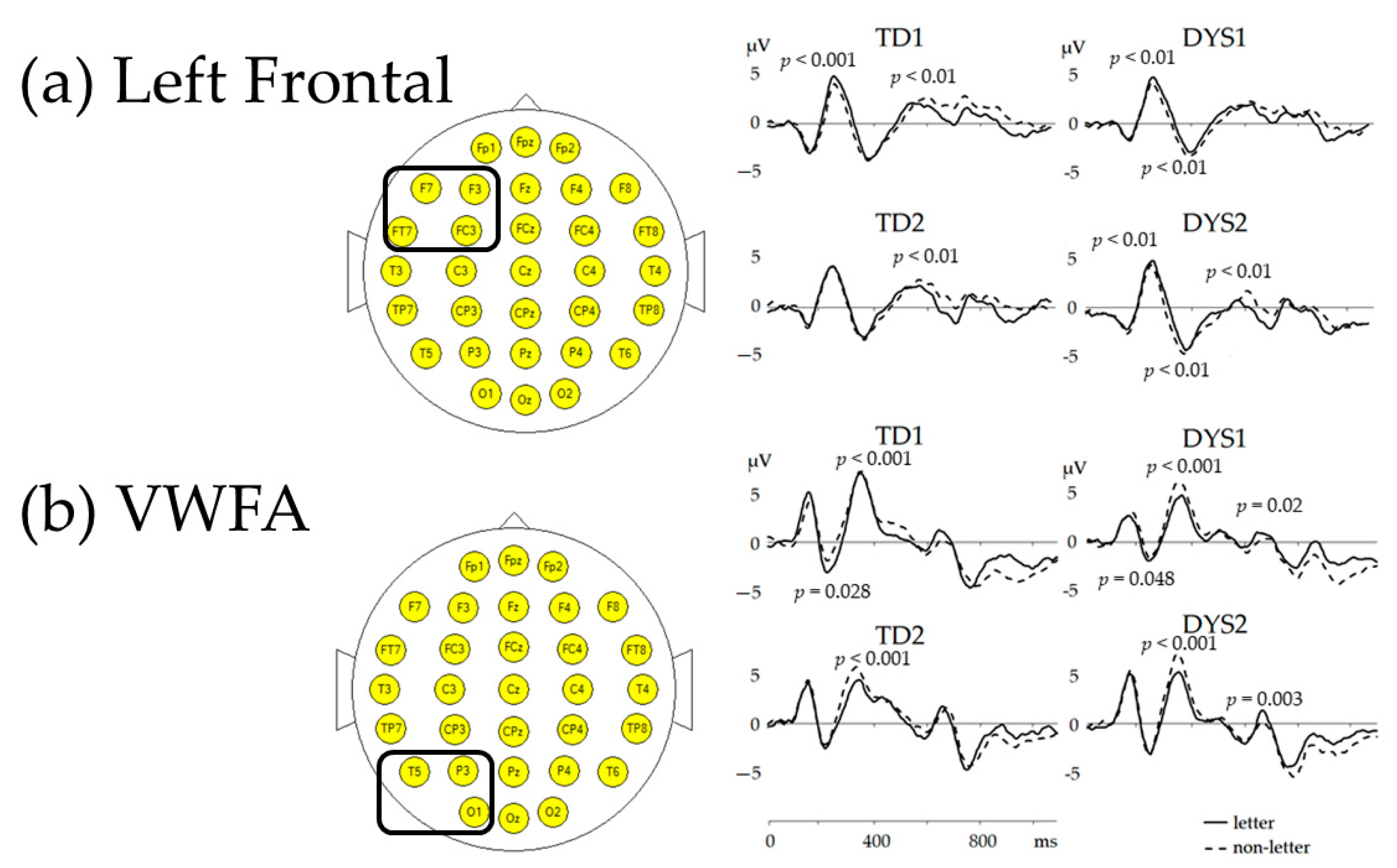
After Grainger and Holcomb (2009), we consider the component with the peak around 150 ms, which is negative in the frontal ROI and positive in the posterior left VWFA ROI, as a single process. N/P150 was detected in the left frontal ROI as a negative deflection within TW 132–184 ms and in the VWFA ROI as a positive deflection within TW of 120–180 ms (Figure 4, Table 2 and Table 3). No significant influence of the within-subject factor, Stimulus type (letters, non-letters), was found in either the frontal (p = 0.4) or VWFA (p = 0.1) ROIs.
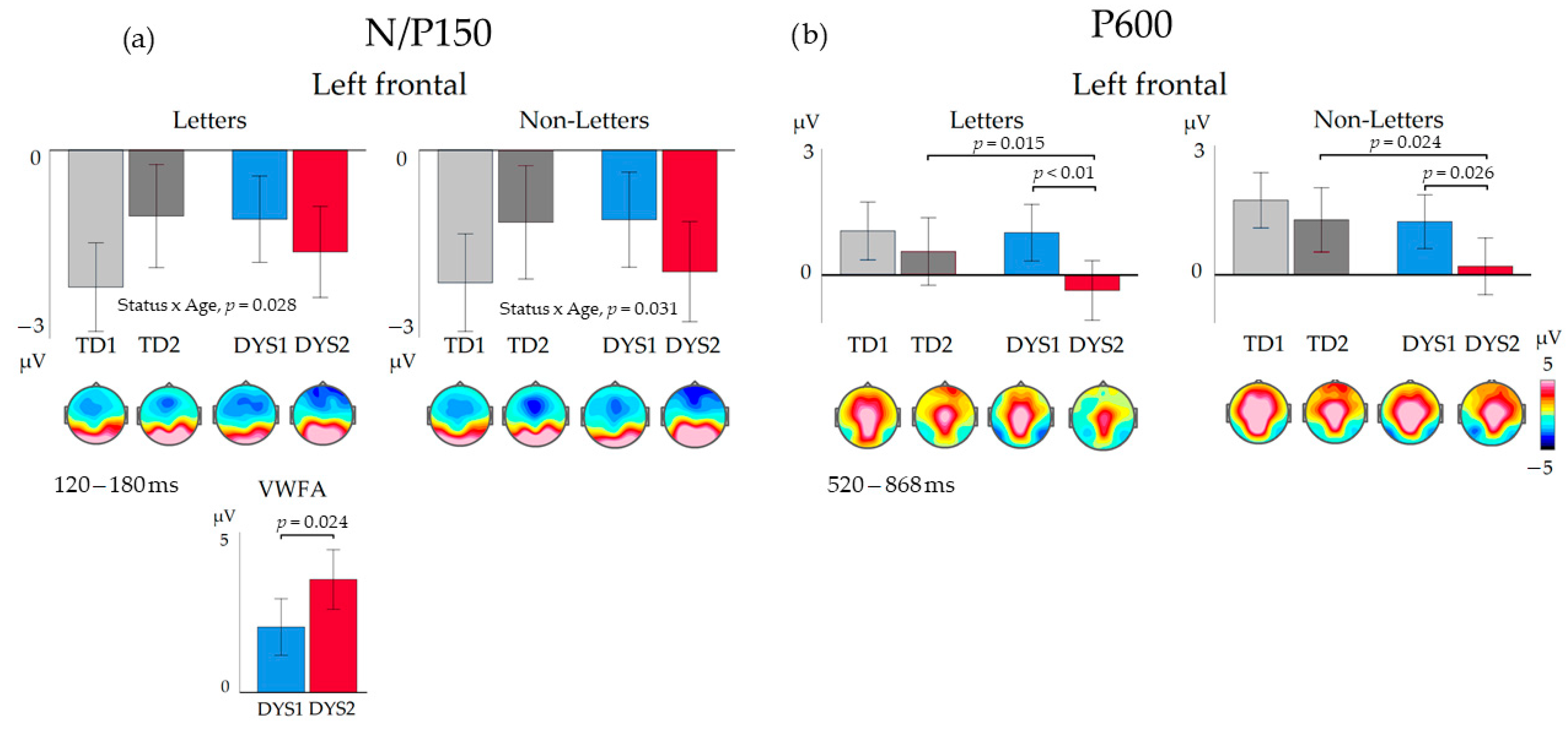
A significant Age × Status interaction was obtained for N/P150 mean amplitude in left frontal ROI, F1,67 = 5.494, p = 0.022, ŋ2 = 0.08 (for letters β = −1.787, t = −2.241, p = 0.028 and for non-letters β = −1.956, t = −2.203, p = 0.031). Post hoc analysis with Bonferroni correction indicated that younger TD children exhibited more negative N/P150 amplitudes during letter recognition than their DYS peers (p = 0.032). In contrast, no significant Status difference was observed among older children (p = 0.2) (Figure 5a, Table 2 and Table 3). In TD children, the older subgroup demonstrated significantly lower amplitude than in the younger subgroup, while in the DYS group, the opposite was observed: the younger children demonstrated higher amplitudes than the older children. The significant age differences were revealed in the posterior areas: the positive amplitude was higher in the older DYS subgroup (M = 3.71 μV, SD = 2.34 vs. M = 2.15 μV, SD = 1.48; post hoc comparisons: β = −1.561, t = 0.675, p = 0.024) (Figure 5a).

3.2.2. N170

The N170 component was identified in the VWFA ROI as a negative deflection within a 200–252 ms time window (Figure 4b, Table 3). This is consistent with prior evidence indicating a broadly distributed ERP peak between 150 and 350 ms in children (Brem et al., 2009; Henderson et al., 2003; Maurer et al., 2005, 2006, 2007). The negative deflection, which peaked around 228 ms at the T5, P3, and O1 electrodes, was significantly larger for letter stimuli than for non-letters. Analysis of its mean amplitudes revealed a significant main effect of the Stimulus type (letters and non-letters) (F1,67 = 5.35, p = 0.024, ŋ2 = 0.07). To further elucidate this effect, simple effects analyses were conducted. Post hoc Bonferroni tests confirmed the effect was significant only in the younger age group, for both typically developing (TD1, p = 0.028) and dyslexic (DYS1, p = 0.048) children. The absence of a significant interaction between Stimulus type and Status indicates that the notable difference between letters and non-letters is a consistent pattern observed across younger children, although the magnitude of this effect varies. In contrast, no significant difference was found between stimuli for older children in either the TD2 (p = 0.36) or DYS2 (p = 0.65) groups. No other significant effects were observed for Status (p = 0.97) or the Status x Age interaction (p = 0.57).

3.2.3. P260

The P260 component was identified in the left frontal ROI as a positive deflection within TW 224–284 ms (Figure 4a, Table 2). The effect of the Stimulus type (letters, non-letters) on the mean amplitudes of the P260 component was significant (F1,67 = 23.391, p < 0.0001, ŋ2 = 0.3). Post hoc comparisons indicated that TD1 showed larger P260 amplitudes for letters (M = 3.39 μV, SD = 2.4) than for non-letters (M = 3.05 μV, SD = 2.4), p < 0.0001 (Bonferroni correction). The same differences were obtained in both subgroups of children with dyslexia. Individuals with dyslexia shown larger P260 amplitudes for letters (DYS1: M = 3.77 μV, SD = 2.4 and DYS2: M = 3.92 μV, SD = 2.7) than for non-letters (DYS1: M = 3.24 μV, SD = 2.2 and DYS2: M = 3.34 μV, SD = 2.5), p = 0.01. The lack of a significant interaction between Stimulus type and Status indicates that the higher amplitude for letters compared to non-letters is a consistent pattern across groups, even though the strength of this effect may differ. Additionally, there was no significant influence of Age (p = 0.97) or Status (p = 0.83), nor was there a significant interaction between them (p = 0.86).

3.2.4. P300

In the VWFA ROI, the positive P300 component was observed in the time window of 300–400 ms (Figure 4b, Table 3). In all subgroups, the Stimulus type (letters, non-letters) significantly affected the mean amplitudes (F1,67 = 60.094, p < 0.0001, ŋ2 = 0.5). Post hoc Bonferroni correction revealed larger amplitudes for non-letters compared to letters (p < 0.001). No significant influences of Age (p = 0.87) or Status (p = 0.91), or their interaction (p = 0.40), were found.

3.2.5. N320

Component N320 was identified in the left frontal ROI, displaying a negative component within the latencies of 336–448 ms (Figure 4a, Table 2). The analysis revealed a significant effect of the Stimulus type (letters, non-letters) on the mean amplitudes of N320 (F1,67 = 19.253, p < 0.0001, ŋ2 = 0.2). The absence of a significant interaction between Stimulus type and Status indicates that the differences in amplitude between letters and non-letters reflect a general trend among children. However, statistically significant effect sizes are observed only in individuals with dyslexia (Bonferroni correction, p = 0.01). There was a significantly more pronounced negativity for non-letters (DYS1: M = −3.37 μV, SD = 2.2; DYS2: M = −3.35 μV, SD = 2.6) compared to letters (DYS1: M = −1.76 μV, SD = 1.9; DYS2: M = −2.95 μV, SD = 2.5). No significant influences of Age (p = 0.61) or Status (p = 0.43), nor their interaction (p = 0.07), were found.

3.2.6. P600

The P600 positive component was identified in the left frontal ROI (latency: 520–868 ms) and the Left VWFA ROI (latency: 640–680 ms) (Figure 4, Table 2 and Table 3). A significant main effect of the Stimulus type (letters vs. non-letters) was found on P600 mean amplitudes in both the left frontal ROI (F1,67 = 46.788, p < 0.0001, ŋ2 = 0.4) and the VWFA ROI (F1,67 = 12.151, p < 0.001, ŋ2 = 0.2).
In the left frontal ROI, post hoc comparisons revealed that older children exhibited larger P600 amplitudes for non-letters than for letters (TD2, non-letters: M = 1.37 μV, SD = 1.7, vs. letters: M = 0.56 μV, SD = 1.6, p = 0.038; DYS2, non-letters: M = 1.37 μV, SD = 1.7, vs. letters: M = 0.56 μV, SD = 1.6, p = 0.01) (Figure 4a). In the VWFA ROI (Figure 4b), post hoc Bonferroni correction showed larger P600 amplitudes for letters than for non-letters in children with dyslexia (DYS1, p = 0.020, and DYS2, p = 0.003).
A significant main effect of Status (TD, DYS) for P600 amplitudes in the left frontal ROI, F1,67 = 4.883, p < 0.031, ŋ2 = 0.07 was revealed (Figure 4b, Table 3). Post hoc comparisons indicated that the TD2 group exhibited larger P 520–868 ms amplitudes than the DYS2 group for letters (β = 1.431, t = 2.488, p = 0.015) and for non-letters (β = 1.499, t = 2.307, p = 0.024). The analysis revealed a significant main effect of Age (7–8 y.o., 9–11 y.o.) for P600 amplitudes, F1,67 = 6.179, p = 0.015, ŋ2 = 0.08, with younger DYS children showing larger P 520–868 ms amplitudes compared to older children for letters (β = 1.371, t = 2.807, p = 0.007) and for non-letters (β = 1.115, t = 2.278, p = 0.026). No significant Age × Status interaction (p = 0.1) was found. In contrast, in the VWFA ROI, no significant Age (p = 0.48) or Status (p = 0.74) influence or their interaction (p = 0.42) was found.

3.2.7. Right Hemisphere ROIs

The effect of the Stimulus factor on mean amplitudes in the right frontal and occipital-temporal-parietal ROIs was similar to that observed in the corresponding left-hemisphere regions (see Table 2 and Table 3). No significant influences of Age, Status, or their interaction were found in the right-hemisphere ROIs.

4. Discussion

In this study, we aimed to estimate changes in ERP correlates of letter and non-letter processing related to age of schooling and print experience in children with dyslexia and their typically developing peers. Behavior analysis of letter/non-letter recognition accuracy scores revealed some between-group distinctions only in the young participants. Older individuals with dyslexia presented relatively the same accuracy score as their TD peers (Figure 3). These data correlate with other dyslexia studies in transparent orthographies (Bigozzi et al., 2015; Serrano & Defior, 2008). Some of the obtained ERP effects in frontal and occipito-temporo-parietal cortex were common for TD and DYS groups, while the others differentiated them. The influence of Stimulus type was observed in the ROIs of both the right and left hemispheres, while Age (which correlates with print experience and age of schooling) and Status factors, as well as their interactions, modulated the ERP measures only in the left hemisphere. Therefore, we will limit our discussion to the effects observed in the left hemisphere’s ROIs.
Comparable amplitude features reflecting the influence of Stimulus type on the N170, P260, and P300 components were observed in both dyslexic and typically developing children (Figure 4). The amplitudes of the N170 and P260 components for letters were higher than for non-letters; however, this effect was observed only in participants aged 7–8 years. This may be attributed to the print sensitivity effect, a phenomenon well documented for the N170 (or N1) component in the left vOTC or VWFA (Amora et al., 2022).
In our study, this effect was less pronounced in young children with dyslexia than in young TD individuals (Figure 4b). Behavioral results showed that in 7–8-year-old children, the percentage of correct responses to both letters and non-letters was significantly higher in the TD group compared to children with dyslexia. At the same time, children with dyslexia made more omissions of responses to letter stimuli and more errors in recognition of non-letters relative to TD peers (Figure 3). Considering that younger children with dyslexia also exhibited a less pronounced N170 component in the VWFA compared to controls, both behavioral and EEG data converge to suggest that younger dyslexic children have not yet automated the letter recognition skill and their discrimination from non-letters, and show reduced print sensitivity. These data are in concordance with previous studies on dyslexic individuals showed a reduced N1 effect in DYS as compared to TD when contrasting familiar versus less familiar orthographic sequences, likely due to a lack of visual specialization for letter processing (Araújo et al., 2012). Maurer and colleagues have shown reduced inferior occipito-temporal N1 tuning for print in dyslexic second graders, suggesting the reduction affects fast processing and the initial development of dyslexia (Maurer et al., 2011). Tarkiainen and colleagues showed that the lack of occipito-temporal activation in dyslexic children is specific to reading (Tarkiainen et al., 2003). The opposite results were obtained by Fraga-González and colleagues: the DYS group revealed larger left-lateralized, word-specific N1 responses than the TD group (Fraga González et al., 2014). Furthermore, positive correlations between N1 amplitudes and reading fluency were found in the dyslexic, but not in the TD group. Such inconsistent results could be explained by differences in the age of onset of literacy acquisition, properties of the alphabet, or teaching methods (Fraga González et al., 2014).
The N170 effect in our study was obtained only in younger children, in both the TD and DYS groups. It was shown that this effect demonstrated an inverted U-shape developmental curve (Fraga-González et al., 2021), perhaps because in the later stages of reading acquisition, the print sensitivity no longer plays such a key role. Lack of group differences implies that early tuning to print occurs even in dyslexia, but may not consolidate properly. Typical readers efficiently integrate, reanalyze, and consolidate these representations, resulting in more robust and automated reading networks. In contrast, individuals with dyslexia may depend more on laborious and general control processes rather than efficient, specialized circuits. This is consistent with previous ERP and fMRI findings showing reduced late frontal positivity and atypical frontotemporal connections (Cainelli et al., 2023).
Letter vs. non-letter differences are also evident in P260 (Figure 4a). Consistent with the previous ERP literature, the later positive deflection in the ~220–300 ms range (P2/P260) is commonly understood to indicate access to abstract letter identities or orthographic representations (Mitra & Coch, 2009; Petit et al., 2006). Our data indicate that the P260 was larger for letters than for non-letters in the frontal areas of both TD and DYS younger groups. This supports the notion that this component reflects print sensitivity, irrespective of low-level visual features. Importantly, the absence of reliable Status or Age × Status effects on the P260 in our single-letter classification task suggests that elementary letter–sound associations and alphabetic discrimination may be relatively intact in dyslexic children. This finding aligns with studies and reviews indicating that orthographic-stage markers (P2/P260) can be present in dyslexic readers, with more significant group differences often emerging in other processing phases (e.g., phonological mapping or phonological decoding) rather than during simple letter recognition. However, the complexity of the stimulus is a factor: studies using longer letter strings or more lexically demanding materials have occasionally reported reduced P2/P260 effects in dyslexia. Fraga González and colleagues, suggesting that deficits may arise when orthographic processing is required to support higher-level or parallel-letter processing (Fraga González et al., 2014). Finally, converging evidence shows that phonological and audiovisual integration deficits are often more pronounced in developmental dyslexia than pure orthographic detection deficits (Varga et al., 2021). This supports the interpretation of our preserved P260 as evidence that dyslexia in our sample reflects downstream integration inefficiencies rather than a failure of single-letter orthographic sensitivity. Lack of Status/Age effects suggests that letter recognition per se is not the main bottleneck for children with dyslexia.
The P300 component in the posterior regions demonstrates a notable stimulus-related difference in the amplitude, which was higher for non-letter than for letter—a pattern observed across all studied groups (Figure 4b). Similar data were obtained in adults on the P3 component, with Global Field Power (GFP) to pseudoletters being greater than letters from 160 to 600 ms (Bann & Herdman, 2016). In some studies, the P2 component with the same latency and same posterior temporoparietal localization as P300 was detected. In 8–11-year-old children, the P2 was larger for false font strings than letter strings, reflecting coarse encoding for orthography (Coch & Meade, 2016). A stronger P300 response for non-letters may probably evidence that novelty or salience detection in the DYS group is intact. This supports the notion that dyslexic deficits do not stem from basic categorization issues.
The N320 and P600 components of the letter-non-letter discrimination in our study differentiate children with dyslexia from their TD peers. The N320 stimulus-related differences, observed only in dyslexic children (with non-letters eliciting more negative responses than letters, as shown in Figure 4a), may reflect increased frontal engagement during stimulus classification, as the compensatory strategy reflecting the effortful decision-making process. Additionally, the higher N320 frontal amplitude in older dyslexic children may be explained by the maturation of the letter–sound (LS) integration process. This is supported by findings that the similar N300 component appears in tasks requiring comparisons between orthographic and phonological representations (Hasko et al., 2012; Spironelli et al., 2010; Spironelli & Angrilli, 2009). Furthermore, studies have shown that audiovisual integration in the bilateral inferior temporal and superior frontal gyri in second graders, along with their functional connectivity to other language areas and regions of the default mode network, reveals different developmental trajectories in poor versus typical readers (Wang et al., 2020).
The P600 component demonstrates that amplitude differences in the perception of letters and non-letters classification vary between the frontal and posterior regions of the brain. In the frontal ROI, ERP amplitude for non-letters was larger than for letters in TD children and older children with dyslexia (Figure 4a). In contrast, in the VWFA, this difference is observed only in children with dyslexia, where letters evoked larger amplitudes than non-letters (Figure 4b). For late components, the distinction between letters and symbols is often not addressed, as such differences are usually attributed to earlier components related to sensory processes. The P600 is traditionally associated with reanalysis of information but has primarily been studied at the word or sentence level (Canseco-Gonzalez, 2000; Friederici, 1995; Savill & Thierry, 2011). However, when examining lower levels of speech decoding, such as letters, P600 effects are frequently overlooked, even though they are evident in the illustrations ((Hasko et al., 2013); see Figure 3).
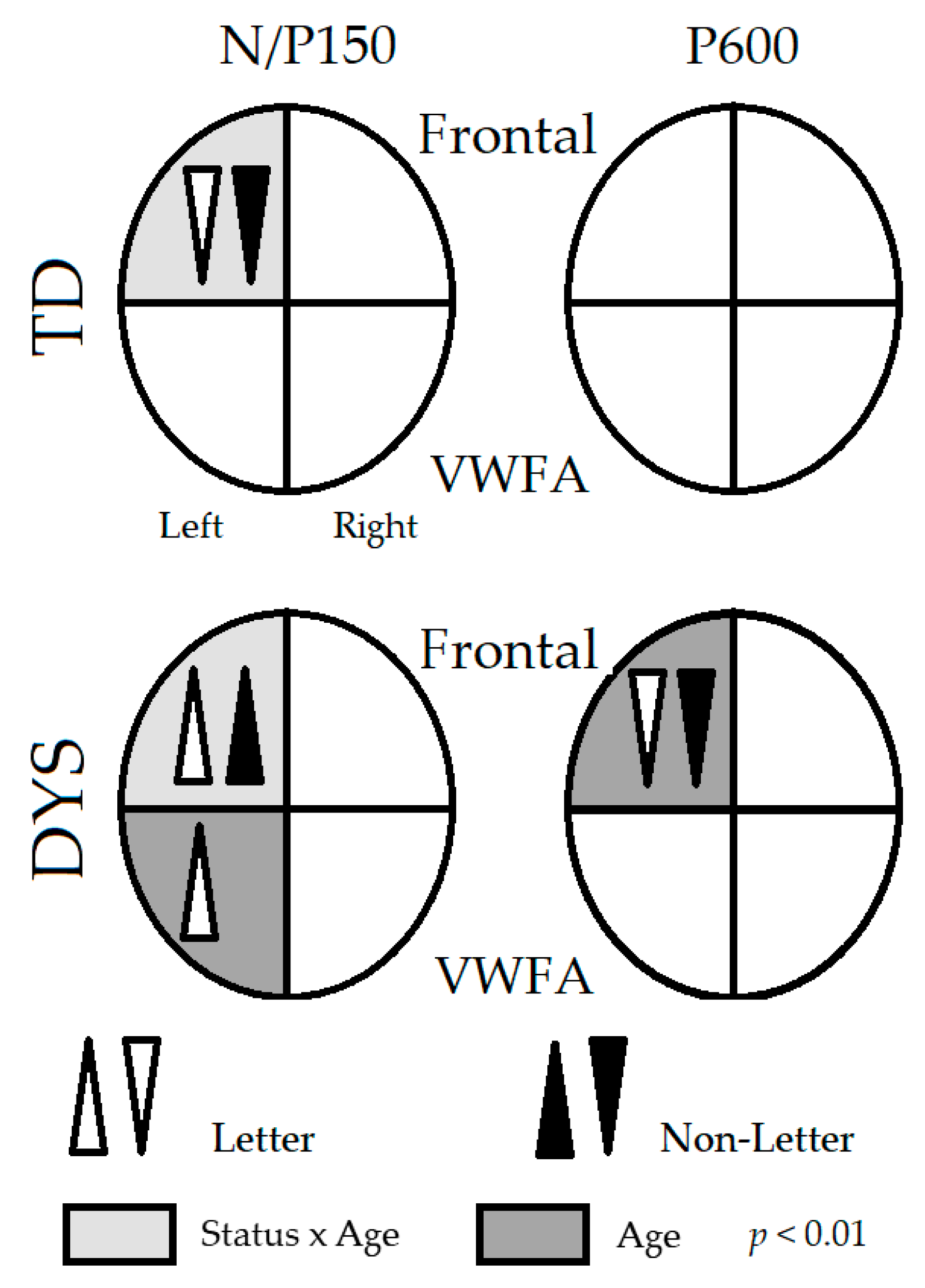
Age-related differences, both behavioral and ERP, were most pronounced in the dyslexic group. Older children with dyslexia showed a higher test accuracy (Figure 3), as well as a higher amplitude of the N/P150 component in the VWFA. This can be interpreted as a developmental trend characterized by an enlargement of the left frontal region and a decrease in P600 amplitude in the same area (Figure 5 and Figure 6). It was shown that the N/P150 was significantly larger for mismatches between the prime and target letter cases, particularly when the physical features of the uppercase and lowercase letters were contrastively different (Grainger & Holcomb, 2009).
The observed age-related increase in early N/P150 amplitudes in children with dyslexia may suggest that their letter recognition is delayed and overly effortful. Another interpretation, drawing on the “neural noise” hypothesis (Hancock et al., 2017), could be that it reflects a failure of the neural system to efficiently “prune” or fine-tune early visual responses. The “neural noise” hypothesis suggests that impaired pruning during development leads to an overabundance of neural connections and increased neural variability (noise), which disrupts the formation of specialized circuits for reading. Our finding of an increasing N/P150 in children with dyslexia may directly reflect this—a failure to prune and fine-tune the early visual response to letters, resulting in a larger, less efficient response that does not follow the typical trajectory of refinement.
Additionally, the P600 in the frontal regions of older children distinguishes dyslexic individuals from their TD peers. People with dyslexia exhibit reduced amplitudes compared to TD individuals. Silva and colleagues found that people with dyslexia exhibited lower P600 amplitudes compared to controls during word reading (P. B. Silva et al., 2022). They attributed this finding to longer information analysis, suggesting a lower automaticity of word recognition in people with dyslexia. However, we find this reasoning insufficient. A more convincing explanation is that the reanalysis process differs in people with dyslexia, as the P600 has traditionally been associated with the reanalysis of information (Canseco-Gonzalez, 2000; Friederici, 1995; Savill & Thierry, 2011).
While we did not find any prior studies reporting the exact pattern we observe—age-related increases in N/P150 at the VWFA and left frontal areas, coupled with age-related decreases in frontal P600 in dyslexic children—several existing findings support the plausibility of such findings (P. B. Silva et al., 2022; Hasko et al., 2013). For example, Hasko and colleagues discovered that dyslexic children exhibit reduced print sensitivity in N170 contrasts (comparing words to false fonts) and diminished LPC modulations during later processing stages (Hasko et al., 2013).
Earlier, we showed that P600 amplitudes in reading tasks change with age, suggesting that later ERP components are sensitive to developmental factors (Galperina et al., 2022a). Furthermore, developmental reviews on print expertise (Amora et al., 2022) indicate that typical readers’ N170 responses become more specialized with age, whereas dyslexic readers often display less specialized distributions. Research often highlights hyperactivation of the IFG in individuals with dyslexia, contrasting with hypoactivation observed in the left OTC and TPC. Typical readers show an age-related decrease in IFG activation, while individuals with dyslexia demonstrate increased activation with age, which may serve as a neural compensatory mechanism (Price, 2012). However, conflicting findings suggest that this pattern is not consistent across all cases of dyslexia. Some studies have reported no significant difference in IFG activation between young adults with and without dyslexia, while others have indicated hypoactivation in individuals with dyslexia (Richlan et al., 2009).
Thus, although our specific interaction pattern seems novel, it is consistent with broader trends in ERP and dyslexia research, highlighting (i) greater developmental modulation of ERP components in dyslexic readers and (ii) altered late positive potentials in reading tasks throughout development.

5. Conclusions

Children with dyslexia and typically developing children exhibit different trajectories in the development of the brain mechanisms underlying visual letter processing. Although our study is cross-sectional, it allows us to extrapolate the data as a developmental trend. Typically developing children demonstrate a developmental pattern indicative of increasing neural specialization and efficiency, characterized by a reduction in early perceptual components and a stabilization or increase in later cognitive components. In contrast, children with dyslexia display a reversed pattern, showing an increase in early components and a decrease in late components. The observed age-related increase in early N/P150 amplitudes in children with dyslexia may indicate a delayed and too effortful invariant letter recognition. Additionally, consistent with prior ERP evidence in dyslexia (Fraga González et al., 2014; Varga et al., 2021) showing attenuated P600 (i.e., late positive components indexing second-pass reanalysis), our finding of reduced late frontal P600 amplitudes indicates a deficit in higher-order cognitive processing and reanalysis in dyslexic readers.
The data suggest that dyslexia is defined not only by a developmental delay but also by an atypical developmental pathway.
The absence of behavioral differences in older children suggests that children with dyslexia can achieve behavioral accuracy through alternative, likely less efficient cognitive strategies. This highlights the significance of neurophysiological measures over behavioral scores alone in understanding the core deficits. The findings support models of dyslexia that involve a disruption in the automatic letter–sound and orthographic integration with other language processes. Therefore, interventions should focus not only on phonological skills but also on enhancing the efficiency of visual letter processing and developing robust top-down regulatory mechanisms to facilitate fluent reading.

Limitations

This study has several limitations that should be considered when interpreting the results. First, the sample size, with approximately 14 to 20 participants per subgroup, may have limited the statistical power to detect effects, particularly for more complex interaction analyses. Furthermore, the cross-sectional design provides only a snapshot of the phenomena, preventing us from tracking the true developmental trajectories of the cognitive processes involved. The generalizability of our findings is also constrained by the exclusive inclusion of Russian monolingual participants and may not extend to populations with orthographies of different transparency. Finally, while the artificial letter/non-letter classification task was effective for isolating sub-lexical mechanisms, it does not directly engage or test word-level processing, which limits the ecological validity of the findings in the context of natural reading.

Author Contributions

Research concept and design of the experiment, A.K., O.K. and E.G.; EEG studies, O.K. and E.G.; speech development and psychological assessment in children, P.B. and A.K.; behavioral results, P.B.; statistical analysis, O.K.; writing and editing the text of the article, O.K., E.G., A.K. and P.B.; preparing illustrations, O.K. All authors have read and agreed to the published version of the manuscript.

Funding

This work was conducted as part of the state assignment of Saint Petersburg State Pediatric Medical University of the Ministry of Health of the Russian Federation, focusing on groups of children with dyslexia, and the state assignment of Sechenov Institute of Evolutionary Physiology and Biochemistry of the Russian Academy of Sciences, which involves groups of typically developing children.

Institutional Review Board Statement

Written informed parental consent was obtained for all children. All children participated in the study voluntarily. At the end of the study, all children received little gifts. All studies were conducted following the principles of biomedical ethics outlined in the 1964 Declaration of Helsinki and its subsequent updates and were approved by the Commission on the Ethics of Biomedical Research of the Sechenov Institute of Evolutionary Physiology and Biochemistry, Russian Academy of Sciences, St. Petersburg, Russia, protocol No. 2–5 from 19 May 2023.

Data Availability Statement

The original data supporting the conclusions of this article will be made available by the authors upon request without any unreasonable reservations.

Acknowledgments

We are grateful to Diana Tolkacheva and Marianna Kovalchik for help with psychological assessment and research organization. We are grateful to Vera Smolyaninova for help with EEG processing. The authors thank the administrations of St. Petersburg schools 5 and 213 for their cooperation and assistance in organizing the study. AI tools have been used to check the English grammar.

Conflicts of Interest

The authors declare no conflicts of interest. The funders had no role in the design of the study; in the collection, analyses, or interpretation of data; in the writing of the manuscript; or in the decision to publish the results.

References

  1. Allison, T., Puce, A., Spencer, D. D., & McCarthy, G. (1999). Electrophysiological studies of human face perception. I: Potentials generated in occipitotemporal cortex by face and non-face stimuli. Cerebral Cortex, 9(5), 415–430. [Google Scholar] [CrossRef]
  2. Amora, K. K., Tretow, A., Verwimp, C., Tijms, J., Leppänen, P. H. T., & Csépe, V. (2022). Typical and atypical development of visual expertise for print as indexed by the visual word N1 (N170w): A systematic review. Frontiers in Neuroscience, 16, 898800. [Google Scholar] [CrossRef] [PubMed]
  3. Appelbaum, L. G., Liotti, M., Perez, R., Fox, S. P., & Woldorff, M. G. (2009). The temporal dynamics of implicit processing of non-letter, letter, and word-forms in the human visual cortex. Frontiers in Human Neuroscience, 3, 623. [Google Scholar] [CrossRef]
  4. Araújo, S., Bramão, I., Faísca, L., Petersson, K. M., & Reis, A. (2012). Electrophysiological correlates of impaired reading in dyslexic pre-adolescent children. Brain and Cognition, 79(2), 79–88. [Google Scholar] [CrossRef]
  5. Araújo, S., Faísca, L., Bramão, I., Reis, A., & Petersson, K. M. (2015). Lexical and sublexical orthographic processing: An ERP study with skilled and dyslexic adult readers. Brain and Language, 141, 16–27. [Google Scholar] [CrossRef]
  6. Aurnhammer, C., Delogu, F., Brouwer, H., & Crocker, M. W. (2023). The P600 as a continuous index of integration effort. Psychophysiology, 60(9), e14302. [Google Scholar] [CrossRef]
  7. Bann, S. A., & Herdman, A. T. (2016). Event related potentials reveal early phonological and orthographic processing of single letters in letter-detection and letter-rhyme paradigms. Frontiers in Human Neuroscience, 10, 176. [Google Scholar] [CrossRef]
  8. Bigozzi, L., Tarchi, C., Pinto, G., & Gamannossi, B. A. (2015). Predicting dyslexia in a transparent orthography from grade 1 literacy skills: A prospective cohort study. Reading & Writing Quarterly, 32(4), 353–372. [Google Scholar] [CrossRef]
  9. Blackburne, L. K., Eddy, M. D., Kalra, P., Debbie, Y., Sinha, P., & Gabrieli, J. D. E. (2014). Neural correlates of letter reversal in children and adults. PLoS ONE, 9(5), e98386. [Google Scholar] [CrossRef] [PubMed]
  10. Brem, S., Halder, P., Bucher, K., Summers, P., Martin, E., & Brandeis, D. (2009). Tuning of the visual word processing system: Distinct developmental ERP and fMRI effects. Human Brain Mapping, 30(6), 1833–1844. [Google Scholar] [CrossRef]
  11. Cainelli, E., Vedovelli, L., Carretti, B., & Bisiacchi, P. (2023). EEG correlates of developmental dyslexia: A systematic review. Annals of Dyslexia, 73(2), 184–213. [Google Scholar] [CrossRef]
  12. Canette, L.-H., Fiveash, A., Krzonowski, J., Corneyllie, A., Lalitte, P., Thompson, D., Trainor, L., Bedoin, N., & Tillmann, B. (2020). Regular rhythmic primes boost P600 in grammatical error processing in dyslexic adults and matched controls. Neuropsychologia, 138, 107324. [Google Scholar] [CrossRef]
  13. Canseco-Gonzalez, E. (2000). Using the recording of event-related brain potentials in the study of sentence processing. Language and the Brain, 12, 229–266. [Google Scholar] [CrossRef]
  14. Casarotto, S., Bianchi, A. M., Ricciardi, E., Gentili, C., Vanello, N., Guazzelli, M., Pietrini, P., Chiarenza, G. A., & Cerutti, S. (2008). Spatiotemporal dynamics of single-letter reading: A combined ERP-FMRI study. Archives Italiennes De Biologie, 146(2), 83–105. [Google Scholar]
  15. Chaumon, M., Bishop, D. V. M., & Busch, N. A. (2015). A practical guide to the selection of independent components of the electroencephalogram for artifact correction. Journal of Neuroscience Methods, 250, 47–63. [Google Scholar] [CrossRef]
  16. Coch, D., & Meade, G. (2016). N1 and P2 to words and wordlike stimuli in late elementary school children and adults. Psychophysiology, 53(2), 115–128. [Google Scholar] [CrossRef]
  17. Dehaene, S. (2010). Reading in the brain. Penguin Books. ISBN 978-0-14-311805-3. [Google Scholar]
  18. Dehaene, S., & Cohen, L. (2011). The unique role of the visual word form area in reading. Trends in Cognitive Sciences, 15(6), 254–262. [Google Scholar] [CrossRef]
  19. Dehaene-Lambertz, G., Monzalvo, K., & Dehaene, S. (2018). The emergence of the visual word form: Longitudinal evolution of category-specific ventral visual areas during reading acquisition. PLoS Biology, 16(3), e2004103. [Google Scholar] [CrossRef] [PubMed]
  20. Dȩbska, A., Wójcik, M., Chyl, K., Dziȩgiel-Fivet, G., & Jednoróg, K. (2023). Beyond the visual word form area—A cognitive characterization of the left ventral occipitotemporal cortex. Frontiers in Human Neuroscience, 17, 1199366. [Google Scholar] [CrossRef] [PubMed]
  21. Di Pietro, S. V., Karipidis, I. I., Pleisch, G., & Brem, S. (2023). Neurodevelopmental trajectories of letter and speech sound processing from preschool to the end of elementary school. Developmental Cognitive Neuroscience, 61, 101255. [Google Scholar] [CrossRef]
  22. Dorofeeva, S. V. (2025). Mechanisms of Dyslexia Development: Overview of the Hypotheses Based on the Experimental Studies. Hum physiol, 51(4), 432–439. [Google Scholar] [CrossRef]
  23. Fletcher, J. M., Stuebing, K. K., & Barth, A. (2011). Cognitive correlates of inadequate response to reading intervention. School Psychology Review, 40(1), 3–22. [Google Scholar] [CrossRef]
  24. Fraga-González, G., Pleisch, G., Di Pietro, S. V., Neuenschwander, J., Walitza, S., Brandeis, D., Karipidis, I. I., & Brem, S. (2021). The rise and fall of rapid occipito-temporal sensitivity to letters: Transient specialization through elementary school—PubMed. Developmental Cognitive Neuroscience, 49, 100958. [Google Scholar] [CrossRef]
  25. Fraga González, G., Žarić, G., Tijms, J., Bonte, M., Blomert, L., & van der Molen, M. (2014). Brain-potential analysis of visual word recognition in dyslexics and typically reading children. Frontiers in Human Neuroscience, 8, 474. [Google Scholar] [CrossRef] [PubMed]
  26. Friederici, A. D. (1995). The time course of syntactic activation during language processing: A model based on neuropsychological and neurophysiological data. Brain and Language, 50(3), 259–281. [Google Scholar] [CrossRef] [PubMed]
  27. Galperina, E. I., Kruchinina, O. V., Kornev, A. N., & Stankova, E. P. (2022a). Late components of event-related potentials elicited by reading words in children, adolescents, and adults. Neuroscience and Behavioral Physiology, 52, 373–382. [Google Scholar] [CrossRef]
  28. Galperina, E. I., Nagornona, J. V., Shemyakina, N., & Kornev, A. N. (2022b). Psychophysiological mechanisms of the initial stage of learning to read. Part II. Human Physiology, 48(3), 285–298. [Google Scholar] [CrossRef]
  29. Grainger, J., & Holcomb, P. (2009). Watching the word go by: On the time-course of component processes in visual word recognition. Language and Linguistics Compass, 3(1), 128–156. [Google Scholar] [CrossRef]
  30. Gupta, S., & Prasad, A. (2025). Evaluation of P300 response through the visual oddball paradigm in healthy children and adolescents. Cureus, 17(7), e89180. [Google Scholar] [CrossRef]
  31. Hancock, R., Pugh, K. R., & Hoeft, F. (2017). Neural noise hypothesis of developmental dyslexia. Trends in Cognitive Sciences, 21(6), 434–448. [Google Scholar] [CrossRef]
  32. Hasko, S., Bruder, J., Bartling, J., & Schulte-Körne, G. (2012). N300 indexes deficient integration of orthographic and phonological representations in children with dyslexia. Neuropsychologia, 50(5), 640–654. [Google Scholar] [CrossRef]
  33. Hasko, S., Groth, K., Bruder, J., Bartling, J., & Schulte-Körne, G. (2013). The time course of reading processes in children with and without dyslexia: An ERP study. Frontiers in Human Neuroscience, 7, 56841. [Google Scholar] [CrossRef]
  34. Henderson, R. M., McCulloch, D. L., & Herbert, A. M. (2003). Event-related potentials (ERPs) to schematic faces in adults and children. International Journal of Psychophysiology, 51(1), 59–67. [Google Scholar] [CrossRef]
  35. Hernández-Vásquez, R., Córdova García, U., Barreto, A. M. B., Rojas, M. L. R., Ponce-Meza, J., & Saavedra-López, M. (2023). An overview on electrophysiological and neuroimaging findings in Dyslexia. Iranian Journal of Psychiatry, 18(4), 503–509. [Google Scholar] [CrossRef]
  36. Hoeft, F., Meyler, A., Hernandez, A., Juel, C., Taylor-Hill, H., Martindale, J. L., McMillon, G., Kolchugina, G., Black, J. M., Faizi, A., Deutsch, G. K., Siok, W. T., Reiss, A. L., Whitfield-Gabrieli, S., & Gabrieli, J. D. E. (2007). Functional and morphometric brain dissociation between dyslexia and reading ability. Proceedings of the National Academy of Sciences, 104(10), 4234–4239. [Google Scholar] [CrossRef]
  37. Holcomb, P., Coffey, S., & Neville, H. J. (1992). Visual and auditory sentence processing: A developmental analysis using event-related brain potentials. Developmental Neuropsychology, 8(2–3), Article 2–3. [Google Scholar] [CrossRef]
  38. Kaan, E., Harris, A., Gibson, E., & Holcomb, P. (2000). The P600 as an index of syntactic integration difficulty. Language and Cognitive Processes, 15(2), 159–201. [Google Scholar] [CrossRef]
  39. Karipidis, I. I., Pleisch, G., Di Pietro, S. V., Fraga-González, G., & Brem, S. (2021). Developmental trajectories of letter and speech sound integration during reading acquisition. Frontiers in Psychology, 12, 750491. [Google Scholar] [CrossRef] [PubMed]
  40. Kornev, A. N. (2003). Narusheniya chteniya i pis’ma u detei [Lesions of reading and writing in children]. Available online: https://www.elibrary.ru/item.asp?id=19886024 (accessed on 13 August 2013).
  41. Kornev, A. N., & Ishimova, O. A. (2010). Metodika diagnostiki disleksii u detei [Method for diagnosing dyslexia in children]. Polytechnic University. Available online: https://elibrary.ru/item.asp?id=20116996 (accessed on 15 August 2013).
  42. Kornev, A. N., Rakhlin, N., & Grigorenko, E. L. (2010). Dyslexia from a cross-linguistic and cross-cultural perspective: The case of Russian and Russia. Learning Disabilities, 8(1), 41–69. [Google Scholar]
  43. Kornev, A. N., Stolyarova, E. I., Galperina, E. I., & Guillemard, D. M. (2014). Formation of sensorimotor mechanisms of syllable production at the initial stage of reading acquisition (in Russian). Pediatrician, 5(4), 85–94. [Google Scholar] [CrossRef]
  44. Lachmann, T., & van Leeuwen, C. (2014). Reading as functional coordination: Not recycling but a novel synthesis. Frontiers in Psychology, 5, 1046. [Google Scholar] [CrossRef]
  45. Ladefoged, P., Johnson, K., & Ladefoged, P. (2006). A course in phonetics (Vol. 3). Thomson Wadsworth. [Google Scholar]
  46. Martin, F. H., Kaine, A., & Kirby, M. (2006). Event-related brain potentials elicited during word recognition by adult good and poor phonological decoders. Brain and Language, 96(1), 1–13. [Google Scholar] [CrossRef]
  47. Maurer, U., Brem, S., Bucher, K., & Brandeis, D. (2005). Emerging neurophysiological specialization for letter strings. Journal of Cognitive Neuroscience, 17(10), 1532–1552. [Google Scholar] [CrossRef]
  48. Maurer, U., Brem, S., Bucher, K., Kranz, F., Benz, R., Steinhausen, H., & Brandeis, D. (2007). Impaired tuning of a fast occipito-temporal response for print in dyslexic children learning to read. Brain, 130(12), 3200–3210. [Google Scholar] [CrossRef] [PubMed]
  49. Maurer, U., Brem, S., Kranz, F., Bucher, K., Benz, R., Halder, P., Steinhausen, H.-C., & Brandeis, D. (2006). Coarse neural tuning for print peaks when children learn to read. NeuroImage, 33(2), 749–758. [Google Scholar] [CrossRef]
  50. Maurer, U., Rometsch, S., Song, B., Zhao, J., Zhao, P., & Li, S. (2024). Repetition suppression for familiar visual words through acceleration of early processing. Brain Topography, 37(4), 608–620. [Google Scholar] [CrossRef] [PubMed]
  51. Maurer, U., Schulz, E., Brem, S., van der Mark, S., Bucher, K., Martin, E., & Brandeis, D. (2011). The development of print tuning in children with dyslexia: Evidence from longitudinal ERP data supported by fMRI. NeuroImage, 57(3), 714–722. [Google Scholar] [CrossRef]
  52. McCandliss, B. D., Cohen, L., & Dehaene, S. (2003). The visual word form area: Expertise for reading in the fusiform gyrus. Trends in Cognitive Sciences, 7(7), 293–299. [Google Scholar] [CrossRef] [PubMed]
  53. McCandliss, B. D., Posner, M. I., & Givón, T. (1997). Brain plasticity in learning visual words. Cognitive Psychology, 33(1), 88–110. [Google Scholar] [CrossRef]
  54. Mitra, P., & Coch, D. (2009). A masked priming ERP study of letter processing using single letters and false fonts. Cognitive, Affective, & Behavioral Neuroscience, 9(2), 216–228. [Google Scholar] [CrossRef]
  55. Niharika, M. K., & Prema Rao, K. S. (2020). Processing syntax: Perspectives on language specificity. International Journal of Neuroscience, 130(8), 841–851. [Google Scholar] [CrossRef]
  56. Papagiannopoulou, E. A., & Lagopoulos, J. (2016). Resting state EEG hemispheric power asymmetry in children with Dyslexia. Frontiers in Pediatrics, 4, 11. [Google Scholar] [CrossRef] [PubMed]
  57. Petit, J.-P., Midgley, K. J., Holcomb, P. J., & Grainger, J. (2006). On the time course of letter perception: A masked priming ERP investigation. Psychonomic Bulletin & Review, 13(4), 674–681. [Google Scholar] [CrossRef]
  58. Price, C. J. (2012). A review and synthesis of the first 20 years of PET and fMRI studies of heard speech, spoken language and reading. Neuroimage, 62(2), 816–847. [Google Scholar] [CrossRef]
  59. Rakhlin, N., Kornilov, S. A., & Grigorenko, E. L. (2017). Learning to Read Russian. In Learning to read across languages and writing systems (pp. 371–392). Cambridge University Press. [Google Scholar] [CrossRef]
  60. Ramus, F. (2002). Outstanding questions about phonological processing in dyslexia—Ramus. Dyslexia, 7(4), 197–216. [Google Scholar] [CrossRef]
  61. Raschle, N. M., Chang, M., & Gaab, N. (2011). Structural brain alterations associated with dyslexia predate reading onset. NeuroImage, 57(3), 742–749. [Google Scholar] [CrossRef] [PubMed]
  62. Richards, T. L., & Berninger, V. W. (2008). Abnormal fMRI connectivity in children with dyslexia during a phoneme task: Before but not after treatment. Journal of Neurolinguistics, 21(4), 294–304. [Google Scholar] [CrossRef] [PubMed]
  63. Richlan, F. (2020). The functional neuroanatomy of developmental dyslexia across languages and writing systems. Frontiers in Psychology, 11, 155. [Google Scholar] [CrossRef]
  64. Richlan, F., Kronbichler, M., & Wimmer, H. (2009). Functional abnormalities in the dyslexic brain: A quantitative meta-analysis of neuroimaging studies. Neuroimaging Journal, 30(10), 3299–3308. [Google Scholar] [CrossRef]
  65. Rüsseler, J., Probst, S., Johannes, S., & Münte, T. (2003). Recognition memory for high- and low-frequency words in adult normal and dyslexic readers: An event-related brain potential study. Journal of Clinical and Experimental Neuropsychology, 25(6), 815–829. [Google Scholar] [CrossRef]
  66. Savill, N. J., & Thierry, G. (2011). Electrophysiological evidence for impaired attentional engagement with phonologically acceptable misspellings in developmental dyslexia. Frontiers in Psychology, 2, 139. [Google Scholar] [CrossRef]
  67. Schmidt-Kassow, M., & Kotz, S. A. (2009). Event-related brain potentials suggest a late interaction of meter and syntax in the P600. Journal of Cognitive Neuroscience, 21(9), 1693–1708. [Google Scholar] [CrossRef]
  68. Serrano, F., & Defior, S. (2008). Dyslexia speed problems in a transparent orthography. Annals of Dyslexia, 58, 81–95. [Google Scholar] [CrossRef]
  69. Shaywitz, S. E., Shaywitz, B. A., Pugh, K. R., Fulbright, R. K., Constable, R. T., Mencl, W. E., Shankweiler, D. P., Liberman, A. M., Skudlarski, P., Fletcher, J. M., Katz, L., Marchione, K. E., Lacadie, C., Gatenby, C., & Gore, J. C. (1998). Functional disruption in the organization of the brain for reading in dyslexia. Proceedings of the National Academy of Sciences, 95(5), 2636–2641. [Google Scholar] [CrossRef] [PubMed]
  70. Silva, L. A. F., Magliaro, F. C. L., de Carvalho, A. C. M., & Matas, C. G. (2017). Maturation of long latency auditory evoked potentials in hearing children: Systematic review. CoDAS, 29(3), e20160107. [Google Scholar] [CrossRef] [PubMed]
  71. Silva, P. B., Oliveira, D. G., Cardoso, A. D., Laurence, P. G., Boggio, P. S., & Macedo, E. C. (2022). Event-related potential and lexical decision task in dyslexic adults: Lexical and lateralization effects. Frontiers in Psychology, 13, 852219. [Google Scholar] [CrossRef]
  72. Skurikhina, J. A., Jakupova, F. F., & Bodnar, S. S. (2014). Comparative analysis of phonemes of Russian and English languages (in Russian). Terra Linguae Reliquiae, 2014, 194–197. [Google Scholar]
  73. Smith-Spark, J. H., & Gordon, R. (2022). Automaticity and executive abilities in developmental Dyslexia: A theoretical review. Brain Sciences, 12(4), 446. [Google Scholar] [CrossRef]
  74. Spironelli, C., & Angrilli, A. (2009). Developmental aspects of automatic word processing: Language lateralization of early ERP components in children, young adults and middle-aged subjects. Biological Psychology, 80(1), 35–45. [Google Scholar] [CrossRef]
  75. Spironelli, C., Penolazzi, B., Vio, C., & Angrilli, A. (2010). Cortical reorganization in dyslexic children after phonological training: Evidence from early evoked potentials. Brain: A Journal of Neurology, 133(11), 3385–3395. [Google Scholar] [CrossRef] [PubMed]
  76. Šipka, D., & Browne, W. (Eds.). (2024). The Cambridge handbook of Slavic linguistics (1st ed.). Cambridge University Press. [Google Scholar] [CrossRef]
  77. Tarkiainen, A., Helenius, P., & Salmelin, R. (2003). Category-specific occipitotemporal activation during face perception in dyslexic individuals: An MEG study. NeuroImage, 19(3), 1194–1204. [Google Scholar] [CrossRef] [PubMed]
  78. Trubach, O. K., Gorshkova, D. I., & Sklyar, L. N. (2023). Comparative analysis of phonetic systems of the Russian, French and Chinese languages. RUDN Journal of Language Studies, Semiotics and Semantics, 14, 171–188. [Google Scholar] [CrossRef]
  79. Vandecruys, F., Vandermosten, M., & De Smedt, B. (2024). The role of formal schooling in the development of children’s reading and arithmetic white matter networks. Developmental Science, 27(6), e13557. [Google Scholar] [CrossRef] [PubMed]
  80. van Dijk, T. A., & Kintsch, W. (2014). Cognitive psychology and discourse: Recalling and summarizing stories. In Current Trends in Textlinguistics (p. 61). Walter de Gruyter GmbH & Co KG. [Google Scholar]
  81. Van Orden, G. C., & Kloos, H. (2005). The question of phonology and reading. In The science of reading: A handbook (pp. 61–78). Blackwell handbooks of developmental psychology. Blackwell Publishing. [Google Scholar] [CrossRef]
  82. Varga, V., Tóth, D., Amora, K. K., Czikora, D., & Csépe, V. (2021). ERP correlates of altered orthographic-phonological processing in Dyslexia. Frontiers in Psychology, 12, 723404. [Google Scholar] [CrossRef]
  83. Wang, F., Karipidis, I. I., Pleisch, G., Fraga-González, G., & Brem, S. (2020). Development of print-speech integration in the brain of beginning readers with varying reading skills. Frontiers in Human Neuroscience, 14, 289. [Google Scholar] [CrossRef]
  84. Yablonski, M., Karipidis, I. I., Kubota, E., & Yeatman, J. D. (2024). The transition from vision to language: Distinct patterns of functional connectivity for subregions of the visual word form area. Human Brain Mapping, 45(4), e26655. [Google Scholar] [CrossRef]
  85. Yap, M. J., & Liow, S. J. R. (2016). Processing the written word. In The routledge handbook of the english writing system (pp. 453–469). Routledge. [Google Scholar]
Figure 1. Experimental design of the letter/non-letter classification task. (a) Trial timing scheme according to the experimental protocol. (b) The experimental situation.
Languages 11 00015 g001
Figure 2. The timeline and names of the ERP components in the frontal and VWFA ROIs.
Languages 11 00015 g002
Figure 3. Behavioral scores of participants in the test. *—between-group differences (TD1 vs. DYS1); p < 0.05. #—between-subgroup differences (DYS1 vs. DYS2); and p < 0.01.
Languages 11 00015 g003
Figure 4. Grand-averaged waveforms recorded at the frontal (a) and VWFA (b) ROIs in response to the letter and non-letter stimuli. TD1—young typically developing group, n = 19; TD2—older typically developing group, n = 14; DYS1—young dyslexic group, n = 20; DYS2—older dyslexic group, n = 18. The p-values (Bonferroni-corrected) are positioned above the components of the ERP, and the differences are reliable when comparing letters and non-letters.
Languages 11 00015 g004
Figure 5. The influence of the factors Status (TD vs. DYS) and Age (7–8 and 9–11 y.o.), as well as their interaction regarding ERP amplitude ((a)—N/P150, (b)—P600) of the left frontal and VWFA ROIs during the perception of letters and non-letters (Bonferroni-corrected p-values). TD1—young typically developing group, n = 19; TD2—older typically developing group, n = 14; DYS1—young dyslexic group, n = 20; DYS2—older dyslexic group, n = 18.
Languages 11 00015 g005
Figure 6. The scheme of the age-related trends in children with dyslexia and typically developing children according to absolute amplitude ERPs’ changes (p < 0.01, Bonferroni corrected). Schematic increase (˄)/decrease (˅) with age of the ERP component amplitude are placed in the quadrants in concordance with the frontal (left/right) and occipito-parieto-temporal (left/right) ROIs.
Languages 11 00015 g006
Table 1. Characteristics of participants included in the analysis.
Typically Developing (TD)Dyslexia (Dys)
subgroupTD1 TD2DYS1DYS2
Age(8.08 ± 0.5)(9.72 ± 0.4)(8.29 ± 0.4)(9.84 ± 0.7)
Numbern = 19n = 14n = 20n = 18
Gender (male/female)11/810/411/912/6
SRQ179.5 ± 15.4 #97.7 ± 16.9 #64.95 ± 18.4169.56 ± 20.47
# U = 214.00, p < 0.005n.s.
SRQ275.1 ± 18.3 ##97.7 ± 17.3 ##62.34 ± 18.9771.13 ± 7.98
## U = 230.00, p < 0.001n.s.
SRQ—standardized reading quotient. Data are presented as M ± sd. Age difference according to the Mann–Whitney U test for SRQ1 (#) and SRQ2 (##).
Table 2. Mean and peak amplitudes in the frontal ROIs.
Left Frontal ROIRight Frontal ROI
Component TW, msGroupsLetterNon-LetterLetterNon-Letter
Ampl.
M ± SD
Peak
μV/ms
Ampl.
M ± SD
Peak
μV/ms
Ampl.
M ± SD
Peak
μV/ms
Ampl.
M ± SD
Peak
μV/ms
N/P150132–184 msTD1−2.36 ± 1.77−2.89/156−2.31 ± 1.54−2.76/168−2.21 ± 2.35−2.63/156−2.06 ± 1.90−2.39/156
TD2−1.14 ± 2.11−1.75/156−1.26 ± 2.16−2.06/152−0.60 ± 2.03−1.48/152−0.61 ± 1.95−1.4/152
DYS1−1.19 ± 1.46−1.52/168−1.22 ± 1.99−1.5/156−1.23 ± 1.38−1.6/156−1.44 ± 1.70−1.77/160
DYS2−1.76 ± 1.35−2.2/156−2.12 ± 1.74−2.6/156−1.07 ± 1.93−1.47/156−1.47 ± 1.80−2.01/152
P250224–284 msTD13.93 ± 2.434.58/2523.05 ± 2.403.8/2523.42 ± 2.463.95/2562.58 ± 2.333.29/256
TD23.48 ± 2.534.03/2403.34 ± 1.874.05/2483.64 ± 2.624.03/2363.28 ± 2.743.94/244
DYS13.77 ± 2.714.34/2563.25 ± 2.233.85/2523.22 ± 2.243.92/2562.79 ± 2.323.39/252
DYS23.92 ± 2.784.62/2563.34 ± 2.523.99/2563.99 ± 2.114.68/2603.47 ± 2.044.32/252
N320336–448 msTD1−2.48 ± 1.81−3.56/380−2.68 ± 1.95−3.37/380−2.00 ± 1.47−2.72/392−2.38 ± 1.53−2.87/396
TD2−1.72 ± 2.18−2.95/364−2.13 ± 1.93−3.2/368−1.13 ± 1.52−1.99/368−1.44 ± 2.06−1.99/368
DYS1−1.77 ± 1.96−2.75/396−2.38 ± 2.27−3.17/388−1.92 ± 1.96−2.78/404−2.56 ± 2.19−3.18/388
DYS2−2.95 ± 2.53−4.23/380−3.53 ± 2.65−4.75/372−2.09 ± 2.67−3.11/380−2.56 ± 2.53−3.58/376
P600 540–868 msTD11.05 ± 1.401.89/5561.87 ± 1.412.46/6160.65 ± 1.261.7/5481.41 ± 1.172.40/612
TD20.56 ± 1.622.47/5961.37 ± 1.712.61/5881.37 ± 1.842.43/5561.75 ± 1.763.32/616
DYS11.01 ± 0.991.82/6481.33 ± 0.842.01/6400.86 ± 0.951.81/5561.51 ± 1.172.19/632
DYS2−0.37 ± 1.930.7/5800.21 ± 1.951.51/6240.33 ± 1.660.72/5800.95 ± 1.822.35/620
Table 3. Mean and peak amplitudes in VWFA ROIs.
Left VWFA ROIRight Homolog of VWFA ROI
Component TW, msGroupsLetterNon-LetterLetterNon-Letter
Ampl.
M ± SD
Peak
μV/ms
Ampl.
M ± SD
Peak
μV/ms
Ampl.
M ± SD
Peak
μV/ms
Ampl.
M ± SD
Peak
μV/ms
N/P150120–180 msTD12.71 ± 2.10 3.6/1562.93 ± 2.21 3.99/1603.71 ± 2.39 4.79/1524.05 ± 3.07 5.17/156
TD23.03 ± 2.39 4.04/152 3.29 ± 2.54 4.27/1523.77 ± 2.34 5.04/1403.88 ± 2.50 5.28/148
DYS12.15 ± 1.48 2.54/1562.37 ± 1.82 2.82/1722.83 ± 1.96 3.31/1523.22 ± 2.34 3.63/152
DYS23.71 ± 2.34 4.89/1643.77 ± 2.65 5.24/1644.16 ± 2.06 5.27/1524.05 ± 1.99 5.24/156
N170200–252 msTD1−1.80 ± 2.22−2.35/228−1.14 ± 2.50 −1.8/224−2.39 ± 3.69−2.9/224−1.82 ± 3.56−2.6/224
TD2−1.75 ± 4.26−2.4/216−1.43 ± 4.49 −2.03/216−2.33 ± 2.73−3.04/216−2.04 ± 2.97−2.68/216
DYS1−1.28 ± 2.28−1.78/232−0.71 ± 2.40 −1.59/236−1.85 ± 2.79−2.57/236−1.20 ± 2.75−2.05/236
DYS2−1.95 ± 3.51−2.95/236−2.08 ± 2.89 −3.11/232−2.78 ± 3.55−3.46/232−2.81 ± 3.35−3.7/232
P300300–400 msTD14.07 ± 2.595.49/3525.30 ± 2.996.81/3525.06 ± 4.186.6/3526.38 ± 4.688.14/352
TD23.39 ± 2.614.27/3484.50 ± 3.095.58/3323.52 ± 2.714.6/3324.46 ± 3.245.93/332
DYS13.40 ± 3.024.45/3564.58 ± 3.485.63/3403.69 ± 2.804.8/3564.83 ± 3.365.84/344
DYS23.83 ± 3.095.08/3485.14 ± 3.866.85/3444.67 ± 2.685.95/3486.41 ± 3.638.37/340
P600 640–680 msTD10.27 ± 2.751.08/6440.06 ± 3.081.15/6600.94 ± 2.291.01/6440.64 ± 2.770.95/644
TD21.36 ± 3.051.50/6721.03 ± 2.481.55/6762.37 ± 3.242.67/6521.67 ± 2.771.93/664
DYS10.83 ± 2.660.94/6440.13 ± 2.550.23/6720.92 ± 2.410.99/6600.53 ± 2.440.51/668
DYS20.90 ± 3.311.24/656−0.06 ± 3.450.12/6501.72 ± 3.732.00/6680.56 ± 3.390.65/668
Disclaimer/Publisher’s Note: The statements, opinions and data contained in all publications are solely those of the individual author(s) and contributor(s) and not of MDPI and/or the editor(s). MDPI and/or the editor(s) disclaim responsibility for any injury to people or property resulting from any ideas, methods, instructions or products referred to in the content.