1. Introduction
It is well known that verbs of perception across languages frequently develop into discourse particles, losing their original referential meaning and taking on procedural or interactional functions (
Albelda, 2016;
Bates Figueras, 2018;
Cuenca & Marín, 2000;
Cornillie, 2007;
González Ramos, 2006;
Kotwica, 2015,
2018). This is the case of the construction
ya ves que… ‘you see that…’, formed with the adverb
ya, as a grounding predication (
Langacker, 2002), and the visual perception verb
ver, ‘to see’, that frequently occurs in different constructions associated with evidential and mirative values in several Spanish dialects:
se ve que (
Albelda, 2020);
visto que, está visto que, visto lo visto (
Cuenca & Estellés, 2020),
mira (
Maldonado & De la Mora, 2021).
The construction
ya ves que has been previously studied and questionably categorized as a discourse marker (
Guillén, 2021). As seen in (1) and (2), the construction occurs with the adverb
ya. For its variability, see
Section 3 below:
| (1) | B: y sí ya tiene su pelo morado ya ves que el Hugo tiene chino/y si el ((largo)) morado |
| | ‘B: and yes, he already has purple hair, you see that Hugo has curly hair/and yes, the ((long)) purple (AMERESCO-CDMX) |
| (2) | siempre estaba con ella ahí platicando ves que vendía los perfumes |
| | ‘I was always there with her, chatting, and you see that she was selling the perfumes’ (AMERESCO-CDMX) |
Besides the questionable adverb alternation, the construction
ya ves que contrasts with a negative polar construction, as shown in (3):
| (3) | A: pero con la pura credencial ya puedes ir a cualquier… |
| | C: ¿cuánto es de la foto? |
| | A: nooo, no ves que como yo estoy afiliado ahí |
| | ‘A: but the card only you can go to any… |
| | ‘C: how much is the picture?’ |
| | ‘A: noooo don’t you see that I’m affiliated there’ (AMERESCO-CDMX) |
Previous studies have accounted for a set of pragmatic readings associated with these constructions; however, there is no principled account of how these meanings are obtained. In this paper, we provide a cognitive explanation for how all the extended meanings of
ya ves que emerge. Based on an analysis of oral data of spontaneous conversations collected from the AMERESCO-CDMX-Corpus (
Maldonado, n.d.)
1, and from the CORDE-Corpus (
CORDE, n.d., RAE online), we argue that these extensions can be accounted for based on the deictic profile of the verb in second person which is maintained alongside a set of bleaching processes where the referent becomes not only abstract, but implicit or even created to be understood as part of the speaker’s fictional
Mental Space (
Fauconnier, 1994).
2 We propose that
ya ves que allows fictive mental spaces to be construed for intersubjective interpretation where new information may be presented as speaker–hearer common knowledge. We will show that the bleaching processes outlined above determine the emergence of different degrees of evidential, epistemic, and, for negative polarity, mirative functions.
2. ya ves que a Discourse Marker?
It has been widely documented that verbs of visual perception in Spanish can lose their concrete perceptual meanings to serve discourse and pragmatic functions. In Spanish, there is a considerable number of studies that have accounted for the evidential and discourse status of constructions with these verbs, specifically with
ver ‘to see’ (
Albelda, 2016,
2018,
2020;
Cornillie & Gras, 2020;
Cuenca & Estellés, 2020;
Albelda & Jansegers, 2019;
Cuenca & Marín, 2000;
Estellés & Albelda, 2020;
Fernández Jaén, 2012) and
mirar, ‘to look’ (
Maldonado & De la Mora, 2021;
Sánchez López, 2017), just to mention a few.
Differing from other constructions, particles and markers derived from verbs of visual perception, the construction ya ves que only seems to be unattended; only a few studies have accounted for its existence. The construction is seldom mentioned, with almost no attention to oral–informal usage.
The construction
ya ves que has been referred to in the literature as a parenthetical form of the verb
ver ‘to see’ (
Marcos Sánchez, 2016) and also as a discourse marker (
Guillén, 2021;
Hernández Páez, 2019). According to
Marcos Sánchez (
2016) the construction
ya ves que and other forms such as
ya veo que are still in a grammaticalization process showing important morphological variability, which makes them parenthetical but not yet discourse markers.
Marcos Sánchez (
2016) rightly proposes viewing
ya ves que as an interactive or intersubjective marker. Through the use of this pragmatic marker, the speaker justifies an assertion based on something that is perceived at the same time by the speaker and the interlocutor. The speaker attempts to empathically orient, guide and teach the interlocutor, putting the speaker in a powerful position regarding knowledge (
Marcos Sánchez, 2016, p. 171). This suggests that
ya ves que triggers an inference of incredulity on the part of the listener in such a way that the assertive function, highlighted by
ya ves que, interactively serves as a confirmation of a previous statement made by the speaker, who, appealing to the evidence, reinforces their assertion (
Marcos Sánchez, 2016, p. 171).
| (4) | Ya ves que aquí están los libros de pragmática |
| | ‘You see that here are the pragmatic books’ |
Besides Marcos Sánchez’ theoretical observations, there are a couple of works on
ya ves que in oral Mexican Spanish, focusing on its pragmatic functions and usage in conversation (
Guillén, 2021;
Hernández Páez, 2019). These studies have questionably suggested that
ya ves que can be characterized as a discourse marker due to its formal fixation, loss of literal meaning, and pragmatic or procedural meaning.
Regarding its formal fixation,
Hernández Páez (
2019) shows that the marker
ya ves que is restricted to be used in second informal and formal person as in (5a–b) and that it accepts number variation (5c):
| (5) | a. | Ya ves que vino mi amigo de Australia. |
| | b. | Ya ve que vino mi amigo de Australia. |
| | c. | Ya ven que vino mi amigo de Australia. |
| | | ‘You/you all see my friend from Australia came’ |
| | | (Hernández Páez, 2019, p. 43) |
Hernández Páez (
2019) observes that this morphological variability may argue for a parenthetical construction rather than a discourse marker. Yet, its fixation argues for the formation of a pragmatic construction, as can be seen from the fact that
ya ves que cannot have elements inserted inside the construction (
Hernández Páez, 2019). Moreover,
ya ves can seldom introduce relative clauses with
lo que, as shown in (6):
| (6) | Pues sí, pero ya ves lo que sucedió. Nadie sabe siquiera dónde puedan estar todos los diputados que votaron por esa medida extraordinaria [CREA] |
| | ‘Well yes, but you see what happened. Nobody even knows where all the deputies who voted for that law might be’ |
| | (Hernández Páez, 2019, p. 46) |
Another formal feature of the construction is its fixation to the present indicative form of the verb (
Hernández Páez, 2019, p. 45). This is a direct consequence of the construction’s deictic base. In (7a–c), time variation designates its non-constructional use and refers to the base meaning of
ver ‘see
/understand’:
| (7) | a. | sí//ya verás que//la chamba de las mujeres es dificilísima |
| | | ‘yes, you’ll see that women’s work is very difficult’ |
| | b. | pero ya viste que- cómo se ha estado/renovando este árbol |
| | | ‘but you’ve seen that- how this tree has been/renewing itself’ |
| | c. | ¿ya viste que ya me dejé mi pelo blanco [blanco?] |
| | | ‘Have you seen that I’ve already let my hair go white [white?]’ |
It is also the case that the lexical meaning of
ver (‘see’) has been bleached out from visual perception to knowledge, which lends itself to developing further pragmatic functions. According to
Hernández Páez (
2019), the main functions of
ya ves que are the following:
- (a)
Updating (actualizador): instructing the listener to retrieve already known content and make it accessible in the discourse.
- (b)
Anchoring (anclaje): marks the updated content as relevant and related to the following discourse. Thus, such content must be processed.
In the case of the ‘updating function’, it recovers old/known information for the listener that is not quite salient or accessible in the current discourse. Consequently, the information that is part of common knowledge becomes updated and more accessible.
As for the ‘anchoring function’, it is correctly assumed that the speaker guides the listener to recover certain information that is not accessible despite being part of shared knowledge. According to the example in (8), taken from
Hernández Páez (
2019, p. 54), the speaker gives the listener the instruction that the information to come is relevant or necessary, as can be seen in the subsequent speech turns of I, which are anchored to the
ganchito presented by
ya ves que:
| (8) | I: y ya de ahí/ya que estaba puesto el carrito pasaba/adonde le ponen la cosita esa para que no se zafe/ya ves que lleva un como ganchito |
| | E: ah sí co-/como un seguro ¿no? |
| | I: como algo así |
| | E: ajá |
| | ‘I: And from there/since the cart was in place, it went/to where they put that little thing so it doesn’t come loose/you know you see it has a… like a hook |
| | E: ah yeah co-/like a safety lock, right? |
| | I: Like something like that |
| | E: Yeah |
Hernández Páez’s observations are sound. Yet,
Guillén (
2021) proposes a slightly different interpretation based on a corpus of formal and popular speech from México City. The author suggests that the function of the marker is not to update shared information but merely to present it and highlight it as communicatively more prominent.
Guillén (
2021) claims that
ya ves que serves the functions of justification, focalization, and attenuation. Example (9) illustrates the introductory justification function. The discourse unit introduced by the marker—“
tiene que salir por cuestiones de trabajo” (“he has to leave due to work-related matters”)—serves as the cause or reason why the informant’s husband is not permanently at home. Consequently, this information has a probative or evidential character, supporting what the speaker previously stated:
| (9) | [Speaking about the time that being a parent requires] |
| | I: no tiene un ritmo de trabajo/con un horario fijo//tampoco está//permanentemente aquí/ya ves que luego tiene que salir//por cuestiones de trabajo//pero cuando él está/yo lo he visto/en sus actitudes (CSCM, entrevista 9). |
| | ‘he does not have a work rhythm/with a fixed schedule//he is not//permanently here either/you see that later he has to leave//for work reasons//but when he is here/I have seen it/in his attitudes’ |
| | (Guillén, 2021, p. 65) |
The focalizing function is equivalent to the ‘anchoring function’ proposed by
Hernández Páez (
2019), illustrated in (10). According to
Guillén (
2021),
ya ves que focalizes the information being introduced—
“hay otros más vivos” (“there are others who are sharper”)—because it will be crucial for processing the discourse that follows:
| (10) | Enc.- ¿Y al principio, a ustedes no les cobraron ni agua…? |
| | Inf.- No, nada; como en quince años o dieciséis años, nos dio la C. U. agua y luz; agua y luz. Y claro que los… Ya ve que hay otros más vivos qui uno; entóns, reventaban los alambres, y que no… pus que no… pus que no hay luz. Que quién sabe qué pasaría… [Risas] (Habla popular, muestra 22). |
| | ‘Enc- And at first, they didn’t even charge you for water…?’ |
| | ‘Inf.- No, nothing; for like fifteen or sixteen years, the C. U. gave us water and electricity; water and electricity. And of course the… You see, there are others smarter than you; so, they would break the wires… and then… well, well, no… well, there’s no electricity. Who knows what happened… [Laughter]’ |
Guillén proposes an attenuation function (
Briz & Albelda, 2013), suggesting that
ya ves que works as a strategic mechanism for linguistic distancing from the message while simultaneously fostering social closeness (
Briz & Albelda, 2013, p. 293).
Finally, as in (11), Guillén notes that
ya ves que makes the listener co-responsible for what is stated after the construction, despite the speaker expressing a personal opinion,
“el bonsái no es de un momento” (“bonsai is not something instant”):
| (11) | [Talking about bonsais] |
| | I: vas a ver después/cuando ya tenga algunos/con el tiempo/ya ves que el bonsai no es de un momento/dentro de unos cuatro o cinco años/te voy a mostrar |
| | ‘You’ll see later/when I already have some/with time/you’ll see that bonsai isn’t just for a moment/in about four or five years/I’ll show you’ (CSCM, interview 26). |
| | Thus, ya ves que acts as a mitigator of self-image, promoting social closeness by seeking agreement, generating complicity, or reinforcing mutual understanding. |
3. Emergence of Evidential Values
The pragmatic readings already identified by
Hernández Páez (
2019) and
Guillén (
2021) undoubtedly exist. There may be readings that can be restated, and there may be some others that naturally develop from the basic schema we will propose below. Now, the analyses referred to above are at the risk of providing an unprincipled array of assorted pragmatic meanings. While acknowledging the functions retrieved above, we attempt to identify the cognitive principles governing the development of such readings. As a working hypothesis, we maintain that the construction is a
deictic pragmatic marker rather than a
discourse marker, a
parenthetical in
Hernández Páez (
2019) terms. While
ya ves que is a fixed construction, the sentence it introduces is its clausal complement. It shows no syntactic independence, as should happen if it were a discourse marker. It is a construction in a bleaching process with increasing pragmatic meaning. A contrast has been established between pragmatic and discourse markers: there is an interactional dimension and a textual/connective one (
Bazzanella, 2006;
Pons Bordería, 2006). While
discourse markers are
connectives, dealing with textual cohesion and specifying how the message relates to the preceding and following discourse,
pragmatic markers accomplish intersubjective functions, handling the interactional exchange and negotiating social relationships (
Pons Bordería, 2006;
Ghezzi, 2014;
Molinelli, 2014). To the extent that
ya ves que is specialized in letting the speaker validate the information being conferred, and present it to the interlocutor as shared knowledge, the construction may be characterized as a
pragmatic marker. This develops from a basic situation where the speaker and the hearer commonly make contact with some visual referent. This deictic basis involves pointing to a referred object, establishing joint attention (
Diessel, 2006,
2012) on shared indexical grounds (
Hanks, 1993,
2011). Deictics constitute the diachronic basis for pronouns in many languages (
Langacker, 2002;
Diessel, 2006,
2012). Deictic forms signal objects and events, such as person, distance, time, and even social representation. Given the array of possible deictic forms (verbs of motion, pronouns, demonstratives, or adverbials), they impose different types of conceptualizations. Verbs of perception can subsume the behavior of demonstratives, since they also point to a referential object to establish speaker-hearer joint attention. From the physical realm, verbs of perception extend to abstract spheres involving different kinds of knowledge. It has been proposed that evidential markers are deictic insofar as they index information, and the conceptualizer makes epistemic judgments regarding the entity being referred to (
Mushin, 2001;
Haßler, 2018). The change from referential deictic to pragmatic deictic marker will be explained as the result of a semantic bleaching process (
Langacker, 1990) where the visual basis dilutes to more abstract realms, developing evidential meanings. Here, the speaker operates as the source to validate the veracity of some statement (
Willett, 1988;
Aikhenvald, 2004). The deictic nature of
ya ves que lends itself to serve evidential meanings since the speaker validates the existence of some referent, first in a presential manner, and then incorporating the hearer in acknowledging some referred event in terms of (alleged) shared knowledge. As will be shown, this function allows
ya ves que to encode a demand for empathy from the hearer. The verb
ves, ‘you see’, in second person, demands joint attention, and this leads to construing the event empathically. The notion of empathy we propose should be distinguished from
Siewierska’s (
2004) observation that, cross-lingustically, second-person pronouns extend to generalizations which, in discourse, have a solidarity marking function, as in
En esas circunstancias piensas que todo es possible (‘In those situations you/one think that everything is possible) (
De Hoop & Hogeweg, 2014;
Scheibman, 2007). Second-person in the
ya ves que construction exclusively demands the hearer’s participation to construe the referred event in alliance with the speaker. We propose that empathy evolves from a referential bleaching process where the diluted referential content is insufficient to construe the event and can only be understood by incorporating the hearer in the speaker’s mental representation, in their mental space (
Fauconnier, 1994).
As for the alleged optionality of the adverb
ya (‘already’), we sustain that
ya is not optional.
Ya is a complex grounding predication (
Langacker, 2002) that anchors the event in the time of speech, subsuming the evolutionary momentum of the event to be mapped against cultural frames. (
Delbecque & Maldonado, 2011).
Ya validates future or past events as most prominent for the time of speech as compared to surrounding ones that may be part of a larger action or an event chain (
Delbecque & Maldonado, 2011;
Arteaga Santos & Maldonado, 2019). Without
ya, the construction
ves que designates events that are not anchored. The speaker is restricted to considering the possibility that the hearer may know the content of the proposition. Information may be presented as new and allowing some familiarity for the hearer, as shown in (12a–b):
| (12) | a. | es que ves que desinfecté también la casa con creolina |
| | | 1‘you see that I also disinfected the house with creolina’ (AMERESCO-CDMX) |
| | b. | así cuando mandas los envíos ves que te dan una cadena |
| | | ‘so when you send the shipments, you see that they give you a chain’ (AMERESCO-CDMX) |
The hearer need not know about the procedures of sending a parcel or may be unaware of the fact that the house was disinfected. In contrast, with ya, the event is grounded, i.e., the speaker assumes that the hearer knows about the content of the proposition, either because it is experientially based, as shown in (13):
| (13) | sí porque ya ves que desde que fue el temblor/… |
| | ‘yes, because since, you see that there was the earthquake…’ (AMERESCO-CDMX) |
or because it is assumed as common knowledge, as shown in (14):
| (14) | que ya ves que estaban hasta pidiendo cooperación |
| | ‘that you see that they were even asking for cooperation’ (AMERESCO-CDMX) |
Moreover,
ya underscores the boundaries of some event—beginning or end—and depicts a wide range of projective values, while keeping the viewpoint of the very speech event. It may identify an imminent event as if it were ‘already’ materializing in the here and now of discourse interaction:
Ya tiene coche (‘S/he already/finally has a car’) (
Delbecque & Maldonado, 2011), and it can make us envisage evolving events as ‘already’ concluded
Ya perdimos el partido (‘We have already lost the game’)—before the game is over (
Arteaga Santos & Maldonado, 2019). It is no surprise that
ya ves que may express an array of attitudinal values oscillating between impatience, frustration, or resignation, and adherence, assent, or confidence regarding the fulfillment of some expectations (
Santos Río, 2003, p. 579, 660). These are values already identified in the use of
ya, corresponding to its specific stage-monitoring capacity, which, as a predication, anchors an episode to the speech event and triggers the activation of frames, understood as pre-established scripts or programs (
Delbecque & Maldonado, 2011).
We propose that, in discourse terms, ya ves que creates a (fictive) representation of shared knowledge. This develops both from the deictic nature of ves que and the anchoring function of ya. The testimonial character of the basic use extends to cases where the speaker presents new information, pretending it is knowledge already shared in current discourse. The construction prompts the hearer to view referred events as content already anchored in the speaker’s mental space, to which the interlocutor is brought in to contribute to a shared view.
Given this proposal, we identify three main categories: (1) a presential visual deictic use, (2) non-visual shared knowledge, and (3) extended rhetorical uses where only the deictic base is preserved, signaling information that is (fictively) shared.
3.1. From Visual to Abstract Deictic
The basic value of the construction corresponds to cases where the speaker and the hearer share the location where the referenced object is visibly present:
| (15) | sí es que me dieron una secadora y ahí ves que tenemos la otra |
| | ‘yes, they gave me a dryer and there you see that we have the other one’ (AMERESCO-CDMX) |
| (16) | y aparte ves que tiene dos tinas grandotototas |
| | ‘and besides that, you see that it has two huge tubs’ (AMERESCO-CDMX) |
This visual concrete base can easily be diluted to more abstract representations. The loss of the physical quality of the referent is gradual, as can be attested in (17–18):
| (17) | ya ves que viviamos acá, no me acuerdo cuál cuál letra porque también era por letra la entrada |
| | ‘You see that we live here I don’t remember which letter because the entrance was also by letter’ (AMERESCO-CDMX) |
| (18) | [o sea] ya ves que están las tablas ahí en la esquina |
| | ‘[that is] you see that the tables are there in the corner’ (AMERESCO-CDMX) |
While the physical representation is evident, there is a considerable degree of shared knowledge not based on visual perception. In both cases, the speaker may be pointing at some location, but they do so while assuming the hearer is familiar with the entity they may be pointing at. Two functions are being conflated in the construction:
Guillén’s (
2021)
focalizing function develops from the construction’s deictic schema, while
Hernández Páez’s (
2019) anchoring function responds to the fundamental function of
ya anchoring the event to the speech interaction and triggering the activation of frames, understood as pre-established scripts or programs (
Delbecque & Maldonado, 2011).
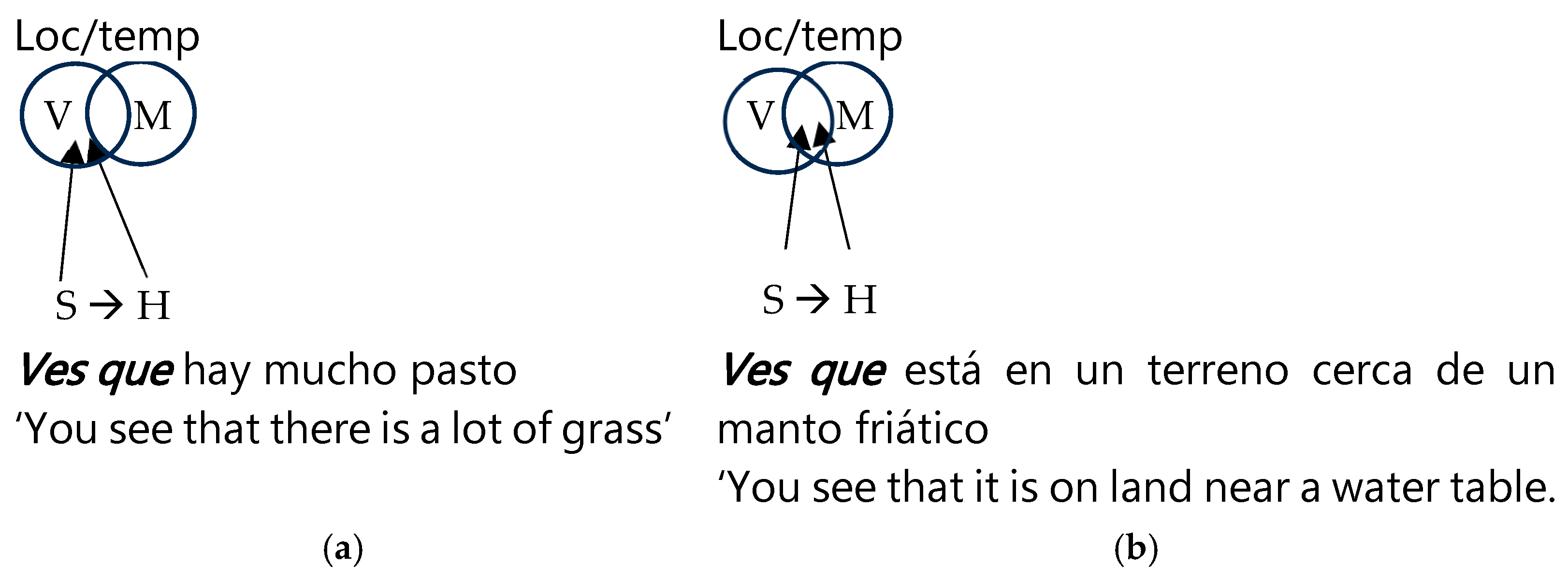
Figure 1a,b provide the schematic content of each construal. In both cases, the speaker has access to some source of (visual) information which they make available to the hearer by pointing at it:
To the extent that the hearer is present with the speaker before the object, the conceptualization is construed jointly by S and H. The evidential character of
ya ves que applies by default since the speaker calls for the hearer’s attention to construe the content of the proposition. This basic use corresponds to first-hand evidentials coming from direct observation or personal experience (
Willett, 1988). Now, as the referent bleaches out, the speaker’s credibility will become more determinant, and the evidential value of the construction will become more prominent.
Figure 1b corresponds to cases where the input may or may not be visual, and yet it is already construed based on common knowledge.
The visual input may be absent altogether in such a way that the referent can only be construed through shared knowledge. The speaker presents the utterance assuming that the hearer knows what he is referring to. From previous experience, the hearer is supposed to have seen the people’s behavior at the saloon in (19) or may have attested that ‘her mother’ does not speak to anyone, as shown in (20):
| (19) | porque ya ves que en ese salón güey todos lo mencionaban ¿no güey? |
| | ‘Because you see that in that room, dude, everyone mentioned it, right, dude?’ (AMERESCO-CDMX) |
| (20) | su mamá ya ves que no le hablaba a nadie ni a nosotros |
| | ‘your mom, you see, didn’t talk to anyone, not even to us’ (AMERESCO-CDMX) |
A subtle extension of
ya ves que can respond to cases where the speaker is not sure that the hearer is familiar with the content of his utterance. Instead of being based on shared knowledge, the speaker attempts to create a common ground, and the utterance is introduced as if its content were already shared. Here, the evidential properties of the construction are determinant. The hearer is supposed to accept the validity of the utterance based on the speaker’s assessment, as they validate the proposition’s truthfulness (21–22). This crucial feature equates with the core properties of firsthand evidentials (
Willett, 1988;
Aikhenvald, 2004).
| (21) | ah sí ya ves que te dije ¿sí te dije no? |
| | ‘Oh yes, you see that I told you, I did tell you, didn’t I?’ (AMERESCO-CDMX) |
| (22) | porque ya ves que la esta Linda su hermana- ¡su hermana!- su novia del ((wey))/ |
| | ‘Because you see that Linda her sister is—her sister!—her ((dude))’s girlfriend/’ (AMERESCO-CDMX) |
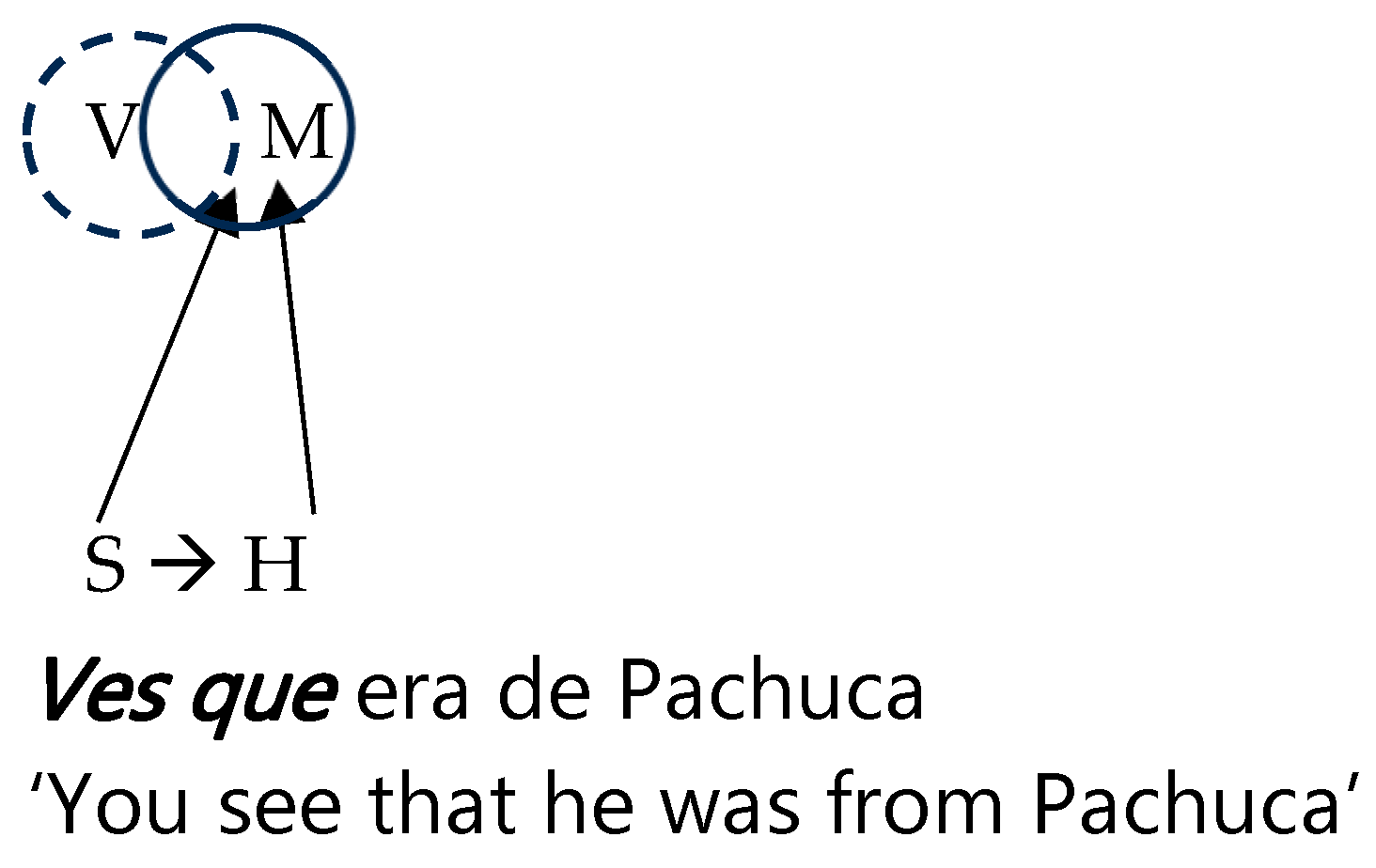
Figure 2 provides the schematic representation of shared knowledge. It can be observed that the deictic basis for the construal remains constant. Yet in the lack of any visual input, pointing is abstract as the speaker demands the hearer to retrieve information assumed to be common for the interlocutors:
More extreme situations correspond to rhetorical cases where
ya ves que is used to introduce new information, making it sound as well-known and familiar to anyone, including the hearer:
| (23) | A: <risas> el otro día me metí a un grupo de facebook de numismática primo, ya ves que dicen que los de cinco centavos valen mucho dinero ahora |
| | C: y este ¿qué te iba a decir? |
| | A: mi abuela tiene… |
| | ‘A: <laughs> The other day I joined a numismatics Facebook group, cousin//you see they say that five-cent coins are worth a lot of money now (AMERESCO-CDMX) |
| (24) | ¿ves que luego en las tiendas hay como muñecas-? |
| | ‘You see that then in the stores there are like dolls-?’ (AMERESCO-CDMX) |
This use is reminiscent of hearsay evidential markers, where the information being presented is shared in the community, with no specific supporting source of information (
Willett, 1988;
Aikhenvald, 2004). As represented in
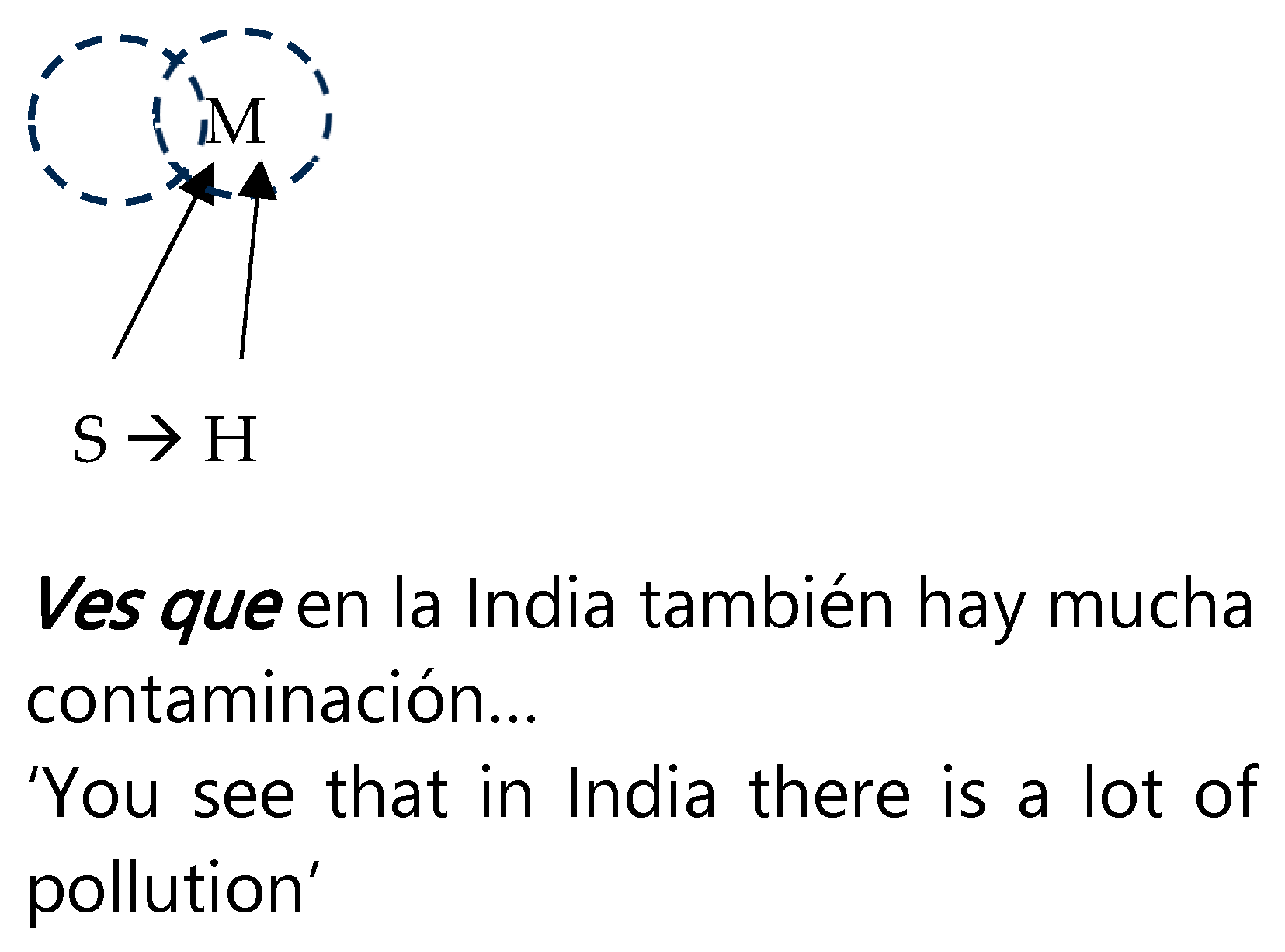
Figure 3, no information is actually shared, and yet it is presented as common knowledge. It is a fictional representation by which the speaker invites the hearer to see some event or situation as already shared:
The data presented so far suggests a transparent cognitive path, wherein a testimonial form develops evidential values as the concrete referent vanishes from the scene and its validity depends more and more on (i) the deictic properties of the construction and (ii) the validation imposed by the speaker on the hearer (as it pertains to a verb of perception used in the second person).
The gradual loss of perceptible referents licensing evidential values can be seen in
Figure 1a,b,
Figure 2 and
Figure 3. The circles in all figures represent the
Visual and
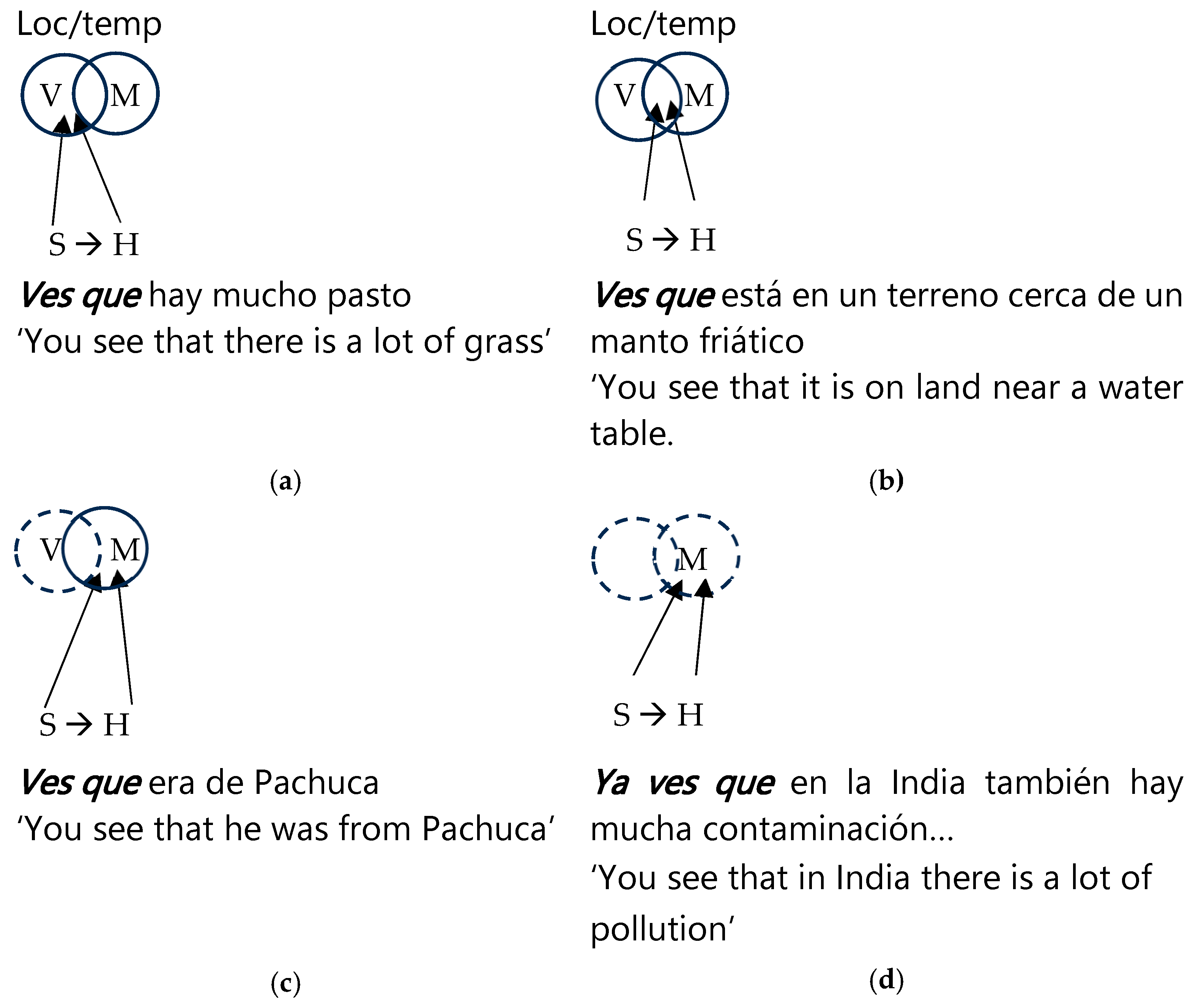
Mental fields coexistent in verbs of perception, and the arrow from S to H represents the S’s call for H’s joint attention. The path from
Figure 4a–d corresponds to a well-known bleaching process by which the visual field involves locative-temporal fields that naturally extend to mental arenas since the visual source gradually dilutes: Visual and Mental representations easily overlap. This overlay sets the base for the concrete referent to bleach out, leading to mental representations shared by the interlocutors, as represented by the M circle in
Figure 4c. Now, the construction may extend to cases where the use of
ya ves que creates a mutual space in which the new information being conveyed (the dotted circle) is presented as if both interlocutors already shared it, as shown in
Figure 4d.
The common mental space being created (
Figure 4d) sets the basis for further pragmatic developments to be considered in the next section.
3.2. Rhetorical Narrative
Once the rhetorical function is activated, we have a basis for the development of many of the pragmatic readings reported in previous studies. In all cases, the speaker creates a mental space into which the hearer is brought so that
Speaker and
Hearer share the S’s point of view:
| (25) | B: ahorita <entre risas>no no<entre_risas> no estoy pensando en eso |
| | A: ni le muevo |
| | B: <risas> no es que no estoy pensando en eso |
| | A: noooo pero está mejor que ya le arregles lo de triciclo mejor |
| | B: sí pus es que ya ves que con el triciclo es un gran apoyo tanto tanto para todos <risas> |
| | A: para todos… para todos y ahí me incluyo |
| | ‘B: right now <laughter> no no<laughter> I’m not thinking about that |
| | A: I don’t even talk about it |
| | B: <laughter> it’s not that I’m not thinking about that |
| | A: nooooo but it’s better if you fix the tricycle, better |
| | B: yes well, you see that with the tricycle it’s a great support so much so much for everyone <laughter> |
| | A: for everyone for everyone and I include myself’ (AMERESCO-CDMX) |
In (25), B’s opinion is not expressed neutrally. The use of
ya ves que demands the hearer to reach the same ironic conclusion, an ironic conclusion that anybody in their right mind should laugh at. To the extent that emotional agreement is also present, we suggest that the construction also involves empathy. As we will show, this phenomenon may be inherited from the empathic use we have been able to find since the 17th century. More obvious are uses involving opinions and attitudes where the hearer is supposed to undertake the Speaker’s position:
| (26) | En un palco estaba el General Díaz, ora ya ves que importante se ve en los periódicos desde que es presidente, en persona me parecio un pinacatillo vestido de uniforme |
| | ‘In the box of honor was General Diaz, now you see how important he looks in the newspapers since he became president, in person he seemed to me like a pinacate bush dressed in uniform’ (1999) González, Eladia Quién como Dios (AMERESCO-CDMX) |
To the extent that the speaker brings the hearer into a common dominion, several pragmatic nuances can be activated in the discourse space. Attenuation, as observed by
Guillén (
2021), is, of course, an expected outcome:
| (27) | B: pues si no soy la novia del/del <entre risas> Julián <entre_risas> |
| | A: no pero pero sí dijo lo de esta chava pero pus a ver a ver qué pasa porque ya ves que la esta Linda su hermana—¡su hermana!—su novia del wey ya no está tatuando creo que sí se separó, pues ya no sé qué se tatuó |
| | B: ya ves que es borracha estaba diciendo ah porque pues tú ahí también estás y te dicen y tú dices que sí y, y luego ya nomás te dejan así como que nada más son pinches habladores |
| | A: pues sí |
| ‘(27) | B: Well, if I’m not the girlfriend of of <laughs> Julián <laughs> |
| | A: No, but. But he did say about this girl. But let’s see Let’s see what happens Because you see how pretty her sister is—her sister!—his girlfriend of dude She’s not tattooing anymore. I think she broke up. Well, I don’t know what she got tattooed |
| | B: You see she’s a drunkard I was saying ah because. Well, you’re there too and they tell you and you say yes and. And then they just leave you like that. They’re just fucking talkers |
| | R: Well, yes (AMERESCO-CDMX) |
The statements that Linda is somebody’s girlfriend and that some girl is a drunkard are accusations attenuated by the fact that they are presented as established common knowledge, which the hearer is expected to accept. The harshness implicit in the utterance is diminished by the joint conceptualization imposed by the pragmatic marker, making it easier to acknowledge the speaker’s judgment. We may wonder about the consequences of negating such common ground.
3.3. Negation
The presence of common knowledge has already been presented as corresponding to the deictic nature of the construction. We show now that this phenomenon is stressed by negation. With
no ves que (‘don’t you see that’), not only is the content of the proposition shared by the interlocutors, but it is presented as information the hearer should already know. This is, in fact, a constructional extension involving a rhetorical question by which the speaker imposes on the hearer the responsibility of knowing the content of the proposition beforehand. Mirativity encodes a speaker’s attitude towards a proposition as representing new, unexpected or surprising information in an utterance (
DeLancey, 1997). To the extent that the hearer ignores information that they should have, the use of
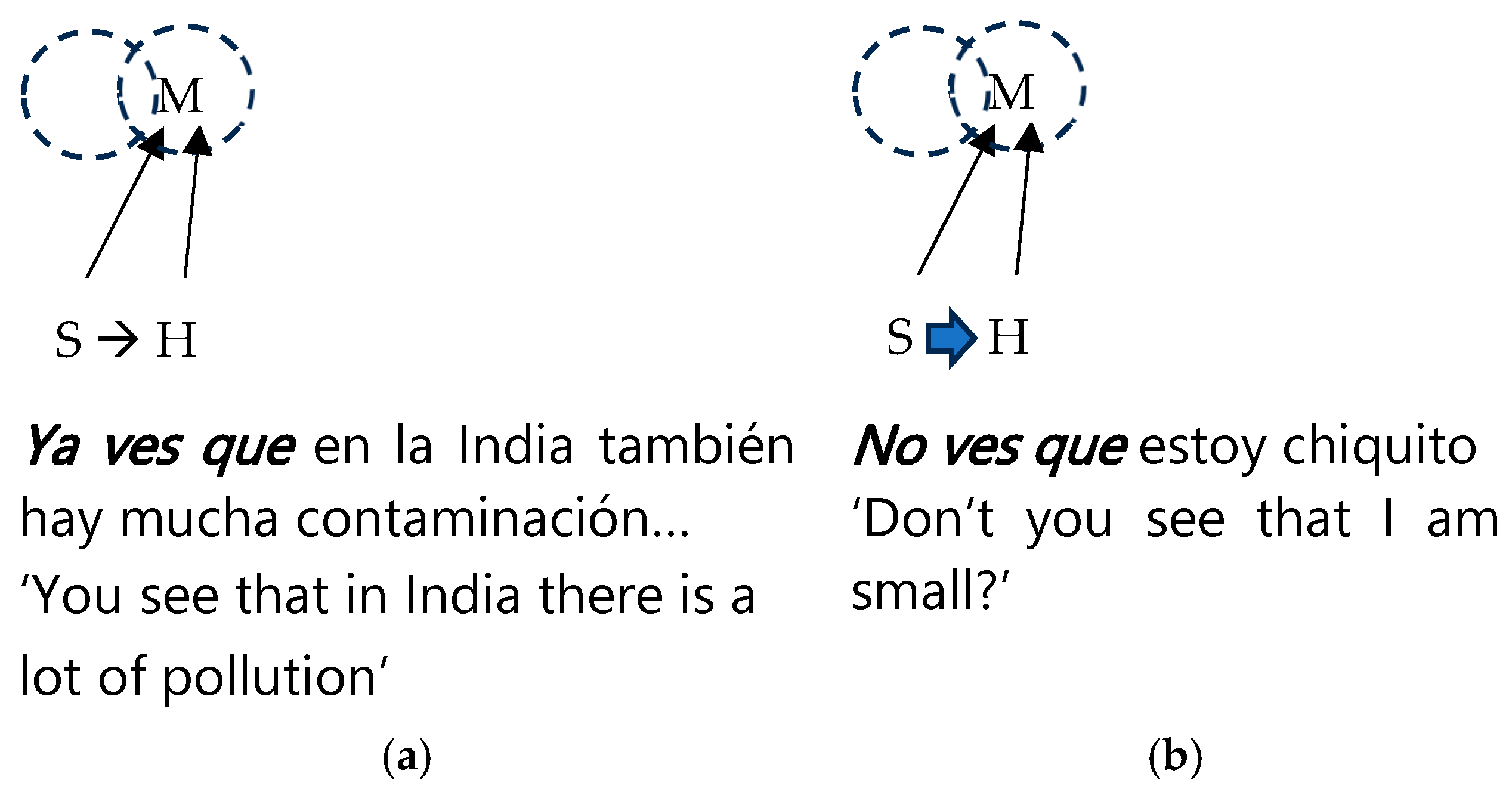
no ves que responds to mirative values: it is against all normal expectations that the interlocutor does not have the relevant information at hand. The polar construction as a whole contrasts with
ya ves que. This can be seen by the fact that
ya and
no are mutually exclusive:
| (28) | * No ya ves que resolví el problema |
| (29) | * Ya no ves que resolví el probelma |
Clearly, no is not a verbal phrase modifier but pertains to a negative mirative construction contrasting with the evidential values of ya ves que. Example (29) may be grammatical if ya is adverbial and has scope over the verbal phrase, but of course, this leads to a different interpretation equivalent to ‘you don’t see any more that I solved the problem’. We conclude that ya in (29) is not part of the ya [no ves que] construction.
No ves que presupposes that the hearer should be blamed for not having the information being referred to in the following interaction:
| (30) | A: ¿el padre? |
| | B: noooo eh/a Fabio… Fabio |
| | A: eh |
| | B: pues sí, no ves que ponen un representante a cada grupo |
| | A: mmm ya |
| | B: dijo “y se murió”dijo “y “ora”… “pusieron otro” dijo |
| | A: ay que no lo pongan a él |
| | ‘A: The father? |
| | B: Noooo eh/am Fabio… Fabio |
| | A: eh |
| | B: Well yes, don’t you see that they put a representative for each group? |
| | A: mmm OK |
| | B: He said “and he died” he said “and now they put another one” he said |
| | A: Oh, I hope they don’t put him’ (AMERESCO-CDMX) |
The speaker assumes the hearer should know that all groups must have a parent representing the students’ interests, and this justifies making such a bad choice as Fabio.
Negative polarity can further be extended to ratify that some information was already on the floor and that it should be accepted as valid by the participants in the current discourse:
| (31) | B: pero la cocina siempre ha sido había sido no sé ahorita ya si este Paco la haya dejado como antes |
| | A: no ya no, no ya no ¿no ves que dijeron? ustedes mismos cuando fueron que yo ya no fui que ya la había tirado |
| | ‘B: but the kitchen has always been had been, I don’t know now if this Paco has left it as it was before |
| | A: no, no, no, no, no, don’t you see what you said yourselves? when you left that I was no longer there that I had already thrown it away (AMERESCO-CDMX) |
The next predictable development for
no ves que is a coined expression operating as a scold. This well-established use has become viral, as a meme and, further, as an electronic game. The construction is typically completed by some pejorative expression designating stupidity (tonta, ‘fool’; babosa, ‘dumb’; estúpida, ‘stupid’):
The implication for (32) is that the old woman is not being considerate of the disadvantage of the little boy (a kitty in the meme). She should control herself to avoid taking advantage of the kid. The scold is the predictable extension deriving from the construction since it suggests that some information should be part of the floor, as in (30–32). The construction implies that lacking well-established knowledge leads to incorrect behavior, and this should, somehow, be reprimanded.
Notice that all along the development of the pragmatic meanings analyzed so far, the deictic profile of the base remains active. It always points out things that the speaker and the hearer, either visually or mentally, should have in their shared dominion. The negative construction also keeps the deictic value of previous expressions. Even more so if the interlocutor fails to see what is in front of their eyes/mind. Ignorance deserves to be scolded. The difference between the rhetorical
ya ves que in
Figure 5a and the negative
no ves que is the stress the negative construction, encoded as a rhetorical question, imposes on the hearer as a requirement for the information to be already activated. This is indicated by the thick horizontal arrow from S to H in
Figure 5b.
The schematic figures are provided to stress three observations: (i) the validity of the cognitive development from referential to pragmatic meanings; (ii) the preservation of the basic schema all along the bleaching process as a deictic instruction making shared contact with some concrete or abstract referent; and (iii) the presence of a crucial inverse process where as the visual or conceptual referential content diminishes, the assumed information increases in the interlocutors mind, even in cases where the traceable content is not visible or notable from the context.
As previously mentioned, the pattern evolves from cases where the speaker invites the hearer to look at some object the speaker has already seen and invites the hearer to establish common visual contact with it, as in
Figure 4a. The physical referent is gradually diluted to more abstract representations, and the deictic operation becomes more mental as the schema changes from
Figure 4a–c. The rhetorical use in
Figure 4d corresponds to cases where the referent is not present for the hearer. In this case, the speaker creates a fictive space to invite the hearer to validate the speaker’s assessment. Finally,
Figure 5b corresponds to a polar construction where the hearer is negatively marked by lacking the information they should have.
The cognitive process just outlined shapes crucial ideas suggested in previous invaluable studies. First, the intersubjective character of the construction is granted by the deictic nature of the construction. Speaker and hearer are to co-construe a compatible image. Second, the empathic guidance and the powerful position of the speaker with respect to the hearer is also granted (
Marcos Sánchez, 2016) by the speaker’s call on the hearer. Moreover, while the updating function observed corresponds to the deictic nature of
ves que, the anchoring property is encoded by
ya (
Hernández Páez, 2019). This suggests that while being fixed, the construction is still partially compositional. As per our hypothesis, the construction creates a fictive discourse space where information is seen as shared and is validated to be considered more prominent. We undertake
Guillén’s (
2021) assessment that profiling information is more relevant than retrieving shared information. This depends fundamentally on the speaker’s intersubjective validation of the event. Crucially, however, the move from testimonial to evidential and then to epistemic values depends on the quality of the referent. The bleaching process of the referential source determines the emergence of shared knowledge. This, taken to the extreme, allows for the intersubjective profile of the construction to validate fictive information assumed as existing shared knowledge, even when such information is new to the hearer. The incremental presence of the conceptualizer seems to correspond to a well-entrenched cognitive process of intersubjectification, where, as the referential content is bleached, the subjective validation of the conceptualizer increases (
Langacker, 1990,
2002). Moreover, the reinforcement of
ya anchors the value of the proposition to the speech event and validates the speaker’s assessment. Given this process, the pragmatic meanings identified in the literature are predictable. We have suggested that the core function of the construction is to create a mental space into which the hearer is brought so that S and H share the speaker’s point of view. The speaker’s demand for sharing a viewpoint determines the emergence of a set of pragmatic nuances: justification and confirmation of an assertion, reinforcement of a previous assessment, agreement concerning some judgment or criticism, validation of a viewpoint, discourse continuity and attenuation.
The conceptual evolution proposed so far has been backed up by synchronic facts. We may see now if diachronic data provide further details on the conceptual evolution of the pragmatic construction. We carry out such exploration in the following section.
5. Conclusions
We have tried to show that ya ves que is a deictic marker that operates both in space and discourse. Its basic configuration involves a deictic maker where the speaker invites the hearer to fix his/her attention on a referent the speaker has already identified. The purpose is to establish a common conceptualization of such a referent. Empathy is thus a fundamental component of the construction. The loss of concrete visual content allows for the emergence of pragmatic values, as the speaker’s point of view emerges. The concrete property of a visual conceptualization gradually dissolves, allowing a visual/mental construal that naturally evolves into a mental representation. Since the hearer has no direct access to the referent, the construction undertakes evidential values as being called upon by the speaker. At the first level, the form mirrors a testimonial evidential, encoding firsthand information. Its strength depends on both the validation offered by the speaker and the assumption of common knowledge, granting mutual recognition of the referent. As referential content dilutes, shared knowledge decreases; thus, the validity of the deictic identification of the content being referred depends more and more on the presence of a created space into which the hearer is brought to adopt the speaker’s view. When no common knowledge exists, ya ves que allows for the creation of a fictive space where the hearer is supposed to assume the information being conferred by the speaker as valid. The last step evolving from such a basic schema comes from an alternative negative construction. Should the hearer ignore the content of the proposed utterance, they should be put in question and even deserve to be scolded. The mirative value of no ves que takes place since one is supposed to see and know the frames and social values established by either the community or the relevant context. Failure to do so may result in treating the listener as being wrong.
In line with
Hernández Páez (
2019) and
Guillén (
2021), we propose that
ya ves que introduces information as shared knowledge. Yet the real presence of such information may be diluted to the extent that it needs to be created in a mental space. For narrative and dialogical purposes, the construction creates a space in which the hearer is brought in to share the speaker’s view of things which the interlocutor may not know.
Ya ves que covers a rhetorical function of granting discourse continuity. On another level, it allows a variety of pragmatic overtones associated with empathy: the speaker may justify an opinion or attenuate controversial assessments. Negation, in the
no ves que construction, strengthens the requirement for shared knowledge in interaction. The validity of an assertion is backed up by negative polarity. Things are validated based on information the hearer should have. This, taken to the extreme, can be used to scold somebody’s ignorance.
Many semantic components of the construction may be lost, particularly the objective content, but the deictic properties must remain to warrant a common view. What we lose in the concrete world is retrieved in the intersubjective interaction (
Langacker, 1990). The cognitive process just outlined is confirmed by diachrony. What we have attested is a gradual decrease in testimonial values and an increase in pragmatic ones. While the rhetorical uses have already been present since the 16th century, they are dependent upon testimonial experience and personal emotions. As the referential dependency decreases from the 19th century, shared knowledge emerges as a relevant conceptualization. An assessment may be valid when its content is part of shared knowledge. As the intersubjective view increases, common knowledge loses relevance; a fictive space, in the voice of the speaker, is created for validating purposes, leaving aside the referential soundness of the content and letting the speaker be the reliable source where things are accepted, an unquestionable evidential value. The pragmaticalization process in the evolution of
ya ves que creates common universes that grant the interlocutor’s consensus. It is worth making a statement, as long as the conceptualization is shared, either in real or in fictional spaces.