Article

Secrecy Energy Efficiency Maximization for RSMA-UAV Assisted Communications with Cooperative Jamming

1
The 54th Research Institute of China Electronics Technology Group Corporation, Shijiazhuang 050081, China
2
School of Information and Communication Engineering, Dalian University of Technology, Dalian 116024, China
*
Author to whom correspondence should be addressed.
Aerospace 2026, 13(5), 485; https://doi.org/10.3390/aerospace13050485
Submission received: 8 April 2026 / Revised: 29 April 2026 / Accepted: 16 May 2026 / Published: 21 May 2026

Abstract

In this paper, we investigate secrecy energy efficiency (SEE) maximization in a rate-splitting multiple access (RSMA)-enabled UAV communication system, which consists of a communication UAV serving legitimate ground users (GUs) and a cooperative jamming UAV transmitting jamming signals to degrade the channel of the eavesdropper (Eve). Taking into account the propulsion energy consumption of fixed-wing UAVs, we formulate a non-convex SEE maximization problem by jointly optimizing communication scheduling, CUAV transmit power, and the trajectories of both UAVs. To tackle the non-convex problem, an iterative optimization algorithm combined with the Dinkelbach method and successive convex approximation (SCA) is developed to obtain a suboptimal solution. Simulation results demonstrate the convergence of the proposed algorithm and show the proposed joint optimization scheme significantly improves SEE compared with benchmark schemes.

1. Introduction

Unmanned aerial vehicles (UAVs), with advantages such as high mobility and low cost [1,2,3,4,5], have become a promising technology in various fields, including emergency communications and integrated sensing and communication (ISAC) [6]. In particular, UAV communication systems enable flexible deployment, making them well-suited for providing communication services in infrastructure-limited environments. However, since the communication between the UAV and the ground users (GUs) relies on line-of-sight (LoS) channels, the UAV communication system is vulnerable to eavesdropping [7,8,9]. Consequently, security issues in UAV communication systems have become an important research direction. Unfortunately, conventional encryption techniques usually incur high computational complexity and energy consumption, which may not be suitable for UAV systems [10]. The application of physical layer security (PLS) in UAV communications has attracted great attention in recent years [11].
It is necessary to design effective UAV trajectories and resource allocation strategies to reduce the impact of the eavesdropper (Eve) on UAV communications. In [12], Zhang et al. consider a UAV communication system that includes both UAV-to-ground and ground-to-UAV transmission scenarios in the presence of a potential Eve. The secrecy rate maximization problems are formulated by jointly optimizing the UAV trajectory and transmit power. In [13], Cai et al. propose a dual UAV secure communication system in which one UAV communicates with GUs and the other jams the Eves, and the minimum secrecy rate of the GUs is maximized by jointly optimizing user communication scheduling and UAV flight trajectory. In [14], Zheng et al. investigate a UAV-enabled secure communication system with multiple users and Eves under no-fly zone constraints. By jointly transmitting information signals and artificial noise (AN), the system enhances physical layer security. A non-convex optimization problem is formulated to maximize the minimum average secrecy rate among users. In [15], Chen et al. propose a reconfigurable intelligent surface (RIS)-assisted UAV swarm NOMA communication system, where the Coordinated Multipoint technique is adopted to effectively suppress intercell interference for all users. The secrecy rate is maximized through joint optimization of UAV trajectories, power allocation, and RIS reflection coefficients.
Rate-splitting multiple access (RSMA) has emerged as a promising candidate multiple access scheme for 6G [16]. It can achieve performance gains in terms of sum rate [17,18], energy efficiency [19], user fairness [20], and other performance metrics compared with conventional multiple access schemes.Benefiting from its novel structure and effective interference management capability, RSMA introduces both new opportunities and challenges for securing communications at the physical layer [21]. Fu et al. consider a two-user multi-input single-output (MISO) RSMA secure communication system under imperfect CSI of Eve. A robust secure beamforming scheme is proposed to maximize the minimum worst-case user secrecy rate [22]. Xia et al. investigate security issues in RSMA communication systems under various scenarios. Ref. [23] studies RSMA-based secure beamforming design in multi-user scenarios, where every user tries to eavesdrop on other users’ private streams. A weighted sum-rate maximization problem under secrecy constraints is formulated and solved via a successive convex approximation (SCA) based iterative algorithm. Ref. [24] examines the impact of AN on the PLS performance of RSMA-based communication systems. A max–min fairness problem with secrecy constraints is formulated. Results show that the use of AN improves the spectral efficiency of the system while satisfying security requirements. Zhao et al. propose an RSMA-enhanced PLS scheme for ISAC systems. To enhance the performance of the system while maintaining security, an optimization problem to maximize the communication-sensing weighted secure sum rate is established by optimizing the precoding matrix and common rate [25]. Additionally, recent studies have further extended RSMA to UAV communication systems. Jaafar et al. propose an RSMA-based UAV communication system. A joint optimization problem involving UAV placement, beamforming, and common rate allocation is formulated to maximize the weighted sum rate of users. An alternating optimization algorithm is proposed to solve the original non-convex problem [26]. Liu et al. investigate an RSMA-based UAV-assisted Internet of Things (IoT) system, where a UAV serves multiple ground nodes. The system energy efficiency is maximized by jointly optimizing user scheduling, UAV trajectory, and beamforming while meeting constraints such as user rate requirements [27].
Introducing RSMA into PLS for UAV-assisted communications has attracted considerable research attention. In [28], Liu et al. propose an RSMA-based dual-UAV secure communication system, where one UAV serves GUs and another transmits jamming signals to an Eve. By jointly optimizing RSMA precoding and UAV trajectories, the minimum secrecy rate is optimized. In [29], Bastami et al. investigate a UAV-assisted cellular system based on CRS with imperfect channel state information (CSI) and an external Eve. A robust resource allocation scheme is proposed to maximize the minimum worst-case secrecy rate. In [30], Ouamri et al. study the enhancement of secure quality-of-experience in UAV-assisted multiuser RSMA networks with the secrecy constraints. The aggregate mean opinion scores (MOSs) of users are maximized by optimizing beamforming, rate allocation, and UAV trajectory jointly. In [31], Zhou et al. investigate the secrecy performance of RSMA-aided satellite–aerial–vehicle integrated networks (SAVIN) under a non-ideal hardware condition. A general system model with a satellite, multiple UAV relays, and non-colluding eavesdroppers is developed. Closed-form and asymptotic expressions for secrecy outage probability of the system are derived. Furthermore, secrecy energy efficiency (SEE) is also analyzed. In [32], Wu et al. study an SEE maximization problem in cognitive satellite–aerial–terrestrial integrated networks (SATINs). Specifically, they integrate RSMA and RIS into a UAV-assisted secondary network with multiple Eves while considering imperfect CSI with bounded estimation error. A deep reinforcement learning (DRL) algorithm based on long short-term memory proximal policy optimization (LSTM-PPO) is proposed to jointly optimize the beamforming, RIS phase shifts, and power splitting ratio.
In particular, SEE is of great practical importance for UAVs. SEE jointly considers secure performance and propulsion energy consumption. For the fixed-wing UAV, propulsion energy consumption is strongly coupled with UAV flight trajectory, velocity, and acceleration, making the optimization problem highly challenging. To the best of our knowledge, the joint optimization of RSMA-based communication resource allocation and the trajectories of UAVs to maximize SEE under the fixed-wing propulsion energy consumption model has not yet been fully investigated.
Motivated by these observations, this paper studies a secrecy energy efficiency (SEE) maximization problem for an RSMA-enabled UAV (RSMA-UAV) communication system. The main contributions are summarized as follows:
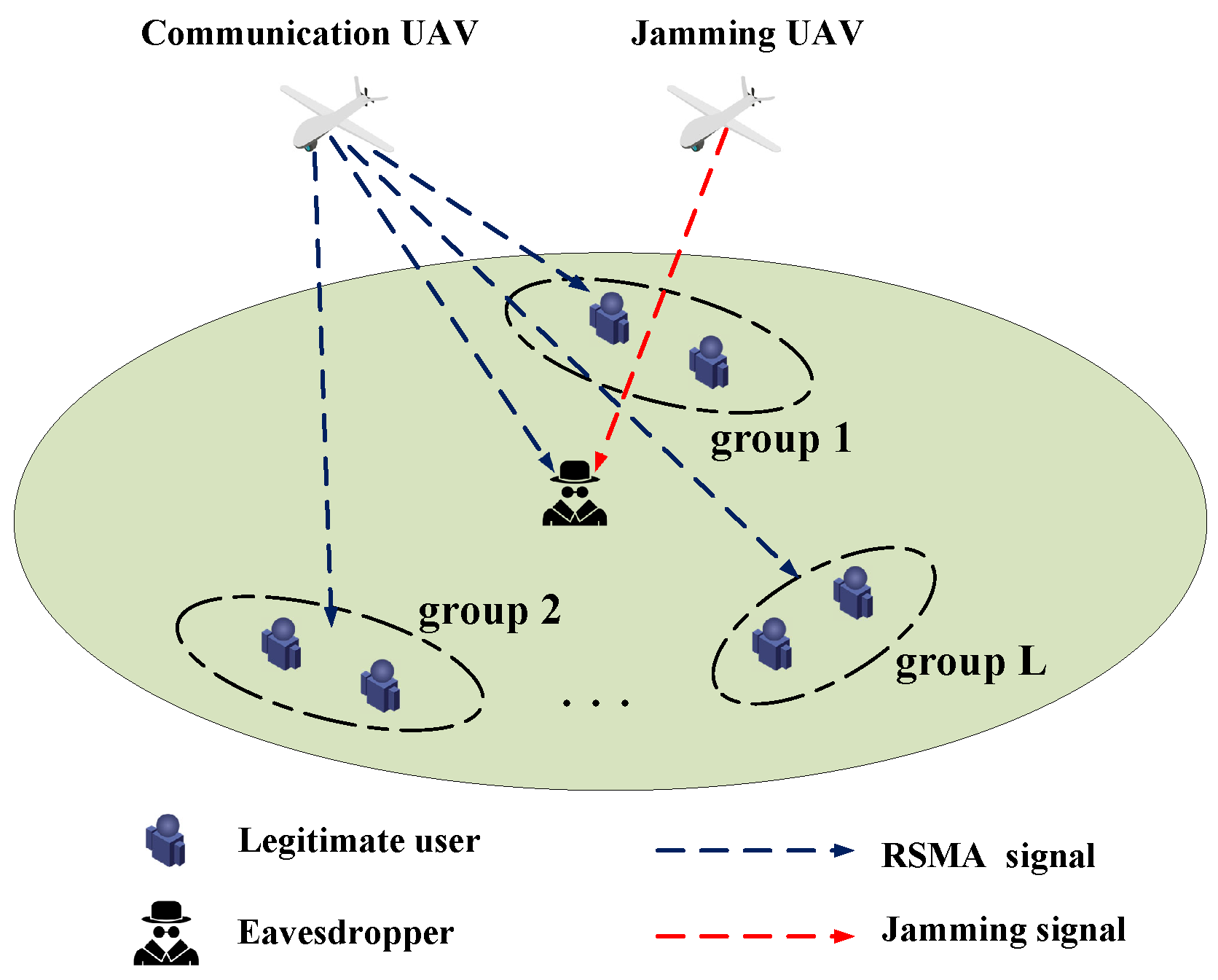
  • We establish a secure RSMA-UAV communication system, where one communication UAV (CUAV) can simultaneously establish RSMA communication links with two legitimate GUs, while a cooperative jamming UAV (JUAV) transmits interference to a ground eavesdropper (Eve), and formulate an SEE maximization problem.
  • To solve the non-convex problem, a block coordinate descent (BCD) method is adopted to decompose it into communication scheduling, CUAV transmit power allocation, JUAV trajectory, and CUAV trajectory optimization subproblems. An iterative algorithm based on the Dinkelbach method and SCA is developed to obtain the locally optimal solution.

2. System Model and Problem Formulation

2.1. System Model

Consider an RSMA-UAV communication system model as shown in Figure 1, where K legitimate GUs and an eavesdropper (Eve) are distributed within the target area. To improve the QoS in the RSMA group, the legitimate GUs are paired and divided into L groups by the K-means method [33], where L = K / 2 . The ith GU in group l can be denoted as G U l , i , where l = 1, 2…, L and i = 1, 2. The position coordinates of G U l , i and Eve can be expressed as q l , i = { x l , i , y l , i , 0 } and q e = { x e , y e , 0 } = { 0 , 0 , 0 } , respectively. One CUAV is used to establish an RSMA link with the legitimate GUs. A JUAV is deployed to transmit artificial jamming signals to interfere with Eve. We assume that GUs can perfectly cancel the jamming signal of the JUAV from the received signal. Both UAVs periodically fly above the target area with a task period of T. And the fixed flight height is H. For ease of analysis, we divide the UAV task period T into N time slots, i.e., T = N δ t , where δ t is the length of one time slot. Hence, the flight trajectory of CUAV and JUAV can be denoted as q c ( n ) = { x c ( n ) , y c ( n ) , H } and q j ( n ) = { x j ( n ) , y j ( n ) , H } , where n = 1 , 2 , , N .
We assume that the channels between the UAVs and the GUs as well as the Eve are LoS links, i.e.,
h l , i ( n ) = β 0 d l , i 2 ( n ) = β 0 q c ( n ) q l , i 2 , n , l , i
h e ( n ) = β 0 d e 2 ( n ) = β 0 q c ( n ) q e 2 , n
h j ( n ) = β 0 d j 2 ( n ) = β 0 q j ( n ) q e 2 , n
where h l , i ( n ) , h e ( n ) , and h j ( n ) denote the channel power gains between CUAV and G U l , i , CUAV and Eve, and JUAV and Eve in the n-th time slot. And β 0 denotes channel power gain at the reference distance d 0 = 1 m. During the flight period, the UAVs should satisfy the following kinematic constraints:
q U ( 1 ) = q U ( N )
v U ( 1 ) = v U ( N )
v U ( n + 1 ) = v U ( n ) + ρ U ( n ) δ t , n
q U ( n + 1 ) = q U ( n ) + v U ( n ) δ t + 1 2 ρ U ( n ) δ t 2 , n
where U { c , j } denotes the CUAV or JUAV, and v U ( n ) , and ρ U ( n ) are the speed and acceleration of the UAVs in the n-th time slot, respectively.
To avoid inter-group interference, we assume that the CUAV can only provide communication services to one RSMA group at a time slot. And a binary scheduling variable a l ( n ) is introduced. If the CUAV serves the l-th group in the n-th time slot, a l ( n ) = 1 ; otherwise, a l ( n ) = 0 . Hence, a l ( n ) should satisfy the following constraints:
a l ( n ) { 0 , 1 } , n , l
l = 1 L a l ( n ) 1 , n
In the RSMA downlink, the information transmitted to the ith GU in the l-th group can be expressed as W l , i ( n ) . It can be divided into common part W c , l , i ( n ) and private part W p , l , i ( n ) . The common part W c , l , i ( n ) of two GUs in one RSMA group is combined into one common message W c , l ( n ) , which is then encoded into the common stream s c , l ( n ) . The private part W p , l , i ( n ) is encoded into the private stream s p , l , i ( n ) [18]. Then, the transmitted signal s l ( n ) of the CUAV is expressed as  
s l ( n ) = p l , c ( n ) s c , l ( n ) + i = 1 2 p l , i ( n ) s p , l , i ( n ) , n , l
where p l , c ( n ) is the transmit power for the common stream s c , l ( n ) in the n-th time slot, and p l , i ( n ) is the transmit power for the private stream s p , l , i ( n ) in the n-th time slot.
At the receiver of G U l , i , the common stream is decoded first. The achievable rate of the common stream for G U l , i is given by
R c , l , i ( n ) = log 2 1 + h l , i ( n ) p l , c ( n ) h l , i ( n ) m = 1 2 p l , m ( n ) + σ 2 , n , l , i
where σ 2 is the noise power. And the private streams are decoded after removing the common stream by successive interference cancellation (SIC). The achievable rate of the private stream for G U l , i is denoted as
R p , l , i ( n ) = log 2 1 + h l , i ( n ) p l , i ( n ) h l , i ( n ) m = 1 , m i 2 p l , m ( n ) + σ 2 , n , l , i
to ensure that all GUs can successfully decode the common stream s c , l ( n ) , the achievable rate of the common stream should satisfy R c , l ( n ) = min i R c , l , i ( n ) . For the Eve, the achievable rate of the common stream is expressed as
R c , l , e ( n ) = log 2 1 + h e ( n ) p l , c ( n ) m = 1 2 h e ( n ) p l , m ( n ) + γ j ( n ) + σ 2 , n , l
where γ j ( n ) = h j ( n ) p j t r and p j t r is the fixed transmit power of the JUAV. It is assumed that Eve cannot subtract the decoded common stream from the received signal. And the achievable rate of the private stream for G U l , i decoded by Eve is
R p , l , i , e ( n ) = log 2 1 + h e ( n ) p l , i ( n ) h e ( n ) p l , c ( n ) + m = 1 , m i 2 h e ( n ) p l , m ( n ) + γ j ( n ) + σ 2 , n , l , i
hence, the achievable secrecy rate of the G U l , i in the l-th group can be expressed as
R l , i , t o t sec ( n ) = R c , l , i sec ( n ) + R p , l , i sec ( n ) , n , l , i
where
R c , l , i sec ( n ) = λ i R c , l ( n ) R c , l , e ( n ) + , n , l , i
R p , l , i sec ( n ) = R p , l , i ( n ) R p , l , i , e ( n ) + , n , l , i
where [ x ] + = max x , 0 and λ i is a non-negative constant, and i = 1 2 λ i = 1 .
Considering the propulsion power for the fixed-wing UAV during the flight, the propulsion power consumption at each time slot can be modeled as [34]  
p U p r o ( n ) = κ 1 v U ( n ) 3 + κ 2 v U ( n ) 1 + ρ U ( n ) 2 g 2 , n
where the propulsion power coefficients κ 1 and κ 2 are the constants related to the UAV design, and g is the acceleration of gravity.

2.2. Problem Formulation

In order to improve the secrecy performance of the system and reduce the propulsion energy consumption of both the CUAV and the JUAV, we define the ratio of the sum secrecy rate of the GUs to the propulsion power consumption of the two UAVs as SEE, i.e.,
η = R s u m sec E U A V
where
R s u m sec = n = 1 N l = 1 L a l ( n ) i = 1 2 R l , i , t o t sec ( n )
E U A V = n = 1 N p s u m ( n )
where p s u m ( n ) = p c p r o ( n ) + p j p r o ( n ) , and p c p r o ( n ) , and p j p r o ( n ) denote the propulsion power of the CUAV and JUAV in the n-th time slot, respectively.
We define the communication scheduling as A = { a l ( n ) , n , l } , the CUAV transmit power as P = { p l , c ( n ) , p l , i ( n ) , n , l , i } , the CUAV flight trajectory as Q c = { q c ( n ) , v c ( n ) , ρ c ( n ) , n } and the JUAV flight trajectory as Q j = { q j ( n ) , v j ( n ) , ρ j ( n ) , n } . Accordingly, we formulate an optimization problem as follows:
max A , P , Q j , Q c η
s . t . a l ( n ) { 0 , 1 } , n , l
l = 1 L a l ( n ) 1 , n
p l , c ( n ) + i = 1 2 p l , i ( n ) P max , n , l
p l , c ( n ) , p l , i ( n ) 0 , n , l , i
q U ( n + 1 ) = q U ( n ) + v U ( n ) δ t + 1 2 ρ U ( n ) δ t 2 , n
v U ( n + 1 ) = v U ( n ) + ρ U ( n ) δ t , n
q U ( 1 ) = q U ( N )
d U A V 2 ( n ) d min 2 , n
v U ( 1 ) = v U ( N )
v min v U ( n ) v max , n
ρ U ( n ) ρ max , n
R c , l ( n ) R c , l , e ( n ) , n , l
R p , l , i ( n ) R p , l , i , e ( n ) , n , l , i
where (22d) denotes that the maximum communication power of the CUAV is limited, and P max is the maximum transmit power at each time slot; (22e) denotes that the transmit power of the CUAV are non-negative; (22i) denotes the collision avoidance requirement among UAVs, where d U A V ( n ) = q c ( n ) q j ( n ) denotes the distance between the UAVs and d min denotes the minimum distance between UAVs; (22k) and (22l) denote the constraints of the velocity and acceleration of the UAV, where v max , v min , and ρ max are the maximum UAV speed, minimum UAV speed, and maximum UAV acceleration; (22m) and (22n) denote the secrecy rate constraints of the common stream and private stream, respectively.

3. Solution Algorithm

Note that the problem (22) is a non-convex fractional programming (FP) problem. According to the BCD method, (22) is further decomposed into four sub-problems: communication scheduling optimization, CUAV transmit power optimization, JUAV trajectory optimization, and CUAV trajectory optimization.
By the Dinkelbach method [35], the objective functions of the problems can be transformed into
R s u m sec η E U A V
where η needs to be updated based on the optimized results obtained by solving the specified problem.

3.1. Communication Scheduling Optimization

We optimize the communication scheduling A by fixing the CUAV transmit power P , the CUAV flight trajectory Q c , and the JUAV flight trajectory Q j , which is given as
max A R s u m sec η E U A V
s . t . ( 22 b ) , ( 22 c )
Since the communication scheduling variable a l ( n ) is a discrete binary variable, the problem (24) cannot be solved directly by CVX. Therefore, we relax a l ( n ) to be a continuous variable as
0 a l ( n ) 1 , n , l
therefore, (24) is transformed into
max A R s u m sec η E U A V
s . t . ( 22 c ) , ( 25 )
It is obvious that (26) is convex, which can be solved by CVX. Since the solution is not binary, we need to transform it into a binary form. By setting the largest a l ( n ) to 1 and the rest to 0 at every time slot, we can obtain the solution of A .

3.2. CUAV Transmit Power Optimization

By fixing the communication scheduling A , the CUAV flight trajectory Q c , and the JUAV flight trajectory Q j , the optimization problem for the CUAV transmit power P is given as
max P R s u m sec η E U A V
s . t . ( 22 d ) , ( 22 e ) , ( 22 m ) , ( 22 n )
problem (27) is a non-convex problem. By introducing the variable r c ( n ) to replace R c , l ( n ) , we can expand R l , i , t o t sec ( n ) as follows   
R l , i , t o t sec ( n ) λ i r c ( n ) + log 2 h e ( n ) p l , 1 ( n ) + h e ( n ) p l , 2 ( n ) + γ j ( n ) + σ 2 + log 2 h l , i ( n ) p l , 1 ( n ) + h l , i ( n ) p l , 2 ( n ) + σ 2 + log 2 h e ( n ) p l , c ( n ) + h e ( n ) p l , m ( n ) + γ j ( n ) + σ 2 ϕ l , i , 1 ( n ) ϕ l , i , 2 ( n ) λ i + 1 , n , l , i , m i
where
ϕ l , i , 1 ( n ) = log 2 h l , i ( n ) p l , m ( n ) + σ 2 , n , l , i , m i
ϕ l , i , 2 ( n ) = log 2 h e ( n ) p l , c ( n ) + h e ( n ) m = 1 2 p l , m ( n ) + γ j ( n ) + σ 2 , n , l , i
and the following constraint should be satisfied
R c , l , i ( n ) r c ( n ) , n , l , i
And we get the upper bound of ϕ l , i , 1 ( n ) and ϕ l , i , 2 ( n ) by first-order Taylor expansion, i.e.,
ϕ l , i , 1 ( n ) ϕ l , i , 1 u b ( n ) = ϕ l , i , 1 ( o ) ( n ) + φ l , i , 1 ( n ) p l , m ( n ) p l , m ( o ) ( n ) , n , l , i , m i
ϕ l , i , 2 ( n ) ϕ l , i , 2 u b ( n ) = ϕ l , i , 2 ( o ) ( n ) + φ l , i , 2 ( n ) p l , c ( n ) + m = 1 2 p l , m ( n ) m = 1 2 p l , m ( o ) ( n ) p l , c ( o ) ( n ) , n , l , i
where ϕ l , i , 1 ( o ) ( n ) denotes the values of ϕ l , i , 1 ( n ) at the local point p l , m ( o ) ( n ) , φ l , i , 1 ( n ) is the first-order derivative of ϕ l , i , 1 ( n ) at the local point p l , m ( o ) ( n ) , ϕ l , i , 2 ( o ) ( n ) denote the values of ϕ l , i , 2 ( n ) at the local point p l , c ( o ) ( n ) , p l , m ( o ) ( n ) , and φ l , i , 2 ( n ) is the first-order derivative of ϕ l , i , 2 ( n ) at the local point p l , c ( o ) ( n ) , p l , m ( o ) ( n ) .
And for R c , l , i ( n ) , its lower bound can be expressed as
R c , l , i ( n ) = log 2 h l , i ( n ) p l , c ( n ) + h l , i ( n ) m = 1 2 p l , m ( n ) + σ 2 ϕ l , i , 3 ( n ) R c , l , i l b ( n ) = log 2 h l , i ( n ) p l , c ( n ) + h l , i ( n ) m = 1 2 p l , m ( n ) + σ 2 ϕ l , i , 3 ( o ) φ l , i , 3 ( n ) m = 1 2 p l , m ( n ) m = 1 2 p l , m ( o ) ( n ) , n , l , i
where ϕ l , i , 3 ( n ) = log 2 h l , i ( n ) m = 1 2 p l , m ( n ) + σ 2 , ϕ l , i , 3 ( o ) ( n ) denote the values of ϕ l , i , 3 ( n ) evaluated at the local point p l , m ( o ) ( n ) in the o-th iteration. And φ l , i , 3 ( n ) is the first-order derivative of ϕ l , i , 3 ( n ) at the local point p l , m ( o ) ( n ) in the o-th iteration. And the following constraints should be satisfied
R c , l , i l b ( n ) r c ( n ) , n , l , i
The non-convex constraint (22m) can be approximated as
r c ( n ) + log 2 h e ( n ) p l , 1 ( n ) + p l , 2 ( n ) + σ 2 + γ j ( n ) ϕ l , i , 2 u b ( n ) , n , l , i
And the non-convex constraint (22n) can be conservatively approximated as
log 2 h l , i ( n ) p l , 1 ( n ) + p l , 2 ( n ) + σ 2 + log 2 h e ( n ) p l , c ( n ) + p l , m ( n ) + σ 2 + γ j ( n ) ϕ l , i , 1 u b ( n ) + ϕ l , i , 2 u b ( n ) , n , l , i , m i
Hence, (27) is transformed into a convex optimization problem as
max P R s u m sec , l b η E U A V
s . t . ( 22 d ) , ( 22 e ) , ( 35 ) , ( 36 ) , ( 37 )
problem (38) can be solved by CVX, where R s u m , t o t sec , l b = n = 1 N l = 1 L a l ( n ) i = 1 2 R l , i , t o t sec , l b ( n ) . And R l , i , t o t sec , l b ( n ) is given as follows
R l , i , t o t sec , l b ( n ) = λ i r c ( n ) + log 2 h e ( n ) p l , 1 ( n ) + h e ( n ) p l , 2 ( n ) + γ j ( n ) + σ 2 + log 2 h l , i ( n ) p l , 1 ( n ) + h l , i ( n ) p l , 2 ( n ) + σ 2 + log 2 h e ( n ) p l , c ( n ) + h e ( n ) p l , m ( n ) + γ j ( n ) + σ 2 ϕ l , i , 1 u b ( n ) ϕ l , i , 2 u b ( n ) λ i + 1 , n , l , i , m i

3.3. JUAV Flight Trajectory Optimization

In this subsection, by fixing the communication scheduling A , the CUAV transmit power P and the CUAV flight trajectory Q c , we optimize the JUAV flight trajectory Q j as follows
max Q j R s u m sec η E U A V
s . t . ( 22 f ) , ( 22 g ) , ( 22 h ) , ( 22 i ) , ( 22 j ) , ( 22 k ) , ( 22 l ) , ( 22 m ) , ( 22 n )
By introducing variables y p , l , i , e j a m ( n ) , y c , l , e j a m ( n ) , β p , l , i , e j a m ( n ) and β c , l , e j a m ( n ) , the following constraints are obtained
log 2 ( 1 + e y p , l , i , e j a m ( n ) ) β p , l , i , e j a m ( n ) , n , l , i
log 2 ( 1 + e y c , l , e j a m ( n ) ) β c , l , e j a m ( n ) , n , l
which leads to the following constraints
e y p , l , i , e j a m ( n ) h e ( n ) p l , c ( n ) + h e ( n ) m = 1 , m i 2 p l , m ( n ) + σ 2 h e ( n ) p l , i ( n ) + β 0 p j t r h e ( n ) p l , i ( n ) d j 2 ( n ) , n , l , i
e y c , l , e j a m ( n ) h e ( n ) m = 1 2 p l , m ( n ) + σ 2 h e ( n ) p l , c ( n ) + β 0 p j t r h e ( n ) p l , c ( n ) d j 2 ( n ) , n , l
Due to the presence of the term 1 / d j 2 ( n ) , (43) and (44) are non-convex. At the o-th iteration, given a local point d j ( o ) 2 ( n ) , we apply first-order Taylor expansion to construct a convex lower bound of 1 / d j 2 ( n ) as
1 d j 2 ( n ) 1 d j ( o ) 2 ( n ) 1 d j ( o ) 2 ( n ) 2 d j 2 ( n ) d j ( o ) 2 ( n ) = Γ j ( o ) ( n ) ,
where d j ( o ) = q j ( o ) ( n ) q e is the local point in the o-th iteration.
(43) and (44) can be expressed in the following form
e y p , l , i , e j a m ( n ) h e ( n ) p l , c ( n ) + h e ( n ) m = 1 , m i 2 p l , m ( n ) + σ 2 h e ( n ) p l , i ( n ) + β 0 p j t r h e ( n ) p l , i ( n ) Γ j ( o ) ( n ) , n , l , i
e y c , l , e j a m ( n ) h e ( n ) m = 1 2 p l , m ( n ) + σ 2 h e ( n ) p l , c ( n ) + β 0 p j t r h e ( n ) p l , c ( n ) Γ j ( o ) ( n ) , n , l
And (22m) and (22n) can be rewritten as the following forms
R c , l ( n ) β c , l , e j a m ( n ) , n , l
R p , l , i ( n ) β p , l , i , e j a m ( n ) , n , l , i
(22i) is non-convex with respect to q j ( n ) . And (22i) can be transformed into
d U A V l b , j ( n ) d min 2 , n
where d U A V l b , j ( n ) denotes the first-order Taylor expansion of d U A V 2 ( n ) with respect to q j ( n ) .
For (22k), a relaxed variable τ j ( n ) is introduced. Without the loss of optimality, τ j ( n ) should not exceed v j ( n ) , and thus the constraints of τ j ( n ) can be written as
v j ( n ) 2 τ j ( n ) 2 , n
τ j ( n ) v min , n
and the following constraints must be met
v j ( n ) v max , n
p j p r o , u b ( n ) is the upper bound of p j p r o ( n ) , which is shown as
p j p r o , u b ( n ) = κ 1 v j ( n ) 3 + κ 2 τ j ( n ) 1 + ρ j ( n ) 2 g 2 , n
However, (51) is still not convex. The lower bound of v j ( n ) 2 is further expressed as
v j l b ( n ) = v j ( o ) ( n ) 2 + 2 v j ( o ) ( n ) T v j ( n ) v j ( o ) ( n ) , n
where v j ( o ) ( n ) is the JUAV speed in the o-th iteration. Hence, (51) can be transformed into a convex constraint as
v j l b ( n ) τ j ( n ) 2 , n
Accordingly, the JUAV trajectory optimization problem can be formulated as
max Q j R s u m sec , l b , q j η E U A V j
s . t . ( 22 f ) , ( 22 g ) , ( 22 h ) , ( 22 j ) , ( 22 l ) , ( 46 ) , ( 47 ) ( 48 ) , ( 49 ) , ( 50 ) , ( 52 ) , ( 53 ) , ( 56 )
where R s u m sec , l b , q j is the lower bound of R s u m sec , and E U A V j is the upper bound of E U A V . (57) is convex and can be efficiently solved by CVX.

3.4. CUAV Flight Trajectory Optimization

By fixing the communication scheduling A , the CUAV transmit power P and the JUAV flight trajectory Q j , we finally optimize the CUAV flight trajectory Q c as follows
max Q c R s u m sec η E U A V
s . t . ( 22 f ) , ( 22 g ) , ( 22 h ) , ( 22 j ) , ( 22 i ) , ( 22 k ) , ( 22 l ) , ( 22 m ) , ( 22 n )
problem (58) is a non-convex optimization problem. And we transform the objective function and constraints into convex forms.
The lower bound of R p , l , i ( n ) can be expressed as
R p , l , i ( n ) R p , l , i l b ( n ) = R p , l , i ( o ) ( n ) χ p , l , i ( n ) q c ( n ) q l , i 2 q c ( o ) ( n ) q l , i 2 , n , l , i
where
χ p , l , i ( n ) = σ 2 β 0 p l , i ( n ) ln 2 σ 2 d l , i ( o ) 2 ( n ) + β 0 m = 1 , m i 2 p l , m ( n ) σ 2 d l , i ( o ) 2 ( n ) + β 0 m = 1 2 p l , m ( n ) , n , l , i
For R c , l , i ( n ) , we introduce the variable β c , l ( n ) to replace it in the objective function. And the following constraint should be satisfied
R c , l , i ( n ) β c , l ( n ) , n , l , i
According to the above derivation, the lower bound of R c , l , i ( n ) is
R c , l , i ( n ) R c , l , i l b ( n ) = R c , l , i ( o ) ( n ) χ c , l , i ( n ) q c ( n ) q l , i 2 q c ( o ) ( n ) q l , i 2 , n , l , i
where
χ c , l , i ( n ) = σ 2 β 0 p l , c ( n ) ln 2 σ 2 d l , i ( o ) 2 ( n ) + β 0 m = 1 2 p l , m ( n ) σ 2 d l , i ( o ) 2 ( n ) + β 0 m = 1 2 p l , m ( n ) + p l , c ( n ) , n , l , i
hence, we can get
R c , l , i l b ( n ) β c , l ( n ) , n , l , i
And for R p , l , i , e ( n ) and R c , l , e ( n ) , the following expression is created
log 2 1 + e y p , l , i , e ( n ) β p , l , i , e ( n ) , n , l , i
log 2 1 + e y c , l , e ( n ) β c , l , e ( n ) , n , l
e y p , l , i , e ( n ) β 0 p l , c ( n ) + m = 1 , m i 2 β 0 p l , m ( n ) + σ 2 + γ j ( n ) μ ( n ) β 0 p l , i ( n ) , n , l , i
e y c , l , e ( n ) m = 1 2 β 0 p l , m ( n ) + σ 2 + γ j ( n ) μ ( n ) β 0 p l , c ( n ) , n , l
μ ( n ) d e 2 ( n ) , n
where y p , l , i , e ( n ) , y c , l , e ( n ) , β p , l , i , e ( n ) , β c , l , e ( n ) and μ ( n ) are auxiliary variables and (69) is non-convex. We apply the Taylor expansion on the right-hand side of the expression, i.e.,
μ ( n ) d e l b ( n ) = q c ( o ) ( n ) q e 2 + 2 q c ( o ) ( n ) q e T q c ( n ) q c ( o ) ( n ) , n
where q c ( o ) ( n ) is the local point in the o-th iteration.
For (22k), according to the derivation in Section 3.3, it can be obtained
τ c ( n ) v min , n
v c l b ( n ) τ c ( n ) 2 , n
v c ( n ) v max , n
And (22m) and (22n) can be rewritten as the following forms
β c , l ( n ) β c , l , e ( n ) , n , l
R p , l , i l b ( n ) β p , l , i , e ( n ) , n , l , i
It can be observed that (22i) is non-convex with respect to q c ( n ) . And (22i) can be transformed into
d U A V l b , c ( n ) d min 2 , n
where d U A V l b , c ( n ) denotes the first-order Taylor expansion of d U A V 2 ( n ) with respect to q c ( n ) .
Hence, problem (58) is transformed into a convex optimization problem as
max Q c R s u m sec , l b , q c η E U A V c
s . t . ( 22f ) , ( 22 g ) , ( 22 h ) , ( 22 j ) , ( 22 l ) , ( 64 ) , ( 65 ) , ( 66 ) , ( 67 ) , ( 68 ) ( 70 ) , ( 71 ) , ( 72 ) , ( 73 ) , ( 74 ) , ( 75 ) , ( 76 )
where R s u m sec , l b , q c is the lower bound of R s u m sec , and E U A V c is the upper bound of E U A V , and (77) can be solved by CVX.

3.5. Joint Optimization

We propose an alternating iterative optimization algorithm to solve (22) by alternately optimizing A , P , Q j , and Q c in Algorithm 1. When the algorithm reaches the maximum number of iterations or the objective value converges, we can obtain the suboptimal solution of (22).
Algorithm 1 Alternating Iterative Optimization
Require: 
Maximum iteration number o max ; iteration index o = 1 ; communication scheduling A ( o ) ; CUAV transmit power P ( o ) ; CUAV trajectory Q c ( o ) ; JUAV trajectory Q j ( o )
  1:
repeat
  2:
    Fix P ( o ) , Q c ( o ) , and Q j ( o ) , solve (26) to obtain A ( o + 1 )
  3:
    Fix A ( o + 1 ) , Q c ( o ) , and Q j ( o ) , solve (38) to obtain P ( o + 1 )
  4:
    Fix A ( o + 1 ) , P ( o + 1 ) , and Q c ( o ) , solve (57) to obtain Q j ( o + 1 )
  5:
    Fix A ( o + 1 ) , P ( o + 1 ) , and Q j ( o + 1 ) , solve (77) to obtain Q c ( o + 1 )
  6:
     o o + 1
  7:
until  o > o max or the objective value converges
Ensure: 
Optimized A , P , Q c and Q j

4. Simulation Results

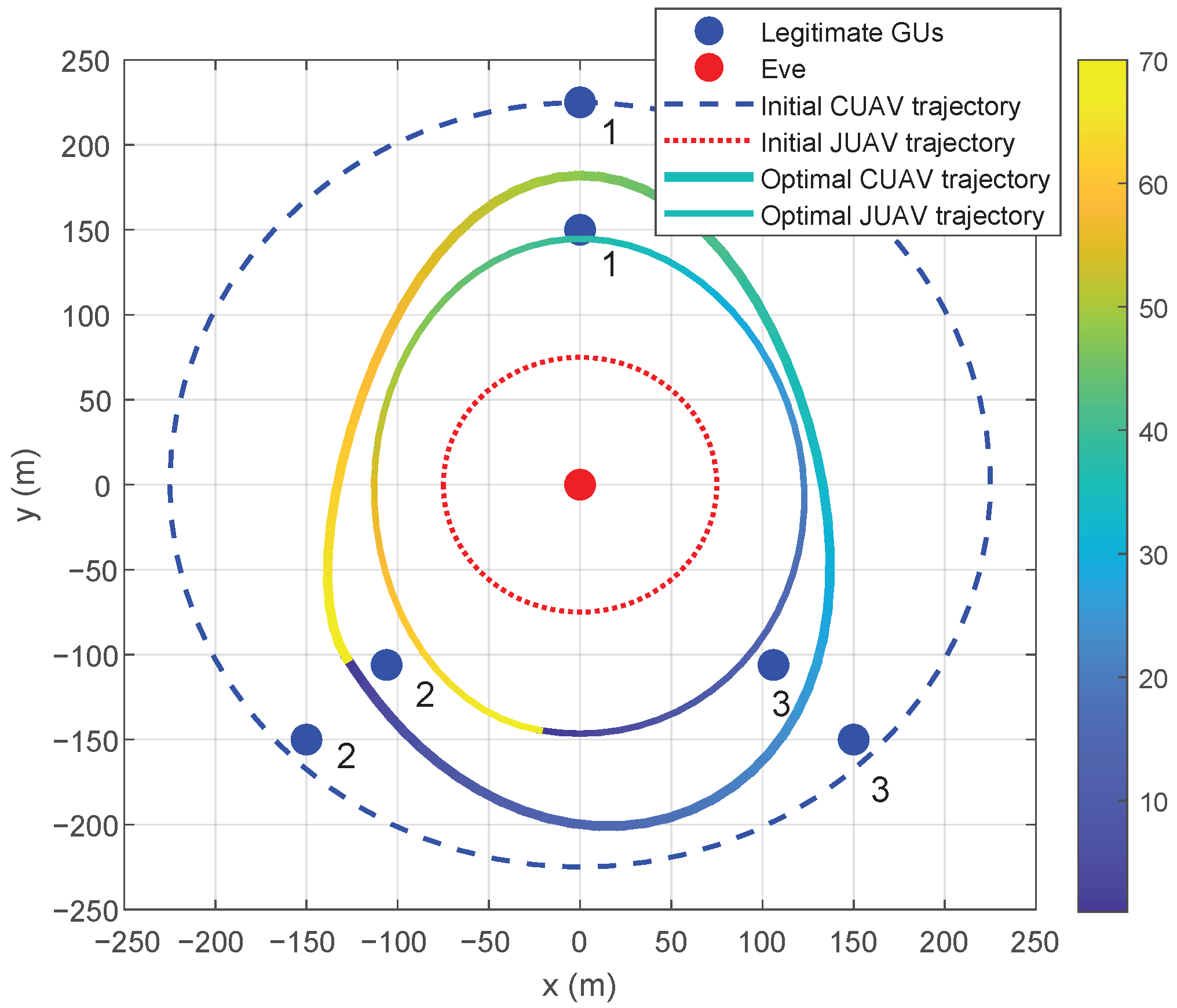
In this section, we provide the simulation results of the proposed iterative algorithm. Table 1 shows the simulation parameters. First, we design the initial trajectories of the UAVs. The initial trajectory of CUAV is expressed as
q c i n i ( n ) = ( R m a x cos α ( n ) , R m a x sin α ( n ) , H )
where α ( n ) = 2 π ( n 1 ) N 1 , n and R max denotes the distance between the Eve and the farthest legitimate GU. The initial trajectory of JUAV is expressed as
q j i n i ( n ) = ( R m i n 2 cos α ( n ) , R m i n 2 sin α ( n ) , H )
where R min denotes the distance between the Eve and the nearest legitimate GU.
Figure 2 illustrates the distribution of legitimate GUs and the optimized flight trajectories of the CUAV and JUAV. Different colors along the trajectories represent the UAV positions at different time slots. It can be observed that each UAV returns to its initial location within one flight period. In addition, the optimized CUAV trajectory approaches each user group, ensuring improved channel conditions and enhanced communication performance.
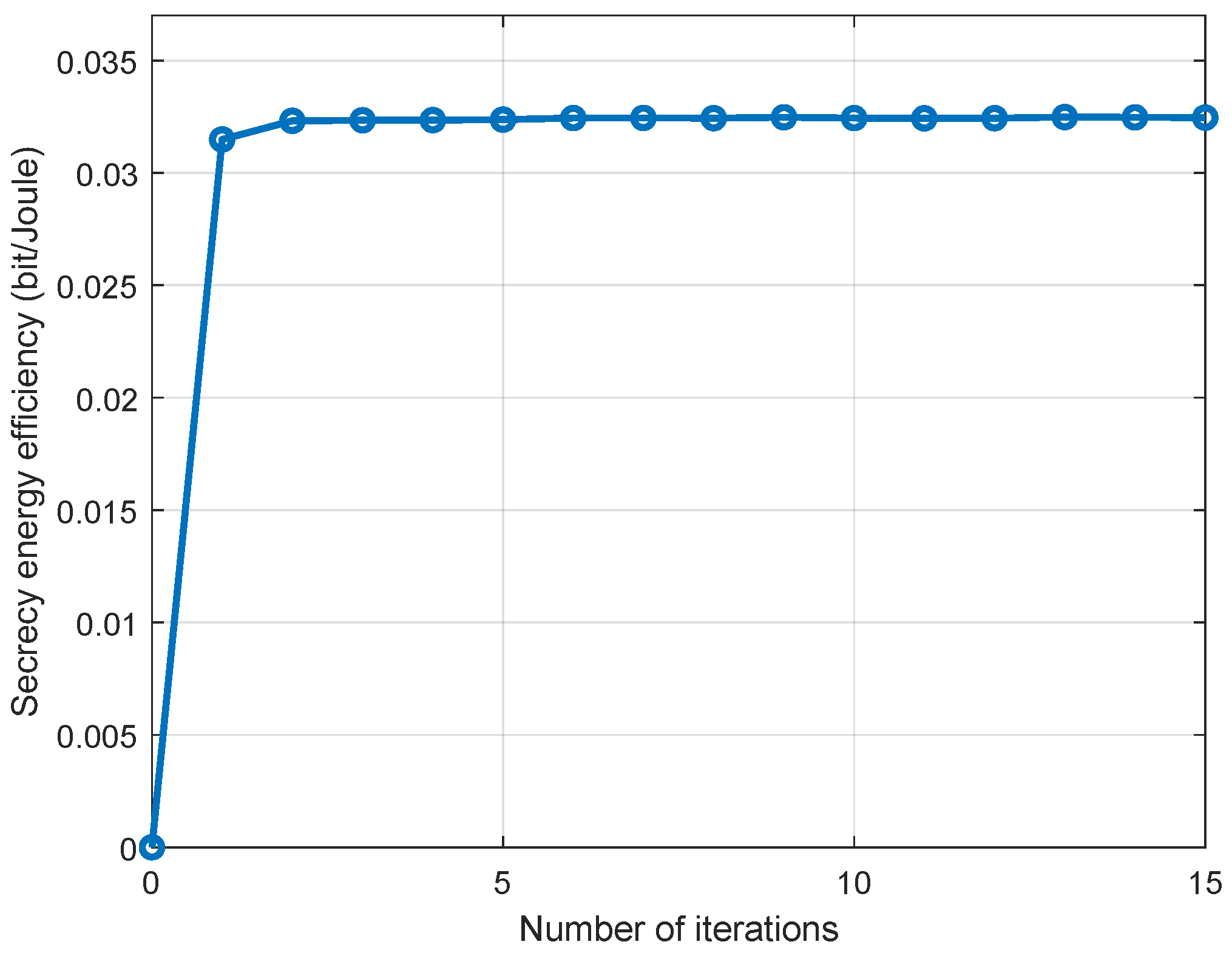
Figure 3 depicts the SEE versus the number of algorithm iterations. It can be observed that the SEE gradually converges after the third iteration, which verifies the convergence performance of the proposed algorithm.
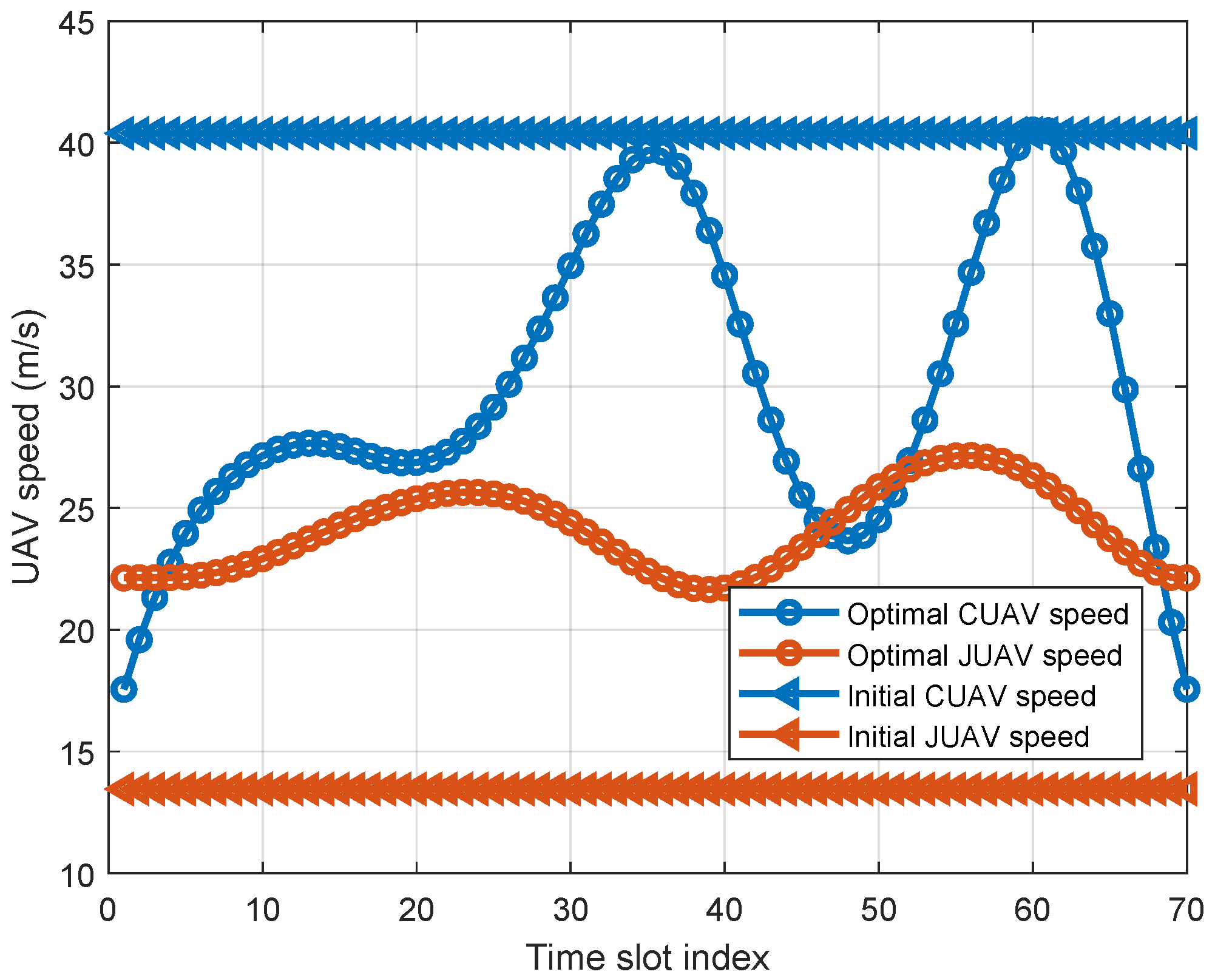
Figure 4 illustrates the relationship between the UAV speed and time slots for both the initial and optimized trajectories. It can be observed that, in the optimized trajectories of the CUAV and JUAV, the flight speeds are maintained at moderate levels to reduce propulsion energy consumption during flight, thereby improving the SEE.
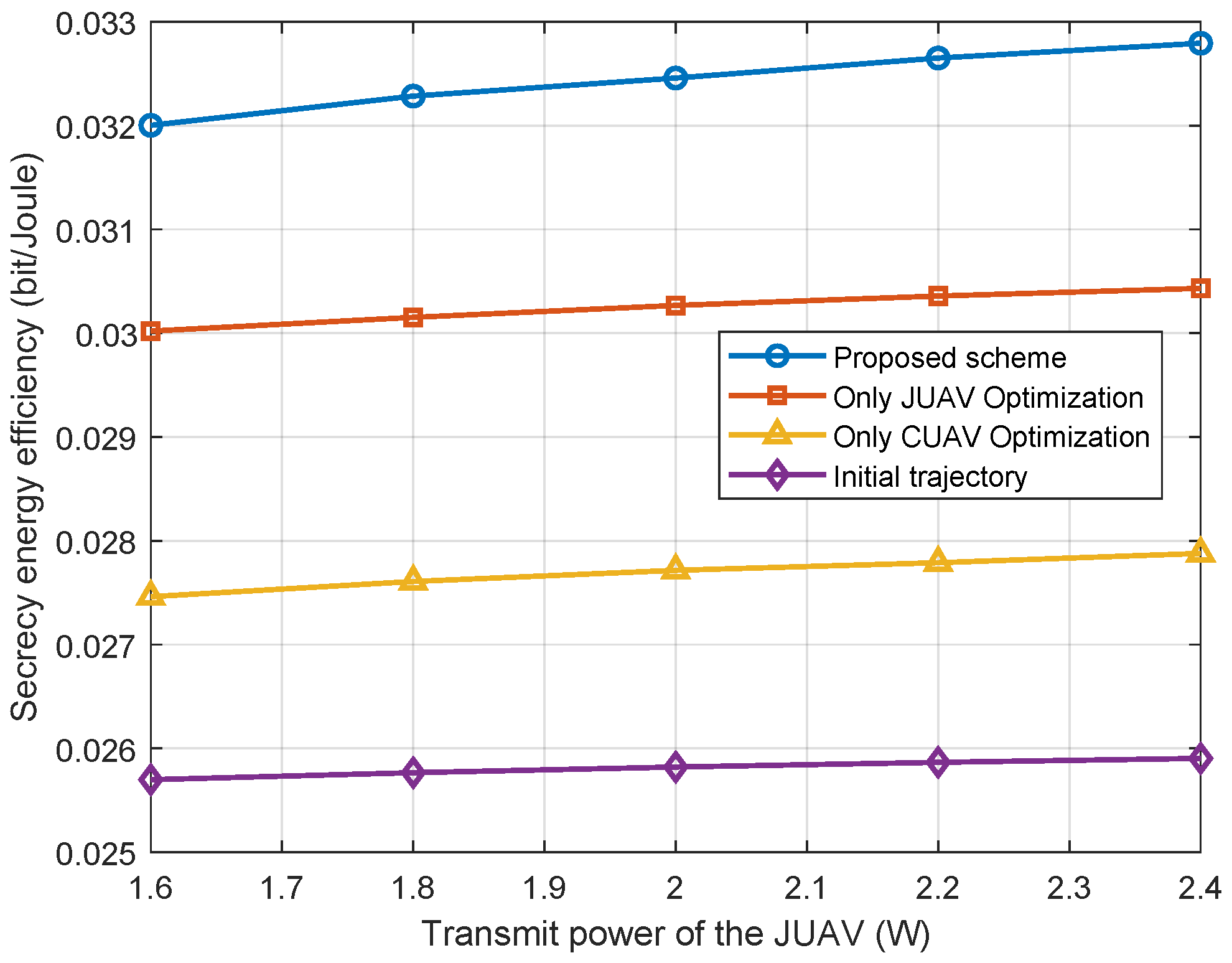
Figure 5 presents the SEE versus the transmit power of the JUAV under different optimization schemes. Three benchmark schemes are considered: (1) optimizing only the CUAV trajectory, (2) optimizing only the JUAV trajectory, and (3) adopting the initial trajectories of both UAVs. In all three schemes, the transmit power of the CUAV and the communication scheduling are optimized. It can be observed that the proposed joint optimization scheme achieves higher SEE than the benchmark schemes, thereby demonstrating the effectiveness of the proposed algorithm.
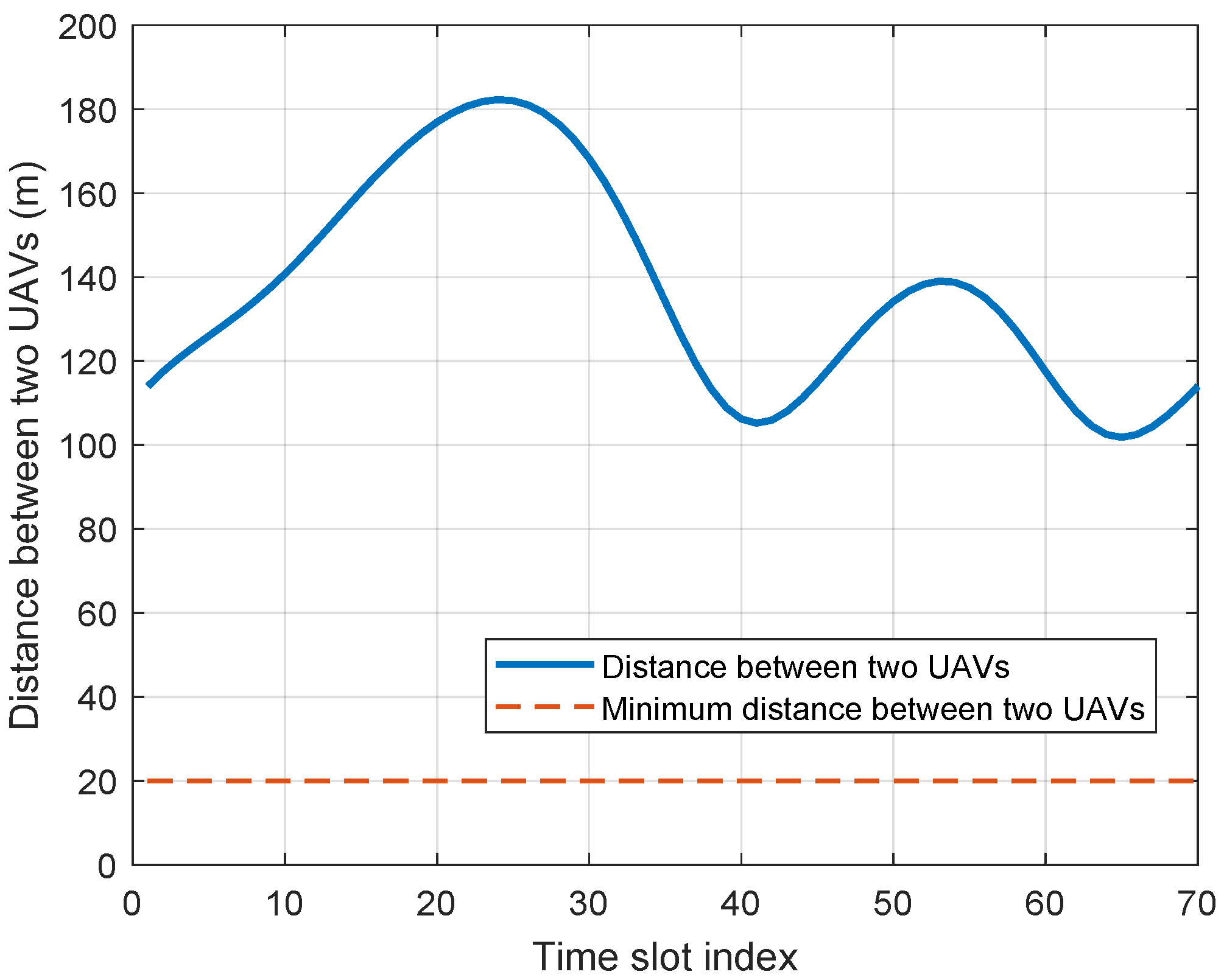
Figure 6 depicts the distance variation between the two UAVs versus time slots. As observed, the distance between the CUAV and the JUAV varies with time but consistently remains above the predefined minimum distance, which ensures effective collision avoidance.
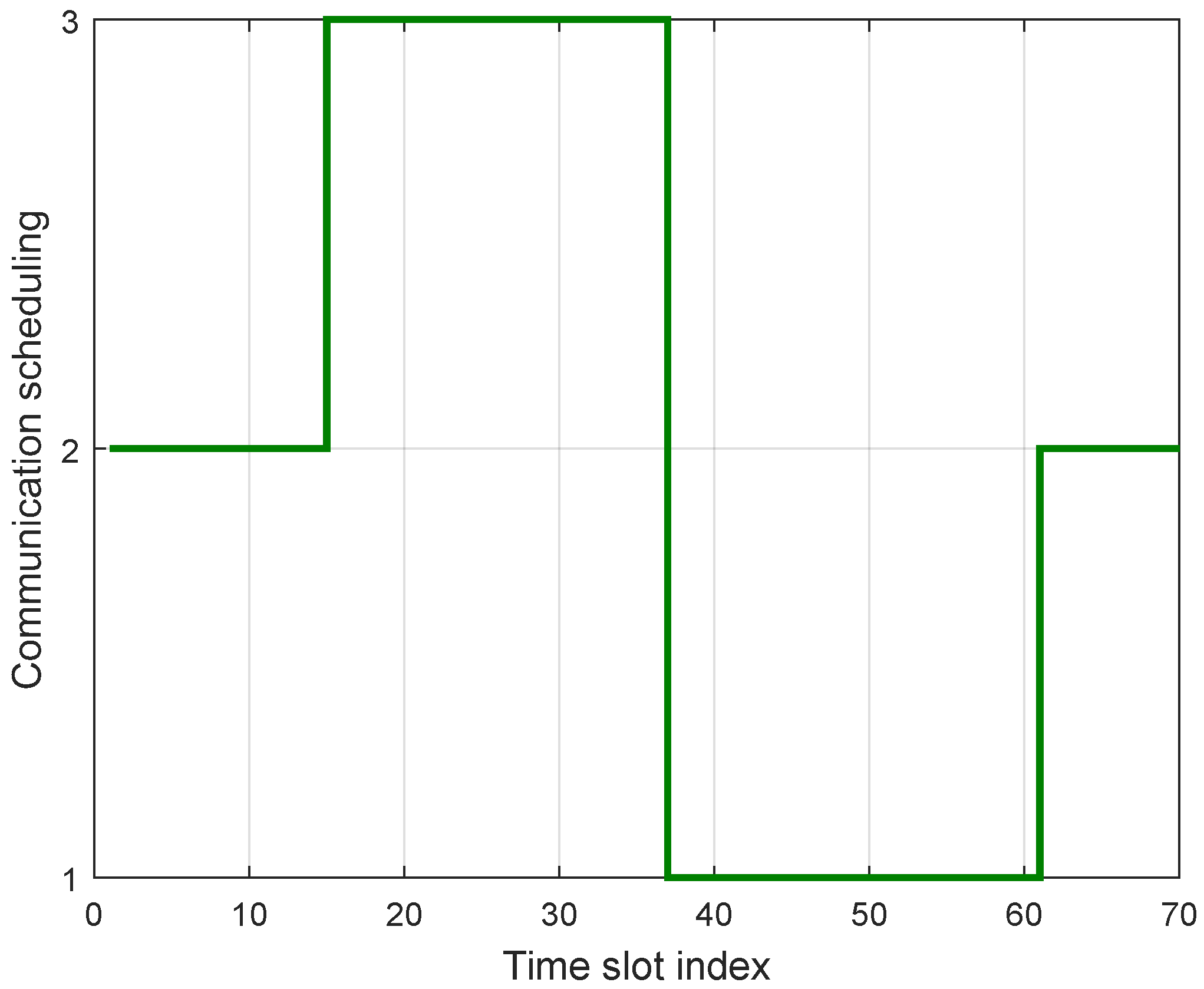
Figure 7 illustrates the communication scheduling versus time slots. It can be observed that the CUAV achieves a relatively balanced scheduling of different user groups, and the scheduling order is related to the UAV trajectory and the distribution of GUs.
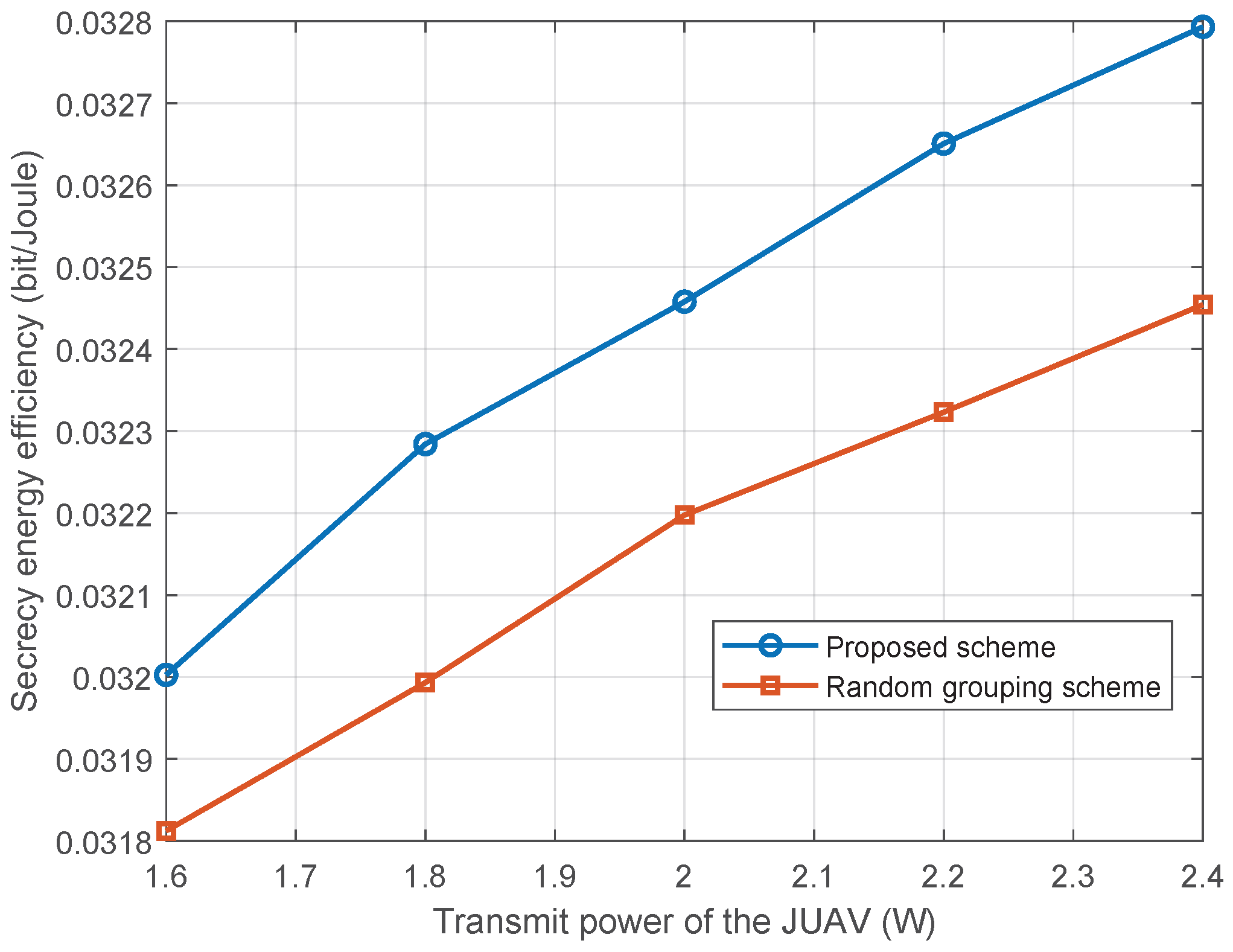
Figure 8 illustrates the SEE versus the JUAV transmit power under different user grouping schemes. The benchmark scheme adopts random grouping of GUs within the target area. It can be observed that the proposed K-means grouping scheme achieves higher SEE than the benchmark, thereby demonstrating the effectiveness of the proposed method.
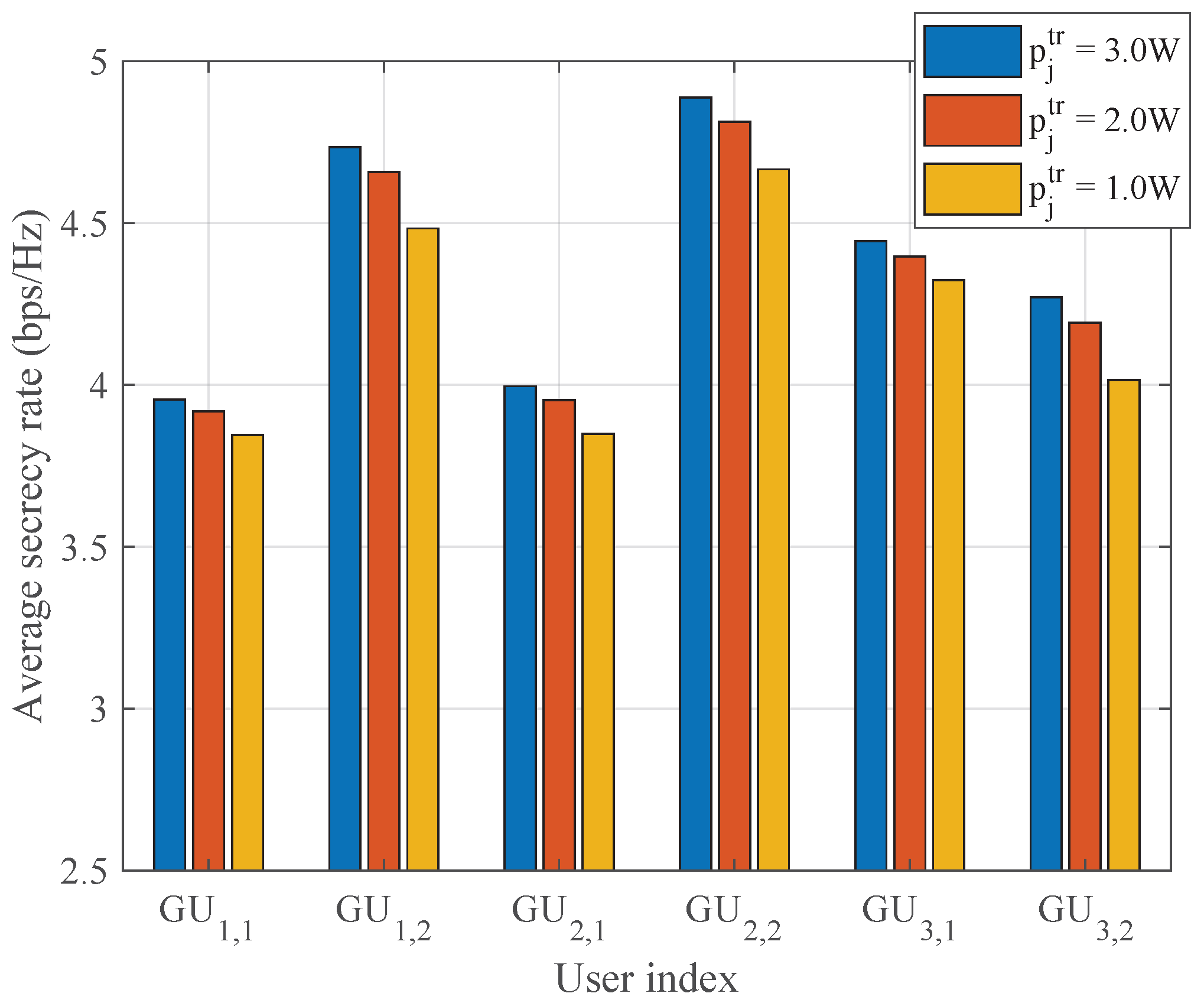
Figure 9 illustrates the average secrecy rate of the GUs versus the transmit power of the JUAV. It can be observed that, as the transmit power of the JUAV increases, the average secrecy rate of GUs also improves, which demonstrates that increasing the transmit power of the JUAV can enhance the secrecy performance of each GU.

5. Conclusions

This paper investigates the SEE maximization problem for an RSMA-UAV communication system. A communication UAV serving legitimate GUs and a cooperative jamming UAV are jointly deployed to enhance secure communication performance. Considering the propulsion energy consumption of fixed-wing UAVs, a non-convex optimization problem is formulated by jointly optimizing communication scheduling, CUAV transmit power allocation, and the trajectories of both UAVs. To address the coupling and non-convexity of the problem, the original problem is decomposed into four subproblems based on the BCD method, and an iterative optimization algorithm integrating the Dinkelbach method and SCA is proposed to obtain a locally optimal solution. Simulation results demonstrate that the proposed scheme improves the overall SEE compared with benchmark UAV trajectory schemes, and the proposed user grouping scheme outperforms the random grouping strategy.

Author Contributions

Conceptualization, Y.L. and Y.W.; Writing—review & editing, Y.L. and Y.W.; Software, J.F.; Validation, J.F. All authors have read and agreed to the published version of the manuscript.

Funding

This research was funded by National Key Laboratory of Advanced Communication Networks OF FUNDER grant number FFX24641X007.

Data Availability Statement

The raw data supporting the conclusions of this article will be made available by the authors on request.

Conflicts of Interest

Yutao Liu and Yifan Wang were employed by China Electronics Technology Group Corporation. The remaining authors declare that the research was conducted in the absence of any commercial or financial relationships that could be construed as a potential conflict of interest.

References

  1. Zeng, Y.; Zhang, R.; Lim, T.J. Wireless communications with unmanned aerial vehicles: Opportunities and challenges. IEEE Commun. Mag. 2016, 54, 36–42. [Google Scholar] [CrossRef] [Scilit]
  2. Wu, Q.; Zeng, Y.; Zhang, R. Joint trajectory and communication design for multi-UAV enabled wireless networks. IEEE Trans. Wirel. Commun. 2018, 17, 2109–2121. [Google Scholar] [CrossRef] [Scilit]
  3. Zhang, L.; Zhao, H.; Hou, S.; Zhao, Z.; Xu, H.; Wu, X.; Wu, Q.; Zhang, R. A Survey on 5G Millimeter Wave Communications for UAV-Assisted Wireless Networks. IEEE Access 2019, 7, 117460–117504. [Google Scholar] [CrossRef] [Scilit]
  4. Liu, Y.; Dai, H.-N.; Wang, Q.; Shukla, M.K.; Imran, M. Unmanned aerial vehicle for internet of everything: Opportunities and challenges. Comput. Commun. 2020, 155, 66–83. [Google Scholar] [CrossRef] [Scilit]
  5. Yang, F.; Qin, X.; Gong, S.; Deng, N.; Xing, C.; Zhao, N. A survey of covert UAV communications. Chin. J. Aeronaut. 2025, 38, 103493. [Google Scholar] [CrossRef] [Scilit]
  6. Lyu, Z.; Zhu, G.; Xu, J. Joint maneuver and beamforming design for UAV-enabled integrated sensing and communication. IEEE Trans. Wirel. Commun. 2023, 22, 2424–2440. [Google Scholar] [CrossRef] [Scilit]
  7. Iqbal, A.; Al-Habashna, A.; Wainer, G.; Boudreau, G. Twin delayed deep deterministic policy gradient-based physical layer security and SEE in RIS-aided UAV communication. Comput. Netw. 2026, 274, 111867. [Google Scholar] [CrossRef] [Scilit]
  8. Cheng, T.; Wang, B.; Wang, Z.; Cao, K.; Dong, R.; Weng, J. Intelligent reflecting surface assisted secure transmission in UAV-MIMO communication systems. Entropy 2022, 24, 1605. [Google Scholar] [CrossRef] [Scilit] [PubMed]
  9. Chai, M.; Liu, Y.; Zhao, S.; Deng, H. Enhancing physical-layer security in UAV-assisted communications: A UAV-mounted reconfigurable intelligent surface scheme for secrecy rate optimization. Drones 2025, 9, 208. [Google Scholar] [CrossRef] [Scilit]
  10. Sun, X.; Ng, D.W.K.; Ding, Z.; Xu, Y.; Zhong, Z. Physical layer security in UAV systems: Challenges and opportunities. IEEE Wirel. Commun. 2019, 26, 40–47. [Google Scholar] [CrossRef] [Scilit]
  11. Wang, J.; Wang, X.; Gao, R.; Lei, C.; Feng, W.; Ge, N.; Jin, S.; Quek, T.Q. Physical layer security for UAV communications: A comprehensive survey. China Commun. 2022, 19, 77–115. [Google Scholar] [CrossRef] [Scilit]
  12. Zhang, G.; Wu, Q.; Cui, M.; Zhang, R. Securing UAV communications via joint trajectory and power control. IEEE Trans. Wirel. Commun. 2019, 18, 1376–1389. [Google Scholar] [CrossRef] [Scilit]
  13. Cai, Y.; Cui, F.; Shi, Q.; Zhao, M.; Li, G.Y. Dual-UAV-enabled secure communications: Joint trajectory design and user scheduling. IEEE J. Sel. Areas Commun. 2018, 36, 1972–1985. [Google Scholar] [CrossRef] [Scilit]
  14. Zheng, F.; Su, G.; Chen, B.; Dai, M.; Lin, X.; Wang, H. Joint optimization of trajectory and resource allocation for secure UAV communication with artificial noise. Proc. IEEE Int. Conf. Electron. Technol. (ICET) 2022, 939–943. [Google Scholar] [CrossRef] [Scilit]
  15. Chen, J.; Zheng, K.; Jia, J.; Deng, Y.; Wang, X. Secure resource allocation and trajectory design for RIS and NOMA assisted multi-UAV systems. IEEE Internet Things J. 2025, 12, 36436–36450. [Google Scholar] [CrossRef] [Scilit]
  16. Mao, Y.; Dizdar, O.; Clerckx, B.; Schober, R.; Popovski, P.; Poor, H.V. Rate-splitting multiple access: Fundamentals, survey, and future research trends. IEEE Commun. Surv. Tutor. 2022, 24, 2073–2126. [Google Scholar] [CrossRef] [Scilit]
  17. Yang, Z.; Chen, M.; Saad, W.; Xu, W.; Shikh-Bahaei, M. Sum-Rate Maximization of Uplink Rate Splitting Multiple Access (RSMA) Communication. IEEE Trans. Mob. Comput. 2022, 21, 2596–2609. [Google Scholar] [CrossRef] [Scilit]
  18. Yang, Z.; Chen, M.; Saad, W.; Shikh-Bahaei, M. Optimization of rate allocation and power control for rate splitting multiple access (RSMA). IEEE Trans. Commun. 2021, 69, 5988–6002. [Google Scholar] [CrossRef] [Scilit]
  19. Yang, Z.; Shi, J.; Li, Z.; Chen, M.; Xu, W.; Shikh-Bahaei, M. Energy Efficient Rate Splitting Multiple Access (RSMA) with Reconfigurable Intelligent Surface. In 2020 IEEE International Conference on Communications Workshops (ICC Workshops); IEEE: New York, NY, USA, 2020; pp. 1–6. [Google Scholar] [CrossRef] [Scilit]
  20. Lee, B.; Shin, W. Max-Min Fairness Precoder Design for Rate-Splitting Multiple Access: Impact of Imperfect Channel Knowledge. IEEE Trans. Veh. Technol. 2023, 72, 1355–1359. [Google Scholar] [CrossRef] [Scilit]
  21. Han, S.; Xia, H.; Zhou, X.; Li, C. Securing RSMA-Based Communications at Physical Layer. IEEE Netw. 2024, 38, 211–217. [Google Scholar] [CrossRef] [Scilit]
  22. Fu, H.; Feng, S.; Tang, W.; Ng, D.W.K. Robust secure beamforming design for two-user downlink MISO rate-splitting systems. IEEE Trans. Wirel. Commun. 2020, 19, 8351–8365. [Google Scholar] [CrossRef] [Scilit]
  23. Xia, H.; Mao, Y.; Clerckx, B.; Zhou, X.; Han, S.; Li, C. Weighted Sum-Rate Maximization for Rate-Splitting Multiple Access Based Secure Communication. In 2022 IEEE Wireless Communications and Networking Conference (WCNC); IEEE: New York, NY, USA, 2022; pp. 19–24. [Google Scholar] [CrossRef] [Scilit]
  24. Xia, H.; Han, S.; Li, C. Max-Min Fair Optimization in RSMA-Assisted Secure Communications with Artificial Noise. IEEE Commun. Lett. 2023, 27, 3181–3184. [Google Scholar] [CrossRef] [Scilit]
  25. Zhao, B.; Qiu, T.; Ren, G.; Jin, Z.; Liu, Z. RSMA-enhanced physical layer security for ISAC systems. IEEE Wirel. Commun. Lett. 2025, 14, 1064–1068. [Google Scholar] [CrossRef] [Scilit]
  26. Jaafar, W.; Naser, S.; Muhaidat, S.; Sofotasios, P.C.; Yanikomeroglu, H. On the downlink performance of RSMA-based UAV communications. IEEE Trans. Veh. Technol. 2020, 69, 16258–16263. [Google Scholar] [CrossRef] [Scilit]
  27. Liu, L.; Qiu, L. Energy-efficient joint communication and trajectory design for UAV-assisted Internet of Things with RSMA. In Proceedings of the 2023 International Conference on Wireless Communications and Signal Processing (WCSP), Hangzhou, China, 2–4 November 2023; pp. 627–632. [Google Scholar] [CrossRef] [Scilit]
  28. Liu, S.; Huang, Z.; Sheng, Z.; Nasir, A.A.; Yu, H.; Hassan, S.A. Rate splitting multiple access for UAV secure communication systems with friendly jamming. Phys. Commun. 2024, 66, 102447. [Google Scholar] [CrossRef] [Scilit]
  29. Bastami, H.; Letafati, M.; Moradikia, M.; Abdelhadi, A.; Behroozi, H.; Hanzo, L. On the physical layer security of the cooperative rate-splitting-aided downlink in UAV networks. IEEE Trans. Inf. Forensics Secur. 2021, 16, 5018–5033. [Google Scholar] [CrossRef] [Scilit]
  30. Ouamri, M.A.; Adam, A.B.M.; Benallouche, Y.; Gueroui, M. Secure QoE-aware UAV-aided rate-splitting multiple access-based communications. In Proceedings of the GLOBECOM 2025—2025 IEEE Global Communications Conference, Taipei, Taiwan, 8–12 December 2025; pp. 4565–4570. [Google Scholar] [CrossRef] [Scilit]
  31. Zhou, F.; Li, X.; Cheng, J.; Wang, J.; Guo, K. RSMA-aided satellite-aerial-vehicle integrated networks: Secrecy performance evaluation with non-ideal hardware. J. Commun. Netw. 2024, 26, 477–489. [Google Scholar] [CrossRef] [Scilit]
  32. Wu, M.; Guo, K.; Li, X.; Lin, Z.; Yang, L.; Tsiftsis, T.A.; Yuen, C. RIS-assisted SATINs with RSMA and DRL: A trade-off between spectral, secrecy, and energy efficiency. IEEE Trans. Commun. 2025, 73, 12380–12395. [Google Scholar] [CrossRef] [Scilit]
  33. Chu, T.M.C.; Zepernick, H.-J.; Duong, T.Q. NOMA-Based Full-Duplex UAV Network with K-Means Clustering for Disaster Scenarios. In Proceedings of the 2022 IEEE 96th Vehicular Technology Conference (VTC2022-Fall), London, UK, 26–29 September 2022; pp. 1–7. [Google Scholar] [CrossRef] [Scilit]
  34. Zeng, Y.; Zhang, R. Energy-efficient UAV communication with trajectory optimization. IEEE Trans. Wirel. Commun. 2017, 16, 3747–3760. [Google Scholar] [CrossRef] [Scilit]
  35. Dinkelbach, W. On nonlinear fractional programming. Manag. Sci. 1967, 13, 492–498. [Google Scholar] [CrossRef] [Scilit]
Figure 1. System model.
Aerospace 13 00485 g001
Figure 2. Optimal and initial trajectories of UAVs.
Aerospace 13 00485 g002
Figure 3. SEE versus the number of iterations.
Aerospace 13 00485 g003
Figure 4. UAV speed versus time slots under different optimization schemes.
Aerospace 13 00485 g004
Figure 5. SEE versus transmit power of the JUAV under different optimization schemes.
Aerospace 13 00485 g005
Figure 6. Distance between two UAVs versus time slots.
Aerospace 13 00485 g006
Figure 7. Communication scheduling versus time slots.
Aerospace 13 00485 g007
Figure 8. SEE versus transmit power of the JUAV under different user grouping schemes.
Aerospace 13 00485 g008
Figure 9. Average secrecy rate of GUs under different transmit power of the JUAV.
Aerospace 13 00485 g009
Table 1. Simulation Parameters.
ParameterValue
Number of GUs: K6
Number of groups: L3
Channel power gain: β 0 −30 dB
Noise power: σ 2 −70 dBm
Length of one time slot: δ t 0.5 s
UAV flight altitude: H100 m
Maximum speed of UAV: v m a x 50 m/s
Minimum speed of UAV: v m i n 3 m/s
Flight period of UAV: T35 s
Maximum acceleration of UAV: ρ m a x 10 m/ s 2
Propulsion power coefficients of UAV: κ 1 0.001
Propulsion power coefficients of UAV: κ 2 2250
Minimum distance between UAVs: d m i n 20 m
Maximum transmit power of CUAV: P m a x 1 W
Transmit power of the JUAV: p j t r 2 W
Disclaimer/Publisher’s Note: The statements, opinions and data contained in all publications are solely those of the individual author(s) and contributor(s) and not of MDPI and/or the editor(s). MDPI and/or the editor(s) disclaim responsibility for any injury to people or property resulting from any ideas, methods, instructions or products referred to in the content.