
Analysis and Enhancement of Steady Climb Performance with Control Input Redundancy for a Dual-Propulsion VTOL UAV


Abstract
1. Introduction
2. Mathematical Model of Dual-Propulsion VTOL
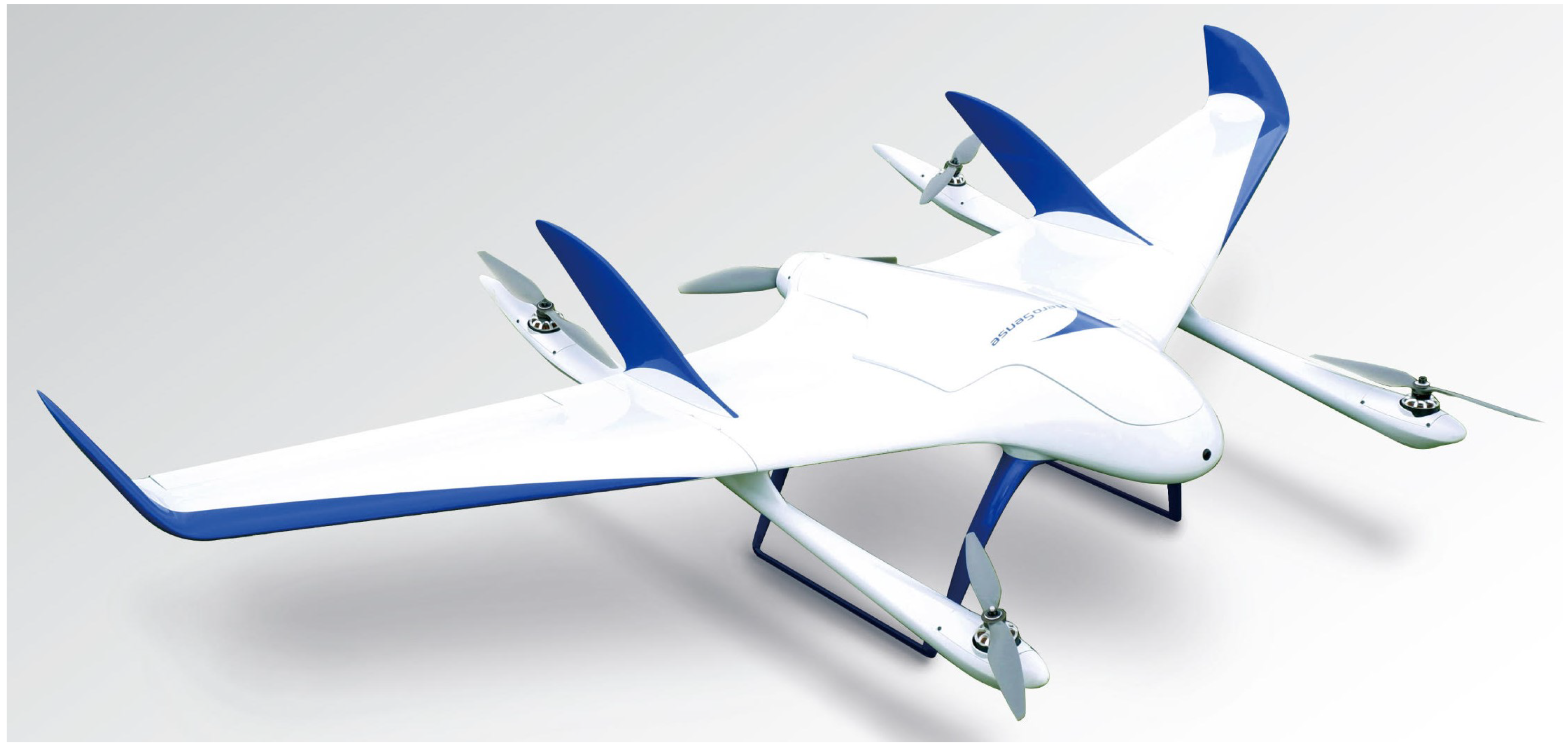
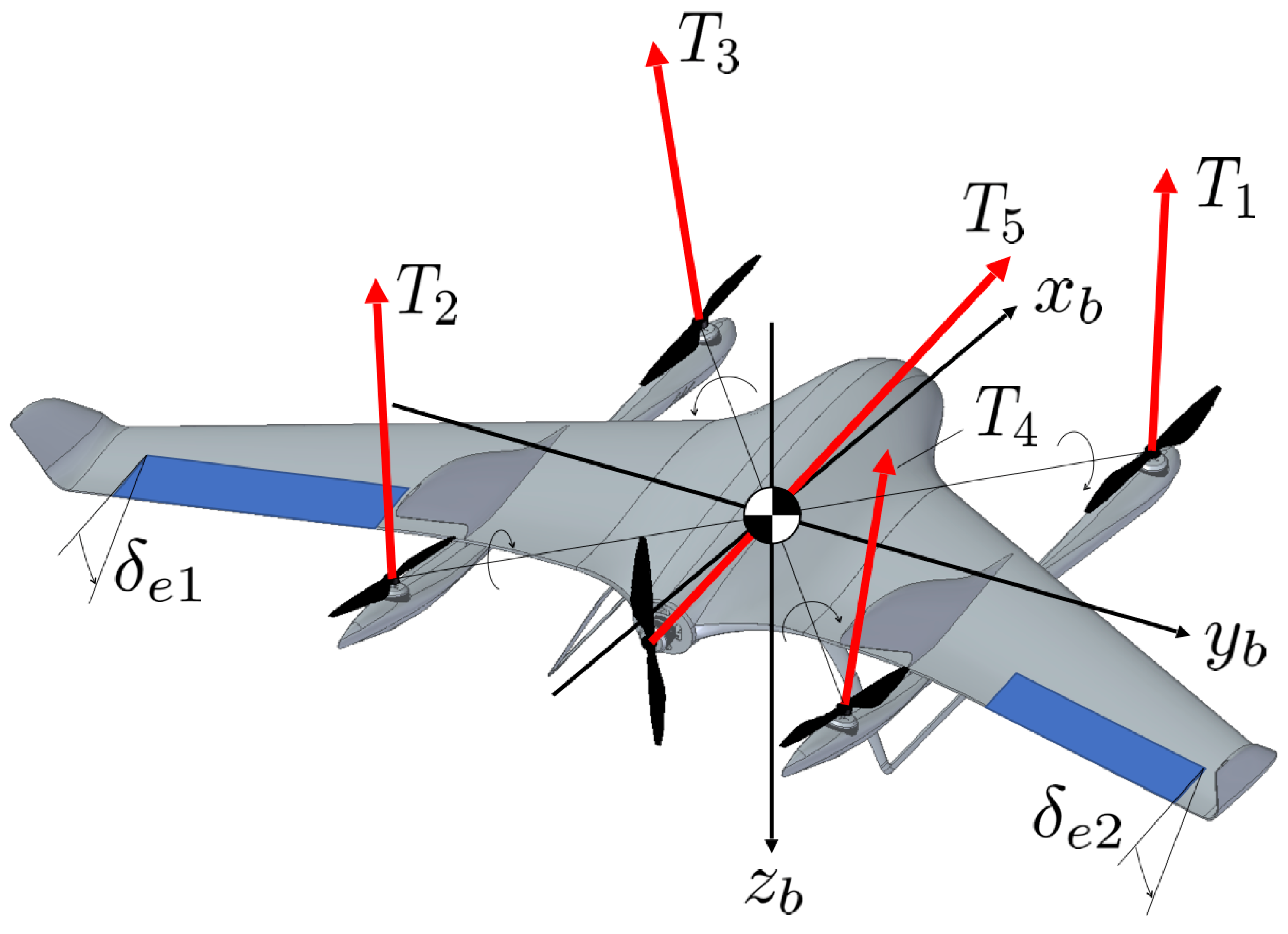
2.1. Dual-Propulsion VTOL
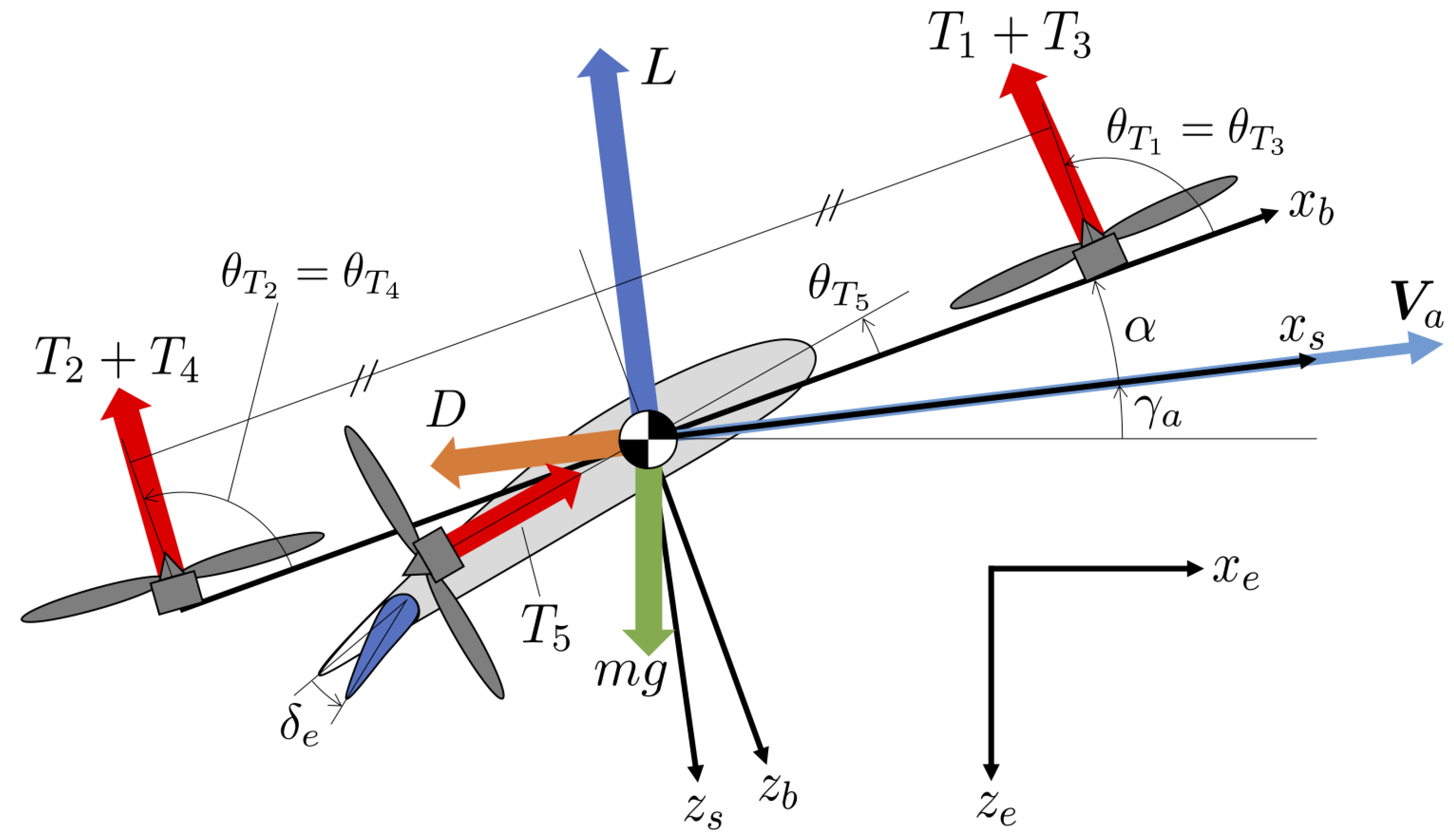
2.2. Equation of Motion
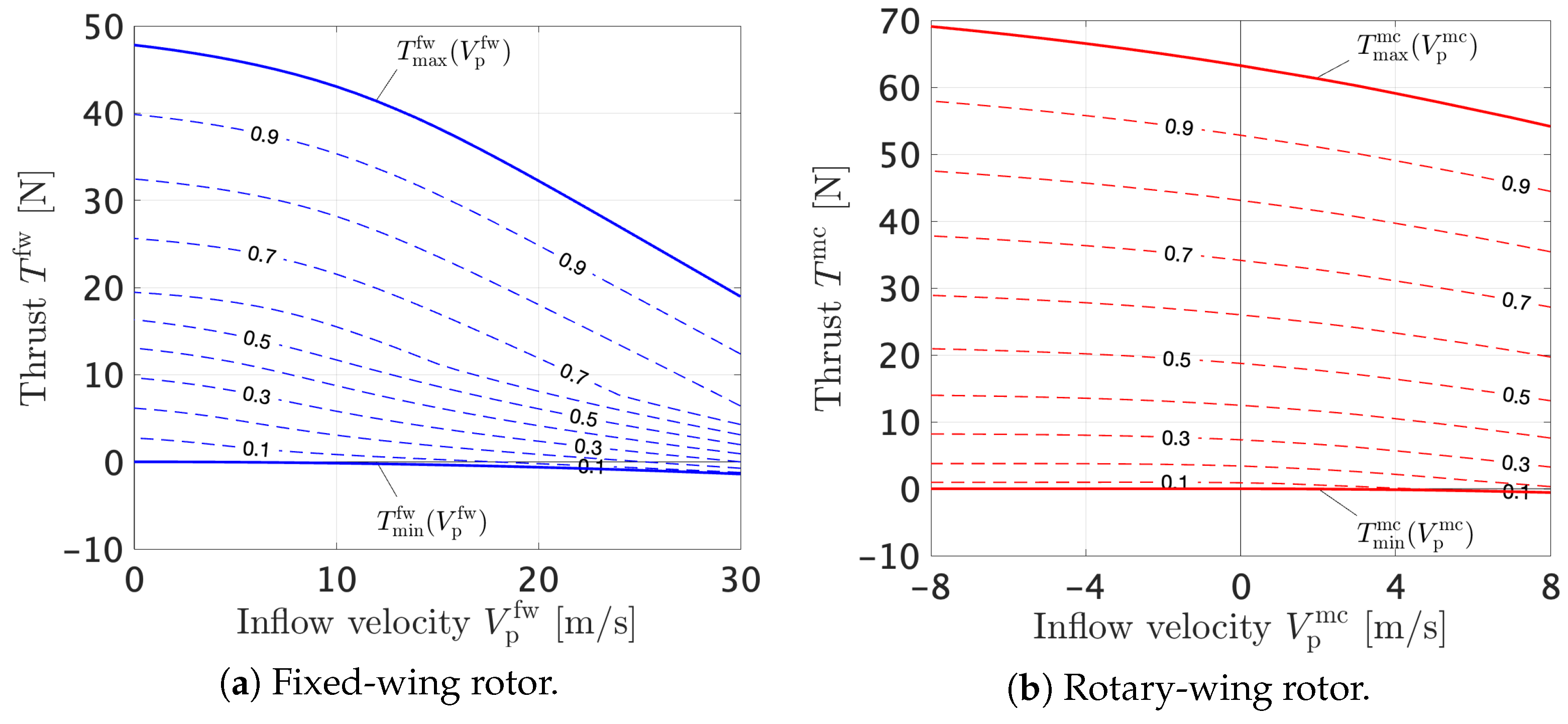
2.3. Rotor Thrust Model
2.4. Aerodynamic Force Model
3. Maneuverability Analysis for Steady Climb
3.1. Force Set and Maneuverability
3.2. Steady Climb State
4. Experimental Demonstration
4.1. Steady Flight Performance in Conventional Flight Mode
4.2. Experimental Results for Steady Climb with MC Rotors
4.3. Discussion
5. Conclusions
Author Contributions
Funding
Data Availability Statement
Conflicts of Interest
References
- Darvishpoor, S.; Roshanian, J.; Raissi, A.; Hassanalian, M. Configurations, Flight Mechanisms, and Applications of Unmanned Aerial Systems: A Review. Prog. Aerosp. Sci. 2020, 121, 100694. [Google Scholar] [CrossRef]
- Saeed, A.S.; Younes, A.B.; Islam, S.; Dias, J.; Seneviratne, L.; Cai, G. A Review on the Platform Design, Dynamic Modeling and Control of Hybrid UAVs. In 2015 International Conference on Unmanned Aircraft Systems (ICUAS); IEEE: New York, NY, USA, 2015; pp. 806–815. [Google Scholar]
- Hartmann, P.; Meyer, C.; Moormann, D. Unified Velocity Control and Flight State Transition of Unmanned Tilt-Wing Aircraft. J. Guid. Control. Dyn. 2017, 40, 1348–1359. [Google Scholar] [CrossRef]
- Raab, S.; Zhang, J.; Bhardwaj, P.; Holzapfel, F. Proposal of a Unified Control Strategy for Vertical Take-off and Landing Transition Aircraft Configurations. In 2018 Applied Aerodynamics Conference; AIAA: Reston, VA, USA, 2018; p. 3478. [Google Scholar]
- Rohr, D.; Stastny, T.; Verling, S.; Siegwart, R. Attitude and Cruise Control of a VTOL Tiltwing UAV. IEEE Robot. Autom. Lett. 2019, 4, 2683–2690. [Google Scholar] [CrossRef]
- Rohr, D.; Studiger, M.; Stastny, T.; Lawrance, N.R.J.; Siegwart, R. Nonlinear Model Predictive Velocity Control of a VTOL Tiltwing UAV. IEEE Robot. Autom. Lett. 2021, 6, 5776–5783. [Google Scholar] [CrossRef]
- Rashad, R.; Goerres, J.; Aarts, R.; Engelen, J.B.C.; Stramigioli, S. Fully Actuated Multirotor UAVs: A Literature Review. IEEE Robot. Autom. Mag. 2020, 27, 97–107. [Google Scholar] [CrossRef]
- Tadokoro, Y.; Ibuki, T.; Sampei, M. Maneuverability Analysis of a Fully-Actuated Hexrotor UAV Considering Tilt Angles and Arrangement of Rotors. IFAC Pap. 2017, 50, 8981–8986. [Google Scholar] [CrossRef]
- Kikumoto, C.; Urakubo, T.; Sabe, K.; Hazama, Y. Back-transition control with large deceleration for a dual propulsion VTOL UAV based on its Maneuverability. IEEE Robot. Autom. Lett. 2022, 7, 11697–11704. [Google Scholar] [CrossRef]
- Urakubo, T.; Nakamura, R.; Kikumoto, C.; Sabe, K.; Hazama, Y. Minimum Turning Radius Analysis for Quad-plane UAVs in High-speed Flights. In IECON 2023—49th Annual Conference of the IEEE Industrial Electronics Society; IECON23-001115; IEEE: New York, NY, USA, 2023. [Google Scholar]
- PERFORMANCE DATA. Available online: https://www.apcprop.com/technical-information/performance-data/?v=24d22e03afb2 (accessed on 29 May 2025).
- Kim, H.; Park, H.; Kim, J. Expansion of Operating Speed Range of High-Speed BLDC Motor Using Hybrid PWM Switching Method Considering Dead Time. Energies 2020, 13, 5212. [Google Scholar] [CrossRef]
- Leishman, R.C.; Macdonald, J.C.; Beard, R.W.; McLain, T.W. Quadrotors and Accelerometers: State Estimation with an Improved Dynamic Model. IEEE Control Syst. Mag. 2014, 34, 28–41. [Google Scholar]
- Bangura, M.; Melega, M.; Naldi, R.; Mahony, R. Aerodynamics of Rotor Blades for Quadrotors. arXiv 2016, arXiv:1601.00733. [Google Scholar] [CrossRef]
- Heyson, H.H. Theoretical and Experimental Investigation of the Performance of a Fan-in-Wing VTOL Configuration; NASA TN D-7498; National Aeronautics and Space Administration: Washington, DC, USA, 1973.
- Selig, M.S. Modeling Propeller Aerodynamics and Slipstream Effects on Small UAVs in Realtime. In AIAA Atmospheric Flight Mechanics 2010 Conference; AIAA: Reston, VA, USA, 2010. [Google Scholar]
- Yoshida, S.; Urakubo, T.; Kikumoto, C.; Sabe, K.; Hazama, Y. Aerodynamics Modeling and Hovering State Analysis for a Dual Propulsion VTOL UAV. In Proceedings of the 21st International Conference on Intelligent Unmanned Systems (ICIUS 2025), Bali, Indonesia, 20–22 August 2025. [Google Scholar]



Disclaimer/Publisher’s Note: The statements, opinions and data contained in all publications are solely those of the individual author(s) and contributor(s) and not of MDPI and/or the editor(s). MDPI and/or the editor(s) disclaim responsibility for any injury to people or property resulting from any ideas, methods, instructions or products referred to in the content. |
© 2026 by the authors. Licensee MDPI, Basel, Switzerland. This article is an open access article distributed under the terms and conditions of the Creative Commons Attribution (CC BY) license.
Share and Cite
Kikumoto, C.; Urakubo, T.; Sabe, K.; Hazama, Y. Analysis and Enhancement of Steady Climb Performance with Control Input Redundancy for a Dual-Propulsion VTOL UAV. Aerospace 2026, 13, 316. https://doi.org/10.3390/aerospace13040316
Kikumoto C, Urakubo T, Sabe K, Hazama Y. Analysis and Enhancement of Steady Climb Performance with Control Input Redundancy for a Dual-Propulsion VTOL UAV. Aerospace. 2026; 13(4):316. https://doi.org/10.3390/aerospace13040316
Chicago/Turabian StyleKikumoto, Chihiro, Takateru Urakubo, Kohtaro Sabe, and Yuichi Hazama. 2026. "Analysis and Enhancement of Steady Climb Performance with Control Input Redundancy for a Dual-Propulsion VTOL UAV" Aerospace 13, no. 4: 316. https://doi.org/10.3390/aerospace13040316
APA StyleKikumoto, C., Urakubo, T., Sabe, K., & Hazama, Y. (2026). Analysis and Enhancement of Steady Climb Performance with Control Input Redundancy for a Dual-Propulsion VTOL UAV. Aerospace, 13(4), 316. https://doi.org/10.3390/aerospace13040316