Article

Impedance-Controlled Compliant Assembly Technology for Large-Scale Components

1
School of Astronautics, Harbin Institute of Technology, Harbin 150001, China
2
Zhengzhou Advanced Research Institute of Harbin Institute of Technology, Zhengzhou 450000, China
3
Suzhou Research Institute of Harbin Institute of Technology, Suzhou 215104, China
*
Authors to whom correspondence should be addressed.
Aerospace 2026, 13(5), 481; https://doi.org/10.3390/aerospace13050481
Submission received: 30 March 2026 / Revised: 8 May 2026 / Accepted: 16 May 2026 / Published: 20 May 2026

Abstract

To meet the high-precision and automated requirements for the insertion assembly between large-scale components and non-cooperative outer shells, an impedance-controlled large-component insertion assembly technology, namely compliant insertion assembly technology, is proposed. This paper explains the working principle of the technology from a theoretical perspective, elaborates on two key technical aspects—pose control and force-following control based on a parallel mechanism—and conducts horizontal insertion assembly simulation for components. The simulation results demonstrate that force-following control via the parallel mechanism can reduce the axial pose accuracy error between the component and the shell by more than 85%, meeting the pose accuracy requirements for insertion assembly. It is also verified that force-following control can adjust the pose of the shell in real time based on the coaxiality between the component and the shell, satisfying the minor deformation requirements during the insertion assembly process.

1. Introduction

As the requirements for precision, efficiency, and process consistency in large-component assembly technology continue to increase, traditional methods that rely on specialized tooling and manual alignment approaches—characterized by “visual inspection, verbal coordination, and manual pushing”—face several limitations. These include long design and manufacturing cycles for tooling, high costs, and poor flexibility. Moreover, the heavy reliance on manual experience results in inconsistent assembly quality and high labor intensity [1], making it increasingly difficult to meet the demands of modern production, which involves multiple models, small batches, and fast-paced workflows. Consequently, the development of flexible assembly technology centered on digitalization, automation, and intelligence has become a critical direction in the manufacturing industry, particularly in the aerospace sector [2].
Under this trend, automated docking technology systems centered on digital measurement systems, attitude adjustment and positioning mechanisms, and intelligent planning and control systems have developed rapidly and have been successfully applied in scenarios such as aircraft fuselage docking and rocket stage docking [3,4,5]. Among these technologies, attitude adjustment mechanisms, which serve as the direct execution units, have evolved into several technical approaches, including flexible tooling based on CNC positioners [6,7], force-interaction robotic adjustment systems [8], and multi-sensor-based pose adjustment platforms [9]. Parallel adjustment mechanisms and aerospace assembly robot systems have attracted increasing attention in recent years due to their high stiffness, large load capacity, compact structure, and excellent pose adjustment capability [10,11]. In addition, parallel kinematic technologies have demonstrated strong application potential in large-scale manufacturing and aerospace assembly tasks, becoming an important research direction in intelligent assembly systems [12,13].
Although existing automated assembly systems have achieved considerable progress in high-precision docking tasks, most current methods are still designed for cooperative assembly scenarios in which dedicated fixtures, predefined alignment references, or highly constrained geometric interfaces are available [14]. In practical aerospace assembly processes, however, large-scale outer shells or thermal protection structures often exhibit characteristics such as low structural rigidity, manufacturing deviation accumulation, uncertain installation posture, and lack of standardized positioning references. Different from conventional cooperative assembly scenarios that rely on dedicated fixtures and predefined references, the target shell considered in this work does not provide standardized alignment interfaces, which significantly increases the difficulty of compliant insertion and pose correction [15]. Under such non-cooperative conditions, rigid position-control-based assembly methods are prone to excessive contact force, local interference, and even structural damage during the insertion process [16].
To address these issues, increasing attention has been devoted to compliant assembly and force-controlled robotic manipulation. The key to improving assembly robustness lies in endowing the assembly system with tactile perception and compliant interaction capability, enabling the transition from pure position control to hybrid force–position and impedance control strategies [17]. Compared with rigid control methods, impedance control can effectively regulate the dynamic interaction relationship between position deviation and contact force, thereby improving adaptability to environmental uncertainty and assembly tolerance variation. In recent years, impedance-based compliant control has been widely investigated in robotic assembly, contact interaction, and insertion tasks [18]. Recent studies have further shown that force control strategies are particularly effective in contact-rich manipulation and insertion tasks, where real-time interaction adaptation is essential for maintaining assembly stability and reducing contact impact [19].
However, most existing compliant assembly studies mainly focus on small-scale precision insertion tasks under relatively idealized contact conditions, while research on large-scale component compliant docking under non-cooperative conditions remains limited. In particular, the coupling relationship among contact force, pose deviation, and multi-degree-of-freedom adjustment during large-scale insertion processes has not yet been sufficiently investigated. Moreover, the absence of reliable external positioning references further increases the difficulty of online pose estimation and compliant control.
To address the above challenges, this paper proposes an impedance-controlled compliant insertion assembly method for large-scale components under non-cooperative conditions. The main contributions of this work can be summarized as follows:
(1)
A compliant assembly framework for large-scale components targeting non-cooperative outer shells is proposed, which eliminates the reliance on dedicated fixtures and predefined alignment references.
(2)
A generalized force model is constructed, and an impedance control strategy with discrete recursive implementation is designed for the hardware framework in (1), thereby achieving force-compliant insertion.
(3)
The effectiveness of the proposed method is validated through simulation under representative aerospace assembly conditions, demonstrating significant reduction in contact force and improved stability during insertion.
The remainder of this paper is organized as follows. Section 2 introduces the overall system architecture and assembly scenario. Section 3 presents the contact force modeling and pose estimation method. Section 4 describes the impedance control strategy and compliant adjustment process. Section 5 provides experimental validation and analysis. Finally, Section 6 concludes the paper and discusses future work.

2. System Architecture and Measurement Scheme Design

2.1. Overall System Composition and Functions

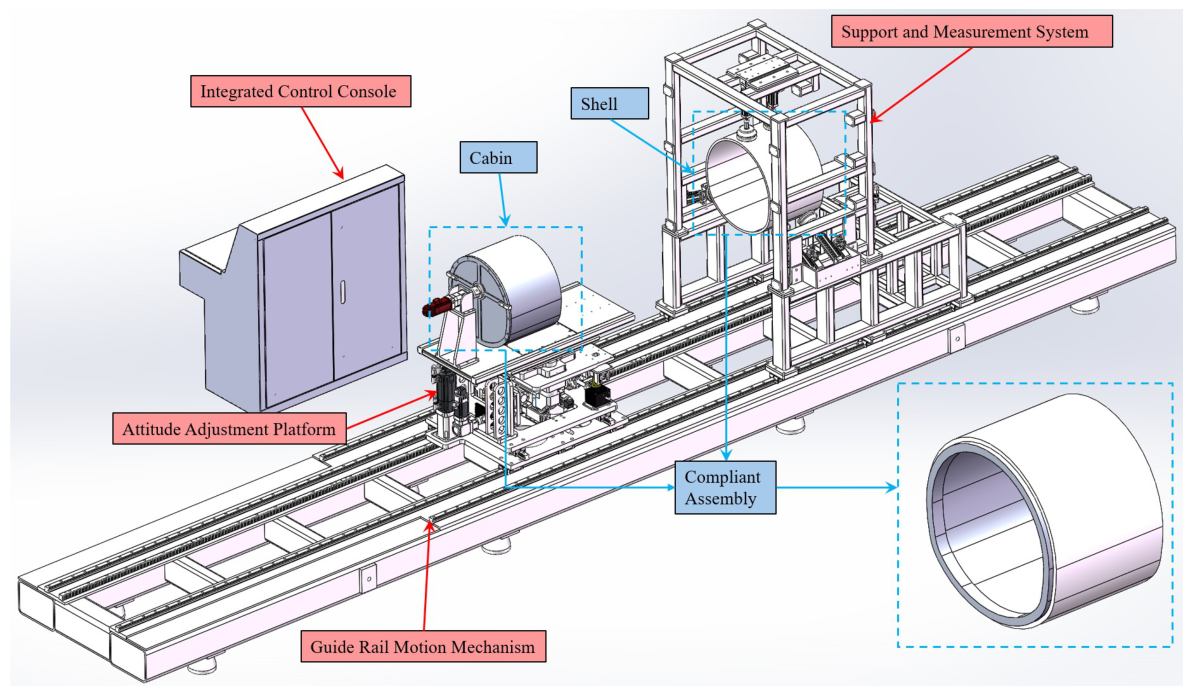
Figure 1 illustrates the overall configuration and working process of the proposed large-scale component compliant insertion system. The system mainly consists of an integrated control console, a guide rail motion mechanism, an attitude adjustment platform, and a support and measurement system.
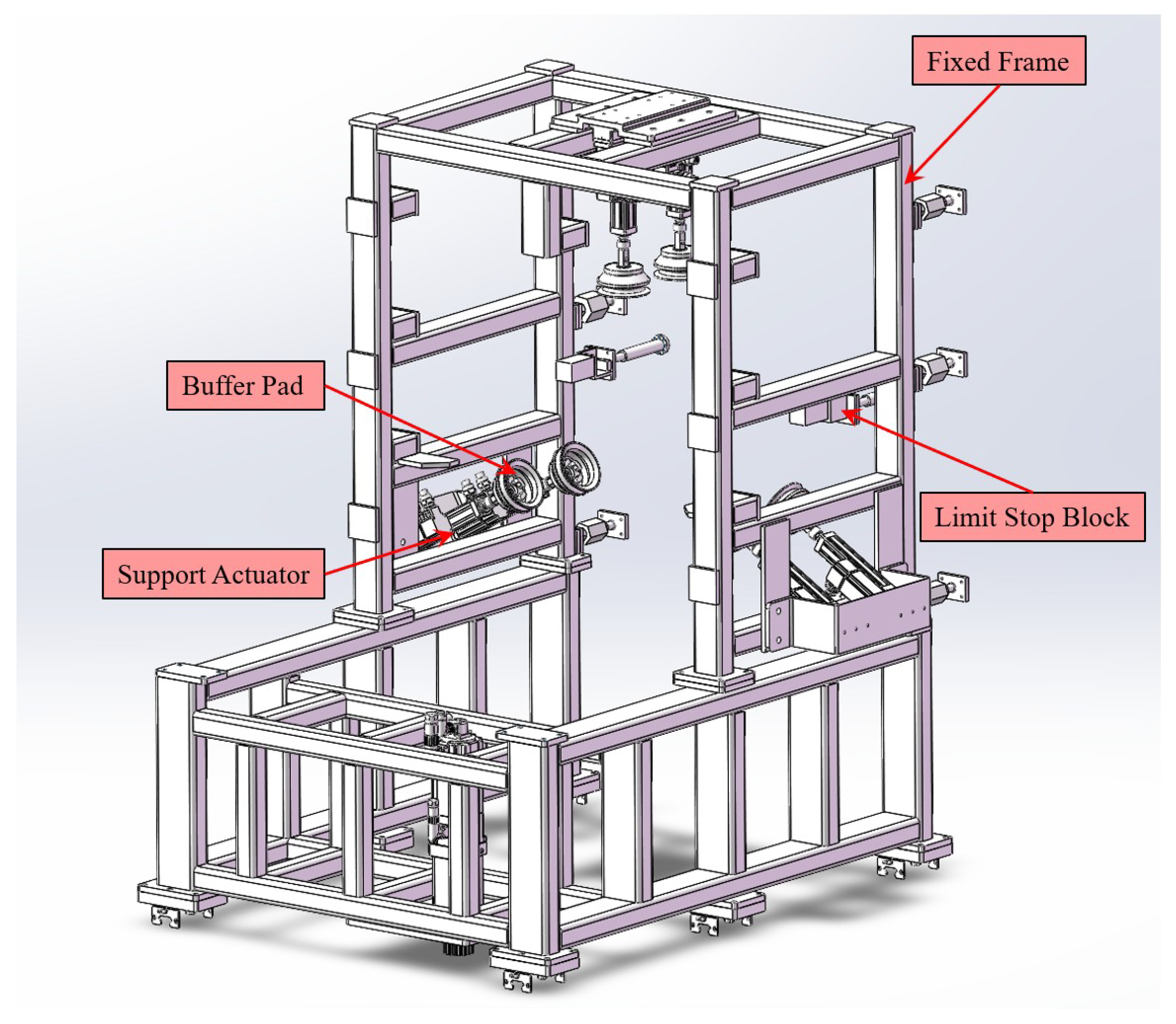
Among these components, the fixed frame serves as the supporting structure of the entire system and is used to install various sensors, actuators, and cables. The support and measurement system mainly consists of six parallelly arranged supports equipped with high-precision force sensors, which are used to evaluate the load conditions of the outer shell. The component pose adjustment system is a five-degree-of-freedom motion platform composed of motors, reducers, a rack-and-pinion transmission mechanism, and a ball-screw transmission mechanism, which is used to push the component into the shell and adjust its pose in real time. The control system is responsible for acquiring and displaying sensor data from the system and for controlling the motion of all actuators.
During the assembly process, the target shell is supported and fixed inside the support frame through six electrically actuated push rods, which are used to provide stable positioning and adjustable support for the non-cooperative outer shell structure. The cabin component is mounted on the attitude adjustment platform through a flange and coupling mechanism. Driven by the guide rail motion mechanism, the attitude adjustment platform moves the cabin component along the axial direction toward the interior of the shell according to the predefined insertion trajectory.
Unlike conventional cooperative assembly scenarios with dedicated alignment references, the shell structure considered in this work does not provide rigid positioning constraints or standardized docking interfaces. Due to manufacturing deviation, installation uncertainty, and structural flexibility, relative pose deviation and contact interference may occur during the insertion process. Under such conditions, traditional manual visual alignment and rigid pushing operations are highly dependent on operator experience and are prone to excessive contact force, local collision, and insertion instability.
The proposed system architecture is particularly suitable for aerospace assembly scenarios involving large-scale cabin segments and thin-walled shell structures, where high precision, low stress, and non-contact pre-alignment are required.
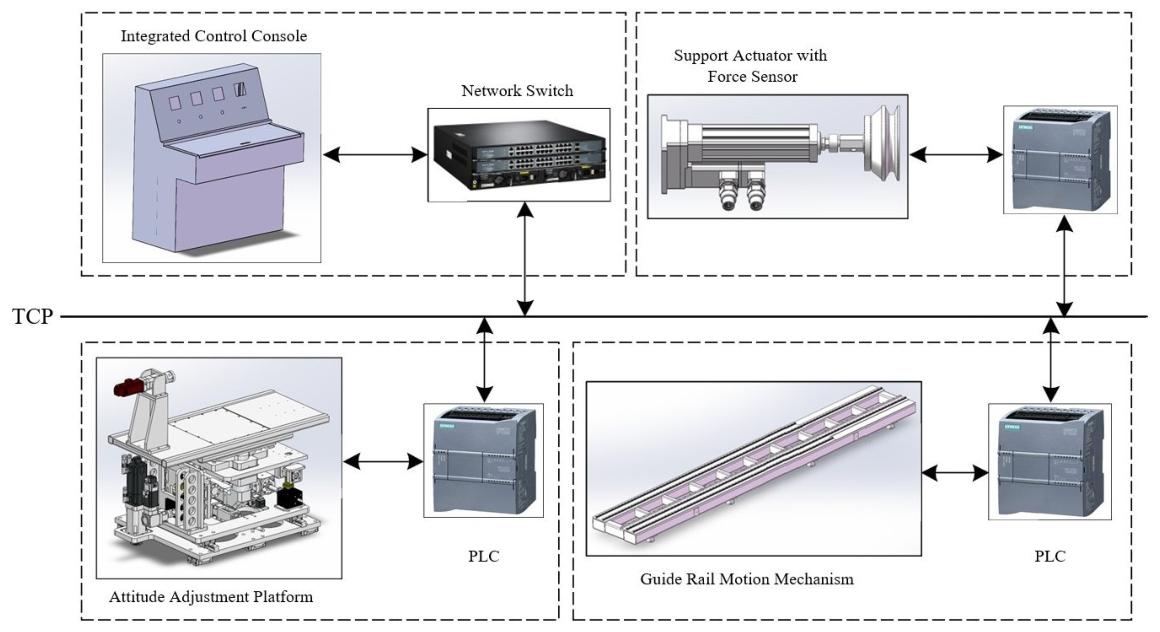
The electrical topology of the system is shown in Figure 2. The measurement and pose adjustment system communicates with the ground control console via the Transmission Control Protocol/Internet Protocol (TCP/IP) and is connected through a network switch. The ground control console enables human–machine interaction and issues control commands. Upon receiving commands from the ground control console to enter the insertion mode, the measurement and pose adjustment system controls the motion of the electric actuators based on the measurement data fed back by the force sensors.
A programmable logic controller (PLC) is used as the main control unit of the system. An RS-485 expansion board is employed to communicate with the force sensors, while an input/output (IO) expansion board is used to collect information such as encoder data and limit switch states. Through the coordinated operation of all components, the compliant insertion assembly of the cabin segment and the outer shell is ultimately achieved.

2.2. Composition of the Force Measurement System

The force measurement system consists of six electric actuators equipped with force sensors. These actuators are installed on the fixed frame in two groups of three, with each group located on a separate parallel plane. Within each plane, the axes of the three actuators are evenly distributed at 120 ° intervals, as shown in Figure 3. The actuators are driven by servo motors operating in position control mode. After the outer shell is inserted into the frame, the actuators move to preset positions defined by the control program and apply force to support the shell at the insertion position.

2.3. Composition of the Component Pose Adjustment System

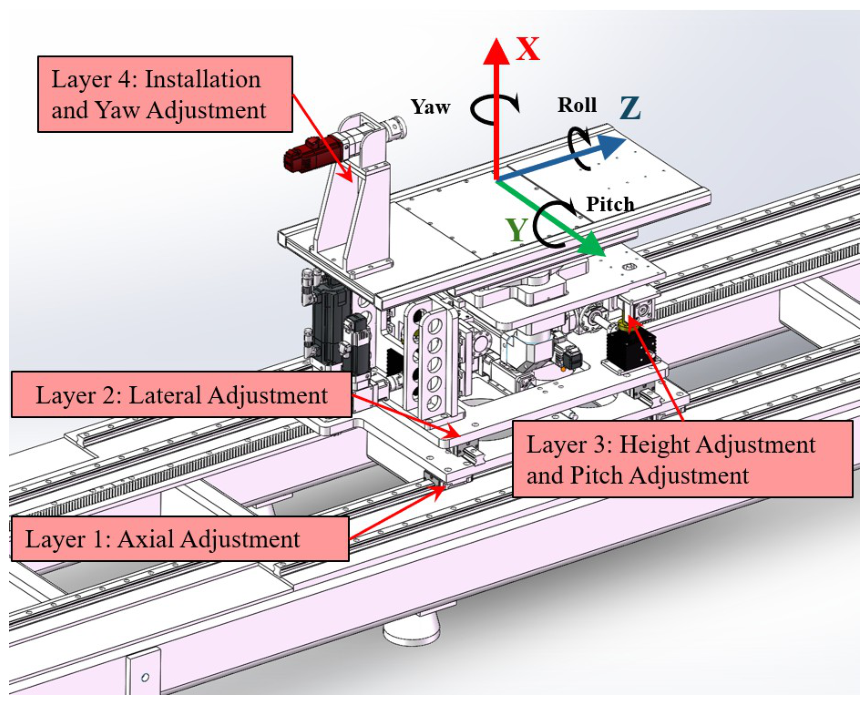
The component pose adjustment system mainly consists of a four-layer structure and is capable of adjusting the six-degree-of-freedom pose of the component, as shown in Figure 4.

2.4. Coordinate System Definition

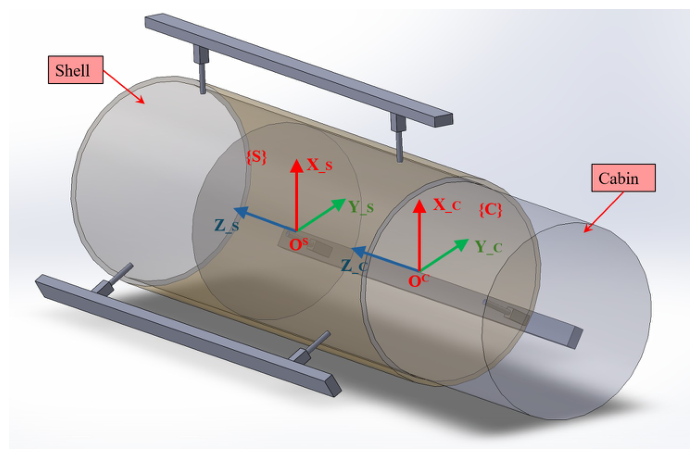
Assuming that the cabin segment and the outer shell can be modeled as a cylinder and a cylindrical shell, respectively, the forces acting on the shell during the insertion process can be simplified, as the system shows in Figure 5.
Regarding the coordinate system definition, the origin O C of the cabin segment coordinate system ( C ) is defined at the geometric center of the cabin segment, while the origin O S of the shell coordinate system ( S ) is defined at the geometric center of the outer shell. The two coordinate systems share the same orientation: the Z-axis is along the cabin advancement direction, the X-axis points vertically upward, and the Y-axis is perpendicular to the ZX plane, forming a right-handed coordinate system with ZX. The planes on which the six electric actuators are mounted are parallel to the XY plane, with O S located at the midpoint between the two planes. In each plane, three actuators are evenly distributed at 120 ° intervals, with one actuator axis aligned parallel to the Y-axis. The six actuators are numbered i = 1∼6 and denote the installation angle of the ( i ) -th actuator (the angle between its axis and the positive X-axis, measured counterclockwise), where θ 1 = θ 4 = 0 ° , θ 2 = θ 5 = 120 ° , θ 3 = θ 6 = 120 ° . The shell has an outer radius of R, and the distance between the two mounting planes is D.

3. Mechanical Modeling of the Measurement and Pose Adjustment System

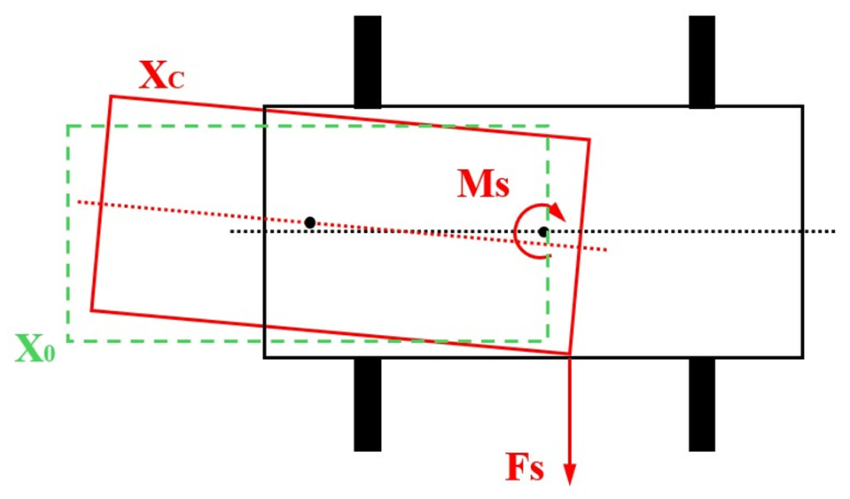
During the insertion process between the spacecraft cabin and the protective shell, factors such as machining and positioning errors, as well as the repeated positioning accuracy of the motion mechanism, inevitably have an impact. Although these errors are small in magnitude, they can still cause significant issues during the insertion process after the adhesive layer has been applied to the outer surface of the cabin and the inner surface of the shell. As shown in Figure 6, when these factors lead to a relative deviation in the axes of the cabin or the thermal protective shell, unintended contact forces and moments occur between the cabin and the shell. Such collisions may increase friction and thereby affect insertion efficiency. More critically, if the axis deviation is large, it may even cause damage to the IPA material of the shell, which is unacceptable in the field of spacecraft assembly. Therefore, measures must be taken to keep the axes of the two components aligned at all times. This paper develops an impedance controller to achieve compliant control of this process. In this chapter, the two components are first modeled. This chapter supports Contribution (2) by establishing the force-based pose estimation model.
In Figure 6, X 0 , indicated by the green dashed line, represents the ideal posture, while X C , indicated by the red solid line, represents the posture with deviation. The goal is to smoothly transition the cabin’s posture from X C to X 0 .

3.1. Mechanism Description

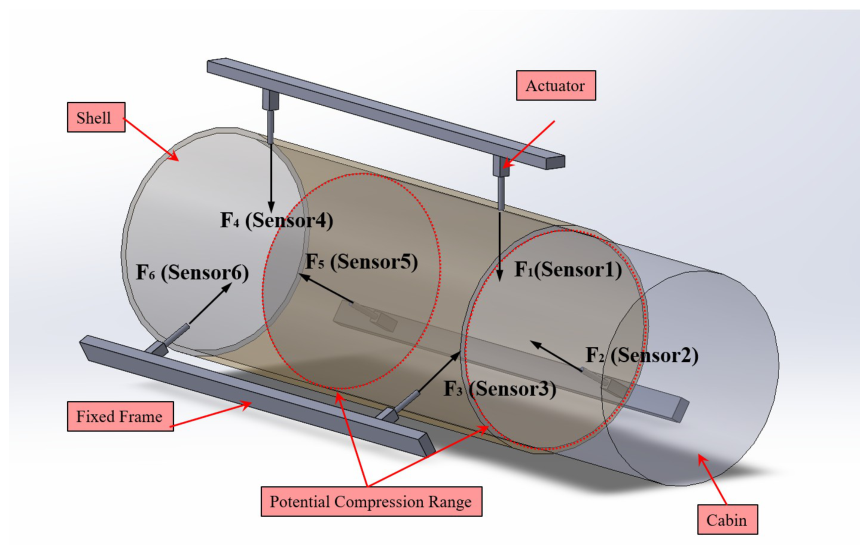
Assume that the outer shell undergoes elastic deformation due to the extrusion exerted by the cabin segment, while the actuators provide rigid support. Let the contact point between the ( i ) -th actuator and the shell be P i . The direction of the applied force is oriented toward the shell axis and is perpendicular to it. The force distribution on the shell during the insertion process is illustrated in Figure 7. The position vector of P i in the ( S ) coordinate system is denoted as r i , and the corresponding force direction vector is n i .
For the ( i ) -th actuator:
r i = R c o s θ i R s i n θ i z i , n i = c o s θ i s i n θ i 0
where: z 1 = z 2 = z 3 = d / 2 , z 3 = z 4 = z 5 = d / 2 .

3.2. Deviation Force Estimation

When contact occurs between the cabin segment and the shell, the force sensors at the ends of the six actuators measure the contact forces. Let the force measured by the ( i ) -th sensor under nominal insertion conditions be f i (a scalar, with compression taken as positive), and let the sensor measurement vector be f = [ f 1 , f 2 , f 3 , f 4 , f 5 , f 6 ] T . The generalized force vector acting on the shell is defined as W S , which can be expressed as:
W S = F S M S T
F S and M S denote the resultant force and resultant moment vectors, respectively.
According to the static equilibrium conditions:
F S = i = 1 6 f i n i = f i cos θ i f i sin θ i 0 ,
M S = i = 1 6 r i × ( f i n i ) = f i z i sin θ i f i z i cos θ i 0 ,
The generalized force vector can be obtained as:
W S = i = 1 6 f i n i r i × ( f i n i ) = f i cos θ i f i sin θ i 0 f i z i sin θ i f i z i cos θ i 0 ,
Due to factors such as local machining errors of the components, limited repeat positioning accuracy of the motion mechanism, and non-uniform adhesive thickness, deviations from the theoretical generalized forces are inevitable during the insertion process. To facilitate the computation of the generalized force from variations in sensor readings, W S can be expressed using the static force Jacobian matrix as:
W S = J F Δ f ,
This modeling approach reflects typical contact conditions in aerospace insertion assembly, where local interference caused by manufacturing tolerances or uneven adhesive layers can induce complex force distributions on thin-walled shell structures.

4. Design of the Impedance Controller

4.1. Design of the Impedance Control System

In aerospace assembly tasks, strict constraints on contact force and structural deformation require the control system to exhibit both high compliance and stability, which motivates the adoption of impedance control. This is especially important for spacecraft cabin docking and fairing integration, where excessive contact force may lead to structural damage or sealing failure. This section addresses Contribution (2), focusing on the design and implementation of the impedance controller.
The system is treated as a fully rigid system for the design of the impedance control scheme. The forces acting on the electric actuators are first obtained from the force sensor measurements, and the corresponding increment of the generalized force acting on the shell is then calculated. Based on this generalized force increment and the desired impedance characteristics of the outer shell under ideal conditions, the pose deviation is determined, which is used to correct the desired pose and obtain the force-corrected “compliant insertion pose”. Subsequently, according to the inverse kinematics of the parallel pose adjustment mechanism, the desired positions of each actuator can be solved and fed into the motor controllers, thereby achieving compliant control with the desired impedance characteristics.
The pose impedance control law in Cartesian space is given as follows:
Δ X = X 0 X C ,
M d Δ X ¨ + B d Δ X ˙ + K d Δ X = Δ W S ,
where:
M d is the inertia matrix of the position impedance, which determines the system’s inertial response to force variations;
B d is the damping matrix, which dissipates energy, ensures system stability, and prevents oscillations;
K d is the stiffness matrix, which determines the restoring force when the system deviates from the desired;
X 0 and X C represent the initial pose and the updated desired pose after force-based compliance, respectively; Δ W S denotes the variation in the generalized force acting on the shell;
Δ X , Δ X ˙ and Δ X ¨ represent the deviation between the initial pose and the desired pose in which:
Δ X = [ δ x δ y δ z δ α δ β δ γ ] T
In the proposed impedance control framework, the selection of the virtual inertia, damping, and stiffness parameters plays a crucial role in determining the dynamic behavior of the system. Rather than relying purely on empirical tuning, the impedance model can be interpreted as a set of decoupled second-order dynamic systems, providing a systematic guideline for parameter design.
Specifically, for each degree of freedom, the dynamic characteristics can be described by the natural frequency and damping ratio, which are related to the impedance parameters as:
ω n = K d M d , ζ = B d 2 M d K d
By specifying appropriate values of ω n and ζ , the impedance parameters M d , B d , and K d can be systematically determined. In practical implementation, the natural frequency ω n is selected to balance responsiveness and stability, while the damping ratio ζ is typically chosen to ensure non-oscillatory or weakly oscillatory behavior during contact.
To ensure computational efficiency and real-time performance, all impedance matrices are defined as diagonal matrices, which decouple the motion along each axis and significantly reduce computational complexity. This allows the control law to be implemented using simple element-wise operations, making it suitable for real-time execution in industrial control systems.
To further verify the rationality of the selected parameters, the values used in Section 5 are analyzed. Specifically, the parameters are set as M d = 50 , B d = 800 , and K d = 2000 . Under this condition, it is equivalent to ω n = 6.32 rad/s, ζ = 1.26 . The resulting natural frequency indicates a moderate system response speed, which is suitable for quasi-static insertion tasks. The damping ratio ζ > 1 corresponds to an overdamped system, which effectively suppresses oscillations and ensures smooth convergence during contact. This is particularly desirable in aerospace assembly scenarios, where excessive vibration or impact may lead to structural damage or assembly failure.
Therefore, the proposed parameter selection method provides a physically interpretable, scalable, and practically effective approach, ensuring stable and low-impact compliant motion under different system conditions.

4.2. Discrete Transformation and Recursive Algorithm of the Impedance Control Law

In the previous section, we designed a continuous-time control law based on the MBK model. However, the industrial control system adopted in this paper operates on a discrete sampling clock, meaning that the controller cannot directly handle infinitesimal time increments d t . Instead, at each fixed sampling period T , it computes the control command for the next time step based on the current sensor inputs and historical states. Therefore, in this section, we convert the complex differential equations into simple algebraic addition and subtraction operations using the backward difference method, thereby ensuring the determinism and efficiency of the control algorithm within the operating system.
To transform the above continuous differential equations into a difference equation recognizable by a computer, it is necessary to discretize the time terms. Introducing the sampling period T , let the current sampling instant be k; then the previous sampling instant is k 1 , and the instant before that is k 2 . The velocity and acceleration terms can be approximated as follows: The first-order derivative is defined as the instantaneous rate of change in displacement with respect to time. In the discrete-time domain, we take the ratio of the difference between the current value and the value at the previous time step to the sampling period:
Δ X ˙ ( k ) Δ X ( k ) Δ X ( k 1 ) T
The second-order derivative is defined as the instantaneous rate of change in velocity with respect to time. Applying the difference operation again to the above velocity approximation yields:
Δ X ¨ ( k ) Δ X ˙ ( k ) Δ X ˙ ( k 1 ) T
By combining like terms, the simplified difference expression for acceleration is obtained as:
Δ X ¨ ( k ) Δ X ( k ) 2 Δ X ( k 1 ) + Δ X ( k 2 ) T 2
Substituting the above approximation terms into the continuous-time impedance control law equation yields:
T 2 Δ W S ( k ) = M d [ Δ X ( k ) 2 Δ X ( k 1 ) + Δ X ( k 2 ) ] + B d T [ Δ X ( k ) Δ X ( k 1 ) ] + K d T 2 Δ X ( k )
By classifying the coefficients in Equation (15) according to the current time k and the historical times k 1 , k 2 , the following expression is obtained:
T 2 Δ W S ( k ) = ( M d + B d T + K d T 2 ) Δ X ( k ) ( 2 M d + B d T ) Δ X ( k 1 ) + M d Δ X ( k 2 )
By integrating the above coefficients, three recursive operators are defined as follows:
A = M d + B d T + K d T 2
B = 2 M d + B d T
C = M d
Thus, during the algorithm initialization phase, these operators need to be calculated only once, significantly reducing the computational cost and improving the dynamic response speed of the system. Substituting the above recursive operators into the equation and solving for the desired pose correction at the current time, the discretized recursive control equation is finally obtained as:
Δ X ( k ) = T 2 Δ W S ( k ) + B Δ X ( k 1 ) C Δ X ( k 2 ) A

4.3. Stability Analysis of the Discretized Impedance Controller

The proposed impedance control law can be interpreted as a second-order dynamic system. For the continuous-time formulation, the system is asymptotically stable provided that the impedance parameters satisfy:
M d > 0 , B d > 0 , K d > 0
Under these conditions, the system behaves as a standard mass–spring–damper system with strictly positive energy dissipation, ensuring convergence of the state variables to equilibrium. From an energy perspective, a Lyapunov candidate function can be defined as:
V = 1 2 X ˙ T M d X ˙ + 1 2 X T K d X
Taking the time derivative of V, it can be shown that:
V ˙ = X ˙ T B d X ˙ 0
Which indicates that the system is stable and dissipative.For the discretized implementation, the backward difference scheme adopted in this study is equivalent to an implicit integration method, which is known for its favorable numerical stability properties, especially for stiff systems. Combined with the positive definiteness of M d , B d , and K d , the discretized recursive formulation in Equation (18) preserves the dissipative nature of the system and ensures stable convergence under the selected sampling period. Therefore, both the continuous-time impedance model and its discrete-time implementation satisfy stability requirements, providing a reliable theoretical foundation for real-time compliant control.

4.4. Inverse Kinematics Solution of the Actuator

After obtaining the desired pose correction at the current time, the control system needs to accurately map it to the physical actuators of the five-degree-of-freedom posture adjustment platform. According to the system architecture shown in Figure 4, the posture adjustment platform consists of a four-layer series-parallel hybrid structure, with each layer responsible for decoupled adjustments in different dimensions. The core objective of the inverse kinematics solution is to calculate the target motion of the drive motors in each layer based on the desired end-effector deviation.
The correction displacement output by the impedance controller represents the small avoidance displacement required by the cabin to release the interference force. Since the displacement deviation in actual assembly conditions is minimal, based on the small-angle approximation principle, the complex homogeneous transformation matrix can be linearly decoupled into independent motion components for each axis. This greatly simplifies the inverse kinematics solution process and meets real-time requirements.
The mechanical structure of the pose adjustment platform determines the mapping of its degrees of freedom, and the motion of each actuator q = [ l axial , l lat , l h 1 , l h 2 , l pitch ] can be solved as follows.
The first layer (base layer) is driven by a rack-and-pinion mechanism and is dedicated to axial feed and displacement compensation along the Z-axis; the second layer enables lateral translation along the Y-axis through a linear guide. These two degrees of freedom are purely linearly decoupled, and the target displacements of their driving motors are directly equivalent to the translational correction outputs of the controller:
l axial = Δ z , l lat = Δ y
The third layer adopts a dual-actuator parallel configuration to achieve coupled adjustment of vertical displacement and pitch angle. The two actuators are arranged along the axial (Z-axis) direction, with a center-to-center distance of L Z . The rotation center of the platform is located at the midpoint between the two actuators. According to the geometric relationship, the displacements of the front actuator l h 1 and the rear actuator l h 2 are composed of the superposition of the overall translation along the X-axis and a small rotation about the Y-axis:
l h 1 = Δ x + L Z 2 sin ( Δ θ ) , l h 2 = Δ x L Z 2 sin ( Δ θ )
where:
l h 1 and l h 2 denote the target displacement increments of the front and rear actuators, respectively;
Δ x is the vertical displacement correction obtained from the discretized impedance control law;
Δ θ is the pitch angle correction about the Y-axis obtained from the discretized impedance control law;
Through this set of parallel differential equations, the system can simultaneously transform the unloading of radial interference forces and the adaptive correction of pitch deviations into coordinated motions of the two actuators.
The fourth layer serves as the attitude compensation layer, responsible for adjusting the yaw angle of the cabin segment relative to the shell. This layer employs a mechanical configuration combining a linear actuator with a rack-and-pinion mechanism to realize rotational motion. In this structure, the linear motion of the actuator drives the rack, which in turn engages with a central gear to rotate the platform about the vertical axis.
Let the pitch circle diameter of the rack-and-pinion system be D pitch . According to the gear transmission principle, there exists a strict linear proportional relationship between the rack displacement l pitch and the rotation angle Δ ψ :
l pitch = Δ ψ · π · D pitch 360 °
If expressed in radians, the equation can be simplified as:
l pitch = D pitch 2 Δ ψ
where:
l pitch denotes the target displacement increment of the actuator in the fourth layer;
D pitch is the pitch circle diameter of the transmission gear, which is predefined as a mechanical constant in the controller;
Δ ψ is the yaw angle correction obtained from the discretized impedance control law.

5. Results

5.1. Simulation Conditions

In the automatic assembly process of cabin segments, the sealing application (adhesive coating) is a critical step to ensure sealing performance. However, due to the physical properties of the adhesive and the complexity of the application environment, it is difficult to achieve a theoretically uniform coating thickness on the cabin surface. Micrometer- to millimeter-level variations in adhesive thickness can translate into significant radial displacement disturbances within the tight assembly clearance. During axial insertion, locally thickened adhesive layers may cause severe mechanical interference with the inner wall of the shell. Such interference forces, induced by displacement deviations, are a primary cause of assembly jamming and component damage. In this chapter, a co-simulation platform based on Python(compiler version 3.8) and V-REP is employed to simulate the smooth displacement drift caused by non-uniform adhesive thickness, and to investigate the dynamic response of the cabin segment within a constrained space. The simulation scenario is designed to approximate typical aerospace assembly conditions, such as the insertion of a cabin segment into a thermal protection shell with non-uniform adhesive distribution. Such conditions are common in aerospace manufacturing, where achieving uniform adhesive thickness is challenging and can lead to localized interference during assembly. This serves as a benchmark for evaluating the effectiveness of the proposed control strategies. This chapter validates Contributions (3) under representative aerospace assembly conditions.
To validate the effectiveness of the proposed force perception and compliant control algorithm, a semi-physical simulation platform is established based on the large-component insertion system shown in Figure 1. To meet the real-time requirements of the discretized admittance control algorithm, the global sampling and control period of the system is set to T = 10 ms .
In the insertion process, adhesive coating remains a key factor affecting sealing performance, and its non-uniformity introduces radial disturbances. To replicate such conditions, a representative interference scenario is defined as follows: the cabin segment is inserted along the Z-axis at a constant velocity of 5 mm/s; when reaching the middle section, an artificial offset constraint equivalent to a maximum deviation of 3 mm is applied along the X-axis (vertical direction) to simulate radial compression caused by uneven adhesive distribution or machining errors.
The key parameters of the impedance controller—virtual mass, virtual damping and virtual stiffness—directly determine the compliance and stability of the system. After dynamic tuning and multiple trials, the impedance parameters for translational motion are set to M d = 50 kg , B d = 800 N · s / m , K d = 2000 N / m , while those for rotational motion are set to M d = 10 kg , B d = 150 N · s / m , K d = 300 N · m / rad . The dead-zone threshold for contact force is set to 5 N to filter out high-frequency noise caused by sensor zero drift and system static friction.
To ensure high fidelity in the co-simulation, the physical properties of the stationary shell component are meticulously configured within the V-REP environment utilizing the Bullet physics engine. The shell is modeled as a rigid body with a mass of 9.5 kg . To accurately replicate its dynamic characteristics and resistance to induced moments during contact, its principal moments of inertia are defined relative to its center of mass. Specifically, the inertia values along the X, Y, and Z axes are configured to 0.13 m 2 , 0.13 m 2 , and 0.09 m 2 , respectively (normalized by mass).
Furthermore, the surface interaction parameters are defined to simulate realistic contact mechanics during the insertion of the cabin segment. The friction coefficient of the shell’s inner surface is set to 0.5, representing a typical metal-to-adhesive interface under constrained conditions. Other critical parameters, such as restitution, linear damping, and angular damping, are optimized to maintain numerical stability and prevent non-physical oscillations during high-frequency contact interactions. The detailed physical parameters of the simulated shell are summarized in Table 1.

5.2. Static Calibration and Data Pre-Processing Strategy

In force-feedback-based compliant assembly simulations, the quality of sensor signals directly determines the compensation accuracy of the impedance controller. However, due to the inherent numerical calculation fluctuations within physical simulation engines during rigid-body contacts, the force sensor outputs often contain high-frequency transient oscillations. If such raw, unprocessed noisy signals are directly fed into the impedance controller, they would trigger high-frequency oscillatory corrective displacements from the actuators, severely compromising the smoothness of the assembly process.
To address this challenge, a comprehensive data pre-processing pipeline has been developed in this study. First, an Exponential Moving Average (EMA) filtering algorithm is implemented for the real-time smoothing of the six-axis force sensor data. By fine-tuning the smoothing factor, this filter effectively suppresses random high-frequency noise originating from the simulation environment while maintaining a rapid response to genuine changes in contact forces.
Considering that the force signal acquired during the insertion process contains measurement noise and local contact fluctuations, an exponential moving average (EMA) filter is introduced to improve signal smoothness and control stability. The EMA filter can be regarded as a first-order discrete low-pass filter, which inherently introduces frequency-dependent phase lag characteristics. In the proposed assembly system, the insertion process is conducted under quasi-static operating conditions with a low insertion velocity of 5 mm/s and a control sampling frequency of 50 Hz. Under such conditions, the effective dynamics of the contact interaction evolve relatively slowly, and the dominant frequency components remain well below the sampling bandwidth of the control system. The EMA filter is designed such that its cutoff frequency is higher than the dominant frequency range associated with the compliant insertion process. Therefore, within the effective operating bandwidth of the system, the filter operates in a near-zero phase-shift region, resulting in only negligible phase lag for the actual contact dynamics while still effectively attenuating high-frequency measurement noise and local contact oscillations. Consequently, the EMA filtering strategy improves signal smoothness and suppresses high-frequency disturbances without noticeably affecting the real-time responsiveness, closed-loop stability, or insertion accuracy of the compliant control system.
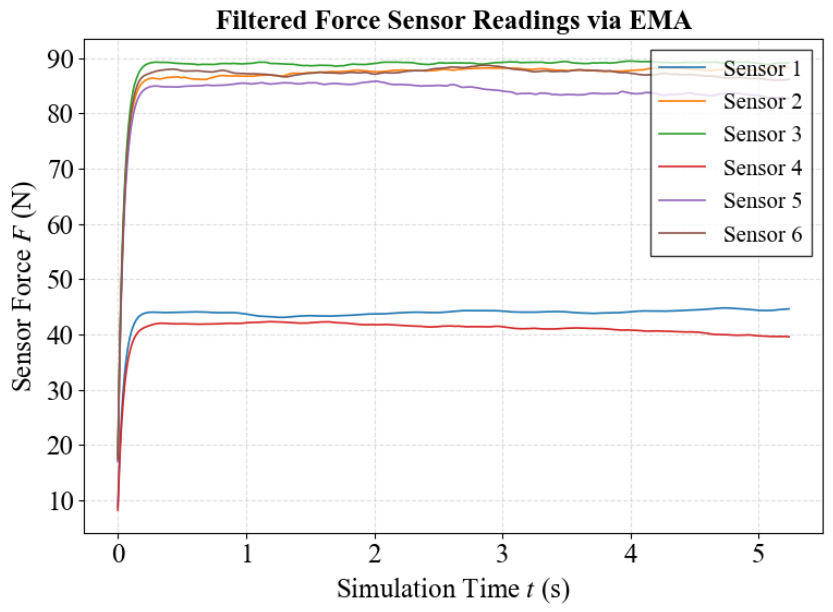
To establish a precise baseline for force deviation calculation, a static reference sampling strategy is employed. At the onset of each assembly task, a 5-s sampling window is reserved. During this interval, the robotic arm maintains a predefined ideal alignment posture, and the system calculates the mean value of the filtered force signals. This mean value serves as the static reference baseline, encompassing gravity bias and initial system pre-tension. This step ensures that the subsequently calculated force deviations accurately reflect geometric misalignment during assembly rather than the system’s inherent static loads. The sampling results of the static baseline support forces for the six sensors are shown in Figure 8.
To further enhance the robustness of the control system, a non-linear dead-zone element is introduced before the force deviations are input into the impedance controller. By setting appropriate force and moment thresholds, this dead-zone filters out minor residual fluctuations. The impedance controller is activated to output corrective displacements only when the contact force deviation exceeds a predefined safety threshold. This pre-processing mechanism ensures sufficient sensitivity to assembly interference while effectively preventing unintended movements caused by numerical instability in the simulation, significantly enhancing the overall stability of the assembly compensation process.

5.3. Comparison of Force and Moment Responses

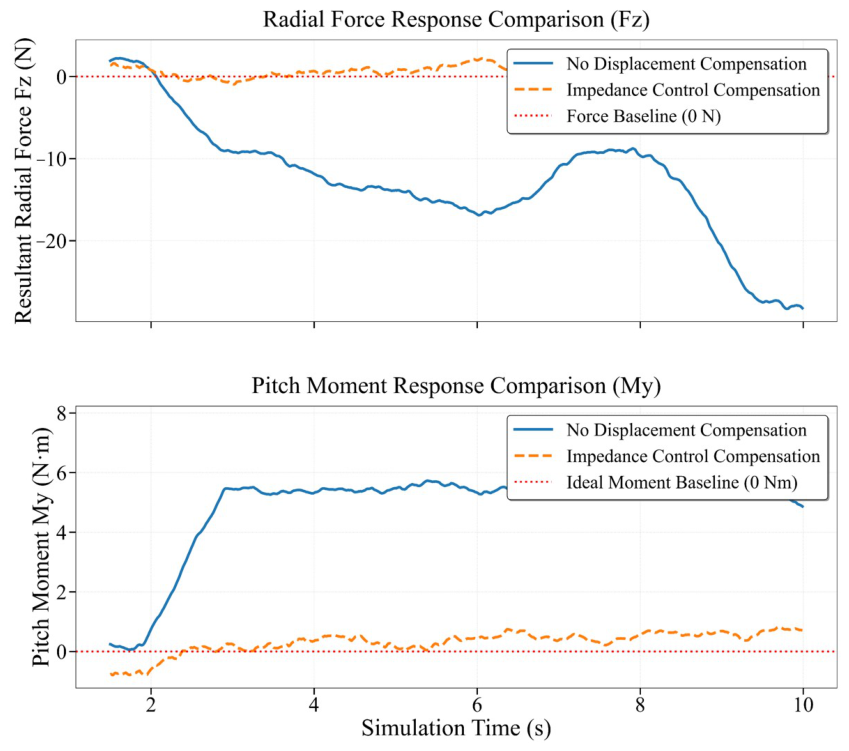
In this section, comparative simulation are conducted to analyze the dynamic response of the system under radial deviation disturbances before and after applying the impedance control-based displacement compensation algorithm. Two simulation groups are considered: a rigid assembly group without active compliance capability (Rigid Assembly) and a compliant compensation group implementing the proposed method (Compliant Compensation).
The simulation results in Figure 9 indicate that, under the same radial displacement disturbance, the force characteristics of the two groups exhibit significant differences. In the rigid assembly process, due to the lack of effective compliance between the shell and the cabin segment, the radial force F z increases sharply with insertion depth. The data curves indicate a pronounced impact load at the moment of contact, and because mechanical interference cannot be mitigated, the resultant force F z eventually approaches the safety threshold of 30 N. Meanwhile, due to misalignment-induced extrusion, the pitch moment M y exhibits substantial nonlinear fluctuations.
In contrast, after applying impedance control-based displacement compensation, the system’s force perception and active compliance mechanisms play a critical role. When a force deviation is detected by the sensors, the controller immediately outputs corrective displacements. As observed from the comparison curves, although the radial force F z in the compliant compensation group shows a slight increase at the initial stage of contact, it quickly converges smoothly to 0 N. The impact load is effectively suppressed, and the force curve demonstrates excellent smoothness. At the same time, the pitch moment M y is consistently constrained within a very small range (approaching 0 N·m), indicating that the proposed method not only corrects positional deviations but also effectively maintains the stability of the assembly posture.
To further validate the effectiveness of the proposed method, Table 2 presents a comparison of key performance metrics under the two operating conditions. The results show that, with displacement compensation, the maximum contact impact force is reduced from 28.3 N to 2.9 N, and the maximum contact moment is reduced from 7.8 N·m to 0.8 N·m, corresponding to a reduction of approximately 90%. In addition, the standard deviation of the force signals decreases significantly, indicating a substantial improvement in the stability of the assembly process.

6. Conclusions and Future Work

6.1. Conclusions

This paper presents an impedance-controlled compliant insertion assembly method for large-scale components under non-cooperative conditions. The proposed approach addresses key challenges in high-precision assembly tasks, particularly in aerospace applications where strict requirements on alignment accuracy, contact force, and structural safety must be satisfied.
  • A compliant assembly framework for non-cooperative outer shells was established, which eliminates the dependence on dedicated fixtures and predefined alignment references in conventional assembly systems. By introducing compliant interaction capability into the insertion process, the proposed framework improves the adaptability of the system to pose deviation and environmental uncertainty.
  • A generalized contact force model was constructed to characterize the interaction relationship between pose deviation and contact force during the insertion process. Based on this model, an impedance control strategy with discrete recursive implementation was designed for the proposed hardware architecture, enabling stable force-compliant insertion under uncertain contact conditions. The proposed method effectively regulates the dynamic interaction between the assembly component and the target structure, thereby reducing excessive contact impact and improving insertion smoothness.
  • Simulation studies under representative aerospace assembly conditions were conducted to evaluate the effectiveness of the proposed method. The results demonstrate that the proposed impedance-controlled compliant insertion strategy can significantly reduce contact force fluctuation and improve insertion stability compared with conventional rigid position-control methods. The proposed method shows strong potential for large-scale aerospace assembly tasks involving non-cooperative structures and uncertain contact environments.
Overall, the proposed method provides a physically interpretable and practically effective solution for automated compliant assembly of large-scale structures. It offers strong potential for applications in aerospace manufacturing, such as spacecraft cabin integration and rocket assembly.

6.2. Future Work

Although this study has achieved the expected results in compliant assembly control for large-scale structures, it is still limited by the current simulation environment and theoretical framework. There remains considerable room for further improvement and extension in future work:
  • The impedance parameters used in this study are tuned for a lightweight composite shell. For heavier structures, the parameters can be systematically reconfigured according to the equivalent mass and desired dynamic characteristics (e.g., natural frequency and damping ratio), ensuring scalability of the proposed method to large-scale aerospace applications. Furthermore, the current system adopts a fixed set of impedance parameters, when facing highly complex or unknown environments with abrupt stiffness variations, its compliance performance becomes limited. In the future, fuzzy control or reinforcement learning algorithms can be introduced to dynamically adjust the parameters M, B, and Konline based on the real-time rate of change in contact force (force derivative), thereby achieving better dynamic response and enhanced impact resistance.
  • Relying solely on force feedback leads to inherent delays when predicting large-scale deformations. Future work can integrate non-contact measurement methods, such as laser rangefinders or machine vision, with force sensing to establish a hybrid control framework of “vision-based preview + force-based fine adjustment.” This approach would further improve the efficiency and reliability of fully automated assembly of large structures under extremely tight clearance conditions.

Author Contributions

Conceptualization, R.Z. and X.W.; methodology, N.Q.; software, L.H.; validation, K.L., R.Z. and X.W.; formal analysis, L.H.; investigation, L.Y.; resources, L.H.; data curation, X.W.; writing—original draft preparation, K.L.; writing—review and editing, R.Z.; visualization, L.H.; supervision, L.H.; project administration, L.H.; funding acquisition, N.Q. All authors have read and agreed to the published version of the manuscript.

Funding

This research is supported by a project funding (JCKY2024204A006), National Key Research and Development Program of China (2022YFB3902701), National Natural Science Foundation of China (52272390), and in part by the China Postdoctoral Science Foundation (2025M784384).

Data Availability Statement

The data presented in this study are available upon request from the corresponding author.

Conflicts of Interest

The authors declare no conflicts of interest.

References

  1. Wen, K.; Du, F.Z.; Zhang, T.J. Research on design and experiment for digital flexible aligning system of cabin components. Aeronaut. Manuf. Technol. 2017, 11, 24–31. [Google Scholar]
  2. Zhao, H.; Ge, D.S.; Luo, L.Z. Survey of automated flexible docking assembly technology for large-scale components. J. Mech. Eng. 2023, 59, 279–297. [Google Scholar]
  3. Chu, W.M.; Huang, X.; Li, S. A ball head positioning method based on hybrid force-position control. Proc. Inst. Mech. Eng. I J. Syst. Control Eng. 2021, 235, 1433–1444. [Google Scholar] [CrossRef]
  4. Zeng, Q.; Li, S.G.; Huang, X. Configuration optimization of the feature-oriented reference system in large component assembly. Int. J. Adv. Manuf. Technol. 2021, 113, 673–687. [Google Scholar] [CrossRef]
  5. Deng, Z.P.; Huang, X.; Li, S.G. On-line calibration and uncertainties evaluation of spherical joint positions on large aircraft component for zero-clearance posture alignment. Robot. Comput. Integr. Manuf. 2019, 56, 38–54. [Google Scholar] [CrossRef]
  6. Mei, Z.Y.; Huang, C.; Fan, Y.Q. Development and prospect of the aircraft digital assembly technology. Aeronaut. Manuf. Technol. 2015, 18, 32–37. [Google Scholar]
  7. Mei, Z.Y.; Maropoulos, P.G. Review of the application of flexible, measurement-assisted assembly technology in aircraft manufacturing. Proc. Inst. Mech. Eng. Part B J. Eng. Manuf. 2014, 228, 1185–1197. [Google Scholar] [CrossRef]
  8. Wang, J.P.; Xie, Y.Q.; Song, T. A precise robot control technology for satellite assembly based on force interaction control. Mach. Des. Res. 2019, 35, 47–52. [Google Scholar]
  9. Chen, G.Y.; Chen, Q.L.; Zhang, J.Y. Multi-sensor measurement based position and pose adjustment method for automatic docking of spacecraft cabins. J. Beijing Univ. Aeronaut. Astronaut. 2019, 45, 1232–1239. [Google Scholar]
  10. Chu, W.M.; Huang, X.; Li, S.G. A calibration method of redundant actuated parallel mechanism for posture adjustment. Ind. Robot. Int. J. Robot. Res. Appl. 2021, 48, 494–509. [Google Scholar] [CrossRef]
  11. Yi, W.M.; Long, C.Y.; Hu, R.Q. Robot system and application for spacecraft assembly test (Part 1). Aerosp. China 2019, 2, 30–33. [Google Scholar]
  12. Izard, J.B.; Dubor, A.; Herve, P.E. On the improvements of a cable-driven parallel robot for achieving additive manufacturing for construction. In Cable-Driven Parallel Robots: Proceedings of the Third International Conference on Cable-Driven Parallel Robots; Springer: Cham, Switzerland, 2018; pp. 29–41. [Google Scholar] [CrossRef]
  13. Pan, G.W.; Chen, W.L.; Wang, M. A review of parallel kinematic mechanism technology for aircraft assembly. Acta Aeronaut. Astronaut. Sin. 2019, 40, 272–288. [Google Scholar]
  14. Wang, Q.; Dou, Y.; Li, J. An assembly gap control method based on posture alignment of wing panels in aircraft assembly. Assem. Autom. 2017, 37, 422–433. [Google Scholar] [CrossRef]
  15. Guo, Z.M.; Jiang, J.X.; Ke, Y.L. Posture alignment for large aircraft parts based on three POGO sticks distributed support. Acta Aeronaut. Astronaut. Sin. 2009, 30, 1319–1324. [Google Scholar]
  16. Zhang, B.; Yao, B.G.; Ke, Y.L. A novel posture alignment system for aircraft wing assembly. J. Zhejiang Univ. Sci. A 2009, 10, 1624–1630. [Google Scholar] [CrossRef]
  17. Luo, Z.H.; Meng, X.L.; Ba, X.F. Design on hybrid force position control of large aircraft components posture alignment platform. J. Zhejiang Univ. Eng. Sci. 2015, 49, 265–274. [Google Scholar]
  18. Li, X.P.; Guo, B.J.; Han, J.H. Research on hybrid force/position control method for robot peg-in-hole assembly. Adv. Mech. Eng. 2025, 17, 1–12. [Google Scholar] [CrossRef]
  19. Beltran-Hernandez, C.C.; Petit, D.; Ramirez-Alpizar, I.G. Learning force control for contact-rich manipulation tasks with rigid position-controlled robots. IEEE Robot. Autom. Lett. 2020, 5, 5709–5716. [Google Scholar] [CrossRef]
Figure 1. Overall configuration and working process of the proposed compliant insertion assembly system for large-scale components.
Aerospace 13 00481 g001
Figure 2. System electrical connection.
Aerospace 13 00481 g002
Figure 3. Composition of the Force Measurement System.
Aerospace 13 00481 g003
Figure 4. Composition of the Segment Pose Adjustment System. The X, Y, and Z axes define the reference directions of the system, corresponding to the axial, lateral, and vertical directions, respectively.
Aerospace 13 00481 g004
Figure 5. Coordinate system schematic. The coordinate frames ( C ) and ( S ) are attached to the centers of the cabin and shell, respectively, and are defined to be parallel to the reference directions shown in Figure 4. The resultant force F S and moment M S are expressed in the shell coordinate frame ( S ) .
Aerospace 13 00481 g005
Figure 6. Schematic Diagram of Shell Forces During the Insertion Process.
Aerospace 13 00481 g006
Figure 7. Sensor arrangement and definition.
Aerospace 13 00481 g007
Figure 8. Force Sensor Readings During the Calibration Stage.
Aerospace 13 00481 g008
Figure 9. Comparison Curves of Radial Force and Pitch Moment under Two Assembly Conditions.
Aerospace 13 00481 g009
Table 1. Physical Properties.
Parameter CategoryPropertyValueUnit
Mass PropertiesMass9.50kg
Inertia I xx /mass0.13 m 2
Inertia I yy /mass0.13 m 2
Inertia I zz /mass0.09 m 2
Contact PropertiesFriction Coefficient0.50
Restitution1.00
Damping PropertiesLinear Damping0.50
Angular Damping0.40
Numerical SettingsCollision Margin Factor0.10
Table 2. Comparison of Performance Metrics Between Rigid Assembly and Compliant Assembly.
Evaluation MetricsRigid AssemblyProposed MethodImprovement
Peak Radial Force/N−28.2956−2.902689.75%
Mean Radial Force/N−12.5805−1.042191.72%
Standard Deviation/N6.91710.868987.44%
Peak Pitch Moment/Nm7.79800.820389.49%
Mean Pitch Moment/Nm5.30480.306994.22%
Standard Deviation/Nm1.77790.360279.75%
Disclaimer/Publisher’s Note: The statements, opinions and data contained in all publications are solely those of the individual author(s) and contributor(s) and not of MDPI and/or the editor(s). MDPI and/or the editor(s) disclaim responsibility for any injury to people or property resulting from any ideas, methods, instructions or products referred to in the content.