Article

Research on a Pinning Control Method for Congestion Mitigation in High-Density Air Route Networks

1
College of Civil Aviation, Nanjing University of Aeronautics and Astronautics, Nanjing 211106, China
2
State Key Laboratory of Air Traffic Management System, Nanjing 211106, China
*
Author to whom correspondence should be addressed.
Aerospace 2026, 13(5), 479; https://doi.org/10.3390/aerospace13050479
Submission received: 3 April 2026 / Revised: 7 May 2026 / Accepted: 18 May 2026 / Published: 20 May 2026
(This article belongs to the Section Air Traffic and Transportation)

Abstract

To address peak-period congestion in high-density air route networks and the high cost and limited precision of traditional global control methods, this study proposes a congestion mitigation method based on pinning control theory. First, a comprehensive evaluation index system for critical waypoints is constructed from complex-network structural characteristics, traffic flow characteristics, and congestion-state information. Pearson correlation analysis is used to examine redundancy among candidate indicators, and the entropy-weighted TOPSIS method is then employed to evaluate waypoint importance and identify critical pinning nodes. Second, a GA-PID pinning control optimization model is established to realize closed-loop optimization of network congestion by dynamically regulating a small number of critical nodes. Finally, simulation experiments are conducted using actual operational trajectory data from the Yangtze River Delta airspace. The results show that the proposed method reduces the network congestion coefficient from 176 to 137, representing a decrease of 22.16%, and increases airspace resource utilization from 70.76% to 84.41%, representing an improvement of 19.29%. Compared with the baseline GA method, the proposed method achieves better optimization performance and requires adjustments at only 13 waypoints, whereas the baseline GA method requires adjustments at 25 waypoints, demonstrating lower control costs and higher regulation efficiency.

1. Introduction

In recent years, with the continued growth of China’s civil aviation transport demand, flight operation density in typical high-density airspace regions, such as the Yangtze River Delta, the Beijing–Tianjin–Hebei region, and the Pearl River Delta, has been rising steadily. As a result, high-density air route networks have remained under heavy load, or even near-saturation, conditions during peak periods for extended periods. Composed of waypoints and air route segments, an airway network is characterized by tightly interconnected nodes, strong traffic coupling, and rapid congestion propagation. When a local waypoint becomes overloaded, congestion can easily spread to surrounding nodes through the network’s connectivity, leading to flight delays, reduced resource utilization, and potential operational safety issues. Although traditional network-wide unified control approaches can alleviate congestion to some extent, they usually involve a broad control scope, slow response times, high implementation costs, and insufficient precision, making them inadequate for the practical need for rapid, accurate, and low-cost regulation in peak congestion scenarios within high-density airway networks. Therefore, identifying a small number of critical waypoints from a complex and highly coupled air route network and using them as leverage points for overall congestion mitigation has become an urgent issue in air traffic flow management. This need also motivates the development of congestion-control methods that can link network-level structural importance with operational traffic flow regulation, rather than relying only on large-scale global adjustment.
Critical waypoint identification provides the basis for selecting a small number of control targets in high-density air route networks. Existing studies have proposed various methods for evaluating node importance from the perspectives of local topology, global structure, multi-indicator fusion, and dynamic propagation. Chen et al. proposed a semi-local centrality method to evaluate node influence by considering neighborhood information, while Lü et al. introduced the H-index of network nodes and analyzed its relationship with degree and coreness [1,2]. Dai et al. further developed a local-neighbor-contribution metric to quantify node importance using local neighborhood structures [3]. To overcome the limitations of purely local indicators, Sheng et al. combined global common-neighbor information with locally weighted degree centrality, Ullah et al. proposed LGC centrality by integrating local and global structural information, and Zhong et al. introduced the local degree dimension method to incorporate global structural signals into local evaluation of node importance [4,5,6]. With the increasing complexity of network structures, multi-indicator fusion methods have also been widely used for critical-node identification. Ren et al. proposed an improved entropy weight centrality method, and Fang et al. combined CRITIC and entropy weighting to objectively integrate degree, betweenness, closeness, and related indicators [7,8]. Du et al. introduced TOPSIS into key node identification, while Wang, Chen, and Ahmad et al. further extended multi-attribute fusion methods by combining TOPSIS, grey relational analysis, weighted-sum schemes, and robustness evaluation for complex and aviation-related networks [9,10,11,12]. In addition, Zhang et al. enhanced weighted node contraction by incorporating edge betweenness, and Zhong et al. proposed an improved gravity model to identify key nodes based on structural and propagation characteristics [13,14]. More recently, dynamic-propagation and learning-based methods have been introduced to capture the temporal evolution of congestion or delay. Zhang et al. used epidemic-style propagation models to identify critical nodes from congestion-spreading behavior, while Kang et al., Tian et al., and Lv et al. developed graph-based or attention-based learning models to analyze delay propagation, short-term waypoint traffic flow, and congestion time-lag characteristics [15,16,17,18]. Ji et al. further combined complex-network features with a symmetric multi-class random forest to improve the identification of congestion-critical nodes [19]. These studies provide an important foundation for critical-node identification. However, for peak-period congestion mitigation in high-density air route networks, critical waypoints should not be evaluated only in terms of static topology or propagation influence. Their operational traffic load, local congestion pressure, and direct connection with subsequent congestion-control decisions should also be considered. Therefore, a multidimensional identification framework that integrates network structure, traffic flow characteristics, and congestion-state information is still needed.
Congestion mitigation in air route networks can be regarded as a traffic flow regulation problem. Although aviation-specific studies remain relatively sparse, the mature theory and methods from urban road-network traffic flow offer valuable references [20]. In air traffic congestion regulation, Cummings et al. developed a macroscopic air-traffic flow model via a gas-kinetic analogy and established a four-dimensional fundamental diagram spanning density, speed, flow, and related state variables, thereby revealing the pivotal role of aircraft density in system performance [21]. Building on this foundation, Daniel, Muara, and Jacquillat et al. optimized resource allocation—leveraging multi-objective genetic algorithms, mixed-integer linear programming, and an iterative framework integrating stochastic queuing models, dynamic programming, and integer programming to address slot allocation, dynamic flight scheduling, and airport-operations coordination for congestion mitigation, respectively [22,23,24]. More recently, large-scale combinatorial and mixed-integer problems in demand–capacity balancing and sequencing have been tackled with advanced optimization and learning. Lavandier et al. employed selective simulated annealing, Idrissi et al. adopted particle swarm optimization, and Chen et al. proposed a deep neural approach combining neural branch-and-bound with neural diving to achieve congestion smoothing, arrival sequencing, and DCB efficiency at scale [25,26,27]. At the airport level, He et al. constructed capacity envelopes and collaborative optimization models and used an improved genetic algorithm to refine flow allocation [28]. At the network level, Ma et al. combined graph neural networks with transformer encoders to identify and predict network flow intersections and applied reinforcement learning for dynamic route assignment [29]. Chen et al. recast tactical-phase DCB as a hotspot-free trajectory-planning problem using adaptive directed spatiotemporal graphs and a heterogeneous, multi-objective incremental A* search [30]. Xu and Yang et al. realized dynamic airspace sectorization by fusing attention-based predictors with XGBoost load forecasting, coupled with intelligent clustering and optimization for precise sector delineation and boundary refinement [31,32]. Complementing these, Wang et al. proposed a quasi-dynamic air-traffic assignment model to reduce airspace complexity, while Zhou et al. formulated a four-dimensional multi-objective trajectory-planning framework that explicitly accounts for weather uncertainty [33,34]. These studies have promoted the development of air traffic congestion management from static allocation to dynamic optimization and intelligent decision-making. However, many of them are formulated as global or large-scale optimization problems involving multiple flights, routes, sectors, or trajectory variables. In peak-period high-density air route networks, such global optimization may lead to a large decision space and high implementation complexity, making it difficult to achieve rapid and fine-grained regulation with a small number of control targets.
Unlike global air traffic optimization, pinning control provides another perspective for congestion mitigation by regulating only a limited number of critical elements in a coupled traffic network. This idea has been widely explored in road traffic systems. Pang et al. pioneered modeling urban expressways as node-coupled networks and, by coupling the cell transmission model with delayed feedback, designed pinning-based chaos suppressors to curb congestion [35]. Building on this, Wang et al. introduced “negative weights” to encode the disutility of severe congestion and proposed an integrated scheme that co-tunes an adaptive state-feedback controller with a coupling-strength regulator, thereby enhancing robustness to time-varying traffic states [36]. Extending the control perimeter to include adjacent signalized intersections, Pang et al. devised a dual-module controller that coordinates ramp metering with signal timing to jointly regulate freeway inflow and outflow, enabling broader area-wide control [37]. Gong et al. further formulated a feedback-driven pinning strategy that treats key intersection signals as decision variables, steering link flows toward desired set points to preempt congestion formation [38]. With the advent of the cyber-physical systems paradigm and mixed traffic, Liu et al. shifted attention to leveraging a controllable subset of connected and automated vehicles to indirectly guide human-driven vehicles. Their contributions develop pinning-control formulations spanning H∞ synthesis, macroscopic traffic flow descriptions, and platoon-stability analysis, yielding improved network coherence and operational efficiency under realistic disturbances and heterogeneity [39,40,41]. These studies demonstrate the effectiveness of applying pinning control to traffic networks. However, their control objects and implementation mechanisms are mainly designed for road traffic systems, such as ramp metering, signal timing, road-link flow regulation, and connected-vehicle guidance. In contrast, congestion regulation in high-density air route networks is organized around waypoints, route segments, and flight trajectories. The control action cannot be directly implemented through signal timing or ramp inflow control, but must be transformed into waypoint-flow regulation and local flight rerouting under route connectivity, temporal feasibility, and capacity constraints. Moreover, unlike road intersections or links, critical waypoints in air route networks should be identified by jointly considering network topology, traffic load, and congestion pressure. Therefore, direct transfer of road-traffic pinning control models is insufficient for airway congestion mitigation. An airway-oriented pinning control framework is still needed, particularly in terms of critical waypoint identification, feedback controller design, parameter tuning, and the mapping from waypoint-level regulation demand to feasible local rerouting actions.
In summary, although existing studies provide an important foundation for air route network congestion management, several gaps remain. First, existing critical-node identification methods are not sufficiently aligned with congestion-control requirements, making it difficult to support control-oriented waypoint selection under peak-period operating conditions. Second, many air traffic congestion optimization studies focus on global regulation or large-scale decision-making, which may lead to high control costs and large decision spaces in high-density air route networks. Third, although pinning control has shown effectiveness in road traffic networks, its application to airway congestion mitigation remains insufficient, especially in terms of critical waypoint selection, feedback regulation, parameter optimization, and the mapping from waypoint-level regulation demand to feasible local rerouting actions.
To address these gaps, this work proposes a pinning-control-based congestion mitigation method for peak-period high-density air route networks. The main contributions are as follows. First, by integrating complex-network structural characteristics, traffic flow characteristics, and congestion-state information, a multidimensional evaluation framework for critical waypoints is constructed. To avoid redundant information among indicators, Pearson correlation analysis is introduced before weight calculation, and the retained indicators are then integrated using the entropy-weighted TOPSIS method to identify critical pinning nodes. Second, a genetic algorithm-based proportional–integral–derivative (GA-PID) pinning control optimization framework is developed to integrate PID parameter optimization, closed-loop feedback regulation, and feasible local flow redistribution. In this framework, the genetic algorithm optimizes the PID parameters, and the resulting waypoint-level regulation demand is mapped into feasible flow redistribution actions through a rule-based rerouting mechanism under reachability, temporal-feasibility, minimum-separation, and capacity constraints. Third, a case study using operational data from the Yangtze River Delta air route network is conducted to verify the effectiveness of the proposed method by comparing congestion mitigation performance, resource utilization improvement, and control cost with a baseline genetic algorithm (GA) method.

2. Identification of Pinning Nodes in High-Density Air Route Networks

2.1. Topological Modeling of High-Density Air Route Networks

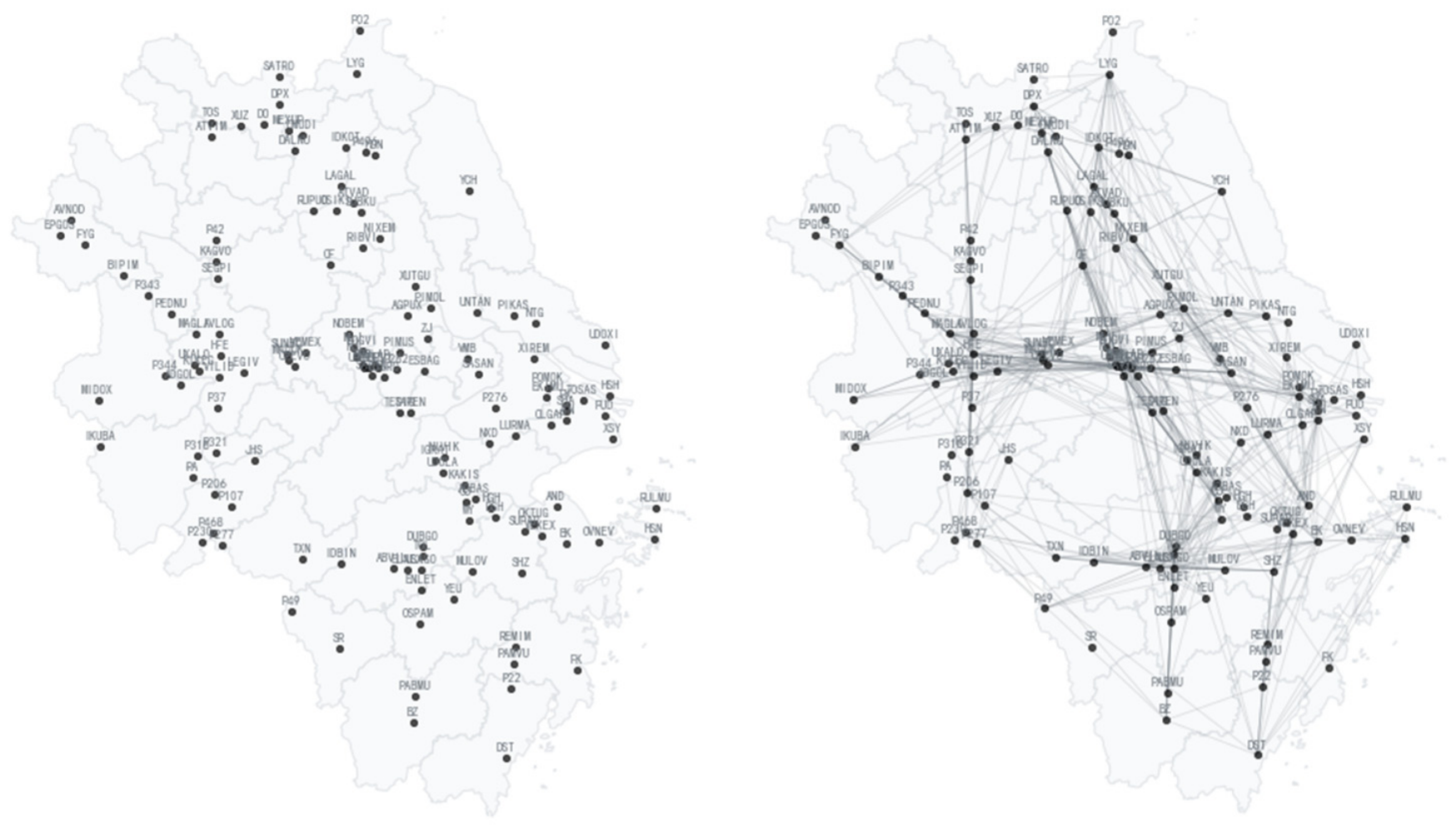
Before analyzing a high-density air route network, an abstract network model is constructed by combining complex network theory with graph-theoretic methods. Since this study focuses on identifying critical waypoints during peak congestion periods and analyzing flow-coupling relationships among waypoints, the air route network is represented as a graph G = ( V , E ) . Here, V = { v 1 , v 2 , , v N } denotes the set of waypoints, where N is the total number of waypoints, and E denotes the set of direct route connections between waypoints. If a direct connection exists between two waypoints, the corresponding adjacency-matrix element is set to 1; otherwise, it is set to 0. Based on historical ADS-B data, flight routes are reconstructed to determine the connectivity among waypoints and obtain the air route network topology. For visualization, the reconstructed network is displayed as a two-dimensional longitude–latitude projection, in which nodes represent waypoints and edges represent direct route connections, as shown in Figure 1.

2.2. Evaluation Metrics Framework for Pinning Nodes in High-Density Air Route Networks

The essence of pinning node identification is to select a small number of critical nodes from a large set of waypoints that have significant influence on network structure, operational load, and congestion propagation, thereby laying the foundation for the subsequent control strategy of “using local control to influence the overall network.” To avoid identification bias caused by a single indicator, this work establishes a comprehensive evaluation index system for critical waypoints in the airway network by jointly considering complex network structure, traffic flow characteristics, and congestion characteristics. Specifically, node degree, betweenness centrality, clustering coefficient, average hourly flow, node loss, and saturation are selected as the comprehensive evaluation indicators for critical waypoints.
(1)
Node Degree
In a high-density air route network, the degree of a waypoint is the number of links directly incident to it. The degree reflects local connectivity; a larger degree indicates that the waypoint has more direct connections and therefore greater structural importance. It is calculated as follows:
k i = j = 1 N e i j
where k i denotes the degree of waypoint i , and e i j represents the edges connected to waypoint i .
(2)
Betweenness Centrality
Betweenness centrality evaluates how crucial a waypoint is for conveying information or traffic flow in a high-density air route network. In the context of high-density air route networks, this indicator is adopted to quantify the extent to which a waypoint serves as an intermediate node on the shortest paths between other waypoint pairs. The larger the value, the more shortest routes traverse that waypoint and the stronger its bridging and traffic-transfer function in the network [42,43]. It is calculated as follows:
B i = m n n i , m i σ m n ( i ) σ m n
where σ m n represents the total number of shortest paths between waypoints m and n , and σ m n ( i ) denotes the number of shortest paths between waypoints m and n that pass through waypoint i .
(3)
Clustering Coefficient
The clustering coefficient is a classical complex-network metric. Under the undirected topological graph representation adopted in this study, it measures the local connectivity among the neighboring waypoints of a given waypoint, that is, the extent to which the neighbors of a waypoint are mutually connected. In an air route network, a higher clustering coefficient indicates stronger local aggregation and alternative connectivity among adjacent waypoints [43]. It is calculated as follows:
C i c l u = 2 E i k i ( k i 1 )
where E i represents the number of actual connections between the neighboring waypoints of waypoint i , and k i ( k i 1 ) / 2 denotes the maximum possible number of connections among its neighbors in an undirected graph.
(4)
Average Hourly Traffic Volume
For each waypoint, the number of flights passing through it is counted for each hour and then averaged over the observation period. This indicator characterizes the typical per-hour load at a waypoint and reveals how busy the network is across different times of day. It is calculated as follows:
q ¯ i = t = 1 24 q i t 24
where q i t is the number of flights traversing waypoint i during hour t .
(5)
Node Loss Degree
The degree of node loss is introduced to describe the vulnerability contribution of a waypoint to the overall air route network. This idea is consistent with node-removal-based vulnerability analysis in air route network studies, where the importance of a waypoint is measured by the reduction in network efficiency or connectivity after its removal [42,43]. In high-density air route networks, larger values indicate that removing the waypoint would degrade network performance more severely, hence the waypoint’s greater importance. It is calculated as follows:
E r = 1 N ( N 1 ) i , j = 1 , i j N 1 d i j
L i = E r E r ( i ) E r
where E r represents the efficiency of the original air route network; E r ( i ) denotes the efficiency of the remaining network after waypoint i and its associated edges are removed; d i j denotes the shortest path length between waypoints i and j ; and L i indicates the node loss degree of waypoint i .
(6)
Saturation Rate
The saturation ratio measures how heavily a waypoint is utilized relative to the network’s historical peak. It is defined as the ratio of the number of flights passing through waypoint i in a given hour to the historical maximum hourly flight count observed at waypoint i in the air route network. It is calculated as follows:
f i = q i q i m a x
where f i represents the saturation rate of waypoint i ; q i denotes the number of flights per unit hour at waypoint i ; and q i m a x indicates the historical maximum number of flights at waypoint i .

2.3. Methodology for Identifying Pinning Nodes in High-Density Air Route Networks

After constructing the comprehensive evaluation index system for critical waypoints, it is further necessary to develop an evaluation method that can uniformly integrate multidimensional indicators so as to achieve a comprehensive ranking of all waypoints. Considering that the established indicators include topological attributes, operational load indicators, and congestion-state indicators, these indicators differ in dimension, degree of dispersion, and contribution to critical node identification. Therefore, it is necessary to adopt a method that combines both objective weighting and comprehensive ranking capabilities. The TOPSIS method ranks evaluation objects by calculating their relative closeness to the positive and the negative ideal solutions, and it can effectively reflect how close the overall performance of different waypoints is to that of the ideal critical node. In recent years, TOPSIS and other multi-indicator evaluation methods have been applied to the identification of influential airports and critical nodes in aviation networks [13,44]. Related studies have also evaluated air route network congestion and node importance from the perspective of key node identification [45]. These studies demonstrate that multi-indicator fusion methods are suitable for identifying critical nodes in aviation and air route networks. The entropy weight method, on the other hand, can objectively determine the weights of indicators based on the degree of dispersion in the sample data, thereby reducing the bias caused by subjective weighting. Therefore, this work adopts the entropy weight–TOPSIS method to conduct a comprehensive evaluation of waypoints in the high-density airway network and identifies those with relatively high scores as critical pinning nodes. The specific steps are as follows:
Step 1: Construct the decision matrix. Assume the route network comprises m waypoints and n evaluation indicators per waypoint. Form the decision matrix Q as follows:
Q = q 11 q 1 n q m 1 q m n
where q i j is the value of the j -th indicator for the i -th waypoint.
Step 2: Normalize the decision matrix. To remove unit inconsistencies across indicators and improve data comparability and model performance, apply column-wise min–max normalization to Q . First classify each indicator as benefit type (larger is better) or cost type (smaller is better). Map all values to [0, 1]:
The standardization formula for benefit-type indicators is as follows:
Q i j = q i j m i n ( q i j ) m a x ( q i j ) m i n ( q i j )
The standardization formula for cost-type indicators is as follows:
Q i j = m a x ( q i j ) q i j m a x ( q i j ) m i n ( q i j )
where Q i j is the normalized value for waypoint i on indicator j .
Step 3: Calculate the weight of each feature indicator for the waypoints. The weight w j of the j -th indicator is determined using the entropy weight method.
Calculate the proportion of each indicator for the waypoints as follows:
p i j = Q i j i m Q i j
where p i j represents the proportion of indicator j for waypoint i .
Calculate the information entropy for each indicator as follows:
e j = 1 ln m i = 1 m p i j ln p i j
where e j denotes the information entropy of the j -th indicator, m is the number of waypoints, and p i j is the proportion of the j -th indicator for waypoint i . The factor 1 ln m is used as the normalization coefficient to ensure 0 e j 1 . When p i j = 0 , the term p i j l n p i j is defined as 0 according to lim p 0 + p ln p = 0 .
Calculate the weight of each indicator as follows:
w j = 1 e j j = 1 m ( 1 e j )
where w j is the weight of the j -th indicator, m is the total number of evaluation indicators, and j = 1 m w j = 1 .
Step 4: Construct the weighted decision matrix. The weighted decision matrix is obtained by multiplying the standardized matrix by the weight vector as follows:
Z i j = w j × Q i j
where Z i j represents the weighted standardized value of the j -th indicator for the i -th waypoint.
Step 5: Determine the positive ideal solution Z + and the negative ideal solution Z . The positive and negative ideal solutions are calculated as follows:
Z + = m a x ( z i 1 , , z i n ) Z = m i n ( z i 1 , , z i n )
Step 6: Calculate the distance between each waypoint and the ideal solutions as follows:
D i + = j = 1 n ( Z j + Z i j ) 2 D i = j = 1 n ( Z j Z i j ) 2
Step 7: Calculate the comprehensive score for each waypoint. The comprehensive score for each waypoint is calculated as follows:
S i = D i D i + + D i
where D i + and D i are the distances of waypoint i from the positive and negative ideal solutions, respectively. The score S i reflects the relative closeness of each waypoint to the positive ideal solution.
Step 8: Rank the waypoints based on their scores to identify key waypoints.
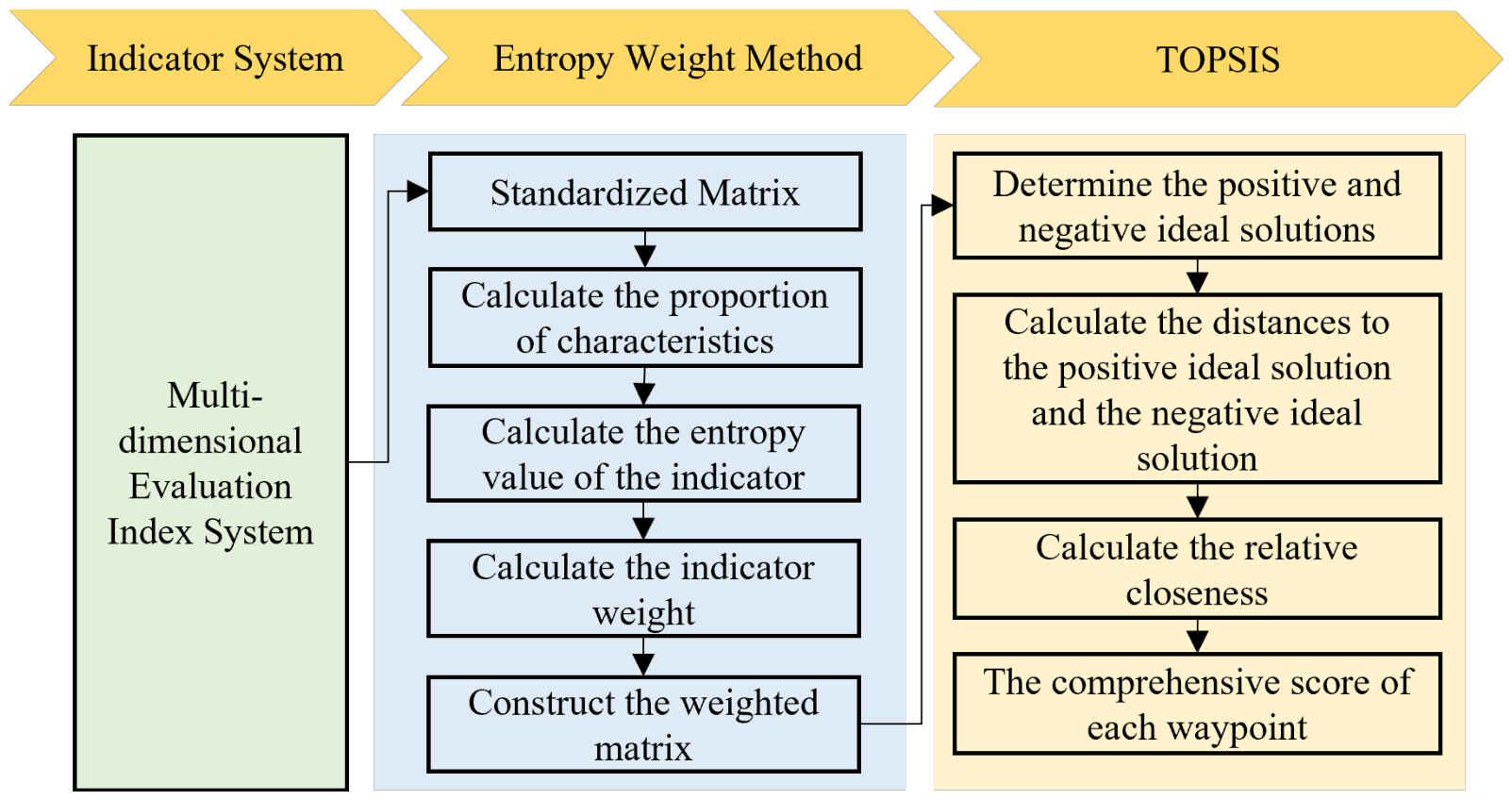
Based on the above evaluation procedure, the pinning node identification problem is solved through an entropy-weighted TOPSIS framework that links multidimensional indicator construction, objective weight calculation, and comprehensive waypoint ranking. The entropy weight method is used to determine the relative importance of the retained indicators, while TOPSIS is used to calculate the relative closeness of each waypoint to the ideal critical-node solution. The complete identification logic is shown in Figure 2.

3. Optimization Strategy for Congestion Pinning Control in High-Density Air Route Networks

3.1. Overview of the Pinning Control Optimization Strategy for Air Route Networks

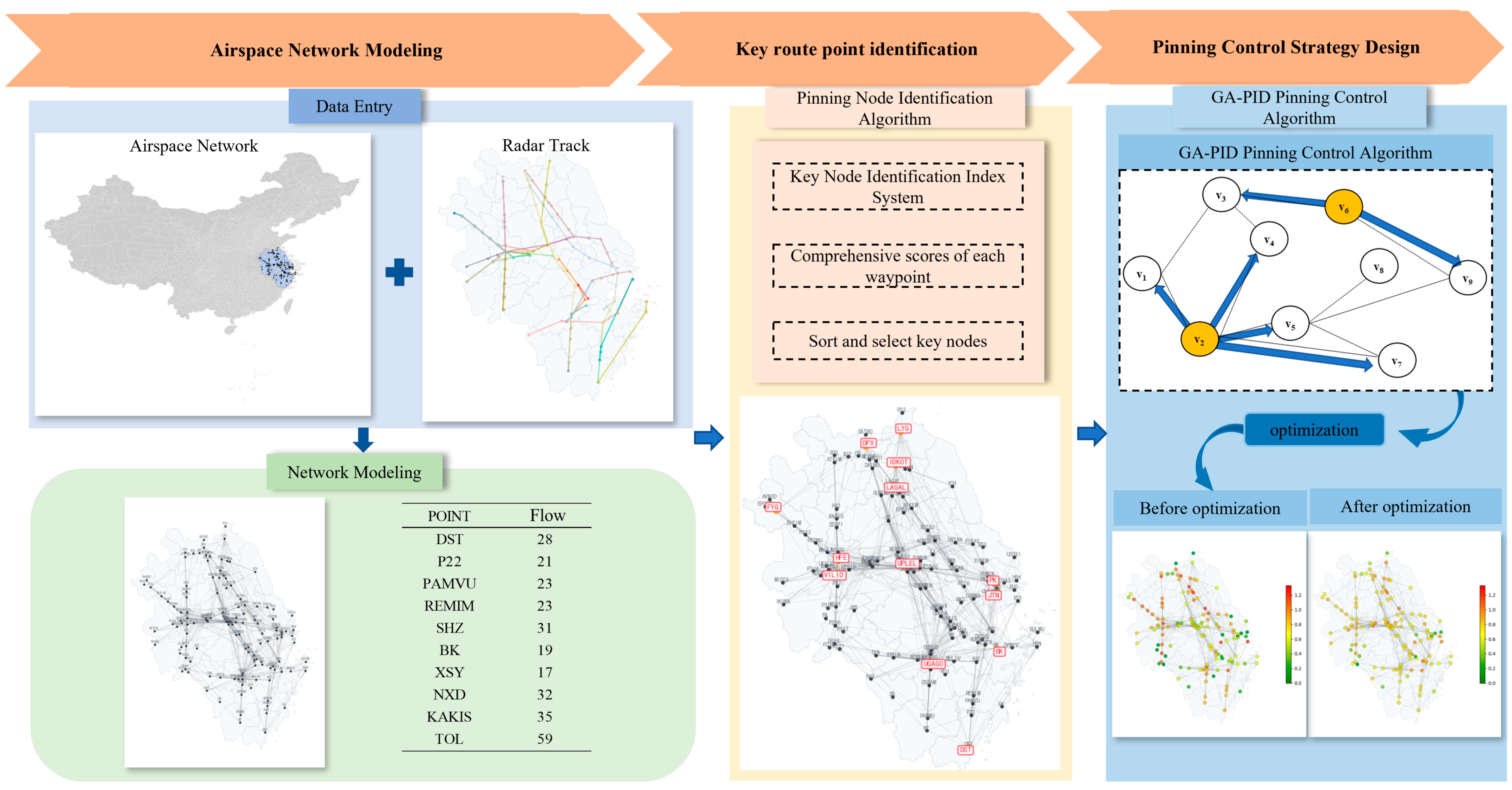
The pinning control problem for congestion situations in high-density airway networks during peak periods is a specific application of complex network theory and pinning control theory in air traffic flow management. Its core idea is that, within a complex airway network composed of a large number of waypoints and their connections, global control is not imposed simultaneously on all waypoints. Instead, based on the results of critical node identification, a small number of critical waypoints that have a significant influence on network connectivity, traffic convergence, and congestion propagation are selected as pinning nodes. By regulating the traffic flow at these nodes and taking advantage of the coupling and propagation relationships among nodes in the network, the controlled nodes can affect the states of their neighboring waypoints, thereby achieving overall mitigation of peak-period congestion. Compared with traditional large-scale network-wide unified control methods, the pinning control approach intervenes only at a small number of critical nodes. This not only reduces the control dimension and implementation cost, but also makes use of network coupling relationships to achieve the control effect of “using local regulation to influence the overall system.” Therefore, it is more suitable for the requirements of control efficiency and operational feasibility in peak congestion scenarios of high-density airway networks. Accordingly, this work proposes a GA-PID pinning control optimization method for congestion mitigation in high-density airway networks. As shown in Figure 3, the entire method consists of three connected stages: air route network modeling, critical waypoint identification, and pinning control strategy design. The network modeling stage provides the topological structure and traffic flow data required for indicator calculation. The critical waypoint identification stage selects a small set of pinning nodes as control targets. The pinning control strategy design stage then uses these nodes as feedback-control objects and maps the generated regulation demand into feasible local flow redistribution actions. In this way, the proposed research design connects network analysis, control modeling, and operational adjustment into a unified congestion mitigation framework.

3.2. Congestion Pinning Control Optimization Model for High-Density Air Route Networks

The pinning control state equation for a high-density airway network entails considering an airway network consisting of N waypoints. Since the traffic flow data used in this study are collected and updated at discrete sampling intervals, and the subsequent PID controller is also implemented at discrete sampling instants, the pinning control state equation is formulated in a discrete-time data-driven form. The traffic flow update of waypoint i is expressed as follows:
x i ( k + 1 ) = x i ( k ) + Δ x i 0 ( k ) + c j = 1 N a i j [ x j ( k ) x i ( k ) ] u i ( k )
where x i ( k ) denotes the traffic flow at waypoint i during sampling interval k ; Δ x i 0 ( k ) represents the intrinsic traffic flow variation of waypoint i estimated from historical operational data; c denotes the network coupling strength coefficient, which is used to scale the influence of traffic flow differences between connected waypoints on the flow variation of waypoint i ; a i j is the element of the adjacency matrix, where a i j = 1 if waypoints i and j are connected and a i j = 0 otherwise; and u i ( k ) denotes the traffic regulation demand applied to waypoint i . The intrinsic flow-variation term is calculated as follows:
Δ x i 0 ( k ) = x i 0 ( k + 1 ) x i 0 ( k )
where x i 0 ( k ) is the observed traffic flow of waypoint i before regulation.
For pinned nodes, the basic negative-feedback form of the regulation input can be written as follows:
u i ( k ) = d i ( x i ( k ) s i ) , i v 0 , i v
where d i is the control gain; s i is the desired traffic flow, set to 80% of the historical maximum flight count at waypoint i ; v represents the set of pinned nodes.
This pinning controller operates as a negative feedback controller. It continuously monitors the actual traffic flow x i ( k ) at the key pinned nodes and compares it with the desired traffic flow s i . When a positive deviation is detected (i.e., x i ( k ) > s i , indicating that the waypoint is becoming congested), the controller generates a corrective force u i ( k ) ) that acts in the opposite direction and is proportional to the magnitude of the deviation. This control input acts on the state equation of the pinning node and attempts to regulate the traffic flow back to the desired level by adjusting the flow distribution.

3.3. Genetic Algorithm-Based PID Pinning Control Algorithm

To achieve effective congestion regulation in high-density airway networks, this work develops a GA-PID pinning control optimization algorithm. Taking the flow deviation at pinning nodes as the feedback input and aiming to optimize the overall traffic distribution of the airway network through local regulation of critical nodes, a closed-loop congestion control process is formed, consisting of “error perception–control generation–flow redistribution–state recursive update.”
In this framework, the regulation of pinned waypoints is not designed to track an arbitrary time-varying trajectory, but to guide local traffic flow toward a relatively stable operational state during the selected congestion control horizon. Therefore, the incremental PID controller is used to generate flow regulation demands according to the current and historical deviations observed at pinned waypoints. This controller relies on measurable traffic flow deviations rather than an explicit analytical expression of the nonlinear traffic flow dynamics, and its output provides the target constraint for subsequent flow redistribution and rule-based rerouting. Considering the strong coupling, dynamic variation, and nonlinear flow redistribution characteristics of high-density air route networks, the parameters K P ,   K I , and K D are further optimized by the genetic algorithm to improve the adaptability of the controller to complex congestion regulation scenarios. Based on this regulation logic, the control objective error function is first constructed as follows:
In peak congestion scenarios of high-density airway networks, the control objective is not only to suppress local overload at critical nodes, but also to take into account the balance of the overall network load distribution. Therefore, at the discrete sampling instant k , the local error of critical node i and the network load-balancing error of the air route network are defined as follows:
e i ( 1 ) ( k ) = x i ( k ) s i C i
where x i ( k ) represents the actual traffic flow at waypoint i at time k .
e ( 2 ) ( k ) = 1 N i = 1 N p i ( k ) p ¯ ( k )
where p i ( k ) = x i ( k ) / C i denotes the resource utilization rate of node i at time k ; C i denotes the capacity of node i ; and p ¯ ( k ) denotes the average resource utilization rate of the entire network.
Taking both local deviation and global equilibrium into account, the comprehensive error function of critical node i is defined as
e i ( k ) = η 1 e i ( k ) + η 2 e ( 2 ) ( k ) ,   η 1 0 ,   η 2 0 ,   η 1 + η 2 = 1
where η 1 and η 2 are weighting coefficients used to balance local overload suppression and network load balancing, respectively. This error function can not only reflect the degree of traffic overload at local critical nodes, but also take into account the balance of traffic distribution across the entire network, thereby providing an effective input for the subsequent PID controller.
On this basis, an incremental PID controller is adopted to generate the flow regulation demand. Let the comprehensive error of critical node i at sampling instant k be e i ( k ) . Then, the control increment is defined as follows:
Δ u i ( k ) = K P e i ( k ) e i ( k 1 ) + K I e i ( k ) + K D e i ( k ) 2 e i ( k 1 ) + e i ( k 2 )
where Δ u i ( k ) denotes the control increment applied to node i at the k -th sampling instant, and K P ,   K I ,   K D are the proportional, integral, and derivative parameters, respectively.
Accordingly, the cumulative output of the controller is given by
u i ( k ) = u i ( k 1 ) + Δ u i ( k )
where u i ( k ) represents the traffic regulation demand of the critical pinning node at the discrete sampling instant k . If u i ( k ) > 0 , it indicates that the node needs to reduce the corresponding traffic flow; if u i ( k ) < 0 , it indicates that the node has the capacity to accommodate additional traffic flow. This output provides the target constraint for the subsequent rerouting optimization.
In the above closed-loop regulation process, the control demand is generated from the traffic flow deviation of the pinned waypoints. The incremental PID controller updates the regulation demand based on current and historical deviations, thereby generating feedback control actions rather than open-loop adjustments. To avoid oscillatory or excessive regulation, the GA-based parameter optimization evaluates each candidate PID parameter combination by considering the control error, settling time, maximum overshoot, and cumulative control input. Therefore, parameter combinations that may lead to excessive oscillation, slow convergence, or excessive control demand are penalized in the fitness evaluation. In the implementation stage, the regulation demand is further restricted by operational feasibility constraints, thereby keeping the control action within the feasible operating range of the air route network and enhancing the boundedness and operational stability of the closed-loop regulation process under bounded traffic flow disturbances.
Since the regulation performance of the incremental PID controller depends heavily on the selection of K P ,   K I , and K D , and high-density air route networks are characterized by strong coupling, dynamic variation, and nonlinear flow redistribution, conventional empirical tuning methods may fail to provide satisfactory parameter combinations for complex congestion scenarios. Therefore, this work employs a genetic algorithm to search for suitable PID parameters under the flow redistribution simulation environment. Let an arbitrary individual be represented as
z = [ K P , K I , K D ]
where z corresponds to a set of PID parameters to be optimized.
The parameter search ranges are set as follows:
K P [ K P m i n , K P m a x ] ,   K I [ K I m i n , K I m a x ] ,   K D [ K D m i n , K D m a x ]
To comprehensively evaluate the control performance of different parameter combinations, the objective function is constructed as
J = w 1 k = 1 T | e ( k ) | + w 2 T s + w 3 M p + w 4 k = 1 T | u ( k ) |
where k = 1 T e ( k ) denotes the integral of absolute error, which is used to reflect control accuracy; T s denotes the settling time; and M p denotes the maximum overshoot; and k = 1 T u ( k ) denotes the cumulative control input, which is used to measure the control cost. The coefficients w i are the weighting coefficients used in the GA-PID fitness evaluation, satisfying w 1 + w 2 + w 3 + w 4 = 1 and w i 0 .
The genetic algorithm takes the minimization of the objective function J as the optimization goal. The objective function is then transformed into the fitness function as
F i t ( z ) = 1 1 + J ( z )
where F i t ( z ) denotes the fitness value of individual z .
Let the population size of the genetic algorithm be M . Then, the initial population can be expressed as
P ( 0 ) = { z 1 , z 2 , , z M }
A combination of tournament selection and elitist preservation is adopted for parent selection. In each generation, the top N e individuals with the highest fitness values are first retained directly for the next generation. The remaining parent set is then generated through tournament selection to enhance the global search capability and convergence stability of the algorithm.
For the two selected parent individuals z 1 and z 2 , offspring individuals are generated by using arithmetic crossover under real-coded representation:
z 1 = λ z 1 + ( 1 + λ )
z 2 = ( 1 λ ) z 1 + λ z 2
where λ [ 0 , 1 ] is the random crossover coefficient. When the crossover probability is p c , the selected parents undergo the crossover operation; otherwise, the parent individuals are retained directly for the next generation.
To enhance population diversity and avoid premature convergence of the algorithm, Gaussian perturbation mutation is applied to randomly perturb the offspring individuals. Let any gene in an individual be denoted by z j . Then, its mutation form is given by
z j = z j + N ( 0 , σ 2 )
where N ( 0 , σ 2 ) denotes a Gaussian random variable with mean 0 and variance σ 2 ; and p m denotes the mutation probability.
Let the maximum number of generations of the genetic algorithm be G m a x . When the change in the best fitness value over G s consecutive generations is smaller than the threshold ε , the individual with the highest fitness at the current generation is output as the optimal PID parameter combination, namely [ K P , K I , K D ] .
After obtaining the optimized PID parameters, the pinning controller generates traffic regulation demands according to the flow deviation at critical nodes and the network coupling relationships. To map the regulation demands into flight-level local adjustment actions, a rule-based heuristic rerouting mechanism is constructed. The mechanism screens candidate waypoints according to topological reachability, arrival-time consistency, temporal occupancy, minimum-separation feasibility, and capacity constraints.
First, at the topological level, the local reachable domain of a congested waypoint i is determined according to the adjacency matrix of the air route network:
N i = j | a i p = 1 , i p
where N i denotes the set of candidate receiving waypoints directly connected to waypoint i , and a i j is the element of the adjacency matrix.
For a flight f reassigned from waypoint i to a candidate waypoint q , let p denote the preceding waypoint on its original route. The great-circle distance between waypoint p and candidate waypoint q is calculated as follows:
d p q = R arccos sin φ p sin φ q + cos φ p cos φ q cos ( λ q λ p )
where R is the radius of the Earth, and φ and λ denote the latitude and longitude of the corresponding waypoint, respectively. If the average speed of flight f on this segment is v f , and its arrival time at waypoint p is t p f , then the estimated arrival time at candidate waypoint q is
t q f = t p f + d p q v f
On this basis, temporal occupancy and minimum-separation constraints are imposed. Let F q ( k ) denote the set of flights expected to pass candidate waypoint q during the corresponding time interval. Candidate waypoint q is considered temporally feasible only if
| t q f t q m | Δ T min ,         m F q ( k ) ,   m f
where t q m is the estimated or scheduled arrival time of flight mmm at waypoint q , and Δ T min denotes the minimum time-separation threshold converted from the local aircraft separation requirement. This constraint is used to avoid local waypoint occupancy conflicts and maintain the required minimum separation within the local rerouting range.
By combining the controller output of the critical nodes with the network coupling term, the theoretical traffic flow adjustment of waypoint i at time k is defined as
Δ x i theo ( k ) = u i ( k ) + c j = 1 N a i j x j ( k ) x i ( k )
where Δ x i theo ( k ) denotes the theoretical traffic flow adjustment demand of waypoint i during sampling interval k ; u i ( k ) denotes the flow-equivalent regulation demand generated by the GA-PID controller; and x i ( k ) and x j ( k ) denote the traffic flows of waypoints i and j , respectively.
The actual transferred traffic flow from waypoint i to candidate waypoint q is denoted by Δ x i q ( k ) . To avoid new local overload after rerouting, the capacity constraint is expressed as
0 x i ( k ) Δ x i q ( k ) C i ,         0 x q ( k ) + Δ x i q ( k ) C q
where C i and C q denote the allowable capacities of waypoint i and candidate waypoint q , respectively. Meanwhile, the actual transferred flow should not exceed the theoretical adjustment demand generated by the controller:
0 < Δ x i q ( k ) max 0 , Δ x i theo ( k )
After a feasible adjustment is accepted, the waypoint flow states are updated recursively as follows:
x i ( k + 1 ) = x i ( k ) Δ x i q ( k ) ,         x q ( k + 1 ) = x q ( k ) + Δ x i q ( k )
Finally, a local flow reallocation strategy is implemented for each pinning node. After each adjustment is completed, the system synchronously updates the node flow state, the flight temporal state, and the mapping relationship between flights and waypoints, thereby ensuring that subsequent control actions are always carried out based on the latest network state.
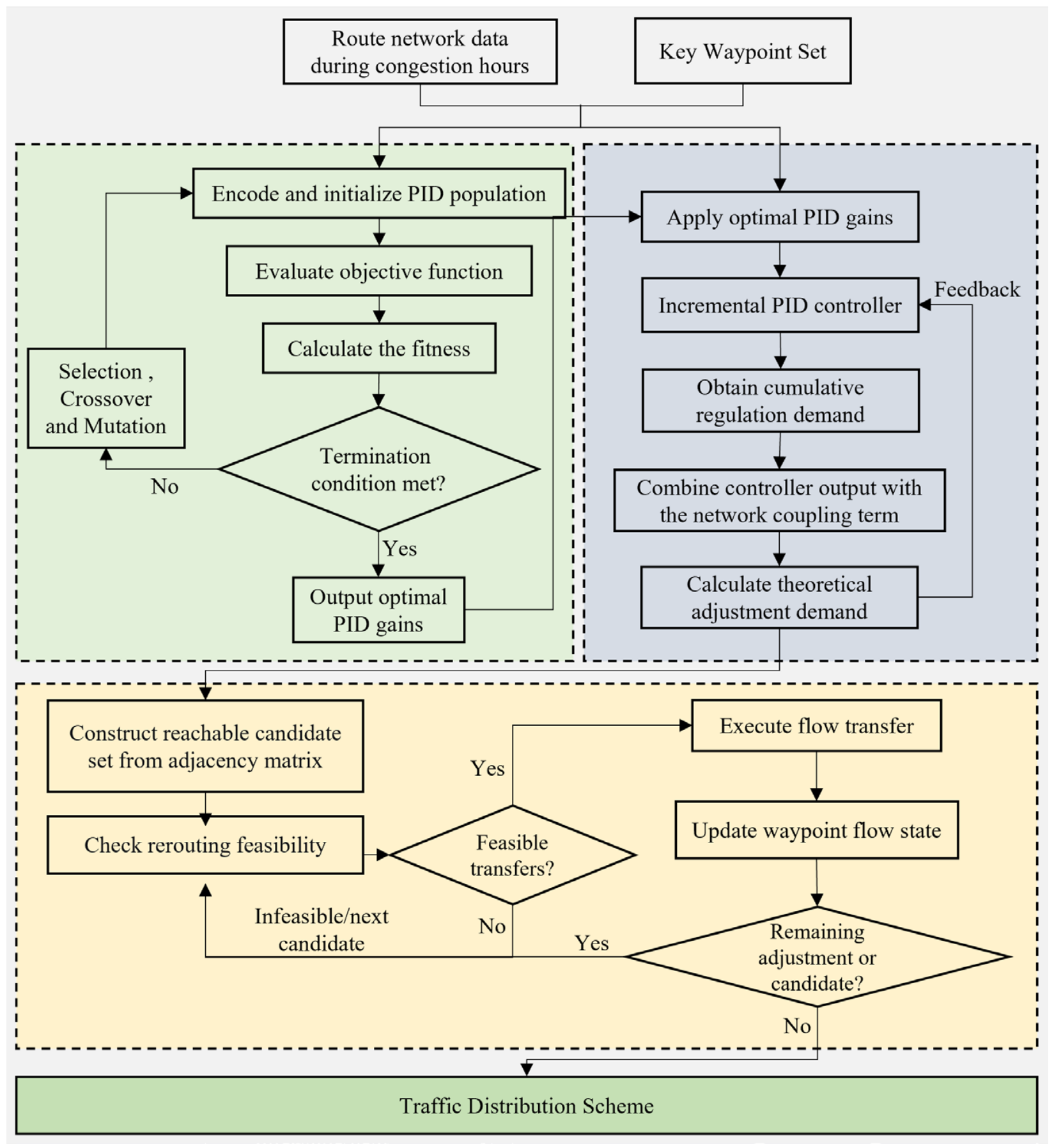
Based on the above modeling process, the proposed GA-PID pinning control algorithm solves the congestion mitigation problem through a closed-loop procedure that links parameter optimization, feedback regulation, and feasible flow redistribution. Specifically, the genetic algorithm is used to obtain suitable PID gains, the optimized controller generates regulation demands according to the traffic flow deviation of pinned waypoints, and the rule-based rerouting mechanism further maps these demands into feasible local flow-transfer actions. The complete solution logic is shown in Figure 4.

3.4. Evaluation of the Effectiveness of the Pinning Control Optimization Strategy

To verify the effectiveness of the optimized pinning control strategy in regulating congestion in the airway network, this work introduces the airway network congestion index, airspace resource utilization, and the number of controlled nodes as comprehensive evaluation metrics. These indicators describe the regulation effect from different perspectives. The airway network congestion index is used to characterize the overall distribution of waypoint congestion states and to provide an interpretable state-level measure of congestion mitigation. The airspace resource utilization rate is calculated based on the continuous ratio of traffic flow to waypoint capacity, thereby reflecting fine-grained changes in traffic load before and after regulation. The number of controlled nodes is used to evaluate the implementation cost of the control strategy. Therefore, the congestion index and resource utilization rate are used jointly, with the former reflecting changes in congestion-state levels and the latter preserving continuous variations in waypoint saturation. Specifically, the congestion state of each waypoint is classified according to its saturation rate. In the selected case scenario, the thresholds 0.4 and 0.8 are used as empirical state-classification boundaries to distinguish low-load, medium-pressure, and high-saturation waypoints. The threshold 0.8 is used to identify waypoints approaching the allowable capacity, while 0.4 is used to separate low-load waypoints from those with increasing traffic pressure. Based on this classification, the air route network congestion index W is calculated by summing the congestion indices of all waypoints. To retain intra-level variation in waypoint saturation, the continuous airspace resource utilization rate U is also introduced as a complementary metric. The formulas are as follows:
W = i = 1 N w i
w i = 0 0 n i C i < 0.4 1 0.4 n i C i < 0.8 2 n i C i 0.8
U = i = 1 N ( n i / C i ) / N
where w i represents the congestion index of each waypoint, n i denotes the traffic flow at waypoint i , N is the total number of waypoints.

4. Case Study

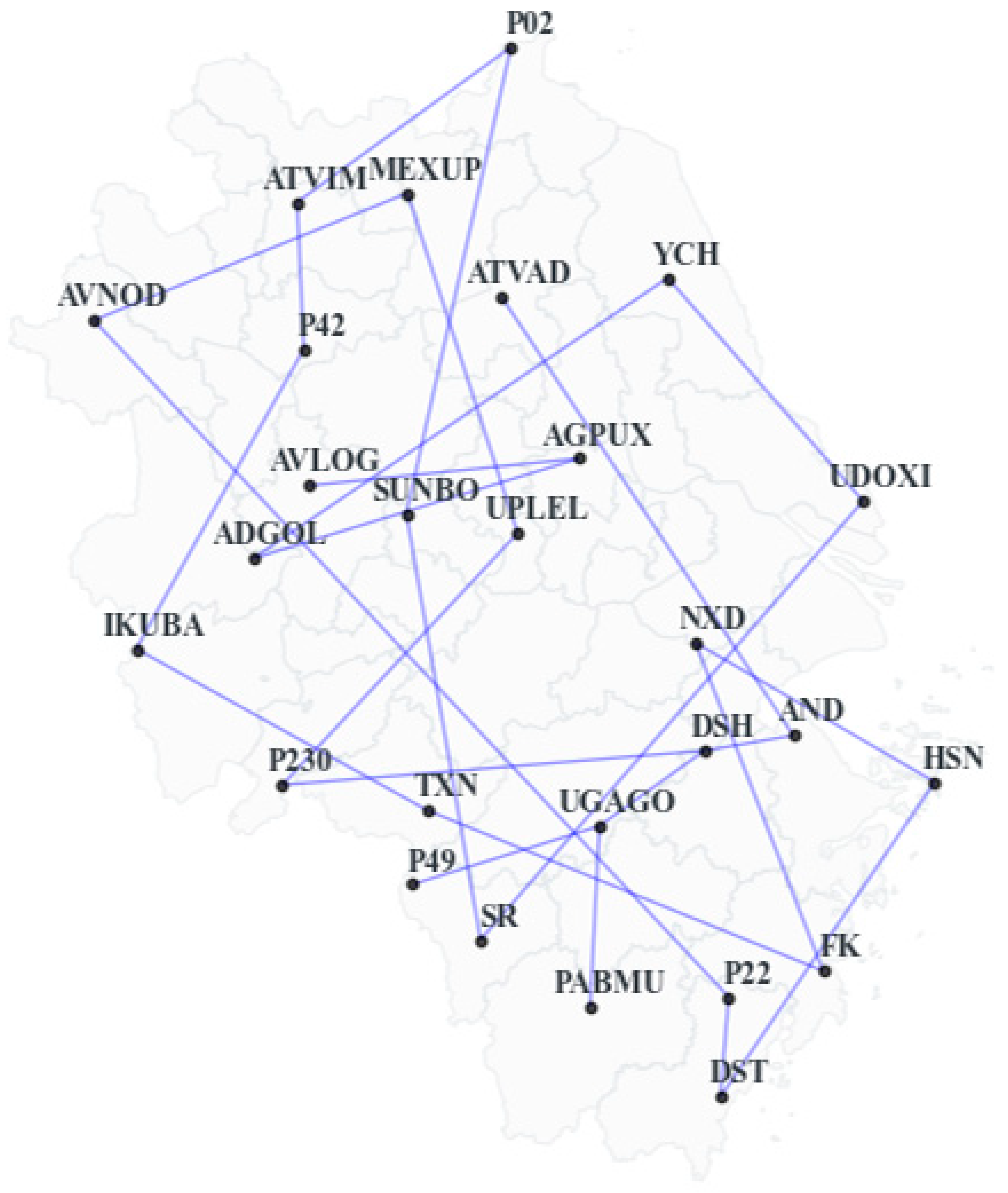
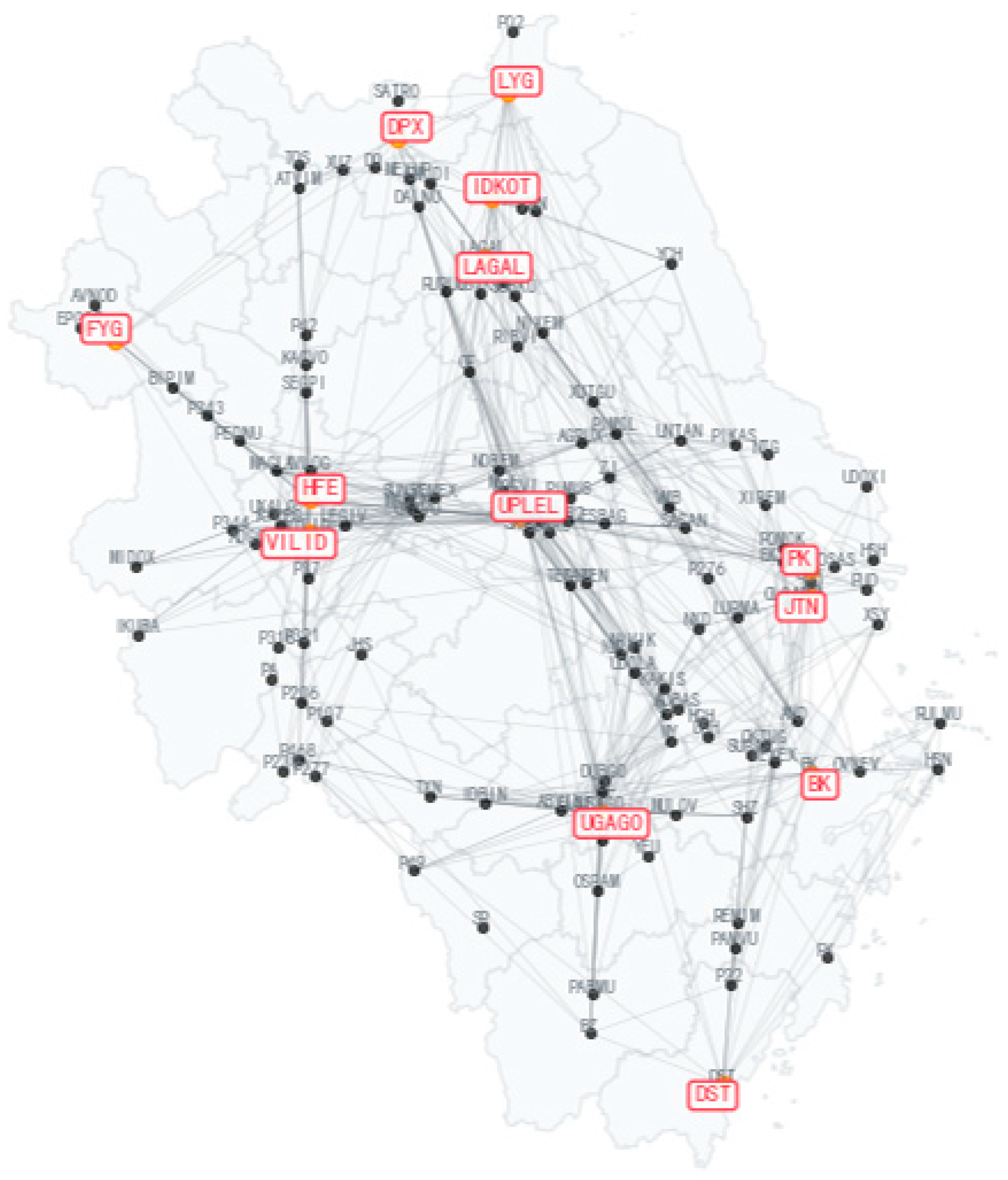
The Yangtze River Delta airspace is one of the busiest high-density airspaces in China, containing several key routes that are critical to the country’s air transportation sector. Therefore, this study uses processed operational trajectory data from March 1 to 7, 2023, within the Yangtze River Delta airspace as the research subject. After preprocessing procedures, including data cleaning, trajectory reconstruction, waypoint matching, and topology-consistency checking, the dataset contains 135 valid waypoints and corresponding waypoint crossing records. The structure of the air route network is shown in Figure 5.

4.1. Identification of Pinning Nodes in the Air Route Network

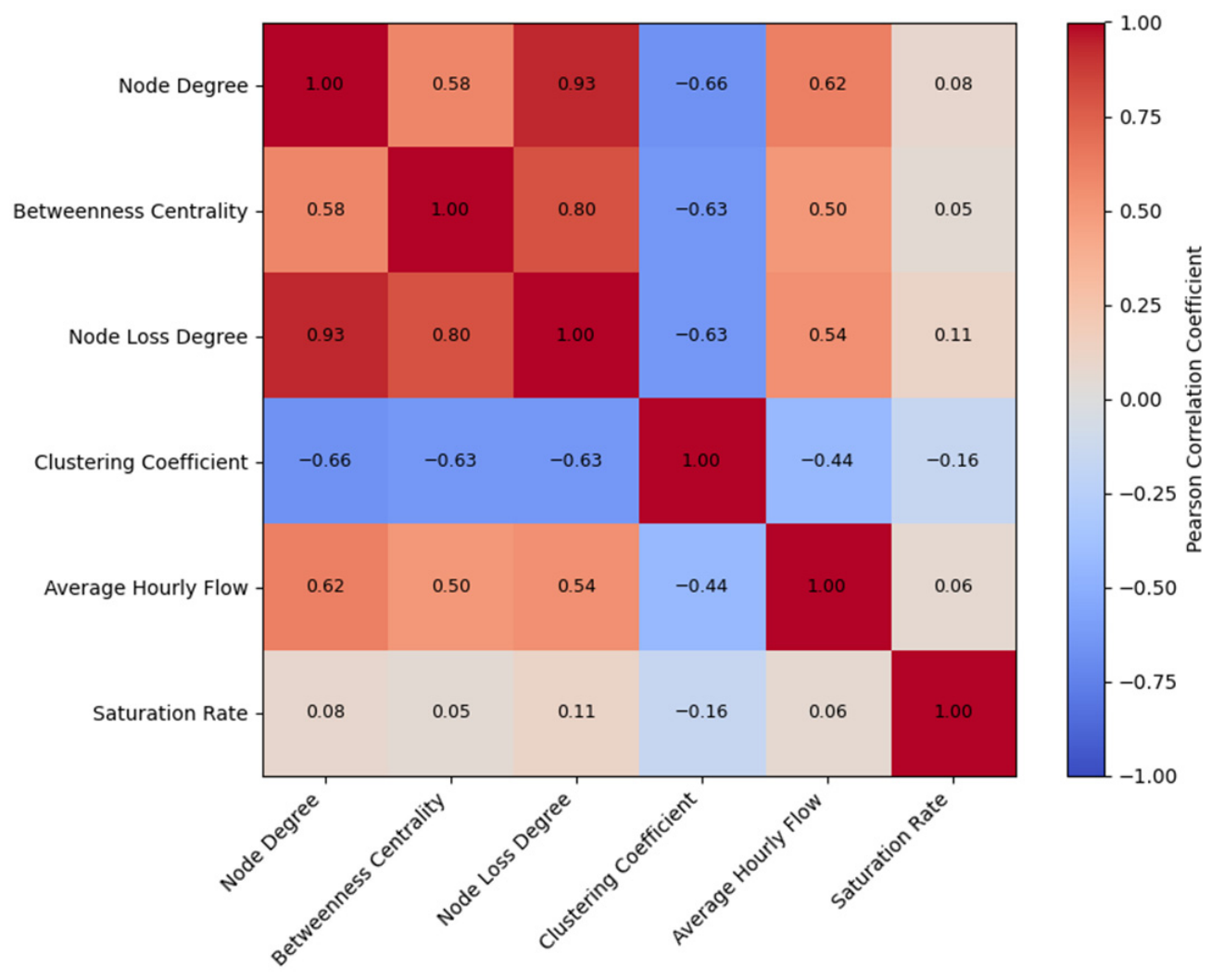
Based on the constructed indicator system for identifying critical waypoints in the airway network, the characteristic indicators of each waypoint are first calculated to form the original feature matrix. To ensure the comparability of different indicators, the data are normalized before subsequent analysis. Since the candidate indicators include multiple structural and operational attributes, Pearson correlation analysis is first conducted to examine whether strong redundancy exists among them. The correlation results are shown in Figure 6.
As shown in Figure 6, the degree of node loss shows a strong positive correlation with node degree, with a Pearson correlation coefficient of 0.93, and also has a relatively high correlation with betweenness centrality, with a coefficient of 0.80. This suggests that the degree of node loss largely overlaps with existing topological indicators in the present case study. By contrast, clustering coefficient, average hourly flow, and saturation rate do not show strong positive correlations with the other indicators. In particular, the saturation rate has very low correlations with the structural indicators and average hourly flow, indicating that it provides relatively independent congestion-pressure information. Therefore, the degree of node loss is removed from the final evaluation framework, and the remaining five indicators—node degree, betweenness centrality, clustering coefficient, average hourly flow, and saturation rate—are retained for entropy-weighted TOPSIS ranking.
After the indicator set is refined, the resulting feature matrix is used to calculate the indicator weights through the entropy weight method, and the results are shown in Table 1.
Table 1 shows that, within the comprehensive evaluation index system for critical waypoints in the air route network, betweenness centrality has the largest weight, reaching 0.212, followed closely by the clustering coefficient and node degree. Average hourly flow and saturation rate have weights of 0.195 and 0.180, respectively, indicating that network structural characteristics play a slightly more important role than traffic flow characteristics in the comprehensive evaluation. Meanwhile, the weights of all retained indicators are relatively balanced, and no single indicator dominates the evaluation result. This suggests that both network topology and operational traffic flow are important for critical waypoint identification, which is consistent with the operational characteristics of the high-density air route network in the Yangtze River Delta.
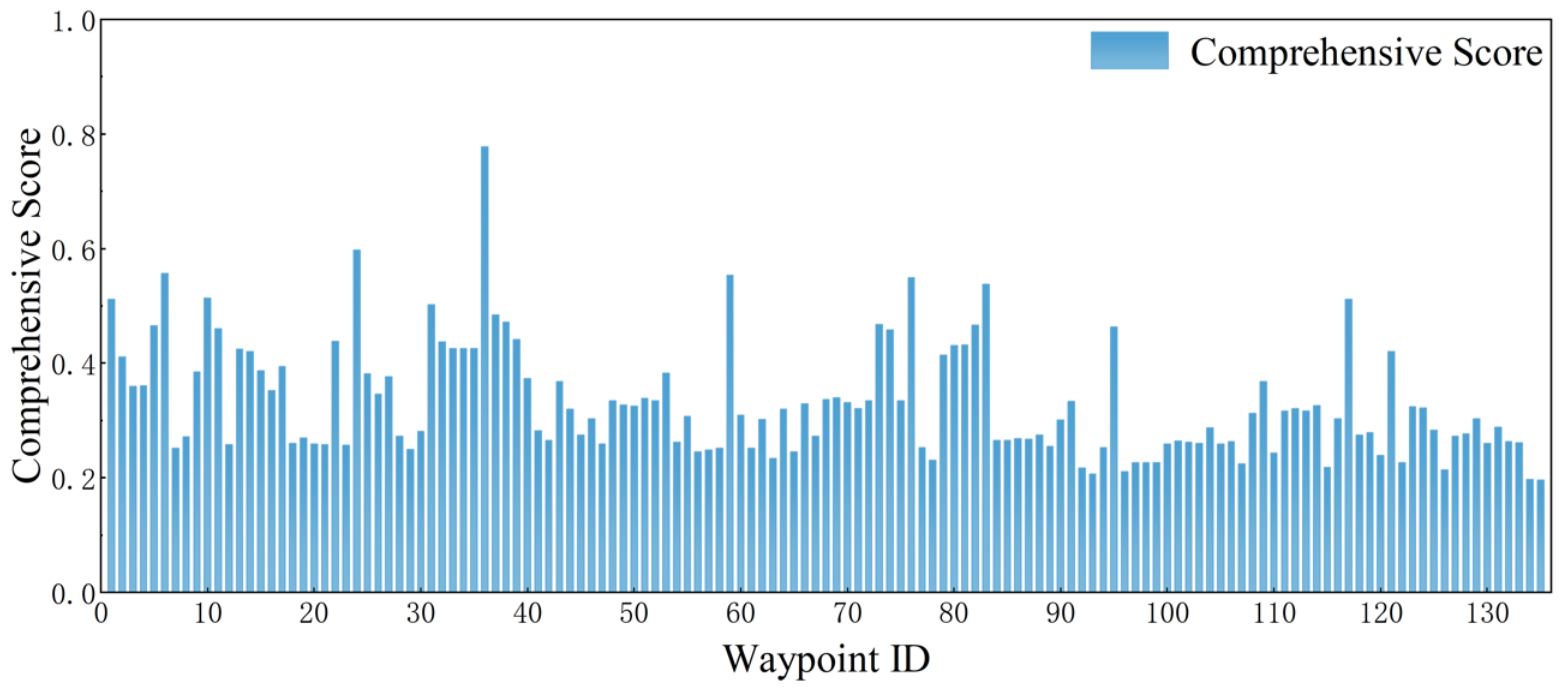
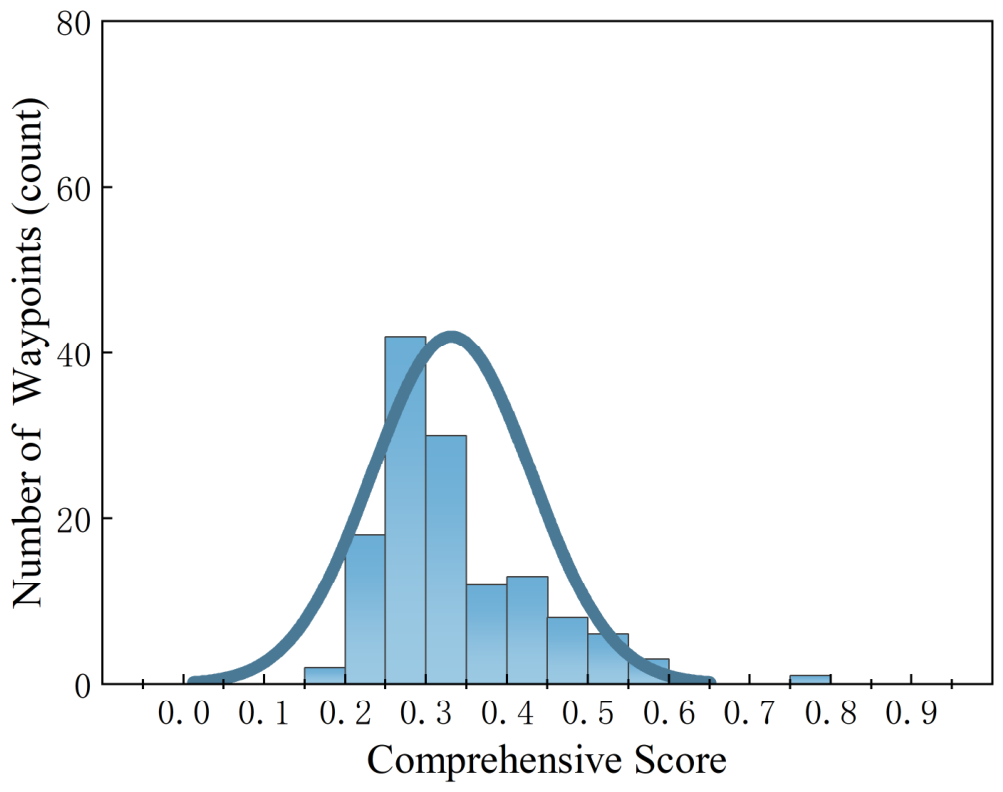
After determining the indicator weights, the TOPSIS method is further employed to conduct a comprehensive evaluation of each waypoint, yielding the comprehensive scores and importance rankings of all nodes. Partial results are shown in Table 2. To more intuitively illustrate the distribution characteristics of waypoint importance, Figure 7 presents the comprehensive scores of the major waypoints, while Figure 8 shows the overall distribution of the comprehensive scores.
Table 2 and Figure 7 and Figure 8 indicate that the comprehensive scores of waypoints in the Yangtze River Delta airspace are distributed relatively evenly, with most values concentrated between 0.2 and 0.3. Only a small number of waypoints obtain much higher scores. Among them, HFE has the highest comprehensive score, reaching 0.777. This result suggests that most waypoints have similar importance levels, whereas a limited number of waypoints play more prominent roles in congestion regulation and traffic flow allocation. Therefore, the ranking results provide a basis for the subsequent pinning control strategy, which aims to improve the overall network state by regulating a small number of critical waypoints.
Based on the identification results, this work further selects the most congested one-hour period during the peak hours as the target for pinning control optimization. According to the analysis of operational data, the period from 9:00 to 10:00 on 2 March 2023, is identified as a typical congestion peak within the study period, and is therefore taken as the subsequent simulation and control scenario. Considering the principle of pinning control, which aims to influence the overall network state by regulating only a small number of critical nodes, this study adopts the top 10% of waypoints in the comprehensive score ranking as a practical cost-control constraint for the case study. Under this setting, 13 critical waypoints are ultimately identified as pinning nodes, including HFE, DPX, and PK. From the identification results, most of the selected pinning nodes are located at major airway intersections or traffic concentration areas within the high-density airway network of the Yangtze River Delta, and they exhibit both high node betweenness and large average hourly flow. This indicates that these nodes not only play a strong intermediary role in the network topology, but also bear relatively heavy operational loads. Therefore, selecting these nodes as the targets of pinning control demonstrates strong structural rationality and operational relevance. The spatial distribution of the pinning nodes in the airway network is shown in Figure 9.

4.2. Route Network Pinning Control Optimization Strategy

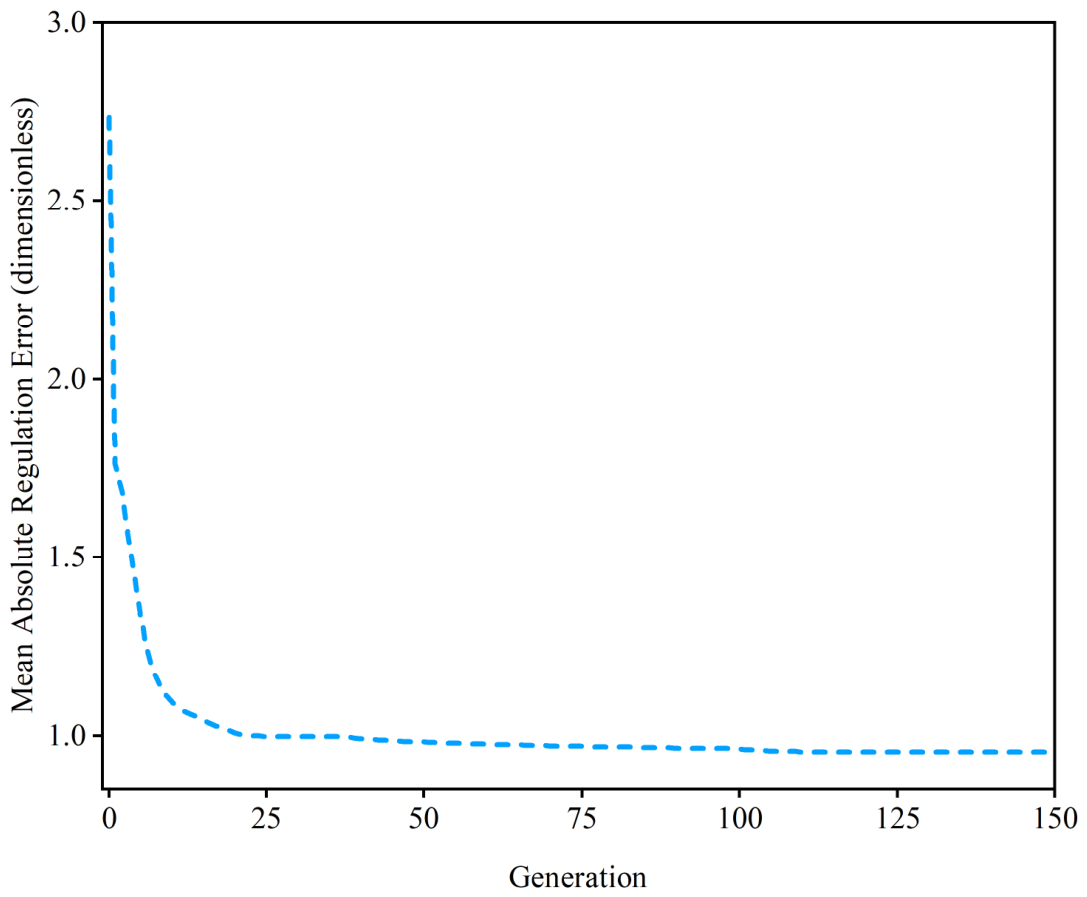
The traffic flow, flight data of each waypoint during congested periods, and critical pinning nodes are used as inputs to solve the regulation scheme for the congestion situation using the genetic algorithm-improved PID pinning control algorithm. The parameter settings for the genetic algorithm are as follows: population size M = 50 and maximum number of generations G m a x = 150 . The PID parameter search range is set to K P [ 0.1 , 3.0 ] ,   K I [ 0.01 , 2.0 ] ,   K D [ 0.01 , 1.0 ] . In the comprehensive error function, the weighting coefficients are set to η 1 = 0.60 and η 2 = 0.40 , giving slightly higher priority to local overload suppression while still considering network load balancing. The network coupling strength coefficient was set to c = 0.03 according to the scale of the waypoint traffic flow variation in the selected peak-period scenario. In the objective function, the weighting coefficients are set to 0.35, 0.20, 0.25, and 0.20, respectively, according to the relative importance of different control objectives in the congestion mitigation task. The genetic operations are configured as follows: tournament selection (tournament size = 2) is adopted, with an elitist preservation ratio of 10%; crossover operation uses blend crossover, with a crossover probability p c = 0.8 and a blend factor α = 0.7 ; and mutation operation employs adaptive Gaussian mutation, where each gene undergoes Gaussian perturbation with a probability of 0.3, and a gene is randomly reset with a probability of 10%. After iterative optimization, the optimal PID parameters K P , K I , K D are obtained as 2.5485, 1.04, and 0.9972, respectively. The iterative optimization process is shown in Figure 10.
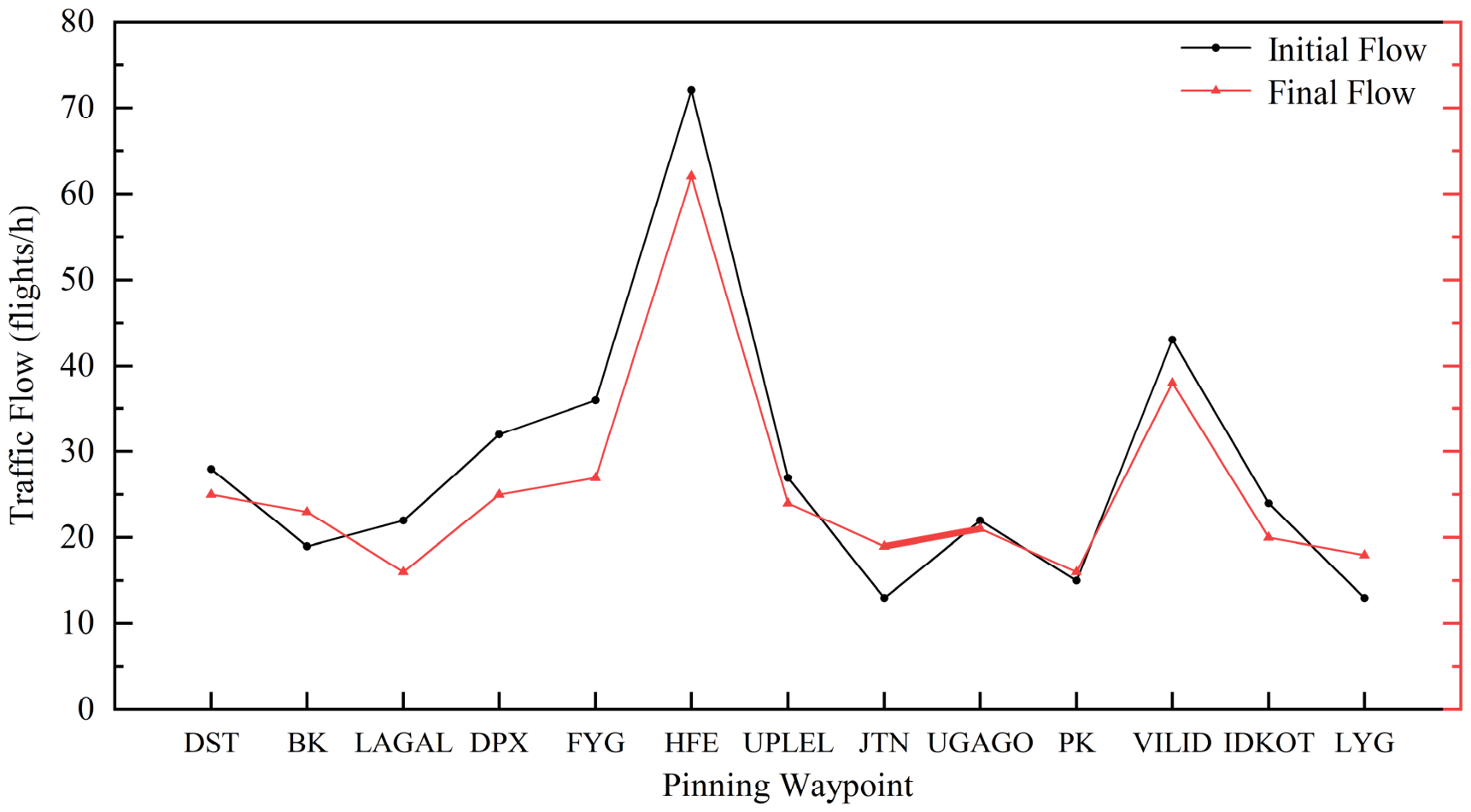
After obtaining the optimal parameters, the congestion state of the airway network during the target peak period is regulated and solved, and the flow variation results of the pinning nodes before and after optimization are obtained, as shown in Table 3 and Figure 11. Specifically, Table 3 presents the flow changes of each pinning node before and after optimization, while Figure 11 illustrates the magnitude and direction of traffic regulation at the critical nodes.
Table 3 and Figure 11 show that the GA-PID pinning control strategy produces differentiated regulation effects for different types of waypoints. For critical nodes that originally have relatively high traffic volume and heavy load, their traffic flow generally decreases after optimization. For example, the traffic flow at node HFE decreases from 72 to 62 flights, and at node DPX, it decreases from 32 to 25 flights. This indicates that the control strategy can effectively identify the major congestion output nodes in the network and reduce their peak-period pressure through local regulation. At the same time, some nodes that originally have relatively low load or available capacity margin undertake the function of traffic diversion. For example, the traffic flow at node JTN increases from 13 flights to 19 flights, and that at node LYG increases from 13 flights to 18 flights. This shows that, without imposing unified control on the entire network, the pinning control strategy can drive the redistribution of the overall network load through local traffic regulation at a small number of critical nodes, thereby achieving overall load balancing.
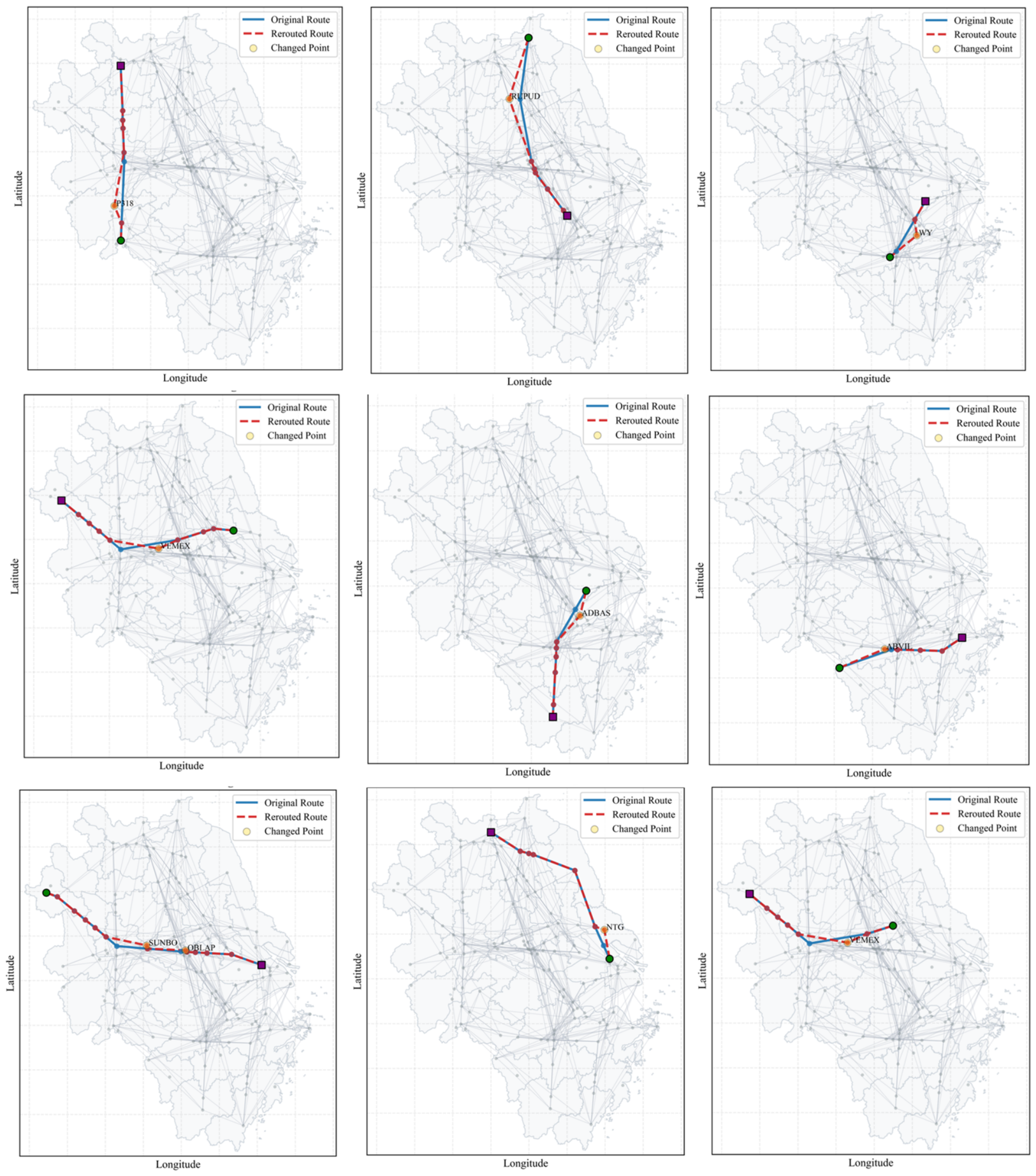
To more intuitively illustrate the changes in flight paths caused by rerouting, this work selects several representative flights and plots a comparison of their paths before and after rerouting, as shown in Figure 12. In the figure, the blue solid lines represent the original flight paths, the red dashed lines represent the rerouted paths, and the yellow dots indicate the waypoints where adjustments occurred.
Figure 12 further illustrates that the rerouting process mainly causes local path changes for selected flights rather than large-scale route reconstruction. Combined with the traffic flow variations at pinning nodes shown in Table 3, this indicates that the proposed method can adjust local flight paths according to the regulation demands generated by pinning control, thereby redistributing traffic flow at relevant waypoints and supporting congestion mitigation in the air route network.
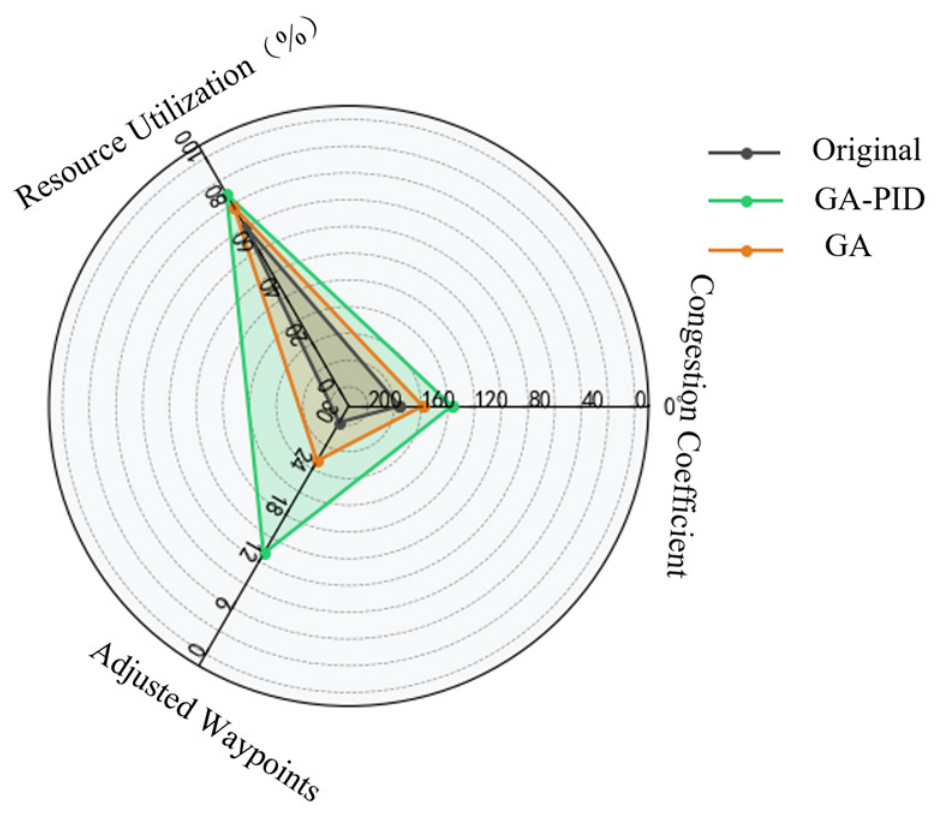
To further verify the effectiveness of the pinning control optimization strategy in alleviating airway network congestion, it is compared with the traditional global congestion control genetic algorithm (GA). To ensure a consistent comparison, the baseline GA is implemented under the same peak-period scenario, initial traffic flow state, evaluation indicators, and operational feasibility requirements as the proposed GA-PID pinning control method. In the baseline GA, all waypoints are regarded as candidate adjustment objects, and a real-coded chromosome is used to represent the traffic flow adjustment amounts of the waypoints. Its fitness evaluation follows the same optimization orientation as the proposed method, including reducing the network congestion coefficient, improving airspace resource utilization, and limiting the adjustment cost. The same evolutionary parameter settings are adopted for the baseline GA and the GA component of the proposed method, so that the comparison focuses on global direct adjustment and pinning-node-based feedback regulation under consistent experimental conditions. Based on the above comparison setting, the effects of the two methods on airway network congestion before and after optimization are compared. According to Equations (42)–(44), the congestion coefficient, airspace resource utilization rate, and the number of adjusted waypoints are calculated, as shown in Table 4 and Figure 13.
Table 4 and Figure 13 compare the optimization results of the proposed GA-PID pinning control method and the baseline GA method. Both methods reduce the congestion coefficient and improve airspace resource utilization, but their optimization performance differs substantially. In terms of the congestion coefficient, the original network has a congestion coefficient of 176, which is reduced to 137 after optimization by the proposed GA-PID pinning control method, corresponding to an improvement rate of 22.16%. In contrast, the baseline GA method reduces the congestion coefficient to 159, with an improvement rate of 9.66%. This indicates that the proposed GA-PID pinning control method has a stronger capability to mitigate network congestion. In terms of airspace resource utilization, the original network level is 70.76%. The proposed method increases it to 84.41%, representing an improvement of 19.29%, whereas the baseline GA method raises it to 78.87%, corresponding to an improvement of 11.46%. This further demonstrates that the proposed GA-PID pinning control method is more effective in improving airspace resource utilization. In terms of the number of adjusted waypoints, the proposed method achieves the above optimization results by adjusting only 13 waypoints, whereas the baseline GA method requires adjustments at 25 waypoints. Although the baseline GA method also achieves a certain degree of optimization, it searches for adjustment schemes over the whole network and, therefore, results in a higher control cost. In contrast, the proposed GA-PID pinning control method performs feedback regulation on the identified pinning nodes and achieves better congestion mitigation with fewer adjusted waypoints.
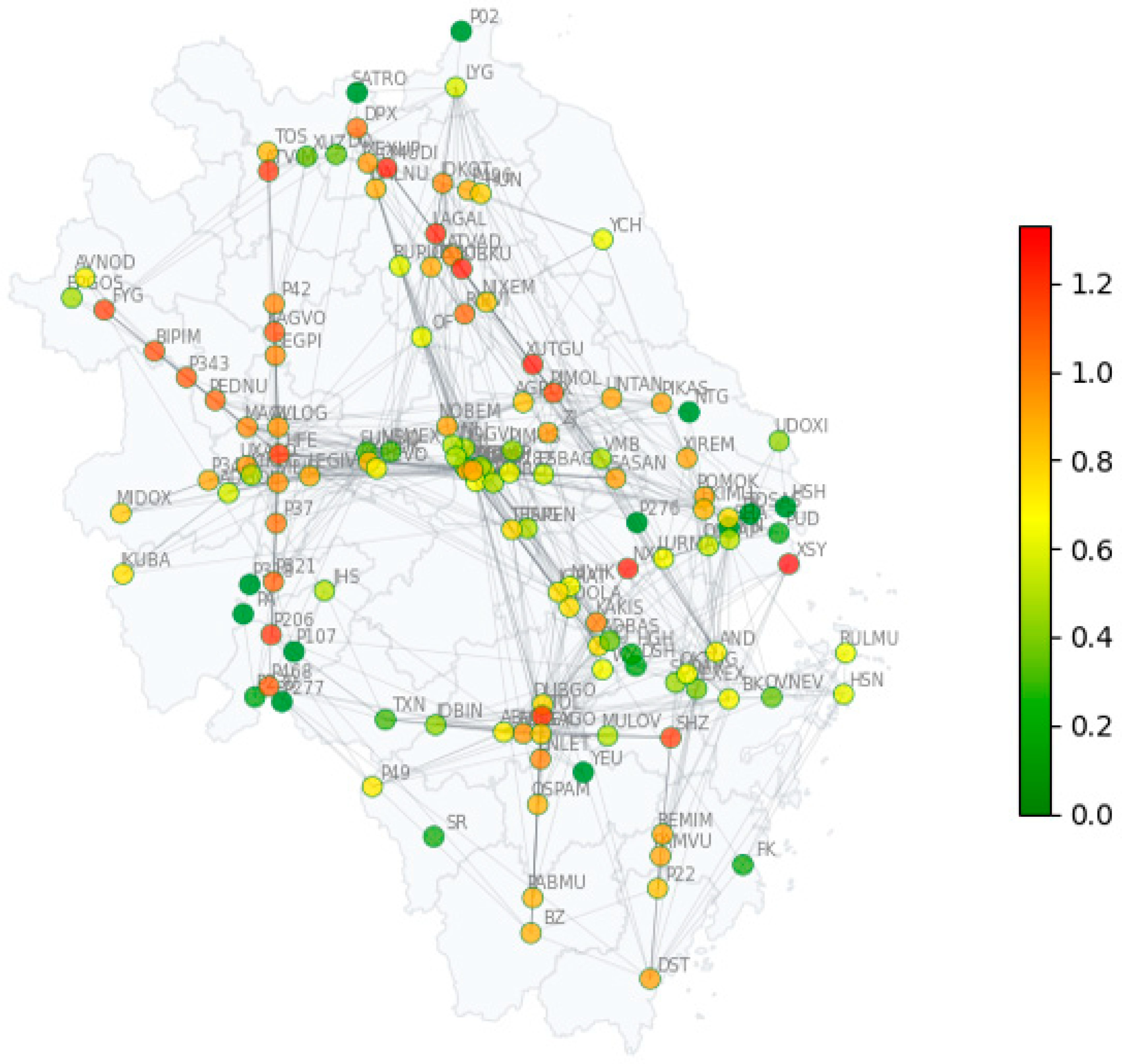
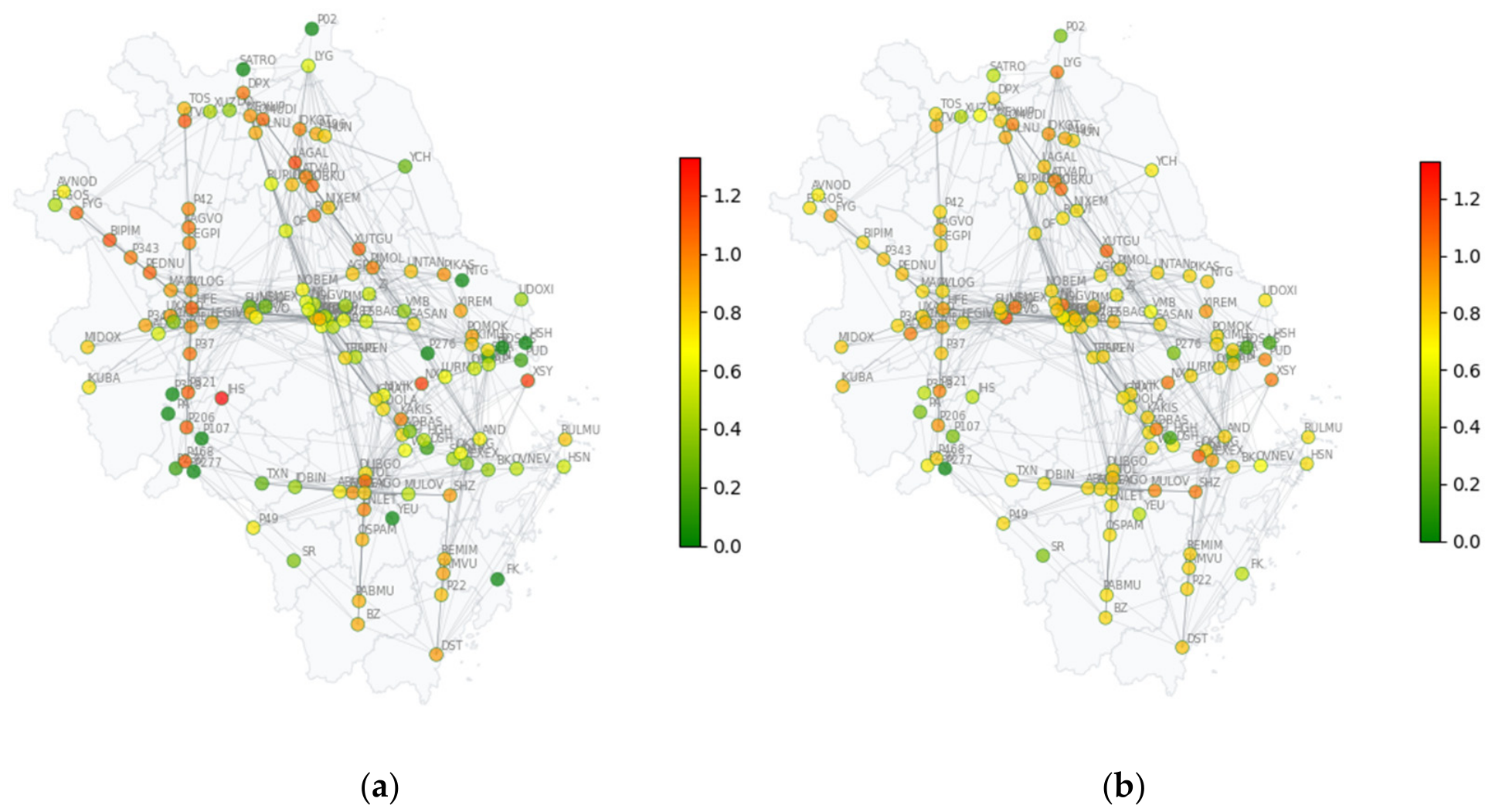
To further illustrate the regulation effects of different optimization strategies at the waypoint level, Figure 14 and Figure 15 present the congestion states of all waypoints in the original air route network, the GA-optimized network, and the GA-PID pinning control optimized network, respectively. Specifically, Figure 14 illustrates the spatial congestion pattern of the original network, while Figure 15a,b show the network states after baseline GA optimization and GA-PID pinning control optimization, respectively. By comparing these three figures, the different effects of the two optimization methods on waypoint congestion levels can be clearly observed. In the original network, some waypoints exhibit relatively high congestion levels, forming distinct congestion hotspots with prominent local load concentration. After baseline GA optimization, some hotspots are alleviated, but many waypoints still remain in relatively high congestion states, and the overall improvement in spatial distribution is limited. By contrast, after GA-PID pinning control optimization, the distribution of congestion states across waypoints becomes more balanced, and the number of highly saturated waypoints is significantly reduced, indicating a more even network load distribution and a further reduction in congestion risk. These visualization results verify, at the waypoint level, the effectiveness and superiority of the proposed GA-PID pinning control strategy in balancing air route network loads and mitigating local congestion.
Overall, the above analysis shows that the GA-PID pinning control method proposed in this work demonstrates good applicability and effectiveness in typical peak congestion scenarios of the high-density airway network in the Yangtze River Delta. On the one hand, based on the results of critical node identification, this method is able to implement precise control over a small number of highly influential nodes. On the other hand, through the pinning control optimization strategy, it can further improve the overall resource utilization efficiency of the network and reduce the overall congestion level. Compared with the traditional global GA method, the proposed method shows clear advantages in terms of congestion mitigation performance, improvement in resource utilization, and control cost, thereby verifying the feasibility and superiority of applying the concept of pinning control to congestion regulation in high-density airway networks.

5. Conclusions

This study addresses local congestion concentration, high global control cost, and insufficiently fine-grained regulation in high-density air route networks during peak operating periods. Following the procedure of “critical waypoint identification–pinning control modeling–optimization and regulation validation,” this study develops a pinning-control-based method for air route network congestion management. First, a comprehensive evaluation index system for critical waypoints is constructed from three dimensions: complex-network structural characteristics, traffic flow characteristics, and congestion-state information. Pearson correlation analysis is further introduced to examine and reduce redundancy among candidate indicators, and the entropy-weighted TOPSIS method is then used to identify 13 critical pinning nodes, including HFE, DPX, and PK. Second, the air route network congestion regulation problem is formulated as a pinning control problem in a complex dynamic network, and a GA-PID pinning control optimization model is established. By regulating the traffic flow of a small number of critical waypoints, the model improves the overall congestion state of the network. Finally, the proposed method is validated using actual operational data from the Yangtze River Delta airspace.
The results show that, during the target peak period, the proposed GA-PID pinning control method reduces the air route network congestion index from 176 to 137, representing a decrease of 22.16%, and increases the airspace resource utilization rate from 70.76% to 84.41%, representing an improvement of 19.29%. Compared with the baseline GA method, the proposed method achieves better congestion mitigation performance with fewer adjusted waypoints, adjusting only 13 waypoints, whereas the baseline GA method requires adjustments at 25 waypoints. This demonstrates that the proposed method has significant advantages in both control effectiveness and control cost, and that global congestion mitigation can be achieved by regulating only a small number of nodes, fully reflecting the refined management concept of “using key points to influence the overall network.”
Nevertheless, several limitations remain in the present study and should be further addressed in future research. First, although the current model considers several feasibility constraints in the rerouting process, more detailed trajectory-level operational factors, such as wind and weather effects and flight-level allocation constraints, have not yet been incorporated. These factors will be further considered in future work to improve the applicability of the proposed method to trajectory-level operational decision-making. Second, dedicated computational-time experiments have not yet been conducted in the present study. Future work will evaluate the computational performance of the proposed method under different hardware environments, traffic scales, and rolling optimization horizons to assess its real-time applicability more rigorously.

Author Contributions

Conceptualization: W.L., M.H. and W.T.; methodology: W.L., M.H. and W.T.; software: W.L.; validation: W.L. and J.S.; formal analysis: W.L. and J.S.; investigation: J.S.; resources: M.H. and W.T.; data curation: W.L. and J.S.; writing—original draft preparation: W.L.; writing—review and editing: W.T., M.H. and W.L.; visualization: W.L. and J.S.; supervision: W.T. and M.H.; project administration: W.T. and M.H.; funding acquisition: W.T. and M.H. All authors have read and agreed to the published version of the manuscript.

Funding

This research was funded by the National Natural Science Foundation of China project (72471115) and the Frontier Technologies R&D Program of Jiangsu (No. BF2025009).

Data Availability Statement

Data is contained within the article.

Conflicts of Interest

The authors declare no conflicts of interest.

References

  1. Chen, D.; Lü, L.; Shang, M.S.; Zhang, Y.C.; Zhou, T. Identifying influential nodes in complex networks. Phys. A Stat. Mech. Its Appl. 2012, 391, 1777–1787. [Google Scholar] [CrossRef]
  2. Lü, L.; Zhou, T.; Zhang, Q.M.; Stanley, H.E. The H-index of a network node and its relation to degree and coreness. Nat. Commun. 2016, 7, 10168. [Google Scholar] [CrossRef] [PubMed]
  3. Dai, J.; Wang, B.; Sheng, J.; Sun, Z.; Khawaja, F.R.; Ullah, A.; Dejene, D.A.; Duan, G. Identifying influential nodes in complex networks based on local neighbor contribution. IEEE Access 2019, 7, 131719–131731. [Google Scholar] [CrossRef]
  4. Sheng, J.; Dai, J.; Wang, B.; Duan, G.; Long, J.; Zhang, J.; Guan, K.; Hu, S.; Chen, L.; Guan, W. Identifying influential nodes in complex networks based on global and local structure. Phys. A Stat. Mech. Its Appl. 2020, 541, 123262. [Google Scholar] [CrossRef]
  5. Ullah, A.; Wang, B.; Sheng, J.F.; Long, J.; Khan, N.; Sun, Z. Identifying vital nodes from local and global perspectives in complex networks. Expert Syst. Appl. 2021, 186, 115778. [Google Scholar] [CrossRef]
  6. Zhong, S.; Zhang, H.; Deng, Y. Identification of influential nodes in complex networks: A local degree dimension approach. Inf. Sci. 2022, 610, 994–1009. [Google Scholar] [CrossRef]
  7. Ren, G.; Zhu, J.; Lu, C. A measure of identifying influential waypoints in air route networks. PLoS ONE 2018, 13, e0203388. [Google Scholar] [CrossRef]
  8. Fang, Q.; Tian, W.; Zhou, X.; Yang, J. Evaluation of air route network congestion based on node importance. In Proceedings of the 2022 Integrated Communication, Navigation and Surveillance Conference (ICNS), Dulles, VA, USA, 5–7 April 2022; pp. 1–9. [Google Scholar]
  9. Du, Y.; Gao, C.; Hu, Y.; Mahadevan, S.; Deng, Y. A new method of identifying influential nodes in complex networks based on TOPSIS. Phys. A Stat. Mech. Its Appl. 2014, 399, 57–69. [Google Scholar] [CrossRef]
  10. Wang, N.; Gao, Y.; He, J.; Yang, J. Robustness evaluation of the air cargo network considering node importance and attack cost. Reliab. Eng. Syst. Saf. 2022, 217, 108026. [Google Scholar] [CrossRef]
  11. Chen, B.; Tong, R.; Chen, Y.; Jiang, P.; Gao, X.; Tao, H. A Network Key Node Identification Method Based on Improved Multiattribute Fusion. Wirel. Commun. Mob. Comput. 2023, 2023, 4386621. [Google Scholar] [CrossRef]
  12. Ahmad, A.; Ahmad, T.; Ahmad, M.; Muthanna, A.; Gupta, B.; El-Latif, A.A.A. Determination of Critical Edges in Air Route Network Using Modified Weighted Sum Method and Grey Relational Analysis. IEEE Trans. Intell. Transp. Syst. 2022, 24, 15578–15589. [Google Scholar] [CrossRef]
  13. Zhang, H.; Zhao, J.; Wang, J.; Zhu, P. An optimization method for critical node identification in aviation network. Front. Phys. 2022, 10, 944136. [Google Scholar] [CrossRef]
  14. Zhong, L.; Gao, X.; Zhao, L.; Zhang, L.; Chen, P.; Yang, H.; Huang, J.; Pan, W. Identifying key nodes in complex networks based on an improved gravity model. Front. Phys. 2023, 11, 1239660. [Google Scholar] [CrossRef]
  15. Zhang, M.; Wen, X.; Wu, M.; Xie, H. Identification of critical nodes for delay propagation in Susceptible-Exposed-Infected-Recovered (SEIR) and genetic algorithm (GA) route networks. Aerospace 2024, 11, 878. [Google Scholar] [CrossRef]
  16. Kang, J.; Yang, S.; Shan, X.; Bao, J.; Yang, Z. Exploring delay propagation causality in various airport networks with attention-weighted recurrent graph convolution method. Aerospace 2023, 10, 453. [Google Scholar] [CrossRef]
  17. Tian, W.; Zhang, Y.; Zhang, Y.; Chen, H.; Liu, W. A short-term traffic flow prediction method for airport group route waypoints based on the spatiotemporal features of traffic flow. Aerospace 2024, 11, 248. [Google Scholar] [CrossRef]
  18. Lv, Y.; Tian, Y.; Huang, X.; Huang, H.; Zhi, B.; Li, J. Analysis of congestion-propagation time-lag characteristics in air route networks based on multi-channel attention DSNG-BiLSTM. Aerospace 2025, 12, 529. [Google Scholar] [CrossRef]
  19. Ji, Y.; Yu, F.; Shen, D.; Peng, Y. Study on the identification of terminal area traffic congestion situation based on symmetrical random forest. Symmetry 2025, 17, 96. [Google Scholar] [CrossRef]
  20. Yang, L. Studies on Complex Dynamics & Congestion Mitigation Methods of Air Traffic Flow in Terminal Airspace. Ph.D. Dissertation, Nanjing University of Aeronautics and Astronautics, Nanjing, China, 2018. [Google Scholar]
  21. Cummings, C.; Mahmassani, H. Airspace Congestion, flow Relations, and 4-D fundamental Diagrams for advanced urban air mobility. Transp. Res. Part C Emerg. Technol. 2024, 159, 104467. [Google Scholar] [CrossRef]
  22. Daniel, D.; Oussedik, S.; Stephane, P. Airspace congestion smoothing by multi-objective genetic algorithm. In Proceedings of the 2005 ACM Symposium on Applied Computing, Santa Fe, NW, USA, 13–17 March 2005; pp. 907–912. [Google Scholar]
  23. Muara, M.C.R.; Müller, C. Control-based optimization approach for aircraft scheduling in a terminal area with alternative arrival routes. Transp. Res. Part E Logist. Transp. Rev. 2015, 73, 96–113. [Google Scholar]
  24. Jacquillat, A.; Odoni, A.R. An integrated scheduling and operations approach to airport congestion mitigation. Oper. Res. 2015, 63, 1390–1410. [Google Scholar] [CrossRef]
  25. Lavandier, J.; Islami, A.; Delahaye, D.; Chaimatanan, S.; Abecassis, A. Selective simulated annealing for large scale airspace congestion mitigation. Aerospace 2021, 8, 288. [Google Scholar] [CrossRef]
  26. Idrissi, O.; Bikir, A.; Mansouri, K. Improving the management of air traffic congestion during the approach phase. Aeronaut. J. 2023, 127, 1752–1773. [Google Scholar] [CrossRef]
  27. Chen, Y.; Zhao, Y.; Fei, F.; Yang, H. Optimizing Large-Scale Demand and Capacity Balancing in Air Traffic Flow Management Using Deep Neural Networks. Aerospace 2024, 11, 966. [Google Scholar] [CrossRef]
  28. He, P.; Pan, W. Collaborative optimization model and algorithm for airport capacity and traffic flow allocation. PLoS ONE 2024, 19, e0298540. [Google Scholar]
  29. Ma, C.; Guleria, Y.; Alam, S.; Li, M.Z. Deep reinforcement learning-based air traffic flow coordination in flow-centric airspace. Adv. Eng. Inform. 2025, 65, 103342. [Google Scholar] [CrossRef]
  30. Chen, Y.; Dalmau, R.; Alam, S. Tactical demand and capacity balancing using incremental search in spatio-temporal graphs with flight uncertainty. Transp. Res. Part C Emerg. Technol. 2025, 181, 105382. [Google Scholar]
  31. Xu, Q.; Pang, Y.; Liu, Y. Dynamic airspace sectorization with machine learning enhanced workload prediction and clustering. J. Air Transp. Manag. 2024, 121, 102683. [Google Scholar] [CrossRef]
  32. Yang, L.; Huang, J.; Gao, Q.; Zhou, Y.; Hu, M.; Xie, H. Dynamic boundary optimization of free route airspace sectors. Aerospace 2022, 9, 832. [Google Scholar] [CrossRef]
  33. Wang, Z.; Delahaye, D.; Farges, J.L.; Alam, S. A quasi-dynamic air traffic assignment model for mitigating air traffic complexity and congestion for high-density UAM operations. Transp. Res. Part C Emerg. Technol. 2023, 154, 104279. [Google Scholar] [CrossRef]
  34. Zhou, Y.; Hu, M.; Delahaye, D.; Yang, L. Multi-objective four-dimensional trajectory planning for free-route operations considering weather forecast uncertainty. J. Air Transp. Manag. 2025, 128, 102831. [Google Scholar] [CrossRef]
  35. Pang, M.; Huang, Y. Coordinated chaos control of urban expressway based on synchronization of complex networks. Chin. Phys. B 2018, 27, 118902. [Google Scholar] [CrossRef]
  36. Wang, D.; Che, W.W.; Yu, H.; Li, J.Y. Adaptive pinning synchronization of complex networks with negative weights and its application in traffic road network. Int. J. Control Autom. Syst. 2018, 16, 782–790. [Google Scholar] [CrossRef]
  37. Pang, M.; Yang, M. Coordinated control of urban expressway integrating adjacent signalized intersections based on pinning synchronization of complex networks. Transp. Res. Part C Emerg. Technol. 2020, 116, 102645. [Google Scholar] [CrossRef]
  38. Gong, G.; Lv, W.; Wang, Q. Research on urban road traffic network pinning control based on feedback control. Sustainability 2023, 15, 9631. [Google Scholar] [CrossRef]
  39. Liu, Z.; Sun, D.; Zhao, M.; Zhao, H. CPS-based H∞ pinning approach for mixed traffic considering human driver differences. Transp. Res. Part C Emerg. Technol. 2022, 140, 103674. [Google Scholar] [CrossRef]
  40. Liu, Z.; Sun, D.; Zhao, M.; Zhao, H.; Wang, S.; Liao, X. Cyber-physical description and CPS-based pinning approach of mixed traffic. IET Intell. Transp. Syst. 2022, 16, 344–362. [Google Scholar] [CrossRef]
  41. Liu, Z.; Sun, D.; Zhao, M.; Jin, S.; Zhang, Y. Pinning control strategy and stability analysis of mixed platoon: A cyber–physical perspective. Phys. A Stat. Mech. Its Appl. 2022, 594, 127049. [Google Scholar] [CrossRef]
  42. Tian, W.; Fang, Q.; Zhou, X.F.; Song, J.J. Identification Method for Key Nodes in En-Route Network. J. Southwest Jiao Tong Univ. 2025, 60, 233–242. [Google Scholar]
  43. Meng, X.; Tian, Y.; Li, J.C. Identification of Route Network Nodes and Edges Based on Multi-indicator Correlation. Comput. Syst. Appl. 2024, 33, 256–263. [Google Scholar]
  44. Du, Y.; Lin, X.; Pan, Y.; Chen, Z.; Xia, H.; Luo, Q. Identifying influential airports in airline network based on failure risk factors with TOPSIS. Chaos Solitons Fractals 2023, 169, 113310. [Google Scholar] [CrossRef]
  45. Ren, G.; Zhang, M.; Guo, Y. Node importance evaluation in air route networks based on Laplacian energy relative entropy. J. Beijing Jiao Tong Univ. 2023, 47, 76–85. [Google Scholar]
Figure 1. Schematic diagram of the air route network topological structure.
Aerospace 13 00479 g001
Figure 2. Flowchart of the pinning node identification algorithm.
Aerospace 13 00479 g002
Figure 3. Schematic diagram of the pinning control optimization.
Aerospace 13 00479 g003
Figure 4. Flowchart of the pinning control optimization algorithm.
Aerospace 13 00479 g004
Figure 5. Yangtze River Delta route network diagram.
Aerospace 13 00479 g005
Figure 6. Correlation analysis of evaluation indicators.
Aerospace 13 00479 g006
Figure 7. Comprehensive score plot of waypoints.
Aerospace 13 00479 g007
Figure 8. Distribution of comprehensive scores.
Aerospace 13 00479 g008
Figure 9. Schematic diagram of the route network with pinning nodes.
Aerospace 13 00479 g009
Figure 10. Iterative optimization process.
Aerospace 13 00479 g010
Figure 11. Traffic flow variation at pinning nodes.
Aerospace 13 00479 g011
Figure 12. Comparison of flight paths before and after rerouting.
Aerospace 13 00479 g012
Figure 13. Comparison before and after optimization.
Aerospace 13 00479 g013
Figure 14. Congestion status of the original route network.
Aerospace 13 00479 g014
Figure 15. Congestion status of the route network after regulation; (a) GA optimization; (b) GA-PID pinning control optimization.
Aerospace 13 00479 g015
Table 1. Weighting of comprehensive evaluation indicators.
Identification IndicatorWeights
Node Degree0.206
Betweenness Centrality0.212
Clustering Coefficient0.207
Average Hourly Flow0.195
Saturation Rate0.180
Table 2. Comprehensive scores of selected waypoints.
WaypointComprehensive ScoresImportance Ranking
HFE0.7771
DPX0.5982
BK0.5563
JTN0.5534
PK0.5495
VILID0.5386
DST0.5127
LYG0.5118
FYG0.5029
UPLEL0.47210
Table 3. Initial and final traffic flow values at the selected pinning nodes
WaypointInitial Flow (Flights/h)Final Flow (Flights/h)
DST2825
BK1923
LAGAL2216
DPX3225
FYG3627
HFE7262
UPLEL2724
JTN1319
PK1516
VILID4338
IDKOT2420
LYG1318
UGAGO2221
Table 4. Comparison of optimization performances.
MetricOriginalGA-PID Pinning ControlImprovement Rate of GA-PIDBaseline GAImprovement Rate of Base-Line GA
Congestion Coefficient17613722.16%1599.66%
Resource Utilization70.76%84.41%19.29%78.87%11.46%
Adjusted Waypoints-13-25-
Disclaimer/Publisher’s Note: The statements, opinions and data contained in all publications are solely those of the individual author(s) and contributor(s) and not of MDPI and/or the editor(s). MDPI and/or the editor(s) disclaim responsibility for any injury to people or property resulting from any ideas, methods, instructions or products referred to in the content.