1. Introduction
Launch vehicles face numerous uncertainties during flight, such as variations in altitude, velocity, atmospheric conditions, and internal structural disturbances. These factors result in significant time-varying characteristics and uncertainties in the attitude dynamics model parameters. Such uncertainties can reduce the stability margin of the attitude control system or even lead to instability [
1]. Addressing the strong coupling, high uncertainties, and complex disturbances during the powered flight phase of launch vehicles poses a highly challenging research problem. Key issues include designing advanced adaptive control methods to improve steady-state control accuracy, reducing aerodynamic bending moments under strong wind disturbances, and achieving stable elastic control under significant elastic vibration frequency deviations. However, traditional frequency-domain-based proportional-derivative (PD) control systems suffer from complex and time-consuming parameter tuning, which heavily relies on design experience. They require margin verification through Monte Carlo targeting experiments, and thus cannot meet complex design requirements in practical applications. There is a clear need for novel methods to adapt to such complex and varying conditions.
In recent years, a novel control approach—Adaptive Augmented Control (AAC)—has been developed to address this issue.
The primary significance of AAC lies in
(1) Seamless integration with traditional PD control laws to form a complete control system, leaving PD controller operation entirely unaffected under disturbance-free conditions.
(2) Capability for online adaptive adjustment of gain parameters, ensuring excellent control performance even under disturbances such as elastic vibrations, liquid sloshing, structural errors, and wind interference.
(3) Marked improvement in system robustness, thereby enhancing rocket flight stability.
This method utilizes sensor data to dynamically adjust controller gains coefficients online, thereby enhancing both control performance and stability [
2]. The concept of AAC has been widely applied in rockets of many countries, with NASA’s Space Launch System (SLS) being a prominent example [
3,
4,
5,
6]. AAC has also successfully passed flight tests in environments such as the F/A-18 and X-15.
Mark Whorton conducted preliminary research on adaptive control technology for launch vehicles, followed by David L. Mellen who proposed an early forward gain adaptive control method. His published article contributed to the structural formation of AAC technology. Charles Hall then took a critical step toward maturing AAC technology [
7]. Building upon the PID control system of the Ares I rocket, Brian D. LeFevre incorporated a hybrid adaptive compensation controller, ultimately developing a hybrid augmented adaptive PID controller. In December 2013, NASA implemented the AAC system on the F/A-18 aircraft at the Armstrong Flight Research Center for flight testing. The tests evaluated the flight control system’s capability to recover under adverse flight conditions and investigated the interaction between manual pilot inputs and the AAC system. Results demonstrated that AAC can effectively enhance manual control performance in challenging flight environments [
4]. The AAC method enhances control performance by adaptively increasing or decreasing the forward gain, thereby mitigating the effects of coupling between additional dynamics and the controller. The AAC algorithm features computational simplicity, stable performance, and permits analysis within the classical frequency-domain framework [
8,
9,
10,
11,
12]. In 2014, Tannen VanZwieten introduced a robust adaptive control scheme that enhanced traditional controllers through real-time loop adaptation. When large tracking errors were detected, the closed-loop gain of the nominal design was strengthened, whereas the gain was reduced when excited elastic vibration and liquid sloshing signals were identified [
13]. In 2016, Brinda.V designed an AAC specifically for the pitch channel of a typical two-stage launch vehicle, taking into account factors such as elastic vibrations, liquid sloshing, engine vibrations, and actuator dynamics [
14,
15]. The design employed a Chebyshev notch filter for high-pass filtering (with a cutoff frequency set at twice the rigid-body frequency) alongside a Butterworth-type low-pass filter with a cutoff frequency near the rigid-body frequency. Simulation results demonstrated strong adaptability to disturbances. In 2016, Zhang et al. [
16] proposed an adaptive augmented fault-tolerant control method. This approach integrated AAC with adaptive vibration frequency identification and fault-tolerant control techniques for application in heavy-lift launch vehicle control system design, achieving notable research outcomes. In 2020, Trotta et al. [
17] proposed a control algorithm combining an adaptive notch filter with adaptive augmentation control (AAC) to address large uncertainties in flexible modal frequencies, enabling online estimation of the first-order bending frequency and real-time adjustment of filter parameters. In 2022, Gui et al. [
18] developed a design method for adaptive augmenting controllers for launch vehicles and rigorously proved that AAC does not destroy the original closed-loop stability of the PD controller. In 2024, Zhang et al. [
1] presented a parameter design and stability margin analysis method for AAC systems, in which a sinusoidal analysis approach was proposed to evaluate the stability margin of the AAC system. AAC is also used in pole-cart platform [
19] and Quad-Rotor [
20].
In addition, conducting stability analysis for the AAC controller is a critically important task. For this purpose, NASA specifically organized a two-year AAC stability assessment effort [
21], which primarily included the following methodologies: nonlinear Lyapunov stability methods, classical stability analysis for static AAC gain variations, generalized gain margin (GGM) analysis based on the circle criterion, time-domain stability margin (TDSM) methods, enhanced Monte Carlo simulations, extreme deviation condition evaluation, and describing function-based analysis methods. Notably, Wall et al. [
22] used the Lyapunov method to prove the stability of two adaptive laws in the AAC, excluding the elastic vibration term. Angelov et al. [
23] derived an equivalent open-loop gain kT value based on the describing function method, though the designed high- and low-pass filter parameters did not align with practical results. Therefore, these findings indicate that a comprehensive and rigorous theoretical proof is still lacking and urgently requires further in-depth research.
In the field of active load relief (LR) control for launch vehicles, three primary methods are currently employed. The first method utilizes angle of attack feedback or load factor feedback for control. The second approach builds upon the first by incorporating an integral component to enhance disturbance rejection capability. The third method involves designing reference models and disturbance observers to achieve online estimation and compensation of disturbances. For example, the Ares I rocket introduced an anti-drift algorithm that establishes a reference model loop, applies control inputs to this model to compute ideal state variables, and then compares them with measured actual states to determine the system’s response to disturbances [
24,
25]. The Space Launch System (SLS) implements a disturbance compensation algorithm that uses a state observer to provide estimates of angular acceleration, thereby calculating the magnitude of external disturbances [
26,
27]. China’s Long March 8 (CZ-8) launch vehicle adopts an active disturbance rejection load relief control method, which incorporates a Linear Extended State Observer (LESO) [
28,
29] to estimate and compensate for disturbances. The proposed integrated load relief scheme has been successfully validated during the maiden flight of CZ-8. However, all the aforementioned methods are studied under the assumption of a rigid-body model and do not consider the impact of launch vehicle elastic vibrations on active disturbance rejection load relief control. Elastic vibrations introduce errors in the attitude angles and angular rates measured by the inertial navigation system, thereby degrading control performance. For the first and second types of load relief control methods, elastic vibrations introduce high-frequency elastic components superimposed on the rigid-body states, affecting the feedback of state variables. To mitigate the influence of elastic vibrations on rigid-body control, the control system design must ensure that the cutoff frequency is significantly lower than the elastic vibration frequency and incorporate compensation networks to reduce the excitation of elastic vibrations by the control system [
30,
31].
The above analysis of the current research landscape indicates that significant individual studies have been conducted on AAC, LESO, and LR, each demonstrating considerable effectiveness. However, integrating these modules to enhance capability across diverse control requirements has not yet been reported in the literature. Furthermore, when these modules are combined, key questions regarding frequency-domain characteristics analysis and their collective impact on system stability margins remain unresolved, necessitating in-depth investigation. The main contributions of this paper are summarized as follows:
(1) For the ascent flight phase of launch vehicles, an adaptive augmented anti-disturbance load relief control algorithm was first proposed. This algorithm integrates PD control, AAC control, a disturbance observer, and a load relief control loop into the control system, is the first integrated composite control framework to incorporate these four control algorithms, simultaneously meeting the composite control requirements of high-precision attitude control, resistance to elastic frequency deviation, sudden wind disturbance rejection, and active load relief.
(2) Based on sinusoidal function analysis and incorporating an adaptive gain control law alongside certain trigonometric simplification assumptions, the frequency-domain analysis results of the AAC controller are derived. This facilitates the theoretical analysis of system stability.
(3) Based on the frequency-domain analysis framework under elastic effects, The system’s amplitude margin and phase margin after the integration of PD control, AAC control, a disturbance observer, and a load reduction control loop are analyzed for the first time.
The remainder of this paper is organized as follows: In
Section 2, the launcher dynamics model, small-perturbation linearization of the dynamic model and state-space model are discussed. The formulation of the adaptive augmented anti-disturbance load relief control is presented in
Section 3. In addition, stability analysis of the proposed controller is also developed and proved in
Section 4. Simulation results are presented in
Section 5. Lastly,
Section 6 concludes this work.
3. Adaptive Augmented Anti-Disturbance Load Relief Controller Design
In this section, we will conduct research on the adaptive augmented anti-disturbance load relief control methodology. A detailed exposition will be provided respectively through the following four components: PD controller with compensation networks, adaptive augmented control law, linear extended state observer, and load relief controller.
3.1. PD Control and Correction Network Design
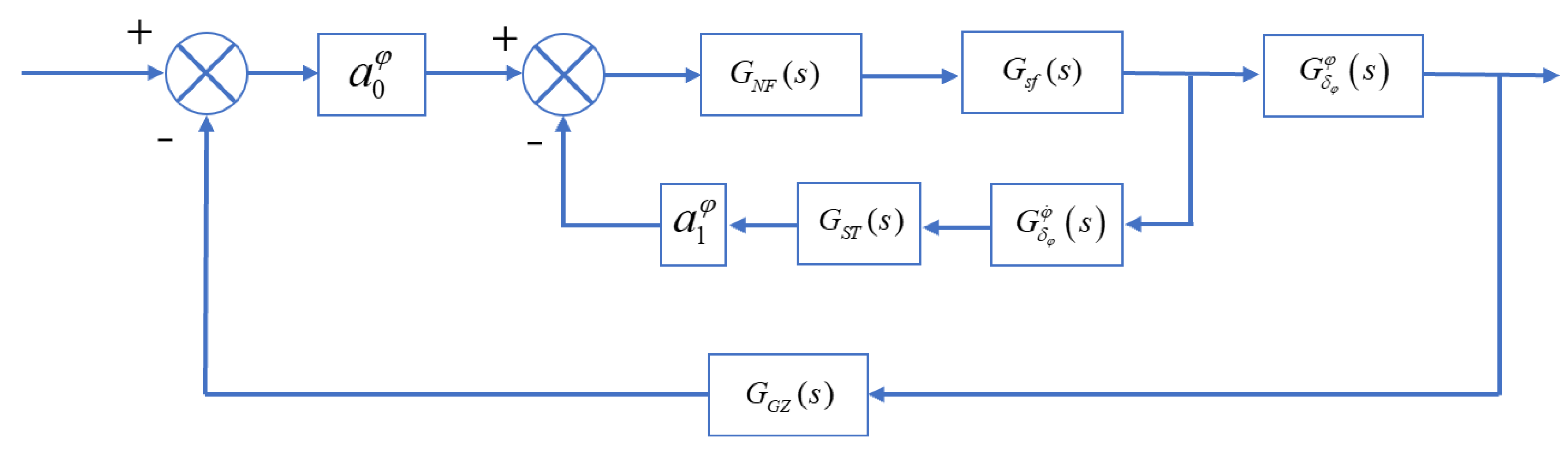
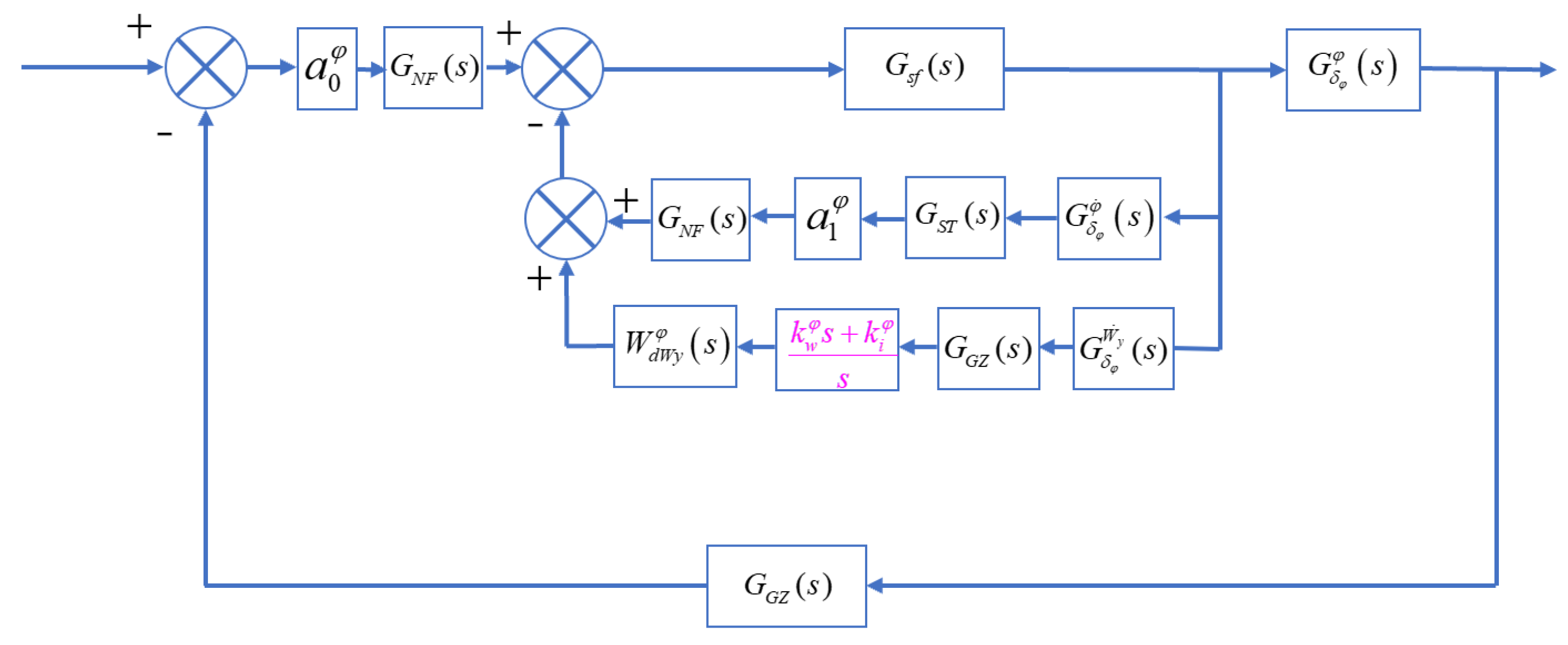
In engineering practice, the design and analysis of the attitude control system are usually carried out in the frequency domain. During the ascent flight phase of the rocket, a series of characteristic points (such as liftoff, pitch-over, transonic phase, maximum dynamic pressure, and the regions near stage separation) are selected to obtain the small-perturbation equation coefficients for each control channel. The control block diagram under elastic conditions is shown in
Figure 2.
Corresponding PD control parameters are then designed, and the open-loop transfer function without the compensation network is calculated as shown below.
where
represents the static gain coefficient of the pitch channel,
is the dynamic gain coefficient,
denote the inertial unit transfer function,
represent the rate gyro transfer function, and
is the servo mechanism transfer function. In the preliminary design of the control system, the position of the rate gyro must first be determined (typically located at the antinode of the second-order vibration mode) to ensure the stability of the second-order elastic amplitude. The transfer function
and
can be obtained by Equation (14). Then,
,
and the open-loop cutoff frequency are initially determined. In general, the amplitude margin under rigid-body conditions should be greater than 6 dB, and the phase margin should be greater than 30°. Finally, by analyzing the Bode diagram, the corresponding correction network can be designed as follows.
(1) Form 1
where
is the notch center frequency, and
denotes the damping ratio.
3.2. Adaptive Augmented Control Design
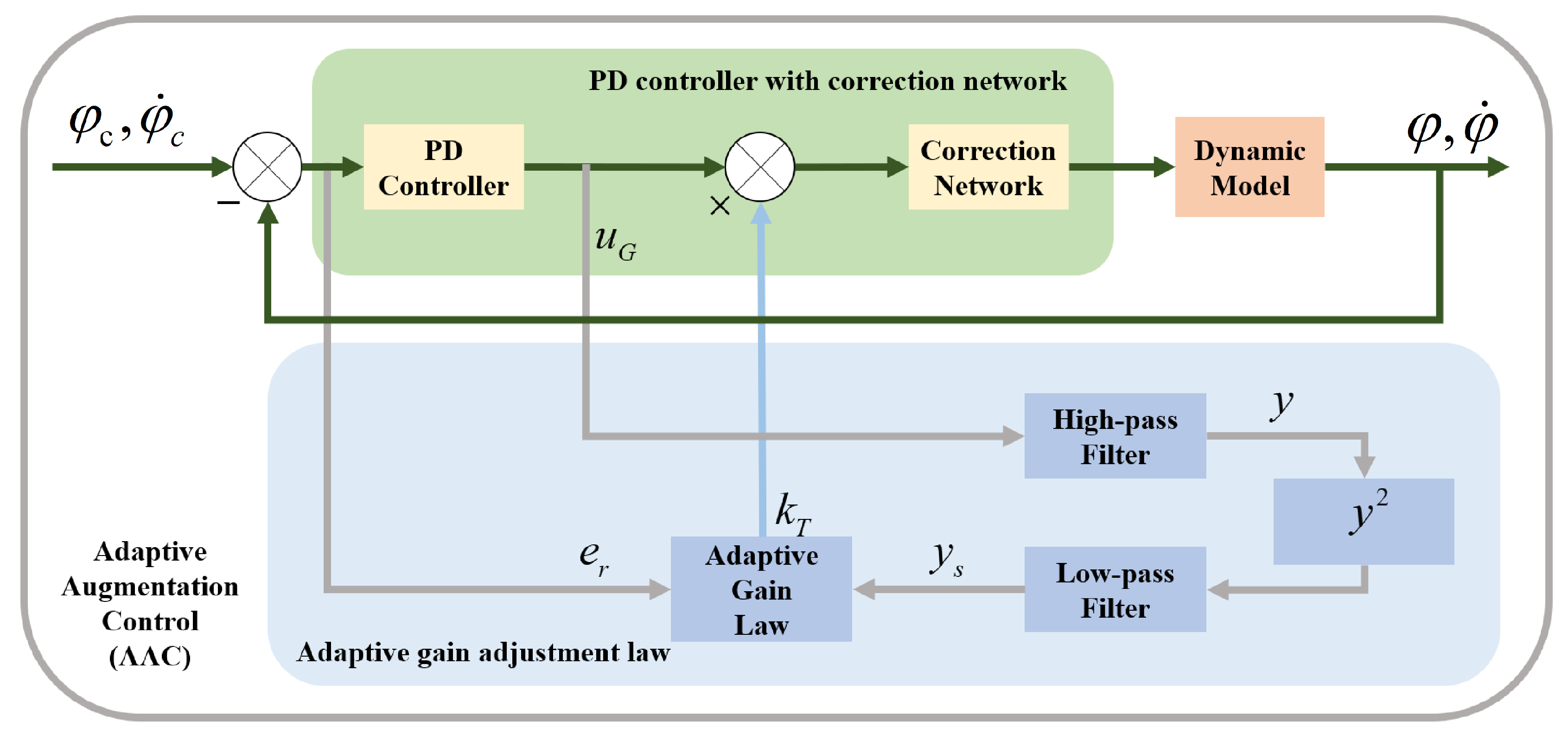
The adaptive law in an adaptive augmented controller is generally designed in the following form [
1] and
Figure 3.
In the first expression of the equation, the first term represents the rate of change in the adaptive gain parameter. The first term on the right-hand side can improve tracking performance, the second term contributes to exiting unstable states, and the third term serves as a stabilization coefficient term. Here, is the error coefficient, is the gain related to the elastic signal, and is the gain coefficient associated with the recovery term, which generally lies within the range (0, 0.1). is the tracking error of the reference model, denotes the elastic amplitude signal. is the upper limit of the gain parameter, and is the lower limit of the gain parameter. represents the adaptive control gain, and is the final open-loop gain coefficient. It can be observed that
Term increases when the system error is large, thereby enhancing the controller’s control parameter to reduce the system error.
Term decreases when the system elasticity is excited, thus reducing the controller’s control parameter to prevent the system from diverging.
Term , through feedback, enables to recover toward 1, maintaining it around 1 when the system operates normally.
The design of the other parts of the adaptive augmented control law is as follows:
(1) Determination of the upper and lower bounds of the gain
Based on the transfer function at a certain characteristic point, it is assumed that the mass deviation, thrust deviation, aerodynamic deviation, density deviation, center-of-mass deviation, and moment of inertia deviation are uniformly distributed within 20%. Without changing the controller’s forward gain
, a Monte Carlo simulation is performed to analyze the gain margin and phase margin under normal operating conditions. From the simulation results, the minimum gain margin is obtained. Then, by solving the following equation inversely, the upper and lower bounds of the gain can be determined.
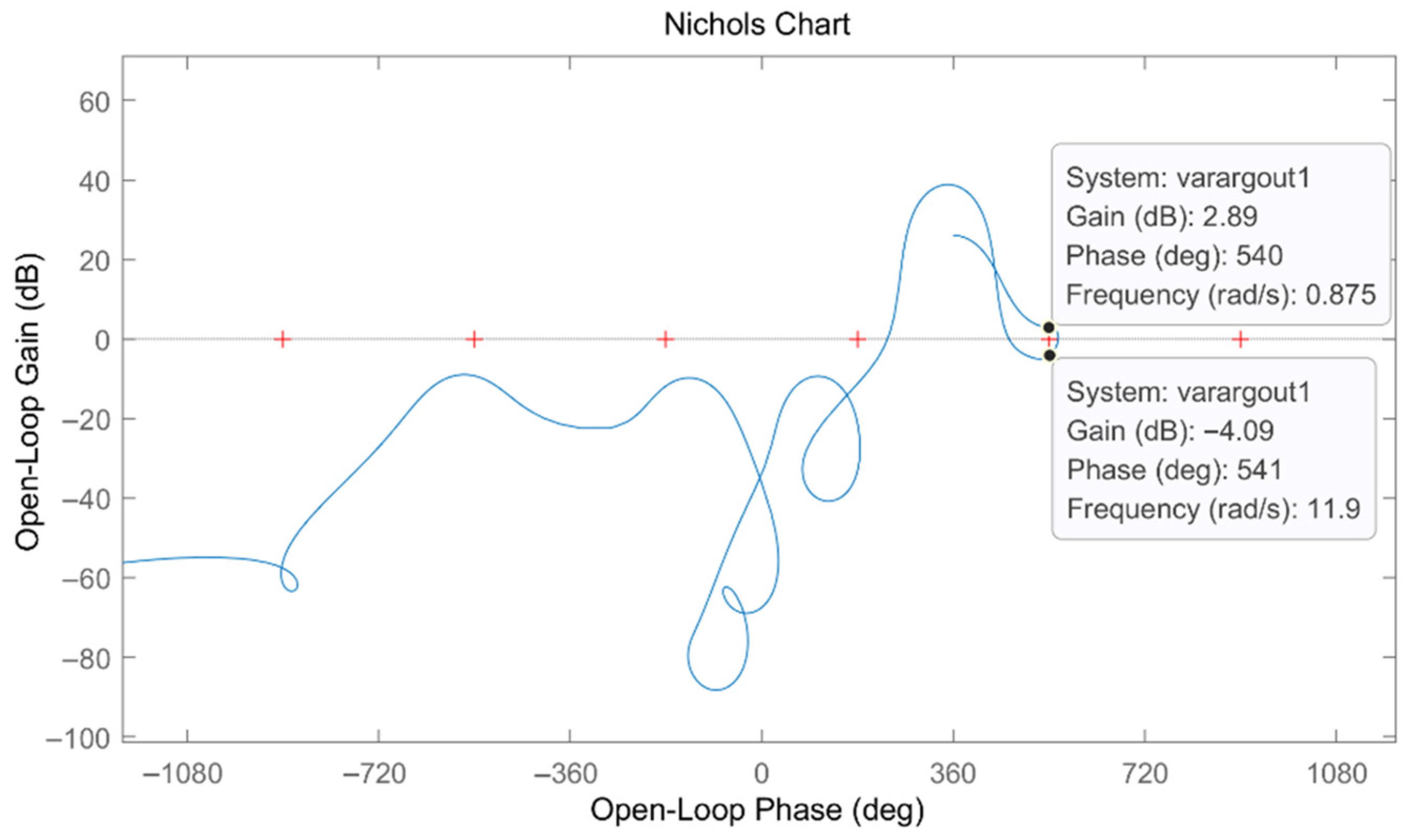
In traditional control system design, it is generally required that By setting , we obtain and , then and . However, in elastic missile design, achieving a 6 dB margin may be difficult. At this point, we can use the Nichols chart (Nichols analysis method) for the design.
Based on the Nichols chart of the open-loop system before compensation, the aerodynamic gain margin point
and the rigid-body gain margin point
are obtained. Then, using equation
, the following can be derived.
Similarly, by using
, we have
For example, the Nichols chart at the 35 s characteristic point is shown in
Figure 4. From the figure, it can be seen that
, and thus
. Since
,
.
(2) Reference model design
The reference model is mainly established by constructing a mathematical model that simulates the missile’s rigid-body controlled motion under nominal conditions. By adjusting the model parameters, the desired tracking response to the guidance command is formed. Then, by comparing this with the missile’s actual disturbed attitude response, the attitude angle error
is obtained. This error serves as the input to the adaptive law, enabling real-time adjustment of the PD controller gains to improve control performance online. Based on the PD control parameters, the reference model can be designed as follows:
By introducing a delay element, the simplified reference model is obtained as follows:
where
,
, and
is the time delay constant.
(3) High-pass/Low-pass filter
The design parameters of the high-pass and low-pass filters should be determined based on the launch vehicle’s characteristics, such as the system’s closed-loop cutoff frequency and the first- or second-order elastic vibration frequencies. Appropriate frequency values and damping ratios should be selected so that the center frequency of the high-pass filter is higher than the closed-loop cutoff frequency, thereby filtering out the rigid-body control signals. Meanwhile, the low-pass filter can smooth the vibration signals, providing information for gain reduction. In this paper, second-order high-pass and low-pass filters are used to obtain smooth elastic vibration signals, and their structures are as follows:
where
is the center frequency of the high-pass filter, and
is generally designed as 0.9. Moreover,
is the center frequency of the low-pass filter, and
is generally designed as 1. The elastic vibration amplitude signal is designed as follows:
This equation will cause a frequency folding phenomenon. Therefore, it can be concluded that .
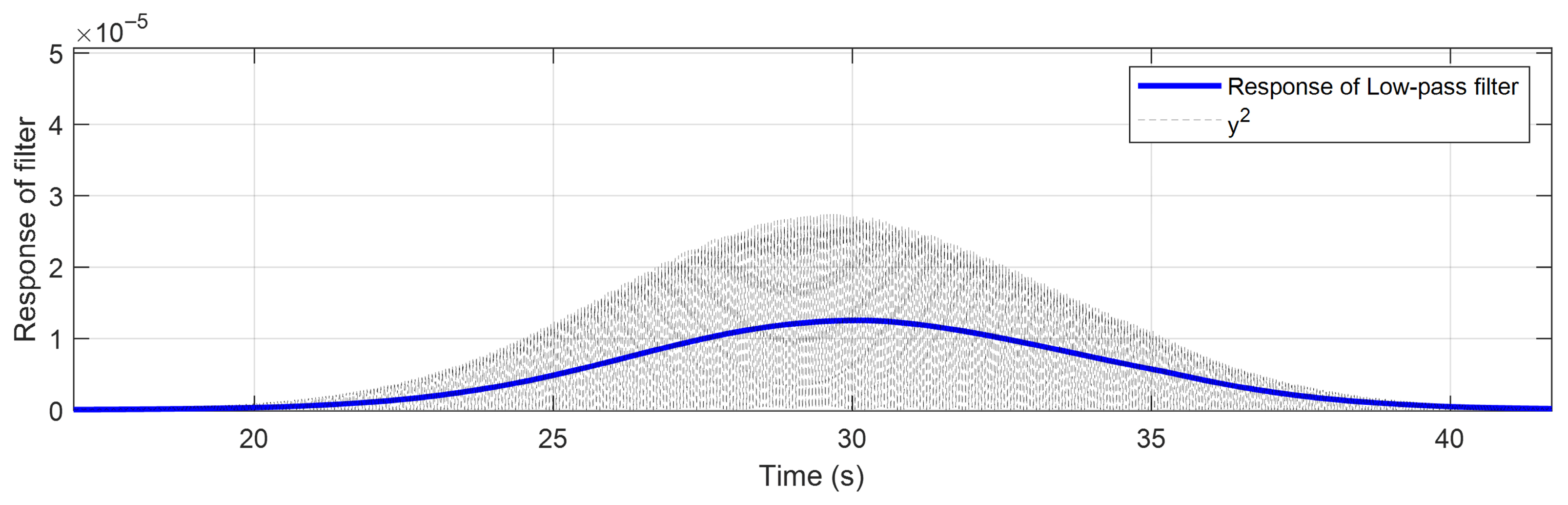
The typical signal, after passing through the high-pass and low-pass filters, produces the results shown in
Figure 5. According to the results, after the signal
is processed by the two filters, it becomes smooth and free from oscillations. This filtered signal can then be used as the input to the adaptive law for adaptive gain adjustment.
(4) Parameter adjustment design
The core of the adaptive augmented controller is the adaptive law, which includes multiple control parameters. However, the adjustment of these parameters is challenging; therefore, this paper proposes an analytical approach for their computation. By setting the magnitude and distribution of deviations related to disturbances, the maximum values of the reference model tracking error
(the maximum error between the attitude angle referenced by the model and the actual attitude angle during the entire flight) and the elastic vibration amplitude signal
can be obtained through the Monte Carlo method. Based on these values, the results shown below can be derived using Equation (18).
where
denotes the time for
to change from
to
, which reflects the rate of gain increase.
is the time for
to change from
to
, which also reflects the rate of gain decrease. To guarantee a robust recovery of
to 1,
is typically chosen as an initial candidate, and can be adjusted during testing.
3.3. Load Relief Control Design
To achieve long-duration and large-magnitude load relief, this section investigates the design methodology for active load shedding. It primarily focuses on the design methods for PI controllers, as well as correction networks, based on acceleration feedback for overload information. In the load relief loop, the measured overload values (
,
) are primarily leveraged to modify and compensate for the original engine deflection angle.
where
and
denote the overload feedback coefficients.
and
are integral gains.
and
are the distances between the accelerometer mounting positions and the center of mass.
3.4. Linear Extended State Observer Design
In this section, a linear extended state observer (LESO) is proposed to further enhance attitude control precision for controller compensation. Based on the small-disturbance linearized equations established earlier, taking the pitch channel as an example and considering only the rigid-body model, the equations are rewritten as follows:
Define the state variable as
,
. Then, the state-space equations can be derived as follows:
where
represents the additional attitude angles and angular rate measurements induced by elastic vibrations.
. Moreover, the other variables are designed as
Based on the two equations above, an extended state observer (ESO) is designed as follows:
where
.
,
, and
are the observations of
,
, and
, respectively.
are the observer gains, it is a critical factor that determines the convergence of the observer. According to the method described in the existing literature, it is determined by configuring the observer bandwidth
.
Therefore, the disturbance compensation control input is designed as follows:
In conclusion, the final design of the adaptive augmented disturbance rejection load relief controller (exemplified with the pitch channel) is shown below:
4. Stability Analysis of the Proposed Controller
In this section, frequency-domain methods and sinusoidal function analysis are applied to the four designed modules to evaluate the system’s stability margins, and the overall stability margin of the whole control system can be calculated. According to the aforementioned PD control block diagram, after incorporating the load relief control loop, the following is obtained in
Figure 6.
Then, the open-loop transfer function of the system is
where
is the correction network of the accelerometer. It can be designed such that
. The transfer function from engine nozzle deflection angle to overload is calculated as follows:
Through Laplace transform, when the deviation in the installation position of the accelerometer relative to the center of mass is removed from the control system feedback, the following is obtained:
When converting the angle of attack to pitch angle and trajectory inclination angle, the following relationship holds
Substituting this into the previous open-loop transfer function (Equation (15)) allows for the plotting of the Bode diagram. Next, let us analyze the stability of the LESO.
Considering the correction network at the state input of the observer, the Laplace transform of Equation (30) yields
where
. According to the above equation, the transfer function of the LESO is derived as follows:
The specific expression is as follows:
Then the control law compensated by the LESO is
The controller parameter
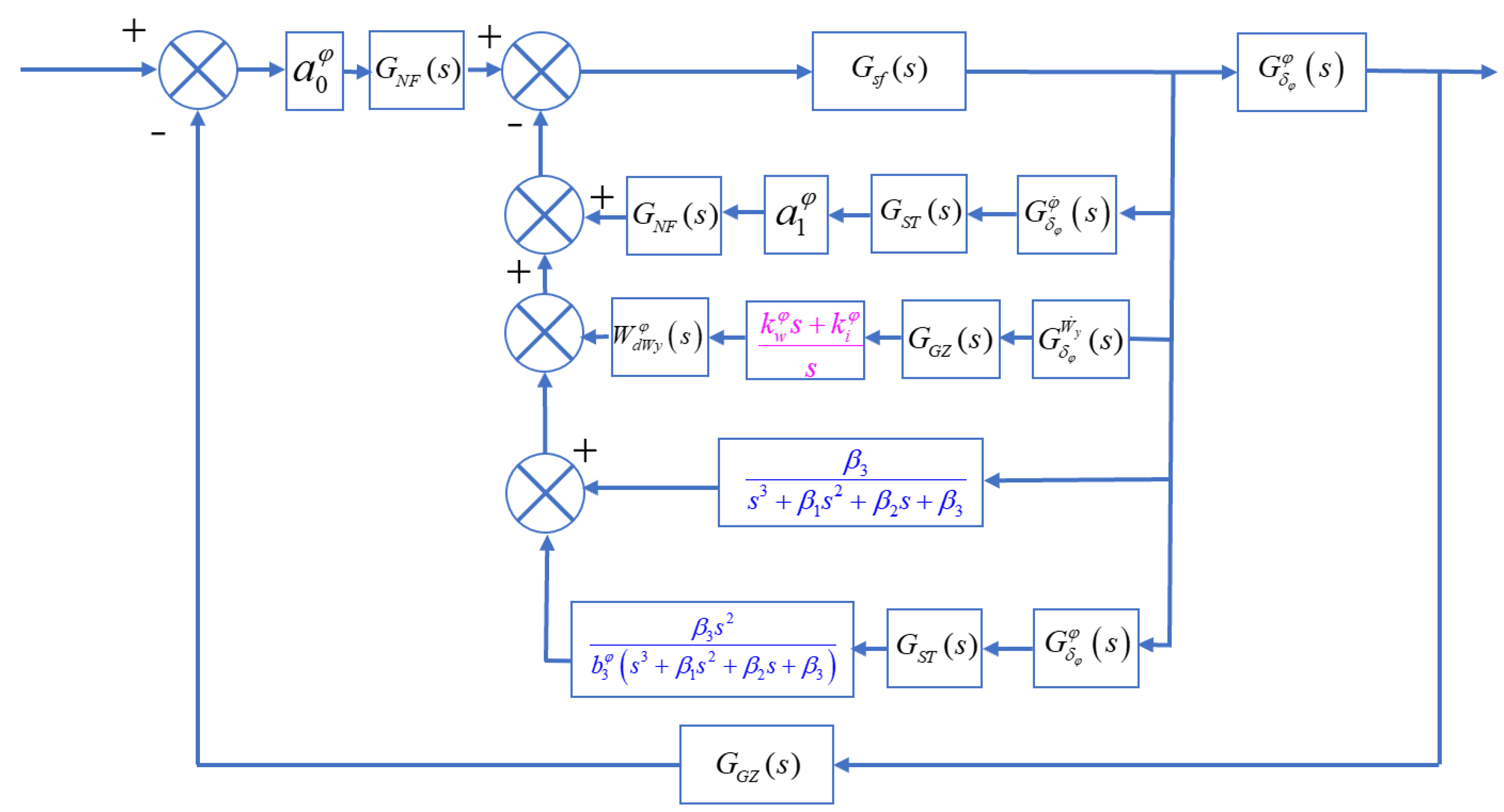
can be determined based on interpolation under nominal operating conditions. Combining the PD controller, load relief controller, and linear extended state observer results in the block diagram shown in
Figure 7.
From the above block diagram, the open-loop transfer function of the system is calculated as follows:
To facilitate the stability analysis of the adaptive augmented control law, the adaptive mechanism in the AAC is rewritten as follows:
Due to the control law expression
, the equation can be expressed as
under the small-disturbance assumption. The stability margin analysis of the adaptive augmented controller can be conducted using the sinusoidal input signal method, thereby deriving the time-domain response of the open-loop gain
. First, assuming the error
satisfies the sinusoidal input condition
, the following relation is obtained based on the high-pass and low-pass filter characteristics:
where
is the phase of the high-pass filter
. Furthermore, utilizing the trigonometric identity
, we can similarly obtain for
:
This is due to the fact that
. Substituting this condition into the preceding equations yields
Further simplification yields
where
,
. The error
can then be passed through a low-pass filter, resulting in a filtered signal
that becomes a small constant. The solution to the above equation is
where
is the coefficient of the general solution, and it is an arbitrary constant. Based on the expressions of
and
, it can be concluded that
implies
,
and
. Therefore, the open-loop gain output by the AAC must be a positive number. Furthermore, since
, as time increases,
, we have
and
.
If the input frequency of
is sufficiently low, then
. Since
is relatively small (on the order of 0.01), it follows that
. When the input frequency is high, there is
, the following relation holds
When , then , i.e., . In summary, it can be concluded that when the input signal is low-frequency, the open-loop gain of the AAC will approach the upper limit value of ; whereas, when the input signal is high-frequency, the AAC gain is less than 1 and approaches (i.e., the minimum value). According to the expression form of Equation (47), the open-loop gain is asymptotically convergent and does not exhibit a chattering problem.
Next, we employ the describing function method to derive the magnitude and phase response curves of the AAC open-loop gain under different frequency conditions. First, we again consider using the describing function method for the derivation. Considering
, it follows that
. In describing function analysis, typically only the fundamental frequency component is considered. Therefore, there is
Substituting this into Equation (46) yields
After combining and transforming these terms, we obtain
The solution of the system is
where
is a constant related to the initial value. If we focus solely on the steady-state solution of the system under different frequencies, then
It can be concluded that the system’s amplitude is independent of
(when the influence of
is not considered). When
is taken into account, the overall open-loop gain
of the system satisfies
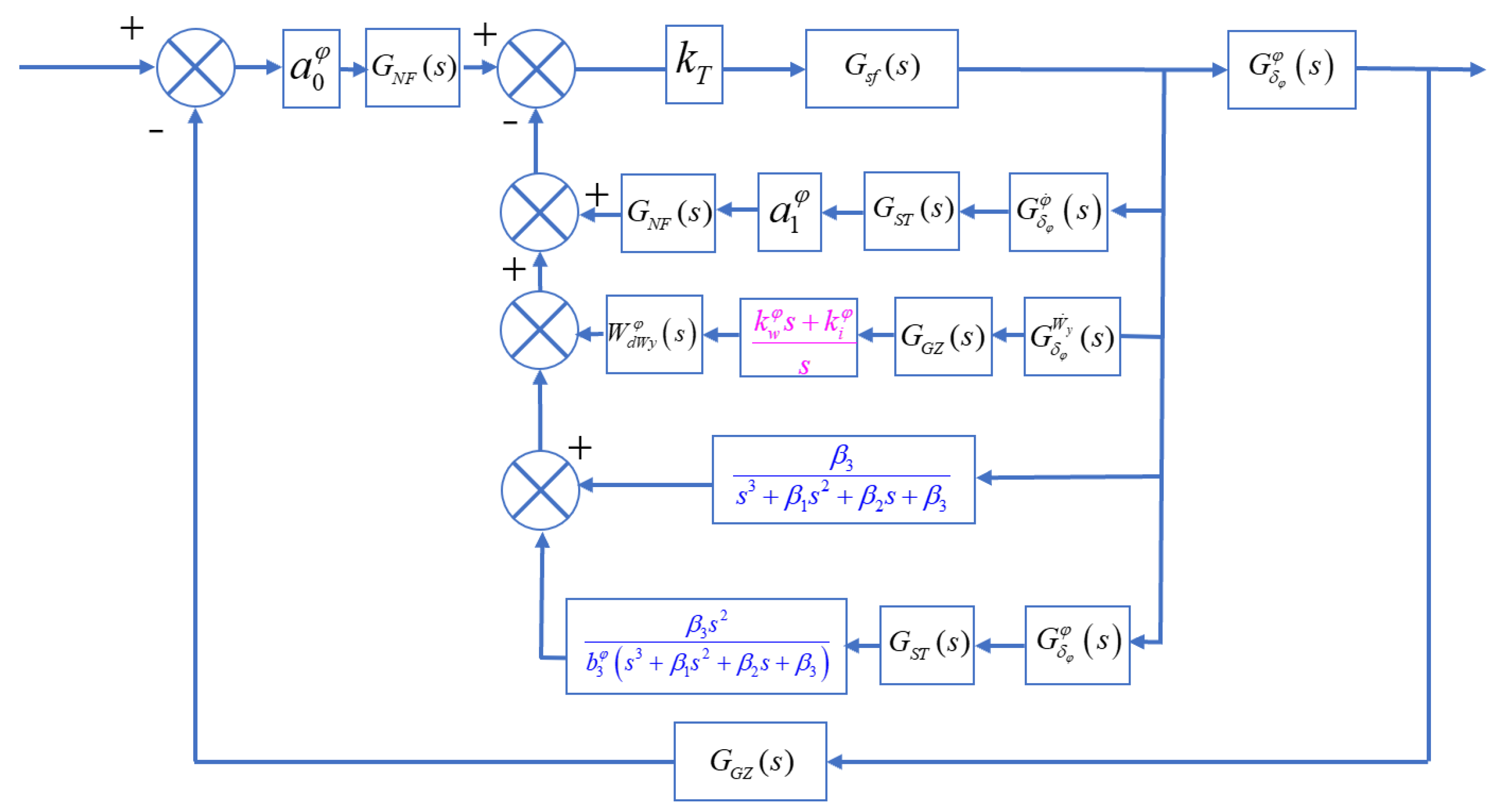
Based on the results from the above equation, it can be concluded that the adaptive augmented control law approximates an open-loop gain in the frequency-domain analysis, exhibiting only magnitude response without phase response. Then, the block diagram of the control system with all four control modules combined is shown in
Figure 8. Subsequent stability analysis can be conducted based on this diagram, and Bode plots can be generated.
5. Simulation and Results
In this section, we consider the following parameters for the solid launch vehicle: a lift-off mass of
35 t, a propellant mass of 21 t, a first-stage engine burn time of 61.6 s under standard temperature conditions, a specific impulse of 268 s, a launch site altitude of 1006 m, a launch longitude of 110°, a launch latitude of 40°, and a launch azimuth angle of 0°. Here, we focus solely on the first-stage flight phase, which is the most critical during atmospheric flight. The PD Control parameters for the pitch and yaw channel are designed in
Table 1.
The frequency-domain requirements for the solid launch vehicle are as follows: low-frequency gain margin not less than 2 dB, high-frequency gain margin not less than 3 dB, rigid-body phase margin not less than 10°, flexible-mode gain margin not less than 10 dB, and flexible-mode phase margin not less than 10°. The pitch channel and yaw channel use the same compensation network parameters. The compensation network is shown below:
5.1. Frequency-Domain Characteristic Analysis
The table below summarizes the low-frequency gain margin (L-GM), high-frequency gain margin (H-GM), and phase margin (PM) of the pitch channel for various operating points under rated conditions with upper/lower deviation limits. It is important to clarify that the aforementioned upper-bound state collectively represents a scenario where the coefficients in the dynamic small-perturbation linearized equations have a positive deviation of +20%. Conversely, the lower-bound state corresponds to a uniform negative deviation of −20% for all coefficients in the dynamic equations.
As shown in
Table 2 and
Table 3, the gain and phase margins for both the pitch and yaw channels meet the stability requirements. With the incorporation of the PI load relief control loop, where the control parameters are set as
. Then, the performances of the pitch channel control system (PD + LR) are listed as follows.
From the results above, after incorporating the PI unloading control loop, the system GM changes from 2.89 dB to 3.08 dB, and the PM changes from 17 deg to 13.6 deg. This confirms that the unloading control loop enhances the system GM at the cost of reducing the PM at 35 s. In
Table 4, a comparison of the results in
Table 2 indicates that the high-frequency gain margin is improved at almost all characteristic points, while the phase margin experiences a slight reduction at these points.
Assuming the control parameters of the linear disturbance observer are set as
. Performances of the pitch channel control system (PD + LR + LESO) are listed in
Table 5.
Based on the above results, after incorporating the PI-based power shedding control loop, the system’s gain margin changes from 2.89 dB to 0.85 dB, and the phase margin changes from 17° to 14.3° at 35 s. This indicates that the disturbance compensation loop has a significant impact on both the gain margin and phase margin of the system, resulting in an error of approximately 2 dB. This outcome aligns with the increase in control gain required to reduce the steady-state error. Essentially, in such scenarios, disturbance compensation is typically applied in high-wind regions to minimize steady-state error, and a corresponding reduction in stability margins is therefore expected.
Finally, the adaptive augmented control parameters for the pitch channel are designed as
,
,
,
,
,
,
,
,
and
. Suppose
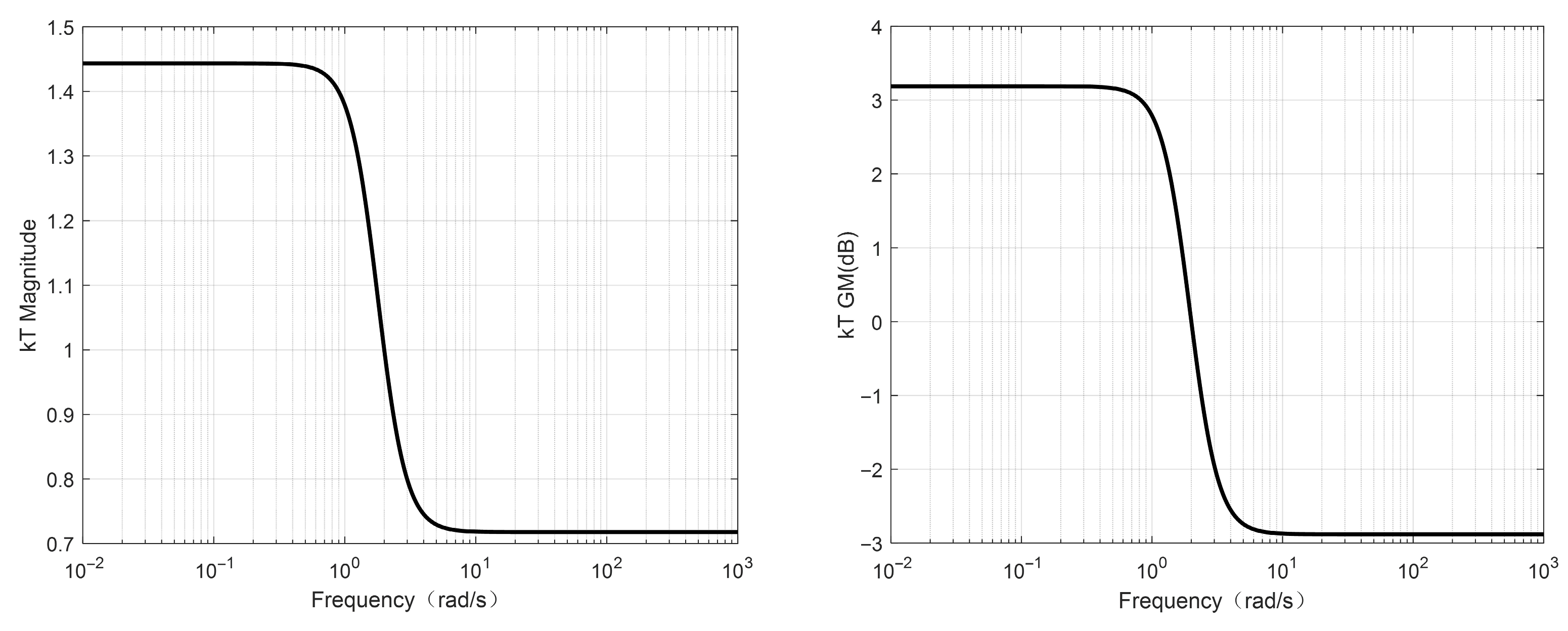
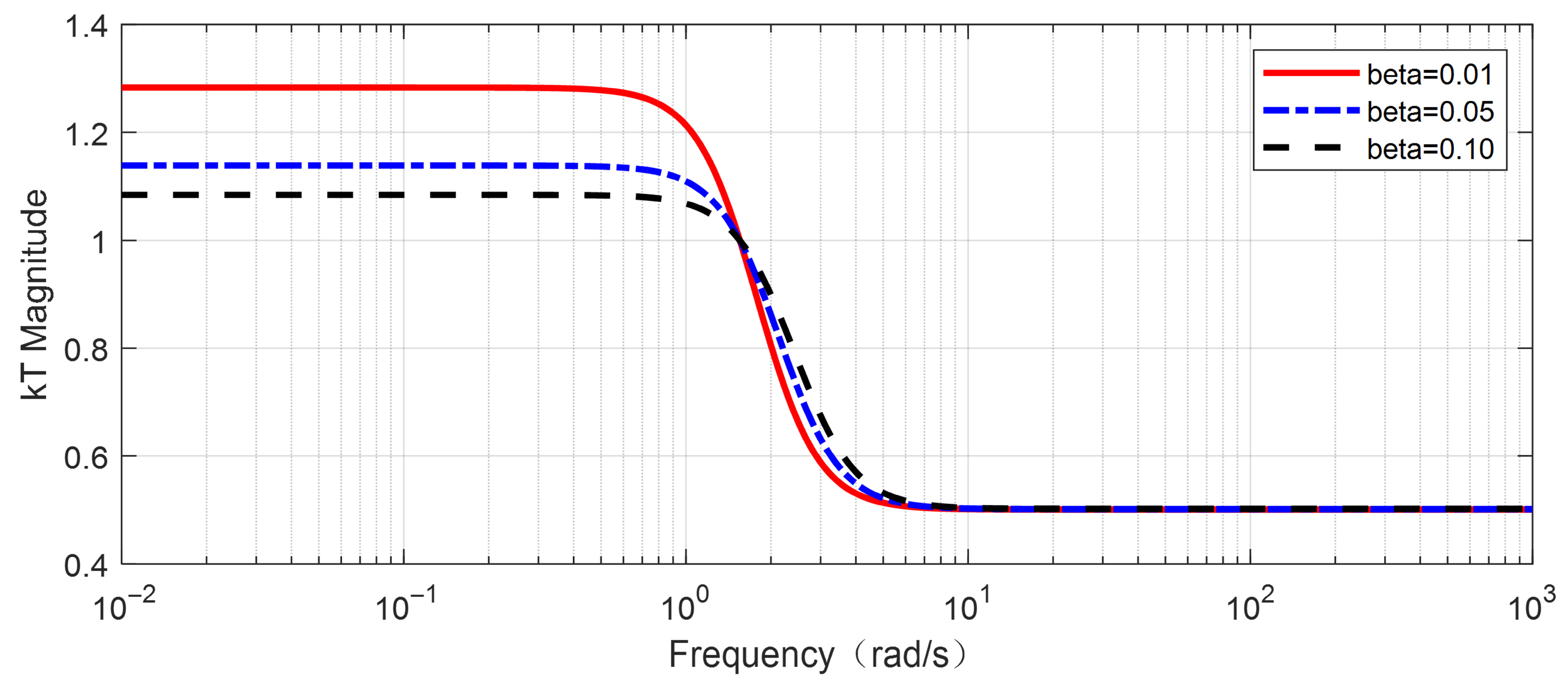
, frequency sweep tests are conducted using sinusoidal input signals of varying amplitudes and frequencies, yielding the results shown in
Figure 9 based on Equation (56).
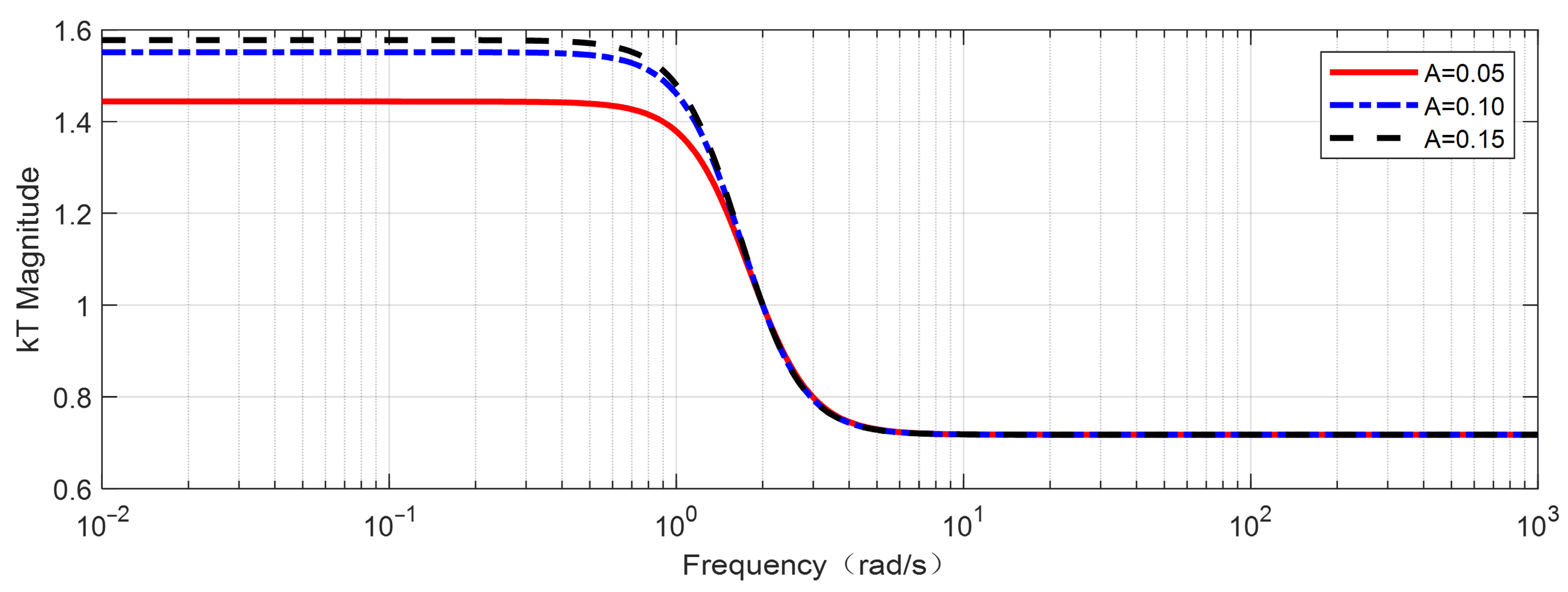
When the value of
is set to 0.05, 0.1, and 0.15 respectively without altering other parameters, the following results are obtained in
Figure 10.
Based on the frequency sweep results, the following conclusions can be drawn:
(1) The AAC can be characterized as a feedforward gain block, contributing no additional phase shift to the system.
(2) In the low-frequency range, the AAC provides a gain greater than 1, which enhances the rigid-body stability margins of the system. Conversely, in the high-frequency range, its gain falls below 1, thereby improving the flexible-body stability margins.
(3) When the term is considered, the AAC gain becomes dependent on the amplitude of the input signal. This dependency vanishes when is disregarded. For input signals with very small amplitudes, the AAC gain is approximately 1 across the entire frequency spectrum. Conversely, for large-amplitude inputs, the gain in the low-frequency band saturates at the upper limit of , while the high-frequency gain settles at its lower limit. Furthermore, the frequency response trends of the AAC control gains across all three channels align well with the theoretical predictions. The parameter A predominantly influences the response in the low-frequency region, with negligible effect on the high-frequency response. Moreover, a larger value of results in a higher overall response of the open-loop gain .
(4) In the low-frequency range, it increases the gain margin by approximately 3.7 dB, and in the high-frequency range, it enhances the flexible-body gain margin by about 2.6 dB.
Furthermore, it is evident that the frequency response trend of the AAC control gain is in good agreement with the theoretical results. The outcomes for cases where only parameter
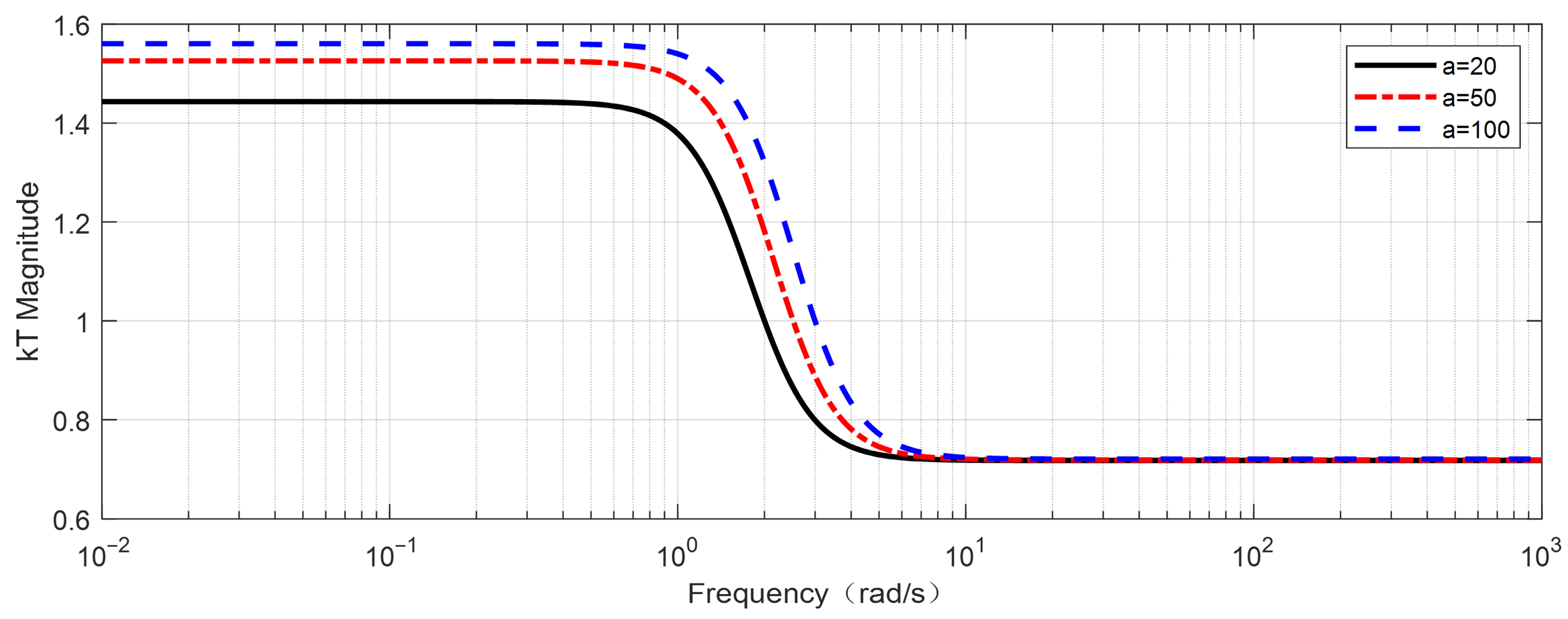
is modified, while keeping all other parameters constant, are presented in
Figure 11.
The simulation results indicate that increasing coefficient
raises the open-loop gain. The corresponding results for an increase in parameter
are shown in
Figure 12.
As can be seen from the figure, increasing parameter leads to a lower open-loop gain (which also converges more rapidly to its minimum value, ). This effect widens the frequency separation, thereby ensuring sufficient stability margins and benefiting elastic mode stabilization. These results collectively demonstrate the effectiveness of the proposed method.
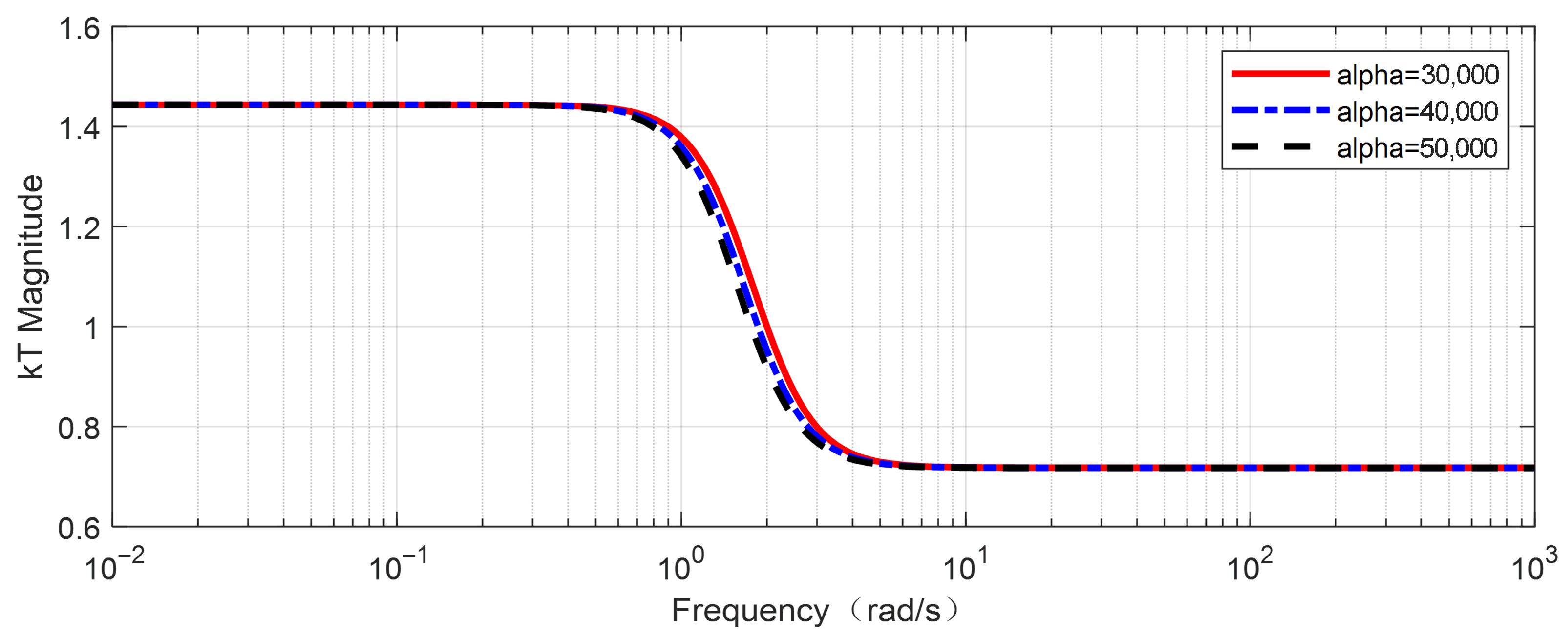
Finally, the results obtained by increasing the value of
are presented in
Figure 13.
As shown in
Figure 13, a larger
value drives the open-loop gain
closer to its nominal value of 1, demonstrating its unique regression characteristic. Consequently, the frequency-domain simulation results confirm the effectiveness of the stability analysis method.
Finally, after incorporating the previously analyzed AAC stability margin module, the performances of the overall synthesized open-loop transfer function for the AAC + PD + LESO + LR loop are listed in
Table 6. It can be seen that the system’s GM increases from 0.85 dB to 4.239 dB (at 35 s), representing a significant improvement. The PM, meanwhile, changes only slightly from 14.3 to 14.4 degrees, indicating minimal impact. This demonstrates the excellent performance of the AAC. Then, the gain margins and phase margins of all characteristic points under the rated, upper limit, and lower limit conditions are listed as follows:
According to the list results, the system’s GM has been improved across the board, and the PM meets the requirements. Therefore, the simultaneous incorporation of the LR control loop, the LESO loop, and the AAC loop can satisfy different control performance indicators without causing mutual coupling that affects the system’s stability margins.
5.2. Analysis Simulation Analysis of PD Control
In this section, we proceed to test the aforementioned PD controller and correction network in the time domain. The disturbance conditions of upper and lower deviations considered during the simulation are listed in
Table 7. It should be noted that wind disturbances include steady wind and wind shear. The wind shear is modeled as a triangular wave and applied three times during the powered flight phase: during 20–30 s, 40–50 s, and within the altitude range of 10 km to 12 km. The maximum wind speed of the shear wind is 20 m/s. Moreover, the simulation step is set to 5 ms.
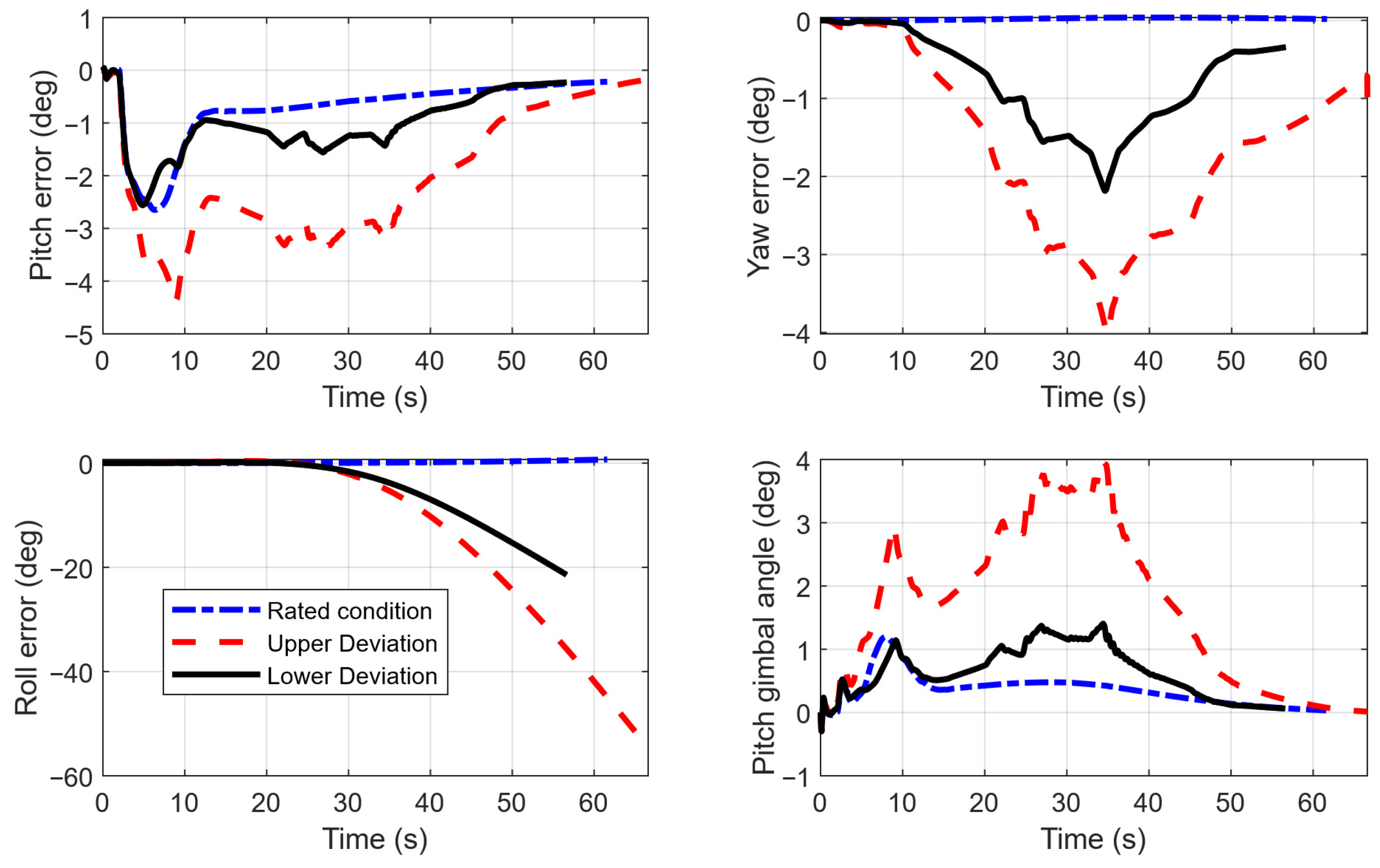
The specific simulation results are presented in
Figure 14.
As evidenced by the simulation results, the PD controller and compensation network designed in this paper successfully meet the pitch and yaw attitude control requirements under both upper and lower deviation conditions. The maximum attitude deviation remains below 5°, while the maximum engine deflection angle does not exceed 2.5°. The roll angle exhibits a maximum divergence of 30 degrees, all of which satisfy flight stability requirements. Furthermore, the absence of excited elastic vibration signals confirms the stability of the flexible system.
5.3. Simulation Analysis of PD Control and PI-LR Feedback Control
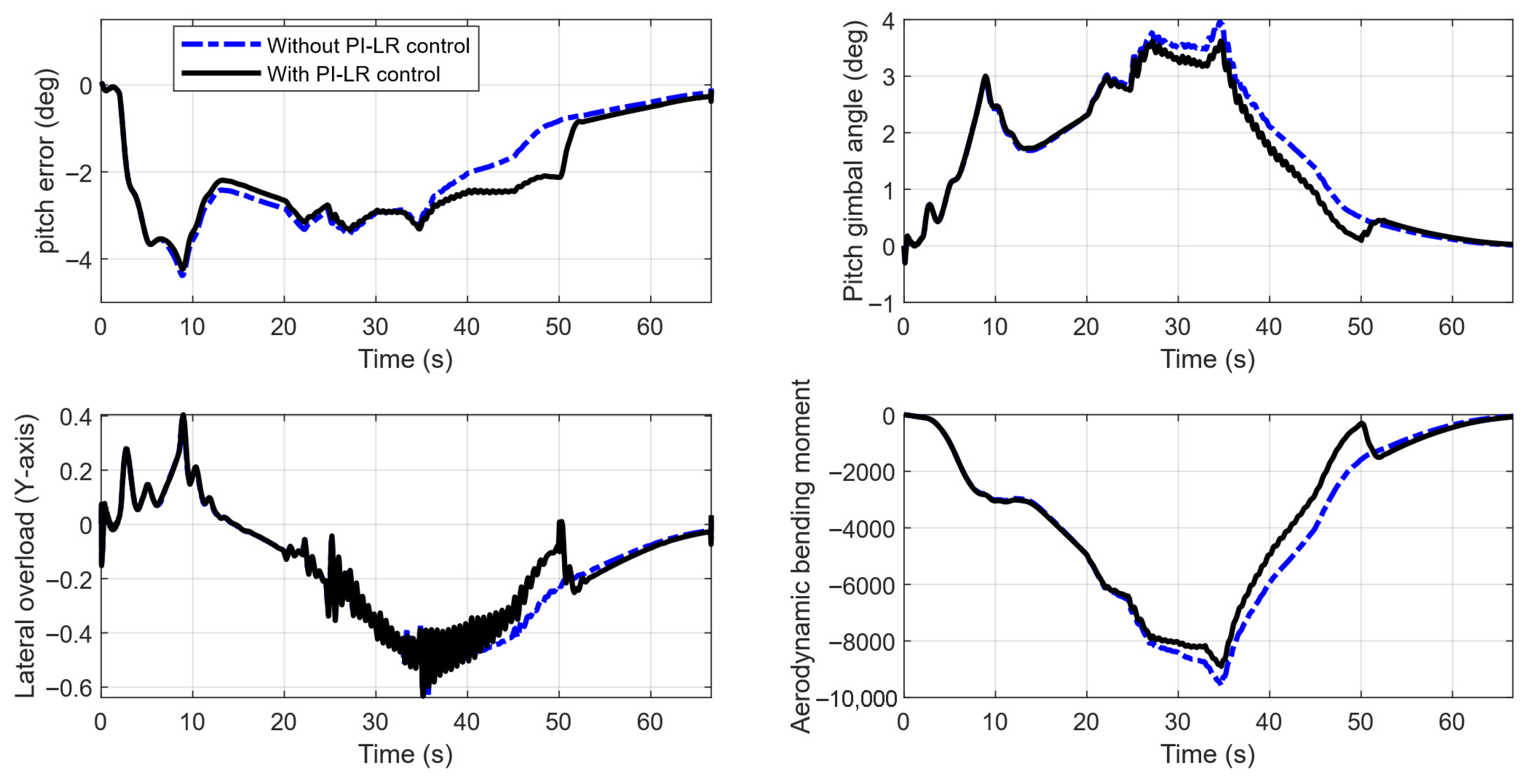
The PI-LR feedback control is applied from 6 s to 50 s, with 2 s ramp signals incorporated for both its engagement and disengagement. The PI-LR control parameters are designed as
,
. The load relief control is exclusively designed within the pitch channel controller and is not implemented in the yaw channel. When considering the upper deviation states, the results are as shown in
Figure 15.
The simulation results indicate that the load relief control loop not only reduces the pitch angle error, engine swing angle, and aerodynamic bending moment by up to 10%, but also effectively ensures attitude stability.
5.4. Simulation Analysis of PD + AAC Control
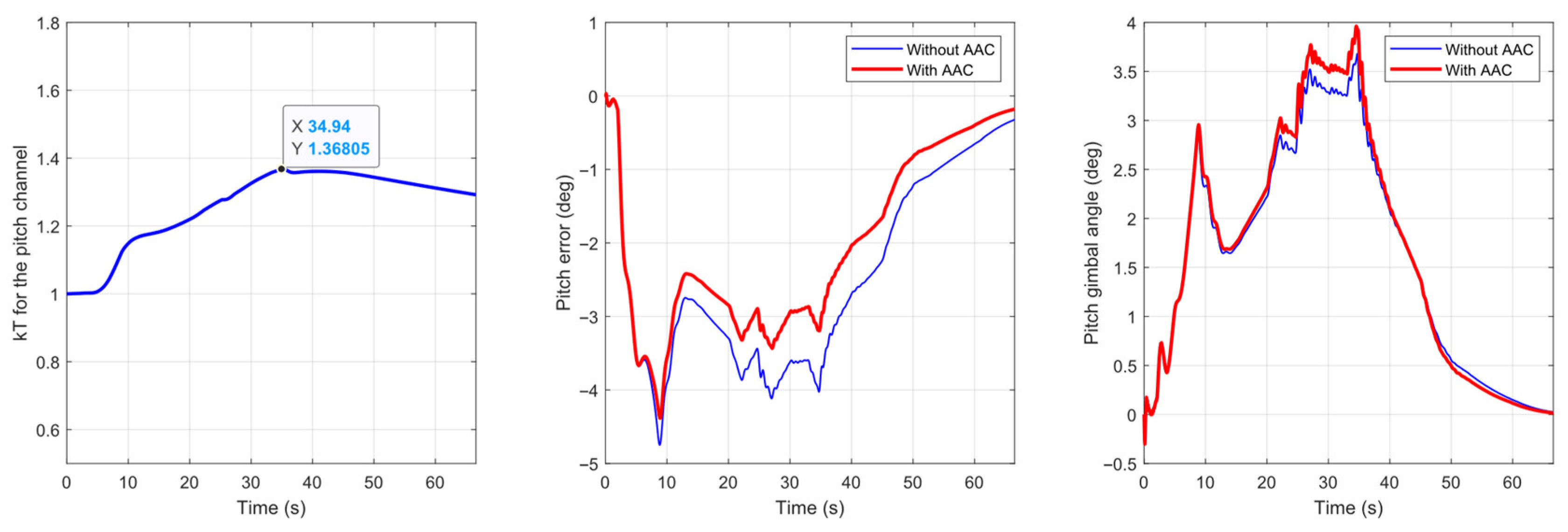
The AAC control parameters are set to be
,
,
and
. The control parameters for the yaw direction are set the same as those for the pitch channel, and will not be reiterated here. Other simulation interference conditions are the same as previously mentioned. When considering the aforementioned upper deviation condition, the simulation results obtained using the designed AAC control parameters and control outcomes are shown in
Figure 16.
According to the simulation results, the conventional PD controller produces significant attitude errors under the upper deviation condition. Consequently, after introducing AAC, the open-loop gain will gradually remain consistently greater than 1 (the max kT is 1.368), thereby reducing the system’s steady-state error, albeit with an increase in the engine deflection angle.
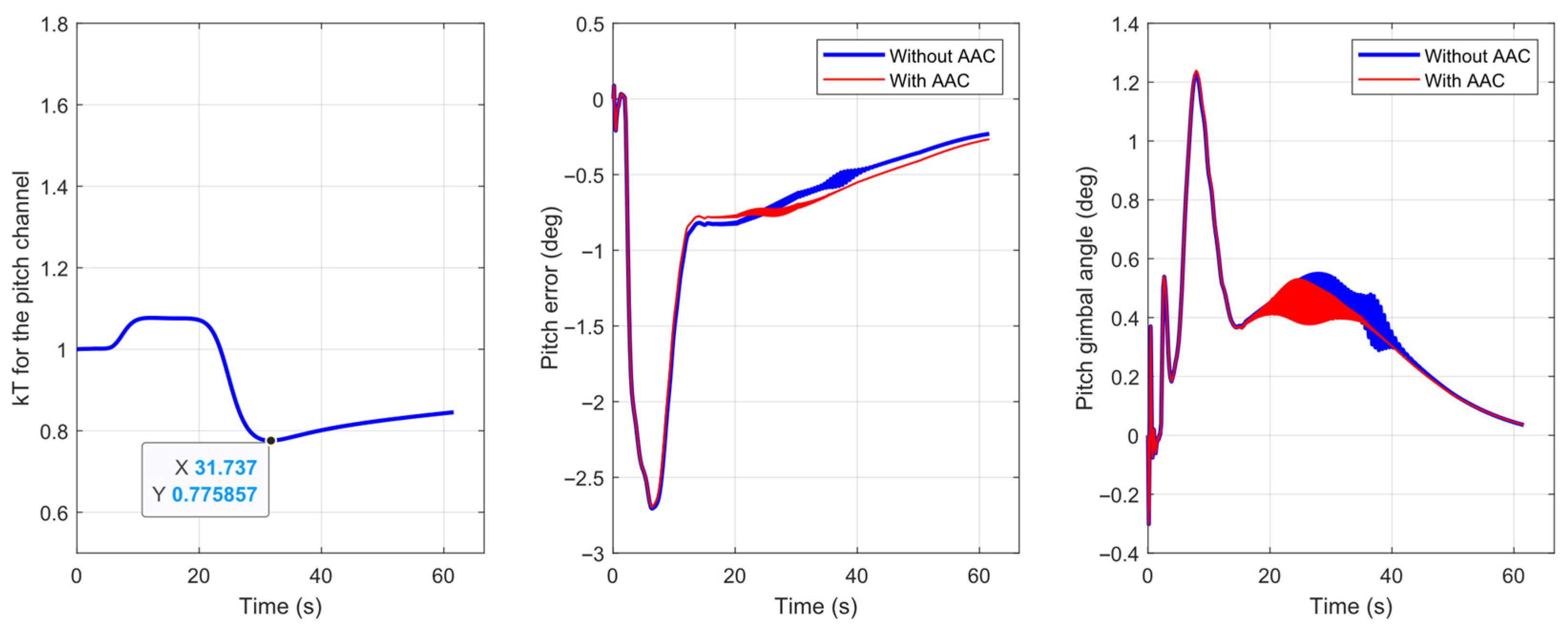
Next, under rated conditions, and considering that the first-order elastic vibration frequency deviation increases to −35% while other control settings remain unchanged, the simulation results are as shown in
Figure 17. According to the simulation results, when the AAC controller is applied under conditions of elastic frequency deviation, the open-loop gain is reduced to approximately 0.78 compared to the PD controller, thereby increasing the frequency separation and ensuring the system’s elastic stability.
5.5. Simulation Analysis of PD + LESO Control
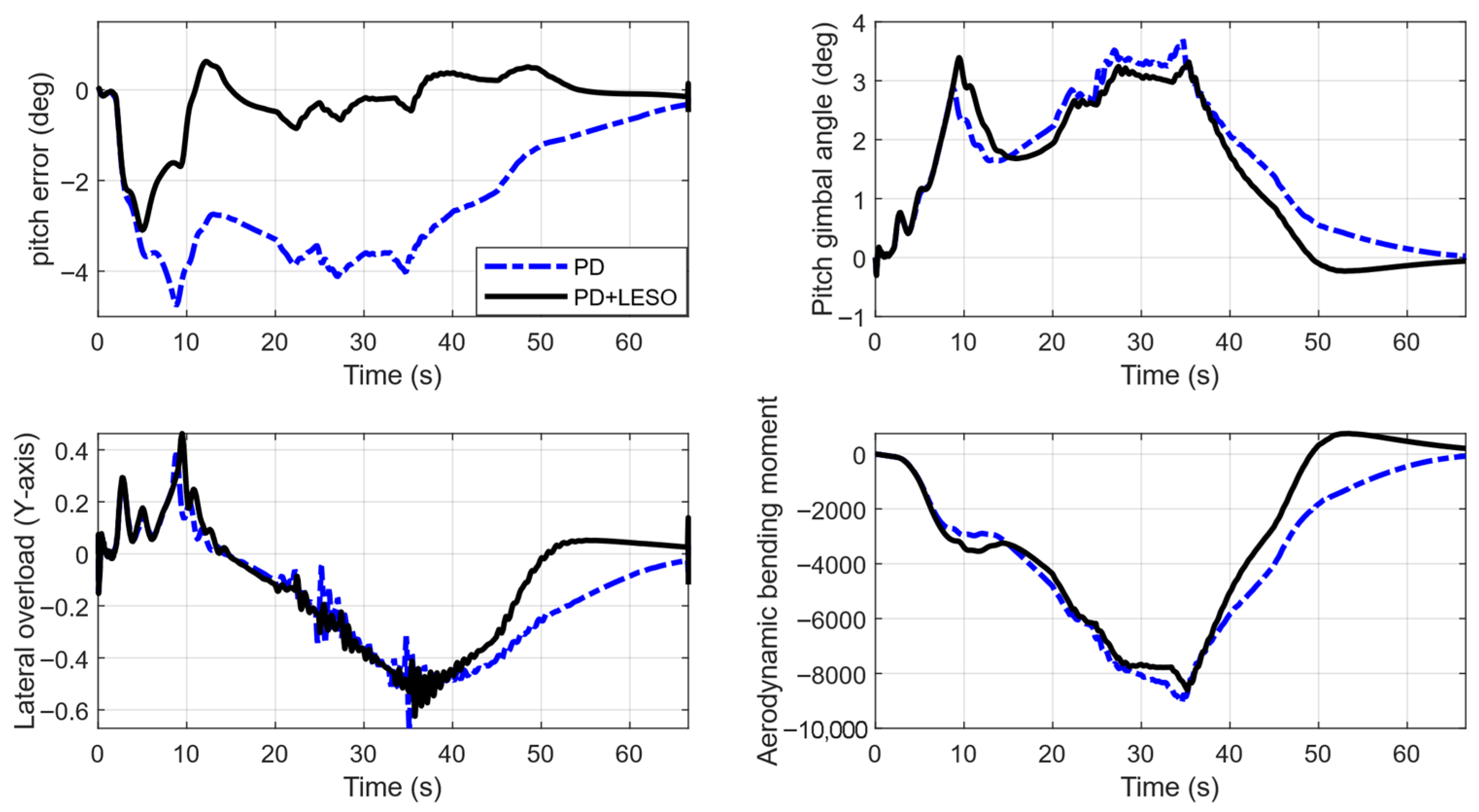
First, the upper limit condition is considered, with the load relief control loop initially excluded. Only the loop incorporating the Linear Extended State Observer (LESO) is added, where the LESO control parameter is set as
. The corresponding results are shown in
Figure 18.
Based on the simulation results presented above, the introduction of the LESO has demonstrated a significant effect on attitude angle error control. The maximum attitude angle error has been reduced from 4.0° to 2.8°. Furthermore, the engine deflection angle has been notably decreased in the high-wind zone, while the Y-direction overload and aerodynamic bending moment have also been reduced to some extent. These results collectively validate the excellent control performance achieved by integrating the LESO with the PD controller.
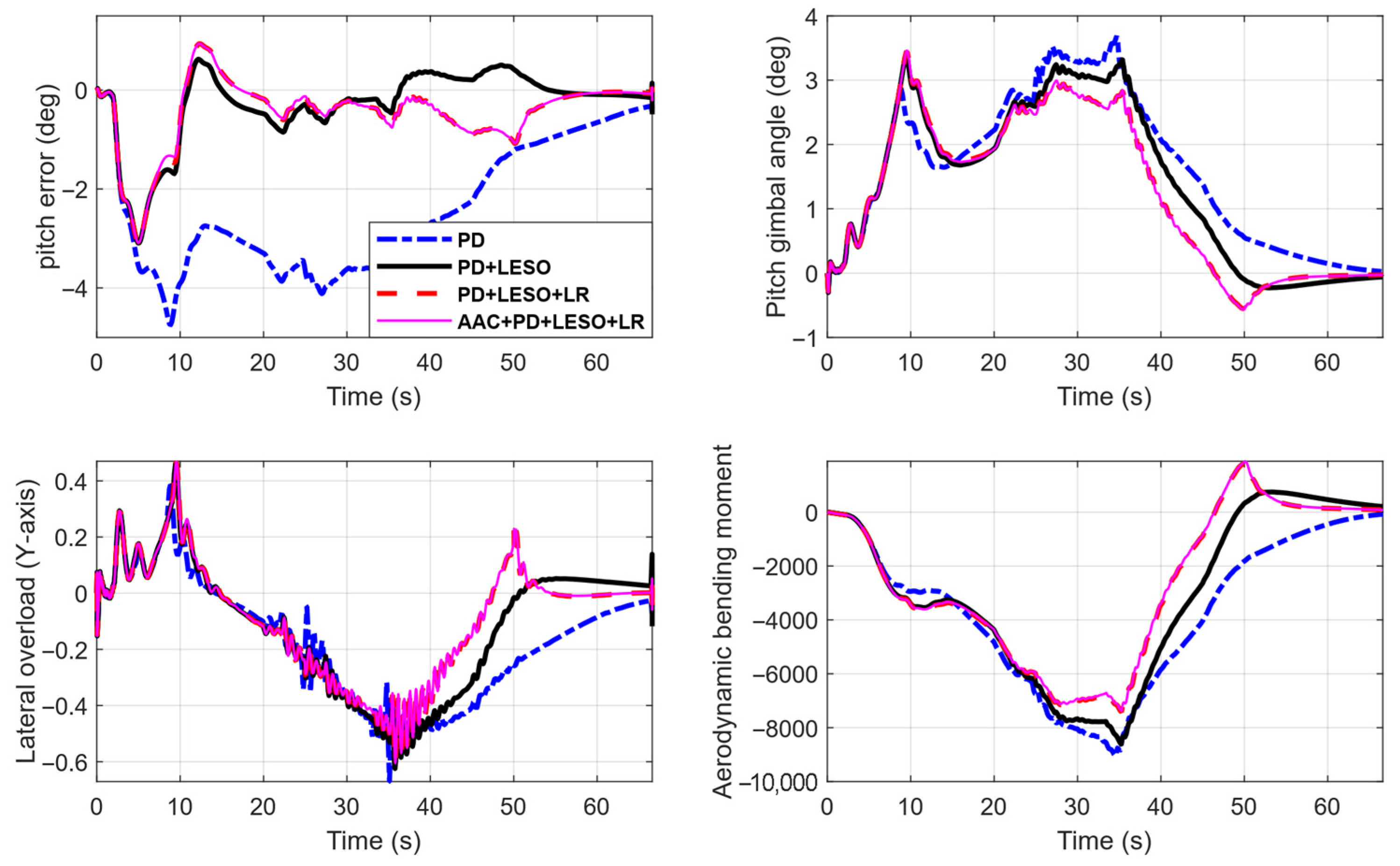
5.6. Simulation Analysis of PD + AAC + LESO + LR Control
In this section, we integrate the PD controller, AAC controller, Linear Extended State Observer (LESO), and PI load relief controller for comprehensive validation. The simulation results obtained are shown in
Figure 19.
The summary of performance comparison of different controllers in time domain analysis are list in
Table 8.
Based on the results presented above, it can be observed that after the integration of AAC, all four components-the AAC controller, PD controller, load relief loop, and the Linear Extended State Observer (LESO)-successfully perform their respective functions. This integrated approach not only achieves a reduction in attitude error but also ensures a decrease in the engine nozzle deflection angle. Consequently, the loads during flight are reduced, thereby guaranteeing the structural safety of the missile.
5.7. Monte Carlo Analysis
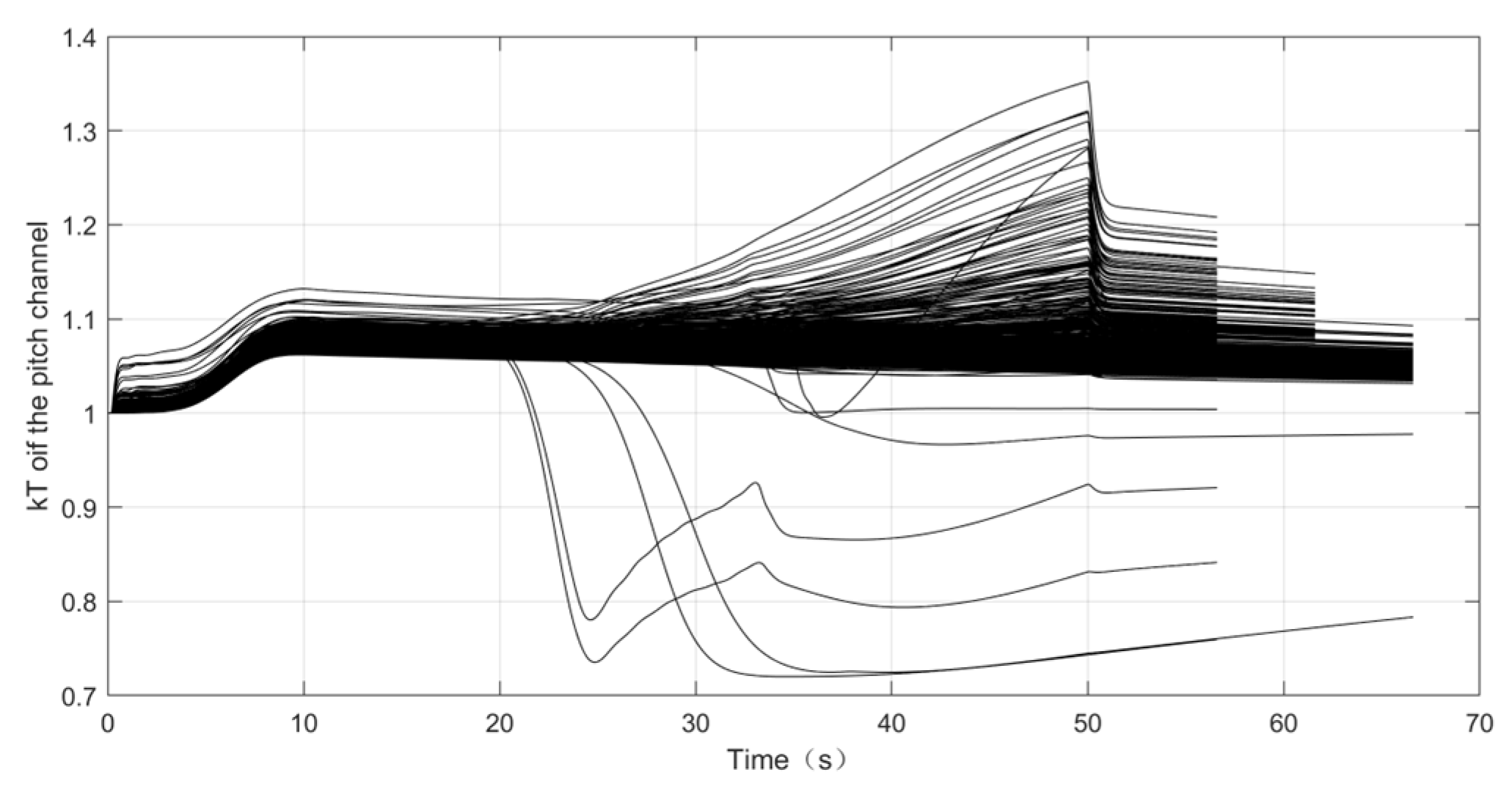
Next, we utilize the data from
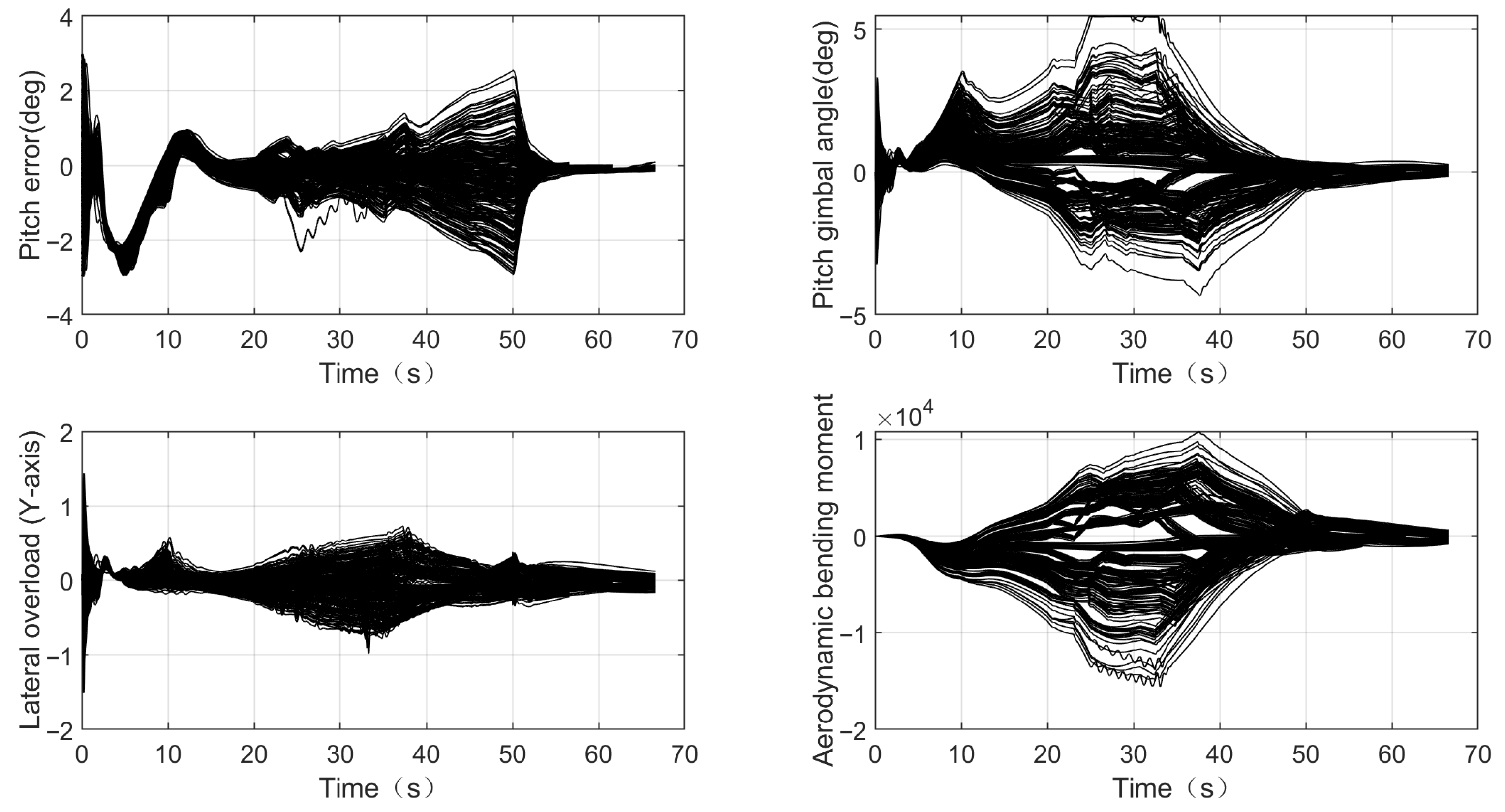
Table 7 as the 3-sigma amplitude boundary to generate normally distributed random numbers as combined disturbances. Simultaneously, for the steady wind direction angles, uniformly distributed random numbers are generated to cover eight directions: 0°, 45°, 90°, 135°, 180°, 225°, 270°, and 315°. Moreover, the initial values of pitch angle and pitch rate are both 10 (
) and consider a maximum 5% deviation in the control gain. A Monte Carlo dispersion analysis is then conducted with 500 simulation runs, and the results are shown in
Figure 20 and
Figure 21.
Based on the results presented above, it can be concluded that the composite controller formed by integrating AAC, PD, LESO, and the load relief loop demonstrates a significant reduction in attitude angle error curves under Monte Carlo dispersion analysis conditions. This clearly indicates its superior control performance.