
Article

Unlocking the Future of Aircraft Manufacturing: The Environmental Benefits of Laser Patterning for Surface Enhancement of Aircraft-Certified Alloys

by
Luis Antonio Sanchez de Almeida Prado
1,*,
Selim Coskun
1,
Anne-Laure Cadène
2,
Ramon Angel Antelo Reguengo
3,
Jake Carter
4,5,
Kyle Ito
4,5,
Minok Park
4,5 and
Vassilia Zorba
4,5
1
Capgemini Engineering Deutschland S.A.S. und C.o. KG, Hein-Sass-Weg 30, 21129 Hamburg, Germany
2
Capgemini Engineering (France), 3 Chemin de Laporte, 31300 Toulouse, France
3
Capgemini Engineering (Spain), Puerto de Somport 9, 28050 Madrid, Spain
4
Department of Mechanical Engineering, University of California, 6163 Etcheverry Hall, Berkeley, CA 94720, USA
5
Laser Technologies Group, Energy Technologies Area, Lawrence Berkeley National Laboratory, Berkeley, CA 94720, USA
*
Author to whom correspondence should be addressed.
Aerospace 2026, 13(5), 414; https://doi.org/10.3390/aerospace13050414
Submission received: 27 February 2026 / Revised: 23 April 2026 / Accepted: 24 April 2026 / Published: 29 April 2026

Abstract

Surface protection and functional modification of aircraft-certified aluminum alloys are essential for corrosion resistance, durability, and long-term airworthiness. At the same time, increasingly restrictive environmental regulations motivate the development of alternatives to legacy wet-chemical surface treatments. This study presents an integrated assessment of ultrafast femtosecond laser surface texturing as a surface functionalization approach for Aluminum 6061 alloys within an aerospace manufacturing and sustainability context. Ultrashort-pulse laser processing enables controlled micro- and nano-scale surface topographical modification with limited thermal impact, allowing adjustment of wettability and surface functionality while preserving bulk material integrity. As a dry and contactless process, femtosecond laser treatment eliminates the use of hazardous chemicals, reduces consumable inputs, and generates minimal secondary waste. A streamlined cradle-to-gate life cycle assessment conducted in accordance with ISO 14040/14044 indicates a lower global-warming potential per functional unit compared with conventional surface treatments, including anodization, plasma-assisted coatings, and organic coating systems. Complementary qualitative analyses addressing environmental health and safety, supply-chain risk, and ESG alignment indicate potential advantages related to occupational safety, regulatory compliance, waste management, and end-of-life recyclability. The investigation is performed on planar Aluminum 6061 reference surfaces with a treated area of 25 mm2, providing a controlled laboratory-scale basis for analyzing process behavior, functional surface modification, and associated environmental metrics. Within this defined scope, the results support further evaluation of femtosecond laser surface texturing as a surface engineering option for future aerospace manufacturing.

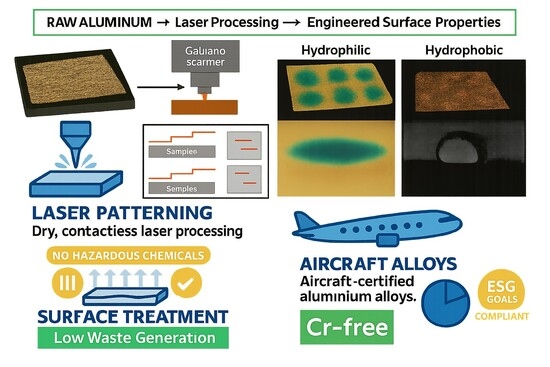
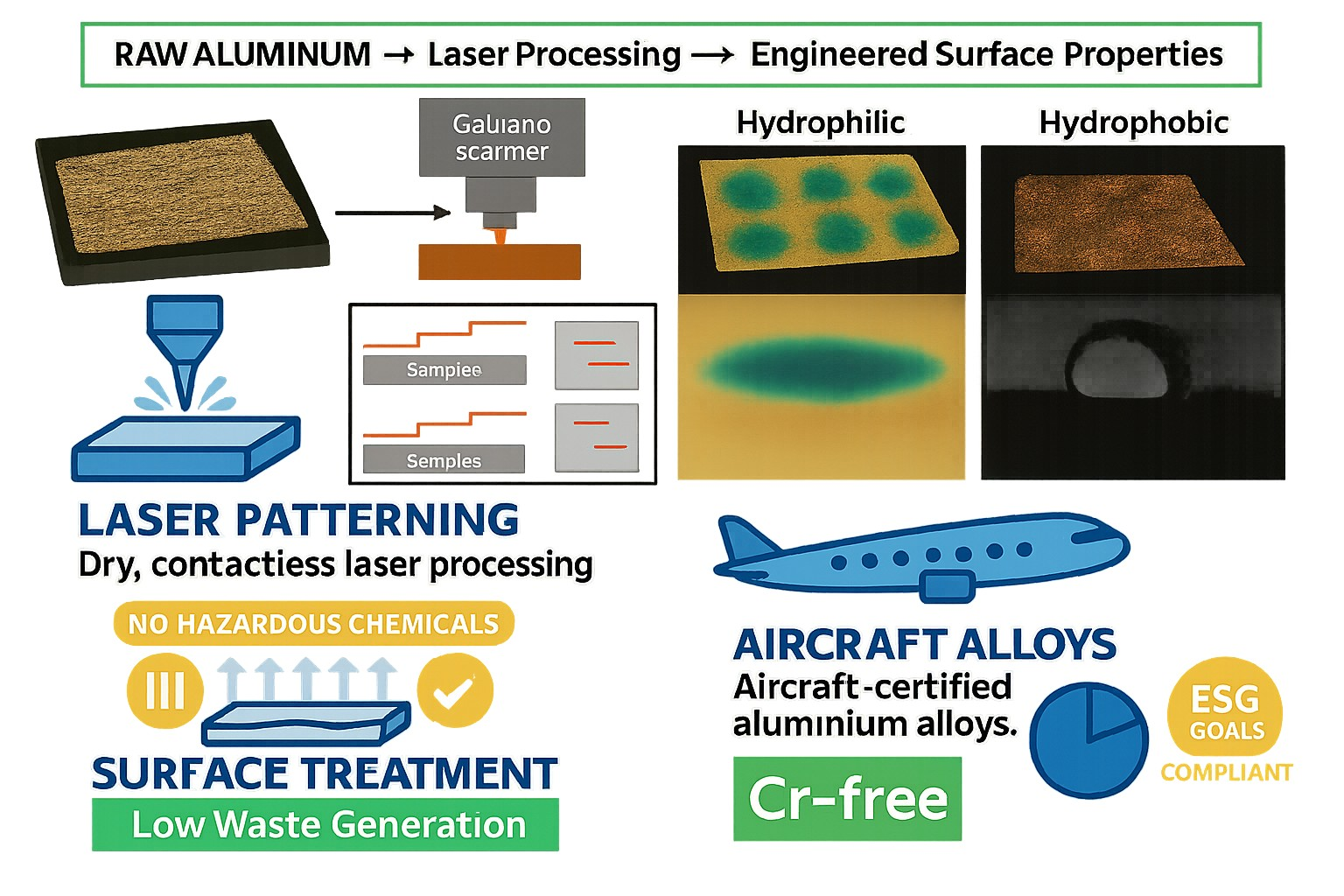
Graphical Abstract

1. Introduction

The aerospace sector is undergoing a strategic transformation, driven by the imperative to reconcile high-performance engineering with environmental sustainability, digital traceability, and economic resilience. In this context, advanced manufacturing technologies—particularly laser-assisted processes—have emerged as pivotal enablers of next-generation aircraft production. These technologies offer precision, scalability, and minimal ecological footprint, making them ideally suited for the fabrication and enhancement of structural components based on Aluminum 6061, a precipitation-hardened alloy of the 6000 series widely employed in aerospace applications due to its favorable strength-to-weight ratio, corrosion resistance, and weldability [1,2].
Laser-assisted manufacturing encompasses a suite of processes, including laser cutting, powder bed fusion using a laser beam (PBF-LB/M), laser beam welding (LBW), laser cladding, and laser surface texturing (LST). These methods enable localized thermal input, reduced heat-affected zones (HAZ), minimal distortion, and high geometrical fidelity—critical for lightweight and complex aerospace geometries. Furthermore, laser systems are inherently compatible with automation and robotic integration, facilitating high-throughput, repeatable production workflows [3,4,5]. Laser beam welding (LBW) is especially advantageous for aluminum alloys, which pose challenges due to high thermal conductivity and reflectivity. LBW enables deep, narrow welds with minimal distortion and reduced HAZ, producing clean joints with low spatter and oxidation. Hybrid approaches such as Laser-Arc Hybrid Welding (LAHW) further mitigate issues like porosity and oxide layer interference, improving gap-bridging and weld quality [3].
In the domain of surface enhancement and repair, laser technologies provide localized treatments that preserve substrate integrity while establishing strong metallurgical bonds. Laser cladding enhances wear resistance and fatigue life without introducing solvents or abrasive media, aligning with eco-friendly manufacturing principles [6]. Laser de-coating enables selective removal of paints, oxides, and contaminants, improving surface microstructure and dislocation density while facilitating clean separation for recycling [7]. These capabilities are particularly relevant for Aluminum 6061, which benefits from tailored surface morphologies to improve adhesion, wettability, and corrosion resistance.
Recent work by Sanchez de Almeida Prado et al. [8] demonstrated that surface tailoring and morphology control via laser-based techniques can significantly influence the functional performance and sustainability profile of transport-sector components. By manipulating surface topographies and microstructural features, it is possible to enhance interfacial bonding, reduce energy consumption, and extend component lifespan—thereby contributing to both technical and environmental objectives.
From a sustainability perspective, laser technologies contribute directly to Environmental, Social, and Governance (ESG) goals. Environmentally, they reduce energy consumption through localized heating, minimize waste via high material utilization rates, and lower emissions by reducing rework and consumables [7,9,10,11]. Socially, laser-assisted processes enhance occupational safety by eliminating hazardous chemicals, promoting workforce development through specialized training, and improving working conditions via clean, automated environments [9,10,11]. In terms of governance, laser systems support traceability and compliance through digital monitoring, automated quality logs, and alignment with frameworks such as the Global Reporting Initiative (GRI), the Sustainability Accounting Standards Board (SASB), and the Corporate Sustainability Reporting Directive (CSRD) [12,13,14].
Life cycle assessment (LCA) is a systematic methodology used to evaluate the environmental impacts associated with all stages of a product’s life—from raw material extraction, manufacturing, and use to end-of-life disposal or recycling. In aerospace applications, LCA provides critical insights into the sustainability of materials, components, and systems, enabling engineers and decision-makers to identify opportunities for reducing carbon footprint, energy consumption, and resource depletion [15,16]. By integrating LCA into the design and development process, aerospace manufacturers can make informed choices that align with environmental regulations and corporate sustainability goals [17]. Moreover, LCA supports the comparison of alternative technologies, such as lightweight composites or bio-based polymers, by quantifying trade-offs in performance versus ecological impact, thereby fostering innovation in greener aviation and space systems [18,19,20].
This study investigates the techno-environmental potential of laser patterning applied to Aluminum 6061 alloys within certified aerospace manufacturing frameworks. By synthesizing insights from laser surface engineering, alloy behavior, LCA, and surface morphology control, we aim to elucidate the role of the laser-based surface patterning process [8] in advancing the dual objectives of performance optimization and responsible innovation in next-generation aircraft production systems. This study presents a unified assessment of femtosecond laser surface treatment applied to aluminum alloys, combining surface engineering, life cycle assessment, and sustainability considerations relevant to aerospace applications. The results are benchmarked against conventional wet-chemical surface treatment methods, enabling a comparative evaluation of environmental and technical performance. In addition to the life cycle assessment, the study includes a qualitative evaluation of environmental health and safety (EHS) aspects and a supply chain risk assessment, considering both the United States and European Union markets. This integrated approach provides a robust framework for assessing the potential applicability of laser-based surface modification technologies in future aerospace applications.

2. Materials and Methods

2.1. Materials

6061 Aluminum alloy substrates were purchased from McMaster Carr (Chicago, IL, USA). As-received materials were used for fs laser processing without additional surface polishing. As-received materials were used for fs laser processing without additional surface polishing. More information on the materials can be found in the first paper of this series [8].

2.2. Ultrafast Fs Laser Processing

A 500-fs laser with 1030 nm wavelength operating at a 200 kHz repetition rate (Tangor, Amplitude, San Francisco, CA, USA) was synchronized with a galvano scanner (excelliSCAN 14, SCANLAB GmbH, Puchheim, Germany) and motorized XYZ stages (A-311, XY air-bearing stages with L-310 vertical stage, PI-USA, Auburn, MA, USA). Prior to contact angle measurements, all Al 6061 plates with the various surface patterns were ultrasonically cleaned in deionized water. Details of the complete procedure are provided in our previous publication [8].

2.3. Goal and Scope Definition for the LCA

2.3.1. Assessment Goals

The primary objective of this assessment is to provide quantitative insights into both process efficiency and sustainability aspects of ultrafast femtosecond laser processing used to generate functional surface patterns on Aluminum 6061. The analysis integrates experimentally derived data on process performance, energy consumption, and product yield with a streamlined life cycle assessment (LCA) focused on the laser surface treatment stage. ISO 14040:2006 [21] and ISO 14044:2006 [22] are adopted as methodological benchmarks because they constitute the internationally accepted reference framework governing how LCA studies are structured, executed, and interpreted. ISO 14040 [21] establishes the overarching principles and phases of LCA—goal and scope definition, life-cycle inventory analysis, impact assessment, and interpretation—while ISO 14044 [22] specifies the detailed requirements for data quality, system boundary selection, functional unit definition, allocation procedures, and impact category reporting. All evaluations adhere to the relevant ISO standards, specifically ISO 14040:2015 [21] and ISO 14044:2006 [22].

2.3.2. Functional Unit

The functional unit is defined as the production of 25 mm2 surface of Aluminum 6061 tailored surface by ultrafast fs laser treatment, after previous surface cleaning. The functional unit corresponds to one laser-patterned area (25 mm2) with validated wettability performance (contact angle measurement). This also corresponds to the size of the super-hydrophobic surface patterns manufactured by the process previously reported in our previous work [8].

2.3.3. Geographical Scope

The geographical scope of this assessment encompasses the state of California. Accordingly, assumptions regarding the energy mix and environmental footprints of individual supplies are based on average values representative of the location.

2.3.4. Temporal Scope

Due to the low technology readiness level of the process (only at the laboratory level), the temporal scope is limited to the steps related to the surface manufacturing process, which is limited to a few seconds per pattern.

2.3.5. Systems Boundaries

In the present investigation, we aim at calculating the GWP of the ultra-fast fs laser treatment of 25 mm2 of Aluminum 6061 surfaces; no quantitative consideration on End-of-Life will be made during this study. A chapter dedicated to possible end-of-life scenarios with the GWP based on secondary data will be presented.

2.3.6. Process Inventory Development

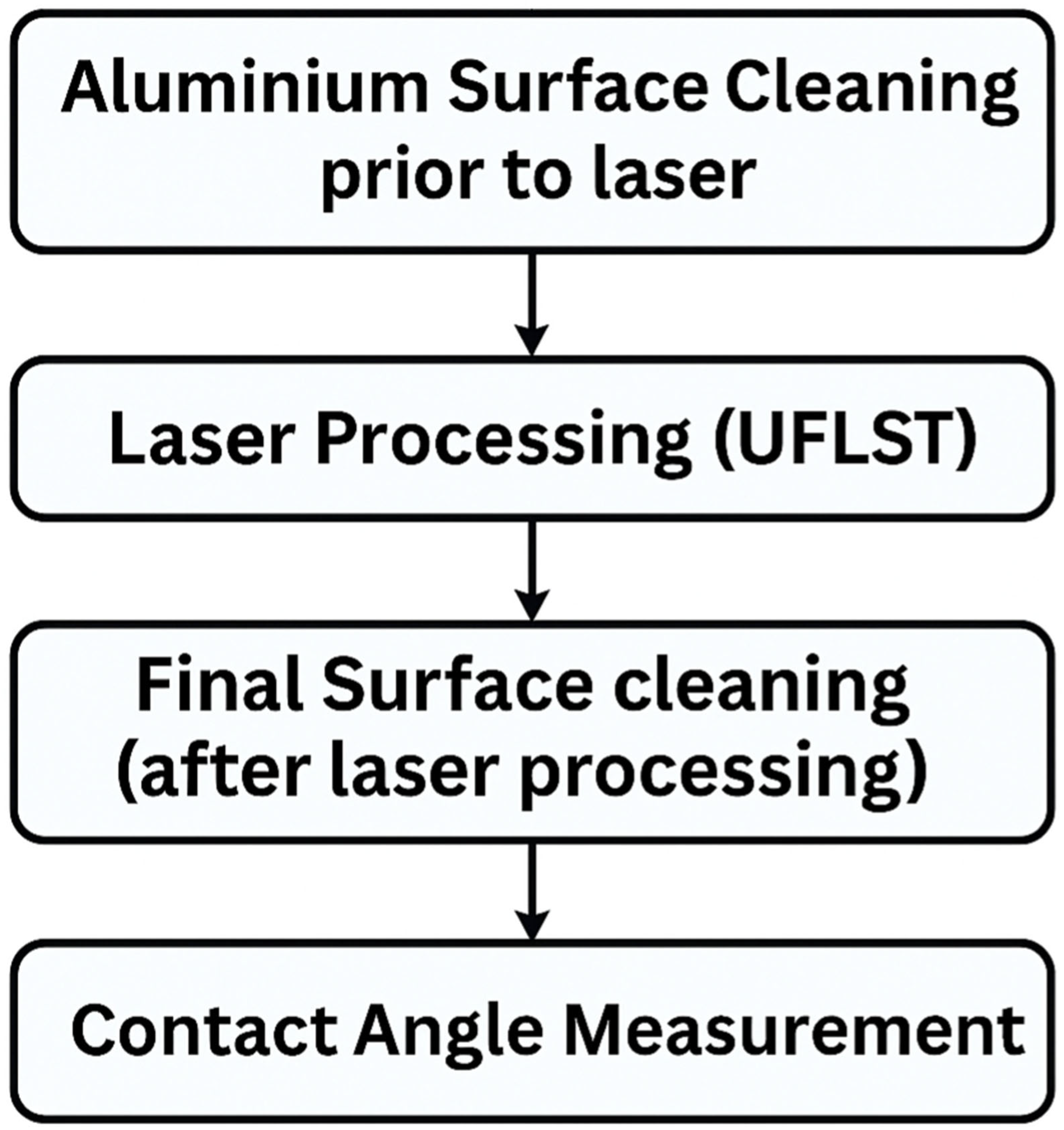
Figure 1 illustrates the process flow for the femtosecond (fs) laser-based surface functionalization of aircraft-certified aluminum alloys. The initial substrate consists of a large aluminum 6061 plate with nominal dimensions of 76.2 mm × 50.8 mm × 1.0 mm, which is subdivided into 81 discrete 25 mm2 regions for separated individual surface patterning. The cleaning protocol after the laser treatment is optimized for batch efficiency, with up to eight plates processed simultaneously over a standard working day. This configuration enables the preparation of up to 648 distinct surface areas, underscoring the energy-efficient nature of the pre-treatment stage. Following laser texturing, wettability is quantitatively assessed via water contact angle measurements to validate surface modification efficacy and reproducibility.
Given that the ultrasonic-bath stage enables the preparation of 648 functional units of 25 mm2 each, the per-unit environmental burden associated with this operation is effectively negligible. At this scale, its contribution to the life-cycle impacts of an individual surface pattern is operationally insignificant. Furthermore, because the laser system requires refurbishment only every 10–15 years, and each 25 mm2 treated Al 6061 functional unit is processed within fractions of a minute, the amortized greenhouse-gas emissions associated with equipment manufacture and maintenance fall well below established LCA cut-off thresholds. Consequently, these capital-equipment contributions were excluded from the life-cycle inventory in accordance with best practices for eliminating low-significance flows.
In accordance with ISO 14040/14044 [21,22], the system boundary was defined to include all unit processes that materially contribute to the functional unit, while allowing justified exclusions of flows that are demonstrably insignificant relative to the study goal and scope. To ensure completeness while keeping the streamlined assessment tractable, a cut-off rule of <1% was applied to exclude inputs/outputs that individually contribute less than 1% of total mass, cumulative energy demand, or total climate-change impact (GWP) of the modeled foreground system. In addition, the cumulative contribution of all excluded flows was checked to remain below 5% of the respective totals to avoid systematic underestimation. All exclusions are documented and justified as required by ISO 14044 [22], and the cut-off approach is applied consistently across the inventory.
Capital equipment—specifically the manufacture of the laser source, galvo scanner, and motion stages, as well as their depreciation—was excluded from the life-cycle inventory because these assets have service lifetimes on the order of years to decades, whereas the processing time associated with a single functional unit is seconds to fractions of a minute. As a result, when amortized over the very large number of functional units that can be produced during the equipment lifetime, the per-functional-unit contribution of capital goods falls below the above cut-off criteria for mass/energy/impact and is therefore not expected to influence the conclusions of this streamlined, process-level cradle-to-gate study. This treatment is consistent with ISO-aligned practice, provided the boundary choice and rationale are transparently reported and the potential influence of excluded flows is demonstrated to be non-significant.
To estimate the material footprint, the mass of the treated aluminum surface was calculated using the density (ρ) of Al 6061, ρ = 2700 kg m−3 and a plate thickness (t) of 1 mm (0.001 m). For a functional unit of 25 mm2 (i.e., an area (A) 2.5 × 10⁻⁵ m2), the corresponding mass (m) is 6.75 × 10⁻⁵ kg.
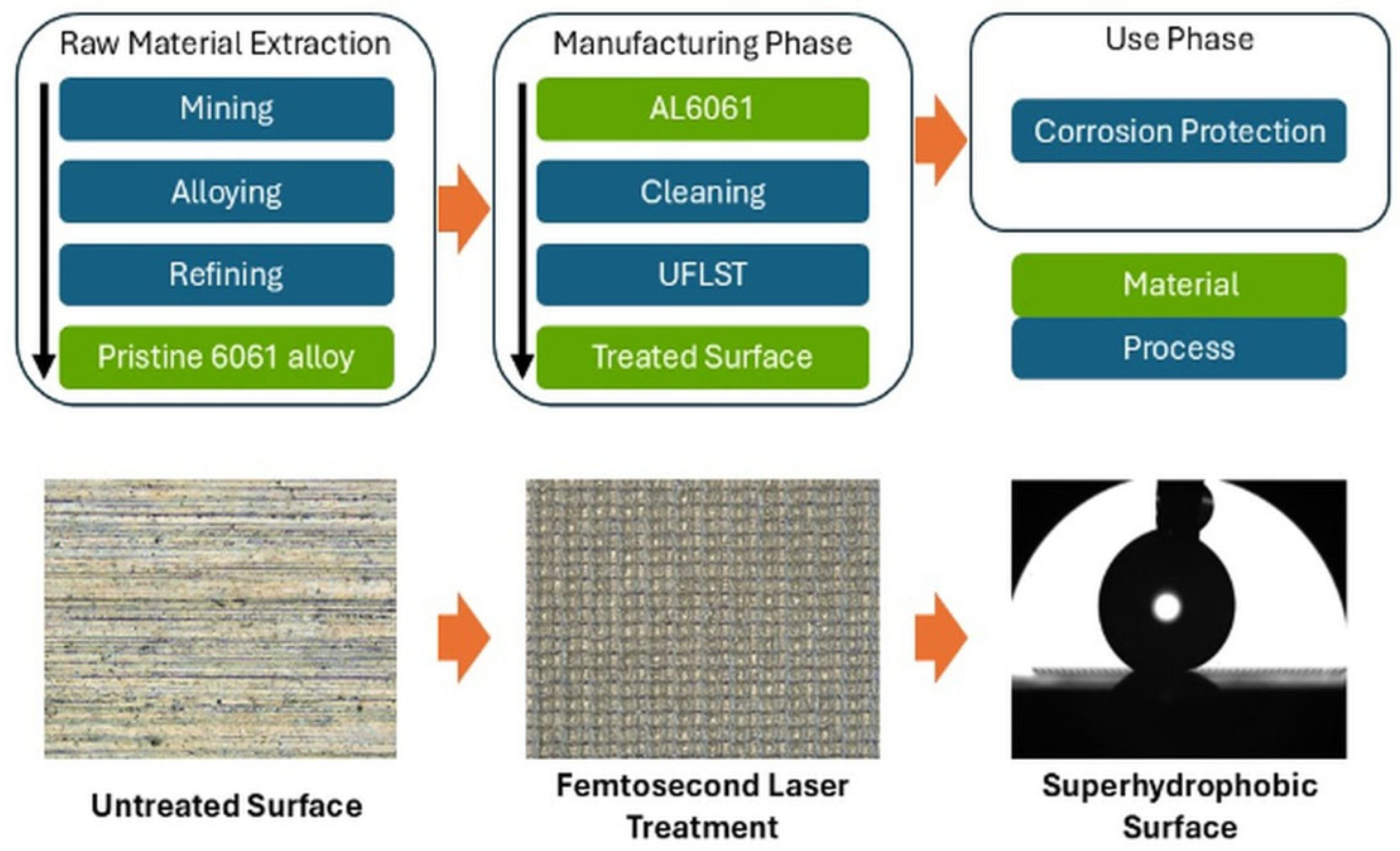
Thus, each treated surface corresponds to a substrate mass of 6.75 × 10⁻⁵ kg of Al 6061. Accordingly, the environmental modeling framework focuses exclusively on the direct energy demand of producing each functional pattern and the carbon footprint associated with this is 6.75 × 10⁻⁵ kg aluminum plate. These parameters define the core inventory used in the assessment. Figure 2 depicts the manufacturing steps and inventory for the LCA cradle-to-gate studies on ultra-fast femtosecond laser treatment.

2.3.7. Life-Cycle Assessment

Inventory modeling is conducted in Umberto 11. Data is mainly drawn from the Ecoinvent Database Version 3.10 (Rev. 1, 28 November 2023). As the impact assessment method, the ReCiPe framework is applied, focusing on the impact category ‘Global Warming Potential’ (i.e., CO2-eq).

2.4. Environmental, Health, and Safety (EHS) Assessment

A qualitative EHS assessment was conducted to evaluate the implications of femtosecond laser surface treatment on occupational safety, environmental emissions, and operator exposure. The methodology was based on the principles outlined in ISO 45001:2018 [23], which provides a framework for managing occupational health and safety risks through hazard identification, risk assessment, and continual improvement [23]. Environmental aspects were assessed in accordance with ISO 14001:2015 [24], which defines requirements for an environmental management system (EMS) aimed at reducing environmental impact and ensuring regulatory compliance [24].
Key elements included:
  • Identification of laser-related hazards (optical radiation, airborne particulates).
  • Evaluation of energy consumption, environmental impact and waste generation compared to conventional methods.

2.5. Supply Chain Risk Assessment

Supply chain risks associated with femtosecond laser systems and aerospace-grade aluminum alloys were evaluated using the ISO 31000:2018 [25] guidelines for risk management [25]. ISO 31000 standard provides a generic and system-oriented framework for managing risks arising from uncertainty in complex industrial environments. The standard’s objective-centric definition of risk enables the consistent evaluation of both internal and external supply chain uncertainties, including supplier availability, process stability, certification constraints, logistical dependencies, and regulatory exposure. By applying the ISO 31000 [25] risk management process—context establishment, risk identification, analysis, evaluation, and treatment—the methodology ensures traceability and reproducibility of risk prioritization across multiple supply chain tiers. The non-prescriptive nature of ISO 31000 [25] further allows the integration of qualitative expert judgment with semi-quantitative scoring approaches, which is particularly relevant for aerospace supply chains characterized by low production volumes, high certification burdens, and limited supplier redundancy. Following the establishment of context (Clause 6.3, Scope, context and criteria), critical raw materials were identified within key laser components, representing potential sources of strategic, operational, and sustainability-driven risk stemming from supply concentration, geopolitical exposure, and regulatory constraints. Material-related risks were then addressed via the ISO risk assessment sequence—“Risk identification” (Clause 6.4.2) and “Risk analysis” (Clause 6.4.3)—by linking raw material dependencies to component criticality and operational consequences. Risk identification captured (a) single-/limited-source supply, (b) geographic and geopolitical concentration, (c) regulatory constraints affecting sourcing and chemical/material use, and (d) lifecycle discontinuity risks (obsolescence of sub-tier parts, long-lead optics/electronics, and serviceability constraints). Risk analysis combined likelihood drivers (supplier concentration, sub-tier opacity, historical lead-time volatility, substitution barriers) with consequence modeling focused on the laser-enabled manufacturing system (downtime-driven throughput losses, re-qualification effort for altered components/materials, and potential degradation of surface functionalization repeatability due to altered pulse/beam stability).
The subsequent “Risk evaluation” step (Clause 6.4.4) compared and analyzed risk levels against the predefined criteria to prioritize the most consequential dependencies and to identify risk-dominant subsystems/material linkages that constrain industrial scale-up. Based on this prioritization, mitigation actions were formulated under “Risk treatment” (Clause 6.5) by selecting and justifying interventions such as qualified alternative materials/components, modular redesign toward second-source compatibility, strategic spares and lifecycle management, and process-window broadening to reduce sensitivity to component variation. Consistent with ISO 31000’s [25] emphasis on an iterative, adaptive process, it is recognized that substitutions and redesigns can introduce secondary technical risks (e.g., altered dispersion management, thermal behavior, noise/stability, coating durability), necessitating targeted qualification and performance verification to demonstrate equivalence with respect to Al 6061 surface outcomes and manufacturing key performance indicators. Overall, this ISO-aligned approach integrates supply-risk intelligence with engineering decision-making to enhance supply-chain resilience while supporting sustainability and ESG objectives in aerospace manufacturing under conditions of resource criticality and evolving regulatory requirements. Consequently, ISO 31000:2018 [25] provides a robust and technically appropriate framework for systematically assessing and managing supply chain risks in aerospace applications.

2.6. ESG Compliance Evaluation

Compliance with Environmental, Social, and Governance (ESG) goals was assessed through alignment with the Global Reporting Initiative (GRI) Standards [26] and the Sustainability Accounting Standards Board (SASB) framework for aerospace and defense [27]. The evaluation focused on contributions to the following UN Sustainable Development Goals (SDGs):
  • SDG 9: Adoption of innovative manufacturing technologies.
  • SDG 12: Reduction in hazardous waste and improved material recyclability.
  • SDG 13: Lower carbon footprint compared to legacy surface treatments.

3. Results and Discussion

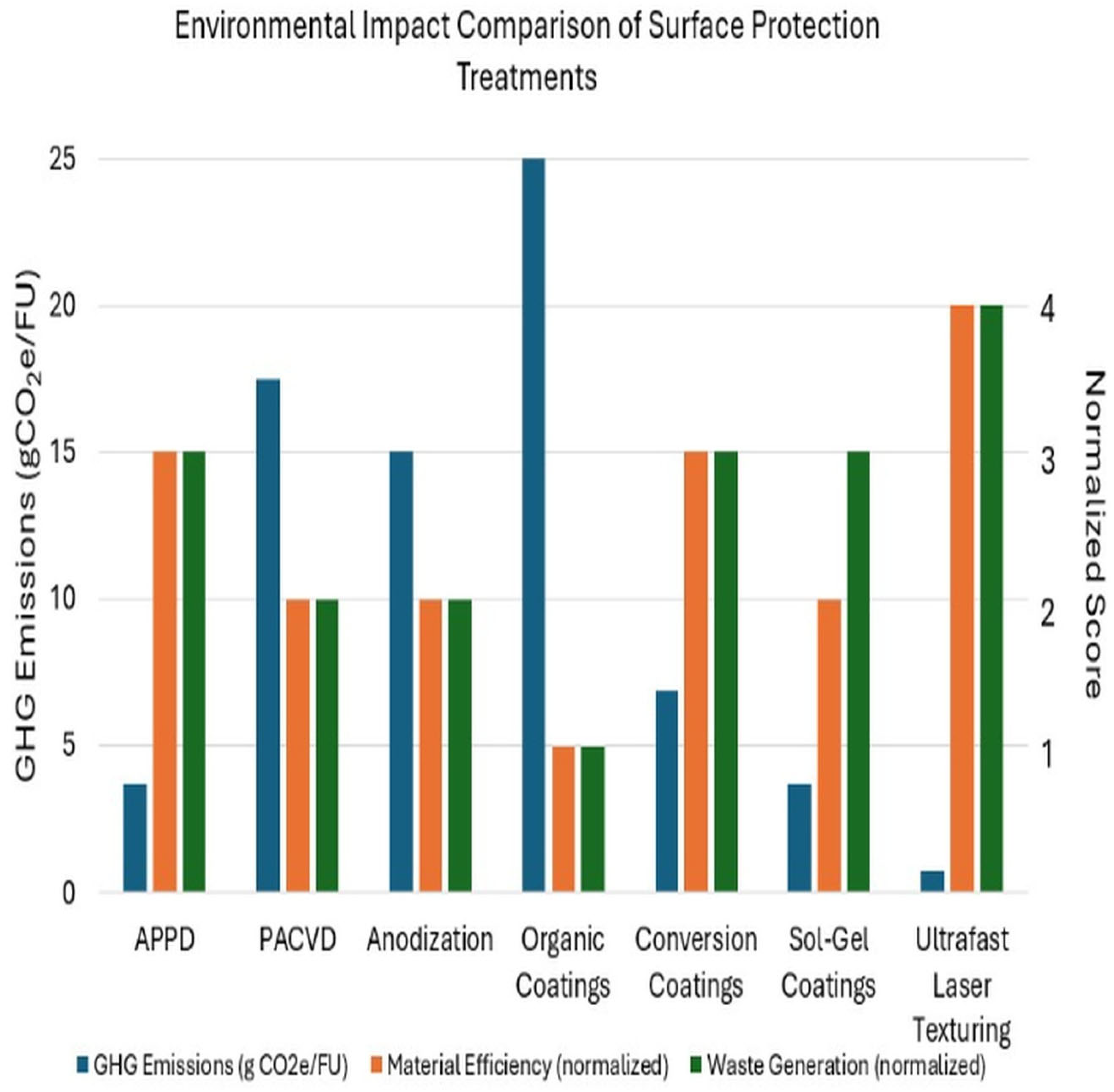
The life cycle assessment (LCA) results presented in Table 1 highlight the significant environmental advantages of ultrafast femtosecond laser surface texturing (UFLST) when benchmarked against established surface protection treatments for aluminum alloys. The analysis was normalized to a functional unit (FU) of 25 mm2 treated surface, enabling direct comparison across technologies.
Among all evaluated treatments, UFLST demonstrated the lowest greenhouse gas (GHG) emissions, with only 0.74 g CO2e/FU, a value that is 3 to 40 times lower than those associated with conventional methods such as anodization (12.5–17.5 g CO2e/FU), PACVD (15–20 g CO2e/FU), and organic coatings (20–30 g CO2e/FU) [28]. Even advanced low-emission alternatives like sol–gel coatings and atmospheric pressure plasma deposition (APPD) exhibit emissions in the range of 2.5–5.0 g CO2e/FU, still significantly higher than UFLST.
These data are also summarized in Table 1.
In terms of material efficiency and waste generation, UFLST also stands out. The process is characterized by negligible material consumption, as it relies on direct laser ablation without the need for chemical precursors, solvents, or post-treatment sealing. Waste generation is similarly negligible (see Figure 3), especially when coupled with energy-efficient ultrasonic cleaning, which replaces traditional chemical baths and minimizes environmental burden.
These findings underscore the potential of UFLST as a sustainable alternative for surface functionalization, particularly in aerospace and other high-performance sectors where environmental compliance and ESG goals are increasingly prioritized. The elimination of hazardous chemicals, reduction in energy demand, and minimal waste footprint position UFLST as a frontrunner in next-generation surface engineering technologies.
The end-of-life (EoL) phase can materially influence the overall environmental profile of aluminum components, particularly in aerospace, where high material value, stringent specifications, and circularity targets converge. In this publication, EoL is therefore addressed explicitly as a scenario analysis based on secondary data and is not included in the cradle-to-gate results, thereby maintaining clear system boundaries while still capturing downstream relevance for industrial adoption. The EoL discussion is provided to contextualize recyclability implications and does not affect the comparative cradle-to-gate ranking of surface treatment options reported herein. Beyond meeting functional requirements, surface treatment technologies must preserve—or ideally enhance—the recyclability of aerospace aluminum alloys by minimizing cross-contamination, auxiliary materials, and preprocessing demands at recycling entry points. Within this context, the ultrafast femtosecond laser surface texturing (UFLST) approach investigated here provides a distinctive EoL advantage: it achieves surface functionalization through controlled topographical modification without introducing coatings, primers, or conversion layers, which are commonly associated with additional stripping, de-coating, or impurity management steps. Consequently, UFLST has the potential to support both improved component performance and more efficient recycling pathways, strengthening the sustainability and resource-resilience case for laser-based surface engineering in aerospace supply chains. Unlike conventional surface treatments—such as organic coatings, anodization, or conversion layers—that may hinder recyclability due to chemical complexity or contamination [29,30], UFLST modifies the surface physically, without introducing foreign substances. This enables direct remelting and mechanical recycling of the treated aluminum, preserving its metallurgical integrity and minimizing the need for pre-treatment.
The life cycle inventory data compiled from multiple literature sources indicate that recycling 1000 kg of aluminum results in distinct carbon footprint contributions from individual processing stages, with approximately 50 kg CO2e associated with collection and sorting, 100 kg CO2e with shredding and cleaning, 300 kg CO2e with remelting, 50 kg CO2e with refining, and 27 kg CO2e with casting [31,32,33,34]. Among these stages, shredding, cleaning, and melting are particularly sensitive to surface contamination, coatings, and residual organic materials, such as impurities, necessitating additional process steps, including thermal de-coating, chemical treatments, increased flux consumption, and longer furnace residence times [35]. These measures not only increase greenhouse gas emissions but also represent a direct economic burden through higher energy demand, consumable usage, equipment wear, and waste treatment requirements. Consequently, maintaining clean scrap streams has a measurable cost advantage in addition to environmental benefits [36]. In this context, surfaces treated by ultrafast femtosecond laser surface structuring (UFLST) are inherently free of organic coatings, primers, paints, or metallic conversion layers, as the process relies exclusively on localized laser–matter interaction without introducing auxiliary materials. As a result, UFLST-treated aluminum components can enter recycling streams without the need for dedicated mechanical, thermal, or chemical de-coating operations, leading to reduced preprocessing time, lower energy consumption, and simplified material handling. From an economic perspective, the elimination of de-coating steps translates into lower operational expenditure per unit of recycled aluminum, improved furnace throughput, and reduced process complexity. This combination of reduced emissions and lower recycling costs constitutes a tangible process-level advantage for UFLST-treated Al 6061 components, particularly in high-value aerospace recycling streams where material purity and processing efficiency are critical.

3.1. Supply Chain Resilience and Material Criticality

In accordance with ISO 31000:2018 [25], a structured risk management approach was applied to assess supply chain risks associated with the femtosecond laser system used for surface processing of Al 6061 alloys. The subsequent “Risk evaluation” step (Clause 6.4.4) compared and analyzed risk levels against the predefined criteria to prioritize the most consequential dependencies and to identify risk-dominant subsystems/material linkages that constrain industrial scale-up. Based on this prioritization, mitigation actions were formulated under “Risk treatment” (Clause 6.5) by selecting and justifying interventions such as qualified alternative materials/components, modular redesign toward second-source compatibility, strategic spares and lifecycle management, and process-window broadening to reduce sensitivity to component variation. Consistent with ISO 31000’s [25] emphasis on an iterative, adaptive process, it is recognized that substitutions and redesigns can introduce secondary technical risks (e.g., altered dispersion management, thermal behavior, noise/stability, coating durability), necessitating targeted qualification and performance verification to demonstrate equivalence with respect to Al 6061 surface outcomes and manufacturing key performance indicators. Overall, this ISO-aligned approach integrates supply-risk intelligence with engineering decision-making to enhance supply-chain resilience while supporting sustainability and ESG objectives in aerospace manufacturing under conditions of resource criticality and evolving regulatory requirements. The subsequent risk evaluation (Clause 6.4.4) enabled prioritization of critical material dependencies, leading to the proposal of alternative materials or component solutions as risk treatment measures (Clause 6.5). Consistent with the iterative and non-prescriptive nature of ISO 31000 [25], it is acknowledged that the implementation of such alternatives may introduce secondary technical risks and therefore necessitates additional qualification and performance testing. This integrated approach supports supply chain resilience while aligning technological decision-making with sustainability and ESG principles, thereby enhancing the robustness of aerospace manufacturing processes in the context of resource criticality and long-term regulatory compliance.
The integration of Yb:YAG femtosecond laser systems into aerospace manufacturing is supported by their favorable material sourcing profile. Notably, yttrium (Y) is listed by the European Commission as a Critical Raw Material (2023), and ytterbium (Yb)—though not always singled out—falls within the heavy rare-earth elements (HREE) category that the EU treats as critical. Consequently, they are not excluded from the EU’s 2023 [37,38] catalogue of critical raw materials. In the United States, both yttrium and ytterbium are explicitly designated as critical minerals in the Final 2025 U.S. Critical Minerals List [39]. Given these classifications, it would be inaccurate to infer low supply risk or assured long-term availability; instead, both jurisdictions recognize elevated supply-chain vulnerability for these elements [37,38].
Ytterbium is predominantly recovered as a byproduct from bastnäsite and monazite mining operations, with global production distributed across China, Australia, the United States, Myanmar, and India. Although China currently dominates the supply chain, active exploration and mining initiatives in Australia and North America are contributing to diversification and enhanced geopolitical resilience [39,40,41].
These factors collectively support the conclusion that Yb:YAG femtosecond laser systems may indeed face bottlenecks related to raw material availability, since both yttrium (Y) and the heavy rare-earth element ytterbium (Yb) fall within categories recognized as critical by major regulatory bodies. In the European Union, yttrium is explicitly designated as a Critical Raw Material (2023), and heavy rare-earth elements—which include ytterbium—are treated as critical as well [37,38].
In the United States, both yttrium and ytterbium are explicitly listed on the Final 2025 U.S. Critical Minerals List [39,40], reflecting their supply-chain vulnerability. Given these classifications, the materials used in Yb:YAG gain media cannot be described as low-risk. Nevertheless, their low-volume but high-value usage, along with opportunities for diversified sourcing and the compatibility of solid-state laser platforms with sustainability and energy-efficiency goals, still supports the view that Yb:YAG systems can remain a viable and scalable technology for advanced aerospace surface-processing applications—even if upstream material criticality necessitates careful supply-chain management [37,38,39,40,41].
To mitigate supply risk arising from constrained availability of ytterbium (Yb) and yttrium (Y)—which are intrinsic to ytterbium-doped yttrium aluminum garnet (Yb:YAG) gain media—two complementary risk-treatment pathways can be considered: (i) feedstock circularity and secondary sourcing and (ii) technology substitution at the laser-architecture level. For the former, procurement strategies that incorporate secondary sources (e.g., reclaimed rare-earth feedstocks recovered from end-of-life optical components and electronic waste streams) can reduce exposure to primary-mining bottlenecks and geopolitical concentration; however, implementing circular supply for laser-grade material requires stringent control of impurity profiles and defect chemistry to preserve optical quality (absorption/scattering losses, laser-induced damage threshold, and photothermal stability).
For the latter pathway, substitution of the gain medium and/or amplification concept provides a direct route to decouple ultrafast processing capability from Yb–Y criticality. In the context of ultrafast surface processing of Al 6061, femtosecond laser sources enable energy deposition on timescales shorter than characteristic electron–phonon equilibration, thereby restricting thermal diffusion during excitation and supporting surface modification with comparatively limited collateral thermal loading when parameters are appropriately selected [42,43]. Among candidate technologies, titanium-doped sapphire (Ti:sapphire) remains a benchmark ultrafast platform because its exceptionally broad gain bandwidth supports sub-100-fs—and, under optimized dispersion management, even few-cycle—pulse generation, providing a large parameter space for tailoring peak intensity and interaction regime for controlled micro-/nano-structuring [44,45]. In addition, parametric amplification architectures, such as optical parametric chirped pulse amplification implemented in nonlinear crystals, offer an alternative ultrafast scaling route in which the amplification medium is not a rare-earth-doped garnet; importantly, these schemes can support broad amplification bandwidths compatible with sub-20-fs pulse durations, albeit with increased optical complexity and alignment/phase-matching sensitivities that must be accounted for in industrial deployment and long-term stability assessment [45].
A further substitution route is the adoption of ultrafast rare-earth-doped fiber laser platforms that shift elemental dependence away from Yb/Y-based garnets. Thulium- or holmium-doped fiber lasers operating near 2 μm are enabled by all-fiber geometries that are compact and thermally manageable and have demonstrated stable ultrafast operation in the two-micrometer spectral range [46,47]. While such platforms do not eliminate rare-earth dependence, they diversify critical-material exposure and may offer additional wavelength-dependent process degrees of freedom.
Finally, irrespective of the chosen substitution pathway, the implementation of alternative laser sources must be accompanied by a formal equivalence demonstration at the process level, since changes in pulse duration, center wavelength, repetition rate, noise characteristics, and beam delivery can alter the effective process window, ablation/melting balance, and resulting microstructure [42,43]. Accordingly, these mitigation measures should be coupled to a qualification plan that includes (i) verification of pulse/beam metrology over relevant duty cycles, (ii) confirmation of surface morphology and functional metrics on Al 6061 under statistically representative conditions, and (iii) assessment of long-term stability and maintainability under operating constraints.

3.2. Comparative EHS and Waste Management Analysis of Surface Treatments for Aerospace Aluminum Alloys

The transition toward sustainable surface treatment technologies in aerospace manufacturing is driven by the need to reduce environmental impact, enhance worker safety, and comply with increasingly stringent international regulations. This section compares the environmental health and safety (EHS) performance of femtosecond (fs) laser surface treatment with conventional wet-chemical methods, including chromic acid anodizing (CAA), tartaric sulfuric acid anodizing (TSA), phosphoric sulfuric acid anodizing (PSA), and sol–gel coatings, to name a few.

3.2.1. EHS Profile of Fs Laser Surface Treatment [48,49,50,51]

The evaluation of environmental, health, and safety (EHS) aspects is critical for assessing the feasibility of emerging surface treatment technologies in aerospace manufacturing, where regulatory compliance and operator safety are primary design constraints. This section establishes an EHS reference profile for femtosecond (fs) laser surface treatment, enabling a structured comparison with legacy chemical-based processes commonly used on aircraft-certified alloys.
Femtosecond (fs) laser processing constitutes a fundamentally different surface engineering paradigm compared to conventional chemical protection routes, as it is inherently dry, contactless, and free from process chemistries such as hexavalent chromium compounds, sulfuric acid electrolytes, and volatile organic compounds (VOCs). By eliminating immersion baths, solvents, and sacrificial coatings, the process exhibits a negligible consumables footprint and generates minimal secondary waste, while materially reducing occupational exposure to toxic, corrosive, or carcinogenic substances. For the purpose of safety and regulatory alignment, ANSI Z136.1 [48] and IEC 60825-1 [49] were selected as the primary reference standards, as they define hazard classification, maximum permissible exposure limits, and required engineering and administrative controls for high-power industrial ultrashort-pulse laser systems. OSHA 1910.133 [50] was additionally considered due to its relevance to eye and face protection within U.S. manufacturing environments, providing a benchmark for evaluating operator protection requirements specific to laser-based surface processing. From an environmental compliance standpoint, femtosecond laser treatment does not generate airborne particulates, chemical vapors, or liquid effluents regulated under EPA AP-42 Chapter 12.20 [51], which addresses emissions from metal surface cleaning and finishing operations. Consequently, the process presents a surface modification concept with the potential to substantially reduce EHS-related regulatory burden associated with air emissions, hazardous waste handling, and chemical process control in aerospace production settings. Table 2 summarizes the potential risks and the mitigation strategies [50,51,52,53,54,55].

3.2.2. EHS Risks of Wet-Chemical Treatments

Wet-chemical surface treatments remain widely used in aerospace manufacturing due to their proven performance in corrosion protection and paint adhesion. However, their environmental health and safety (EHS) profiles vary significantly depending on the chemical systems employed. This section provides a comprehensive comparison of key treatments—Chromic Acid Anodizing (CAA), Tartaric Sulfuric Acid Anodizing (TSA), Phosphoric Sulfuric Acid Anodizing (PSA), and Sol–Gel Coatings—with a focus on regulatory compliance, environmental impact, and market adoption. The manufacturing steps are described in the Supplementary Materials of the current publication.
Chromic Acid Anodizing (CAA) has historically been the standard for aerospace aluminum alloys due to its excellent corrosion resistance and minimal impact on fatigue strength. However, it relies on hexavalent chromium (Cr6+), a known carcinogen banned under EU REACH regulations since 2017. Disposal of chromic acid waste requires specialized treatment, and airborne emissions are tightly regulated by agencies such as CARB and OSHA. Despite its effectiveness, CAA is being phased out in favor of safer alternatives, particularly in commercial aviation. Military applications may still use CAA under exemption clauses, but the long-term trend is toward chrome-free certification pathways [56,57].
Tartaric Sulfuric Acid Anodizing (TSA) is a REACH-compliant alternative developed by Airbus and widely adopted across European aerospace supply chains [56,57]. It offers high corrosion resistance and excellent paint adhesion, with a thin oxide layer (2–7 µm) that minimizes dimensional impact. TSA does not significantly affect fatigue strength and is suitable for pre-treatment before coating. Its environmental footprint is lower than CAA, with reduced energy consumption and wastewater toxicity. TSA is now a preferred method for OEMs seeking compliance with Airbus standards [56,57].
Phosphoric Sulfuric Acid Anodizing (PSA) is another chrome-free anodizing process recommended by Airbus [56] and Boeing for bonding applications. It provides a porous oxide layer that enhances adhesive bonding while maintaining corrosion resistance. PSA is particularly effective for composite-metal interfaces, making it valuable in hybrid aircraft structures. Like TSA, PSA is REACH-compliant and NADCAP-certifiable, with lower environmental impact and easier integration into automated surface treatment lines [56,58].
Sol–Gel technologies represent a next-generation solution for corrosion protection and adhesion promotion. These coatings are derived from organically modified silicates (Ormosils) and can be tailored to include corrosion inhibitors, adhesion promoters, and self-healing functionalities. Sol–gel systems are inherently chrome-free, water/alcohol-based, and non-toxic, aligning with sustainability goals and regulatory mandates. They are increasingly used in drop-in fastener applications, composite bonding, and as primers for paint systems. Market adoption is growing, especially in MRO (Maintenance, Repair, and Operations) and retrofit operations, due to their ease of application and compatibility with existing aircraft components [59,60].
According to recent market research, the global aircraft surface treatment market is projected to grow from USD 2.87 billion in 2024 to USD 4.86 billion by 2033, driven by increased aircraft production [61], fleet modernization, and stricter environmental regulations. OEMs and MRO providers are investing in automated [60], REACH-compliant surface treatment lines to meet certification requirements from FAA, EASA, and NADCAP. Chrome-free technologies like TSA, PSA, and sol–gel are gaining traction due to their lower operating costs, reduced environmental liabilities, and compatibility with digital traceability systems [57].
Table 3 summarizes the environmental health and safety (EHS) and waste management characteristics of key surface treatments used for certified aircraft aluminum alloys, including Chromic Acid Anodizing (CAA), Tartaric Sulfuric Acid Anodizing (TSA), Phosphoric Sulfuric Acid Anodizing (PSA), and Sol–Gel coatings.

3.3. Waste Management Implications

A recent review on aircraft recycling highlights the importance of minimizing chemical residues to facilitate end-of-life material recovery [62]. Additionally, industry-wide efforts to reduce hazardous waste have emphasized the need for cleaner surface technologies [63]. Fs laser treatment produces negligible solid or liquid waste, reducing the burden on aerospace waste management systems. In contrast, wet-chemical processes generate significant volumes of hazardous waste requiring neutralization, filtration, and disposal [64,65,66]. A detailed comparison of the manufacturing flowcharts of the wet-chemical surface protection processes of aluminum alloys can be seen in the Supplementary Materials of this publication.

3.4. ESG Comparison of Femtosecond Laser vs. Conventional Surface Treatments

Environmental, Social, and Governance (ESG) goals represent a multidimensional framework for evaluating an organization’s commitment to sustainability, ethical leadership, and long-term resilience. In the context of aerospace engineering and advanced manufacturing, ESG principles are increasingly recognized as strategic imperatives that align technological innovation with global sustainability objectives. ESG frameworks guide organizations in minimizing environmental impact through metrics such as greenhouse gas emissions, resource efficiency, and waste reduction, while also promoting social equity via workplace inclusivity, community engagement, and employee well-being [67]. Governance metrics, including transparency, ethical compliance, and board diversity, further reinforce institutional accountability and stakeholder trust [68]. The integration of ESG goals into design and production processes not only supports regulatory compliance and risk mitigation but also enhances competitiveness by attracting sustainability-conscious investors and customers [69]. As aerospace systems evolve toward greener, smarter, and more socially responsible paradigms, ESG-aligned design methodologies offer a robust foundation for achieving the United Nations Sustainable Development Goals (SDGs), particularly SDG 9 (Industry, Innovation, and Infrastructure), SDG 12 (Responsible Consumption and Production), and SDG 13 (Climate Action) [67].
Femtosecond (fs) laser surface treatment represents an alternative in aerospace materials engineering, offering significant ESG (Environmental, Social, and Governance) benefits over conventional surface treatments such as Chromic Acid Anodizing (CAA) [70,71], Tartaric Sulfuric Acid Anodizing (TSA), Phosphoric Sulfuric Acid Anodizing (PSA) [56], and Sol–Gel coatings [59,60,72]. Unlike chemical-based methods, fs laser processing is a dry [73,74,75,76], contactless technique that eliminates the use of hazardous substances like hexavalent chromium and minimizes water and energy consumption. This results in a reduced environmental footprint, aligning with REACH regulations and sustainability goals, as summarized in Table 4. The precision of fs lasers enables micro/nano-structuring that enhances corrosion resistance, wettability, and anti-icing properties without generating toxic effluents or requiring complex waste management protocols. Moreover, the absence of chemical baths and emissions significantly improves worker safety and supports clean manufacturing practices.
From a governance and industrial strategy perspective, femtosecond (fs) laser surface treatment represents a technically substantiated option for addressing regulatory compliance and manufacturing continuity under increasingly restrictive environmental and occupational safety frameworks. Industrial case studies and technology assessments show that fs laser micro- and nano-texturing enables repeatable, application-specific surface functionalities—including controlled wettability, friction reduction, and wear mitigation—through direct surface topographical modification, without reliance on coating systems or hazardous chemical process steps [77,78]. Comparative life cycle assessment (LCA) studies conducted in adjacent industrial sectors provide quantitative support for the environmental relevance of this approach. In wind energy applications, Baroni et al. demonstrated that fs laser-textured turbine blade surfaces achieve hydrophobic to superhydrophobic behavior comparable to silicone-based coating systems via micro- and nano-structuring alone, while exhibiting significantly lower environmental impact due to the elimination of polymeric coatings, primers, VOC (Volatile Organic Compounds) emissions, and associated waste streams [79]. In mechanical bearing applications, a separate LCA showed that fs laser-textured surfaces deliver friction-reducing and wear-mitigating functionality comparable to hard chromium electroplating by introducing engineered surface features that function as lubricant reservoirs and debris traps, without the use of Cr(VI) compounds or electrochemical baths [79,80]. Both studies identify the absence of consumable coatings and chemical baths as a primary factor in reduced waste treatment requirements and simplified end-of-life handling [79,80]. Complementing these findings, a recent high-throughput laser processing study reported the use of ultrafast laser surface texturing combined with in-line characterization and data-driven optimization to rapidly generate and screen anti-icing metal surfaces, demonstrating that functional performance—such as reduced ice adhesion, increased freezing delay, and tailored optical absorptivity for passive heating—can be achieved through coating-free fs laser processing at processing rates compatible with scalable manufacturing concepts [81]. In contrast, established aerospace surface treatments such as chromic acid anodizing (CAA) remain subject to increasing regulatory pressure due to Cr(VI)-related health and environmental risks [70,71]. Taken together, these findings indicate that fs laser surface treatment is a technologically established solution in multiple industrial domains, with a defined experimental and environmental basis for evaluation as a sustainable surface engineering option for aircraft-certified aluminum alloys. Table 4 summarizes the ESG performance of fs laser treatment relative to conventional methods based on the recent literature and industry reports.

3.5. Scope, Current Maturity, and Pathways for Extension

The ultrafast femtosecond laser surface texturing (UFLST) process investigated in this study is examined within a deliberately defined laboratory-scale framework, focusing on planar Aluminum 6061 reference surfaces. This scope was selected to enable controlled and reproducible assessment of laser–matter interactions, surface functionalization outcomes, and associated environmental performance metrics without confounding influences arising from component geometry, accessibility, or system-level integration. Such an approach is consistent with established development practices for advanced surface engineering technologies and provides a necessary foundation for subsequent scale-up and qualification activities.
Importantly, the present scope should be interpreted in the context of prior industrial and pre-industrial studies demonstrating that femtosecond laser micro- and nano-texturing is already a technologically substantiated approach in multiple application domains. Industrial case studies and technology assessments report that fs laser surface texturing enables repeatable, application-specific surface functionalities—including controlled wettability, friction reduction, wear mitigation, and anti-icing behavior—through direct topographical modification, without reliance on coating systems or hazardous wet-chemical processing routes [77,78]. Comparative life-cycle assessment studies conducted in adjacent sectors further provide quantitative evidence that these functional outcomes can be achieved with reduced environmental impact versus conventional coating-based solutions. In wind-energy applications, fs-laser-textured turbine blade surfaces have been shown to achieve hydrophobic to superhydrophobic behavior comparable to silicone-based coatings while eliminating polymeric layers, primers, VOC emissions, and associated waste streams [73]. Similarly, bearing-industry LCAs demonstrate that fs laser surface texturing provides friction-reducing and wear-mitigating performance comparable to hard chromium electroplating by introducing engineered surface features acting as lubricant reservoirs and debris traps, without the use of Cr(VI) compounds or electrochemical baths [80]. Both studies identify the absence of consumable coatings and chemical baths as a key factor in reduced waste treatment requirements and simplified end-of-life handling [79,80].
In addition, recent high-throughput fs laser processing studies combining in-line characterization and data-driven optimization demonstrate that coating-free laser surface functionalization can be implemented at processing rates compatible with scalable manufacturing concepts, while enabling systematic exploration of functional properties such as reduced ice adhesion, increased freezing delay, and tailored optical absorptivity for passive heating [81]. These results provide an important indication that throughput and scalability considerations can be addressed within the fs laser processing paradigm through appropriate system-level design, even though such aspects are intentionally not treated within the scope of the present investigation.
Against this background, the laboratory-scale focus adopted here represents a methodologically appropriate step toward aerospace application, allowing isolation of process behavior and sustainability attributes prior to addressing geometric complexity, production throughput, and certification-driven constraints. Future extensions will require investigation of scan strategies, beam delivery architectures, synchronized multi-axis motion, and in situ monitoring to ensure surface uniformity on complex aerospace geometries. Furthermore, mechanical performance aspects—particularly fatigue behavior and durability under cyclic loading—must be evaluated when transitioning from reference surfaces to load-bearing aerospace components to support airworthiness qualifications.
Finally, integration into existing aerospace surface protection and finishing chains remains a central pathway for extension. In applications where coatings, primers, or adhesive bonding are mandatory, the compatibility of laser-textured surfaces with downstream processes—and the potential role of UFLST as a standalone or complementary surface treatment step—requires systematic validation. Building on the functional performance, environmental advantages, and scalability indicators demonstrated in prior studies [73,77,78,79,80,81], addressing these aspects will enable progression from controlled laboratory investigations toward certified, industrially relevant aerospace manufacturing implementations.

4. Conclusions

This study presents a multi-dimensional assessment of ultrafast femtosecond laser surface texturing (UFLST) applied to Aluminum 6061 alloys, integrating surface engineering considerations with life cycle assessment, environmental health and safety evaluation, supply-chain risk analysis, and ESG alignment within an aerospace manufacturing context. Conventional wet-chemical surface treatments—such as chromic acid anodizing, sulfuric-based anodizing routes, and organic or sol–gel coatings—remain effective from a functional standpoint but are increasingly constrained by hazardous chemical use, waste generation, occupational exposure risks, and regulatory pressure.
The results demonstrate that UFLST enables precise micro- and nano-scale surface functionalization through purely physical modification, without the introduction of coatings, conversion layers, or chemical baths. Life cycle assessment results normalized to a 25 mm2 functional unit show lower greenhouse gas emissions compared with established surface treatments, primarily due to reduced energy demand, negligible consumable usage, and the elimination of chemical waste streams. These characteristics are further reflected in favorable EHS and ESG profiles, including reduced operator exposure, simplified regulatory compliance, and improved waste management performance.
Beyond manufacturing-phase impacts, the absence of applied coatings or chemical residues provides a distinct advantage for end-of-life handling and aluminum recycling, where clean scrap streams and simplified preprocessing translate into lower energy demand, reduced emissions, and potential economic benefits. The analysis also indicates that, despite the use of critical raw materials within solid-state laser architectures, the low material intensity, long equipment lifetimes, and available mitigation pathways support manageable supply-chain risk when assessed using ISO 31000 [25]-aligned frameworks.
At present, UFLST must be regarded as a laboratory-scale, proof-of-concept process demonstrated on planar substrates. Key limitations include scalability to large or complex geometries, throughput constraints for industrial production, and the need for qualification of mechanical performance—particularly fatigue behavior—on load-bearing aerospace components. Addressing these challenges will require further work on high-throughput beam delivery strategies, process window robustness, in situ monitoring, and integration into certified aerospace manufacturing chains.
Overall, the findings establish a coherent technical and environmental rationale for femtosecond laser surface texturing as a sustainable surface engineering option worthy of continued development. With targeted advances in scalability, robustness, and certification-focused validation, UFLST has the potential to contribute meaningfully to future aerospace manufacturing strategies that seek to balance performance, compliance, and long-term sustainability.

Supplementary Materials

The following supporting information can be downloaded at: https://www.mdpi.com/article/10.3390/aerospace13050414/s1. Figure S1. Flow-charts for the thin film sulfuric acid anodizing (TFSAA), chromic acid anodizing (CAA) and tartaric sulfuric anodizing (TSA) surface protection of aircraft certified Al alloys. (based on the experimental details cited in [82,83,84]); Figure S2. Flow-charts for the phosphoric sulfuric acid anodizing (PSA) and so-gel surface protection of aircraft certified Al alloys. (based on the experimental details cited in [85,86]). (References [87,88,89,90,91,92,93] were also used in this supplementary material.

Author Contributions

Conceptualization, L.A.S.d.A.P., and V.Z.; methodology, V.Z.; software, J.C.; validation, V.Z., J.C., K.I. and M.P.; formal analysis, S.C. and J.C.; investigation, L.A.S.d.A.P., J.C. and V.Z.; writing—original draft preparation, L.A.S.d.A.P.; writing—review and editing, J.C.; visualization, J.C.; supervision, V.Z.; project administration, R.A.A.R. and V.Z.; funding acquisition, A.-L.C. All authors have read and agreed to the published version of the manuscript.

Funding

This research was partially funded by the Laboratory Directed Research and Development Program of Lawrence Berkeley National Laboratory under U.S. Department of Energy, Contract No. DE-AC02-05CH11231.

Data Availability Statement

The authors declare that the data supporting the findings of this study are available within the article.

Acknowledgments

This work is supported by Capgemini in the context of the Berkeley-Capgemini research agreement “Laser Processing for Accelerated Optical Materials Discovery”. MP, KI, and VZ acknowledge partial support by the Laboratory Directed Research and Development Program of Lawrence Berkeley National Laboratory under U.S. Department of Energy, Contract No. DE-AC02-05CH11231.

Conflicts of Interest

The authors declare no competing interests. Authors Luis Antonio Sanchez de Almeida Prado and Selim Coskun were employed by the company Capgemini Engineering Deutschland S.A.S. und Co. KG. Author Anne-Laure Cadène was employed by the company Capgemini Engineering (France). Author Ramón Angel Antelo Reguengo was employed by the company Capgemini Engineering (Spain). The remaining authors declare that the research was conducted in the absence of any commercial or financial relationships that could be construed as a potential conflict of interest.

Abbreviations

The following abbreviations are used in this manuscript:
AIPSAirbus Process Specifications
AlAluminum
APPDAtmospheric pressure plasma deposition
CAAChromic Acid Anodizing
CARBCalifornia Air Resources Board
CSRDCorporate Sustainability Reporting Directive
EASAEuropean Union Aviation Safety Agency
EHSEnvironmental Health and Safety
EMSEnvironmental Management System
EolEnd of Life
ESGEnvironmental, Social, and Governance
EUEuropean Union
FAAFederal Aviation Administration
FsFemtosecond
FUFunctional Unit
GHGGreenhouse gas
GRIGlobal Reporting Initiative
GWPGlobal Warming Potential
HAZHeat Affected Zones
LAHWLaser-Arc Hybrid Welding
LBWLaser Beam Welding
LCALife Cycle Assessment
LSTLaser Surface Texturing
MROMaintenance, Repair, and Operations
NADCAPNational Aerospace and Defense Contractors Accreditation Program
OEMOriginal Equipment Manufacturer
OSHAOccupational Safety and Health Administration.
PACVDPlasma-Activated Chemical Vapor Deposition
PBF LB/MPowder Bed Fusion using Laser Beam
PSAPhosphoric Sulfuric Acid Anodizing
REACHRegistration, Evaluation, Authorization and Restriction of Chemicals
SASBSustainability Accounting Standards Board
SDGsSustainable Development Goals
TFSA
TSA
Thin Film Sulfuric Acid Anodizing
Tartaric Sulfuric Acid Anodizing
VOCVolatile Organic Compounds
UFLSTUltrafast Femtosecond Laser Surface Texturing
UNUnited Nations
Yb:YAGYtterbium-doped Yttrium Aluminum Garnet

References

  1. Satheesh Kumar, S.; Ragupathi, P. Comparative Study of Characteristics and Applications of Aluminum Alloy Series. In International Conference on Recent Advancements in Materials Science and Technology; Springer Nature: Cham, Switzerland, 2024; Volume 415, pp. 353–362. [Google Scholar] [CrossRef]
  2. Montanari, R.; Palombi, A.; Richetta, M.; Varone, A. Additive Manufacturing of Aluminum Alloys for Aeronautic Applications: Advantages and Problems. Metals 2023, 13, 716. [Google Scholar] [CrossRef]
  3. Blanco, D.; Rubio, E.M.; Lorente-Pedreille, R.M.; Sáenz-Nuño, M.A. Sustainable Processes in Aluminium, Magnesium, and Titanium Alloys Applied to the Transport Sector: A Review. Metals 2022, 12, 9. [Google Scholar] [CrossRef]
  4. Yadegari, A.; Ghasemi, A.; Ghasemi, M.; Ghasemi, M.R.; Ghasemi, M.R. Aluminum Laser Additive Manufacturing: A Review on Challenges and Opportunities Through the Lens of Sustainability. Appl. Sci. 2025, 15, 2221. [Google Scholar] [CrossRef]
  5. Chen, Y.; Zhang, H.; Liu, Y.; Wang, J. Research Status of Laser Cladding Technology on Aluminum Alloy Surface. Int. J. Adv. Manuf. Technol. 2025, 152, 8. [Google Scholar] [CrossRef]
  6. Deng, Y.; Zhang, Y.; Li, X.; Wang, Z. Research Progress and Challenges in Laser-Controlled Cleaning of Aluminum Alloy Surfaces. Materials 2022, 15, 5469. [Google Scholar] [CrossRef]
  7. Laser Photonics Corporation. ESG Commitment: Environmental, Social, and Governance; Laser Photonics Blog; Laser Photonics Corporation: Lake Mary, FL, USA, 2025. [Google Scholar]
  8. Sanchez de Almeida Prado, L.A.; Coskun, S.; Cadène, A.-L.; Antelo Reguengo, R.A.; Carter, J.; Ito, K.; Park, M.; Zorba, V. Surface-Tailoring and Morphology Control as Strategies for Sustainable Development in Transport Sector. Aerospace 2025, 12, 301. [Google Scholar] [CrossRef]
  9. Ramard, M.; Miroir, M.; Laniel, R.; Kerbrat, O. Framework Guided by Environmental Analysis for Comparing Manufacturing Alternatives in Laser Cutting. Int. J. Precis. Eng. Manuf.-Green Technol. 2026, 13, 879. [Google Scholar] [CrossRef]
  10. Rahmani, R.; Bashiri, B.; Lopes, S.I.; Hussain, A.; Maurya, H.S.; Vilu, R. Sustainable Additive Manufacturing: An Overview on Life Cycle Impacts and Cost Efficiency of Laser Powder Bed Fusion. J. Manuf. Mater. Process. 2025, 9, 18. [Google Scholar] [CrossRef]
  11. TraceX Technologies. Digital Transformation for Sustainability: Traceability & Compliance. TraceX Blog. 2025. Available online: https://tracextech.com/digital-transformation-sustainability-traceability-compliance/ (accessed on 26 January 2026).
  12. World Economic Forum. Innovations in Advanced Manufacturing Support ESG Reporting. World Economic Forum Agenda, 2022. Available online: https://www.weforum.org/stories/2022/01/8-innovations-advanced-manufacturing-support-esg-reporting/ (accessed on 26 January 2026).
  13. Manufacturers Alliance. The Regulatory Labyrinth: Sustainability Reporting and Compliance in Manufacturing; Research Insights. 2025. Available online: https://www.manufacturersalliance.org/research-insights/regulatory-labyrinth-sustainability-reporting-and-compliance-manufacturing (accessed on 26 January 2026).
  14. Lukács, B.; Molnár, P.; Tóth, Á. Measuring Corporate Compliance with the SDGs Based on the GRI’s ESG Reporting Methodology. J. Sustain. Res. 2025, 7, 1700. [Google Scholar]
  15. Haddad, Y.; Jagtap, S.; Pagone, E.; Salonitis, K. Sustainability Assessment of Aerospace Manufacturing: An LCA-Based Framework. In Lecture Notes in Mechanical Engineering; Springer: Cham, Switzerland, 2023; pp. 712–720. [Google Scholar] [CrossRef]
  16. Atescan-Yuksek, Y.; Mills, A.; Ayre, D.; Koziol, K.; Salonitis, K. Comparative Life Cycle Assessment of Aluminium and CFRP Composites: The Case of Aerospace Manufacturing. Int. J. Adv. Manuf. Technol. 2024, 131, 4345–4357. [Google Scholar] [CrossRef]
  17. Wu, M.; Sadhukhan, J.; Murphy, R.; Bharadwaj, U.; Cui, X. A Novel Life Cycle Assessment and Life Cycle Costing Framework for Carbon Fibre-Reinforced Composite Materials in the Aviation Industry. Int. J. Life Cycle Assess. 2023, 28, 566–589. [Google Scholar] [CrossRef]
  18. Chen, P.H.; Lee, U.; Liu, X.; Cai, H.; Wang, M. Life-Cycle Analysis of Sustainable Aviation Fuel Production through Catalytic Hydrothermolysis. Biofuels Bioprod. Bioref. 2024, 18, 42–54. [Google Scholar] [CrossRef]
  19. Mazur, K.; Saleh, M.; Hornung, M. Integrating Life Cycle Assessment in Conceptual Aircraft Design: A Comparative Tool Analysis. Aerospace 2024, 11, 101. [Google Scholar] [CrossRef]
  20. Hasan, Y.; Hasan, I.; Aliabadi, A.A.; Gharabaghi, B. Comparative Life Cycle Assessment in the Aerospace Industry Regarding Aviation Seat Frame Options. Sustainability 2025, 17, 3188. [Google Scholar] [CrossRef]
  21. ISO 14040:2006; Environmental Management—Life Cycle Assessment—Principles and Framework. International Organization for Standardization (ISO): Geneva, Switzerland, 2006. Available online: https://www.iso.org/standard/37456.html (accessed on 2 September 2025).
  22. ISO 14044:2006; Environmental Management—Life Cycle Assessment—Requirements and Guidelines. International Organization for Standardization (ISO): Geneva, Switzerland, 2006. Available online: https://www.iso.org/standard/38498.html (accessed on 2 September 2025).
  23. ISO 45001:2018; Occupational Health and Safety Management Systems—Requirements with Guidance for Use. International Organization for Standardization (ISO): Geneva, Switzerland, 2018. Available online: https://www.iso.org/standard/63787.html (accessed on 2 September 2025).
  24. ISO 14001:2015; Environmental Management Systems—Requirements with Guidance for Use. International Organization for Standardization (ISO): Geneva, Switzerland, 2015. Available online: https://www.iso.org/standard/60857.html (accessed on 2 September 2025).
  25. ISO 31000:2018; Risk Management—Guidelines. International Organization for Standardization (ISO): Geneva, Switzerland, 2018. Available online: https://www.iso.org/standard/65694.html (accessed on 2 September 2025).
  26. Global Reporting Initiative (GRI). GRI Universal Standards 2021 (GRI 1: Foundation 2021; GRI 2: General Disclosures 2021; GRI 3: Material Topics 2021); Global Reporting Initiative: Amsterdam, The Netherlands, 2021; Available online: https://www.globalreporting.org/standards (accessed on 2 September 2025).
  27. Sustainability Accounting Standards Board (SASB). SASB Industry-Based Sustainability Disclosure Standards (2018); IFRS Foundation: London, UK, 2018; Available online: https://sasb.ifrs.org/standards/ (accessed on 2 September 2025).
  28. Lackner, J.M.; Kaindl, R.; Carniello, S.; Chwatal, S.; Stummer, M. Sustainable Corrosion Protection of Aluminium Alloys–Life Cycle Assessment of Established and Innovative Coating Processes. Teh. Glas. 2025, 19, 55–59. [Google Scholar] [CrossRef]
  29. Juhl, A.D. Why Anodizing Is the Most Sustainable Surface Treatment for Aluminum; Light Metal Age: South San Francisco, CA, USA, 2022; Available online: https://www.lightmetalage.com/news/industry-news/surface-finishing/why-anodizing-is-the-most-sustainable-surface-treatment-for-aluminum/ (accessed on 9 September 2025).
  30. Vallejo-Olivares, A.; Tranell, G. Effect of Compaction and Thermal De-coating Pre-treatments on the Recyclability of Coated and Uncoated Aluminium. Metall. Mater. Trans. B 2016, 47, 1485–1497. [Google Scholar] [CrossRef]
  31. Sævarsdóttir, G.; Magnússon, T.; Kvande, H. Reducing the Carbon Footprint: Primary Production of Aluminum and Silicon with Changing Energy Systems. J. Sustain. Metall. 2021, 7, 848–857. [Google Scholar] [CrossRef]
  32. Padamata, S.K.; Yasinskiy, A.; Polyakov, P. A Review of Secondary Aluminum Production and Its Byproducts. JOM 2021, 73, 2603–2614. [Google Scholar] [CrossRef]
  33. Wong, D.S.; Kvithyld, A.; Peng, H. Aluminum: Recycling and Carbon/Environmental Footprint. JOM 2020, 72, 3332–3333. [Google Scholar] [CrossRef]
  34. Núñez, P.; Jones, S. Cradle to Gate: Life Cycle Impact of Primary Aluminium Production. Int. J. Life Cycle Assess. 2016, 21, 1594–1604. [Google Scholar] [CrossRef]
  35. Vallejo-Olivares, A.; Høgåsen, S.; Kvithyld, A.; Tranell, G. Thermal De-coating Pre-treatment for Loose or Compacted Aluminum Scrap and Consequences for Salt-Flux Recycling. J. Sustain. Metall. 2022, 8, 1485–1497. [Google Scholar] [CrossRef]
  36. Momber, A.W.; Serdechnova, M.; Blawert, C. The Performance of AA6082 Aluminum in Simulated Marine Environments after Blast-Cleaning with Recycled Glass Grit. J. Mater. Eng. Perform. 2025, 35, 2264–2281. [Google Scholar] [CrossRef]
  37. European Commission. Critical Raw Materials Act—Strategic Raw Materials List. Available online: https://ec.europa.eu (accessed on 1 September 2025).
  38. European Commission. Study on the Critical Raw Materials for the EU 2023—Final Report; Directorate-General for Internal Market, Industry, Entrepreneurship and SMEs: Brussels, Belgium, 2023; Available online: https://single-market-economy.ec.europa.eu/publications/study-critical-raw-materials-eu-2023-final-report_en (accessed on 1 September 2025).
  39. United Nations Environment Programme (UNEP). UN-Energy Policy Brief: Aligning Critical Raw Materials Development with Sustainable Development; UNECE: Geneva, Switzerland, 2023; Available online: https://unece.org/info/Sustainable-Energy/UNFC-and-Sustainable-Resource-Management/pub/380848 (accessed on 1 September 2025).
  40. U.S. Geological Survey (USGS). Final 2025 List of Critical Minerals; Federal Register; Department of the Interior, Geological Survey; Mineral Commodity Summaries 2025; National Minerals Information Center: Reston, VA, USA, 2025. [Google Scholar] [CrossRef]
  41. Australian Government Department of Industry. Critical Minerals Strategy. Available online: https://www.industry.gov.au (accessed on 1 September 2025).
  42. Shugaev, M.V.; Wu, C.; Armbruster, O.; Naghilou, A.; Brouwer, N.; Ivanov, D.S.; Derrien, T.J.-Y.; Bulgakova, N.M.; Kautek, W.; Rethfeld, B.; et al. Fundamentals of Ultrafast Laser–Material Interaction. MRS Bull. 2016, 41, 960–968. [Google Scholar] [CrossRef]
  43. Tumkur, T.U.; Li, R.; Korakis, V.; Lantzsch, T.; Willenborg, E.; Vedder, C.; Laurence, T.A.; Beach, R.J.; Häfner, C.; Grigoropoulos, C.P.; et al. A Review of Laser Materials Processing Paradigms. MRS Bull. 2025, 50, 1519–1538. [Google Scholar] [CrossRef]
  44. Dabu, R. Femtosecond Laser Pulses Amplification in Crystals. Crystals 2019, 9, 347. [Google Scholar] [CrossRef]
  45. Yang, J.; Van Gasse, K.; Lukin, D.M.; Guidry, M.A.; Ahn, G.H.; White, A.D.; Vučković, J. Titanium: Sapphire on Insulator Integrated Lasers and Amplifiers. Nature 2024, 630, 853–859. [Google Scholar] [CrossRef] [PubMed]
  46. Todorov, F.; Aubrecht, J.; Peterka, P.; Schreiber, O.; Jasim, A.A.; Mrázek, J.; Podrazký, O.; Kamrádek, M.; Kanagaraj, N.; Grábner, M.; et al. Active Optical Fibers and Components for Fiber Lasers Emitting in the 2 μm Spectral Range. Materials 2020, 13, 5177. [Google Scholar] [CrossRef]
  47. Ahmad, H.; Azri, M.F.M.; Ramli, R.; Samion, M.Z.; Yusoff, N.; Lim, K.S. 2 μm Passively Mode Locked Thulium Doped Fiber Lasers with Ta2AlC Deposited Tapered and Side Polished Fibers. Sci. Rep. 2021, 11, 21278. [Google Scholar] [CrossRef] [PubMed]
  48. ANSI Z136.1-2022; Safe Use of Lasers. American National Standards Institute (ANSI): New York, NY, USA, 2022.
  49. IEC 60825-1:2014; Safety of Laser Products—Part 1: Equipment Classification and Requirements. International Electrotechnical Commission (IEC): Geneva, Switzerland, 2014. Available online: https://webstore.iec.ch/publication/60479 (accessed on 1 September 2025).
  50. 29 CFR §1910.133; Eye and Face Protection. Occupational Safety and Health Administration (OSHA). U.S. Department of Labor: Washington, DC, USA, 2025. Available online: https://www.osha.gov/laws-regs/regulations/standardnumber/1910/1910.133 (accessed on 1 September 2025).
  51. U.S. Environmental Protection Agency (EPA). AP-42, Chapter 12.20—Electroplating; U.S. EPA: Washington, DC, USA, 2025. [Google Scholar]
  52. ISO 11553-1; Safety of Machinery—Laser Processing Machines—Part 1: General Safety Requirements. International Organization for Standardization (ISO): Geneva, Switzerland, 2005.
  53. National Fire Protection Association (NFPA). NFPA 115: Standard for Laser Fire Protection; NFPA: Quincy, MA, USA, 2022. [Google Scholar]
  54. Food and Drug Administration (FDA). 21 CFR Part 1040—Performance Standards for Light-Emitting Products; U.S. Department of Health and Human Services: Washington, DC, USA, 2023. [Google Scholar]
  55. ANSI B11.21; Safety Requirements for Machine Tools Using Lasers for Processing Materials. American National Standards Institute (ANSI): New York, NY, USA, 2018.
  56. Paz Martínez-Viademonte, M.; Abrahami, S.T.; Hack, T.; Burchardt, M.; Terryn, H. A Review on Anodizing of Aerospace Aluminum Alloys for Corrosion Protection. Coatings 2020, 10, 1106. [Google Scholar] [CrossRef]
  57. Zhang, W.; Kryzman, M.A.; Zafiris, G.S.; Tredway, W.K.; Williams, K.S.; Hofer, S.G.; McNeill, J.; Ntanyi, L.; Hashiguchi, D.; Spicer, K.; et al. Systems Approach to REACH-Compliant Coating Systems for Aerospace Applications; DAU Technical Report; Defense Acquisition University: Fort Belvoir, VA, USA, 2024; Available online: https://www.dau.edu/sites/default/files/Migrated/CopDocuments/Systems%20Approach%20to%20REACH-compliant%20Coating%20Systems%20for%20Aerospace%20Applications.pdf (accessed on 1 September 2025).
  58. Surface Treatment BV. Tartaric Sulphuric Acid Anodizing (TSA)—Product Sheet. Surface Treatment. 2025. Available online: https://surfacetreatment.nl/public/files/files/productsheet_UK_TSA.PDF (accessed on 1 September 2025).
  59. Figueira, R.B. Hybrid Sol–gel Coatings for Corrosion Mitigation: A Critical Review. Polymers 2020, 12, 689. [Google Scholar] [CrossRef]
  60. Socomore. Advanced Surface Treatments: Introduction to Sol-Gel Technology in Aerospace. Socomore Expertise Blog. 2024. Available online: https://www.socomore.com/en/blog/expertise/advanced-surface-treatments-introduction-sol-gel-technology-in-aerospace (accessed on 9 September 2025).
  61. Growth Market Reports. Aircraft Surface Treatment Market Research Report 2033. GrowthMarketReports.com. 2025. Available online: https://growthmarketreports.com/report/aircraft-surface-treatment-market (accessed on 1 September 2025).
  62. Habib, M.A.; Subeshan, B.; Kalyanakumar, C.; Asmatulu, R.; Rahman, M.M.; Asmatulu, E. Current Practices in Recycling and Reusing of Aircraft Materials and Equipment. Mater. Circ. Econ. 2025, 7, 12. [Google Scholar] [CrossRef]
  63. Pollution Prevention InfoHouse. Hazardous Waste Reduction in the Aerospace Industry. Available online: https://p2infohouse.org (accessed on 1 September 2025).
  64. California Air Resources Board. Airborne Toxic Control Measure for Chromium Electroplating and Chromic Acid Anodizing Operations. Available online: https://ww2.arb.ca.gov (accessed on 1 September 2025).
  65. European Commission. Best Available Techniques (BAT) Reference Document for Surface Treatment of Metals and Plastics (STM BREF). Joint Research Centre (JRC), Seville, Spain, 2006 (with Subsequent Updates). Available online: https://bureau-industrial-transformation.jrc.ec.europa.eu/reference/surface-treatment-metals-and-plastics (accessed on 22 April 2026).
  66. NASA Johnson Space Center. Process Specification for PTFE-Impregnated Surface Treatment of Aluminum Alloys. Available online: https://www.nasa.gov (accessed on 1 September 2025).
  67. Eccles, R.G.; Ioannou, I.; Serafeim, G. The Impact of Corporate Sustainability on Organizational Processes and Performance. Manag. Sci. 2014, 60, 2835–2857. [Google Scholar] [CrossRef]
  68. Friede, G.; Busch, T.; Bassen, A. ESG and Financial Performance: Aggregated Evidence from More than 2000 Empirical Studies. J. Sustain. Financ. Invest. 2015, 5, 210–233. [Google Scholar] [CrossRef]
  69. United Nations Global Compact. ESG Integration in Business Strategy. Available online: https://www.unglobalcompact.org/library/5717 (accessed on 1 September 2025).
  70. Godja, N.; Munteanu, F.-D. Environmentally Friendly Solutions as Potential Alternatives to Chromium-Based Anodization and Chromate Sealing for Aeronautic Applications. Coatings 2025, 15, 439. [Google Scholar] [CrossRef]
  71. Galvatek. Environmentally Friendly Aluminium Anodising Process. Int. Surf. Technol. 2017, 10, 46–47. [Google Scholar] [CrossRef]
  72. Zheludkevich, M.L.; Salvado, I.M.M.; Ferreira, M.G.S. Sol–Gel Coatings for Corrosion Protection of Metals. J. Mater. Chem. 2005, 15, 5099–5111. [Google Scholar]
  73. Sanchez de Almeida Prado, L.A.; Gopal Das, T.S.; Coskun, S.; Kötter, A. Development of Innovative and Eco-Friendly Airframe Technologies to Improve Aircraft Life Cycle Environmental Footprint—Life Cycle Assessment Activities at ECOTECH/CleanSky 2. Presented at the 33rd Congress of the International Council of the Aeronautical Sciences (ICAS), Stockholm, Sweden, 4–9 September 2022; Available online: https://www.icas.org/icas_archive/ICAS2022/data/papers/ICAS2022_0895_paper.pdf (accessed on 15 April 2026).
  74. Zhou, J.; Wu, J.; Tang, S.; Li, Y. Review of Laser Texturing Technology for Surface Protection and Functional Regulation of Aluminum Alloys. Coatings 2025, 15, 567. [Google Scholar] [CrossRef]
  75. Chen, Z.; Zhou, J.; Cen, W.; Yan, Y.; Guo, W. Femtosecond Laser Fabrication of Wettability-Functional Surfaces. Nanomaterials 2025, 15, 573. [Google Scholar] [CrossRef]
  76. Sirris. Femtosecond Laser Texturing as a Sustainable Surface Solution. Available online: https://www.sirris.be/en/inspiration/femtosecond-laser-texturing-sustainable-surface-solution (accessed on 1 September 2025).
  77. Poole, L. Femtosecond Laser Microdevices: Transforming Precision Manufacturing with Measurable Results. ModernTechMech. Available online: https://www.moderntechmech.com/femtosecond-laser-microdevices/ (accessed on 1 September 2025).
  78. HEF Group. Ultra-Fast Femtosecond Laser Treatment—A High-Performance Technological Opportunity. Available online: https://hef.group/en/ultra-fast-femtosecond-laser-treatment-a-high-performance-technological-opportunity/ (accessed on 1 September 2025).
  79. Baroni, F. Laser Texturing vs. Hydrophobic Coatings in Wind Turbines: Series of LCA Studies—Part 2. Sirris. Available online: https://www.sirris.be/en/inspiration/laser-texturing-vs-hydrophobic-coatings-wind-turbines (accessed on 1 September 2025).
  80. Baroni, F. Laser Texturing vs. Hard Chromium Coatings in Bearings—Series of LCA Studies, Part 4. Sirris. 2025. Available online: https://www.sirris.be/en/inspiration/laser-texturing-vs-hard-chromium-coatings-bearings (accessed on 1 September 2025).
  81. Carter, J.; Ito, K.; Awasthi, S.; Li, S.; Schutzius, T.; Park, M.; Paeng, D.; Klunder, D.; Myatt, J.; Coskun, S.; et al. High—Throughput Laser Processing towards Autonomous Discovery of Anti-Icing Materials. Proc. SPIE 2026, 13881, PC138810K. [Google Scholar] [CrossRef]
  82. Boeing Commercial Airplanes. Sulfuric Acid Anodizing for Aluminum Alloys (Thin-Film Conditions); Boeing Process Specification BAC 5632/BAC 5719; The Boeing Company: Seattle, WA, USA, 2015. [Google Scholar]
  83. Hakim, M.L.; Syah, A.; Safa’at, A.; Subiyanto, H.; Pradityana, A. Analysis of the Effect of Temperature and Anodizing Time on the Coating Thickness in Anodizing Process of Aluminium 6061. In Smart Innovation in Mechanical Engineering; Lecture Notes in Mechanical Engineering; Springer: Singapore, 2025; pp. 681–689. [Google Scholar] [CrossRef]
  84. Lee, C.C.; Chen, C.W.; Lin, J.S.; Wang, S.H.; Lee, C.S.; Chen, C.C.; Chen, C.Y. Effect of Anodization Treatment on the Thickness, Hardness, and Microstructural Characterization of Anodic Aluminum Oxide Film on AA 6061 and Critical Patent Analysis. J. Mater. Eng. Perform. 2022, 31, 667–681. [Google Scholar] [CrossRef]
  85. Chamidy, H.N.; Ngatin, A.; Rosyadi, A.F.; Julviana, A.; Noviyani, N. Effect of Voltage on the Thickness of Oxide Layer at Aluminum Alloys for Structural Bonding Using Phosphoric Sulfuric Acid Anodizing (PSA) Process. Int. J. Mech. Eng. Technol. Appl. 2023, 4, 69–76. [Google Scholar] [CrossRef]
  86. Van Dam, J.P.B.; Tiringer, U.; Abrahami, S.T.; Milošev, I.; Terryn, H.; Kovač, J.; Mol, J.M.C. Surface Engineering of Aerospace Aluminium Alloys: Understanding Alloying Effects on Chemical Pre-Treatment and Sol-Gel Coating Adhesion. Surf. Coat. Technol. 2024, 485, 130901. [Google Scholar] [CrossRef]
  87. Blohowiak, K.; Osborne, J.; Seebergh, J. Development and Implementation of Sol-Gel Coatings for Aerospace Applications; SAE Technical Paper 2009-01-3208; SAE International: Warrendale, PA, USA, 2009. [Google Scholar] [CrossRef]
  88. Valence Surface Technologies. Sol-Gel Coating Technology in Aerospace. Available online: https://www.valencesurfacetech.com (accessed on 1 September 2025).
  89. Valence Surface Technologies. Phosphoric Acid Anodize. Available online: https://www.valencesurfacetech.com/services/anodizing/phosphoric-acid-anodize/ (accessed on 1 September 2025).
  90. Surface Treatment. Chromic Acid Anodising. Available online: https://www.surfacetreatment.nl/public/files/files/Chromic%20Acid%20Anodising.pdf (accessed on 1 September 2025).
  91. Poeton Industries. Tartaric Sulphuric Acid Anodising (TSA); Poeton Industries Ltd.: Gloucester, UK, 2019; Available online: https://www.poeton.co.uk/surface-treatments/anodising/tartaric-sulphuric-acid-anodising/ (accessed on 23 April 2026).
  92. Pop, A.B.; Pop, G.I.; Gusan, V.; Titu, A.M. Surface Treatment in Aerospace Industry: A Study on Acid Pickling and Paint Adhesion. Int. J. Mech. Aerosp. Ind. Manuf. Eng. 2023, 17, 58–69. [Google Scholar]
  93. Belmar Technologies. Tartaric Acid Anodising—Waste Treatment and Recycling. Available online: https://belmar-technologies.com/waste-treatment-recycling/tartaric-acid-anodising/ (accessed on 1 September 2025).
Figure 1. Manufacturing flow-chart of the ultra-fast femtosecond laser treatment on Aluminum 6061 alloys.
Aerospace 13 00414 g001
Figure 2. Manufacturing steps and inventory for the LCA cradle-to-gate studies on ultra-fast femtosecond laser treatment on Aluminum 6061 alloys.
Aerospace 13 00414 g002
Figure 3. Environmental impact comparison of surface protection treatments for aluminum alloys, normalized to a functional unit of 25 mm2 treated surface. Material Efficiency and Waste Generation are normalized as follows: Material Efficiency—Low = 1, Moderate = 2, High = 3, Negligible = 4; Waste Generation—High = 1, Moderate = 2, Low = 3, Negligible = 4.
Aerospace 13 00414 g003
Table 1. Environmental impact of surface protection treatments.
Treatment TypeGHG Emissions (g CO2e/FU 1)Material EfficiencyWaste Generation
APPD 2 [28]2.5–5.060%Low
PACVD 3 [28]15–2050%Moderate
Anodization [28]12.5–17.5 (with sealing)ModerateModerate
Organic Coatings [28]20–30LowHigh
Conversion Coatings [28]6.25–7.5 (cerium-based)HighLow
Sol–Gel Coatings [28]2.5–5.0ModerateLow
Ultrafast femtosecond surface texturing0.74 (with ultrasonic bath)NegligibleNegligible
1 Functional unit (FU): 25 mm2 treated surface. 2 APPD: Atmospheric pressure plasma deposition (silicone-based); 3 PACVD: plasma-activated chemical vapor deposition (silicone-based).
Table 2. Operational risks and risk mitigation strategies for Fs laser treatment of Al 6061.
RiskSeverityProbabilityMitigation StrategyRelated Standards *
Laser Radiation (Eye/Skin Exposure)HighMediumUse ANSI Z136.1 [48] rated laser safety goggles; Enclosed workstations with interlocksANSI Z136.1 [48]; IEC 60825-1 [49]; OSHA 1910.133 [50]
Airborne Particulates and FumesMediumMediumInstall local exhaust ventilation (LEV); Use HEPA filters; Monitor air qualityOSHA General Industry [50];
ISO 11553-1 [52]
Fire Hazard from Reflections or DustHighLowUse beam enclosures; Avoid flammable materials; Follow NFPA 115 guidelines [53]NFPA 115 [53]; ANSI Z136.1 [48]
Ergonomic Issues (Microscope Use, Handling)LowHighUse adjustable workstations; Implement automation for repetitive tasksOSHA Ergonomics Guidelines [50]
Electrical Hazards (High Voltage Equipment)HighLowImplement lockout/tagout procedures; Regular equipment maintenanceOSHA 1910 Subpart S [50]; ANSI B11.21
* These standards are also listed in the references list.
Table 3. Comparison of environmental, health, and safety (EHS), waste management, and worker exposure risks in wet-chemical surface treatments for aircraft aluminum alloys.
Treatment MethodChemical HazardWaste GenerationWorker Exposure RiskRegulatory ComplianceMarket Adoption
Reference
Chromic Acid Anodizing (CAA)High (Cr6+ carcinogen)High (toxic effluent)HighRestricted under REACH; OSHA regulatedDeclining; limited to military use [56]
Tartaric Sulfuric Acid Anodizing (TSA)Low (chrome-free)ModerateModerateREACH-compliant; Airbus approvedGrowing; preferred in EU aerospace [56,57,58]
Phosphoric Sulfuric Acid Anodizing (PSA)Low (chrome-free)ModerateModerateREACH-compliant; NADCAP certifiableWidely used for bonding applications [56]
Sol–Gel CoatingsLow (non-toxic, water/alcohol-based)LowLowREACH-compliant; EPA safeIncreasing in MRO and OEM sectors [60,61]
Table 4. Comparative assessment of surface treatment technologies for aluminum alloys based on Environmental, Social, and Governance (ESG) criteria: legacy surface treatments versus femtosecond laser treatment.
ESG DimensionCAA [70,71]TSA/PSA [56]Sol–Gel [72]Femtosecond Laser [74,75,76,77,78,79,80]
Environmental ImpactHigh: Cr6+, toxic wasteModerate: acid bathsLow: water/alcohol-basedVery Low: dry, chemical-free
Carbon FootprintHigh [73]ModerateModerateLow
Waste ManagementHazardous effluentAcidic wasteMinimalNegligible
Worker SafetyLowModerateHighVery High
Regulatory CompliancePoorGoodExcellentExcellent
Social ResponsibilityNegativeNeutralPositiveStrong Positive
Governance and Market TrendsDecliningStableGrowingEmerging
Disclaimer/Publisher’s Note: The statements, opinions and data contained in all publications are solely those of the individual author(s) and contributor(s) and not of MDPI and/or the editor(s). MDPI and/or the editor(s) disclaim responsibility for any injury to people or property resulting from any ideas, methods, instructions or products referred to in the content.