Coordinated Control of Quadrotor Suspension Systems Based on Consistency Theory




Abstract
1. Introduction
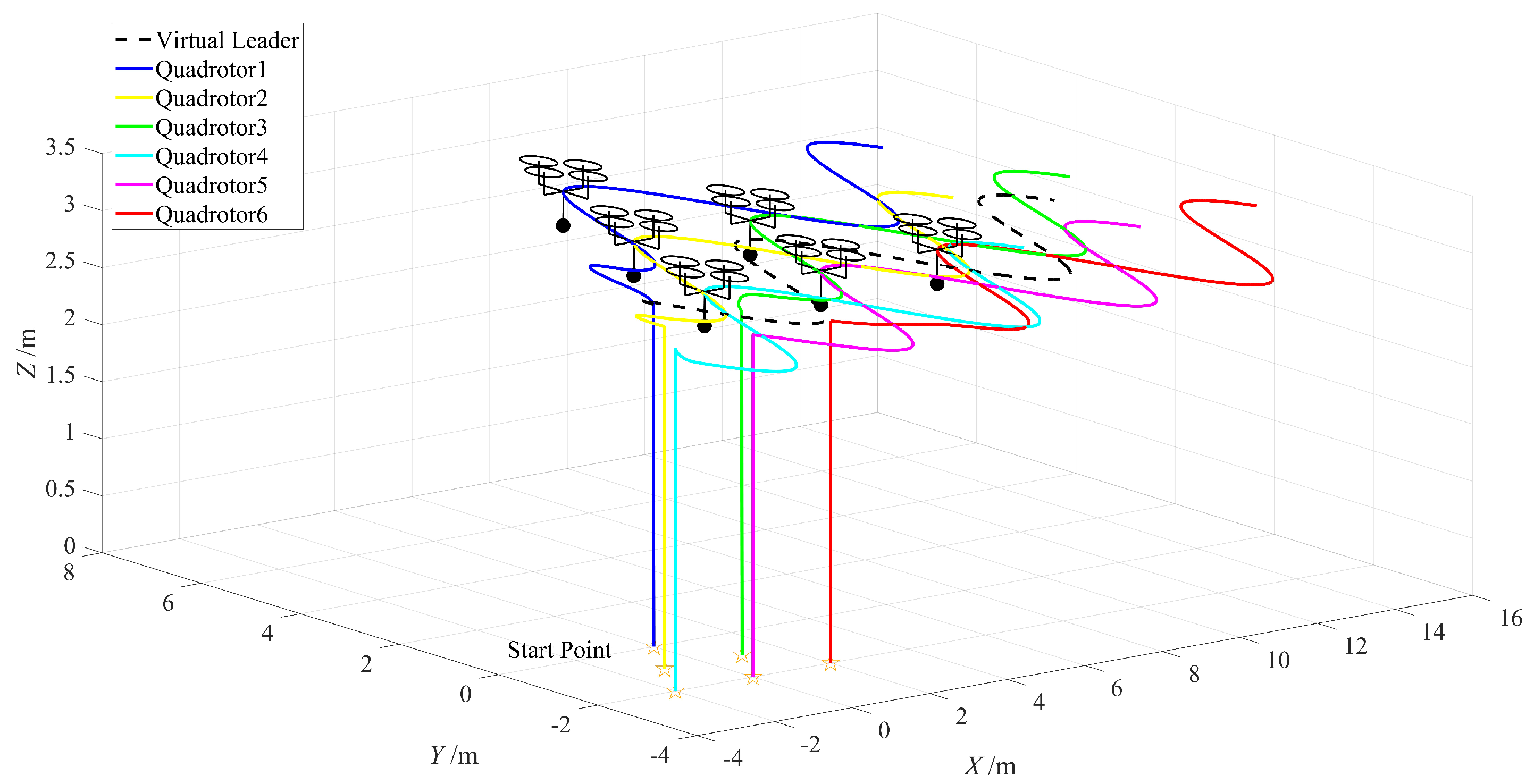
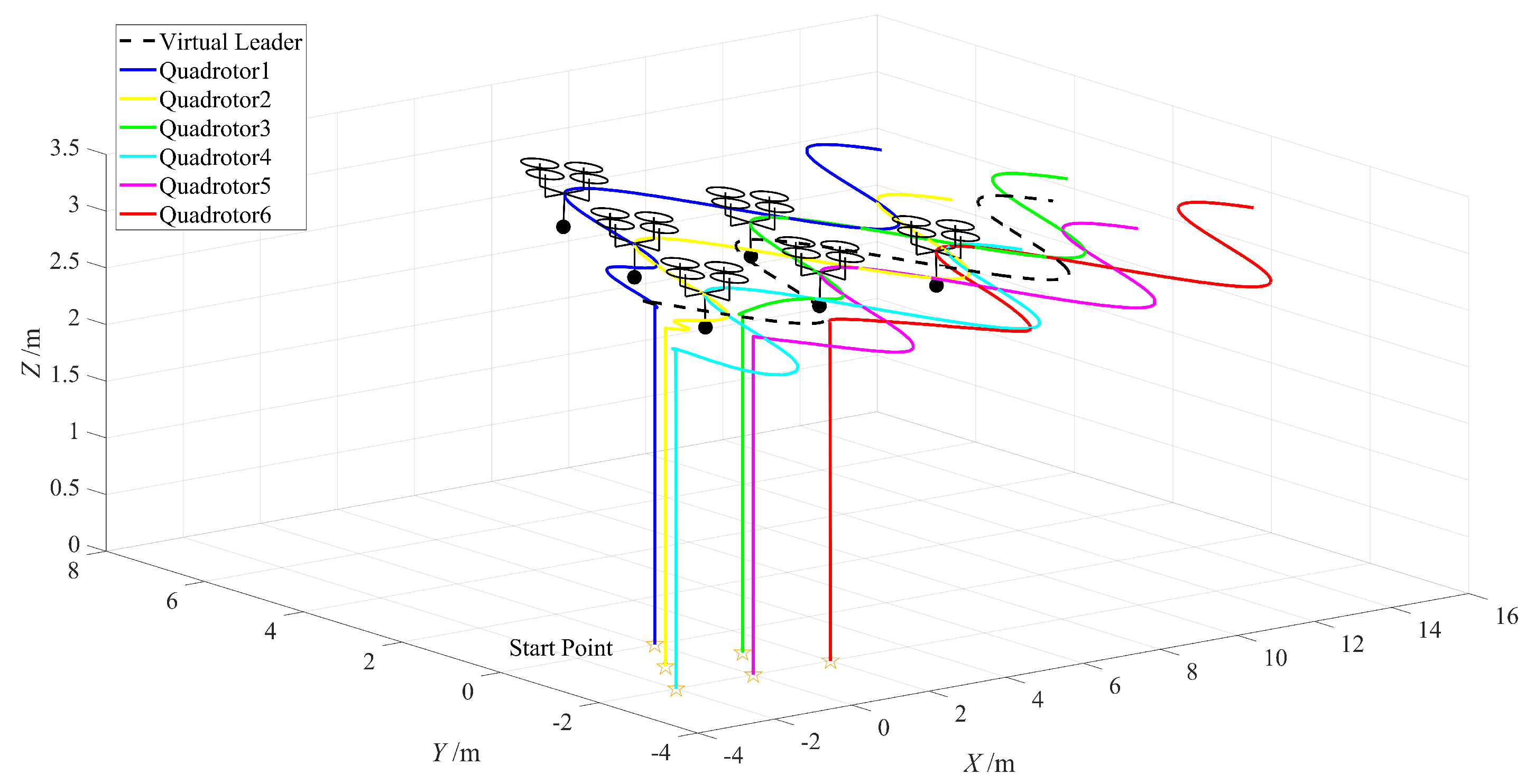
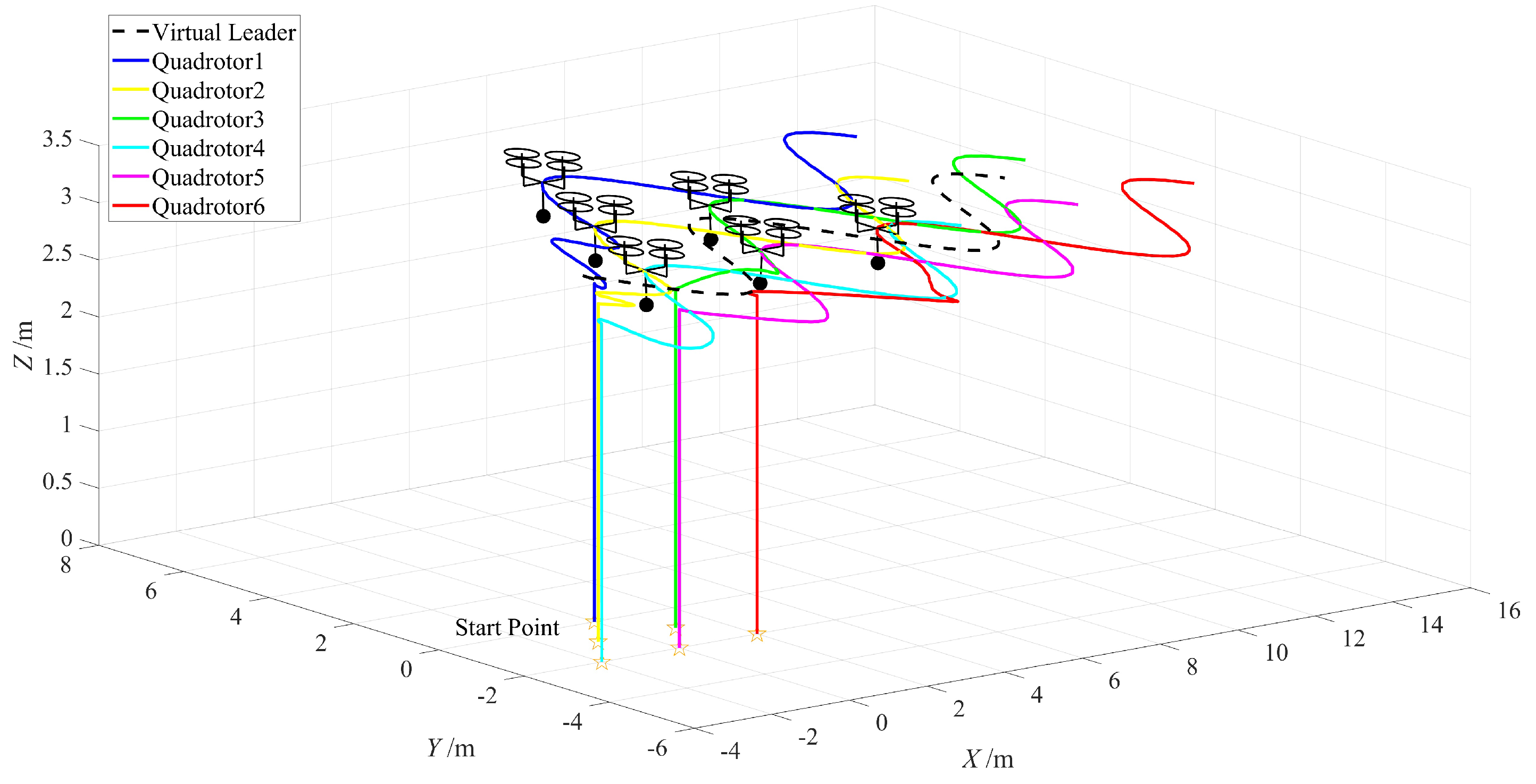
- Formation Control with a Virtual Leader: In response to the intricacies inherent to the operation of quadrotor suspension systems, this research introduces a novel formation controller, strategically incorporating a virtual leader. Deliberately designed to address both the horizontal and vertical aspects of the system, this controller places a primary emphasis on preserving the coherency of quadrotor relative positions. Notably, the design enhances the anticipated relative distances among quadrotors, effectively reducing the potential for collisions and, consequently, promoting a heightened degree of safety and synchronization within the formation.
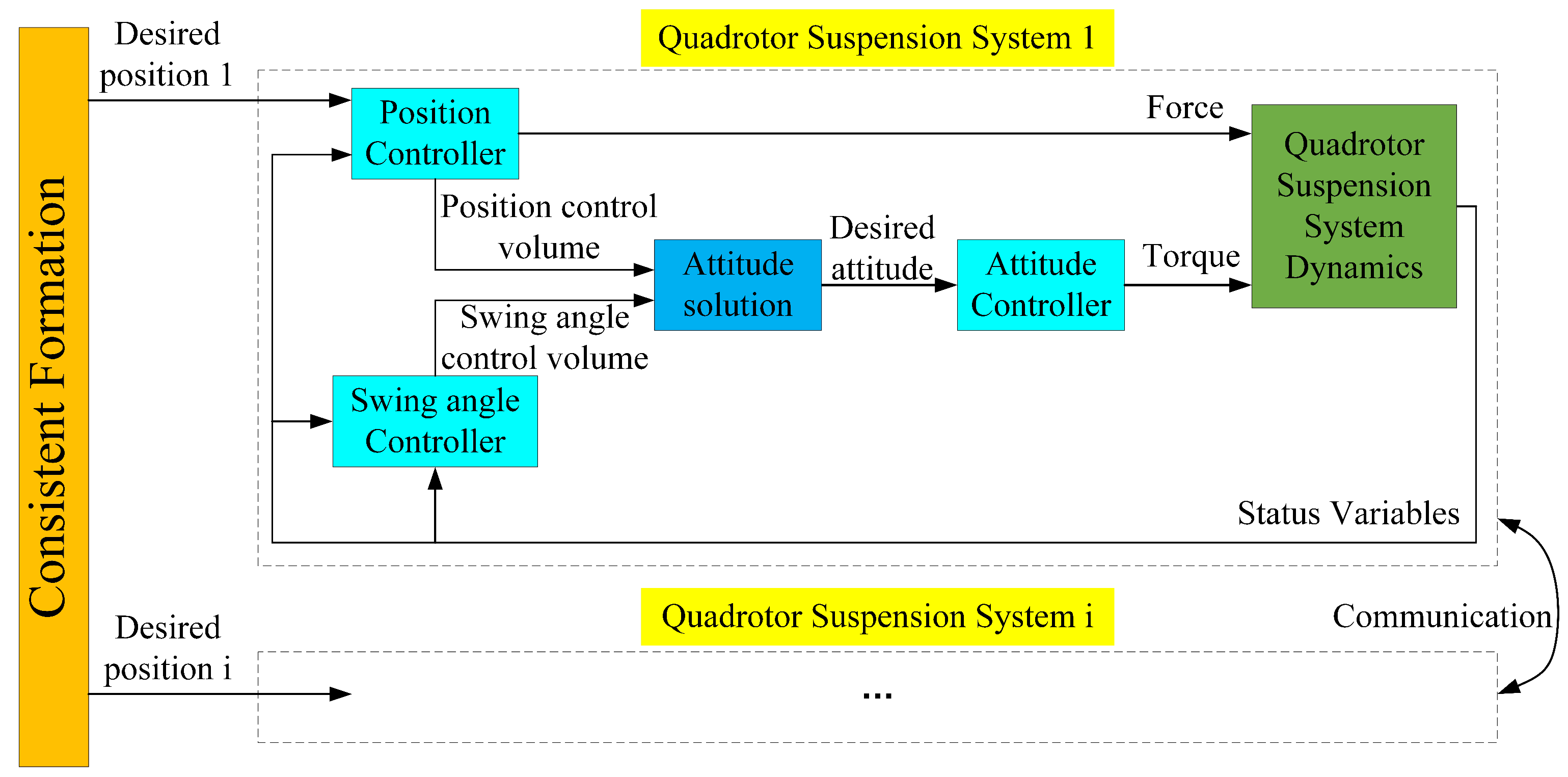
- Integrated Control for Position, Attitude, and Swing Angles: A sophisticated control strategy is meticulously devised to govern the position, attitude, and swing angles within the quadrotor suspension system. This intricate control paradigm harnesses the seamless integration of three pivotal components: the position controller, the swing angle controller, and the attitude controller. Notably, the control of swing angles in the suspension system is achieved by translating output signals from the position and swing angle controllers into inputs for the attitude controller. This holistic methodology ensures the precise tracking of quadrotor trajectories while mitigating the oscillations induced by load dynamics.
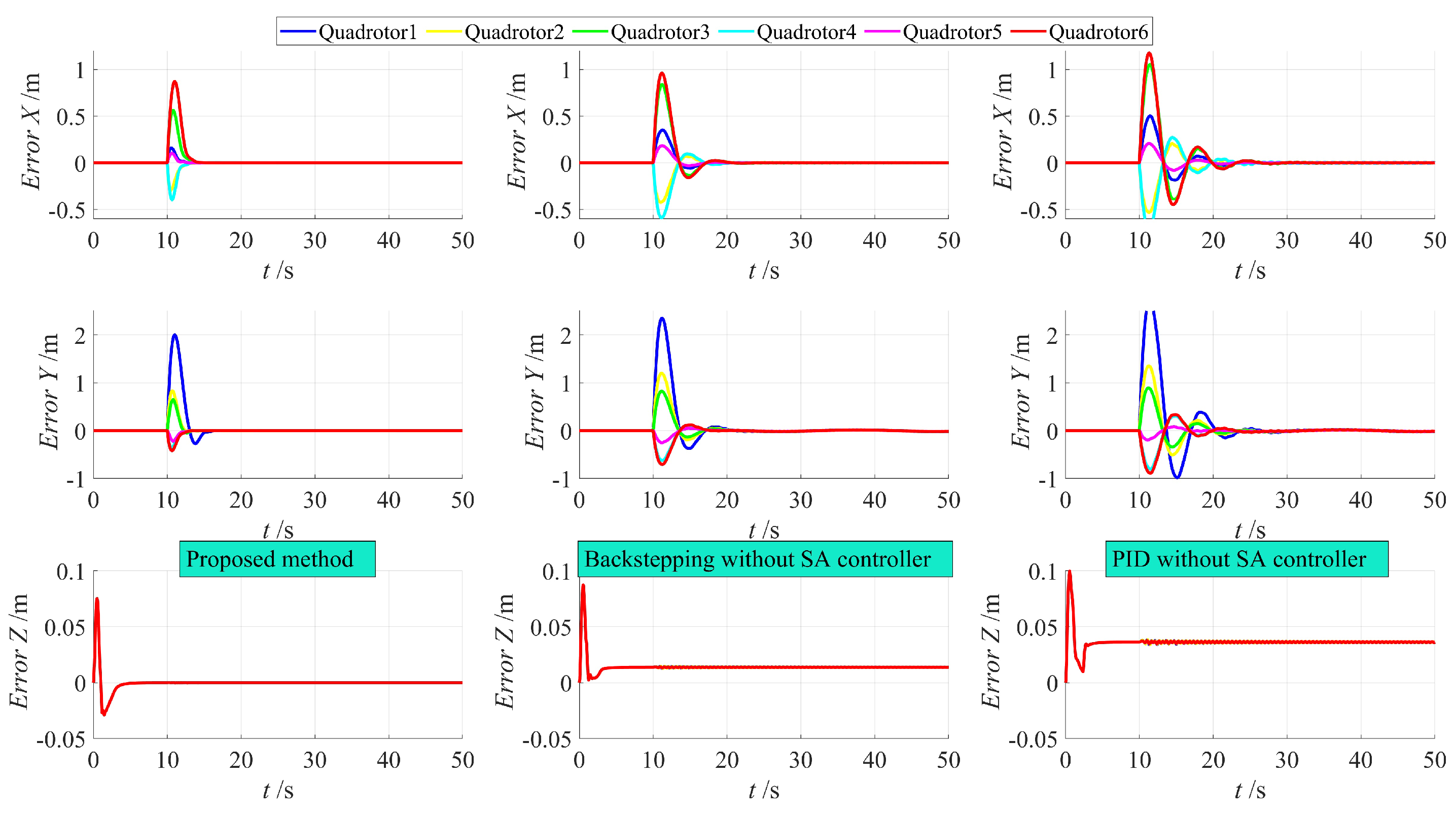
- Integral Type Backstepping Sliding Mode Controller: To address the challenge posed by oscillations in the position of quadrotors induced by suspended loads, an integral-type backstepping sliding mode controller is introduced. This controller offers a resilient solution to mitigate oscillations through the skillful integration of integral control techniques within the backstepping sliding mode framework. An innovative adaptation involves substituting the conventional sign function with the hyperbolic tangent function. This alteration not only minimizes jitter in controller outputs, but also fortifies the overall robustness of the system, resulting in enhanced performance and reliability.
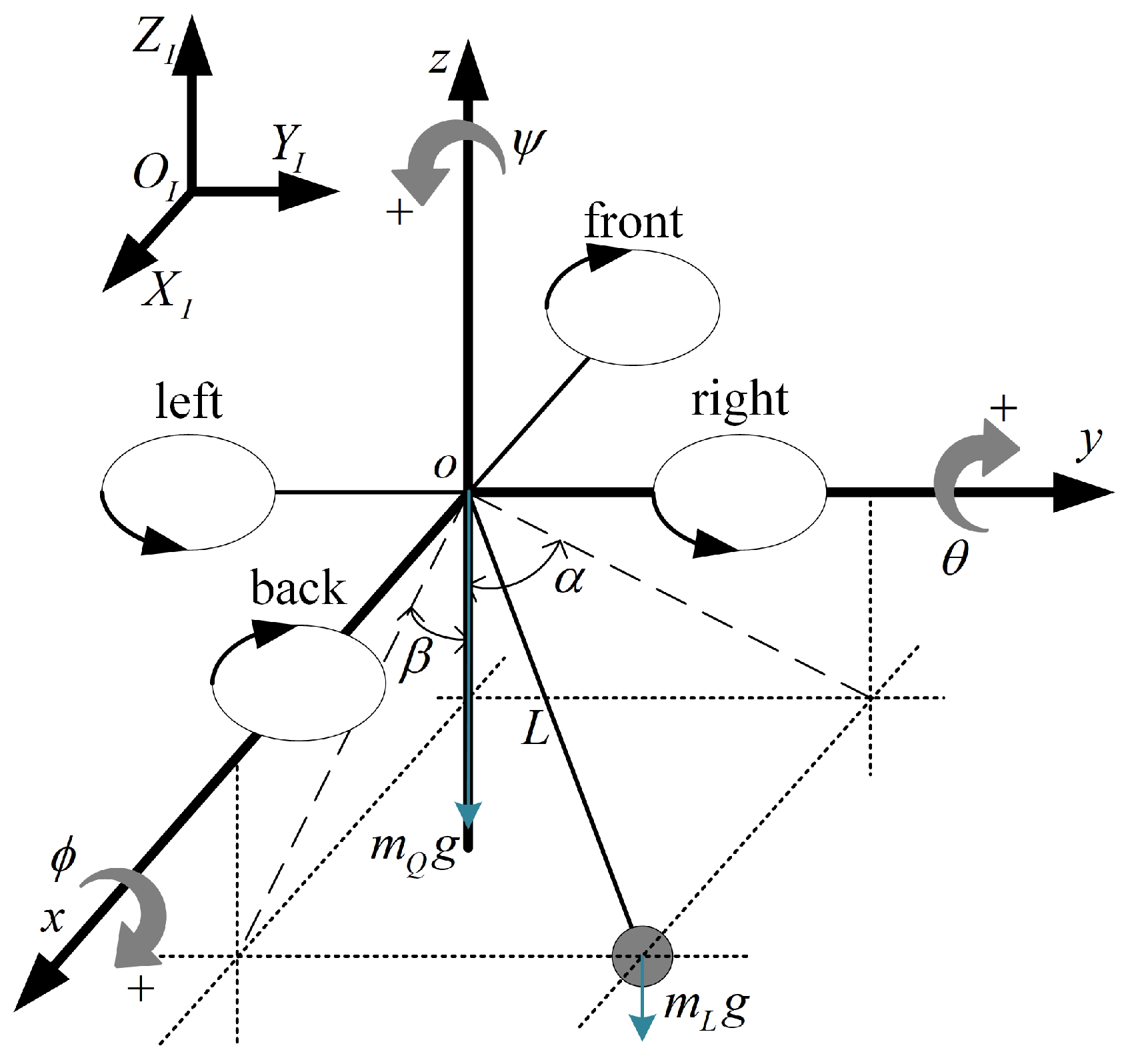
2. Quadrotor Suspension System Dynamic
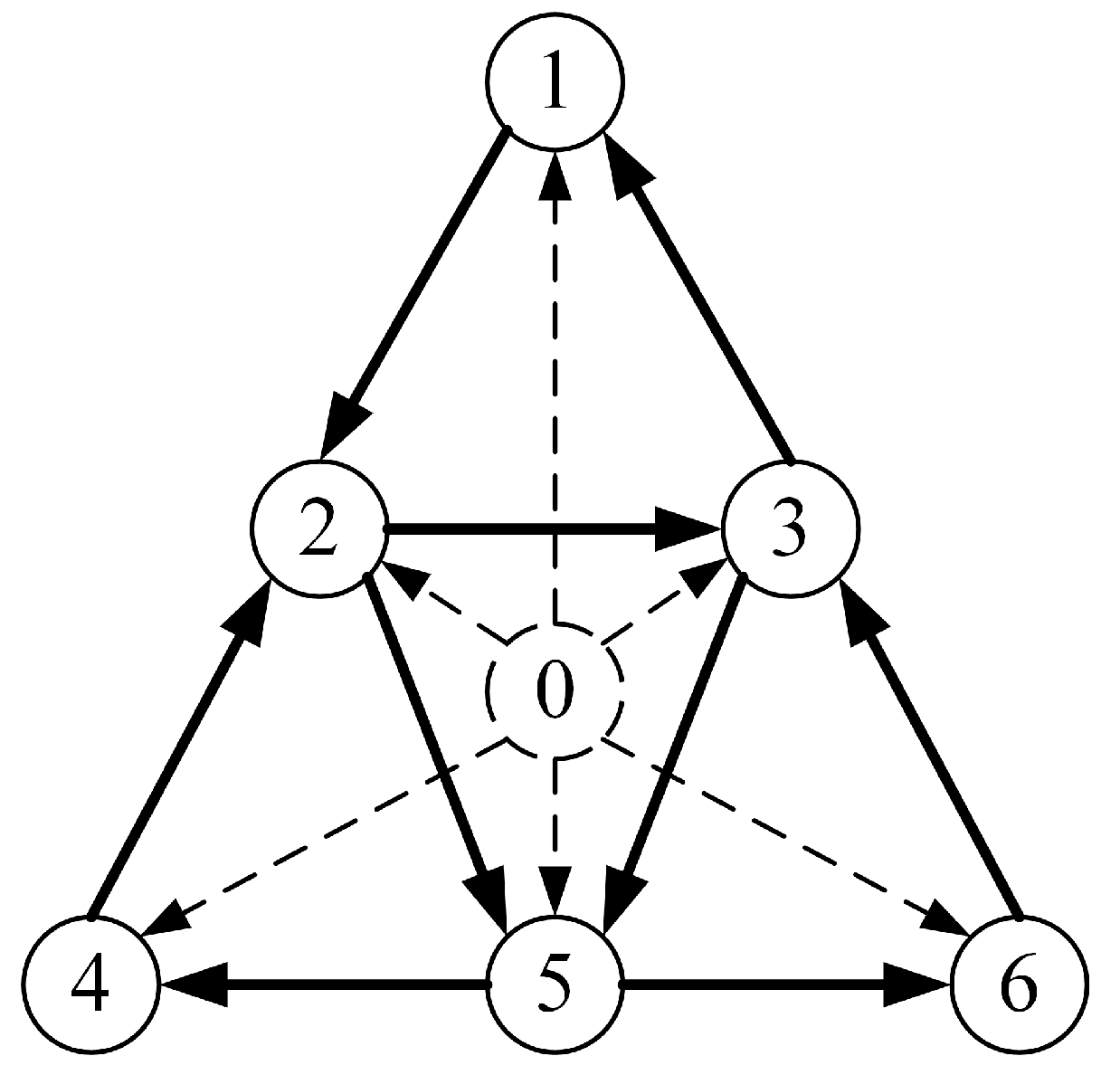
3. Cooperative Formation Controller Design
3.1. Collaborative Trajectory Generation
3.2. Controller Design
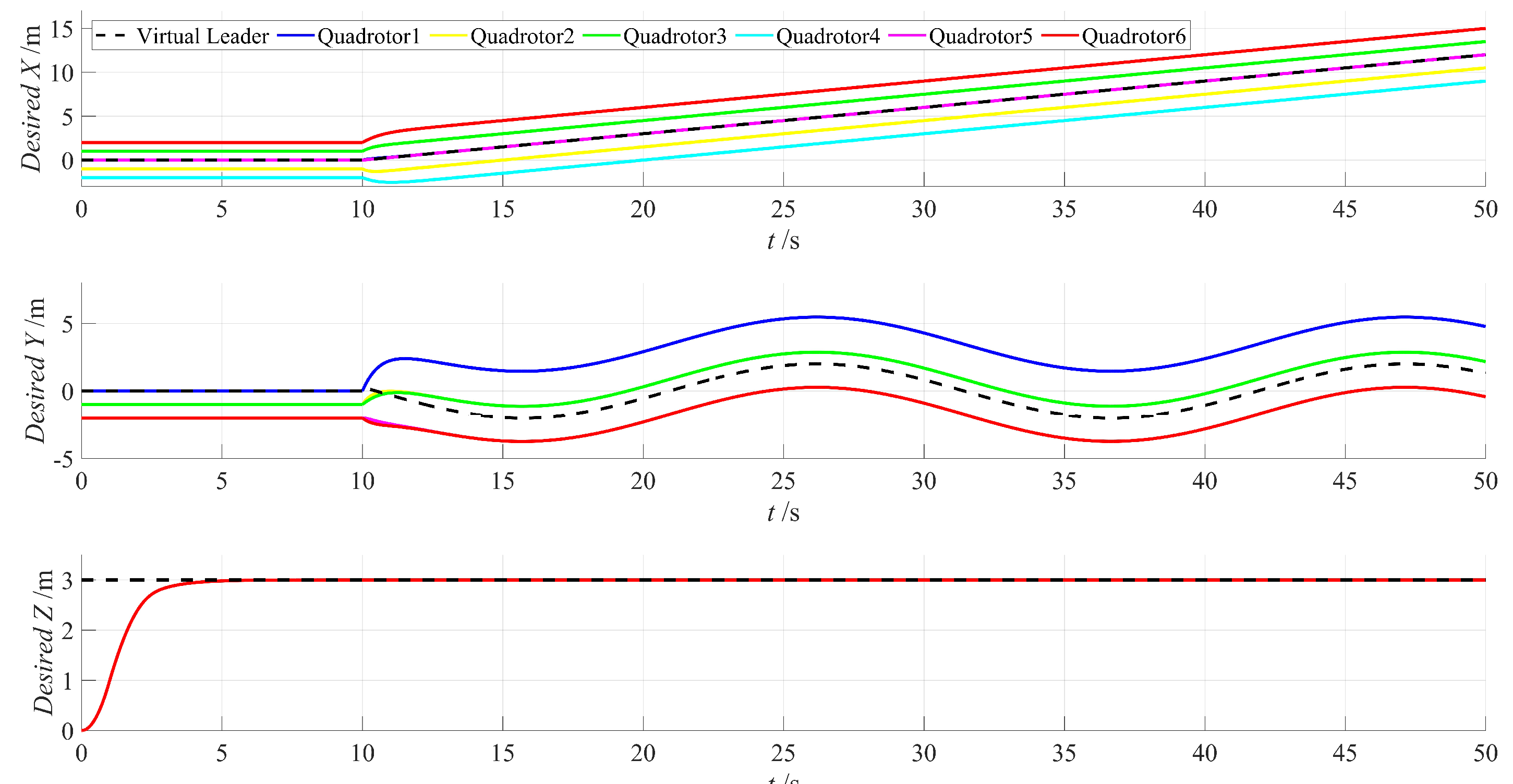
4. Simulation Results
5. Conclusions
Author Contributions
Funding
Data Availability Statement
Acknowledgments
Conflicts of Interest
References
- Jiang, B.; Li, B.; Zhou, W.; Lo, L.-Y.; Chen, C.-K.; Wen, C.-Y. Neural Network Based Model Predictive Control for a Quadrotor UAV. Aerospace 2022, 9, 460. [Google Scholar] [CrossRef] [Scilit]
- Mariani, M.; Fiori, S. Design and Simulation of a Neuroevolutionary Controller for a Quadcopter Drone. Aerospace 2023, 10, 418. [Google Scholar] [CrossRef] [Scilit]
- Potter, J.J.; Adams, C.J.; Singhose, W. A planar experimental remote-controlled helicopter with a suspended load. IEEE/ASME Trans. Mechatronics 2015, 20, 2496–2503. [Google Scholar] [CrossRef] [Scilit]
- Duan, D.; Wang, Z.; Li, J.; Zhang, C.; Wang, Q. Stabilization control for unmanned helicopter-slung load system based on active disturbance rejection control and improved sliding mode control. Proc. Inst. Mech. Eng. Part G J. Aerosp. Eng. 2021, 235, 1803–1816. [Google Scholar] [CrossRef] [Scilit]
- Yang, S.; Xian, B.; Cai, J.; Wang, G. Finite-time convergence control for a quadrotor unmanned aerial vehicle with a slung load. IEEE Trans. Ind. Inform. 2023; early access.
- Outeiro, P.; Cardeira, C.; Oliveira, P. Control Architecture for a Quadrotor Transporting a Cable-Suspended Load of Uncertain Mass. Drones 2023, 7, 201. [Google Scholar] [CrossRef] [Scilit]
- Si, P.; Fu, Z.; Shu, L.; Yang, Y.; Huang, K.; Liu, Y. Target-barrier coverage improvement in an insecticidal lamps internet of UAVs. IEEE Trans. Veh. Technol. 2022, 71, 4373–4382. [Google Scholar] [CrossRef] [Scilit]
- Sreenath, K.; Lee, T.; Kumar, V. Geometric control and differential flatness of a quadrotor UAV with a cable-suspended load. In Proceedings of the 52nd IEEE Conference on Decision and Control, Firenze, Italy, 10–13 December 2013; pp. 2269–2274. [Google Scholar]
- Vahdanipour, M.; Khodabandeh, M. Adaptive fractional order sliding mode control for a quadrotor with a varying load. Aerosp. Sci. Technol. 2019, 86, 737–747. [Google Scholar] [CrossRef] [Scilit]
- Wang, Z.; Zhao, T. Based on robust sliding mode and linear active disturbance rejection control for attitude of quadrotor load UAV. Nonlinear Dyn. 2022, 108, 3485–3503. [Google Scholar] [CrossRef] [Scilit]
- Roy, K.R.; Waghmare, L.M.; Patre, B.M. Dynamic modeling and displacement control for differential flatness of quadrotor UAV slung-load system. Int. J. Dyn. Control. 2023, 11, 637–655. [Google Scholar] [CrossRef] [Scilit]
- Yang, P.; Zhang, A.; Bi, W.; Li, M. Cooperative group formation control for multiple quadrotors system with finite-and fixed-time convergence. ISA Trans. 2023, 138, 186–196. [Google Scholar] [CrossRef] [Scilit]
- Doakhan, M.; Kabganian, M.; Azimi, A. Robust adaptive control for formation-based cooperative transportation of a payload by multi quadrotors. Eur. J. Control. 2023, 69, 100763. [Google Scholar] [CrossRef] [Scilit]
- Zhang, K.; Yang, Z.; Başar, T. Multi-agent reinforcement learning: A selective overview of theories and algorithms. In Handbook of Reinforcement Learning and Control; Springer: Berlin/Heidelberg, Germany, 2021; pp. 321–384. [Google Scholar]
- Oroojlooy, A.; Hajinezhad, D. A review of cooperative multi-agent deep reinforcement learning. Appl. Intell. 2023, 53, 13677–13722. [Google Scholar] [CrossRef] [Scilit]
- Du, Z.; Negenborn, R.R.; Reppa, V. Cooperative multi-agent control for autonomous ship towing under environmental disturbances. IEEE/CAA J. Autom. Sin. 2021, 8, 1365–1379. [Google Scholar] [CrossRef] [Scilit]
- Mukras, S.M.S.; Omar, H.M. Development of a 6-DOF testing platform for multirotor flying vehicles with suspended loads. Aerospace 2021, 8, 355. [Google Scholar] [CrossRef] [Scilit]
- Ding, F.; Sun, C.; Ai, Y.; Huang, J. Sliding Mode Control for Quadrotor-Slung Load Transportation System with State Constraints. In Proceedings of the 2022 IEEE International Conference on Cyborg and Bionic Systems (CBS), Wuhan, China, 24–26 March 2023; pp. 368–373. [Google Scholar]
- Yu, G.; Cabecinhas, D.; Cunha, R.; Silvestre, C. Aggressive maneuvers for a quadrotor-slung-load system through fast trajectory generation and tracking. Auton. Robot. 2022, 46, 499–513. [Google Scholar] [CrossRef] [Scilit]
- Lv, Z.; Zhao, Q.; Li, S.; Wu, Y. Finite-time control design for a quadrotor transporting a slung load. Control. Eng. Pract. 2022, 122, 105082. [Google Scholar] [CrossRef] [Scilit]
- Lv, Z.; Wu, Y.; Sun, X.-M.; Wang, Q.-G. Fixed-time control for a quadrotor with a cable-suspended load. IEEE Trans. Intell. Transp. Syst. 2022, 23, 21932–21943. [Google Scholar] [CrossRef] [Scilit]
- Salih, Z.; Saleh, M.H. Attitude and Altitude Control of Quadrotor Carrying a Suspended Payload using Genetic Algorithm. J. Eng. 2022, 28, 25–40. [Google Scholar] [CrossRef] [Scilit]
- Sun, H.; Gu, X.; Luo, S.; Liang, Y.; Bai, J. Robust stabilization technique for a quadrotor slung-load system using sliding mode control. J. Phys. Conf. Ser. 2022, 2232, 012013. [Google Scholar] [CrossRef] [Scilit]
- Chandra, A.; Lal, P.P.S. Higher Order Sliding Mode Controller for a Quadrotor UAV with a Suspended Load. IFAC-PapersOnLine 2022, 55, 610–615. [Google Scholar] [CrossRef] [Scilit]
- Wang, J.; Yuan, X.; Zhu, B. Geometric control for trajectory-tracking of a quadrotor UAV with suspended load. IET Control. Theory Appl. 2022, 16, 1271–1281. [Google Scholar] [CrossRef] [Scilit]
- Omar, H.M.; Mukras, S. Integrating anti-swing controller with px4 autopilot for quadrotor with suspended load. J. Mech. Sci. Technol. 2022, 36, 1511–1519. [Google Scholar] [CrossRef] [Scilit]
- Yan, D.; Zhang, W.; Chen, H. Design of a multi-constraint formation controller based on improved MPC and consensus for quadrotors. Aerospace 2022, 9, 94. [Google Scholar] [CrossRef] [Scilit]
- Wang, P.K.C. Navigation strategies for multiple autonomous mobile robots moving in formation. J. Robot. Syst. 1991, 8, 177–195. [Google Scholar] [CrossRef] [Scilit]
- Lewis, M.A.; Tan, K.H. High precision formation control of mobile robots using virtual structures. Auton. Robot. 1997, 4, 387–403. [Google Scholar] [CrossRef] [Scilit]
- Balch, T.; Arkin, R.C. Behavior-based formation control for multirobot teams. IEEE Trans. Robot. Autom. 1998, 14, 926–939. [Google Scholar] [CrossRef] [Scilit]
- Desai, J.P.; Ostrowski, J.P.; Kumar, V. Modeling and control of formations of nonholonomic mobile robots. IEEE Trans. Robot. Autom. 2001, 17, 905–908. [Google Scholar] [CrossRef] [Scilit]
- Liu, R.; Qu, B.; Wei, T.; Zhang, L.; Yan, L.; Chai, X. Research on UAV Formation Obstacle Avoidance Based on Consistency Control. In Proceedings of the 2023 IEEE 12th Data Driven Control and Learning Systems Conference (DDCLS), Xiangtan, China, 12–14 May 2023; pp. 155–160. [Google Scholar]
- Yu, H.; Ning, L. Coordinated Obstacle Avoidance of Multi-AUV Based on Improved Artificial Potential Field Method and Consistency Protocol. J. Mar. Sci. Eng. 2023, 11, 1157. [Google Scholar] [CrossRef] [Scilit]
- Rojo-Rodriguez, E.G.; Garcia, O.; Ollervides, E.J.; Zambrano-Robledo, P.; Espinoza-Quesada, E.S. Robust consensus-based formation flight for multiple quadrotors. J. Intell. Robot. Syst. 2019, 93, 213–226. [Google Scholar] [CrossRef] [Scilit]
- Wang, J.; Ma, X.; Li, H.; Tian, B. Self-triggered sliding mode control for distributed formation of multiple quadrotors. J. Frankl. Inst. 2020, 357, 12223–12240. [Google Scholar] [CrossRef] [Scilit]
- Steinleitner, A.; Ballam, R.; McFadyen, A. Practical consensus-based formation control for quadrotor systems. In Proceedings of the 2022 International Conference on Unmanned Aircraft Systems (ICUAS), Dubrovnik, Croatia, 21–24 June 2022; pp. 1510–1519. [Google Scholar]
- Liu, Y.; Li, Y. Application of Inverse Optimal Formation Control for Euler-Lagrange Systems. IEEE Trans. Intell. Transp. Syst. 2023, 24, 5655–5662. [Google Scholar] [CrossRef] [Scilit]
- Hwang, C.L.; Abebe, H.B. Generalized and heterogeneous nonlinear dynamic multiagent systems using online RNN-based finite-time formation tracking control and application to transportation systems. IEEE Trans. Intell. Transp. Syst. 2021, 23, 13708–13720. [Google Scholar] [CrossRef] [Scilit]
- Omar, H.M.; Akram, R.; Mukras, S.M.S.; Mahvouz, A.A. Recent advances and challenges in controlling quadrotors with suspended loads. Alex. Eng. J. 2023, 63, 253–270. [Google Scholar] [CrossRef] [Scilit]
- Chen, X.; Zhao, Y.; Fan, Y. Adaptive Integral Backstepping Control for a Quadrotor with Suspended Flight. In Proceedings of the 2020 5th International Conference on Automation, Control and Robotics Engineering (CACRE), Dalian, China, 19–20 September 2020; 2020; pp. 226–234. [Google Scholar]
- Fan, Y.; Guo, H.; Han, X.; Chen, X. Research and Verification of Trajectory Tracking Control of a Quadrotor Carrying a Load. Appl. Sci. 2022, 12, 1036. [Google Scholar] [CrossRef] [Scilit]
- Fan, Y.; Chen, X.; Zhao, Y.; Song, B. Nonlinear control of quadrotor suspension system based on extended state observer. Acta Autom. Sin. 2023, 49, 1758–1770. [Google Scholar]
- Olfati-Saber, R.; Fax, J.A.; Murray, R.M. Consensus and cooperation in networked multi-agent systems. Proc. IEEE 2007, 95, 215–233. [Google Scholar] [CrossRef] [Scilit]



| Parameter | Value |
|---|---|
| kg | |
| kg | |
| l | m |
| kg·m | |
| kg·m | |
| kg·m | |
| g | m/(s) |
| L | m |
| Parameter | Value |
|---|---|
| , , , , | 53.3, 5.8, 1.45, 7.8, 1 |
| , , | 5.5, 3.5, 2 |
| , , , , | 8.5, 0.01, 0.015, 20.55, 0.1 |
| , | 0.5, 20 |
| , | 0.8, 1 |
| , | 2, 5 |
Disclaimer/Publisher’s Note: The statements, opinions and data contained in all publications are solely those of the individual author(s) and contributor(s) and not of MDPI and/or the editor(s). MDPI and/or the editor(s) disclaim responsibility for any injury to people or property resulting from any ideas, methods, instructions or products referred to in the content. |
© 2023 by the authors. Licensee MDPI, Basel, Switzerland. This article is an open access article distributed under the terms and conditions of the Creative Commons Attribution (CC BY) license (https://creativecommons.org/licenses/by/4.0/).
Share and Cite
Chen, X.; Fan, Y.; Wang, G.; Mu, D. Coordinated Control of Quadrotor Suspension Systems Based on Consistency Theory. Aerospace 2023, 10, 913. https://doi.org/10.3390/aerospace10110913
Chen X, Fan Y, Wang G, Mu D. Coordinated Control of Quadrotor Suspension Systems Based on Consistency Theory. Aerospace. 2023; 10(11):913. https://doi.org/10.3390/aerospace10110913
Chicago/Turabian StyleChen, Xinyu, Yunsheng Fan, Guofeng Wang, and Dongdong Mu. 2023. "Coordinated Control of Quadrotor Suspension Systems Based on Consistency Theory" Aerospace 10, no. 11: 913. https://doi.org/10.3390/aerospace10110913
APA StyleChen, X., Fan, Y., Wang, G., & Mu, D. (2023). Coordinated Control of Quadrotor Suspension Systems Based on Consistency Theory. Aerospace, 10(11), 913. https://doi.org/10.3390/aerospace10110913