
Article

Evaluating Geovisualizations Based on Open Data: An Integrative Framework for Engagement, Openness, and Accessibility

by
Andrea Miletić
* and
Ana Kuveždić Divjak
University of Zagreb Faculty of Geodesy, 10000 Zagreb, Croatia
*
Author to whom correspondence should be addressed.
ISPRS Int. J. Geo-Inf. 2026, 15(6), 259; https://doi.org/10.3390/ijgi15060259 (registering DOI)
Submission received: 2 April 2026 / Revised: 6 June 2026 / Accepted: 8 June 2026 / Published: 10 June 2026
(This article belongs to the Special Issue Cartography and Geovisual Analytics)

Abstract

Geovisualizations based on open data are increasingly used as public-facing interfaces for communicating geospatial information, yet their evaluation often remains limited to isolated design, usability, or technical aspects. This study addresses that gap by developing and applying an integrative evaluation framework that combines four analytical dimensions: cartographic representation, interaction and engagement affordances, openness, and accessibility, while treating contextual characteristics as conditioning factors. The framework is operationalized through a mixed-methods content analysis of 26 publicly available geovisualizations based on open data. The results show that most cases are produced by public-sector actors, focus on environmental and transport themes, and rely on conventional cartographic techniques combined with medium levels of interactivity that support structured exploration rather than deeper analytical reasoning. Although many geovisualizations cite data sources and provide some form of data access, licensing remains inconsistent, particularly for the visualization artefacts themselves, limiting reuse potential. Accessibility is implemented even less consistently across geovisualizations, with recurring shortcomings in color contrast, keyboard navigation, screen-reader compatibility, and multilingual support. Overall, the findings suggest that the broader societal potential of geovisualizations based on open data may not be determined by individual features, but by balanced cross-dimensional configurations. Strengthening the integration of openness and accessibility alongside interaction and design may enhance the potential of geovisualizations to support reuse, inclusiveness, and public engagement.

1. Introduction

The availability of open data—defined as data that can be freely accessed, used, modified, and shared by anyone—has grown substantially over the past decade. A central motivation for publishing open government data (OGD) is to enhance public and user engagement and generate broader societal benefits [1], including increased government transparency and accountability [2,3,4], economic growth and innovation [5,6], and the creation of new job opportunities [7]. Active citizen engagement has therefore been widely recognized as a key success factor of open data initiatives [8,9], as it enables data to move beyond mere availability toward meaningful public use. From an organizational perspective, the value of open data emerges not only through data availability itself but through its transformation into actionable knowledge, decision support, and innovation processes [10].
However, despite the emergence of open data portals intended to facilitate data reuse [11], engagement with these datasets among non-expert citizens remains limited [12,13]. One of the key barriers is that many open datasets are published in raw, technically demanding formats that require relatively high levels of data literacy and technical expertise [3,4,14]. As a result, a persistent gap exists between data provision and meaningful public engagement with open data.
Data visualizations have been widely recognized as a promising means of bridging this gap by transforming complex datasets into more accessible and cognitively manageable forms [15,16,17]. Among different forms of data visualization, geovisualizations are particularly relevant in the context of open data, as a substantial share of open datasets contains a spatial component [18]. By enabling users to recognize geographic patterns, explore spatial relationships, and uncover trends that remain hidden in tabular or textual formats [19,20], geovisualizations can function as intuitive interfaces for accessing and interpreting open geospatial data.
At the same time, the widespread adoption of open-source geographic information systems (GIS) and web-mapping tools has contributed to the democratization of cartography by lowering technical barriers to map production and enabling broader participation in spatial data creation and visualization [21,22,23]. As a result, non-expert actors such as journalists, researchers, civic organizations, activists, and analysts can now independently produce and disseminate geovisualizations based on open data. While this shift has significantly increased the availability of geovisualizations across open data portals, media platforms, and public websites, empirical studies indicate that their potential to support effective communication and citizen engagement is often not fully realized in practice [24,25,26]. Many contemporary tools enable map production but do not necessarily support geographic semantic reasoning, spatial interpretation, or meaningful user engagement.
Existing research on geovisualizations has largely focused on isolated aspects such as technical system architecture [27], interface components [28,29], interaction types [30], or individual cartographic characteristics [31,32]. However, evaluation studies that address these aspects in isolation risk overlooking important dependencies—for example, cases in which technically advanced or visually appealing geovisualizations remain inaccessible, legally non-reusable, or poorly suited for public exploration. This research gap highlights the need for more integrative evaluation approaches that reflect the socio-technical nature of geovisualizations based on open data.
In particular, two dimensions that are important for the broader public value of geovisualizations based on open data—openness and accessibility—remain underexplored in existing evaluation approaches. While data sources are often cited, licensing information is frequently missing, ambiguous, or difficult to locate, limiting legal reusability and interoperability [33]. Similarly, while compliance with web accessibility standards is increasingly recognized as a legal and ethical necessity for digital governance, essential for enabling inclusive democracy, enhanced user experience and public services [34,35], accessibility is rarely assessed in the geovisualization context. Evaluating geovisualizations solely through the lenses of cartographic design or interactivity provides only a partial understanding of their actual usability and public impact. These gaps point to the absence of evaluation approaches that jointly address design, interaction, openness, and accessibility as interdependent analytical dimensions rather than isolated features. As a result, existing approaches often fail to identify cross-dimensional imbalances and trade-offs, such as geovisualizations that are visually sophisticated and highly interactive but remain legally non-reusable or insufficiently accessible to diverse publics. By integrating openness and accessibility alongside cartographic representation and interaction, the framework proposed in this study can enable a more comprehensive interpretation of how geovisualizations support reuse, inclusiveness, and public engagement in practice.
Accordingly, the aim of this study is to assess the current state of geovisualizations based on open data through the development and application of an integrative evaluation framework. The proposed framework integrates four evaluative dimensions: cartographic representation, interaction and engagement affordances, openness, and accessibility, while contextual scope is treated as a conditioning factor informing interpretation. By operationalizing these dimensions through a framework-driven mixed-methods content analysis, the study enables systematic comparison of heterogeneous geovisualizations and supports a more comprehensive assessment of their public-facing design and governance qualities.
This article makes two main contributions. First, it proposes a synthesized framework for evaluating geovisualizations that explicitly incorporates openness and accessibility alongside cartographic and interaction-related characteristics, thereby extending existing evaluation approaches. Second, the framework is applied to an illustrative purposive sample of 26 publicly available and currently active geovisualizations based on open data, providing an empirical overview of contemporary practices and identifying recurring design patterns and limitations.
To achieve this aim, the study addresses the following research objectives: (O1) to identify the key actors and contextual characteristics of geovisualizations based on open data; (O2) to classify their cartographic and interactive design features; (O3) to assess their engagement potential; and (O4) to evaluate their compliance with principles of openness and web accessibility.
Collectively, these objectives correspond to the main analytical dimensions of the proposed framework and structure the empirical analysis presented later in the paper. Contextual characteristics (O1) function as conditioning factors informing interpretation across cases, cartographic representation and interaction affordances (O2) address the visual and functional design of geovisualizations, engagement potential (O3) reflects the interpretative synthesis of interaction-related characteristics, while openness and accessibility (O4) examine the legal, technical, and inclusive conditions shaping reuse and public access.
The remainder of this paper is structured as follows. Section 2 reviews related work on open data reuse and the evaluation of geovisualizations. Section 3 introduces the conceptual dimensions underlying the proposed framework. Section 4 presents the integrative evaluation framework by explicating the relationships between evaluative dimensions, operational criteria, and analytical outcomes. Section 5 details the empirical methodology, including the sampling strategy, operationalization through coding indicators, and the analytical approach used to identify cross-dimensional configurations. Section 6 presents and discusses empirical results, identifying recurrent cross-dimensional configurations across the 26 analyzed geovisualizations based on open data and examining their implications for broader public engagement, reuse and inclusiveness. Section 7 concludes by summarizing key findings, outlining implications for the design and evaluation of geovisualizations based on open data while acknowledging limitations, and indicating directions for future research.

2. Related Work: Evaluating Geovisualizations in the Open Data Context

2.1. Open Data Reuse and Public Engagement

Open data initiatives are commonly justified by their potential to enhance transparency, accountability, innovation, and citizen engagement [1,4,17]. However, a growing body of research, such as [13,36,37], indicates that the mere availability of open datasets does not automatically lead to meaningful public use. Instead, open data reuse remains uneven and is often concentrated among expert users, such as analysts, developers, and researchers. Non-expert citizens often lack the necessary data literacy to interpret and use open data effectively [38,39], which contributes to their limited engagement.
One of the most frequently identified challenges is the technical and cognitive complexity of open datasets [38]. Data are commonly published in raw, machine-readable formats that require specialized knowledge, domain expertise, or dedicated software to interpret [40]. As a result, open data portals often function as repositories rather than as interfaces for public understanding. This gap between formal openness and practical usability has been repeatedly highlighted in studies of open government data, emphasizing the need for intermediaries who possess certain skills and resources, enabling them to translate data into accessible and meaningful forms [41].
Visualization has therefore been widely proposed as a mechanism for lowering barriers to open data reuse [42,43]. By transforming abstract or complex datasets into visual representations, data visualizations can support sensemaking, comparison, and exploration [44], particularly for users with limited data literacy. In the context of geospatial data, geovisualizations are especially relevant, as they draw on everyday spatial cognition and enable intuitive reasoning about location, distance, and spatial relationships.

2.2. Geovisualizations as Public-Facing Data Interfaces

Geovisualizations extend traditional cartographic representations by integrating interaction, allowing users to actively engage with spatial data rather than passively consuming information [45,46]. Through functionalities such as navigation, filtering, querying, and temporal exploration, geovisualizations can support exploratory analysis, pattern recognition, and contextual understanding [47]. These characteristics position geovisualizations as public-facing data interfaces that mediate access to open geospatial data.
Advances in web cartography and the proliferation of open-source mapping libraries and platforms have significantly lowered the technical barriers to map production. As a result, geovisualizations based on open data are now produced by a wide range of actors, including government agencies, academic institutions, journalists, non-governmental organizations (NGOs), civic technology communities, and private companies. This diversification of map producers has contributed to the democratization of cartography, expanding both the quantity and variety of publicly available geovisualizations.
Despite this growth, prior research suggests that many publicly available geovisualizations remain limited in their ability to support deeper user engagement [24,25,26]. Common shortcomings include reliance on conventional cartographic techniques, restricted interaction options, and interfaces that prioritize presentation over exploration. While such designs may be effective for communicating predefined messages, they often provide limited support for user-driven inquiry, critical interpretation, or meaningful reuse of underlying data.

2.3. Existing Approaches to Evaluating Geovisualizations

A wide range of methods has been employed to evaluate geovisualizations, reflecting their multidisciplinary nature. User-centered approaches, such as usability testing [48], eye-tracking [49], surveys and interviews [50] have been widely used to examine perceptual, cognitive, and experiential aspects of map use. These methods provide valuable insights into how users interact with visualizations, what elements attract attention, and how effectively information is communicated.
In parallel, system- and design-oriented evaluations have focused on technical architecture, interface components, interaction techniques, and cartographic design principles. Content analysis has also been used to systematically examine collections of maps or visualizations, enabling comparison of design choices, interaction features, and communicative strategies across multiple cases [51,52,53]. Such approaches are particularly valuable when direct access to users or interaction logs is unavailable, as is often the case for publicly accessible geovisualizations.
However, existing evaluation approaches tend to address these aspects in isolation. Studies frequently focus on either usability and user experience, cartographic representation, or technical functionality, without considering how these dimensions interact with broader socio-technical conditions. In particular, issues related to legal openness, reusability, transparency of data sources, and compliance with accessibility standards are rarely integrated into evaluations of geovisualizations, despite their central role in determining who can access, reuse, and benefit from open data.
As a result, evaluations that focus solely on visual design or interactivity risk overlooking critical limitations. A geovisualization may be visually appealing and technically sophisticated, yet remain inaccessible to users with visual impairment, legally non-reusable due to unclear licensing, or unsuitable for public exploration due to mismatches between interface complexity and user capabilities. These limitations point to a conceptual gap in the literature: the absence of integrative frameworks that treat geovisualizations based on open data as socio-technical artefacts rather than as purely visual or technical products.

2.4. Towards Integrated Evaluation Frameworks

Recent work has begun to acknowledge the need for more holistic approaches to evaluating data visualizations and geovisualizations [54,55,56,57], particularly in public and journalistic contexts. Such approaches emphasize the importance of considering combinations of design components, interaction mechanisms, and contextual factors, rather than isolated features. However, frameworks that explicitly integrate cartographic representation, interaction affordances, openness, and accessibility within a single evaluative structure remain relatively limited.
Existing approaches to evaluating geovisualizations can be broadly grouped into three strands: (1) user-centered studies focusing on usability, perception, and interaction (e.g., [48,49,50]); (2) system- and design-oriented analyses addressing cartographic representation and interaction techniques (e.g., [30,31,57]); and (3) content-analytic approaches examining collections of visualizations (e.g., [51,52,53]). While these approaches provide valuable insights, they typically address individual dimensions in isolation and rarely consider geovisualizations as integrated socio-technical artefacts.
In particular, aspects related to openness (e.g., licensing, data reuse) and accessibility (e.g., color contrast, keyboard navigation, screen-reader compatibility) remain largely absent from existing evaluation frameworks, despite their importance for enabling broader public use and reuse of geovisualizations based on open data. As a result, current approaches offer only a partial understanding of how such artefacts function in practice. This limitation is particularly significant in the context of geovisualizations based on open data, where the capacity of geovisualizations to support public use, reuse, and inclusiveness depends not only on how effectively data are visualized or how many interaction options are provided, but also on whether both the underlying datasets and the resulting visualizations are legally reusable, technically accessible, and inclusive of diverse user groups.
In response to this gap, the present study proposes an integrative evaluation framework that brings together multiple analytical dimensions relevant to geovisualizations based on open data. The conceptual dimensions underlying this framework are introduced in the following section (Section 3).

3. Dimensional Components of Geovisualizations Based on Open Data

To enable a systematic evaluation of geovisualizations based on open data, this section introduces the key dimensional components that structure the proposed evaluation framework. Based on a synthesis of cartographic theory, geovisualization research, and open data literature, four core dimensions are identified: cartographic representation, interaction and engagement affordances, openness, and accessibility. These dimensions reflect how data are represented, how users can interact with them, and under which legal, technical, and perceptual conditions geovisualizations can be accessed and reused.
Although these dimensions are conceptually distinct, certain features may appear across multiple dimensions depending on their analytical role within the framework. Cartographic representation refers to how spatial and temporal information is visually encoded through geovisualization design. In contrast, interaction and engagement affordances refer to user-controlled functionalities that enable navigation, exploration, filtering, querying, or transformation of displayed content. For example, classification methods and legend design are treated as elements of cartographic representation because they define the predefined visual structure established by the cartographer. In contrast, functionalities such as symbology adjustment, reclassification, or interactive legends are categorized as interaction and engagement affordances because they allow users to actively manipulate or explore these representations. Keyboard navigation and screen-reader compatibility, however, are evaluated as accessibility features because they concern inclusive access to interaction rather than interaction itself.
A similar distinction applies to color. Within cartographic representation, color is considered in terms of its role in visual encoding and cognitive interpretation, whereas within accessibility, the focus is on aspects such as color contrast and color-blind-safe palettes that influence inclusive access and usability. Likewise, accessibility and interaction may appear closely related, but within the proposed framework, they are treated as analytically distinct dimensions. While interaction and engagement affordances focus on the functionalities that enable users to navigate, manipulate, and explore geovisualizations, accessibility concerns whether visual and interactive elements can be inclusively perceived, understood, and operated by diverse user groups.
Similarly, openness extends beyond licensing conditions alone and additionally includes technical and procedural aspects such as data access, documentation, transparency, reproducibility, and reuse support mechanisms. In this sense, openness concerns the legal and technical conditions of reuse rather than the visual quality or usability of the interface itself.

3.1. Cartographic Representation

Cartographic representation forms the visual foundation of geovisualizations and plays a central role in shaping how spatial data are perceived, interpreted, and understood. This dimension encompasses the predefined visual encoding of information established by the geovisualization designer and presented to users through the map interface, including the selection of mapping techniques, classification methods, symbolization strategies, temporal representation, and scale-dependent design choices. While these elements are often treated as technical design decisions, they fundamentally influence users’ cognitive processing and sensemaking [31,58].
The choice of cartographic technique—such as choropleth maps, symbol maps, flow maps, or heat maps—determines which spatial patterns become salient and which remain obscured. Similarly, classification methods, legend design, applied color schemes and consistency between legends and map symbols hierarchies influence the perception of spatial differences, trends, and outliers, showing that cartographic representation influences how users interpret spatial data rather than simply displaying it neutrally [30,59,60,61]. Visual saliency plays a critical role here; design choices can “pull” user attention toward specific features, regardless of their statistical importance, necessitating a cognitively inspired approach to design [32]. Temporal representation further shapes users’ ability to reason about change and dynamics in spatial phenomena [29]. Within this framework, temporal representation refers to how temporal information is visually presented by default, for example through static snapshots, predefined animations, or dynamic visual updates. In contrast, user-controlled functionalities such as time sliders, animation controls, temporal filtering, and temporal comparison are treated as interaction and engagement affordances because they allow users to actively manipulate temporal exploration.

3.2. Interaction and Engagement Affordances

Interaction constitutes a defining characteristic of contemporary geovisualization and is the primary mechanism through which users move from passive viewing to active exploration and reasoning [45,46]. This dimension captures the affordances that allow users to navigate, manipulate, interrogate, and contextualize spatial data within a visualization environment. Unlike cartographic representation, which concerns predefined visual encoding, this dimension focuses on functionalities that allow users to dynamically manipulate, adjust, and explore spatial information.
At a foundational level, interaction includes spatial, temporal, and thematic navigation, enabling users to control viewpoint, scale, time frame, and thematic focus [62]. In this study, spatial navigation includes functionalities such as panning and zooming that assist users in navigating geographic space. These functionalities enable users to dynamically control the viewpoint and map scale during exploration. Thematic navigation includes functionalities that allow users to modify the displayed thematic content, while temporal navigation refers to user-controlled exploration of temporal information through functionalities such as time sliders, animation controls, temporal filtering, and temporal comparison. These affordances support user-driven exploration by allowing individuals to align the visualization with their interests and questions.
Beyond navigation, interaction extends to user-controlled display and classification functionalities, such as layer toggling, symbology adjustment, and reclassification, which allow users to directly influence how spatial patterns are perceived and compared [31,57]. More advanced forms of interaction involve analytical affordances, including data querying, comparative views, linked charts, simulations, and other tools that support hypothesis testing and spatial reasoning [27,63]. These functionalities transform geovisualizations from communicative interfaces into exploratory and analytical environments capable of generating new insights. In addition, narrative affordances—such as guided storylines, annotations, and contextual explanations—may further support interpretation and reduce cognitive load for non-expert users [27,64].
Emerging AI-driven and advanced analytical functionalities further expand this dimension by enabling semi-automated exploration, pattern detection, and predictive analysis [65].

3.3. Openness

Openness represents a core dimension for evaluating geovisualizations derived from open data and extends beyond data availability alone. It encompasses the legal, technical, and procedural conditions that determine whether both the underlying datasets and the resulting visualizations, as derived artefacts, can be reused, shared, and adapted.
Key aspects of openness include the presence of explicit licenses for both underlying datasets and the geovisualization itself, clear citation of data sources, and the mechanisms supporting data access and reuse, such as data download options, sharing functions and application programming interfaces (APIs). In addition to legal licensing conditions, openness within this framework also includes procedural and technical transparency measures that support reproducibility and secondary reuse. These include access to source code repositories, documentation of data processing methods, and versioning information, and update histories.
Within the proposed framework, such elements are evaluated as components of openness, not because they improve usability or accessibility of the interface itself, but because they determine whether datasets and geovisualizations can be transparently examined, reproduced, adapted, and reused by other users. In this sense, openness evaluates the broader reuse infrastructure surrounding a geovisualization rather than its visual or interaction design quality. Without such conditions, geovisualizations may function primarily as end products for viewing rather than as reusable interfaces to open data.

3.4. Accessibility

Accessibility addresses the extent to which geovisualizations can be perceived, understood, and operated by diverse user groups, including users with disabilities, varying language backgrounds, and different levels of data literacy. This dimension reflects both technical accessibility standards and inclusive design practices.
Key accessibility considerations include sufficient color contrast, color-blind-safe palettes, scalable text, keyboard navigation, screen-reader compatibility, and responsive design across devices. Linguistic accessibility, such as multilingual interfaces and localization, further influences who can meaningfully engage with a geovisualization. Standards such as the Web Content Accessibility Guidelines (WCAG) provide practical benchmarks for evaluating these aspects.
Within the proposed framework, accessibility focuses on whether geovisualizations can be inclusively used rather than on the analytical complexity or richness of interaction itself. For example, keyboard navigation and screen-reader compatibility are evaluated as accessibility conditions because they determine whether users can access and operate interface functionalities regardless of physical or perceptual limitations.
Accessibility constitutes the primary determinant of inclusiveness and a necessary precondition for engagement to materialize across diverse publics. Even legally open and technically sophisticated geovisualizations may fail to support inclusive public use and engagement if accessibility barriers exclude significant portions of potential users.

3.5. Contextual Characteristics

Context and scope are not treated as evaluative dimensions, but as conditioning factors that inform the interpretation of all previously described dimensions. This concerns the contextual characteristics within which a geovisualization is produced and disseminated. This includes the type of actor responsible for its creation (e.g., public institutions, non-governmental organizations, media, academic or commercial entities), the thematic focus of the visualization, and its geographic scope. These contextual factors influence not only design choices but also the intended role of the geovisualization within the open data ecosystem.
Geovisualizations created by different actors often pursue distinct communicative goals and address different audiences. For example, public sector organizations frequently aim to inform or report on predefined indicators, whereas civic organizations or journalists may emphasize exploration, accountability, or advocacy. Similarly, thematic domains such as environment, transport, or public services are associated with different data structures, update frequencies, and expectations of user interaction. The geographic scope of a geovisualization—ranging from local to global—further shapes its level of detail, complexity, and relevance to users’ everyday experiences.
Evaluating context and scope therefore provides essential background for interpreting other designs and functional characteristics. It helps situate individual geovisualizations within broader institutional, thematic, and spatial settings, and supports comparison across heterogeneous cases.

4. An Integrative Framework for Evaluating Geovisualizations

Building on the dimensional components introduced in Section 3, this section presents an integrative evaluation framework for evaluating geovisualizations based on open data. Rather than cataloguing individual features or technologies, the framework conceptualizes geovisualizations as socio-technical artefacts whose analytical outcomes depend on how multiple dimensions are combined, rather than on isolated design elements.
The framework is structured around four evaluative conceptual dimensions: cartographic representation, interaction and engagement affordances, openness, and accessibility, which jointly shape three analytical outcomes: engagement potential, reuse potential, and inclusiveness potential. In this framework, engagement potential refers to the inferred capacity of a geovisualization to facilitate user involvement based on its design and interaction characteristics rather than empirically observed user behavior or usage metrics. In addition, context and scope—including the type of producing actor, thematic focus, geographic scale, and intended audience—are treated as conditioning factors that inform interpretation across all dimensions, rather than as evaluative dimensions in themselves.
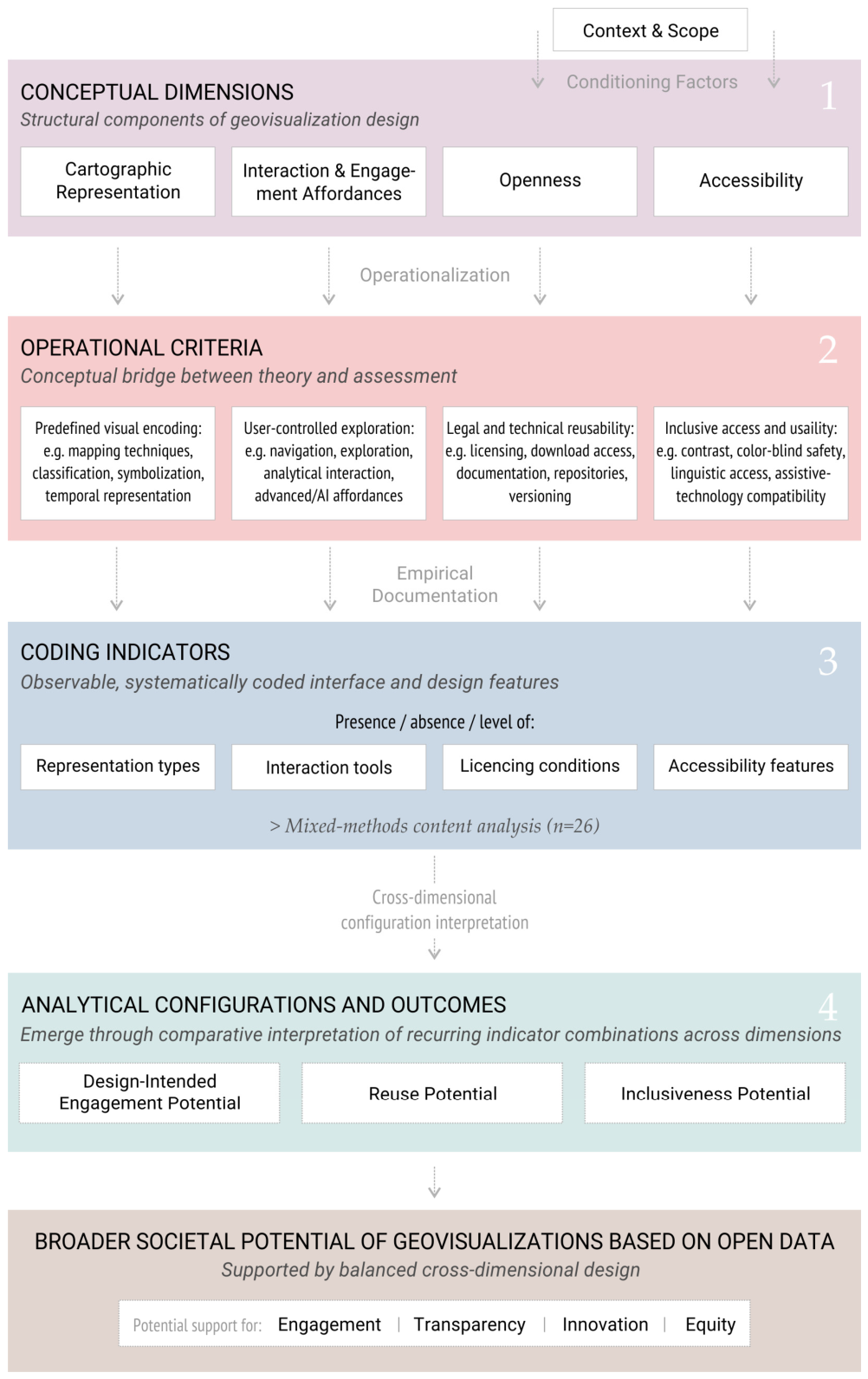
Figure 1 provides an overview of the analytical logic underpinning the framework. It illustrates how conceptual dimensions are translated into operational criteria and implemented through observable coding indicators, from which analytical outcomes emerge through comparative interpretation of cross-dimensional indicator combinations. Although the framework was not intended to produce final rankings or overall scores of analyzed geovisualizations, the analysis necessarily involved structured categorization and comparative interpretation of indicators in order to assess recurring characteristics and cross-dimensional relationships among cases. Accordingly, categories such as low, medium, and high interactivity are used to support comparative interpretation across cases, rather than as standardized measurements or rankings.
Within this study, configurations refer to recurring combinations of characteristics observed across multiple evaluative dimensions within individual geovisualizations. Rather than being derived from formal scoring procedures, configurations were identified through comparative interpretation of indicator patterns across cases. For example, geovisualizations combining strong openness indicators (e.g., standardized licensing, downloadable data, and methodological transparency) with comparatively weak accessibility indicators (e.g., insufficient color contrast or limited assistive-technology support) were interpreted as representing “open but insufficiently accessible” configurations. Similarly, cases characterized by extensive interaction affordances, but limited openness features were interpreted as “interactive yet weakly reusable” configurations. Analytical outcomes therefore emerged from the combined interpretation of indicators across dimensions rather than from isolated features or numerical aggregation.
Within this framework, cartographic representation primarily conditions perceptual clarity and interpretability, interaction and engagement affordances constitute the central driver of user engagement, openness determines the legal and technical conditions for reuse, and accessibility functions as a foundational requirement for inclusive participation. Context and scope shape expectations and constraints across all dimensions, influencing how geovisualizations are designed, interpreted, and used.
To enable empirical application, each conceptual dimension of the framework is translated into a set of operational criteria that specify how the dimension can be systematically assessed in practice. These operational criteria function as an intermediate conceptual layer between abstract dimensions and empirical observation: they delineate the key aspects through which a dimension manifests in geovisualizations based on open data and can therefore be consistently evaluated across heterogeneous cases.
Operational criteria define key aspects of each dimension and guide how observable indicators are selected and interpreted. For example, the dimension cartographic representation is operationalized through criteria addressing mapping techniques, classification, symbolization, temporal representation and scale dependence. Interaction and engagement affordances are operationalized through sets of criteria capturing navigation, exploration, analytical interaction, narrative support, and advanced/artificial intelligence (AI) affordances. The dimension of accessibility is operationalized through criteria related to visual, technical, and linguistic access, while openness is operationalized through criteria addressing legal reusability, technical access to data, and transparency of documentation.
Each set of operational criteria is implemented through concrete coding indicators, which capture specific, observable properties of geovisualizations and allow for systematic mixed-methods content analysis (See Section 5.4). Quantitative coding is used to document the presence, absence, or level of individual indicators—such as licensing information or accessibility features—while qualitative interpretation is employed to synthesize how combinations of indicators reflect broader configurations within and across evaluative dimensions. Analytical outcomes are not based on single indicators, but on how groups of indicators are interpreted together within each dimension.

5. Materials and Methods

This section outlines the methodological approach used to operationalize and empirically apply the integrative evaluation framework introduced in Section 3 through a mixed-methods content analysis.

5.1. Research Design

Content analysis is understood as a systematic and replicable research method used to examine and compare key features of complex media artefacts, such as maps, by identifying and coding their observable characteristics [51,53]. When applied in geovisualization research, content analysis allows structured comparison across diverse visual and interactive designs without relying on user data or interaction logs.
Content analysis can be applied using both quantitative and qualitative approaches. Quantitative content analysis relies on well-defined codes that function as operational rules for identifying and recording specific features and characteristics, enabling the examination of patterns and distributions across cases [52]. Qualitative content analysis complements this approach by supporting interpretative analysis of relationships between features and their communicative and analytical implications.
This study applies a mixed-methods (quantitative and qualitative) content analysis to examine a purposive sample of 26 geovisualizations. This approach is suitable because geovisualizations based on open data are produced by diverse actors and are typically publicly accessible without usage statistics or interaction data. Under these conditions, content analysis enables systematic, transparent, and replicable comparison of cartographic design choices, interaction and engagement affordances, openness conditions, and accessibility features across heterogeneous cases.

5.2. Scope and Research Questions

The empirical scope of this study is defined by four research objectives: (O1) to identify the key actors and contextual characteristics of geovisualizations based on open data; (O2) to classify their cartographic and interactive design features; (O3) to assess their engagement potential; and (O4) to evaluate their compliance with principles of openness and web accessibility.
To address these objectives within the integrative evaluation framework, they are translated into four research questions that guide the empirical analysis:
RQ1. How are geovisualizations based on open data configured across the four evaluative dimensions of cartographic representation, interaction and engagement affordances, openness, and accessibility?
RQ2. What recurring cross-dimensional configurations and imbalances characterize practice?
RQ3. How do these patterns shape the engagement potential, reuse conditions, and accessibility and inclusiveness characteristics of geovisualizations based on open data?
RQ4. Which design imbalances may constrain the potential societal value of geovisualizations based on open data?
Together, these questions enable a configuration-oriented assessment of contemporary geovisualization practices within the open data ecosystem.

5.3. Sampling Strategy and Case Selection

The sample of geovisualizations was constructed through systematic online searches, conducted between September 2025 and October 2025, using search engines such as Google, Google Images, and Bing with combinations of keywords such as “open data geovisualization”, “open data map”, “open government data visualization”, and related terms. To ensure variation across institutional, thematic, and functional characteristics, the search process included not only examples commonly associated with national open data portals and public agencies, but also searching for widely recognized visualizations (e.g., Global Forest Watch [66], winner of the United Nations (UN) Big data Climate Challenge Prize; Coronavirus in the U.S.: Latest Map and Case Count [67], winner of the Pulitzer Prize for Public Service and prominent examples from open data portals or public agency websites (e.g., the European Air Quality Index Map [68] from the European Environment Agency)).
The initial sample consisted of approximately 20 cases identified through these searches. Preliminary review indicated that many cases were produced by governmental actors and emphasized exploratory interaction patterns. To broaden the analytical diversity of the sample, additional targeted searches were conducted to include cases produced by journalists, research institutions, and non-governmental organizations, as well as cases exhibiting less represented characteristics such as narrative storytelling, advanced analytical affordances, and AI-supported functionalities. This resulted in the inclusion of six additional cases, including Afghanistan: Visualizing the Impact of 20 Years of War [69], Beescape [70], and NYC Taxi Trips [71].
Inclusion criteria for choosing geovisualizations required that (a) the visualization is map-centric; (b) the underlying datasets are openly accessible and, where possible, explicitly licensed; and (c) the visualization is publicly accessible on the web at the time of sampling. Visualizations were excluded if they were based on proprietary or non-redistributable datasets, implemented as closed dashboards without data access, or designed as infographics in which the map played a secondary role.
The final illustrative purposive sample consists of 26 geovisualizations, originally launched between 2002 and 2022, all of which remained publicly accessible and functional on the web at the time of analysis (2025). The sample was designed to capture heterogeneity in contemporary geovisualization practices and to support comparison across different configurations of design characteristics rather than to achieve statistical representativeness.

5.4. Operationalization and Coding Procedure

The operational criteria defined in Section 4 are implemented through a structured coding scheme designed to support systematic and replicable analysis. Each criterion is translated into one or more observable indicators that can be consistently identified across heterogeneous geovisualization artefacts.
Coding combines quantitative recording of indicators (e.g., presence or absence) with qualitative notes on design and functionality. For each evaluative dimension, operational criteria specify which aspects of a geovisualization are analytically relevant, while coding indicators define how these aspects are observed and recorded in practice.
Indicators related to cartographic representation capture whether visual encoding supports clarity and interpretability, including visualization type (static/dynamic), mapping technique(s), classification method, legend design and consistency, scale-dependence, labelling strategy, and projection transparency (Table A3, Appendix A).
Indicators for interaction and engagement affordances document the availability of user-facing functionalities across spatial, thematic, and temporal navigation, as well as display/classification controls, analytical tools, narrative support, and emerging AI-enabled capabilities (Table A4 and Table A5, Appendix A). The degree of user interaction is captured through engagement interactivity level (low, medium, high), synthesizing the scope and complexity of interaction affordances documented in the interaction category. Since this study does not have direct access to user logs, and because engagement is widely recognized in the Human Computer Interaction (HCI) research as a multidimensional and inconsistently conceptualized construct that cannot be adequately captured through a single indicator [72,73], engagement potential is interpreted through the observed combination of intended use, purpose, and interactivity level. These characteristics were considered jointly as indicators of engagement potential because they collectively reflect whether a geovisualization is designed primarily for passive presentation, exploratory use, or more active user participation and knowledge generation. The resulting categories (not engaging, engaging, highly engaging), therefore, reflect the potential of a geovisualization to facilitate and sustain user involvement based on its design characteristics rather than empirically observed or validated user engagement outcomes.
Indicators for openness assess the legal and technical conditions of reuse by capturing licensing for both data and visualization, download and sharing affordances, citation and identifiers, documentation, update and versioning practices, and collaboration infrastructure such as open repositories (Table A6, Appendix A).
Finally, accessibility is operationalized through indicators aligned with inclusive web design practices, capturing linguistic access, visual accessibility (contrast and colour-blind safety), responsive design, assistive-technology compatibility, keyboard operability, and user support (Table A7, Appendix A). Contextual characteristics (Table A2, Appendix A) are coded as conditioning factors to support interpretation across heterogeneous cases.
All geovisualizations were coded using a structured spreadsheet-based database, with each case represented as a single record and each indicator captured as a separate variable. To improve clarity and consistency, a pilot coding round was conducted on a subset of cases, leading to minor refinements in indicator definitions and value categories.
Final coding was performed by a primary researcher to ensure consistent application of the coding scheme. To assess the reliability of the coding procedure, a second independent researcher familiar with the coding protocol was involved in a validation step. A subset of the sample (20 geovisualizations, approximately 77% of the dataset) was independently coded using the same coding protocol. Inter-coder agreement was assessed using percentage agreement, calculated as the proportion of identical coding decisions assigned by both coders across all indicators included in the validation subset. The resulting overall agreement was 91%, indicating a high level of consistency in the application of the coding scheme. Discrepancies were subsequently reviewed and discussed by both coders, and consensus was reached through clarification and consistent application of the coding rules.
All indicators were defined using explicit operational criteria, and interpretative judgments were grounded in documented design features and interface behavior. The transparency of the coding scheme (see Supplementary Materials) further supports replication and future validation by additional researchers.
To further clarify how the framework was operationalized in practice, the following example presents the coding procedure applied to one geovisualization from the analyzed sample, Global Forest Watch [66]. The example illustrates how individual indicators were identified, coded, and interpreted within two conceptual dimensions of the framework: openness and accessibility.
The coder first examined the main interface and associated metadata pages, including settings menus, footer sections, documentation pages, repositories, and terms-of-use pages.
Within the openness dimension, the coder verified whether the visualization and underlying datasets included explicitly stated reuse licenses. In this case, both the visualization and the datasets provided standard open licenses and were coded as “2 = standard”, with the dataset licensed under CC BY 4.0. The coder then examined whether the underlying data could be downloaded directly, whether source datasets were transparently cited, and whether sharing or embedding functions were available. Global Forest Watch [66] provided multiple download options (coded as “4 = more options”), transparent source citation with citable references or DOI-based attribution (coded as “3 = yes”) and embed functions for sharing the visualization (coded as “2 = embed code”).
The coder additionally assessed the availability of terms and privacy information, maintainer contact options, repository access, versioning information, methodological documentation, and update frequency. Terms/privacy information was available (coded as “1 = yes”), maintainer contact was provided through a contact form (coded as “2 = form”), and links to open repositories were available (coded as “1 = yes”). However, no formal version history or changelog was identified (coded as “0 = no”), and the date of the most recent update was not explicitly stated (coded as “0 = unknown”). Cookie/tracking transparency information was available (coded as “1 = yes”), methodological details were described in detail (coded as “2 = detailed”), and updates were provided on a near real-time and monthly basis.
Based on the combined presence of openness-related indicators, Global Forest Watch [66] demonstrated a relatively strong overall openness. This assessment was based on the presence of several core openness conditions, including standard open licenses for both the visualization and datasets, multiple data download options, transparent and citable source attribution, repository access, contact information, cookie/tracking transparency, and detailed methodological documentation. Although some limitations were identified, particularly the absence of a DOI/identifier for the visualization, formal version history, and explicit last update date, these did not outweigh the strong support for legal and technical reuse provided by the other indicators.
Within the accessibility dimension, the coder evaluated observable interface characteristics related to inclusive use. The primary interface language and the availability of multilingual support were recorded by inspecting language menus and interface settings. In the case of Global Forest Watch [66], the primary interface language was English, while multilingual support was available through manual language selection options (Multi-language toggle coded as “1 = yes”; Interface languages coded as “1 = ≥2 languages (manual)”). This indicates that multiple languages were supported, although the interface was not systematically localized across all functions and content.
Visual accessibility was assessed through colour contrast, colour-blind compatibility, text scaling, and responsive design using a combination of automated accessibility evaluation tools and manual browser-based inspection. For example, to assess the color contrast ratio between text and map background, we used a Color Contrast Checker [74]. This online tool assesses compliance against the WCAG 2.1 AA standard, which requires a minimum contrast ratio of at least 4.5:1 for normal text, and 3:1 for large text (at least 18 pt).
Colour contrast met WCAG-oriented accessibility requirements and was coded as “2 = passes”, while no dedicated colour-blind-safe scheme was identified (coded as “0 = no”). The coder additionally tested whether text could be enlarged without breaking the interface layout and whether the visualization adapted to smaller screen sizes. Both text scaling and responsive mobile design were supported and coded as “1 = yes”.
Technical accessibility features were assessed through direct interaction with the interface. Alternative text implementation, screen reader compatibility, and keyboard navigation were each coded as “1 = partially”, as these features were implemented for some interface elements but not consistently across the entire platform. Visible focus indicators were not consistently present and were therefore coded as “0 = no”, while a help/FAQ section was available and coded as “1 = yes”.
Based on the combined interpretation of these indicators, the geovisualization was overall interpreted as accessible. This interpretation was supported primarily by multilingual support, acceptable colour contrast, responsive mobile design, text scaling without layout disruption, and partial implementation of screen-reader compatibility, alternative text, and keyboard navigation. However, several important accessibility limitations were also identified, including the absence of dedicated colour-blind-safe schemes, inconsistent focus indicators, and the lack of systematic implementation of assistive-technology support across the platform. The assessment therefore reflects a comparative interpretation of accessibility performance within the analyzed sample rather than full compliance with broader accessibility standards such as WCAG 2.1.
Taken together, this combination of indicators positioned Global Forest Watch [66] within the “open and accessible” configuration identified in Section 6.4 Strong openness indicators—including standardized licensing, downloadable data, transparent citation practices, and methodological documentation—contributed to high reuse potential by supporting transparency, reproducibility, and secondary data use. At the same time, relatively strong accessibility performance contributed to broader inclusiveness compared to many other cases in the sample, despite remaining barriers for users relying on assistive technologies. This example demonstrates how analytical outcomes within the framework emerged from the combined interpretation of multiple indicators across dimensions rather than from isolated interface features.

5.5. Methodological Scope and Limitations

It is important to note that the methodology evaluates engagement potential, reuse conditions, and inclusiveness as they are embedded in geovisualization design, rather than measuring actual user behavior or user experience.
While user-centered methods (e.g., usability testing, eye-tracking, or interaction log analysis) provide direct insights into how users interact with geovisualizations, the present study adopts a design-oriented perspective. Specifically, it focuses on the affordances that enable or constrain user interaction, engagement, and accessibility.
In this sense, user-oriented aspects are addressed indirectly, through the analysis of interaction design, engagement potential, and accessibility features, rather than through empirical observation of users. This represents a methodological choice and a limitation of the study. Consequently, the findings should be interpreted as indicative of potential capabilities and constraints embedded in geovisualization design rather than as evidence of actual user engagement or behavioral outcomes. An important limitation of this study is that it does not incorporate the perspectives, experiences, or opinions of users when interacting with the analyzed geovisualizations. Because the findings related to engagement potential, reuse, and inclusiveness have not been empirically validated through user studies, the analytical outcomes cannot currently be cross-validated against observed user behavior. Future research should therefore complement the present framework with user-centered evaluation methods, such as usability testing, surveys, interviews, eye-tracking, or interaction-log analysis, to cross-validate the analytical outcomes and strengthen the empirical basis of the framework.
In addition, the illustrative purposive nature of the sample limits the statistical generalizability of findings. While the sample size is limited, it is analytically sufficient for configuration-oriented content analysis, as the objective is not statistical generalization but the identification and comparison of cross-dimensional configurations and structural tendencies across heterogeneous cases.
Finally, certain accessibility assessments rely on expert inspection and simulation rather than comprehensive automated testing or user studies.
Despite these constraints, the methodological approach provided a transparent and replicable analytical basis for examining geovisualizations based on open data as socio-technical artefacts and for identifying structural patterns that may influence their broader societal potential.

6. Results and Discussion: Configurations of Geovisualizations Based on Open Data

Instead of presenting results as separate answers to each research question, this section summarizes them as recurring configurations of geovisualizations based on open data. These configurations reflect typical combinations of contextual characteristics, cartographic representation, interaction affordances, openness, and accessibility, and show how they influence engagement potential, reuse and openness, and inclusiveness and accessibility.

6.1. Contextual Configurations: Who Produces What, and at Which Scale

Across the analyzed sample, geovisualizations based on open data are produced by a diverse set of actors, confirming the ongoing democratization of cartographic production. Nevertheless, distinct contextual configurations emerge when authorship, thematic focus, and geographic scale are considered together.
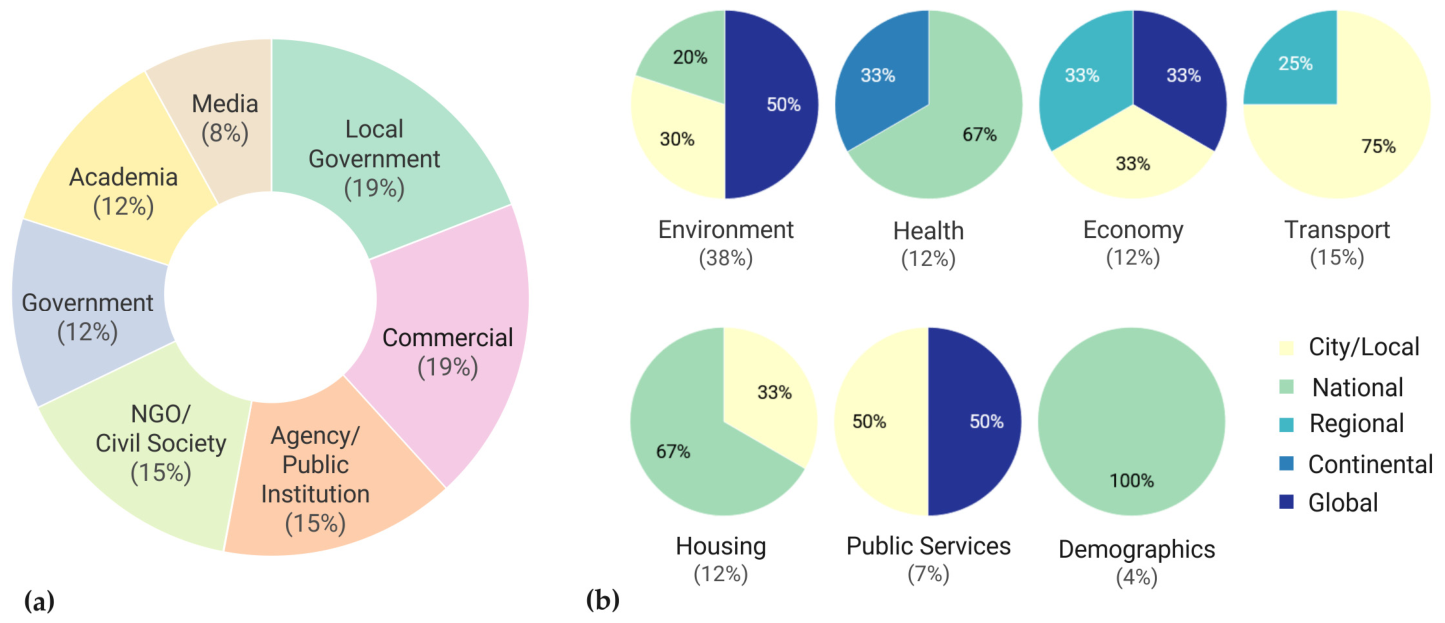
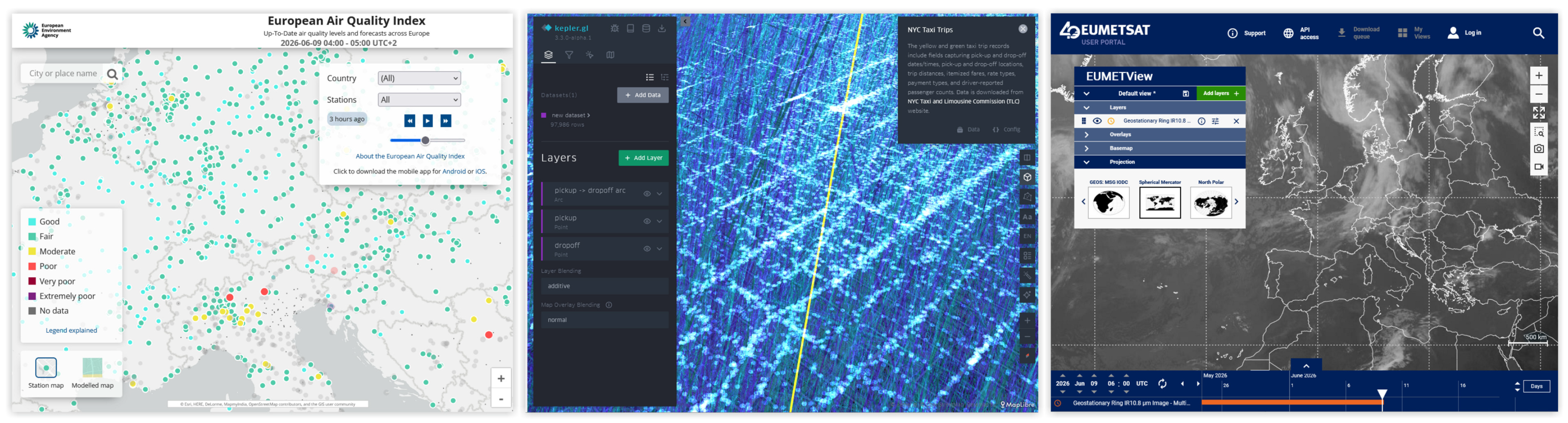
A dominant configuration is characterized by public-sector actors producing locally focused geovisualizations. Public institutions (government entities (12%), local governments (19%), and public agencies (15%)) account for 46% of all cases analyzed (Figure 2a), making them the most prominent producers in the sample. These visualizations most frequently address environmental topics (38% of the total sample) and transport-related themes (15%) (Figure 2b), often at the city or municipal scale (34%). Examples include Weather Radar—Composite by the Croatian Meteorological and Hydrological Service (DHMZ) [75] and EUMETView [76] by European Organization for the Exploitation of Meteorological Satellites (EUMETSAT), as well as local transport-focused tools such as Traffic Simulation in Plzeň [77] and the City of Edinburgh Parking Areas and Bays [78]. Such geovisualizations typically aim to inform citizens about local conditions, services, or infrastructure, positioning maps as transparency and reporting tools rather than as instruments for open-ended exploration.
This is probably because one of the main roles of public sector actors is service delivery; they are responsible for providing and improving access to public resources [79]. The focus on transport and environmental themes likely stems from the role of public institutions in managing public infrastructure and environmental monitoring systems, which also makes them primary sources of the underlying spatial data. Consequently, these geovisualizations are typically designed to support communication, transparency, and access to information rather than supporting open-ended exploration or interpretive analysis.
In contrast, non-governmental organizations (NGOs) (representing 15% of the total sample) and media actors (8%) tend to produce geovisualizations with broader thematic framing and stronger exploratory ambitions. These actors more frequently address issues of environmental risk, public accountability, or societal impact, often focusing on national or global scales—scopes that represent overall sample shares of 27% and 24%, respectively (Figure 2b). For example, the World Resources Institute’s Global Forest Watch [66] and The New York Times’ Coronavirus in the U.S. [67] illustrate how open data is mobilized to support broader public awareness and policy debate. Unlike public-sector actors, NGOs and media organizations act as knowledge intermediaries that contextualize and interpret open data for broader audiences. The broader thematic framing and geographic scope of these geovisualizations likely reflect their role in shaping public understanding of complex societal and environmental issues, with a stronger emphasis on sensemaking, civic engagement, and policy debate than on routine operational reporting.
Commercial actors (19%) and academic institutions (12%) form another distinctive group (Figure 2a). Commercial actors frequently focus on housing and the built environment, as illustrated by Building Ages in The Netherlands [80] and How Old Are the Buildings in St. Petersburg? [81]. Academic projects, such as Beescape [70], often emphasize research-driven or methodological innovation. These patterns suggest that commercial actors and academic organizations produce geovisualizations that are often motivated by commercial interests or research-oriented objectives, encouraging experimentation with analytical depth or visual design. However, because these projects are less strongly shaped by public-service or transparency mandates, they appear less consistently aligned with standardized openness practices or accessibility requirements.
Overall, the findings indicate that authorship and institutional context strongly shape thematic orientation, geographic scale, and communicative intent. Environmental topics dominate across the sample (38%), followed by transport (15%), while health, economy, and housing each account for 12%. City-level visualizations are most common (34%), followed by national (27%) and global (24%) scales, with regional (8%) and continental (4%) cases comparatively rare.
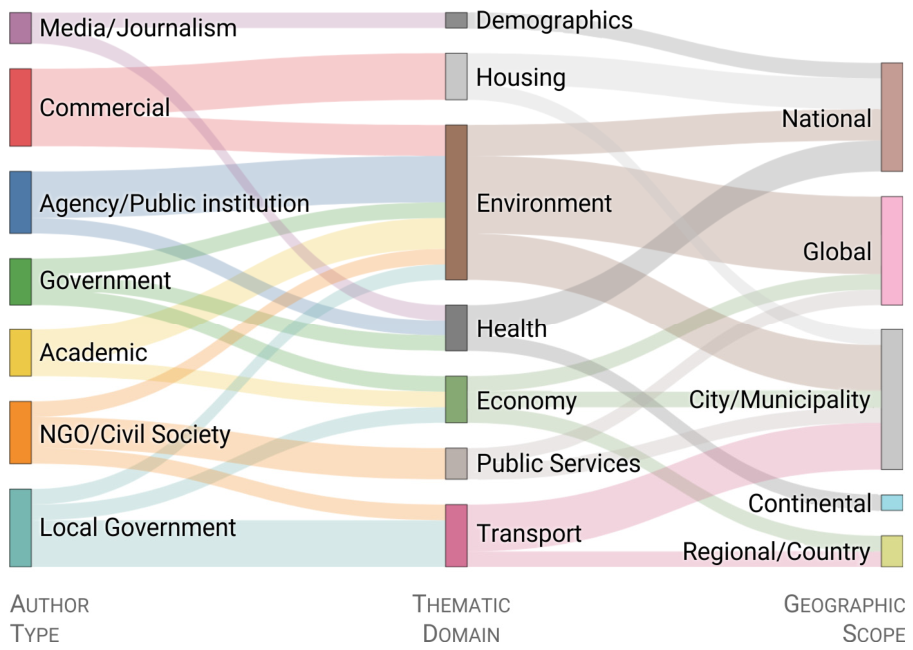
The interrelationships between author type, thematic domain, and geographic scope are further illustrated in the Sankey diagram (Figure 3), which visualizes the dominant flows between institutional producers, thematic preferences, and spatial scales. The diagram highlights, for example, the link between public-sector actors and environmental or transport themes at local scales, as well as the tendency of NGOs and media organizations to operate at broader geographic levels.
Overall, these patterns demonstrate that geovisualizations based on open data are not distributed randomly across actors and scales, but cluster into recurring contextual configurations that shape their communicative orientation and societal role.

6.2. Representation–Interaction Configurations: Conventional Cartography as the Exploratory Default

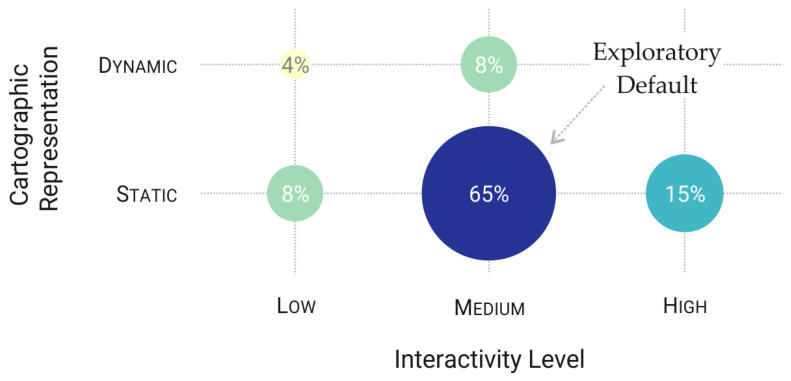
In terms of visualization type, the majority of geovisualizations in the sample are static (77%), representing a fixed temporal state without continuous live updating. Only 23% are dynamic, enabling users to explore temporal changes through animations or interactive controls. A smaller subset integrates real-time data streams (23%), such as EUMETView [76] or Satellite Loop Interactive Data Explorer in Real-time [82], which provide near real-time environmental monitoring. This imbalance indicates that most geovisualizations based on open data still prioritize stable representations over continuously evolving analytical environments (Figure 4).
Regarding mapping techniques, symbol maps are the most frequently used method (58%), followed by choropleth maps (38%). Most geovisualizations (77%) rely on a single cartographic technique, while only 23% combine multiple methods within the same interface. A notable exception is NYC Taxi Trips [71], which integrates symbol maps (pick-up points), flow maps (trip paths), and heat-map style aggregation, demonstrating a more complex representational strategy.
Legend design further reflects a predominantly conventional approach: 88% of geovisualizations include a legend, and 48% of these provide interactive legend functionality. Moreover, 81% maintain legend–symbol consistency, suggesting general adherence to cartographic clarity. However, map projection transparency is extremely rare, with explicit projection information provided in only one case (EUMETView [76]), indicating limited attention to cartographic metadata transparency.
When paired with interaction, a dominant configuration becomes evident: conventional cartographic representation combined with medium-level interactivity (73% of geovisualizations fall into the medium interactivity category) (Figure 5). Basic spatial navigation (pan and zoom) is available in 85% of cases, effectively functioning as a baseline feature. Beyond this, thematic exploration tools such as attribute filtering (69%), data queries (65%), and layer toggling (54%) represent the most common interaction affordances. These features enable structured exploration without requiring advanced analytical competence, establishing what can be described as the “exploratory default” of open data-based geovisualization practice.
Low-interactivity configurations remain limited (12%), typically restricted to basic navigation only, while highly interactive cases (15%) incorporating advanced analytical or AI-supported functionality are comparatively rare. AI-driven affordances such as natural language queries (4%), pattern detection (4%), or predictive modelling (15%) appear only sporadically. For example, Global Forest Watch [66] represents one of the few cases enabling automated anomaly alerts and temporal forest-loss analysis, while NYC Taxi Trips [71] supports natural language querying. These cases illustrate the upper bound of interaction-driven analytical depth within the sample.
Overall, the findings indicate that current practice is characterized less by a shift beyond static representation than by the addition of medium-level interaction to otherwise conventional map displays. Advanced analytical and AI-supported functionalities remain uncommon. This finding aligns with previous studies that have identified a tendency toward conventional cartographic representations combined with limited interaction complexity in publicly available geovisualizations [24,25,26].

6.3. Engagement-Oriented Configurations: Exploration Without Analysis

When examined through the lens of engagement potential inferred from observed design characteristics, most geovisualizations in the sample fall into an exploratory but not analytical configuration. In terms of engagement purpose, exploration is the most common primary orientation (46%), followed by revelation/knowledge generation (35%) and presentation (19%).
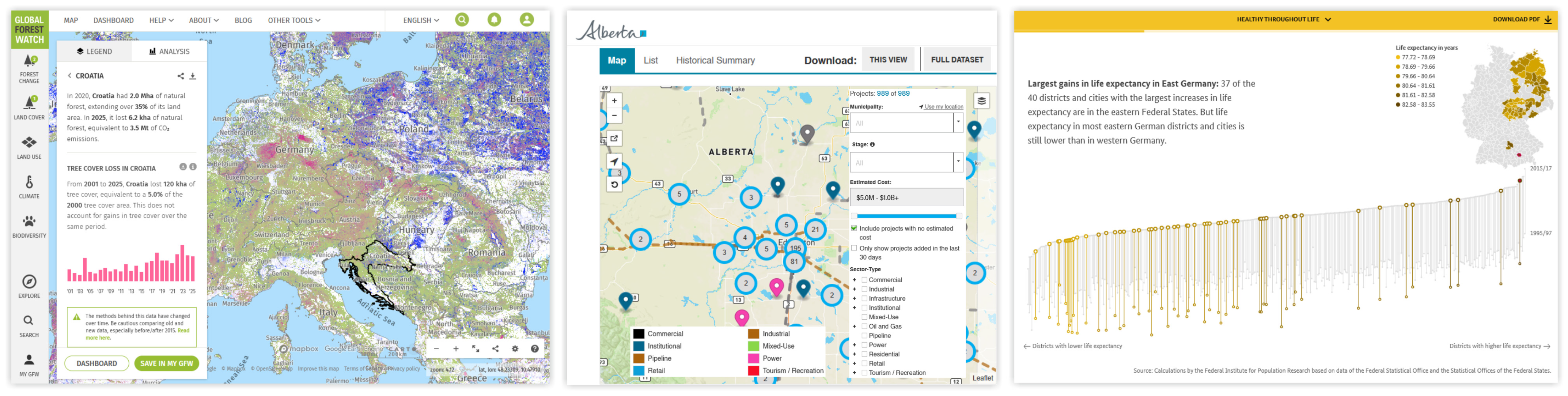
The distribution of engagement potential reflects this pattern: 73% of geovisualizations are classified as engaging, typically characterized by medium interactivity combined with an exploratory purpose. Examples include the Alberta Major Projects Tracker [83], Payroll Employment Locations in Boston [84], and Interactive Visualization of NYC Street Trees [85], all of which enable user-driven exploration through filtering, navigation, and thematic switching (Figure 6).
Geovisualizations interpreted as having higher engagement potential—those combining high interactivity with revelation-oriented purposes—are less frequent (8%). These cases typically include advanced analytical tools such as scenario simulation, temporal comparison, or automated insights. Global Forest Watch [66] exemplifies this configuration by enabling users not only to view deforestation data but to analyze change over time and subscribe to anomaly alerts. Similarly, Traffic Simulation in Plzeň [77] allows users to simulate traffic scenarios and support more advanced analysis.
At the opposite end of the spectrum, 19% of geovisualizations are interpreted as not engaging, generally due to low interactivity combined with primarily presentational purposes. Even when narrative elements are included, insufficient interactivity limits engagement potential. Narrative functionality itself appears in only 15% of the sample and, while beneficial for cognitive guidance—as seen in Healthy Throughout Life [86]—rarely substitutes for analytical affordances.
Importantly, the distribution of engagement levels broadly corresponds to the interactivity structure observed in Section 6.2. Most geovisualizations interpreted as “engaging” combined medium interactivity with exploratory functionality, while cases interpreted as having higher engagement potential were consistently associated with analytical functionality and high interactivity. This pattern suggests that structured exploratory interaction represents a common configuration within the analyzed sample, whereas highly analytical and AI-supported configurations remain comparatively uncommon.
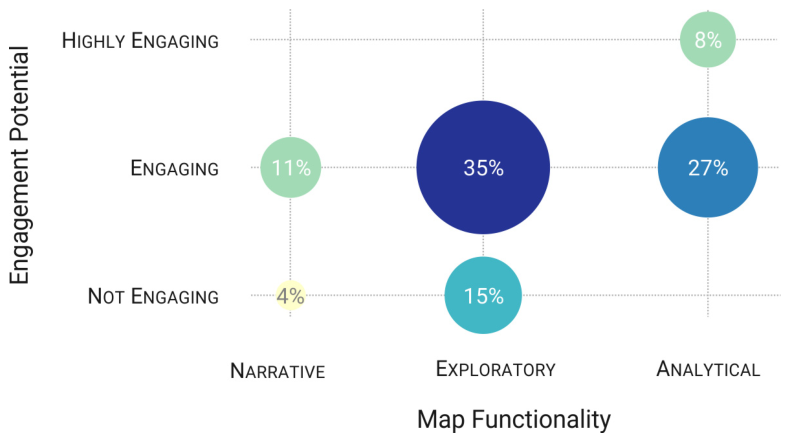
The distribution of cases across functionality types further substantiates this configuration pattern (Figure 7). Exploratory functionality is the most common (50%), followed by analytical functionality (35%) and narrative functionality (15%). Highly engaging geovisualizations are consistently associated with analytical functionality, in which the interface supports queries, comparisons, simulations, or scenario-based reasoning. For example, Global Forest Watch [66] enables users to analyse deforestation over time and subscribe to automated alerts, while Traffic Simulation in Plzeň [77] visualization supports scenario-based traffic analysis.
By contrast, exploratory geovisualizations—although classified as engaging in 73% of cases—primarily support structured interaction without deeper analytical reasoning. Finally, presentational or narrative designs with low interactivity tend to correspond to lower engagement potential. For instance, a linear narrative map from Al Jazeera [69] remained largely passive, whereas The New York Times’ Coronavirus in the U.S. [67] was interpreted as having higher engagement potential by integrating narrative structure with interactive filtering and personalization tools.
Figure 7 illustrates how engagement potential aligns more strongly with interaction level and analytical affordances than with narrative structure alone, reinforcing the framework’s emphasis on configuration rather than isolated features.

6.4. Openness–Accessibility Imbalance: Transparency Without Inclusiveness

One of the most striking patterns to emerge from the analysis concerns the relationship between openness and accessibility. Although transparency is relatively common, full legal and practical openness remains inconsistent. While 92% of geovisualizations clearly cite their data sources and 62% provide an option to download the underlying dataset, only 58% use a standard open license for the dataset itself. The remaining 42% rely on mixed, custom, or unclear licensing terms. For example, the Atlas of Economic Complexity [87] encourages reuse through a descriptive permission statement but does not apply a standard open license, illustrating how formal openness can remain ambiguous in practice.
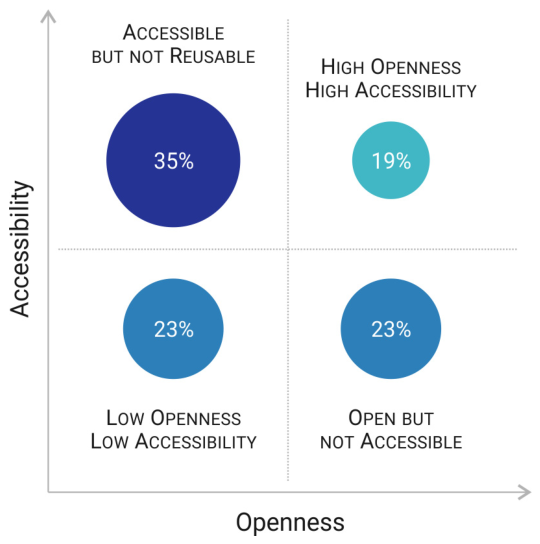
The situation is even more restrictive for the visualization artefact itself: only 38% explicitly state a standard open license. This creates a common configuration of accessible but not reusable geovisualizations—cases in which users can explore data but face legal uncertainty regarding modification, redistribution, or derivative use. Features that would actively support collaborative reuse are comparatively rare: only 15% provide access to an open repository (e.g., GitHub), and 69% lack clear versioning or update history. These findings suggest that creators prioritize visibility and citation over long-term reproducibility and collaborative openness.
Accessibility presents an even more pronounced limitation. While 80% of geovisualizations adopt responsive layouts suitable for mobile devices and 85% allow text resizing without breaking the interface, compliance with broader web accessibility principles remains low. Visual accessibility is particularly problematic: 54% of cases exhibit insufficient color contrast relative to Web Content Accessibility Guidelines (WCAG) 2.1 AA standards, which define how web content should be designed to be accessible to people with disabilities. Testing for red–green color blindness (deuteranopia) revealed that only 54% of geovisualizations remain visually interpretable under simulated conditions.
Linguistic accessibility also remains limited. English is the primary interface language in 69% of cases. Although 35% provide multilingual toggles (e.g., Global Forest Watch), these are implemented manually rather than through systematic localization based on browser settings. Accessibility for users relying on assistive technologies is also not satisfactory: systematic use of alternative text appears in only 12% of cases, while 84% of platforms are partially navigable via keyboard, with only 12% supporting full keyboard navigation.
Taken together, these results reveal a persistent imbalance between openness and accessibility (Figure 8). Many geovisualizations align with open data ideals in principle—through citation and partial data access—yet fail to provide the legal clarity, technical infrastructure, or inclusive design necessary for full reuse and broad public accessibility. These results are consistent with prior research emphasizing the gap between formal openness and practical usability in open data ecosystems [13,36,37], but further demonstrate that accessibility remains an equally critical yet underexplored constraint in geovisualization practice. As a result, significant segments of the public remain excluded from meaningful engagement, constraining the broader societal benefits that geovisualizations based on open data are intended to support.

6.5. Cross-Dimensional Competing Priorities and Design Implications

Taken together, the results reveal recurring trade-offs that shape contemporary geovisualizations based on open data. Engagement is most strongly influenced by interaction affordances, yet increased interactivity often comes at the cost of accessibility and cognitive simplicity. Similarly, efforts to maintain institutional control and minimize legal risk can limit openness and reuse potential.
The prevalence of medium-interaction exploratory geovisualizations suggests the emergence of a one-size-fits-most design paradigm. While this configuration may be adequate for a broad audience, it risks being simultaneously too simplistic for expert users (with high data literacy skills) and too complex for novices (low data literacy). The limited presence of adaptive, layered, or audience-specific designs highlights a missed opportunity to tailor geovisualizations to different levels of data literacy and engagement. This suggests that future geovisualizations should better adapt interaction complexity to different user groups and levels of data literacy.
From a design perspective, the results indicate that improving public engagement with open data requires more than adding interactive features or visual sophistication. Meaningful engagement potential may be supported by configurations that integrate interaction, clarity, openness, and accessibility. For practitioners, this means that adding more interactive features alone is insufficient if accessibility and openness are not addressed simultaneously. Without such integration, even technically advanced geovisualizations risk remaining underutilized or exclusionary. For practitioners, this highlights the importance of balancing technical sophistication with accessibility, clarity, and reuse support.

6.6. Linking Identified Configurations to Analytical Outcomes

To synthesize the empirical findings presented in Section 6.1, Section 6.2, Section 6.3, Section 6.4 and Section 6.5, Table 1 summarizes how the identified configurations relate to the three analytical outcomes: engagement potential, reuse, and inclusiveness. The matrix uses a qualitative classification ranging from strong (●●●) and moderate (●●) to limited (●) conceptual links between dimensions and outcomes. The assigned levels are informed by the theoretical role of each dimension and by recurring patterns observed across the analyzed cases. The levels were not derived through formal scoring, weighting, or quantitative aggregation of indicators, but represent interpretative judgments intended to summarize the relative prominence of relationships within the framework.
The matrix summarizes how the evaluative dimensions relate to the analytical outcomes within the proposed framework. First, contextual factors (actors, themes, geographic scale) operate primarily as conditioning elements. They influence engagement through relevance and audience alignment, shape expectations of reuse, and frame accessibility demands. However, they do not directly determine analytical outcomes.
Second, cartographic representation contributes primarily to perceptual clarity and interpretability, thereby supporting both engagement potential (●●) and inclusiveness (●●●). In the context of open data, this dimension enhances readability and understanding through visual design choices such as colour schemes, contrast, symbolization, and classification strategies. Decisions such as the use of colour-blind-safe palettes (e.g., ColorBrewer [60]) or sufficient contrast ratios can significantly improve perceptual accessibility for diverse users. However, cartographic representation has only a limited direct effect on reuse potential, as legal and technical conditions extend beyond visual design.
Third, interaction and engagement affordances appear most closely related to engagement potential within the analytical framework (●●●), because engagement potential is operationalized through intended use, purpose, and interaction-related characteristics. The empirical analysis nevertheless showed that most geovisualizations provide medium-level interactivity, resulting in predominantly exploratory rather than analytical configurations. Although interaction and engagement affordances may also support reuse and inclusiveness, these outcomes are more strongly associated with the dimensions of openness and accessibility within the proposed framework. The predominance of exploratory interaction and the limited presence of advanced analytical functionalities further indicate that interaction is primarily used to facilitate engagement with information rather than to directly support reuse or inclusiveness.
Fourth, openness is closely related to reuse potential within the framework (●●●), while its impact on engagement and inclusiveness is more indirect. Licensing clarity, download options, and documentation directly shape whether geovisualizations function as reusable artefacts or as closed presentation interfaces. Where openness is incomplete—through unclear licenses or missing repositories—the broader ecosystem benefits of open data, such as interoperability, collaborative development, and secondary innovation, are constrained. Formal transparency without legal and technical reusability may limit opportunities for reuse and collaboration associated with open data initiatives. In practice, this means that simply citing data sources is insufficient if users cannot clearly reuse, download, or build upon the visualization and its data.
Finally, accessibility represents a central condition for inclusiveness (●●●) and a necessary precondition for engagement to materialize across diverse user groups. Even highly interactive or legally open visualizations may have limited capacity to support engagement and inclusiveness if perceptual, linguistic, or technical barriers exclude users. For designers and public institutions, accessibility should therefore be treated as a core design requirement rather than an optional enhancement.
Overall, the results suggest that effective geovisualizations require a balance between interaction, openness, and accessibility rather than reliance on a single design feature. Such a balance emerges through cross-dimensional configurations in which interaction may support meaningful engagement, openness may facilitate reuse and innovation, and accessibility may support inclusive participation. The recurring configuration patterns identified in this study—such as dominance of a one-size-fits-most design paradigm, exploratory but non-analytical engagement, accessible but non-reusable artefacts, and legally open yet inaccessible interfaces—illustrate structural misalignments that may limit the potential of geovisualizations based on open data to support engagement, reuse and inclusiveness.

7. Conclusions

This study sets out to develop and empirically apply an analytical framework for evaluating geovisualizations based on open data, with a particular focus on engagement potential, openness, and accessibility. By analyzing 26 publicly available geovisualizations through a mixed-methods content analysis, the study provides a structured overview of current design practices and reveals recurring configurations that shape how open geospatial data are communicated and experienced by users.
The findings demonstrate that geovisualizations based on open data are predominantly produced by public-sector actors and primarily address environmental and transport-related topics at local and national scales. While this confirms the growing role of geovisualization as an interface between open data and citizens, it also highlights a persistent imbalance in thematic diversity and geographic coverage, suggesting that the communicative potential of open data remains unevenly distributed across domains and scales.
From a design and interaction perspective, the analysis reveals a strong dominance of conventional cartographic techniques and medium levels of interactivity that support basic exploration. These configurations are generally designed to support more exploratory use, but they rarely support deeper analytical reasoning or hypothesis-driven inquiry. Despite increasing scholarly and technological interest in Geospatial Artificial Intelligence (GeoAI) and advanced analytics, such functionalities remain largely absent from publicly accessible open data geovisualizations, indicating a gap between technological potential and current public-facing practice.
A central contribution of this study lies in its systematic integration of openness and accessibility into the evaluation of geovisualizations. While data sources are frequently cited and datasets are often downloadable, licensing information for both data and visualizations is frequently missing or ambiguous, substantially limiting legal reuse and interoperability. Even more critically, compliance with web accessibility standards is generally low. Deficiencies in color contrast, color-blind-safe design, keyboard navigation, and screen-reader compatibility across geovisualizations indicate potential barriers for diverse user groups, thereby undermining the inclusive ambitions of the open data movement.
By interpreting empirical findings through a matrix of evaluation dimensions and analytical outcomes, this study suggests that the potential for engagement, reuse, and inclusiveness emerges not from individual design features but from specific cross-dimensional configurations. High engagement can coexist with low reuse potential, and legal openness does not guarantee inclusive access. In practical terms, a visualization may appear interactive and transparent while still remaining difficult to reuse or inaccessible to parts of the public. These competing priorities highlight the limitations of one-size-fits-all geovisualization designs and underscore the need for more balanced, context-aware approaches.
The proposed analytical framework represents the primary theoretical contribution of this work. By combining cartographic design, interaction, engagement, openness, and accessibility into a unified evaluative structure, it provides a transferable tool for systematically analyzing geovisualizations across domains. Beyond descriptive assessment, the framework enables researchers and practitioners to identify dominant configurations, diagnose design imbalances, and reflect critically on the societal implications of open data-based visual communication.
This study has several limitations. The illustrative purposive sample is not statistically representative of the broader landscape of geovisualizations based on open data, and the findings should therefore be interpreted as configuration-oriented analytical insights rather than generalizable trends. Moreover, the analysis assesses engagement potential rather than actual user behavior, as it does not include user studies or interaction log data. Future research should therefore complement this framework-based approach with empirical user studies, including usability testing, controlled experiments, and interaction log analysis, to better understand how different user groups engage with and interpret geovisualizations in practice. Such studies would also help determine whether the engagement potential identified through content analysis corresponds to actual engagement outcomes, thereby providing an important complement to the present framework and further strengthening its practical and theoretical applicability. In addition, methods such as eye-tracking could provide deeper insights into visual attention, cognitive load, and user interaction patterns, particularly in relation to cartographic design and interface complexity.
Comparative studies across different user groups (e.g., experts vs. non-experts) and application contexts would further support the validation and refinement of the proposed framework. Such approaches would enable a more comprehensive assessment of how design configurations influence engagement, reuse, and inclusiveness in real-world settings.
Looking ahead, the results suggest that the future of geovisualizations based on open data lies in adaptive, user-centered, and inclusive design. This requires moving beyond moderately interactive exploratory interfaces toward designs that consciously align engagement goals with openness and accessibility principles. The framework presented in this study offers a foundation for such efforts and invites further refinement through application in different domains, scales, and user contexts.

Policy and Design Recommendations

Based on the identified configurations and cross-dimensional competing priorities, this study formulates four key policies and design recommendations aimed at improving the broader societal potential, reuse support, and inclusiveness of geovisualizations based on open data.
  • Move beyond “moderate interactivity” as a default design choice. Current practice is dominated by exploratory interfaces with medium levels of interactivity that support basic data inspection but rarely support more advanced analytical reasoning or knowledge generation. Designers and public institutions should move beyond this “safe middle ground” by deliberately aligning interaction complexity with intended user groups. Geovisualizations that support guided, narrative-driven exploration and are associated with lower levels of interactivity may be more appropriate for non-expert users, where excessive interface complexity can increase cognitive load and reduce usability. In contrast, higher levels of analytical interactivity—including comparative tools, scenario simulations, querying functionalities, or temporal analysis—may be more suitable for data-literate users and experts. Such functionalities are particularly relevant in planning, monitoring, and decision-support contexts that require deeper exploratory and analytical capabilities.
  • Embed openness within the design process, instead of limiting it to metadata statements or licensing notes. The frequent absence or ambiguity of licensing information substantially limits reuse, even when datasets are technically open. Open data policies should explicitly require that both datasets and resulting geovisualizations carry clear, standard open licenses and provide transparent documentation of data sources and update practices. From a design perspective, openness should be operationalized through visible download, sharing, and reuse affordances that actively encourage downstream use rather than merely permitting it.
  • Make accessibility a fundamental design principle, not an afterthought. The low level of compliance with web accessibility standards reveals a critical misalignment between the inclusive ambitions of open data initiatives and actual geovisualization practices. Accessibility requirements—such as sufficient color contrast, color-blind-safe palettes, keyboard navigation, screen-reader compatibility, and multilingual support—should be integrated from the earliest design stages. Policymakers and funding bodies should treat accessibility compliance as a minimum requirement for publicly funded geovisualizations rather than an optional feature.
  • Adopt configuration-aware evaluation and procurement practices. Rather than evaluating geovisualizations through isolated checklists of features, institutions should assess them as socio-technical configurations that balance engagement, reuse potential, and inclusiveness. The analytical framework proposed in this study offers a practical tool for such evaluation and can inform commissioning, benchmarking, and quality assurance processes. Applying configuration-aware assessment criteria can help prevent common competing priorities, such as highly engaging yet legally non-reusable or formally open but inaccessible visualizations.

Supplementary Materials

The following supporting information can be downloaded at https://www.mdpi.com/article/10.3390/ijgi15060259/s1, Dataset S1: Complete coding scheme and full dataset for 26 geovisualizations (Microsoft Excel file).

Author Contributions

Conceptualization, A.K.D. and A.M.; methodology, A.M. and A.K.D.; formal analysis, A.M.; investigation, A.M. and A.K.D.; writing, A.M. and A.K.D.; writing—review and editing, A.K.D.; visualization, A.M. and A.K.D. All authors have read and agreed to the published version of the manuscript.

Funding

This work was supported by the results of the Twinning Open Data Operational project that has received funding from the European Union’s Horizon 2020 research and innovation programme under Grant Agreement No. 857592, and was funded by the GeoVizEyeTrack project, financed through the National Recovery and Resilience Plan (NRRP) with resources from the European Union—NextGenerationEU.

Data Availability Statement

The dataset supporting the findings of this study is openly available in the Zenodo repository at the following DOI: [https://doi.org/10.5281/zenodo.17831491]. The dataset contains the full coding scheme and the analysis of all geovisualizations.

Acknowledgments

Andrea Miletić acknowledges support from the “Young Researchers’ Career Development Project—Training of Doctoral Students” (DOK-01-2020), funded by the Croatian Science Foundation. During the preparation of this manuscript, the authors used OpenAI’s ChatGPT 5.5 as a language assistance tool for translation from Croatian into English and for improving the clarity and structure of the text. The authors have reviewed and edited the output and take full responsibility for the content of this publication.

Conflicts of Interest

The authors declare no conflict of interest.

Abbreviations

The following abbreviations are used in this manuscript:
OGDOpen Government Data
NGONon-Governmental Organizations
GISGeographic Information System
MLMachine Learning
APIApplication Programming Interfaces
DOIDigital Object Identifiers
HCIHuman Computer Interaction
FAQFrequently Asked Question
AIArtificial intelligence
WCAGWeb Content Accessibility Guidelines
UNUnited Nations
DHMZCroatian National Meteorological Service
EUMETSATEuropean Organization for the Exploitation of Meteorological Satellites
GeoAIGeospatial Artificial Intelligence

Appendix A

This appendix presents structured descriptions of all analyzed geovisualizations and the complete coding scheme applied in the analysis of 26 geovisualizations based on open data. The scheme is structured according to the main categories outlined in Section 3 and Section 5.4. The following tables provide a detailed overview of all coding indicators, their descriptions, and predefined values used in the content analysis.
Table A1. Overview of the illustrative purposive sample of analyzed geovisualizations, including authorship, data sources, descriptions, and key functional characteristics.
Name and AuthorData Source(s)DescriptionKey Features
1. Radar Composite (DHMZ) [75]Open meteorological datasets and radar observations provided through DHMZ XML services under the Open Licence of the Republic of Croatia.A national-scale meteorological radar visualization showing cloud cover and precipitation intensity across Croatia.Dynamic radar imagery updated every 15 min, sequential precipitation color scale, animated weather monitoring, and zoom/pan navigation.
2. Satellite Slider (RAMMB) [82]The SLIDER primarily displays real-time and archived satellite imagery derived from NOAA’s GOES-R Series (and JMA’s Himawari-8/9 satellites, along with data from polar-orbiting satellites like SNPP An interactive satellite visualization platform for exploring near real-time atmospheric and weather conditions.Temporal sliders, multi-band spectral filtering, advanced spatial navigation, layer comparison, near real-time satellite imagery.
3. EUMETView (EUMETSAT) [76]Data from EUMETSAT’s satellites and Copernicus Sentinel missions.An online map service providing near real-time and historical visualization of meteorological and Earth observation dataMulti-layer selection; interactive legend; animation control, temporal filtering, data download/API options.
4. De Olho nas Metas (Rede Nossa São Paulo)
[88]
São Paulo municipal open government and policy monitoring datasets.The visualization tracks São Paulo’s municipal goals and projects, showing progress on public policies and initiatives to promote transparency and civic engagement.Sectoral filtering, city-level spatial indicators, and integrated progress charts.
5. Alberta Major Projects (Government of Alberta) [83]Government of Alberta infrastructure and economic development open datasets.A geovisualization that provides an interactive inventory of major infrastructure and development projects across the province of Alberta, Canada.Interactive project exploration, searchable project database, project filtering, and metadata pop-ups.
6. An Interactive Visualization of NYC Street Trees (Cloudred) [85]Open meteorological datasets and radar observations provided through DHMZ XML services under the Open Licence of the Republic of Croatia.A national-scale meteorological radar visualization showing cloud cover and precipitation intensity across Croatia.Dynamic radar imagery updated every 15 min, sequential precipitation color scale, animated weather monitoring, and zoom/pan navigation.
7. Find Local Cherry Trees (DDOT’s Urban Forestry Division) [89]The primary data source is the District Department of Transportation (DDOT) Urban Forestry Division’s street tree database.A geovisualization designed to help users locate cherry trees, particularly during the blooming season, in Washington, D.C.Location-based search, interactive attribute pop-ups, and seasonal exploration.
8. Building Ages in The Netherlands (Parallel) [80]BAG (Basisregistratie Adressen en Gebouwen) building registry data combined with the Dutch National Height Model (AHN) and 3D building datasets developed by TU Delft.An interactive map showing the construction year and urban characteristics of over 11 million buildings across the Netherlands.Interactive 3D visualization, color-coded building ages, and temporal exploration of construction periods.
9. How Old Are the Buildings in St. Petersburg? (Nikita Slavin) [81]Multiple open geospatial and historical datasets, including Rosreestr open cadastral data, OpenStreetMap, Saint Petersburg Open Data Portal, Ministry of Culture open data, WikiMapia, and CityWalls.ru.An interactive map visualizing the age of buildings in St. Petersburg.Color-coded building ages, searchable addresses, and building information pop-ups.
10. Traffic Simulation in Plzeň (City of Plzeň) [77]Digitized traffic information from the National Traffic Information Centre (NDIC) combined with municipal traffic datasets used by the City of PlzeňAn interactive geovisualization platform for monitoring and simulating traffic conditions in the city of Plzeň.Interactive traffic simulation, visualization of traffic intensity and average speeds, temporal navigation, and scenario-based traffic analysis.
11. Swimplaces (Mapotic) [90]A global community-oriented platform for discovering and reviewing swimming locations worldwide.Crowdsourced swimming location data submitted through Swimplaces platform and bathing water quality data from the European Environment Agency (EEA).User reviews, search functionality, mobile-responsive interface, and interactive exploration of swimming places
12. Traffic Accidents in Flanders (Flemish Government) [91]Flemish Government traffic accident open datasetsAn interactive geovisualization of traffic accidents in the Flanders region of Belgium.Interactive accident filtering, spatial and temporal exploration of accident patterns, summary statistics visualization.
13. CityScale (CityScale) [92]Ukrainian municipal and national open datasets, including cadastral, environmental, crime, health, education, transport, and statistical data provided by governmental institutions and public agencies.A platform visualizing socio-economic, environmental, transport, and public service indicators across Ukrainian cities.Interactive thematic map, comparative indicator visualization, and address-level search.
14. City of Edinburgh Parking Areas and Bays [78]Open datasets from The City of Edinburgh Council, including parking bay types and parking price data for different city zones.An interactive map showing the location, type, and operational details of parking bays across the city of Edinburgh.Information-focused, layer toggling for parking types, location search.
15. Payroll Employment Locations in Boston [84]It uses U.S. Census Bureau LEHD (Longitudinal Employer-Household Dynamics) Origin-Destination Employment Statistics (LODES) datasets.A geovisualization of employment distribution and workforce statistics across Boston.Interactive dashboard interface, spatial filtering, linked chart visualizations.
16. Healthy throughout Life (Federal Government of Germany) [86]National statistical and quality-of-life indicator datasets developed within the German federal government initiative “Gut leben in Deutschland”.A narrative visualization exploring quality-of-life and health indicators across Germany.Interactive thematic visualization, integrated explanatory text, and comparative exploration of regional quality-of-life indicators.
17. Atlas of Economic Complexity (Harvard Growth Lab) [87]It uses multiple international trade and economic datasets, including data from the United Nations Comtrade database, International Monetary Fund (IMF), and Federal Reserve Economic Data (FRED).An interactive platform designed to help users explore international trade flows, export structures, productive capabilities, and the economic complexity of countries.Thematic switching between trade indicators, attribute filtering by country, product, and year, and comparative exploration of global trade flows.
18. eBird (Cornell Lab of Ornithology) [93]The geovisualization uses the eBird Basic Dataset (EBD), a global crowdsourced bird observation dataset managed by the Cornell Lab of Ornithology, combined with environmental datasets from NASA, NOAA, and USGS.A biodiversity platform that uses statistical models and machine learning to visualize bird migration, abundance patterns, and species distributionsAnimated migration visualization, species filtering, and interactive exploration of abundance patterns.
19. Global Forest Watch (World Resources Institute) [66]It uses multiple forest-monitoring datasets, including Global Forest Watch data, University of Maryland GLAD lab datasets, Landsat satellite imagery, and data provided by Google, USGS, and NASA.A global-scale web-based geovisualization platform designed to monitor forest change and support environmental governance and public awareness.Interactive map with temporal sliders, data filtering, real-time updates, and analytical tools such as forest loss detection and anomaly alerts; supports data download and API access.
20. Identify Your Watershed and Sewer System (District of Columbia Government) [94]It uses open datasets from the District of Columbia Open Data Portal and USGS Watershed Boundary Dataset (WBD), including watershed boundaries, hydrologic unit codes, and sewer infrastructure data.A municipal environmental map identifying watershed boundaries and sewer system types in Washington, D.C.Address-based search, base map switching, bookmarks, infrastructure-related information pop-ups.
21. Beescape (Penn State University) [70]It uses various environmental, climatic, agricultural, and land-cover datasets, including the USDA-NASS Cropland Data Layer (CDL), PRISM Climate Group climate data, and U.S. Census of Agriculture datasets.A web-based environmental geovisualization designed to assess landscape suitability and habitat quality for bees and other pollinators.Layer toggling, thematic switching between pollinator habitat indicators, interactive legends, spatial queries, statistical summaries of habitat quality, and calculation of pollinator-related agricultural value.
22. Coronavirus in the U.S.: Latest Map and Case Count (The New York Times) [67]The geovisualization uses COVID-19 datasets collected from U.S. state and local health departments and public health reporting agencies.A national public-health geovisualization tracking COVID-19 cases, deaths, and hospitalizations across the United States.Interactive maps and charts, temporal trend visualization, county-level data exploration, and comparative analysis of COVID-19 indicators.
23. European Air Quality Index (European Environment Agency) [68]It uses near real-time air-quality data from European monitoring stations collected by the European Environment Agency (EEA), supplemented by Copernicus Atmosphere Monitoring Service (CAMS) data.A near real-time interactive geovisualization of air quality conditions across Europe based on monitoring station data and pollutant measurements.Thematic switching between air-quality indicators and pollutants, attribute filtering, multiple coordinated map and chart views, time-slider and animation controls for temporal exploration, attribute calculations, and comparative analytical tools.
24. Open Data Impact Map (Center for Open Data Enterprise) [95]It uses datasets from various open data research initiatives, crowdsourced surveys, regional supporter contributions, and publicly available organizational case studies collected by the Center for Open Data Enterprise and the Open Data for Development Network (OD4D).A global scale map documenting how organizations use open data across sectors and regions.Interactive pop-ups, legend interactivity, thematic filtering by country and sector and display of organization-related information.
25. NYC Taxi Trips (Kepler.gl) [71]The geovisualization uses New York City Taxi and Limousine Commission (TLC) open taxi trip datasets.A geovisualization of taxi trip pick-ups and drop-offs in New York City designed for exploration and analysis of large-scale urban mobility data.Coordinated map views, temporal filtering with time-slider controls, interactive legends, advanced trip-data queries, statistical summaries, and comparative analysis of taxi mobility patterns.
26. Afghanistan: Visualising the Impact of 20 Years of War (Al Jazeera) [69]It uses datasets from international organizations and projects, including Brown University’s Costs of War project, UN humanitarian data, and publicly available socio-economic and conflict datasets related to Afghanistan.A narrative geovisualization examining the humanitarian, social, and economic impacts of prolonged conflict in Afghanistan.Scrollytelling narrative structure, temporal exploration, and comparative visualization of conflict impacts.
Table A2. Contextual characteristics: coding indicators and predefined values.
IndicatorDescriptionCodes (Values)
Map TitleThe map has a clear title0 = no, 1 = yes
TitleThe primary, visible title of the mapText (String)
Subtitle/TaglineThe secondary title or short descriptive textText (String)/N/A
Thematic DomainThe primary subject matter of the map1 = Environment, 2 = Transport,
3 = Health, 4 = Demographics,
5 = Economy,6 = Housing,
7 = Public Services
Map ThemeA summary of the map’s subject matterText (String)
AuthorThe primary organization or individual responsibleText (String)
Author TypeThe primary category of the creator1 = Government; 2 = Local Government; 3 = Agency/Public Inst; 4 = Academic;
5 = Media/Journalism;
6 = NGO/Civil Society; 7 = Commercial
Year of LaunchThe year of the map’s first publicationYear (YYYY)
Intended AudienceThe declared or inferred target audienceMulti-select
1 = General Public; 2 = Decision-makers
3 = Experts; 4 = Media
5 = Education; 6 = Other
Geographic ScopeThe geographical area the map covers1 = Global; 2 = Continental
3 = National; 4 = Regional
5 = City/Local + Text (Name of area)
Geographic ScopeNameText (String)
About/Info pageChecks for a page/section with project details0 = no, 1 = yes
Table A3. Cartographic representation: coding indicators and predefined values.
IndicatorDescriptionCodes (Values)
Visualization TypeAssesses if the map’s content is static or dynamic 1 = Static;
2 = Dynamic
Mapping TechniqueThe primary cartographic method(s) usedChoropleth Map; Symbol Map; Proportional Symbol Map; Flow Map; Isoline Map; Cartogram; Dot Density Map; Heat Map
Multiple TechniquesChecks if multiple techniques are used simultaneously0 = no;
1 = yes
Thematic CategoryClassifies the primary subject matter of the map into a broad thematic category.1 = Physical-geographical;
2 = Socio-economic;
3 = Technical
Classification MethodIdentifies the data classification method used.1 = Natural Breaks (Jenks); 2 = Quantile; 3 = Equal Interval; 4 = Standard Deviation; 5 = Custom (Manual)
Legend DesignAssesses the presence and interactivity of the map legend.0 = no; 1 = yes (basic, static);
2 = yes (advanced/interactive)
Legend/Symbol ConsistencyAssesses the consistency between map and legend symbols.0 = no;
1 = yes
Scale-DependenceAssesses if the visual representation of data changes dynamically with the map scale0 = no (scale is fixed);
1 = yes
Labeling StrategyAssesses whether a clear and systematic strategy is used for placing and displaying labels 0 = no;
1 = yes
Projection InformationAssesses whether the cartographic projection used is explicitly stated to the user0 = no;
1 = yes
Table A4. Interaction affordances: coding indicators and predefined values.
Interactivity TypeIndicatorDescriptionScale/Codes
Spatial NavigationPan & zoomUsers can pan the map in all directions and zoom using scroll, +/− buttons, or pinch gestures.0 = no, 1 = yes
Rotation & TiltMap can be rotated around its Z-axis and perspective can be tilted.0 = no, 1 = yes
Full 3D EnvironmentMaps enable a 3D scene including buildings, terrain, or other objects.0 = no, 1 = partial, 2 = full 3D
Mini-map/OverviewAdditional overview map or extent frame shows current view context.0 = no, 1 = yes
Bookmarks/PresetsPredefined positions or bookmarks for quick navigation.0 = no, 1 = yes
Thematic NavigationLayer TogglingUser can turn thematic data layers on/off.0 = no, 1 = yes
Attribute FilteringUser can filter data based on attributes.0 = no, 1 = yes
Thematic SwitchingSwitch between different thematic views (e.g., Indicator A vs. B).0 = no, 1 = yes
Linked/Coordinated
Views
Multiple panels (e.g., map + chart) update synchronously.0 = no, 1 = yes
Symbology SelectionChoose between different symbols or layer styles.0 = no, 1 = yes
Temporal NavigationTime SliderSlider control to browse data through time.0 = no, 1 = yes
Animation ControlsPlay, pause, and replay temporal animations.0 = no, 1 = yes
Temporal FilteringFilter data by specific time range.0 = no, 1 = yes
Real-time Data StreamConnected to live external data sources.0 = no, 1 = yes
Temporal ComparisonCompare two time periods (e.g., before/after).0 = no, 1 = yes
Display & Classification InteractivityPop-ups/Hover InfoClicking or hovering shows feature attributes.0 = no, 1 = yes
Legend InteractivityUsers interact with legends to filter or toggle data.0 = no, 1 = yes
Symbology AdjustmentChange symbols (color, size, shape).0 = no, 1 = yes
Classification
Adjustment
Change data classification method or class breaks.0 = no, 1 = manual,
2 = advanced
Basemap SwitchingChange base map style (e.g., satellite, topographic).0 = no, 1 = yes
Layer Transparency
Control
Adjust transparency of layers.0 = no, 1 = yes
Label TogglingTurn labels or annotations on/off.0 = no, 1 = yes
Custom Color SchemesSelect or define custom color palettes.0 = no, 1 = yes
Analytical InteractivityData QueriesFilter or query data interactively.0 = no, 1 = basic,
2 = advanced
Statistical SummariesShow basic stats (count, mean, distribution).0 = no, 1 = yes
Interactive HighlightingSelecting in one view highlights another.0 = no, 1 = yes
Download Analysis ResultsExport analysis results or filtered data.0 = no, 1 = yes
Spatial Analysis ToolsTools like buffer, hotspot, nearest neighbor.0 = no, 1 = yes
Attribute CalculationGenerate new attributes (sums, ratios).0 = no, 1 = yes
Comparative AnalysisCompare datasets, layers, or time periods.0 = no, 1 = yes
Narrative InteractivityText & Multimedia
Integration
Explanatory text, images, video, or media integrated.0 = no, 1 = partial,
2 = integrated
Step-by-step Guided TourStructured guide walks through visualization.0 = no, 1 = yes
ScrollytellingMaps react dynamically to user scrolling.0 = no, 1 = yes
Annotation and
Highlighting
Labels, arrows, drawings direct attention.0 = no, 1 = yes
Narrative SequencingSequential storytelling structure.0 = no, 1 = yes
Interactive Storytelling ControlsUser controls story flow (skip, choose scenarios).0 = no, 1 = yes
Contextual TriggersText or buttons trigger map changes.0 = no, 1 = yes
AI & Advanced Analytics Natural Language QueryInteract using text or voice commands.0 = no, 1 = yes
Automated (AI) Map
Generation
Map generated automatically from data.0 = no, 1 = yes
Pattern DetectionDetects clusters, anomalies, spatial patterns.0 = no, 1 = yes
Predictive ModelingIncludes future scenarios or simulations.0 = no, 1 = yes
Multi-agent SimulationShows dynamic interactions of entities.0 = no, 1 = yes
ML/OptimizationUses ML or optimization for styling/insights.0 = no, 1 = yes
Recommendation SystemsSuggests relevant layers or analyses.0 = no, 1 = yes
Automated anomaly alertsThe system automatically alerts to significant changes or anomalies in real time0 = no, 1 = yes
Table A5. Engagement affordances: coding indicators and predefined values. (Indicators in this category reflect intended use and engagement potential rather than observed user behavior).
IndicatorDescriptionScale/Codes
Engagement UseDefines whether the visualization is intended for private or public use.1 = Private;
2 = Public
Engagement PurposeIndicates the main purpose of engagement with the visualization.1 = Presentation
2 = Exploration;
3 = Revelation/Knowledge Generation
Engagement Interactivity LevelReflects the degree of interactivity provided to the user.1 = Low; 2 = Medium; 3 = High
Engagement PotentialRepresents the overall engaging quality or ability of the visualization to attract and sustain user attention.0 = Not engaging;
1 = Engaging;
2 = Highly engaging
Map FunctionalityRefers to the dominant functional type of the map.1 = Exploratory;
2 = Narrative;
3 = Analytical
Table A6. Openness: coding indicators and predefined values.
IndicatorDescriptionScale/Codes
Reuse License
(Visualization)
Clearly stated license for the visualization itself 0 = Unknown;
1 = Descriptive;
2 = Standard
Reuse License (Data)Clearly stated license for the dataset(s) used.0 = Unknown;
1 = Mixed;
2 = Standard open license;
3 = Restrictive
Data DownloadAbility to download the
underlying data.
0 = No; 1 = Yes (tabular);
2 = Yes (geospatial, e.g., GeoJSON/Shapefile);
3 = Yes (via API);
4 = Multiple formats/options
Data Source (Citation)Transparent citation or
reference to the source dataset(s).
0 = No;
1 = Yes (in-text reference);
2 = Yes (hyperlink);
3 = Citable (DOI)
Share/Embed OptionsOptions for sharing or
embedding the visualization.
0 = No; 1 = Share link;
2 = Embed code; 3 = Social sharing options
DOI/IdentifierThe existence of a DOI or internal version identifier0 = no;
1 = yes; +Tekst (ID)
Terms/Privacy PolicyAccessible page with terms of use and/or privacy information.0 = No;
1 = Yes
Contact/MaintainerWay to contact the maintainer or author (email, form, GitHub issues, etc.).0 = No; 1 = Email;
2 = Web form; 3 = Repository issues; 4 = Multiple options
Open RepositorySource code or data hosted in an open repository (e.g., GitHub, GitLab, Zenodo).0 = No;
1 = Yes (link)
Versioning/ChangelogPresence of changelog or
version history for the visualization/data.
0 = No;
1 = Yes
Last Update DateDate of most recent update
(of visualization or dataset).
Text (YYYY-MM-DD
or N/A)
Cookie/Tracking TransparencyClear information about
cookies or tracking use and purpose.
0 = No;
1 = Yes
Methodology DetailsDescription of the data processing or analytical methods used.0 = No;
1 = Brief;
2 = Detailed
Update FrequencyDeclared frequency of data or visualization updates.0 = Unknown; 1 = Real-time;
2 = Daily; 3 = Weekly;
4 = Monthly; 5 = Ad hoc
Table A7. Accessibility: coding indicators and predefined values.
IndicatorDescriptionScale/Codes
Language(s)Primary interface language used Text (ISO language code)
Multi-lingual ToggleAbility to switch interface language.0 = No; 1 = Yes
Interface LanguagesMulti-language availability and switching options0 = One language;
1 = ≥2 languages (manual toggle);
2 = ≥2 languages (systematic, localized)
Color ContrastText–background contrast meets the minimum WCAG 2.1 AA standard 0 = Not assessed;
1 = Obvious problems; 2 = Passes
Color-blind SchemesUse color blind friendly schemes0 = No;
1 = Yes
Text Size/ScalingText can be enlarged (up to 200%) without breaking layout or UI.0 = No;
1 = Yes
Responsive Design
(Mobile)
Interface adapts to narrow screens (mobile-friendly layout).0 = No;
1 = Yes
Alternative Text (Alt)Alt text for key images/icons and “empty alt” for decorative ones.0 = No; 1 = Partially;
2 = Systematically applied
Screen Reader AccessibilityNavigation and map control elements have accessible names/roles.0 = No; 1 = Partially;
2 = Systematically implemented
Keyboard NavigationTab/Shift + Tab can focus controls; interface usable without a mouse.0 = No; 1 = Partially;
2 = Fully accessible
Focus VisibleClear “focus” indicators are visible on interactive elements.0 = No;
1 = Yes
Help/FAQPresence of a help or FAQ section to support users.0 = No;
1 = Yes

References

  1. Purwanto, A.; Zuiderwijk, A.; Janssen, M. Citizen engagement with open government data: Lessons learned from Indonesia’s presidential election. Transform. Gov. People Process Policy 2020, 14, 1–30. [Google Scholar] [CrossRef]
  2. Attard, J.; Orlandi, F.; Scerri, S.; Auer, S. A systematic review of open government data initiatives. Gov. Inf. Q. 2015, 32, 399–418. [Google Scholar] [CrossRef]
  3. Cahlikova, T.; Mabillard, V. Open data and transparency: Opportunities and challenges in the Swiss context. Public Perform. Manag. Rev. 2020, 43, 662–686. [Google Scholar] [CrossRef]
  4. Nikiforova, A.; McBride, K. Open government data portal usability: A user-centred usability analysis of 41 open government data portals. Telemat. Inform. 2021, 58, 101539. [Google Scholar] [CrossRef]
  5. Natvig, M.K.; Jiang, S.; Stav, E. Using open data for digital innovation: Barriers for use and recommendations for publishers. JeDEM 2021, 13, 28–57. [Google Scholar] [CrossRef]
  6. Zuiderwijk, A.; Janssen, M. Open data policies, their implementation and impact: A framework for comparison. Gov. Inf. Q. 2014, 31, 17–29. [Google Scholar] [CrossRef]
  7. Zuiderwijk, A.; Shinde, R.; Janssen, M. Investigating the attainment of open government data objectives: Is there a mismatch between objectives and results? Int. Rev. Adm. Sci. 2019, 85, 645–672. [Google Scholar] [CrossRef]
  8. Dietrich, D. The role of civic tech communities in PSI reuse and open data policies. Eur. Public Sect. Inf. Platf. 2015, 5, 2015. [Google Scholar]
  9. Janssen, K. The influence of the PSI directive on open government data: An overview of recent developments. Gov. Inf. Q. 2011, 28, 446–456. [Google Scholar] [CrossRef]
  10. Gunther, W.A.; Mehrizi, M.H.R.; Huysman, M.; Feldberg, F. Debating big data: A literature review on realizing value from big data. J. Strat. Inf. Syst. 2017, 26, 191–209. [Google Scholar] [CrossRef]
  11. Mutambik, I.; Almuqrin, A.; Lee, J.; Zhang, J.Z.; Alomran, A.; Omar, T.; Floos, A.; Homadi, A. Usability of the G7 open government data portals and lessons learned. Sustainability 2021, 13, 13740. [Google Scholar] [CrossRef]
  12. Ansari, B.; Barati, M.; Martin, E.G. Enhancing the usability and usefulness of open government data: A comprehensive review of the state of open government data visualization research. Gov. Inf. Q. 2022, 39, 101657. [Google Scholar] [CrossRef]
  13. Safarov, I.; Meijer, A.; Grimmelikhuijsen, S. Utilization of open government data: A systematic literature review of types, conditions, effects and users. Inf. Polity 2017, 22, 1–24. [Google Scholar] [CrossRef]
  14. Chokki, A.P.; Simonofski, A.; Frénay, B.; Vanderose, B. Engaging citizens with open government data: The value of dashboards compared to individual visualizations. Digit. Gov. Res. Pract. 2022, 3, 21. [Google Scholar] [CrossRef]
  15. Bohman, S. Civic participation and empowerment through visualization. In Proceedings of the SIGRAD 2015, Stockholm, Sweden, 1–2 June 2015. [Google Scholar]
  16. Eberhardt, A.; Silveira, M.S. Show me the data! A systematic mapping on open government data visualization. In Proceedings of the 19th Annual International Conference on Digital Government Research: Governance in the Data Age, Delft, The Netherlands, 30 May–1 June 2018; pp. 1–10. [Google Scholar]
  17. Park, S.; Gil-Garcia, J.R. Open data innovation: Visualizations and process redesign as a way to bridge the transparency-accountability gap. Gov. Inf. Q. 2022, 39, 101456. [Google Scholar] [CrossRef]
  18. Quarati, A.; De Martino, M.; Rosim, S. Geospatial open data usage and metadata quality. ISPRS Int. J. Geo-Inf. 2021, 10, 30. [Google Scholar] [CrossRef]
  19. Koua, E.L.; Kraak, M.-J. Geovisualization to support the exploration of large health and demographic survey data. Int. J. Health Geogr. 2004, 3, 12. [Google Scholar] [CrossRef]
  20. Fleta-Asín, J.; Muñoz, F.; Sáenz-Royo, C. A methodological approach for enhancing visualization of country data representation in the presence of significant spatial disparity. MethodsX 2024, 13, 102833. [Google Scholar] [CrossRef]
  21. Dilk, G.; Behr, F.-J. Democratization of mapping: Conceptual design and implementation of a multi-channel, multi-purpose participatory mapping program. Int. J. Disaster Stud. Clim. Resil. 2025, 1, 55. [Google Scholar] [CrossRef]
  22. Korycka-Skorupa, J.; Nowacki, T. Cartographic presentation—From simple to complex map. Misc. Geogr. 2019, 23, 16–22. [Google Scholar] [CrossRef]
  23. Orozco Frutos, G.; Díaz-Cuevas, P. Developing an open-source tool for collaborative mapping: Process, challenges and solutions. GeoFocus Int. Rev. Geogr. Inf. Sci. Technol. 2025, 36, 1–24. [Google Scholar]
  24. Degbelo, A.; Kauppinen, T. Increasing transparency through web maps. In Proceedings of the Web Conference 2018 Companion, Lyon, France, 23–27 April 2018; pp. 899–904. [Google Scholar]
  25. Degbelo, A.; Kray, C. Intelligent geovisualizations for open government data (vision paper). In Proceedings of the ACM SIGSPATIAL International Conference on Advances in Geographic Information Systems, Seattle, WA, USA, 6–9 November 2018; pp. 77–80. [Google Scholar]
  26. Marzouki, A.; Lafrance, F.; Daniel, S.; Mellouli, S. The relevance of geovisualization in citizen participation processes. In Proceedings of the 18th Annual International Conference on Digital Government Research, Staten Island, NY, USA, 7–9 June 2017; pp. 397–406. [Google Scholar]
  27. Smith, D.A. Online interactive thematic mapping: Applications and techniques for socio-economic research. Comput. Environ. Urban Syst. 2016, 57, 106–117. [Google Scholar] [CrossRef]
  28. Cybulski, P.; Medyńska-Gulij, B.; Horbiński, T. Users’ visual experience during temporal navigation in forecast weather maps on mobile devices. J. Geovisualization Spat. Anal. 2023, 7, 32. [Google Scholar] [CrossRef]
  29. Roth, R.E.; Ross, K.S.; MacEachren, A.M. User-centered design for interactive maps: A case study in crime analysis. ISPRS Int. J. Geo-Inf. 2015, 4, 262–301. [Google Scholar] [CrossRef]
  30. Roth, R.E. An empirically-derived taxonomy of interaction primitives for interactive cartography and geovisualization. IEEE Trans. Vis. Comput. Graph. 2013, 19, 2356–2365. [Google Scholar] [CrossRef] [PubMed]
  31. Brewer, C.A.; Pickle, L. Evaluation of methods for classifying epidemiological data on choropleth maps in series. Ann. Assoc. Am. Geogr. 2002, 92, 662–681. [Google Scholar] [CrossRef]
  32. Fabrikant, S.I.; Hespanha, S.R.; Hegarty, M. Cognitively inspired and perceptually salient graphic displays for efficient spatial inference making. Ann. Assoc. Am. Geogr. 2010, 100, 13–29. [Google Scholar] [CrossRef]
  33. Zhu, X.; Thomas, C.; Moore, J.; Allen, S. Open government data licensing: An analysis of the U.S. state open government data portals. In Electronic Government and the Information Systems Perspective; Toeppe, K., Yan, H., Chu, S.K.W., Eds.; Springer: Cham, Switzerland, 2021; pp. 260–273. [Google Scholar]
  34. Chirumavilla, V. Digital citizenship for all: Accessibility requirements in public domain websites. J. Comput. Sci. Technol. Stud. 2025, 7, 273–282. [Google Scholar] [CrossRef]
  35. Mohamad, Y.; Paternò, F.; Pulina, F.; Sorrentino, C.; Hine, G.; Yesilada, Y. Requirements for large scale web accessibility evaluation. In Computers Helping People with Special Needs; Miesenberger, K., Manduchi, R., Penaz, P., Eds.; Springer: Cham, Switzerland, 2020; pp. 275–283. [Google Scholar]
  36. Janssen, M.; Charalabidis, Y.; Zuiderwijk, A. Benefits, adoption barriers and myths of open data and open government. Inf. Syst. Manag. 2012, 29, 258–268. [Google Scholar] [CrossRef]
  37. Weerakkody, V.; Irani, Z.; Kapoor, K.; Sivarajah, U.; Dwivedi, Y.K. Open data and its usability: An empirical view from the citizen’s perspective. Inf. Syst. Front. 2017, 19, 285–300. [Google Scholar] [CrossRef]
  38. Smith, G.; Sandberg, J. Barriers to innovating with open government data: Exploring experiences across service phases and user types. Inf. Polity 2018, 23, 249–265. [Google Scholar] [CrossRef]
  39. Perovich, L.; Wylie, S.; Bongiovanni, R. Chemicals in the creek: Designing a situated data physicalization of open government data with the community. IEEE Trans. Vis. Comput. Graph. 2021, 27, 913–923. [Google Scholar] [CrossRef]
  40. Hossain, M.A.; Dwivedi, Y.K.; Rana, N.P. State-of-the-art in open data research: Insights from existing literature and a research agenda. J. Organ. Comput. Electron. Commer. 2016, 26, 14–40. [Google Scholar] [CrossRef]
  41. Shaharudin, A.; Van Loenen, B.; Janssen, M. Towards a common definition of open data intermediaries. Digit. Gov. Res. Pract. 2023, 4, 6. [Google Scholar] [CrossRef]
  42. Graves, A.; Hendler, J. A study on the use of visualizations for open government data. Inf. Polity 2014, 19, 73–91. [Google Scholar] [CrossRef]
  43. Hagen, L.; Keller, T.E.; Yerden, X.; Luna-Reyes, L.F. Open data visualizations and analytics as tools for policy-making. Gov. Inf. Q. 2019, 36, 101387. [Google Scholar] [CrossRef]
  44. Baker, J.; Jones, D.; Burkman, J. Using visual representations of data to enhance sensemaking in data exploration tasks. J. Assoc. Inf. Syst. 2009, 10, 533–559. [Google Scholar] [CrossRef]
  45. Çöltekin, A.; Griffin, A.L.; Slingsby, A.; Robinson, A.C.; Christophe, S.; Rautenbach, V.; Chen, M.; Pettit, C.; Klippel, A. Geospatial information visualization and extended reality displays. In Manual of Digital Earth; Springer: Singapore, 2020; pp. 229–277. [Google Scholar]
  46. MacEachren, A.M. Visualization in modern cartography: Setting the agenda. In Visualization in Modern Cartography; MacEachren, A.M., Taylor, D.R.F., Eds.; Pergamon: Oxford, UK, 1994; pp. 1–12. [Google Scholar]
  47. Kraak, M.J. Geovisualization. In International Encyclopedia of Human Geography; Kitchin, R., Thrift, N., Eds.; Elsevier: Oxford, UK, 2009; pp. 468–480. [Google Scholar]
  48. Tobon, C. Usability Testing for Improving Interactive Geovisualization Techniques; Working Paper; Centre for Advanced Spatial Analysis, University College London: London, UK, 2002. [Google Scholar]
  49. Herman, L.; Popelka, S.; Hejlova, V. Eye-tracking analysis of interactive 3D geovisualization. J. Eye Mov. Res. 2017, 10, 15. [Google Scholar] [CrossRef] [PubMed]
  50. Harding, J. Usability of geographic information—Factors identified from qualitative analysis of task-focused user interviews. Appl. Ergon. 2013, 44, 940–947. [Google Scholar] [CrossRef] [PubMed]
  51. Fish, C.S. Cartographic content analysis of compelling climate change communication. Cartogr. Geogr. Inf. Sci. 2020, 47, 492–507. [Google Scholar] [CrossRef]
  52. Muehlenhaus, I. Another Goode method: How to use quantitative content analysis to study variation in thematic map design. Cartogr. Perspect. 2011, 69, 29–40. [Google Scholar] [CrossRef]
  53. Zuo, C.; Wei, M.; Zhang, P.; Chen, C.; Meng, L. Assessing maps for social topic representation: A qualitative content analysis of maps for sustainable mobility. Int. J. Cartogr. 2025, 11, 458–476. [Google Scholar] [CrossRef]
  54. Çöltekin, A.; Bleisch, S.; Andrienko, G.; Dykes, J. Persistent challenges in geovisualization—A community perspective. Int. J. Cartogr. 2017, 3, 115–139. [Google Scholar] [CrossRef]
  55. Engebretsen, M.; Kennedy, H. (Eds.) Data Visualization in Society; Amsterdam University Press: Amsterdam, The Netherlands, 2020. [Google Scholar]
  56. Slocum, T.; Blok, C.; Jiang, B.; Koussoulakou, A.; Montello, D.; Fuhrmann, S.; Hedley, N. Cognitive and usability issues in geovisualization. Cartogr. Geogr. Inf. Sci. 2001, 28, 61–75. [Google Scholar] [CrossRef]
  57. Roth, R.E. Interactive maps: What we know and what we need to know. J. Spat. Inf. Sci. 2013, 6, 59–115. [Google Scholar] [CrossRef]
  58. Fairbairn, D.; Andrienko, G.; Andrienko, N.; Buziek, G.; Dykes, J. Representation and its relationship with cartographic visualization. Cartogr. Geogr. Inf. Sci. 2001, 28, 13–28. [Google Scholar] [CrossRef]
  59. Monmonier, M. Lying with maps. Stat. Sci. 2005, 20, 215–222. [Google Scholar] [CrossRef]
  60. Garlandini, S.; Fabrikant, S.I. Evaluating the effectiveness and efficiency of visual variables for geographic information visualization. In Spatial Information Theory; Hornsby, K., Claramunt, C., Denis, M., Ligozat, G., Eds.; Springer: Berlin/Heidelberg, Germany, 2009; Volume 5756, pp. 195–211. [Google Scholar]
  61. Harrower, M.; Brewer, C.A. ColorBrewer.org: An online tool for selecting colour schemes for maps. Cartogr. J. 2003, 40, 27–37. [Google Scholar] [CrossRef]
  62. Neumann, A. Spatial, Temporal and Thematic Navigation: Visualizing Biographies of European Artists Using a Task Oriented User Interface Design Approach. Ph.D. Thesis, ETH Zurich, Zurich, Switzerland, 2010. [Google Scholar]
  63. Crampton, J.W. Interactivity types in geographic visualization. Cartogr. Geogr. Inf. Sci. 2002, 29, 85–98. [Google Scholar] [CrossRef]
  64. Roth, R.E. Cartographic design as visual storytelling: Synthesis and review of map-based narratives, genres, and tropes. Cartogr. J. 2021, 58, 83–114. [Google Scholar] [CrossRef]
  65. Mai, G.; Xie, Y.; Jia, X.; Lao, N.; Rao, J.; Zhu, Q.; Liu, Z.; Chiang, Y.-Y.; Jiao, J. Towards the next generation of geospatial artificial intelligence. Int. J. Appl. Earth Obs. Geoinf. 2025, 136, 104368. [Google Scholar] [CrossRef]
  66. Global Forest Watch. Available online: https://www.globalforestwatch.org/map/ (accessed on 1 December 2025).
  67. Coronavirus in the U.S.: Latest Map and Case Count. The New York Times. Available online: https://www.nytimes.com/interactive/2021/us/covid-cases.html (accessed on 1 December 2025).
  68. European Environment Agency. European Air Quality Index. Available online: https://airindex.eea.europa.eu/AQI/index.html (accessed on 1 December 2025).
  69. Al Jazeera. Afghanistan: Visualising the Impact of 20 Years of War. Available online: https://interactive.aljazeera.com/aje/2021/afghanistan-visualising-impact-of-war/index.html (accessed on 1 December 2025).
  70. Beescape. Available online: https://beescape.psu.edu/ (accessed on 1 December 2025).
  71. Kepler.gl. NYC Taxi Trips. Available online: https://kepler.gl/demo/nyctrips (accessed on 1 December 2025).
  72. Jansen, B.J.; Guan, K.W.; Salminen, J.; Aldous, K.K.; Jung, S.-G. What Is User Engagement? A Systematic Review of 241 Research Articles in Human–Computer Interaction and Beyond. In Proceedings of the 2025 CHI Conference on Human Factors in Computing Systems (CHI’25), New York, NY, USA, 26 April–1 May 2025; pp. 1–19. [Google Scholar]
  73. Peters, C.; Castellano, G.; De Freitas, S. An Exploration of User Engagement in HCI. In Proceedings of the International Workshop on Affective-Aware Virtual Agents and Social Robots (AFFINE 2009), Boston, MA, USA, 6 November 2009; pp. 1–3. [Google Scholar]
  74. Coolors Contrast Checker. Available online: https://coolors.co/contrast-checker (accessed on 1 December 2025).
  75. Državni Hidrometeorološki Zavod. Radarska Slika Kompozit. Available online: https://meteo.hr/podaci.php?section=podaci_mjerenja&param=radari (accessed on 1 December 2025).
  76. EUMETSAT. EUMETView. Available online: https://view.eumetsat.int/productviewer (accessed on 1 December 2025).
  77. RoadTwin. Traffic Simulation in Plzeň. Available online: https://plzen.roadtwin.com/scenarios?mapmode=modelSTA&mapitem=9 (accessed on 1 December 2025).
  78. The City of Edinburgh Council. Find Parking Bays. Available online: https://www.edinburgh.gov.uk/parking-spaces/find-parking-bays (accessed on 1 December 2025).
  79. Guo, Y.; Zhang, Z. How Open Government Data Enhances Public Service Delivery: A Quasi-Natural Experiment from Government Data Platforms. Systems 2026, 14, 408. [Google Scholar] [CrossRef]
  80. Parallel. Building Age Netherlands. Available online: https://netherlands.parallel.co.uk/ (accessed on 1 December 2025).
  81. Kontiki Maps. How Old Are the Buildings in St. Petersburg? Available online: https://kontikimaps.com/how-old/saint-p (accessed on 1 December 2025).
  82. RAMMB Slider Satellite Imagery Viewer. Available online: https://slider.cira.colostate.edu/ (accessed on 1 December 2025).
  83. Government of Alberta. Alberta Major Projects. Available online: https://majorprojects.alberta.ca/#/ (accessed on 1 December 2025).
  84. Payroll Employment Locations. City of Boston. Available online: https://boston.maps.arcgis.com/apps/dashboards/1af39de1500b4acfb2dd7bb32feb2dd1 (accessed on 1 December 2025).
  85. Cloudred. NYC Street Trees. Available online: https://www.cloudred.com/labprojects/nyctrees/index.php?year=2015 (accessed on 1 December 2025).
  86. Healthy Throughout Life. Available online: https://www.gut-leben-in-deutschland.de/report/health/ (accessed on 1 December 2025).
  87. Harvard Growth Lab. The Atlas of Economic Complexity. Available online: https://atlas.hks.harvard.edu/explore/geomap (accessed on 1 December 2025).
  88. Rede Nossa São Paulo. De Olho Nas Metas (Overview of São Paulo’s Goals). Available online: https://2017.deolhonasmetas.org.br/ (accessed on 1 December 2025).
  89. District of Columbia Geographic Information System (DCGIS). Find Local Cherry Trees. Available online: https://dcgis.maps.arcgis.com/apps/Nearby/index.html?appid=11cadab2140e475f89ddf5162f2d4108 (accessed on 1 December 2025).
  90. Swimplaces. Available online: https://www.swimplaces.com/ (accessed on 1 December 2025).
  91. Innoconnect. Accidents Flanders. Available online: https://accidentsflanders.innoconnect.net/ (accessed on 1 December 2025).
  92. CityScale. Available online: https://www.cityscale.com.ua/en/index.htm (accessed on 1 December 2025).
  93. Cornell Lab of Ornithology. eBird Status and Trends: Brant Abundance Map. Available online: https://science.ebird.org/en/status-and-trends/species/brant/abundance-map (accessed on 1 December 2025).
  94. Identify Your Watershed and Sewer System Area Web App. Available online: https://www.arcgis.com/home/item.html?id=57e0b80b693a4522a69d1397d392d7e8 (accessed on 1 December 2025).
  95. Open Data Impact Map—Europe and Central Asia Visualizations. Available online: https://opendataimpactmap.org/eca#visualizations (accessed on 1 December 2025).
Figure 1. Overview of the integrative evaluation framework linking conceptual dimensions (1), operational criteria (2), coding indicators (3), and analytical outcomes (4) under contextual conditions.
Ijgi 15 00259 g001
Figure 2. Distribution of analyzed geovisualizations based on open data by (a) author type and (b) thematic domain and geographic scope. Percentages in parentheses indicate the share of geovisualizations in the total sample. In (b), each pie chart represents the proportional distribution of geovisualizations across geographic scope categories within a given thematic domain.
Ijgi 15 00259 g002
Figure 3. Sankey diagram showing flows between producing actors, thematic focus, and geographic scope.
Ijgi 15 00259 g003
Figure 4. Representation–interaction configurations: (left) conventional symbol-based visualization with medium interactivity (European Air Quality Index [68]); (middle) multi-layer interactive visualization with increased analytical complexity (NYC Taxi Trips [71]); (right) dynamic geovisualization with real-time data (EUMETView [76]).
Ijgi 15 00259 g004
Figure 5. Representation–Interaction configurations of the analyzed geovisualizations. Most cases cluster in the static representation–medium interactivity quadrant, indicating the prevalence of an exploratory default design pattern.
Ijgi 15 00259 g005
Figure 6. Engagement configurations: (left) analytically oriented geovisualization supporting deeper insight generation (Global Forest Watch [66]); (middle) exploratory geovisualization supporting structured interaction (Alberta Major Projects Tracker [83]); (right) narrative-oriented geovisualization providing guided interpretation but limited analytical functionality (Healthy Throughout Life [86]).
Ijgi 15 00259 g006
Figure 7. Distribution of geovisualizations by engagement potential and map functionality.
Ijgi 15 00259 g007
Figure 8. Openness–accessibility configuration of analysed geovisualizations. Cases are positioned according to composite indicators of legal/technical openness and inclusive accessibility.
Ijgi 15 00259 g008
Table 1. Analytical matrix providing a conceptual summary of how each dimension contributes to analytical outcomes of engagement potential, reuse, and inclusiveness within the proposed framework.
Dimension ↓/Outcome →Engagement PotentialReuseInclusiveness
Context & Scope *
Cartographic Representation●●●●●
Interaction & Engagement Affordances●●●
Openness●●●
Accessibility●●●
* Context and scope are included as conditioning factors and are not treated as evaluative dimensions.
Disclaimer/Publisher’s Note: The statements, opinions and data contained in all publications are solely those of the individual author(s) and contributor(s) and not of MDPI and/or the editor(s). MDPI and/or the editor(s) disclaim responsibility for any injury to people or property resulting from any ideas, methods, instructions or products referred to in the content.