

A Refined Span Classification Model for Recognizing Nested Named Entity in Marine Meteorological Disaster Texts


Abstract
1. Introduction
- (1)
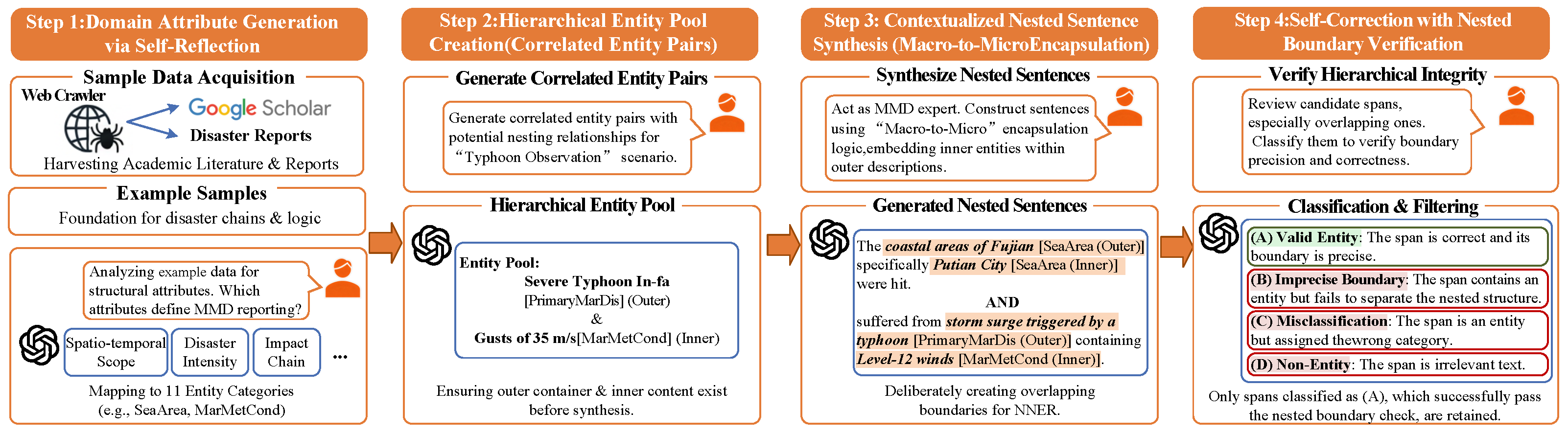
- We construct and validate MMD-NER, the first specialized nested NER dataset for marine meteorological disaster texts. Built through a four-step LLM-assisted pipeline, MMD-NER contains 11 domain-specific entity types, 1899 sentences, 17,017 entities, and 2978 nested entity pairs. Its annotation quality is further examined through human-gold validation, error analysis, and LLM-backbone comparison.
- (2)
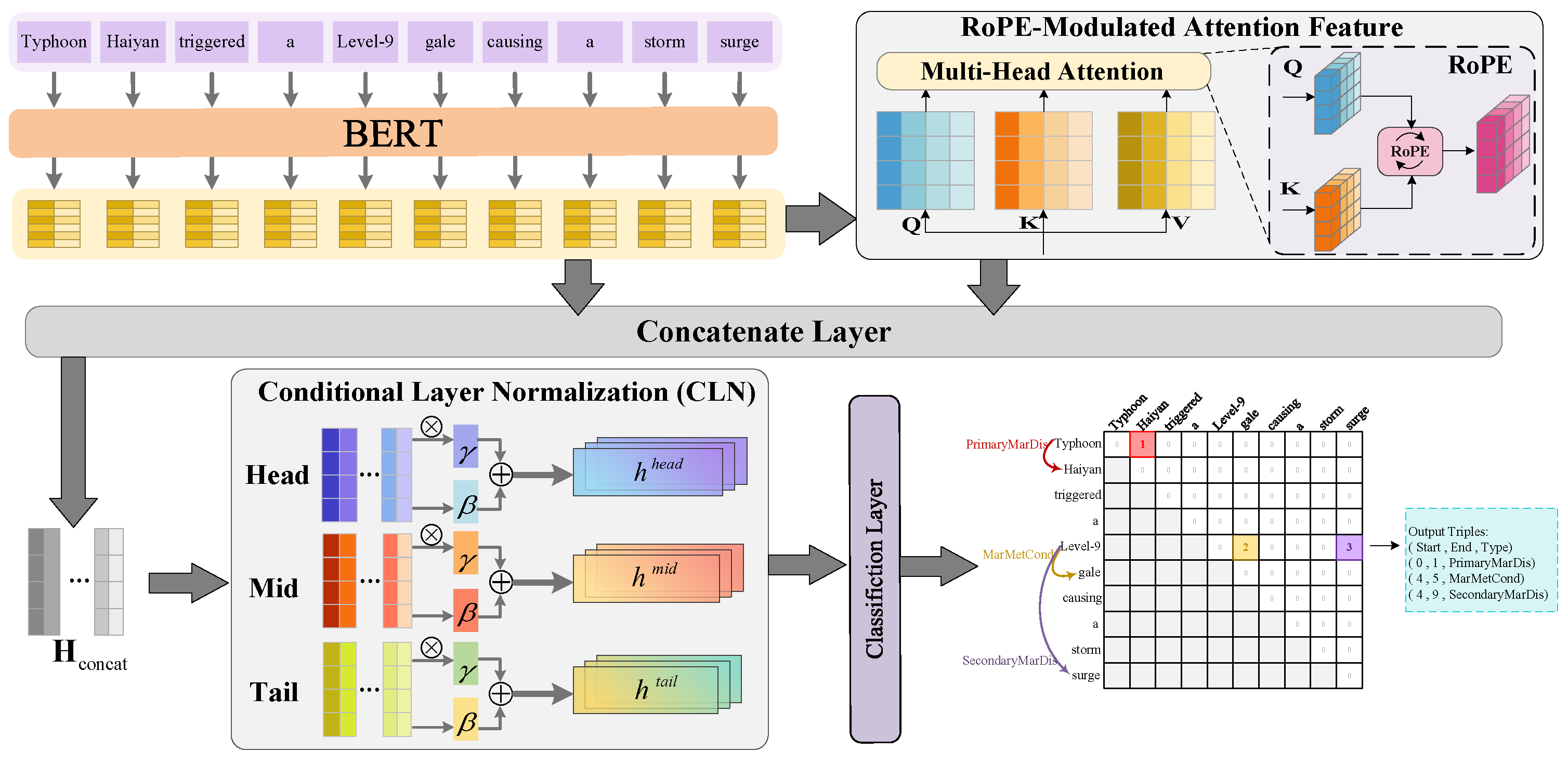
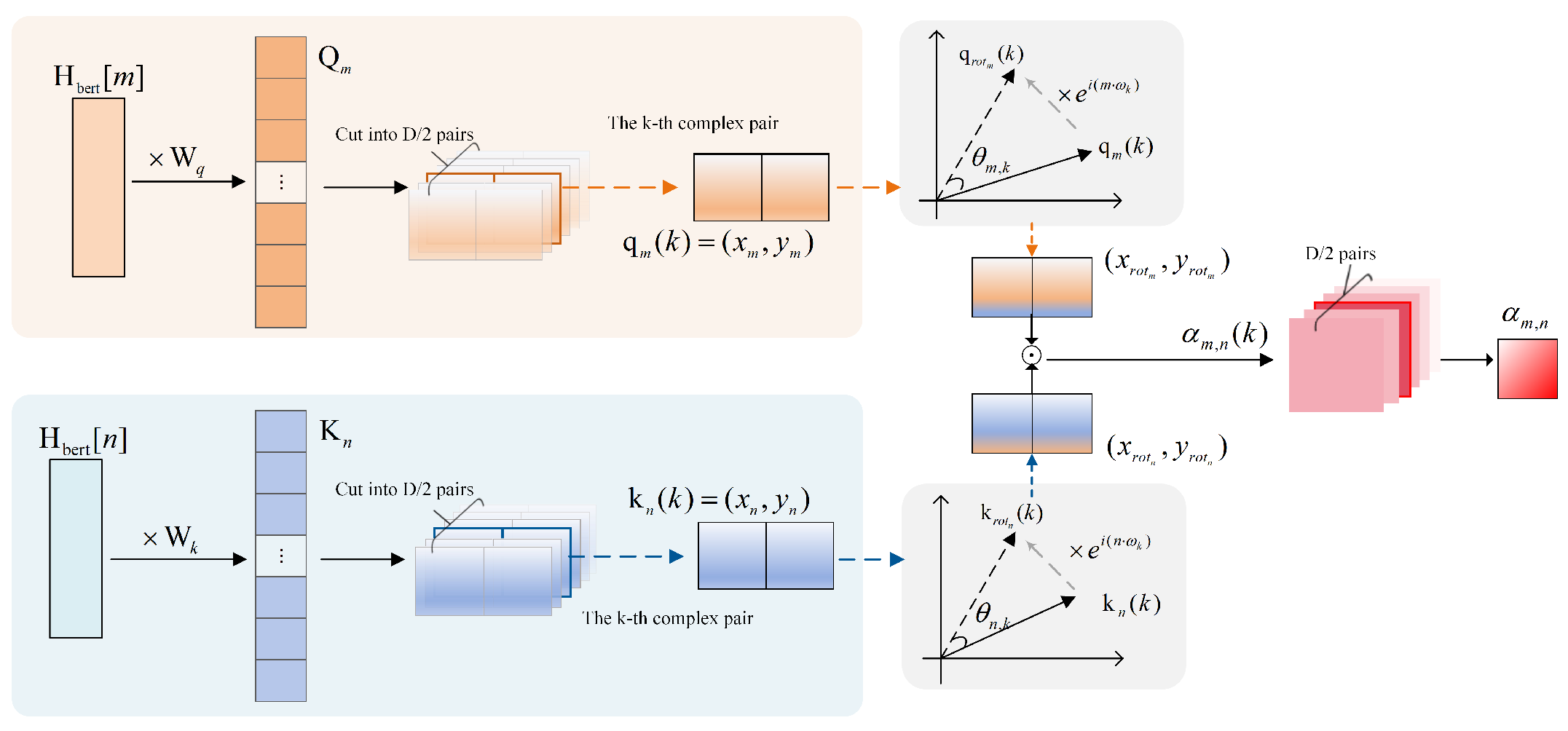
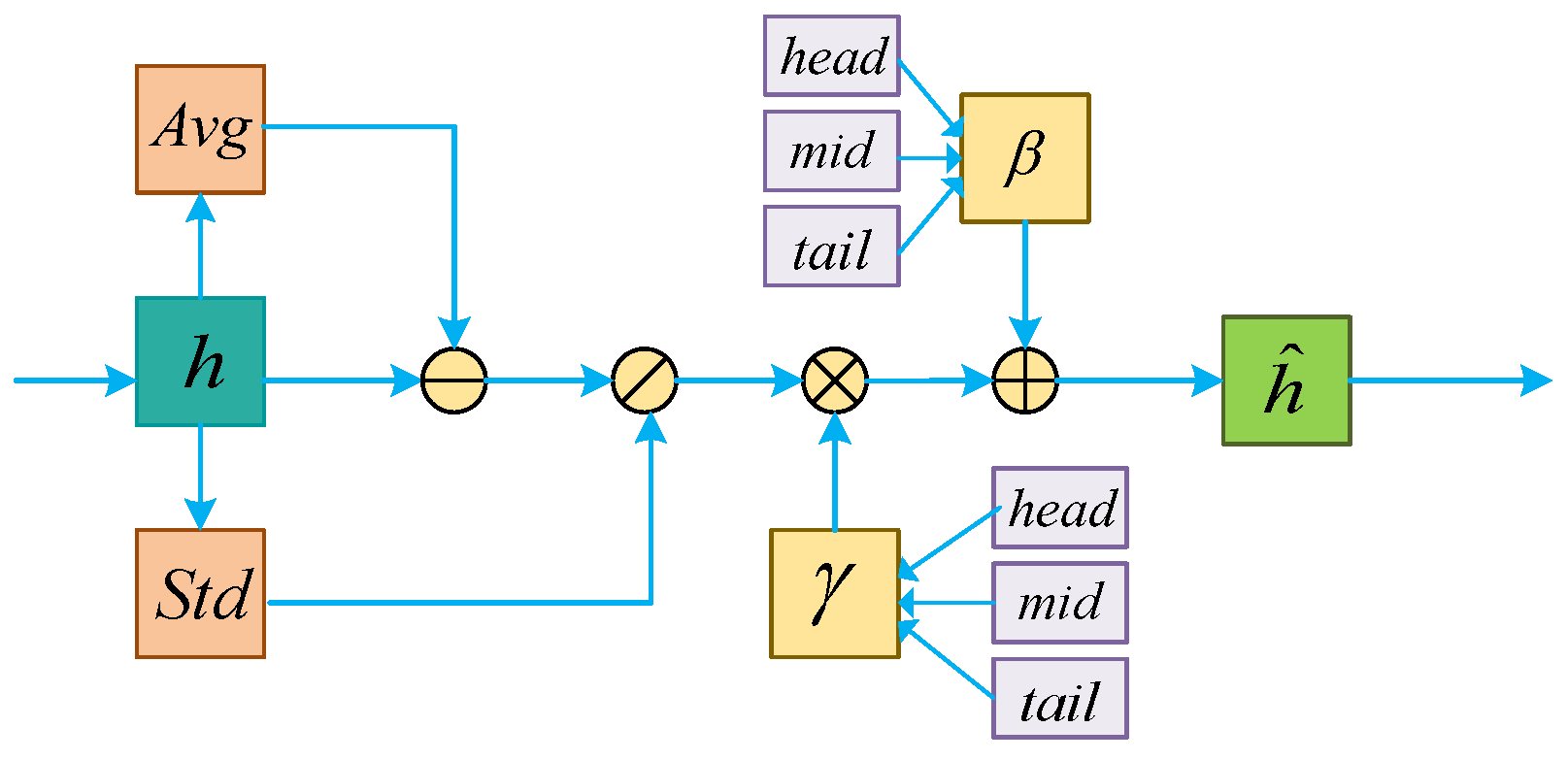
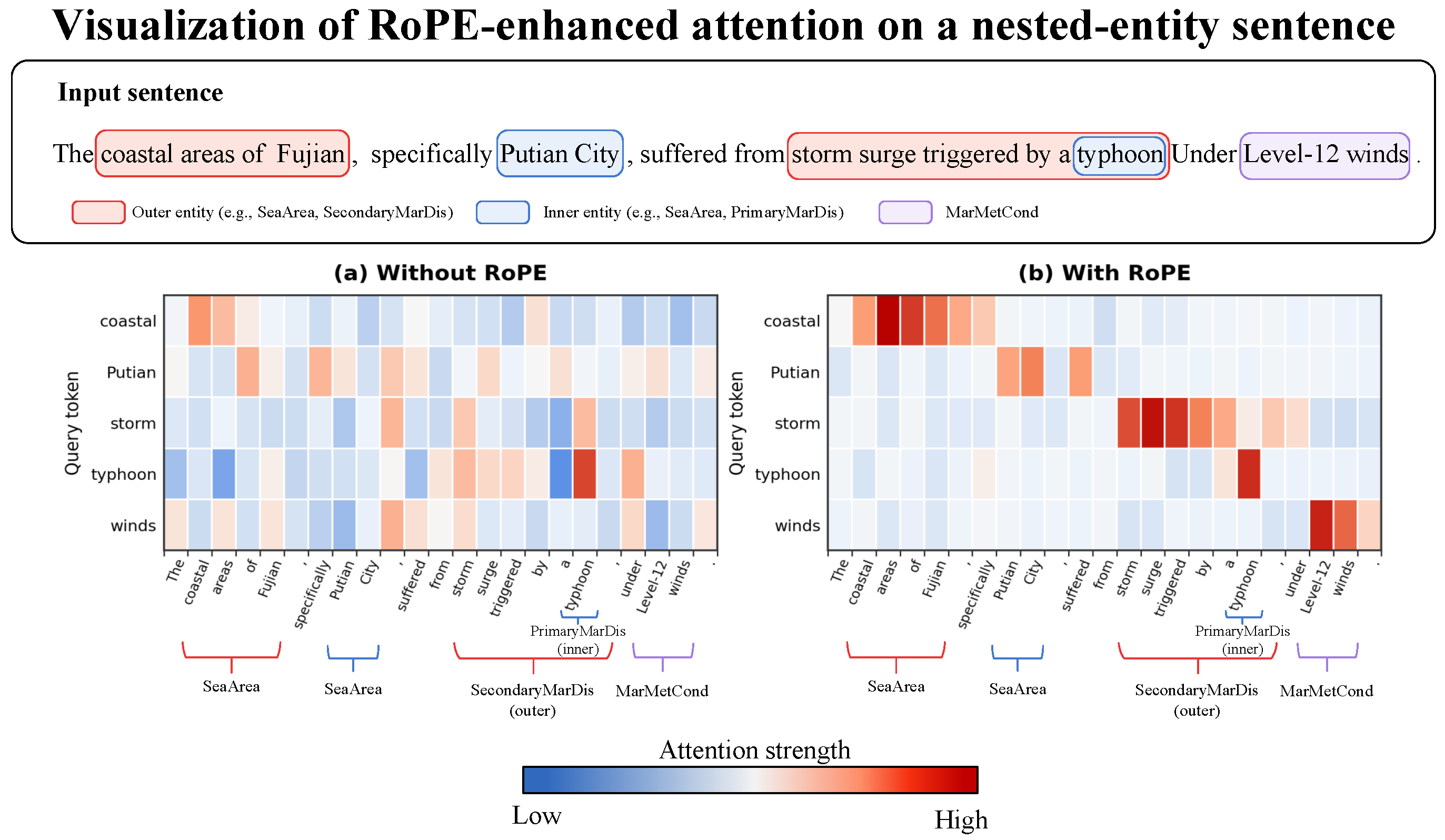
- We propose PRSpan, a position-role-aware span classification framework for nested entity recognition. By combining RoPE-enhanced attention, CLN-generated Head/Mid/Tail role features, and Positional Role Pooling, PRSpan captures both boundary-sensitive positional dependencies and span-internal semantic coherence.
- (3)
- We perform comprehensive evaluations on MMD-NER and related disaster-domain data. Beyond overall comparisons with representative baselines, we conduct fine-grained structural analysis, extended ablation studies, cross-domain transfer evaluation, LLM prompting comparison, and qualitative error analysis, demonstrating PRSpan’s effectiveness, robustness, and applicability.
2. Related Work
2.1. General Nested Named Entity Recognition Methods
2.2. Named Entity Recognition Methods in the Marine Meteorological Disaster Domain
2.3. Prompting Large Language Models for NER and Synthetic NER Data Generation
3. Problem Description of Named Entity Recognition in the Marine Meteorological Disaster Domain
3.1. Named Entity Category Definition
3.2. Formal Task Definition
4. Methods
4.1. Initial Encoding Integrating RoPE Attention
4.2. Span Encoding with Positional Role Dependence
4.3. Span Generation and Recognition Based on Positional Role Pooling
5. Experiments
5.1. MMD-NER Dataset Construction and Validation
5.1.1. Four-Step LLM-Assisted Dataset Construction
- (A)
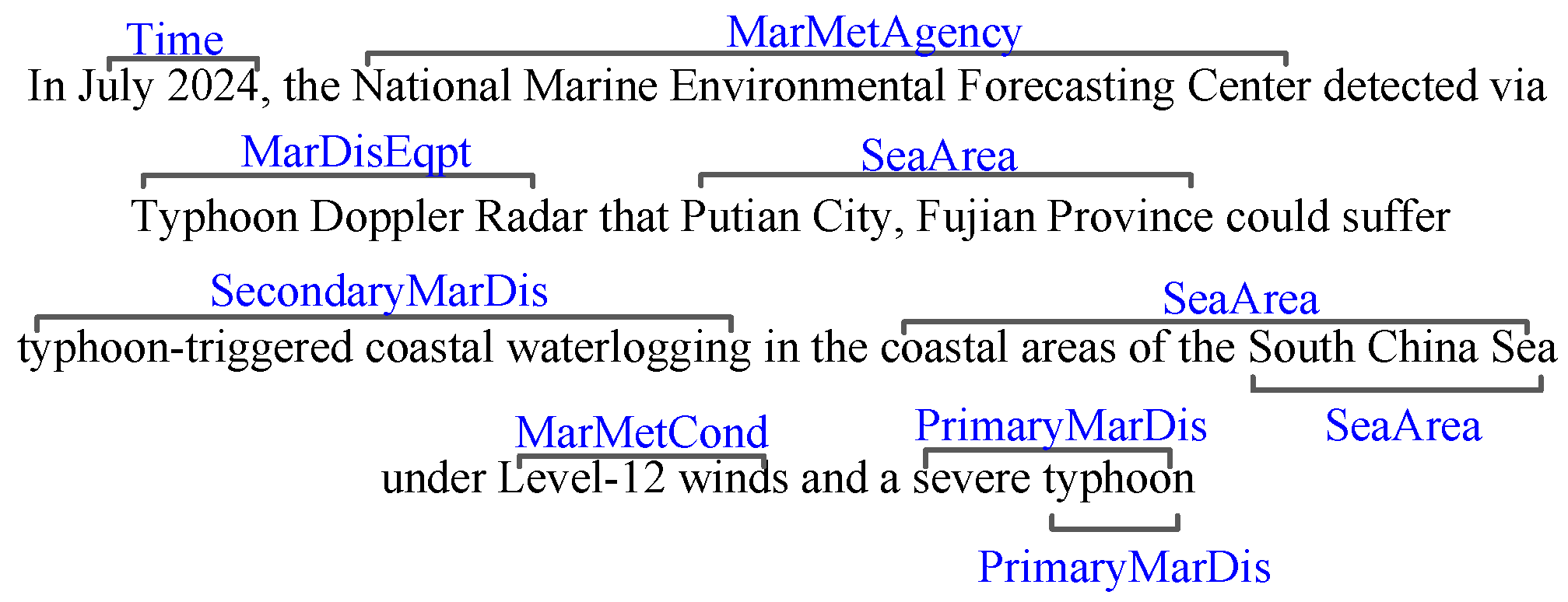
- Valid Entity: The span is correct with precise boundaries (e.g., correctly identifying the inner “Level-12 wind” as distinct from the outer “Typhoon”).
- (B)
- Imprecise Boundary: The span contains an entity but fails to separate the nested structure (e.g., merging the inner attribute with the outer event into a single long span).
- (C)
- Misclassification: The span is a valid entity but assigned an incorrect category.
- (D)
- Non-Entity: The span is irrelevant text.
5.1.2. Human Validation of Generated Annotations
5.1.3. LLM-Backbone Analysis for Data Generation
5.2. Experimental Settings and Baselines
- Sequence Labeling Models: BERT-CRF [34], BiLSTM-CRF [35], and BERT-BiGRU-Att-CRF [2] treat NER as a sequence labeling task. BERT-BiGRU-Att-CRF extends standard CRF-based tagging by incorporating BiGRU and attention modules, but it still follows the token-level labeling paradigm. Therefore, these models are less suitable for nested NER, where a token may participate in multiple overlapping entity spans.
- Hierarchical Structure Models: Pyramid [16] is designed specifically for nested entities, employing a bidirectional pyramid interaction structure that parses nested relationships through stacked hierarchical layers.
- Span Classification Models: Global Pointer [15] and Biaffine [18] directly score all possible entity spans in the input sequence by modeling associations between start and end positions. Our proposed PRSpan belongs to this category, which represents one of the most effective paradigms for processing nested entities, allowing direct comparison to reveal the specific gains contributed by our RoPE-enhanced attention, CLN, and Positional Role Pooling components.
5.3. Overall and Category-Level Performance
5.3.1. Main Results Under Micro-Average and Macro-Average
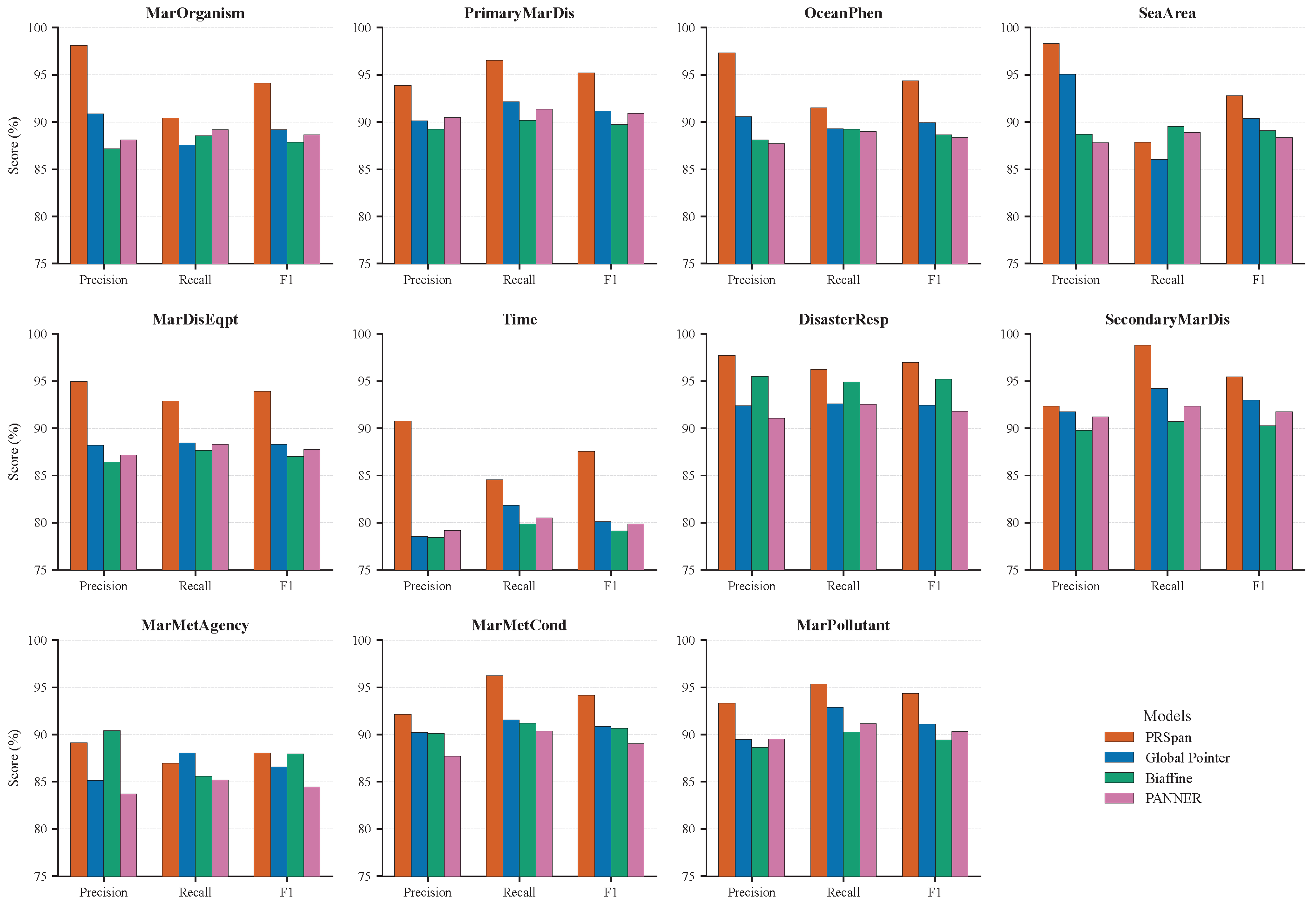
5.3.2. Category-Level Analysis
5.4. Ablation Analysis
5.4.1. RoPE Attention Visualization
5.4.2. Extended Ablation on CLN and Positional Role Pooling
5.4.3. Practical Case Study of CLN Role Features
5.5. Fine-Grained Analysis of Nested Structures
5.6. Cross-Domain Transfer Evaluation
5.7. Comparison with LLM Prompting Baselines
5.8. Qualitative Error Analysis
6. Discussion
6.1. Robustness-Related Findings
6.2. Practical Deployment Considerations
6.3. Ethical Considerations and Risk Mitigation
6.4. Limitations and Future Work
7. Conclusions
Author Contributions
Funding
Data Availability Statement
Conflicts of Interest
References
- Holloway, S.W. Named Entity Recognition in the Climate Change Domain: An Examination of NER Systems for Climatological Knowledge Discovery. Master’s Thesis, Norwegian University of Science and Technology (NTNU), Trondheim, Norway, 2015. [Google Scholar]
- Zhao, D.F.; Chen, X.L.; Chen, Y. Named Entity Recognition for Chinese Texts on Marine Coral Reef Ecosystems Based on the BERT-BiGRU-Att-CRF Model. Appl. Sci. 2024, 14, 5743. [Google Scholar] [CrossRef]
- Miwa, M.; Bansal, M. End-to-End Relation Extraction using LSTMs on Sequences and Tree Structures. In Proceedings of the 54th Annual Meeting of the Association for Computational Linguistics, Volume 1: Long Papers, Berlin, Germany, 7–12 August 2016; Association for Computational Linguistics: Stroudsburg, PA, USA, 2016; pp. 1105–1116. [Google Scholar] [CrossRef]
- Hanifah, A.F.; Kusumaningrum, R. Non-Factoid Answer Selection in Indonesian Science Question Answering System using Long Short-Term Memory (LSTM). Procedia Comput. Sci. 2021, 179, 736–746. [Google Scholar] [CrossRef]
- Bai, T.; Ge, Y.; Guo, S.; Zhang, Z.; Gong, L. Enhanced Natural Language Interface for Web-Based Information Retrieval. IEEE Access 2021, 9, 4233–4241. [Google Scholar] [CrossRef]
- Li, Y.; Luo, L.; Zeng, X.; Han, Z. Fine-tuned BERT-BiLSTM-CRF approach for named entity recognition in geological disaster texts. Earth Sci. Inform. 2025, 18, 368. [Google Scholar] [CrossRef]
- Qiu, Q.; Tian, M.; Tao, L.; Xie, Z.; Ma, K. Semantic information extraction and search of mineral exploration data using text mining and deep learning methods. Ore Geol. Rev. 2024, 165, 105863. [Google Scholar] [CrossRef]
- Li, J.; Sun, A.; Han, J.; Li, C. A Survey on Deep Learning for Named Entity Recognition. IEEE Trans. Knowl. Data Eng. 2022, 34, 50–70. [Google Scholar] [CrossRef]
- Guo, X.; Luo, P.; Wang, T.; Wang, W. Chinese Named Entity Recognition Based on Transformer Encoder and BiLSTM. Des. Eng. 2020, 68–80. Available online: https://api.semanticscholar.org/CorpusID:231778912 (accessed on 28 May 2026).
- Yan, R.; Jiang, X.; Dang, D. Named Entity Recognition by Using XLNet-BiLSTM-CRF. Neural Process. Lett. 2021, 53, 3339–3356. [Google Scholar] [CrossRef]
- Chang, J.; Han, X. Multi-level context features extraction for named entity recognition. Comput. Speech Lang. 2023, 77, 101412. [Google Scholar] [CrossRef]
- Wang, Y.; Tong, H.H.; Zhu, Z.Y.; Li, Y. Nested Named Entity Recognition: A Survey. ACM Trans. Knowl. Discov. Data 2022, 16, 108. [Google Scholar] [CrossRef]
- Eberts, M.; Ulges, A. Span-based joint entity and relation extraction with transformer pre-training. In Proceedings of the European Conference on Artificial Intelligence (ECAI 2020); International Committee on Computational Linguistics: Stroudsburg, PA, USA, 2020. [Google Scholar] [CrossRef]
- Shen, Y.L.; Ma, X.Y.; Tan, Z.; Zhang, S.; Wang, W.; Lu, W.M. Locate and Label: A Two-stage Identifier for Nested Named Entity Recognition. In Proceedings of the 59th Annual Meeting of the Association for Computational Linguistics and the 11th International Joint Conference on Natural Language Processing, Volume 1: Long Papers, Online, 1–6 August 2021; International Committee on Computational Linguistics: Stroudsburg, PA, USA, 2021; pp. 2782–2794. [Google Scholar] [CrossRef]
- Su, J.L.; Murtadha, A.; Pan, S.F.; Hou, J.; Sun, J.; Huang, W.W.; Wen, B.; Liu, Y.F. Global Pointer: Novel Efficient Span-based Approach for Named Entity Recognition. arXiv 2022, arXiv:2208.03054. [Google Scholar] [CrossRef]
- Wang, J.; Shou, L.D.; Chen, K.; Chen, G. Pyramid: A Layered Model for Nested Named Entity Recognition. In Proceedings of the 58th Annual Meeting of the Association for Computational Linguistics, Online, 5–10 July 2020; International Committee on Computational Linguistics: Stroudsburg, PA, USA, 2020; pp. 5918–5928. [Google Scholar] [CrossRef]
- Rojas, M.; Robaldo, L.; Soto, X.; Muñoz, R. Simple yet powerful: An overlooked architecture for nested named entity recognition. In Proceedings of the 29th International Conference on Computational Linguistics, Gyeongju, Republic of Korea, 12–17 October 2022; International Committee on Computational Linguistics: Stroudsburg, PA, USA, 2022; pp. 5248–5260. Available online: https://aclanthology.org/2022.coling-1.184/ (accessed on 28 May 2026).
- Yu, J.T.; Bohnet, B.; Poesio, M. Named Entity Recognition as Dependency Parsing. In Proceedings of the 58th Annual Meeting of the Association for Computational Linguistics, Online, 5–10 July 2020; International Committee on Computational Linguistics: Stroudsburg, PA, USA, 2020; pp. 6470–6476. [Google Scholar] [CrossRef]
- Luo, Y.; Zhao, H. Bipartite Flat-Graph Network for Nested Named Entity Recognition. In Proceedings of the 58th Annual Meeting of the Association for Computational Linguistics, Online, 5–10 July 2020; International Committee on Computational Linguistics: Stroudsburg, PA, USA, 2020; pp. 6408–6418. [Google Scholar] [CrossRef]
- Wan, J.; Ru, D.; Zhang, W.; Yu, Y. Nested named entity recognition with span-level graphs. In Proceedings of the 60th Annual Meeting of the Association for Computational Linguistics, Volume 1: Long Papers, Dublin, Ireland, 22–27 May 2022; International Committee on Computational Linguistics: Stroudsburg, PA, USA, 2022; pp. 892–903. [Google Scholar] [CrossRef]
- Yang, S.; Tu, K. Bottom-up constituency parsing and nested named entity recognition with pointer networks. In Proceedings of the 60th Annual Meeting of the Association for Computational Linguistics, Volume 1: Long Papers, Dublin, Ireland, 22–27 May 2022; International Committee on Computational Linguistics: Stroudsburg, PA, USA, 2022; pp. 1763–1774. [Google Scholar] [CrossRef]
- Lou, C.; Yang, S.; Tu, K. Nested named entity recognition as latent lexicalized constituency parsing. In Proceedings of the 60th Annual Meeting of the Association for Computational Linguistics, Volume 1: Long Papers, Dublin, Ireland, 22–27 May 2022; International Committee on Computational Linguistics: Stroudsburg, PA, USA, 2022; pp. 6183–6198. [Google Scholar] [CrossRef]
- Qiu, Q.; Xie, Z.; Wu, L.; Tao, L. Automatic spatiotemporal and semantic information extraction from unstructured geoscience reports using text mining techniques. Earth Sci. Inform. 2020, 13, 1393–1410. [Google Scholar] [CrossRef]
- Lv, X.; Xie, Z.; Wu, L.; Tao, L.; Qiu, Q. Chinese named entity recognition in the geoscience domain based on BERT. Earth Space Sci. 2022, 9, e2021EA002166. [Google Scholar] [CrossRef]
- Sun, J.; Liu, Y.; Cui, J.; He, H. Deep learning-based methods for natural hazard named entity recognition. Sci. Rep. 2022, 12, 4598. [Google Scholar] [CrossRef] [PubMed]
- Shen, Y.; Tan, Z.; Wu, S.; Zhang, W.; Zhang, R.; Xi, Y.; Lu, W.; Zhuang, Y. PromptNER: Prompt locating and typing for named entity recognition. In Proceedings of the 61st Annual Meeting of the Association for Computational Linguistics, Volume 1: Long Papers, Toronto, ON, Canada, 9–14 July 2023; International Committee on Computational Linguistics: Stroudsburg, PA, USA, 2023; pp. 12492–12507. Available online: https://aclanthology.org/2023.acl-long.698/ (accessed on 28 May 2026).
- Zhang, R.; Li, Y.; Ma, Y.; Zhou, M.; Zou, L. LLMaAA: Making large language models as active annotators. In Findings of the Association for Computational Linguistics: EMNLP 2023, Singapore, 6–10 December 2023; International Committee on Computational Linguistics: Stroudsburg, PA, USA, 2023; pp. 13088–13103. [Google Scholar] [CrossRef]
- Santoso, J.; Sutanto, P.; Cahyadi, B.; Setiawan, E. Pushing the limits of low-resource NER using LLM artificial data generation. In Findings of the Association for Computational Linguistics: ACL 2024, Bangkok, Thailand, 11–16 August 2024; International Committee on Computational Linguistics: Stroudsburg, PA, USA, 2024; pp. 9652–9667. [Google Scholar] [CrossRef]
- Kamath, G.; Vajjala, S. Does synthetic data help named entity recognition for low-resource languages? In Proceedings of the 14th International Joint Conference on Natural Language Processing and the 4th Conference of the Asia-Pacific Chapter of the Association for Computational Linguistics, Mumbai, India, 20–24 December 2025; International Committee on Computational Linguistics: Stroudsburg, PA, USA, 2025; pp. 159–167. Available online: https://aclanthology.org/2025.ijcnlp-short.15/ (accessed on 28 May 2026).
- Zhao, D.; Mu, W.; Jia, X.; Liu, S.; Chu, Y.; Meng, J.; Lin, H. Few-shot biomedical NER empowered by LLMs-assisted data augmentation and multi-scale feature extraction. BioData Min. 2025, 18, 28. [Google Scholar] [CrossRef] [PubMed]
- Huang, Y.; Xia, Y.; Tao, R.; Jiao, D.; Min, X.; Zheng, J.; Jiang, Y.; Wu, W.; Du, P. A LLM-based agent for the construction of typhoon knowledge graphs. Environ. Model. Softw. 2026, 197, 106856. [Google Scholar] [CrossRef]
- Su, J.L.; Ahmed, M.; Lu, Y.; Pan, S.; Bo, W.; Liu, Y. RoFormer: Enhanced transformer with Rotary Position Embedding. Neurocomputing 2024, 568, 127063. [Google Scholar] [CrossRef]
- Zhang, Z.H.; Li, X.Q.; Li, Y.X.; Dong, Y.J.; Wang, D.; Xiong, S.W. Neural Noise Embedding for End-To-End Speech Enhancement with Conditional Layer Normalization. In Proceedings of ICASSP 2021–2021 IEEE International Conference on Acoustics, Speech and Signal Processing; IEEE: New York, NY, USA, 2021; pp. 7113–7117. [Google Scholar] [CrossRef]
- Hu, S.; Zhang, H.; Hu, X.; Du, J. Chinese Named Entity Recognition based on BERT-CRF Model. In Proceedings of the 2022 IEEE/ACIS 22nd International Conference on Computer and Information Science (ICIS), Zhuhai, China, 26–28 June 2022; IEEE: New York, NY, USA, 2022; pp. 105–108. [Google Scholar] [CrossRef]
- Lample, G.; Ballesteros, M.; Subramanian, S.; Kawakami, K.; Dyer, C. Neural Architectures for Named Entity Recognition. In Proceedings of the 2016 Conference of the North American Chapter of the Association for Computational Linguistics: Human Language Technologies, San Diego, CA, USA, 12–17 June 2016; International Committee on Computational Linguistics: Stroudsburg, PA, USA, 2016; pp. 260–270. [Google Scholar] [CrossRef]
- Zhou, L.; Li, J.M.; Gu, Z.Q.; Qiu, J.; Gupta, B.B.; Tian, Z.H. PANNER: POS-Aware Nested Named Entity Recognition Through Heterogeneous Graph Neural Network. IEEE Trans. Comput. Soc. Syst. 2024, 11, 4718–4726. [Google Scholar] [CrossRef]
- Hafsa, N.E.; Alzoubi, H.M.; Almutlq, A.S. Accurate disaster entity recognition based on contextual embeddings in self-attentive BiLSTM-CRF. PLoS ONE 2025, 20, e0318262. [Google Scholar] [CrossRef]



| Entity Category | Category Meaning | Domain Examples |
|---|---|---|
| Time | Related time | 10 July 2024 |
| SeaArea | Coverage area | Northern waters of the South China Sea; waters of the Yangtze River Estuary |
| OceanPhen | Marine natural phenomena | El Niño phenomenon; red tide outbreak |
| MarMetCond | Meteorological element | Level-12 wind speed; sea fog visibility |
| MarPollutant | Ecological pollutants | Red tide toxins; oil spill contaminants |
| MarMetAgency | Professional institutions | National Marine Environmental Forecasting Center (NMEFC) |
| MarOrganism | Biological population | Coral reef community |
| DisasterResp | Professionals | Maritime search and rescue personnel |
| MarDisEqpt | Technical equipment | Doppler radar; breakwater |
| PrimaryMarDis | Source disaster | Typhoon; South China Sea storm surge |
| SecondaryMarDis | Derived chain disasters | Coastal waterlogging triggered by typhoon |
| Train | Dev | Test | |
|---|---|---|---|
| Sentence | 1323 | 385 | 191 |
| Number of Words | 28,091 | 8913 | 4331 |
| Number of entities | 11,872 | 3389 | 1756 |
| Entity Category | Quantity of Entities |
|---|---|
| MarOrganism | 171 |
| PrimaryMarDis | 4161 |
| OceanPhen | 1778 |
| SeaArea | 2835 |
| MarDisEqpt | 823 |
| Time | 89 |
| DisasterResp | 371 |
| SecondaryMarDis | 3622 |
| MarMetAgency | 393 |
| MarMetCond | 1712 |
| MarPollutant | 1062 |
| Validation Aspect | Metric | Value |
|---|---|---|
| Sampled sentences | 200 | |
| Pipeline-generated entities | 1842 | |
| Validation subset | Human-gold entities | 1796 |
| Pipeline-generated nested pairs | 326 | |
| Human-gold nested pairs | 309 | |
| Boundary agreement F1 | 94.86% | |
| Inter-annotator agreement | Type-aware agreement F1 | 92.73% |
| Nested-pair agreement F1 | 90.41% | |
| Boundary-only F1 | 93.02% | |
| Pipeline vs. human gold | Type-aware strict F1 | 90.01% |
| Nested-pair F1 | 86.54% |
| Error Type | Description | Percentage |
|---|---|---|
| Boundary over-extension | The generated span is longer than the expert boundary | 24.03% |
| Type confusion | The entity boundary is correct or partially correct, but the type is wrong | 22.48% |
| Boundary under-extension | The generated span misses part of the expert boundary | 18.60% |
| Missing inner entity | The inner entity in a nested structure is omitted | 11.63% |
| Missing outer entity | The enclosing outer entity is omitted | 9.30% |
| Spurious entity | Non-entity text is incorrectly labeled as an entity | 8.53% |
| Invalid nesting relation | The generated inner–outer relation is inconsistent with expert judgment | 5.43% |
| Error Type | Sentence Fragment | Pipeline-Generated Annotation | Human-Gold Annotation | Explanation |
|---|---|---|---|---|
| Boundary over-extension | persistent sea fog reduced visibility to less than 200 m near the Zhoushan fishing grounds | “persistent sea fog reduced visibility to less than 200 m” → MarMetCond | “persistent sea fog” → OceanPhen; “visibility to less than 200 m” → MarMetCond; “Zhoushan fishing grounds” → SeaArea | The pipeline incorrectly merged an ocean phenomenon and its meteorological condition into one over-extended condition span. |
| Boundary under-extension | coastal waterlogging triggered by severe typhoon In-fa | “coastal waterlogging” → SecondaryMarDis | “coastal waterlogging triggered by severe typhoon In-fa” → SecondaryMarDis; “severe typhoon In-fa” → PrimaryMarDis | The outer disaster-chain expression was truncated and the causal trigger was not included. |
| Type confusion | abnormal sea surface temperature in the South China Sea | “abnormal sea surface temperature” → OceanPhen | “abnormal sea surface temperature” → MarMetCond | The pipeline confused a meteorological/oceanographic condition with a marine phenomenon. |
| Missing inner entity | storm surge caused by Typhoon Doksuri | “storm surge caused by Typhoon Doksuri” → SecondaryMarDis | “storm surge caused by Typhoon Doksuri” → SecondaryMarDis; “Typhoon Doksuri” → PrimaryMarDis | The outer entity was identified, but the inner source-disaster entity was omitted. |
| Missing outer entity | red tide toxins released during a red tide outbreak | “red tide toxins” → MarPollutant; “red tide outbreak” → OceanPhen | “red tide toxins released during a red tide outbreak” → OceanPhen; “red tide toxins” → MarPollutant | The pipeline identified inner entities but failed to annotate the enclosing phenomenon-level span. |
| Spurious entity | emergency coordination was strengthened along the coast | “emergency coordination” → DisasterResp | None | The phrase describes an action rather than a disaster-response personnel entity. |
| Invalid nesting relation | floating oil contaminants drifted eastward near the Beibu Gulf after the cold wave | “Beibu Gulf” → SeaArea nested inside “floating oil contaminants” → MarPollutant | “floating oil contaminants” → MarPollutant; “Beibu Gulf” → SeaArea; “cold wave” → PrimaryMarDis | The pipeline incorrectly constructed a nesting relation between pollutant and sea area, although the two mentions are separate entities without span containment. |
| Seed | Field | Content |
|---|---|---|
| Seed 1 | Scenario seed | Typhoon-induced coastal hazard |
| Target domain | Marine meteorological disaster | |
| Expected semantic dimensions | Disaster event; meteorological condition; sea area; impact chain | |
| Target complexity | At least one nested entity pair | |
| Suggested nesting difficulty | Medium | |
| Constraint | Do not predefine entity spans or entity labels; the LLM must generate attributes, entity pool, nested sentence, and verified annotations through the four-step pipeline. | |
| Seed 2 | Scenario seed | Red tide ecological impact |
| Target domain | Marine ecological disaster | |
| Expected semantic dimensions | Ocean phenomenon; pollutant; marine organism; affected sea area | |
| Target complexity | At least one nested entity pair | |
| Suggested nesting difficulty | Medium | |
| Constraint | Do not predefine entity spans or entity labels; the LLM must generate attributes, entity pool, nested sentence, and verified annotations through the four-step pipeline. |
| LLM | Valid Sample Rate | Requirement Satisfaction | Nesting Validity | Boundary Agreement F1 | Type-Aware Agreement F1 | Nested-Pair Agreement F1 |
|---|---|---|---|---|---|---|
| GPT-4o mini | 90.00% | 88.00% | 86.00% | 92.41% | 89.76% | 85.31% |
| Qwen2.5-72B-Instruct | 86.00% | 84.00% | 82.00% | 90.47% | 87.32% | 82.68% |
| DeepSeek-V3 | 88.00% | 86.00% | 84.00% | 91.16% | 88.05% | 83.74% |
| Model | Precision (%) | Recall (%) | F1-Score (%) |
|---|---|---|---|
| BERT-CRF | 55.65 | 52.63 | 54.06 |
| BiLSTM-CRF | 57.44 | 19.64 | 29.28 |
| BERT-BiGRU-Att-CRF | 83.41 | 80.96 | 82.17 |
| Pyramid | 84.70 | 87.70 | 86.20 |
| Global Pointer | 90.52 | 91.42 | 90.97 |
| Biaffine | 89.57 | 89.94 | 89.86 |
| BiFlaG | 87.27 | 85.00 | 86.12 |
| PANNER | 89.17 | 90.46 | 89.87 |
| PRSpan | 93.92 | 95.00 | 94.58 |
| Model | Precision (%) | Recall (%) | F1-Score (%) |
|---|---|---|---|
| BERT-CRF | 56.48 | 48.83 | 48.46 |
| BiLSTM-CRF | 32.81 | 11.36 | 16.17 |
| BERT-BiGRU-Att-CRF | 80.73 | 78.94 | 79.82 |
| Pyramid | 86.19 | 88.99 | 85.86 |
| Global Pointer | 89.13 | 89.95 | 89.54 |
| Biaffine | 88.52 | 89.23 | 88.57 |
| BiFlaG | 86.41 | 86.77 | 86.18 |
| PANNER | 88.05 | 89.73 | 88.16 |
| PRSpan | 94.37 | 92.49 | 93.47 |
| Variant | Span Representation | Precision (%) | Recall (%) | Micro-F1 (%) | Macro-F1 (%) |
|---|---|---|---|---|---|
| w/o CLN | Base (start) + Base (mid) + Base (end) | 93.00 | 92.10 | 92.54 | 91.20 |
| Mid-only CLN | Mid (start) + Mid (mid) + Mid (end) | 92.84 | 92.61 | 92.72 | 91.64 |
| Boundary-only CLN | Head (start) + Base (mid) + Tail (end) | 93.46 | 93.58 | 93.52 | 92.36 |
| Full CLN + AvgPool | AvgPool (Head, Mid, Tail) over span | 93.55 | 93.41 | 93.48 | 92.34 |
| Full CLN + MaxPool | MaxPool (Head, Mid, Tail) over span | 93.42 | 93.25 | 93.33 | 92.18 |
| Full CLN | Head (start) + Mid (mid) + Tail (end) | 93.92 | 95.00 | 94.58 | 93.47 |
| Sentence Fragment | Gold Annotation | Variant | Prediction | Interpretation |
|---|---|---|---|---|
| red tide toxins released during a red tide outbreak | “red tide toxins” → MarPollutant; “red tide outbreak” → OceanPhen; outer nested span → OceanPhen | w/o CLN | Only identifies “red tide outbreak” | The model lacks role-specific span representation and misses the pollutant-related nested structure. |
| Head + Tail | Identifies the outer span but misclassifies it as MarPollutant | Boundary cues are captured, but internal semantic composition is insufficient. | ||
| Mid only | Identifies “toxins released during a red tide” with imprecise boundary | Internal semantics are partially captured, but explicit start/end boundary roles are weakened. | ||
| Full CLN | Correctly identifies both inner entities and the outer nested span | Head and Tail features support boundary localization, while Mid features preserve internal semantic coherence. |
| Nested Structure Type | Definition | Pairs Count | GlobalPointer F1 (%) | PRSpan F1 (%) |
|---|---|---|---|---|
| Strict containment | 121 | 91.28 | 95.21 | |
| Head-nested | 76 | 89.86 | 94.37 | |
| Tail-nested | 67 | 88.97 | 93.82 | |
| Crossing | 34 | 85.62 | 90.94 |
| Nesting Depth | Description | Entity Count | GlobalPointer F1 (%) | PRSpan F1 (%) |
|---|---|---|---|---|
| Depth–1 | Non-nested or single-level entity | 1264 | 91.67 | 95.53 |
| Depth–2 | Entity involved in two-level nesting | 402 | 88.95 | 93.88 |
| Depth ≥ 3 | Entity involved in three or more nested levels | 90 | 84.31 | 90.76 |
| Entity Length | Entity Count | GlobalPointer F1 (%) | PRSpan F1 (%) |
|---|---|---|---|
| 1–2 tokens | 684 | 92.14 | 96.18 |
| 3–5 tokens | 712 | 90.85 | 95.02 |
| 6–10 tokens | 276 | 88.12 | 93.11 |
| >10 tokens | 84 | 83.97 | 89.74 |
| Dataset | Domain | Language | Source | EntitySchema | NestedAnnotations | UsedSamples |
|---|---|---|---|---|---|---|
| MMD-NER | Marine meteorological disasters | English | This study | 11 fine-grained marine disaster-chain entity types | Yes | 1899 sentences |
| Disaster-specific NER | Disaster-related news | English | Hafsa et al. (2025) [37] | 14 crisis-specific entity types | No | 1000 sentences |
| Model/Setting | Precision (%) | Recall (%) | Micro-F1 (%) | Macro-F1 (%) |
|---|---|---|---|---|
| BERT-CRF Target-only | 85.96 | 84.73 | 85.34 | 82.71 |
| GlobalPointer Target-only | 87.18 | 85.94 | 86.55 | 83.96 |
| PRSpan Target-only | 87.86 | 86.72 | 87.29 | 84.61 |
| PRSpan MMD-NER → Disaster-NER | 88.74 | 87.96 | 88.35 | 85.52 |
| Method | Setting | Sample Size | Micro-F1 (%) | Boundary Agreement F1 (%) | Nested-Pair Agreement F1 (%) | Inference Efficiency | Cost-Effectiveness |
|---|---|---|---|---|---|---|---|
| GPT-4o mini | Few-shot prompting | 50 | 78.42 | 82.35 | 70.18 | Low | Medium |
| Qwen3 | Few-shot prompting | 50 | 75.86 | 79.64 | 66.72 | Low | Medium/Low |
| PRSpan | Supervised model | 50 | 94.31 | 96.08 | 91.46 | High | High after training |
| Failure Mode | Sentence Fragment | Gold Annotation | PRSpan Prediction | Analysis |
|---|---|---|---|---|
| Low-frequency temporal expression | from late July to early August, offshore warnings were issued repeatedly | “late July to early August” → Time | Missed Time | Temporal expressions are sparse in MMD-NER and appear in diverse surface forms, making them harder to learn than high-frequency disaster entities. |
| Semantic confusion between related entity types | abnormally high sea surface temperature intensified the algal bloom | “abnormally high sea surface temperature” → MarMetCond; “algal bloom” → OceanPhen | “abnormally high sea surface temperature” → OceanPhen; “algal bloom” → OceanPhen | Both categories describe abnormal marine states, so the model may confuse background conditions with observable ocean phenomena. |
| Incomplete recognition of long outer entity | coastal flooding caused by prolonged storm surge along low-lying islands | “coastal flooding caused by prolonged storm surge” → SecondaryMarDis; “storm surge” → OceanPhen | “coastal flooding” → SecondaryMarDis; “storm surge” → OceanPhen | The inner entity is correctly recognized, but the long outer disaster-chain expression is shortened because the causal modifier increases span complexity. |
| Error in coordinated overlapping structure | strong waves and coastal erosion affected the harbor entrance during the gale | “strong waves” → OceanPhen; “coastal erosion” → SecondaryMarDis; “gale” → MarMetCond | “strong waves and coastal erosion” → OceanPhen; “gale” → MarMetCond | Coordinated expressions are challenging because adjacent entities are semantically related but should not always be merged into one span. |
Disclaimer/Publisher’s Note: The statements, opinions and data contained in all publications are solely those of the individual author(s) and contributor(s) and not of MDPI and/or the editor(s). MDPI and/or the editor(s) disclaim responsibility for any injury to people or property resulting from any ideas, methods, instructions or products referred to in the content. |
© 2026 by the authors. Published by MDPI on behalf of the International Society for Photogrammetry and Remote Sensing. Licensee MDPI, Basel, Switzerland. This article is an open access article distributed under the terms and conditions of the Creative Commons Attribution (CC BY) license.
Share and Cite
Ni, W.; Wang, W.; Xie, N.; Liu, T.; Zeng, Q.; Liu, C. A Refined Span Classification Model for Recognizing Nested Named Entity in Marine Meteorological Disaster Texts. ISPRS Int. J. Geo-Inf. 2026, 15, 258. https://doi.org/10.3390/ijgi15060258
Ni W, Wang W, Xie N, Liu T, Zeng Q, Liu C. A Refined Span Classification Model for Recognizing Nested Named Entity in Marine Meteorological Disaster Texts. ISPRS International Journal of Geo-Information. 2026; 15(6):258. https://doi.org/10.3390/ijgi15060258
Chicago/Turabian StyleNi, Weijian, Wenjing Wang, Nengfu Xie, Tong Liu, Qingtian Zeng, and Cong Liu. 2026. "A Refined Span Classification Model for Recognizing Nested Named Entity in Marine Meteorological Disaster Texts" ISPRS International Journal of Geo-Information 15, no. 6: 258. https://doi.org/10.3390/ijgi15060258
APA StyleNi, W., Wang, W., Xie, N., Liu, T., Zeng, Q., & Liu, C. (2026). A Refined Span Classification Model for Recognizing Nested Named Entity in Marine Meteorological Disaster Texts. ISPRS International Journal of Geo-Information, 15(6), 258. https://doi.org/10.3390/ijgi15060258